Market Minds Advisory
Fiber-Reinforced Plastic Recycling Market

Fiber-Reinforced Plastic Recycling Market: Composite Waste Volume and Recovery Technology Through 2036

Wind turbine blade decommissioning and aerospace composite scrap are forcing a genuinely difficult recycling problem into the open, pushing mechanical and chemical recovery technologies to scale faster than the category's early years suggested was possible.

Lead Analyst

Bilal Shaikh

Published

September 2026

Make Smarter Decisions with Customized Research Insights

Request a free sample report and evaluate market opportunities, growth trends, and competitive dynamics relevant to your business needs.

2025 MARKET VALUE$0.8BMarket Size 2025
2036 FORECAST VALUE$3.1BBase Case , 2026 to 2036
CAGR 2026 TO 203612.5 %Bull 13.8% / Bear 11.2%
INCREMENTAL OPPORTUNITY$2.2BNet 10- year value creation
EXPANSION MULTIPLE3.25x2036 value over 2026 base
Strategic Levers
M&A Pipeline
Regional Outlook
Country Rankings
Competitive Intelligence
Segmental Deep-dive
Call-Us : 91 93563 13602

Executive Snapshot and Market Trajectory

Fiber-reinforced plastic was designed to last decades, which is exactly the problem now that early wind turbine blades and aerospace components are reaching end of life with nowhere established to go beyond landfill in most regions currently operating without dedicated recovery infrastructure.
Veolia and Neocomp continue operating established mechanical recycling and cement kiln co-processing routes, since that infrastructure already exists at meaningful scale across several regions today and requires little additional upfront capital investment. Pyrolysis-based chemical recycling is capturing disproportionate investment attention as it recovers usable carbon fiber rather than merely grinding composite waste into lower-value filler material sold at commodity prices.
Vartega and Carbon Conversions are investing in dedicated carbon fiber recovery facilities, betting that recovered fiber pricing will remain attractive enough relative to virgin fiber to sustain long-term demand across aerospace and industrial applications worldwide over time. Processors without proven fiber recovery technology increasingly find themselves confined to lower-value glass fiber filler applications rather than premium recovered carbon fiber markets.
Market Definition
The fiber-reinforced plastic recycling market covers mechanical recycling and grinding, pyrolysis-based chemical recycling, solvolysis chemical recycling, cement kiln co-processing, incineration with energy recovery, and recovered fiber resale services for end-of-life glass and carbon fiber-reinforced plastic waste. It excludes virgin fiber production and finished composite manufacturing sold as separate market categories.
Base Year Value
$0.8B in 2025 (MMA Primary Research Dataset, August 2026)
Forecast Period
2026 to 2036, eleven discrete annual values
CAGR
12.5% base case. Bull 13.8%. Bear 11.2%.
Fastest Growth Segment
Pyrolysis-Based Chemical Recycling: 16.5% CAGR
Fastest Growth Country
Germany: 14.0% CAGR
Fastest Growth Region
Largest Region
Market Leaders
Veolia, Neocomp, Vartega, Carbon Conversions, ELG Carbon Fibre. Source: MMA Analysis based on company annual reports.
Primary Survey
n=3,800 procurement and R&D decision-makers, Q4 2025, six countries
Methodology
Demand-side build-up, cross-validated against public data, 47 expert interviews

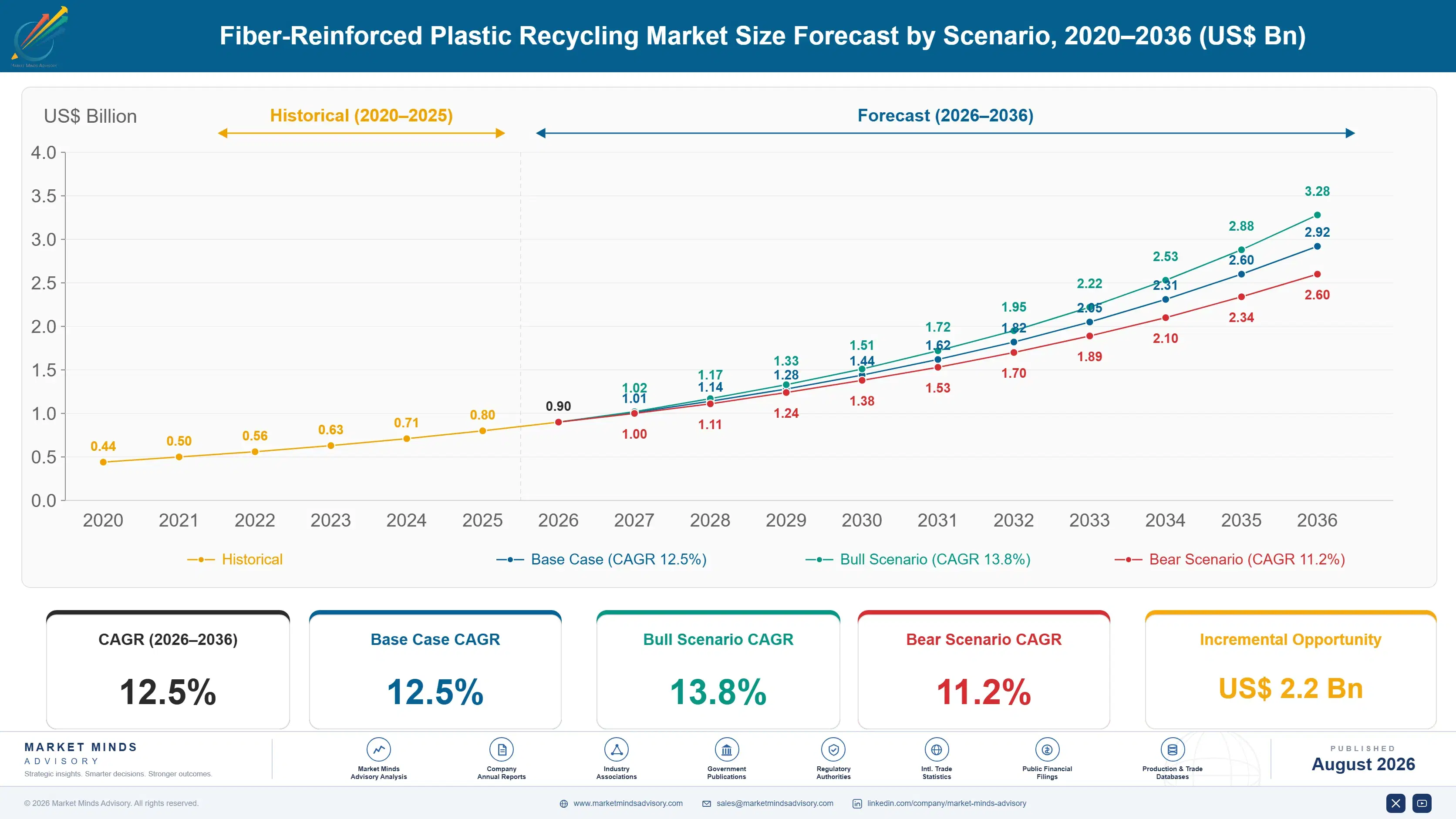
Fiber-Reinforced Plastic Recycling Market Forecast Scenarios

fiber-reinforced-plastic-recycling-market-size-forecast-scenario-1787550408292
Between 2020 and 2025 the market grew at roughly 10.0 percent a year, as early wind turbine blade decommissioning volume began arriving in meaningful quantity and several European governments introduced landfill restrictions specifically targeting composite waste disposal across their domestic markets during that entire stretch of recent years and well beyond it too, into today.
The base case assumes 12.5 percent annual growth to 2036, built on three mechanisms: rising wind turbine blade decommissioning volume as the first generation of large-scale installations reaches end of life, aerospace composite scrap growing alongside increased commercial aircraft production and retirement cycles, and pyrolysis-based chemical recycling scaling capacity as recovered carbon fiber pricing becomes increasingly competitive with virgin fiber for non-critical applications across multiple industries and end uses worldwide.
A bull case near 13.8 percent depends on landfill restrictions expanding faster than currently planned across additional markets beyond Europe and into entirely new regions worldwide over time. The bear case near 11.2 percent assumes recovered fiber quality and pricing fail to reach parity with virgin fiber fast enough to sustain demand beyond mandated disposal volume.

A Waste Problem Becoming a Recovery Business

Fiber-reinforced plastic recycling covers two chemically distinct waste streams that happen to share a disposal problem: glass fiber composites from boats and construction, and carbon fiber composites from wind turbine blades and aerospace structures reaching the end of their service life. The processing economics differ sharply, since carbon fiber recovery can justify far more expensive processing given the resulting material's much higher resale value in downstream markets.
MARKET CONCENTRATIONCR5 38%Fragmented base remains with many regional specialty processors
AVERAGE SELLING PRICE$1,850 per tonneRecovered carbon fiber commands far more than glass fiber
TOP PRODUCING COUNTRY SHAREGermany 24%Largest base tied to early landfill restriction policy
CAPACITY UTILIZATION64%Ample room as new pyrolysis capacity comes online
TRADE INTENSITY28% cross-borderRecovered fiber moves across borders to composite buyers
FEEDSTOCK COST SHARE OF COGS22%Energy and processing costs dominate over feedstock itself
Demand for recycling capacity tracks decommissioning volume more than any consumer-facing trend, since wind turbine blades and aircraft components reach end of life on fixed engineering timelines rather than discretionary replacement cycles common elsewhere. Pyrolysis-based chemical recycling is capturing disproportionate investment as it recovers fiber with properties closer to virgin material than mechanical grinding alone can achieve across most application categories.
Processing capacity concentrates in Europe given its early landfill restriction policies and dense wind turbine installation base now reaching decommissioning age across several countries simultaneously and rapidly. Germany holds the largest single-country share given both policy leadership and proximity to major aerospace and wind energy manufacturing clusters built up over the past two decades of industrial investment.
"Nobody built wind turbines thinking about what happens to the blades in twenty years. Now that bill is coming due, and the companies who figured out fiber recovery early are about to look very smart."
Practice Lead, Circular Materials and Composite Recovery · MMA Chemicals and Materials Practice · August 2026

Market Trends

Pyrolysis Recovery Scales Beyond Pilot Facilities

Pyrolysis-based chemical recycling has moved beyond small pilot facilities into commercial-scale plants capable of processing meaningful volumes of end-of-life carbon fiber composite, thermally breaking down resin matrix while preserving usable fiber length and mechanical properties. Vartega and Carbon Conversions have both expanded commercial capacity specifically to serve growing wind turbine blade and aerospace scrap volume that mechanical grinding alone cannot economically justify processing at premium prices. Recovered fiber pricing remains below virgin carbon fiber but has narrowed meaningfully as process yields improve, opening a genuine commercial pathway for non-critical structural applications previously unable to justify recycled material adoption.
Impact : +1.2 PPT to base CAGR

Wind Blade Decommissioning Volume Accelerates Sharply

The first generation of large-scale wind turbine installations from the early 2000s is now reaching the end of typical twenty-year service life, generating decommissioning volume that dwarfs anything the recycling industry has previously handled. This differs meaningfully from earlier composite waste streams, since wind blades are physically massive and require specialized cutting and transport logistics before any recycling process can even begin. Several European countries have introduced landfill bans specifically targeting wind blade disposal, forcing operators toward recycling pathways regardless of relative processing cost compared with historical disposal options.
Impact : +1.2 PPT to base CAGR
3 additional market trends, 0 additional growth drivers, and 0 additional restraints and challenges are covered in the full report. Contact sales@marketmindsadvisory.com to access the complete intelligence.

Segment CAGR and Growth Architecture

Section default visual
Full segment breakdown across 7 segments available in the complete report.

Regional Architecture and Country Demand Map

Regional intelligence for 0 additional markets available in the complete report: . Contact sales@marketmindsadvisory.com.
Section default visual

Where revenue compounds.

Who Controls the Margin Pool

fiber-reinforced-plastic-recycling-market-market-share-analysis-1787550408823

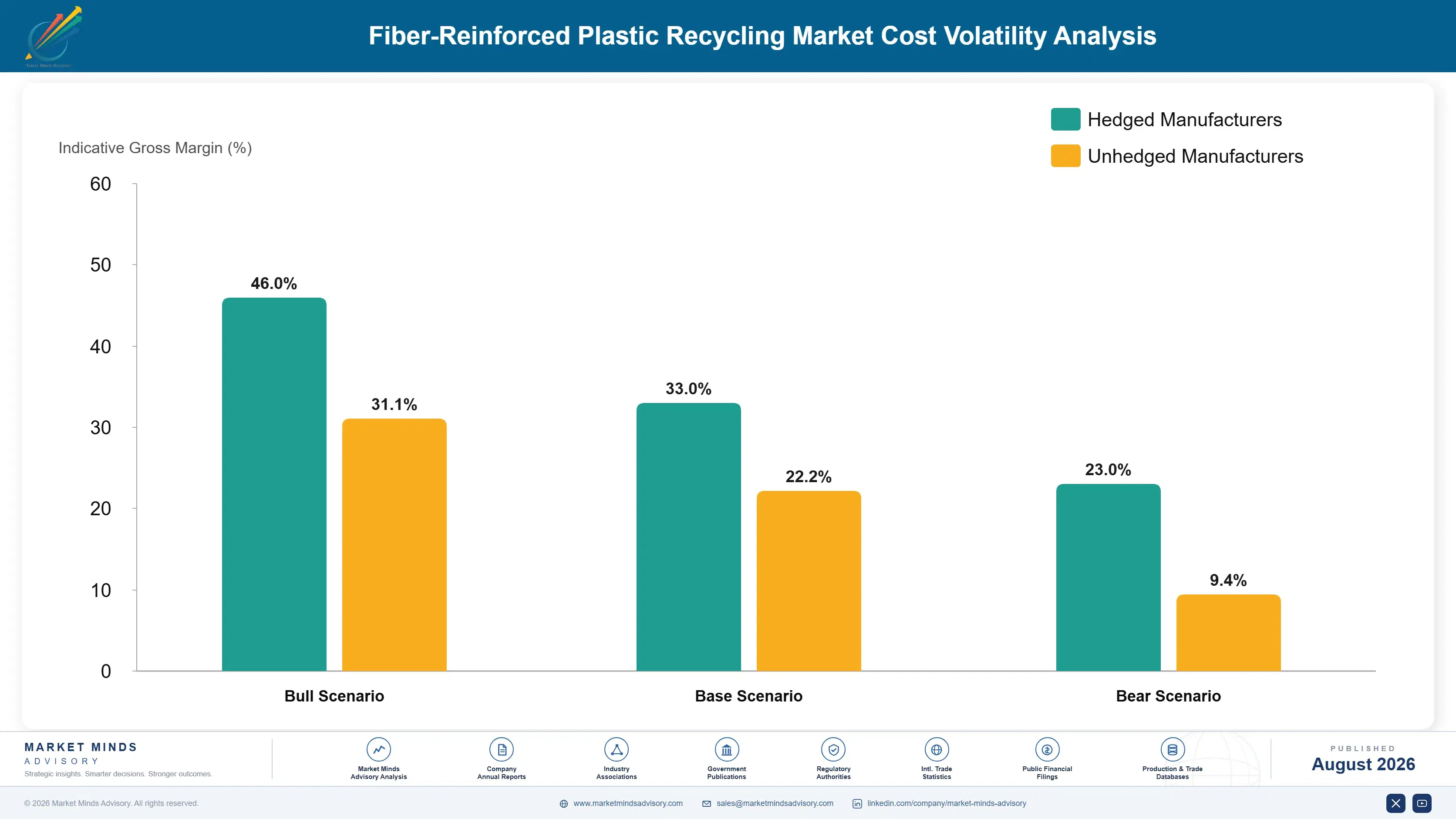
Input cost volatility and margin defence.

fiber-reinforced-plastic-recycling-market-country-cagr-analysis-1787550409018

Portfolio Architecture for Margin Defence

Section default visual

End-use penetration and the annuity logic.

Section default visual

Four calls that define the decade.

These are among the four positions where our research anticipates prominent divergence between winners and laggards over the coming forecast period. Each is grounded in the demand model, the regulatory perimeter, and the announced capacity pipeline.

Engagement Snapshot From the Field

A live engagement with an industry participant carrying material or product regulatory and market exposure ahead of a defining policy shift, showing how our research translates into a defensible multi-year portfolio strategy.
MARKET MINDS ADVISORY · CLIENT ENGAGEMENT SUMMARY
Fiber-Reinforced Plastic Recycling Producer Strategic Portfolio Review and Transition Roadmap 2026·Investment Scenario on Fiber-Reinforced Plastic Recycling Exposure Evaluation 2025-26
CLIENT PROFILE
STRATEGIC CHALLENGE
MMA APPROACH
KEY FINDINGS
    CLIENT PROFILE
    STRATEGIC CHALLENGE
    MMA APPROACH
    KEY FINDINGS
      RECOMMENDED STRATEGY
      OUTCOME

      Frequently Asked Questions

      Foundational context covering the market sizes, CAGR, scope, country, region and competition that inform every finding below. This section is provided to cover basics and most often pre-purchase conversations, answered from the MMA Primary Research Dataset.

      Report Segmentation Architecture

      The full report scope spans multiple orthogonal segmentation dimensions, with cross-tabulated demand data provided for each dimension pair. Coverage extends further to regional breakdowns, trend trajectories, and the competitive detail needed to support segment-level decision-making.

      By Region

        Scope, Methodology, and Coverage

        Every figure in this report is reproducible from documented input assumptions. The scope below maps the historical period, the forecast horizon, the segmentation dimensions, and the countries covered, alongside the underlying primary and qualitative methodology.
        Historical Period
        2020 to 2025
        Forecast Period
        2026 to 2036
        Base Year
        2025 (USD billions; MMA Primary Research Dataset, August 2026)
        Market Definition
        The fiber-reinforced plastic recycling market covers mechanical recycling and grinding, pyrolysis-based chemical recycling, solvolysis chemical recycling, cement kiln co-processing, incineration with energy recovery, and recovered fiber resale services for end-of-life glass and carbon fiber-reinforced plastic waste. It excludes virgin fiber production and finished composite manufacturing sold as separate market categories.
        Quantitative Units
        USD billions
        Segmentation Dimensions
        Regions Covered
        Countries Covered
        Key Companies Profiled
        Quantitative Methodology
        Primary survey, n=3,800 respondents, Q4 2025, six countries; demand-side model with trade association cross-validation
        Qualitative Methodology
        47 expert interviews, Q4 2025; applied to validate demand model assumptions, identify emerging dynamics, and assess competitive positioning
        Report Format
        PDF and XLSX data workbook (Word format preview document)
        Publisher
        Market Minds Advisory
        Report Code
        MMA-2026-CHM-108
        Published
        August 2026
        Contact
        sales@marketmindsadvisory.com | www.marketmindsadvisory.com

        Purchase the full Fiber-Reinforced Plastic Recycling Market Report (2026 to 2036).

        Built For The People Who Decide

        From boardroom strategy to bench-side execution, this report is read cover-to-cover by leaders shaping the next decade of their industry, turning demand scenarios, market dynamics and valuation benchmarks into decisions.
        CXOs/ Presidents/ VPs/ Managers
        M&A and Corporate Development
        Strategy Teams and R&D Heads
        Procurement and Product Directors
        Regulatory and Compliance Leaders
        Investor Relations and Equity Analysts