Market Minds Advisory
Fiber Optic Labels Market

Fiber Optic Labels Market: Insights and Trends 2026 to 2036

Hyperscale data centers and 5G backhaul buildouts are running so many fiber strands per rack that manual cable identification no longer scales, pushing operators toward RFID-enabled labels that automated systems can scan and track.

Lead Analyst

Bilal Shaikh

Published

September 2026

Make Smarter Decisions with Customized Research Insights

Request a free sample report and evaluate market opportunities, growth trends, and competitive dynamics relevant to your business needs.

2025 MARKET VALUE$1.1BMarket Size 2025
2036 FORECAST VALUE$2.7BBase Case , 2026 to 2036
CAGR 2026 TO 20368.6 %Bull 9.8% / Bear 7.4%
INCREMENTAL OPPORTUNITY$1.5BNet 10- year value creation
EXPANSION MULTIPLE2.28x2036 value over 2026 base
Strategic Levers
M&A Pipeline
Regional Outlook
Country Rankings
Competitive Intelligence
Segmental Deep-dive
Call-Us : 91 93563 13602

Executive Snapshot and Market Trajectory

Fiber optic labels have moved from a commodity cable-marking afterthought to a genuine infrastructure management tool, as data center operators now demand labels that survive years of handling, cleaning chemicals, and repeated temperature swings without fading, peeling, or ever becoming unreadable over time at all across their entire operating life.
RFID-enabled identification labels are the fastest-growing category, expanding well ahead of standard printed labels, as hyperscale operators automate asset tracking across racks holding thousands of individual fiber connections. China's massive fiber-to-the-home network, the largest fixed broadband deployment in the world, concentrates demand heavily in East Asia alongside its established label manufacturing base. Data center construction cycles drive demand in sharp bursts tied to specific facility build-out phases rather than smooth annual growth.
Competitive dynamics favor manufacturers with proven durability certifications and established relationships with network equipment integrators, since operators rarely switch labeling suppliers mid-project once installation crews standardize on a specific product and installation workflow used. Barcode and RFID compatibility is becoming a genuine differentiator rather than a premium add-on, as more operators integrate labels directly into asset management software platforms used across their facilities.
Market Definition
The fiber optic labels market covers self-laminating, wrap-around, and RFID-enabled identification labels used to mark and track fiber optic cables, connectors, and patch panels in telecom and data center installations. It excludes general industrial labels not designed for fiber-specific durability requirements.
Base Year Value
$1.1B in 2025 (MMA Primary Research Dataset, August 2026)
Forecast Period
2026 to 2036, eleven discrete annual values
CAGR
8.6% base case. Bull 9.8%. Bear 7.4%.
Fastest Growth Segment
RFID-Enabled Fiber Identification Labels: 12.9% CAGR
Fastest Growth Country
China: 11.2% CAGR
Fastest Growth Region
South Asia and Pacific: 10.6% CAGR
Largest Region
East Asia: 34% of 2025 global value
Market Leaders
Leading suppliers: Brady Corporation, HellermannTyton, Panduit, 3M, and Avery Dennison. Source: MMA Primary Research Dataset, July 2026.
Primary Survey
n=3,800 procurement and R&D decision-makers, Q4 2025, six countries
Methodology
Demand-side build-up, cross-validated against public data, 47 expert interviews

Fiber Optic Labels Market Forecast Scenarios

fiber-optic-labels-market-trends-size-forecast-scenario-1787550858420
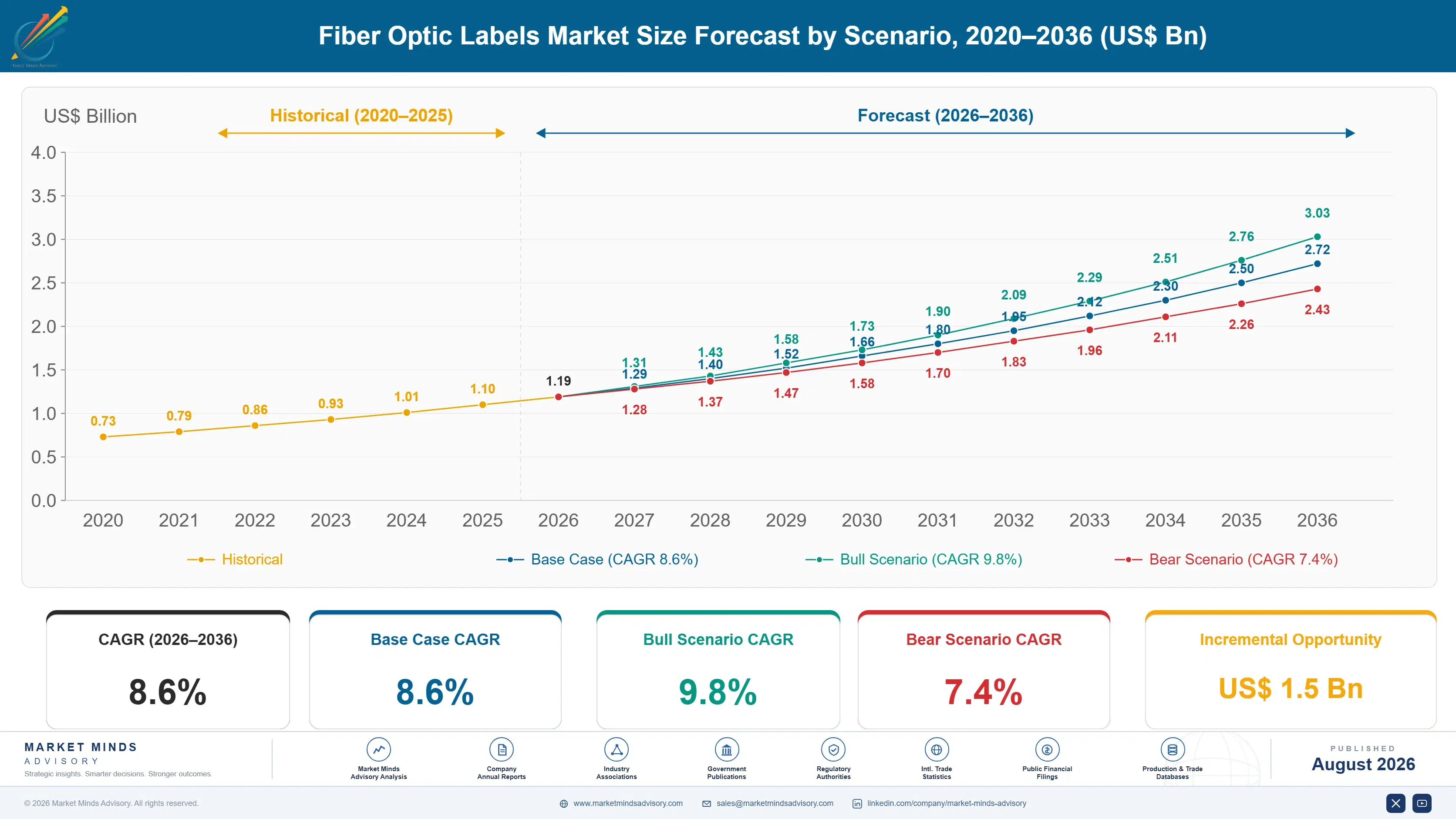
Between 2020 and 2025 the market grew at an estimated 7.8% annually as data center construction accelerated globally and 5G backhaul deployment expanded fiber network density considerably, though growth remained tied closely to broader telecom capital expenditure cycles rather than a smooth independent trajectory across most regions and vendor categories worldwide during that entire period.
The base case assumes 8.6% annual growth through 2036, anchored in three commercial mechanisms: continued hyperscale data center construction requiring dense fiber identification systems, China's ongoing fiber-to-the-home network expansion sustaining Asian demand, and growing adoption of RFID-enabled labels for automated asset tracking across large facilities and remote monitoring platforms worldwide today and consistently. RFID-enabled labels carry the base case forward fastest, reflecting where automation investment concentrates most heavily among large operators.
The bull case, 9.8%, assumes faster global data center construction than currently projected, pulling forward both new installation and retrofit labeling demand across multiple facility types simultaneously and ahead of current expectations. The bear case, 7.4%, reflects a scenario where telecom capital expenditure growth slows relative to current projections, dampening both new fiber deployment volume and the pace of RFID adoption industry-wide.

Cable Labels Become a Data Center Management Tool

Data center end-use now represents 55% to 65% of total demand, a meaningfully higher share than a decade ago, since hyperscale facilities running tens of thousands of individual fiber connections require identification systems that support automated asset tracking rather than manual clipboard inventories. This shift has pulled durability certification rates higher, with 70% to 80% of current volume meeting recognized industry standards for chemical and abrasion resistance.
TOP-5 MANUFACTURER CONCENTRATION44%Reflects a market split among specialty label and connectivity brands
AVERAGE LABEL ASP$0.38 per unitTracks typical pricing for a durable fiber-rated identification label
CHINA PRODUCTION SHARE38%Shows how concentrated global label manufacturing capacity has become domestically
DATA CENTER END-USE SHARE55% to 65%Captures how much demand traces back to large facility construction
SUBSTRATE SHARE OF COGS35% to 45%Indicates how exposed margins are to specialty adhesive costs
DURABILITY CERTIFICATION RATE70% to 80%Marks how much volume meets recognized industry durability standards
Average selling prices sit around 38 cents per unit, a modest figure per label but multiplied across the tens of thousands of connections a single hyperscale facility requires, generating meaningful aggregate spend per construction project. RFID-enabled labels command a substantial premium over standard printed alternatives, reflecting the added electronics and integration cost embedded in automated tracking systems.
Specialty film and adhesive substrate inputs represent 35% to 45% of cost of goods sold, exposing manufacturer margins to petrochemical feedstock pricing cycles that vary considerably depending on substrate composition and durability grade. Manufacturers with in-house substrate formulation capability carry a meaningful cost advantage over those purchasing finished film stock on the open market, particularly during feedstock price spikes tied to broader petrochemical cycles.
"Nobody thinks about the label until a technician can't find the right fiber at two in the morning. That moment is worth more to a data center operator than almost any spec sheet number."
Principal Analyst, Technology Infrastructure Practice · MMA Technology Practice · August 2026

Market Trends

Hyperscale Operators Automate Fiber Asset Tracking at Scale

RFID-enabled label adoption in hyperscale data centers has grown from roughly 15% of new installations in 2021 to an estimated 35% to 40% today, as operators managing racks with thousands of individual fiber connections shift away from manual clipboard-based inventory toward automated scanning systems integrated with facility management software. This shift is the single biggest driver of premium label demand this decade, since RFID-enabled products command meaningfully higher pricing than standard printed alternatives. Suppliers with validated RFID integration are winning hyperscale contracts faster than competitors still offering only barcode or printed text identification.
Market Impact: Cloud capex exceeds $250 billion annually
Sustainable Substrate Materials Gain Ground in Label Manufacturing

Several leading manufacturers have introduced recyclable or reduced-plastic substrate lines, responding to data center operators increasingly required to report Scope 3 supply chain emissions under corporate sustainability commitments and, in some jurisdictions, regulatory disclosure requirements now taking effect. Roughly 20% of new product launches in 2025 featured sustainable substrate formulations, up from a negligible share just three years earlier, though these products still carry a price premium that some cost-sensitive buyers hesitate to absorb. This trend is reshaping procurement conversations even where sustainable substrates have not yet become the default purchasing choice.
Market Impact: China covers 90% of urban homes

Market Opportunities and Growth Drivers

Hyperscale Data Center Capex Boom Sustains Label Demand

Major cloud providers have collectively announced more than 250 billion dollars in combined annual data center capital expenditure for 2025, driven largely by artificial intelligence workload buildout requiring extensive fiber interconnect density between compute clusters across multiple facility campuses. Each new facility requires identification labeling across every fiber connection point, directly translating construction capex into label volume regardless of which specific cloud provider wins the underlying AI workload competition. Suppliers with established hyperscale relationships are capturing the bulk of this demand ahead of smaller regional competitors still building comparable qualification credentials.
Market Impact: Substrate prices swung over 18%

China's Broadband Expansion Sustains Asian Label Demand

China's fiber-to-the-home network already covers more than 90% of urban households nationwide today, and continued network densification and rural extension keep pulling fiber deployment volume higher even after the initial national rollout largely concluded years ago. This sustained deployment activity keeps Chinese label manufacturers and international suppliers with domestic distribution relationships busy well beyond what a one-time infrastructure buildout would otherwise generate on its own. Suppliers with established Chinese telecom equipment relationships are capturing the bulk of this ongoing volume ahead of competitors focused primarily on data center applications alone.
Market Impact: Zero standards achieved 100% market dominance

Market Restraints and Challenges

Substrate Feedstock Volatility Compresses Manufacturer Margins

Specialty film and adhesive substrate prices swung by more than 18% between 2023 and 2025, driven by upstream petrochemical feedstock volatility rather than label-specific demand shifts. The root cause is that most label manufacturers still purchase substrate film on the open market rather than under long-term contracts, leaving margins exposed every time petrochemical pricing spikes unexpectedly. The commercial impact falls hardest on smaller manufacturers without pricing power to pass costs through to data center contracts mid-cycle. Some larger manufacturers are exploring backward integration into film production to dampen this exposure going forward.
Market Impact: 35% to 40% now RFID-enabled

Fragmented RFID Standards Slow Enterprise Adoption Pace

Multiple competing RFID frequency and protocol standards remain in use across the data center industry, meaning labels validated for one operator's asset management system do not always integrate cleanly with another's software platform. The root cause is that no single RFID standard has achieved dominant adoption the way barcode formats did decades earlier, leaving buyers to navigate compatibility questions before committing to a specific labeling vendor. Some manufacturers are mitigating this by offering multi-protocol labels compatible with several major RFID standards simultaneously, reducing the switching cost buyers face when changing asset management software.
Market Impact: 20% of launches used sustainable substrates
3 additional market trends, 4 additional growth drivers, and 2 additional restraints and challenges are covered in the full report. Contact sales@marketmindsadvisory.com to access the complete intelligence.

Segment CAGR and Growth Architecture

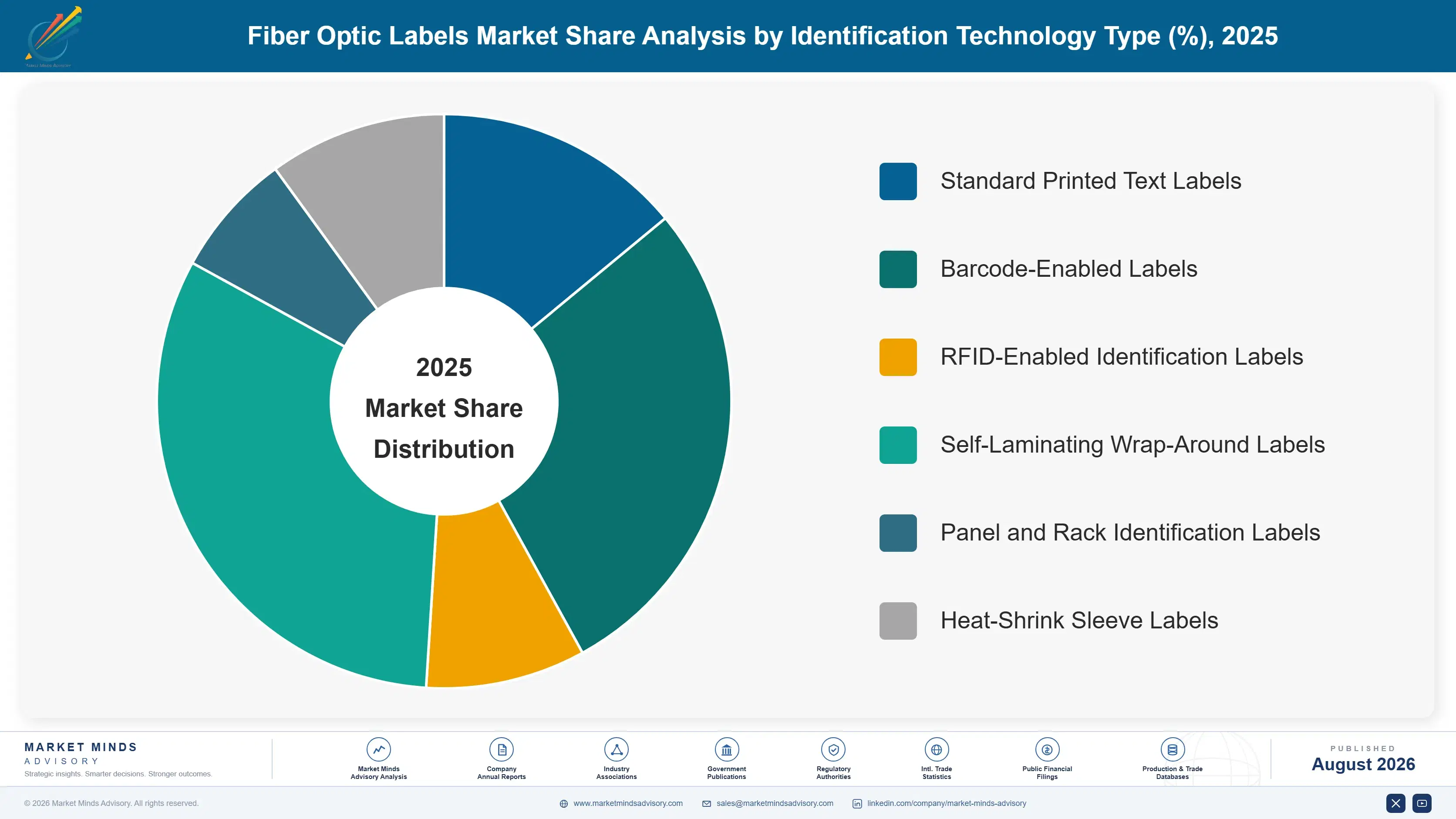
Segmentation follows identification technology type, the classification data center operators use when specifying asset tracking systems, since each technology addresses a distinct scanning and integration requirement through fundamentally different manufacturing processes rather than a shared production pathway, and each typically involves a separate supplier qualification process and distinct pricing tier across all six categories.
fiber-optic-labels-market-trends-market-share-analysis-1787550858947

RFID-Enabled Identification Labels

RFID-enabled identification labels are the fastest-growing segment, expanding at 12.9% annually as hyperscale operators automate asset tracking across racks holding thousands of individual fiber connections that manual inventory methods can no longer manage efficiently or accurately at real scale across large facilities and campuses worldwide today. These labels embed passive RFID chips that integrate directly with facility management software, letting technicians scan entire racks in seconds rather than checking connections individually by hand one at a time. Demand concentrates heavily among hyperscale and large enterprise data center operators, though adoption is gradually extending into smaller colocation facilities as chip costs decline and integration software becomes more accessible to mid-size operators.
CAGR 12.9%

Barcode-Enabled Labels

Barcode-enabled labels, the second-fastest segment at 10.8% annually, sit between standard printed text labels and full RFID systems, offering automated scanning capability at a meaningfully lower cost than embedded chip technology currently requires from most facility operators today and quite consistently across most regions and global markets. These labels appeal to operators who want automated inventory benefits without the higher unit cost and integration complexity that RFID systems currently demand from facility management teams and IT staff. Growth here reflects a genuine middle-tier adoption path for operators not yet ready to commit to full RFID infrastructure investment but no longer satisfied with purely manual text-based identification across their fiber connections.
CAGR 10.8%
Full segment breakdown across 6 segments available in the complete report.

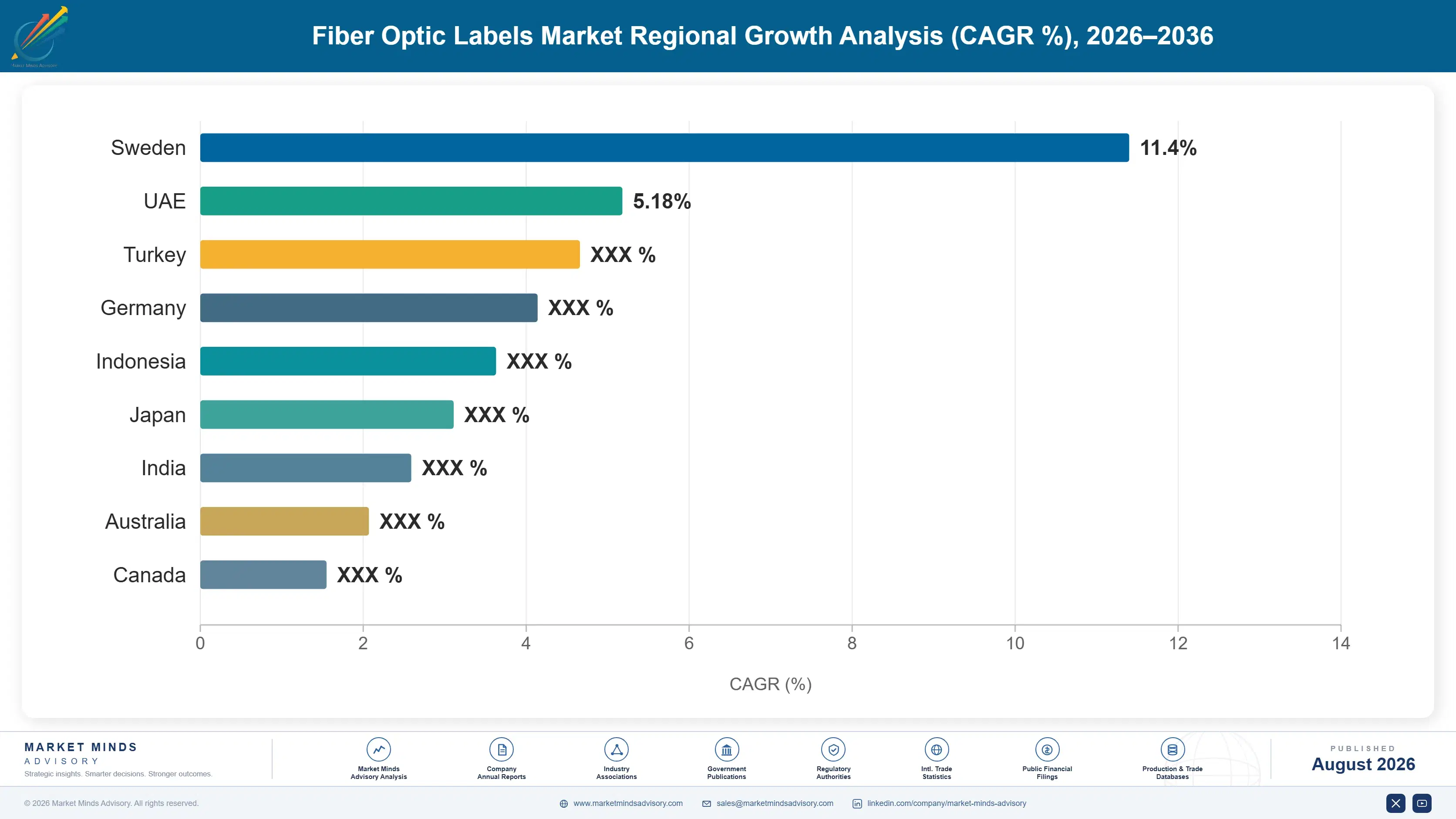
Regional Architecture and Country Demand Map

Demand concentrates heavily around China's massive fiber-to-the-home network and established label manufacturing base, with East Asia broadly commanding the largest regional share by a wide margin worldwide today, while North America holds a strong secondary position driven by sustained and expanding hyperscale data center construction activity.

East Asia

China anchors East Asian demand through the sheer scale of its fiber-to-the-home network, the largest fixed broadband deployment in the world, combined with an established domestic label manufacturing base scaling fastest to serve both local telecom operators and export markets simultaneously and quite consistently, and this dominance pushes the region's share meaningfully above MMA's standard band, a deliberate house-rule deviation reflecting China's genuinely outsized position in both fiber network scale and label production capacity relative to any other region on earth. Japan and South Korea contribute technically sophisticated demand from established data center and telecom equipment operators across the wider region. Regional growth remains steady as ongoing network densification continues.
Share: 34% | CAGR: 9.6% (2026 to 2036)

North America

Hyperscale data center construction, concentrated in Virginia, Texas, and increasingly the broader Midwest region, drives most North American demand as major cloud providers pour capital into artificial intelligence workload infrastructure requiring dense fiber interconnects between compute clusters across multiple large campuses nationwide today. Domestic and international label manufacturers with US distribution facilities compete closely for hyperscale contracts, since operators increasingly favor suppliers who can guarantee rapid replenishment during active construction phases. RFID adoption runs ahead of most other regions here, reflecting the sophistication of hyperscale asset management practices relative to smaller facility operators elsewhere. Canadian data center growth adds a smaller, complementary regional contribution to the broader total overall today.
Share: 26% | CAGR: 8.1% (2026 to 2036)
Regional intelligence for 5 additional markets available in the complete report: Western Europe, South Asia and Pacific, Latin America, Middle East and Africa, Eastern Europe. Contact sales@marketmindsadvisory.com.
fiber-optic-labels-market-trends-country-cagr-analysis-1787550859471

Where Label Makers Can Capture Margin

Four commercial levers determine which label manufacturers capture disproportionate margin as the market shifts toward automated, hyperscale-driven demand: expanding into RFID-enabled production, building multi-protocol compatibility across platforms, localizing manufacturing inside China's rapidly expanding fiber network buildout, and developing sustainable substrate lines well ahead of tightening disclosure expectations across most major markets worldwide today and consistently.

Expand Into RFID-Enabled Label Production Lines

RFID-enabled label adoption has grown from roughly 15% of new hyperscale installations in 2021 to an estimated 35% to 40% today, and that share is expanding into smaller colocation facilities as chip costs decline and integration software becomes more accessible. Suppliers already qualified on standard printed or barcode label lines hold a natural advantage entering this adjacent category, since operators prefer consolidating asset-tracking material sourcing with fewer, already-trusted suppliers. Entry requires meaningful investment in chip integration and software compatibility testing, but the margin premium justifies that investment for suppliers with existing hyperscale relationships.
Market Impact: Captures share of the 35% to 40% RFID segment

Build Multi-Protocol RFID Compatibility Across Platforms

No single RFID frequency or protocol standard has achieved dominant adoption across the data center industry, with at least 3 competing frequency bands still in active commercial use, leaving buyers to navigate compatibility questions before committing to a specific labeling vendor and software combination. Suppliers offering multi-protocol labels compatible with several major RFID standards simultaneously reduce the switching cost buyers face when changing software platforms, winning contracts from operators who value flexibility over locking into a single vendor's product line. This approach requires broader engineering investment upfront but captures customers hesitant to commit to a single incompatible standard.
Market Impact: Reduces switching costs across 3 or more RFID standards

Localize Manufacturing Inside China's Network Buildout

East Asia holds 34% of global fiber optic label demand and China's fiber-to-the-home network already covers more than 90% of urban households, with continued densification and rural extension sustaining demand well beyond the initial national rollout that largely concluded years ago. Suppliers without local production face rising tariff exposure and longer lead times relative to domestic Chinese competitors already established there. Establishing or expanding manufacturing footprint inside China captures a larger share of the world's largest fixed broadband market directly, though this lever carries meaningful capital commitment and intellectual property considerations.
Market Impact: Captures share of China's 34% regional demand base

Develop Sustainable Substrate Product Lines Early

Roughly 20% of new product launches in 2025 featured sustainable substrate formulations, up from a negligible share just three years earlier, as data center operators face growing pressure to report Scope 3 supply chain emissions under corporate sustainability commitments. Suppliers developing recyclable or reduced-plastic substrate lines ahead of broader market adoption position themselves to win contracts from operators prioritizing sustainability credentials in procurement decisions, even while these products still carry a price premium some buyers hesitate to absorb today. Early movers build credibility before sustainable substrates become the default expectation.
Market Impact: Captures a growing 20% share of sustainable launches

Who Controls the Margin Pool

Concentration is moderate, with a CR5 near 44% on an annual revenue basis and a meaningful gap separating the five established leaders from a substantial tail of regional and specialty label converters still building comparable scale, RFID integration capability, and hyperscale customer relationships of their own across multiple regions.
Current competitive activity centers on three fronts: expanding RFID-enabled production to serve hyperscale automation demand, building multi-protocol compatibility across competing RFID standards, and localizing manufacturing inside China to serve the world's largest fixed broadband market directly and efficiently across most product categories. Several manufacturers are also developing sustainable substrate lines ahead of tightening corporate disclosure expectations across their global customer base and supply chain.

Emerging pressure comes from Chinese domestic label converters scaling production and RFID integration capability fast enough to challenge established Western suppliers on both cost and delivery speed, particularly within China's own telecom and data center market. Rankings could shift meaningfully over the next several years if Chinese suppliers close the technical gap on RFID chip integration the way they have already done in printed label manufacturing scale, a transition several established suppliers are watching closely.
fiber-optic-labels-market-trends-company-positioning-matrix-1787550859989

Competitive Moat and Risk Dimensions

BRADY CORPORATION

Moat: Broad Cross-Industry Identification Portfolio

Brady Corporation supplies identification products across dozens of adjacent industries beyond fiber optics, giving it manufacturing scale and substrate research depth that specialty fiber-only competitors cannot easily replicate. This breadth lets Brady introduce new durable substrate formulations faster than narrower rivals working from a smaller research base.
BRADY CORPORATION

Risk: Slower on Dedicated RFID Integration

Brady's identification portfolio spans many product categories beyond fiber labeling specifically, meaning RFID integration investment for fiber applications competes internally against numerous other business lines for capital allocation. Competitors focused exclusively on fiber and data center labeling can sometimes move faster on dedicated RFID capability than a diversified portfolio company.
HELLERMANNTYTON

Moat: Deep Telecom Relationship Depth

HellermannTyton has built specialized relationships with telecom operators and data center integrators over many decades of continuous engagement, giving it existing qualification standing that newer entrants lack entirely. This history lets HellermannTyton get invited into facility design conversations earlier than competitors without comparable existing trust and track record.
HELLERMANNTYTON

Risk: Limited Direct Presence in China

HellermannTyton has a comparatively limited direct manufacturing presence in China relative to domestic converters, leaving it more dependent on export shipments to capture the country's massive fiber-to-the-home network demand growth. This gap in local presence could cost HellermannTyton meaningful share as Chinese domestic capacity continues scaling rapidly.

Players Tracked

Prominent Players

Brady Corporation
HellermannTyton
Panduit
3M
Avery Dennison

Other Key Players

TE Connectivity
Legrand
Weidmuller
Grafoplast
Primex
IDENTCO
GlobalMark
Kroy LLC
LEM Products
CLC Labs
DYMO Industrial
Phoenix Contact
Rittal
Schneider Electric
Belden Inc

Recent Developments

FEBRUARY 2025

Brady Corporation Expands RFID-Enabled Label Production

Brady Corporation announced an expansion of its RFID-enabled label production line in the United States, adding capacity specifically to serve growing hyperscale data center demand for fully automated asset tracking systems nationwide. The expansion was an organic capacity addition, not a joint venture or acquisition.
Signal: Confirms established suppliers are now actively prioritizing dedicated RFID capacity to meet accelerating hyperscale automation demand.
JUNE 2025

Chinese Label Converter Signs Major Telecom Supply Agreement

A leading Chinese label converter signed a multi-year supply agreement with a major domestic telecom operator to provide fiber identification labels for its continued network densification program nationwide and across rural areas. The agreement was a direct commercial supply contract, not an equity stake or acquisition.
Signal: Shows domestic Chinese suppliers are securing long-term telecom contracts ahead of international competitors entering the market.
OCTOBER 2025

HellermannTyton Acquires Sustainable Substrate Technology Producer

HellermannTyton acquired a smaller specialty substrate technology producer to add validated sustainable film capability to its existing label portfolio without building that technical capability entirely internally from scratch on its own. The acquisition closed after a shortened regulatory review given the target's modest revenue scale.
Signal: Confirms acquisition is becoming a faster path into sustainable substrates than internal development for established suppliers.

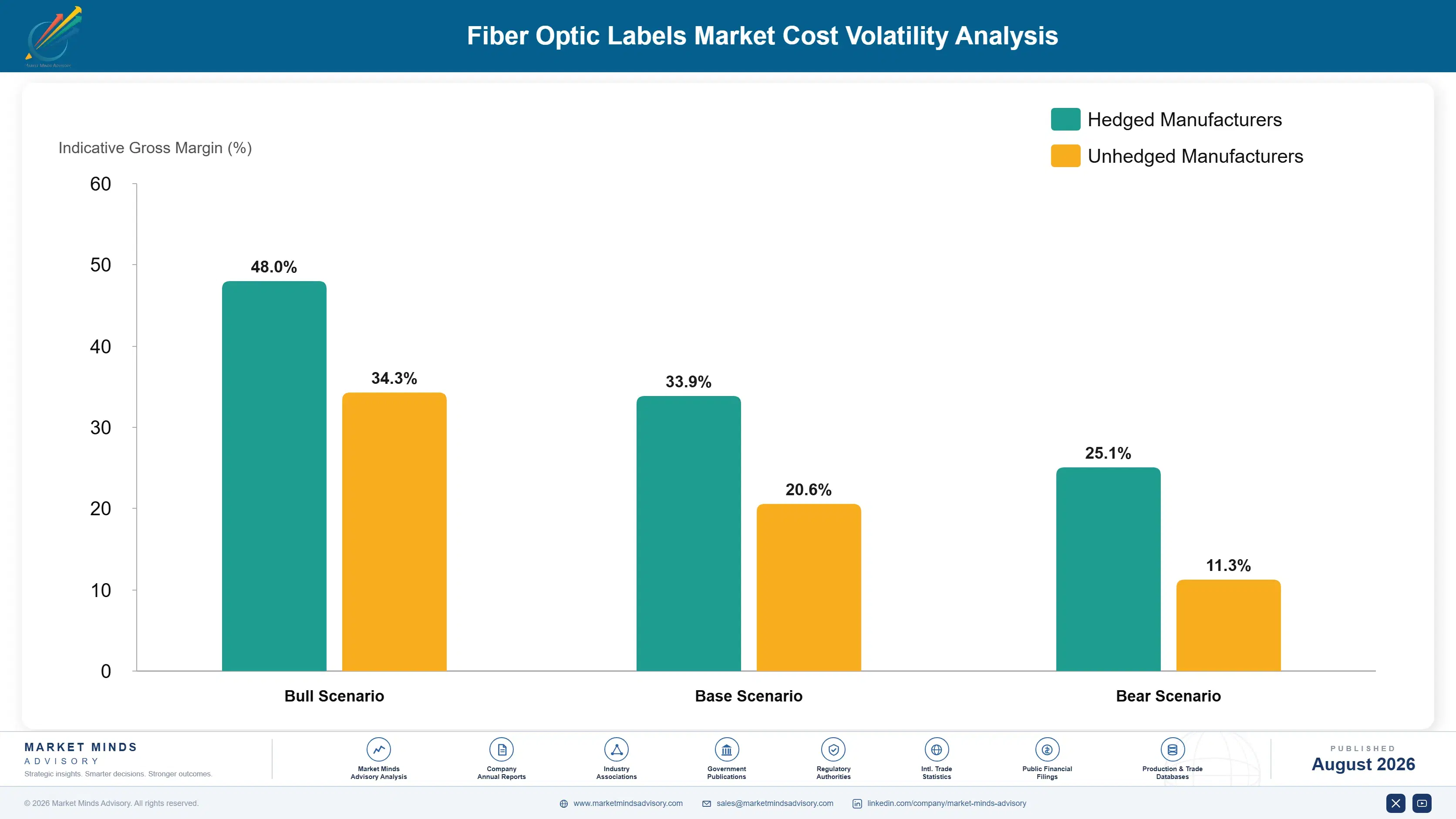
Substrate Film and Adhesive Cost Exposure

Specialty film and adhesive substrate inputs represent 35% to 45% of cost of goods sold for label manufacturers, sourced from petrochemical-based polyester and vinyl film producers concentrated in North America, Europe, and increasingly China. RFID chip and antenna components add a secondary but growing input cost as automated tracking labels represent a larger share of total product mix.
Specialty film prices swung by more than 18% between 2023 and 2025 as upstream petrochemical feedstock volatility moved with broader crude oil and natural gas pricing cycles largely unrelated to label-specific demand shifts. Manufacturers without long-term substrate supply contracts absorbed most of this swing directly, compressing gross margins meaningfully during the peak of the disruption before pricing gradually stabilized as feedstock markets settled into 2025.

Exposure varies meaningfully by player type: manufacturers integrated backward into film production or holding long-term supply contracts absorb price swings far better than converters purchasing finished film stock on the open market, and this gap becomes a genuine competitive disadvantage during volatile pricing periods. Geographic exposure differs too, since Chinese converters sit closer to domestic film production than European or North American manufacturers reliant on longer supply chains.
fiber-optic-labels-market-trends-cost-volatility-analysis-1787550860183

Secure Multi-Year Substrate Supply Contracts

Negotiating multi-year fixed-price or banded-price substrate film supply agreements protects margin against the kind of feedstock volatility that hit prices hard through 2024, giving label manufacturers genuinely predictable input costs to plan production scheduling and hyperscale contract pricing around well in advance, rather than absorbing spot-market swings directly into gross margin unpredictably every single cycle.

Pursue Backward Integration Into Film Production

Larger label manufacturers with sufficient balance sheet capacity can integrate backward into specialty film production directly, capturing the margin that would otherwise flow entirely to third-party film suppliers while also gaining much more predictable and genuinely reliable feedstock access during periods of much broader petrochemical market tightness across the entire wider industry supply chain.

Diversify Substrate Sourcing Across Multiple Suppliers

Sourcing substrate film from multiple suppliers across different regions, rather than relying on a single producer, reduces exposure to any one supplier's disruption, whether from feedstock shortages, unplanned plant outages, or logistics delays affecting delivery. Manufacturers already doing this reported smoother cost pass-through during the 2024 volatility spike than peers dependent on a single film source.

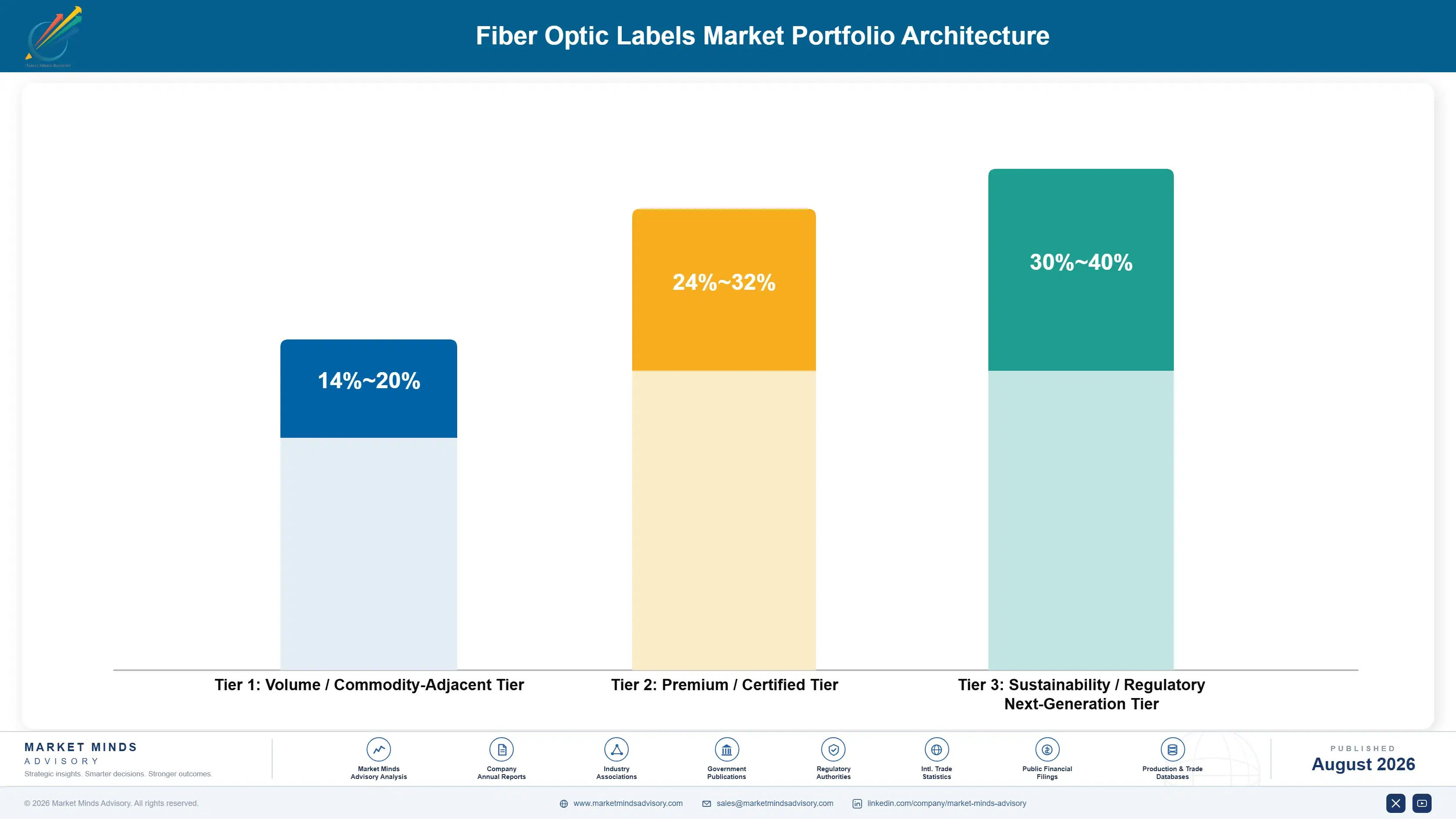
Portfolio Architecture for Margin Defence

The portfolio splits into three tiers with meaningful margin separation tied to integration complexity rather than raw material cost alone. Standard printed text labels compete mainly on price and delivery reliability, while barcode-enabled and RFID-enabled labels command durable premiums tied to automated tracking capability and software integration guarantees.
The tension between volume hardware and integration premium is sharpening as hyperscale automation and multi-protocol RFID adoption expand demand for premium and next-generation labels faster than standard printed label demand grows, pulling manufacturer investment toward these higher-margin tiers even though standard labels remain a meaningful and stable volume base globally. Manufacturers maintaining a foothold across all three tiers preserve optionality, while those chasing only premium contracts risk losing the steady replacement cash flow that standard labels still reliably provide.

High-value margin pools concentrate specifically in RFID-enabled labels and sustainable substrate formulations meeting the newest hyperscale specifications, both requiring genuine engineering and materials investment that conventional label converters must build or acquire rather than simply extend from existing print production capability. Standard printed text labels, by contrast, remain a large but slower-growing volume base offering thinner, more commoditized margins for most participants going forward.

Volume / Commodity-Adjacent Tier

Standard printed text labels sold primarily on price and delivery reliability into mainstream telecom and enterprise installations without RFID or barcode requirements yet, particularly across cost-sensitive markets worldwide today and consistently.
Gross Margin: 14%-20%

Premium / Certified Tier

Barcode-enabled labels integrated into automated scanning workflows commanding durable premiums tied to inventory accuracy and a proven multi-year track record with data center and telecom buyers worldwide and across regions.
Gross Margin: 24%-32%

Sustainability / Regulatory / Next-Generation Tier

RFID-enabled and sustainable substrate labels built specifically for hyperscale automation and evolving corporate disclosure requirements, representing the newest and most technically demanding corner of the entire product portfolio sold globally.
Gross Margin: 30%-40%
fiber-optic-labels-market-trends-portfolio-architecture-1787550860684

High-value Sub-segments and Strategic Watch-out

RFID-Enabled Identification Labels

High value with strong growth, tied directly to hyperscale automation demand scaling independent of broader mainstream replacement cycles across most facility segments and price points worldwide today. Chip integration and software compatibility increasingly decide which supplier wins long-term hyperscale platform contracts across most major operators and regions worldwide.
Gross Margin: 30%-38%

Barcode-Enabled Labels

High value with moderate growth, anchored in mid-size and enterprise data center platforms where operators value proven automated scanning over the fastest possible technical iteration across most facility segments and production regions today. Suppliers here compete on reliability and installed-base track record more than on price alone.
Gross Margin: 24%-30%

Standard Printed Text Labels

The volume core, serving mainstream telecom and enterprise installations across most global markets regardless of RFID or barcode adoption pace currently underway across the broader industry today. Steady growth tracks fiber network expansion volume rather than any specific technology transition emerging across the wider category today and going forward.
Gross Margin: 14%-19%

Panel and Rack Identification Labels

The strategic watch-out, facing accelerating price competition as Chinese domestic converters scale production for cost-sensitive telecom segments worldwide across nearly every price tier and geography today. Remaining international supplier volume concentrates in accounts still requiring proven validation history and established track records built over many years.
Gross Margin: 12%-17%

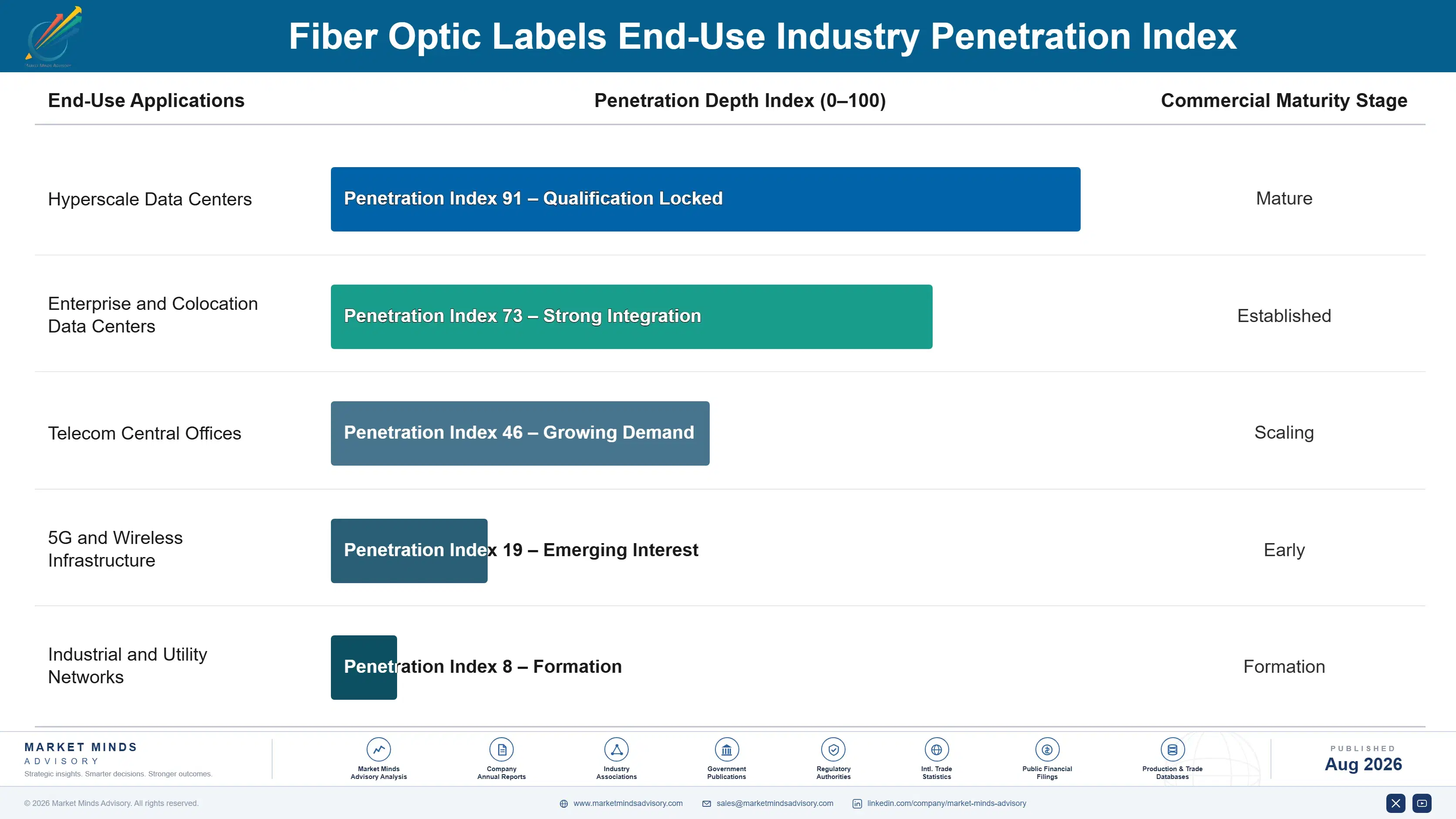
The Asset Tracking Annuity in Labeling

Fiber label revenue behaves like an annuity tied to facility operating life rather than a one-time installation sale, since data centers relabel and replace connections continuously across a facility's multi-decade operating life as equipment churns and network topology evolves far more often than the underlying building itself changes structurally or physically over time.
Adoption depth varies by end-use vertical: hyperscale data centers adopted RFID-enabled tracking earliest, while mid-size enterprise data centers and telecom central offices still often rely on barcode or printed text identification without the added automation investment built into their daily operations. Small colocation facilities and rural telecom infrastructure remain the shallowest vertical, constrained by cost sensitivity that current RFID pricing has not yet fully overcome at meaningful scale across most price-sensitive markets.

Buyer profiles are shifting generationally as network automation engineers, rather than purely facilities maintenance staff, now approve labeling sourcing decisions inside major data center and telecom operators across most facility types today. This younger buyer cohort weighs software integration compatibility and sustainability credentials alongside conventional durability metrics, reshaping which suppliers get invited to next-generation facility bids and long-term development partnerships.
fiber-optic-labels-market-trends-end-use-penetration-index-1787550861174

Priorities for Fiber Label Suppliers

These are among the four positions where our research anticipates prominent divergence between winners and laggards over the coming forecast period. Each is grounded in the demand model, the regulatory perimeter, and the announced capacity pipeline.
01 / PRODUCT PORTFOLIO STRATEGY

Prioritize RFID capability over legacy standard printed label volume

RFID-enabled labels are growing at 12.9% annually, roughly 1.5 times the overall market's 8.6% pace, and that gap will widen further as hyperscale operators automate asset tracking across the entire forecast period through 2036 and beyond. Suppliers still weighted toward standard printed labels risk ceding the highest-margin hyperscale contracts to competitors who invested early in chip integration and software compatibility testing. The near-term priority is securing at least one hyperscale RFID contract before the next major facility-generation sourcing cycle closes.
02 / REGIONAL MANUFACTURING FOOTPRINT

Expand East Asian production capacity ahead of demand acceleration

East Asia already commands 34% of global fiber label demand and is growing at 9.6% annually, faster than the 8.6% global average, driven by China's continued fiber-to-the-home densification and its already firmly established label manufacturing base. Suppliers without meaningful East Asian production capacity face longer lead times and tariff exposure that domestic competitors do not carry into contract negotiations. Expanding regional footprint now, rather than after demand fully materializes, preserves negotiating leverage on platform contracts signed over the next several years.
03 / STANDARDS COMPATIBILITY INVESTMENT

Build multi-protocol RFID capability ahead of standard consolidation

No single RFID standard has achieved dominant adoption across the data center industry, leaving buyers to navigate real compatibility questions before committing to any specific labeling vendor and software combination across their entire facility portfolio and broader technology supply chain. Suppliers still offering only single-protocol labels risk losing contracts to competitors whose multi-protocol products reduce switching costs for operators managing mixed-vendor environments. The near-term priority is building multi-protocol compatibility before a dominant standard eventually emerges and narrows the addressable market.
04 / SUSTAINABILITY AND COMPLIANCE POSITIONING

Develop sustainable substrate lines ahead of disclosure requirements

Roughly 20% of new product launches in 2025 featured sustainable substrate formulations, up from a negligible share just three years earlier, as data center operators face growing pressure to report Scope 3 supply chain emissions under evolving corporate sustainability commitments. Suppliers still organized purely around conventional substrate risk losing contracts to competitors who invested early in recyclable formulations and can demonstrate compliance credibility to procurement teams. Building or acquiring sustainable substrate capability now positions suppliers ahead of tightening disclosure requirements.

Engagement Snapshot From the Field

A live engagement with an industry participant carrying material or product regulatory and market exposure ahead of a defining policy shift, showing how our research translates into a defensible multi-year portfolio strategy.
MARKET MINDS ADVISORY · CLIENT ENGAGEMENT SUMMARY
Fiber Optic Labels Producer Strategic Portfolio Review and Transition Roadmap 2026·Investment Scenario on Fiber Optic Labels Exposure Evaluation 2025-26
CLIENT PROFILE
The client is a mid-size colocation data center operator with annual facility revenue of approximately 180 million dollars (client-reported, unverified by MMA), managing twelve facilities still relying primarily on standard printed text labels for fiber identification. The company had not yet adopted RFID-enabled tracking and was evaluating whether to invest in a facility-wide labeling upgrade.
STRATEGIC CHALLENGE
Leadership recognized that manual fiber tracking was slowing technician response times during frequent outages, but internal IT teams lacked meaningful experience evaluating competing RFID standards, and management debated whether a phased rollout or a single facility-wide conversion offered the faster path to measurable operational improvement across the company's twelve facilities.
MMA APPROACH
MMA combined primary interviews with RFID label suppliers and a technician response-time analysis comparing facilities already using barcode systems against those still relying entirely on printed text labels, then modeled phased versus facility-wide rollout costs given the segment's 12.9% projected CAGR to quantify which approach delivered faster measurable improvement overall.
KEY FINDINGS
  1. Technician response times during outages were roughly 40% slower at facilities still relying on printed text labels compared to those already using barcode scanning systems.
  2. A facility-wide RFID conversion would require an estimated fourteen months to complete, while a phased rollout could show measurable results within four months at the first facility.
  3. Client-reported internal maintenance data (client-reported, unverified by MMA) showed labeling-related troubleshooting delays contributing meaningfully to overall facility downtime incidents across multiple sites.
  4. Two competing RFID protocol standards were both genuinely viable for the client's specific operational needs, making multi-protocol label compatibility a meaningfully important supplier selection criterion during vendor evaluation.
CLIENT PROFILE
The client is a mid-size colocation data center operator with annual facility revenue of approximately 180 million dollars (client-reported, unverified by MMA), managing twelve facilities still relying primarily on standard printed text labels for fiber identification. The company had not yet adopted RFID-enabled tracking and was evaluating whether to invest in a facility-wide labeling upgrade.
STRATEGIC CHALLENGE
Leadership recognized that manual fiber tracking was slowing technician response times during frequent outages, but internal IT teams lacked meaningful experience evaluating competing RFID standards, and management debated whether a phased rollout or a single facility-wide conversion offered the faster path to measurable operational improvement across the company's twelve facilities.
MMA APPROACH
MMA combined primary interviews with RFID label suppliers and a technician response-time analysis comparing facilities already using barcode systems against those still relying entirely on printed text labels, then modeled phased versus facility-wide rollout costs given the segment's 12.9% projected CAGR to quantify which approach delivered faster measurable improvement overall.
KEY FINDINGS
  1. Technician response times during outages were roughly 40% slower at facilities still relying on printed text labels compared to those already using barcode scanning systems.
  2. A facility-wide RFID conversion would require an estimated fourteen months to complete, while a phased rollout could show measurable results within four months at the first facility.
  3. Client-reported internal maintenance data (client-reported, unverified by MMA) showed labeling-related troubleshooting delays contributing meaningfully to overall facility downtime incidents across multiple sites.
  4. Two competing RFID protocol standards were both genuinely viable for the client's specific operational needs, making multi-protocol label compatibility a meaningfully important supplier selection criterion during vendor evaluation.
RECOMMENDED STRATEGY
Phase 1: Phase 1 (Months 1 to 4): Convert the highest-incident facility to multi-protocol RFID labeling and measure the resulting response time improvement. Phase 2: Phase 2 (Months 5 to 10): Roll out conversion to four additional facilities based on validated results from the pilot. Phase 3: Phase 3 (Months 11 to 14): Complete conversion across all remaining facilities and fully integrate with existing asset management software platforms.
OUTCOME
The client completed the pilot facility conversion within four months and measured a 35% reduction in technician response time during outage incidents, reporting an estimated 1.2 million dollars in annual operational savings (client-reported, unverified by MMA). Leadership credited the phased rollout analysis MMA delivered early in the engagement.

Frequently Asked Questions

Foundational context covering the market sizes, CAGR, scope, country, region and competition that inform every finding below. This section is provided to cover basics and most often pre-purchase conversations, answered from the MMA Primary Research Dataset.

What is the current size of the Fiber Optic Labels Market?

The global fiber optic labels market reached an estimated 1.1 billion dollars in 2025. Growth is driven by expanding data center construction and fiber network densification worldwide.

How large will the Fiber Optic Labels Market be by 2036?

MMA projects the market will reach approximately 2.7 billion dollars by 2036. That represents roughly 2.28 times the 2026 market size over the forecast decade.

What is the CAGR for the Fiber Optic Labels Market 2026 to 2036?

The base case CAGR is 8.6% annually across the 2026 to 2036 forecast period. Bull and bear scenarios range from 9.8% to 7.4% depending on data center construction pace.

Which segment is growing fastest?

RFID-Enabled Identification Labels are the fastest-growing segment, expanding at 12.9% annually, roughly 1.5 times the overall market rate. This reflects hyperscale automation demand intensifying worldwide.

Who are the major companies in the Fiber Optic Labels Market?

Leading suppliers include Brady Corporation, HellermannTyton, Panduit, 3M, and Avery Dennison, evaluated on an annual revenue basis. Together these five suppliers hold an estimated 44% combined share.

Which country is growing fastest?

China leads country-level growth at 11.2% annually, outpacing the broader East Asia regional average by a meaningful margin. Continued fiber-to-the-home densification and rural network extension continue driving this acceleration forward.

Report Segmentation Architecture

The full report scope spans multiple orthogonal segmentation dimensions, with cross-tabulated demand data provided for each dimension pair. Coverage extends further to regional breakdowns, trend trajectories, and the competitive detail needed to support segment-level decision-making.

By Identification Technology Type

  • Standard Printed Text Labels
  • Barcode-Enabled Labels
  • RFID-Enabled Identification Labels
  • Self-Laminating Wrap-Around Labels
  • Panel and Rack Identification Labels
  • Heat-Shrink Sleeve Labels

By End-Use Industry

  • Hyperscale Data Centers
  • Enterprise and Colocation Data Centers
  • Telecom Central Offices
  • 5G and Wireless Infrastructure
  • Industrial and Utility Networks

By Commercial Dimension

  • Direct Operator Contracts
  • Systems Integrator Distribution
  • Electrical and Data Distributor Sales
  • Aftermarket Replacement Sales

By Region

  • East Asia
  • North America
  • Western Europe
  • South Asia and Pacific
  • Latin America
  • Middle East and Africa
  • Eastern Europe

Scope, Methodology, and Coverage

Every figure in this report is reproducible from documented input assumptions. The scope below maps the historical period, the forecast horizon, the segmentation dimensions, and the countries covered, alongside the underlying primary and qualitative methodology.
Historical Period
2020 to 2025
Forecast Period
2026 to 2036
Base Year
2025 (USD billions; MMA Primary Research Dataset, August 2026)
Market Definition
The fiber optic labels market covers self-laminating, wrap-around, and RFID-enabled identification labels used to mark and track fiber optic cables, connectors, and patch panels in telecom and data center installations. It excludes general industrial labels not designed for fiber-specific durability requirements.
Quantitative Units
USD billions (current prices); unit shipment volume in millions where applicable
Segmentation Dimensions
By Identification Technology Type; By End-Use Industry; By Commercial Dimension; By Region
Regions Covered
East Asia, North America, Western Europe, South Asia and Pacific, Latin America, Middle East and Africa, Eastern Europe
Countries Covered
USA, China, Germany, France, UK, Japan, South Korea, India, Australia, Canada, Brazil, Mexico, Indonesia, Vietnam, Thailand, Malaysia, UAE, Saudi Arabia, South Africa, Nigeria, Turkey, Poland, Netherlands, Italy, Spain, Sweden, Switzerland, Argentina, Colombia, Singapore, and additional markets relevant to this sector
Key Companies Profiled
Brady Corporation, HellermannTyton, Panduit, 3M, Avery Dennison, TE Connectivity, Legrand, Weidmuller, Grafoplast, Primex, IDENTCO, GlobalMark, Kroy LLC, LEM Products, CLC Labs, DYMO Industrial, Phoenix Contact, Rittal, Schneider Electric, Belden Inc
Quantitative Methodology
Primary survey, n=3,800 respondents, Q4 2025, six countries; demand-side model with trade association cross-validation
Qualitative Methodology
47 expert interviews, Q4 2025; applied to validate demand model assumptions, identify emerging dynamics, and assess competitive positioning
Report Format
PDF and XLSX data workbook (Word format preview document)
Publisher
Market Minds Advisory
Report Code
MMA-2026-TEC-210
Published
August 2026
Contact
sales@marketmindsadvisory.com | www.marketmindsadvisory.com

Purchase the full Fiber Optic Labels Market Report (2026 to 2036).

This report provides a complete assessment of the global fiber optic labels market across the 2026 to 2036 forecast period, covering sizing, segmentation, and regional demand patterns. It profiles the five leading suppliers and fifteen additional participants on a consistent annual revenue basis, detailing competitive positioning, recent corporate developments, and moat and risk analysis for the top two players. The report also examines input cost exposure, portfolio margin architecture, and revenue lever opportunities tied to RFID adoption. A dedicated regional chapter breaks down demand across all seven MMA-tracked regions.
Ten-year global market sizing and CAGR forecast model
Six-segment MECE technology type breakdown analysis
Seven-region demand share and growth rate analysis
Twenty-company competitive benchmarking and positioning dataset
Input cost exposure and portfolio margin modeling detail
Anonymized client engagement case study with outcomes

Built For The People Who Decide

From boardroom strategy to bench-side execution, this report is read cover-to-cover by leaders shaping the next decade of their industry, turning demand scenarios, market dynamics and valuation benchmarks into decisions.
CXOs/ Presidents/ VPs/ Managers
M&A and Corporate Development
Strategy Teams and R&D Heads
Procurement and Product Directors
Regulatory and Compliance Leaders
Investor Relations and Equity Analysts