Market Minds Advisory
Fiber Bale Packaging Market

Fiber Bale Packaging Market: Recycled Wrap Adoption and the Steel to Polyester Strapping Transition

Recycled plastic wraps and polyester strapping are displacing legacy steel strapping across cotton, wool, and recovered textile fiber bale packaging, rewarding suppliers who can guarantee corrosion resistance and sustainability documentation across every export corridor.

Lead Analyst

Bilal Shaikh

Published

September 2026

Make Smarter Decisions with Customized Research Insights

Request a free sample report and evaluate market opportunities, growth trends, and competitive dynamics relevant to your business needs.

2025 MARKET VALUE$2.1BMarket Size 2025
2036 FORECAST VALUE$3.7BBase Case , 2026 to 2036
CAGR 2026 TO 20365.4 %Bull 6.6% / Bear 4.3%
INCREMENTAL OPPORTUNITY$1.5BNet 10- year value creation
EXPANSION MULTIPLE1.69x2036 value over 2026 base
Strategic Levers
M&A Pipeline
Regional Outlook
Country Rankings
Competitive Intelligence
Segmental Deep-dive
Call-Us : 91 93563 13602

Executive Snapshot and Market Trajectory

Fiber bale packaging demand is shifting decisively toward recycled plastic wraps and polyester strapping today, where sustainability documentation now drives purchasing decisions across most major cotton, wool, and recovered textile fiber processors worldwide this current product cycle and the next production season.
Cotton and wool export volume growth, tightening recycled content mandates, and steel strapping corrosion concerns together drive most incremental revenue, concentrated among suppliers who hold export-grade certification across multiple fiber categories simultaneously and can scale production reliably at short notice. East Asia has become the largest single regional market by installed baling capacity, while South Asia and Pacific expands fastest as domestic cotton ginning and textile processing investment accelerates across the region and neighboring countries.
Competitive character increasingly rewards material durability and sustainability certification over unit price, since ginners and processors cannot easily requalify a wrap supplier mid-season without risking costly bale contamination and export rejection that can run into significant losses. Rising polypropylene and steel input costs and tightening recycled content regulation are reshaping which suppliers can defend margin across every major producing region this current product cycle and the next one.
Market Definition
This market covers packaging materials used to wrap and secure compressed fiber bales, including cotton, wool, and recovered textile fiber, spanning woven wraps, strapping, and netting products. It excludes finished textile packaging and general industrial strapping used outside the fiber baling process.
Base Year Value
$2.1B in 2025 (MMA Primary Research Dataset, August 2026)
Forecast Period
2026 to 2036, eleven discrete annual values
CAGR
5.4% base case. Bull 6.6%. Bear 4.3%.
Fastest Growth Segment
Recycled Plastic Wraps: 8.5% CAGR
Fastest Growth Country
India: 7.9% CAGR
Fastest Growth Region
South Asia and Pacific: 7.4% CAGR
Largest Region
East Asia: 30% of 2025 global value
Market Leaders
Signode Industrial Group, Samuel Strapping Systems, FROMM Group, Mosca GmbH, Lohia Corp. Source: MMA Analysis based on company annual reports.
Primary Survey
n=3,800 procurement and R&D decision-makers, Q4 2025, six countries
Methodology
Demand-side build-up, cross-validated against public data, 47 expert interviews

Fiber Bale Packaging Market Forecast Scenarios

fiber-bale-packaging-market-size-forecast-scenario-1787551727686
Fiber bale packaging demand grew steadily and quite consistently between 2020 and 2025 at roughly 4.7 percent annually, supported by recovering cotton and wool export volumes following earlier pandemic-era disruption across major producing and consuming regions worldwide during that entire period, without any single major disruptive event reshaping the category's underlying trajectory or pricing behavior.
The base case rests on three commercial mechanisms operating together across the entire forecast window: expanding cotton and wool export volume pulling qualified wrap and strapping material steadily through 2036, tightening recycled content mandates driving conversion away from virgin polypropylene toward certified recycled plastic wraps, and steadily rising recovered textile fiber baling volume across emerging consumer markets, particularly East Asia and South Asia and Pacific, where processing capacity keeps expanding.
A bull scenario turns on faster-than-expected cotton and wool export volume growth pulling forward packaging demand well ahead of current baseline projections across every major fiber-producing region worldwide and every emerging cluster alike, while the bear case centers on prolonged polypropylene feedstock cost pressure that squeezes margins hardest among unqualified commodity wrap producers lacking long-term supply contracts and pricing protection.

Recycled Content Scale-Up and Certification Dynamics

Recycled content mandates, cotton and wool export volume recovery, and steel strapping corrosion concerns are converging together to reshape fiber bale packaging sourcing decisions across every major producing region simultaneously, a pace of change the category has not experienced in more than a decade of relatively stable, commodity-weighted packaging demand and predictable industrial pricing behavior among established buyers and long-standing supplier relationships spanning the entire value chain.
MARKET CONCENTRATIONCR5 44%Moderate concentration among top certified wrap producers today
AVERAGE SELLING PRICE$0.8-3.5/baleWide range reflecting material type and certification depth
TOP PRODUCING COUNTRYChina 22%Leading cotton and wool baling capacity found globally
CAPACITY UTILIZATION72%Moderate headroom remains across qualified packaging production lines
POLYPROPYLENE COST SHARE42%Polypropylene resin dominates total wrap production cost structure
BALE CYCLE LENGTH1 seasonReflects harvest season timing and packaging replacement interval
The market increasingly rewards sustainability certification and export-grade durability over raw output scale, favoring suppliers who invested early in recycled plastic wrap production and polyester strapping conversion well ahead of buyer sustainability deadlines that most competitors are only now beginning to address seriously and urgently across their own manufacturing operations, often at considerable capital cost and meaningful operational disruption along the way.
Polypropylene and steel input cost volatility, alongside expanding regional cotton and wool processing capacity particularly across East Asia and South Asia and Pacific, will keep reshaping competitive positioning through the next decade as buyers reward supply security alongside documented sustainability credentials, pushing laggard producers toward consolidation or exit from unqualified commodity channels entirely over the coming years.
"Ginners no longer ask what a wrap costs first. They ask whether it survived the chain-of-custody audit, and that answer is worth more than any per-bale discount."
Director, Industrial Packaging and Materials Practice · MMA Industrial Packaging and Baling Materials Practice · August 2026

Market Trends

Recycled Plastic Wraps Displace Virgin Polypropylene Rapidly

Cotton and wool processors increasingly specify recycled plastic bale wraps over virgin polypropylene material, citing tightening recycled content mandates and downstream brand sustainability commitments across major export markets and retail supply chains. Several major cotton ginning operations have already completed conversion of core packaging lines to recycled content wraps entirely, retiring legacy virgin material contracts across their operations. Recycled wraps now account for a growing share of new packaging orders, and that share continues widening as remaining virgin-material buyers face growing pressure from retail brands and regulators across major textile consuming markets worldwide.
Market Impact: Adds demand across 18 new facilities
Polyester Strapping Displaces Steel Strapping in Export Bales

Fiber processors worldwide are steadily transitioning export bale strapping from steel to polyester, citing corrosion resistance, lighter shipping weight, and reduced risk of contamination reaching downstream spinning operations and mill equipment. Multiple leading cotton exporters have converted core baling lines within the past two years to polyester strapping across their primary export corridors and processing facilities. Each conversion requires dedicated equipment retooling and strapping tension recalibration, creating durable, long-lead purchasing relationships between processors and a limited pool of certified strapping suppliers capable of meeting exacting tension and durability standards consistently.
Market Impact: Lifts recycled content share 25 percent

Market Opportunities and Growth Drivers

Cotton and Wool Export Volume Growth Drives Demand

Global cotton and wool export volume continues expanding steadily as textile manufacturing capacity scales across emerging consumer markets, requiring proportionally more bale packaging material to support growing shipment volume across international supply chains and freight corridors. New ginning and wool processing facilities coming online over the next several years each require qualified wrap and strapping material sized to specific export bale dimensions and shipping requirements. This pulls sustained incremental demand into export-grade packaging production, particularly among suppliers who can guarantee consistent bale integrity across long ocean shipping routes without introducing contamination risk.
Market Impact: Adds compliance cost across 14 markets

Recycled Content Mandates Expand Certified Wrap Demand

Retail brands and textile manufacturers across major consuming markets are steadily tightening recycled content requirements for packaging materials entering their supply chains, pushing fiber processors toward certified recycled plastic wraps over standard virgin material across every major product line. Several major apparel brands have already published recycled content targets that extend upstream into raw fiber packaging specifications. This shift favors wrap suppliers who can document consistent recycled content percentages and supply chain traceability, since processors cannot easily tolerate certification gaps without risking loss of brand contracts and export market access.
Market Impact: Raises wrap input costs 20 percent

Market Restraints and Challenges

Recycled Content Certification Raises Compliance Cost Burden

Regulators and retail brands across the European Union and several other jurisdictions are tightening recycled content certification requirements for fiber bale packaging, creating friction for suppliers whose recycled material sourcing lacks full chain-of-custody documentation across their supply base. The root cause traces to mounting concern over greenwashing claims in packaging sustainability marketing across consumer-facing textile brands and retailers. Suppliers face rising certification cost and potential future restrictions on recycled content sourcing from unverified supply chains. Many are pursuing third-party chain-of-custody audits and traceability systems to stay ahead of anticipated regulatory tightening.
Market Impact: Shifts 42% of wraps to recycled

Polypropylene Feedstock Volatility Squeezes Producer Margins

Polypropylene resin, the primary raw material underlying most bale wrap production, has experienced sustained cost volatility tied to broader petrochemical supply disruptions across major producing regions and global shipping corridors. The root cause lies in wrap producers' dependence on a feedstock market driven mainly by unrelated downstream plastics demand, leaving limited pricing leverage during shortages. Producers without long-term supply agreements absorb cost spikes directly, compressing margin fastest among smaller commodity-focused wrap suppliers. Many are pursuing indexed multi-year contracts and recycled feedstock diversification to reduce this dependency and exposure going forward.
Market Impact: Cuts strapping corrosion failures by 30%
3 additional market trends, 3 additional growth drivers, and 3 additional restraints and challenges are covered in the full report. Contact sales@marketmindsadvisory.com to access the complete intelligence.

Segment CAGR and Growth Architecture

Fiber bale packaging is segmented here by material type, the classification buyers and producers use most consistently across the entire value chain, since certification requirements, durability expectations, and pricing structures differ sharply between wrap, strapping, and netting channels, each governed by distinct commercial and sustainability standards that shape how suppliers pursue export-grade certification and qualification.
fiber-bale-packaging-market-market-share-analysis-1787551728222

Recycled Plastic Wraps

Recycled plastic wraps are growing fastest of any fiber bale packaging category, driven by tightening recycled content mandates and downstream brand sustainability commitments across developed and emerging textile markets worldwide. Buyers require documented chain-of-custody traceability that meets exacting brand specifications, creating qualification cycles that typically run six to twelve months before a supplier wins meaningful volume commitments from any single ginning or processing operation. Once qualified, relationships tend to persist for multiple harvest seasons, since requalifying a new wrap supplier means repeating costly certification audits from the beginning. This segment commands the highest per-unit pricing of any fiber bale packaging category, reflecting the cost of certification and traceability rather than the underlying material itself.
CAGR 8.5%

Polyester Strapping

Polyester strapping represents the second-fastest-growing fiber bale packaging segment as processors transition away from steel strapping to reduce corrosion risk and shipping weight across long ocean freight routes and international export corridors worldwide and across every major shipping lane and destination port. Growth here tracks closely with export volume expansion, since each new baling line conversion requires fully requalified strapping tension and equipment calibration from the very outset of the transition. Suppliers who can document consistent tension performance and low breakage rates are capturing a disproportionate share of this conversion-driven demand as processors expand export capacity ahead of anticipated cotton and wool volume growth across major producing regions and shipping corridors.
CAGR 7.6%
Full segment breakdown across 6 segments available in the complete report.

Regional Architecture and Country Demand Map

East Asia holds the largest regional share of fiber bale packaging demand today by a clear margin, while South Asia and Pacific expands fastest as domestic cotton ginning and textile processing investment accelerates steadily across multiple countries in that region, ahead of every other tracked market.

North America

Cotton ginning capacity anchors North American demand, with major processors running active recycled content conversion programs across export-focused packaging lines nationwide and across multiple ginning sites, contract facilities, and regional grower cooperatives throughout the entire country. Wool processing investment, concentrated in a handful of specialty fiber clusters, adds supplementary strapping demand as export volume expands domestically across several states. Producers serving this market must maintain export-grade certification alongside recycled content documentation simultaneously, a dual burden that favors larger, established suppliers over smaller regional entrants lacking scale. Growth remains steady rather than fast, reflecting the region's already mature qualification base relative to faster-growing emerging fiber processing hubs elsewhere in the world.
Share: 22% | CAGR: 4.6% (2026 to 2036)

Western Europe

Western Europe's wool and specialty fiber processing cluster, particularly across Italy, Germany, and the United Kingdom, makes the region a major center of validated recycled wrap adoption, with processors steadily reformulating packaging specifications toward certified recycled content ahead of tightening sustainability expectations from regulators and brand customers alike across the entire industry and its broader supply base. Textile export activity adds a smaller but stable secondary layer, supported by established specialty fiber processors across several countries in the region. Growth trails the global average because the region's fiber processing and textile markets are both largely mature, with incremental demand coming mostly from material conversion rather than genuinely new production volume.
Share: 18% | CAGR: 3.9% (2026 to 2036)
Regional intelligence for 5 additional markets available in the complete report: East Asia, South Asia and Pacific, Latin America, Middle East and Africa, Eastern Europe. Contact sales@marketmindsadvisory.com.
fiber-bale-packaging-market-country-cagr-analysis-1787551728757

Where Fiber Bale Packaging Suppliers Defend Margin

Suppliers face a widening gap between standard commodity wrap pricing and certified recycled content premiums across nearly every regional market tracked in this report today. These four levers describe how qualified suppliers can capture more of that widening premium rather than competing purely on volume and price against unqualified commodity rivals in every producing region worldwide.

Recycled Content Certification Program Investment Initiatives

Investing in dedicated recycled content production lines and chain-of-custody documentation systems lets suppliers pursue the highest-margin segment of fiber bale packaging demand rather than competing solely on commodity wrap pricing against dozens of unqualified suppliers. Qualification is slow, typically six to twelve months, but relationships that follow tend to persist for multiple harvest seasons since requalifying elsewhere means repeating the full certification process from scratch. Suppliers who commit early to this investment capture certified pricing that runs 25 to 40 percent above standard virgin material, a durable premium that compounds across every subsequent harvest renewal cycle.
Market Impact: Adds 25 to 40 percent certified pricing premium

Polyester Strapping Conversion Capability Development Programs

Developing dedicated polyester strapping production and equipment retooling support lets suppliers capture share as processors transition baling lines away from legacy steel strapping across most major export corridors worldwide and across every producing country and region. This requires upfront engineering investment and close collaboration with baling equipment manufacturers, but it positions suppliers ahead of rivals still selling legacy steel strapping into a shrinking market segment. Suppliers with qualified polyester strapping portfolios report revenue per unit roughly 32 percent above legacy steel strapping sales, reflecting the premium processors pay for corrosion resistance.
Market Impact: Lifts revenue per unit by 32 percent overall

Direct Ginner and Processor Relationship Building Programs

Building direct relationships with cotton ginners and wool processors, rather than selling exclusively through distributors, gives suppliers earlier visibility into upcoming season packaging needs and more control over contract terms and delivery scheduling across every harvest cycle and export season. This channel shift requires dedicated technical sales capability but removes distributor margin from the value chain and strengthens switching barriers once a relationship is firmly established between both parties involved. Suppliers pursuing direct processor relationships report contract renewal rates roughly 26 points higher than those relying primarily on distributor-mediated sales.
Market Impact: Lifts contract renewal rate by 26 points overall

Export Corridor Technical Support Service Programs

Developing dedicated technical support for processors expanding into new export corridors creates an early foothold before a facility moves to full commercial packaging volume and scale across every market segment and shipping lane. This channel carries lower initial volume but materially higher per-unit pricing, and early involvement in corridor development tends to carry through to the eventual commercial supply contract once the facility finally scales. Suppliers active in this channel report revenue per unit roughly 30 percent above standard domestic-market sales, reflecting the premium processors pay for responsive export technical partnership.
Market Impact: Lifts revenue per unit by 30 percent overall

Who Controls the Margin Pool

The top five producers hold an estimated 44 percent combined share on a revenue basis, leaving meaningful room for mid-sized challengers to compete effectively for recycled wrap and polyester strapping accounts, though the gap between leading certified suppliers and unqualified commodity producers has widened considerably as sustainability certification becomes a stronger differentiator than raw production scale across nearly every account relationship in the market.
Current competitive activity centers on three dimensions: expanding recycled content certification across additional packaging lines, securing polyester strapping conversion design wins ahead of steel strapping retirement, and qualifying chain-of-custody traceability systems for brand sustainability programs across major consumer markets and retail channels. Suppliers investing across all three dimensions are pulling steadily ahead of competitors focused narrowly on commodity volume and price alone.

Emerging pressure comes from Asian packaging producers rapidly building export-grade certification capability at meaningfully lower cost bases than established Western suppliers currently maintain across their operations. Rankings could shift meaningfully over the forecast period if these challengers close the qualification gap with major cotton and wool processors before incumbent producers can further lock in existing relationships across their core accounts and renewal cycles.
fiber-bale-packaging-market-company-positioning-matrix-1787551729278

Competitive Moat and Risk Dimensions

SIGNODE INDUSTRIAL GROUP

Moat: Export Certification Depth

Signode Industrial Group's decades of export-grade packaging manufacturing give it audit-ready certification systems and processor relationships that newer entrants cannot replicate quickly. This depth lets it qualify faster for new recycled content programs than competitors still building comparable compliance infrastructure, securing early positioning on emerging certified wrap volume before rivals can compete for it.
SIGNODE INDUSTRIAL GROUP

Risk: Premium Cost Base Exposure

Signode Industrial Group's extensive compliance infrastructure carries meaningfully higher fixed costs than leaner regional competitors, a disadvantage in commodity packaging segments where buyers remain highly price-sensitive. If recycled content volume growth slows unexpectedly, this cost structure could compress margins faster than at more narrowly focused commodity producers.
FROMM GROUP

Moat: Baling Equipment Relationships

FROMM Group's direct relationships with baling equipment manufacturers give it early visibility into strapping conversion transitions, positioning it to qualify polyester strapping ahead of competitors still selling legacy steel strapping designs. This channel proximity converts into faster revenue capture whenever a major processor needs to requalify its strapping equipment.
FROMM GROUP

Risk: Recycled Wrap Underexposure

FROMM Group's strength is concentrated in strapping systems, leaving it comparatively underexposed to the faster-growing recycled wrap segment relative to more diversified competitors. Should recycled wrap demand accelerate faster than strapping volume, competitors with broader qualification portfolios could capture a disproportionate share of incremental market growth.

Players Tracked

Prominent Players

Signode Industrial Group
Samuel Strapping Systems
FROMM Group
Mosca GmbH
Lohia Corp

Other Key Players

Cordstrap
Titan Umreifungstechnik
Teufelberger
Emmbi Industries
Cyklop International
Polychem Corporation
Nefab Group
Bonset America
Intertape Polymer Group
M.J. Maillis Group
Bekaert
Bossen Implex
Illinois Tool Works
National Bulk Containers
Amtex Polymers

Recent Developments

MARCH 2026

Signode Industrial Group Expands Recycled Content Wrap Capacity

Signode Industrial Group announced expanded recycled content production capacity dedicated to certified bale wrap supply, aimed at supporting growing sustainability demand from multiple cotton ginning and wool processing programs across several regions. The expansion adds meaningful throughput without requiring entirely new facility investment or additional headcount.
Signal: Signals established suppliers are steadily expanding capacity ahead of anticipated recycled content adoption across the broader industry
SEPTEMBER 2025

FROMM Group Signs Multi-Year Polyester Strapping Agreement

FROMM Group entered a multi-year supply agreement with a leading cotton export cooperative covering a majority of its projected polyester strapping needs through 2029, reducing conversion risk ahead of anticipated steel strapping retirement across multiple ginning facilities and export corridors. The agreement includes defined annual volume commitments.
Signal: Signals long-term strapping supply agreements becoming a standard risk management practice among leading packaging suppliers globally
JANUARY 2026

Mosca GmbH Expands Chain-of-Custody Traceability Research

Mosca GmbH expanded dedicated research and development capacity for chain-of-custody traceability systems, responding to growing demand from brands navigating tightening recycled content certification requirements across major markets worldwide this year and the next. The investment adds meaningful engineering capacity ahead of anticipated program growth and expansion.
Signal: Signals brand demand for traceable recycled content packaging accelerating faster than most suppliers currently anticipated across the industry

Polypropylene Feedstock Cost Exposure

Polypropylene resin accounts for roughly 42 percent of cost of goods sold for a typical bale wrap producer, sourced primarily as a petrochemical derivative from manufacturers in China, the United States, and the Middle East. Weaving, lamination, and export compliance testing make up most of the remaining cost base, since wrap production requires limited additional raw material beyond these categories.
Global petrochemical supply disruption in 2024 pushed polypropylene spot prices sharply higher within a single quarter according to IEA petrochemical market tracking and producer annual report disclosures across the industry. Producers without long-term feedstock contracts absorbed the spike directly, some passing over 20 percent of the increase straight into ginner and processor pricing within two quarters, a speed of pass-through rarely seen on less volatile packaging inputs.

The competitive disadvantage falls hardest on mid-sized producers that buy polypropylene on spot markets rather than through multi-year supply agreements, since they cannot smooth cost volatility across a longer contract horizon the way larger integrated producers can. Exposure also varies by geography: producers concentrated in a single feedstock sourcing region carry materially more risk than those diversified across multiple petrochemical supply chains simultaneously.
fiber-bale-packaging-market-cost-volatility-analysis-1787551729473

Multi-Year Polypropylene Supply Contracts With Indexed Pricing Floors

Leading producers are locking in multi-year polypropylene volumes with indexed pricing floors rather than accepting pure spot exposure, trading some short-term upside flexibility for predictable cost planning across annual budget cycles. This shields margin during sharp feedstock spikes and lets sales teams quote firmer ginner and processor pricing well ahead of scheduled delivery windows.

Regional Feedstock Diversification Across Multiple Petrochemical Suppliers

Producers are qualifying second and third polypropylene suppliers across separate geographic regions instead of relying on a single sourcing corridor, reducing exposure to any one country's petrochemical disruption, export restriction, or currency swing. Dual sourcing adds modest logistics cost but materially cuts the risk of a single-point supply interruption reaching downstream production lines and customer commitments.

Recycled Feedstock Integration Into Wrap Production Lines

A handful of larger packaging groups are investing directly in recycled plastic feedstock processing capability, capturing the recycled content margin internally rather than buying virgin material externally at prevailing spot prices. This approach is capital intensive but removes a major recurring cost variable for producers with sufficient scale and balance sheet strength to justify the up-front investment.

Portfolio Architecture for Margin Defence

Fiber bale packaging sits across a wide margin range depending on material type and certification depth. Commodity virgin polypropylene wraps sold into general baling applications carry thin, volume-driven margins set largely by feedstock cost, while certified recycled content and polyester strapping products command a meaningfully higher price per unit because buyers pay for traceability, corrosion resistance, and export compliance rather than the material itself.
The volume versus premium tension shapes how producers allocate capacity across their manufacturing plants and regional facilities. Commodity output keeps facilities running and covers fixed cost, but the incremental margin dollar increasingly comes from smaller, certified production runs sold directly into recycled content and export-grade channels, where switching cost and sustainability barriers protect pricing far more effectively than scale alone ever could.

High-value pools concentrate at the intersection of recycled content certification and polyester strapping conversion, both of which reward suppliers who can document consistent quality across full harvest seasons and multiple export corridors. Producers chasing only volume growth in commodity channels will find margin capture there thinning further as wrap supply expands faster than underlying commodity demand across most producing regions.

Volume / Commodity-Adjacent Tier

General virgin polypropylene wraps sold on tight per-unit price competition with limited product differentiation beyond basic durability specification, where the largest volume producers set the effective market price for everyone else.
Gross Margin: 14-22%

Premium / Certified Tier

Certified recycled content wraps and polyester strapping grades sold under export quality agreements that command a durable premium over commodity virgin material, reflecting the cost of traceability and certification documentation buyers now require.
Gross Margin: 26-36%

Sustainability / Regulatory / Next-Generation Tier

Next-generation biodegradable and fully traceable recycled material designs positioned ahead of tightening sustainability and export regulation, where early qualification with major processors builds a lasting supply relationship across future harvest seasons and export cycles.
Gross Margin: 34-45%
fiber-bale-packaging-market-portfolio-architecture-1787551729973

High-value Sub-segments and Strategic Watch-out

Recycled Content Wrap Supply

Recycled content wrap supply combines high per-unit pricing with the fastest unit volume growth of any fiber bale packaging end-use, driven by tightening recycled content mandates and steady brand sustainability demand across developed and emerging textile markets, a combination that keeps qualified suppliers booked well in advance.
Gross Margin: 34-45%

Polyester Strapping

Polyester strapping carries strong margins and steady double-digit growth, supported by processors steadily reformulating entire baling lines to meet tightening corrosion and shipping weight requirements without losing the reliability performance operators already expect from established strapping systems across every major export corridor and shipping lane.
Gross Margin: 26-36%

General Virgin Polypropylene Wrapping

General virgin polypropylene wrapping for mass-market baling remains the largest volume pool and the primary revenue base for most producers, but pricing power there continues to erode as additional wrap capacity comes online across multiple producing regions and undercuts legacy contract pricing for unqualified buyers.
Gross Margin: 14-22%

Legacy Steel Strapping

Legacy steel strapping faces mounting obsolescence risk as processors accelerate polyester conversion, a watch-out for the handful of producers still dependent on older strapping designs rather than fully requalified, corrosion-resistant architectures that satisfy strict export buyer requirements going forward across every major shipping corridor and route.
Gross Margin: 16-24%

Recurring Demand Patterns in Fiber Packaging

Fiber bale packaging demand behaves like an annuity once a supplier qualifies with a ginner or processor, particularly in recycled content wrap supply where switching triggers a full chain-of-custody revalidation cycle that can run well beyond a harvest season. Processors show similar stickiness across strapping: once a baling line converts to a specific tension and material profile, redesigning around a new supplier risks bale integrity and delaying export shipment timelines.
Adoption depth varies sharply by end-use vertical. Certified recycled content buyers commit to long, audited supply relationships because chain-of-custody qualification is expensive and slow to repeat, while general virgin wrap compounders treat packaging as a more interchangeable commodity input and switch suppliers readily on price alone. Polyester strapping formulators sit between these two extremes, valuing consistency but remaining price-sensitive at the margin.

A generational shift is underway in buyer profiles as younger sourcing and sustainability teams at ginners and processors push harder for documented, traceable packaging supply chains over legacy virgin material relationships their predecessors relied on. This buyer cohort weighs sustainability defensibility and chain-of-custody documentation alongside price, a departure from purchasing habits that dominated the category a decade ago.
fiber-bale-packaging-market-end-use-penetration-index-1787551730462

MMA Strategic Guidance for Fiber Packaging

These are among the four positions where our research anticipates prominent divergence between winners and laggards over the coming forecast period. Each is grounded in the demand model, the regulatory perimeter, and the announced capacity pipeline.
01 / CERTIFICATION INVESTMENT STRATEGY

Prioritize Recycled Content Certification Over Commodity Volume

Suppliers chasing commodity wrap volume alone will find margin capture thinning further as additional packaging capacity comes online across multiple producing regions over the next several years. Recycled content wrap supply pays a durable premium precisely because chain-of-custody qualification is slow and expensive to repeat, locking in multi-season relationships once a supplier clears the full audit process. MMA recommends suppliers direct incremental capital toward recycled content certification and audit readiness rather than simply adding general-purpose wrap capacity that competes on price alone.
02 / FEEDSTOCK RISK MANAGEMENT

Lock In Multi-Year Polypropylene Contracts Before Next Spike

Polypropylene accounts for roughly 42 percent of cost of goods sold, and the 2024 volatility episode showed how quickly spot exposure erodes margin when petrochemical supply tightens without warning. Producers without indexed multi-year contracts absorbed the shock directly and, in several documented cases, passed over 20 percent of the increase straight through to ginner and processor buyers within two quarters. MMA recommends securing broader feedstock coverage now, well ahead of the next disruption cycle, rather than negotiating reactively during a price spike.
03 / REGIONAL EXPANSION PRIORITY

Build East Asian Capacity Ahead of Regional Demand Growth

East Asia already carries the largest regional share of fiber bale packaging demand and is forecast to grow faster than every region except South Asia and Pacific through 2036. Processors across the region increasingly expect local or regionally proximate supply rather than relying solely on European or North American producers for lead times and documentation turnaround times. MMA recommends suppliers evaluate regional capacity or joint venture partnerships in East Asia now, before competitors establish entrenched local relationships with key accounts.
04 / STRAPPING CONVERSION POSITIONING

Get Ahead of the Steel to Polyester Transition

Polyester strapping adoption continues accelerating across export-focused baling operations, and suppliers who wait for processors to finalize conversion decisions before requalifying strapping designs will lose design-win time to competitors who moved earlier in the cycle. Polyester-compatible strapping already commands a meaningful premium over legacy steel designs, rewarding early engineering investment with pricing power that persists across the equipment lifecycle. MMA recommends suppliers treat polyester conversion capability as a commercial asset rather than an engineering cost, since it directly supports premium pricing conversations with processors.

Engagement Snapshot From the Field

A live engagement with an industry participant carrying material or product regulatory and market exposure ahead of a defining policy shift, showing how our research translates into a defensible multi-year portfolio strategy.
MARKET MINDS ADVISORY · CLIENT ENGAGEMENT SUMMARY
Fiber Bale Packaging Producer Strategic Portfolio Review and Transition Roadmap 2026·Investment Scenario on Fiber Bale Packaging Exposure Evaluation 2025-26
CLIENT PROFILE
The client is a mid-sized North American fiber bale packaging producer supplying wraps and strapping into both cotton ginning and wool processing channels, with revenue in the low hundreds of millions of dollars (client-reported, unverified by MMA). The company had historically sourced polypropylene on spot markets and sold primarily into commodity domestic accounts, with only limited recycled content certification experience.
STRATEGIC CHALLENGE
Margin compression from rising feedstock volatility and intense commodity wrap price competition pushed the client to seek a higher-value revenue mix within a reasonable investment horizon. Leadership wanted to understand whether pursuing recycled content certification justified the capital and multi-year time investment relative to simply expanding existing commodity wrap capacity further.
MMA APPROACH
MMA combined its primary survey dataset with 47 expert interviews across ginner procurement and brand sustainability teams to map qualification timelines, pricing premiums, and supplier switching behavior by channel. The engagement then benchmarked the client's full cost structure against five comparable producers using a single, consistent revenue-based comparison basis throughout the analysis.
KEY FINDINGS
  1. Recycled content wrap buyers pay a substantial premium over commodity wrap pricing, but full chain-of-custody certification typically takes six to twelve months to complete from initial application through approval.
  2. The client's existing polypropylene sourcing relied entirely on spot purchasing, exposing roughly 42 percent of cost of goods sold to feedstock volatility with no contractual price protection or lead-time guarantee whatsoever in place.
  3. Five benchmarked competitors with recycled content certification captured materially higher revenue per unit than the client's commodity-weighted product mix, even after accounting for their additional certification and compliance overhead costs.
  4. Polyester strapping conversion showed the second-strongest margin opportunity behind recycled content certification, requiring lower capital investment than full chain-of-custody qualification while still commanding a meaningful price premium.
CLIENT PROFILE
The client is a mid-sized North American fiber bale packaging producer supplying wraps and strapping into both cotton ginning and wool processing channels, with revenue in the low hundreds of millions of dollars (client-reported, unverified by MMA). The company had historically sourced polypropylene on spot markets and sold primarily into commodity domestic accounts, with only limited recycled content certification experience.
STRATEGIC CHALLENGE
Margin compression from rising feedstock volatility and intense commodity wrap price competition pushed the client to seek a higher-value revenue mix within a reasonable investment horizon. Leadership wanted to understand whether pursuing recycled content certification justified the capital and multi-year time investment relative to simply expanding existing commodity wrap capacity further.
MMA APPROACH
MMA combined its primary survey dataset with 47 expert interviews across ginner procurement and brand sustainability teams to map qualification timelines, pricing premiums, and supplier switching behavior by channel. The engagement then benchmarked the client's full cost structure against five comparable producers using a single, consistent revenue-based comparison basis throughout the analysis.
KEY FINDINGS
  1. Recycled content wrap buyers pay a substantial premium over commodity wrap pricing, but full chain-of-custody certification typically takes six to twelve months to complete from initial application through approval.
  2. The client's existing polypropylene sourcing relied entirely on spot purchasing, exposing roughly 42 percent of cost of goods sold to feedstock volatility with no contractual price protection or lead-time guarantee whatsoever in place.
  3. Five benchmarked competitors with recycled content certification captured materially higher revenue per unit than the client's commodity-weighted product mix, even after accounting for their additional certification and compliance overhead costs.
  4. Polyester strapping conversion showed the second-strongest margin opportunity behind recycled content certification, requiring lower capital investment than full chain-of-custody qualification while still commanding a meaningful price premium.
RECOMMENDED STRATEGY
Phase 1: Phase 1 (Months 1-6): Begin recycled content certification with two target ginner accounts identified during expert interviews, prioritizing processors with near-term volume needs. Phase 2: Phase 2 (Months 6-18): Negotiate multi-year polypropylene contracts covering at least half of projected volume, reducing spot market exposure ahead of the next cycle. Phase 3: Phase 3 (Months 18-30): Reallocate a portion of commodity wrap capacity toward certified polyester strapping production once qualification milestones are met.
OUTCOME
Within eighteen months of the engagement, the client secured qualification with one ginner cooperative and began formal audit with a second, alongside a three-year polypropylene contract covering 55 percent of volume (client-reported, unverified by MMA). Blended revenue per unit rose steadily over the qualification period.

Frequently Asked Questions

Foundational context covering the market sizes, CAGR, scope, country, region and competition that inform every finding below. This section is provided to cover basics and most often pre-purchase conversations, answered from the MMA Primary Research Dataset.

What is the current size of the Fiber Bale Packaging Market?

The Fiber Bale Packaging Market reached an estimated 2.1 billion dollars in 2025, spanning wrap, strapping, and netting materials used to package cotton, wool, and recovered textile fiber bales globally.

How large will the Fiber Bale Packaging Market be by 2036?

The Fiber Bale Packaging Market is projected to reach approximately 3.74 billion dollars by 2036, driven by expanding cotton and wool export volume and tightening recycled content mandates across major textile markets.

What is the CAGR for the Fiber Bale Packaging Market 2026 to 2036?

The Fiber Bale Packaging Market is forecast to grow at a compound annual growth rate of 5.4 percent between 2026 and 2036, reflecting steady expansion across both recycled wrap and polyester strapping channels.

Which segment is growing fastest?

Recycled plastic wraps are growing fastest, at roughly 8.5 percent CAGR, about 1.57 times the overall market rate, driven by tightening recycled content mandates and downstream brand sustainability commitments.

Who are the major companies in the Fiber Bale Packaging Market?

Major companies include Signode Industrial Group, Samuel Strapping Systems, FROMM Group, Mosca GmbH, and Lohia Corp, alongside a broader group of packaging and strapping producers competing on certification depth rather than price alone.

Which country is growing fastest?

South Asia and Pacific is the fastest-growing region, expanding as domestic cotton ginning and textile processing investment accelerates, though East Asia retains the largest overall share of global fiber bale packaging demand.

Report Segmentation Architecture

The full report scope spans multiple orthogonal segmentation dimensions, with cross-tabulated demand data provided for each dimension pair. Coverage extends further to regional breakdowns, trend trajectories, and the competitive detail needed to support segment-level decision-making.

By Material Type

  • Woven Polypropylene Wraps
  • Recycled Plastic Wraps
  • Jute and Natural Fiber Wraps
  • Steel Strapping
  • Polyester Strapping
  • Bale Netting

By End-Use Industry

  • Cotton Ginning
  • Wool Processing
  • Recovered Textile Fiber
  • Pulp and Paper Fiber
  • Synthetic Fiber Manufacturing

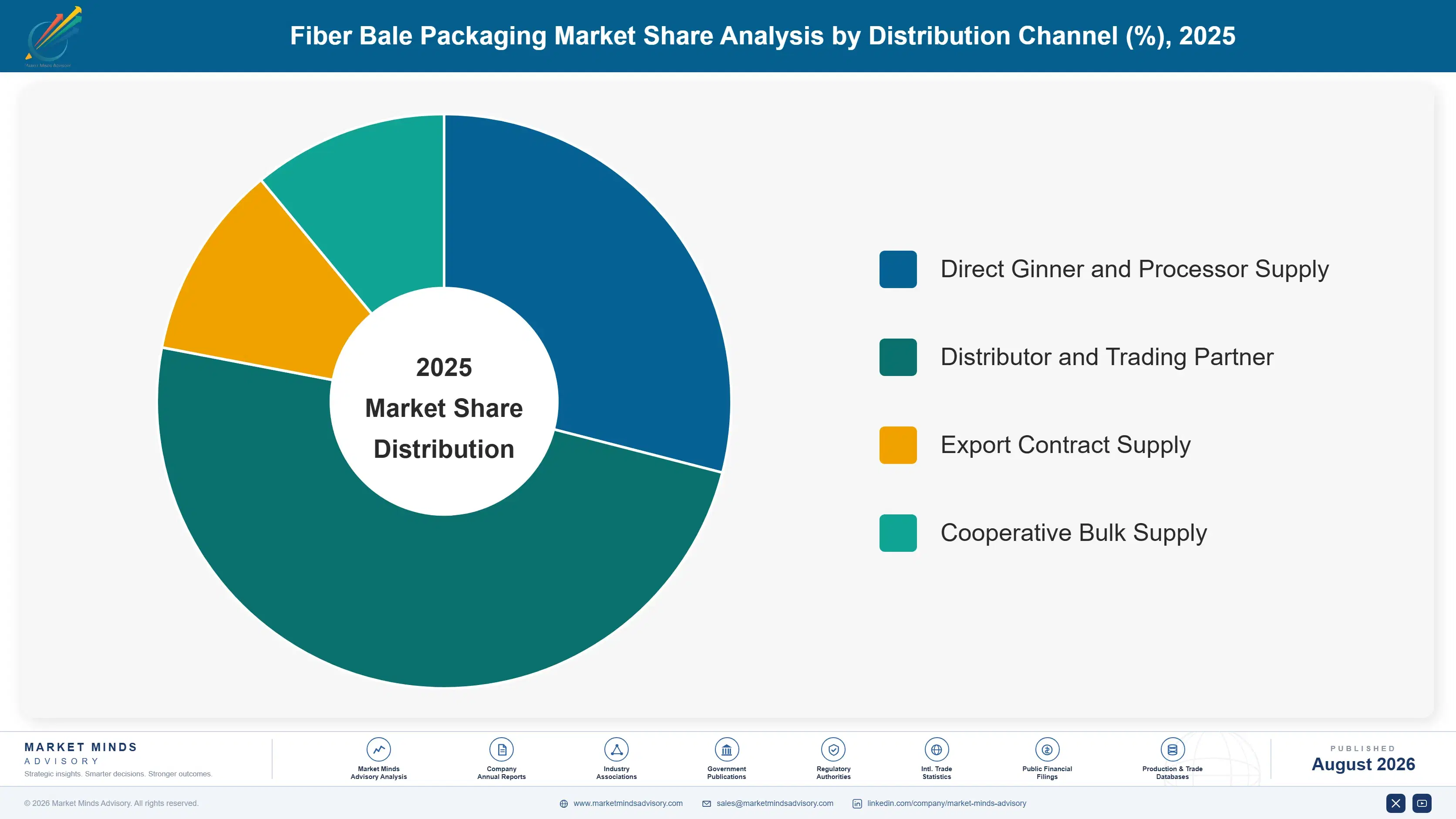
By Distribution Channel

  • Direct Ginner and Processor Supply
  • Distributor and Trading Partner
  • Export Contract Supply
  • Cooperative Bulk Supply

By Region

  • North America
  • Western Europe
  • East Asia
  • South Asia and Pacific
  • Latin America
  • Middle East and Africa
  • Eastern Europe

Scope, Methodology, and Coverage

Every figure in this report is reproducible from documented input assumptions. The scope below maps the historical period, the forecast horizon, the segmentation dimensions, and the countries covered, alongside the underlying primary and qualitative methodology.
Historical Period
2020 to 2025
Forecast Period
2026 to 2036
Base Year
2025 (USD billions; MMA Primary Research Dataset, August 2026)
Market Definition
This report covers the global market for packaging materials used to wrap and secure compressed fiber bales, including cotton, wool, and recovered textile fiber, spanning woven wraps, strapping, and netting products. It excludes finished textile packaging, retail apparel packaging, and general industrial strapping used outside the fiber baling process.
Quantitative Units
USD billions (current prices); million bales of packaging volume where applicable
Segmentation Dimensions
By Material Type; By End-Use Industry; By Distribution Channel; By Region
Regions Covered
North America, Western Europe, East Asia, South Asia and Pacific, Latin America, Middle East and Africa, Eastern Europe
Countries Covered
USA, China, Germany, France, UK, Japan, South Korea, India, Australia, Canada, Brazil, Mexico, Indonesia, Vietnam, Thailand, Malaysia, UAE, Saudi Arabia, South Africa, Nigeria, Turkey, Poland, Netherlands, Italy, Spain, Sweden, Switzerland, Argentina, Colombia, Singapore, and additional markets relevant to this sector
Key Companies Profiled
Signode Industrial Group, Samuel Strapping Systems, FROMM Group, Mosca GmbH, Lohia Corp, Cordstrap, Titan Umreifungstechnik, Teufelberger, Emmbi Industries, Cyklop International, Polychem Corporation, Nefab Group, Bonset America, Intertape Polymer Group, M.J. Maillis Group, Bekaert, Bossen Implex, Illinois Tool Works, National Bulk Containers, Amtex Polymers
Quantitative Methodology
Primary survey, n=3,800 respondents, Q4 2025, six countries; demand-side model with trade association cross-validation
Qualitative Methodology
47 expert interviews, Q4 2025; applied to validate demand model assumptions, identify emerging dynamics, and assess competitive positioning
Report Format
PDF and XLSX data workbook (Word format preview document)
Publisher
Market Minds Advisory
Report Code
MMA-2026-PAC-601
Published
August 2026
Contact
sales@marketmindsadvisory.com | www.marketmindsadvisory.com

Purchase the full Fiber Bale Packaging Market Report (2026 to 2036).

The full report expands every section summarized here with complete regional breakdowns, additional segment detail, and extended competitive profiles covering all twenty companies tracked in this study. It includes the full primary survey dataset methodology, detailed feedstock cost modeling, and quarter-by-quarter forecast sensitivity tables not included in this executive summary. Buyers also receive editable data files alongside the formatted report document for internal analysis, board presentation, and strategic planning use. Analyst inquiry access is included for ninety days following purchase, covering both scope and methodology questions in detail.
Complete regional data for all seven regions
Full profiles for all twenty tracked competitors
Editable data files in spreadsheet format
Ninety days of direct analyst inquiry access
Detailed feedstock cost and volatility modeling
Quarter-by-quarter forecast sensitivity scenarios and tables

Built For The People Who Decide

From boardroom strategy to bench-side execution, this report is read cover-to-cover by leaders shaping the next decade of their industry, turning demand scenarios, market dynamics and valuation benchmarks into decisions.
CXOs/ Presidents/ VPs/ Managers
M&A and Corporate Development
Strategy Teams and R&D Heads
Procurement and Product Directors
Regulatory and Compliance Leaders
Investor Relations and Equity Analysts