Market Minds Advisory
Flexible Intermediate Bulk Container (FIBC) Market

Flexible Intermediate Bulk Container (FIBC) Market: Woven Polypropylene And Transferred Liability

Anybody with a loom can weave a bulk bag. Very few can certify one that lifts a tonne over a worker's head, and fewer still can carry what happens when it fails.

Lead Analyst

Bilal Shaikh

Published

August 2026

Make Smarter Decisions with Customized Research Insights

Request a free sample report and evaluate market opportunities, growth trends, and competitive dynamics relevant to your business needs.

2025 MARKET VALUE$5.6BMarket Size 2025
2036 FORECAST VALUE$10.4BBase Case , 2026 to 2036
CAGR 2026 TO 20365.8 %Bull 7.0% / Bear 4.5%
INCREMENTAL OPPORTUNITY$4.5BNet 10- year value creation
EXPANSION MULTIPLE1.76x2036 value over 2026 base
Strategic Levers
M&A Pipeline
Regional Outlook
Country Rankings
Competitive Intelligence
Segmental Deep-dive
Call-Us : 91 93563 13602

Executive Snapshot and Market Trajectory

A bulk bag is woven polypropylene with four lifting loops, and the technology has barely moved in thirty years. What a buyer actually purchases is a certified five to one safety factor and somebody willing to stand behind it when a tonne of material hangs over a worker.
The market reaches USD 5.6 billion in 2025 and compounds at 5.8% to USD 10.41 billion by 2036. Type C conductive constructions grow fastest at 8.7%, exactly 1.50 times the market rate, driven by combustible dust handling rules. East Asia holds 27% of value on Chinese chemical and mineral volume, while South Asia and Pacific takes 17%, well above the band this framework applies, because India both weaves and consumes at scale.
Concentration is remarkably low at 19% across the top five, since weaving capacity is available almost anywhere and certification credibility is not available at all. Roughly 78% of bags are discarded after a single trip, which makes this a very large disposable plastic volume now attracting regulatory attention. Polypropylene is 64% of manufacturing cost, so margins move with a petrochemical the industry does not control.
Market Definition
The flexible intermediate bulk container market covers woven polypropylene bulk bags designed for handling and transporting dry flowable materials in payloads typically between 500 and 2,000 kilograms, spanning Type A, Type B, Type C, and Type D electrostatic constructions, baffle and formstable designs, and ventilated and specialty constructions, together with liners and closures supplied with them. Rigid intermediate bulk containers, drums, small woven sacks below 100 kilograms, flexitanks for liquids, and bulk container liners sold separately are excluded.
Base Year Value
$5.6B in 2025 (MMA Primary Research Dataset, August 2026)
Forecast Period
2026 to 2036, eleven discrete annual values
CAGR
5.8% base case. Bull 7.0%. Bear 4.5%.
Fastest Growth Segment
Type C Conductive Constructions: 8.7% CAGR
Fastest Growth Country
India: 8.6% CAGR
Fastest Growth Region
South Asia and Pacific: 8.0% CAGR
Largest Region
East Asia: 27% of 2025 global value
Market Leaders
Greif, LC Packaging, Berry Global, Conitex Sonoco, Rishi FIBC Solutions. Source: MMA Primary Research Dataset, July 2026.
Primary Survey
n=3,800 procurement and R&D decision-makers, Q4 2025, six countries
Methodology
Demand-side build-up, cross-validated against public data, 47 expert interviews

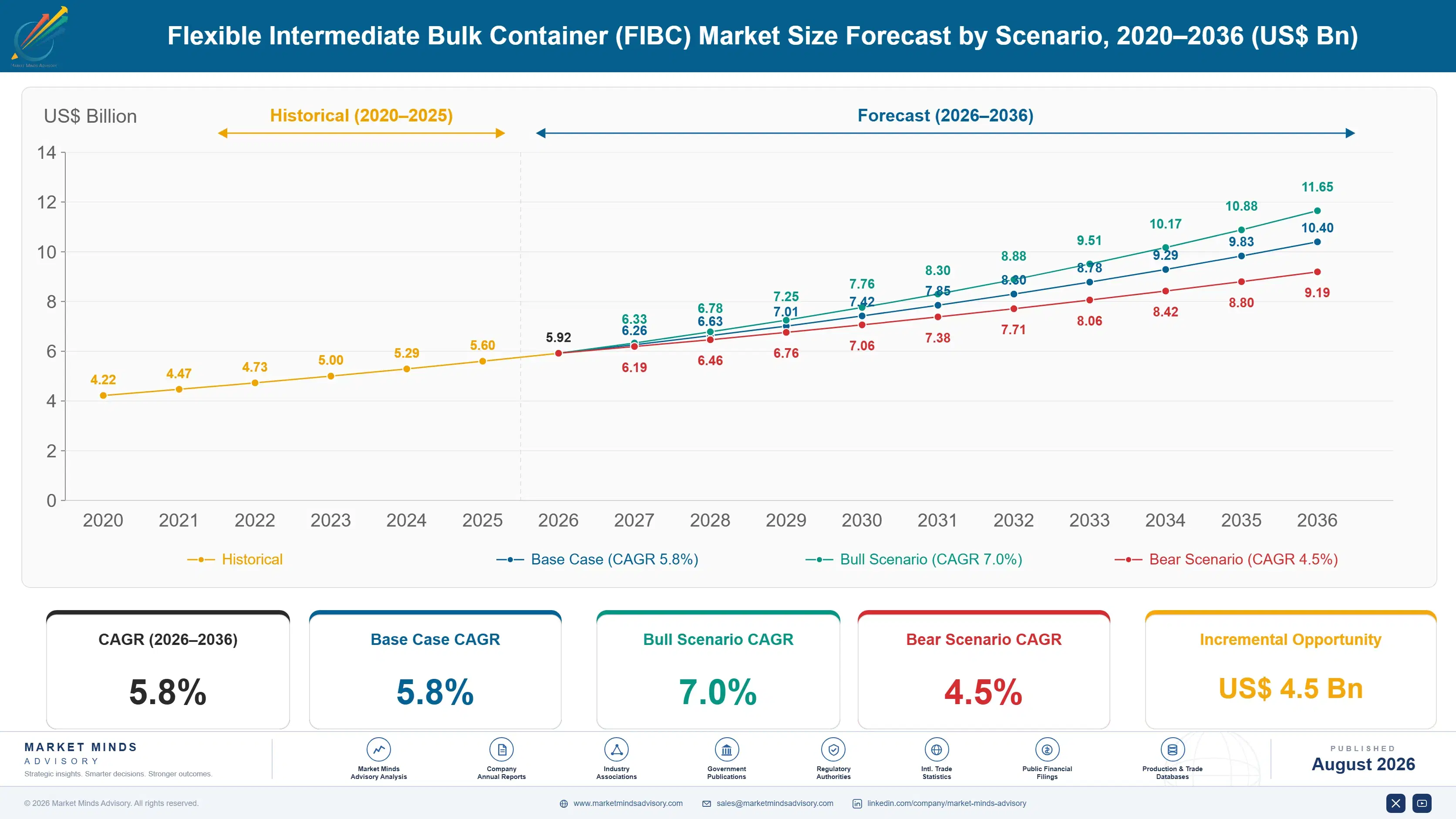
Flexible Intermediate Bulk Container (FIBC) Market Forecast Scenarios

fibc-market-size-forecast-scenario-1787298188119
Between 2020 and 2025 this market was pushed around by resin rather than by demand. Polypropylene pricing spiked through 2021 and 2022 on feedstock and energy costs, converters passed through what they could, and buyers deferred replacement or shifted specification downward. Indian export volumes kept climbing throughout against periodic trade measures. A 4.6% historical CAGR reflects price movement far more than any change in bags shipped.
Three mechanisms carry the 5.8% base case. Combustible dust regulation is the largest, since Type C and Type D constructions are increasingly mandatory where flammable powders are handled and both cost considerably more than a plain bag. Food and pharmaceutical certification is the second, as traceability and clean-room production requirements widen. And Asian chemical and mineral capacity growth is the third, because bulk bag demand follows bulk material handling everywhere it goes.
The 7.0% bull case rests on extended producer responsibility schemes covering industrial packaging, which would fund the reuse and recertification systems that currently cost more than a replacement bag. The 4.5% bear case is polypropylene price collapse feeding straight into selling prices, since converters compete on delivered cost and pass resin movements through in both directions within a quarter.

A Woven Bag And A Liability Position

The product is simple and the liability is not. A single-trip bulk bag must test to five times its marked safe working load, which means a tonne bag is proven at five tonnes, and the entire commercial relationship rests on that certificate being genuine. Loops fail. When they fail, a tonne of material drops from height onto a working floor, and the buyer's procurement decision becomes a legal question.
TOP FIVE CONCENTRATION19%Anyone can weave a bag; few can certify one
SAFETY FACTOR REQUIREMENT5:1Ratio of tested load to marked safe working load
INDIAN PRODUCTION SHARE62%Portion of global bulk bag output woven in one country
SINGLE-TRIP BAG SHARE78%Proportion discarded after one use rather than recertified
RESIN COST SHARE64%Polypropylene contribution to the finished bag manufacturing cost
TYPICAL BAG PAYLOAD1,000 kgStandard load a bulk bag is designed to carry
Electrostatic classification is the second liability layer and it is poorly understood by many buyers. Type A offers no static protection at all, Type B limits breakdown voltage, Type C requires grounding during filling and discharge, and Type D dissipates charge without grounding. Using a Type A bag with a combustible powder is how dust explosions happen. Regulation has pushed steadily toward Type C and Type D across chemicals, food, and minerals.
Manufacturing sits almost entirely in one place. Roughly 62% of world output is woven in India on integrated polypropylene tape lines, with China, Turkey, and Vietnam supplying most of the balance. That concentration has attracted antidumping attention repeatedly. It also means Western converters are largely distributors holding certification, quality systems, and liability rather than looms.
"Buyers benchmark bulk bags by the piece, which is like benchmarking parachutes by the square metre. The certificate is the product. I have seen procurement save eleven cents a bag and then spend two years in litigation over a dropped load."
Director, Industrial Packaging And Bulk Handling Practice · MMA Packaging Practi

Market Trends

Combustible Dust Rules Force Conductive Bag Adoption

Regulatory attention to combustible dust following a series of industrial explosions has pushed chemical, food, and mineral processors toward Type C and Type D constructions wherever flammable powders are filled or discharged. Both cost substantially more than a plain Type A bag, with conductive yarn or antistatic fibre adding roughly 40% to material cost. The specification change is being driven by insurers and site safety audits rather than by any purchasing preference, which makes the shift considerably more durable than any ordinary commercial trend would be. Converters without conductive weaving capability are simply excluded from the work.
Market Impact: Bags carry 1,000 kg each
Food And Pharmaceutical Certification Reshapes Manufacturing Requirements

Bulk bags carrying food ingredients or pharmaceutical intermediates now require clean-room or controlled-environment production, documented resin traceability, metal detection, and audit trails that ordinary industrial weaving operations simply do not run. That has split the supplier base into those who invested and those who cannot bid for the work at all. Certified production commands price premiums of 25% to 45% over standard industrial bags, and the audit burden on the buyer side effectively locks approved suppliers in place for years afterwards. Requalifying an alternative means repeating a nine month process nobody volunteers for.
Market Impact: Replaces 20 small sacks each

Market Opportunities and Growth Drivers

Asian Chemical And Mineral Capacity Pulls Bag Demand

Bulk bags follow bulk material handling with almost no lag, so every polymer plant, fertiliser unit, and mineral processing facility commissioned across Asia generates recurring bag demand from the day it starts. Chinese chemical capacity additions alone consume enormous volumes of woven polypropylene packaging annually. Indian fertiliser and agrochemical output adds a great deal more on top of that. Gulf polymer and sulphur production contributes another substantial recurring stream. This demand is genuinely mechanical rather than discretionary: material has to leave the plant in something, and below full container load quantities that something is almost always a bulk bag.
Market Impact: Resin is 64% of cost

Bulk Bags Displace Drums And Small Sacks On Handling Cost

Moving a tonne of material in one lift rather than twenty small sacks removes manual handling, cuts warehouse labour, and reduces packaging weight per tonne shipped by a wide margin. Set against steel or fibre drums, a bulk bag costs a small fraction as much and folds flat when it is empty, which transforms return logistics. That substitution has been running for three decades and continues wherever manual handling regulations tighten or labour costs rise, particularly across food ingredients, agricultural inputs, and construction materials where volumes are large and margins thin.
Market Impact: 78% discarded after one trip

Market Restraints and Challenges

Polypropylene Price Movement Passes Straight Through Margins

Resin accounts for roughly 64% of manufacturing cost, and converters competing on delivered price per bag have almost no ability to hold a price increase or retain a decrease. The root cause is that the product is undifferentiated at the commodity end, so any converter absorbing resin movement simply loses the order to one who did not. Commercially, margins compress whenever resin rises faster than contracts reprice. Participants mitigate through quarterly indexation clauses, through resin hedging where liquidity allows, and through moving mix toward certified grades where price is less exposed.
Market Impact: Conductive yarn adds 40% cost

Single-Trip Disposal Attracts Growing Regulatory Attention

Roughly 78% of bulk bags are discarded after one use, because inspection, cleaning, and recertification typically cost more than a replacement bag does. The root cause is that safety certification cannot be assumed to survive a trip whose handling history nobody documented. Commercially this leaves a very large industrial plastic waste stream that is now beginning to appear in packaging regulation across several jurisdictions. Mitigation runs toward documented multi-trip programmes with tracked bag histories, toward recycled content in non-food constructions, and toward take-back schemes operated jointly with individual major users.
Market Impact: Certification commands 45% price premium
2 additional market trends, 4 additional growth drivers, and 3 additional restraints and challenges are covered in the full report. Contact sales@marketmindsadvisory.com to access the complete intelligence.

Segment CAGR and Growth Architecture

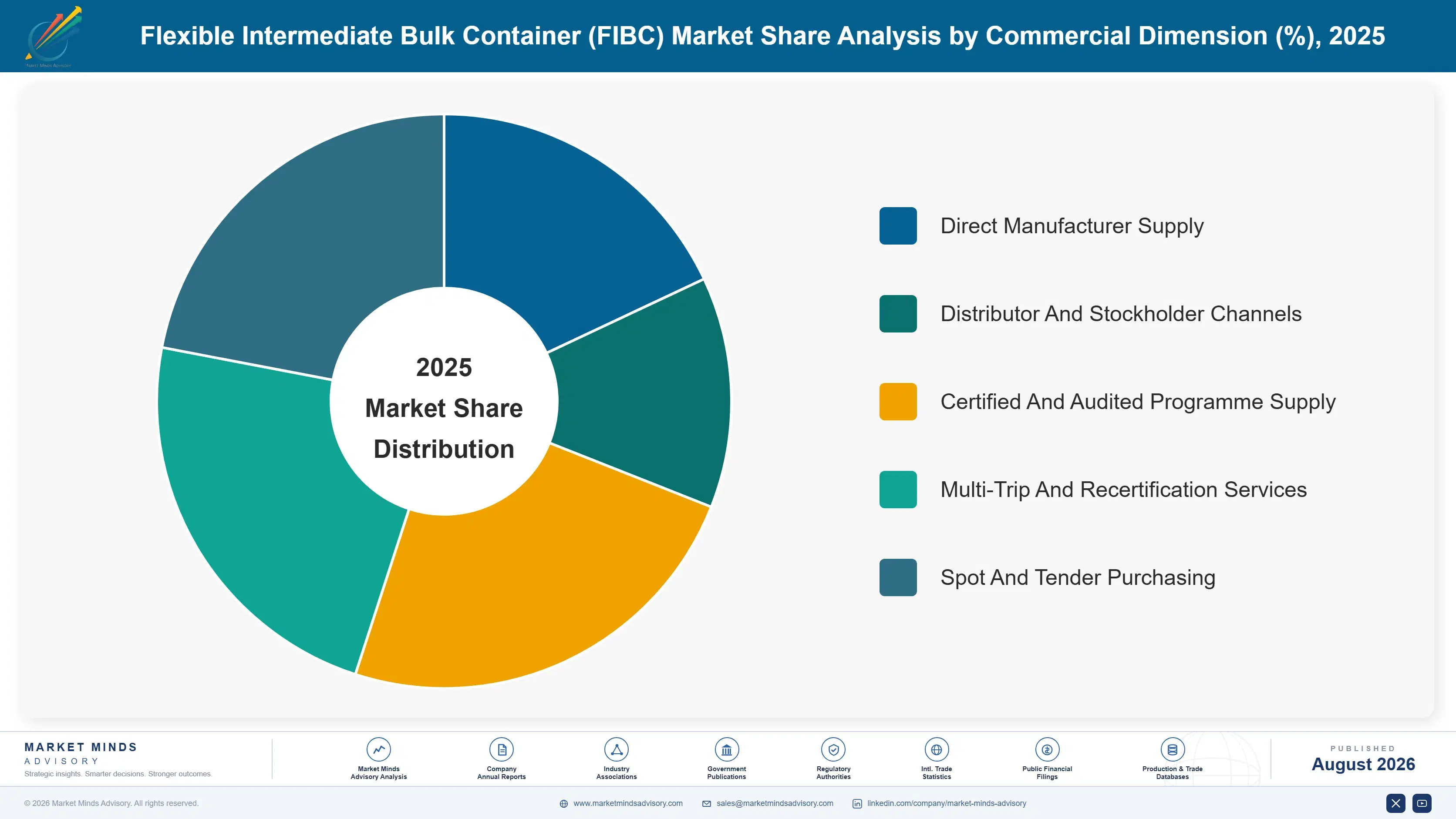
Segmentation follows bag construction, because construction determines the electrostatic protection a bag provides, the materials and yarns it needs, the applications regulation permits it to serve, and the price a buyer pays. Payload size, end-use industry, and certification route are handled in the framework and in commentary rather than being treated as separate segments here.
fibc-market-market-share-analysis-1787298188656

Type C Conductive Constructions

Type C grows fastest at 8.7%, exactly 1.50 times the market rate, weaving conductive threads through the fabric in an interconnected grid that must be grounded during filling and discharge. That grounding requirement is both its strength and its weakness: correctly connected it handles flammable powders and solvent atmospheres safely, and a missed connection removes the protection entirely without any visible sign. Conductive yarn adds roughly 40% to the material cost of a bag. Combustible dust regulation and insurer requirements rather than buyer preference drive the adoption, which makes this growth considerably more durable than any ordinary commercial trend. Site safety assessments now name the specification directly, removing it from procurement's discretion entirely.
CAGR 8.7%

Type D Antistatic Constructions

Type D grows at 8.1%, dissipating static charge through specially engineered antistatic fibres without needing any grounding connection at all, which removes the single largest failure mode in Type C use. Operators cannot forget to ground a bag that requires no grounding. The fabric costs more than Type C and the performance can be affected by surface contamination or high humidity, which limits some applications. Adoption runs strongest where filling operations are manual or where grounding discipline cannot be reliably enforced across shifts, and it continues taking share from Type C for exactly that reason. European chemical producers have begun standardising on it after finding grounding failures during internal safety audits.
CAGR 8.1%
Full segment breakdown across 6 segments available in the complete report.

Regional Architecture and Country Demand Map

Two regions sit outside this framework's bands, and manufacturing geography explains both of them. Bulk bags are woven where polypropylene tape lines and labour are cheapest and then shipped worldwide, so production and consumption sit in noticeably different places from one another around the world.

East Asia

East Asia holds 27% of value, the largest share of any region, on Chinese chemical, mineral, and construction material volume that has to leave plants in something. Domestic weaving capacity is substantial and mostly serves the home market rather than export, unlike India. Chinese converters have moved steadily up the specification ladder into Type C and food grade production as domestic safety enforcement has tightened over recent years. Japanese and Korean demand is considerably smaller and skews heavily toward certified and specialty constructions. Export volumes are modest compared with India despite comparable installed weaving capacity. Growth at 6.5% exceeds the global rate on continued chemical capacity additions rather than specification upgrade.
Share: 27% | CAGR: 6.5% (2026 to 2036)

South Asia and Pacific

South Asia and Pacific takes 17% of value against a 12% ceiling in this framework, and India explains the entire breach because it both weaves and consumes at scale. Roughly 62% of world output comes off Indian integrated polypropylene tape lines, and while most is exported, domestic fertiliser, agrochemical, and cement demand is very large in its own right. Indian producers have invested heavily in food and pharmaceutical certified capacity specifically to move beyond commodity export into direct supply. Bangladeshi and Vietnamese capacity is growing behind them. Australian mineral handling adds steady volume at higher specification levels than the regional average. Growth at 8.0% is the fastest of any region in this forecast.
Share: 17% | CAGR: 8.0% (2026 to 2036)
Regional intelligence for 5 additional markets available in the complete report: North America, Western Europe, Latin America, Middle East and Africa, Eastern Europe. Contact sales@marketmindsadvisory.com.
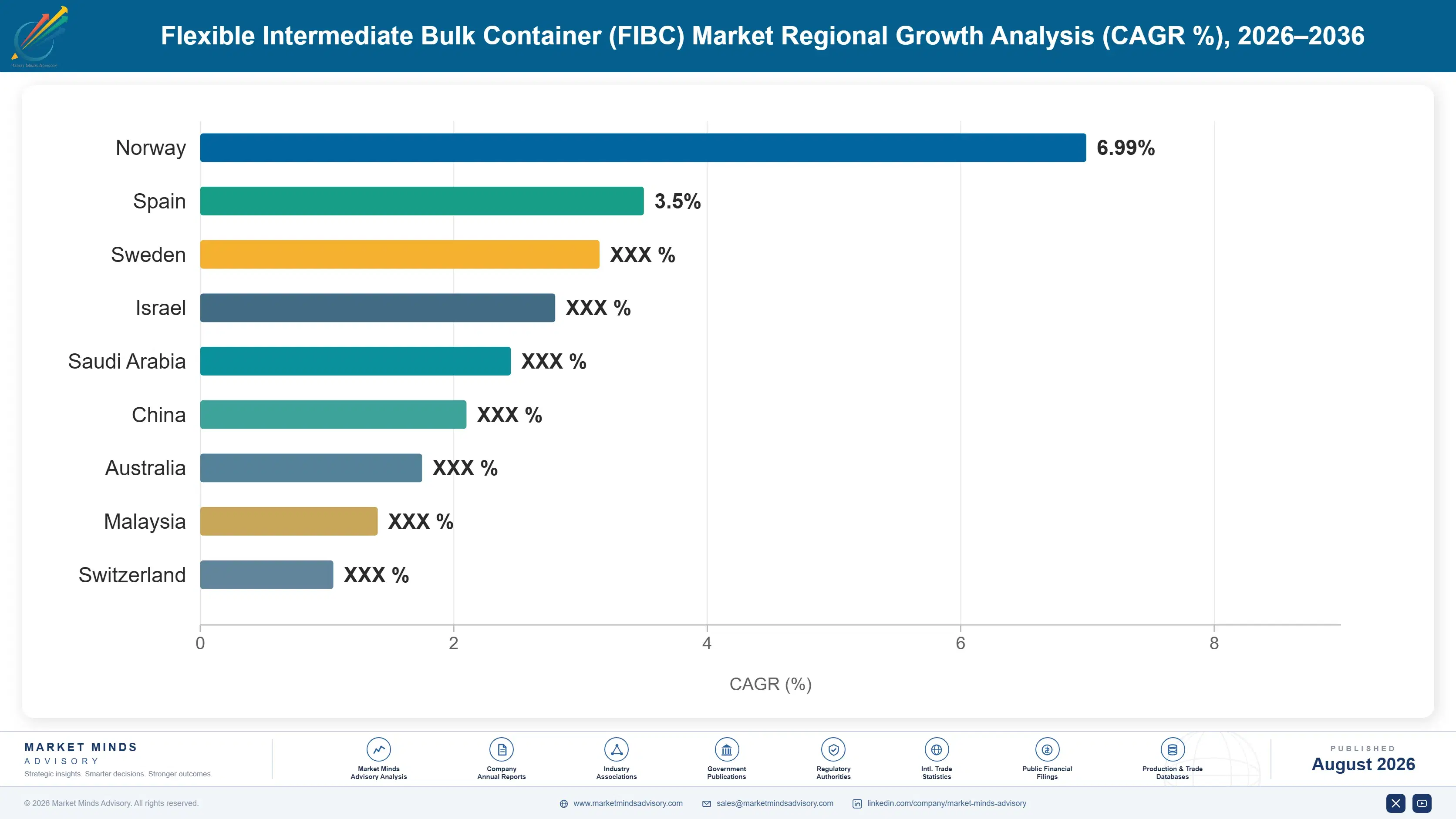
fibc-market-country-cagr-analysis-1787298189177

Selling Certificates, Not Woven Fabric

Weaving capacity is available to anybody, so no lever here works through manufacturing. Certification depth, liability capacity, indexation discipline, and documented reuse programmes each move a converter out of the commodity comparison that procurement teams default to. Four follow, and every one of them raises the cost of switching supplier rather than lowering the price per bag.

Invest In Food And Pharmaceutical Certified Capacity

Clean-room production, documented resin traceability, metal detection, and audit-ready quality systems cost roughly USD 3 million to establish at an existing weaving site and exclude every competitor who has not made that investment. Certified bags command price premiums of 25% to 45% over standard industrial equivalents. The audit burden on the buyer side is what really protects the position, since requalifying an alternative supplier means repeating a process that took nine months the first time and nobody in a quality function ever volunteers for that. Approved suppliers routinely hold accounts for a decade or more as a direct result.
Market Impact: Premiums run 25% to 45% above standard bags

Carry The Liability Rather Than Passing It Upstream

Buyers are purchasing an assurance that a tonne will not drop on a working floor, and a distributor who disclaims responsibility and points at an offshore weaver has sold nothing of value. Holding product liability cover, running independent batch testing, and standing behind failures converts a commodity transaction into a supplier relationship. That position supports 12% to 18% higher pricing than pure import broking, and it is precisely why Western converters survive commercially without owning a single loom of their own. Independent batch testing costs very little against the pricing it defends.
Market Impact: Supports 12% to 18% higher pricing than broking

Index Resin Cost In Every Supply Agreement

Polypropylene is 64% of manufacturing cost and moves faster than any annual contract reprices, so a fixed-price agreement is a bet on petrochemical markets that no converter is equipped to win. Quarterly indexation to a published polymer benchmark removes that exposure entirely, and buyers accept it readily because the alternative they receive is a quotation padded for risk they end up paying for anyway. Converters still running annual fixed pricing are exactly the ones whose margins vanish during every resin upcycle, and several exited the industry during the last one rather than trade through it.
Market Impact: Resin runs at 64% of the total cost

Run Documented Multi-Trip Programmes With Major Users

Around 78% of bags go to landfill after a single trip because nobody can certify a bag whose handling history is unknown. A tracked programme with a single large user, where bags return on documented routes and get inspected and recertified, changes that arithmetic completely. Recertification runs at roughly 35% of new bag cost while producing recurring service revenue rather than a one-off sale, and it effectively locks in the account for the full life of the scheme. Extended producer responsibility rules reaching industrial packaging would make this economics considerably more attractive.
Market Impact: Recertification costs 35% of a new bag price

Who Controls the Margin Pool

Concentration is remarkably low at 19% across the top five, which reflects an industry where manufacturing capability is genuinely available to anybody with a tape line and a loom. All participants here are compared on measured global revenue from flexible intermediate bulk containers and directly associated liners and services, which places integrated Asian weavers and Western certification businesses on the same basis.
Competition runs on certification, liability capacity, and lead time rather than on manufacturing cost, at least in the segments worth serving. Greif and Berry both combine industrial packaging breadth with bulk bag positions. LC Packaging holds deep European food and pharmaceutical relationships while sourcing fabric from Asia. Conitex Sonoco competes across industrial grades. Rishi and other Indian producers have moved beyond commodity export into certified production for direct supply.

Pressure is coming from Indian producers moving up the value chain rather than from any new entrant. Certified capacity in India now competes for work that previously required a Western intermediary, which threatens distributors whose only contribution was quality assurance. Rankings shift on certification investment and on trade measures, since antidumping duties periodically reshape which origin can serve which market at what landed cost.
fibc-market-company-positioning-matrix-1787298189706

Competitive Moat and Risk Dimensions

GREIF

Moat: Industrial Packaging Portfolio Breadth

Greif supplies bulk bags alongside steel and fibre drums, intermediate bulk containers, and reconditioning services, which lets an industrial customer consolidate packaging procurement across formats with one supplier. That breadth wins contracts where a bulk bag specialist can only bid on part of the requirement, and it makes the relationship considerably harder for a single-format competitor to dislodge.
GREIF

Risk: Commodity Exposure Across Multiple Formats

The same breadth means several product lines sit in undifferentiated markets where resin, steel, and fibre costs pass straight through to price. Bulk bags are a modest line inside the group and compete for capital against businesses with better returns. Certified and conductive constructions, where the growth actually sits, demand focused investment the group has not obviously prioritised.
LC PACKAGING

Moat: European Food Certification Relationships

The company holds long-standing food and pharmaceutical approvals with European ingredient and specialty chemical users, built through audit cycles that took years and would take a competitor just as long to repeat. Buyers requalifying an alternative supplier face nine months of process nobody volunteers for. Owned manufacturing gives it cost control alongside the certification position.
LC PACKAGING

Risk: Indian Certified Capacity Bypassing Intermediaries

Indian producers have invested heavily in food and pharmaceutical certified capacity and increasingly hold approvals to supply European buyers directly. Where a distributor's contribution was quality assurance and certification, that value erodes as the weaver acquires it independently. Defending the position requires services beyond certification, which is a different business from the one built over three decades.

Players Tracked

Prominent Players

Greif
LC Packaging
Berry Global
Conitex Sonoco
Rishi FIBC Solutions

Other Key Players

Global-Pak
Intertape Polymer Group
Bulk Lift International
BAG Corp
Sackmaker
Halsted Corporation
Emmbi Industries
Jumbo Bag Limited
Kanpur Plastipack
Flexituff International
Bulk Corp International
Taihua Group
Shandong Ruiyuan
Nihon Matai
Isbir Sentetik

Recent Developments

FEBRUARY 2025

Indian Producer Commissions Food Grade Clean Room Weaving Capacity

An Indian bulk bag manufacturer commissioned additional clean-room certified production capacity for food and pharmaceutical grade containers, targeting direct supply to European and North American ingredient users. The investment was organic and internally funded, and it followed audit approvals obtained from several multinational food companies during the previous year.
Signal: Certified weaving capacity inside India removes the quality assurance role that Western intermediaries had historically sold
JUNE 2025

European Chemical Group Standardises On Type D Constructions

A European specialty chemical producer standardised on Type D antistatic bulk bags across its powder handling sites, replacing Type C constructions that required operator grounding at every fill point. The company cited grounding compliance failures found during internal safety audits rather than any change in regulatory requirement.
Signal: Grounding discipline failures rather than any regulation are moving specification from Type C toward Type D
SEPTEMBER 2025

Trade Authority Opens Review Of Imported Bulk Bag Pricing

A national trade authority opened an antidumping review covering imported woven polypropylene bulk bags following petitions from domestic converters. The review examines landed pricing against domestic production cost, and any resulting duties would reshape which origins can economically serve that market at prevailing specification levels.
Signal: Trade measures rather than any competitive capability now decide which origin can economically serve which market

Polypropylene And Everything Else

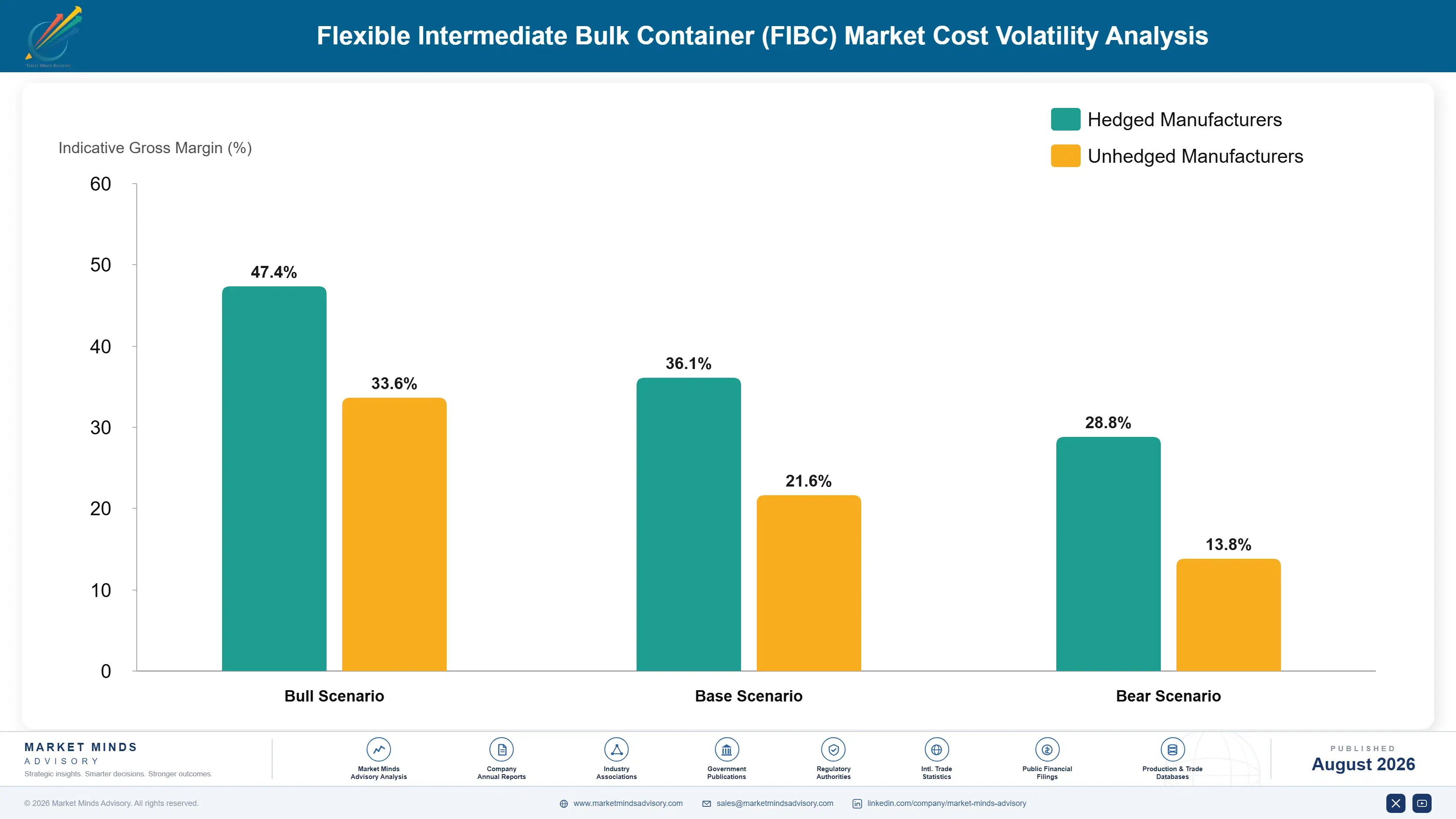
Polypropylene resin accounts for roughly 60% to 68% of manufacturing cost, sourced from petrochemical producers across the Gulf, India, and Northeast Asia, and it moves with propylene and therefore with crude and naphtha. Conductive and antistatic yarns add 6% to 11% on Type C and Type D constructions. Weaving, cutting, sewing, and testing labour accounts for 12% to 18%, which is why production concentrates where labour costs least.
Polypropylene pricing rose sharply through 2021 and into 2022 as feedstock and European energy costs climbed with the gas shock the IEA documented that year, and converters running annual fixed-price contracts absorbed the whole move. Berry Global's 2022 annual report described substantial resin cost inflation and the lag before pass-through took effect. Several smaller weavers exited the industry during that period rather than attempt to trade through it.

Exposure separates by contract structure rather than by scale. A converter with quarterly indexation to a published polymer benchmark carries almost no resin risk and competes on service. One holding annual fixed pricing is running an unhedged petrochemical position it has no capability to manage. Indian weavers buying domestic resin sit on a different cost curve, though it moves in the same direction.
fibc-market-cost-volatility-analysis-1787298189903

Index Resin To A Published Polymer Benchmark Quarterly

Annual fixed pricing on a product where resin is nearly two thirds of total cost is an unhedged petrochemical position, and no bulk bag converter anywhere is equipped to manage one. Quarterly indexation to a published polymer benchmark removes that exposure, and buyers accept it because the alternative quotation always carries a risk premium.

Qualify Resin Supply Across Two Producing Regions

Polypropylene grades suitable for tape extrusion come from a limited set of producers, and single-region sourcing adds freight, trade, and outage exposure that has nothing to do with price. Qualifying a second regional supplier requires extrusion trials and finished bag testing over several months, and it converts a supply interruption into a commercial choice rather than a production stop.

Move Mix Toward Certified And Conductive Constructions

Standard Type A bags compete purely on delivered cost, so resin movement flows straight to margin with nothing to absorb it. Certified food grade and Type C or Type D constructions carry premiums of 25% to 45%, which gives a converter room to absorb short-term resin movement without losing the account or repricing mid-contract.

Portfolio Architecture for Margin Defence

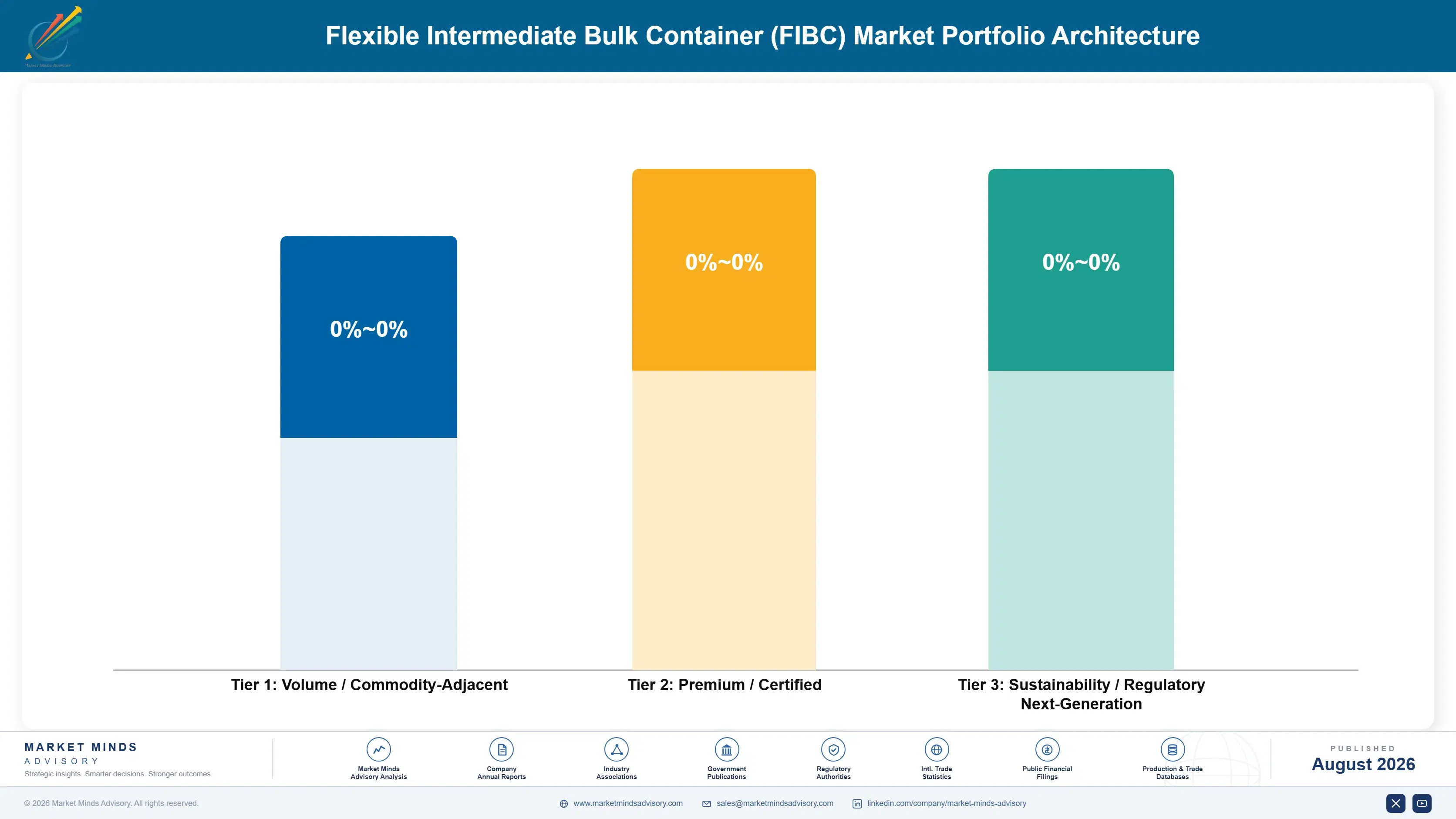
Margin architecture separates by whether the buyer can substitute a cheaper bag without consequence. Standard Type A and Type B industrial constructions earn 7% to 15%, competed on delivered cost per bag against weavers on three continents. Certified food and pharmaceutical grades and Type C and Type D constructions earn 22% to 34%, because audit approval and electrostatic classification both remove the substitution option entirely.
The tension is that the low tier carries most of the tonnage and teaches a converter nothing it can sell elsewhere. Filling looms with commodity Type A work generates volume, absorbs overhead, and builds no defensible position whatsoever. The converters who invested in clean-room capacity and conductive constructions did so by deliberately turning away commodity volume, which is an uncomfortable decision to explain in a low-utilisation quarter.

High-value pools concentrate in certified food and pharmaceutical production, conductive constructions, and documented multi-trip service programmes. All three raise switching cost rather than lowering price, which is the only defence available in a product anybody can weave. Multi-trip programmes carry the widest margin range, because a tracked service contract and an untracked one are entirely different businesses.

Volume / Commodity-Adjacent

Standard Type A and Type B industrial bulk bags sold on delivered cost per unit against weavers across three continents. The eight-point range separates integrated producers weaving their own tape from converters buying woven fabric and finishing it locally.
Gross Margin: 7% to 15%

Premium / Certified

Food and pharmaceutical certified constructions, Type C and Type D electrostatic bags, and UN-certified hazardous goods containers. The twelve-point range separates conductive industrial work from clean-room food grade production, where audit barriers are considerably higher and pricing follows.
Gross Margin: 22% to 34%

Sustainability / Regulatory / Next-Generation

Documented multi-trip and recertification programmes, recycled content constructions, and take-back schemes with major users. The twenty-six point range reflects genuine divergence: recycled content competes on price while tracked recertification services carry recurring service economics.
Gross Margin: 16% to 42%
fibc-market-portfolio-architecture-1787298190406

High-value Sub-segments and Strategic Watch-out

Certified Food Grade Production

Strong growth and the best margins in the market, protected by audit approval processes that take nine months and that no buyer wants to repeat. Clean-room capacity costs around three million dollars to establish. Indian producers are now investing in it and supplying European buyers directly.
Gross Margin: 26% to 34%

Type C And Type D Constructions

High growth driven by combustible dust regulation and insurer requirements rather than by buyer preference, which makes the demand unusually durable. Conductive yarn adds roughly forty percent to material cost. Type D is taking share from Type C on grounding compliance failures found during audits.
Gross Margin: 22% to 30%

Standard Industrial Type A Bags

The volume core of this market, carrying most of the tonnage at margins that barely cover overhead and offering no defence against any weaver anywhere. Resin movement passes straight through. This tier fills looms and builds nothing a converter can sell into a different account.
Gross Margin: 7% to 15%

Single-Trip Disposal Volumes

Strategic watch-out. Roughly seventy-eight percent of bags reach landfill after one use, and industrial packaging is beginning to appear in extended producer responsibility schemes. Converters whose volume depends on disposal economics face a cost structure that packaging regulation could reprice quickly and without much warning.
Gross Margin: 7% to 15%

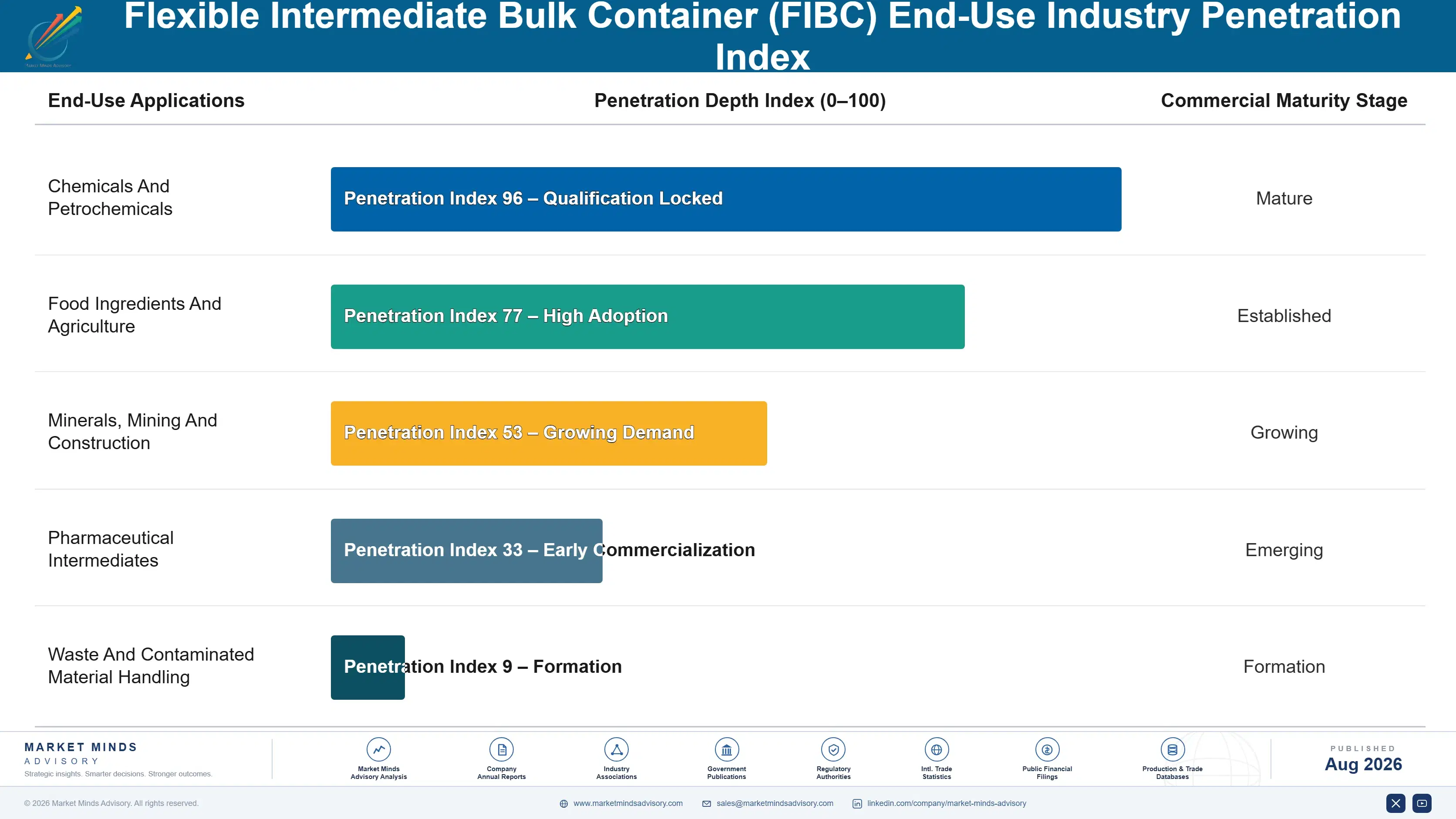
How Bag Volume Recurs

The annuity here is the material stream rather than any contract. A plant shipping fifty thousand tonnes of powder a year needs fifty thousand bags a year, every year, and the requirement stops only when the plant does. Around 78% go to landfill afterwards, so nothing returns to reduce next year's order. That makes demand unusually predictable, which is exactly why procurement teams feel confident tendering it annually on price alone.
Depth varies sharply by specification. Food and pharmaceutical certified supply is the stickiest, because requalifying an alternative supplier means repeating an audit process that took nine months and that nobody in quality assurance wants to run again. Conductive constructions are nearly as durable once a site safety assessment names a specification. Standard industrial bags are the shallowest, moving on a few cents per unit at every tender.

Buyer profiles have shifted in a way that punishes commodity suppliers. Purchasing moved from plant-level buyers who understood bag construction toward centralised procurement comparing unit prices across sites, while safety and quality functions gained veto over specification. Both changes reward converters who engage with site safety assessments, and they erode anybody whose only argument is the quoted number.
fibc-market-end-use-penetration-index-1787298190897

Where We Come Out

These are among the four positions where our research anticipates prominent divergence between winners and laggards over the coming forecast period. Each is grounded in the demand model, the regulatory perimeter, and the announced capacity pipeline.
01 / CERTIFICATION INVESTMENT PRIORITY

Audit approval is the only barrier weaving capacity cannot cross

Anybody with a tape line and a loom can produce a standard bulk bag, which is precisely why the top five hold under a fifth of this market between them. Food and pharmaceutical certification costs around three million dollars to establish at an existing site and takes buyers nine months of audit work to approve, which nobody in quality assurance volunteers to repeat for a few cents. That asymmetry is the entire defence available in a product this simple to manufacture.
02 / LIABILITY POSITION OWNERSHIP

Disclaiming responsibility means you have sold nothing at all

A buyer purchasing a bulk bag is purchasing an assurance that a tonne of material will not drop onto a working floor, tested at five times the marked load. A distributor who disclaims responsibility and points at an offshore weaver has not sold that assurance and cannot charge for it either. Holding product liability cover, running independent batch testing, and standing behind failures supports pricing twelve to eighteen percent above import broking, and it is why Western converters survive owning no looms.
03 / RESIN INDEXATION DISCIPLINE

Fixed annual pricing is an unhedged petrochemical bet

Polypropylene is roughly two thirds of manufacturing cost and moves considerably faster than any annual contract reprices, so a fixed-price agreement puts a converter into a commodity position it has no capability whatsoever to manage. Quarterly indexation to a published polymer benchmark removes that exposure completely, and buyers accept it readily because a padded fixed quotation costs them more across a stable market. Converters still holding annual fixed pricing lose their margin during every resin upcycle without exception, and several exited the industry entirely during the last one.
04 / REUSE PROGRAMME DEVELOPMENT

Single-trip economics will not survive producer responsibility rules

Roughly seventy-eight percent of bulk bags reach landfill after one trip, because certifying a bag whose handling history nobody documented costs more than buying a new one. Extended producer responsibility schemes are beginning to reach industrial packaging formats, and when they do that arithmetic reverses quickly. Tracked multi-trip programmes with documented return routes cost around thirty-five percent of a new bag to inspect and recertify, and they generate recurring service revenue rather than a single one-off transaction with no follow-on.

Engagement Snapshot From the Field

A live engagement with an industry participant carrying material or product regulatory and market exposure ahead of a defining policy shift, showing how our research translates into a defensible multi-year portfolio strategy.
MARKET MINDS ADVISORY · CLIENT ENGAGEMENT SUMMARY
Flexible Intermediate Bulk Container (FIBC) Producer Strategic Portfolio Review and Transition Roadmap 2026·Investment Scenario on Flexible Intermediate Bulk Container (FIBC) Exposure Evaluation 2025-26
CLIENT PROFILE
A European bulk packaging distributor supplying woven polypropylene containers to chemical, food ingredient, and mineral customers across nine countries, with roughly EUR 96 million in annual revenue (client-reported, unverified by MMA). The business owned no manufacturing, sourcing all fabric and finished bags from Indian and Turkish weavers, and its value proposition rested on certification management, quality assurance, and stock holding.
STRATEGIC CHALLENGE
Two long-standing food ingredient accounts had begun buying directly from Indian producers who had obtained the same audit approvals the client held, removing the quality assurance role that justified its margin. Standard industrial business was simultaneously losing on price to importers with no stock holding costs. The board needed to establish what, if anything, it was still selling.
MMA APPROACH
MMA analysed margin and retention by account and specification across four years, interviewed twenty-two customer quality and procurement leads on why they buy through a distributor at all, and assessed which Indian and Turkish suppliers held approvals that made direct supply feasible. Liability arrangements, stock service levels, and recertification economics were modelled as alternative sources of defensible value.
KEY FINDINGS
  1. Accounts where the client held product liability and performed independent batch testing retained at 94%, against 61% where it functioned purely as an importer of certified bags.
  2. Seventeen of twenty-two customers named lead time and emergency stock availability, not certification, as the reason they used a distributor rather than importing directly themselves.
  3. Standard Type A business ran at 9% gross margin and consumed 44% of working capital, with no account in that tier retained longer than three years.
  4. Indian suppliers holding equivalent food approvals could serve the client's two largest accounts directly, and had already quoted roughly 14% below the client's landed cost.
CLIENT PROFILE
A European bulk packaging distributor supplying woven polypropylene containers to chemical, food ingredient, and mineral customers across nine countries, with roughly EUR 96 million in annual revenue (client-reported, unverified by MMA). The business owned no manufacturing, sourcing all fabric and finished bags from Indian and Turkish weavers, and its value proposition rested on certification management, quality assurance, and stock holding.
STRATEGIC CHALLENGE
Two long-standing food ingredient accounts had begun buying directly from Indian producers who had obtained the same audit approvals the client held, removing the quality assurance role that justified its margin. Standard industrial business was simultaneously losing on price to importers with no stock holding costs. The board needed to establish what, if anything, it was still selling.
MMA APPROACH
MMA analysed margin and retention by account and specification across four years, interviewed twenty-two customer quality and procurement leads on why they buy through a distributor at all, and assessed which Indian and Turkish suppliers held approvals that made direct supply feasible. Liability arrangements, stock service levels, and recertification economics were modelled as alternative sources of defensible value.
KEY FINDINGS
  1. Accounts where the client held product liability and performed independent batch testing retained at 94%, against 61% where it functioned purely as an importer of certified bags.
  2. Seventeen of twenty-two customers named lead time and emergency stock availability, not certification, as the reason they used a distributor rather than importing directly themselves.
  3. Standard Type A business ran at 9% gross margin and consumed 44% of working capital, with no account in that tier retained longer than three years.
  4. Indian suppliers holding equivalent food approvals could serve the client's two largest accounts directly, and had already quoted roughly 14% below the client's landed cost.
RECOMMENDED STRATEGY
Phase 1: Phase one: exit standard Type A business below a defined margin floor and release the working capital tied up in commodity stock holding. Phase 2: Phase two: formalise product liability cover and independent batch testing as a priced service, and market it explicitly rather than assuming customers value it. Phase 3: Phase three: build a tracked multi-trip recertification programme with the two largest mineral accounts, using released working capital to fund inspection capacity.
OUTCOME
The client exited commodity Type A supply over three quarters and launched the recertification programme with one mineral customer. Revenue fell 11% while gross margin rose from 16% to 24%, and the two food accounts at risk both renewed after the liability position was priced and presented explicitly (client-reported, unverified by MMA).

Frequently Asked Questions

Foundational context covering the market sizes, CAGR, scope, country, region and competition that inform every finding below. This section is provided to cover basics and most often pre-purchase conversations, answered from the MMA Primary Research Dataset.

What is the current size of the Flexible Intermediate Bulk Container (FIBC) Market?

The global FIBC market reached USD 5.6 billion in 2025, covering woven polypropylene bulk bags for dry flowable materials in payloads between 500 and 2,000 kilograms. That includes liners and closures supplied with them.

How large will the Flexible Intermediate Bulk Container (FIBC) Market be by 2036?

MMA forecasts USD 10.41 billion by 2036, up from USD 5.92 billion in 2026, an increase of USD 4.49 billion. That represents an expansion multiple of 1.76 times across the forecast period.

What is the CAGR for the Flexible Intermediate Bulk Container (FIBC) Market 2026 to 2036?

The base case CAGR is 5.8%, with a bull case of 7.0% and a bear case of 4.5%. Historical growth between 2020 and 2025 ran at 4.6%, reflecting polypropylene price movement more than any change in units shipped.

Which segment is growing fastest?

Type C conductive constructions grow fastest at 8.7%, exactly 1.50 times the market rate, on combustible dust regulation and insurer requirements. Type D antistatic constructions follow at 8.1% as grounding compliance failures push specification further.

Who are the major companies in the Flexible Intermediate Bulk Container (FIBC) Market?

Greif, LC Packaging, Berry Global, Conitex Sonoco, and Rishi FIBC Solutions lead, together holding just 19% of the market. Weaving capacity is available to anybody, so concentration stays remarkably low.

Which country is growing fastest?

India grows fastest at 8.6%, and it is unusual in being both the largest producer and a rapidly growing consumer. Roughly 62% of world output is woven on Indian polypropylene tape lines.

Report Segmentation Architecture

The full report scope spans multiple orthogonal segmentation dimensions, with cross-tabulated demand data provided for each dimension pair. Coverage extends further to regional breakdowns, trend trajectories, and the competitive detail needed to support segment-level decision-making.

By Bag Construction

  • Type A Standard Constructions
  • Type B Low Breakdown Voltage
  • Type C Conductive Constructions
  • Type D Antistatic Constructions
  • Baffle And Formstable Designs
  • Ventilated And Specialty Constructions

By End-Use Industry

  • Chemicals And Petrochemicals
  • Food Ingredients And Agriculture
  • Minerals, Mining And Construction
  • Pharmaceutical Intermediates
  • Waste And Contaminated Material Handling

By Commercial Dimension

  • Direct Manufacturer Supply
  • Distributor And Stockholder Channels
  • Certified And Audited Programme Supply
  • Multi-Trip And Recertification Services
  • Spot And Tender Purchasing

By Region

  • East Asia
  • South Asia and Pacific
  • North America
  • Western Europe
  • Latin America
  • Middle East and Africa
  • Eastern Europe

Scope, Methodology, and Coverage

Every figure in this report is reproducible from documented input assumptions. The scope below maps the historical period, the forecast horizon, the segmentation dimensions, and the countries covered, alongside the underlying primary and qualitative methodology.
Historical Period
2020 to 2025
Forecast Period
2026 to 2036
Base Year
2025 (USD billions; MMA Primary Research Dataset, August 2026)
Market Definition
The flexible intermediate bulk container market covers woven polypropylene bulk bags designed for handling, storing, and transporting dry flowable materials in payloads typically between 500 and 2,000 kilograms. Scope spans Type A, Type B, Type C, and Type D electrostatic constructions, baffle and formstable designs, ventilated and specialty constructions, and the liners, closures, and lifting arrangements supplied with them, together with recertification and multi-trip services. Rigid intermediate bulk containers, drums, woven sacks below 100 kilograms, flexitanks for liquids, and separately sold liners are excluded.
Quantitative Units
USD billions at manufacturer and distributor revenue level; units shipped annually; tonnes of polypropylene consumed.
Segmentation Dimensions
By bag construction; by end-use industry; by commercial dimension; by region.
Regions Covered
East Asia, South Asia and Pacific, North America, Western Europe, Latin America, Middle East and Africa, Eastern Europe
Countries Covered
United States, Canada, Germany, Netherlands, Belgium, United Kingdom, France, Italy, Poland, Czech Republic, China, Japan, South Korea, India, Vietnam, Australia, Brazil, Mexico, Saudi Arabia, South Africa.
Key Companies Profiled
Greif, LC Packaging, Berry Global, Conitex Sonoco, Rishi FIBC Solutions, Global-Pak, Intertape Polymer Group, Bulk Lift International, BAG Corp, Sackmaker, Halsted Corporation, Emmbi Industries, Jumbo Bag Limited, Kanpur Plastipack, Flexituff International, Bulk Corp International, Taihua Group, Shandong Ruiyuan, Nihon Matai, Isbir Sentetik.
Quantitative Methodology
Primary survey, n=3,800 respondents, Q4 2025, six countries; demand-side model with trade association cross-validation
Qualitative Methodology
47 expert interviews, Q4 2025; applied to validate demand model assumptions, identify emerging dynamics, and assess competitive positioning
Report Format
PDF and XLSX data workbook (Word format preview document)
Publisher
Market Minds Advisory
Report Code
MMA-2026-PAC-813
Published
August 2026
Contact
sales@marketmindsadvisory.com | www.marketmindsadvisory.com

Purchase the full Flexible Intermediate Bulk Container (FIBC) Market Report (2026 to 2036).

The full MMA report on flexible intermediate bulk containers covers construction type, regional, and competitive analysis in detail, with separate treatment of the certification and liability economics that separate defensible positions from commodity supply. It includes resin cost pass-through modelling by contract structure, food and pharmaceutical audit approval timelines and cost, electrostatic specification adoption tracking by end-use industry, and multi-trip recertification economics. Regional chapters cover twenty countries with production and consumption assessed separately. Competitive profiling spans twenty companies compared on a single consistent revenue basis throughout the analysis.
Twenty country production and consumption demand chapters
Resin cost pass-through modelling by contract structure
Certification approval timelines and investment cost analysis
Electrostatic specification adoption tracking by industry
Twenty company competitive profiles compared consistently
Multi-trip recertification economics and programme models

Built For The People Who Decide

From boardroom strategy to bench-side execution, this report is read cover-to-cover by leaders shaping the next decade of their industry, turning demand scenarios, market dynamics and valuation benchmarks into decisions.
CXOs/ Presidents/ VPs/ Managers
M&A and Corporate Development
Strategy Teams and R&D Heads
Procurement and Product Directors
Regulatory and Compliance Leaders
Investor Relations and Equity Analysts