Market Minds Advisory
Ferrous Sulfate Market

Ferrous Sulfate Market: By-Product Grades Across Water, Cement, Feed and Agriculture, 2026 to 2036

Most of this product is made by companies trying to make something else, which means supply responds to titanium dioxide economics and steel output rather than to anything happening in its own market.

Lead Analyst

Bilal Shaikh

Published

September 2026

Make Smarter Decisions with Customized Research Insights

Request a free sample report and evaluate market opportunities, growth trends, and competitive dynamics relevant to your business needs.

2025 MARKET VALUE$1.3BMarket Size 2025
2036 FORECAST VALUE$2.1BBase Case , 2026 to 2036
CAGR 2026 TO 20364.4 %Bull 5.6% / Bear 3.2%
INCREMENTAL OPPORTUNITY$0.7BNet 10- year value creation
EXPANSION MULTIPLE1.54x2036 value over 2026 base
Strategic Levers
M&A Pipeline
Regional Outlook
Country Rankings
Competitive Intelligence
Segmental Deep-dive
Call-Us : 91 93563 13602

Executive Snapshot and Market Trajectory

Ferrous sulfate is a by-product before it is a product. Roughly 82% of output arises from titanium dioxide sulphate processing and steel pickling rather than from deliberate manufacture, which means supply is set by decisions taken in entirely different markets, for reasons that have nothing to do with this one.
Growth concentrates in feed and pharmaceutical grade monohydrate, expanding at 6.6%, where iron supplementation in animal nutrition and human anaemia treatment carries specification requirements and pricing that technical grades never come close to approaching. East Asia holds 30% of value, the largest regional share, because Chinese sulphate-route titanium dioxide capacity and steel pickling volumes together generate more by-product ferrous sulfate than any other region has to place.
The supplier base is fragmented, with the top five holding 29% of tonnage, because by-product output attaches itself to wherever pigment and steel plants happen to sit rather than to where demand is. Competition runs on freight position and drying capability rather than on chemistry, since the compound is identical whoever produces it. Cement chromate regulation is what turned a disposal problem into a genuine commercial product across most of Europe.
Market Definition
The market comprises ferrous sulfate in its hydrated and dried forms supplied for commercial use, spanning feed and pharmaceutical grade monohydrate, granulated cement chromate reduction grades, liquid solution grades, technical heptahydrate and fertiliser micronutrient grades. Sizing captures revenue at realised delivered price across water and wastewater treatment, cement manufacture, animal feed, agriculture, pigment production and industrial applications. Iron oxide pigments manufactured from ferrous sulfate, ferric sulfate and chloride coagulants, other iron salts, chelated iron micronutrients and untreated pickle liquor sold for disposal fall outside scope.
Base Year Value
$1.3B in 2025 (MMA Primary Research Dataset, August 2026)
Forecast Period
2026 to 2036, eleven discrete annual values
CAGR
4.4% base case. Bull 5.6%. Bear 3.2%.
Fastest Growth Segment
Feed and Pharmaceutical Grade Monohydrate: 6.6% CAGR
Fastest Growth Country
India: 6.9% CAGR
Fastest Growth Region
South Asia and Pacific: 6.6% CAGR
Largest Region
East Asia: 30% of 2025 global value
Market Leaders
Venator Materials, Kronos Worldwide, Tronox Holdings, Crown Technology, Kemira. Source: MMA Analysis based on company annual reports.
Primary Survey
n=3,800 procurement and R&D decision-makers, Q4 2025, six countries
Methodology
Demand-side build-up, cross-validated against public data, 47 expert interviews

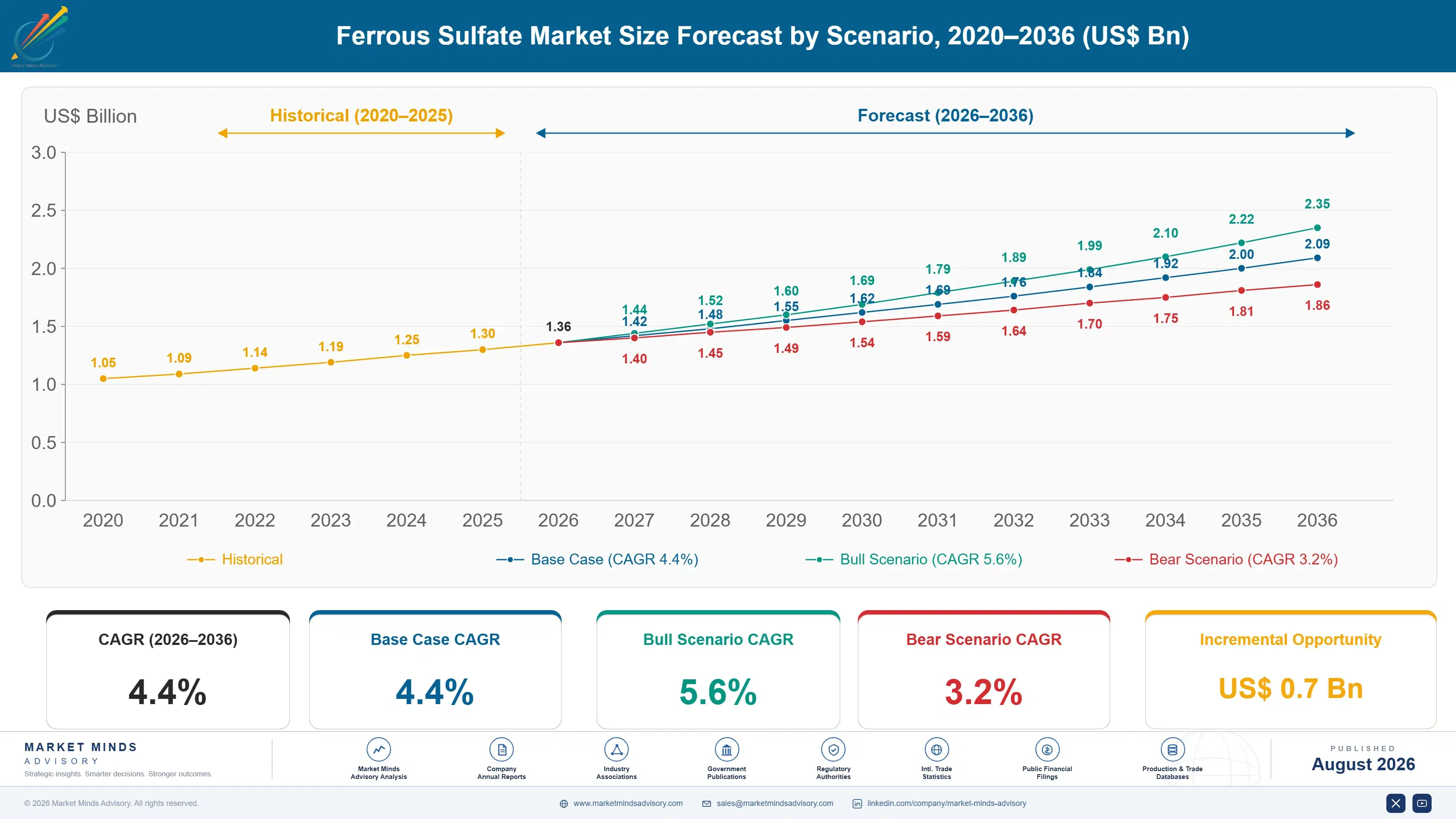
Ferrous Sulfate Market Forecast Scenarios

ferrous-sulfate-market-trends-size-forecast-scenario-1787310280248
Growth of 3.5% across 2020 to 2025 concealed a supply story rather than a demand one. Sulphate-route titanium dioxide producers cut output through 2022 and 2023 as pigment demand weakened and European energy costs rose, which tightened by-product ferrous sulfate availability in exactly the markets that had come to depend on it. Prices moved on supply withdrawal rather than on any change in what customers wanted.
The base case at 4.4% rests on three mechanisms. Cement chromate reduction demand continues across Europe and the markets adopting comparable limits, since the requirement is regulatory rather than discretionary and applies to every tonne of cement sold. Municipal phosphorus removal obligations tighten across treatment plants that use ferrous sulfate as the cheapest available precipitant. And feed and micronutrient demand grows with livestock production and with soil iron deficiency in intensively farmed regions.
The bull case at 5.6% turns on phosphorus discharge limits tightening further across Europe and Asia, which would pull substantial additional volume into municipal treatment. The bear case at 3.2% turns on supply. Continued closure of sulphate-route pigment capacity in favour of the chloride process would remove by-product availability faster than demand falls, pushing buyers toward alternative iron salts permanently.

What Actually Sets Ferrous Sulfate Value

Almost everything commercially odd about this market follows from two facts. The product is 82% by-product, so supply responds to titanium dioxide and steel economics rather than to its own demand, and heptahydrate crystal carries 45% water by weight, so freight is 34% of delivered cost and every buyer is served from whatever plant is nearest. Producers have very little control over how much they make and even less over where they can sell it profitably.
TOP FIVE SHARE29%Concentration of ferrous sulfate tonnage across the largest suppliers
HEPTAHYDRATE BULK PRICEUSD 105 per tonneDelivered bulk price per tonne of technical grade heptahydrate
BY-PRODUCT SUPPLY SHARE82%Share of output arising as a by-product rather than deliberately
FREIGHT COST SHARE34%Transport share of delivered cost for bulk hydrated crystal
CHROMATE LIMIT SPECIFICATION2 ppmSoluble chromium limit that cement must meet before sale
CRYSTAL WATER CONTENT45%Water fraction carried in heptahydrate crystal during transport
That structure inverts the usual commercial logic. A by-product with a disposal cost attached becomes valuable the moment somebody finds a use for it, and the producer's incentive is to place volume rather than to maximise price. Cement chromate reduction did exactly that across Europe, converting a waste stream into contracted supply almost overnight when the regulation arrived.
Drying and granulation is where the genuine differentiation sits. Monohydrate carries far less water, ships economically over longer distances and meets feed and pharmaceutical specifications that wet crystal cannot. The capital and energy required are real, which is why most by-product output still moves as heptahydrate within a few hundred kilometres of the plant.
"The producers who treat this as waste disposal accept whatever price places the tonnage, and the ones who invested in drying and granulation sell into feed and pharmaceutical markets at several times that. The compound is identical. What differs is whether somebody decided a by-product was worth capital."
Director, Inorganic Chemicals and By-Product Markets Practice · MMA Chemicals an

Market Trends

Chloride Process Migration Erodes By-Product Supply Base

Titanium dioxide producers have been shifting from sulphate to chloride process technology for decades, and the chloride route generates no ferrous sulfate at all. Roughly 19% of sulphate-route capacity outside China has closed or converted over the past ten years, which removes by-product supply from the regions with the strongest regulatory demand. The result is an unusual market where consumption grows while the supply base contracts, and where buyers who assumed a waste stream would always be cheap have found themselves negotiating for allocation instead. Nobody is building sulphate capacity to replace what closed.
Market Impact: Limit set at 2 ppm chromium

Feed And Pharmaceutical Grades Pull Investment Into Drying

Monohydrate for animal feed and human iron supplementation commands prices several times technical heptahydrate, on specifications covering heavy metals, particle size and iron content that wet by-product crystal cannot meet without purification and drying. Around 23% of output now moves as dried monohydrate. The capital involved is modest against the price differential, and the producers who committed to it converted a placement problem into a genuine business with customers who qualify suppliers formally and then stay with them for years. Feed premix and human supplement demand have both been growing steadily for years.
Market Impact: Covers 3,100 European treatment wor

Market Opportunities and Growth Drivers

Cement Chromate Regulation Mandates Reducing Agent Addition

European rules require cement placed on the market to contain no more than 2 ppm soluble chromium, to prevent the allergic contact dermatitis that chromate causes in construction workers, and ferrous sulfate is the standard reducing agent used to meet it. Every tonne of cement sold in regulated markets carries that addition. Comparable soluble chromium limits have since been adopted across several other jurisdictions. This is compliance demand rather than economic demand, which makes it largely insensitive to price and remarkably stable through construction cycles that would otherwise move volumes considerably.
Market Impact: Freight is 34% of cost

Phosphorus Discharge Limits Drive Municipal Precipitation Demand

Nutrient discharge limits have tightened across European, North American and increasingly Asian treatment plants, and chemical precipitation with iron salts remains the cheapest route to compliance for plants without biological phosphorus removal. Around 3,100 municipal treatment works across Europe alone now dose iron salts for phosphorus control. Ferrous sulfate competes against ferric chloride and ferric sulfate on delivered cost per unit of iron, which is why local by-product availability usually decides the choice rather than any technical preference among the alternatives. Tightening limits pull additional plants into chemical dosing each year.
Market Impact: By-product is 82% of supply

Market Restraints and Challenges

Freight Economics Confine Every Producer To A Radius

Heptahydrate crystal is 45% water by weight, which means a truck carries less than half a load of useful product and freight reaches 34% of delivered cost. The root cause is chemistry rather than logistics: the stable hydrate at ambient conditions holds seven water molecules per iron atom, and removing them costs energy. Commercially this caps every producer inside a few hundred kilometres and prevents any national or global position forming. Mitigation runs through drying to monohydrate, producing concentrated liquid grades where customers can receive them, and siting granulation near demand rather than near supply.
Market Impact: Removed 19% of sulphate capacity

By-Product Supply Ignores Downstream Demand Entirely

Output is 82% by-product, so volumes rise and fall with titanium dioxide pigment operating rates and steel pickling activity regardless of what ferrous sulfate customers need. The root cause is that no producer would build a plant to make this deliberately at current prices. Commercially it creates periods of glut where material is given away and periods of shortage where regulated buyers must pay whatever is asked. Participants are responding with multi-source purchasing agreements, storage capacity that buffers seasonal mismatch, and qualification of ferric alternatives as a fallback where specification permits it.
Market Impact: Reaches 23% of total output
4 additional market trends, 2 additional growth drivers, and 3 additional restraints and challenges are covered in the full report. Contact sales@marketmindsadvisory.com to access the complete intelligence.

Segment CAGR and Growth Architecture

Segmentation follows product form and grade, which is the dimension determining drying and purification requirement, freight economics, qualification burden and realised price together. End-use application cuts across several grades without separating them commercially, since the same granulated product serves cement and agriculture alike, so application belongs in demand analysis rather than in the primary hierarchy.
ferrous-sulfate-market-trends-market-share-analysis-1787310280778

Feed and Pharmaceutical Grade Monohydrate

Growing at 6.6%, exactly 1.50 times the market rate, and the only grade where a by-product producer earns genuine specification pricing rather than placement pricing. Dried monohydrate for animal feed premixes and human iron supplementation must meet limits on heavy metals, particle size distribution and iron assay that wet by-product crystal cannot approach without purification and controlled drying. Customers qualify suppliers formally and change reluctantly, which creates commercial positions that survive the glut periods when technical grade material is effectively free. The capital required for drying and granulation is modest against the price differential it opens, which makes the reluctance of most by-product producers to invest genuinely difficult to explain.
CAGR 6.6%

Granulated Cement Chromate Reduction Grade

Expanding at 5.5% on compliance demand that construction cycles barely disturb, since every tonne of cement sold into a regulated market needs chromate reduction regardless of how much cement is being sold. Granulation matters because the reducing agent must dose accurately into a dry cement stream and must not cake or degrade in storage, and shelf stability of the reduced ferrous ion determines how long treated cement holds its specification. Producers who solved that stability problem hold contracted positions with cement groups across several countries. The grade travels considerably better than wet heptahydrate, but still poorly enough that regional supply dominates every market except where local by-product generation has disappeared.
CAGR 5.5%
Full segment breakdown across 5 segments available in the complete report.

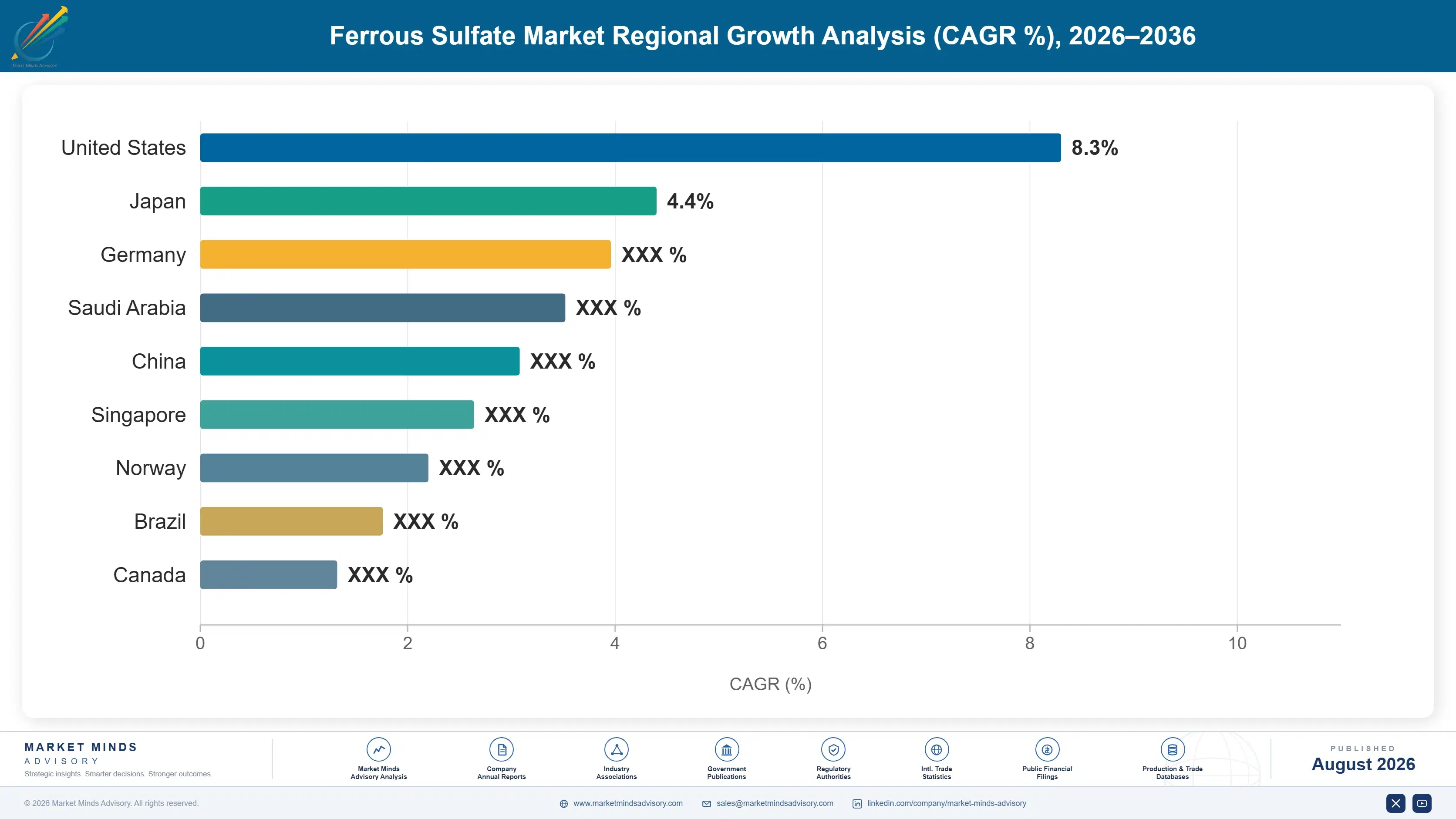
Regional Architecture and Country Demand Map

Regional value follows by-product generation and regulatory demand together, and the two do not always sit in the same place. A region producing large volumes without regulated uses gives material away, while one with tight rules and no local pigment plants pays considerably more for it.

East Asia

Thirty percent of value, the largest regional share, rests on by-product generation rather than on regulatory demand. Chinese sulphate-route titanium dioxide capacity is by far the world's largest and continues operating where Western producers converted or closed, and Chinese steel pickling volumes generate further ferrous sulfate at scale. That output finds domestic uses across water treatment, agriculture and pigment manufacture, and increasingly moves into export markets where regulated demand exceeds local supply. Japanese and South Korean demand comes from municipal water treatment and from cement production operating under standards broadly comparable to European limits. Growth of 5.4% runs above the global rate, supported by domestic regulation tightening alongside export demand.
Share: 30% | CAGR: 5.4% (2026 to 2036)

North America

Twenty-two percent of value comes from municipal water treatment, cement production and a substantial feed and agriculture demand base spread across the continent. By-product supply is comparatively tight here, because North American titanium dioxide production has moved decisively toward the chloride process and steel pickling liquor is often regenerated rather than crystallised. That scarcity supports pricing above what by-product economics alone would suggest, and it has pulled dried monohydrate imports into feed applications. Municipal phosphorus removal demand is substantial and continues growing under tightening nutrient discharge rules. Growth of 3.8% reflects a mature demand base constrained more by regional supply availability than by any shortage of applications willing to use the material.
Share: 22% | CAGR: 3.8% (2026 to 2036)
Regional intelligence for 5 additional markets available in the complete report: Western Europe, South Asia and Pacific, Latin America, Middle East and Africa, Eastern Europe. Contact sales@marketmindsadvisory.com.
ferrous-sulfate-market-trends-country-cagr-analysis-1787310281287

Where Ferrous Sulfate Producers Earn More

Placing wet by-product crystal at whatever price clears it is disposal wearing a commercial label rather than a business. The value available sits in drying, in the regulated applications that pay for specification rather than for iron content, and in the contract structures that survive the glut periods this market produces with some regularity.

Invest In Drying And Granulation Capacity Deliberately

Heptahydrate carries 45% water and cannot travel or meet specification, while dried monohydrate ships economically and qualifies for feed, pharmaceutical and cement duties. Producers who invested in drying realise roughly 3.4 times the price per tonne of iron against wet crystal placement, on capital that pays back inside a few years at current differentials. Most by-product producers still treat the material as a waste stream to be moved rather than a product to be made, which is the single largest value gap visible anywhere in this market and the easiest to close.
Market Impact: Realises roughly 3.4 times wet crys

Contract Regulated Demand Rather Than Spot Placement

Cement chromate reduction and municipal phosphorus removal are compliance obligations that do not pause when construction slows or municipal budgets tighten, which makes them the most reliable demand available anywhere in this market by a considerable margin. Multi-year contracts with cement groups and utilities secure roughly 40% higher realised pricing than spot placement across a full supply cycle, because the buyer is paying for certainty of supply rather than for iron content. Producers long accustomed to clearing tonnage weekly find the contracting discipline unfamiliar rather than genuinely difficult to acquire.
Market Impact: Secures roughly 40% higher realised

Qualify Into Feed And Pharmaceutical Specification Markets

Feed premix and human supplement customers qualify their suppliers on heavy metals, assay and particle size, then stay with them for years afterwards because requalification is genuinely burdensome to undertake. That qualification barrier is exactly why the segment grows at 6.6% while its pricing holds at roughly 5 times technical grade levels. The purification, documentation and audit work required is real but firmly bounded, and it is the only route by which a by-product producer escapes competing purely on freight radius against whoever else happens to have a plant nearby.
Market Impact: Holds pricing roughly 5 times techn

Site Granulation Near Demand Instead Of Near Supply

Freight at 34% of delivered cost means a producer serves customers within a few hundred kilometres and effectively nobody beyond that, which caps saleable volume regardless of how much by-product a pigment plant happens to generate. Shipping concentrated material to granulation capacity sited near cement clusters or feed manufacturers extends economic reach by roughly 3 times the conventional radius. The capital involved is modest and the logistics entirely straightforward. Producers rarely consider it, because by-product handling is managed as a plant logistics problem rather than as a commercial network decision.
Market Impact: Extends economic reach roughly 3 ti

Who Controls the Margin Pool

Concentration is low and follows plant geography rather than corporate strategy. The top five participants hold 29% of ferrous sulfate tonnage supplied, the basis used throughout this section, and the gap between the pigment producers and everyone else reflects the scale of sulphate-route capacity they operate rather than any commercial position in this product. Venator, Kronos and Tronox generate by-product at pigment plants; specialist processors and distributors add drying, granulation and ma
Competition currently runs on three dimensions and chemistry is not among them, since the compound is identical whoever makes it. Freight radius decides who can serve which customer at all. Drying and granulation capability decides which grades a producer can offer and therefore what it can charge. Specification qualification decides access to feed and pharmaceutical demand entirely.

Pressure is building from two directions. Continued chloride process migration keeps removing by-product supply in exactly the regions with regulated demand. Chinese and Indian dried material is reaching export markets where local supply has tightened. Rankings shift first in dried grades, where capital investment rather than plant location determines who participates at all.
ferrous-sulfate-market-trends-company-positioning-matrix-1787310281811

Competitive Moat and Risk Dimensions

VENATOR MATERIALS

Moat: Sulphate route by-product scale

Operating sulphate-route pigment capacity at scale in regions where most competitors converted to the chloride process gives access to by-product volume that regulated European buyers increasingly struggle to source locally. Established relationships with cement groups requiring chromate reduction turn what other producers treat as a disposal cost into contracted supply with predictable offtake.
VENATOR MATERIALS

Risk: Pigment economics drive output

Ferrous sulfate volumes depend entirely on pigment operating rates, which are decided by titanium dioxide market conditions rather than by anything happening in this market. A period of weak pigment demand withdraws supply precisely when regulated buyers need it, and no commercial decision inside the ferrous sulfate business can influence that at all.
KRONOS WORLDWIDE

Moat: European regulated demand proximity

Sulphate-route production sited close to European cement and municipal treatment demand converts freight economics from a constraint into an advantage, since at 34% of delivered cost distance decides who can compete for any given customer. Long-standing supply arrangements in a market where regulated buyers value certainty above price provide unusually stable placement.
KRONOS WORLDWIDE

Risk: Energy cost pressure on production

European sulphate-route pigment production carries energy costs well above Asian competitors, which pressures the underlying operation continuously rather than only during a spike. Any further capacity rationalisation removes by-product availability alongside pigment output, and the ferrous sulfate business has no ability to argue for capacity it does not control.

Players Tracked

Prominent Players

Venator Materials
Kronos Worldwide
Tronox Holdings
Crown Technology
Kemira

Other Key Players

Nouryon
Chemtrade Logistics
Pencco
Feralco
USALCO
ArcelorMittal
Nippon Steel
POSCO
Tata Steel
Cathay Industries
Lomon Billions
CNNC Hua Yuan Titanium Dioxide
Shandong Doguide Group
Verdesian Life Sciences
Aditya Birla Chemicals

Recent Developments

MAY 2025

Cement group contracts multi-year chromate reduction supply

A European cement producer concluded a multi-year granulated ferrous sulfate supply agreement covering several of its plants, prioritising security of allocation over unit price entirely after regional by-product availability tightened noticeably following further sulphate-route pigment capacity rationalisation across the continent over the preceding two years.
Signal: Regulated buyers are contracting for certa
AUGUST 2025

Drying and granulation capacity commissioned at pigment site

Additional drying and granulation capacity entered commercial operation at a European sulphate-route pigment plant, converting wet heptahydrate by-product into dried monohydrate grades suitable for feed, cement and longer-haul export supply rather than local placement at whatever price happened to clear the volume in any given week.
Signal: Capital spent on drying is the clearest si
FEBRUARY 2025

Feed grade qualification secured with premix manufacturer

A ferrous sulfate producer completed qualification with an animal feed premix manufacturer covering heavy metal limits, iron assay and particle size distribution across several batches, following an extended documentation and audit process that ran considerably longer than the commercial team had anticipated at the outset.
Signal: Qualification burden is exactly what makes

What Sits Inside Delivered Product Cost

Cost structure here is unusual because the raw material frequently carries a negative value, arriving as a by-product that a pigment or steel plant would otherwise pay to dispose of. Freight dominates at roughly 34% of delivered cost, driven by the 45% water content of the crystal. Drying and granulation energy accounts for about 31% where dried grades are made, handling and packaging around 18%, with purification adding 12%.
Energy costs moved sharply through 2021 and 2022 and hit this market twice over. European industrial gas and electricity prices reached levels the IEA documented as unprecedented for industry, raising drying costs directly while pushing sulphate-route pigment capacity below normal operating rates. Venator Materials Annual Report 2022 and Kronos Worldwide Annual Report 2022 both recorded elevated energy costs and reduced European operating rates across that period.

The competitive disadvantage runs through drying capability rather than raw material access. A producer without drying capacity places wet crystal within a short freight radius at whatever price clears it. Producers with drying and granulation reach regulated and specification markets at several times that. Location compounds the gap, since a plant far from cement or feed customers cannot recover freight even on dried product.
ferrous-sulfate-market-trends-cost-volatility-analysis-1787310282008

Convert wet crystal to monohydrate before shipping

Drying removes most of the water that freight is otherwise paying to move, which extends economic radius several times over and opens grades that wet crystal cannot serve. The energy cost is real and it is recovered many times through the price differential, provided the producer has somewhere worth shipping the dried product to.

Secure energy on indexed or self-generated terms

Drying is energy intensive enough that tariff exposure decides whether dried grades are profitable in a volatile year. Producers using waste heat from adjacent pigment or steel operations carry an advantage that no purchasing arrangement replicates, and a good many sites have that heat available without ever having thought to use it for this purpose.

Buffer supply variability with storage and multi-sourcing

By-product output follows pigment and steel plant operating rates rather than anything customers are asking for, so storage capacity spanning a few months converts what would be a supply mismatch into a scheduling matter. Buyers holding agreements across several producing sites weather allocation far better than those depending entirely on one plant's operating decisions.

Portfolio Architecture for Margin Defence

Margin architecture separates almost entirely by whether a producer has invested in drying. Wet heptahydrate placed locally earns whatever clears the volume, which in a glut is close to nothing and occasionally less than nothing once handling is counted. Dried and granulated grades reach regulated and specification markets at several times that value on the same underlying material, which makes this one of the clearest capital investment arguments in inorganic chemicals.
The volume versus premium tension is unusually stark because the volume tier barely earns at all. Technical heptahydrate carries the tonnage that has to be placed regardless, since a pigment plant cannot stop generating it, at prices that reflect disposal avoidance more than commercial value. Feed, pharmaceutical and cement grades earn genuinely well on a fraction of the mass. A producer without drying capacity is not choosing between those tiers; it simply cannot access the second.

High-value pools concentrate in three places. Feed and pharmaceutical monohydrate commands price because qualification is burdensome and customers stay. Granulated cement grades earn on compliance demand that construction cycles barely touch. And contracted regulated supply earns on certainty during the shortage periods this market produces regularly.

Volume / Commodity-Adjacent Tier

Wet technical heptahydrate placed locally into water treatment, agriculture and industrial uses within short freight radius, at prices reflecting disposal avoidance rather than any genuine commercial value in the material.
Gross Margin: 4-14%

Premium / Certified Tier

Granulated cement chromate reduction grades and concentrated liquid solutions supplied under contract, where dosing accuracy and shelf stability of the reduced iron genuinely matter. The nine-point range reflects contracted against spot supply economics.
Gross Margin: 22-31%

Sustainability / Regulatory / Next-Generation Tier

Dried monohydrate meeting feed, pharmaceutical and micronutrient specifications on heavy metals, assay and particle size. Qualification burden defends pricing strongly here. The eleven-point range reflects feed grade against pharmaceutical grade economics.
Gross Margin: 34-45%
ferrous-sulfate-market-trends-portfolio-architecture-1787310282516

High-value Sub-segments and Strategic Watch-out

Feed and pharmaceutical monohydrate grades

High value and high growth together, because customers qualify suppliers on heavy metals, assay and particle size, then stay for years since requalification is genuinely burdensome. Pricing holds roughly 5 times technical grade levels right through the glut periods that flatten pricing everywhere else in this market.
Gross Margin: 34-45%

Contracted cement chromate reduction supply

Strong realised value on steady growth, because every tonne of cement sold into a regulated market needs the reducing agent regardless of how much construction activity there is. Shelf stability of the reduced ferrous ion is the technical barrier that keeps casual suppliers out of the segment entirely.
Gross Margin: 22-31%

Wet heptahydrate local placement

The volume core and the least attractive part of this market, carrying tonnage that has to move because a pigment plant cannot stop producing it. Necessary for material balance, but this tier funds nothing at all and occasionally costs real money once handling is properly counted.
Gross Margin: 4-14%

Agricultural iron micronutrient grades

The strategic watch-out, because chelated iron products compete directly on efficacy in alkaline soils where ferrous sulfate performs inconsistently, and premium agriculture has been migrating toward them steadily for several seasons. Volume demand persists wherever cost per hectare rather than efficacy dominates the purchasing decision.
Gross Margin: 16-28%

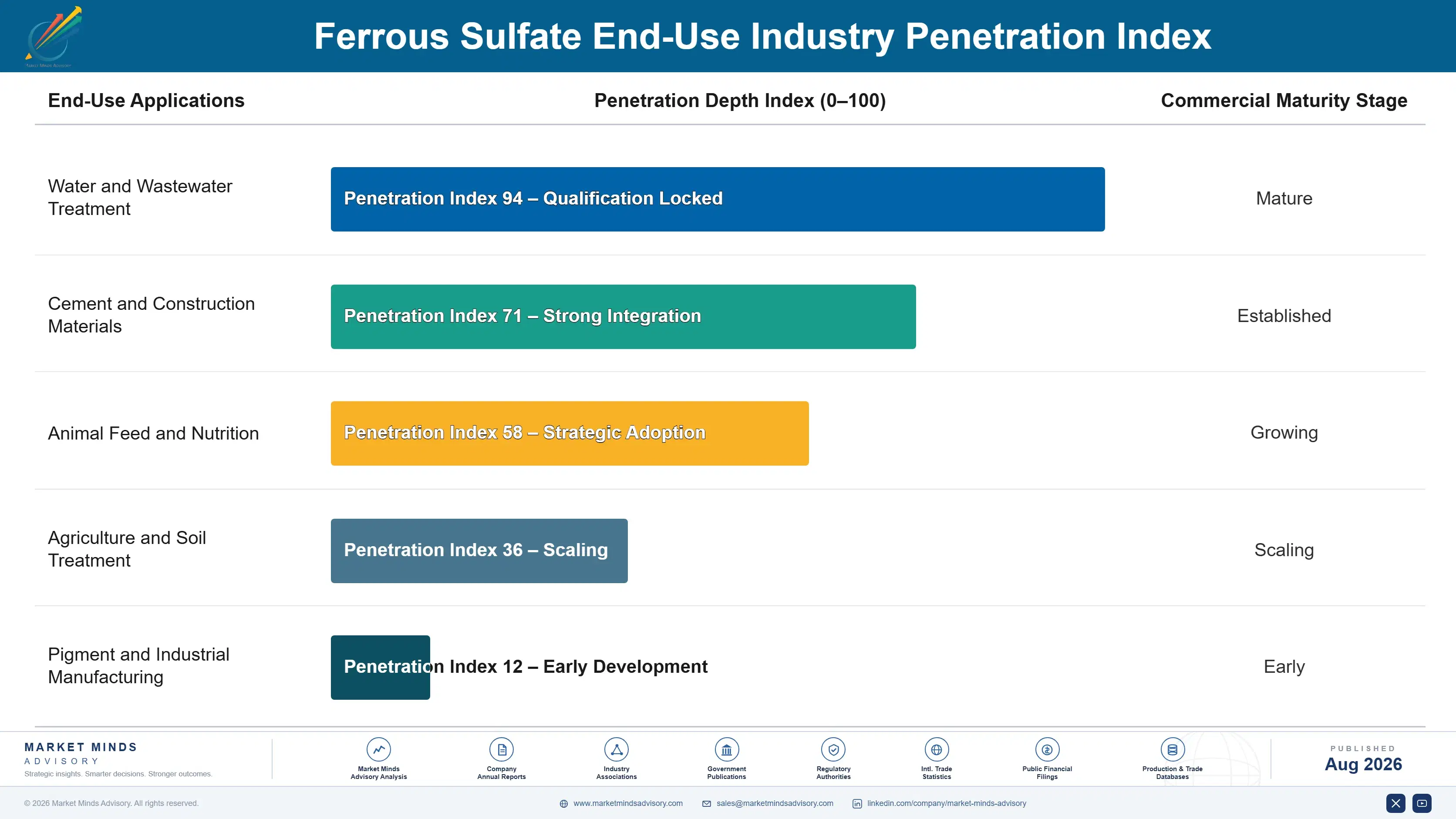
How Ferrous Sulfate Demand Behaves

Demand splits between compliance obligation and cost-driven substitution, and the two behave nothing alike. Cement chromate reduction and municipal phosphorus removal are regulatory requirements attached to every tonne of cement sold and every megalitre treated, which makes that demand steady, forecastable and largely insensitive to price. Agricultural and industrial uses are cost-driven, switch readily to alternative iron sources, and disappear entirely when a cheaper option appears within frei
Stickiness varies with qualification burden more than with relationship. Technical heptahydrate is loosest, bought from whoever is nearest at whatever price clears, with switching costing nothing at all. Cement grades are tighter, since dosing equipment and shelf stability behaviour are validated against a particular product. Feed and pharmaceutical grades are stickiest by a wide margin, where audit, documentation and assay qualification make substitution a project nobody undertakes casually.

The buyer profile has changed more than the producers have. A decade ago this material was bought by plant managers looking for the cheapest iron within reach. Regulated buyers now dominate value, and they evaluate supply security, documentation and specification consistency, which rewards producers who invested in drying and qualification rather than those who simply have tonnage available.
ferrous-sulfate-market-trends-end-use-penetration-index-1787310283001

Where We Land On This

These are among the four positions where our research anticipates prominent divergence between winners and laggards over the coming forecast period. Each is grounded in the demand model, the regulatory perimeter, and the announced capacity pipeline.
01 / DRYING CAPITAL INVESTMENT

Invest in drying before anything else in this business

Heptahydrate carries 45% water, cannot travel economically and cannot meet feed, pharmaceutical or cement specification without controlled drying and purification work. Producers who invested realise roughly 3.4 times the price per tonne of iron against wet crystal placement, on capital that pays back inside a few years at the price differentials currently available. Most by-product producers still manage this material as a waste stream to be moved off site rather than as a product to be made deliberately and sold properly.
02 / REGULATED DEMAND CONTRACTING

Contract compliance demand instead of clearing tonnage weekly

Cement chromate reduction and municipal phosphorus removal are regulatory obligations that continue through construction downturns and budget freezes alike, which makes them the steadiest demand available anywhere in this market. Multi-year contracts with cement groups and utilities secure roughly 40% higher realised pricing than spot placement across a full supply cycle, because the buyer is paying for certainty rather than for iron content. Producers used to clearing tonnage weekly find the contracting discipline unfamiliar rather than genuinely difficult to acquire.
03 / SPECIFICATION GRADE QUALIFICATION

Pursue feed and pharmaceutical qualification despite the burden

Feed premix and human supplement customers qualify suppliers on heavy metals, assay and particle size distribution, then stay with them for years because requalification is genuinely onerous to undertake. That barrier is exactly why the segment grows at 6.6% while pricing holds roughly 5 times technical grade levels through periods when technical material is effectively free. The documentation and audit work is bounded, and it is the only genuine escape from competing purely on freight radius against whoever else is nearby.
04 / SUPPLY VOLATILITY PLANNING

Plan around by-product supply that ignores demand entirely

Output is 82% by-product, so volumes track titanium dioxide operating rates and steel pickling activity rather than anything that customers do or want, and chloride process migration has already removed roughly 19% of sulphate-route capacity outside China. Regulated buyers who assumed a waste stream would always be both cheap and available have found themselves negotiating for allocation instead. Storage capacity and multi-site supply agreements are the only genuine protection available, and both need arranging well before the next shortage arrives.

Engagement Snapshot From the Field

A live engagement with an industry participant carrying material or product regulatory and market exposure ahead of a defining policy shift, showing how our research translates into a defensible multi-year portfolio strategy.
MARKET MINDS ADVISORY · CLIENT ENGAGEMENT SUMMARY
Ferrous Sulfate Producer Strategic Portfolio Review and Transition Roadmap 2026·Investment Scenario on Ferrous Sulfate Exposure Evaluation 2025-26
CLIENT PROFILE
A sulphate-route titanium dioxide producer operating two European pigment plants, generating substantial ferrous sulfate by-product placed locally as wet heptahydrate into water treatment and agriculture through brokers and short-haul contracts. By-product revenue approached EUR 18 million annually (client-reported, unverified by MMA) against handling and logistics costs that management had never fully separated from pigment operations.
STRATEGIC CHALLENGE
By-product placement was managed by the plant logistics function as a disposal obligation, and nobody had asked what the material might be worth if treated as a product. Regional cement customers were buying granulated material from competitors while the client shipped wet crystal to agriculture at prices barely covering haulage. A proposed landfill contingency assumed placement would become harder still.
MMA APPROACH
MMA interviewed forty-seven cement producers, feed premix manufacturers, water utilities and distributors across four markets, establishing what each grade was actually worth delivered. We modelled drying and granulation economics at both plants including available waste heat, quantified freight radius by product form, and mapped the qualification requirements standing between the client and feed grade supply.
KEY FINDINGS
  1. Regional cement producers within economic reach of both plants were buying granulated material at multiples of the client's realised wet crystal price, from suppliers shipping considerably further.
  2. Waste heat available at one plant could dry the entire by-product stream at marginal energy cost, and nobody in the organisation had ever evaluated the option seriously.
  3. Feed grade qualification required documentation and audit work the client could complete within a year, against pricing several times its current realisation (client-reported, unverified by MMA).
  4. Freight analysis showed the client's economic radius for wet crystal was under two hundred kilometres, while dried monohydrate would reach roughly three times that distance profitably.
CLIENT PROFILE
A sulphate-route titanium dioxide producer operating two European pigment plants, generating substantial ferrous sulfate by-product placed locally as wet heptahydrate into water treatment and agriculture through brokers and short-haul contracts. By-product revenue approached EUR 18 million annually (client-reported, unverified by MMA) against handling and logistics costs that management had never fully separated from pigment operations.
STRATEGIC CHALLENGE
By-product placement was managed by the plant logistics function as a disposal obligation, and nobody had asked what the material might be worth if treated as a product. Regional cement customers were buying granulated material from competitors while the client shipped wet crystal to agriculture at prices barely covering haulage. A proposed landfill contingency assumed placement would become harder still.
MMA APPROACH
MMA interviewed forty-seven cement producers, feed premix manufacturers, water utilities and distributors across four markets, establishing what each grade was actually worth delivered. We modelled drying and granulation economics at both plants including available waste heat, quantified freight radius by product form, and mapped the qualification requirements standing between the client and feed grade supply.
KEY FINDINGS
  1. Regional cement producers within economic reach of both plants were buying granulated material at multiples of the client's realised wet crystal price, from suppliers shipping considerably further.
  2. Waste heat available at one plant could dry the entire by-product stream at marginal energy cost, and nobody in the organisation had ever evaluated the option seriously.
  3. Feed grade qualification required documentation and audit work the client could complete within a year, against pricing several times its current realisation (client-reported, unverified by MMA).
  4. Freight analysis showed the client's economic radius for wet crystal was under two hundred kilometres, while dried monohydrate would reach roughly three times that distance profitably.
RECOMMENDED STRATEGY
Phase 1: Phase 1 (0 to 9 months): Cancel the landfill contingency and commission drying using available waste heat at the better positioned plant. Phase 2: Phase 2 (9 to 24 months): Add granulation and contract cement chromate reduction supply with regional producers on multi-year terms. Phase 3: Phase 3 (24 to 42 months): Complete feed grade qualification and build specification supply as a business rather than a by-product placement.
OUTCOME
The client abandoned the landfill contingency entirely and commissioned drying within a year at modest capital cost (client-reported, unverified by MMA). Realised value per tonne of by-product rose sharply, two multi-year cement contracts were signed in the region, and feed grade qualification was underway twenty months into the programme.

Frequently Asked Questions

Foundational context covering the market sizes, CAGR, scope, country, region and competition that inform every finding below. This section is provided to cover basics and most often pre-purchase conversations, answered from the MMA Primary Research Dataset.

What is the current size of the Ferrous Sulfate Market?

The market reached USD 1.3 billion in 2025, measured as revenue at realised delivered price across all commercial grades. Roughly 82% of output arises as a by-product rather than deliberate manufacture.

How large will the Ferrous Sulfate Market be by 2036?

MMA forecasts USD 2.09 billion by 2036, an expansion of 1.54 times the 2026 level. Incremental value across the forecast period reaches USD 0.73 billion.

What is the CAGR for the Ferrous Sulfate Market 2026 to 2036?

The base case compound annual growth rate is 4.4%, with a bull case of 5.6% and a bear case of 3.2%. Phosphorus limits and sulphate-route capacity closures separate those scenarios.

Which segment is growing fastest?

Feed and pharmaceutical grade monohydrate grows fastest at 6.6%, exactly 1.50 times the overall market rate. Qualification barriers on heavy metals and assay keep that segment genuinely defensible.

Who are the major companies in the Ferrous Sulfate Market?

Venator Materials, Kronos Worldwide, Tronox Holdings, Crown Technology and Kemira lead, holding 29% of tonnage between them. Sulphate-route pigment capacity rather than commercial strategy explains most positions.

Which country is growing fastest?

India grows fastest at 6.9%, where pigment and steel by-product generation coincides with large agricultural iron micronutrient demand on alkaline soils. Feed grade consumption is expanding alongside poultry production.

Report Segmentation Architecture

The full report scope spans multiple orthogonal segmentation dimensions, with cross-tabulated demand data provided for each dimension pair. Coverage extends further to regional breakdowns, trend trajectories, and the competitive detail needed to support segment-level decision-making.

By Product Form and Grade

  • Feed and Pharmaceutical Grade Monohydrate
  • Granulated Cement Chromate Reduction Grade
  • Liquid Solution Grades
  • Fertiliser Micronutrient Grade
  • Technical Heptahydrate

By End-Use Industry

  • Water and Wastewater Treatment
  • Cement and Construction Materials
  • Animal Feed and Nutrition
  • Agriculture and Soil Treatment
  • Pigment and Industrial Manufacturing

By Customer Type and Channel

  • Cement Producers
  • Municipal Utilities
  • Feed and Premix Manufacturers
  • Agricultural Distributors
  • Chemical Traders and Brokers

By Region

  • North America
  • Western Europe
  • East Asia
  • South Asia and Pacific
  • Latin America
  • Middle East and Africa
  • Eastern Europe

Scope, Methodology, and Coverage

Every figure in this report is reproducible from documented input assumptions. The scope below maps the historical period, the forecast horizon, the segmentation dimensions, and the countries covered, alongside the underlying primary and qualitative methodology.
Historical Period
2020 to 2025
Forecast Period
2026 to 2036
Base Year
2025 (USD billions; MMA Primary Research Dataset, August 2026)
Market Definition
The market comprises ferrous sulfate in hydrated and dried forms supplied for commercial use, spanning feed and pharmaceutical grade monohydrate, granulated cement chromate reduction grades, liquid solution grades, fertiliser micronutrient grades and technical heptahydrate, whether generated as a by-product of titanium dioxide sulphate processing and steel pickling or produced deliberately. Sizing captures revenue at realised delivered price across water and wastewater treatment, cement manufacture, animal feed, agriculture, pigment production and general industrial applications. Iron oxide pigments manufactured from ferrous sulfate, ferric sulfate and chloride coagulants, other iron salts, chelated iron micronutrients and untreated pickle liquor sold for disposal fall outside scope.
Quantitative Units
USD billions (current prices); product tonnes supplied annually; USD per tonne at realised delivered price by grade
Segmentation Dimensions
By Product Form and Grade; By End-Use Industry; By Customer Type and Channel; By Region
Regions Covered
North America, Western Europe, East Asia, South Asia and Pacific, Latin America, Middle East and Africa, Eastern Europe
Countries Covered
USA, Canada, Mexico, UK, Germany, France, Italy, Spain, Netherlands, Belgium, Finland, Poland, Czech Republic, Romania, Turkey, China, Japan, South Korea, Taiwan, India, Vietnam, Indonesia, Thailand, Australia, Brazil, Chile, Argentina, Saudi Arabia, UAE, Egypt, Morocco, South Africa, and additional markets relevant to this sector
Key Companies Profiled
Venator Materials, Kronos Worldwide, Tronox Holdings, Crown Technology, Kemira, Nouryon, Chemtrade Logistics, Pencco, Feralco, USALCO, ArcelorMittal, Nippon Steel, POSCO, Tata Steel, Cathay Industries, Lomon Billions, CNNC Hua Yuan Titanium Dioxide, Shandong Doguide Group, Verdesian Life Sciences, Aditya Birla Chemicals.
Quantitative Methodology
Primary survey, n=3,800 respondents, Q4 2025, six countries; demand-side model with trade association cross-validation
Qualitative Methodology
47 expert interviews, Q4 2025; applied to validate demand model assumptions, identify emerging dynamics, and assess competitive positioning
Report Format
PDF and XLSX data workbook (Word format preview document)
Publisher
Market Minds Advisory
Report Code
MMA-2026-CHM-438
Published
August 2026
Contact
sales@marketmindsadvisory.com | www.marketmindsadvisory.com

Purchase the full Ferrous Sulfate Market Report (2026 to 2036).

The full report sizes the ferrous sulfate market across five product grades, five end-use industries, five customer channels and seven regions, with annual forecasts to 2036 in revenue and tonnes supplied. It models drying and granulation economics against wet crystal placement by production site, which is the analysis establishing what a by-product stream is genuinely worth if treated as a product. Twenty participants are assessed on a consistent tonnage supplied basis, with drying capability and specification qualification mapped separately from by-product generation. Sulphate-route pigment capacity is tracked plant by plant against regulated demand by region.
Five product grades sized and forecast annually
Drying economics modelled against wet crystal placement
Twenty participants on consistent tonnage supplied basis
Drying capability mapped separately from by-product generation
Sulphate-route pigment capacity tracked plant by plant
Regulated demand quantified by cement and treatment region

Built For The People Who Decide

From boardroom strategy to bench-side execution, this report is read cover-to-cover by leaders shaping the next decade of their industry, turning demand scenarios, market dynamics and valuation benchmarks into decisions.
CXOs/ Presidents/ VPs/ Managers
M&A and Corporate Development
Strategy Teams and R&D Heads
Procurement and Product Directors
Regulatory and Compliance Leaders
Investor Relations and Equity Analysts