Market Minds Advisory
Ferro Aluminum Market

Ferro Aluminum Market: Low-Carbon Alloy Certification and Steelmaking Demand

Steel and aluminum deoxidation demand is shifting toward premium low-carbon ferro aluminum grades as mills tighten alloy specification tolerances, EAF capacity expands, and producers face pressure to certify recycled aluminum content.

Lead Analyst

Bilal Shaikh

Published

September 2026

Make Smarter Decisions with Customized Research Insights

Request a free sample report and evaluate market opportunities, growth trends, and competitive dynamics relevant to your business needs.

2025 MARKET VALUE$3.9BMarket Size 2025
2036 FORECAST VALUE$6.0BBase Case , 2026 to 2036
CAGR 2026 TO 20363.9 %Bull 5.0% / Bear 2.8%
INCREMENTAL OPPORTUNITY$1.9BNet 10- year value creation
EXPANSION MULTIPLE1.46x2036 value over 2026 base
Strategic Levers
M&A Pipeline
Regional Outlook
Country Rankings
Competitive Intelligence
Segmental Deep-dive
Call-Us : 91 93563 13602

Executive Snapshot and Market Trajectory

Specification tightening at electric arc furnace steelmakers is reshaping ferro aluminum demand, as mills increasingly require certified low-carbon and traceable-source alloy inputs over generic commodity grades across most major production regions, mill networks, and steelmaking corridors worldwide each successive year and quarter.
Commercial demand concentrates around electric arc furnace steelmaking, where ferro aluminum serves as a critical deoxidizer and grain refiner in specialty and stainless steel grades across most major producing regions and mill networks worldwide. East Asia, anchored by China's vast steelmaking base, commands the largest consumption share worldwide, while North America and Western Europe compete on certified low-carbon sourcing and traceability documentation rather than pure volume alone across their respective mill networks and steelmaking corridors.
Competitive intensity remains moderate but is rising as aluminum smelters integrate downstream into alloy production, squeezing independent ferro alloy producers who lack captive aluminum feedstock supply of their own to draw on nationwide and internationally. Tightening carbon border adjustment rules in Europe and stricter mill specification audits are reshaping which producers can retain premium contracts, favoring those with certified low-carbon smelting processes over producers competing purely on price alone.
Market Definition
The Ferro Aluminum Market covers ferro aluminum alloy production used as a deoxidizer and grain refiner in steelmaking, including standard and low-carbon certified grades. It excludes primary aluminum smelting, aluminum billet production, and finished steel products.
Base Year Value
$3.9B in 2025 (MMA Primary Research Dataset, August 2026)
Forecast Period
2026 to 2036, eleven discrete annual values
CAGR
3.9% base case. Bull 5.0%. Bear 2.8%.
Fastest Growth Segment
Low-Carbon Certified Ferro Aluminum Grades: 6.4% CAGR
Fastest Growth Country
India: 6.2% CAGR
Fastest Growth Region
South Asia and Pacific: 5.8% CAGR
Largest Region
East Asia: 30% of 2025 global value
Market Leaders
Elkem, Metalmen Sales, Shandong Weiqiao, Jiangsu Alcha, Reading Alloys. Source: MMA Analysis based on company annual reports.
Primary Survey
n=3,800 procurement and R&D decision-makers, Q4 2025, six countries
Methodology
Demand-side build-up, cross-validated against public data, 47 expert interviews

Ferro Aluminum Market Forecast Scenarios

ferro-aluminum-market-trends-size-forecast-scenario-1787550744367
Ferro aluminum consumption grew steadily but modestly between 2020 and 2025, tracking global crude steel output closely as electric arc furnace capacity additions in China, India, and the Middle East expanded the addressable deoxidizer market at a measured pace year over year across most major steelmaking regions and specification categories worldwide, particularly in specialty steel grades.
The base case rests on three commercial mechanisms: continued electric arc furnace capacity expansion increasing per-tonne deoxidizer consumption across new steelmaking facilities, tightening carbon border adjustment regulation in Europe pushing mills toward certified low-carbon alloy inputs at a price premium, and steel specification standards gradually raising minimum alloy purity requirements across automotive and construction-grade steel categories. Together these mechanisms sustain steady single-digit volume growth even as overall steel demand growth moderates in mature markets.
The bull case centers on faster-than-expected electric arc furnace capacity build-out in India and Southeast Asia pulling forward deoxidizer demand ahead of current projections across the industry. The bear case centers on a prolonged global steel demand slowdown tied to weaker construction and automotive output, which would compress ferro aluminum consumption growth across most major producing regions and mill networks.

Deoxidizer Demand and Certification Economics

Three forces converge on this market at once: electric arc furnace steelmaking capacity expansion pulling deoxidizer volume upward across most major steel-producing regions and mill networks worldwide, carbon border adjustment regulation tightening certification requirements for imported alloy inputs into Europe and beyond, and aluminum smelters integrating downstream into ferro alloy production to capture more of the value chain themselves each successive year and budget cycle.
MARKET CONCENTRATIONCR5 28%Combined share held by top five ferro aluminum producers
AVERAGE SELLING PRICE$2,850 per tonneBlended average price across standard and certified low-carbon grades
TOP COUNTRY SHAREChina 34%Share held by the largest single producing nation
EAF CAPACITY UTILIZATION78%Average utilization across electric arc furnace steelmaking capacity
TRADE INTENSITY41%Share of global production volume moving across borders annually
ALUMINUM FEEDSTOCK COST SHARE62%Primary aluminum input cost as share of total COGS
Commercially, the market increasingly rewards producers who can document low-carbon smelting processes and recycled aluminum content alongside consistent alloy purity, since mills serving carbon-regulated export markets now screen suppliers on certification before price across most major accounts and supply agreements nationwide. Producers without captive aluminum feedstock face persistently thinner margins during aluminum price spikes, squeezed between volatile input costs and long-term steel mill supply contracts that limit pass-through flexibility considerably.
Over the next decade, differentiation will concentrate around certified low-carbon supply chains and traceability documentation rather than raw production capacity, as specification tightening across automotive and construction steel grades continues raising the bar for premium contract eligibility across most major producing regions, mill networks, and export corridors worldwide each year.
"Certification has quietly become the real product here; the alloy chemistry was solved decades ago, but proving where the aluminum came from is what wins contracts now."
Director, Metals and Materials Practice · MMA Chemicals and Materials Practice · August 2026

Market Trends

Carbon Border Adjustment Mechanism Reshapes European Sourcing

The European Union's carbon border adjustment mechanism now requires importers of ferro aluminum and other alloy products to report embedded carbon emissions, with financial certificate obligations phasing in over the coming years. This is pushing European steel mills to favor suppliers who can document low-carbon smelting processes, particularly those using hydro or renewable-powered aluminum reduction rather than coal-fired grid electricity. Producers in regions with cleaner grid mixes, including parts of Scandinavia and Canada, are gaining preferential access to European contracts, while coal-grid-dependent Asian producers face growing certification cost burdens to remain competitive in this export market.
Market Impact: Purity premiums add 10 percent pricing

Electric Arc Furnace Capacity Expansion Lifts Volume Demand

Steelmakers worldwide continue shifting capacity toward electric arc furnace technology over traditional blast furnace routes, both for lower emissions profiles and for capital cost advantages in new facility construction across most major producing regions. Each new electric arc furnace ton of capacity carries a defined deoxidizer requirement, directly expanding the addressable ferro aluminum market as this technology transition continues across China, India, and the Middle East. Several major steelmakers have announced electric arc furnace conversion timelines extending through the next decade, providing visible forward demand for alloy input suppliers worldwide.
Market Impact: India capacity to grow 9 percent

Market Opportunities and Growth Drivers

Rising Specialty Steel Output Requires Higher Alloy Purity

Automotive and aerospace-grade specialty steel production has grown steadily as manufacturers demand tighter tolerance and higher-strength alloys, and these specialty grades require more precise deoxidation control than standard construction steel needs across most production lines. Mills serving these premium end markets increasingly specify higher-purity ferro aluminum grades and tighter chemical composition tolerances, supporting average selling price growth even where volume growth is modest overall. This trend is particularly pronounced in electric vehicle component steel, where weight reduction targets are pushing mills toward more sophisticated alloy formulations across most major automotive supply chains.
Market Impact: Aluminum prices swung over 25 percent

India's Steel Capacity Build-Out Expands Regional Demand

India's steel industry continues expanding capacity rapidly to meet domestic construction and infrastructure demand, with several major producers announcing multi-year capacity expansion plans that will require substantial new deoxidizer volume across most new facilities nationwide and internationally as well. Government infrastructure spending programs are sustaining steel demand growth even as some other major markets moderate their own construction output, and domestic ferro alloy production capacity has not kept fully pace with steel expansion, creating meaningful import opportunities for established international producers with proven supply reliability and consistent alloy quality. Regional import demand is expected to remain elevated through the decade.
Market Impact: Scrap substitution covers 8 percent

Market Restraints and Challenges

Aluminum Price Volatility Compresses Independent Producer Margins

Primary aluminum prices swing considerably with global supply and energy cost cycles, and independent ferro aluminum producers who purchase aluminum feedstock on the open market struggle to pass through cost spikes quickly enough under fixed-price steel mill supply contracts. The root cause is a persistent mismatch between spot aluminum pricing and multi-year mill contract terms negotiated well before delivery, an issue vertically integrated producers with captive aluminum supply do not face to the same degree. Producers are mitigating this by negotiating index-linked pricing clauses and shorter contract terms with steel mill customers where commercially feasible.
Market Impact: Adds certification costs near 8 percent

Recycled Aluminum Scrap Substitution Pressures Primary Demand

Some steelmakers are exploring recycled aluminum scrap-based deoxidizer alternatives as sustainability procurement policies tighten, threatening a portion of primary ferro aluminum demand over the long run across several major producing regions and mill networks. The root cause is genuine cost and carbon footprint advantage for recycled content once collection and processing logistics are established at sufficient scale nationwide and internationally. Producers are responding by developing their own recycled-content certified product lines, positioning themselves to capture this shift rather than lose volume to alternative suppliers entirely across their customer base. Producers expect this shift to accelerate over the coming years.
Market Impact: EAF capacity grows 6 percent
3 additional market trends, 4 additional growth drivers, and 2 additional restraints and challenges are covered in the full report. Contact sales@marketmindsadvisory.com to access the complete intelligence.

Segment CAGR and Growth Architecture

Segmentation follows alloy grade and certification tier, since procurement decisions increasingly hinge on carbon footprint documentation and purity specification rather than base chemistry alone across most steel mill accounts and supply agreements nationwide and internationally. Six segments span standard commodity grades through certified low-carbon and high-purity specialty formulations used in premium steel applications worldwide.
ferro-aluminum-market-trends-market-share-analysis-1787550744897

Certified Low-Carbon Ferro Aluminum

Certified low-carbon ferro aluminum, produced using renewable or hydro-powered aluminum reduction with documented chain-of-custody emissions data, is the fastest-growing segment as carbon border adjustment regulation and mill sustainability procurement policies expand simultaneously across Europe and increasingly North America each year. Producers in regions with cleaner grid electricity mixes hold a durable cost advantage in certification, though the segment still commands meaningful price premiums over standard grades given limited current low-carbon smelting capacity worldwide and high qualification costs. Mills serving carbon-regulated export markets increasingly specify this grade as a baseline procurement requirement rather than an optional upgrade, reinforcing sustained demand growth well ahead of the broader category average across most regions.
CAGR 8.9%

High-Purity Specialty Grades (Automotive/Aerospace)

High-purity specialty ferro aluminum, formulated for automotive and aerospace-grade steel requiring tighter chemical composition tolerances than standard construction steel, is growing nearly as fast as the certified low-carbon segment as electric vehicle component demand accelerates specification tightening across supply chains nationwide and internationally. This grade commands premium pricing tied to purity consistency rather than carbon credentials, and producers must invest in tighter process controls and more frequent quality testing to maintain qualification with demanding automotive and aerospace steel mill customers. Contract structures here favor long-term qualified-supplier relationships over spot-market transactions, since requalifying a new supplier for high-purity applications carries meaningful engineering cost and lead time for steel producers. This dynamic is expected to persist over the coming years.
CAGR 7.6%
Full segment breakdown across 6 segments available in the complete report.

Regional Architecture and Country Demand Map

China's vast steelmaking base makes East Asia the largest regional consumer of ferro aluminum by volume worldwide each successive year. North America and Western Europe compete on certified low-carbon sourcing and traceability documentation rather than pure tonnage alone across their mill networks and supply chains.

North America

North America's ferro aluminum demand is anchored by electric arc furnace steelmakers across the United States and Canada, where domestic scrap-based steel production has expanded steadily alongside infrastructure and automotive manufacturing investment nationwide and across most major industrial corridors. Section 232 tariff measures on imported steel products have indirectly supported domestic alloy input demand by sustaining higher domestic steelmaking utilization rates than would otherwise prevail across the region. Canadian producers benefit from access to hydro-powered aluminum smelting capacity, positioning them favorably for certified low-carbon grade supply as sustainability procurement requirements tighten across both domestic and export-oriented steel mill customers throughout the region and its major manufacturing corridors and industrial hubs.
Share: 26% | CAGR: 4.5% (2026 to 2036)

Western Europe

Western Europe's ferro aluminum market is shaped decisively by carbon border adjustment regulation, which is reordering supplier relationships as mills scramble to document embedded emissions across their alloy input supply chains nationwide and across all member states. Germany and France anchor regional demand through their large automotive and specialty steel production bases, both of which increasingly specify certified low-carbon ferro aluminum as standard procurement policy rather than an optional premium. Energy cost volatility since the regional gas supply disruptions of recent years has also pushed some European ferro alloy production offshore, increasing the region's reliance on certified imports from cleaner-grid producing nations to meet both volume and carbon documentation requirements simultaneously across the wider continent.
Share: 19% | CAGR: 2.3% (2026 to 2036)
Regional intelligence for 5 additional markets available in the complete report: East Asia, South Asia and Pacific, Latin America, Middle East and Africa, Eastern Europe. Contact sales@marketmindsadvisory.com.
ferro-aluminum-market-trends-country-cagr-analysis-1787550745403

Where Ferro Aluminum Producers Can Capture Margin

Ferro aluminum margins are thin on standard commodity grades, so incremental revenue growth concentrates in certification, purity specification, and supply reliability rather than volume alone across the category and its customer base. Four paths stand out across low-carbon certification, vertical integration, specialty grades, and contract structuring for producers investing ahead of demand and regulation.

Build Certified Low-Carbon Production Capability Now

Producers who invest in renewable or hydro-powered aluminum reduction and build documented chain-of-custody certification capture pricing power that standard commodity producers cannot match, since carbon border adjustment regulation increasingly screens suppliers before price is even discussed at all in most procurement processes today. Early movers report price premiums of roughly 12 to 18 percent on certified low-carbon volume versus standard grade sales, and certification investment also opens access to European accounts that exclude uncertified suppliers entirely from procurement consideration going forward across most major mill relationships and long-term supply agreements.
Market Impact: Adds a 12 to 18 percent price premium

Vertically Integrate Into Aluminum Feedstock Supply

Producers who secure captive or long-term contracted aluminum feedstock supply avoid the margin compression that independent producers face during aluminum price spikes, since fixed-price steel mill contracts cannot absorb volatile input costs on short notice or renegotiation terms easily and quickly enough. Vertical integration requires substantial upfront capital investment but has delivered gross margin stability improvements of 5 to 8 percentage points for producers who pursued it, particularly valuable during periods of elevated aluminum price volatility across global markets, export corridors, and long-term mill supply relationships nationwide and abroad. Feedstock security remains a differentiator.
Market Impact: Adds 5 to 8 points of margin stability

Expand Into High-Purity Automotive and Aerospace Grades

Producers who qualify for high-purity automotive and aerospace-grade steel supply relationships command meaningfully higher margins than standard grade sales, since these accounts prioritize consistency and testing documentation over pure price competition across most qualification cycles and renewal periods each year and contract term across the board. Qualification requires sustained investment in process control and quality testing infrastructure across multiple production lines, but qualified suppliers typically retain multi-year contracts commanding 15 to 20 percent price premiums over commodity-grade sales to the same customer base and account relationships nationwide and internationally. Long-term retention rates remain notably higher.
Market Impact: Commands a 15 to 20 percent price premium

Negotiate Index-Linked Multi-Year Mill Supply Contracts

Producers who negotiate index-linked pricing clauses into multi-year steel mill supply contracts protect margins during aluminum price volatility while still securing the demand predictability that long-term contracts provide over spot-market transactions and short-term deals alike across the industry and its broader customer base. This approach has reduced margin volatility by an estimated 30 to 40 percent for producers who adopted it relative to fixed-price contract peers, and it strengthens customer retention since mills value the pricing transparency during volatile periods as well and across multiple budget cycles and planning horizons.
Market Impact: Cuts margin volatility by 30 to 40 percent

Who Controls the Margin Pool

The ferro aluminum market is moderately concentrated, with CR5 near 28 percent measured on production capacity, since aluminum feedstock access and regional steelmaking proximity both matter more than global scale in this business. The gap between the top five producers and regional challengers is narrower than in most metals categories, since production technology is widely accessible.
Current competitive activity centers on three dimensions: certified low-carbon production capability development to serve carbon-regulated export markets, vertical integration into captive aluminum feedstock supply to stabilize margins, and qualification for high-purity automotive and aerospace steel accounts that command durable pricing premiums. Producers are also expanding regional production footprints closer to major steelmaking hubs to reduce freight costs and improve delivery responsiveness.

Emerging pressure comes from Chinese producers who can undercut Western competitors on price for standard commodity grades while gradually building their own low-carbon certification capability to contest premium export accounts as well. Rankings are most likely to shift as carbon border adjustment enforcement tightens further and as recycled aluminum scrap-based alternatives mature, rewarding producers who invested early in certification and feedstock security over those competing purely on price.
ferro-aluminum-market-trends-company-positioning-matrix-1787550745920

Competitive Moat and Risk Dimensions

ELKEM

Moat: Hydro-Powered Low-Carbon Certification

Elkem's vertically integrated aluminum and silicon smelting operations, powered predominantly by Norwegian hydroelectric capacity, give it a natural low-carbon certification advantage that competitors reliant on grid electricity struggle to replicate cost-effectively. This positions Elkem favorably for carbon border adjustment compliant contracts across European steel mill accounts increasingly prioritizing documented emissions data.
ELKEM

Risk: Regulatory Dependence and Cost Base

Elkem's premium positioning depends heavily on European carbon regulation remaining stringent and consistently enforced, leaving it exposed if policy softens or if enforcement timelines slip relative to current expectations. Higher Norwegian production costs relative to Asian competitors also limit Elkem's competitiveness in price-sensitive standard commodity grade markets outside its certified niche.
SHANDONG WEIQIAO

Moat: Integrated Scale and Feedstock Control

Shandong Weiqiao's massive integrated aluminum production scale in China gives it durable cost advantages in standard ferro aluminum grades that smaller independent producers cannot match, supporting dominant domestic market share and meaningful export volume. Its captive aluminum feedstock also insulates it from the price volatility independent producers face.
SHANDONG WEIQIAO

Risk: Limited Low-Carbon Certification Reach

Shandong Weiqiao's cost advantage is concentrated in standard grades and carries limited certified low-carbon production capability, leaving it exposed as carbon border adjustment regulation increasingly gates access to premium European accounts. Chinese grid electricity's carbon intensity also complicates near-term certification efforts relative to hydro-powered competitors.

Players Tracked

Prominent Players

Elkem
Metalmen Sales
Shandong Weiqiao
Jiangsu Alcha
Reading Alloys

Other Key Players

American Elements
Minex Metallurgical
Shanxi Jinbei
Guizhou Redstar
Henan Star Metallurgy
Bear Metallurgical
Affival
TDK Ferro Alloys
Sunrise Ferro Alloys
Yichuan Jinyuan
Ningxia Tianyuan
IMFA (Indian Metals and Ferro Alloys)
Nava Bharat Ventures
Ferroglobe
Gulf Ferro Alloys

Recent Developments

FEBRUARY 2026

Elkem Expands Certified Low-Carbon Capacity in Norway

Elkem announced expansion of its hydro-powered certified low-carbon ferro aluminum production capacity at its Norwegian facility, targeting growing European steel mill demand for documented low-carbon deoxidizer inputs ahead of tightening carbon border adjustment enforcement timelines across the region and its major mill networks and export accounts.
Signal: Signals low-carbon certification is becoming a prerequisite for competing effectively in European steel mill accounts and contracts.
OCTOBER 2025

Shandong Weiqiao Commissions New Production Line

Shandong Weiqiao commissioned a new integrated ferro aluminum production line adjacent to its existing aluminum smelting operations in China, expanding domestic supply capacity while improving feedstock logistics efficiency ahead of anticipated steel demand growth across major Chinese industrial regions, export corridors, and several neighboring markets.
Signal: Signals Chinese producers are expanding capacity to defend domestic share against rising import competition and pressure.
MAY 2026

Reading Alloys Signs Aerospace-Grade Supply Agreement

Reading Alloys signed a multi-year supply agreement with a major North American specialty steel producer to provide high-purity ferro aluminum grades for automotive and aerospace-grade steel applications, formalizing a relationship that had previously operated through shorter rolling purchase orders without committed volume or pricing terms.
Signal: Signals specialty steel accounts increasingly favor formalized long-term contracts over short-term transactional spot-market purchase arrangements today.

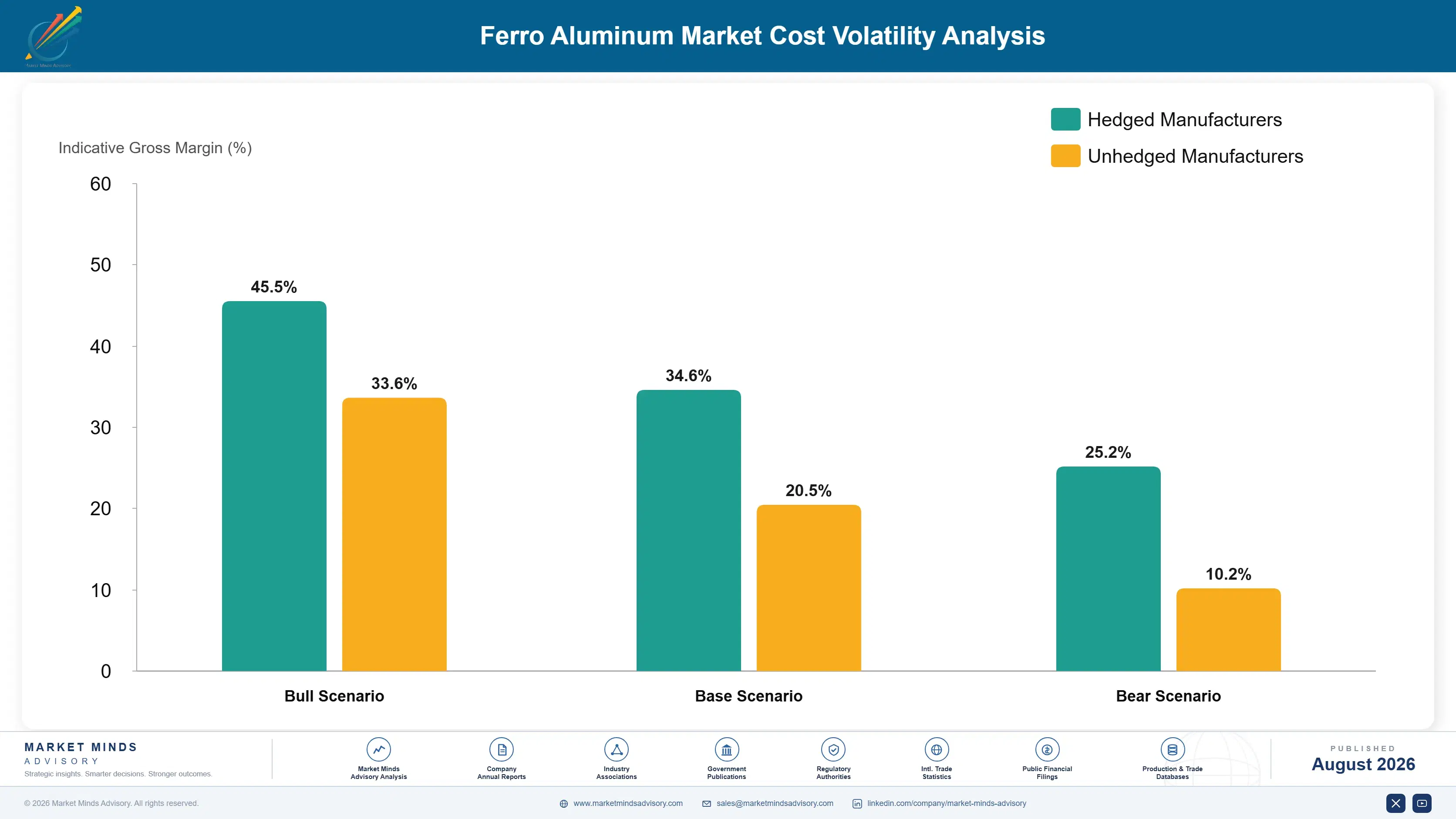
Aluminum Feedstock and Energy Cost Exposure

Primary aluminum accounts for roughly 60 to 65 percent of ferro aluminum cost of goods sold, sourced predominantly from smelters in China, the Middle East, and Norway, with the remainder split between energy costs and alloying additives across most production facilities. Producers without captive smelting capacity purchase aluminum on the London Metal Exchange spot or forward markets.
Aluminum prices spiked sharply during 2024 as energy cost pressure in Europe curtailed smelter output while global demand held steady, tightening available supply and pushing spot prices well above prior-year averages for an extended period. The IEA noted that aluminum smelting is among the most energy-intensive industrial processes, making it particularly exposed to regional power price volatility, a dynamic that materially affected ferro aluminum producer margins across Europe during this window.

Independent ferro aluminum producers without captive aluminum feedstock carry heavier exposure than vertically integrated competitors such as Elkem and Shandong Weiqiao, who capture margin at both the smelting and alloying stages of production. This gap widens materially during price spikes, pushing independent producers toward long-term supply agreements or index-linked pricing clauses to stabilize input costs across their contract base.
ferro-aluminum-market-trends-cost-volatility-analysis-1787550746114

Secure Captive or Long-Term Aluminum Feedstock Supply

Producers are increasingly securing captive or long-term contracted aluminum feedstock supply rather than relying on London Metal Exchange spot purchases, reducing exposure to short-term price swings tied to energy cost volatility. This approach requires substantial upfront capital or long-term commitment but has measurably reduced margin volatility during recent aluminum price spikes across major producing regions.

Negotiate Renewable Power Purchase Agreements

Some producers are negotiating power purchase agreements directly with renewable energy generators to hedge against grid electricity price volatility affecting their own or their feedstock supplier's smelting operations across multiple facilities and regions. This has proven particularly valuable for European producers exposed to volatile regional power markets during periods of constrained supply and elevated demand.

Lock In Index-Linked Mill Supply Pricing

Producers are negotiating index-linked pricing clauses into multi-year steel mill supply contracts, passing through aluminum price movements rather than absorbing them entirely under fixed-price terms negotiated years in advance and locked in for extended periods of time. This trades some pricing simplicity for meaningfully reduced margin exposure during volatile aluminum price cycles and market disruptions.

Portfolio Architecture for Margin Defence

Ferro aluminum portfolios span three tiers running from standard commodity grades through certified low-carbon products to next-generation high-purity specialty formulations, with gross margins widening substantially as products move up this ladder toward certification and purity premium capture across most major producer tiers nationwide and internationally each year and budget planning cycle.
The tension between volume and premium positioning defines producer strategy: standard commodity grades keep smelters running at scale but margins there compress steadily as Chinese capacity additions intensify competition among mid-tier producers nationwide and internationally. Certified low-carbon and high-purity specialty tiers require sustained capital investment in renewable power sourcing and quality testing infrastructure that smaller producers often cannot sustain without anchor customer commitments already secured well in advance.

High-value margin pools concentrate most heavily around certified low-carbon grades serving carbon-regulated European accounts and high-purity specialty grades serving automotive and aerospace steel producers, where producers can charge documented premiums for certification and consistency rather than competing purely on tonnage across most major accounts. This concentration is likely to deepen further as carbon regulation broadens across additional jurisdictions and producing regions over the coming several years.

Volume / Commodity-Adjacent Tier

Standard commodity ferro aluminum sold largely on price into general steelmaking deoxidation applications across broad regional accounts without specific certification requirements attached, serving mills prioritizing cost over documentation and traceability.
Gross Margin: 12-18%

Premium / Certified Tier

Certified low-carbon ferro aluminum produced using renewable or hydro-powered aluminum reduction with documented chain-of-custody emissions data, sold to carbon-regulated export accounts in Europe and increasingly North America each successive year.
Gross Margin: 22-30%

Sustainability / Regulatory / Next-Generation Tier

High-purity specialty grades formulated for automotive and aerospace-grade steel requiring tighter chemical composition tolerances and consistent quality documentation across multi-year qualified-supplier relationships and rigorous testing protocols nationwide, internationally, and across supply chains.
Gross Margin: 28-36%
ferro-aluminum-market-trends-portfolio-architecture-1787550746603

High-value Sub-segments and Strategic Watch-out

Certified Low-Carbon Grades (Europe)

Certified low-carbon grades serving carbon-regulated European accounts represent the highest-growth, highest-margin segment, combining premium pricing with durable regulatory tailwinds that standard commodity sales cannot replicate across comparable accounts nationwide and internationally each year and budget cycle across most major mill relationships and export corridors worldwide.
Gross Margin: 28-36%

High-Purity Automotive/Aerospace Grades

High-purity automotive and aerospace specialty grades offer strong margins with somewhat slower adoption, dependent on lengthy supplier qualification cycles and steel producer capital investment timelines that vary considerably across regions, account types, contract renewal periods, customer segments, and production schedules nationwide and internationally. Timelines vary by account.
Gross Margin: 24-30%

Standard Commodity Grades

Standard commodity ferro aluminum remains the volume core of the market, sustaining smelter utilization and mill relationships even as margins compress under Chinese producer competition nationwide and internationally each successive budget year and planning cycle across most regional markets, account tiers, and customer segments. Pricing stays highly competitive.
Gross Margin: 12-18%

Recycled Scrap-Based Alternatives

Recycled aluminum scrap-based deoxidizer alternatives face slow but steady adoption as sustainability procurement policies tighten, warranting close monitoring for producers still reliant on primary aluminum feedstock for meaningful revenue and growth going forward into future budget cycles, planning horizons, and strategic reviews across regions. Adoption pace remains uncertain.
Gross Margin: 16-22%

Recurring Deoxidizer Consumption Economics

Ferro aluminum revenue resembles a recurring industrial input purchase rather than a one-time sale, since steel mills consume deoxidizer continuously against production volume, creating stable repeat-order demand tied directly to mill utilization rates rather than discrete capital purchase cycles typical of equipment sales. This annuity character is strongest with mills operating under multi-year supply agreements, where predictable consumption volumes support long-term production planning for ferro aluminum producers rather than the volatile order patterns typical of spot-market commodity transactions.
Adoption depth varies by end-use vertical: automotive and aerospace-grade steel producers show the deepest specification lock-in, since requalifying an alternative supplier carries meaningful engineering cost and lead time that most mills prefer to avoid absent a compelling reason. General construction-grade steel producers switch suppliers more readily based primarily on price and delivery reliability, since specification tolerances are looser and requalification costs correspondingly lower. Specialty stainless steel producers sit between these extremes, valuing consistency but retaining more supplier flexibility.

Generational shifts are underway as mill procurement decisions move from pure cost-per-tonne evaluation toward sustainability and compliance officers weighing carbon border adjustment exposure, changing who ferro aluminum producers must sell to and how supply contracts get structured across premium accounts.
ferro-aluminum-market-trends-end-use-penetration-index-1787550747093

Strategic Priorities for Ferro Aluminum Producers

These are among the four positions where our research anticipates prominent divergence between winners and laggards over the coming forecast period. Each is grounded in the demand model, the regulatory perimeter, and the announced capacity pipeline.
01 / LOW-CARBON CERTIFICATION STRATEGY

Build Certified Low-Carbon Capability Ahead of Regulation

Producers competing purely on standard commodity price will lose ground to those who built certified low-carbon capability ahead of tightening European carbon regulation across most export markets. Certification, not raw production scale, is becoming the deciding factor for premium export contracts across the continent's largest steel mill accounts and long-term supply agreements. MMA recommends investing in renewable or hydro-powered smelting capacity now, even at a cost premium, since certification lead times run years and latecomers risk permanent exclusion from carbon-regulated accounts.
02 / FEEDSTOCK RISK MANAGEMENT

Secure Long-Term Aluminum Feedstock Contracts Now

Independent producers without captive aluminum feedstock remain persistently exposed to margin compression during price spikes that vertically integrated competitors largely avoid across their broader integrated operations and supply chains today. This exposure will only grow as aluminum price volatility persists amid ongoing energy market disruption across major producing regions and export corridors worldwide. MMA recommends pursuing long-term feedstock contracts or index-linked pricing clauses now and acting on timing, since producers who wait risk locking in unfavorable terms during the next price spike cycle.
03 / SPECIALTY GRADE QUALIFICATION

Pursue High-Purity Automotive and Aerospace Accounts

High-purity automotive and aerospace-grade qualification represents a durable margin advantage that most standard-grade producers have not yet pursued, despite its meaningfully higher pricing power and contract stickiness across the account base. Qualification cycles run long, meaning producers who start now will hold multi-year advantages over later entrants competing for the same accounts and customer relationships. MMA recommends prioritizing quality testing infrastructure investment ahead of demand, since automotive and aerospace steel mills prefer established, proven suppliers over new entrants without track records.
04 / PRODUCT LINE DIVERSIFICATION

Develop Recycled-Content Product Lines Proactively

Recycled aluminum scrap-based deoxidizer alternatives remain a small but growing threat that most producers are not yet actively addressing in their product strategy or long-term planning processes today. Sustainability procurement policies will likely accelerate this shift faster than current volume trends suggest across major steel-producing regions and export accounts worldwide and beyond. MMA recommends developing recycled-content certified product lines proactively now, since early movers gain lasting advantage rather than waiting for material volume loss to force a reactive response later.

Engagement Snapshot From the Field

A live engagement with an industry participant carrying material or product regulatory and market exposure ahead of a defining policy shift, showing how our research translates into a defensible multi-year portfolio strategy.
MARKET MINDS ADVISORY · CLIENT ENGAGEMENT SUMMARY
Ferro Aluminum Producer Strategic Portfolio Review and Transition Roadmap 2026·Investment Scenario on Ferro Aluminum Exposure Evaluation 2025-26
CLIENT PROFILE
The client is a mid-size independent ferro aluminum producer operating two production facilities in Central Europe, supplying deoxidizer alloy primarily to regional steel mills under a mix of spot and short-term contract sales. Facing approaching carbon border adjustment mechanism compliance deadlines and growing customer requests for certified low-carbon documentation, the client lacked a clear roadmap for transitioning production toward renewable-powered smelting and certification infrastructure.
STRATEGIC CHALLENGE
The client needed to determine whether to invest in renewable power purchase agreements, pursue third-party certification for its existing production, or risk losing carbon-regulated accounts to certified competitors within an eighteen-month window before enforcement tightened further. Capital constraints meant the client could not pursue every option simultaneously across both facilities.
MMA APPROACH
MMA benchmarked the client's current carbon footprint against certified competitors, modeled the return on investment for renewable power purchase agreements against third-party certification alone, and assessed which of the client's key accounts carried the most immediate certification requirements. The engagement combined primary interviews with the client's largest mill customers and certification body representatives.
KEY FINDINGS
  1. Three of the client's largest accounts, representing over 40 percent (client-reported, unverified by MMA) of total revenue, had explicit certification requirements taking effect within twelve months of the engagement.
  2. Third-party certification alone, without renewable power investment, would only address documentation requirements but could not close the emissions intensity gap versus fully certified hydro-powered competitors in the same market.
  3. A phased renewable power purchase agreement covering 60 percent of facility electricity demand delivered better return on investment than full renewable conversion within the client's available capital budget and timeline.
  4. Early engagement with certification bodies shortened the expected audit and documentation approval timeline by several months compared to the client's original internal planning assumptions and departmental estimates.
CLIENT PROFILE
The client is a mid-size independent ferro aluminum producer operating two production facilities in Central Europe, supplying deoxidizer alloy primarily to regional steel mills under a mix of spot and short-term contract sales. Facing approaching carbon border adjustment mechanism compliance deadlines and growing customer requests for certified low-carbon documentation, the client lacked a clear roadmap for transitioning production toward renewable-powered smelting and certification infrastructure.
STRATEGIC CHALLENGE
The client needed to determine whether to invest in renewable power purchase agreements, pursue third-party certification for its existing production, or risk losing carbon-regulated accounts to certified competitors within an eighteen-month window before enforcement tightened further. Capital constraints meant the client could not pursue every option simultaneously across both facilities.
MMA APPROACH
MMA benchmarked the client's current carbon footprint against certified competitors, modeled the return on investment for renewable power purchase agreements against third-party certification alone, and assessed which of the client's key accounts carried the most immediate certification requirements. The engagement combined primary interviews with the client's largest mill customers and certification body representatives.
KEY FINDINGS
  1. Three of the client's largest accounts, representing over 40 percent (client-reported, unverified by MMA) of total revenue, had explicit certification requirements taking effect within twelve months of the engagement.
  2. Third-party certification alone, without renewable power investment, would only address documentation requirements but could not close the emissions intensity gap versus fully certified hydro-powered competitors in the same market.
  3. A phased renewable power purchase agreement covering 60 percent of facility electricity demand delivered better return on investment than full renewable conversion within the client's available capital budget and timeline.
  4. Early engagement with certification bodies shortened the expected audit and documentation approval timeline by several months compared to the client's original internal planning assumptions and departmental estimates.
RECOMMENDED STRATEGY
Phase 1: Phase 1 (Months 1-4): Complete carbon footprint benchmarking and engage certification bodies for both facilities and all major mill accounts. Phase 2: Phase 2 (Months 5-12): Execute phased renewable power purchase agreements and begin third-party certification audit processes fully across the board. Phase 3: Phase 3 (Months 13-18): Complete certification for priority accounts and expand renewable coverage across the remaining facility capacity base entirely.
OUTCOME
The client secured certified low-carbon status for its priority accounts within the eighteen-month compliance window, retaining contracts representing roughly 40 percent of revenue that were at risk of loss (client-reported, unverified by MMA). The phased renewable power approach delivered the required emissions reduction at approximately 35 percent lower capital cost (client-reported, unverified by MMA) than full facility conversion.

Frequently Asked Questions

Foundational context covering the market sizes, CAGR, scope, country, region and competition that inform every finding below. This section is provided to cover basics and most often pre-purchase conversations, answered from the MMA Primary Research Dataset.

What is the current size of the Ferro Aluminum Market?

The Ferro Aluminum Market was valued at approximately $3.9 billion globally in 2025. This figure covers deoxidizer and grain refiner alloy production for steelmaking, including standard and certified low-carbon grades.

How large will the Ferro Aluminum Market be by 2036?

MMA projects the market will reach approximately $6.0 billion by 2036. This represents a 1.46 times expansion from the 2026 base of $4.1 billion over the ten-year forecast period.

What is the CAGR for the Ferro Aluminum Market 2026 to 2036?

The market is forecast to grow at a 3.9 percent compound annual growth rate between 2026 and 2036. Bull and bear scenarios range from 2.8 to 5.0 percent depending on steel demand and regulation.

Which segment is growing fastest?

Certified low-carbon ferro aluminum is the fastest-growing segment, expanding at 8.9 percent annually. This outpaces the overall market by roughly 2.3 times, driven by carbon border adjustment regulation in Europe.

Who are the major companies in the Ferro Aluminum Market?

Leading companies include Elkem, Metalmen Sales, Shandong Weiqiao, Jiangsu Alcha, and Reading Alloys. These five players hold a combined CR5 near 28 percent measured on production capacity.

Which country is growing fastest?

India leads country-level growth at approximately 6.2 percent annually, ahead of the broader South Asia and Pacific regional average. This reflects rapid electric arc furnace steel capacity build-out nationwide.

Report Segmentation Architecture

The full report scope spans multiple orthogonal segmentation dimensions, with cross-tabulated demand data provided for each dimension pair. Coverage extends further to regional breakdowns, trend trajectories, and the competitive detail needed to support segment-level decision-making.

By Alloy Grade and Certification Tier

  • Standard Commodity Grade
  • Certified Low-Carbon Grade
  • High-Purity Automotive Grade
  • Aerospace-Grade
  • Recycled-Content Grade
  • Custom Formulation

By End-Use Steel Industry

  • Construction-Grade Steel
  • Automotive-Grade Steel
  • Aerospace-Grade Steel
  • Stainless Steel
  • Specialty Alloy Steel

By Commercial Dimension

  • Long-Term Contract
  • Spot Market
  • Certified Export Accounts
  • Domestic Supply

By Region

  • North America
  • Western Europe
  • East Asia
  • South Asia and Pacific
  • Latin America
  • Middle East and Africa
  • Eastern Europe

Scope, Methodology, and Coverage

Every figure in this report is reproducible from documented input assumptions. The scope below maps the historical period, the forecast horizon, the segmentation dimensions, and the countries covered, alongside the underlying primary and qualitative methodology.
Historical Period
2020 to 2025
Forecast Period
2026 to 2036
Base Year
2025 (USD billions; MMA Primary Research Dataset, August 2026)
Market Definition
The Ferro Aluminum Market covers ferro aluminum alloy production used as a deoxidizer and grain refiner in steelmaking, including standard and low-carbon certified grades. It excludes primary aluminum smelting, aluminum billet production, and finished steel products.
Quantitative Units
USD billions (current prices); metric tonnes shipped (thousands)
Segmentation Dimensions
By Alloy Grade and Certification Tier; By End-Use Steel Industry; By Commercial Dimension; By Region
Regions Covered
North America, Western Europe, East Asia, South Asia and Pacific, Latin America, Middle East and Africa, Eastern Europe
Countries Covered
USA, China, Germany, France, UK, Japan, South Korea, India, Australia, Canada, Brazil, Mexico, Indonesia, Vietnam, Thailand, Malaysia, UAE, Saudi Arabia, South Africa, Nigeria, Turkey, Poland, Netherlands, Italy, Spain, Sweden, Switzerland, Argentina, Colombia, Singapore, and additional markets relevant to this sector
Key Companies Profiled
Elkem, Metalmen Sales, Shandong Weiqiao, Jiangsu Alcha, Reading Alloys, American Elements, Minex Metallurgical, Shanxi Jinbei, Guizhou Redstar, Henan Star Metallurgy, Bear Metallurgical, Affival, TDK Ferro Alloys, Sunrise Ferro Alloys, Yichuan Jinyuan, Ningxia Tianyuan, IMFA (Indian Metals and Ferro Alloys), Nava Bharat Ventures, Ferroglobe, Gulf Ferro Alloys
Quantitative Methodology
Primary survey, n=3,800 respondents, Q4 2025, six countries; demand-side model with trade association cross-validation
Qualitative Methodology
47 expert interviews, Q4 2025; applied to validate demand model assumptions, identify emerging dynamics, and assess competitive positioning
Report Format
PDF and XLSX data workbook (Word format preview document)
Publisher
Market Minds Advisory
Report Code
MMA-2026-CHM-103
Published
August 2026
Contact
sales@marketmindsadvisory.com | www.marketmindsadvisory.com

Purchase the full Ferro Aluminum Market Report (2026 to 2036).

The full Ferro Aluminum Market report delivers a comprehensive 200-plus page analysis covering detailed segmentation by alloy grade, certification tier, and end-use steel industry alongside country-level sizing across all seven tracked regions. It includes in-depth competitive profiles of twenty producers, quantified aluminum feedstock and energy cost risk analysis, and scenario-based forecasts through 2036. Subscribers also receive access to underlying primary survey and expert interview datasets referenced throughout the analysis. Quarterly update briefings cover regulatory and certification developments across major producing regions, and custom segmentation cuts are available on request for enterprise subscribers.
Country-level market sizing across 30 countries
Twenty profiled ferro aluminum producers included
Carbon border adjustment exposure scoring included
Aluminum feedstock cost benchmarking data included
Quarterly market update subscription access included
Custom segmentation cuts available on request

Built For The People Who Decide

From boardroom strategy to bench-side execution, this report is read cover-to-cover by leaders shaping the next decade of their industry, turning demand scenarios, market dynamics and valuation benchmarks into decisions.
CXOs/ Presidents/ VPs/ Managers
M&A and Corporate Development
Strategy Teams and R&D Heads
Procurement and Product Directors
Regulatory and Compliance Leaders
Investor Relations and Equity Analysts