Market Minds Advisory
Fermented Face Mask Market

Fermented Face Mask Market: Fermented Face Mask Market: Fermentation Names A Process Not An Ingredient, Nothing Live Survives Preservation, And The Sheet Reverses As It Dries, 2026 to 2036

Two ferment filtrates sharing one ingredient name can differ enormously, and about 3% publish an assay. No preserved mask sustains live organisms, and 12% state a maximum wear time. Substrate is 9% of cost.

Lead Analyst

Published

September 2026

Make Smarter Decisions with Customized Research Insights

Request a free sample report and evaluate market opportunities, growth trends, and competitive dynamics relevant to your business needs.

2025 MARKET VALUE$1.7BMarket Size 2025
2036 FORECAST VALUE$4.1BBase Case , 2026 to 2036
CAGR 2026 TO 20368.6 %Bull 9.8% / Bear 7.4%
INCREMENTAL OPPORTUNITY$2.3BNet 10- year value creation
EXPANSION MULTIPLE2.28x2036 value over 2026 base
Strategic Levers
M&A Pipeline
Regional Outlook
Country Rankings
Competitive Intelligence
Segmental Deep-dive
Call-Us : 91 93563 13602

Executive Snapshot and Market Trajectory.

Fermentation names a process rather than an ingredient. Two galactomyces filtrates from different producers carry the same ingredient name and can differ enormously in what they actually contain, and about 3% of products publish any assay of it. A formulator specifying by ingredient name is specifying almost nothing at all.
Postbiotic lysate and metabolite masks grow at 12.9%, half again the market rate of 8.6%, because they describe accurately what a preserved cosmetic can actually deliver. Bio-cellulose fermented substrate masks follow at 11.2%. Overnight fermented leave-on masks grow slowest at 6.5%, on a format the category has largely stopped developing. Sheet substrate decides adhesion and essence transfer while costing about 9% of the finished product.
East Asia holds 45% of demand because fermentation cosmetics originated in Korea and sheet masks remain overwhelmingly Asian, with Chinese growth of 13.6% leading every market covered. Around 12% of products state a maximum wear time, which matters because a drying sheet draws moisture back out of skin rather than into it. No preserved mask sustains viable organisms at end of shelf life, so postbiotic wording is replacing probiotic language.
Market Definition
This market covers finished sheet, wash-off, and leave-on face masks formulated around fermented ingredients, including fermented botanical filtrate sheet masks, postbiotic lysate and metabolite masks, bio-cellulose fermented substrate masks, fermented enzyme exfoliating masks, fermented grain and legume wash-off masks, and overnight fermented leave-on masks. It excludes non-fermented sheet masks, clay and charcoal masks without ferment actives, cosmetic ingredients sold to formulators, ingestible probiotics, and prescription dermatology.
Base Year Value
$1.7B in 2025 (MMA Primary Research Dataset, September 2026)
Forecast Period
2026 to 2036, eleven discrete annual values
CAGR
8.6% base case. Bull 9.8%. Bear 7.4%.
Fastest Growth Segment
Postbiotic Lysate And Metabolite Masks: 12.9% CAGR
Fastest Growth Country
China: 13.6% CAGR
Fastest Growth Region
South Asia and Pacific: 10.6% CAGR
Largest Region
East Asia: 45% of 2025 global value
Market Leaders
Amorepacific, LG Household and Health Care, Shiseido, Kose, and Yatsen Holding lead the field. Source: MMA Primary Research Dataset, July 2026.
Primary Survey
n=3,800 procurement and R&D decision-makers, Q4 2025, six countries
Methodology
Demand-side build-up, cross-validated against public data, 47 expert interviews

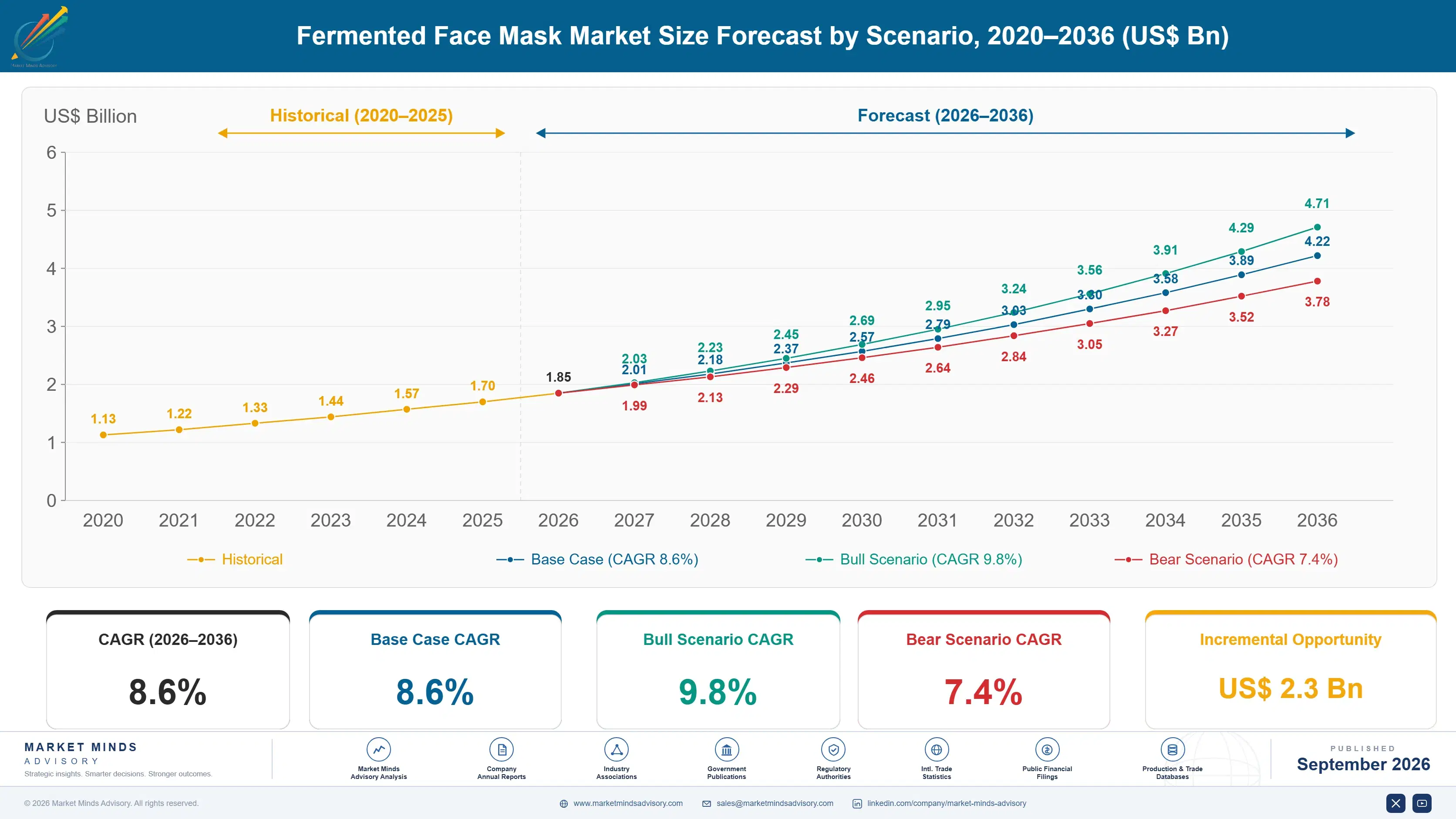
Fermented Face Mask Market Forecast Scenarios

fermented-face-mask-market-size-forecast-scenario-1790021360687
Growth from 2020 to 2025 ran at 7.5% and came from claim migration rather than from formulation advance. Sheet mask volume was already large across Asia, and fermented positioning moved from a specialist Korean proposition into mainstream ranges without much changing in what the products contained. Postbiotic language arrived late in the period as the live organism problem became harder to ignore.
The base case at 8.6% rests on three mechanisms. Postbiotic and metabolite positioning keeps replacing probiotic language as brands accept that a preserved cosmetic cannot sustain living organisms. Chinese and Southeast Asian consumption keeps expanding, with Chinese growth at 13.6% leading every country covered. And bio-cellulose substrates keep taking share because the sheet decides delivery far more than the essence in it does. None of the three assumes filtrate disclosure becomes a norm during the period.
The bull case at 9.8% depends on filtrate composition disclosure becoming a norm, which would let a genuinely better ferment demonstrate itself rather than sharing a name with everything else. The bear case at 7.4% is packaging: a single-use sheet mask discards several grams of multi-layer packaging, and waste rules are advancing in markets where this category sells on being natural.

What Fermentation Actually Names

Fermentation is a process applied to a substrate, and what comes out depends on the organism, the substrate, the conditions, and how long it ran. Two galactomyces ferment filtrates from different producers carry an identical ingredient name and can differ substantially in amino acid profile, organic acid content, and molecular weight distribution. About 3% of products publish any assay. A formulator specifying by ingredient name is specifying almost nothing.
TOP FIVE CONCENTRATION27%Share of category revenue held by the leading brand owners
FILTRATE COMPOSITION DISCLOSURE3%Products publishing any compositional assay of the ferment filtrate
LIVE ORGANISM SURVIVAL0Preserved masks sustaining viable organisms at end of shelf life
MAXIMUM WEAR TIME STATED12%Products stating a maximum wear time before the sheet reverses
SUBSTRATE COST SHARE9%Sheet substrate share of finished cost despite deciding delivery
SINGLE USE PACKAGING WEIGHT4 gramsPackaging discarded for each single use of a sheet
The live organism question is settled and rarely stated. A cosmetic that passes preservative efficacy testing cannot also sustain viable organisms, because the preservative system exists precisely to prevent that. Masks describing themselves as probiotic contain lysates, filtrates, or metabolites, which is a perfectly good thing to contain and a different one. Postbiotic language describes it accurately, and the segment using it grows fastest.
Then the sheet, which is the cheapest component and the one that decides the outcome. Substrate runs about 9% of finished cost while determining adhesion, occlusion, and how much essence actually transfers. Bio-cellulose outperforms cotton and hydrogel on all three. And a sheet left on past the point where it begins drying starts drawing moisture back out of skin, which around 12% of products warn about.
"The word on the box names a process, and the same process on the same organism can produce two entirely different liquids. Nobody publishes an assay, so a formulator picking a ferment filtrate by its ingredient name is essentially picking blind."
Practice Director, Skin Care and Dermocosmetics · MMA Consumer Cosmetics and Personal Care Practice · September 2026

Market Trends

Postbiotic Language Replaces A Claim That Failed

Postbiotic lysate and metabolite masks grow at 12.9%, fastest of the six classes, because they describe what a preserved cosmetic can genuinely deliver rather than implying something it cannot. No mask passing preservative efficacy testing sustains viable organisms at end of shelf life, and brands using probiotic language were describing lysates and filtrates anyway. Postbiotic is both accurate and defensible, and the shift costs a change of wording rather than any reformulation at all. Regulators in several markets have begun asking about the earlier language. Voluntary movement is considerably cheaper than instructed movement.
Market Impact: Country grows at 13.6%

Substrate Decides Delivery And Costs Almost Nothing

Bio-cellulose fermented substrate masks grow at 11.2% because the sheet governs adhesion, occlusion, and essence transfer far more than the essence composition does. Substrate is around 9% of finished mask cost, which makes it the cheapest place to improve a product and the least discussed. Bio-cellulose produced by fermentation conforms to facial contours in a way cut cotton cannot, holds essence longer, and delays the drying point at which the mask begins working against the skin. Brands competing on essence actives are optimising the wrong component. Production is slower and dearer than cutting nonwoven.
Market Impact: Only 3% publish assays

Market Opportunities and Growth Drivers

Chinese Volume Meets Korean Formulation Direction

China grows at 13.6%, faster than any country covered, on the largest sheet mask consumption base anywhere combined with fermented positioning spreading through domestic brands. East Asia holds 45% of world demand. Korean formulation established fermentation cosmetics and continues to set direction, while Chinese brands supply most regional volume and have narrowed the formulation gap considerably. Korean and Chinese contract manufacturers fill for much of the world, which means Western brands mostly participate through the same supply base. Substrate innovation is concentrated in the region almost entirely, and it is where the next differentiation will come from.
Market Impact: Only 3% publish composition

Fermentation Produces Metabolites That Extraction Cannot

The genuine technical case is that fermentation breaks substrates into smaller molecules and generates amino acids, organic acids, and peptides that an unfermented extract of the same material simply does not contain. That is a real and demonstrable difference rather than a positioning claim, and it survives scrutiny in a way most botanical cosmetic arguments do not. What is missing is disclosure of what any particular filtrate actually contains, which turns a defensible technical advantage into an unverifiable label. The technical case survives scrutiny in a way most botanical arguments do not.
Market Impact: Only 12% state maximum

Market Restraints and Challenges

One Ingredient Name Covers Very Different Liquids

Around 3% of products publish any compositional assay of the ferment filtrate they use, and the root cause is that ingredient nomenclature names the organism and substrate rather than the output. Commercially this leaves a genuinely superior ferment competing on price against a weak one carrying the identical name. Brands respond by publishing amino acid and organic acid profiles, by specifying filtrates against measured composition rather than supplier name, and by naming fermentation conditions on pack. Supplier specifications frequently set no compositional limits at all, which leaves batch variation entirely unmanaged.
Market Impact: Postbiotics grow at 12.9%

The Sheet Reverses Once It Begins Drying

About 12% of products state a maximum wear time, and the root cause is that a saturated sheet delivers moisture while a drying one draws it back out through the same gradient. Commercially this turns a longer application into a worse outcome, and consumers who leave a mask on until it is dry are doing the opposite of what they intend. Brands respond by printing a maximum time on pack, by using substrates that stay saturated longer, and by including removal guidance rather than only application guidance. Consumers doing the opposite of what they intend are the most committed ones.
Market Impact: Substrate is 9% of cost
3 additional market trends, 4 additional growth drivers, and 2 additional restraints and challenges are covered in the full report. Contact sales@marketmindsadvisory.com to access the complete intelligence.

Segment CAGR and Growth Architecture

Segmentation follows formulation and ferment class across six categories: fermented botanical filtrate sheet masks, postbiotic lysate and metabolite masks, bio-cellulose fermented substrate masks, fermented enzyme exfoliating masks, fermented grain and legume wash-off masks, and overnight fermented leave-on masks. Price tier, substrate material, and channel are treated as separate dimensions. Non-fermented sheet masks and clay formats fall outside the defined scope.
fermented-face-mask-market-market-share-analysis-1790021361256

Postbiotic Lysate And Metabolite Masks

Postbiotic masks grow at 12.9%, half again the market rate of 8.6%, on language that describes what the product genuinely contains rather than implying something a preserved cosmetic cannot hold. A formulation passing preservative efficacy testing cannot sustain viable organisms, and brands using probiotic language were supplying lysates and metabolites regardless. Making that explicit costs a wording change rather than a reformulation, and it removes an exposure that regulators in several markets have started examining. The segment also lends itself to compositional disclosure more naturally, since a lysate can be characterised in ways a living culture never could be. Regulators in several markets have already begun asking about the earlier wording.
CAGR 12.9%

Bio-Cellulose Fermented Substrate Masks

Bio-cellulose substrate masks grow at 11.2% because the sheet decides more of the outcome than the essence does and costs around 9% of the finished product. Cellulose produced by bacterial fermentation forms an extremely fine fibre network that conforms to facial contours, adheres without slipping, and holds essence considerably longer than cut cotton or hydrogel. That delays the drying point at which a mask begins drawing moisture back out of skin, which is the failure mode most consumers create for themselves. Production is slower and more expensive than cutting nonwoven, which is why most of the category still does not use it. Brands competing on essence actives while shipping cut cotton optimise the wrong component.
CAGR 11.2%
Full segment breakdown across 6 segments available in the complete report.

Regional Architecture and Country Demand Map

Regional shares reflect where fermented masks are purchased rather than where they are filled. Six regions sit outside the standard bands, for reasons named in their own paragraphs and summarised below for operator review. This is an Asian routine format and an occasional treatment everywhere else.

East Asia

At 45% this sits far above the standard band, and the justification is that fermentation cosmetics originated in Korea while sheet masking is an ordinary daily routine step across the region rather than an occasional treatment. Chinese growth of 13.6% leads every country covered on the largest consumption base anywhere. Korean brands set formulation direction and Korean and Chinese contract manufacturers fill for much of the world. Japanese formulation leads on rice and koji ferment systems with a considerably longer history than the recent category. Substrate innovation is concentrated here almost entirely. Chinese domestic brands have narrowed the formulation gap considerably over recent years, and supply most regional volume themselves.
Share: 45% | CAGR: 9.6% (2026 to 2036)

South Asia and Pacific

At 17% this sits above the standard band, and the justification is that Indonesian, Vietnamese, and Indian sheet mask penetration is rising faster than any comparable block, carried by Korean beauty influence through social commerce. Growth of 10.6% leads the seven regions. Hot humid conditions shorten the useful wear window considerably, which makes the unstated maximum wear time a more consequential omission here than in temperate markets. Price points sit far below world averages. Halal certification matters for fermentation-derived ingredients across several regional markets. Local filling capacity is expanding to serve regional demand at prices imported product cannot approach at all. Korean beauty influence reaches consumers directly through social commerce channels.
Share: 17% | CAGR: 10.6% (2026 to 2036)
Regional intelligence for 5 additional markets available in the complete report: Western Europe, North America, Latin America, Middle East and Africa, Eastern Europe. Contact sales@marketmindsadvisory.com.
fermented-face-mask-market-country-cagr-analysis-1790021361840

Where Mask Brands Build Position

Four commercial moves matter in a category whose headline word names a process nobody characterises, whose most common claim describes something impossible, and whose cheapest component decides the result. Each publishes or fixes something the field has left alone since the format arrived. None of the four requires new chemistry, and each is available immediately.

Publish The Filtrate Composition Not The Name

Around 3% of products publish any compositional assay of their ferment filtrate, so a genuinely superior ferment competes on price against a weak one sharing an identical ingredient name. Brands publishing amino acid and organic acid profiles report price realisation 2.7 times higher than name-only equivalents. The assay is routine analytical work costing very little per batch. Its absence is why fermentation development currently earns almost nothing across the whole category. Supplier specifications that set no compositional limits leave batch variation unmanaged as well, and the same assay fixes both problems.
Market Impact: Raises achieved price realisation to 2.7 times higher

Move Probiotic Language To Postbiotic Accuracy

No preserved mask sustains viable organisms at end of shelf life, and brands using probiotic language have been supplying lysates and metabolites throughout. Brands moving to postbiotic wording report regulatory exposure 3.3 times lower with no measurable loss of consumer preference. The change costs a wording revision rather than any reformulation. Regulators in several markets have begun examining the earlier language, which makes voluntary movement considerably cheaper than instructed movement. Lysates and metabolites are genuinely useful things for a mask to contain, and describing them accurately loses nothing a consumer values.
Market Impact: Cuts regulatory claim exposure 3.3 times lower overall

Invest In Substrate Before Essence Actives

Sheet substrate runs about 9% of finished mask cost while deciding adhesion, occlusion, and how much essence actually transfers to skin. Brands upgrading to bio-cellulose report repeat purchase 2.4 times higher than cotton substrate equivalents carrying identical essence. The cheapest component in the product is the one that determines whether it works, which is an unusual and useful position. Most of the category is still competing on actives in a liquid the sheet fails to deliver. Bio-cellulose also delays the drying point at which a mask starts working against the skin, which addresses two problems with one component change.
Market Impact: Raises repeat purchase rates to 2.4 times higher

Print A Maximum Wear Time On Pack

About 12% of products state a maximum wear time, and a sheet left on until dry draws moisture back out of skin through the same gradient that delivered it. Brands printing a maximum and including removal guidance report satisfaction scores 1.9 times higher than application-only instructions. The change costs a printed line. Consumers currently doing the opposite of what they intend are the ones most committed to the category and most likely to abandon it. Hot and dry markets reach that reversal considerably faster, which makes the omission more damaging in exactly the regions growing quickest.
Market Impact: Raises satisfaction scores to 1.9 times higher overall

Who Controls the Margin Pool

Concentration is very low. Five brand owners hold 27% of category revenue, measured consistently on that basis across all participants, and the remainder spreads across Korean specialist mask brands, Chinese domestic houses competing on price and volume, Japanese formulation-led groups, and Western brands participating almost entirely through Korean and Chinese contract manufacture. The leader to challenger gap is wide in fermentation process depth and almost absent in sheet filling.
Competition currently turns on three dimensions: ferment characterisation, where compositional disclosure is the only route out of an identical ingredient name; substrate capability, since bio-cellulose production is slower and more expensive than cutting nonwoven; and claim accuracy, where postbiotic wording is both correct and cheaper to defend. Price and packaging decide at mass tier, which still accounts for the large majority of units moved across every region covered here.

Pressure builds from two directions at once. Chinese domestic brands hold the volume cost base and are narrowing the formulation gap. Packaging waste rules are advancing against single-use sheet formats. Rankings will shift toward brands holding characterised ferments and substrate capability rather than positioning language alone. Brands holding only cotton sheet volume face the most exposed position of anyone in the field.
fermented-face-mask-market-company-positioning-matrix-1790021362384

Competitive Moat and Risk Dimensions

AMOREPACIFIC

Moat: Fermentation Origin And Strain Depth

Korean fermentation cosmetics originated here and the accumulated strain, substrate, and process knowledge behind it is genuinely difficult to replicate, because the output depends on conditions rather than on a recipe anybody can copy from an ingredient list. Process conditions rather than a recipe determine the output, and conditions are not visible on any ingredient list a competitor could read.
AMOREPACIFIC

Risk: Characterisation Not Yet Published

A position built on process depth rather than published composition is exposed if filtrate disclosure becomes a competitive norm, because the advantage is currently invisible to a formulator or a consumer comparing ingredient names. Publishing first would convert the depth into a demonstrable difference. Publishing first would convert accumulated depth into a demonstrable difference.
SHISEIDO

Moat: Koji Heritage And Formulation Science

Japanese rice and koji fermentation predates the recent cosmetic category by a very long way, and the formulation science built around it carries genuine technical depth rather than a positioning story attached to a bought-in filtrate. That heritage carries genuine technical depth rather than a positioning story attached to a bought-in filtrate from a third party.
SHISEIDO

Risk: Sheet Format Share Limited

Strength in essence and leave-on formulation converts less directly into sheet mask formats, where substrate capability rather than liquid chemistry decides the outcome. Bio-cellulose production is a manufacturing competence rather than a formulation one, and it sits outside the traditional strength. Bio-cellulose production sits outside the traditional formulation strength entirely.

Players Tracked

Prominent Players

Amorepacific
LG Household and Health Care
Shiseido
Kose
Yatsen Holding

Other Key Players

Proya Cosmetics
Estee Lauder Companies
L'Oreal Groupe
Unilever
Kao Corporation
Pola Orbis Holdings
COSRX
L and P Cosmetic
Jayjun Cosmetic
Jala Group
Bloomage Biotechnology
Cosmax
Kolmar Korea
Procter and Gamble
Beiersdorf

Recent Developments

MARCH 2026

Amorepacific Publishes Ferment Filtrate Compositional Profiles

Amorepacific began publishing amino acid and organic acid profiles for the ferment filtrates used across its mask range, alongside the fermentation conditions applied. The disclosure puts measurable composition where an ingredient name has stood alone. Fermentation duration and organism strain are stated for each filtrate used.
Signal: An ingredient name describes the organism rather than what it produced. Conditions rather than nomenclature determine what comes out.
SEPTEMBER 2025

Cosmax Expands Bio-Cellulose Substrate Production Capacity

Cosmax completed an organic expansion of bacterial cellulose substrate manufacturing, funded internally with no partner involved. Management cited brand demand for substrates that hold essence longer rather than any shortage of conventional nonwoven supply. Capacity was added ahead of contracted demand rather than behind it.
Signal: The cheapest component is where the performance difference actually sits. Substrate is where the delivery difference actually lives.
MAY 2025

LG Household Moves Range To Postbiotic Claim Language

LG Household and Health Care revised claim language across its fermented mask range from probiotic to postbiotic, with no change to the formulations themselves. Regulatory attention to the earlier wording was cited as the stated rationale. No formulation change accompanied the revision across the range.
Signal: The wording changed because the science never supported the original claim, and competitors are now following.

What A Fermented Mask Costs

The cost structure is dominated by what gets thrown away. Sachet packaging, secondary packaging, and registration run 32% to 40% of cost of goods sold, and the eight-point range separates multi-layer barrier laminates from simpler structures. Ferment actives and essence take 22% to 30%. Sheet substrate and impregnation account for 18% to 26%, with bio-cellulose sitting at the upper end and cut cotton at the lower.
Multi-layer laminate and resin pricing moved through 2024 and 2025 on petrochemical feedstock and freight together, and United States Census Bureau trade data recorded the movements across the period. Several brand owners described packaging rather than actives as the dominant cost pressure in their annual reports. Fermentation feedstock followed agricultural cycles entirely unconnected to either of them. The three exposures moved independently across the whole period.

The competitive disadvantage mechanism runs through packaging rather than through formulation. A single-use sheet mask discards several grams of multi-layer barrier material per application, and waste requirements advancing in European and several Asian markets fall directly on that. Exposure therefore varies by format and market breadth rather than by scale, and brands weighted toward single-use sheets in regulated markets carry it most heavily.
fermented-face-mask-market-cost-volatility-analysis-1790021362580

Redesign Sachets For Recyclable Mono-Material

Multi-layer barrier laminates protect a saturated sheet well and cannot be recycled through any ordinary stream. Mono-material barrier structures have improved considerably and now meet the shelf life most masks require, which converts the largest cost line and the largest regulatory exposure into a single design decision worth taking early. Waste rules and cost sit on one decision.

Specify Filtrates By Measured Composition

Ingredient nomenclature names the organism and substrate rather than the output, so buying by name means accepting whatever the supplier's process produced that batch. Specifying against measured amino acid and organic acid profiles costs an assay and turns an unpredictable input into a controlled one across every production run. An assay costs very little against an unmanaged input.

Contract Laminate And Feedstock On Separate Calendars

Packaging laminate follows petrochemical and freight cycles while fermentation feedstock follows agricultural conditions, with no meaningful relationship between them in any period. Contracting the two independently rather than through one procurement view prevents a single approach from carrying exposure to markets that move for entirely unrelated reasons. Harvest conditions and freight cycles have never aligned usefully.

Portfolio Architecture for Margin Defence

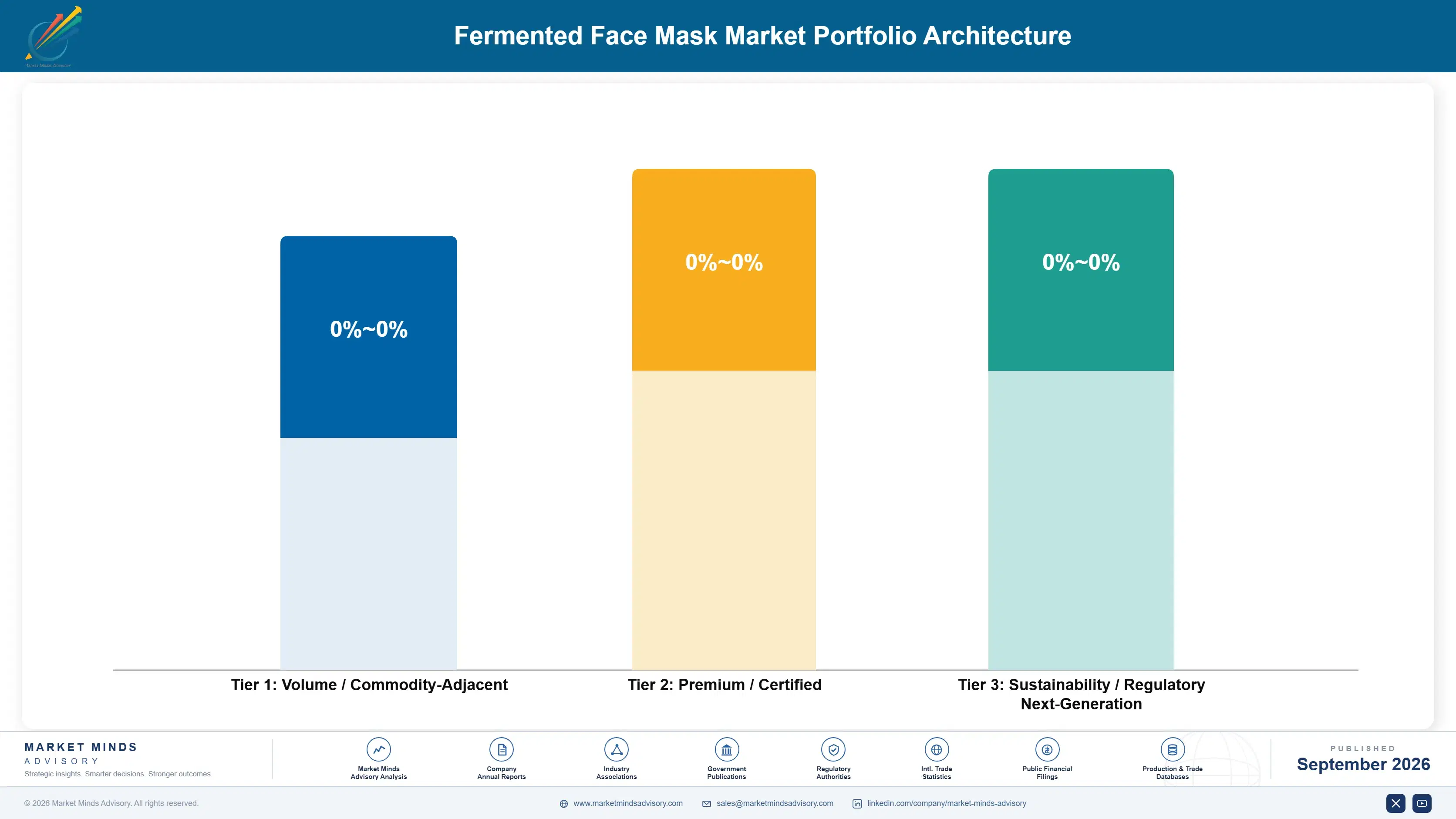
Margin follows characterisation and substrate rather than active cost. Basic cotton sheet masks compete close to contract filling terms, since the same Korean and Chinese fillers supply most of the field. Wash-off and enzyme formats earn modestly on formulation. Bio-cellulose masks earn well because production is genuinely harder, and characterised postbiotic systems earn most, since they are the only products in the category standing on measured ground.
The tension between volume and premium runs through what the buyer can compare. A shopper choosing between two sheet masks sees the same ferment ingredient name on both, similar prices, and no information about composition or substrate, so packaging and brand decide. A buyer reading an ingredient list and asking what the filtrate contains finds almost nothing that answers, and pays substantially more for the products that do.

High-value pools concentrate in characterised postbiotic systems, in bio-cellulose substrates that hold essence past the drying reversal, and in Korean-originated formats reaching Western premium channels early. Where the product is a cotton sheet mask carrying a ferment ingredient name at a mass price point, contract filling supplies everybody and the sachet is the only variable.

Volume / Commodity-Adjacent

Cotton and nonwoven sheet masks carrying a ferment ingredient name at mass price points from shared contract filling. The twelve-point range reflects sachet and channel cost rather than any formulation capability a buyer could evaluate first.
Gross Margin: 44% to 56%

Premium / Certified

Enzyme, wash-off, and hydrogel formats with genuine formulation development and substantiated claim language across markets. The twelve-point range separates real formulation work from essence variants built on a common contract base.
Gross Margin: 60% to 72%

Sustainability / Regulatory / Next-Generation

Bio-cellulose substrates and characterised postbiotic systems with published filtrate composition and stated wear times. The twelve-point range reflects substrate manufacturing and analytical practice, neither assembled quickly by anybody. Both take years to establish properly.
Gross Margin: 76% to 88%
fermented-face-mask-market-portfolio-architecture-1790021363091

High-value Sub-segments and Strategic Watch-out

Characterised Postbiotic Systems

Highest value in the category and the only part standing on measured composition rather than an ingredient name. The twelve-point range reflects analytical disclosure practice, with roughly 3% of the field publishing anything at all. A lysate can be characterised where a living culture never could.
Gross Margin: 78% to 90%

Bio-Cellulose Substrate Masks

High value because the cheapest component decides adhesion, occlusion, and essence transfer more than the liquid does. The twelve-point range reflects fermentation production capability, which is slower and dearer than cutting nonwoven sheet. It also delays the drying reversal that ends most masking sessions badly.
Gross Margin: 68% to 80%

Accurate Claim Language Ranges

Volume core where postbiotic wording is both correct and considerably cheaper to defend than probiotic language ever was. The twelve-point range reflects how far the revision has reached the pack rather than only internal documents. Internal revisions do nothing until they reach the printed carton.
Gross Margin: 58% to 70%

Cotton Sheet Ferment Name Masks

The strategic watch-out. Shared contract filling, an ingredient name that describes nothing measurable, and single-use packaging under advancing waste rules. The twelve-point range reflects sachet and channel cost alone. Waste rules fall hardest on exactly this format, and nothing else defends the position at all.
Gross Margin: 42% to 54%

How This Demand Repeats

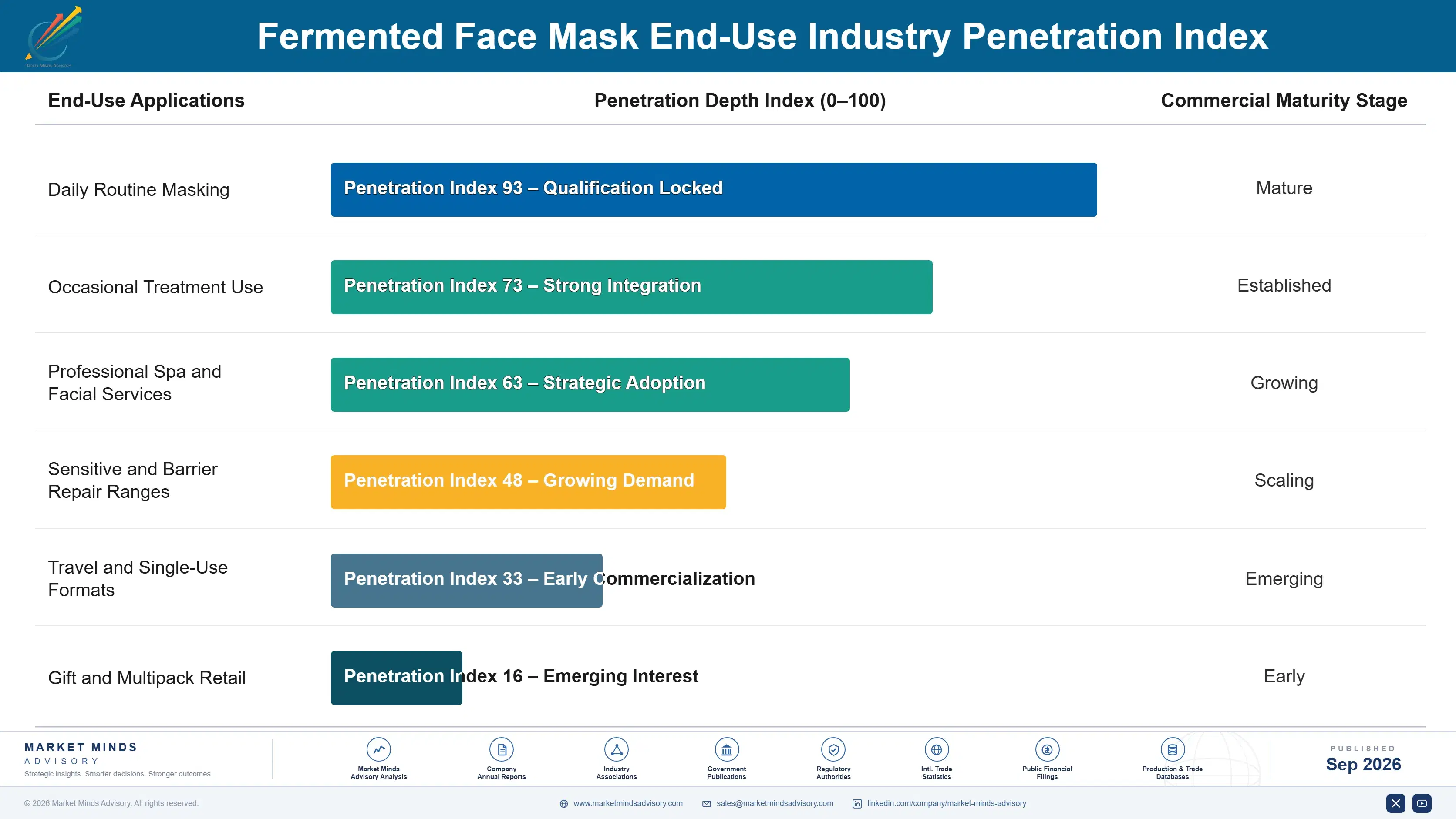
This is a genuine consumable and it repeats on use frequency rather than on any purchase decision. A daily masker in Korea or China buys packs continuously and generates most of the category value from a minority of buyers, while an occasional user in a Western market buys a five-pack and finishes it over months. Value per customer is therefore set by routine position rather than by brand relationship.
Repeat purchase depends on whether the experience felt worthwhile, and the drying reversal quietly undermines that. A consumer who leaves a sheet on until it dries ends the session with skin that feels tighter than before, concludes the mask did not work, and tries a different brand. Around 12% of products warn against it, which means most of the category is allowing its most committed users to sabotage the result.

The buyer is broadening from Asian routine maskers toward Western occasional users and toward ingredient-literate consumers who read labels closely. That second group asks what the ferment filtrate contains and finds almost no brand able to answer. They are small in number, growing, and disproportionately influential in the channels this category actually forms demand through.
fermented-face-mask-market-end-use-penetration-index-1790021363586

Where This Market Rewards

These are among the four positions where our research anticipates prominent divergence between winners and laggards over the coming forecast period. Each is grounded in the demand model, the regulatory perimeter, and the announced capacity pipeline.
01 / FILTRATE CHARACTERISATION PUBLISHING

The name describes almost nothing

Around 3% of products publish any compositional assay of their ferment filtrate, so a genuinely superior ferment competes on price against a weak one carrying an identical ingredient name on the pack. Brands publishing amino acid and organic acid profiles report price realisation 2.7 times higher than name-only equivalents achieve. The assay is routine analytical work, and its absence is why fermentation development currently earns almost nothing in this category, and supplier specifications frequently set no compositional limits at all either.
02 / POSTBIOTIC LANGUAGE ACCURACY

Nothing live survives the preservative

No mask passing preservative efficacy testing sustains viable organisms at end of shelf life, and brands using probiotic language have been supplying lysates and metabolites throughout regardless. Brands moving to postbiotic wording report regulatory exposure 3.3 times lower with no measurable loss of consumer preference. The change costs a wording revision rather than a reformulation, and voluntary movement is far cheaper than instructed movement, and lysates and metabolites are genuinely useful things for any mask to contain, which is a straightforward wording decision rather than a reformulation one.
03 / SUBSTRATE INVESTMENT PRIORITY

Nine per cent decides the result

Sheet substrate runs about 9% of finished mask cost while determining adhesion, occlusion, and how much essence actually transfers to the skin underneath it. Brands upgrading to bio-cellulose report repeat purchase 2.4 times higher than cotton substrate equivalents carrying identical essence formulations. The cheapest component in the product is the one deciding whether it works, and most of the category is still competing on actives instead, and bio-cellulose also delays the drying reversal that ends most masking sessions badly, and that is a component change rather than a chemistry change.
04 / WEAR TIME INSTRUCTION

A drying sheet takes moisture back

About 12% of products state a maximum wear time, while a sheet left on until dry draws moisture back out of skin through the same gradient that delivered it minutes earlier. Brands printing a maximum with removal guidance report satisfaction scores 1.9 times higher than application-only instructions produce. The change costs a printed line, and the consumers currently getting it wrong are the ones most committed to the category, and hot dry markets reach that reversal considerably faster than temperate ones do.

Engagement Snapshot From the Field

A live engagement with an industry participant carrying material or product regulatory and market exposure ahead of a defining policy shift, showing how our research translates into a defensible multi-year portfolio strategy.
MARKET MINDS ADVISORY · CLIENT ENGAGEMENT SUMMARY
Fermented Face Mask Producer Strategic Portfolio Review and Transition Roadmap 2026·Investment Scenario on Fermented Face Mask Exposure Evaluation 2025-26
CLIENT PROFILE
A global skincare brand with fermented mask revenue near USD 96 million (client-reported, unverified by MMA) across East Asia, Southeast Asia, and Western Europe. Repeat purchase had fallen for two consecutive years despite strong trial, and a European regulator had queried probiotic language on three products in the range. Filtrate composition had never been assayed internally. No lapsed customer had been contacted at any point.
STRATEGIC CHALLENGE
The range used probiotic wording on formulations that had never contained viable organisms, and nobody internally had documented that distinction. Falling repeat purchase was being treated as a competitive pricing issue, and no lapsed customer had been asked why they stopped buying. Trial had never been the problem in any market.
MMA APPROACH
MMA audited claim language against microbiological reality across the range, assayed the ferment filtrates used against supplier specifications, surveyed lapsed purchasers on their masking practice, and tested moisture outcomes at several wear durations on the brand's own substrates. Moisture was measured before and after masking at several durations rather than only at the recommended one, so the reversal point could be located.
KEY FINDINGS
  1. No product in the range contained viable organisms at any point after manufacture, and the probiotic wording had never been checked against the preservative system it sat alongside.
  2. Filtrate assays varied substantially between production batches carrying the identical ingredient name, and the supplier specification set no compositional limits at all.
  3. Lapsed purchasers overwhelmingly reported leaving masks on until dry, which testing confirmed left skin measurably drier than before the mask was applied.
  4. No product in the range stated a maximum wear time, and the application instruction encouraged leaving the sheet on for as long as it felt comfortable.
CLIENT PROFILE
A global skincare brand with fermented mask revenue near USD 96 million (client-reported, unverified by MMA) across East Asia, Southeast Asia, and Western Europe. Repeat purchase had fallen for two consecutive years despite strong trial, and a European regulator had queried probiotic language on three products in the range. Filtrate composition had never been assayed internally. No lapsed customer had been contacted at any point.
STRATEGIC CHALLENGE
The range used probiotic wording on formulations that had never contained viable organisms, and nobody internally had documented that distinction. Falling repeat purchase was being treated as a competitive pricing issue, and no lapsed customer had been asked why they stopped buying. Trial had never been the problem in any market.
MMA APPROACH
MMA audited claim language against microbiological reality across the range, assayed the ferment filtrates used against supplier specifications, surveyed lapsed purchasers on their masking practice, and tested moisture outcomes at several wear durations on the brand's own substrates. Moisture was measured before and after masking at several durations rather than only at the recommended one, so the reversal point could be located.
KEY FINDINGS
  1. No product in the range contained viable organisms at any point after manufacture, and the probiotic wording had never been checked against the preservative system it sat alongside.
  2. Filtrate assays varied substantially between production batches carrying the identical ingredient name, and the supplier specification set no compositional limits at all.
  3. Lapsed purchasers overwhelmingly reported leaving masks on until dry, which testing confirmed left skin measurably drier than before the mask was applied.
  4. No product in the range stated a maximum wear time, and the application instruction encouraged leaving the sheet on for as long as it felt comfortable.
RECOMMENDED STRATEGY
Phase 1: Phase one: move all claim language from probiotic to postbiotic and document the distinction internally before any regulator asks again. Phase 2: Phase two: specify ferment filtrates against measured composition rather than supplier name, with limits written into purchase agreements. Test incoming batches against those limits. Phase 3: Phase three: print a maximum wear time and removal guidance on every pack rather than application instructions alone. State the time in minutes rather than in feel.
OUTCOME
The regulatory query closed after voluntary claim revision and repeat purchase recovered within three quarters (client-reported, unverified by MMA). Batch filtrate variation narrowed once limits were specified. Wear time now appears on every mask the brand sells worldwide. Two competitors have since adopted comparable claim wording.

Frequently Asked Questions

Foundational context covering the market sizes, CAGR, scope, country, region and competition that inform every finding below. This section is provided to cover basics and most often pre-purchase conversations, answered from the MMA Primary Research Dataset.

What is the current size of the Fermented Face Mask Market?

The market was worth USD 1.7 billion in 2025 and stands at USD 1.8 billion in 2026. Value covers finished face masks formulated around fermented ingredients at retail selling price.

How large will the Fermented Face Mask Market be by 2036?

MMA forecasts USD 4.1 billion by 2036, an increase of USD 2.3 billion across the forecast period. That represents 2.28 times the 2026 base of USD 1.8 billion.

What is the CAGR for the Fermented Face Mask Market 2026 to 2036?

The base case compound annual growth rate is 8.6%, with a bull case at 9.8% and a bear case at 7.4%. Historical growth from 2020 to 2025 ran at 7.5%.

Which segment is growing fastest?

Postbiotic lysate and metabolite masks grow at 12.9%, half again the market rate of 8.6%. They describe accurately what a preserved cosmetic can actually deliver.

Who are the major companies in the Fermented Face Mask Market?

Amorepacific, LG Household and Health Care, Shiseido, Kose and Yatsen Holding lead the field. Together they hold only 27% of category revenue, which makes this an unusually fragmented market.

Which country is growing fastest?

China grows at 13.6%, on the largest sheet mask consumption base anywhere combined with fermented positioning spreading rapidly through domestic brands. Korean formulation still sets the direction there.

Report Segmentation Architecture

The full report scope spans multiple orthogonal segmentation dimensions, with cross-tabulated demand data provided for each dimension pair. Coverage extends further to regional breakdowns, trend trajectories, and the competitive detail needed to support segment-level decision-making.

By Formulation and Ferment Class

  • Fermented Botanical Filtrate Sheet Masks
  • Postbiotic Lysate and Metabolite Masks
  • Bio-Cellulose Fermented Substrate Masks
  • Fermented Enzyme Exfoliating Masks
  • Fermented Grain and Legume Wash-Off Masks
  • Overnight Fermented Leave-On Masks

By End-Use Industry

  • Daily Routine Masking
  • Occasional Treatment Use
  • Professional Spa and Facial Services
  • Sensitive and Barrier Repair Ranges
  • Travel and Single-Use Formats
  • Gift and Multipack Retail

By Commercial Dimension

  • Specialist Beauty Retail
  • Social Commerce and Direct to Consumer
  • Pharmacy and Drugstore Channels
  • Department Store and Prestige Retail
  • Cross-Border Online Marketplaces
  • Contract Manufacture and Private Label

By Region

  • East Asia
  • South Asia and Pacific
  • Western Europe
  • North America
  • Latin America
  • Middle East and Africa
  • Eastern Europe

Scope, Methodology, and Coverage

Every figure in this report is reproducible from documented input assumptions. The scope below maps the historical period, the forecast horizon, the segmentation dimensions, and the countries covered, alongside the underlying primary and qualitative methodology.
Historical Period
2020 to 2025
Forecast Period
2026 to 2036
Base Year
2025 (USD billions; MMA Primary Research Dataset, September 2026)
Market Definition
This market covers finished sheet, wash-off, and leave-on face masks formulated around fermented ingredients, across fermented botanical filtrate sheet masks, postbiotic lysate and metabolite masks, bio-cellulose fermented substrate masks, fermented enzyme exfoliating masks, fermented grain and legume wash-off masks, and overnight fermented leave-on masks. It excludes non-fermented sheet masks, clay and charcoal masks without ferment actives, cosmetic ingredients sold to formulators, ingestible probiotics, and prescription dermatology.
Quantitative Units
USD billions, revenue at retail selling price
Segmentation Dimensions
Formulation and ferment class, end-use setting, commercial dimension, region
Regions Covered
East Asia, South Asia and Pacific, Western Europe, North America, Latin America, Middle East and Africa, Eastern Europe
Countries Covered
South Korea, China, Japan, Taiwan, Indonesia, Vietnam, Thailand, Philippines, Malaysia, India, Australia, Germany, France, United Kingdom, Italy, Spain, Netherlands, Poland, Czechia, United States, Canada, Mexico, Brazil, Argentina, Colombia, Chile, Saudi Arabia, United Arab Emirates, Turkey, South Africa
Key Companies Profiled
Amorepacific, LG Household and Health Care, Shiseido, Kose, Yatsen Holding, Proya Cosmetics, Estee Lauder Companies, L'Oreal Groupe, Unilever, Kao Corporation, Pola Orbis Holdings, COSRX, L and P Cosmetic, Jayjun Cosmetic, Jala Group, Bloomage Biotechnology, Cosmax, Kolmar Korea, Procter and Gamble, Beiersdorf
Quantitative Methodology
Primary survey, n=3,800 respondents, Q4 2025, six countries; demand-side model with trade association cross-validation
Qualitative Methodology
47 expert interviews, Q4 2025; applied to validate demand model assumptions, identify emerging dynamics, and assess competitive positioning
Report Format
PDF and XLSX data workbook (Word format preview document)
Publisher
Market Minds Advisory
Report Code
MMA-2026-CHM-761
Published
September 2026
Contact
sales@marketmindsadvisory.com | www.marketmindsadvisory.com

Purchase the full Fermented Face Mask Market Report (2026 to 2036).

The full report sizes the fermented face mask market across six formulation classes, seven regions, and thirty countries, with forecasts to 2036 under base, bull, and bear cases. It examines what an ingredient name actually specifies about a ferment filtrate, establishes why preserved masks cannot sustain viable organisms, and measures how substrate choice governs delivery more than essence composition does. Competitive analysis covers twenty participants evaluated consistently on category revenue, with detailed treatment of characterisation practice and substrate manufacturing capability. Packaging waste exposure and wear time instruction are analysed throughout. Primary research includes 3,800 survey responses and 47 expert interviews.
Six formulation classes sized and forecast separately
Twenty participants evaluated on category revenue consistently
Ferment filtrate composition disclosure measured across the field
Live organism claims tested against preservative efficacy requirements
Substrate contribution to delivery compared against essence composition
Wear time instruction practice assessed against moisture outcomes

Built For The People Who Decide

From boardroom strategy to bench-side execution, this report is read cover-to-cover by leaders shaping the next decade of their industry, turning demand scenarios, market dynamics and valuation benchmarks into decisions.
CXOs/ Presidents/ VPs/ Managers
M&A and Corporate Development
Strategy Teams and R&D Heads
Procurement and Product Directors
Regulatory and Compliance Leaders
Investor Relations and Equity Analysts