Market Minds Advisory
Feldspar Market

Feldspar Market: Flux Economics, Iron Content Premiums, and a Demand Map Drawn by Ceramic Tile Production

A flux earns its price by lowering the temperature a furnace has to reach. As energy costs climbed, that arithmetic changed in feldspar's favour, and iron content became the line between commodity and premium.

Lead Analyst

Bilal Shaikh

Published

September 2026

Make Smarter Decisions with Customized Research Insights

Request a free sample report and evaluate market opportunities, growth trends, and competitive dynamics relevant to your business needs.

2025 MARKET VALUE$2.6BMarket Size 2025
2036 FORECAST VALUE$4.3BBase Case , 2026 to 2036
CAGR 2026 TO 20364.6 %Bull 5.8% / Bear 3.4%
INCREMENTAL OPPORTUNITY$1.5BNet 10- year value creation
EXPANSION MULTIPLE1.57x2036 value over 2026 base
Strategic Levers
M&A Pipeline
Regional Outlook
Country Rankings
Competitive Intelligence
Segmental Deep-dive
Call-Us : 91 93563 13602

Executive Snapshot and Market Trajectory

Feldspar exists commercially for one reason: it lowers the temperature at which glass and ceramic batches melt. When furnace energy got expensive, the value of that service rose with it, and buyers started paying attention to grade in ways they had not for years. Grade suddenly mattered again.
Commercial advantage belongs to producers who can strip iron out of the mineral rather than simply dig and grind it, because low-iron material commands roughly 62% over standard grade. Low-iron high-purity feldspar grows fastest at 9.6%, roughly 2.09 times the market. East Asia holds the largest position at 33% of consumption, following Chinese ceramic tile output that no other country approaches at anything like comparable scale.
Concentration is very low at roughly 22% for the top five, since a quarry serving a regional tile cluster competes perfectly well against any multinational. Freight at 34% of delivered cost is why. Around 56% of consumption goes into tile and sanitaryware, which makes ceramic production geography the demand map for this entire industry. Nothing about a country's economic size predicts how much feldspar that country consumes in any given year.
Market Definition
The market comprises feldspar mineral products supplied to glass, ceramic, filler, and abrasive applications, covering sodium feldspar, potassium feldspar, mixed and plagioclase feldspar, feldspathic sand, micronised feldspar, and low-iron high-purity feldspar. Value is measured at producer level on material delivered into the region of consumption. Nepheline syenite, silica sand sold as a separate product, recycled glass cullet, quartz and cristobalite products, and downstream glass or ceramic manufacture fall outside scope.
Base Year Value
$2.6B in 2025 (MMA Primary Research Dataset, August 2026)
Forecast Period
2026 to 2036, eleven discrete annual values
CAGR
4.6% base case. Bull 5.8%. Bear 3.4%.
Fastest Growth Segment
Low-Iron High-Purity Feldspar: 9.6% CAGR
Fastest Growth Country
India: 7.4% CAGR
Fastest Growth Region
South Asia and Pacific: 6.8% CAGR
Largest Region
East Asia: 33% of 2025 global value
Market Leaders
Sibelco, Imerys, Kaltun Madencilik, Esan Eczacibasi, and Minerali Industriali lead on feldspar production and sales revenue. Source: company annual reports and MMA Analysis, July 2026.
Primary Survey
n=3,800 procurement and R&D decision-makers, Q4 2025, six countries
Methodology
Demand-side build-up, cross-validated against public data, 47 expert interviews

Feldspar Market Forecast Scenarios

feldspar-market-trends-size-forecast-scenario-1787551233630
Between 2020 and 2025 demand tracked ceramic tile and glass container output more closely than any economic aggregate. Chinese tile capacity consolidated under environmental enforcement while Indian output expanded. European energy costs made flux performance a live procurement question for the first time in decades. The 4.0% historical rate combines steady volume with a genuine mix shift toward processed and low-iron grades that carry better realised pricing.
The 4.6% base case rests on three mechanisms. Solar cover glass keeps expanding and requires low-iron batch materials that ordinary feldspar cannot supply at any price. Indian and Southeast Asian tile capacity continues building out against domestic construction demand. And furnace energy costs stay high enough that flux quality remains a procurement conversation rather than a purchasing formality nobody thinks about. None of the three depends on construction activity recovering anywhere in particular.
The 5.8% bull case assumes solar glass capacity builds at the faster end of announced schedules, pulling low-iron grades along with it. The 3.4% bear case reflects construction weakness in China and Europe, faster cullet substitution in container glass, and silica exposure rules pushing ceramic producers toward nepheline syenite as a free-silica-free alternative flux. Freight economics sit under both cases.

A Flux Priced by What It Saves

Three things govern this market and none of them is geology. Freight comes first, because a mineral selling near 78 dollars a tonne cannot travel far before transport at 34% of delivered cost eats the margin entirely. Iron content comes second and separates commodity from premium. Ceramic tile production geography comes third and draws the demand map more precisely than any measure of economic activity does.
TOP-FIVE CONCENTRATION22%Combined output share held by the largest producing companies
AVERAGE REALISED PRICEUSD 78 per tonneBlended across standard and processed grades sold globally
FREIGHT COST SHARE34%Portion of delivered cost attributable to transport alone
CERAMIC DEMAND SHARE56%Portion of consumption entering tile and sanitaryware production
LOW-IRON GRADE PREMIUM62%Uplift commanded over standard grade by low-iron material
TOP PRODUCING COUNTRY SHARE31%Portion of global output mined in the leading producing country
Iron is the whole quality argument. Ferric oxide above roughly 0.1% tints glass green and mottles white ceramic bodies, and removing it takes magnetic separation, flotation, and careful deposit selection rather than better grinding. Low-iron material earns about 62% over standard grade. Producers who cannot reach the specification are selling into applications where nothing distinguishes their output from a competitor's.
Concentration at 22% looks like an industry waiting to consolidate and it is nothing of the kind. A quarry beside a tile cluster in Gujarat or Castellon delivers cheaper than any multinational shipping from elsewhere, and no amount of scale changes that arithmetic. Consolidation happens in processing and grade capability rather than in tonnage, which is a different business from mining.
"Buyers talked about feldspar as sand with a fancy name until furnace gas bills tripled, and then somebody worked out what a flux with two percent more alkali was actually worth per year in energy. That conversation is still going on, and it has changed which suppliers get the call."
Practice Director, Industrial Minerals and Ceramic Raw Materials · MMA Industrial Minerals Practice · August 2026

Market Trends

Solar Cover Glass Pulls Low-Iron Grades Into Short Supply

Photovoltaic cover glass needs light transmission above 91%, which rules out any batch material carrying meaningful ferric oxide, and feldspar is one of the harder components to source clean. Deposits with naturally low iron are geographically limited, and processing the rest requires magnetic separation and flotation that most quarry operations never installed. Low-iron material earns roughly 62% over standard grade as a result. That segment grows at 9.6%, more than twice the market, and solar glass capacity expansion is what drives almost all of it. Deposit ownership matters more here than anywhere else in the market.
Market Impact: Ceramics take 56% of consumption
Energy Prices Turned Flux Quality Into a Procurement Question

A glass or ceramic furnace running thousands of hours a year responds directly to batch alkali content, and a formulation melting 20 degrees cooler saves real fuel across a campaign. European producers rediscovered this when gas prices spiked, and technical purchasing arrived in conversations that had been handled by commodity buyers for years. Suppliers able to document alkali consistency and justify a price on energy saved rather than tonnage delivered found themselves in a different negotiation entirely. Consistency matters more than headline assay. Batch-to-batch variation costs more than a slightly lower average assay.
Market Impact: Micronised grades growing at 7.2%

Market Opportunities and Growth Drivers

Chinese and Indian Tile Output Anchors Global Consumption

Ceramic tile absorbs the majority of the 56% of feldspar going into ceramics, and China and India together produce more of it than the rest of the world combined by a considerable distance. Chinese capacity consolidated under environmental enforcement without shrinking much in total, while Indian output expanded rapidly around the Morbi cluster in Gujarat. That concentration is why East Asia holds 33% of consumption and South Asia 15%. Regional quarries serving those clusters set delivered prices that distant producers cannot approach. Neither cluster shows any sign of moving production somewhere cheaper.
Market Impact: Substitution risks 12% of demand

Processed Grades Shift Mix Toward Higher Realised Value

Micronised feldspar for paint, plastic, and coating fillers sells at multiples of run-of-quarry material, and it requires classification and iron control rather than simply finer grinding. Demand has grown steadily as formulators substitute functional extenders for more expensive pigments and resins. Producers with milling and air classification capability capture that value while pure quarry operators watch it go elsewhere. The micronised segment grows at 7.2% against a market rate of 4.6%, and processing investment is what separates the two groups. Freight tolerance improves too, since higher value per tonne carries further.
Market Impact: Cullet ratios exceed 60% regionally

Market Restraints and Challenges

Nepheline Syenite Substitutes Directly on Silica Grounds

Nepheline syenite delivers alumina and alkali without free crystalline silica, which matters increasingly as occupational exposure rules tighten around ceramic and glass plants. The root cause is regulatory rather than technical: nepheline performs comparably as a flux and always has. Feldspar producers mitigate through low-free-silica processing routes, through documentation supporting workplace exposure control at customer sites, and by competing on delivered cost where nepheline's limited deposit geography leaves it exposed to long freight on a low-value mineral. Reformulating a ceramic body takes months of trials, which slows substitution without preventing it.
Market Impact: Low-iron grade earns 62% premium

Recycled Cullet Displaces Raw Batch in Container Glass

Every tonne of recycled glass entering a container furnace removes roughly a tonne of virgin batch materials including feldspar, and collection rates keep improving under packaging regulation across Europe and elsewhere. The root cause is that cullet is both cheaper and less energy intensive to melt, so producers maximise it whenever quality permits. Mitigation runs through the colour and contamination limits that cap practical cullet ratios, through growth in flat and solar glass where cullet use is far more constrained, and through ceramic demand that cullet cannot touch. Ceramics remain entirely unaffected.
Market Impact: Melting temperature falls 20 degrees
3 additional market trends, 4 additional growth drivers, and 2 additional restraints and challenges are covered in the full report. Contact sales@marketmindsadvisory.com to access the complete intelligence.

Segment CAGR and Growth Architecture

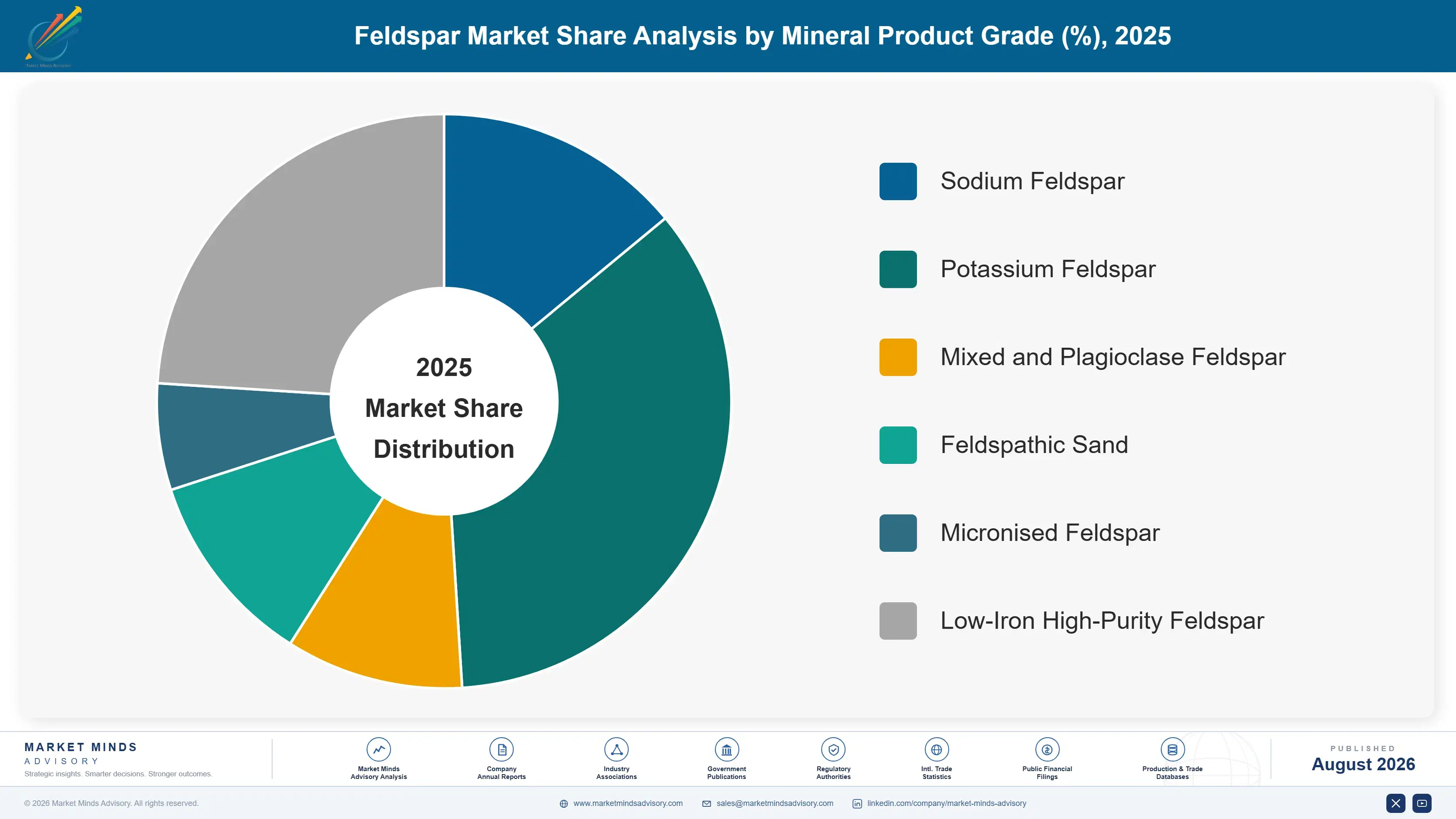
Segmentation follows mineral product grade, because alkali chemistry, iron content, and particle size determine which applications a material can serve and what it realises per tonne. Six grades cover commercial supply, and the divide between run-of-quarry material and processed low-iron or micronised product matters far more commercially than sodium against potassium chemistry. Chemistry is the least of it.
feldspar-market-trends-market-share-analysis-1787551234163

Low-Iron High-Purity Feldspar

The fastest grade at 9.6%, roughly 2.09 times the market, and the only one where supply genuinely constrains demand. Ferric oxide below about 0.1% is required for solar cover glass, high-transmission architectural glazing, and white ceramic bodies, and reaching it needs deposit selection, magnetic separation, and flotation rather than better grinding. Realised prices run roughly 62% above standard grade. Deposits naturally low in iron are geographically limited, which gives producers holding them a position no processing investment fully replicates. Solar glass expansion drives nearly all current growth in this grade. Qualification with a glass batch technologist typically takes several months of trials, which slows how quickly new supply can actually reach the market.
CAGR 9.6%

Micronised Feldspar

Second fastest at 7.2%, serving paint, plastic, rubber, and coating applications as a functional extender rather than a flux. Value comes from controlled particle size distribution, low iron, and consistent oil absorption, all of which require milling and air classification capability that most quarry operations lack entirely. Formulators substitute it for more expensive pigment and resin volume, which ties demand to coatings and polymer output rather than to ceramic tile. Realised pricing sits at multiples of run-of-quarry material. Freight economics improve too, since higher value per tonne tolerates longer haul distances. Coatings and polymer demand also moves on entirely different cycles from construction, which gives producers serving both a useful hedge against tile downturns.
CAGR 7.2%
Full segment breakdown across 6 segments available in the complete report.

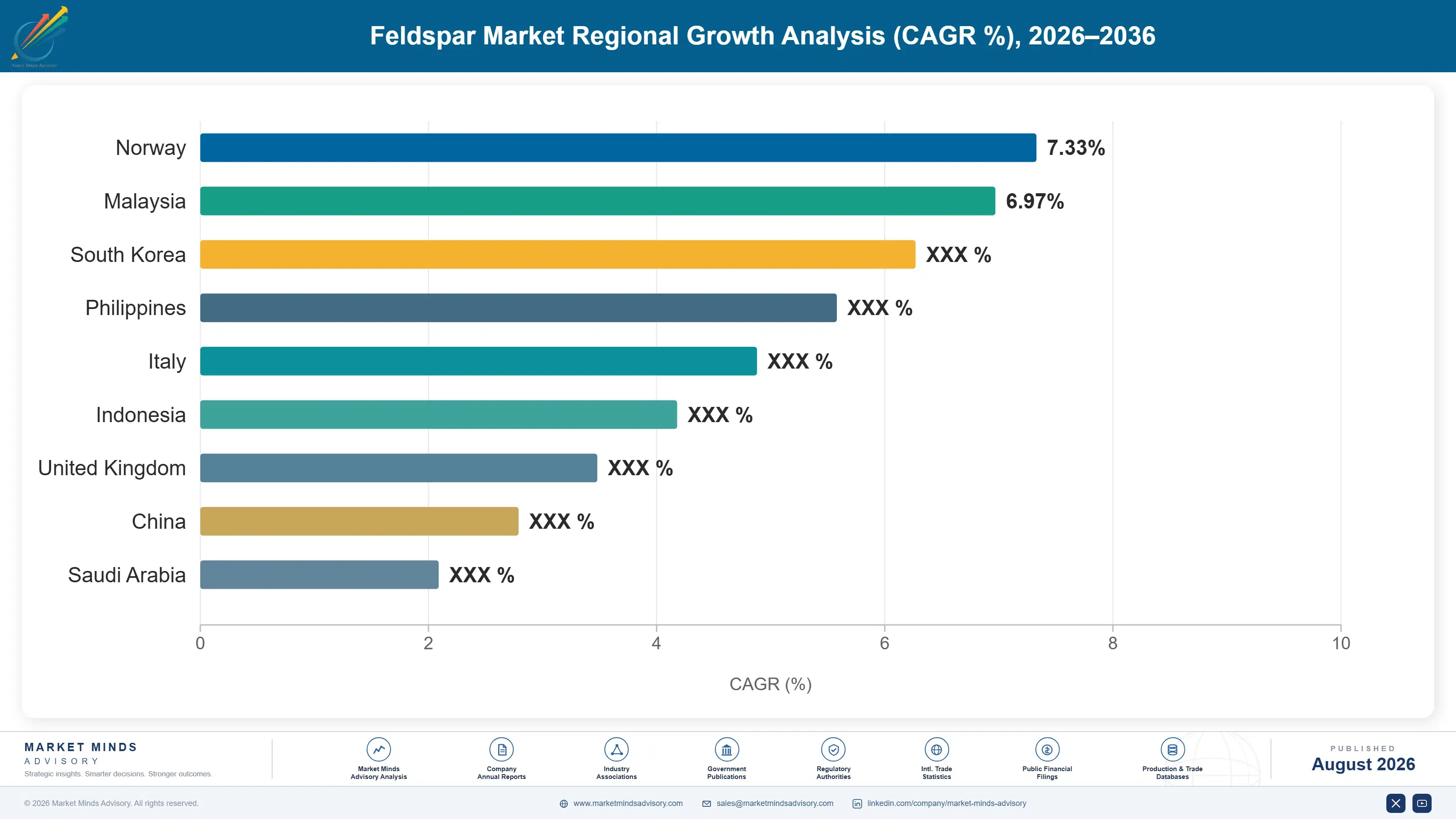
Regional Architecture and Country Demand Map

Regional shares follow ceramic tile and glass production rather than economic size, and the gap between those two things is unusually wide in this market. Four regions sit outside the standard share bands as a result, each for reasons named in the paragraphs below. The mismatch is worth stating plainly.

North America

North America sits at 11%, well below the standard band, because the region manufactures very little ceramic tile and imports most of what it uses, which removes the application taking 56% of global consumption. Demand is therefore weighted toward glass container and flat glass production, where feldspar competes against cullet and alternative alumina sources. Imerys and Covia hold established positions serving glass batch customers across the Southeast and Midwest. Fibreglass insulation manufacture adds steady volume. Growth of 4.0% tracks glass output and construction activity rather than any ceramic production trend, since almost none exists here. Low-iron material for solar glass is largely imported, since domestic separation capacity was never built for it.
Share: 11% | CAGR: 4.0% (2026 to 2036)

Western Europe

Italian and Spanish tile clusters at Sassuolo and Castellon consume feldspar at intensities no other developed region approaches, producing the world's highest-value ceramic output against imported and regional mineral supply. Energy costs made flux performance a genuine procurement question here before it became one anywhere else. Sibelco, Imerys, Maffei Sarda Silicati, and Incusa serve those clusters with technically specified grades. Occupational silica exposure rules are also tightest here, which gives nepheline syenite its strongest substitution position. Growth of 3.2% is the slowest anywhere, reflecting mature tile output and continued cullet gains in container glass. Micronised filler demand from regional coatings and polymer formulators adds a second market that construction cycles do not govern.
Share: 21% | CAGR: 3.2% (2026 to 2036)
Regional intelligence for 5 additional markets available in the complete report: East Asia, South Asia and Pacific, Latin America, Middle East and Africa, Eastern Europe. Contact sales@marketmindsadvisory.com.
feldspar-market-trends-country-cagr-analysis-1787551234674

Four Moves Worth the Capital

Advantage here comes from iron removal, particle engineering, and freight position rather than from reserves, which almost every producer has in abundance. Four moves justify capital across the forecast period, and the first determines whether a producer sells a commodity or a specification nobody else can meet. Reserves are the least interesting asset in this business.

Install iron removal ahead of solar glass demand

Ferric oxide below 0.1% is what solar cover glass and high-transmission glazing require, and reaching it needs magnetic separation and flotation rather than finer grinding. Low-iron material realises roughly 62% above standard grade and the segment grows at 9.6%, more than double the market. Deposits naturally low in iron are geographically limited, so processing is the route open to most producers. Quarries selling run-of-mine material into ceramic bodies are competing where nothing distinguishes their output from anybody else's product. Qualification with a glass batch technologist takes several months, so the investment needs starting well before demand arrives.
Market Impact: Captures the entire 62% premium on low-iron grade

Price on energy saved rather than tonnes delivered

A furnace running thousands of hours responds directly to batch alkali content, and a formulation melting 20 degrees cooler saves real fuel across a campaign. European buyers learned this when gas prices spiked and technical purchasing entered conversations commodity buyers had handled for years. Suppliers who document alkali consistency and quantify the energy saving in the customer's own furnace terms negotiate on entirely different ground. Consistency matters more than headline assay, and very few producers actually measure it well enough to make the argument. Documentation is the barrier here, not the underlying chemistry.
Market Impact: Saves roughly 20 degrees of furnace melting temperature

Build milling and classification for filler markets

Micronised feldspar sells at multiples of run-of-quarry material into paint, plastic, and coating applications, and it grows at 7.2% against a market rate of 4.6%. Controlled particle size distribution, low iron, and consistent oil absorption are what buyers pay for, and they require air classification capability most quarry operations never built. Higher value per tonne also tolerates longer freight, which widens the addressable market beyond the regional radius a commodity grade can reach. The capital requirement is modest against the realised price difference. Payback runs shorter than most quarry operators expect it to.
Market Impact: Filler grade demand is growing at 7.2% annually

Defend the freight radius against substitution

Transport is 34% of delivered cost on material selling near 78 dollars a tonne, which means a quarry beside a tile cluster beats any multinational shipping in and no scale advantage changes it. Nepheline syenite's substitution threat is strongest where its own freight is short. Producers should map their genuine delivered-cost radius, defend inside it with service and consistency, and stop quoting outside it against competitors whose transport arithmetic is better. Position beats reserves in this business almost every single time. Sales incentives measuring tonnage rather than contribution are usually what push volume past the boundary.
Market Impact: Freight alone represents 34% of total delivered cost

Who Controls the Margin Pool

Concentration is very low at roughly 22% for the top five on production and sales revenue, and freight economics rather than any failure of consolidation explain it. Sibelco and Imerys hold the broadest international positions with genuine processing capability across multiple grades. Kaltun and Esan dominate Turkish output and the export trade that flows from it. Minerali Industriali serves the Italian ceramic cluster with technically specified material.
Competition runs on three dimensions. Delivered cost inside a freight radius is the first and it decides most commodity tonnage. Iron control and particle engineering is the second, and it separates producers who realise premium pricing from those who do not. Technical service is the third, since flux performance arguments require documentation the customer can verify in a furnace.

Pressure is building from two directions. Nepheline syenite takes share wherever silica exposure rules bite hardest, competing on a regulatory rather than a performance basis. Cullet keeps displacing virgin batch in container glass as collection improves. Rankings will shift toward producers holding low-iron capability and processing depth rather than tonnage. Tonnage alone has stopped being a useful measure of position in this industry.
feldspar-market-trends-company-positioning-matrix-1787551235196

Competitive Moat and Risk Dimensions

SIBELCO

Moat: Multi-site processing and grade breadth

Sibelco operates processing capability across many sites rather than shipping run-of-quarry material, which lets it serve low-iron, micronised, and standard grades from positions inside multiple freight radii simultaneously. That combination is genuinely difficult to assemble, since it requires both deposit access and capital investment in separation. Customers buying to specification find few alternatives with comparable reach.
SIBELCO

Risk: Nepheline syenite substitution exposure

European ceramic and glass customers face the tightest occupational silica exposure rules anywhere, and nepheline syenite answers that concern directly while performing comparably as a flux. Sibelco's strongest positions sit in exactly those markets. Defending them requires low-free-silica processing routes and exposure documentation, neither of which fully removes a regulatory argument that favours a competing mineral outright.
IMERYS

Moat: Ceramic formulation technical service

Imerys sells into ceramic bodies as a formulation partner rather than a mineral supplier, combining feldspar with kaolin and other minerals it produces to solve the whole batch problem. That relationship survives price comparison in a way tonnage supply never does. It also lets the company argue flux value on energy saved, which requires knowing the furnace in detail.
IMERYS

Risk: Weak North American ceramic demand

North America consumes only 11% of global feldspar because it manufactures almost no ceramic tile, which caps what Imerys can build there against strong glass batch competition and cullet substitution. The region's growth depends entirely on glass output rather than the ceramic applications where the company's technical service advantage is strongest and pricing holds up best.

Players Tracked

Prominent Players

Sibelco
Imerys
Kaltun Madencilik
Esan Eczacibasi
Minerali Industriali

Other Key Players

Matek Maden
Quarzwerke
Maffei Sarda Silicati
Incusa
US Silica
Covia
20 Microns
Sun Minerals
Gimpex
Sino Mineral
Zhongxing Mining
Mineracao Jundu
Grupo Mota
Fabi Bruschi
Ceratech Minerals

Recent Developments

MARCH 2025

Producer commissions flotation circuit for solar glass grade

A European feldspar producer commissioned magnetic separation and flotation capacity aimed at ferric oxide below 0.1%, targeting solar cover glass customers who had previously imported material from a small number of naturally low-iron deposits elsewhere. Standard grade output from the same quarry continues unchanged alongside it.
Signal: Processing rather than favourable geology is now becoming the route into low-iron supply for most producers today
JULY 2025

Ceramic manufacturer switches flux on silica exposure grounds

A Western European sanitaryware producer moved part of its body formulation to nepheline syenite, citing workplace crystalline silica exposure limits rather than any performance concern with the feldspar it had used for years. Batch reformulation took several months of trials to complete properly. Performance was never questioned.
Signal: Substitution here is driven by occupational health regulation rather than by flux performance or delivered price
NOVEMBER 2025

Turkish exporter signs long-term Asian ceramic supply agreement

A Turkish producer concluded a multi-year supply agreement with Southeast Asian tile manufacturers, using port access and consistent grade to compete against regional quarries on a mineral where freight normally decides the outcome. Vessel economics on larger parcels made the delivered arithmetic work. Regional quarries lost the tonnage.
Signal: Freight radius can be stretched by scale and port position, though only for producers holding both together

What Drives Delivered Cost

Freight is the dominant line at roughly 34% of delivered cost on material realising near 78 dollars a tonne, and it comes from road haulage, rail, and bulk vessel depending on distance and port access. Quarrying, crushing, and grinding energy takes a further 23%, most of it electricity. Labour and site operations take 16%. Magnetic separation, flotation, and classification add real cost on processed grades and none on run-of-quarry material.
European electricity and diesel prices moved sharply through 2022 and into 2023, and producers running energy-intensive grinding circuits absorbed most of it because contract pricing on annual ceramic supply agreements had already been set. Sibelco and Imerys both discussed energy cost pressure and pricing recovery in their reporting for those years. Bulk freight rates moved independently on vessel availability, hitting exporters far harder than domestic suppliers serving nearby clusters.

Exposure divides on freight position and grade mix. A producer beside a tile cluster carries short haul and low freight exposure regardless of size. An exporter shipping across oceans carries the full weight of vessel rates on a low-value mineral. Processed grade producers hold margins that absorb energy swings; run-of-quarry operations have almost no cushion when grinding power moves against them.
feldspar-market-trends-cost-volatility-analysis-1787551235391

Match grade to freight distance deliberately

Run-of-quarry material at 78 dollars a tonne cannot travel far before freight at 34% of delivered cost removes the margin entirely. Processed and low-iron grades realising considerably more tolerate much longer haul. Producers should route commodity output to nearby clusters and reserve distant customers for grades whose value per tonne genuinely justifies the transport being paid for.

Index ceramic supply contracts to grinding power

Annual supply agreements priced firm against volatile industrial electricity transfer the whole energy risk onto the producer for no compensating return. Grinding is the most power-intensive step and its cost moves with regional tariffs. Indexation tied to published electricity references removes the mismatch, and ceramic customers facing the same exposure themselves rarely refuse it outright.

Recover value from processing rejects and fines

Magnetic separation and flotation generate iron-rich rejects and fine fractions that most operations treat as waste and pay to store. Some of it sells into lower specification ceramic bodies, cement raw meal, or aggregate applications. Recovering even part of that stream improves the economics of installing separation in the first place quite considerably. The waste storage saving helps too.

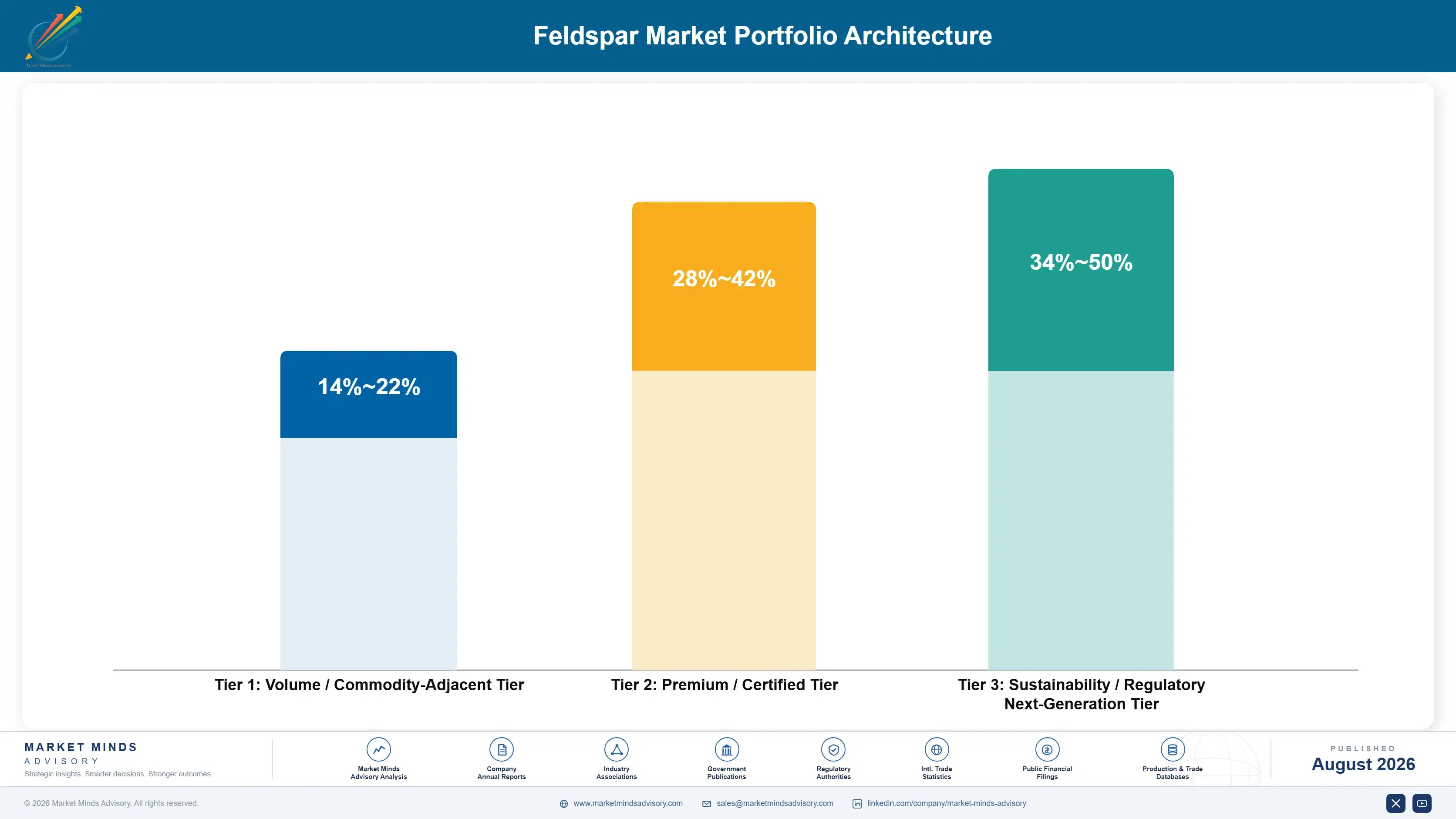
Portfolio Architecture for Margin Defence

Margin architecture follows processing rather than reserves, and the spread between the ends of it is wider than most mineral businesses show. Run-of-quarry material sold into ceramic bodies competes on delivered cost inside a freight radius and earns accordingly. Micronised filler grades earn multiples of that on particle engineering. Low-iron material for solar and high-transmission glass earns most of all, and supply genuinely constrains demand there.
The volume and premium tension is really a question about capital. A quarry can ship tonnage profitably enough with almost no investment beyond crushing and screening. Reaching filler and low-iron specifications requires milling, classification, magnetic separation, and flotation, which is a processing business with a mining operation attached rather than the other way round. Plenty of operators never make that transition at all.

High-value pools concentrate in low-iron grades for solar glass, micronised fillers for coatings and polymers, and technical service relationships with ceramic formulators. Each is defended by processing capability or application knowledge rather than by deposit ownership, which is why concentration stays near 22% while realised margins differ by a factor of several between producers. Deposit ownership is close to worthless on its own.

Volume / Commodity-Adjacent Tier

Run-of-quarry sodium, potassium, and mixed feldspar sold into ceramic bodies and glass batch inside a freight radius. Delivered cost decides everything. Reserves offer no advantage because almost every producer has plenty of them.
Gross Margin: 14%-22%

Premium / Certified Tier

Micronised and classified grades for paint, plastic, rubber, and coating fillers where particle size distribution and oil absorption are specified. Higher value per tonne also tolerates longer freight. The range reflects wide variation in classification capability between producers.
Gross Margin: 28%-42%

Sustainability / Regulatory / Next-Generation Tier

Low-iron high-purity grades for solar cover glass and high-transmission glazing, plus low-free-silica routes answering occupational exposure rules. Supply constrains demand. The range is wide because deposit quality varies enormously before any processing is applied.
Gross Margin: 34%-50%
feldspar-market-trends-portfolio-architecture-1787551235891

High-value Sub-segments and Strategic Watch-out

Low-Iron Solar Glass Grades

Growing at 9.6% with a 62% price premium and genuine supply constraint, since naturally low-iron deposits are limited and separation capacity is scarce. Solar cover glass capacity expansion drives nearly all of the current demand growth. Qualification with batch technologists takes months, which slows how fast supply responds.
Gross Margin: 36%-50%

Micronised Filler Grades

Growing at 7.2% into coatings and polymers where formulators substitute functional extender for costlier pigment and resin volume. Air classification capability rather than deposit quality decides who can serve it profitably at all. Demand also follows coatings and polymer cycles rather than construction, which hedges tile exposure usefully.
Gross Margin: 30%-42%

Ceramic Body Supply Near Clusters

Steady volume anchored by ceramics taking 56% of consumption, defended entirely by freight position rather than by anything a competitor cannot replicate. Technical service on flux consistency is the only real differentiation available here. Sales incentives measuring tonnage rather than contribution push volume past the profitable boundary.
Gross Margin: 16%-24%

Container Glass Batch Supply

The strategic watch-out. Cullet ratios above 60% in some regions displace virgin batch directly, collection keeps improving under packaging rules, and nothing about feldspar's role in a container furnace resists that substitution at all. Flat and solar glass are where the remaining defensible volume actually sits.
Gross Margin: 13%-20%

How Tonnage Actually Gets Bought

Demand reaches producers through two buying behaviours that barely overlap. Commodity ceramic and glass batch tonnage is bought annually by procurement against delivered price, with grade treated as a pass or fail threshold rather than a variable worth paying for. Specification grades are bought by technical functions who test material in their own furnace or formulation and care about consistency between shipments far more than headline price. The second group is smaller, stickier, and worth several times more per tonne to serve.
Stickiness varies with what has been qualified. A ceramic body formulation approved on a specific feldspar resists change because reformulation costs months of trials. A container glass batch switches on price at renewal. Filler applications sit between the two, held by particle distribution consistency rather than contract.

The deciding buyer moved toward technical and energy functions when furnace costs spiked, and it has not moved back. Those people evaluate alkali consistency, iron content, and melting behaviour rather than tonnage price alone. Procurement still signs, but it increasingly signs what the furnace people have already chosen for them. That reversal happened quickly and it has not reversed back.
feldspar-market-trends-end-use-penetration-index-1787551236382

Where the Margin Lives

These are among the four positions where our research anticipates prominent divergence between winners and laggards over the coming forecast period. Each is grounded in the demand model, the regulatory perimeter, and the announced capacity pipeline.
01 / IRON REMOVAL CAPABILITY

Install separation before solar glass demand hardens

Ferric oxide below roughly 0.1% is what solar cover glass and high-transmission glazing require, and reaching it takes magnetic separation and flotation rather than any amount of finer grinding at the quarry. Low-iron material realises about 62% above standard grade and grows at 9.6%, more than twice the market rate, with supply genuinely constraining demand across the segment. Deposits naturally clean enough are geographically limited, so processing is the only route open to most producers who want any share of that pricing at all.
02 / FLUX VALUE ARGUMENT

Sell energy saved, not tonnes delivered

A glass or ceramic furnace running thousands of hours a year responds directly to batch alkali content, and a formulation melting 20 degrees cooler saves genuine fuel across a full furnace campaign. European buyers learned this when gas prices spiked, and technical purchasing entered conversations that commodity buyers had handled unchallenged for years beforehand. Suppliers documenting alkali consistency and quantifying the saving in a customer's own furnace terms negotiate somewhere entirely different from any tonnage price comparison a buyer might run.
03 / PARTICLE ENGINEERING INVESTMENT

Build classification capacity for filler applications

Micronised feldspar realises multiples of run-of-quarry pricing into paint, plastic, and coating formulations, and the segment grows at 7.2% against a market rate of 4.6% across all grades. Controlled particle size distribution, low iron, and consistent oil absorption are what buyers actually pay for, and delivering them requires air classification that most quarry operations have never installed at all. Higher value per tonne also tolerates longer freight, which widens the reachable market well beyond whatever radius a commodity grade can reach.
04 / FREIGHT RADIUS DISCIPLINE

Map the real delivered-cost radius and hold it

Transport represents 34% of delivered cost on material realising near 78 dollars a tonne, which means a quarry beside a tile cluster beats any multinational shipping in from elsewhere regardless of how much scale that multinational has. Producers should map where their delivered cost genuinely wins, defend inside that boundary with consistency and service, and stop quoting beyond it against competitors whose transport arithmetic is simply better than theirs. Position beats reserves in this business almost every single time it is properly tested.

Engagement Snapshot From the Field

A live engagement with an industry participant carrying material or product regulatory and market exposure ahead of a defining policy shift, showing how our research translates into a defensible multi-year portfolio strategy.
MARKET MINDS ADVISORY · CLIENT ENGAGEMENT SUMMARY
Feldspar Producer Strategic Portfolio Review and Transition Roadmap 2026·Investment Scenario on Feldspar Exposure Evaluation 2025-26
CLIENT PROFILE
A Mediterranean feldspar producer with revenue near EUR 74 million (client-reported, unverified by MMA), operating three quarries and supplying ceramic tile and sanitaryware customers with crushed and ground standard grades. No flotation capacity existed anywhere in the business, no filler grades were produced, and realised prices had tracked commodity benchmarks downward for six years running.
STRATEGIC CHALLENGE
Regional tile customers were tendering annually on delivered price alone while solar glass buyers imported low-iron material the client could not supply from deposits that assayed close enough to qualify. Two sanitaryware customers had begun trialling nepheline syenite on silica exposure grounds without warning. No documentation on workplace exposure had ever been produced.
MMA APPROACH
MMA assayed deposit iron content against solar glass specifications, modelled flotation and magnetic separation capital against realised premium, and mapped delivered-cost radius against every customer served. Forty-seven expert interviews with glass batch technologists, ceramic formulators, and coatings formulators established what each application genuinely requires and pays for. Freight cost was rebuilt customer by customer from actual haulage invoices.
KEY FINDINGS
  1. One of the three deposits assayed low enough in ferric oxide that modest magnetic separation alone would reach solar glass specification, and nobody in the business had ever tested for it.
  2. Roughly a fifth of tonnage was being shipped beyond the point where freight consumed the entire margin, sustained by sales incentives measuring volume rather than any contribution to profit.
  3. The two sanitaryware customers trialling nepheline syenite cited workplace exposure documentation rather than performance, and the client had never supplied any such documentation to anybody.
  4. Coatings formulators within existing haul distance were buying micronised extender from three hundred kilometres away, because the client had no air classification capability of its own.
CLIENT PROFILE
A Mediterranean feldspar producer with revenue near EUR 74 million (client-reported, unverified by MMA), operating three quarries and supplying ceramic tile and sanitaryware customers with crushed and ground standard grades. No flotation capacity existed anywhere in the business, no filler grades were produced, and realised prices had tracked commodity benchmarks downward for six years running.
STRATEGIC CHALLENGE
Regional tile customers were tendering annually on delivered price alone while solar glass buyers imported low-iron material the client could not supply from deposits that assayed close enough to qualify. Two sanitaryware customers had begun trialling nepheline syenite on silica exposure grounds without warning. No documentation on workplace exposure had ever been produced.
MMA APPROACH
MMA assayed deposit iron content against solar glass specifications, modelled flotation and magnetic separation capital against realised premium, and mapped delivered-cost radius against every customer served. Forty-seven expert interviews with glass batch technologists, ceramic formulators, and coatings formulators established what each application genuinely requires and pays for. Freight cost was rebuilt customer by customer from actual haulage invoices.
KEY FINDINGS
  1. One of the three deposits assayed low enough in ferric oxide that modest magnetic separation alone would reach solar glass specification, and nobody in the business had ever tested for it.
  2. Roughly a fifth of tonnage was being shipped beyond the point where freight consumed the entire margin, sustained by sales incentives measuring volume rather than any contribution to profit.
  3. The two sanitaryware customers trialling nepheline syenite cited workplace exposure documentation rather than performance, and the client had never supplied any such documentation to anybody.
  4. Coatings formulators within existing haul distance were buying micronised extender from three hundred kilometres away, because the client had no air classification capability of its own.
RECOMMENDED STRATEGY
Phase 1: Phase one: install magnetic separation at the low-iron deposit and qualify the output with solar glass batch technologists before committing to any flotation capital. Phase 2: Phase two: withdraw from customers beyond the profitable freight radius and reset sales incentives onto contribution rather than tonnage shipped. Phase 3: Phase three: add air classification for micronised filler grades, targeting the coatings formulators already buying comparable material from much further away.
OUTCOME
The client qualified low-iron material with two solar glass producers within ten months of commissioning separation. Withdrawal from unprofitable distant accounts reduced tonnage while raising contribution, blended gross margin improved 8.4 percentage points, and classification capital was approved (client-reported, unverified by MMA). A third quarry is now being assayed for the same purpose.

Frequently Asked Questions

Foundational context covering the market sizes, CAGR, scope, country, region and competition that inform every finding below. This section is provided to cover basics and most often pre-purchase conversations, answered from the MMA Primary Research Dataset.

What is the current size of the Feldspar Market?

The market was valued at USD 2.6 billion in 2025, rising to an estimated USD 2.72 billion in 2026. East Asia holds the largest regional share at 33% of consumption.

How large will the Feldspar Market be by 2036?

MMA forecasts USD 4.26 billion by 2036 under the base case, an expansion multiple of 1.57 times the 2026 value. That represents USD 1.54 billion of incremental value.

What is the CAGR for the Feldspar Market 2026 to 2036?

The base case CAGR is 4.6%, with a bull case of 5.8% and a bear case of 3.4%. The spread reflects uncertainty over solar glass build-out and nepheline syenite substitution.

Which segment is growing fastest?

Low-iron high-purity feldspar grows fastest at 9.6%, roughly 2.09 times the market rate, driven by solar cover glass. Micronised filler grades follow at 7.2% into coatings.

Who are the major companies in the Feldspar Market?

Sibelco, Imerys, Kaltun Madencilik, Esan Eczacibasi, and Minerali Industriali lead, holding roughly 22% between them. Concentration is low because freight economics favour quarries near consumption.

Which country is growing fastest?

India grows fastest at 7.4%, driven by ceramic tile expansion centred on the Morbi cluster in Gujarat. Domestic quarrying in Rajasthan and Andhra Pradesh supplies most of that demand.

Report Segmentation Architecture

The full report scope spans multiple orthogonal segmentation dimensions, with cross-tabulated demand data provided for each dimension pair. Coverage extends further to regional breakdowns, trend trajectories, and the competitive detail needed to support segment-level decision-making.

By Mineral Product Grade

  • Sodium Feldspar
  • Potassium Feldspar
  • Mixed and Plagioclase Feldspar
  • Feldspathic Sand
  • Micronised Feldspar
  • Low-Iron High-Purity Feldspar

By End-Use Industry

  • Ceramic Tile Manufacturing
  • Sanitaryware and Tableware
  • Container and Flat Glass
  • Solar and High-Transmission Glass
  • Paints, Plastics and Coatings Fillers
  • Abrasives and Frits

By Customer Type

  • Ceramic Tile Cluster Manufacturers
  • Glass Container Producers
  • Solar Glass Manufacturers
  • Coatings and Polymer Formulators
  • Mineral Distributors and Traders

By Region

  • North America
  • Western Europe
  • East Asia
  • South Asia and Pacific
  • Latin America
  • Middle East and Africa
  • Eastern Europe

Scope, Methodology, and Coverage

Every figure in this report is reproducible from documented input assumptions. The scope below maps the historical period, the forecast horizon, the segmentation dimensions, and the countries covered, alongside the underlying primary and qualitative methodology.
Historical Period
2020 to 2025
Forecast Period
2026 to 2036
Base Year
2025 (USD billions; MMA Primary Research Dataset, August 2026)
Market Definition
The market comprises feldspar mineral products supplied to glass, ceramic, filler, and abrasive applications, covering sodium feldspar, potassium feldspar, mixed and plagioclase feldspar, feldspathic sand, micronised feldspar, and low-iron high-purity feldspar. Value is measured at producer level on material delivered into the region of consumption. Nepheline syenite, silica sand sold as a separate product, recycled glass cullet, quartz and cristobalite products, kaolin and ball clay, and downstream glass or ceramic manufacture fall outside scope.
Quantitative Units
USD billions (current prices); million tonnes produced annually; USD per tonne by grade and delivery basis
Segmentation Dimensions
By Mineral Product Grade; By End-Use Industry; By Customer Type; By Region
Regions Covered
North America, Western Europe, East Asia, South Asia and Pacific, Latin America, Middle East and Africa, Eastern Europe
Countries Covered
China, Japan, South Korea, Taiwan, India, Indonesia, Vietnam, Thailand, Australia, Italy, Spain, Germany, France, Portugal, United Kingdom, Poland, Czechia, Ukraine, Romania, United States, Canada, Mexico, Brazil, Colombia, Peru, Turkey, Iran, Egypt, Saudi Arabia, South Africa
Key Companies Profiled
Sibelco, Imerys, Kaltun Madencilik, Esan Eczacibasi, Minerali Industriali, Matek Maden, Quarzwerke, Maffei Sarda Silicati, Incusa, US Silica, Covia, 20 Microns, Sun Minerals, Gimpex, Sino Mineral, Zhongxing Mining, Mineracao Jundu, Grupo Mota, Fabi Bruschi, Ceratech Minerals
Quantitative Methodology
Primary survey, n=3,800 respondents, Q4 2025, six countries; demand-side model with trade association cross-validation
Qualitative Methodology
47 expert interviews, Q4 2025; applied to validate demand model assumptions, identify emerging dynamics, and assess competitive positioning
Report Format
PDF and XLSX data workbook (Word format preview document)
Publisher
Market Minds Advisory
Report Code
MMA-2026-CHM-296
Published
August 2026
Contact
sales@marketmindsadvisory.com | www.marketmindsadvisory.com

Purchase the full Feldspar Market Report (2026 to 2036).

The full report sizes feldspar demand across six mineral grades, six end-use industries, and seven regions with 2026 to 2036 forecasts under base, bull, and bear cases. It separates run-of-quarry tonnage from processed and low-iron grades, since realised pricing differs by a factor of several and the growth rates diverge sharply. Competitive profiles cover twenty producers assessed consistently on production and sales revenue, processing capability, and freight position. Cost analysis traces freight, grinding energy, and separation costs against contract pricing structures. Commercial guidance addresses iron removal, flux value arguments, particle engineering, and freight radius discipline.
Six mineral grades sized separately by region
Run-of-quarry tonnage separated from processed grade supply
Low-iron premium quantified against solar glass specifications
Nepheline syenite substitution mapped against silica exposure rules
Delivered-cost freight radius modelled by producing region
Cullet displacement assessed across container glass markets

Built For The People Who Decide

From boardroom strategy to bench-side execution, this report is read cover-to-cover by leaders shaping the next decade of their industry, turning demand scenarios, market dynamics and valuation benchmarks into decisions.
CXOs/ Presidents/ VPs/ Managers
M&A and Corporate Development
Strategy Teams and R&D Heads
Procurement and Product Directors
Regulatory and Compliance Leaders
Investor Relations and Equity Analysts