Market Minds Advisory
Fashion Bag Market

Fashion Bag Market: Handbags, Totes, and Everyday Carry Accessories

Luxury handbag houses face a resale market undercutting their pricing power, while everyday tote and backpack brands compete on sustainable materials and direct-to-consumer economics, splitting one category into two businesses with little in common.

Lead Analyst

Bilal Shaikh

Published

September 2026

Make Smarter Decisions with Customized Research Insights

Request a free sample report and evaluate market opportunities, growth trends, and competitive dynamics relevant to your business needs.

2025 MARKET VALUE$42.0BMarket Size 2025
2036 FORECAST VALUE$86.6BBase Case , 2026 to 2036
CAGR 2026 TO 20366.8 %Bull 8.1% / Bear 5.5%
INCREMENTAL OPPORTUNITY$41.8BNet 10- year value creation
EXPANSION MULTIPLE1.93x2036 value over 2026 base
Strategic Levers
M&A Pipeline
Regional Outlook
Country Rankings
Competitive Intelligence
Segmental Deep-dive
Call-Us : 91 93563 13602

Executive Snapshot and Market Trajectory

Fashion bags have quietly split into two entirely separate businesses wearing one shared category label. Luxury handbags trade on scarcity and craft heritage, while totes and backpacks compete on sustainable materials and price, and almost nothing about how one side wins applies meaningfully to the other side anymore.
Tote bags are growing fastest of any format, expanding close to nine and a half percent annually and roughly a third faster than the category overall, as reusable-bag habits formed by retail regulation spill steadily into everyday fashion purchasing decisions. East Asia anchors both manufacturing and consumption at meaningful scale, while India's rapidly expanding middle-class wardrobe spend is now the single fastest-growing national market covered anywhere in this report.
Twenty-eight percent concentration among the top five houses, evaluated here on estimated global retail revenue, still leaves considerable room for smaller independent and direct-to-consumer brands to compete on design and price rather than heritage alone. A fast-growing resale and authentication market is quietly reshaping how luxury houses think about scarcity management, since a bag that resells well on the secondary market becomes considerably harder to justify discounting when it is still brand new in stores.
Market Definition
The fashion bag market comprises handbags, totes, backpacks, crossbody bags, clutches, and travel bags sold as fashion or everyday-carry accessories to individual consumers. It excludes industrial and occupational carrying equipment, luggage sold purely for travel logistics rather than fashion positioning, and wholesale packaging or shopping bags without standalone product value.
Base Year Value
$42.0B in 2025 (MMA Primary Research Dataset, August 2026)
Forecast Period
2026 to 2036, eleven discrete annual values
CAGR
6.8% base case. Bull 8.1%. Bear 5.5%.
Fastest Growth Segment
Tote Bags: 9.4% CAGR
Fastest Growth Country
India: 10.8% CAGR
Fastest Growth Region
South Asia and Pacific: 9.0% CAGR
Largest Region
East Asia: 27% of 2025 global value
Market Leaders
Tapestry, Inc., Capri Holdings Limited, LVMH Moët Hennessy Louis Vuitton SE, Kering SA, and Samsonite International S.A. lead the category. Source: MMA Analysis based on company annual reports and investor filings.
Primary Survey
n=3,800 procurement and R&D decision-makers, Q4 2025, six countries
Methodology
Demand-side build-up, cross-validated against public data, 47 expert interviews

Fashion Bag Market Forecast Scenarios

fashion-bag-market-size-forecast-scenario-1787306973655
Between 2020 and 2025 the category grew at roughly 5.9 percent annually as pandemic-era demand collapse in luxury handbags gave way to a strong reopening rebound, while everyday tote and backpack demand proved considerably more resilient throughout the disruption. Direct-to-consumer digital brands captured meaningful share from traditional department store distribution during the period, a shift that accelerated faster than most legacy houses had originally anticipated.
The base case assumes 6.8 percent annual growth through 2036, anchored in three mechanisms: expanding middle-class fashion spend across South Asia and East Asia pulling new consumers into branded bags for the first time, sustainable and recycled-material tote and backpack demand growing faster than the category overall, and resale and authentication platforms extending effective luxury handbag lifespan without cannibalizing new purchases as much as initially feared. Direct-to-consumer economics continue compressing wholesale margins throughout the window.
A bull case builds around resale platforms proving to strengthen rather than cannibalize luxury demand by preserving resale value that justifies premium new pricing, pushing growth toward 8.1 percent. The bear case centers on counterfeit and dupe-culture social commerce eroding brand pricing power faster than expected, pulling growth down toward 5.5 percent if authentic-brand loyalty weakens among younger buyers.

Where Heritage and Everyday Carry Diverge

Fashion bags occupy an unusual position in consumer goods, where the same broad category label covers products with almost opposite economics: scarcity-driven luxury handbags that appreciate in resale value, and price-competitive everyday totes that depreciate the moment they leave the store. Both halves grow, but the forces driving each are barely related to one another anymore, and treating them as a single strategic problem misses how differently each customer actually decides to buy.
MARKET CONCENTRATION (CR5)28%Top five houses hold roughly a quarter of revenue
AVERAGE SELLING PRICE$86 per unitBlended price across mass, premium, and luxury tiers
TOP PRODUCING COUNTRY SHAREChina, 33% of unitsConcentrated leather goods and textile manufacturing base overall
CAPACITY UTILISATION74%Cut-and-sew production lines run below full nameplate capacity
RESALE MARKET PENETRATION9% of luxury segment valueShare of luxury handbag value transacted through resale
REPLACEMENT CYCLE LENGTH2 to 4 yearsAverage holding period before consumers replace their bags
Competitive character increasingly runs through direct-to-consumer digital channels rather than traditional department store and wholesale distribution, which has compressed margins for brands still dependent on third-party retail while rewarding those with strong owned e-commerce and social commerce presence. Sustainable material sourcing has become a genuine purchasing consideration rather than pure marketing among younger buyers specifically, reshaping how brands brief their design and sourcing teams.
Over the next decade, resale and authentication platforms will likely decide whether luxury houses can keep raising prices without losing perceived scarcity value, while sustainable material innovation will shape which everyday brands can command premium pricing above pure commodity totes and backpacks. Counterfeit and dupe-culture social commerce remains an unresolved threat to brand pricing power across both tiers.
"A two-hundred-dollar tote and a ten-thousand-dollar handbag are technically the same product category, but they do not compete for the same dollar, the same customer, or the same shelf. Treating them as one business is how legacy brands keep losing both ends."
Director, Consumer Goods and Accessories Practice · MMA Consumer Goods and Acces

Market Trends

Luxury Resale and Authentication Platforms Reshape Scarcity Economics

Third-party resale and authentication platforms have matured enough that a meaningful share of luxury handbag transactions now happen outside the original brand's retail channel entirely, creating a secondary market that preserves resale value for well-made bags in a way that quietly reinforces rather than undermines new-purchase pricing power. Luxury houses initially treated resale platforms as a threat, but several have since launched certified pre-owned programs, recognizing strong resale value justifies premium new pricing to buyers who see the bag as an appreciating purchase. Authentication technology, including embedded chips and blockchain provenance tracking, is becoming standard for the highest-value product lines.
Market Impact: Adds 6 million first-time buyers ye

Recycled and Bio-Based Materials Enter Mainstream Tote Production

Recycled polyester, mushroom leather, and other bio-based materials have moved from niche sustainable-brand marketing into mainstream tote and backpack production at meaningful commercial scale, driven by both consumer preference among younger buyers and corporate sustainability commitments extending into product material sourcing specifically. Major mass-market brands now offer recycled-material product lines alongside conventional options rather than treating sustainability as a separate premium sub-brand, normalizing the material shift faster than pure premium positioning alone would have achieved. Cost parity between recycled and virgin materials has improved considerably, though genuine cost gaps persist for the most advanced bio-based leather alternatives still scaling production.
Market Impact: Lifts tote purchase frequency by 22

Market Opportunities and Growth Drivers

Middle-Class Fashion Spending Expands Across South Asia and East Asia

Rising disposable income among urban middle-class consumers across India, China, and Southeast Asia is pulling millions of first-time buyers into branded fashion bags annually, a demographic shift retailers describe as the single largest volume driver in the category today. India's organized retail expansion specifically has brought international and domestic bag brands into cities that previously had limited access to anything beyond unbranded local product, accelerating brand awareness and aspiration purchasing meaningfully. This expanding buyer base skews toward accessible premium and mass-premium price points rather than true luxury, favoring brands positioned between commodity totes and scarcity-driven luxury handbags specifically.
Market Impact: Erodes youth segment pricing by 8%

Reusable Bag Regulation Normalizes Everyday Fashion Tote Purchasing

Plastic bag bans and reusable-bag mandates across dozens of jurisdictions worldwide have normalized carrying a fashion tote as an everyday habit rather than an occasional purchase, expanding the addressable buyer base for tote bags specifically well beyond traditional fashion-conscious shoppers. Retailers report that consumers who purchase reusable totes for grocery and retail compliance increasingly trade up to fashion-branded versions once the basic habit forms, creating a genuine upgrade path retailers actively market against. This regulatory tailwind has pulled tote bag purchasing frequency meaningfully higher than other bag formats over the past several years specifically.
Market Impact: Compresses smaller-brand margins 6-

Market Restraints and Challenges

Counterfeit and Dupe-Culture Social Commerce Erodes Brand Pricing Power

Social media platforms have normalized openly discussing and purchasing counterfeit or closely imitative dupe products, a shift from the discreet counterfeit market of a decade ago into openly celebrated content treating a convincing dupe find as an achievement. The root cause is that imitation manufacturing quality has improved enough that visual distinction narrows considerably at a casual glance, while social commerce provides direct purchase pathways counterfeiters previously lacked. This is eroding pricing power specifically among younger, price-sensitive buyers. Brands are responding with legal takedown campaigns and increased investment in visible, hard-to-replicate craftsmanship details.
Market Impact: Resale covers 9% of luxury value

Leather Sourcing Volatility Compresses Margins for Smaller Brands

Genuine leather input costs fluctuate meaningfully with broader livestock cycles, and smaller fashion bag brands without long-term tannery agreements absorb that volatility directly into thin margins during tight-supply periods. The root cause is that leather is a byproduct of the meat industry rather than a dedicated commodity, meaning supply responds slowly to fashion-industry demand regardless of how quickly brand orders scale. This compresses gross margins for smaller independent brands by an estimated six to nine percentage points during volatile periods. Larger houses are responding by securing dedicated tannery supply agreements that smaller competitors lack the purchasing scale to negotiate.
Market Impact: Adds 14% recycled-material product
3 additional market trends, 4 additional growth drivers, and 2 additional restraints and challenges are covered in the full report. Contact sales@marketmindsadvisory.com to access the complete intelligence.

Segment CAGR and Growth Architecture

MMA segments the fashion bag market by product type, distinguishing tote bags, backpacks, structured handbags, crossbody bags, clutches, and travel bags because each carries a distinct purchasing occasion, buyer, and price architecture, despite sharing overlapping fashion and sustainable-materials trends across the broader category, from everyday commuting to formal evening wear and international leisure travel.
fashion-bag-market-market-share-analysis-1787306974188

Tote Bags

Tote bags are growing fastest as reusable-bag habits formed by retail regulation converge with rising demand for versatile, everyday fashion accessories that work equally well for commuting, shopping, and casual social occasions. Sustainable material adoption concentrates most heavily here, since tote construction lends itself naturally to recycled canvas and cotton, materials harder to apply to structured leather handbags. Direct-to-consumer brands have found totes particularly effective as an entry-price product that introduces new customers to a brand before they consider higher-priced items in the same collection. Retailers report tote purchase frequency now exceeds every other bag format, since consumers treat totes as more disposable than structured handbags, supporting higher unit volume despite lower average selling prices.
CAGR 9.4%

Backpacks

Backpacks form the second-fastest-growing segment, driven by hybrid work patterns that normalized carrying laptops and daily essentials together, alongside a broader fashion shift that has made backpacks acceptable in professional and social settings where they were once considered purely casual or athletic. Premium backpack brands increasingly emphasize organizational features and protective laptop compartments alongside pure aesthetic design, recognizing that functional utility now matters as much as style to the segment's core commuter buyer base. Travel-oriented backpack demand has also strengthened as leisure travel recovered, with buyers favoring versatile designs that work for both daily commuting and weekend travel rather than owning separate bags. This dual-purpose positioning supports meaningfully higher average selling prices than commodity backpacks offered a decade earlier.
CAGR 8.1%
Full segment breakdown across 6 segments available in the complete report.

Regional Architecture and Country Demand Map

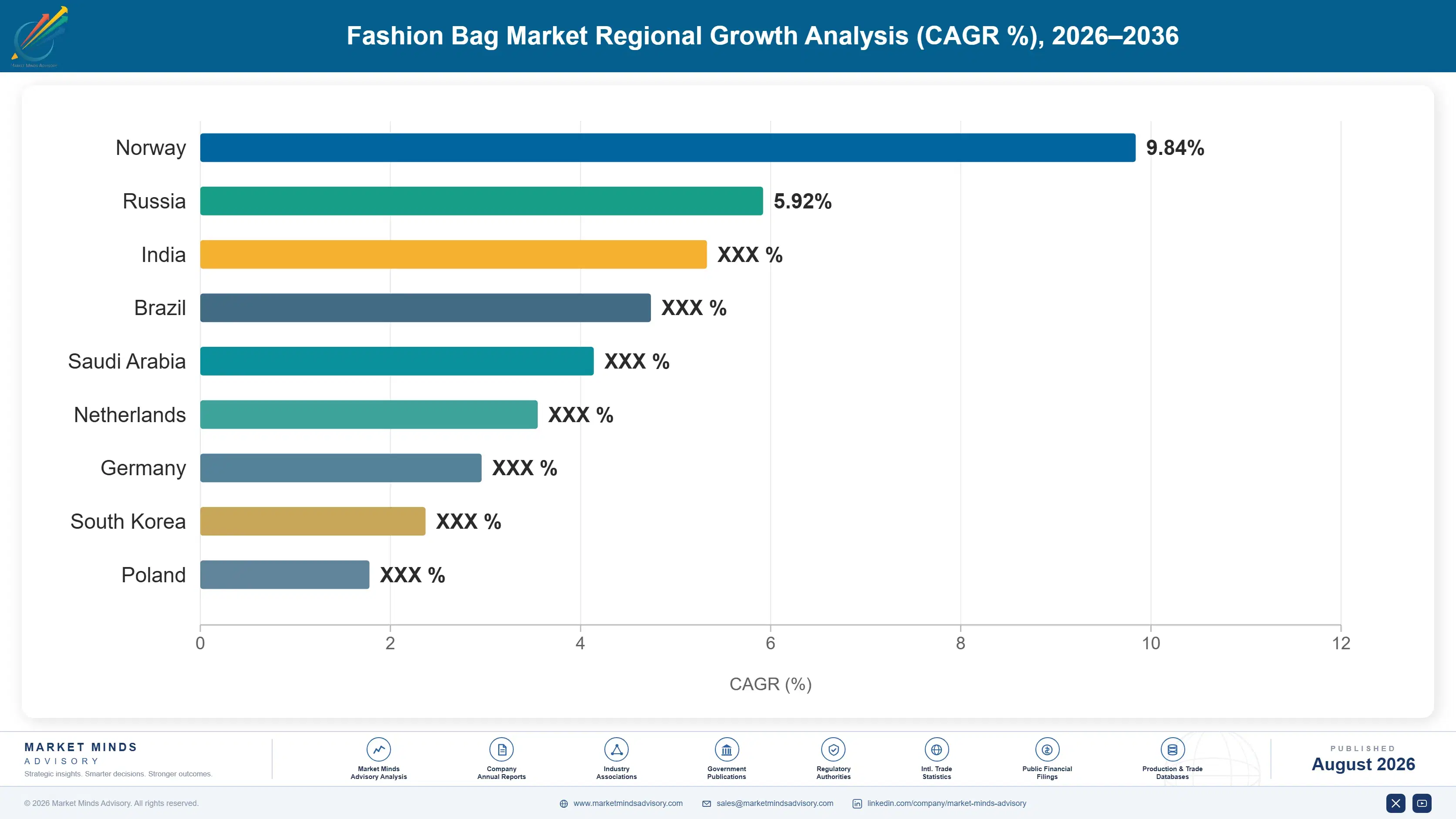
East Asia anchors both manufacturing and consumption at meaningful scale, while North America and Western Europe remain the largest luxury handbag markets by value overall. South Asia and Pacific is growing fastest as middle-class fashion spending expands rapidly across the forecast period in nearly every major economy.

North America

United States consumers drive the large majority of North American fashion bag spending, split between a mature luxury handbag market concentrated in major metropolitan areas and a fast-growing direct-to-consumer tote and backpack segment selling primarily through owned e-commerce channels. Department store distribution continues losing share to both direct-to-consumer digital brands and off-price retail, forcing traditional wholesale-dependent brands to rebuild their own retail and digital capabilities from a weaker starting position than newer entrants. Canada's smaller market follows broadly similar consumption patterns, though with comparatively less luxury concentration relative to the United States specifically. Growth here trails the category average because the region's fashion bag market is already mature and largely saturated across most core demographic segments.
Share: 25% | CAGR: 6.2% (2026 to 2036)

Western Europe

France and Italy anchor Western European demand through their concentrated luxury handbag manufacturing and design heritage, home to several of the category's most recognized global brands and their primary production facilities. Sustainable material sourcing regulation is advancing faster here than in most other regions, pushing brands toward recycled and traceable-origin materials ahead of formal regulatory requirements that several governments have signaled are coming within the next few years. The region's luxury resale market is also more developed here than almost anywhere else, supported by long-established consumer comfort buying and selling pre-owned designer goods. Growth trails the global average because luxury handbag demand is already deeply penetrated and mass-market tote growth has not kept pace with faster-growing emerging regions.
Share: 21% | CAGR: 5.4% (2026 to 2036)
Regional intelligence for 5 additional markets available in the complete report: East Asia, South Asia and Pacific, Latin America, Middle East and Africa, Eastern Europe. Contact sales@marketmindsadvisory.com.
fashion-bag-market-country-cagr-analysis-1787306974698

Where Fashion Bag Brands Can Defend Margin

Margin defense in fashion bags depends heavily on capturing resale market value, defending against dupe-culture erosion, and building direct-to-consumer relationships that survive the shift away from wholesale distribution entirely. The four levers below target distinct points in the value chain where established brands can capture value fragmented and counterfeit competitors cannot easily replicate at scale.

Certified Pre-Owned Resale Program Development Strategy

Third-party resale platforms already capture a meaningful share of luxury handbag transaction value that brands previously left entirely on the table, missing both the transaction margin and the customer relationship data that resale generates for whoever controls the channel. Brands launching certified pre-owned programs capture authentication and resale transaction revenue directly while reinforcing the scarcity value that justifies premium new pricing to first-time buyers evaluating a purchase as a long-term asset rather than pure depreciation. Early adopters report certified pre-owned programs generating roughly 12 percent incremental revenue beyond original sale value per bag over its resale lifecycle.
Market Impact: Adds roughly 12% incremental revenu

Recycled and Bio-Based Material Product Line Expansion

Recycled and bio-based materials have reached commercial cost parity closely enough with conventional materials that sustainable product lines no longer require the steep price premium they once did, removing the main barrier that kept adoption limited to niche sustainable-focused brands specifically. Manufacturers building recycled-material capacity now capture younger, sustainability-conscious buyers willing to pay a modest premium for verified material sourcing, a customer segment growing meaningfully faster than the category overall today. Brands with established recycled-material lines report these products commanding a 14 percent price premium over otherwise comparable conventional items.
Market Impact: Commands roughly 14% premium on rec

Direct-to-Consumer Digital Channel Investment Priority Now

Wholesale and department store distribution continues compressing margins through discounting pressure and channel fees that direct e-commerce and owned retail avoid entirely, yet many legacy brands remain heavily dependent on wholesale relationships built decades before digital channels existed as a viable alternative. Brands investing meaningfully in owned e-commerce and social commerce capture both higher margin per unit and direct customer relationship data that wholesale distribution never provides them at any scale. Brands with mature direct-to-consumer channels report gross margins running roughly 18 percentage points above wholesale-dependent competitors on comparable product.
Market Impact: Lifts gross margin by roughly 18 pe

Anti-Counterfeit Authentication Technology Investment Push Now

Embedded chip and blockchain-based provenance authentication technology, once limited to the highest-value luxury product lines, is becoming commercially viable for broader premium product ranges as implementation costs decline steadily across the category. Brands deploying authentication technology capture customer trust and resale value premium that counterfeit-exposed competitors cannot match, while also generating verified ownership data that supports both resale program development and targeted marketing to existing customers over time across every major sales channel. Authenticated products currently command a 9 percent resale value premium over unauthenticated comparable items in the secondary market.
Market Impact: Commands roughly a 9% resale authen

Who Controls the Margin Pool

Five houses, evaluated here on estimated global retail revenue, hold roughly twenty-eight percent of the fashion bag category between them, a concentration level reflecting how strongly the luxury tier consolidates around a handful of heritage names while the mass and premium tiers remain considerably more fragmented. The gap between the largest luxury conglomerates and mid-tier premium brands remains wide, given the scale advantages heritage brand equity provides.
Current competitive activity centers on three fronts: certified resale program development to capture secondary market value, recycled-material product line expansion to capture sustainability-conscious buyers, and direct-to-consumer digital investment to escape wholesale margin compression. Luxury houses are also acquiring smaller, design-forward independent brands to capture younger customer segments before they age into full luxury purchasing power.

Pressure is building from dupe-culture social commerce and direct-to-consumer independent brands that compete on design and price without the overhead of heritage brand infrastructure, a threat concentrated specifically in the accessible-premium tier where brand loyalty matters less than in true luxury. Ranking shifts are most likely among mid-tier wholesale-dependent brands unable to fund direct-to-consumer transformation, several of which MMA expects to be acquired or exit within the next few years.
fashion-bag-market-company-positioning-matrix-1787306975215

Competitive Moat and Risk Dimensions

TAPESTRY, INC.

Moat: Multi-Brand Portfolio Diversification

Tapestry operates Coach, Kate Spade, and Stuart Weitzman across distinct price tiers and customer demographics, giving it diversified revenue exposure across accessible-luxury and premium segments that single-brand competitors cannot replicate, while sharing manufacturing, logistics, and digital infrastructure investment across the combined portfolio to meaningfully improve operating leverage.
TAPESTRY, INC.

Risk: Brand Dilution From Discounting

Tapestry's Coach brand has faced persistent criticism for outlet and discount channel overexposure diluting its premium positioning, a tension between volume growth and brand scarcity that competitors positioned more firmly in true luxury do not face to nearly the same degree across their core product lines.
LVMH MOËT HENNESSY LOUIS VUITTON SE

Moat: Unmatched Heritage Brand Equity

LVMH's Louis Vuitton brand commands genuine pricing power built over more than a century of consistent craft positioning and scarcity management, a heritage advantage that newer luxury entrants cannot replicate regardless of design quality or marketing investment, since brand equity of this depth compounds slowly over generations rather than years.
LVMH MOËT HENNESSY LOUIS VUITTON SE

Risk: Chinese Consumer Demand Sensitivity

LVMH's luxury handbag revenue carries meaningful exposure to Chinese consumer spending specifically, leaving it more sensitive to Chinese economic conditions and shifting domestic luxury sentiment than competitors with more geographically diversified customer bases across comparable price tiers, product categories, and geographic markets it has not yet fully diversified into.

Players Tracked

Prominent Players

Tapestry, Inc.
Capri Holdings Limited
LVMH Moët Hennessy Louis Vuitton SE
Kering SA
Samsonite International S.A.

Other Key Players

Herschel Supply Co.
Fossil Group, Inc.
Vera Bradley, Inc.
Longchamp SAS
Furla S.p.A.
Baggallini LLC
Timbuk2 Designs Inc.
Osprey Packs, Inc.
Baggu Inc.
State Bags Inc.
Dagne Dover Inc.
Cuyana Inc.
Rains ApS
Radley London Ltd.
Kipling (VF Corporation)

Recent Developments

JUNE 2025

Tapestry Launches Certified Pre-Owned Program for Coach Brand

Tapestry launched a certified pre-owned resale program for its Coach brand, partnering with an authentication technology provider to verify and resell used handbags directly through owned digital channels, capturing secondary market transaction revenue and customer relationship data previously flowing entirely to third-party resale platforms outside the brand's control.
Signal: Signals legacy brands moving to capture re
SEPTEMBER 2025

LVMH Expands Recycled-Material Sourcing Agreement with Textile Supplier

LVMH signed a multi-year supply agreement with a specialty recycled-textile producer to secure sustainable material capacity for select handbag lines, expanding beyond pilot volumes into meaningful commercial-scale production as sustainability commitments extend further into core product material sourcing across the group's broader luxury handbag portfolio overall.
Signal: Shows luxury houses committing meaningful
MARCH 2025

Capri Holdings Acquires Direct-to-Consumer Backpack Startup

Capri Holdings acquired a majority equity stake in a digitally native backpack brand popular among younger commuter consumers, gaining direct-to-consumer digital capability and a customer base skewing meaningfully younger than its existing Michael Kors core demographic, ahead of broader generational shifts in fashion bag purchasing behavior.
Signal: Reflects legacy brands acquiring digital-n

Leather and Recycled Textile Exposure

Genuine leather and technical textile materials together represent an estimated 40 to 48 percent of cost of goods sold for a typical fashion bag, with leather specifically sourced as a byproduct of global livestock and meat industry supply concentrated in Brazil, the United States, and Italy. This dependency leaves brands with limited substitution options when livestock supply cycles tighten unexpectedly.
Leather prices rose meaningfully during 2024 after reduced cattle herd sizes across major producing regions tightened hide supply just as fashion and automotive upholstery demand both recovered simultaneously, according to figures the USDA tracks for livestock and hide market conditions. Smaller fashion bag brands without long-term tannery contracts reported input cost increases exceeding 16 percent within two quarters, a shock larger houses with hedged supply absorbed more comfortably.

Smaller independent brands without the purchasing scale to negotiate multi-year fixed-price tannery contracts absorb raw material volatility directly into thin margins, while the largest luxury houses use long-term supply agreements and, in some cases, direct ownership stakes in tanneries themselves. This gap compounds over time: undercapitalized brands either raise prices, risking volume loss to dupe alternatives, or hold pricing and erode margin, a choice larger integrated houses rarely face.
fashion-bag-market-cost-volatility-analysis-1787306975411

Multi-Year Fixed-Price Tannery Supply Agreements

Locking leather and technical textile procurement into two to four year fixed-price agreements with primary tannery partners protects margin predictability during livestock cycle volatility, though it requires accepting somewhat higher baseline pricing during calm periods, a trade-off larger houses with stronger balance sheets absorb more comfortably than smaller independent brands operating on thinner margins.

Direct Tannery Ownership and Investment Stakes

The largest luxury houses are selectively acquiring direct ownership stakes in specialty tanneries, securing dedicated hide supply and quality control that open-market purchasing cannot guarantee, even though the capital investment required puts this option genuinely out of reach for smaller independent brands competing primarily on design and price rather than any form of vertical supply chain integration.

Recycled and Bio-Based Material Diversification

Shifting a portion of material sourcing toward recycled polyester and emerging bio-based leather alternatives reduces exposure to livestock supply cycle volatility entirely, though this diversification requires meaningful product reformulation investment that smaller brands often cannot justify without guaranteed customer demand for sustainable materials established well in advance across each product category the brand serves currently.

Portfolio Architecture for Margin Defence

Fashion bag portfolios split cleanly into three margin tiers. Volume commodity-adjacent totes and mass-market backpacks sold through broad retail distribution carry the thinnest margins but the highest unit volume, competing primarily on price and design trend responsiveness rather than material craft. Premium certified handbags, built on established brand heritage and genuine leather craftsmanship, command meaningfully higher margins tied to scarcity management and brand equity rather than raw
The tension between volume commodity distribution and premium scarcity positioning shapes nearly every strategic decision brands make, from how widely to distribute product to which price points to defend against discounting pressure. Chasing volume through broad wholesale distribution generates cash flow but erodes brand scarcity value over time, while over-indexing on premium positioning limits addressable market size given how small the true luxury buyer base remains relative to broader fashion consumer demand.

High-value margin pools concentrate specifically in certified pre-owned resale and recycled-material premium product lines, both growing faster than the broader category and commanding pricing that neither commodity totes nor standard premium handbags currently achieve at comparable scale, a gap MMA expects to widen further.

Volume / Commodity-Adjacent Tier

Mass-market totes and backpacks sold through broad retail and e-commerce distribution, competing primarily on price, design trend responsiveness, and availability rather than material craft or heritage brand differentiation across most order volume today.
Gross Margin: 20-28%

Premium / Certified Tier

Established heritage handbags built on genuine leather craftsmanship and brand equity, sold primarily through owned retail and select wholesale partners commanding meaningfully higher price points than mass-market alternatives across every major region.
Gross Margin: 42-52%

Sustainability / Regulatory / Next-Generation Tier

Recycled-material and bio-based leather alternative products, certified pre-owned resale offerings, and authentication-verified luxury items targeting sustainability-conscious and scarcity-focused buyers ahead of broader industry adoption across most major markets and buyer demographics.
Gross Margin: 38-48%
fashion-bag-market-portfolio-architecture-1787306975910

High-value Sub-segments and Strategic Watch-out

Certified Pre-Owned Luxury Resale

Authenticated resale programs for luxury handbags represent the fastest-growing, highest-margin pocket of the category, moving from third-party platform dominance into brand-owned channels as houses recognize resale value directly reinforces new-purchase pricing power rather than undermining it, a shift MMA expects to accelerate meaningfully over the next several years.

Recycled and Bio-Based Material Lines

Sustainable material product lines are growing steadily among younger, sustainability-conscious buyers, commanding a meaningful price premium that is narrowing gradually as recycled and bio-based material costs continue approaching parity with conventional leather and textile alternatives across most product categories and price tiers over the next several years.

Standard Tote and Backpack Volume

The largest volume segment by unit count, standard totes and backpacks sold through broad retail distribution anchor category revenue even as growth moderates, remaining the entry point through which most first-time buyers discover branded fashion bags before eventually trading up to premium or luxury tiers later in life.

Dupe-Culture Social Commerce Threat

Openly marketed counterfeit and closely imitative dupe products sold through social commerce platforms represent a genuine strategic threat, eroding branded pricing power fastest among younger, price-sensitive buyers who show limited brand loyalty once basic style similarity is achieved at a fraction of the branded price.

Where Scarcity Meets Everyday Habit

Fashion bag demand splits into genuinely different economic patterns depending on tier. Luxury handbags function closer to durable assets that appreciate or hold value through resale, generating replacement demand driven by collection expansion and trend refresh rather than product failure, while mass-market totes and backpacks depreciate immediately and generate replacement demand from wear, trend cycling, and habitual purchasing far more frequently across a typical buyer's wardrobe.
Adoption depth varies considerably by end-use vertical. Luxury buyers show deep brand loyalty reinforced by resale value preservation and scarcity management, while everyday tote and backpack buyers show meaningfully shallower loyalty, switching brands readily whenever design trends, price, or sustainability positioning shift in a competitor's favor. Commuter backpack buyers sit in between, valuing functional consistency enough to show moderate repeat-purchase loyalty within a preferred brand over several purchase cycles.

A generational shift among younger buyers, increasingly comfortable purchasing pre-owned luxury and openly discussing dupe alternatives on social media, is reshaping purchase behavior fundamentally, favoring authenticated resale value and social commerce discovery over the traditional department store browsing that shaped previous generations' brand relationships and loyalty patterns built over decades.
fashion-bag-market-end-use-penetration-index-1787306976398

Where Fashion Bag Brands Should Focus

These are among the four positions where our research anticipates prominent divergence between winners and laggards over the coming forecast period. Each is grounded in the demand model, the regulatory perimeter, and the announced capacity pipeline.
01 / RESALE PROGRAM DEVELOPMENT

Launch certified pre-owned programs to capture secondary market value

Third-party resale platforms already capture meaningful luxury handbag transaction value that brands previously left entirely on the table, missing both transaction margin and customer relationship data that resale generates for whoever controls the channel. Brands launching certified pre-owned programs capture authentication and resale revenue directly while reinforcing scarcity value that justifies premium new pricing to buyers evaluating a purchase as a long-term asset rather than pure depreciation. Companies that delay this investment risk permanently ceding resale value and customer data to third-party platforms.
02 / SUSTAINABLE MATERIAL INVESTMENT

Scale recycled-material lines ahead of broader industry adoption

Recycled and bio-based materials have reached commercial cost parity closely enough with conventional materials that sustainable product lines no longer require the steep price premium they once did, removing the main barrier that kept adoption limited to niche sustainable-focused brands specifically. Manufacturers building recycled-material capacity now capture younger, sustainability-conscious buyers willing to pay a modest premium for verified sourcing, a segment growing meaningfully faster than the category overall. Waiting risks ceding this pricing advantage to competitors who move first on material investment.
03 / DIGITAL CHANNEL TRANSFORMATION

Build owned digital channels to escape wholesale margin compression

Wholesale and department store distribution continues compressing margins through discounting pressure and channel fees that direct e-commerce and owned retail avoid entirely, yet many legacy brands remain heavily dependent on wholesale relationships built decades before digital channels existed as a viable alternative. Brands investing meaningfully in owned e-commerce and social commerce capture both higher margin per unit and direct customer relationship data that wholesale distribution never provides. This transformation compounds in value as digital channel share keeps expanding across the broader category.
04 / TANNERY SUPPLY HEDGING

Lock multi-year leather contracts to protect margin stability

Leather input costs fluctuate meaningfully with broader livestock cycles, and brands without long-term supply agreements absorb spot-market volatility directly into thin margins during tight-supply periods that recur unpredictably across the industry. Brands negotiating multi-year fixed-price tannery contracts protect margin predictability even during industry-wide price spikes, a stability smaller independent competitors without comparable purchasing scale genuinely cannot replicate on their own. Brands that skip this hedging discipline remain exposed every time livestock supply cycles tighten unexpectedly or hide prices spike without warning.

Engagement Snapshot From the Field

A live engagement with an industry participant carrying material or product regulatory and market exposure ahead of a defining policy shift, showing how our research translates into a defensible multi-year portfolio strategy.
MARKET MINDS ADVISORY · CLIENT ENGAGEMENT SUMMARY
Fashion Bag Producer Strategic Portfolio Review and Transition Roadmap 2026·Investment Scenario on Fashion Bag Exposure Evaluation 2025-26
CLIENT PROFILE
The client is a mid-tier accessible-luxury handbag brand generating approximately 180 million dollars in annual revenue (client-reported, unverified by MMA), historically dependent on department store wholesale distribution for roughly 70 percent of total sales. The brand had limited owned e-commerce infrastructure and no meaningful social commerce presence despite growing awareness that younger consumers were discovering competitors primarily through digital channels.
STRATEGIC CHALLENGE
Management needed to determine how aggressively to shift investment from wholesale relationships toward owned digital channels without disrupting existing department store partnerships that still generated the majority of current revenue, while also evaluating whether a certified resale program made sense at the brand's current scale and modest heritage depth relative to true luxury peers.
MMA APPROACH
MMA conducted primary interviews with the client's wholesale, digital, and merchandising teams, benchmarked digital transformation outcomes at comparable accessible-luxury brands, and modeled margin and revenue outcomes under three transition-pace scenarios ranging from cautious to aggressive before presenting a phased digital investment recommendation to leadership for board approval and phased budget allocation.
KEY FINDINGS
  1. Wholesale-channel gross margins ran roughly 22 percentage points below comparable owned e-commerce sales once channel fees and discounting patterns were fully accounted for across both channels.
  2. Comparable accessible-luxury brands that shifted toward direct-to-consumer over three years grew total revenue while shrinking wholesale dependency to under 40 percent of sales.
  3. A pilot certified resale program at one comparable brand generated meaningful incremental revenue without measurably cannibalizing new product sales during its first eighteen months of operation.
  4. The brand's existing customer data showed department store buyers skewing meaningfully older than social-media-driven traffic already visiting its limited existing digital storefront each month.
CLIENT PROFILE
The client is a mid-tier accessible-luxury handbag brand generating approximately 180 million dollars in annual revenue (client-reported, unverified by MMA), historically dependent on department store wholesale distribution for roughly 70 percent of total sales. The brand had limited owned e-commerce infrastructure and no meaningful social commerce presence despite growing awareness that younger consumers were discovering competitors primarily through digital channels.
STRATEGIC CHALLENGE
Management needed to determine how aggressively to shift investment from wholesale relationships toward owned digital channels without disrupting existing department store partnerships that still generated the majority of current revenue, while also evaluating whether a certified resale program made sense at the brand's current scale and modest heritage depth relative to true luxury peers.
MMA APPROACH
MMA conducted primary interviews with the client's wholesale, digital, and merchandising teams, benchmarked digital transformation outcomes at comparable accessible-luxury brands, and modeled margin and revenue outcomes under three transition-pace scenarios ranging from cautious to aggressive before presenting a phased digital investment recommendation to leadership for board approval and phased budget allocation.
KEY FINDINGS
  1. Wholesale-channel gross margins ran roughly 22 percentage points below comparable owned e-commerce sales once channel fees and discounting patterns were fully accounted for across both channels.
  2. Comparable accessible-luxury brands that shifted toward direct-to-consumer over three years grew total revenue while shrinking wholesale dependency to under 40 percent of sales.
  3. A pilot certified resale program at one comparable brand generated meaningful incremental revenue without measurably cannibalizing new product sales during its first eighteen months of operation.
  4. The brand's existing customer data showed department store buyers skewing meaningfully older than social-media-driven traffic already visiting its limited existing digital storefront each month.
RECOMMENDED STRATEGY
Phase 1: Phase 1 (Months 1 to 6): Rebuild owned e-commerce infrastructure and launch targeted social commerce marketing toward younger, digitally-native prospective customers. Phase 2: Phase 2 (Months 6 to 14): Gradually reduce wholesale dependency by renegotiating department store terms while scaling direct-to-consumer digital sales volume. Phase 3: Phase 3 (Months 14 to 22): Launch a certified pre-owned resale program to capture secondary market value and reinforce brand scarcity positioning.
OUTCOME
Within eighteen months, direct-to-consumer revenue grew to represent an estimated 34 percent of total sales, up from under 15 percent at engagement start (client-reported, unverified by MMA), while blended gross margin improved meaningfully as wholesale dependency declined. Management credited the phased approach with preserving department store relationships while building genuine digital capability rather than disrupting both simultaneously.

Frequently Asked Questions

Foundational context covering the market sizes, CAGR, scope, country, region and competition that inform every finding below. This section is provided to cover basics and most often pre-purchase conversations, answered from the MMA Primary Research Dataset.

What is the current size of the Fashion Bag Market?

The fashion bag market reached an estimated 42 billion dollars in 2025. Growth is being driven by expanding middle-class fashion spending and resale market development worldwide.

How large will the Fashion Bag Market be by 2036?

MMA projects the market will reach approximately 86.6 billion dollars by 2036 under the base case scenario, nearly double the 2026 starting value over the ten-year forecast window.

What is the CAGR for the Fashion Bag Market 2026 to 2036?

The base case CAGR is 6.8 percent annually through 2036, with a bull case of 8.1 percent and a bear case of 5.5 percent depending on resale and dupe-culture dynamics.

Which segment is growing fastest?

Tote bags are growing fastest, at roughly 9.4 percent annually, nearly 1.38 times the category average as reusable-bag habits spill into everyday fashion purchasing worldwide.

Who are the major companies in the Fashion Bag Market?

Tapestry, Capri Holdings, LVMH, Kering, and Samsonite lead the category based on estimated global retail revenue across both luxury and mass-market tiers combined worldwide today.

Which country is growing fastest?

India is the fastest-growing major market, expanding at an estimated 10.8 percent annually as organized retail expansion brings branded bags to newly aspirational middle-class consumers.

Report Segmentation Architecture

The full report scope spans multiple orthogonal segmentation dimensions, with cross-tabulated demand data provided for each dimension pair. Coverage extends further to regional breakdowns, trend trajectories, and the competitive detail needed to support segment-level decision-making.

By Product Type

  • Tote Bags
  • Backpacks
  • Structured Handbags
  • Crossbody Bags
  • Clutches
  • Travel Bags

By End-Use Industry

  • Personal Fashion and Lifestyle
  • Business and Commuter Use
  • Travel and Leisure
  • Gifting and Special Occasion
  • Resale and Secondary Market

By Commercial Dimension

  • Wholesale and Department Store
  • Direct-to-Consumer E-Commerce
  • Owned Retail Storefronts
  • Certified Resale and Authentication

By Region

  • North America
  • Western Europe
  • East Asia
  • South Asia and Pacific
  • Latin America
  • Middle East and Africa
  • Eastern Europe

Scope, Methodology, and Coverage

Every figure in this report is reproducible from documented input assumptions. The scope below maps the historical period, the forecast horizon, the segmentation dimensions, and the countries covered, alongside the underlying primary and qualitative methodology.
Historical Period
2020 to 2025
Forecast Period
2026 to 2036
Base Year
2025 (USD billions; MMA Primary Research Dataset, August 2026)
Market Definition
The fashion bag market comprises handbags, totes, backpacks, crossbody bags, clutches, and travel bags sold as fashion or everyday-carry accessories to individual consumers. It excludes industrial and occupational carrying equipment, luggage sold purely for travel logistics rather than fashion positioning, and wholesale packaging or shopping bags without standalone product value.
Quantitative Units
USD billions (current prices); unit volume in million bags where applicable
Segmentation Dimensions
Product Type; End-Use Industry; Commercial Dimension; By Region
Regions Covered
North America, Western Europe, East Asia, South Asia and Pacific, Latin America, Middle East and Africa, Eastern Europe
Countries Covered
USA, China, Germany, France, UK, Japan, South Korea, India, Australia, Canada, Brazil, Mexico, Indonesia, Vietnam, Thailand, Malaysia, UAE, Saudi Arabia, South Africa, Nigeria, Turkey, Poland, Netherlands, Italy, Spain, Sweden, Switzerland, Argentina, Colombia, Singapore, and additional markets relevant to this sector
Key Companies Profiled
Tapestry, Inc., Capri Holdings Limited, LVMH Moët Hennessy Louis Vuitton SE, Kering SA, Samsonite International S.A., Herschel Supply Co., Fossil Group, Inc., Vera Bradley, Inc., Longchamp SAS, Furla S.p.A., Baggallini LLC, Timbuk2 Designs Inc., Osprey Packs, Inc., Baggu Inc., State Bags Inc., Dagne Dover Inc., Cuyana Inc., Rains ApS, Radley London Ltd., Kipling (VF Corporation)
Quantitative Methodology
Primary survey, n=3,800 respondents, Q4 2025, six countries; demand-side model with trade association cross-validation
Qualitative Methodology
47 expert interviews, Q4 2025; applied to validate demand model assumptions, identify emerging dynamics, and assess competitive positioning
Report Format
PDF and XLSX data workbook (Word format preview document)
Publisher
Market Minds Advisory
Report Code
MMA-2026-CON-354
Published
August 2026
Contact
sales@marketmindsadvisory.com | www.marketmindsadvisory.com

Purchase the full Fashion Bag Market Report (2026 to 2036).

This report provides a comprehensive analysis of the global fashion bag market, covering market sizing, segmentation, and regional dynamics across the 2026 to 2036 forecast period. It profiles twenty leading brands spanning luxury handbags and mass-market totes and backpacks, with detailed competitive positioning, moat and risk analysis for the two category leaders, and recent corporate developments across resale, sustainability, and digital transformation. The report examines revenue-generation levers, leather input cost exposure, and portfolio margin economics across three product tiers. It draws on primary survey data from 3,800 respondents and 47 expert interviews conducted across six countries in the fourth quarter of 2025.
Ten-year market sizing and growth forecast
Six-segment product type breakdown with CAGR
Seven-region demand and pricing trend analysis
Twenty-company competitive profiling and moat assessment
Leather input cost exposure and mitigation review
Revenue lever and portfolio margin economics

Built For The People Who Decide

From boardroom strategy to bench-side execution, this report is read cover-to-cover by leaders shaping the next decade of their industry, turning demand scenarios, market dynamics and valuation benchmarks into decisions.
CXOs/ Presidents/ VPs/ Managers
M&A and Corporate Development
Strategy Teams and R&D Heads
Procurement and Product Directors
Regulatory and Compliance Leaders
Investor Relations and Equity Analysts