Market Minds Advisory
Face Steamer Market

Face Steamer Market: Face Steamer Market: Pores Have No Muscles, Nano Means Nothing In Particular, And Scale Kills Most Of These Devices, 2026 to 2036

About 82% of products claim to open pores, which have no muscles and cannot open. Mineral scale causes 63% of warranty returns, and only 11% of owners descale at the specified interval.

Lead Analyst

Published

September 2026

Make Smarter Decisions with Customized Research Insights

Request a free sample report and evaluate market opportunities, growth trends, and competitive dynamics relevant to your business needs.

2025 MARKET VALUE$0.9BMarket Size 2025
2036 FORECAST VALUE$2.1BBase Case , 2026 to 2036
CAGR 2026 TO 20367.6 %Bull 8.8% / Bear 6.4%
INCREMENTAL OPPORTUNITY$1.1BNet 10- year value creation
EXPANSION MULTIPLE2.10x2036 value over 2026 base
Strategic Levers
M&A Pipeline
Regional Outlook
Country Rankings
Competitive Intelligence
Segmental Deep-dive
Call-Us : 91 93563 13602

Executive Snapshot and Market Trajectory.

Pores have no muscles and cannot open or close, and roughly 82% of products in this category say they do. What steam actually does is hydrate and soften the stratum corneum and sebum, which genuinely helps extraction. That is a real benefit described wrongly for forty years.
Multi-function combination units grow at 11.4%, half again the market rate of 7.6%, because a single device carrying steam plus a magnifying lamp and extraction tools justifies a shelf position that a steamer alone increasingly cannot. Ultrasonic mist steamers follow at 9.8%. Wearable hands-free formats grow slowest of the six architectures at 5.4%. Nano-ionic has no agreed particle size definition behind it anywhere, so devices with genuine ultrasonic mist share a shelf with boiling water.
East Asia holds 34% of demand and manufactures nearly all of it, with Indian growth of 14.2% leading every market covered on home and salon adoption together. Mineral scale causes about 63% of warranty returns while only 11% of owners descale at the specified interval, which makes water hardness the largest single determinant of device life. Around 38% of professional units still carry an ozone lamp into treatment rooms.
Market Definition
This market covers facial steaming devices for consumer and professional use, including benchtop consumer steamers, handheld portable steamers, ultrasonic mist steamers, floor-standing professional steamers, multi-function combination units, and wearable and hands-free steamers. It excludes full-body steam cabinets and saunas, humidifiers and air treatment appliances, nebulisers and respiratory medical devices, hair steamers, and clinical hydrodermabrasion systems.
Base Year Value
$0.9B in 2025 (MMA Primary Research Dataset, September 2026)
Forecast Period
2026 to 2036, eleven discrete annual values
CAGR
7.6% base case. Bull 8.8%. Bear 6.4%.
Fastest Growth Segment
Multi-Function Combination Units: 11.4% CAGR
Fastest Growth Country
India: 14.2% CAGR
Fastest Growth Region
South Asia and Pacific: 9.6% CAGR
Largest Region
East Asia: 34% of 2025 global value
Market Leaders
Panasonic Holdings, Conair, Beurer, Ya-Man, and Foreo lead the field. Source: MMA Primary Research Dataset, July 2026.
Primary Survey
n=3,800 procurement and R&D decision-makers, Q4 2025, six countries
Methodology
Demand-side build-up, cross-validated against public data, 47 expert interviews

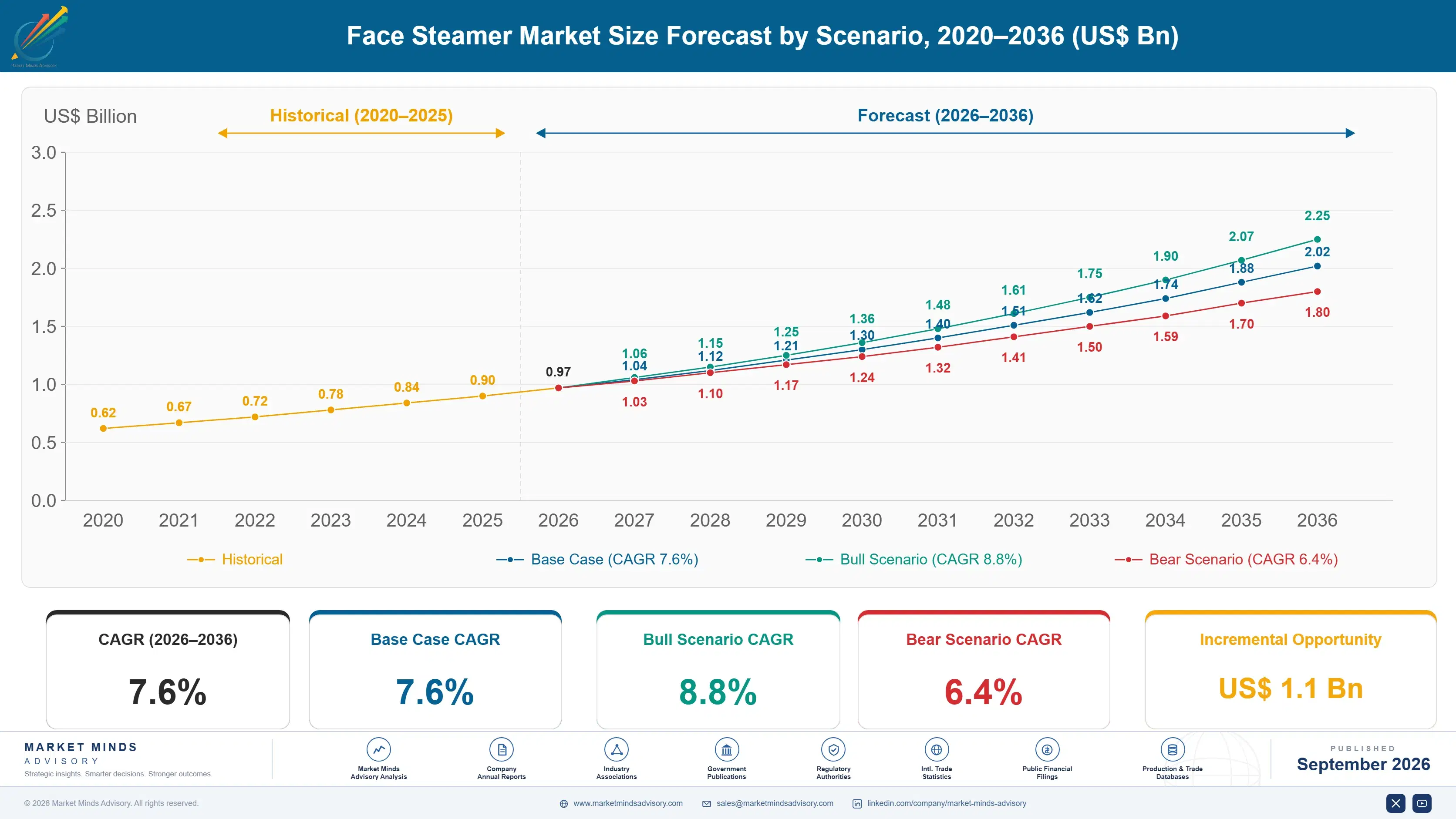
Face Steamer Market Forecast Scenarios

face-steamer-market-size-forecast-scenario-1790017894544
Growth from 2020 to 2025 ran at 6.5% and came from home use rather than from salons. Consumers who could not visit a professional bought equipment to approximate the experience, and a large share of those devices were used intensively for a few months and then intermittently. Professional demand recovered slowly and remains a smaller share of units while setting the format that consumer products imitate.
The base case at 7.6% rests on three mechanisms. Multi-function combination units keep displacing single-purpose steamers by justifying the counter space a steamer alone struggles to hold. Asian home and salon adoption expands quickly, with Indian growth at 14.2% leading every country covered. And professional replacement demand runs on scale-driven failure rather than obsolescence, which makes it more predictable than consumer purchasing. None of the three depends on the pore explanation being corrected.
The bull case at 8.8% depends on integrated descaling or filtration becoming standard, which would extend device life and, counter-intuitively, raise category value by moving purchases up-market. The bear case at 6.4% is regulatory: about 38% of professional units ship with an ozone lamp, and several jurisdictions already restrict ozone-generating devices in occupied spaces. A treatment room is occupied space.

What Steam Actually Does

A pore is an opening in the skin with no surrounding musculature, so it cannot open or close in response to temperature. About 82% of products in this category claim otherwise. What steam does is hydrate the stratum corneum and soften sebum, which makes comedones considerably easier to extract and makes subsequent products absorb better. That is a real benefit the category has spent four decades describing incorrectly.
TOP FIVE CONCENTRATION24%Share of category revenue held by the leading manufacturers
PORE CLAIM PREVALENCE82%Products claiming to open pores, which have no muscles
NANO TERM STANDARDS0Agreed particle size definitions behind the nano-ionic label
SCALE FAILURE SHARE63%Warranty returns caused by mineral scale rather than component failure
DESCALING COMPLIANCE11%Owners descaling at the interval their manual actually specifies
OZONE FEATURE SHARE38%Professional units shipping with an ozone lamp fitted
The nano-ionic label is the second piece of imprecision. There is no agreed particle size definition behind it, and droplet size in a boiling-water device is set by condensation physics rather than by anything ionic. Some products do add an ultrasonic element that produces a genuinely finer mist, and those perform differently. Most print the word on the box, and a consumer cannot tell the two apart.
The thing that actually determines whether one of these devices survives is water. Mineral scale accounts for around 63% of warranty returns, ahead of every electrical and mechanical cause combined, and only about 11% of owners descale at the interval the manual specifies. Hard water areas therefore see device life a fraction of soft water areas, and nobody sells against that.
"Pores are holes. They have no muscles and they do not open, and this industry has been saying they do since before most of its current products existed. The underlying benefit is real, which makes the persistence of the wrong explanation harder to excuse rather than easier."
Practice Director, Personal Care Devices and Small Appliances · MMA Consumer Appliances and Personal Care Devices Practice · September 2026

Market Trends

Combination Units Displace The Single-Purpose Steamer

Multi-function combination units grow at 11.4%, fastest of the six architectures, because counter and cupboard space is the binding constraint on a device used a few times a month. A unit carrying steam alongside a magnifying lamp, extraction tools, and sometimes light therapy earns the space that a steamer alone increasingly cannot. Consumers are not buying more capability so much as buying permission to keep the device out where they will use it. Manufacturers treating this as a feature race rather than a space argument tend to overshoot on function.
Market Impact: Country grows at 14.2%
Scale Failure Becomes A Product Design Question

Mineral scale causes around 63% of warranty returns while only 11% of owners descale at the specified interval, which makes user compliance an unrealistic thing to design around. Manufacturers fitting integrated filtration, scale-tolerant heating geometry, or automated descaling cycles report materially longer service life and lower return cost. The change also moves the product up-market, since a device that survives hard water can carry a longer warranty and a higher price. Very few manufacturers currently treat water chemistry as a design input at all. Water hardness varies enormously between markets and almost nobody maps returns against it.
Market Impact: Region holds 34% share

Market Opportunities and Growth Drivers

Indian Home And Salon Adoption Compound Together

India grows at 14.2%, faster than any country covered, as home facial routines and salon density expand at the same time from a base where steamers were mostly professional equipment. Salon facials are an established mass-market service there rather than a premium one, which puts steamers in front of consumers who then buy their own. South Asia and Pacific holds 15% of world demand. Hard water across much of the region makes scale failure a considerably larger practical problem than manufacturers account for. Manufacturers pricing integrated filtration for temperate conditions are underpricing it badly here.
Market Impact: Affects 82% of products

Chinese Manufacture Sets The Entire Cost Structure

East Asia holds 34% of demand and manufactures very nearly all of the world's face steamers, which means every brand in the category is buying from the same contract manufacturing base with the same heating elements and pumps. Differentiation therefore has to come from housing design, control electronics, or genuinely different mist generation rather than from the core. Chinese domestic brands increasingly sell directly rather than only supplying others, which compresses the margin available to Western labels considerably. Western brands buying from the same base must differentiate on housing, electronics, or mist generation.
Market Impact: Covers 38% of units

Market Restraints and Challenges

The Category's Central Claim Is Anatomically Wrong

Around 82% of products claim to open pores, and the root cause is that the explanation predates the products and was never revisited by anyone selling them. Commercially the exposure is modest today and rising, since advertising regulators in several markets have begun examining mechanism claims in beauty devices. Manufacturers respond by describing hydration and sebum softening accurately, which turns out to be more persuasive rather than less, and by attaching extraction guidance that makes the actual benefit visible to a user. Describing the effect accurately turns out to be more persuasive than the false version.
Market Impact: Segment grows at 11.4%

Ozone Lamps Persist Despite Tightening Restrictions

About 38% of professional units still ship with an ozone lamp, and the root cause is that ozone was marketed as an antibacterial benefit long before indoor air restrictions existed. Commercially this is a concentrated exposure, since several jurisdictions already restrict ozone-generating devices in occupied spaces and salon treatment rooms are exactly that. Manufacturers respond by removing the lamp, by substituting ultraviolet or filtration approaches, and by retrofitting existing installed units where regulation has already moved. Retrofitting installed units converts the exposure into a service revenue line. Very few have attempted it.
Market Impact: Scale drives 63% returns
4 additional market trends, 3 additional growth drivers, and 2 additional restraints and challenges are covered in the full report. Contact sales@marketmindsadvisory.com to access the complete intelligence.

Segment CAGR and Growth Architecture

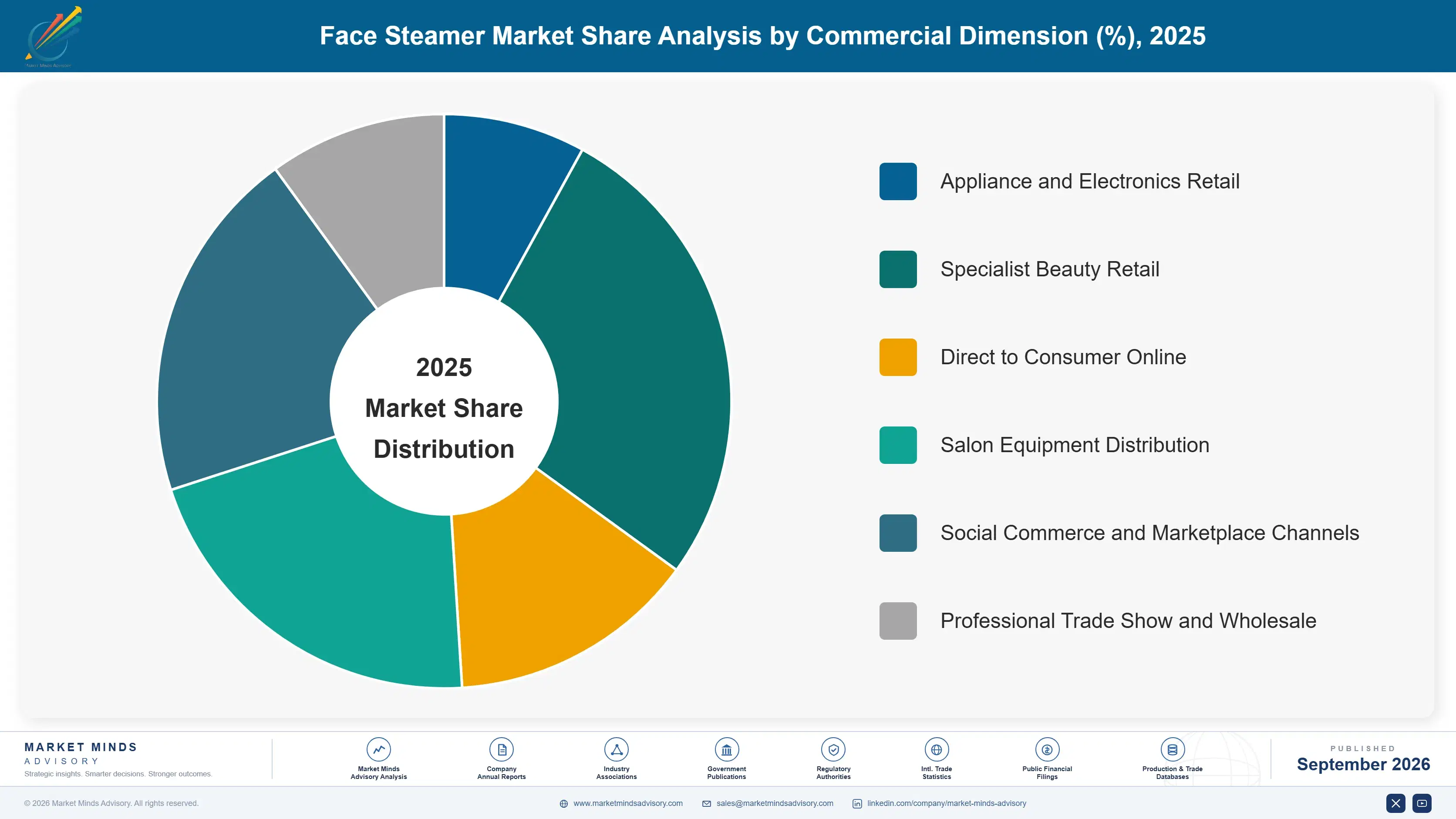
Segmentation follows device architecture across six categories: benchtop consumer steamers, handheld portable steamers, ultrasonic mist steamers, floor-standing professional steamers, multi-function combination units, and wearable and hands-free steamers. End-use setting, price tier, and feature specification are treated as separate dimensions rather than folded into this hierarchy. Full-body steam cabinets, humidifiers, and hair steamers fall outside the defined scope entirely.
face-steamer-market-market-share-analysis-1790017895100

Multi-Function Combination Units

Multi-function combination units grow at 11.4%, half again the market rate of 7.6%, on an argument about space rather than capability. A device used a few times a month competes for counter or cupboard position against everything else in a bathroom, and a unit carrying steam alongside a magnifying lamp and extraction tools earns that position where a single-purpose steamer no longer does. The failure mode is overshoot: manufacturers reading this as a feature race add light therapy, sonic cleansing, and misting until the device is expensive and nobody uses most of it. The units performing best combine two or three genuinely related functions rather than six unrelated ones. Restraint is the differentiator here rather than capability.
CAGR 11.4%

Ultrasonic Mist Steamers

Ultrasonic mist steamers grow at 9.8% and are the one architecture where the fine-particle argument holds up. An ultrasonic transducer produces droplets meaningfully smaller than boiling condensation does, which changes how the mist behaves on skin and how it feels. The commercial difficulty is that no agreed particle size standard exists behind the nano-ionic label, so devices doing this properly sit on a shelf beside devices that print the word and boil water. Manufacturers publishing measured droplet distribution separate themselves; almost nobody does. Ultrasonic elements are also considerably more scale-sensitive than a simple heating coil, which compounds the water problem. Publishing measured droplet distribution is the only way a buyer can distinguish the two.
CAGR 9.8%
Full segment breakdown across 6 segments available in the complete report.

Regional Architecture and Country Demand Map

Regional shares reflect where face steamers are purchased for home and salon use rather than where they are manufactured. Three regions sit outside the standard bands, for reasons named in their own paragraphs and summarised below for operator review. Water hardness and ozone regulation vary sharply between them.

East Asia

At 34% this sits above the standard band, and the justification is that the region both manufactures nearly all of the world's face steamers and contains the consumers who adopted home steaming as a routine step rather than an occasional treatment. Growth of 8.6% runs above the world rate. Korean routines place steaming within a multi-step sequence, which raises usage frequency well above Western norms. Japanese manufacturers lead on ultrasonic mist generation and control electronics. Chinese domestic brands increasingly sell directly rather than supplying Western labels, which compresses margin across the field. Water hardness varies enormously across the region and is rarely a specification input. That omission costs manufacturers more than they realise.
Share: 34% | CAGR: 8.6% (2026 to 2036)

North America

Home purchasing dominates the regional mix and was driven by a period when professional treatment was unavailable, which produced a large installed base used considerably less often than it was intended to be. Growth of 6.8% runs a little under the world rate. Multi-function combination units sell better here than anywhere, because bathroom counter space is the binding constraint on whether a device gets used at all. Advertising regulators have begun examining mechanism claims in beauty devices. Ozone-equipped professional units face tightening restriction in several states. Hard water areas see markedly shorter device life. Social discovery rather than appliance retail now drives most consumer purchasing, which favours brands with direct channels over those relying on shelf placement in electronics stores.
Share: 22% | CAGR: 6.8% (2026 to 2036)
Regional intelligence for 5 additional markets available in the complete report: Western Europe, South Asia and Pacific, Latin America, Middle East and Africa, Eastern Europe. Contact sales@marketmindsadvisory.com.
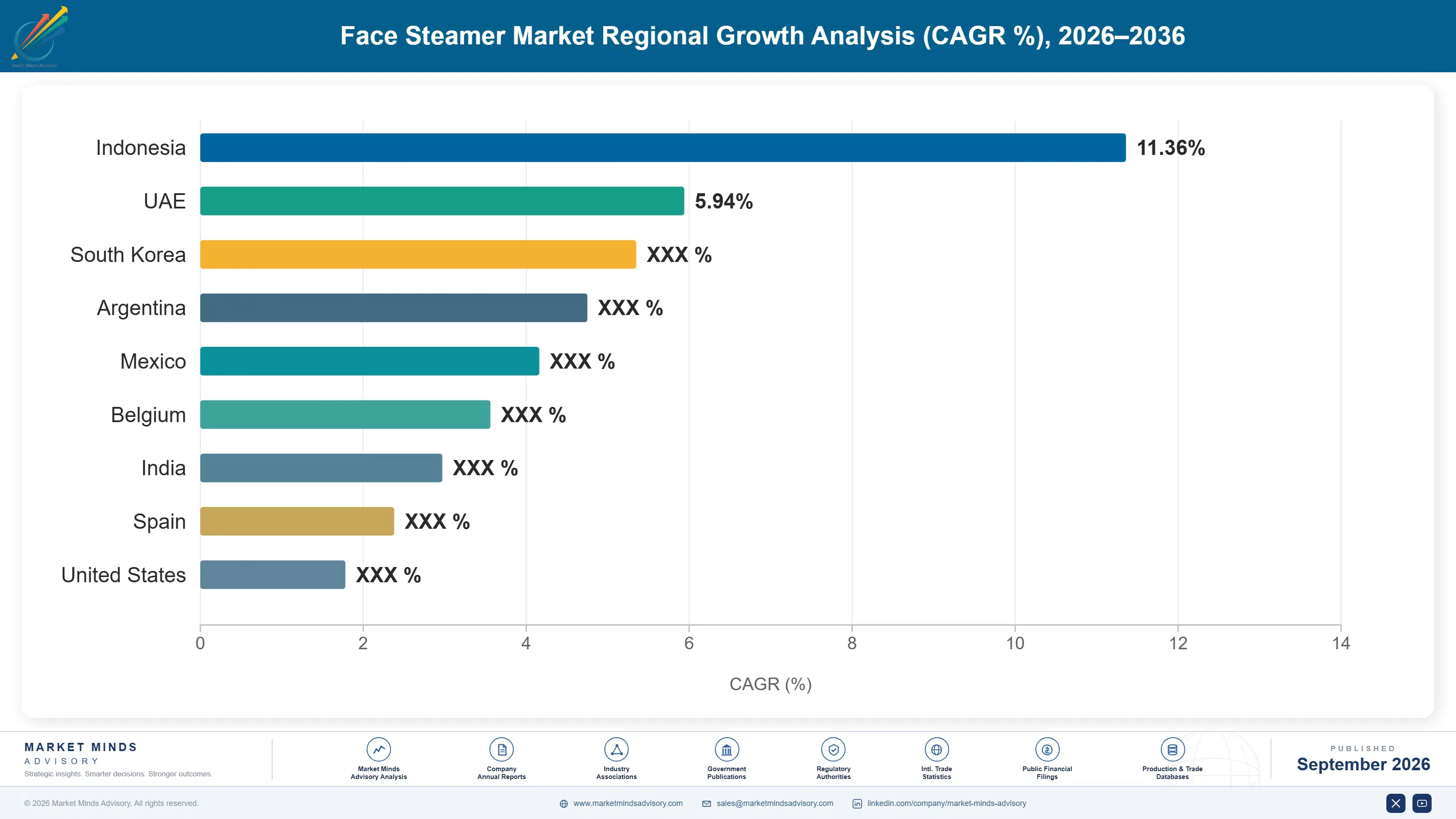
face-steamer-market-country-cagr-analysis-1790017895625

Where Steamer Makers Build Position

Four commercial moves matter in a category built on an explanation that is wrong, a label that means nothing, and a failure mode nobody designs for. Each replaces something the field currently repeats with something a buyer can actually verify or benefit from directly. None of them requires a new component or a new supplier.

Describe The Mechanism Correctly And Specifically

Around 82% of products claim to open pores, which cannot happen, while the real effect of hydrating the stratum corneum and softening sebum is both true and more useful to explain. Manufacturers describing it accurately with extraction guidance attached report satisfaction scores 1.8 times higher than pore-claim equivalents. Users who understand what the device does use it correctly and get a visible result. Users told their pores will open look for something that never happens and conclude the device failed. Correcting the description costs a packaging revision and nothing else.
Market Impact: Raises satisfaction scores to 1.8 times higher overall

Engineer For Water Rather Than For Compliance

Mineral scale causes about 63% of warranty returns and only 11% of owners descale at the specified interval, so designing around user compliance is designing around something that does not happen. Manufacturers fitting integrated filtration or scale-tolerant heating geometry report warranty cost 2.9 times lower alongside longer achievable warranty terms. That combination moves the product up-market rather than merely reducing a cost line, which is why it is worth more than it looks. Mapping returns against local water hardness is the first step and takes a postal code analysis rather than engineering work.
Market Impact: Cuts warranty cost to 2.9 times lower overall

Publish Measured Droplet Distribution Data Openly

No agreed particle size standard sits behind the nano-ionic label, so devices with genuine ultrasonic mist generation sit beside devices that print the word and boil water. Manufacturers publishing measured droplet distribution report price realisation 2.3 times higher in premium tiers than unmeasured equivalents. The measurement is inexpensive and almost nobody performs it. Setting the disclosure norm first also shapes what a regulator or standards body eventually asks the rest of the field to demonstrate. A buyer currently cannot distinguish a genuine ultrasonic system from a kettle with a nozzle.
Market Impact: Raises achieved price realisation to 2.3 times higher

Remove Ozone Before Regulators Require It

About 38% of professional units still ship with an ozone lamp while several jurisdictions restrict ozone-generating devices in occupied spaces, and a salon treatment room is precisely that. Manufacturers removing the feature and substituting filtration report specification wins 2.6 times higher with salon groups already managing air quality obligations. Retrofit programmes for installed units convert a regulatory exposure into a service revenue line, which very few manufacturers in this field have attempted. Salon groups managing air quality obligations are already asking the question, and a manufacturer without an answer is removed from the specification before price is discussed at all.
Market Impact: Raises salon specification wins to 2.6 times higher

Who Controls the Margin Pool

Concentration is very low. Five manufacturers hold 24% of category revenue, measured consistently on that basis across all participants, and the remainder spreads across appliance groups, beauty device specialists, salon equipment suppliers, and a very large Chinese contract manufacturing base that increasingly sells under its own brands. Every participant sources heating elements and pumps from broadly the same suppliers. That shared base makes the leader to challenger gap narrow in consumer formats and wider in professional equipment.
Competition currently turns on three dimensions: mist generation capability, where genuine ultrasonic systems differ measurably from boiling condensation; scale tolerance engineering, which decides device life in the hard water regions carrying most of the growth; and professional specification position, where electrical safety and air quality requirements narrow the permissible field. Price decides in consumer retail, which still accounts for most units moved in every region covered.

Pressure builds from two directions at once. Chinese manufacturers hold the cost base and are moving into direct selling. Ozone restriction is tightening in professional channels. Rankings will shift toward manufacturers holding measurable mist differentiation and scale-tolerant design rather than housing styling and brand alone. Manufacturers holding only basic consumer formats are most exposed.
face-steamer-market-company-positioning-matrix-1790017896154

Competitive Moat and Risk Dimensions

PANASONIC HOLDINGS

Moat: Mist Generation And Control Depth

Engineering capability in ultrasonic and fine mist generation combined with control electronics produces a device that behaves measurably differently from boiling condensation, which is the one technical difference in this category a user can actually feel. That capability sits well beyond what a contract manufacturing base can supply to anybody who asks.
PANASONIC HOLDINGS

Risk: Premium Price Against Direct Sellers

Chinese manufacturers selling directly under their own brands price well below appliance group structures while sourcing from the same component base. Defending a premium on genuine mist quality requires a buyer to understand a difference that no published standard currently helps them evaluate at the point of sale.
BEURER

Moat: Professional Specification And Safety

Established position in professional and salon equipment where electrical safety, treatment room air quality, and duty cycle requirements narrow the permissible field considerably before price is discussed. Professional specification is renewed at refit rather than contested at every purchase, which makes the position unusually durable once won.
BEURER

Risk: Limited Consumer Format Reach

Professional strength translates poorly into the multi-function consumer units growing fastest, where the buying argument is about counter space and social discovery rather than duty cycle or certification. That segment is being contested through channels salon equipment distribution does not reach at all. Social discovery is where those buyers now form their shortlists.

Players Tracked

Prominent Players

Panasonic Holdings
Conair
Beurer
Ya-Man
Foreo

Other Key Players

Homedics
Helen of Troy
Silk'n
MTG Company
Koizumi Seiki
Tescom
Groupe SEB
Koninklijke Philips
Xiaomi
LG Electronics
Skin Inc
Kingdomcares
Vanity Planet
Skin Act
Lumeta Beauty

Recent Developments

MARCH 2026

Panasonic Publishes Measured Droplet Distribution Across Steamer Range

Panasonic Holdings released measured droplet size distribution data across its facial steamer products alongside the measurement method used. The disclosure puts a comparable figure where the unstandardised nano-ionic label has stood alone across the category. Method documentation was released rather than a summary figure alone.
Signal: A measured number separates genuine ultrasonic systems from boiling water quickly. Measurement separates engineering from marketing language immediately.
OCTOBER 2025

Beurer Removes Ozone Lamps From Professional Steamer Range

Beurer withdrew ozone generation from its professional facial steamer products and introduced a filtration alternative, ahead of restriction in several markets. A retrofit programme was offered for units already installed in salon treatment rooms. Filtration performance data was published alongside the substitution itself in full.
Signal: Retrofitting installed units converts a regulatory exposure into service revenue. Moving ahead of a ruling costs less.
JUNE 2025

Conair Acquires Scale-Tolerant Heating Technology Business

Conair completed an acquisition of a business developing scale-tolerant heating geometry and integrated filtration for small water-heating appliances. The transaction was an outright acquisition rather than a joint venture or minority stake, with warranty cost cited as the rationale. Heating chamber design staff transferred with the business.
Signal: Water chemistry is finally being treated as a design input rather than user error. Compliance was never realistic.

What A Steamer Costs

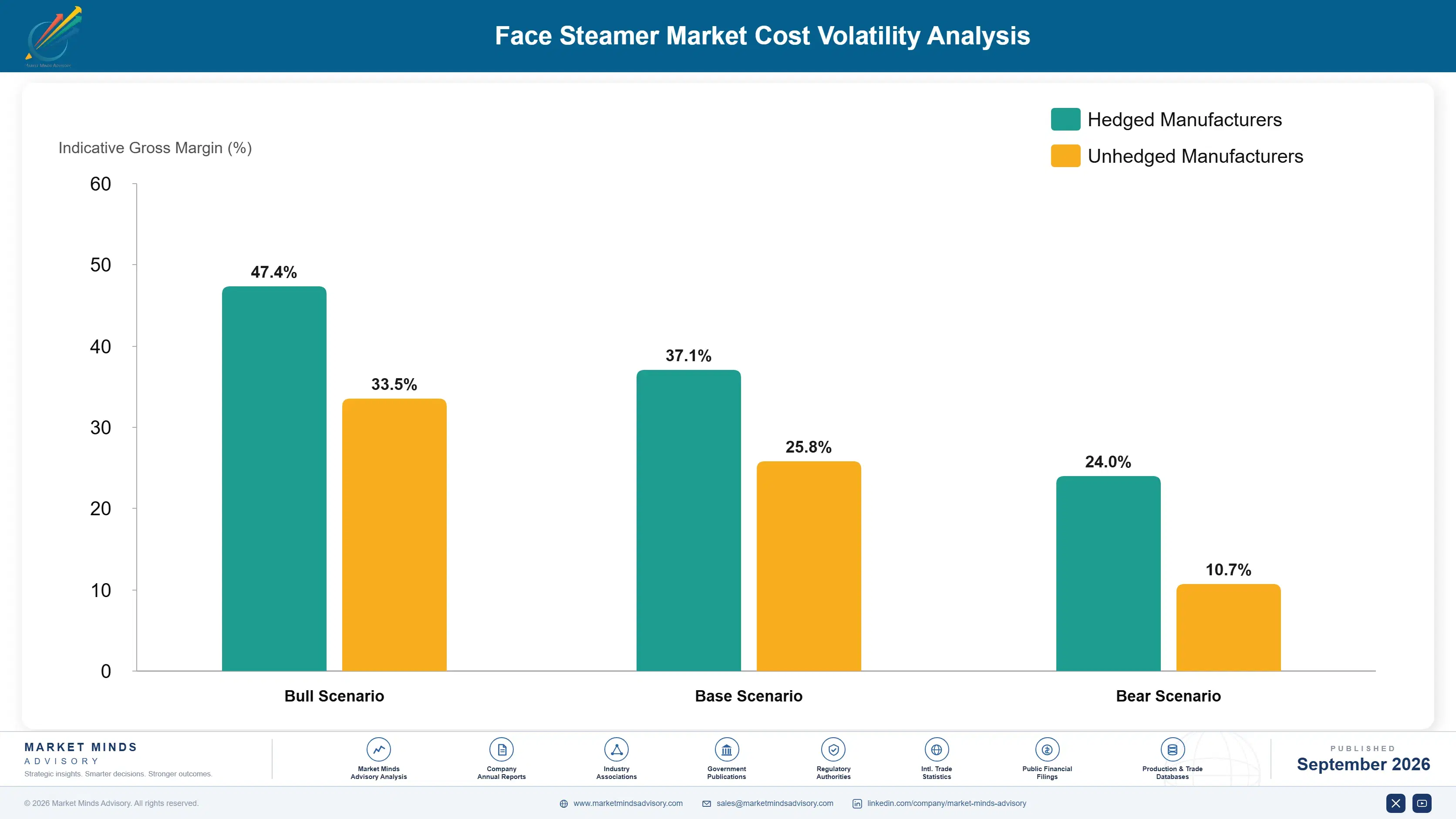
Three cost groups dominate. Heating elements, pumps, ultrasonic transducers, and control electronics run 30% to 38% of cost of goods sold, and the eight-point range separates genuine ultrasonic systems from simple boiling designs. Housing, tooling, and assembly take 24% to 32%, rising for multi-function units carrying additional components. Packaging, certification, and electrical safety testing account for 20% to 28% across the range of markets served.
Copper, aluminium, and engineering polymer pricing moved through 2024 and 2025 on industrial demand and freight together, and United States Geological Survey mineral commodity summaries documented the metal movements across the period. Several appliance manufacturers described the resulting margin pressure in their annual reports. Electronic component costs fell across the same window on volumes generated by unrelated consumer categories entirely. The two moved in opposite directions.

The competitive disadvantage mechanism runs through certification rather than through component cost. A brand serving many markets carries electrical safety and ozone compliance testing across each of them, while a Chinese direct seller entering one or two markets carries a fraction of that burden on identical hardware. Exposure therefore varies by market breadth rather than by scale, and mid-sized Western brands selling everywhere are the most squeezed.
face-steamer-market-cost-volatility-analysis-1790017896350

Design One Platform Across Certification Regimes

Electrical safety and ozone requirements differ enough between markets that separate variants are frequently developed for each, multiplying tooling and testing cost. A single platform engineered to the strictest regime and certified once across markets converts a repeated compliance burden into a volume position, which is the only lever that materially changes this line.

Specify Electronics At Consumer Category Volumes

Transducer, sensor, and controller costs are falling because unrelated consumer categories consume them at volumes personal care devices never will approach. Specifying components already at scale in those categories rather than bespoke parts captures a cost curve this industry contributes nothing to and can otherwise only watch from outside. Bespoke parts forfeit a curve this industry does not drive.

Contract Metals Against Industrial Rather Than Seasonal Cycles

Copper and aluminium pricing follows industrial demand and freight at volumes small appliance manufacture cannot influence in any direction whatever. Contracting against those cycles rather than against the fourth quarter production peak removes most of the exposure and secures allocation through periods when larger consumers are competing. Seasonal production peaks and industrial metal cycles never align.

Portfolio Architecture for Margin Defence

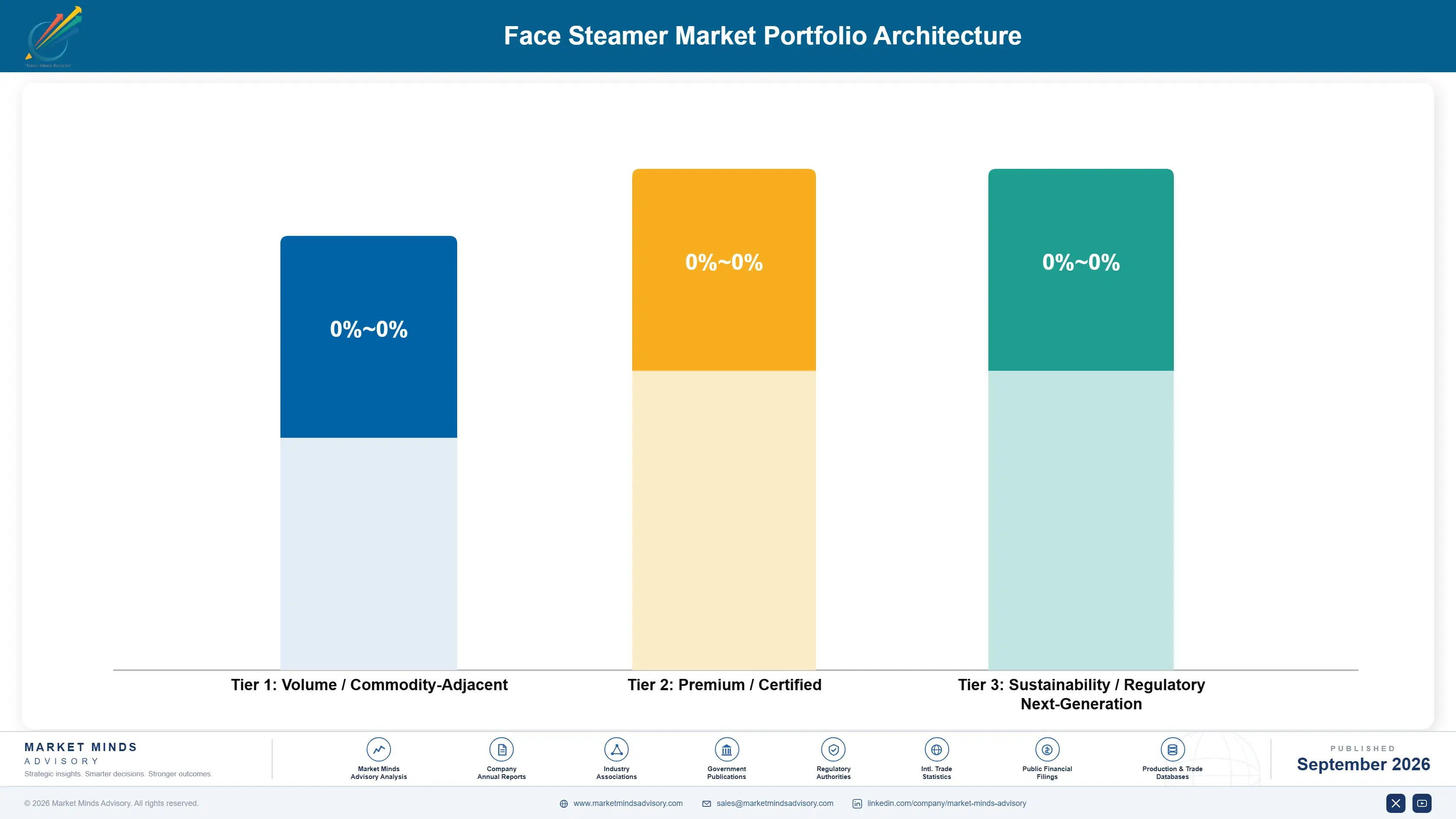
Margin follows measurable difference rather than feature count. Basic benchtop and handheld steamers compete close to commodity terms against Chinese direct sellers using identical components. Multi-function units earn moderately on the space argument rather than on capability. Genuine ultrasonic mist systems earn well where the difference is published and demonstrable, and scale-tolerant professional equipment earns most, because device life is what a salon actually buys.
The tension between volume and premium runs through what the buyer can verify. A consumer comparing two boxes sees the same wattage, the same tank size, and the same nano-ionic wording, so price decides. A salon owner replacing a unit that failed after eighteen months in hard water is buying duty cycle and service life, and will pay several times consumer prices for equipment that demonstrably survives the conditions it works in.

High-value pools concentrate in professional equipment with integrated filtration and long warranty terms, in ultrasonic systems publishing measured droplet data, and in multi-function units combining two or three genuinely related functions well. Where the product is a basic benchtop steamer sold on wattage and tank size, components are identical across the field and Chinese direct sellers hold the cost position outright.

Volume / Commodity-Adjacent

Basic benchtop and handheld consumer steamers sold on wattage, tank size, and an unstandardised nano-ionic claim. The ten-point range reflects sourcing position and channel cost rather than any capability a buyer could evaluate before purchase.
Gross Margin: 28% to 38%

Premium / Certified

Multi-function combination units and consumer devices with genuine ultrasonic mist generation and certified safety across multiple markets. The twelve-point range separates real mist engineering from housing styling applied over identical components.
Gross Margin: 44% to 56%

Sustainability / Regulatory / Next-Generation

Professional equipment with integrated filtration, scale-tolerant heating, ozone-free air handling, and warranty terms that reflect it. The fourteen-point range reflects durability engineering and certification depth, neither assembled quickly. Salon buyers know exactly what killed the last unit.
Gross Margin: 58% to 72%
face-steamer-market-portfolio-architecture-1790017896850

High-value Sub-segments and Strategic Watch-out

Scale-Tolerant Professional Equipment

Highest value in the category, addressing the mineral scale causing about 63% of warranty returns across every architecture. The fourteen-point range reflects durability engineering, which supports both longer warranty terms and materially higher price points. Salon buyers know exactly what killed their last unit already.
Gross Margin: 60% to 74%

Measured Ultrasonic Mist Systems

High value where droplet distribution is published rather than implied by an unstandardised label on a box. The fourteen-point range reflects genuine transducer engineering against devices printing the word and boiling water instead. The measurement costs very little and almost nobody in the field performs it.
Gross Margin: 48% to 62%

Multi-Function Combination Units

Volume core growing fastest at 11.4% on an argument about counter space rather than about capability at all. The twelve-point range reflects restraint, since units combining six unrelated functions cost more and get used less. Two or three genuinely related functions beat six unrelated ones.
Gross Margin: 42% to 54%

Basic Benchtop Consumer Steamers

The strategic watch-out. Identical components across the field, an unverifiable claim on the box, and Chinese direct sellers holding the cost base outright. The ten-point range reflects sourcing and channel position, with nothing else defending it. Chinese direct sellers now reach the same consumers online.
Gross Margin: 26% to 36%

How This Demand Repeats

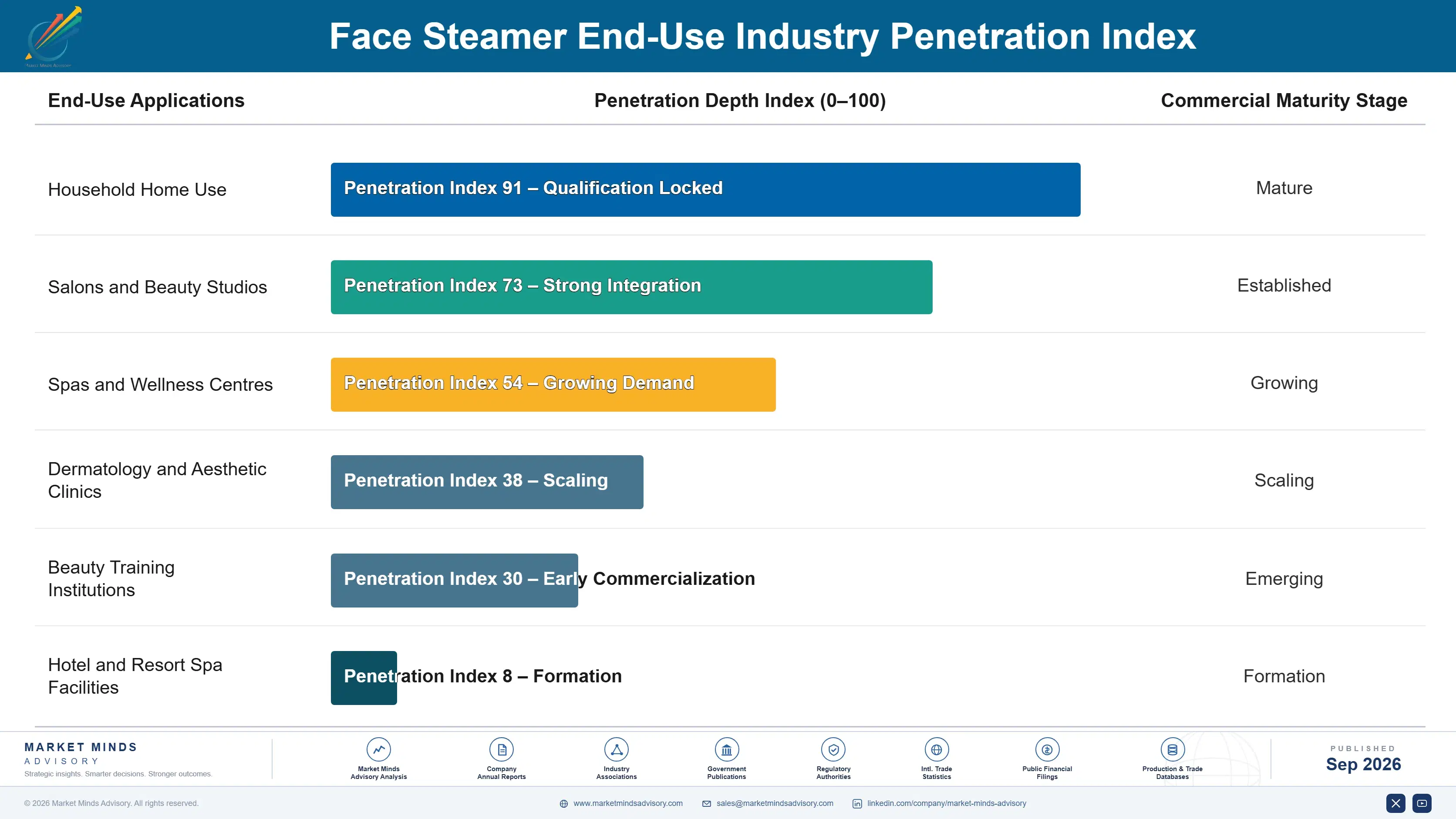
Consumer demand repeats on failure rather than on wear, and the failure is almost always scale. A device used a few times a month should last many years; in a hard water area it frequently does not last two, and around 63% of warranty returns trace to mineral deposit rather than to any component reaching end of life. That produces unplanned replacement demand and return cost manufacturers absorb.
Professional demand behaves quite differently and is considerably more predictable. A salon steamer runs several hours daily, accumulates scale far faster, and is replaced on a cycle measured in low single-figure years. Salon owners buying replacements know exactly what killed the last unit, which makes integrated filtration and warranty terms genuinely persuasive there in a way they are not on a consumer shelf.

The buyer profile is shifting from home users who bought during a period without salon access toward consumers discovering the category through social video and salon exposure. That second group buys multi-function units and asks what the device does rather than accepting the pore explanation. They are also considerably more likely to abandon a device that stops working, which raises the commercial value of surviving hard water.
face-steamer-market-end-use-penetration-index-1790017897341

Where This Market Rewards

These are among the four positions where our research anticipates prominent divergence between winners and laggards over the coming forecast period. Each is grounded in the demand model, the regulatory perimeter, and the announced capacity pipeline.
01 / MECHANISM DESCRIPTION ACCURACY

Pores are holes without muscles

Around 82% of products claim to open pores, which is anatomically impossible, while the real effect of hydrating the stratum corneum and softening sebum is both true and considerably more useful to explain. Manufacturers describing it accurately with extraction guidance attached report satisfaction scores 1.8 times higher than pore-claim equivalents achieve. Users told to expect something that cannot happen look for it, fail to see it, and conclude the device did not work, and correcting the description costs a packaging revision and nothing more than that.
02 / WATER CHEMISTRY ENGINEERING

Nobody descales, so design around it

Mineral scale causes about 63% of warranty returns while only 11% of owners descale at the interval their manual specifies, which makes user compliance an unrealistic thing for any manufacturer to design around. Those fitting integrated filtration or scale-tolerant heating geometry report warranty cost 2.9 times lower alongside longer achievable warranty terms. That combination moves the product up-market rather than only reducing a cost line, which is worth more than it appears, and mapping returns against local water hardness takes a postal analysis rather than engineering.
03 / DROPLET DATA DISCLOSURE

Nano means nothing in particular

No agreed particle size standard sits behind the nano-ionic label, so genuine ultrasonic systems share a shelf with devices that print the word and boil ordinary water. Manufacturers publishing measured droplet distribution report price realisation 2.3 times higher in premium tiers than unmeasured equivalents. The measurement costs very little, almost nobody performs it, and setting the norm first shapes what a standards body eventually asks everyone to demonstrate, and the absence suppresses the price of good products rather than lifting poor ones.
04 / OZONE FEATURE WITHDRAWAL

A treatment room is occupied space

About 38% of professional units still ship with an ozone lamp while several jurisdictions restrict ozone-generating devices in occupied spaces, and a salon treatment room is exactly the space those rules describe. Manufacturers removing the feature and substituting filtration report specification wins 2.6 times higher with salon groups already managing air quality obligations. Retrofit programmes for installed units turn a regulatory exposure into a service revenue line entirely, and salon groups managing air quality obligations are already asking the question directly.

Engagement Snapshot From the Field

A live engagement with an industry participant carrying material or product regulatory and market exposure ahead of a defining policy shift, showing how our research translates into a defensible multi-year portfolio strategy.
MARKET MINDS ADVISORY · CLIENT ENGAGEMENT SUMMARY
Face Steamer Producer Strategic Portfolio Review and Transition Roadmap 2026·Investment Scenario on Face Steamer Exposure Evaluation 2025-26
CLIENT PROFILE
A beauty device brand with facial steamer revenue near USD 38 million (client-reported, unverified by MMA) across North America, Western Europe, and the Gulf. Warranty returns had risen for three consecutive years to a level materially above the rest of its device portfolio, and quality engineering had proposed a supplier change. No returned unit had been opened.
STRATEGIC CHALLENGE
Returns had been coded to heating element failure without anybody examining the returned units in detail, and the proposed supplier change would have replaced a component that was not actually failing. Nobody had compared return rates against water hardness in the markets where the devices were sold. The coding rested on customer descriptions rather than inspection.
MMA APPROACH
MMA tore down a stratified sample of returned units, coded the actual failure mode in each, mapped return rates against local water hardness by postal region, surveyed owners on descaling behaviour, and modelled outcomes under supplier change, integrated filtration, and scale-tolerant redesign options. Teardowns were coded blind to the original return reason so the two datasets could be compared honestly.
KEY FINDINGS
  1. Mineral scale rather than component failure was the actual cause in a large majority of returned units, and the heating elements in most of them were functionally intact.
  2. Return rates in hard water postal regions ran several times those in soft water regions selling the identical product through the identical channels.
  3. Owner surveys found roughly one in ten descaling anywhere near the interval the manual specified, with most respondents unaware the requirement existed at all.
  4. Integrated filtration modelling showed warranty cost falling far enough to fund a longer warranty term and a higher retail price simultaneously. The price increase held in every market tested.
CLIENT PROFILE
A beauty device brand with facial steamer revenue near USD 38 million (client-reported, unverified by MMA) across North America, Western Europe, and the Gulf. Warranty returns had risen for three consecutive years to a level materially above the rest of its device portfolio, and quality engineering had proposed a supplier change. No returned unit had been opened.
STRATEGIC CHALLENGE
Returns had been coded to heating element failure without anybody examining the returned units in detail, and the proposed supplier change would have replaced a component that was not actually failing. Nobody had compared return rates against water hardness in the markets where the devices were sold. The coding rested on customer descriptions rather than inspection.
MMA APPROACH
MMA tore down a stratified sample of returned units, coded the actual failure mode in each, mapped return rates against local water hardness by postal region, surveyed owners on descaling behaviour, and modelled outcomes under supplier change, integrated filtration, and scale-tolerant redesign options. Teardowns were coded blind to the original return reason so the two datasets could be compared honestly.
KEY FINDINGS
  1. Mineral scale rather than component failure was the actual cause in a large majority of returned units, and the heating elements in most of them were functionally intact.
  2. Return rates in hard water postal regions ran several times those in soft water regions selling the identical product through the identical channels.
  3. Owner surveys found roughly one in ten descaling anywhere near the interval the manual specified, with most respondents unaware the requirement existed at all.
  4. Integrated filtration modelling showed warranty cost falling far enough to fund a longer warranty term and a higher retail price simultaneously. The price increase held in every market tested.
RECOMMENDED STRATEGY
Phase 1: Phase one: cancel the proposed supplier change and redesign the heating chamber for scale tolerance with integrated inlet filtration fitted. Phase 2: Phase two: extend the warranty term on the redesigned unit and price it above the outgoing product rather than at parity. Phase 3: Phase three: code returns by observed failure mode rather than by customer description, across the whole device portfolio. Report the two codings side by side quarterly.
OUTCOME
Warranty returns on the redesigned unit fell by roughly two thirds within three quarters (client-reported, unverified by MMA). The higher price point held in every market. Failure mode coding was adopted across the brand's entire device range afterwards. Hard water region returns converged with soft water region rates within a year.

Frequently Asked Questions

Foundational context covering the market sizes, CAGR, scope, country, region and competition that inform every finding below. This section is provided to cover basics and most often pre-purchase conversations, answered from the MMA Primary Research Dataset.

What is the current size of the Face Steamer Market?

The market was worth USD 0.9 billion in 2025 and stands at USD 1.0 billion in 2026. Value covers consumer and professional facial steaming devices at manufacturer selling price.

How large will the Face Steamer Market be by 2036?

MMA forecasts USD 2.1 billion by 2036, an increase of USD 1.1 billion across the forecast period. That represents 2.10 times the 2026 base of USD 1.0 billion.

What is the CAGR for the Face Steamer Market 2026 to 2036?

The base case compound annual growth rate is 7.6%, with a bull case at 8.8% and a bear case at 6.4%. Historical growth from 2020 to 2025 ran at 6.5%.

Which segment is growing fastest?

Multi-function combination units grow at 11.4%, half again the market rate of 7.6%. They win counter space that a single-purpose steamer increasingly cannot justify, which is the actual argument rather than capability.

Who are the major companies in the Face Steamer Market?

Panasonic Holdings, Conair, Beurer, Ya-Man and Foreo lead the field. Together they hold only 24% of category revenue, with Chinese contract manufacturers increasingly selling directly.

Which country is growing fastest?

India grows at 14.2%, as home facial routines and salon density expand together. Salon facials are a mass-market service there rather than a premium one.

Report Segmentation Architecture

The full report scope spans multiple orthogonal segmentation dimensions, with cross-tabulated demand data provided for each dimension pair. Coverage extends further to regional breakdowns, trend trajectories, and the competitive detail needed to support segment-level decision-making.

By Device Architecture

  • Benchtop Consumer Steamers
  • Handheld Portable Steamers
  • Ultrasonic Mist Steamers
  • Floor-Standing Professional Steamers
  • Multi-Function Combination Units
  • Wearable and Hands-Free Steamers

By End-Use Industry

  • Household Home Use
  • Salons and Beauty Studios
  • Spas and Wellness Centres
  • Dermatology and Aesthetic Clinics
  • Beauty Training Institutions
  • Hotel and Resort Spa Facilities

By Commercial Dimension

  • Appliance and Electronics Retail
  • Specialist Beauty Retail
  • Direct to Consumer Online
  • Salon Equipment Distribution
  • Social Commerce and Marketplace Channels
  • Professional Trade Show and Wholesale

By Region

  • East Asia
  • North America
  • Western Europe
  • South Asia and Pacific
  • Latin America
  • Middle East and Africa
  • Eastern Europe

Scope, Methodology, and Coverage

Every figure in this report is reproducible from documented input assumptions. The scope below maps the historical period, the forecast horizon, the segmentation dimensions, and the countries covered, alongside the underlying primary and qualitative methodology.
Historical Period
2020 to 2025
Forecast Period
2026 to 2036
Base Year
2025 (USD billions; MMA Primary Research Dataset, September 2026)
Market Definition
This market covers facial steaming devices for consumer and professional use, across benchtop consumer steamers, handheld portable steamers, ultrasonic mist steamers, floor-standing professional steamers, multi-function combination units, and wearable and hands-free steamers. It excludes full-body steam cabinets and saunas, humidifiers and air treatment appliances, nebulisers and respiratory medical devices, hair steamers, and clinical hydrodermabrasion systems.
Quantitative Units
USD billions, revenue at manufacturer selling price
Segmentation Dimensions
Device architecture, end-use setting, commercial dimension, region
Regions Covered
East Asia, North America, Western Europe, South Asia and Pacific, Latin America, Middle East and Africa, Eastern Europe
Countries Covered
China, Japan, South Korea, Taiwan, India, Indonesia, Thailand, Vietnam, Philippines, Australia, United States, Canada, Mexico, Germany, France, United Kingdom, Italy, Spain, Netherlands, Poland, Czechia, Brazil, Argentina, Colombia, Chile, Saudi Arabia, United Arab Emirates, Turkey, Egypt, South Africa
Key Companies Profiled
Panasonic Holdings, Conair, Beurer, Ya-Man, Foreo, Homedics, Helen of Troy, Silk'n, MTG Company, Koizumi Seiki, Tescom, Groupe SEB, Koninklijke Philips, Xiaomi, LG Electronics, Skin Inc, Kingdomcares, Vanity Planet, Skin Act, Lumeta Beauty
Quantitative Methodology
Primary survey, n=3,800 respondents, Q4 2025, six countries; demand-side model with trade association cross-validation
Qualitative Methodology
47 expert interviews, Q4 2025; applied to validate demand model assumptions, identify emerging dynamics, and assess competitive positioning
Report Format
PDF and XLSX data workbook (Word format preview document)
Publisher
Market Minds Advisory
Report Code
MMA-2026-CON-571
Published
September 2026
Contact
sales@marketmindsadvisory.com | www.marketmindsadvisory.com

Purchase the full Face Steamer Market Report (2026 to 2036).

The full report sizes the face steamer market across six device architectures, seven regions, and thirty countries, with forecasts to 2036 under base, bull, and bear cases. It examines what facial steam physically does against what the category claims, measures the prevalence of unstandardised nano-ionic labelling, and traces warranty returns to mineral scale rather than to component failure. Competitive analysis covers twenty participants evaluated consistently on category revenue, with detailed treatment of mist generation capability and scale-tolerant design. Cost structure by certification breadth and ozone regulatory exposure are analysed throughout. Primary research includes 3,800 survey responses and 47 expert interviews.
Six device architectures sized and forecast separately
Twenty participants evaluated on category revenue consistently
Warranty returns coded by observed failure mode
Return rates mapped against local water hardness by region
Nano-ionic labelling prevalence measured against droplet data
Ozone feature exposure assessed by jurisdiction and channel

Built For The People Who Decide

From boardroom strategy to bench-side execution, this report is read cover-to-cover by leaders shaping the next decade of their industry, turning demand scenarios, market dynamics and valuation benchmarks into decisions.
CXOs/ Presidents/ VPs/ Managers
M&A and Corporate Development
Strategy Teams and R&D Heads
Procurement and Product Directors
Regulatory and Compliance Leaders
Investor Relations and Equity Analysts