Market Minds Advisory
Face Mask Device Market

Face Mask Device Market: Face Mask Device Market: Irradiance Nobody Publishes, The Abandonment Curve and Why Clinical Evidence Stops At The Door

Light therapy works at a dose, and almost no home device states the irradiance that decides whether a twenty minute session delivers one or only a small fraction of one.

Lead Analyst

Published

September 2026

Make Smarter Decisions with Customized Research Insights

Request a free sample report and evaluate market opportunities, growth trends, and competitive dynamics relevant to your business needs.

2025 MARKET VALUE$1.9BMarket Size 2025
2036 FORECAST VALUE$4.4BBase Case , 2026 to 2036
CAGR 2026 TO 20367.8 %Bull 9.0% / Bear 6.6%
INCREMENTAL OPPORTUNITY$2.3BNet 10- year value creation
EXPANSION MULTIPLE2.10x2036 value over 2026 base
Strategic Levers
M&A Pipeline
Regional Outlook
Country Rankings
Competitive Intelligence
Segmental Deep-dive
Call-Us : 91 93563 13602

Executive Snapshot and Market Trajectory.

Light therapy is dose-dependent and almost nothing in this category publishes a dose. Irradiance at the skin surface decides whether a twenty minute session delivers a therapeutic quantity of light or a small fraction of one, and roughly 19% of devices state it anywhere. Two masks can differ hugely.
Clinically validated multi-wavelength masks grow at 11.7%, half again the market rate of 7.8%, because buyers who paid for one device that did nothing want evidence before paying again. Silicone flexible LED masks follow at 9.4%. Single-wavelength rigid masks grow slowest at 3.2%, the format that built the category and generated most of its disappointment. Evidence has become a commercial asset rather than a regulatory formality.
Abandonment rather than competition limits this market. Around 63% of owners stop using a mask within four months, because visible change requires daily sessions across twelve weeks and nothing about the purchase prepares anybody for that. Concentration is low at 31% and South Korea grows fastest at 13.1%. Published protocols require around 84 sessions across twelve weeks before visible change appears, and the marketing sells the result while saying almost nothing about the commitment.
Market Definition
This market covers wearable light-emitting devices for facial skin treatment used outside clinical settings, spanning single-wavelength rigid masks, silicone flexible LED masks, clinically validated multi-wavelength masks, combination light and microcurrent masks, targeted eye and neck light devices, and professional-grade masks sold to salons. Sizing is at manufacturer net revenue. Handheld light devices, laser and intense pulsed light hair removal, topical skincare products, and clinical phototherapy equipment are excluded.
Base Year Value
$1.9B in 2025 (MMA Primary Research Dataset, September 2026)
Forecast Period
2026 to 2036, eleven discrete annual values
CAGR
7.8% base case. Bull 9.0%. Bear 6.6%.
Fastest Growth Segment
Clinically Validated Multi-Wavelength Masks: 11.7% CAGR
Fastest Growth Country
South Korea: 13.1% CAGR
Fastest Growth Region
South Asia and Pacific: 9.8% CAGR
Largest Region
East Asia: 35% of 2025 global value
Market Leaders
CurrentBody, Dr Dennis Gross Skincare, Shark Beauty, Omnilux, LG Electronics. Source: MMA Primary Research Dataset, July 2026.
Primary Survey
n=3,800 procurement and R&D decision-makers, Q4 2025, six countries
Methodology
Demand-side build-up, cross-validated against public data, 47 expert interviews

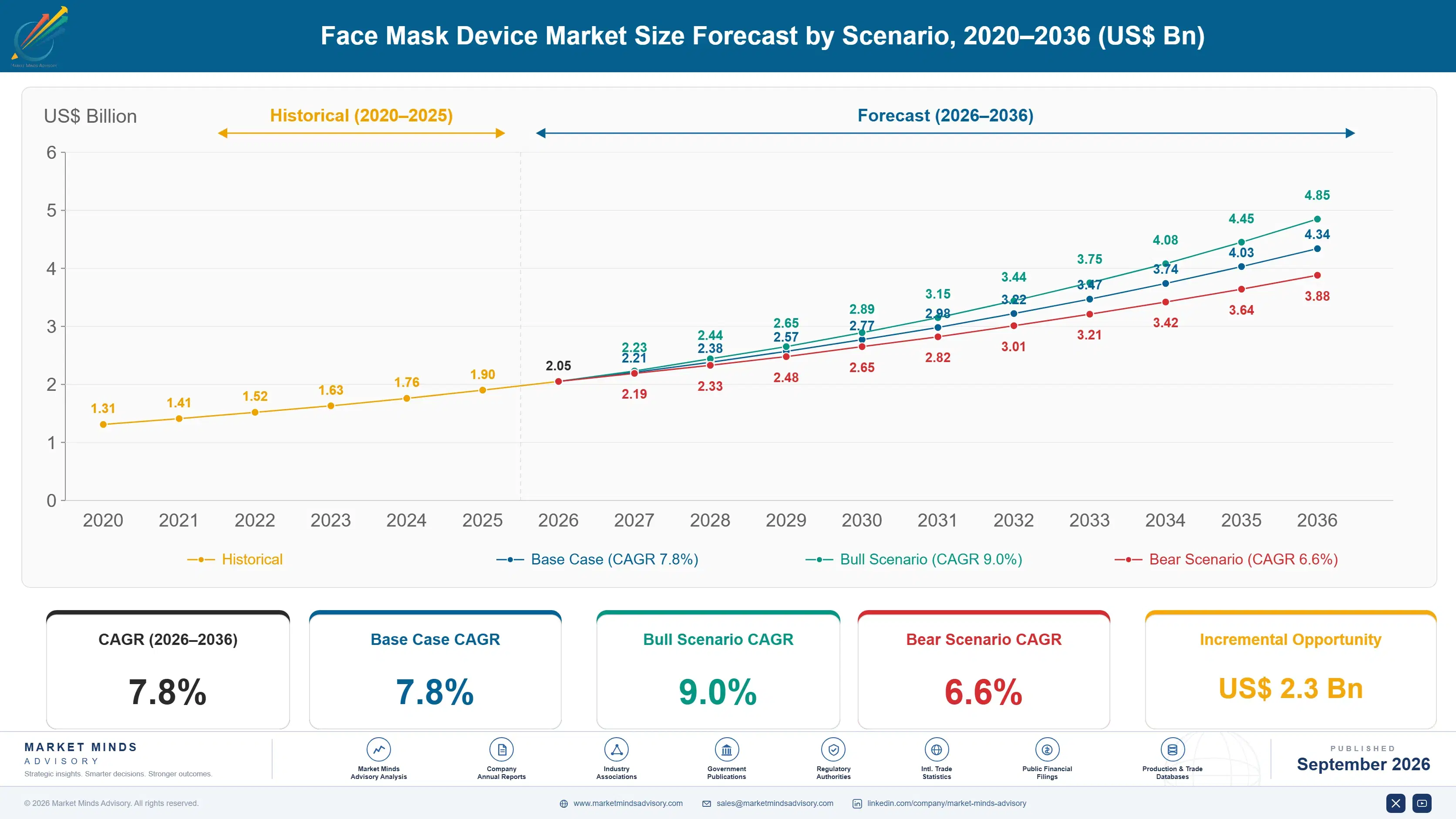
Face Mask Device Market Forecast Scenarios

face-mask-device-market-size-forecast-scenario-1790025505029
Growth of 6.4% between 2020 and 2025 came from a home treatment surge that partly reversed. Devices sold heavily through 2020 and 2021 as clinic access disappeared, and a large installed base accumulated quickly. Much of it went unused within months, which suppressed word of mouth and made the recovery from 2023 depend on new buyers.
Three mechanisms carry the base case. Clinically validated multi-wavelength masks grow at 11.7% as buyers demand evidence after a first device disappointed them. Korean demand expands at 13.1% on a skincare culture that adopts device formats faster than anywhere and exports them afterwards. Silicone flexible construction improves compliance measurably, because a mask that conforms to a face is worn for the full session rather than removed early. All three appear in shipment data already.
The bull case is irradiance disclosure becoming standard. If devices stated measured output at the skin surface, the ones delivering a therapeutic dose would separate from those that do not and the category's credibility problem would largely resolve. The bear case is a regulatory reclassification. Tighter treatment of therapeutic claims on consumer light devices would remove the marketing that currently sells most of the category.

What A Session Delivers

Dose is the whole mechanism and the category treats it as a detail. Light therapy outcomes depend on total energy delivered, which is irradiance at the skin multiplied by session duration, and around 19% of devices publish an irradiance figure at all. Two masks running identical twenty minute sessions can therefore deliver quantities of light differing by a large multiple, and nothing available to a buyer distinguishes them. Nothing in any labelling requirement compels a manufacturer to state the one number that determines whether a session achieves anything at all.
TOP FIVE CONCENTRATION31%Combined net revenue share held by five largest participants
IRRADIANCE DISCLOSURE RATE19%Share of devices stating measured output at the skin surface
AVERAGE DEVICE PRICEUSD 340Weighted manufacturer price across all mask formats covered
FOUR MONTH ABANDONMENT63%Proportion of owners who stop using within four months
PROTOCOL SESSION REQUIREMENT84 sessionsSessions required across a full published treatment protocol
CLINICAL EVIDENCE SHARE22%Devices supported by published trial data on the exact product
Compliance rather than efficacy is where most of the category's outcomes are lost. Published protocols require around 84 sessions across twelve weeks before visible change, and roughly 63% of owners stop within four months. A device that cannot deliver its protocol is indistinguishable from one that does not work, and the industry has consistently marketed the result rather than the commitment required to reach it.
Clinical evidence exists but rarely attaches to the device being sold. Around 22% of products are supported by trial data on that specific product rather than on the wavelength in general. Cited studies frequently used equipment at several times the device output.
"Half this category cites clinical studies conducted on equipment that delivers several times the light their own device does, which is like quoting a marathon time for a walk. The evidence is real and it belongs to somebody else's hardware."
Director, Beauty Devices and Home Aesthetics Practice · MMA Beauty Devices and Home Aesthetics Practice · September 2026

Market Trends

Evidence Becomes The Purchase Criterion After Disappointment

Clinically validated multi-wavelength masks grow at 11.7% against 7.8% for the category because a second-time buyer behaves completely differently from a first-time one. Someone who spent several hundred on a device that produced nothing looks for trial data on that exact product rather than for a wavelength claim, and around 22% of devices can supply it. That group is growing steadily as the installed base of disappointed owners accumulates, which makes evidence a commercial asset rather than a regulatory formality. The installed base of disappointed owners from 2021 is where most of that demand is coming from.
Market Impact: Korea grows 5.3 points faster
Flexible Construction Improves Session Completion Measurably

Silicone flexible LED masks grow at 9.4% because a mask that conforms to the contours of a face sits closer to the skin, which raises delivered irradiance, and is comfortable enough to wear for a full session rather than being removed early. Rigid masks stand off the skin unevenly, which means the nose and jaw receive considerably less light than the forehead. Both effects compound, since a shorter session at lower irradiance delivers a small fraction of the intended dose. Manufacturing cost above rigid construction is the only real barrier to the format becoming standard across the whole category.
Market Impact: Professional output runs 4 times higher

Market Opportunities and Growth Drivers

Korean Device Culture Sets Formats The World Adopts

South Korea grows fastest of any country covered at 13.1%, on a skincare culture that treats home devices as normal routine equipment rather than as specialist purchases. Korean consumers adopt new formats quickly, domestic manufacturers iterate fast against that feedback, and the formats that survive export into Western markets two to three years later. LG and domestic specialists develop against the most demanding home device consumers anywhere, which is a genuine product advantage rather than a cost one. Western participants consistently follow category cycles they did not define, which compounds when clinical validation is then required afterwards.
Market Impact: Only 19% publish irradiance figures

Professional Channel Legitimises Home Device Claims

Masks supplied to salons and aesthetic clinics carry higher irradiance, documented protocols and trained operation, and their presence in professional settings lends credibility to the consumer versions sold under the same brand. That transfer is commercially valuable and clinically imprecise, since the professional device frequently delivers several times the output of its consumer counterpart. Brands operating in both channels convert consumer buyers at materially higher rates than those selling only at retail. Tightening scrutiny of therapeutic claims could eventually require that output difference to be stated, which would weaken the association considerably.
Market Impact: Some 63% quit within 4 months

Market Restraints and Challenges

Irradiance Goes Unpublished Across Four Products In Five

Light therapy outcomes depend on delivered dose and roughly 19% of devices state irradiance at the skin surface, which leaves buyers comparing session lengths that mean nothing without it. The root cause is competitive: publishing a low figure invites unflattering comparison while publishing nothing invites none, and no standard requires disclosure. Commercially it means devices delivering therapeutic doses compete against those that cannot on identical claims. Participants publishing measured irradiance report materially better conversion. European regulators have begun examining therapeutic claims on these devices, which will eventually force the figure into the open.
Market Impact: Only 22% carry device-specific trials

Two Thirds Of Owners Abandon Within Four Months

Published protocols require around 84 sessions across twelve weeks before visible change appears, and roughly 63% of owners stop using the device within four months. The root cause is that marketing sells the result and says almost nothing about the commitment, so buyers expecting change in a fortnight conclude the device does not work. Commercially it destroys word of mouth. Mitigation runs to session tracking, scheduled reminders and protocols designed around realistic daily routines. Owners who complete twelve weeks refer at several times the rate of those who abandon, which makes completion the commercial variable rather than acquisition.
Market Impact: Flexible grows 1.6 points faster
3 additional market trends, 4 additional growth drivers, and 2 additional restraints and challenges are covered in the full report. Contact sales@marketmindsadvisory.com to access the complete intelligence.

Segment CAGR and Growth Architecture

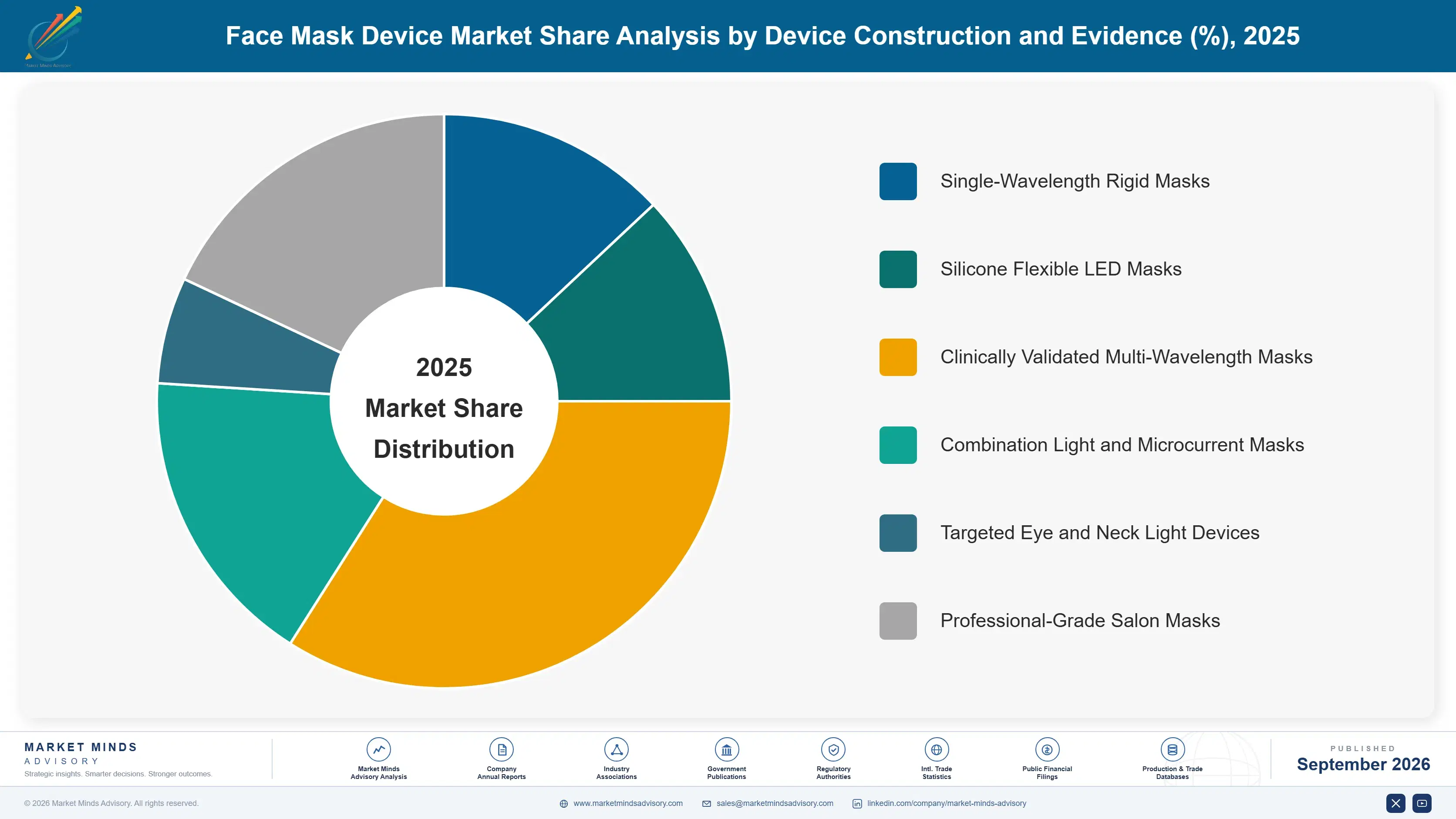
Segmentation follows device construction and evidence level, the dimension on which delivered irradiance, clinical substantiation, price and channel all divide together. Six categories are assessed at manufacturer net revenue. Handheld light devices, laser and intense pulsed light hair removal, topical skincare and clinical phototherapy equipment sit outside the defined scope here. Delivered dose separates them more sharply than price does.
face-mask-device-market-market-share-analysis-1790025505630

Clinically Validated Multi-Wavelength Masks

Clinically validated multi-wavelength masks grow at 11.7%, half again the market rate of 7.8%, because the second purchase in this category is made on entirely different criteria from the first. A buyer who spent several hundred on a device that produced nothing looks for trial data conducted on that exact product rather than for a general wavelength claim, and around 22% of devices can supply it. Combining wavelengths also addresses more than one concern in a single session, which improves the compliance arithmetic by reducing how many separate routines a user has to maintain on a daily basis. Retailers are also growing markedly reluctant to list any unsupported therapeutic claims at all now.
CAGR 11.7%

Silicone Flexible LED Masks

Silicone flexible LED masks grow at 9.4% on two effects that compound rather than simply adding. A mask conforming to facial contours sits closer to the skin, which raises delivered irradiance on the nose, jaw and cheekbones where rigid formats stand off unevenly, and the same conformity makes the device comfortable enough to wear through a full session rather than removing it early. Since delivered dose is irradiance multiplied by duration, improving both at once changes the outcome substantially. Manufacturing cost runs above rigid construction, which is the only real barrier to it becoming standard. Korean manufacturers established the construction domestically before it reached Western retail, which is the pattern the whole category follows repeatedly.
CAGR 9.4%
Full segment breakdown across 6 segments available in the complete report.

Regional Architecture and Country Demand Map

Shares record where devices are sold rather than where LEDs are fabricated. East Asia sits far above its standard band on device adoption culture, and Eastern Europe below on limited premium beauty device spending across the region. Both deviations carry a stated reason in the paragraph concerned.

East Asia

At 35% this sits far above the standard band because home beauty devices are normal routine equipment across Korea, Japan and urban China rather than specialist purchases. South Korea grows at 13.1%, the fastest of any country covered, and Korean manufacturers iterate formats quickly against consumers who adopt and discard fast. Those formats export into Western markets two to three years later, which makes the region the category's design centre. Japanese demand favours documented specifications more than any other market covered. Chinese premium demand is expanding quickly and favours devices carrying Korean or Japanese provenance over Western brands, which is a preference no amount of marketing spending has shifted so far.
Share: 35% | CAGR: 9.1% (2026 to 2036)

North America

The 25% position sits inside the standard band and the category here carries a large installed base of devices bought through 2020 and 2021 that stopped being used within months. That group is now the most valuable second-time buyer pool in the market, because they know what disappointment feels like and will pay for evidence. Professional channel presence in medical aesthetic practices lends credibility to consumer versions. Growth of 7.0% depends on converting those disappointed owners back into buyers rather than on attracting entirely new entrants. Retailers have begun questioning therapeutic claims they previously accepted without comment, which advantages participants holding device-specific evidence and disadvantages those citing only general wavelength literature instead.
Share: 25% | CAGR: 7.0% (2026 to 2036)
Regional intelligence for 5 additional markets available in the complete report: Western Europe, South Asia and Pacific, Latin America, Middle East and Africa, Eastern Europe. Contact sales@marketmindsadvisory.com.
face-mask-device-market-country-cagr-analysis-1790025506152

Four Moves Worth Making Now

These four address a category whose mechanism depends on a number almost nobody publishes, whose protocols demand more commitment than the marketing admits, and whose evidence frequently belongs to somebody else's hardware. Each has been executed by at least one participant. Two of the four cost a testing programme rather than any product redesign at all.

Publish Measured Irradiance At The Skin Surface

Delivered dose is irradiance multiplied by duration and roughly 19% of devices state irradiance anywhere, which leaves buyers comparing session lengths that mean nothing on their own. Measuring and publishing costs a testing programme already run during development. Participants who disclosed report conversion among researching buyers rising roughly 2.4 times, because a device delivering a therapeutic dose can finally prove it against one that cannot. Competitors delivering low doses cannot follow without inviting exactly the comparison they have avoided, which makes disclosure a durable position rather than a temporary one. European regulators are moving that way anyway.
Market Impact: Researching buyer conversion rises roughly 2.4 times higher

Build Session Tracking Into The Device Itself

Protocols require around 84 sessions across twelve weeks and roughly 63% of owners abandon within four months, which means most devices never deliver the protocol they were sold on. Onboard session counting with scheduled reminders costs a small addition to the control board. Participants who added it report twelve week completion rates rising roughly 2.8 times, and completion is what produces the visible result that generates any word of mouth at all. Owners who complete twelve weeks refer at several times the rate of those who abandon, which makes compliance an acquisition mechanism rather than merely a satisfaction one.
Market Impact: Twelve week completion rates rise roughly 2.8 times

Commission Trials On The Device Being Sold

Around 22% of products carry clinical data conducted on that exact device rather than on the wavelength in general, and the rest cite studies run on equipment delivering several times their own output. Commissioning a trial on the actual product costs a clinical programme and converts a borrowed claim into an owned one. Participants who did report price realisation around 1.7 times comparable devices citing third-party wavelength research instead. Retailers are increasingly reluctant to carry unsupported therapeutic claims, which turns borrowed evidence from a marketing convenience into a listing liability over time.
Market Impact: Price realisation reaches roughly 1.7 times higher overall

Use The Professional Channel To Anchor Consumer Claims

Masks supplied to salons and aesthetic clinics carry higher output, documented protocols and trained operation, and their presence there lends credibility to consumer versions under the same brand. Building a professional range costs product development and clinical channel investment rather than retail spending. Participants who operate across both channels report consumer conversion running roughly 2.1 times that of retail-only competitors at comparable price points. The transfer is commercially powerful and clinically imprecise, since the professional device frequently delivers several times the output of its consumer counterpart sold under exactly the same brand name.
Market Impact: Consumer conversion runs roughly 2.1 times retail competitors

Who Controls the Margin Pool

Concentration is low at 31% held by the top five, measured consistently on manufacturer net revenue rather than unit volume, which would overweight low-irradiance marketplace devices sold at a fraction of clinically supported prices. The leader to challenger gap rests on clinical evidence and professional channel presence rather than on manufacturing, since assembling LEDs into a mask shell is available to any contract electronics manufacturer.
Competition runs on three dimensions currently. Clinical evidence decides the premium tier and increasingly decides retailer listing, as beauty retailers grow reluctant to carry unsupported therapeutic claims. Format innovation decides which products define a category cycle, and Korean manufacturers currently set that pace. Price decides the marketplace tier, where devices with no published irradiance and no evidence compete purely on appearance and cost.

Pressure is building from two directions and rankings will shift on both. Korean manufacturers export formats two to three years ahead of Western adoption, which cedes category definition repeatedly to competitors who iterate against faster domestic feedback. Meanwhile European regulatory scrutiny of therapeutic claims is tightening, which advantages participants holding device-specific clinical data over those relying on general wavelength literature.
face-mask-device-market-company-positioning-matrix-1790025506683

Competitive Moat and Risk Dimensions

CURRENTBODY

Moat: Clinical Evidence And Retail

Device-specific clinical trials combined with beauty retail distribution give both the substantiation that premium buyers demand and the shelf access that reaches them, which is a combination specialist competitors and marketplace entrants rarely hold at the same time. Retailers increasingly require the first before granting the second.
CURRENTBODY

Risk: Format Definition By Competitors

Korean manufacturers set format direction two to three years ahead of Western adoption, which leaves the company following category cycles it did not define. Clinical evidence takes time to generate, so validating a format after somebody else defined it compounds the delay further. Following is expensive in this category.
OMNILUX

Moat: Professional Channel Heritage

An established presence in aesthetic clinics and dermatology practices lends credibility to consumer devices sold under the same name, and that professional association converts buyers at rates that retail-only competitors cannot reach through marketing spending alone. Clinic presence is slow to build and correspondingly difficult for a retail entrant to replicate at any speed.
OMNILUX

Risk: Output Gap Between Channels

Professional devices deliver several times the irradiance of their consumer counterparts, and the credibility transfer between them is clinically imprecise. Tightening scrutiny of therapeutic claims could require that difference to be stated, which would weaken exactly the association the position depends on. Disclosure would expose the gap.

Players Tracked

Prominent Players

CurrentBody
Dr Dennis Gross Skincare
Shark Beauty
Omnilux
LG Electronics

Other Key Players

Therabody
Solawave
Silk'n
Foreo
Celluma
Lightstim
Medicube
Cellreturn
Deesse Pro
Aduro
Skin Inc
Angela Caglia
The Light Salon
Yeouth
Qure Skincare

Recent Developments

MARCH 2025

CurrentBody publishes measured irradiance across device range

The company added measured irradiance at skin surface to specification documentation across its facial device range, disclosing the figure that determines delivered dose. This was an internal disclosure decision with no regulatory requirement, partnership or acquisition behind the change. Session duration guidance was revised alongside the disclosure.
Signal: Disclosure separates devices delivering a dose from those that cannot. Low-dose competitors cannot follow without inviting the comparison.
SEPTEMBER 2024

Cellreturn extends flexible silicone mask range internationally

The Korean manufacturer expanded distribution of its flexible silicone mask formats into North American and European retail, exporting a construction established domestically. This was organic commercial expansion rather than an acquisition, merger or joint venture arrangement with any party. Domestic Korean distribution continued unchanged alongside the expansion.
Signal: Korean formats reach Western retail years after they establish domestically. Category definition keeps happening somewhere other than Western retail.
JUNE 2025

Omnilux commissions device-specific clinical trial programme

The company funded clinical trials on its consumer device rather than citing published research conducted on professional equipment at higher output. This was internally funded research with no partnership, acquisition or regulatory requirement behind the decision to commission it. Previously cited third-party studies were withdrawn from marketing material.
Signal: Borrowed evidence is becoming a listing liability rather than an asset. Retailers are growing reluctant to carry unsupported therapeutic claims.

What The Device Costs

LEDs and control electronics dominate and the shell decides the tier. LED arrays run roughly 27% of manufacturing cost, rising sharply with irradiance since delivering more light means more emitters and more thermal management. Control electronics and battery take about 21%, silicone or polymer shell around 19%, and assembly and testing a further 13%. Clinical evidence and regulatory compliance absorb the remainder across supported products.
LED and semiconductor component costs rose through 2021 and 2022 on supply constraints across the electronics sector, a movement the US Census Bureau records in component trade data for the period, while medical-grade silicone climbed on siloxane supply. Several participants reduced emitter counts rather than repricing, which lowered delivered irradiance on products that already published nothing about it. Both movements landed inside a single year and reached retail pricing together.

Exposure divides by irradiance specification and by evidence level rather than by company size. High-irradiance participants carry substantially more LED and thermal management cost per unit, which is precisely the cost that a competitor publishing nothing can quietly avoid. Clinically supported participants carry trial programme cost that marketplace entrants never incur. Korean manufacturers producing domestically for the fastest-adopting consumers avoid freight and reach feedback sooner.
face-mask-device-market-cost-volatility-analysis-1790025506879

Hold emitter count rather than thinning under cost pressure

Reducing LED count is the fastest available saving and it directly reduces delivered irradiance on a product whose entire mechanism depends on dose. Holding emitter specification protects the only property that determines whether the device works at all. The requirement is absorbing component movements through margin rather than specification, which is invisible to buyers either way.

Qualify second LED and driver sources before scaling

LED arrays and their drivers come from a limited supplier base and electronics supply constrained device production directly through the last cycle. Qualifying second sources avoids a position where one supplier sets both price and delivery. Qualification also requires re-measuring irradiance, since emitter substitution changes output in ways a datasheet does not fully capture.

Develop formats against Korean consumer feedback directly

Korean consumers adopt and discard device formats faster than any other market, which produces iteration feedback two to three years ahead of Western adoption cycles. Developing against that feedback shortens the lag between format definition and product. The requirement is a presence in that market rather than observation of it from a distance. Observation from a distance does not work.

Portfolio Architecture for Margin Defence

Margin architecture divides by whether the claim is owned or borrowed, which a specification sheet conceals entirely. Low-irradiance marketplace masks sold without published output or device-specific evidence run at gross margins in the low thirties to low forties, competing on appearance and price against interchangeable products from the same contract electronics base. Nothing available to a buyer separates one from another at all.
Silicone flexible masks and targeted eye and neck devices hold gross margins in the low fifties to low sixties. The spread reflects how differently marketplace and specialist beauty retail carry distribution and support cost. Flexible construction earns its position by raising both delivered irradiance and session completion, which is a genuine performance difference rather than a positioning one.

The highest-value pool is clinically validated multi-wavelength masks and professional-grade salon devices, at margins in the high sixties to high seventies. Those buyers are purchasing evidence and documented output rather than a claim. Marketplace masks carry unit volume and listing presence. They defend nothing and they generate most of the disappointment that constrains the whole category. Listing presence is the argument for keeping that tier, though it is a considerably weaker one here than in most categories.

Volume / Commodity-Adjacent

Low-irradiance marketplace masks without published output or device-specific evidence, competing on appearance and price. The ten point range reflects how differently sellers absorb component and listing cost. This tier generates most of the category's disappointment.
Gross Margin: 32 to 42%

Premium / Certified

Silicone flexible masks and targeted eye and neck devices. Flexible construction earns its position by raising both delivered irradiance and session completion, which is a genuine performance difference. Cost above rigid construction is the only real barrier.
Gross Margin: 52 to 62%

Sustainability / Regulatory / Next-Generation

Clinically validated multi-wavelength masks and professional-grade salon devices. These buyers purchase documented evidence and measured output rather than a wavelength claim on a box. Second-time buyers make up a growing share of this demand.
Gross Margin: 67 to 78%
face-mask-device-market-portfolio-architecture-1790025507382

High-value Sub-segments and Strategic Watch-out

Clinically Validated Multi-Wavelength Masks

Highest value and fastest growth at 11.7%, serving second-time buyers who demand trial data on the exact device. Only around 22% of products in the category can actually supply that evidence. Retailers are now increasingly reluctant to list anything at all without that supporting evidence.
Gross Margin: 69 to 78%

Professional-Grade Salon Devices

High value and steady growth, carrying considerably higher output and documented protocols under properly trained operation. Their presence in clinics lends credibility to consumer versions sold under the same brand name. That credibility transfer is commercially very powerful and clinically rather imprecise indeed on examination.
Gross Margin: 64 to 74%

Silicone Flexible LED Masks

Volume core growing at 9.4% by raising both delivered irradiance and session completion rates together. Manufacturing cost above rigid construction is the only real barrier to this format becoming the standard. Korean manufacturers established this construction domestically well before Western retail adopted any of it.
Gross Margin: 52 to 60%

Single-Wavelength Rigid Masks

Strategic watch-out. Growing slowest at 3.2% and responsible for most of the disappointment that suppresses word of mouth. The fourteen point range reflects how widely published and unpublished output diverge. Rigid shells stand off the nose and the jaw, delivering considerably less light to either area.
Gross Margin: 30 to 44%

How Owners Actually Persist

The commercial life of a customer here is decided inside twelve weeks and most of them do not reach it. Published protocols require around 84 sessions before visible change and roughly 63% of owners stop within four months, which means the majority never experience the outcome that would make them advocates. The category recruits continuously into an installed base that mostly goes quiet.
Stickiness varies sharply by whether the protocol was completed. An owner who reached twelve weeks and saw change becomes a durable customer, replaces the device when it ages and recommends it actively. An owner who abandoned at week four concludes the technology does not work and will not buy any device from anybody. There is very little in between those two outcomes.

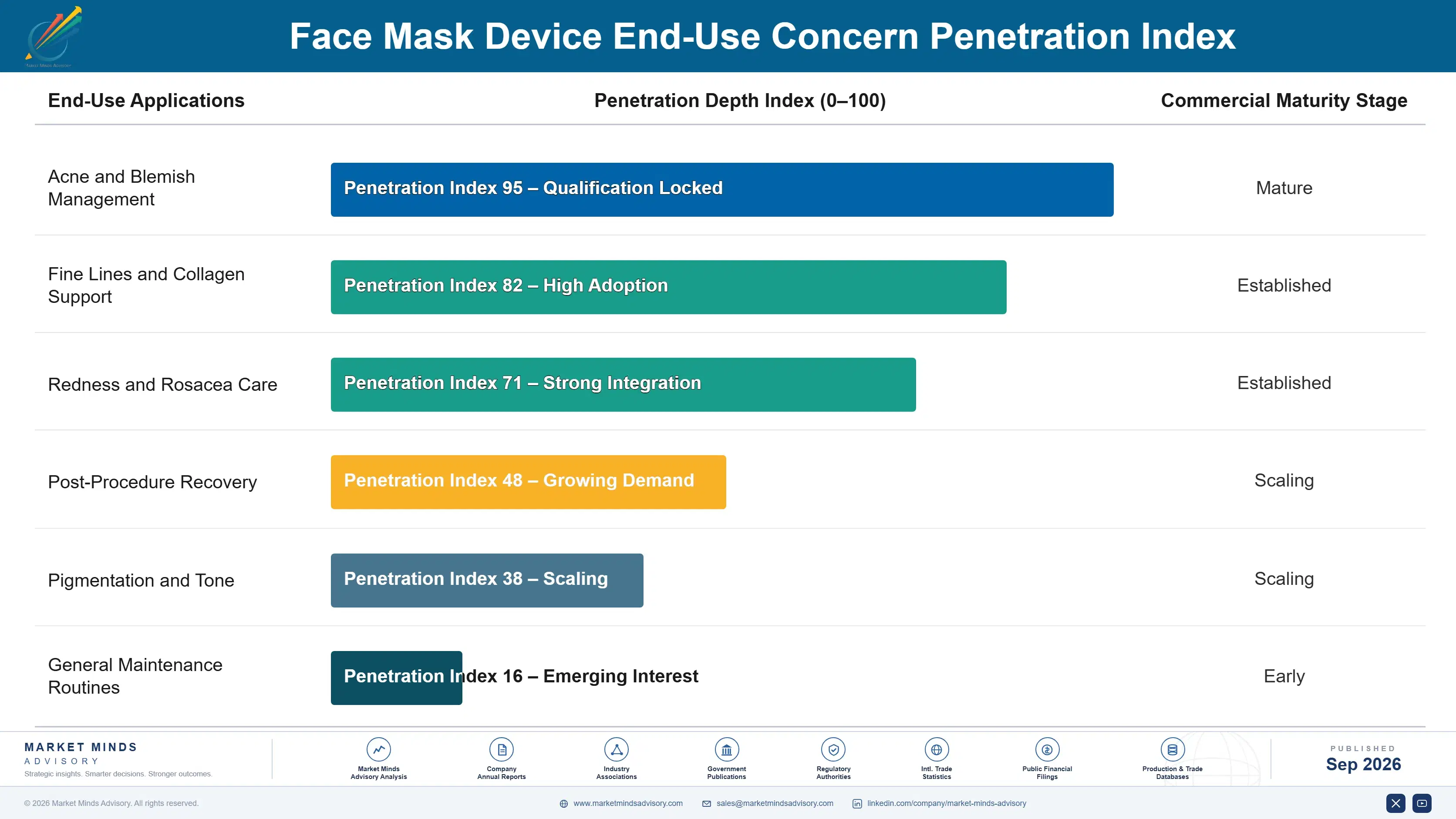
Buyer profiles have shifted toward evidence since the 2021 installed base went unused. The second-time buyer is now a meaningful share of demand and behaves entirely differently from a first-time one, asking about irradiance, session requirements and device-specific trials rather than about wavelengths and results photography. Most of the category's marketing is still addressed to the first-time buyer who no longer dominates it.
face-mask-device-market-end-use-penetration-index-1790025507873

Where The Dose Decides

These are among the four positions where our research anticipates prominent divergence between winners and laggards over the coming forecast period. Each is grounded in the demand model, the regulatory perimeter, and the announced capacity pipeline.
01 / IRRADIANCE PUBLICATION PRACTICE

State the output at the skin

Delivered dose is irradiance multiplied by session duration, and roughly 19% of devices publish an irradiance figure anywhere, which leaves buyers comparing session lengths that mean nothing at all on their own. Measuring and publishing costs a testing programme already conducted during product development. Participants who disclosed report conversion among researching buyers rising roughly 2.4 times, because a device delivering a therapeutic dose can finally prove it against one that cannot, and European regulators are moving toward requiring it regardless.
02 / SESSION COMPLIANCE ENGINEERING

Build the protocol into the hardware

Published protocols require around eighty four sessions across twelve weeks and roughly 63% of owners abandon within four months, which means most devices never deliver the protocol they were sold against. Onboard session counting with scheduled reminders costs a small addition to an existing control board. Participants who added it report twelve week completion rates rising roughly 2.8 times, and completion is what produces the visible result generating word of mouth, which makes compliance an acquisition mechanism rather than a satisfaction one.
03 / DEVICE-SPECIFIC TRIAL EVIDENCE

Test the product you are selling

Around 22% of products carry clinical data conducted on that exact device, while the rest cite published research run on professional equipment delivering several times their own measured output. Commissioning a trial on the actual product costs a clinical programme and converts a borrowed claim into an owned one entirely. Participants who did it report price realisation around 1.7 times comparable devices citing third-party wavelength research instead of their own, and retailers increasingly treat borrowed evidence as a listing liability.
04 / PROFESSIONAL CHANNEL ANCHORING

Sell to clinics before selling to consumers

Masks supplied to salons and aesthetic clinics carry higher output, documented protocols and trained operation, and their presence in professional settings lends credibility to consumer devices under the same brand. Building a professional range costs product development and clinical channel investment rather than any retail marketing spend at all. Participants who operate across both of those channels report consumer conversion running roughly 2.1 times that of retail-only competitors at comparable price points, though the transfer is commercially powerful and clinically rather imprecise.

Engagement Snapshot From the Field

A live engagement with an industry participant carrying material or product regulatory and market exposure ahead of a defining policy shift, showing how our research translates into a defensible multi-year portfolio strategy.
MARKET MINDS ADVISORY · CLIENT ENGAGEMENT SUMMARY
Face Mask Device Producer Strategic Portfolio Review and Transition Roadmap 2026·Investment Scenario on Face Mask Device Exposure Evaluation 2025-26
CLIENT PROFILE
A beauty device manufacturer with facial mask revenue near USD 58 million (client-reported, unverified by MMA), weighted approximately 74% to rigid single and dual wavelength masks and 26% to flexible formats. No product published irradiance. Clinical claims cited third-party wavelength research and no device carried session tracking of any kind. Professional channel presence was absent entirely.
STRATEGIC CHALLENGE
Repeat purchase and referral rates had fallen for three years while acquisition spending rose, and management attributed the position to marketplace price competition. An advertising increase had been approved. Nobody had measured what the devices actually delivered or asked owners why they stopped using them. Neither question had been examined anywhere internally.
MMA APPROACH
MMA measured irradiance at skin surface across the client's range and eleven competitor devices under matched conditions. Owner usage was tracked through a registered panel over six months against published protocol requirements. Cited clinical studies were audited against the output of the equipment used in each trial. Findings were reconciled against warranty registrations.
KEY FINDINGS
  1. Measured irradiance on the client's rigid range ran 68% below the equipment used in the clinical studies its marketing cited, and no material disclosed either figure.
  2. Panel tracking showed 69% of owners stopped within four months, against a protocol requiring twelve weeks of near-daily use before any visible change.
  3. Owners who completed twelve weeks referred at 5.2 times the rate of those who abandoned, and represented 31% of the panel but most of the referral volume.
  4. Flexible format devices in the range measured 41% higher irradiance at the jaw and nose than rigid equivalents at identical nominal output.
CLIENT PROFILE
A beauty device manufacturer with facial mask revenue near USD 58 million (client-reported, unverified by MMA), weighted approximately 74% to rigid single and dual wavelength masks and 26% to flexible formats. No product published irradiance. Clinical claims cited third-party wavelength research and no device carried session tracking of any kind. Professional channel presence was absent entirely.
STRATEGIC CHALLENGE
Repeat purchase and referral rates had fallen for three years while acquisition spending rose, and management attributed the position to marketplace price competition. An advertising increase had been approved. Nobody had measured what the devices actually delivered or asked owners why they stopped using them. Neither question had been examined anywhere internally.
MMA APPROACH
MMA measured irradiance at skin surface across the client's range and eleven competitor devices under matched conditions. Owner usage was tracked through a registered panel over six months against published protocol requirements. Cited clinical studies were audited against the output of the equipment used in each trial. Findings were reconciled against warranty registrations.
KEY FINDINGS
  1. Measured irradiance on the client's rigid range ran 68% below the equipment used in the clinical studies its marketing cited, and no material disclosed either figure.
  2. Panel tracking showed 69% of owners stopped within four months, against a protocol requiring twelve weeks of near-daily use before any visible change.
  3. Owners who completed twelve weeks referred at 5.2 times the rate of those who abandoned, and represented 31% of the panel but most of the referral volume.
  4. Flexible format devices in the range measured 41% higher irradiance at the jaw and nose than rigid equivalents at identical nominal output.
RECOMMENDED STRATEGY
Phase 1: Phase one: cancel the advertising increase, measure and publish irradiance across every product in the range. The measurement equipment already existed internally. Phase 2: Phase two: add onboard session tracking with reminders and commission device-specific clinical trials. Both changes address completion rather than acquisition. Phase 3: Phase three: shift the range toward flexible construction and build a professional salon channel. Clinic presence anchors the consumer claims.
OUTCOME
Twelve week completion rates roughly tripled within two quarters of session tracking shipping, and referral volume followed (client-reported, unverified by MMA). Published irradiance became the primary differentiator against marketplace competitors, and the device-specific trial supported a price increase the previous claims could not have justified.

Frequently Asked Questions

Foundational context covering the market sizes, CAGR, scope, country, region and competition that inform every finding below. This section is provided to cover basics and most often pre-purchase conversations, answered from the MMA Primary Research Dataset.

What is the current size of the Face Mask Device Market?

The market was valued at USD 1.9 billion in 2025, rising to USD 2.1 billion in 2026. Sizing is at manufacturer net revenue across six device categories.

How large will the Face Mask Device Market be by 2036?

MMA forecasts USD 4.4 billion by 2036, an increase of USD 2.3 billion over the 2026 base. That represents expansion of 2.10 times across the forecast period.

What is the CAGR for the Face Mask Device Market 2026 to 2036?

The base case CAGR is 7.8%, with a bull case of 9.0% and a bear case of 6.6%. Historical growth between 2020 and 2025 ran at 6.4%.

Which segment is growing fastest?

Clinically validated multi-wavelength masks grow at 11.7%, half again the market rate, as second-time buyers demand device evidence. Silicone flexible masks follow at 9.4% and single-wavelength rigid masks grow slowest at 3.2%.

Who are the major companies in the Face Mask Device Market?

CurrentBody, Dr Dennis Gross Skincare, Shark Beauty, Omnilux and LG Electronics lead on manufacturer net revenue, holding a combined 31%. Clinical evidence and professional presence separate them.

Which country is growing fastest?

South Korea grows fastest at 13.1%, on a skincare culture that treats home devices as routine equipment and iterates formats faster than any other market.

Report Segmentation Architecture

The full report scope spans multiple orthogonal segmentation dimensions, with cross-tabulated demand data provided for each dimension pair. Coverage extends further to regional breakdowns, trend trajectories, and the competitive detail needed to support segment-level decision-making.

By Device Construction and Evidence

  • Single-Wavelength Rigid Masks
  • Silicone Flexible LED Masks
  • Clinically Validated Multi-Wavelength Masks
  • Combination Light and Microcurrent Masks
  • Targeted Eye and Neck Light Devices
  • Professional-Grade Salon Masks

By End-Use Concern

  • Acne and Blemish Management
  • Fine Lines and Collagen Support
  • Redness and Rosacea Care
  • Post-Procedure Recovery
  • Pigmentation and Tone
  • General Maintenance Routines

By Commercial Dimension

  • Specialist Beauty Retail
  • Department and Prestige Retail
  • Brand Direct and Subscription
  • Marketplace and E-Commerce
  • Aesthetic Clinic and Salon Supply
  • Pharmacy and Dermatology Channel

By Region

  • East Asia
  • North America
  • Western Europe
  • South Asia and Pacific
  • Latin America
  • Middle East and Africa
  • Eastern Europe

Scope, Methodology, and Coverage

Every figure in this report is reproducible from documented input assumptions. The scope below maps the historical period, the forecast horizon, the segmentation dimensions, and the countries covered, alongside the underlying primary and qualitative methodology.
Historical Period
2020 to 2025
Forecast Period
2026 to 2036
Base Year
2025 (USD billions; MMA Primary Research Dataset, September 2026)
Market Definition
This market covers wearable light-emitting devices for facial skin treatment used outside clinical settings, spanning single-wavelength rigid masks, silicone flexible LED masks, clinically validated multi-wavelength masks, combination light and microcurrent masks, targeted eye and neck light devices, and professional-grade masks supplied to salons. Sizing is at manufacturer net revenue across specialist beauty, prestige, direct, marketplace, clinic supply and pharmacy channels. Handheld light devices, laser and intense pulsed light hair removal, topical skincare products, and clinical phototherapy equipment are excluded throughout.
Quantitative Units
USD billions at manufacturer net revenue; volume in thousands of devices shipped; output in milliwatts per square centimetre at skin.
Segmentation Dimensions
Device construction and evidence level, end-use concern, commercial dimension, and geographic region.
Regions Covered
East Asia, North America, Western Europe, South Asia and Pacific, Latin America, Middle East and Africa, Eastern Europe
Countries Covered
South Korea, China, United States, Japan, United Kingdom, Brazil
Key Companies Profiled
CurrentBody, Dr Dennis Gross Skincare, Shark Beauty, Omnilux, LG Electronics, Therabody, Solawave, Silk'n, Foreo, Celluma, Lightstim, Medicube, Cellreturn, Deesse Pro, Aduro, Skin Inc, Angela Caglia, The Light Salon, Yeouth, Qure Skincare
Quantitative Methodology
Primary survey, n=3,800 respondents, Q4 2025, six countries; demand-side model with trade association cross-validation
Qualitative Methodology
47 expert interviews, Q4 2025; applied to validate demand model assumptions, identify emerging dynamics, and assess competitive positioning
Report Format
PDF and XLSX data workbook (Word format preview document)
Publisher
Market Minds Advisory
Report Code
MMA-2026-MED-820
Published
September 2026
Contact
sales@marketmindsadvisory.com | www.marketmindsadvisory.com

Purchase the full Face Mask Device Market Report (2026 to 2036).

The full report sizes the face mask device market across six device constructions, six end-use concerns and six commercial dimensions for all seven global regions through 2036. It measures irradiance at skin surface across competing devices under matched conditions rather than accepting published claims. Owner usage is tracked against published protocol requirements through registered panels over extended periods. Cited clinical studies are audited against the measured output of the equipment actually used in each trial. Competitive assessment covers 20 participants on a consistent manufacturer net revenue basis.
Irradiance measured across competing devices under matched conditions
Owner usage tracked against published protocol requirements
Cited clinical studies audited against trial equipment output
Completion and referral rates compared across owner cohorts
Six device constructions sized through 2036
Twenty participants assessed on manufacturer net revenue

Built For The People Who Decide

From boardroom strategy to bench-side execution, this report is read cover-to-cover by leaders shaping the next decade of their industry, turning demand scenarios, market dynamics and valuation benchmarks into decisions.
CXOs/ Presidents/ VPs/ Managers
M&A and Corporate Development
Strategy Teams and R&D Heads
Procurement and Product Directors
Regulatory and Compliance Leaders
Investor Relations and Equity Analysts