Market Minds Advisory
Fabric Spreading Machine Market

Fabric Spreading Machine Market: Automation Economics and the Cutting Room of the Future

Apparel manufacturers are replacing manual spreading crews with computerized multi-ply systems as labor costs climb across Vietnam and Bangladesh, forcing machinery suppliers to compete on fabric-waste reduction and integration with digital cutting room software.

Lead Analyst

David Horsley

Published

September 2026

Make Smarter Decisions with Customized Research Insights

Request a free sample report and evaluate market opportunities, growth trends, and competitive dynamics relevant to your business needs.

2025 MARKET VALUE$0.7BMarket Size 2025
2036 FORECAST VALUE$1.5BBase Case , 2026 to 2036
CAGR 2026 TO 20366.8 %Bull 8.0% / Bear 5.6%
INCREMENTAL OPPORTUNITY$0.7BNet 10- year value creation
EXPANSION MULTIPLE1.94x2036 value over 2026 base
Strategic Levers
M&A Pipeline
Regional Outlook
Country Rankings
Competitive Intelligence
Segmental Deep-dive
Call-Us : 91 93563 13602

Executive Snapshot and Market Trajectory

Garment factories across South and Southeast Asia are swapping manual spreading crews for computerized multi-ply systems as minimum wages rise faster than fabric prices, turning a once-overlooked pre-cutting step into a closely measurable lever for margin recovery across fast-fashion and technical apparel supply chains alike.
Fully automatic computerized spreading systems are growing fastest, at roughly nine and a half percent annually, as brands push factories toward tighter ply tolerances and substantially lower fabric waste to protect margins under fixed-price purchase orders. Vietnam and Bangladesh are absorbing the bulk of new installed capacity as apparel sourcing diversifies away from China, while Chinese domestic machinery builders increasingly compete on price against established European and American incumbents.
Competition centers on integration: machinery makers increasingly bundle spreading systems with automated cutting and inline fabric inspection software rather than selling standalone hardware, raising switching costs for factories. European suppliers defend premium positioning through precision and uptime guarantees, while Chinese and Taiwanese builders undercut on cost. Rising factory-floor automation mandates in several exporting countries and tightening apparel traceability rules are pushing digitized, data-logging spreading lines from a premium option toward a baseline procurement requirement.
Market Definition
The fabric spreading machine market covers equipment used to lay multiple layers of woven, knitted, and technical fabric onto cutting tables ahead of garment or textile-product cutting, spanning manual, semi-automatic, and fully computerized systems. It excludes downstream cutting machinery, sewing equipment, and standalone fabric inspection systems sold independently of spreading hardware.
Base Year Value
$0.7B in 2025 (MMA Primary Research Dataset, August 2026)
Forecast Period
2026 to 2036, eleven discrete annual values
CAGR
6.8% base case. Bull 8.0%. Bear 5.6%.
Fastest Growth Segment
Fully Automatic Computerized Spreading Machines: 9.5% CAGR
Fastest Growth Country
Vietnam: 8.7% CAGR
Fastest Growth Region
South Asia and Pacific: 9.0% CAGR
Largest Region
East Asia: 29% of 2025 global value
Market Leaders
Lectra, Eastman Machine Company, Bullmer GmbH, Morgan Tecnica S.p.A, Kuris Spezialmaschinen GmbH. Source: MMA Analysis based on company annual reports and investor filings.
Primary Survey
n=3,800 procurement and R&D decision-makers, Q4 2025, six countries
Methodology
Demand-side build-up, cross-validated against public data, 47 expert interviews

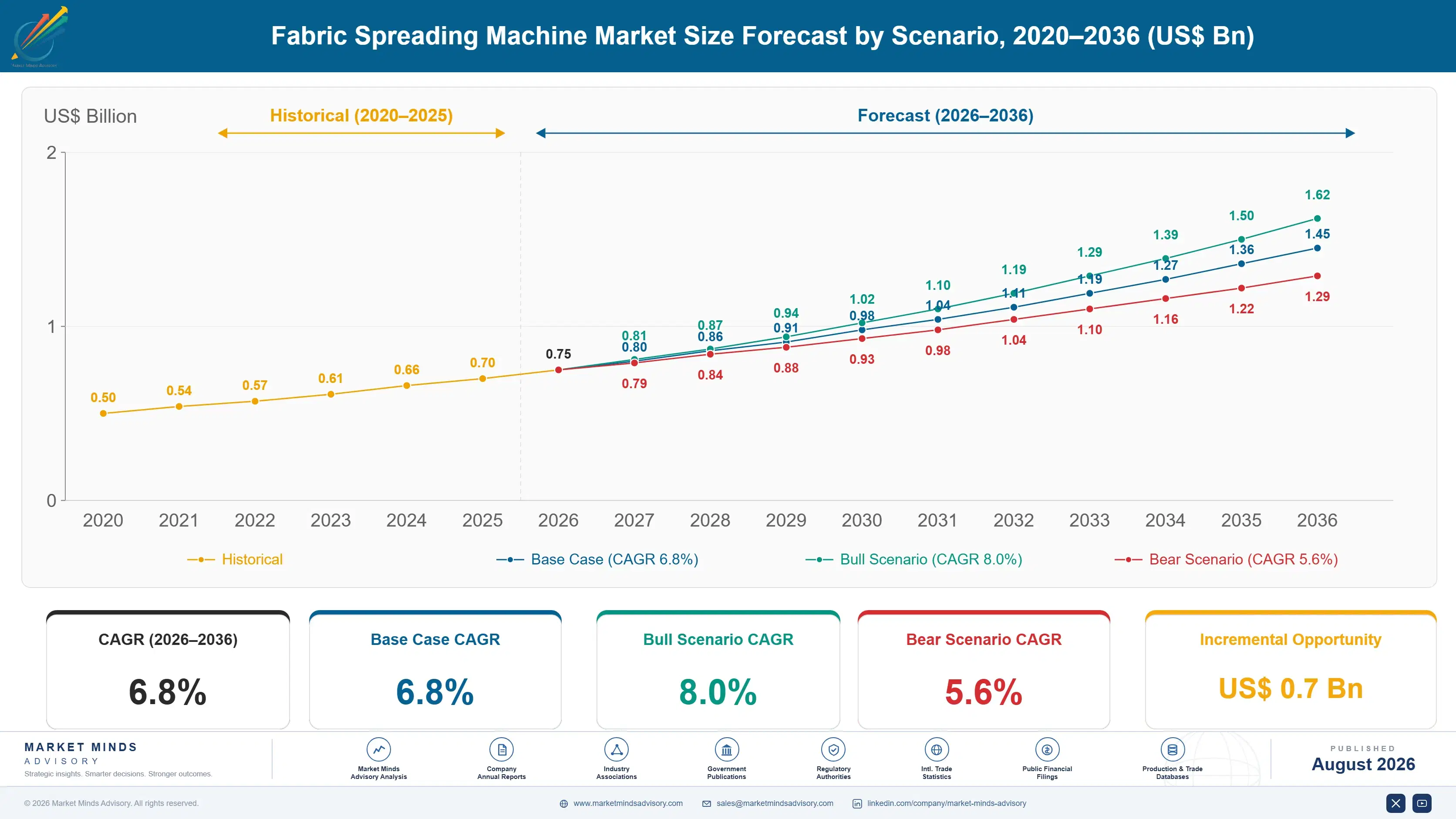
Fabric Spreading Machine Market Forecast Scenarios

fabric-spreading-machine-market-size-forecast-scenario-1787333084971
Fabric spreading equipment demand slowed in 2020 as apparel factories closed under pandemic disruption, then rebounded through 2022 as sourcing shifted toward Vietnam and Bangladesh. Replacement demand from aging manual lines dominated through 2023 and 2024. The market grew at a historical rate of 5.8 percent annually across the 2020 to 2025 period, gaining momentum as automation investment accelerated into 2025.
The base case assumes fully automatic spreading adoption continues at pace, driven by three mechanisms: rising minimum wages across Vietnam, Bangladesh, and Cambodia that make labor-saving automation pay back within two to three years; brand-mandated fabric waste reduction targets tied to sustainability disclosure requirements; and machinery financing programs from equipment lessors that lower the capital barrier for mid-sized factories. Replacement of aging manual and semi-automatic fleets installed during the 2000s and 2010s adds a demand layer independent of new capacity.
The bull case rests on faster-than-expected minimum wage escalation in Bangladesh pulling automation forward across thousands of factory lines simultaneously. The bear case centers on a global apparel demand slowdown, mirroring 2023's inventory glut, that would push factories to defer capital equipment purchases and stretch replacement cycles on existing machines beyond a typical ten to twelve year service life.

Automation Economics Reshape the Cutting Room Floor

Fabric spreading sits at an unglamorous but increasingly consequential point in apparel manufacturing: the step that determines how much fabric is wasted before a single garment is cut. As brands push suppliers toward tighter cost discipline and sustainability reporting, factories that once treated spreading as a manual, low-skill task now measure ply accuracy and waste percentage as line-level performance metrics, turning equipment purchasing into a board-level capital allocation decision.
MARKET CONCENTRATION38% (CR5)Top five suppliers hold just over a third of shipments
AVERAGE SELLING PRICE$85,000-$140,000Fully computerized systems command a substantial price premium
TOP EXPORTING COUNTRYVietnam, 24% shareLeading apparel exporter absorbs the largest share of installations
CAPACITY UTILIZATION71%Installed base runs well below theoretical continuous operating capacity
REPLACEMENT CYCLE LENGTH10-12 yearsTypical service life before factories retire ageing spreading lines
INPUT COST SHARE34% of COGSFrame steel and servo components dominate manufacturing cost structure
Demand concentrates where apparel export capacity is expanding fastest. Vietnam, Bangladesh, Cambodia, and Indonesia are absorbing new machinery orders as brands diversify sourcing away from China, while Chinese factories themselves are upgrading existing lines rather than adding net new capacity. Machinery builders are responding with modular systems that scale from single-ply pilot lines to full computerized installations, letting mid-sized factories finance automation in stages instead of committing to a single large capital outlay.
Over the next decade, spreading machinery converges with digital cutting room software: fabric consumption data, ply counts, and waste metrics feed directly into enterprise planning systems. Suppliers that fail to offer this connectivity risk losing accounts to rivals bundling hardware with subscription-based production analytics, a shift already reshaping vendor selection criteria at larger apparel manufacturing groups.
"Spreading used to be the part of the cutting room nobody budgeted for. Now it's the line item that decides whether a factory keeps a contract, because brands can measure fabric waste down to the ply."
Director, Industrial Equipment and Manufacturing Technology Practice · MMA Texti

Market Trends

Digital Cutting Room Integration and Data-Logged Spreading

Apparel brands increasingly require factories to report fabric utilization rates as part of sustainability disclosures tied to the EU Corporate Sustainability Reporting Directive and similar frameworks adopted by major retailers. This is pushing machinery builders to embed sensors that log ply count, spreading speed, and fabric consumption directly into factory Manufacturing Execution Systems. Suppliers offering this connectivity are winning multi-machine orders from larger apparel groups consolidating vendor relationships, while standalone hardware sellers without a software layer are increasingly relegated to price-only competition in the lowest tier of the fragmented market.
Market Impact: Cuts automation payback below 2 yea
Nearshoring and Sourcing Diversification Away From China

Apparel sourcing has diversified rapidly since 2022 as brands reduce reliance on a single manufacturing base, pushing new capacity into Vietnam, Bangladesh, Cambodia, and increasingly India and parts of Africa. Each new factory build represents a discrete machinery purchase decision, unlike incremental line upgrades in mature manufacturing hubs. Machinery builders with established service networks and spare parts depots in these emerging hubs are capturing disproportionate share of new installations, while suppliers reliant on China-based distribution are having to rebuild service infrastructure in markets where uptime guarantees increasingly decide contract renewal.
Market Impact: Targets 10 to 15% waste cuts

Market Opportunities and Growth Drivers

Rising Minimum Wages Across Major Apparel Hubs

Minimum wages in Bangladesh rose more than 50% in a single adjustment in 2023, following similar increases across Vietnam and Cambodia over the preceding three years, compressing the labor cost advantage that kept manual spreading crews economically viable. Factories running two or three shifts of manual spreaders are recalculating payback periods for automated systems at under two years in several cases, a threshold that previously took five to seven years to reach. Machinery lessors and equipment financing arms of major manufacturers are structuring shorter-term leases specifically to capture this newly compressed payback window.
Market Impact: Excludes factories below 2-shift ut

Brand Sustainability Mandates on Fabric Waste

Major apparel brands have set fabric waste reduction targets of 10 to 15% by 2027 as part of broader sustainability commitments disclosed in annual ESG reporting, and several now require suppliers to report ply utilization data as a condition of contract renewal. This is converting fabric spreading from a purely operational decision into a compliance-linked procurement criterion. Factories unable to demonstrate measurable waste reduction risk losing allocation to competitors that can, pushing capital toward computerized systems capable of generating auditable utilization records rather than toward cheaper alternatives that offer no such reporting trail.
Market Impact: Cuts unplanned downtime by roughly

Market Restraints and Challenges

High Capital Cost Deters Smaller Manufacturers

Fully computerized spreading systems cost between $85,000 and $140,000 per unit, a substantial outlay for small and mid-sized factories operating on thin garment manufacturing margins that rarely exceed 5%. The root cause is that automation value is captured mainly at high volume: factories running fewer than two shifts struggle to justify the investment against manual labor that remains comparatively inexpensive. This locks a large tier of smaller manufacturers into semi-automatic equipment. Equipment lessors and vendor financing programs are emerging as a mitigation path, spreading the capital outlay over three to five years instead of upfront purchase.
Market Impact: Lifts connected-machine orders towa

Skilled Technician Shortage for Automated Systems

Computerized spreading machines require trained technicians for calibration, software updates, and preventive maintenance, a skill set that remains scarce in several emerging apparel manufacturing hubs where the equipment is newest. The root cause traces to vocational training systems built around manual sewing and cutting skills rather than mechatronics. Machine downtime from unresolved technical faults can idle an entire cutting line, with knock-on delays to downstream sewing capacity that factories operating under tight shipment deadlines cannot absorb. Machinery builders are responding by expanding remote diagnostics capability and establishing regional training centers to shorten technician ramp-up time from months to weeks.
Market Impact: Redirects roughly 30% of new orders
3 additional market trends, 4 additional growth drivers, and 2 additional restraints and challenges are covered in the full report. Contact sales@marketmindsadvisory.com to access the complete intelligence.

Segment CAGR and Growth Architecture

MMA segments the fabric spreading machine market by automation and technology level, the classification apparel manufacturers themselves use when budgeting capital equipment purchases and negotiating financing terms. This dimension captures the shift from labor-intensive manual operation toward computerized, sensor-integrated systems more precisely than a product-type or application split would, since automation level is what drives price and service requirements.
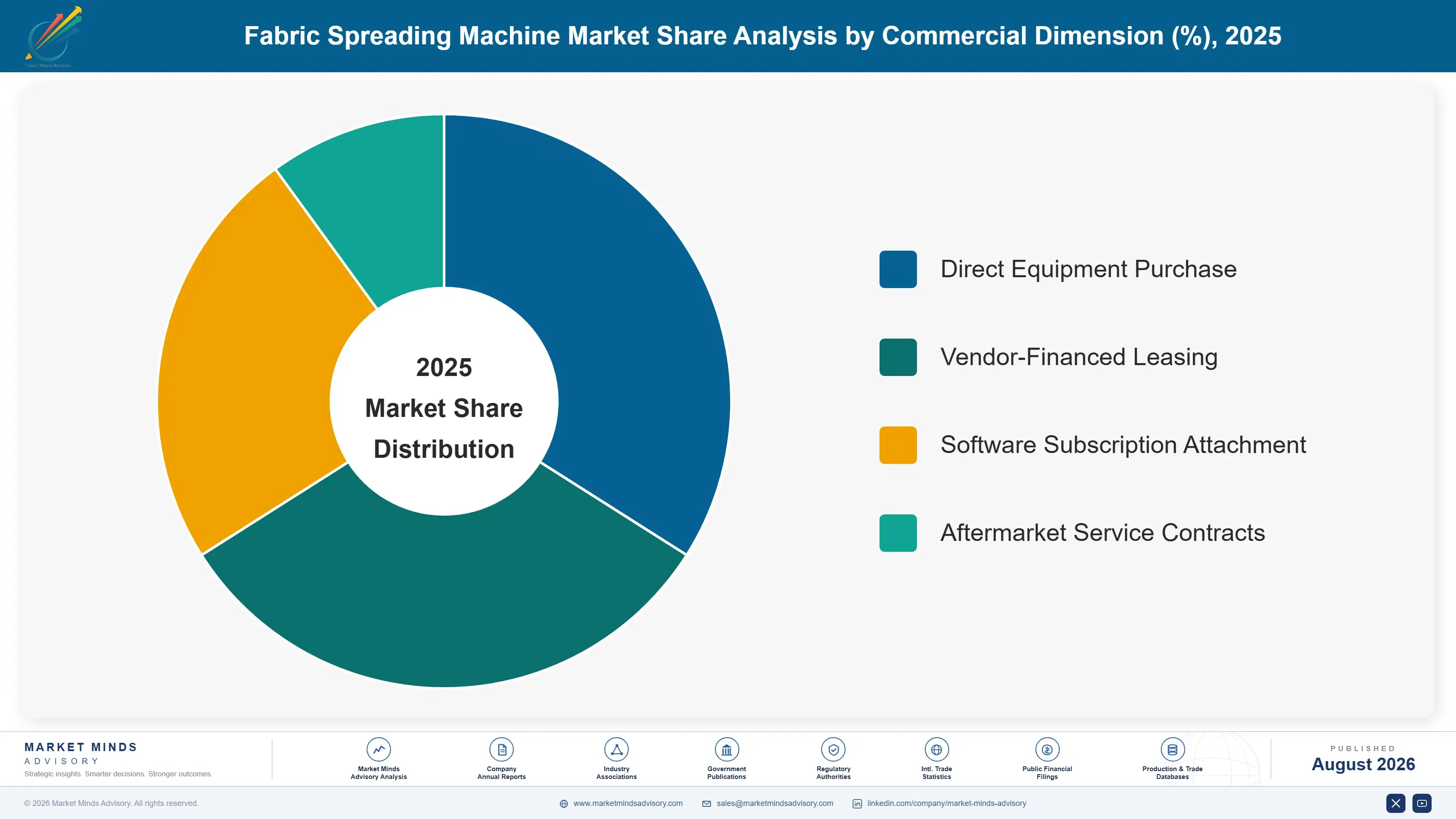
fabric-spreading-machine-market-market-share-analysis-1787333085513

Fully Automatic Computerized Spreading Machines

Fully automatic computerized spreading machines lay fabric with servo-controlled carriages, automated tension control, and integrated ply counting, cutting fabric waste to within 1 to 2% versus 5 to 8% for manual operation. Adoption concentrates among tier-one apparel manufacturers supplying global fast-fashion and technical apparel brands that demand auditable waste data as part of sustainability reporting. Unit prices range from $85,000 to $140,000, and the segment is growing at roughly 9.5% annually as Vietnam, Bangladesh, and Cambodia expand new factory capacity almost exclusively with computerized lines. Machinery builders are bundling these systems with digital cutting room software, positioning them as the default choice for new large-scale factory builds rather than an optional upgrade for existing operations.
CAGR 9.5%

Servo-Driven Carriage Spreading Systems

Servo-driven carriage spreading systems sit between fully computerized and semi-automatic equipment, using motorized carriages with programmable spreading parameters but less extensive sensor integration and lower unit cost, typically $45,000 to $70,000. This segment is growing at roughly 8.4% annually as mid-sized factories seek a lower-capital entry point into automation without committing to the highest-tier systems. Demand concentrates among factories serving mid-market apparel brands where waste-reduction requirements exist but auditable digital reporting is not yet contractually mandated. Machinery builders position servo-driven carriages as an upgrade path: factories adopt this tier first and migrate toward full computerization as contracts increasingly require it, making the segment a bridge category rather than a permanent end state.
CAGR 8.4%
Full segment breakdown across 6 segments available in the complete report.

Regional Architecture and Country Demand Map

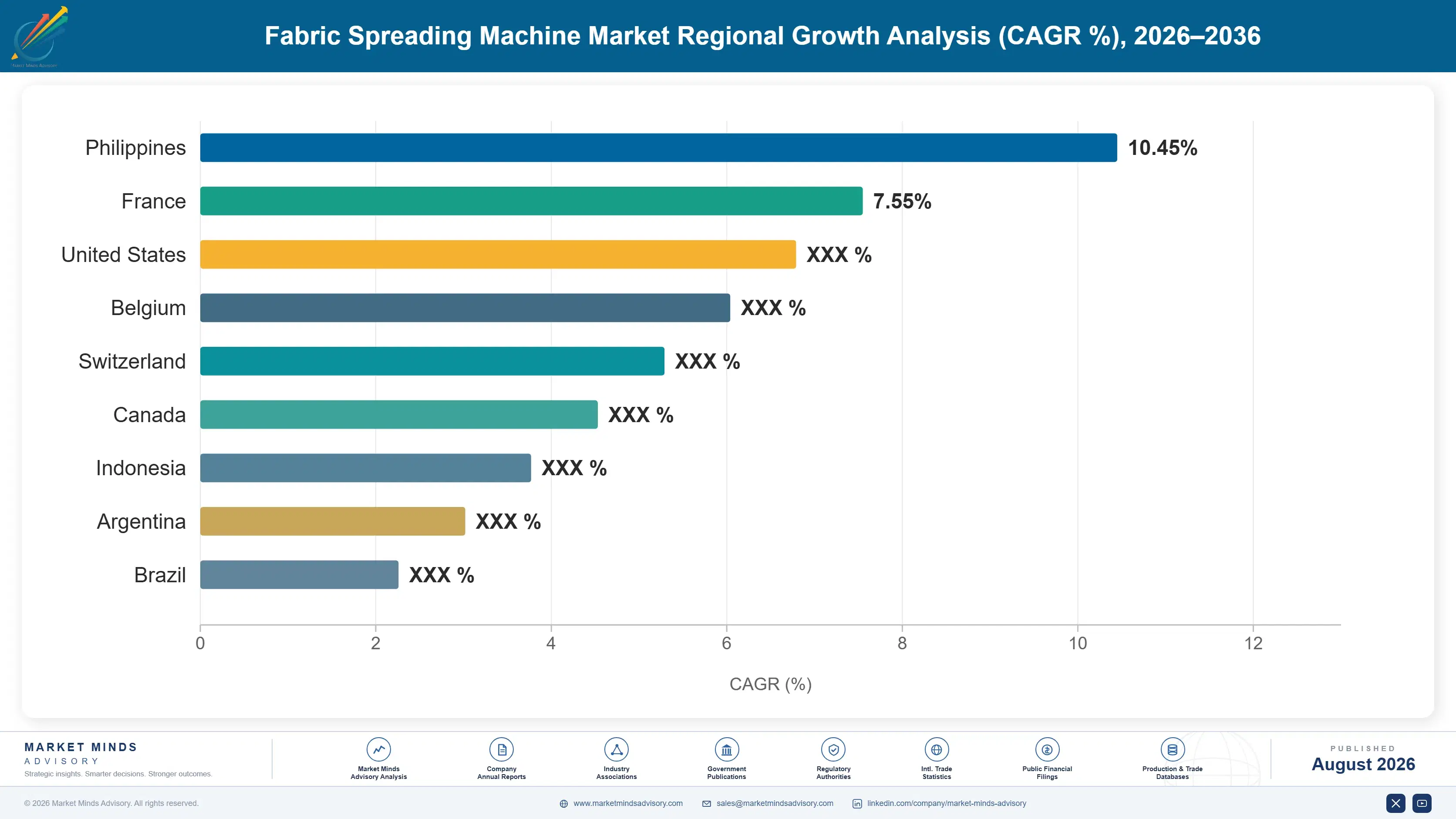
East Asia leads global demand on the strength of China's remaining apparel manufacturing base and rapid capacity buildout across Vietnam and Cambodia, while South Asia and Pacific grows fastest as Bangladesh and India add new export-oriented factory lines. Western Europe and Eastern Europe together account for a smaller, replacement-driven share.

North America

North America holds the second-largest share of global fabric spreading machinery demand, anchored by the United States' technical apparel, workwear, and home textile manufacturing base rather than mass-market garment production, which has largely moved offshore. Replacement of aging spreading fleets installed during the 2000s dominates purchasing activity, since new greenfield apparel factory construction is rare domestically. Mexico's growing nearshored apparel production for the US market, supported by USMCA trade preferences, is adding incremental demand for mid-tier semi-automatic and servo-driven systems as manufacturers rebuild regional supply chains. Canada contributes a small, stable replacement market concentrated in technical and outdoor apparel manufacturing. Service and spare parts revenue, rather than new unit sales, increasingly defines vendor relationships across the region.
Share: 24% | CAGR: 7.3% (2026 to 2036)

Western Europe

Western Europe's fabric spreading machinery market centers on Germany, Italy, and France, where technical textile, automotive interior fabric, and luxury apparel manufacturers sustain demand for precision computerized systems despite a shrinking mass-market garment production base. The region grows the slowest of the seven as apparel cutting and sewing operations continue migrating to North Africa and Eastern Europe under longstanding outward-processing arrangements, leaving equipment demand concentrated in high-value, low-volume manufacturing that prizes accuracy over throughput. German and Italian machinery builders, several of whom are also the market's leading global suppliers, maintain a domestic home-market advantage in service response time and spare parts availability that imported competitors struggle to match on short lead times.
Share: 19% | CAGR: 5.3% (2026 to 2036)
Regional intelligence for 5 additional markets available in the complete report: East Asia, South Asia and Pacific, Latin America, Middle East and Africa, Eastern Europe. Contact sales@marketmindsadvisory.com.
fabric-spreading-machine-market-country-cagr-analysis-1787333086027

Where Machinery Builders Can Defend Margin

Fabric spreading machinery margins face sustained pressure from Chinese and Taiwanese price competition on standardized hardware across every automation tier. Suppliers that shift revenue toward software, financing, and service attachments rather than one-time equipment sales protect margin and build recurring revenue streams that are considerably harder for lower-cost rivals to replicate quickly at scale.

Bundling Digital Cutting Room Software Subscriptions

Machinery builders bundling spreading hardware with subscription-based cutting room software convert a one-time equipment sale into a multi-year revenue relationship, typically adding 8 to 12% of annual recurring revenue per installed machine over its service life. Factories increasingly favor this model because software updates, ply-optimization algorithms, and utilization reporting improve over time without requiring new hardware purchases. Suppliers offering this bundle report meaningfully lower customer churn than those selling standalone hardware, since switching to a competitor's system means abandoning accumulated production data and retraining staff on a new interface, a cost most mid-sized factories are reluctant to absorb.
Market Impact: Adds 8 to 12% in recurring annual r

Expanding Equipment Financing and Leasing Programs

Vendor-backed financing and operating lease structures lower the effective capital barrier for mid-sized factories that cannot justify an $85,000 to $140,000 upfront purchase against thin garment manufacturing margins. Machinery builders offering three to five year lease terms report significantly higher win rates against cash-purchase competitors, particularly in Bangladesh and Vietnam where local bank financing for capital equipment remains expensive and difficult to access. This shifts the vendor's role from equipment seller to financing partner, increasing switching costs since factories are reluctant to unwind an existing lease relationship mid-term even when a competitor offers marginally better hardware specifications.
Market Impact: Lifts win rate by roughly 15 percen

Regional Service and Spare Parts Network Buildout

Machinery builders with regional service depots and locally stocked spare parts capture disproportionate share in fast-growing hubs like Bangladesh and Vietnam, where unplanned downtime on a single spreading line can idle an entire cutting and sewing operation within hours. Suppliers reducing average repair response time from several days to under 24 hours command a measurable price premium, often 5 to 10% above competitors without comparable local infrastructure. This service layer is difficult for lower-cost Chinese and Taiwanese entrants to replicate quickly, since building a regional technician network and parts inventory requires sustained capital investment rather than a single product launch.
Market Impact: Supports a 5 to 10% price premium o

Retrofitting Sensor Kits Onto Installed Manual Fleets

Retrofitting sensor and connectivity kits onto older manual and semi-automatic machines already installed across thousands of factories offers a lower-cost upgrade path that captures data-reporting revenue without requiring a full machine replacement. This addresses factories that need to meet brand sustainability disclosure requirements but cannot justify a full computerized system purchase, opening a mid-market retrofit opportunity estimated at 15 to 20% of the installed base over the coming decade. Suppliers offering retrofit kits also create a natural upgrade funnel, since factories that adopt basic connectivity often move toward full automation once data demonstrates the waste-reduction case internally.
Market Impact: Targets 15 to 20% of the installed

Who Controls the Margin Pool

The fabric spreading machine market is moderately fragmented, with a CR5 of roughly 38%. Lectra, the largest player following its acquisition of Gerber Technology, holds a meaningful lead over the next tier of specialized European and American builders, while a long tail of Chinese and Taiwanese manufacturers competes primarily on price in the lowest automation tier of the market.
Competitive activity concentrates on three fronts: software and connectivity integration, financing structures that lower the effective purchase barrier, and regional service network expansion into Vietnam, Bangladesh, and Cambodia well ahead of confirmed demand. European incumbents defend premium positioning through precision engineering and uptime guarantees, while Chinese and Taiwanese builders compete on capital cost and increasingly on faster delivery lead times into Southeast Asian factories.

Emerging pressure comes from Chinese domestic builders improving product quality fast enough to challenge European suppliers on mid-tier computerized systems, not just manual and semi-automatic equipment. Rankings could shift meaningfully if a Chinese builder successfully establishes a credible regional service network in Bangladesh or Vietnam, removing the service-quality advantage that currently justifies the European price premium among larger apparel manufacturing groups and their procurement committees.
fabric-spreading-machine-market-company-positioning-matrix-1787333086552

Competitive Moat and Risk Dimensions

LECTRA

Moat: Integrated Software and Hardware

Lectra's acquisition of Gerber Technology combined two of the industry's largest installed bases with a unified software platform spanning design, spreading, and cutting. This integration raises switching costs meaningfully, since factories standardized on Lectra's connected software and hardware platform face significant retraining and data migration costs to move to a competitor's system.
LECTRA

Risk: Premium Pricing Vulnerability

Lectra's premium pricing leaves it exposed to Chinese and Taiwanese builders who now offer computerized systems at 30 to 40% lower capital cost with adequate, if less sophisticated, connectivity. In price-sensitive markets like Bangladesh, this gap is wide enough that some mid-sized manufacturers are choosing lower-cost alternatives despite Lectra's stronger software integration.
EASTMAN MACHINE COMPANY

Moat: US Technical Apparel Relationships

Eastman's century-long relationships with US technical textile, workwear, and home furnishing manufacturers give it a defensible position in a market segment where reliability and long-term parts availability matter more than lowest unit cost, insulating it somewhat from direct price competition with Asian entrants targeting mass-market apparel factories.
EASTMAN MACHINE COMPANY

Risk: Limited Asian Manufacturing Presence

Eastman's demand base remains concentrated in North America's shrinking domestic apparel and technical textile manufacturing sector, with limited direct presence in the faster-growing Vietnam, Bangladesh, and Cambodia markets where the bulk of new global capacity is being added, constraining its exposure to the industry's fastest-growing demand pools.

Players Tracked

Prominent Players

Lectra
Eastman Machine Company
Bullmer GmbH
Morgan Tecnica S.p.A
Kuris Spezialmaschinen GmbH

Other Key Players

Gerber Technology
FK Group S.p.A
Veit Group
Yin's Industrial Co. Ltd
Zund Systemtechnik AG
Investronica Sistemas
Zhejiang Sunrise Garment Equipment Co.
Shanghai Ruian Garment Machinery
KM International
Rocella S.r.l.
Wuxi Jinsheng Garment Machinery
Zhejiang Baoyi Machinery
Guangzhou Yicheng Garment Machinery
Ningbo Ningxing Garment Machinery
Techno Craft Engineers Pvt Ltd

Recent Developments

MARCH 2025

Lectra Launches AI-Enabled Fabric Optimization Software Update

Lectra released an artificial intelligence powered nesting and spreading optimization module integrated into its existing software platform, aimed at reducing fabric waste for customers operating both Lectra and legacy Gerber Technology hardware. The update targets waste reduction improvements of 1 to 2 percentage points for factories running mixed equipment fleets.
Signal: Signals software, not hardware, is becomin
SEPTEMBER 2025

Eastman Machine Expands Service Network Into Vietnam

Eastman Machine Company opened a new regional service and spare parts depot in Ho Chi Minh City, its first dedicated facility in Southeast Asia, aimed at reducing repair response times for the growing base of US technical apparel supply chain factories relocating production to Vietnam.
Signal: Signals US-focused suppliers are following
JANUARY 2025

Bullmer Introduces Lower-Cost Servo-Driven Spreading Line

Bullmer launched a new servo-driven carriage spreading system priced below its flagship computerized range, aimed at mid-sized factories seeking an automation entry point without the full capital outlay of premium systems. The launch directly targets price-sensitive customers currently evaluating lower-cost Chinese alternatives for new factory lines.
Signal: Signals established European builders are

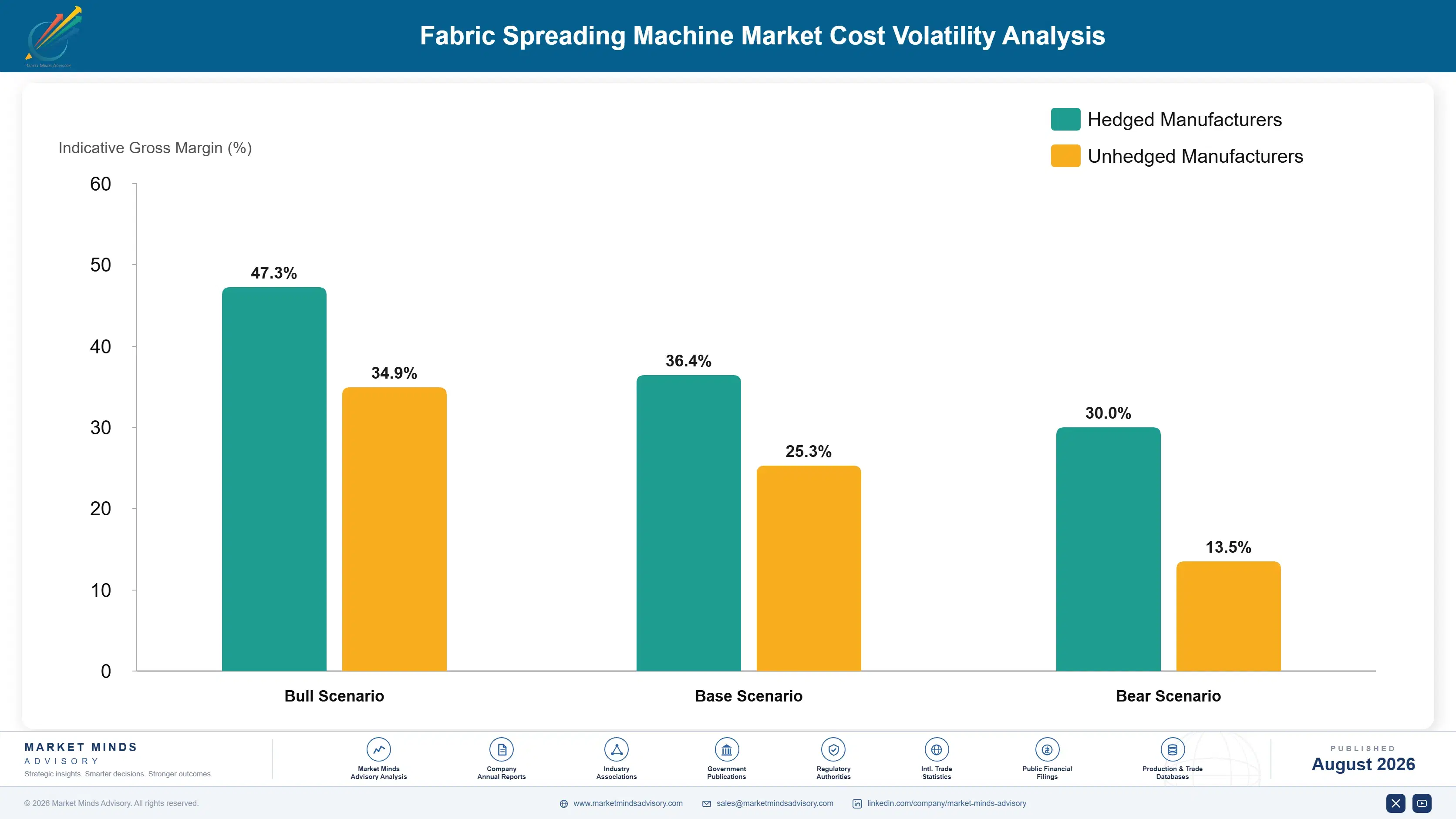
Steel, Servo Components, and Software Costs

Frame steel and structural components account for roughly 25 to 30% of manufacturing cost, sourced primarily from domestic steel mills in China, Germany, and the United States depending on the manufacturer's home base. Servo motors, motion controllers, and sensor electronics, largely sourced from Japanese and Taiwanese component suppliers, contribute a further 30 to 35%, making these systems more exposed to electronics supply chains than to raw material markets alone.
The 2021 to 2022 global semiconductor shortage delayed servo motor and motion controller deliveries for several machinery builders, extending equipment lead times from a typical eight to ten weeks to over six months in some cases, according to component sourcing disclosures in Lectra's 2022 annual report. The disruption pushed several manufacturers to qualify secondary electronics suppliers, a shift that has persisted even as chip availability normalized through 2024.

Smaller regional machinery builders without long-term supply agreements with electronics component makers face greater exposure to price and availability swings than larger players like Lectra and Bullmer, who negotiate volume-based contracts directly with component suppliers. Chinese builders benefit from proximity to domestic electronics manufacturing clusters, giving them a cost and lead-time advantage over European and American rivals dependent on imported servo components.
fabric-spreading-machine-market-cost-volatility-analysis-1787333086748

Qualifying Secondary Servo Motor and Controller Suppliers

Machinery builders are increasingly dual-sourcing servo motors and motion controllers from at least two component suppliers rather than relying on a single vendor relationship, reducing exposure to any single supplier's capacity constraints or sudden price increases. This adds modest qualification cost upfront but has meaningfully shortened recovery time from any future component shortage industry-wide.

Building Regional Component Inventory Buffers

Several builders have increased safety stock of critical electronics components from roughly four weeks to twelve weeks of forward demand, absorbing additional working capital cost in exchange for shorter, more predictable customer lead times overall. This buffer strategy is more common among larger builders with balance sheet capacity to carry additional standing inventory.

Shifting Toward Modular, Standardized Control Architectures

Standardizing control electronics across multiple machine models rather than customizing per product line allows builders to substitute components more easily during a shortage without redesigning software or mechanical interfaces entirely. This shortens the qualification cycle for alternate suppliers from months to weeks and lowers ongoing engineering overhead.

Portfolio Architecture for Margin Defence

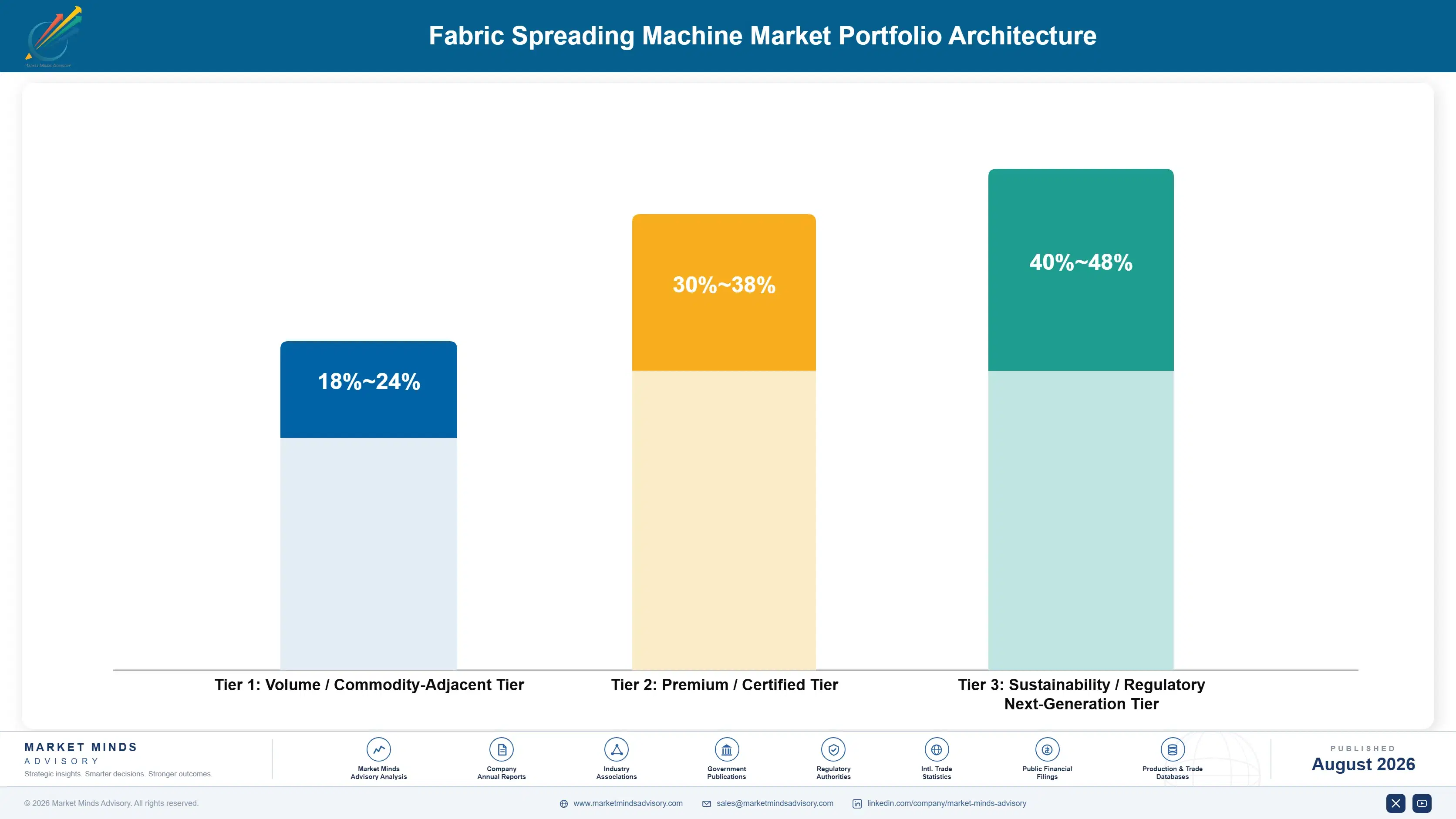
The market splits into three tiers running from commodity manual equipment to fully connected, software-bundled systems sold with multi-year contracts. Margin concentrates heavily at the top: computerized systems paired with data-reporting software earn gross margins 15 to 20 percentage points above manual equipment, reflecting both hardware sophistication and the recurring software revenue layered on top of the initial machine sale price.
Volume and premium tiers pull manufacturers in different directions. Chinese and Taiwanese builders are pushing aggressively upmarket into servo-driven and computerized systems, compressing margin in the middle tier where European incumbents historically earned steady returns, forcing established players to defend the premium tier more aggressively through software differentiation rather than hardware specifications alone, which are increasingly comparable across competitors regardless of country of origin or brand heritage.

High-value margin pools concentrate among suppliers serving large, multi-site apparel manufacturing groups that standardize on a single connected software platform across dozens of factories at once, since these accounts generate recurring software and service revenue far exceeding the value of the initial hardware sale itself, and remain the primary target of every major machinery builder's account strategy today.

Volume / Commodity-Adjacent Tier

Manual and semi-automatic spreading machines sold primarily into price-sensitive markets and smaller factories, competing on unit cost against low-cost Chinese and Taiwanese builders, with thin margins reflecting commoditized hardware and minimal service attachment.
Gross Margin: 18-24%

Premium / Certified Tier

Servo-driven and standard computerized spreading systems sold with baseline software and multi-year service contracts, capturing better margin through precision engineering, brand reputation, and established distributor relationships across mature and emerging regions.
Gross Margin: 30-38%

Sustainability / Regulatory / Next-Generation Tier

Fully computerized systems bundled with connected software, sensor-based waste reporting, and financing options, commanding the highest margin as brands increasingly require auditable sustainability data that only this tier reliably provides at scale.
Gross Margin: 40-48%
fabric-spreading-machine-market-portfolio-architecture-1787333087249

High-value Sub-segments and Strategic Watch-out

Fully Automatic Computerized Systems with Waste-Reporting Software

Bundled hardware and software systems generating recurring revenue through data subscriptions and ply-optimization algorithms, growing fastest as brand sustainability disclosure requirements make auditable fabric waste data a contractual condition for major apparel manufacturing accounts across multiple sourcing countries simultaneously and increasingly permanently across contract renewal cycles.
Gross Margin: 42-48%

Vendor-Financed Leasing Programs

Equipment financing arms and third-party lessors bundling machinery purchase with multi-year service agreements, expanding steadily as mid-sized factories in emerging apparel hubs seek automation without committing full capital upfront, generating durable interest and service margin across the full multi-year lease term for the vendor.
Gross Margin: 35-42%

Semi-Automatic and Servo-Driven Standard Systems

The largest unit volume segment, serving mid-sized factories across established and emerging manufacturing hubs that need automation gains without the highest tier's full connectivity and software cost, forming the steady revenue backbone of most machinery builders' current order books and service contracts.
Gross Margin: 24-30%

Chinese Domestic Computerized System Builders

Chinese manufacturers are moving upmarket into computerized systems at prices 30 to 40% below European incumbents, a segment strategic watchers should track closely since continued quality improvement here could compress premium tier margins faster than currently modeled by most established suppliers.
Gross Margin: 20-28%

Recurring Revenue Beyond the Machine Sale

Fabric spreading machinery is shifting from a one-time capital sale toward an annuity-like revenue relationship as software subscriptions, financing interest, and multi-year service contracts increasingly outweigh the initial hardware margin over a machine's ten to twelve year service life, particularly among suppliers that have successfully bundled connectivity into their core product offering rather than selling it as a separate, optional add-on to the base machine.
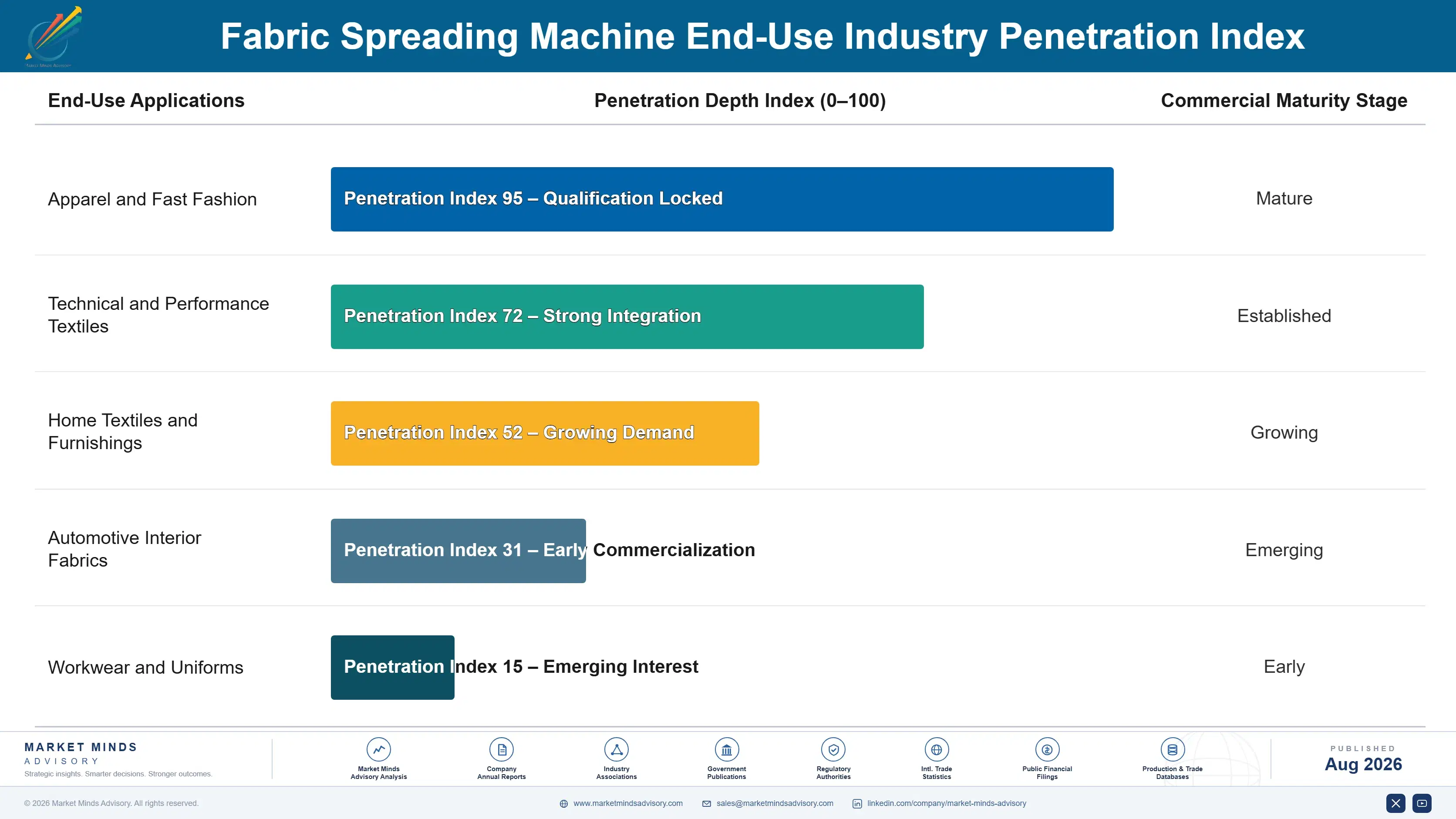
Adoption depth varies sharply by end-use vertical. Fast-fashion and technical apparel manufacturers adopt computerized systems fastest and most completely, since waste reduction directly affects margin on high-volume, low-price-point production runs. Home textile and automotive interior fabric manufacturers adopt more selectively, often retaining manual or semi-automatic equipment for low-volume specialty runs where computerized systems offer limited efficiency benefit over skilled manual operation and craftsmanship.

A generational shift in buyer profile is underway as factory operations managers, increasingly trained on production data systems rather than purely on mechanical equipment, replace an older generation of buyers who prioritized machine longevity and mechanical simplicity above software integration, a change that is reshaping which vendor capabilities actually win purchasing decisions across both established and emerging manufacturing hubs.
fabric-spreading-machine-market-end-use-penetration-index-1787333087742

Where Machinery Builders Should Focus

These are among the four positions where our research anticipates prominent divergence between winners and laggards over the coming forecast period. Each is grounded in the demand model, the regulatory perimeter, and the announced capacity pipeline.
01 / SOFTWARE INTEGRATION PRIORITY

Bundle connectivity now, before it becomes a baseline requirement

Brand sustainability disclosure requirements are converting fabric waste data from a nice-to-have into a contractual condition across a growing share of apparel manufacturing accounts worldwide. Suppliers still selling standalone hardware without a connected reporting layer are increasingly losing multi-machine orders to rivals offering bundled software subscriptions and analytics. Builders that move now, rather than waiting for connectivity to become table stakes, can still capture premium pricing and recurring revenue that latecomers entering an already commoditized software market simply will not.
02 / REGIONAL SERVICE BUILDOUT

Establish Southeast Asian service depots ahead of demand, not after

New apparel manufacturing capacity is concentrating in Vietnam, Bangladesh, and Cambodia faster than most machinery builders' existing service infrastructure can realistically support today. Suppliers without local technicians and spare parts depots are losing multi-machine orders to rivals who can guarantee sub-24-hour repair response times in these fast-growing markets. Building regional service capacity ahead of confirmed demand is a real capital commitment with genuine near-term cost, but waiting until competitors are entrenched will prove considerably more expensive to reverse course later on.
03 / FINANCING AND LEASING EXPANSION

Offer flexible financing to capture mid-sized factory demand

Mid-sized factories in emerging apparel hubs frequently cannot justify the full upfront cost of computerized spreading systems against thin manufacturing margins that rarely exceed five percent industry-wide. Vendor-backed financing and leasing programs materially expand the addressable customer base by lowering the effective capital barrier to entry for these price-sensitive buyers. Machinery builders without a financing arm are ceding this fast-growing segment entirely to competitors and third-party lessors willing to structure flexible multi-year payment terms that win deals.
04 / CHINA COMPETITIVE RESPONSE

Defend the premium tier as Chinese builders move upmarket

Chinese domestic machinery builders are improving computerized system quality fast enough to challenge established suppliers on mid-tier equipment, not only on price for manual and semi-automatic machines as before. European and American incumbents need to differentiate through software, service quality, and financing rather than relying solely on historical brand reputation for precision engineering and reliability. Suppliers that fail to articulate this differentiation clearly and quickly risk losing share in exactly the segment that currently generates their strongest margins.

Engagement Snapshot From the Field

A live engagement with an industry participant carrying material or product regulatory and market exposure ahead of a defining policy shift, showing how our research translates into a defensible multi-year portfolio strategy.
MARKET MINDS ADVISORY · CLIENT ENGAGEMENT SUMMARY
Fabric Spreading Machine Producer Strategic Portfolio Review and Transition Roadmap 2026·Investment Scenario on Fabric Spreading Machine Exposure Evaluation 2025-26
CLIENT PROFILE
The client operates four garment manufacturing facilities across Vietnam and Cambodia, supplying mid-market apparel brands with roughly $180 million in annual revenue (client-reported, unverified by MMA). The company had grown primarily through capacity addition rather than efficiency improvement, and its spreading equipment fleet remained largely manual and semi-automatic despite rising labor costs across both operating countries putting sustained pressure on production margins.
STRATEGIC CHALLENGE
Management needed to decide whether to invest in computerized spreading equipment across all four facilities simultaneously or phase the transition, while facing uncertainty about payback timelines given volatile minimum wage trajectories and limited internal data on actual fabric waste rates under current manual operations, a gap that made the business case difficult to build with confidence.
MMA APPROACH
MMA conducted facility-level waste audits across all four sites, modeled payback scenarios under three minimum wage trajectories, and benchmarked machinery vendor financing terms across five suppliers active in Southeast Asia, structuring a phased automation roadmap prioritized by facility-level labor cost exposure and existing fabric waste rates rather than a uniform rollout timeline.
KEY FINDINGS
  1. Actual fabric waste under manual operation ran 6.2%, nearly double management's internal estimate, representing a larger automation payback opportunity than the client had previously modeled internally.
  2. The two facilities with the highest labor cost exposure showed computerized system payback periods under 18 months, while the remaining two facilities exceeded 30 months.
  3. Vendor financing terms varied by more than 300 basis points across the five suppliers benchmarked, with the most competitive offer tied to a multi-machine, multi-year commitment.
  4. Software connectivity was not a near-term priority for any facility, since none currently faced brand-mandated waste disclosure requirements from their existing buyer base.
CLIENT PROFILE
The client operates four garment manufacturing facilities across Vietnam and Cambodia, supplying mid-market apparel brands with roughly $180 million in annual revenue (client-reported, unverified by MMA). The company had grown primarily through capacity addition rather than efficiency improvement, and its spreading equipment fleet remained largely manual and semi-automatic despite rising labor costs across both operating countries putting sustained pressure on production margins.
STRATEGIC CHALLENGE
Management needed to decide whether to invest in computerized spreading equipment across all four facilities simultaneously or phase the transition, while facing uncertainty about payback timelines given volatile minimum wage trajectories and limited internal data on actual fabric waste rates under current manual operations, a gap that made the business case difficult to build with confidence.
MMA APPROACH
MMA conducted facility-level waste audits across all four sites, modeled payback scenarios under three minimum wage trajectories, and benchmarked machinery vendor financing terms across five suppliers active in Southeast Asia, structuring a phased automation roadmap prioritized by facility-level labor cost exposure and existing fabric waste rates rather than a uniform rollout timeline.
KEY FINDINGS
  1. Actual fabric waste under manual operation ran 6.2%, nearly double management's internal estimate, representing a larger automation payback opportunity than the client had previously modeled internally.
  2. The two facilities with the highest labor cost exposure showed computerized system payback periods under 18 months, while the remaining two facilities exceeded 30 months.
  3. Vendor financing terms varied by more than 300 basis points across the five suppliers benchmarked, with the most competitive offer tied to a multi-machine, multi-year commitment.
  4. Software connectivity was not a near-term priority for any facility, since none currently faced brand-mandated waste disclosure requirements from their existing buyer base.
RECOMMENDED STRATEGY
Phase 1: Phase 1 (Months 1 to 6): Convert the two highest labor-cost-exposure facilities to fully computerized spreading systems under a five-year vendor financing arrangement securing the strongest benchmarked rate. Phase 2: Phase 2 (Months 7 to 18): Monitor minimum wage trajectories and fabric waste data at the two remaining facilities, triggering conversion once payback periods fall below 24 months. Phase 3: Phase 3 (Months 19 to 36): Evaluate software connectivity investment only if buyer contracts begin requiring waste disclosure, avoiding premature spend on unrequired reporting capability.
OUTCOME
The client converted two facilities within eight months of the engagement, financing the transition through the recommended vendor leasing structure rather than upfront capital (client-reported, unverified by MMA). Fabric waste at converted facilities fell to approximately 1.8% within the first two full production quarters, and management adopted the phased framework for evaluating the remaining two facilities.

Frequently Asked Questions

Foundational context covering the market sizes, CAGR, scope, country, region and competition that inform every finding below. This section is provided to cover basics and most often pre-purchase conversations, answered from the MMA Primary Research Dataset.

What is the current size of the Fabric Spreading Machine Market?

The global fabric spreading machine market was valued at approximately $0.72 billion in 2025. Growth is being driven primarily by automation adoption across Vietnam, Bangladesh, and Cambodia.

How large will the Fabric Spreading Machine Market be by 2036?

The market is projected to reach approximately $1.49 billion by 2036, up from $0.77 billion in 2026. This represents nearly a doubling of forecast-period value over the ten-year window.

What is the CAGR for the Fabric Spreading Machine Market 2026 to 2036?

The market is forecast to grow at a CAGR of 6.8% between 2026 and 2036. Bull and bear scenarios range from roughly 5.6% to 8.0%.

Which segment is growing fastest?

Fully automatic computerized spreading machines are the fastest-growing segment, expanding at approximately 9.5% annually. This is about 1.4 times the overall market's 6.8% growth rate.

Who are the major companies in the Fabric Spreading Machine Market?

Leading suppliers include Lectra, Eastman Machine Company, Bullmer GmbH, Morgan Tecnica S.p.A, and Kuris Spezialmaschinen GmbH. Together these five players hold roughly 38% of global share on a unit shipment basis.

Which country is growing fastest?

Vietnam is the fastest-growing single country, expanding at approximately 8.7% annually. This reflects continued apparel sourcing diversification away from China toward Southeast Asian manufacturing hubs.

Report Segmentation Architecture

The full report scope spans multiple orthogonal segmentation dimensions, with cross-tabulated demand data provided for each dimension pair. Coverage extends further to regional breakdowns, trend trajectories, and the competitive detail needed to support segment-level decision-making.

By Automation and Technology Type

  • Manual Spreading Machines
  • Semi-Automatic Spreading Machines
  • Fully Automatic Computerized Spreading Machines
  • Servo-Driven Carriage Spreading Systems
  • Turntable Spreading Machines
  • End-Cutter Integrated Spreading Machines

By End-Use Industry

  • Apparel and Fast Fashion
  • Technical and Performance Textiles
  • Home Textiles and Furnishings
  • Automotive Interior Fabrics
  • Workwear and Uniforms

By Commercial Dimension

  • Direct Equipment Purchase
  • Vendor-Financed Leasing
  • Software Subscription Attachment
  • Aftermarket Service Contracts

By Region

  • North America
  • Western Europe
  • East Asia
  • South Asia and Pacific
  • Latin America
  • Middle East and Africa
  • Eastern Europe

Scope, Methodology, and Coverage

Every figure in this report is reproducible from documented input assumptions. The scope below maps the historical period, the forecast horizon, the segmentation dimensions, and the countries covered, alongside the underlying primary and qualitative methodology.
Historical Period
2020 to 2025
Forecast Period
2026 to 2036
Base Year
2025 (USD billions; MMA Primary Research Dataset, August 2026)
Market Definition
The fabric spreading machine market covers equipment used to lay multiple layers of woven, knitted, and technical fabric onto cutting tables ahead of garment or textile-product cutting, spanning manual, semi-automatic, and fully computerized systems. It excludes downstream cutting machinery, sewing equipment, and standalone fabric inspection systems sold independently of spreading hardware.
Quantitative Units
USD billions (current prices); unit shipments where disclosed
Segmentation Dimensions
By Automation and Technology Type; By End-Use Industry; By Commercial Dimension; By Region
Regions Covered
North America, Western Europe, East Asia, South Asia and Pacific, Latin America, Middle East and Africa, Eastern Europe
Countries Covered
USA, China, Germany, France, UK, Japan, South Korea, India, Australia, Canada, Brazil, Mexico, Indonesia, Vietnam, Thailand, Malaysia, UAE, Saudi Arabia, South Africa, Nigeria, Turkey, Poland, Netherlands, Italy, Spain, Sweden, Switzerland, Argentina, Colombia, Singapore, and additional markets relevant to this sector
Key Companies Profiled
Lectra, Eastman Machine Company, Bullmer GmbH, Morgan Tecnica S.p.A, Kuris Spezialmaschinen GmbH, Gerber Technology, FK Group S.p.A, Veit Group, Yin's Industrial Co. Ltd, Zund Systemtechnik AG, Investronica Sistemas, Zhejiang Sunrise Garment Equipment Co., Shanghai Ruian Garment Machinery, KM International, Rocella S.r.l., Wuxi Jinsheng Garment Machinery, Zhejiang Baoyi Machinery, Guangzhou Yicheng Garment Machinery, Ningbo Ningxing Garment Machinery, Techno Craft Engineers Pvt Ltd
Quantitative Methodology
Primary survey, n=3,800 respondents, Q4 2025, six countries; demand-side model with trade association cross-validation
Qualitative Methodology
47 expert interviews, Q4 2025; applied to validate demand model assumptions, identify emerging dynamics, and assess competitive positioning
Report Format
PDF and XLSX data workbook (Word format preview document)
Publisher
Market Minds Advisory
Report Code
MMA-2026-CON-309
Published
August 2026
Contact
sales@marketmindsadvisory.com | www.marketmindsadvisory.com

Purchase the full Fabric Spreading Machine Market Report (2026 to 2036).

The full report provides a comprehensive assessment of the global fabric spreading machine market, including detailed segmentation by automation and technology type, end-use industry, and commercial dimension across all seven world regions. It profiles twenty leading and emerging machinery builders, benchmarking competitive positioning, financing models, and service network capability. The analysis includes ten-year forecasts through 2036 under base, bull, and bear scenarios, alongside primary research findings drawn from MMA's survey of 3,800 respondents and 47 expert interviews conducted in the fourth quarter of 2025. A dedicated input cost and supply chain risk section examines servo component and steel exposure across major manufacturing regions.
Detailed segment-level ten-year forecasts through 2036
Profiles of twenty leading and emerging suppliers
Regional analysis spanning all seven world regions
Input cost and supply chain risk assessment
Competitive benchmarking on moats and vulnerabilities
Primary survey and expert interview data appendix

Built For The People Who Decide

From boardroom strategy to bench-side execution, this report is read cover-to-cover by leaders shaping the next decade of their industry, turning demand scenarios, market dynamics and valuation benchmarks into decisions.
CXOs/ Presidents/ VPs/ Managers
M&A and Corporate Development
Strategy Teams and R&D Heads
Procurement and Product Directors
Regulatory and Compliance Leaders
Investor Relations and Equity Analysts