Market Minds Advisory
Fabric Filter System Market

Fabric Filter System Market: Bag Life Economics, Catalytic Media, and the Aftermarket Most Suppliers Lose

The baghouse is sold once on competitive tender at thin margin. The bags inside it are replaced every three years at much better margin, and independent media suppliers take most of that revenue away.

Lead Analyst

Bilal Shaikh

Published

September 2026

Make Smarter Decisions with Customized Research Insights

Request a free sample report and evaluate market opportunities, growth trends, and competitive dynamics relevant to your business needs.

2025 MARKET VALUE$9.8BMarket Size 2025
2036 FORECAST VALUE$19.4BBase Case , 2026 to 2036
CAGR 2026 TO 20366.4 %Bull 7.6% / Bear 5.2%
INCREMENTAL OPPORTUNITY$9.0BNet 10- year value creation
EXPANSION MULTIPLE1.86x2036 value over 2026 base
Strategic Levers
M&A Pipeline
Regional Outlook
Country Rankings
Competitive Intelligence
Segmental Deep-dive
Call-Us : 91 93563 13602

Executive Snapshot and Market Trajectory

This is two businesses wearing one name. Selling a baghouse is a competitive tender at thin margin. Selling the bags that go inside it every 38 months is an annuity, and 44% of supplier revenue comes from that side of the ledger. Everything else here follows from that split.
Commercial position depends on holding the media replacement stream after the system is commissioned, because independent bag suppliers take a substantial share of it from the original equipment manufacturer. High-temperature catalytic fabric filters grow fastest at 11.6%, roughly 1.81 times the market. East Asia holds the largest regional position at 30% of value, driven by Chinese ultra-low emission retrofit programmes across cement, steel, and coal power.
Concentration is unusually low at roughly 28% for the top five, because fabric filter housings are fabricated steel and regional shops build them competently. Media technology, guarantee capability, and service reach are what separate suppliers rather than manufacturing. Around 58% of orders replace or upgrade existing equipment rather than serving new plant construction. Suppliers who win the housing and lose the bags have funded a competitor's annuity out of their own tender discount.
Market Definition
The market comprises fabric filter systems for industrial particulate control, covering pulse-jet fabric filters, reverse-air fabric filters, shaker fabric filters, cartridge-type fabric filters, high-temperature catalytic fabric filters, and modular skid-mounted units. Value is measured at supplier level and includes replacement filter media and service on installed systems. Electrostatic precipitators, wet scrubbers, cyclones, selective catalytic reduction reactors sold separately, ducting and fans supplied independently, and cleanroom or building air filtration fall outside scope.
Base Year Value
$9.8B in 2025 (MMA Primary Research Dataset, August 2026)
Forecast Period
2026 to 2036, eleven discrete annual values
CAGR
6.4% base case. Bull 7.6%. Bear 5.2%.
Fastest Growth Segment
High-Temperature Catalytic Fabric Filters: 11.6% CAGR
Fastest Growth Country
India: 9.4% CAGR
Fastest Growth Region
South Asia and Pacific: 8.6% CAGR
Largest Region
East Asia: 30% of 2025 global value
Market Leaders
Babcock and Wilcox, Donaldson, Andritz, FLSmidth, and Thermax lead on fabric filter system and media revenue. Source: company annual reports and MMA Analysis, July 2026.
Primary Survey
n=3,800 procurement and R&D decision-makers, Q4 2025, six countries
Methodology
Demand-side build-up, cross-validated against public data, 47 expert interviews

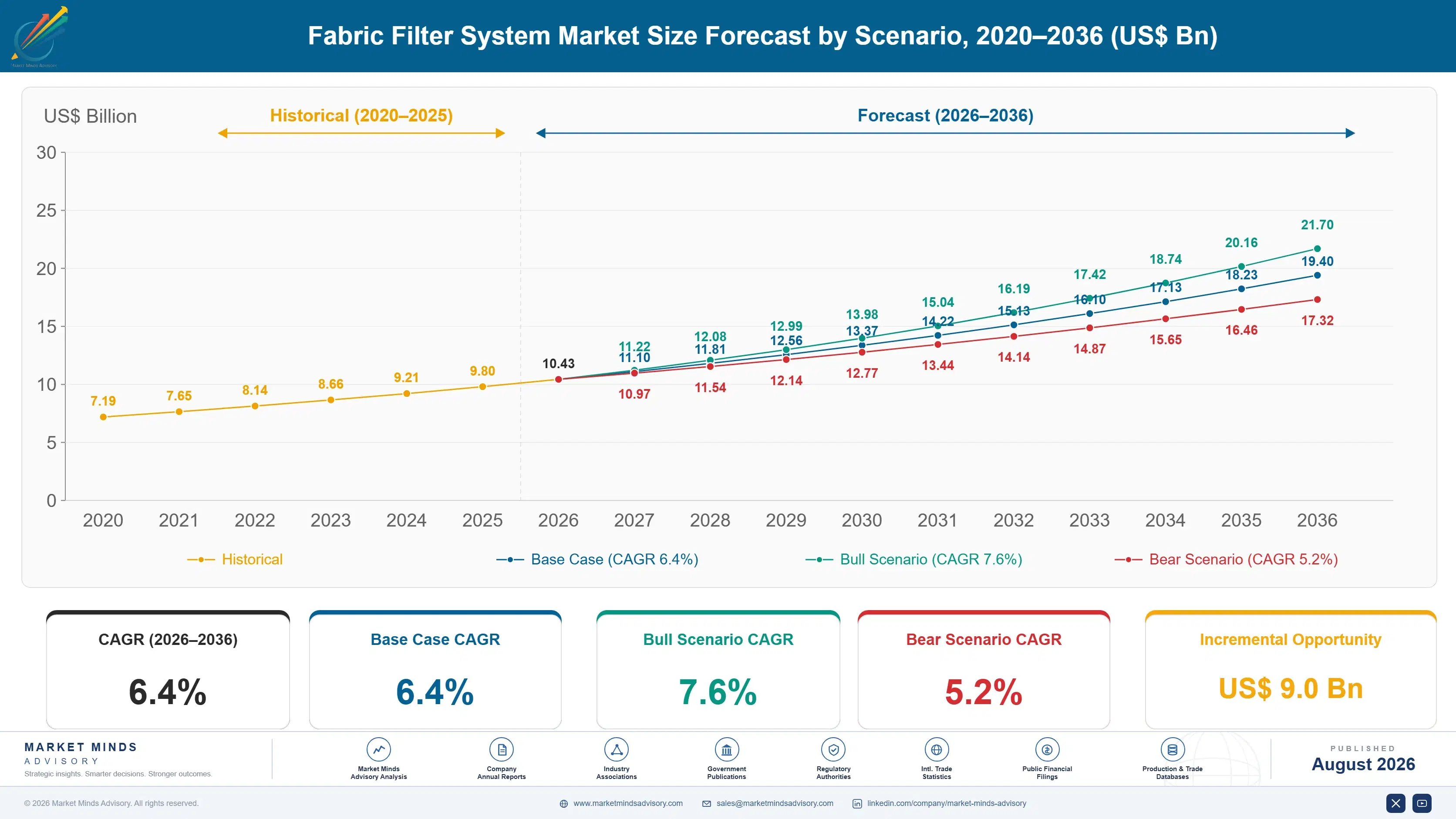
Fabric Filter System Market Forecast Scenarios

fabric-filter-system-market-trends-size-forecast-scenario-1787551210572
Growth between 2020 and 2025 came almost entirely from regulation rather than from industrial expansion. Chinese ultra-low emission standards for cement, steel, and coal power forced retrofits on an enormous installed base. European best available techniques conclusions tightened particulate limits to levels electrostatic precipitators struggle to reach reliably. The 5.6% historical rate reflects compliance-driven replacement in mature economies offsetting weak new plant construction almost everywhere outside Asia.
The 6.4% base case rests on three mechanisms. Emission limits continue tightening across jurisdictions, and fabric filters reach outlet levels near 5 milligrams that precipitators cannot guarantee consistently. Waste-to-energy and biomass combustion capacity keeps expanding, and both require the high-temperature and catalytic media that carry the best pricing. And the installed base itself grows, which compounds the replacement media annuity underneath everything else in this market. None of that depends on new heavy industrial construction.
The 7.6% bull case assumes condensable particulate and fine particle limits enter regulation broadly, forcing specification changes across the installed base. The 5.2% bear case reflects industrial output weakness in cement and steel, deferred retrofit capital in a higher interest rate environment, and Chinese retrofit programmes completing faster than replacement demand can absorb the capacity.

Where the Money Sits After Commissioning

Three things decide outcomes here and only one of them is the equipment. Media selection comes first, because the wrong fibre in the wrong gas chemistry fails in months rather than years and takes the plant down with it. Guarantee capability comes second, since customers buy an emission number rather than a machine. Service reach comes third and determines who supplies the bags afterwards.
TOP-FIVE CONCENTRATION28%Combined share of system supply held by leading manufacturers
AVERAGE FILTER BAG LIFE38 monthsTypical service interval before media replacement becomes necessary
AFTERMARKET REVENUE SHARE44%Portion of supplier revenue from replacement media and service
FILTER MEDIA COST SHARE31%Portion of system cost attributable to the media itself
OUTLET EMISSION PERFORMANCE5 mg/Nm3Typical guaranteed particulate level achieved by modern installations
RETROFIT PROJECT SHARE58%Portion of orders replacing or upgrading existing collection equipment
The aftermarket is the commercial prize and plenty of suppliers lose it. A baghouse sold on competitive tender earns modest margin once. The bags inside it get replaced roughly every 38 months for the twenty-year life of the installation, at margins several times better, and independent media houses compete hard for that business with no capital equipment obligation whatsoever.
Housings themselves are fabricated steel and offer very little defensible advantage, which explains why top-five concentration sits near 28% in an industry that looks like it should consolidate. Regional fabricators build competent boxes. What they cannot do is guarantee an outlet emission figure across varying gas chemistry, or supply media engineered for the specific failure mode that plant presents. That distinction is the entire commercial argument in this industry.
"Everybody quotes the box and argues about steel weight. Then the plant runs, the bags fail eleven months early because somebody specified polyphenylene sulphide into an oxidising gas stream, and the conversation about who actually understood the application starts far too late to help anybody."
Practice Director, Industrial Emissions and Process Equipment · MMA Air Pollution Control Equipment Practice · August 2026

Market Trends

Catalytic Media Removes a Separate Reactor From the Plant

Filter bags with catalyst embedded in the media destroy nitrogen oxides and dioxins while collecting dust, which lets a plant delete a selective catalytic reduction reactor from its flue gas train entirely. The capital and footprint saving is considerable, particularly on waste-to-energy plants where space is tight and dioxin limits are strict. Media cost per bag runs several times conventional fibre. High-temperature catalytic filters grow at 11.6%, the fastest type here, and waste combustion is where nearly all of that growth currently sits. Cement and biomass plants are starting to ask the same question.
Market Impact: East Asia holds 30% of value

Fabric Filters Keep Displacing Electrostatic Precipitators on Retrofits

Tightening particulate limits have moved beyond what precipitators reliably guarantee, particularly where fly ash resistivity varies with fuel or where fine particle capture matters. Fabric filters hold outlet levels near 5 milligrams across changing conditions, which is why 58% of current orders replace or upgrade existing equipment rather than serving new plants. Retrofit work carries its own difficulty, since fitting a baghouse into a precipitator casing constrains cloth area and gas velocity. Suppliers who solve that geometry problem win disproportionately across every industrial sector. Cloth area and can velocity are where the retrofits fail.
Market Impact: Bag life falls below 30 months

Market Opportunities and Growth Drivers

Chinese Ultra-Low Emission Programmes Drive Retrofit Volume

Ultra-low emission standards applied to Chinese cement, steel, and coal power installations forced particulate control upgrades across an installed base larger than any other country's, and much of that work specified fabric filters over precipitators on guarantee grounds. Fujian Longking and Sinoma Technology captured substantial domestic share against international suppliers. The programme also created an enormous installed base now entering its replacement media cycle. That combination gives East Asia the largest regional position at 30% of value across this market. Domestic suppliers built fabrication cost bases during that programme they still hold.
Market Impact: Aftermarket is 44% of revenue

Waste-to-Energy Capacity Expands With Strict Dioxin Limits

Municipal waste combustion capacity keeps growing across Europe, China, and increasingly Southeast Asia, and every plant requires particulate control operating at high temperature against strict dioxin and acid gas limits. That specification favours high-value media: polytetrafluoroethylene membranes, polyimide fibres, and catalytic constructions rather than commodity polyester. Bag life in these applications runs shorter than in cement or power, which shortens the replacement cycle and improves the annuity. Waste combustion is where catalytic filter adoption is concentrated almost entirely at present. Acid gas attack rather than abrasion is what ends bag life here.
Market Impact: Concentration remains near 28%

Market Restraints and Challenges

Independent Media Suppliers Capture the Replacement Annuity

Filter bags are replaceable by anybody who can measure a cage and match a fabric, and independent media houses compete for that work with no capital equipment obligation and lower overhead. The root cause is that the original supplier's advantage expires at commissioning unless something ties the customer to them afterwards. Suppliers mitigate through performance guarantees contingent on approved media, through condition monitoring services that make the incumbent the obvious source, and through media engineered specifically for a documented failure mode competitors cannot diagnose. Nothing about the housing itself creates any loyalty at all.
Market Impact: Fastest type growing at 11.6%

Steel Fabrication Offers No Defensible Cost Position

A fabric filter housing is plate steel, hoppers, and a cleaning system, and competent regional fabricators build them at prices international suppliers cannot match on transport-heavy equipment. The root cause is straightforward: there is no proprietary content in a welded box. Suppliers mitigate by shifting the commercial argument onto guaranteed outlet emissions, by licensing designs to local fabricators while retaining media and controls, and by moving toward modular skid-mounted units where factory build quality justifies the freight. Concentration stays near 28% regardless. Freight cost is the only genuine barrier on large installations.
Market Impact: Retrofits are 58% of orders
3 additional market trends, 4 additional growth drivers, and 2 additional restraints and challenges are covered in the full report. Contact sales@marketmindsadvisory.com to access the complete intelligence.

Segment CAGR and Growth Architecture

Segmentation follows fabric filter system type, because cleaning mechanism and media construction determine achievable emission performance, capital cost, footprint, and which applications the system can serve. Six types cover commercial supply, and the divide between conventional dust collection and multi-pollutant catalytic construction matters more than any cleaning method difference. Cleaning method decides very little commercially.
fabric-filter-system-market-trends-market-share-analysis-1787551211107

High-Temperature Catalytic Fabric Filters

The fastest type at 11.6%, roughly 1.81 times the market, from a small but rapidly commercialising base. Catalyst embedded within the filter media destroys nitrogen oxides and dioxins at filtration temperature, which allows a plant to remove a separate selective catalytic reduction reactor along with its footprint, capital cost, and reheat energy. Media cost runs several times conventional fibre, and bag life is shorter than in benign applications, so the replacement annuity is unusually attractive. Waste-to-energy carries nearly all current adoption. Cement and biomass applications are beginning to specify it as limits tighten. Catalyst deactivation from alkali and heavy metals in the flue gas is the main technical risk operators weigh before specifying it.
CAGR 11.6%

Modular Skid-Mounted Fabric Filter Units

Second fastest at 9.8%, driven by installation cost rather than by any filtration advantage over conventional construction. Factory-assembled units arrive tested and connected, which removes weeks of site fabrication labour and the quality variability that comes with it. Smaller industrial applications and process dust collection favour them most, and mining and minerals handling has adopted them widely for remote sites where site labour is expensive or scarce. Freight cost limits practical size, so large power and cement installations remain field-erected. Standardisation also improves media supply, since bag dimensions repeat across units. Pricing sits above field-erected equivalents on a pure equipment basis, and below them once site labour, schedule, and rework are counted properly.
CAGR 9.8%
Full segment breakdown across 6 segments available in the complete report.

Regional Architecture and Country Demand Map

Regional shares follow heavy industrial capacity and emission regulation rather than economic size. East Asia leads on both counts by a wide margin, Western Europe leads on specification stringency and media value per installation, and the installed base determines aftermarket weight everywhere. Economic size predicts almost nothing here.

North America

Maximum achievable control technology standards drove a wave of fabric filter retrofits across coal power, cement, and metals processing, and much of that installed base is now well into its replacement media cycle. Coal plant retirements cut new capital orders sharply while leaving aftermarket demand on the remaining fleet intact. Cement, glass, foundry, and grain handling now carry more of the new equipment volume than power does. Babcock and Wilcox, Donaldson, and CECO hold established positions with strong service reach. Growth of 6.0% is carried substantially by aftermarket media rather than by new system orders. Independent media houses are unusually well established here, which makes aftermarket capture harder than in any other region.
Share: 24% | CAGR: 6.0% (2026 to 2036)

Western Europe

Best available techniques conclusions under industrial emissions rules set particulate limits that effectively require fabric filtration on most combustion and process applications, which makes specification stringency the highest anywhere. Waste-to-energy capacity is substantial and expanding, and it drives demand for the polytetrafluoroethylene, polyimide, and catalytic media carrying the best value per installation. Scheuch, Lühr Filter, Intensiv-Filter Himenviro, and Andritz hold deep application engineering positions across the region. Growth of 4.8% is the slowest here, reflecting an installed base already largely compliant and limited new heavy industrial construction anywhere. Catalytic media adoption is further advanced here than anywhere else, since dioxin limits on waste combustion made the economics work before other regions had comparable rules.
Share: 21% | CAGR: 4.8% (2026 to 2036)
Regional intelligence for 5 additional markets available in the complete report: East Asia, South Asia and Pacific, Latin America, Middle East and Africa, Eastern Europe. Contact sales@marketmindsadvisory.com.
fabric-filter-system-market-trends-country-cagr-analysis-1787551211632

Four Moves That Change Returns

Advantage here comes from holding the media stream, guaranteeing an emission number, and moving into constructions where fibre alone is not the product. Four moves justify capital across the forecast period, and the first determines whether a supplier earns once from an installation or for twenty years. The distinction is worth more than any pricing decision.

Tie the media annuity to the performance guarantee

Aftermarket media and service represent 44% of supplier revenue at margins several times the capital equipment they follow, and independent bag houses take a substantial share of it from the original supplier. A guarantee contingent on approved media, backed by condition monitoring that documents differential pressure and bag condition, makes the incumbent the obvious source at every replacement. Suppliers treating commissioning as the end of the relationship are handing away the better half of the business to competitors carrying none of the original obligation. Commissioning is where the relationship should start, not finish.
Market Impact: Protects the entire 44% of revenue that repeats

Compete on guaranteed outlet emissions, not steel weight

A housing is plate steel and hoppers, and regional fabricators build them at prices no international supplier matches on freight-heavy equipment. Concentration sits near 28% precisely because of that. Customers are actually buying an outlet number near 5 milligrams held across varying gas chemistry, fuel changes, and load swings. Suppliers who move the commercial conversation onto guaranteed performance, backed by application engineering and media selection nobody else can replicate, compete on ground where fabrication cost stops mattering entirely. Application engineering and media selection are what actually carry that guarantee, and neither is visible in a tender document.
Market Impact: Competes on ground the 28% concentration figure hides

Build catalytic media capability before limits tighten further

Catalytic filter bags destroy nitrogen oxides and dioxins during filtration, letting a plant delete a separate reactor with its footprint, capital cost, and reheat energy. The type grows at 11.6%, the fastest here, and waste-to-energy carries nearly all current adoption. Media prices run several times conventional fibre with shorter bag life, which improves the annuity as well as the initial sale. Suppliers without catalytic capability are excluded from the applications where limits are tightening fastest and pricing is best. Licensing is a faster route than internal development for suppliers without any catalyst chemistry capability of their own.
Market Impact: Enters the fastest segment, currently growing at 11.6%

Standardise modular units for smaller industrial duties

Factory-assembled skid units grow at 9.8% because they remove weeks of site fabrication labour and the quality variability that comes with it, not because they filter any better. Mining, minerals handling, and process dust collection at remote sites favour them heavily. Standardised bag dimensions across a unit range also concentrate media demand into fewer part numbers, which improves aftermarket capture and inventory economics considerably. Freight cost caps practical size, so this competes alongside field erection rather than replacing it. Inventory economics improve as well, since fewer part numbers cover more of the installed base being served.
Market Impact: Modular unit demand is growing at 9.8% annually

Who Controls the Margin Pool

Concentration is unusually low at roughly 28% for the top five on system and media revenue, which reflects an industry where the visible product is fabricated steel that competent regional shops build. Babcock and Wilcox and Andritz lead on large combustion and process installations with deep guarantee capability. Donaldson holds a strong position weighted toward industrial dust collection and media. FLSmidth dominates cement applications, and Thermax leads in India with genuine cost advantages.
Competition runs on three dimensions. Media engineering and application knowledge is the first, and it decides whether bags last 38 months or fail at eleven. Guarantee capability is the second, since customers buy an emission number. Service reach is the third, and it determines who supplies replacement media across a twenty-year installation life.

Pressure is building from two directions. Independent media houses take aftermarket share with no capital equipment obligation and lower overhead. Chinese suppliers including Fujian Longking and Sinoma have moved beyond domestic retrofit work into export markets, carrying cost bases built around local fabrication that international suppliers cannot approach on housings. Rankings will move toward suppliers making their own media rather than toward whoever fabricates cheapest.
fabric-filter-system-market-trends-company-positioning-matrix-1787551212154

Competitive Moat and Risk Dimensions

BABCOCK AND WILCOX

Moat: Combustion application engineering depth

Decades of experience with flue gas chemistry across coal, biomass, and waste combustion lets Babcock and Wilcox guarantee outlet emissions where gas conditions vary with fuel and load. That knowledge sits in application engineering and media selection rather than in any hardware. Customers taking a compliance risk on a permit limit pay for certainty rather than equipment.
BABCOCK AND WILCOX

Risk: Coal capacity retirement exposure

A substantial portion of the installed base sits on coal power plants that are retiring across North America and Europe, which removes both future capital orders and the replacement media annuity attached to them. Redirecting toward cement, waste combustion, and industrial process applications means competing where other suppliers already hold the relationships and the reference installations.
DONALDSON

Moat: Media manufacturing and distribution scale

Donaldson makes filtration media rather than buying it, which gives control over the part of this business carrying the best margin and the most technical differentiation. Distribution reach into industrial dust collection puts replacement media in front of customers whose original equipment came from somebody else. That combination attacks the aftermarket from a position most system suppliers cannot match.
DONALDSON

Risk: Limited large combustion presence

Heavy combustion and cement installations demand guarantee capability and site engineering scale that Donaldson's industrial dust collection focus does not naturally provide. Those applications carry the largest single orders and the most valuable catalytic media specifications. Building the reference base and engineering depth to compete there takes years, and incumbents defend it on performance history rather than price.

Players Tracked

Prominent Players

Babcock and Wilcox
Donaldson
Andritz
FLSmidth
Thermax

Other Key Players

Nederman
CECO Environmental
Camfil
Parker Hannifin
Mitsubishi Heavy Industries
Ducon Technologies
Redecam Group
Scheuch
Intensiv-Filter Himenviro
Lühr Filter
Hamon
Fujian Longking
Sinoma Technology
Tenova
Freudenberg Filtration

Recent Developments

FEBRUARY 2025

Waste-to-energy operator specifies catalytic media over separate reactor

A European waste combustion operator selected catalytic filter bags in place of a downstream selective catalytic reduction reactor on a plant expansion, citing footprint constraints and the reheat energy the separate reactor would have required. Media cost was several times conventional fibre and still cheaper overall.
Signal: Catalytic media now competes against reactor capital cost rather than against other filter bags on unit price
JUNE 2025

System supplier links emission guarantee to approved media

An equipment manufacturer restructured its performance guarantee to remain valid only where approved replacement media is fitted, after analysis showed independent bag suppliers were taking most of the aftermarket revenue on installations it had originally commissioned itself. Condition monitoring was bundled alongside the change. Enforcement begins at renewal.
Signal: Guarantee structure is now the main tool for defending an aftermarket that commissioning alone never protected
OCTOBER 2025

Chinese supplier wins Southeast Asian cement retrofit award

A Chinese fabric filter manufacturer secured a cement plant retrofit outside its domestic market, pricing the housing well below European quotations on the strength of a fabrication cost base built during the ultra-low emission programme. Media supply was contracted separately to a regional house. No media supply followed.
Signal: Housings and media are increasingly purchased separately, which erodes the aftermarket annuity original equipment suppliers depend on

What Sets the Cost Base

Filter media is the largest input at roughly 31% of system cost, covering polyester, polyphenylene sulphide, polyimide, aramid, fibreglass, and polytetrafluoroethylene membrane laminates sourced largely from Germany, Japan, and the United States. Plate steel and structural sections take a further 26%. Cages, valves, and pulse cleaning hardware absorb 14%. Site erection labour on field-built installations consumes the balance of delivered project cost.
Steel prices moved sharply through 2021 and 2022 and again on European energy costs, and suppliers holding fixed-price contracts on multi-year deliveries absorbed most of it directly. Andritz and FLSmidth both discussed input cost pressure and project margin effects in their reporting for those years. Specialist fibre availability tightened at the same time, particularly polyimide and membrane laminates from a narrow supplier base. Substitution was rarely possible, since media selection follows gas chemistry rather than preference.

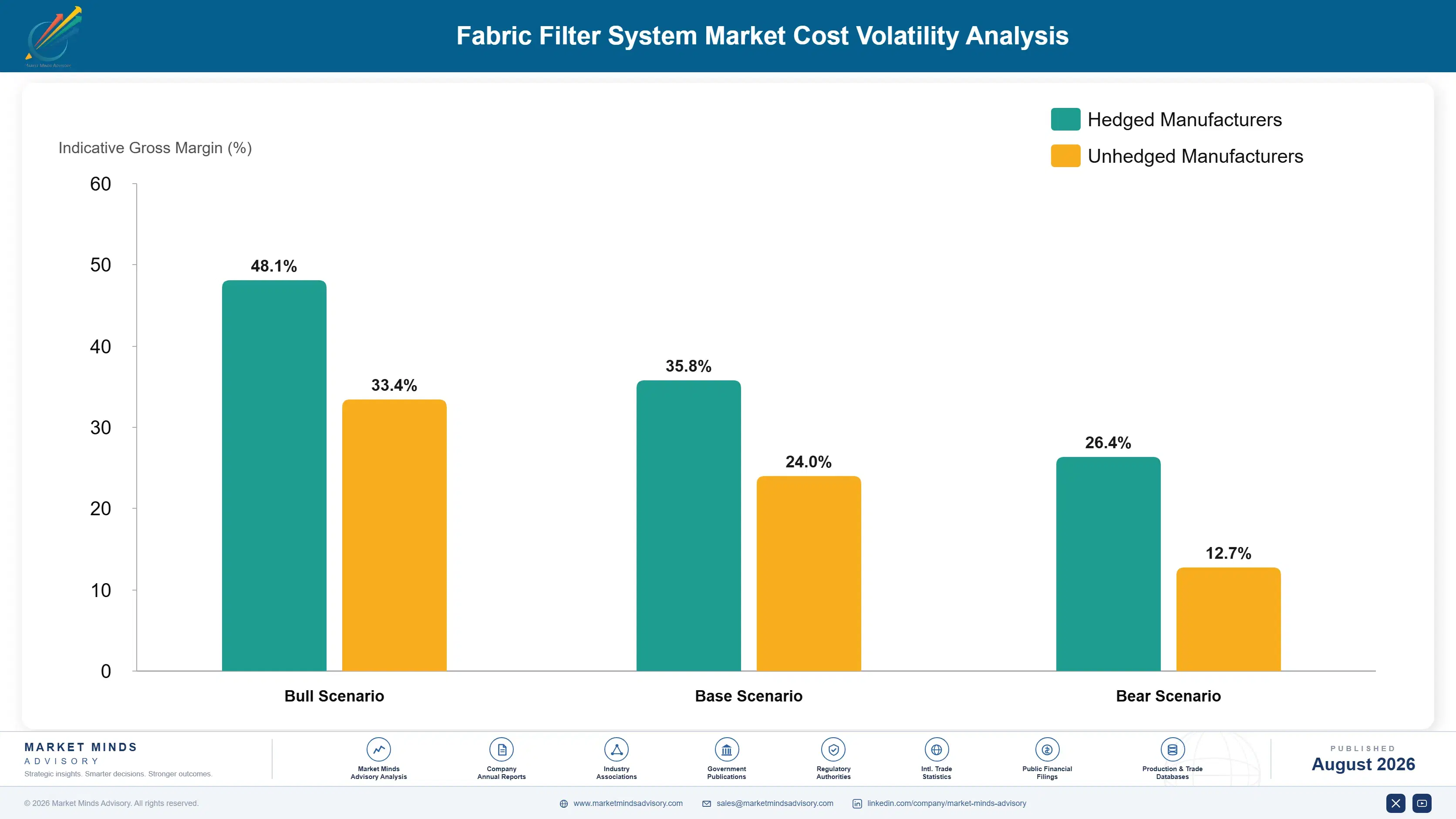
Exposure divides on revenue mix, not scale. Suppliers weighted toward capital equipment carry full steel and fabrication exposure against thin tender margins, so any input move lands directly on project profitability. Aftermarket media revenue at 44% carries far better margin and much shorter pricing cycles, which absorbs input swings. Suppliers making their own media hold a further advantage procurement cannot replicate.
fabric-filter-system-market-trends-cost-volatility-analysis-1787551212349

Shift revenue mix toward media and service

Aftermarket media at 44% of revenue carries margins several times capital equipment and reprices on far shorter cycles, which absorbs steel and fibre volatility that fixed-price project contracts cannot. Building the guarantee and monitoring structures that hold that stream is the most effective input cost defence available here, and it happens to be where the growth sits anyway.

Index project contracts to steel and fibre

Multi-year delivery schedules priced firm against volatile plate steel transfer the entire input risk onto the supplier for no compensating return. Indexation clauses tied to published steel and fibre references remove that mismatch and rarely lose a tender on their own. Suppliers quoting firm on eighteen-month deliveries are absorbing a risk they never priced.

Qualify alternate specialist fibre sources

Polyimide and membrane laminate supply comes from a narrow base, and media selection is dictated by gas chemistry rather than by preference, so substitution under pressure is rarely available. Qualifying alternate sources ahead of need costs application testing time and removes a genuine constraint on the highest-value part of the portfolio. Testing time is the whole cost.

Portfolio Architecture for Margin Defence

Margin architecture follows what a supplier controls after commissioning, and the spread between the two halves of this business is wide. Field-erected housings sold on competitive tender earn thin returns against steel, fabrication, and site labour that regional shops price better. Replacement media earns several times that on repeat volume for the life of the installation. Catalytic and membrane constructions sit higher again on technical scarcity.
The volume and premium tension plays out over time rather than across products. A large capital order looks impressive and returns little, and it is worth taking mainly for the twenty years of media replacement it creates. Suppliers who win the housing and lose the bags have funded somebody else's annuity with their own tender discount, which happens far more often than the industry admits publicly.

High-value pools concentrate in catalytic and membrane media, guarantee-backed performance contracts, and condition monitoring services that make the incumbent the obvious replacement source. Each is defended by application engineering, media technology, or installed base access rather than by fabrication cost, which is why concentration remains low while margins vary enormously. Fabrication scale buys almost nothing in this business.

Volume / Commodity-Adjacent Tier

Field-erected housings, hoppers, and structural steel sold on competitive tender. Regional fabricators price this well and freight limits international competition. Returns are thin and the order is worth taking mainly for what follows it.
Gross Margin: 9%-17%

Premium / Certified Tier

Replacement media, cages, and service on installed systems backed by emission guarantees and condition monitoring. Repeat revenue across a twenty-year installation life. The range reflects wide differences between commodity polyester and engineered constructions.
Gross Margin: 30%-46%

Sustainability / Regulatory / Next-Generation Tier

Catalytic media destroying nitrogen oxides and dioxins during filtration, and membrane laminates for fine particle capture. Technical scarcity supports pricing. The range is wide because catalytic loading and application severity vary considerably between plants.
Gross Margin: 36%-52%
fabric-filter-system-market-trends-portfolio-architecture-1787551212858

High-value Sub-segments and Strategic Watch-out

Catalytic Media Supply

The fastest type at 11.6%, competing against reactor capital cost rather than against other bags, with shorter service life that improves the annuity. Waste-to-energy carries nearly all adoption today and cement is beginning to follow. Catalyst deactivation from alkali and heavy metals is the main operator concern.
Gross Margin: 38%-52%

Guarantee-Backed Media Contracts

Aftermarket represents 44% of revenue and independent houses take much of it, so guarantees contingent on approved media plus condition monitoring are what hold the stream. The structure matters more than the fabric itself does. Monitoring data gives maintenance managers something better than unit price to decide on.
Gross Margin: 32%-46%

Modular Skid-Mounted Units

Growing at 9.8% on installation labour savings rather than filtration performance, with standardised bag dimensions that concentrate aftermarket demand into fewer part numbers. Freight cost caps practical size and keeps large installations field-erected. Mining and minerals handling at remote sites is where site labour cost makes the argument easiest.
Gross Margin: 24%-34%

Field-Erected Housing Supply

The strategic watch-out. Plate steel and site labour with no proprietary content, priced by regional fabricators who carry no guarantee obligation whatsoever. Worth winning only where the media and service stream genuinely follows it afterwards. Chinese suppliers price this below what most Western fabrication bases allow.
Gross Margin: 9%-17%

How Orders and Reorders Arrive

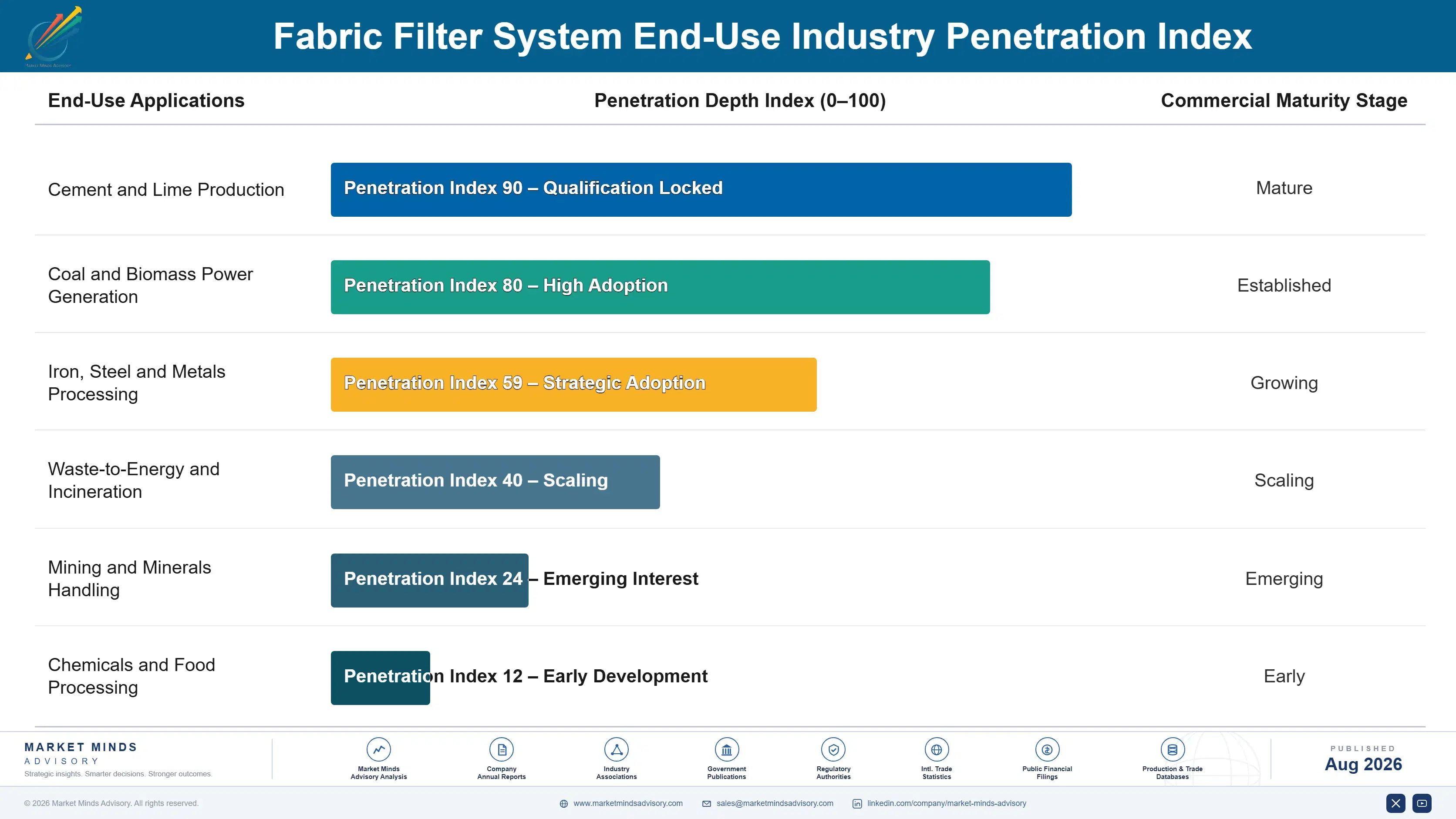
Demand arrives in two rhythms that barely resemble each other. Capital orders come through competitive tender against a permit deadline or a plant expansion, arrive unpredictably, and are decided by consulting engineers weighing guarantee credibility against price. Media replacement arrives roughly every 38 months per installation, forever, decided by a maintenance manager weighing bag life history against unit cost. The second stream is larger in aggregate, steadier, and considerably more profitable than the first one ever is.
Stickiness varies with what the supplier can prove. A guarantee contingent on approved media holds the customer completely. Documented bag life advantage on a specific gas chemistry holds them through one or two cycles. A housing supplied without either holds nothing at all beyond commissioning. Nothing else survives past the warranty period at all.

The deciding buyer has shifted from plant engineering toward environmental compliance and maintenance functions. Compliance teams evaluate guarantee wording and permit risk; maintenance teams evaluate bag life against replacement labour. Neither is much interested in steel weight, which is what most tender documents still specify in detail. Tender documents and buying behaviour have drifted a long way apart.
fabric-filter-system-market-trends-end-use-penetration-index-1787551213354

Where the Returns Are

These are among the four positions where our research anticipates prominent divergence between winners and laggards over the coming forecast period. Each is grounded in the demand model, the regulatory perimeter, and the announced capacity pipeline.
01 / AFTERMARKET ANNUITY DEFENCE

Hold the media stream or lose the business

Replacement media and service represent 44% of supplier revenue at margins several times the capital equipment they follow, and independent bag houses take a substantial share of it while carrying none of the original obligation. Guarantees contingent on approved media, supported by condition monitoring that documents differential pressure and bag condition over time, make the incumbent the obvious source at every replacement cycle. Suppliers who treat commissioning as the end of the relationship have funded a competitor's annuity with their own tender discount.
02 / PERFORMANCE GUARANTEE POSITIONING

Sell the emission number, never the steel weight

A fabric filter housing is plate steel and hoppers that competent regional fabricators build at prices no international supplier can match on freight-heavy equipment, which is exactly why concentration sits near 28% across this whole industry. What customers are actually buying is a guaranteed outlet figure near 5 milligrams held across varying gas chemistry, fuel switching, and load swings. Suppliers who move the commercial argument onto that ground compete where fabrication cost advantage stops deciding the outcome for anybody at all.
03 / CATALYTIC MEDIA DEVELOPMENT

Enter catalytic construction before limits tighten again

Catalytic filter bags destroy nitrogen oxides and dioxins during filtration, which lets a plant delete an entire selective catalytic reduction reactor along with its footprint, capital cost, and reheat energy requirement along with it. The type grows at 11.6%, the fastest in this market, at media prices several times conventional fibre and with shorter service life that improves the replacement annuity as well. Suppliers without the capability are shut out of exactly the applications where emission limits are tightening fastest and pricing holds up best.
04 / MODULAR PRODUCT STANDARDISATION

Standardise smaller duties into factory-built units

Factory-assembled skid units grow at 9.8% on installation labour savings and quality consistency rather than on any filtration advantage over conventional field-erected construction of the same duty. Mining, minerals handling, and process dust collection at remote sites favour them heavily where site labour is expensive or difficult to source at any reasonable rate. Standardised bag dimensions across a unit range also concentrate replacement demand into fewer part numbers, which improves aftermarket capture and inventory economics well beyond whatever the equipment margin itself returns.

Engagement Snapshot From the Field

A live engagement with an industry participant carrying material or product regulatory and market exposure ahead of a defining policy shift, showing how our research translates into a defensible multi-year portfolio strategy.
MARKET MINDS ADVISORY · CLIENT ENGAGEMENT SUMMARY
Fabric Filter System Producer Strategic Portfolio Review and Transition Roadmap 2026·Investment Scenario on Fabric Filter System Exposure Evaluation 2025-26
CLIENT PROFILE
A European fabric filter system supplier with revenue near EUR 280 million (client-reported, unverified by MMA), serving cement, waste-to-energy, and metals customers with field-erected installations. Capital equipment represented the substantial majority of revenue, aftermarket media had never been formally targeted, and project margins had compressed for four consecutive years running. Media was purchased in rather than manufactured.
STRATEGIC CHALLENGE
Independent media houses were supplying replacement bags on installations the client had commissioned, capturing the profitable half of the business it had created. Chinese suppliers had begun quoting housings below the client's steel and fabrication cost on export projects. No catalytic media capability existed anywhere in the portfolio. Two recent tenders had been lost outright.
MMA APPROACH
MMA traced replacement media revenue across the client's installed base against what the installations should have generated, assessed guarantee wording and monitoring practice at suppliers holding their aftermarket successfully, and evaluated catalytic media development options. Forty-seven expert interviews with plant maintenance managers, compliance officers, and consulting engineers established how replacement decisions actually get taken.
KEY FINDINGS
  1. The client was capturing under a third of the replacement media revenue its own installed base generated, and most of the remainder went to two independent houses with no engineering capability.
  2. Performance guarantees expired at the end of the warranty period rather than continuing contingent on approved media, which removed every commercial reason for a customer to return.
  3. Maintenance managers making replacement decisions had no bag life data comparing suppliers, and defaulted to unit price because nobody had ever given them anything better to use.
  4. Two waste-to-energy tenders had been lost outright on catalytic media capability the client could not offer, and both customers had considered its conventional filtration entirely adequate.
CLIENT PROFILE
A European fabric filter system supplier with revenue near EUR 280 million (client-reported, unverified by MMA), serving cement, waste-to-energy, and metals customers with field-erected installations. Capital equipment represented the substantial majority of revenue, aftermarket media had never been formally targeted, and project margins had compressed for four consecutive years running. Media was purchased in rather than manufactured.
STRATEGIC CHALLENGE
Independent media houses were supplying replacement bags on installations the client had commissioned, capturing the profitable half of the business it had created. Chinese suppliers had begun quoting housings below the client's steel and fabrication cost on export projects. No catalytic media capability existed anywhere in the portfolio. Two recent tenders had been lost outright.
MMA APPROACH
MMA traced replacement media revenue across the client's installed base against what the installations should have generated, assessed guarantee wording and monitoring practice at suppliers holding their aftermarket successfully, and evaluated catalytic media development options. Forty-seven expert interviews with plant maintenance managers, compliance officers, and consulting engineers established how replacement decisions actually get taken.
KEY FINDINGS
  1. The client was capturing under a third of the replacement media revenue its own installed base generated, and most of the remainder went to two independent houses with no engineering capability.
  2. Performance guarantees expired at the end of the warranty period rather than continuing contingent on approved media, which removed every commercial reason for a customer to return.
  3. Maintenance managers making replacement decisions had no bag life data comparing suppliers, and defaulted to unit price because nobody had ever given them anything better to use.
  4. Two waste-to-energy tenders had been lost outright on catalytic media capability the client could not offer, and both customers had considered its conventional filtration entirely adequate.
RECOMMENDED STRATEGY
Phase 1: Phase one: restructure performance guarantees to continue contingent on approved media, and bundle differential pressure monitoring into every new installation contract. Phase 2: Phase two: build bag life documentation across the installed base, giving maintenance managers the comparison data that currently defaults every decision to unit price. Phase 3: Phase three: develop or license catalytic media capability, targeting the waste-to-energy tenders where its absence has already cost the client two separate awards.
OUTCOME
The client restructured guarantees across new contracts and retrofitted monitoring on eleven major installations within a year. Aftermarket media capture on those sites roughly doubled, blended gross margin improved 6.2 percentage points, and a catalytic media licensing agreement was concluded (client-reported, unverified by MMA). Two competitors lost media positions on those sites.

Frequently Asked Questions

Foundational context covering the market sizes, CAGR, scope, country, region and competition that inform every finding below. This section is provided to cover basics and most often pre-purchase conversations, answered from the MMA Primary Research Dataset.

What is the current size of the Fabric Filter System Market?

The market was valued at USD 9.8 billion in 2025, rising to an estimated USD 10.43 billion in 2026. East Asia holds the largest regional share at 30% of value.

How large will the Fabric Filter System Market be by 2036?

MMA forecasts USD 19.39 billion by 2036 under the base case, an expansion multiple of 1.86 times the 2026 value. That represents USD 8.96 billion of incremental value.

What is the CAGR for the Fabric Filter System Market 2026 to 2036?

The base case CAGR is 6.4%, with a bull case of 7.6% and a bear case of 5.2%. The spread reflects uncertainty over industrial output and retrofit capital timing.

Which segment is growing fastest?

High-temperature catalytic fabric filters grow fastest at 11.6%, roughly 1.81 times the market rate. Modular skid-mounted units follow at 9.8% on installation labour savings rather than filtration performance.

Who are the major companies in the Fabric Filter System Market?

Babcock and Wilcox, Donaldson, Andritz, FLSmidth, and Thermax lead, holding roughly 28% between them. Concentration is low because housings are fabricated steel that regional shops build.

Which country is growing fastest?

India grows fastest at 9.4%, driven by genuine cement and steel capacity expansion rather than retrofit work. Tightening pollution control board limits and stronger enforcement support demand.

Report Segmentation Architecture

The full report scope spans multiple orthogonal segmentation dimensions, with cross-tabulated demand data provided for each dimension pair. Coverage extends further to regional breakdowns, trend trajectories, and the competitive detail needed to support segment-level decision-making.

By Fabric Filter System Type

  • Pulse-Jet Fabric Filters
  • Reverse-Air Fabric Filters
  • Shaker Fabric Filters
  • Cartridge-Type Fabric Filters
  • High-Temperature Catalytic Fabric Filters
  • Modular Skid-Mounted Fabric Filter Units

By End-Use Industry

  • Cement and Lime Production
  • Coal and Biomass Power Generation
  • Iron, Steel and Metals Processing
  • Waste-to-Energy and Incineration
  • Mining and Minerals Handling
  • Chemicals and Food Processing

By Sales Model

  • Competitive Tender Capital Projects
  • Engineering Contractor Specification
  • Direct Aftermarket Media Supply
  • Guarantee-Backed Service Contracts
  • Design Licensing to Local Fabricators

By Region

  • North America
  • Western Europe
  • East Asia
  • South Asia and Pacific
  • Latin America
  • Middle East and Africa
  • Eastern Europe

Scope, Methodology, and Coverage

Every figure in this report is reproducible from documented input assumptions. The scope below maps the historical period, the forecast horizon, the segmentation dimensions, and the countries covered, alongside the underlying primary and qualitative methodology.
Historical Period
2020 to 2025
Forecast Period
2026 to 2036
Base Year
2025 (USD billions; MMA Primary Research Dataset, August 2026)
Market Definition
The market comprises fabric filter systems for industrial particulate control, covering pulse-jet fabric filters, reverse-air fabric filters, shaker fabric filters, cartridge-type fabric filters, high-temperature catalytic fabric filters, and modular skid-mounted units. Value is measured at supplier level across capital equipment, replacement filter media, and service on installed systems. Electrostatic precipitators, wet and dry scrubbers, cyclones, selective catalytic reduction reactors supplied separately, ducting and fans purchased independently, cleanroom filtration, and building air handling fall outside scope.
Quantitative Units
USD billions (current prices); thousand systems installed annually; USD per square metre of cloth area by media type
Segmentation Dimensions
By Fabric Filter System Type; By End-Use Industry; By Sales Model; By Region
Regions Covered
North America, Western Europe, East Asia, South Asia and Pacific, Latin America, Middle East and Africa, Eastern Europe
Countries Covered
China, Japan, South Korea, Taiwan, India, Australia, Indonesia, Vietnam, Thailand, Germany, France, United Kingdom, Italy, Spain, Netherlands, Sweden, Austria, Poland, Czechia, Romania, United States, Canada, Mexico, Brazil, Chile, Peru, Saudi Arabia, United Arab Emirates, Egypt, South Africa
Key Companies Profiled
Babcock and Wilcox, Donaldson, Andritz, FLSmidth, Thermax, Nederman, CECO Environmental, Camfil, Parker Hannifin, Mitsubishi Heavy Industries, Ducon Technologies, Redecam Group, Scheuch, Intensiv-Filter Himenviro, Lühr Filter, Hamon, Fujian Longking, Sinoma Technology, Tenova, Freudenberg Filtration
Quantitative Methodology
Primary survey, n=3,800 respondents, Q4 2025, six countries; demand-side model with trade association cross-validation
Qualitative Methodology
47 expert interviews, Q4 2025; applied to validate demand model assumptions, identify emerging dynamics, and assess competitive positioning
Report Format
PDF and XLSX data workbook (Word format preview document)
Publisher
Market Minds Advisory
Report Code
MMA-2026-CON-206
Published
August 2026
Contact
sales@marketmindsadvisory.com | www.marketmindsadvisory.com

Purchase the full Fabric Filter System Market Report (2026 to 2036).

The full report sizes fabric filter system demand across six system types, six end-use industries, and seven regions with 2026 to 2036 forecasts under base, bull, and bear cases. It separates capital equipment from replacement media and service, since the two carry entirely different margins and the aftermarket is where most of the profit actually sits. Competitive profiles cover twenty suppliers assessed consistently on system and media revenue, guarantee capability, and installed base access. Cost analysis traces media, steel, and site labour exposure against fixed-price project contracts. Commercial guidance addresses aftermarket defence, guarantee positioning, catalytic development, and modular standardisation.
Six system types sized separately by region
Capital equipment separated from aftermarket media revenue
Bag life economics modelled across gas chemistries
Catalytic media assessed against separate reactor capital cost
Aftermarket capture rates estimated by supplier type
Emission limit timetables tracked across major jurisdictions

Built For The People Who Decide

From boardroom strategy to bench-side execution, this report is read cover-to-cover by leaders shaping the next decade of their industry, turning demand scenarios, market dynamics and valuation benchmarks into decisions.
CXOs/ Presidents/ VPs/ Managers
M&A and Corporate Development
Strategy Teams and R&D Heads
Procurement and Product Directors
Regulatory and Compliance Leaders
Investor Relations and Equity Analysts