Market Minds Advisory
Fabric Care Market

Fabric Care Market: Fabric Care: Cold Water Chemistry, Dose Compression And The Private Label That Now Sets The Price

Washing got colder and the doses got smaller, which means manufacturers now sell considerably less product per wash and have to charge more for every single gram of what remains.

Lead Analyst

Published

September 2026

Make Smarter Decisions with Customized Research Insights

Request a free sample report and evaluate market opportunities, growth trends, and competitive dynamics relevant to your business needs.

2025 MARKET VALUE$94.0BMarket Size 2025
2036 FORECAST VALUE$167.6BBase Case , 2026 to 2036
CAGR 2026 TO 20365.4 %Bull 6.6% / Bear 4.2%
INCREMENTAL OPPORTUNITY$68.6BNet 10- year value creation
EXPANSION MULTIPLE1.69x2036 value over 2026 base
Strategic Levers
M&A Pipeline
Regional Outlook
Country Rankings
Competitive Intelligence
Segmental Deep-dive
Call-Us : 91 93563 13602

Executive Snapshot and Market Trajectory.

Every trend in this category reduces how much product gets used. Doses compressed, temperatures fell, and machines got more efficient, which means the industry sells fewer grams per wash and must recover that in price. Every one of those changes was correct and none of them helped.
Cold water and enzyme-optimised detergents grow fastest at 8.1%, because efficiency labelling pushed wash temperatures to a point where conventional surfactant chemistry stops working properly. Enzymes that perform at thirty degrees are genuinely difficult formulation rather than a marketing claim, and they are the one place in this category where a manufacturer can still charge for something a consumer can verify. Everything else in this category can be matched within a season by somebody.
Concentration is 58% and private label now sets the price rather than following it. Discounter own label reached 31% of volume, retailers understand the chemistry well enough to specify it, and premium tiers survive on fragrance, convenience and habit rather than on any cleaning claim a household could actually test. A household that tried private label during a cost squeeze and found it worked has not come back.
Market Definition
Revenue from products used to clean, condition and treat textiles in domestic and commercial laundry, covering cold water and enzyme-optimised detergents, unit dose and concentrated formats, fabric conditioners and softeners, stain removers and pre-treatment products, laundry fragrance and finishing products, and commercial and institutional laundry chemicals. Excludes washing machines and appliances, dry cleaning solvents and services, machine cleaning and descaling products, and textile finishing chemicals applied during manufacture.
Base Year Value
$94.0B in 2025 (MMA Primary Research Dataset, August 2026)
Forecast Period
2026 to 2036, eleven discrete annual values
CAGR
5.4% base case. Bull 6.6%. Bear 4.2%.
Fastest Growth Segment
Cold Water and Enzyme-Optimised Detergents: 8.1% CAGR
Fastest Growth Country
India: 7.4% CAGR
Fastest Growth Region
South Asia and Pacific: 7.4% CAGR
Largest Region
East Asia: 24% of 2025 global value
Market Leaders
Procter and Gamble, Unilever, Henkel, Reckitt and Church and Dwight lead on fabric care product revenue across retail and institutional channels. Source: company annual reports and MMA Primary Research Dataset, July 2026.
Primary Survey
n=3,800 procurement and R&D decision-makers, Q4 2025, six countries
Methodology
Demand-side build-up, cross-validated against public data, 47 expert interviews

Fabric Care Market Forecast Scenarios

fabric-care-market-size-forecast-scenario-1788167788102
The 2020 to 2025 period compressed the product and raised the price of what remained. Unit dose formats spread rapidly, concentration increased, wash temperatures continued falling under efficiency labelling, and the grams of detergent used per wash declined steadily throughout. Private label took share during the cost of living pressure and did not give it back. Revenue compounded near 4.3%, entirely on price rather than on volume.
Three mechanisms carry the base case. Cold water enzyme chemistry continues developing as temperatures fall further and conventional formulation reaches its limits. Emerging market penetration rises as machine ownership and organised retail both expand. And commercial and institutional laundry demand grows with hospitality and healthcare activity on contracted terms that retail pricing pressure never touches. None of the three restores so much as a single gram to the average wash.
The bull catalyst is regulatory recognition of cold wash performance standards, which would let manufacturers make verifiable claims that private label formulations could not readily match. The bear risk is continued private label advance: retailers now understand this chemistry, discounter share has proved sticky, and premium tiers rest on attributes that a consumer cannot test and may eventually stop paying for.

Less Product, Higher Price

The commercial problem here is that every improvement reduces consumption. Concentration and unit dose formats cut the average wash to around 26 grams from considerably more, efficiency labelling pushed temperatures to about 31 degrees, and machines use less water and therefore need less product. Each of those is genuine progress and each of them removes grams from a business that is ultimately paid by the gram.
MARKET CONCENTRATION CR558%Share of category revenue held by the leading manufacturers
AVERAGE WASH TEMPERATURE31 degreesTypical domestic setting across major developed laundry markets
DETERGENT DOSE PER WASH26 gramsAverage quantity used against considerably higher historic levels
PRIVATE LABEL VOLUME SHARE31%Portion of volume sold under retailer rather than manufacturer brands
UNIT DOSE FORMAT SHARE37%Share of developed market volume sold in premeasured formats
SURFACTANT COST SHARE34%Proportion of formulation cost from surfactant and enzyme content
Cold washing is also where the chemistry got difficult, which is commercially useful. Conventional surfactants rely on heat to lift soil and lipid, and at thirty degrees they simply do less. Enzyme systems that perform at low temperature are properly hard to formulate, hard to stabilise and hard to copy quickly, which makes them the one place a manufacturer can still charge for something a household observes.
Meanwhile the retailer learned the chemistry. Private label reached 31% of volume, discounters treat detergent as an ordinary chemical purchase, and own label formulations are now good enough that the comparison is close. Premium tiers survive on fragrance, convenience and habit rather than on cleaning performance a consumer could test, which is a considerably more fragile foundation than the industry likes to acknowledge.
"This industry has spent two decades making its product smaller, and every step was correct environmentally and awkward commercially. You cannot keep selling less of something and expect the price per gram to carry it forever."
Director, Household Care Practice · MMA Household Care and Cleaning Products Practice · August 2026

Market Trends

Every Efficiency Gain Removes Grams From The Business

Concentration, unit dose and lower wash temperatures have taken average dose to around 26 grams from considerably higher historic levels, and each of those changes was environmentally correct and commercially awkward at the same time. A business paid by the gram cannot keep reducing grams and recover it through price indefinitely. Manufacturers have managed the transition well so far, and the arithmetic underneath it has not become any more favourable than it was. Nobody has yet explained how a business paid by weight grows while the weight keeps falling steadily.
Market Impact: Grows at 8.1% against 5.4%
Retailers Now Understand This Chemistry Well Enough To Specify It

Private label reached 31% of volume and did not retreat when cost pressure eased, because own label formulations became genuinely competent rather than merely cheap. Discounters specify to contract manufacturers who understand surfactant and enzyme systems properly. The gap that brand premiums rested on has narrowed to fragrance, convenience and habit, none of which a household can test and all of which are considerably more fragile than cleaning performance ever was. A retailer who can specify competent chemistry is a competitor rather than merely a customer, and this industry took some time to accept that.
Market Impact: Contracts across 3 year supply terms

Market Opportunities and Growth Drivers

Cold Water Chemistry Is Genuinely Difficult To Replicate

Conventional surfactants depend on heat to lift soil and lipid, and at around 31 degrees they perform considerably less well than the formulation was designed for. Enzyme systems that work at low temperature are hard to formulate, hard to stabilise across a shelf life and hard to copy at short notice. Cold water detergents accordingly grow at 8.1% against a market rate of 5.4%, and they are where a verifiable claim is still possible. Difficulty is the only thing that has ever protected a formulation from being copied at all quickly.
Market Impact: Reduces dose to 26 grams

Institutional Laundry Buys On Contract Rather Than On Shelf

Hospitality, healthcare and commercial laundry operators purchase against measured consumption on multi-year contracts, which removes them entirely from the retail price competition that governs the rest of this category. Volumes are large, specification is technical, and the buyer evaluates cost per kilogram of textile processed rather than a shelf price. Growth follows hospitality and healthcare activity rather than household purchasing behaviour, and it is considerably more stable. Dosing equipment placed on an operator's site makes switching supplier genuinely inconvenient, which is a form of protection that retail shelf products never have available.
Market Impact: Faces private label at 31%

Market Restraints and Challenges

Falling Dose Undermines A Business Paid By Volume

Average dose at around 26 grams reflects two decades of concentration, unit dose adoption and machine efficiency, all of which reduce the quantity a household buys across a year. The root cause is that every environmental and formulation improvement in this category removes product from the wash. Commercially it means volume declines are permanent. Mitigation runs through premium format pricing, cold water performance claims, institutional channels and adjacent product ranges sold to the same household. Nothing at all in this category has ever once reversed a reduction in average dose size.
Market Impact: Uses 26 grams per wash

Premium Tiers Rest On Attributes Nobody Can Verify

With private label formulations now genuinely competent, brand premiums depend on fragrance, packaging, convenience and habit rather than on any cleaning result a household could actually compare. The root cause is that detergent works, has worked for decades, and the remaining performance differences are below the threshold a consumer detects. Commercially it leaves premium pricing exposed. Mitigation runs through cold water enzyme claims with real evidence, format innovation, fragrance investment and channel positions retailers cannot easily substitute. A premium resting on habit lasts exactly as long as the habit does.
Market Impact: Holds 31% of category volume
4 additional market trends, 3 additional growth drivers, and 2 additional restraints and challenges are covered in the full report. Contact sales@marketmindsadvisory.com to access the complete intelligence.

Segment CAGR and Growth Architecture

Segmentation follows product function, since detergents, conditioners, treatments and institutional chemicals serve different purposes and face entirely different competitive pressure. Six categories describe the market completely, from fabric conditioners under sustained volume decline through to cold water detergents where the chemistry is difficult enough to still support a genuine and verifiable claim anywhere at all.
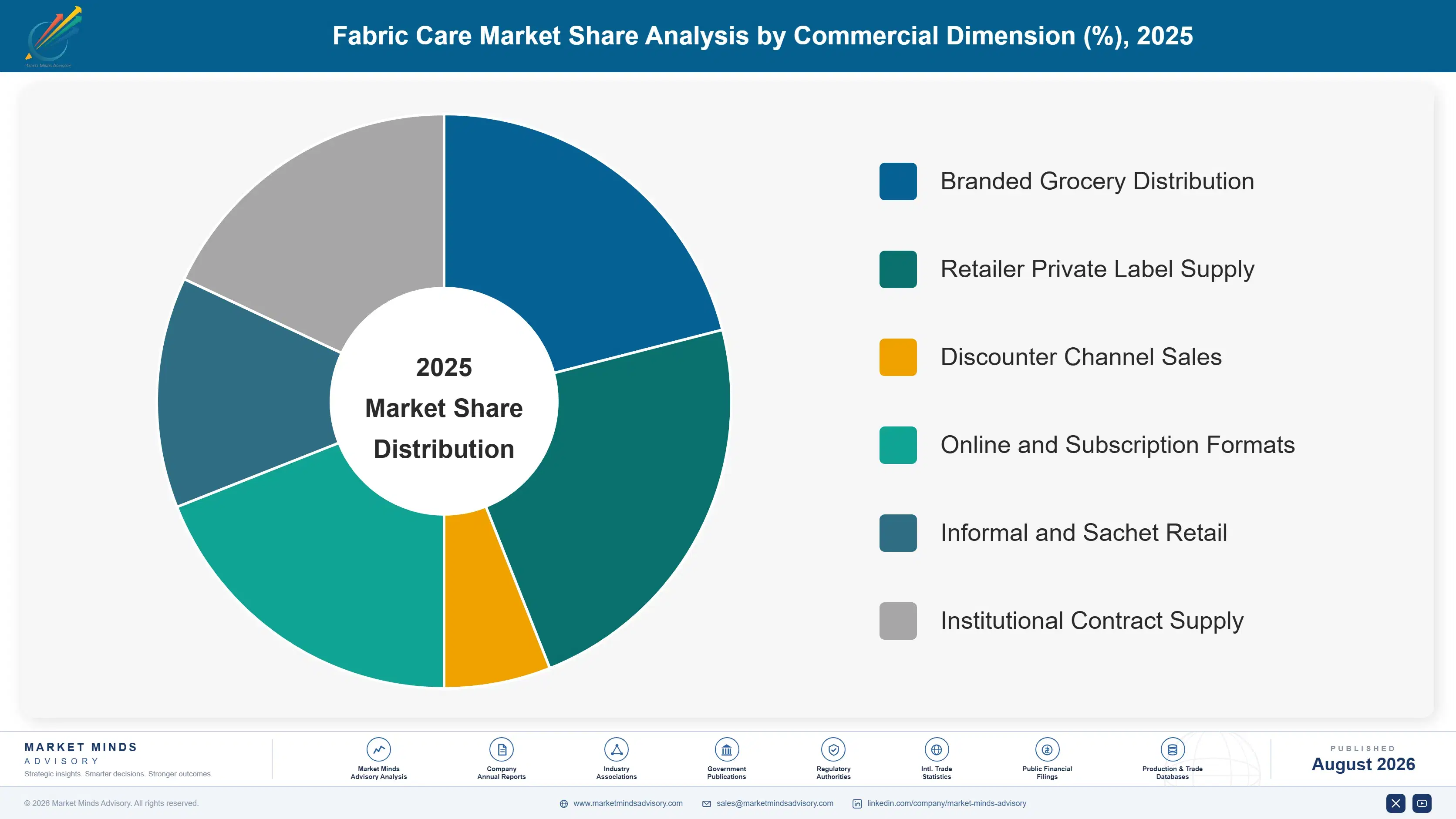
fabric-care-market-market-share-analysis-1788167788668

Cold Water and Enzyme-Optimised Detergents

The fastest category grows at 8.1%, half again the market rate of 5.4%, and it grows because the chemistry is genuinely hard. Conventional surfactants rely on heat to lift soil and lipid, and at around 31 degrees they do considerably less than the formulation intended. Enzyme systems that perform at low temperature are difficult to formulate, difficult to stabilise across a shelf life and difficult to copy at short notice, which is unusual in a category where private label matches most things within a season. It is the one place left where a household can observe a difference and a manufacturer can therefore charge for one. Nothing else here still works that way.
CAGR 8.1%

Commercial and Institutional Laundry Chemicals

Institutional chemicals grow at 7.2% on a buyer who behaves nothing like a household and is largely insulated from retail price competition. Hospitality, healthcare and commercial laundry operators purchase against measured consumption on multi-year contracts, evaluating cost per kilogram of textile processed rather than any shelf price. Specification is technical, dosing is automated and the supplier relationship persists across years rather than ending when somebody notices a promotion. Growth follows hospitality and healthcare activity, which makes it considerably more stable than anything happening in the retail half of this category. A buyer evaluating cost per kilogram of textile is running an entirely different calculation from a shopper comparing two boxes on a shelf.
CAGR 7.2%
Full segment breakdown across 6 segments available in the complete report.

Regional Architecture and Country Demand Map

Volume follows machine ownership and population while value follows temperature, format and income. South Asia and Pacific leads on volume and penetration growth, with East Asia and North America larger by value and Western Europe most advanced on cold washing. Those two measures diverge considerably here.

South Asia and Pacific

Out-of-band note: this region holds 22% against a band of 7 to 12% because it contains the largest laundry population anywhere alongside machine penetration still well below saturation, which no share band designed for developed markets accommodates. Growth is fastest in the report here at 7.4%, driven by Indian machine ownership rising steadily and by hand washing converting to powder and then to liquid formats. Regional manufacturers compete effectively on cost and distribution reach. Sachet and small pack formats reach households that cannot purchase a full pack. Volume and value pointing in opposite directions is the defining feature here, and it makes this region enormous by tonnage and considerably smaller by revenue than anybody expects.
Share: 22% | CAGR: 7.4% (2026 to 2036)

East Asia

A 24% share reflects high value per wash across Japanese and Korean markets where fabric care is taken seriously and premium formats command genuine pricing. Chinese volume is enormous and value per unit considerably lower, with domestic manufacturers holding strong positions built on distribution rather than formulation. Cold washing is well established across the region. Fragrance and finishing products take a larger share of spending here than in any other market, which supports category value beyond detergent itself. Fragrance and finishing spending running higher here than anywhere else is commercially useful, because it is exactly the attribute households describe when asked why they repurchase and exactly the one private label finds hardest to match.
Share: 24% | CAGR: 6.0% (2026 to 2036)
Regional intelligence for 5 additional markets available in the complete report: North America, Western Europe, Latin America, Middle East and Africa, Eastern Europe. Contact sales@marketmindsadvisory.com.
fabric-care-market-country-cagr-analysis-1788167789187

Where Fabric Care Margin Sits

Four levers work on verifiable performance, channel structure and format rather than on marketing weight, which private label has proved it can survive comfortably. Cold water evidence, institutional contracting, fragrance investment and emerging market formats each address the volume decline directly. None of the four requires a better detergent than any competitor already sells on the shelf.

Build Verifiable Cold Water Performance Claims

Low temperature enzyme systems are difficult to formulate and difficult to copy, which makes them the one remaining place a household can observe a difference and a manufacturer can charge for it. Cold water detergents grow at 8.1% against 5.4% for the market. Independent testing evidence costs perhaps 4 million dollars to assemble properly and gives a claim private label cannot readily match. Every other premium attribute in this category rests on something a consumer cannot test at all. A claim nobody can test is worth exactly what private label charges.
Market Impact: Grows at 8.1% against a 5.4% market rate

Contract Institutional Laundry Away From Retail Pressure

Hospitality, healthcare and commercial operators buy against measured consumption on multi-year agreements, evaluating cost per kilogram of textile rather than any shelf price, which removes them from the private label competition entirely. Volumes are substantial and the relationship persists across years. Dosing equipment placement makes switching genuinely inconvenient. Manufacturers organised purely around grocery are ignoring a buyer who cannot be reached by a discounter and does not respond to promotion at all. Institutional contracts here typically run 3 to 5 years against retail pricing that changes every single promotional cycle.
Market Impact: Buys against 1 contracted specification across several years

Invest In Fragrance Where Testing Cannot Reach

With cleaning performance now close between brand and private label, fragrance is the attribute households actually notice and describe when asked why they repurchase. Fragrance development and encapsulation technology are expensive and genuinely hard to replicate at value price points. It is a weaker foundation than cleaning performance and considerably better than packaging or habit. Premium tiers holding distinctive fragrance retain 20 to 30 percent better than those competing on cleaning claims nobody can verify. A 25% retention advantage costs sustained perfumery investment rather than any media weight at all.
Market Impact: Retains roughly 25% better than comparable branded alternatives

Engineer Small Pack Formats For Penetration Markets

Emerging market conversion happens through sachets and small packs sold in informal retail, reaching households that cannot fund a full pack purchase in one transaction. Formats designed for developed market grocery do not work in that channel at all. Sachet distribution reaches perhaps 3 times the household population a standard pack does in those markets. Manufacturers who never redesigned packaging for the channel have simply been absent from where the volume growth actually is. Volume growth and value growth are in different places, and only one of them requires a sachet.
Market Impact: Reaches roughly 3 times as many households overall

Who Controls the Margin Pool

Concentration sits around 58% across the five largest participants measured on fabric care product revenue, and it has held up better than the underlying pricing power has. Manufacturing scale, distribution reach and formulation capability all remain genuine advantages, but private label at 31% of volume demonstrates that none of them prevents a retailer specifying something competent at a lower price.
Competition runs on formulation capability, channel position and format innovation. Formulation capability matters most in cold water chemistry, where the difficulty is real and copying takes time. Channel position decides shelf access against a retailer who now sells a competing product. Format innovation has driven most of the value growth of the past two decades and the obvious moves have largely been made.

Pressure is arriving from private label and from regional manufacturers rather than from new international entrants. Discounters specify to contract manufacturers who understand this chemistry properly. Regional participants in growth markets hold distribution international brands cannot match domestically. Rankings will shift toward participants with genuine cold water evidence and institutional channel positions, since both sit outside the price competition governing everything else.
fabric-care-market-company-positioning-matrix-1788167789708

Competitive Moat and Risk Dimensions

PROCTER AND GAMBLE

Moat: Formulation depth and format leadership

Procter and Gamble holds formulation capability in enzyme and surfactant systems that private label reaches only through contract manufacturers, and it led the unit dose format transition that reshaped category value. Retail scale gives it category management influence that smaller manufacturers cannot approach. Sustained marketing investment maintains brand recognition that discounter own label competes against rather than simply displaces.
PROCTER AND GAMBLE

Risk: Premium tiers exposed to substitution

Premium positioning increasingly rests on fragrance, convenience and habit rather than on cleaning performance a household can verify, and private label formulations have closed most of the observable gap. Format innovation has fewer obvious moves remaining after two decades. Volume decline from falling dose sizes affects the largest participant most in absolute terms.
HENKEL

Moat: Cold chemistry and institutional reach

Henkel combines low temperature enzyme formulation strength with a substantial institutional and industrial laundry business, which reaches a buyer entirely insulated from retail price competition. European market position gives it early exposure to cold washing requirements that other regions are still moving toward. Dosing equipment placement in institutional accounts makes those relationships genuinely difficult to displace.
HENKEL

Risk: Concentration in private label markets

European exposure means competing in the markets where discounter private label share is highest and retailer specification capability is most developed. Cold water advantage narrows as contract manufacturers acquire the same enzyme technology over time. Institutional demand follows hospitality and healthcare activity rather than growing independently of it.

Players Tracked

Prominent Players

Procter and Gamble
Unilever
Henkel
Reckitt
Church and Dwight

Other Key Players

Kao Corporation
Lion Corporation
Colgate-Palmolive
SC Johnson
Ecolab
Diversey
Blue Moon Group
Liby Group
Nice Group
Wipro Consumer Care
Godrej Consumer Products
Jyothy Labs
Werner and Mertz
McBride
Dalli Group

Recent Developments

APRIL 2024

Discounter extended private label into premium detergent tiers

A discount grocery retailer extended its own label detergent range into premium tiers rather than competing only at value price points, using contract manufacturers with enzyme formulation capability that own label products had previously lacked. This was a retailer merchandising decision rather than any transaction between manufacturers.
Signal: Private label entering the premium tiers shows that retailers now command the formulation capability as well.
SEPTEMBER 2024

Efficiency labelling revision lowered reference wash temperature

A regulatory authority revised appliance efficiency labelling to reference a lower wash temperature in its testing protocol, pushing machine defaults and consumer behaviour further toward cold washing across every product sold into that market. This was regulatory action rather than any commercial arrangement between detergent manufacturers.
Signal: Regulation lowering reference temperatures makes cold water enzyme capability commercially decisive rather than merely optional now.
FEBRUARY 2025

Manufacturer expanded sachet distribution across informal retail

A fabric care manufacturer expanded sachet and small pack distribution across informal retail channels in emerging markets, reaching households unable to fund a full pack purchase in a single transaction. This was a distribution expansion rather than any acquisition or joint venture between participants in the category.
Signal: Small pack formats reach the households where volume growth actually is rather than where value is.

What A Wash Actually Costs

Cost divides four ways and surfactant chemistry dominates the formulation. Surfactants and enzymes absorb roughly 34% of manufacturing cost, builders, polymers and processing aids near 22%, packaging and unit dose film near 24%, and fragrance with minor ingredients the remaining 20%. Unit dose formats shifted cost toward packaging considerably, since the film and the moulding cost more than the powder container it replaced ever did.
Surfactant feedstock pricing moved sharply across recent years on petrochemical and palm derivatives together, and enzyme costs moved separately on fermentation capacity. Procter and Gamble and Henkel have both discussed input cost across recent reporting periods. Passing movement into retail pricing has become considerably harder with private label at 31% of volume, since a retailer holding a competent own label alternative simply adjusts relative shelf pricing instead.

Exposure varies by format and channel rather than by geography. Unit dose participants carry packaging cost that powder never had, against premium pricing that private label is now attacking. Institutional suppliers carry surfactant exposure against contracts that generally permit indexation. Regional manufacturers in growth markets operate cost structures international participants find genuinely difficult to match on domestic terms.
fabric-care-market-cost-volatility-analysis-1788167789907

Surfactant sourcing across petrochemical and oleochemical routes

Surfactants absorb roughly a third of formulation cost and price on petrochemical and palm derivative markets that move independently of one another. Formulation flexibility across both routes, qualified in advance rather than during a price spike, reduces exposure measurably. Manufacturers committed to a single feedstock route have absorbed movement that dual qualification would have avoided entirely.

Unit dose film cost engineered against format premium

Unit dose packaging costs considerably more than the container it replaced, and the format premium has to cover that before it contributes anything to margin. Film thickness, moulding efficiency and compartment design all move that cost measurably. Participants who priced the format on convenience alone without engineering the film cost have found the premium thinner than expected.

Indexation negotiated into institutional supply contracts

Institutional agreements run across multiple years while surfactant feedstock prices move on far shorter cycles, and contracts written without indexation transfer that risk entirely to the supplier. Customers accept indexation more readily on long agreements than manufacturers generally assume. Suppliers who omitted it are absorbing movement across contracts running for several more years yet.

Portfolio Architecture for Margin Defence

The portfolio separates by whether a consumer can verify anything. Mainstream detergents and fabric conditioners are the volume core and the exposed position: private label at 31% of volume, formulations that are genuinely close, and premium tiers resting on fragrance and habit rather than on any result a household could compare against an alternative. Nothing about that half of the category is defensible any more.
Margin concentrates in cold water chemistry and in institutional supply. Low temperature enzyme systems are hard to formulate and hard to copy, which makes them the one remaining verifiable claim. Institutional contracts sit entirely outside retail price competition, run for years and involve dosing equipment that makes switching inconvenient. Both are defended by something real. Both sit outside the retail price competition.

The overlooked pool is emerging market format engineering. Sachets and small packs reach households that cannot fund a full pack in one transaction, distribution runs through informal retail that developed market packaging cannot serve, and this is where the volume growth genuinely is. Manufacturers who never redesigned for that channel are absent from it entirely. That is where the growth actually is.

Volume / Commodity-Adjacent

Mainstream powder and liquid detergents, private label supply and value tier products competing on shelf. Range spans ten points because manufacturing scale and feedstock position decide outcomes far more than branding does.
Gross Margin: 22-32%

Premium / Certified

Unit dose formats, premium branded detergents, fabric conditioners and laundry fragrance products. Range spans twelve points because format premium and packaging cost vary considerably between participants in this tier. Packaging cost decides much.
Gross Margin: 34-46%

Sustainability / Regulatory / Next-Generation

Cold water enzyme systems, specialist stain treatments and commercial institutional laundry chemicals. Range spans sixteen points because retail and contracted institutional economics are barely comparable within a single tier. Contract structure separates them.
Gross Margin: 42-58%
fabric-care-market-portfolio-architecture-1788167790408

High-value Sub-segments and Strategic Watch-out

Cold Water and Enzyme-Optimised Detergents

High value and high growth at 8.1%, resting on chemistry that is genuinely difficult to formulate and to copy quickly. The fourteen point range separates participants holding independent performance evidence from those making cold water claims without any testing behind them. Difficulty is the whole protection.
Gross Margin: 44-58%

Commercial and Institutional Laundry Chemicals

High value with moderate growth at 7.2%, contracted across years and entirely insulated from the retail price competition elsewhere. The twelve point range reflects whether dosing equipment is placed, since installed equipment makes switching suppliers genuinely inconvenient for an operator. Nobody reaches this buyer through a shelf.
Gross Margin: 40-52%

Mainstream Detergents and Conditioners

The volume core and the most exposed position anywhere in this category today. Private label at nearly a third of volume, formulations that have closed most of the observable gap, and premium tiers resting on attributes nobody can actually test. Nothing about this position is defensible.
Gross Margin: 22-32%

Falling Dose Per Wash

The strategic watch-out rather than a growth pool. Concentration, unit dose and cold washing have all reduced grams consumed, every one of those changes is permanent, and a business paid by the gram absorbs each of them. Nothing has ever once reversed one of them.
Gross Margin: Variable

Why Households Keep Repurchasing

Fabric care produces annuity economics of the most ordinary and reliable kind. Every household with a machine buys detergent repeatedly for as long as it owns one, purchase frequency is high and the decision is barely considered after the first few times. That reliability is what makes the falling dose so awkward, because the frequency holds while the quantity consumed on each occasion keeps declining year after year.
Stickiness varies by what the household actually notices. Fragrance creates genuine repurchase habit because it is the attribute people describe when asked why they buy what they buy. Format familiarity holds unit dose buyers reasonably well. Cleaning performance holds almost nobody now, since private label closed that gap and a household comparing two competent products chooses on price. Institutional relationships are stickiest of all, held by dosing equipment and contract terms.

The buyer has become more willing to compare. Cost of living pressure moved households into private label and most of them stayed after trying it, because the product worked. That single discovery is the most commercially significant development in this category for a generation, and no amount of marketing weight has yet reversed it in any developed market.
fabric-care-market-end-use-penetration-index-1788167790896

Where Manufacturers Should Commit

These are among the four positions where our research anticipates prominent divergence between winners and laggards over the coming forecast period. Each is grounded in the demand model, the regulatory perimeter, and the announced capacity pipeline.
01 / COLD WATER EVIDENCE BUILDING

The last claim a household can actually verify

Low temperature enzyme systems are difficult to formulate, difficult to stabilise across a shelf life and difficult to copy at short notice, which makes them the one remaining place a household can observe a difference and a manufacturer can therefore charge for it. Cold water detergents grow at 8.1% against 5.4% for the wider market as a whole. Independent testing evidence costs perhaps four million dollars to assemble properly and gives a claim that private label cannot readily match at all.
02 / INSTITUTIONAL CHANNEL CONTRACTING

A buyer no discounter can ever reach

Hospitality, healthcare and commercial laundry operators all purchase against measured consumption on multi-year supply agreements, evaluating the cost per kilogram of textile processed rather than any shelf price at all, which removes them from any private label competition altogether entirely. Volumes here are substantial and the relationship persists across many years rather than ending at the next promotion. Dosing equipment placement also makes switching genuinely inconvenient, and manufacturers organised purely around grocery distribution are ignoring that buyer completely and entirely.
03 / FRAGRANCE INVESTMENT PRIORITY

Households describe smell, not cleaning performance

With cleaning results now genuinely close between branded and private label products, fragrance is now the attribute households actually notice and describe when asked why they repurchase a particular detergent at all. Fragrance development and encapsulation technology are both expensive and genuinely difficult to replicate at any value price point anywhere. It is a weaker foundation than cleaning performance once was and considerably better than packaging or habit, and premium tiers holding distinctive fragrance retain measurably better than the rest.
04 / PENETRATION FORMAT ENGINEERING

Full packs do not reach the growth households

Emerging market conversion happens mostly through sachets and small packs sold in informal retail, reaching households that simply cannot fund a full pack purchase in one single transaction anywhere at all. Formats designed for developed market grocery shelves do not work in that channel at all and they never have done. Sachet distribution reaches perhaps three times the household population a standard pack does, and manufacturers who never redesigned packaging are absent from where the volume growth actually is today.

Engagement Snapshot From the Field

A live engagement with an industry participant carrying material or product regulatory and market exposure ahead of a defining policy shift, showing how our research translates into a defensible multi-year portfolio strategy.
MARKET MINDS ADVISORY · CLIENT ENGAGEMENT SUMMARY
Fabric Care Producer Strategic Portfolio Review and Transition Roadmap 2026·Investment Scenario on Fabric Care Exposure Evaluation 2025-26
CLIENT PROFILE
A branded fabric care manufacturer selling detergents and conditioners across five developed markets, with strong unit dose positions, no institutional business and no independent cold water performance evidence. Volume had declined for four consecutive years while the company had raised prices to compensate, and management described the decline as private label competition rather than as falling dose per wash.
STRATEGIC CHALLENGE
The board needed to establish how much of the volume decline was dose compression rather than share loss, and whether assembling independent cold water evidence justified the cost against continued brand marketing. It also faced a decision on entering institutional laundry supply, which the commercial organisation regarded as a low margin industrial business outside its consumer competence.
MMA APPROACH
MMA decomposed four years of volume decline into dose, penetration and share effects across all five markets, separating permanent consumption change from anything competitive. It modelled cold water evidence development against continued marketing investment. Expert interviews with retailers, contract manufacturers, institutional operators and consumers established what buyers actually notice and pay for.
KEY FINDINGS
  1. Falling dose per wash explained roughly three fifths of the volume decline, and share loss to private label accounted for considerably less than management had assumed throughout.
  2. Consumers describing why they repurchased named fragrance far more often than cleaning performance, which the client's marketing had never emphasised in any market.
  3. Private label products in three markets matched the client's formulations closely enough that blind comparison produced no consistent preference among tested households.
  4. Institutional laundry margins at comparable suppliers exceeded the client's retail margins, and dosing equipment placement made those customer relationships considerably more durable.
CLIENT PROFILE
A branded fabric care manufacturer selling detergents and conditioners across five developed markets, with strong unit dose positions, no institutional business and no independent cold water performance evidence. Volume had declined for four consecutive years while the company had raised prices to compensate, and management described the decline as private label competition rather than as falling dose per wash.
STRATEGIC CHALLENGE
The board needed to establish how much of the volume decline was dose compression rather than share loss, and whether assembling independent cold water evidence justified the cost against continued brand marketing. It also faced a decision on entering institutional laundry supply, which the commercial organisation regarded as a low margin industrial business outside its consumer competence.
MMA APPROACH
MMA decomposed four years of volume decline into dose, penetration and share effects across all five markets, separating permanent consumption change from anything competitive. It modelled cold water evidence development against continued marketing investment. Expert interviews with retailers, contract manufacturers, institutional operators and consumers established what buyers actually notice and pay for.
KEY FINDINGS
  1. Falling dose per wash explained roughly three fifths of the volume decline, and share loss to private label accounted for considerably less than management had assumed throughout.
  2. Consumers describing why they repurchased named fragrance far more often than cleaning performance, which the client's marketing had never emphasised in any market.
  3. Private label products in three markets matched the client's formulations closely enough that blind comparison produced no consistent preference among tested households.
  4. Institutional laundry margins at comparable suppliers exceeded the client's retail margins, and dosing equipment placement made those customer relationships considerably more durable.
RECOMMENDED STRATEGY
Phase 1: Phase one: commission independent cold water performance testing and build claims around the one attribute private label cannot readily match. Phase 2: Phase two: redirect marketing emphasis toward fragrance, which households actually describe, rather than toward cleaning claims that nobody can actually verify. Phase 3: Phase three: enter institutional laundry supply through acquisition rather than organic build, given the dosing equipment placement that it clearly requires.
OUTCOME
The client reported premium tier share stabilising within five quarters after fragrance-led repositioning (client-reported, unverified by MMA). Cold water testing produced usable claims in two of the five markets. An institutional acquisition was approved, and volume decline continued as dose compression had already predicted that it would.

Frequently Asked Questions

Foundational context covering the market sizes, CAGR, scope, country, region and competition that inform every finding below. This section is provided to cover basics and most often pre-purchase conversations, answered from the MMA Primary Research Dataset.

What is the current size of the Fabric Care Market?

The market is valued at USD 94.0 billion in 2025, measured as revenue from products used to clean, condition and treat textiles in domestic and commercial laundry.

How large will the Fabric Care Market be by 2036?

MMA forecasts USD 167.64 billion by 2036, up from USD 99.08 billion in 2026. That represents incremental revenue of USD 68.56 billion and an expansion multiple of 1.69 times.

What is the CAGR for the Fabric Care Market 2026 to 2036?

The base case CAGR is 5.4%, with a bull case of 6.6% and a bear case of 4.2%. Cold water chemistry and emerging market penetration supply most of that.

Which segment is growing fastest?

Cold water and enzyme-optimised detergents grow at 8.1%, half again the market rate of 5.4%, because low temperature chemistry is genuinely difficult to formulate and copy.

Who are the major companies in the Fabric Care Market?

Procter and Gamble, Unilever, Henkel, Reckitt and Church and Dwight lead on category revenue, holding around 58% between them across both retail and institutional channels.

Which country is growing fastest?

India grows fastest at 7.4%, driven by machine ownership rising steadily and by hand washing converting first to powder and then to liquid detergent formats.

Report Segmentation Architecture

The full report scope spans multiple orthogonal segmentation dimensions, with cross-tabulated demand data provided for each dimension pair. Coverage extends further to regional breakdowns, trend trajectories, and the competitive detail needed to support segment-level decision-making.

By Product Function

  • Cold Water and Enzyme-Optimised Detergents
  • Unit Dose and Concentrated Formats
  • Fabric Conditioners and Softeners
  • Stain Removers and Pre-Treatment Products
  • Laundry Fragrance and Finishing Products
  • Commercial and Institutional Laundry Chemicals

By End-Use Industry

  • Household Machine Laundry
  • Hand Washing Households
  • Hotels and Hospitality Laundry
  • Healthcare and Care Facilities
  • Commercial Laundry Services
  • Textile Rental and Workwear

By Commercial Dimension

  • Branded Grocery Distribution
  • Retailer Private Label Supply
  • Discounter Channel Sales
  • Online and Subscription Formats
  • Informal and Sachet Retail
  • Institutional Contract Supply

By Region

  • South Asia and Pacific
  • East Asia
  • North America
  • Western Europe
  • Latin America
  • Middle East and Africa
  • Eastern Europe

Scope, Methodology, and Coverage

Every figure in this report is reproducible from documented input assumptions. The scope below maps the historical period, the forecast horizon, the segmentation dimensions, and the countries covered, alongside the underlying primary and qualitative methodology.
Historical Period
2020 to 2025
Forecast Period
2026 to 2036
Base Year
2025 (USD billions; MMA Primary Research Dataset, August 2026)
Market Definition
Revenue from products used to clean, condition and treat textiles in domestic and commercial laundry, spanning cold water and enzyme-optimised detergents, unit dose and concentrated formats, fabric conditioners and softeners, stain removers and pre-treatment products, laundry fragrance and finishing products, and commercial and institutional laundry chemicals. Branded grocery distribution, retailer private label supply, discounter channels, online and subscription formats, informal and sachet retail and institutional contract supply are all included. Washing machines and appliances, dry cleaning solvents and services, machine cleaning and descaling products, and textile finishing chemicals applied during manufacture are excluded.
Quantitative Units
USD billions, fabric care product revenue at manufacturer level
Segmentation Dimensions
Product function, laundry setting, distribution channel, region
Regions Covered
South Asia and Pacific, East Asia, North America, Western Europe, Latin America, Middle East and Africa, Eastern Europe
Countries Covered
India, China, Indonesia, Japan, United States, Brazil, Mexico, Germany, United Kingdom, France, Turkey, Nigeria, Poland, Australia
Key Companies Profiled
Procter and Gamble, Unilever, Henkel, Reckitt, Church and Dwight, Kao Corporation, Ecolab, Blue Moon Group, Godrej Consumer Products, McBride
Quantitative Methodology
Primary survey, n=3,800 respondents, Q4 2025, six countries; demand-side model with trade association cross-validation
Qualitative Methodology
47 expert interviews, Q4 2025; applied to validate demand model assumptions, identify emerging dynamics, and assess competitive positioning
Report Format
PDF and XLSX data workbook (Word format preview document)
Publisher
Market Minds Advisory
Report Code
MMA-2026-CHM-181
Published
August 2026
Contact
sales@marketmindsadvisory.com | www.marketmindsadvisory.com

Purchase the full Fabric Care Market Report (2026 to 2036).

The full report examines a category where every improvement to the product reduces how much of it gets sold. It decomposes volume movement into dose compression, penetration and share effects across every major market, quantifies private label advance against the formulation gap that has now closed, and assesses cold water enzyme chemistry as the last verifiable claim available to anybody. Segment analysis covers all six product functions, with particular attention to cold water detergents and institutional supply where defensible positions actually remain. Competitive assessment ranks twenty participants on fabric care product revenue.
Six product function segmentation with growth rates
Volume decline decomposed into dose and share effects
Twenty participant assessment on fabric care revenue
Private label advance tracked against formulation capability
Cold water enzyme performance assessed as verifiable claim
Institutional contract economics compared with retail pricing

Built For The People Who Decide

From boardroom strategy to bench-side execution, this report is read cover-to-cover by leaders shaping the next decade of their industry, turning demand scenarios, market dynamics and valuation benchmarks into decisions.
CXOs/ Presidents/ VPs/ Managers
M&A and Corporate Development
Strategy Teams and R&D Heads
Procurement and Product Directors
Regulatory and Compliance Leaders
Investor Relations and Equity Analysts