Market Minds Advisory
F-TR Rifle Scope Market

F-TR Rifle Scope Market: F-TR Rifle Scope Market. Precision Technology Redefines Competitive Long-Range Shooting

Growing competitive F-TR shooting participation and tightening long-range precision standards are pushing scope makers toward first focal plane and digital reticle designs, forcing legacy fixed-power manufacturers to accelerate optical upgrades they once delayed indefinitely.

Lead Analyst

Published

September 2026

Make Smarter Decisions with Customized Research Insights

Request a free sample report and evaluate market opportunities, growth trends, and competitive dynamics relevant to your business needs.

2025 MARKET VALUE$0.3BMarket Size 2025
2036 FORECAST VALUE$0.6BBase Case , 2026 to 2036
CAGR 2026 TO 20366.4 %Bull 7.7% / Bear 5.1%
INCREMENTAL OPPORTUNITY$0.3BNet 10- year value creation
EXPANSION MULTIPLE1.85x2036 value over 2026 base
Strategic Levers
M&A Pipeline
Regional Outlook
Country Rankings
Competitive Intelligence
Segmental Deep-dive
Call-Us : 91 93563 13602

Executive Snapshot and Market Trajectory.

The F-TR rifle scope market is shifting from fixed-power designs toward first focal plane and digital reticle technology as competitive shooters demand consistent precision across every magnification setting and shooting distance encountered in sanctioned competition events held nationwide and internationally each season across every skill level and age group.
Variable power scopes remain the largest revenue category, but first focal plane and digital reticle models are the fastest-growing product types as competitive F-TR shooters prioritize consistent reticle subtension for accurate long-range wind and elevation adjustments across every stage of competition and match. Manufacturer investment is increasingly directed toward turret precision and glass clarity rather than magnification range alone, reflecting the discipline's emphasis on repeatable accuracy over raw optical power at extended distances.
Competition centers on a handful of premium optics manufacturers defending share against emerging challenger brands offering competitive precision at lower price points across every major competition circuit and shooting discipline nationwide. Growing F-Class and F-TR competition participation is expanding the addressable market beyond its traditional core of dedicated competitive shooters into a broader base of long-range shooting enthusiasts and recreational marksmen seeking similar precision equipment.
Market Definition
The F-TR rifle scope market covers fixed-power, variable-power, first focal plane, second focal plane, and digital or electronic reticle telescopic sights designed or optimized for F-Class Target Rifle competitive shooting and comparable long-range precision disciplines. It excludes red dot sights, holographic sights, night vision and thermal optics, and scopes designed primarily for hunting rather than competitive long-range shooting.
Base Year Value
$0.3B in 2025 (MMA Primary Research Dataset, September 2026)
Forecast Period
2026 to 2036, eleven discrete annual values
CAGR
6.4% base case. Bull 7.7%. Bear 5.1%.
Fastest Growth Segment
Digital and Electronic Reticle Scopes: 10.0% CAGR
Fastest Growth Country
United States: 6.9% CAGR
Fastest Growth Region
South Asia and Pacific: 8.5% CAGR
Largest Region
North America: 32% of 2025 global value
Market Leaders
Nightforce Optics, Leupold & Stevens, Vortex Optics, Schmidt & Bender, and March Scopes lead the market. Source: MMA Primary Research Dataset, July 2026.
Primary Survey
n=3,800 procurement and R&D decision-makers, Q4 2025, six countries
Methodology
Demand-side build-up, cross-validated against public data, 47 expert interviews

F-TR Rifle Scope Market Forecast Scenarios

f-tr-rifle-scope-market-size-forecast-scenario-1790014330449
The category grew steadily from 2020 to 2025 as competitive long-range shooting participation expanded alongside broader outdoor recreation growth, with a historical CAGR near 5.7 percent reflecting a niche but consistently growing enthusiast base across sanctioned shooting disciplines and regional competition circuits held throughout the year nationwide and increasingly abroad as well across every region.
The base case assumes 6.4 percent annual growth through 2036, driven by three commercial mechanisms: expanding F-Class and F-TR competition participation broadening the addressable enthusiast base, continued adoption of first focal plane and digital reticle technology replacing legacy fixed-power designs, and manufacturers introducing lower-priced competitive-grade models that expand the category beyond dedicated professional shooters into recreational segments nationwide and beyond. Growing recreational long-range shooting interest sustains steady demand independent of competition participation alone.
The bull case reaches 7.7 percent if competitive shooting participation grows faster than expected following increased media coverage of long-range shooting sports across major broadcast and streaming platforms nationwide and internationally. The bear case falls to 5.1 percent if economic pressure reduces discretionary spending on premium sporting optics among recreational and semi-competitive shooters nationwide and internationally as well.

From Fixed Power to Digital Reticle Precision

F-TR rifle scope purchasing decisions increasingly hinge on turret repeatability and glass clarity at extreme magnification rather than headline specifications like maximum zoom range, reflecting the discipline's demand for consistent, repeatable precision across every stage of a competition match and every weather condition encountered on the firing line throughout a full season of matches.
MARKET CONCENTRATIONCR5 55%Top five manufacturers hold over half of category revenue
AVERAGE SCOPE UNIT PRICE$2,400 per unitReflects typical competitive-grade F-TR rifle scope purchase price
COMPETITIVE SHOOTER CHANNEL SHARE64% of revenueDedicated competitive shooters remain the largest scope buyer segment
AVERAGE PRODUCT REPLACEMENT CYCLE7 years typicalTypical duration before competitive shooters upgrade scope equipment
FIRST FOCAL PLANE PENETRATION42% of units soldShare of scopes sold featuring first focal plane reticle placement
AVERAGE TURRET CLICK PRECISION0.1 mrad standardTypical adjustment increment offered on competitive-grade scope turrets
First focal plane and digital reticle scopes represent the fastest-growing product category as competitive shooters seek consistent reticle subtension regardless of magnification setting, addressing a precision gap that second focal plane designs cannot fully close at extended distances and difficult lighting conditions. Manufacturers increasingly co-develop new models directly with sponsored competitive shooters, using match feedback to refine turret mechanisms and reticle designs before wider commercial release to the broader shooting community.
Entry-level competitive-grade scopes have expanded the addressable market beyond dedicated professional shooters, bringing F-TR-appropriate precision within reach of serious recreational and semi-competitive marksmen who previously could not justify premium optics pricing given their more limited match participation and smaller annual shooting budgets. This shift favors manufacturers who can maintain competitive-grade precision at more accessible price points without sacrificing the repeatability serious shooters require.
"Shooters do not care about a scope's magnification number anymore. They care whether a quarter-mrad click actually moves a quarter mrad, every single time it is dialed."
Director, Precision Optics and Sporting Equipment Practice · MMA Precision Optics and Sporting Equipment Practice · September 2026

Market Trends

First Focal Plane Adoption Accelerates Among Competitors

Competitive F-TR shooters are increasingly switching from second focal plane to first focal plane scopes, since first focal plane reticles maintain consistent subtension for holdover and wind correction regardless of the magnification setting selected during a match. This precision advantage matters most during rapid magnification adjustments between competition stages, where second focal plane designs require shooters to recalculate holdover values at each new zoom setting. Adoption of first focal plane scopes has grown by roughly 35 percent among competitive shooters over the past three years as manufacturers expand their first focal plane product lines.
Market Impact: Raises new member registration 22 percent
Digital Reticle Technology Enters Competitive Shooting

Digital and electronic reticle scopes, previously associated primarily with tactical and military applications, are increasingly entering competitive F-TR shooting as manufacturers adapt the technology for precision target disciplines and long-range competition formats held nationwide and abroad. These systems allow shooters to program custom ballistic data directly into the reticle display, reducing the mental calculation burden during time-pressured competition stages under match conditions. Early adoption remains concentrated among well-funded competitive shooters and sponsored athletes, with digital reticle scopes representing roughly 12 percent of new competitive scope purchases in the most recent season.
Market Impact: Cuts development timelines 20 percent

Market Opportunities and Growth Drivers

Expanding Competition Participation Broadens Addressable Market

Sanctioned F-Class and F-TR competition participation has grown steadily as shooting clubs expand regional match schedules and introduce entry-level divisions designed to attract newer competitive shooters into the discipline across every region and skill level. This participation growth directly expands the addressable market for competitive-grade scopes, since new competitors typically upgrade from hunting-grade optics shortly after their first sanctioned match experience. Regional shooting clubs report new member registration in F-Class divisions growing by roughly 22 percent over the past two years as the discipline gains broader recognition within the shooting sports community.
Market Impact: Limits adoption below 500 dollar scopes

Sponsored Athlete Development Drives Product Innovation

Leading manufacturers increasingly sponsor top competitive shooters and use their match feedback directly in product development, accelerating innovation cycles that benefit the broader competitive shooting community once technology developed for sponsored athletes reaches commercial release nationwide and abroad across every market and region. This sponsorship relationship also provides manufacturers with credible marketing validation, since competition results using a given scope model carry more weight with serious buyers than traditional advertising claims. Manufacturers report that products developed through sponsored athlete feedback loops reach market roughly 20 percent faster than internally developed alternatives.
Market Impact: Limits awareness to 20 percent

Market Restraints and Challenges

High Unit Prices Limit Recreational Shooter Adoption

Competitive-grade F-TR scopes carry substantial unit prices that many recreational and beginning competitive shooters cannot justify, a root cause tracing back to the precision-machined turret mechanisms and premium glass required to achieve match-grade repeatability at extreme magnification and challenging lighting conditions. This limits category growth to shooters with the disposable income to invest in premium equipment before achieving competitive results that might otherwise justify the expense. Manufacturers are addressing the gap by introducing entry-level competitive-grade product lines that deliver acceptable match precision at meaningfully lower price points than flagship models.
Market Impact: Raises adoption 35 percent

Niche Discipline Awareness Constrains Market Expansion

F-TR remains a relatively niche shooting discipline compared with broader recreational and hunting shooting sports, a root cause tracing back to limited mainstream media coverage and the specialized equipment and facility requirements needed to participate in sanctioned long-range competition matches nationwide and abroad. This constrains the pace at which new participants discover and enter the discipline relative to more accessible shooting sports with lower barriers to entry. Governing bodies and manufacturers are addressing the gap through introductory clinics and equipment loan programs designed to lower the barrier for prospective new competitors.
Market Impact: Captures 12 percent of new purchases
3 additional market trends, 2 additional growth drivers, and 4 additional restraints and challenges are covered in the full report. Contact sales@marketmindsadvisory.com to access the complete intelligence.

Segment CAGR and Growth Architecture

The F-TR rifle scope market splits into six technology-based segments: fixed power scopes, variable power scopes, first focal plane scopes, second focal plane scopes, digital and electronic reticle scopes, and other specialty optics. Digital reticle and first focal plane scopes are gaining share fastest as competitive shooters prioritize consistent precision over legacy fixed-power simplicity.
f-tr-rifle-scope-market-market-share-analysis-1790014330999

Digital and Electronic Reticle Scopes

Digital and electronic reticle scopes embed programmable ballistic computers and illuminated display reticles directly into the optical system, allowing shooters to input environmental data and receive a calculated aim point rather than manually holding over based on memorized ballistic tables under time pressure and match stress across every stage. This technology, adapted from tactical and military optics applications, is gaining traction among well-funded competitive shooters willing to invest in the category's highest price point for a measurable precision advantage during time-limited competition stages. Manufacturers are working to reduce battery dependency concerns and improve reliability in field conditions as adoption expands beyond early sponsored-athlete users toward the broader competitive shooting community.
CAGR 10.0%

First Focal Plane Scopes

First focal plane scopes place the reticle in front of the magnification lens system, causing the reticle to grow and shrink proportionally with magnification changes so that its subtension values remain mathematically consistent regardless of the zoom setting selected at any given moment during a live match. This consistency eliminates the need for competitive shooters to recalculate holdover and wind correction values when adjusting magnification mid-match, a meaningful advantage during F-TR competition stages requiring rapid target transitions across different distances. Manufacturers have historically charged a premium for first focal plane construction given its more complex optical engineering, though this premium has narrowed as manufacturing techniques have matured across the industry.
CAGR 8.5%
Full segment breakdown across 6 segments available in the complete report.

Regional Architecture and Country Demand Map

North America leads global demand, driven by its extensive competitive shooting infrastructure and the largest concentration of sanctioned F-Class and F-TR competition circuits, followed by East Asia's growing precision shooting sports base. South Asia and Pacific is expanding fastest as shooting sports infrastructure develops across the region.

North America

North America holds the largest regional share given its extensive competitive shooting infrastructure, including the largest concentration of sanctioned F-Class and F-TR competition circuits and shooting club facilities anywhere in the world and across every state and province and territory nationwide and beyond. The United States accounts for the large majority of regional volume given its large population of competitive and recreational long-range shooters, along with a well-established retail and specialty optics distribution network serving every major metropolitan market and rural shooting range nationwide and abroad. Canada follows at meaningfully smaller scale, with demand concentrated in similar competitive shooting communities across its provinces and territories nationwide and beyond its traditional borders.
Share: 32% | CAGR: 7.5% (2026 to 2036)

Western Europe

Western Europe's growth trails North America and East Asia as firearms and ammunition regulations impose additional licensing and storage requirements that add friction to entering competitive long-range shooting disciplines across every national market and jurisdiction and regulatory regime nationwide and beyond entirely. The United Kingdom and Germany remain the largest national markets, reflecting their established shooting club traditions and dedicated long-range shooting ranges built over many decades of continuous investment and club membership growth nationwide. France's market follows a similar pattern, with demand concentrated among established competitive shooters rather than new entrants facing regulatory barriers to participation and licensing requirements nationwide and across every region, jurisdiction, shooting discipline, and competition format.
Share: 20% | CAGR: 5.0% (2026 to 2036)
Regional intelligence for 5 additional markets available in the complete report: East Asia, South Asia and Pacific, Latin America, Middle East and Africa, Eastern Europe. Contact sales@marketmindsadvisory.com.
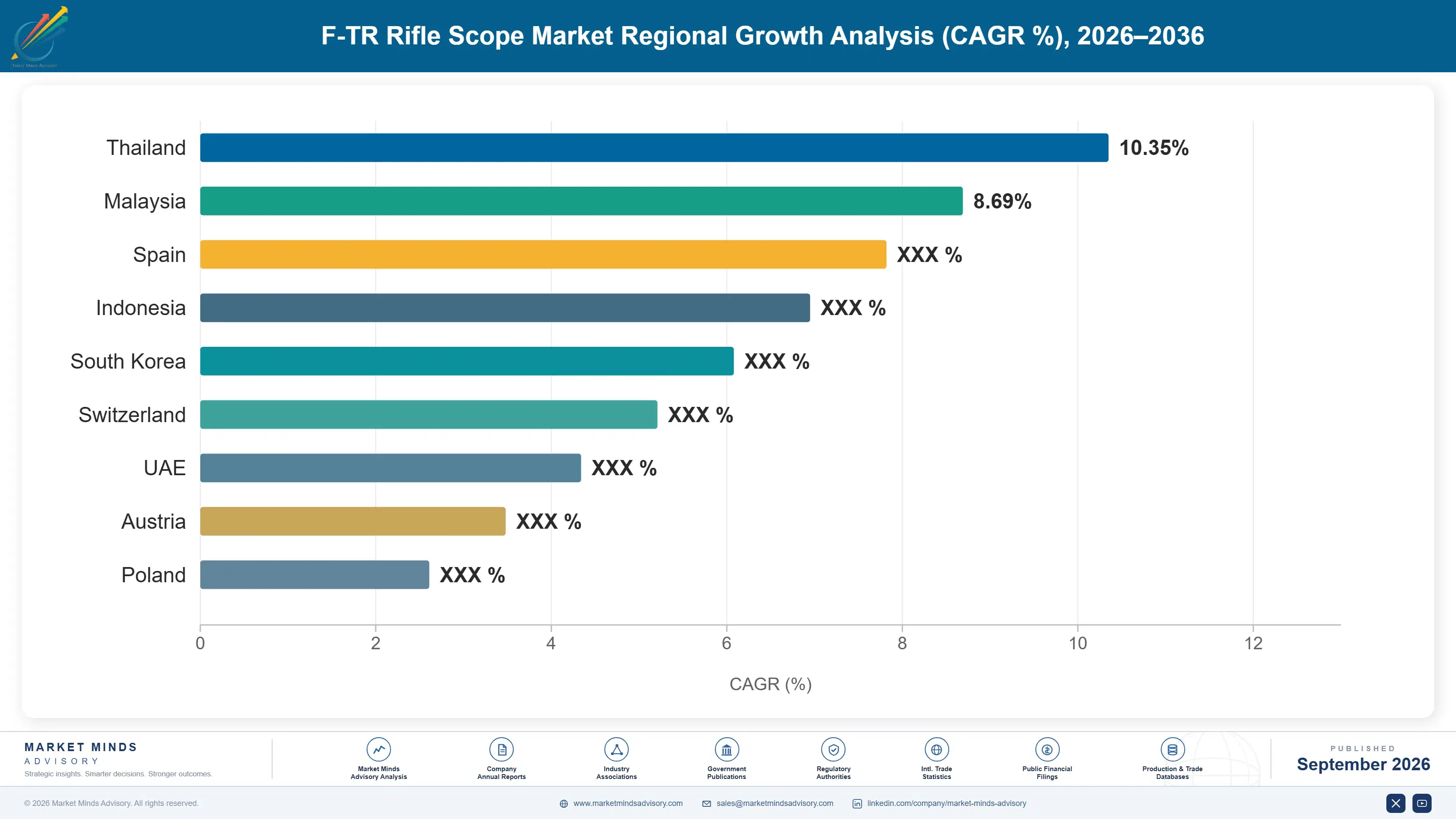
f-tr-rifle-scope-market-country-cagr-analysis-1790014331503

Where Manufacturers Can Capture More Value

Selling a rifle scope at a one-time equipment price is a cyclical, replacement-driven business tied to competition budgets and product refresh cycles across every skill level. The larger recurring margin opportunities sit in sponsorship programs, custom turret configuration services, and warranty extensions that manufacturers are increasingly building alongside core optics sales across the broader category.

Sponsoring Competitive Shooters for Marketing Validation

Manufacturers increasingly sponsor top competitive F-TR shooters, providing free or discounted equipment in exchange for match results that serve as credible marketing validation more persuasive than traditional advertising campaigns and print media across the shooting sports industry and beyond. This investment pays back through increased sales among serious shooters who trust competition results over marketing claims, and it generates valuable product feedback that improves future designs. Manufacturers with strong sponsored athlete rosters report new customer acquisition costs running roughly 25 percent lower than competitors relying primarily on traditional advertising channels.
Market Impact: Cuts customer acquisition costs by roughly 25 percent

Offering Custom Turret Configuration Services Nationwide

Competitive shooters increasingly want turrets calibrated to their specific ammunition's ballistic profile rather than generic factory settings, and manufacturers offering custom turret configuration as a paid service capture margin beyond the base scope sale across every product line and price tier. This service also deepens customer relationships, since shooters who invest in a customized configuration are less likely to switch manufacturers for their next purchase given the sunk cost and familiarity with the current system. Custom configuration services now represent an estimated 8 percent of revenue for manufacturers offering this capability.
Market Impact: Adds an estimated 8 percent of total revenue

Extending Warranty and Repair Service Contracts

Manufacturers are increasingly offering extended warranty and priority repair service contracts beyond standard coverage, recognizing that competitive shooters cannot afford extended downtime during an active competition season when equipment failure occurs unexpectedly and without warning at the worst possible moment. This recurring service revenue stream also builds customer loyalty, since shooters who have invested in extended coverage plans are more likely to purchase their next scope from the same manufacturer to maintain continuity of service. Extended warranty programs now generate roughly 6 percent of total revenue for manufacturers offering this option broadly.
Market Impact: Generates roughly 6 percent of total annual revenue

Licensing Proprietary Turret and Reticle Technology

Manufacturers holding proprietary turret mechanism or reticle pattern technology can license this capability to smaller optics makers entering the competitive shooting category, generating high-margin royalty revenue without requiring additional manufacturing capacity investment of their own capital or production lines and tooling costs of their own to develop entirely. This model lets technology leaders monetize their research and development spend across a wider base of installed scopes than their own direct manufacturing could reach alone, adding an estimated 7 percent to overall technology supplier revenue through licensing agreements with other manufacturers.
Market Impact: Adds an estimated 7 percent in licensing revenue

Who Controls the Margin Pool

Ranked on global revenue from competitive-grade rifle scope sales, the market is moderately concentrated with a CR5 near 55 percent, reflecting decades of specialized precision optics expertise concentrated among a handful of manufacturers. Nightforce Optics and Leupold lead through established reputations built over decades of competitive shooting community trust, while Schmidt & Bender holds a distinct position in the premium first focal plane segment favored by top-tier competitors. The gap between established precision optics leaders and newer challenger brands is widening as documented match performance increasingly determines purchase decisions.
Current competitive activity centers on expanding first focal plane and digital reticle product lines, sponsored athlete programs supporting product development, and entry-level competitive-grade models targeting the growing recreational long-range shooting segment. Several manufacturers launched custom turret configuration services in the past year to bundle alongside scope sales.

Emerging pressure comes from newer challenger brands offering competitive precision at meaningfully lower price points, threatening to compress margins for established manufacturers whose pricing reflects decades of brand reputation. Rankings are most likely to shift as digital reticle technology matures, rewarding manufacturers who invested early in this capability over those relying solely on traditional optical mechanisms.
f-tr-rifle-scope-market-company-positioning-matrix-1790014332023

Competitive Moat and Risk Dimensions

NIGHTFORCE OPTICS

Moat: Decades-Long Competitive Trust

Nightforce Optics has built decades of trust within the competitive shooting community through consistent performance in sanctioned matches, giving it credibility that newer entrants cannot easily replicate regardless of their technical specifications. This trust translates directly into purchase decisions, since competitive shooters weigh proven match performance more heavily than marketing claims or specification sheets alone.
NIGHTFORCE OPTICS

Risk: Premium Pricing Vulnerability

Nightforce's scopes carry a substantial price premium tied to its brand reputation, which leaves it exposed as newer competitors with adequate match performance enter the market at lower price points. Budget-conscious competitive shooters increasingly evaluate lower-cost alternatives, and defending share may require Nightforce to compete more directly on price over time.
SCHMIDT & BENDER

Moat: First Focal Plane Technology Leadership

Schmidt & Bender holds a deep engineering heritage in first focal plane scope design, giving it credibility among top-tier competitors who prioritize this technology for its consistent subtension across magnification settings. This technical leadership lets Schmidt & Bender command premium pricing among the most demanding competitive shooters.
SCHMIDT & BENDER

Risk: Limited Digital Reticle Presence

Schmidt & Bender has moved more slowly into digital and electronic reticle technology than some newer competitors, relying instead on its traditional optical engineering strength to defend share. This leaves an opening for challengers building dedicated digital reticle capability to capture share among technology-forward competitive shooters first.

Players Tracked

Prominent Players

Nightforce Optics
Leupold & Stevens
Vortex Optics
Schmidt & Bender
March Scopes

Other Key Players

Meopta Optika
U.S. Optics
Sightron
Bushnell
Carl Zeiss Sports Optics
Swarovski Optik
Tangent Theta
IOR Valdada
Steiner Optics
Trijicon
Burris Optics
Athlon Optics
Element Optics
Riton Optics
Sig Sauer Electro-Optics

Recent Developments

FEBRUARY 2026

Nightforce Launches Digital Reticle Scope Line

Nightforce Optics launched a new digital electronic reticle scope line targeting competitive F-TR shooters, its first major entry into digital reticle technology previously dominated by tactical-focused competitors in the broader industry. The launch aims to defend Nightforce's competitive shooting market position against digital-first challenger brands.
Signal: Signals established precision optics manufacturers are finally committing meaningfully to digital reticle technology development nationwide and abroad
SEPTEMBER 2025

Schmidt & Bender Signs Competitive Shooter Sponsorships

Schmidt & Bender signed a multi-year sponsorship agreement with several top-ranked F-TR competitive shooters to support product development and provide credible match performance validation for its premium scope lineup nationwide and abroad. The agreement reflects growing manufacturer investment in sponsored athlete feedback loops and product testing.
Signal: Signals sponsored athlete programs are becoming essential to product credibility and development cycles industry-wide and beyond
MAY 2026

March Scopes Expands Custom Turret Configuration Service

March Scopes expanded its custom turret configuration service to cover a broader range of competitive ammunition profiles, allowing shooters to order factory-calibrated turrets matched precisely to their specific handload data and conditions. The expansion reflects growing demand for personalized precision configuration among serious competitors nationwide.
Signal: Signals custom configuration services are becoming a meaningful competitive differentiator in premium optics manufacturing nationwide and abroad

Optical Glass and Precision Machining Costs

Optical glass elements represent roughly 40 percent of cost of goods sold for premium F-TR rifle scopes, sourced primarily from specialty glass manufacturers in Japan, Germany, and the United States. Precision-machined turret and housing components represent a further significant cost share, sourced mainly from aluminum and steel machining specialists concentrated in the United States and Germany serving global markets.
Specialty optical glass prices spiked sharply in 2022 amid supply disruptions affecting rare earth element availability used in certain premium glass formulations, based on Census Bureau commentary on precision materials supply chains and global trade flows. Several manufacturers reported input cost increases of 15 to 25 percent during that period before prices partially normalized through 2024, compressing margins for manufacturers reliant on affected glass formulations.

Manufacturers reliant on single-source optical glass suppliers face greater margin exposure during price spikes than diversified competitors who can shift sourcing across multiple glass manufacturers or regions on short notice and negotiate favorable terms. Smaller manufacturers without the purchasing scale to secure priority glass allocation carry the steepest exposure, since they lack the volume commitments larger manufacturers can offer during a shortage.
f-tr-rifle-scope-market-cost-volatility-analysis-1790014332220

Diversifying Optical Glass Supply Sources

Larger manufacturers are qualifying optical glass from multiple specialty suppliers across different regions rather than relying on a single source, reducing exposure to regional shortages or rare earth element supply disruption affecting any one manufacturer or region. This diversification requires additional quality validation work but meaningfully reduces production risk during a glass supply shortage.

Building In-House Precision Machining Capability

Manufacturers are increasingly bringing precision turret and housing machining in-house rather than relying entirely on external machining specialists, reducing exposure to third-party capacity constraints and pricing power across the supply chain. This vertical integration requires significant capital investment but gives manufacturers greater control over production timelines and component quality consistency across every product line.

Portfolio Architecture for Margin Defence

The category splits into three commercial tiers with distinct margin economics. Volume commodity-adjacent fixed and second focal plane scopes sold to recreational and entry-level competitive shooters carry moderate margins given intensifying price competition from newer challenger brands. Premium certified first focal plane scopes command higher margins through documented match performance and precision engineering, and the next-generation digital reticle tier, while smallest in volume, captures a growing share of category gross profit.
Volume producers compete on price and manufacturing scale, leaving moderate room to differentiate beyond basic optical performance in a category with many similar entry-level competitors. Premium and next-generation suppliers instead compete on documented match performance, sponsored athlete validation, and precision engineering, letting them expand margin as serious competitive shooters prioritize repeatable accuracy over unit price alone.

High-value margin pools concentrate in first focal plane and digital reticle scopes purchased by top-tier competitive shooters, where manufacturers can charge premium pricing for documented precision and sponsored athlete validation across every major competition circuit. Standard fixed and second focal plane scopes remain a meaningful volume base but the thinner margin pool in the category, a gap that continues widening as competitive shooters increasingly prioritize documented match performance.

Volume / Commodity-Adjacent Tier

Standard fixed power and second focal plane scopes sold to recreational and entry-level competitive shooters, competing primarily on price rather than documented match performance or precision engineering features and connectivity.
Gross Margin: 20-28%

Premium / Certified Tier

Certified first focal plane scopes with documented precision engineering, sold to serious competitive shooters requiring consistent reticle subtension across every magnification setting used during a competition match nationwide and internationally each season.
Gross Margin: 34-42%

Sustainability / Regulatory / Next-Generation Tier

Digital and electronic reticle scopes with programmable ballistic computers, sold into premium competitive applications commanding the category's highest unit pricing and sponsored athlete validation nationwide and abroad across every major circuit.
Gross Margin: 44-54%
f-tr-rifle-scope-market-portfolio-architecture-1790014332726

High-value Sub-segments and Strategic Watch-out

Digital and Electronic Reticle Scopes

Digital and Electronic Reticle Scopes: the fastest-growing, highest-margin segment as well-funded competitive shooters seek programmable precision that traditional optical reticles cannot match under time pressure across every stage of competition nationwide and internationally, especially among sponsored athletes, top-ranked competitors, and emerging talent across every division.
Gross Margin: 46-56%

First Focal Plane Scopes

First Focal Plane Scopes: strong growth and healthy margins as competitive shooters increasingly demand consistent reticle subtension across every magnification setting used throughout a competition match and every stage of long-range shooting nationwide and abroad, especially in sanctioned events, international competitions, and regional qualifiers held annually.
Gross Margin: 34-42%

Variable Power Scopes

Variable Power Scopes: the largest volume base today, generating steady but moderate margins as manufacturers compete intensely on price across recreational and entry-level competitive shooting segments and price tiers nationwide and internationally across every shooting discipline, skill level, age category, and geographic market currently served.
Gross Margin: 20-28%

Competition Participation Growth

Competition Participation Growth: a segment to watch as sanctioned F-Class and F-TR match registration expands, potentially accelerating the addressable market for competitive-grade optics entirely across every regional shooting circuit, national federation worldwide, and emerging market nationwide and abroad in the coming years and future decades.
Gross Margin: 22-32%

The Match Loyalty Economics of Optics

Rifle scope purchasing behaves like an annuity once a competitive shooter builds match success around a specific optic, since switching scopes mid-season risks disrupting a carefully calibrated ballistic solution that took considerable time to develop and validate through repeated competition use across multiple stages and match conditions throughout an entire competitive season.
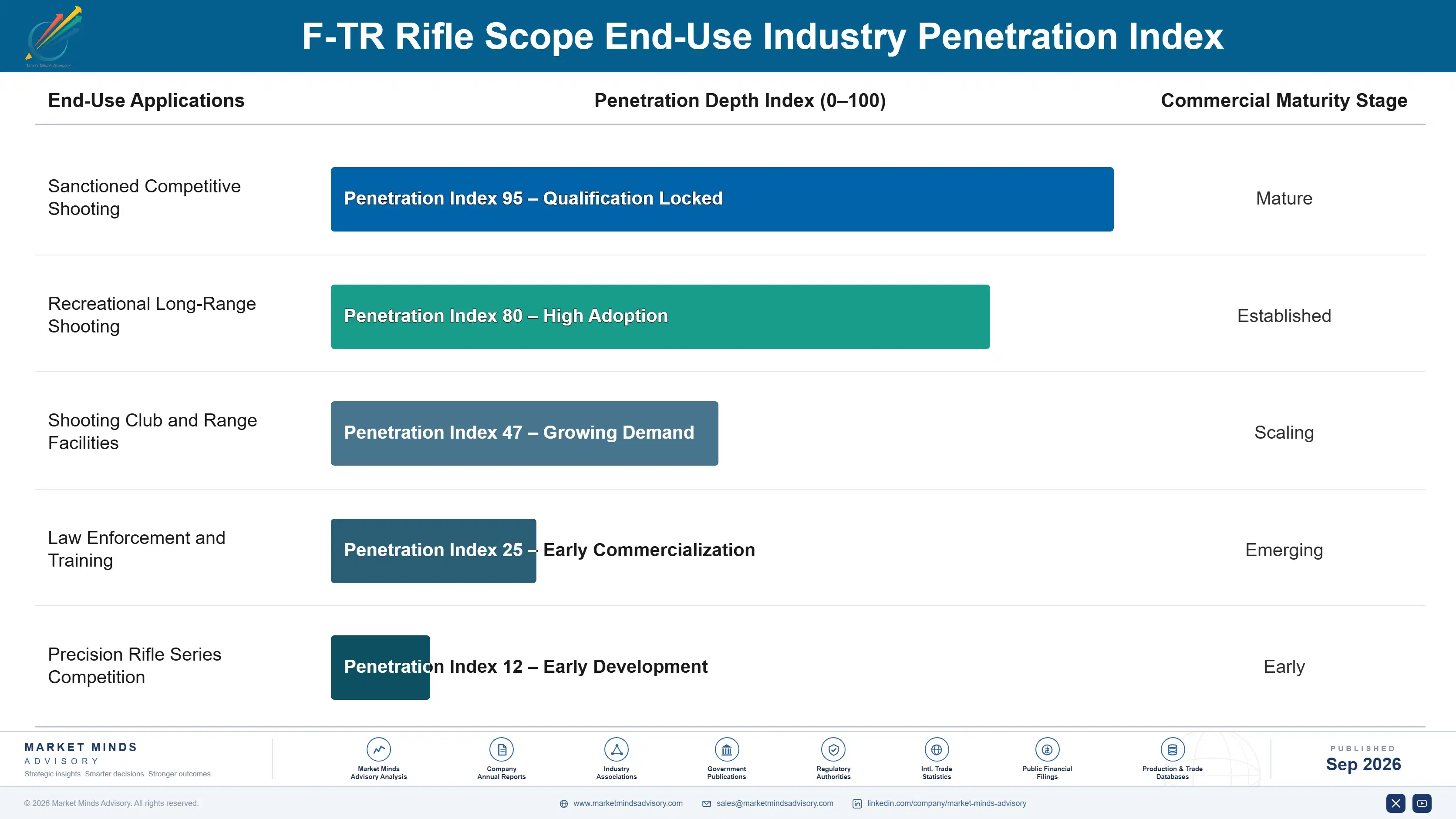
Adoption stickiness varies meaningfully by end-use vertical. Sponsored competitive shooters show the deepest lock-in, since manufacturer relationships and equipment familiarity built over multiple seasons are difficult to replicate quickly with a new brand mid-career. Recreational and entry-level shooters show far less stickiness, switching manufacturers more readily as they gain experience and better understand their own precision requirements before committing to a long-term equipment relationship.

Buyer profiles are shifting generationally as younger competitive shooters, more comfortable with digital technology and data-driven ballistic calculation than previous generations, increasingly favor digital reticle systems over traditional optical mechanisms by default when entering the sport. This generational shift is accelerating adoption of newer optics technology faster than pure precision performance data alone would explain, and shows little sign of reversing as this cohort advances into senior competitive ranks.
f-tr-rifle-scope-market-end-use-penetration-index-1790014333219

Where Manufacturers Should Focus Next

These are among the four positions where our research anticipates prominent divergence between winners and laggards over the coming forecast period. Each is grounded in the demand model, the regulatory perimeter, and the announced capacity pipeline.
01 / DIGITAL RETICLE INVESTMENT

Accelerate digital reticle development ahead of tactical-only positioning

Manufacturers still treating digital reticle technology as a tactical-only niche are underestimating how quickly well-funded competitive shooters are adopting programmable ballistic systems for time-pressured match conditions across every major competition circuit. Early movers in this segment are capturing sponsored athlete relationships that generate credible marketing validation competitors relying on traditional advertising cannot easily replicate. The manufacturers gaining the strongest reputations today are the ones that committed to digital reticle development years before broader competitive adoption became apparent to the rest of the industry.
02 / SPONSORED ATHLETE RELATIONSHIPS

Build sponsored shooter programs before competitors lock up top talent

Sponsored competitive shooters provide credible match performance validation that carries more weight with serious buyers than traditional advertising campaigns ever could across every major shooting discipline and price tier. Manufacturers without established sponsored athlete relationships are missing a marketing channel that directly reaches the most influential buyers in the category and their broader networks. The manufacturers building these relationships now will find it increasingly difficult for competitors to displace them once top shooters have committed to a given brand for multiple seasons.
03 / ENTRY-LEVEL PRODUCT EXPANSION

Expand entry-level competitive-grade lines to capture new participants

Growing F-Class and F-TR competition participation is expanding the addressable market beyond dedicated professional shooters, yet many manufacturers still focus exclusively on premium flagship products at the expense of broader market reach and new customer acquisition. Entry-level competitive-grade scopes capture new participants who will likely upgrade to premium products as their skills and budgets grow over time and experience. Manufacturers who capture these new entrants early build brand loyalty that persists as shooters advance through the sport and eventually purchase premium equipment.
04 / OPTICAL GLASS SUPPLY DIVERSIFICATION

Diversify glass sourcing before the next specialty material shortage

Optical glass price volatility has already forced temporary cost increases once this decade, and specialty glass supply concentration among a handful of manufacturers means another disruption remains entirely plausible over the coming years. Manufacturers relying on a single glass supply contract carry meaningfully more margin risk than those who diversified sourcing after the last spike affected their production costs directly. The manufacturers best positioned for the next shock are the ones treating diversification as standard practice rather than a reactive response.

Engagement Snapshot From the Field

A live engagement with an industry participant carrying material or product regulatory and market exposure ahead of a defining policy shift, showing how our research translates into a defensible multi-year portfolio strategy.
MARKET MINDS ADVISORY · CLIENT ENGAGEMENT SUMMARY
F-TR Rifle Scope Producer Strategic Portfolio Review and Transition Roadmap 2026·Investment Scenario on F-TR Rifle Scope Exposure Evaluation 2025-26
CLIENT PROFILE
The client is a regional shooting sports club operating three sanctioned F-Class ranges across the midwestern United States, serving both competitive members and a growing recreational membership base. The club had relied on member-owned equipment of widely varying quality and faced growing pressure to raise competitive standards ahead of hosting a regional qualifying match for the first time.
STRATEGIC CHALLENGE
The club needed to evaluate whether establishing a recommended equipment standard or loaner program could raise competitive performance among newer members without requiring costly individual upgrades across its entire membership base immediately, given the club's limited discretionary budget for member support programs and its small volunteer-run administrative capacity and staffing overall.
MMA APPROACH
MMA benchmarked five competitive-grade scope options against the club's membership budget profile and competition goals, evaluating price accessibility, documented match performance, and manufacturer support for club-level bulk purchasing programs across multiple vendor relationships. The engagement combined primary interviews with club leadership and comparative performance modeling across entry-level and premium equipment tiers.
KEY FINDINGS
  1. A bulk purchasing arrangement with one manufacturer reduced per-unit equipment costs by approximately 20 percent (client-reported, unverified by MMA) for participating members.
  2. Two of five evaluated manufacturers offered club-level loaner programs allowing newer members to trial competitive-grade equipment before committing to individual purchase decisions.
  3. The club's newer members showed measurably improved match scores within two full competitive seasons of adopting standardized competitive-grade equipment recommendations club-wide and consistently.
  4. A phased equipment upgrade program allowed the club to raise overall competitive standards without requiring immediate costly purchases from every individual member.
CLIENT PROFILE
The client is a regional shooting sports club operating three sanctioned F-Class ranges across the midwestern United States, serving both competitive members and a growing recreational membership base. The club had relied on member-owned equipment of widely varying quality and faced growing pressure to raise competitive standards ahead of hosting a regional qualifying match for the first time.
STRATEGIC CHALLENGE
The club needed to evaluate whether establishing a recommended equipment standard or loaner program could raise competitive performance among newer members without requiring costly individual upgrades across its entire membership base immediately, given the club's limited discretionary budget for member support programs and its small volunteer-run administrative capacity and staffing overall.
MMA APPROACH
MMA benchmarked five competitive-grade scope options against the club's membership budget profile and competition goals, evaluating price accessibility, documented match performance, and manufacturer support for club-level bulk purchasing programs across multiple vendor relationships. The engagement combined primary interviews with club leadership and comparative performance modeling across entry-level and premium equipment tiers.
KEY FINDINGS
  1. A bulk purchasing arrangement with one manufacturer reduced per-unit equipment costs by approximately 20 percent (client-reported, unverified by MMA) for participating members.
  2. Two of five evaluated manufacturers offered club-level loaner programs allowing newer members to trial competitive-grade equipment before committing to individual purchase decisions.
  3. The club's newer members showed measurably improved match scores within two full competitive seasons of adopting standardized competitive-grade equipment recommendations club-wide and consistently.
  4. A phased equipment upgrade program allowed the club to raise overall competitive standards without requiring immediate costly purchases from every individual member.
RECOMMENDED STRATEGY
Phase 1: Phase one: negotiate a bulk purchasing agreement with a recommended manufacturer for club members joining the program voluntarily each season. Phase 2: Phase two: establish a loaner equipment program allowing newer members to trial competitive-grade optics before making a final purchase commitment. Phase 3: Phase three: track member match performance improvements over time to refine future equipment recommendations and ongoing manufacturer partnerships going forward.
OUTCOME
The club successfully hosted its regional qualifying match with measurably improved overall competitive standards among participating members (client-reported, unverified by MMA). The bulk purchasing and loaner programs increased newer member retention as equipment cost barriers to serious competitive participation declined meaningfully across the entire membership base.

Frequently Asked Questions

Foundational context covering the market sizes, CAGR, scope, country, region and competition that inform every finding below. This section is provided to cover basics and most often pre-purchase conversations, answered from the MMA Primary Research Dataset.

What is the current size of the F-TR Rifle Scope Market?

The market reached $0.31 billion globally in 2025. This covers fixed power, variable power, first focal plane, second focal plane, and digital reticle scopes designed for F-Class Target Rifle competitive shooting.

How large will the F-TR Rifle Scope Market be by 2036?

MMA projects the market will reach $0.61 billion by 2036 under the base case scenario. That represents roughly 1.85 times the 2026 starting value over the ten-year forecast window.

What is the CAGR for the F-TR Rifle Scope Market 2026 to 2036?

The base case CAGR is 6.4 percent annually through 2036. Bull and bear scenarios range from 5.1 to 7.7 percent depending on competitive shooting participation growth.

Which segment is growing fastest?

Digital and electronic reticle scopes lead at a 10.0 percent CAGR, roughly 1.56 times the overall market rate. First focal plane scopes follow as the second-fastest segment.

Who are the major companies in the F-TR Rifle Scope Market?

Nightforce Optics, Leupold & Stevens, Vortex Optics, Schmidt & Bender, and March Scopes lead the market. Together they hold an estimated CR5 near 55 percent of category revenue.

Which country is growing fastest?

The United States leads at an estimated 6.9 percent CAGR, driven by its extensive competitive shooting infrastructure and sanctioned match circuits. South Asia and Pacific follows closely as shooting sports infrastructure develops.

Report Segmentation Architecture

The full report scope spans multiple orthogonal segmentation dimensions, with cross-tabulated demand data provided for each dimension pair. Coverage extends further to regional breakdowns, trend trajectories, and the competitive detail needed to support segment-level decision-making.

By Primary Market Dimension

  • Fixed Power Scopes
  • Variable Power Scopes
  • First Focal Plane Scopes
  • Second Focal Plane Scopes
  • Digital and Electronic Reticle Scopes
  • Other Specialty Optics

By End-Use Industry

  • Sanctioned Competitive Shooting
  • Recreational Long-Range Shooting
  • Shooting Club and Range Facilities
  • Law Enforcement and Training
  • Precision Rifle Series Competition

By Commercial Dimension

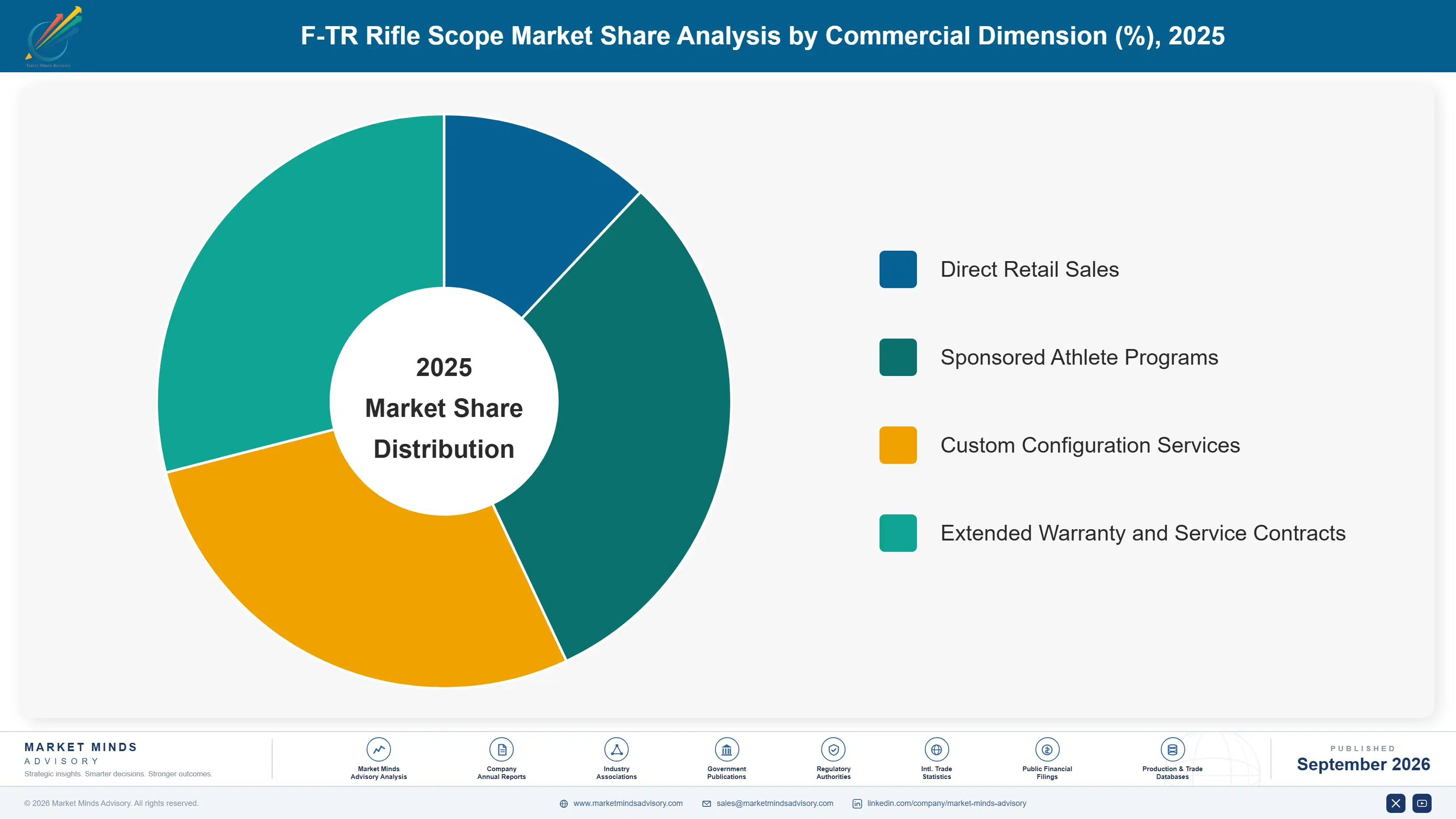
  • Direct Retail Sales
  • Sponsored Athlete Programs
  • Custom Configuration Services
  • Extended Warranty and Service Contracts

By Region

  • North America
  • Western Europe
  • East Asia
  • South Asia and Pacific
  • Latin America
  • Middle East and Africa
  • Eastern Europe

Scope, Methodology, and Coverage

Every figure in this report is reproducible from documented input assumptions. The scope below maps the historical period, the forecast horizon, the segmentation dimensions, and the countries covered, alongside the underlying primary and qualitative methodology.
Historical Period
2020 to 2025
Forecast Period
2026 to 2036
Base Year
2025 (USD billions; MMA Primary Research Dataset, September 2026)
Market Definition
The F-TR rifle scope market covers fixed-power, variable-power, first focal plane, second focal plane, and digital or electronic reticle telescopic sights designed or optimized for F-Class Target Rifle competitive shooting and comparable long-range precision disciplines. It excludes red dot sights, holographic sights, night vision and thermal optics, and scopes designed primarily for hunting rather than competitive long-range shooting.
Quantitative Units
USD billions (current prices); unit volume of scopes sold where applicable
Segmentation Dimensions
By Primary Market Dimension; By End-Use Industry; By Commercial Dimension; By Region
Regions Covered
North America, Western Europe, East Asia, South Asia and Pacific, Latin America, Middle East and Africa, Eastern Europe
Countries Covered
USA, China, Germany, France, UK, Japan, South Korea, India, Australia, Canada, Brazil, Mexico, Indonesia, Vietnam, Thailand, Malaysia, UAE, Saudi Arabia, South Africa, Nigeria, Turkey, Poland, Netherlands, Italy, Spain, Sweden, Switzerland, Argentina, Colombia, Singapore, and additional markets relevant to this sector
Key Companies Profiled
Nightforce Optics, Leupold & Stevens, Vortex Optics, Schmidt & Bender, March Scopes, Meopta Optika, U.S. Optics, Sightron, Bushnell, Carl Zeiss Sports Optics, Swarovski Optik, Tangent Theta, IOR Valdada, Steiner Optics, Trijicon, Burris Optics, Athlon Optics, Element Optics, Riton Optics, Sig Sauer Electro-Optics
Quantitative Methodology
Primary survey, n=3,800 respondents, Q4 2025, six countries; demand-side model with trade association cross-validation
Qualitative Methodology
47 expert interviews, Q4 2025; applied to validate demand model assumptions, identify emerging dynamics, and assess competitive positioning
Report Format
PDF and XLSX data workbook (Word format preview document)
Publisher
Market Minds Advisory
Report Code
MMA-2026-TEC-905
Published
September 2026
Contact
sales@marketmindsadvisory.com | www.marketmindsadvisory.com

Purchase the full F-TR Rifle Scope Market Report (2026 to 2036).

This report delivers a comprehensive assessment of the F-TR rifle scope market, covering market sizing, segmentation, and regional demand through 2036 across seven major world regions and shooting disciplines. It profiles the twenty leading optics manufacturers, benchmarking competitive positioning, moat durability, and emerging risk across the top two market leaders in depth. The analysis includes detailed input cost exposure, portfolio margin architecture, and revenue diversification opportunities specific to precision optics manufacturers. A dedicated case study illustrates how a regional shooting club navigated a live equipment standardization engagement.
Ten-year market sizing and forecast to 2036
Six-segment MECE technology segmentation overview detailed
Seven-region demand, share, and growth rate analysis
Twenty-company competitive benchmarking with moat and risk assessment
Input cost exposure and mitigation pathways
Anonymized shooting club standardization case study

Built For The People Who Decide

From boardroom strategy to bench-side execution, this report is read cover-to-cover by leaders shaping the next decade of their industry, turning demand scenarios, market dynamics and valuation benchmarks into decisions.
CXOs/ Presidents/ VPs/ Managers
M&A and Corporate Development
Strategy Teams and R&D Heads
Procurement and Product Directors
Regulatory and Compliance Leaders
Investor Relations and Equity Analysts