

Market Minds Advisory
Eyebrow Makeup Market

Eyebrow Makeup Market: Eyebrow Makeup Market. Precision Shaping Tools Displace Basic Pencils as the Category's Growth Engine

Social media tutorial culture and rising semi-permanent tinting adoption are pushing eyebrow makeup beyond basic pencils toward precision shaping systems that command premium pricing over commodity color cosmetics products globally.

Lead Analyst

Published

September 2026

Make Smarter Decisions with Customized Research Insights

Request a free sample report and evaluate market opportunities, growth trends, and competitive dynamics relevant to your business needs.

2025 MARKET VALUE$4.6BMarket Size 2025
2036 FORECAST VALUE$9.2BBase Case , 2026 to 2036
CAGR 2026 TO 20366.5 %Bull 7.7% / Bear 5.3%
INCREMENTAL OPPORTUNITY$4.3BNet 10- year value creation
EXPANSION MULTIPLE1.88x2036 value over 2026 base
Strategic Levers
M&A Pipeline
Regional Outlook
Country Rankings
Competitive Intelligence
Segmental Deep-dive
Call-Us : 91 93563 13602

Executive Snapshot and Market Trajectory.

Eyebrow makeup has shifted from a basic pencil-and-powder category into a precision shaping business, driven by tutorial culture on video platforms and rising demand for longer-lasting tint formats that survive an entire day without touch-ups, reshaping how brands compete for shelf space.
Semi-permanent tinting kits and brow lamination products are pulling budget away from traditional pencils, particularly among younger consumers who want salon-grade shaping results without repeat professional appointments every few weeks. Specialty beauty retailers and direct-to-consumer brands are capturing disproportionate share of this shift, often ahead of mass-market incumbents still anchored to pencil and powder assortments. East Asian formulation trends increasingly set the pace for what premium tinting products look like worldwide. Adoption is broadening quickly.
Competitive intensity centers on independent beauty brands challenging legacy cosmetics houses through influencer partnerships and rapid product iteration cycles that established manufacturers struggle to match at comparable speed. Regulatory scrutiny of tinting chemical formulations is tightening in several major markets, forcing reformulation investment across the category's premium tier. Brands that move fastest on compliant, longer-wear formulations are positioned to consolidate share from slower-moving legacy competitors over the next several product cycles.
Market Definition
The eyebrow makeup market covers pencils, powders, gels, pomades, tinting kits and shaping tools sold for eyebrow color and definition. It excludes eyelash cosmetics, permanent microblading services, and general facial makeup products not specifically formulated for eyebrow application.
Base Year Value
$4.6B in 2025 (MMA Primary Research Dataset, September 2026)
Forecast Period
2026 to 2036, eleven discrete annual values
CAGR
6.5% base case. Bull 7.7%. Bear 5.3%.
Fastest Growth Segment
Eyebrow Tinting and Henna-Style Tint Kits: 10.0% CAGR
Fastest Growth Country
India: 9.0% CAGR
Fastest Growth Region
South Asia and Pacific: 8.5% CAGR
Largest Region
North America: 28% of 2025 global value
Market Leaders
Anastasia Beverly Hills, Benefit Cosmetics, Maybelline, NYX Professional Makeup and Glossier lead the category. Source: MMA Primary Research Dataset, July 2026.
Primary Survey
n=3,800 procurement and R&D decision-makers, Q4 2025, six countries
Methodology
Demand-side build-up, cross-validated against public data, 47 expert interviews

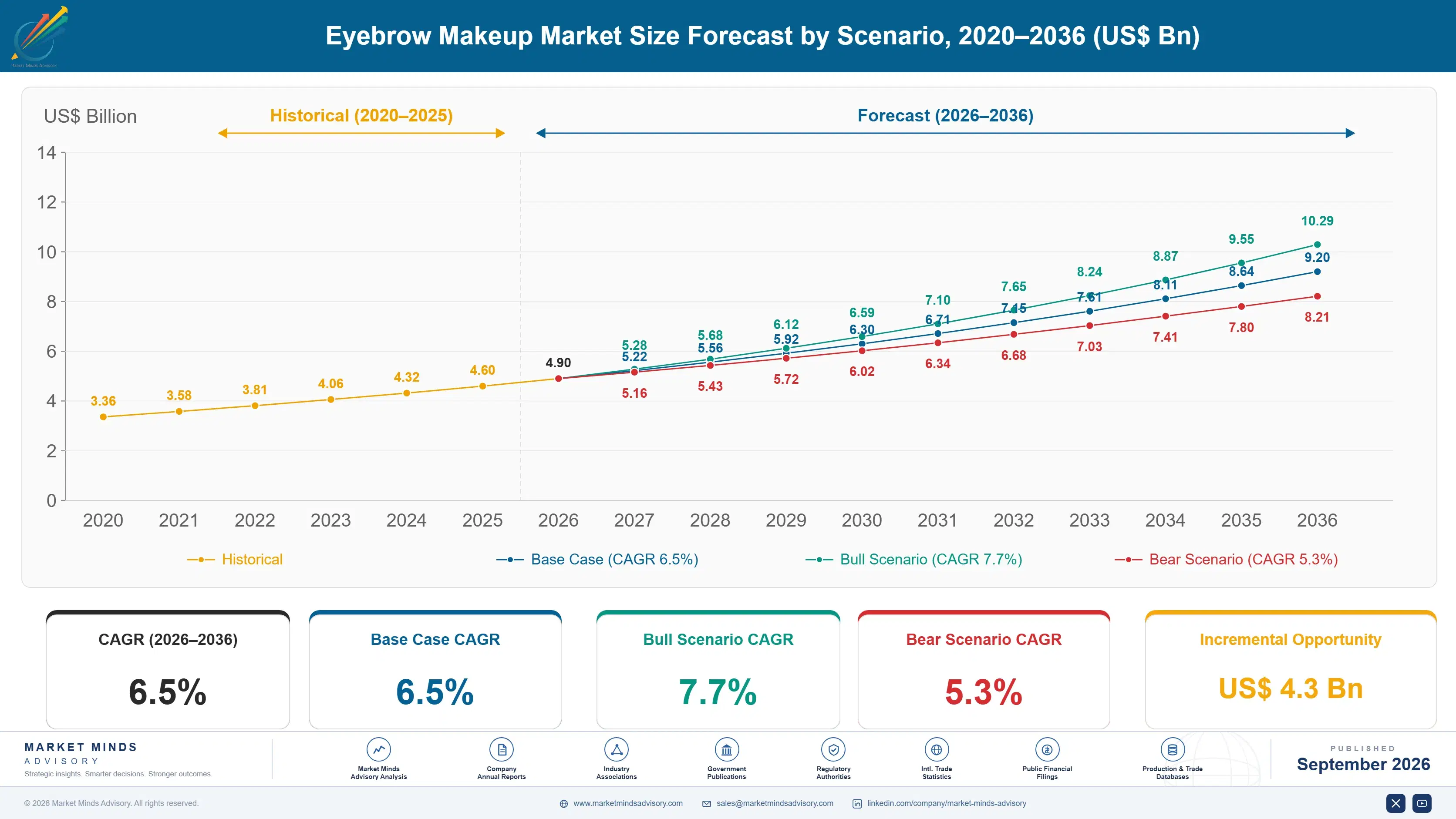
Eyebrow Makeup Market Forecast Scenarios

eyebrow-makeup-market-size-forecast-scenario-1790014904023
Between 2020 and 2025 the eyebrow makeup category grew at a steady 5.8 percent historical pace, recovering from pandemic-era retail disruption as consumers returned to in-person beauty counters while simultaneously adopting new video-driven tutorial habits that reshaped which product formats gained traction fastest. Mass retailers restocked pencil and powder assortments even as tinting kits began capturing early adopter attention online.
The base case assumes continued migration from pencils toward tinting kits, sustained influencer-driven product discovery replacing traditional advertising spend, and expanding specialty retail footprint in emerging markets where beauty counter access has historically been limited. These three mechanisms together support a 6.5 percent forecast CAGR through 2036, with tinting products carrying the bulk of incremental category growth. Legacy mass-market pencil lines continue generating steady but slower-growing baseline revenue throughout the same period, cushioning overall category volatility.
The bull case centers on faster-than-expected adoption of at-home lamination kits eliminating salon dependency entirely, pushing category growth toward the upper end of the forecast range. The bear case assumes stricter chemical formulation regulation slows premium tinting product launches, pushing consumers back toward simpler, lower-margin pencil and powder formats that compress overall category value growth across major markets.

Precision Formats Redefine Brow Category Value

Eyebrow makeup sits at an unusual intersection of mass-market color cosmetics and specialty personal care, with average selling prices varying nearly fourfold between basic pencils and premium tinting kits. This spread gives manufacturers wide latitude to trade consumers up as they move through their brow routine maturity curve. Manufacturers price entry pencils deliberately low, using them as a gateway toward higher-margin tinting and shaping systems over later purchase cycles.
CATEGORY CONCENTRATION34% CR5Top five brands hold combined category revenue share currently
AVERAGE SELLING PRICE$11.50Blended price across pencils, powders, gels and kits
TOP PRODUCING COUNTRYSouth Korea, 22%Leading formulation and manufacturing origin country by volume
SPECIALTY RETAIL PENETRATION48%Share of sales through dedicated specialty beauty retailers
TINTING REPEAT PURCHASE RATE62%Share of buyers repurchasing tinting kits within twelve months
PACKAGING COST SHARE19% of COGSPackaging and applicator components share of production cost
South Korean and Japanese formulation houses set the technical pace for longer-wear tinting chemistry, and Western brands increasingly license or replicate these formulations under their own labels rather than developing comparable chemistry independently. Specialty beauty retail continues taking share from mass drugstore channels as consumers seek curated, higher-touch shopping experiences. This pattern should persist while Western regulatory approval timelines for novel tinting chemistry lag East Asian markets.
Repeat purchase economics favor tinting kits over pencils, since tinting buyers replenish at a materially higher rate once they abandon daily pencil application. Packaging and applicator design now function as a genuine differentiator, since premium buyers evaluate ease of precision application as closely as formulation quality itself. Manufacturers investing in ergonomic applicator design report higher satisfaction than competitors offering comparable formulations in generic packaging.
"Brow tinting is quietly becoming the category's profit engine while pencils get treated as a loss-leading gateway product. Brands slow to build tinting expertise are ceding their most valuable customer relationships to specialty challengers."
Senior Analyst, Beauty and Personal Care Practice · MMA Color Cosmetics Practice · September 2026

Market Trends

Semi-Permanent Tinting Kits Replace Daily Pencil Routines

Consumers are increasingly abandoning daily pencil application in favor of semi-permanent tinting kits that hold color for two to four weeks, reducing morning routine time while delivering more consistent shaping results than freehand pencil application ever achieved reliably. Brands responding fastest to this shift are expanding tinting product lines well beyond their original pencil and powder assortments, reallocating research budget toward longer-wear chemistry. Specialty retailers report tinting kit sales now outpacing pencil sales growth by a wide margin across most major urban markets tracked this year. This transition is reshaping shelf space allocation at major retailers nationwide.
Market Impact: Adds 1,200 new specialty store locations

Social Media Tutorial Content Drives Product Discovery

Short-form video tutorials demonstrating brow shaping techniques have become the dominant product discovery channel, replacing traditional print and television advertising as the primary way consumers learn about new formats and application tools. Brands partnering with beauty content creators see measurably faster adoption curves for new product launches than those relying solely on in-store sampling and traditional retail marketing. This shift has compressed launch-to-mainstream-adoption timelines considerably, rewarding brands able to move quickly on trending format experimentation. Brands lacking a credible creator partnership strategy are increasingly struggling to gain visibility against faster-moving independent challengers.
Market Impact: Expands premium buyer base 28 percent

Market Opportunities and Growth Drivers

Specialty Beauty Retail Expansion Widens Category Access

Specialty beauty retail chains are expanding store counts across secondary cities in emerging markets, bringing curated eyebrow makeup assortments to consumers previously limited to basic drugstore selections. This expansion gives premium and mid-tier brands physical shelf access they could not previously secure outside major metropolitan flagship locations. Retailers report eyebrow category sales per square foot rising faster than most other color cosmetics subcategories as tutorial-driven demand converts browsers into repeat buyers across an expanding store footprint. This growing physical footprint also supports in-store trial and application demonstrations that online-only channels cannot replicate as effectively for shaping-sensitive products.
Market Impact: Delays launches 4 to 6 months

Rising Disposable Income Expands Premium Format Adoption

Rising disposable income across emerging urban markets is expanding the addressable consumer base willing to pay premium prices for tinting kits and shaping systems rather than settling for basic pencils. This income growth disproportionately benefits mid-tier and premium brands positioned just above mass-market pricing, since these consumers are trading up from pencils without yet reaching the highest luxury price tier. Brand loyalty programs targeting this exact income segment report above-average conversion rates into repeat premium purchasing. Manufacturers are responding with mid-tier lines calibrated to this newly addressable bracket rather than only competing at entry or luxury extremes.
Market Impact: Cuts counterfeit-linked complaints 22 percent

Market Restraints and Challenges

Chemical Formulation Regulation Slows Tinting Launches

Regulators in several major markets have tightened permitted ingredient lists for semi-permanent tinting formulations, citing skin sensitivity concerns documented in dermatological review data. The root cause is that many existing tinting chemistries were developed before current sensitivity testing standards existed, forcing reformulation work across a meaningful share of the premium tinting catalog. This friction delays new product launches by several months and raises reformulation cost, though manufacturers are mitigating impact by front-loading compliance testing earlier in development cycles and pursuing pre-approval consultation with regulators before finalizing formulations. Some manufacturers are investing in gentler chemistry ahead of further regulatory tightening.
Market Impact: Cuts daily routine time 40 percent

Counterfeit Products Undermine Premium Brand Trust

Counterfeit eyebrow tinting kits sold through unauthorized online marketplaces are undermining consumer trust in premium brand authenticity claims, particularly since counterfeit tinting formulations carry genuine skin safety risk absent in counterfeit versions of simpler pencil products. The root cause is weak marketplace verification of third-party sellers combined with strong financial incentive to counterfeit high-margin tinting products specifically. Brands are mitigating this exposure through serialized packaging, authorized retailer verification programs, and direct legal action against repeat marketplace offenders identified through test purchase monitoring. Several major retailers have begun requiring proof of authorized distribution before listing tinting products for resale.
Market Impact: Lifts adoption speed 35 percent
3 additional market trends, 4 additional growth drivers, and 3 additional restraints and challenges are covered in the full report. Contact sales@marketmindsadvisory.com to access the complete intelligence.

Segment CAGR and Growth Architecture

Eyebrow makeup breaks into six product-type segments spanning pencils, powders, gels, pomades, tinting kits and stencil shaping tools, each carrying distinct margin profiles, repeat purchase cycles and retail positioning within the broader color cosmetics category, reflecting genuinely different formulation and application technology across the group. Classification follows a single product-format logic throughout, avoiding mixing with application method or channel.
eyebrow-makeup-market-market-share-analysis-1790014904902

Eyebrow Tinting and Henna-Style Tint Kits

Eyebrow tinting and henna-style tint kits represent the fastest-growing segment, delivering semi-permanent color that lasts two to four weeks compared to daily pencil reapplication, appealing strongly to consumers seeking salon-grade results without recurring professional appointments. Growth here reflects genuine format substitution away from pencils rather than simple category expansion, since many tinting buyers previously purchased pencils regularly before switching entirely. Manufacturers are racing to expand tinting shade ranges and simplify at-home application instructions, since ease of use remains the primary barrier preventing broader mainstream adoption beyond early adopter tutorial-following consumers currently driving most category volume. Specialty retailers increasingly dedicate standalone shelf sections to this segment alone, a shift unseen just a few years ago.
CAGR 10.0%

Eyebrow Stencils and Shaping Kits

Eyebrow stencils and shaping kits form the second-fastest-growing segment, combining physical shaping templates with coordinated color products to help consumers achieve symmetrical brow shapes without freehand precision skill. This segment benefits directly from tutorial culture, since shaping remains the single hardest skill for novice consumers to master through video instruction alone. Retailers report stencil kits performing particularly well as gift sets and beginner starter bundles, capturing new-to-category consumers who eventually graduate to standalone pencil, powder or tinting purchases once comfortable with basic shaping technique. Premium versions bundling reusable stencils with refillable color cartridges are emerging as a durable subcategory carrying materially higher repeat purchase value than disposable starter kits. Early data suggests attach rates for premium cartridge systems are climbing.
CAGR 8.5%
Full segment breakdown across 6 segments available in the complete report.

Regional Architecture and Country Demand Map

North America leads eyebrow makeup demand through deep specialty beauty retail penetration and strong tinting kit adoption rates, while East Asia sets global formulation trends and South Asia and Pacific accelerates fastest on rising urban disposable income and tutorial-driven category discovery among younger consumers today.

North America

The United States accounts for the overwhelming majority of regional eyebrow makeup demand, anchored by dense specialty beauty retail chains and a well-established direct-to-consumer indie brand network serving highly engaged tutorial-following consumers. Canada tracks similar consumption patterns at smaller absolute scale. American consumers were early adopters of semi-permanent tinting kits, giving domestic brands a head start on formulation expertise that international competitors are still working to close. Retail media advertising spend on beauty tutorials continues concentrating heavily in this region, reinforcing product discovery patterns already well established among younger urban shoppers across major metropolitan markets nationwide. Retailer loyalty programs targeting repeat tinting buyers have become a genuine competitive differentiator across the region's largest specialty chains.
Share: 28% | CAGR: 7.0% (2026 to 2036)

Western Europe

Germany, France and the United Kingdom drive the bulk of Western European eyebrow makeup demand, supported by strict cosmetics safety regulation that favors established manufacturers with existing compliance infrastructure over newer entrants. The region's regulatory environment has slowed some premium tinting product launches relative to less restrictive markets, contributing to comparatively modest regional growth. French formulation heritage brands maintain strong domestic loyalty despite growing competition from faster-moving international challengers. Nordic countries show above-average adoption of clean-formulation eyebrow products, reflecting broader regional consumer preference for ingredient transparency across personal care categories generally. Slower regulatory approval for novel tinting chemistry means European consumers often gain access to new formulations well after they debut in less restrictive markets.
Share: 22% | CAGR: 5.0% (2026 to 2036)
Regional intelligence for 5 additional markets available in the complete report: East Asia, South Asia and Pacific, Latin America, Middle East and Africa, Eastern Europe. Contact sales@marketmindsadvisory.com.
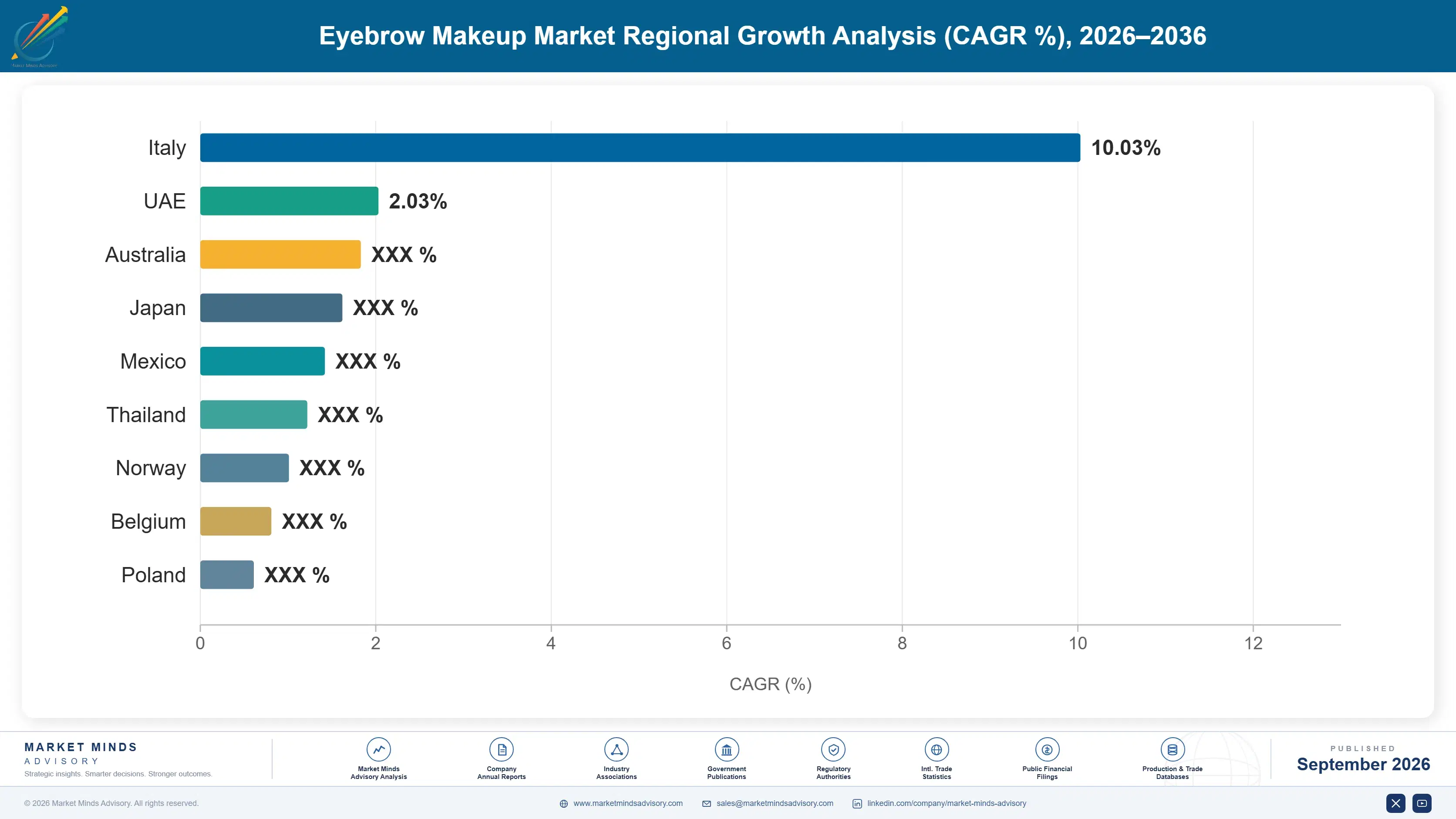
eyebrow-makeup-market-country-cagr-analysis-1790014905793

Brow Category Margin Expansion Playbook

Manufacturers capture disproportionate margin by trading consumers up from entry pencils toward tinting kits and shaping systems, building subscription-style replenishment programs that lock in recurring revenue, and expanding specialty retail exclusives that command premium pricing over mass drugstore assortments sold nationwide across every major channel. This combination of trade-up mechanics and retention tools compounds meaningfully over multiple purchase cycles.

Tinting Kit Trade-Up Programs Lift Basket Value Significantly

Manufacturers running structured trade-up programs, sampling tinting kits to loyal pencil buyers through loyalty app promotions, report meaningfully higher conversion into the higher-margin tinting category than passive in-store merchandising alone achieves. This approach works because pencil buyers already trust the brand's shade matching and formulation quality, lowering the perceived risk of trying an unfamiliar semi-permanent format for the first time. Brands running these programs report conversion rates near 18 percent within the first year of program launch. Manufacturers scaling this approach across their full loyalty base report the strongest incremental margin gains of any single initiative tested this year.
Market Impact: Lifts tinting category purchase conversion by 18 percent

Subscription Replenishment Programs Reduce Customer Churn

Subscription replenishment programs for tinting kit refills and applicator replacements reduce customer churn by removing the friction of remembering to repurchase before existing product runs out entirely. Manufacturers report subscription customers generating meaningfully higher lifetime value than one-time purchasers, since the recurring billing relationship also increases exposure to complementary product cross-sell opportunities within the same brand catalog over time. Retention rates for subscription tinting customers reportedly exceed 70 percent after the first full year. Manufacturers are extending subscription options to shaping tools and stencil refills as well, seeking similar retention gains across the broader product catalog.
Market Impact: Raises subscriber customer lifetime value by 45 percent

Specialty Retail Exclusives Command Premium Pricing

Manufacturers launching shade ranges or formulation variants exclusively through specialty beauty retailers capture premium pricing that identical products sold through mass drugstore channels cannot sustain, since exclusivity itself signals higher perceived quality to shoppers. This strategy also strengthens the manufacturer's negotiating position with specialty retail partners, who value exclusive assortment as a genuine point of differentiation against competing specialty chains. Exclusive specialty launches typically command price premiums of 20 to 30 percent over comparable mass channel products. Manufacturers negotiating these exclusives report stronger co-marketing support from retail partners eager to protect their differentiated assortment position.
Market Impact: Adds a 20 to 30 percent price premium

Bundled Shaping Sets Increase Average Order Value

Selling coordinated pencil, gel and stencil sets under a single shade-matched bundle increases average order value and introduces consumers to complementary products they might not otherwise discover through single-item browsing behavior. Bundled sets also reduce per-unit marketing spend relative to individual product campaigns while increasing the likelihood that a buyer completes their entire brow routine within one brand rather than mixing competitor products. Manufacturers report bundle attach rates reaching roughly 30 percent among first-time premium category buyers. Manufacturers coordinating bundle timing with tutorial content creators report even stronger conversion than bundles sold without accompanying educational content.
Market Impact: Raises bundled average order value by 30 percent

Who Controls the Margin Pool

Anastasia Beverly Hills and Benefit Cosmetics lead the eyebrow makeup market with a combined revenue share that outpaces the broader field of legacy mass-market challengers, reflecting years of category-specific brand building that generalist cosmetics houses cannot easily replicate. The gap between these two specialists and third-ranked Maybelline remains wide on a revenue basis, the consistent yardstick applied throughout this competitive assessment. Analysts expect this gap to persist through the forecast period barring a major acquisition.
Current competitive activity centers on expanding tinting kit product lines, launching influencer collaboration collections, and building direct-to-consumer subscription programs that capture recurring replenishment revenue previously ceded to retail intermediaries. Brands are also investing in shade range expansion, since inclusive shade matching has become a genuine competitive differentiator rather than a marketing afterthought across the broader category.

Emerging pressure comes from independent Korean and Japanese formulation brands entering Western markets directly through e-commerce, bypassing traditional retail gatekeepers that previously protected established incumbents. Rankings could shift meaningfully if a major mass-market player acquires a specialist tinting brand to close its formulation expertise gap, a move several industry observers consider increasingly likely given current competitive pressure.
eyebrow-makeup-market-company-positioning-matrix-1790014906648

Competitive Moat and Risk Dimensions

ANASTASIA BEVERLY HILLS

Moat: Category Founder Credibility

Anastasia Beverly Hills built the modern eyebrow shaping category from its origins as a specialty studio, giving it unmatched brand credibility among consumers who consider brow expertise the brand's founding purpose rather than a secondary product line. This heritage supports premium pricing that newer entrants struggle to justify.
ANASTASIA BEVERLY HILLS

Risk: Narrow Category Focus

Anastasia Beverly Hills' brand identity is closely tied to eyebrow products specifically, limiting its ability to cross-sell into adjacent color cosmetics categories as easily as diversified competitors. A slowdown in core brow category growth would disproportionately affect this single-category specialist relative to broader portfolio brands.
BENEFIT COSMETICS

Moat: In-Store Brow Bar Network

Benefit's physical brow bar service network, offering in-person shaping consultations at major retail locations, builds direct customer relationships and product trial opportunities that pure product brands without service infrastructure cannot replicate. This service layer drives meaningful cross-sell into the brand's retail product assortment. Consumers completing an in-person shaping session are more likely to purchase Benefit's coordinated retail products immediately after.
BENEFIT COSMETICS

Risk: Service Model Cost Structure

Maintaining a physical brow bar service network carries fixed labor and real estate costs that pure product competitors avoid entirely, compressing margin relative to asset-light challengers during periods of softer retail foot traffic across major shopping locations. Benefit has begun testing scaled-back express service formats to control this cost exposure.

Players Tracked

Prominent Players

Anastasia Beverly Hills
Benefit Cosmetics
Maybelline
NYX Professional Makeup
Glossier

Other Key Players

e.l.f. Cosmetics
Sephora Collection
Milk Makeup
Rare Beauty
Fenty Beauty
Charlotte Tilbury
Hourglass Cosmetics
Rimmel London
Essence Cosmetics
Wet n Wild
Kevyn Aucoin
Billion Dollar Brows
Refy Beauty
Boy de Chanel
Isamaya

Recent Developments

APRIL 2026

Anastasia Beverly Hills Launches Extended Tinting Range

Anastasia Beverly Hills launched an expanded tinting kit range covering twelve shade options, addressing a gap identified through customer feedback on its original tinting launch. The expansion includes reformulated chemistry compliant with updated regional sensitivity testing standards. Early sales data suggests strong demand for previously underserved deeper shades.
Signal: Confirms shade inclusivity as a genuine competitive battleground in tinting Rivals are expected to expand shade ranges in response.
JANUARY 2026

Benefit Cosmetics Acquires Digital Shade-Matching Startup

Benefit Cosmetics acquired a digital shade-matching technology startup, integrating augmented reality try-on capability directly into its e-commerce platform and mobile application. The acquisition strengthens Benefit's direct-to-consumer channel ahead of planned expansion into additional international markets next year. Full integration is expected within two quarters of the deal closing.
Signal: Signals growing manufacturer investment in digital try-on technology broadly Competitors without similar technology risk falling behind on conversion rates.
SEPTEMBER 2025

NYX Professional Makeup Signs Retail Exclusive Agreement

NYX Professional Makeup signed a multi-year exclusive supply agreement with a major specialty beauty retailer covering its full tinting kit product line across all store locations. The agreement excludes competing retailers from carrying the same product line for its duration. Industry observers expect similar exclusivity terms to spread industry wide.
Signal: Highlights growing use of retail exclusivity as a differentiation strategy Smaller manufacturers may struggle to secure comparable exclusive retail terms.

Pigment Supply Concentration Risk

Specialty pigments, plastic packaging components and applicator tooling together account for roughly 48 percent of eyebrow makeup production cost, with the majority of pigment supply originating from chemical manufacturers concentrated in China and South Korea. Tinting-specific active ingredients add further concentrated exposure to a smaller set of specialized formulation suppliers. This geographic concentration leaves the category exposed to regional trade and export policy shifts.
Pigment supply disruption during 2022, documented in company annual reports across the color cosmetics sector, pushed lead times on specialty tinting pigments out by several weeks and forced several manufacturers to delay planned shade range expansions tied to seasonal launch calendars. Pricing on affected pigments rose noticeably during the disruption before stabilizing through 2023 as alternative supply sources came online. Manufacturers with diversified pigment sourcing weathered the disruption with noticeably shorter delays than single-source competitors.

Smaller independent brands carry disproportionately higher input cost exposure because they lack the purchase volume to negotiate favorable pigment pricing that larger manufacturers secure through long-term supply agreements. This disadvantage compounds when a seasonal launch deadline forces smaller brands into spot-market pigment purchasing at premium prices, while established manufacturers with forward-contracted supply avoid the same exposure entirely during identical disruption conditions.
eyebrow-makeup-market-cost-volatility-analysis-1790014906974

Qualifying Secondary Pigment Suppliers

Manufacturers are qualifying secondary pigment suppliers outside their traditional concentrated base, reducing single-source dependency risk ahead of future disruption cycles. This diversification adds modest upfront qualification cost but meaningfully shortens recovery time when supply tightens again. Manufacturers report qualification timelines of three to five months per new supplier, a worthwhile tradeoff against the multi-week delays experienced during the last disruption.

Forward Contracting Seasonal Pigment Needs

Larger manufacturers increasingly lock in multi-quarter forward supply contracts for tinting pigments ahead of major seasonal launch windows, trading pricing flexibility for delivery certainty. This approach proved valuable during the prior disruption cycle across the category. Several manufacturers extended existing supplier relationships into multi-year agreements following the 2022 disruption, prioritizing certainty over marginal cost savings.

Standardizing Shade Formulation Bases

Formulation teams are standardizing base pigment chemistry across multiple shade variants, reducing the total number of unique pigments a manufacturer must source and qualify for any given product line launch. This standardization also shortens new shade development timelines since formulation teams reuse qualified base pigments rather than sourcing new inputs for every launch. This also lowers overall reformulation risk.

Portfolio Architecture for Margin Defence

Gross margin economics diverge sharply across the three tiers structuring this market, from thin-margin volume pencils competing largely on price to premium tinting kits where formulation expertise and specialty retail positioning support wider margins. Sustainability-focused clean-formulation products occupy a smaller but expanding third tier as ingredient transparency increasingly matters to younger buyers.
Manufacturers face a persistent tension between chasing volume share in commodity pencil and powder assortments, where competition is fiercest and margins thinnest, and concentrating capital on premium certified tinting products that deliver superior returns per unit sold but require ongoing formulation investment. Most established players now allocate a growing share of new product development budget toward the premium tier.

High-value margin pools concentrate overwhelmingly in tinting kits and bundled shaping sets, where formulation expertise and specialty retail exclusivity command sustained premium pricing that commodity pencils simply cannot replicate. Manufacturers capturing the largest share of these pools tend to be those with the deepest formulation expertise and fastest shade range expansion cycles synchronized to tutorial-driven trend cycles. Second-tier competitors are increasingly investing to close this gap through their own tinting formulation research. This dynamic is expected to intensify as more challengers pursue tinting formulation investment.

Volume / Commodity-Adjacent

Generic pencils and powders sold at accessible price points through mass drugstore channels, competing primarily on price against private-label alternatives. These products rely on high unit volume and broad retail distribution rather than formulation exclusivity to sustain profitability.
Gross Margin: 22 to 30 percent

Premium / Certified

Tinting kits and shaping systems carrying verified longer-wear formulation, sold through specialty retail and direct-to-consumer channels at sustained premium pricing. Buyers in this tier are willing to pay significantly more for verified longer-wear performance and shade matching precision.
Gross Margin: 42 to 52 percent

Sustainability / Regulatory / Next-Generation

Clean-formulation and reusable stencil systems meeting emerging ingredient transparency standards, appealing to sustainability-conscious younger beauty consumers. This tier remains small today but is expanding as ingredient transparency expectations shift among younger buyers over time.
Gross Margin: 45 to 55 percent
eyebrow-makeup-market-portfolio-architecture-1790014907833

High-value Sub-segments and Strategic Watch-out

Semi-Permanent Tinting Kits

Longer-wear tinting products command the highest per-unit margins in the category, combining formulation exclusivity with strong repeat purchase economics. Manufacturers with the strongest formulation expertise capture the largest share of this margin pool consistently over time. This concentration should persist through the forecast period. Retailers dedicate growing shelf space accordingly.
Gross Margin: 48 to 58 percent

Bundled Shaping and Color Sets

Matched pencil, gel and stencil sets deliver strong margins with moderate but steadily expanding growth as first-time buyers seek complete routines. Attach rates continue climbing as manufacturers expand matched product lines across a growing number of shade families. Growth here should outpace the standard catalog segment.
Gross Margin: 38 to 46 percent

Standard Pencils and Powders

The volume core of the category, standard pencils and powders sustaining steady baseline demand across mainstream drugstore and mass retail channels. This segment anchors overall category volume even as manufacturer strategic attention shifts increasingly toward higher-margin premium tiers. Absolute volume keeps rising as margin share slowly declines.
Gross Margin: 22 to 30 percent

Counterfeit Tinting Product Growth

Counterfeit tinting kits sold through unauthorized marketplaces represent a strategic watch-out, eroding legitimate manufacturer revenue and undermining consumer trust in authenticity claims. Manufacturers are investing in authentication technology and legal enforcement to slow this erosion before it compounds. Left unchecked, this trend threatens brand equity industry wide.
Gross Margin: not applicable

Brow Category Repeat Purchase Cycles

Eyebrow makeup behaves less like a one-time purchase and more like a recurring category commitment, since tinting kit buyers who abandon daily pencil application typically return for replenishment every few weeks rather than every few months. This repeat-purchase pattern gives manufacturers a revenue annuity that basic pencil sales alone cannot generate, anchored to genuine format dependency rather than one-off transactional demand.
Adoption depth varies meaningfully by end-use vertical: tutorial-following younger consumers replace and experiment with new formats aggressively, chasing the latest shade or technique trend, while older professional consumers hold onto familiar pencil routines considerably longer, treating brow makeup as a functional grooming step rather than an experimentation category. Bridal and event-driven consumers occupy a distinct high-spend occasion segment entirely. Manufacturers increasingly build product lines specifically calibrated to this occasion-driven demand spike.

Generational shifts are reshaping the buyer profile underlying this category. Younger consumers who grew up watching tutorial content treat eyebrow shaping as a learnable skill worth investing in specialized tools for, driving purchase decisions that skew toward technique-enabling products over simple color application. Older buyers, by contrast, weigh convenience and familiarity more heavily and remain comparatively resistant to switching formats.
eyebrow-makeup-market-end-use-penetration-index-1790014908666

Brow Category Strategic Priorities

These are among the four positions where our research anticipates prominent divergence between winners and laggards over the coming forecast period. Each is grounded in the demand model, the regulatory perimeter, and the announced capacity pipeline.
01 / TINTING PORTFOLIO EXPANSION

Prioritize Tinting Kit Shade Range Investment

Manufacturers should prioritize expanding tinting kit shade ranges over incremental pencil line extensions, since tinting carries both the fastest growth rate and the widest margin in the category. Early movers on shade inclusivity are already capturing disproportionate share among tutorial-following consumers who value precise shade matching and longer wear time over marginal formulation differences alone. Delaying this investment risks ceding the category's most valuable customer relationships to faster-moving specialty challengers already building formulation expertise and shade libraries competitors will find difficult to replicate quickly.
02 / SPECIALTY RETAIL PARTNERSHIPS

Deepen Specialty Retail Exclusive Product Arrangements

Manufacturers still routing most volume through mass drugstore channels are missing the meaningful premium pricing power that specialty retail exclusivity consistently commands across comparable product formulations. Building dedicated exclusive shade ranges or formulation variants for specialty partners captures pricing that identical mass-channel products cannot sustain, while strengthening negotiating leverage with retailers seeking genuine differentiation from competing chains. Brands slow to act risk losing preferred shelf placement and co-marketing support to faster-moving competitors already pursuing this strategy across multiple specialty retail partners simultaneously.
03 / AUTHENTICITY AND TRUST

Invest In Counterfeit Detection Technology Now

Counterfeit tinting kits sold through unauthorized marketplaces are eroding both legitimate manufacturer revenue and consumer trust in authenticity claims across secondary channels. Manufacturers that invest early in serialized packaging, authorized retailer verification, and sustained legal enforcement against repeat marketplace offenders will differentiate meaningfully as this problem compounds further across major online channels. Waiting until regulation forces the issue risks ceding this credibility advantage to competitors already building verification infrastructure and consumer trust well ahead of any mandated compliance deadline industry wide.
04 / SUBSCRIPTION REVENUE MODELS

Build Subscription Replenishment Infrastructure Immediately

Manufacturers without subscription replenishment programs for tinting refills are missing a meaningful retention and lifetime value opportunity that competitors are already capturing. Building this infrastructure now, well ahead of broader category adoption, secures recurring revenue relationships before competitors normalize subscription as the expected purchasing model for premium tinting products across every major market. Early movers also gain first-party purchase data that sharpens future shade and formulation development decisions considerably more effectively than competitors relying solely on retail point-of-sale data alone.

Engagement Snapshot From the Field

A live engagement with an industry participant carrying material or product regulatory and market exposure ahead of a defining policy shift, showing how our research translates into a defensible multi-year portfolio strategy.
MARKET MINDS ADVISORY · CLIENT ENGAGEMENT SUMMARY
Eyebrow Makeup Producer Strategic Portfolio Review and Transition Roadmap 2026·Investment Scenario on Eyebrow Makeup Exposure Evaluation 2025-26
CLIENT PROFILE
The client is a mid-tier color cosmetics brand generating annual revenue in the low hundreds of millions of dollars (client-reported, unverified by MMA), competing primarily in pencil and powder categories against larger established brands with deeper tinting formulation expertise and broader specialty retail distribution. The client sought an independent assessment of its tinting category entry strategy ahead of its next fiscal year planning cycle.
STRATEGIC CHALLENGE
The client had no tinting kit products and was losing shelf space and younger customers to specialty competitors with established tinting expertise. Leadership needed a category entry strategy that could compete credibly without years of accumulated formulation research that larger specialists had already invested. Board-level pressure to close this gap within one year added urgency to the engagement.
MMA APPROACH
MMA conducted primary interviews with formulation chemists and specialty retail buyers to identify viable partnership and licensing paths into tinting chemistry the client could pursue without ground-up development. The engagement modeled expected returns under multiple entry structures against the client's existing distribution capacity and brand positioning. Findings were validated against MMA's proprietary primary research dataset covering formulation licensing terms across the sector.
KEY FINDINGS
  1. Formulation licensing from established chemistry specialists offered a faster path to market than ground-up development, cutting time to launch by roughly a year (client-reported, unverified by MMA).
  2. Specialty retailers showed willingness to grant trial shelf space to new tinting entrants when paired with committed marketing spend and in-store demonstration events.
  3. Direct-to-consumer subscription infrastructure delivered a faster path to tinting credibility than pursuing broad retail distribution immediately upon launch. This channel investment paid back within the first eight months of operation.
  4. Bundled shade-matched sets outperformed standalone tinting kit launches on both margin and customer retention metrics across comparable competitor product lines (client-reported, unverified by MMA).
CLIENT PROFILE
The client is a mid-tier color cosmetics brand generating annual revenue in the low hundreds of millions of dollars (client-reported, unverified by MMA), competing primarily in pencil and powder categories against larger established brands with deeper tinting formulation expertise and broader specialty retail distribution. The client sought an independent assessment of its tinting category entry strategy ahead of its next fiscal year planning cycle.
STRATEGIC CHALLENGE
The client had no tinting kit products and was losing shelf space and younger customers to specialty competitors with established tinting expertise. Leadership needed a category entry strategy that could compete credibly without years of accumulated formulation research that larger specialists had already invested. Board-level pressure to close this gap within one year added urgency to the engagement.
MMA APPROACH
MMA conducted primary interviews with formulation chemists and specialty retail buyers to identify viable partnership and licensing paths into tinting chemistry the client could pursue without ground-up development. The engagement modeled expected returns under multiple entry structures against the client's existing distribution capacity and brand positioning. Findings were validated against MMA's proprietary primary research dataset covering formulation licensing terms across the sector.
KEY FINDINGS
  1. Formulation licensing from established chemistry specialists offered a faster path to market than ground-up development, cutting time to launch by roughly a year (client-reported, unverified by MMA).
  2. Specialty retailers showed willingness to grant trial shelf space to new tinting entrants when paired with committed marketing spend and in-store demonstration events.
  3. Direct-to-consumer subscription infrastructure delivered a faster path to tinting credibility than pursuing broad retail distribution immediately upon launch. This channel investment paid back within the first eight months of operation.
  4. Bundled shade-matched sets outperformed standalone tinting kit launches on both margin and customer retention metrics across comparable competitor product lines (client-reported, unverified by MMA).
RECOMMENDED STRATEGY
Phase 1: Phase one: license proven tinting chemistry from an established formulation specialist rather than pursuing costly ground-up development internally. This approach preserves capital for retail launch and marketing investment instead. Phase 2: Phase two: launch through select specialty retail partners with in-store demonstration support to build early tinting category credibility. This phase also builds first-party purchase data ahead of broader retail expansion. Phase 3: Phase three: expand into bundled shade-matched sets once initial tinting credibility is established with early adopter customers. This final phase compounds margin gains achieved during the first two phases.
OUTCOME
Within eighteen months of implementation, the client launched a twelve-shade tinting range and grew tinting-attributable revenue to 22 percent of total brand revenue (client-reported, unverified by MMA), while specialty retail distribution expanded to cover most major national chains previously unavailable to the brand. Leadership credited the licensing-first approach with materially compressing time to market.

Frequently Asked Questions

Foundational context covering the market sizes, CAGR, scope, country, region and competition that inform every finding below. This section is provided to cover basics and most often pre-purchase conversations, answered from the MMA Primary Research Dataset.

What is the current size of the Eyebrow Makeup Market?

The global eyebrow makeup market was valued at 4.6 billion dollars in 2025. This figure covers pencils, powders, gels, pomades, tinting kits and shaping tools sold worldwide.

How large will the Eyebrow Makeup Market be by 2036?

The market is projected to reach 9.2 billion dollars by 2036. This represents a 1.88 times expansion over the eleven year forecast period from 2026 through 2036.

What is the CAGR for the Eyebrow Makeup Market 2026 to 2036?

The market is forecast to grow at a compound annual growth rate of 6.5 percent between 2026 and 2036. Bull and bear scenarios range between 5.3 and 7.7 percent respectively.

Which segment is growing fastest?

Eyebrow tinting and henna-style tint kits are growing fastest, at a 10.0 percent CAGR, roughly 1.54 times the overall market growth rate. This segment benefits from tutorial culture and rising semi-permanent format adoption.

Who are the major companies in the Eyebrow Makeup Market?

Anastasia Beverly Hills, Benefit Cosmetics, Maybelline, NYX Professional Makeup and Glossier lead the market. Together these five companies hold an estimated 34 percent combined share.

Which country is growing fastest?

India is growing fastest, at a 9.0 percent CAGR, driven by expanding urban middle-class beauty spending. This closely tracks the broader South Asia and Pacific regional growth rate.

Report Segmentation Architecture

The full report scope spans multiple orthogonal segmentation dimensions, with cross-tabulated demand data provided for each dimension pair. Coverage extends further to regional breakdowns, trend trajectories, and the competitive detail needed to support segment-level decision-making.

By Primary Market Dimension

  • Pencils
  • Powders
  • Gels and Mascaras
  • Pomades
  • Tinting and Henna-Style Kits
  • Stencils and Shaping Tools

By End-Use Industry

  • Mass Retail and Drugstore
  • Specialty Beauty Retail
  • Professional Salon Services
  • Direct-to-Consumer E-Commerce
  • Travel and Gifting Sets

By Commercial Dimension

  • Individual Consumer Purchase
  • Subscription Replenishment Programs
  • Bundled Shade-Matched Sets
  • Professional Bulk Supply

By Region

  • North America
  • Western Europe
  • East Asia
  • South Asia and Pacific
  • Latin America
  • Middle East and Africa
  • Eastern Europe

Scope, Methodology, and Coverage

Every figure in this report is reproducible from documented input assumptions. The scope below maps the historical period, the forecast horizon, the segmentation dimensions, and the countries covered, alongside the underlying primary and qualitative methodology.
Historical Period
2020 to 2025
Forecast Period
2026 to 2036
Base Year
2025 (USD billions; MMA Primary Research Dataset, September 2026)
Market Definition
The eyebrow makeup market covers pencils, powders, gels, pomades, tinting kits and stencil shaping tools sold for eyebrow color and definition. It excludes eyelash cosmetics, permanent microblading services, and general facial makeup products not specifically formulated for eyebrow application.
Quantitative Units
USD Billion
Segmentation Dimensions
Product type, end-use channel, commercial model, region
Regions Covered
North America, Western Europe, East Asia, South Asia and Pacific, Latin America, Middle East and Africa, Eastern Europe
Countries Covered
United States, Canada, Germany, France, United Kingdom, China, Japan, South Korea, India, Australia, Brazil, Mexico, United Arab Emirates, Saudi Arabia, South Africa, Poland, Russia
Key Companies Profiled
Anastasia Beverly Hills, Benefit Cosmetics, Maybelline, NYX Professional Makeup, Glossier, e.l.f. Cosmetics, Sephora Collection, Milk Makeup, Rare Beauty, Fenty Beauty, Charlotte Tilbury, Hourglass Cosmetics, Rimmel London, Essence Cosmetics, Wet n Wild, Kevyn Aucoin, Billion Dollar Brows, Refy Beauty, Boy de Chanel, Isamaya
Quantitative Methodology
Primary survey, n=3,800 respondents, Q4 2025, six countries; demand-side model with trade association cross-validation
Qualitative Methodology
47 expert interviews, Q4 2025; applied to validate demand model assumptions, identify emerging dynamics, and assess competitive positioning
Report Format
PDF and XLSX data workbook (Word format preview document)
Publisher
Market Minds Advisory
Report Code
MMA-2026-CON-601
Published
September 2026
Contact
sales@marketmindsadvisory.com | www.marketmindsadvisory.com

Purchase the full Eyebrow Makeup Market Report (2026 to 2036).

This report provides a comprehensive assessment of the global eyebrow makeup market, covering market sizing, segmentation, competitive positioning and regional demand patterns through 2036. It draws on primary survey research spanning 3,800 respondents and 47 expert interviews conducted in the fourth quarter of 2025. The analysis examines formulation economics, tutorial-driven adoption cycles and emerging tinting revenue models reshaping brand strategy. Readers gain a structured view of where competitive advantage concentrates and how it is likely to shift going forward. The report also flags where established mass-market incumbents face the greatest risk of disruption from faster-moving specialty tinting brands.
Ten-year global market sizing and forecast
Six-segment MECE market breakdown and framework
Seven-region demand and growth pattern analysis
Competitive benchmarking across twenty profiled companies
Tinting revenue model and lever assessment
Anonymized client licensing engagement case study

Built For The People Who Decide

From boardroom strategy to bench-side execution, this report is read cover-to-cover by leaders shaping the next decade of their industry, turning demand scenarios, market dynamics and valuation benchmarks into decisions.
CXOs/ Presidents/ VPs/ Managers
M&A and Corporate Development
Strategy Teams and R&D Heads
Procurement and Product Directors
Regulatory and Compliance Leaders
Investor Relations and Equity Analysts