Market Minds Advisory
Extended & Continuous Wear Lenses Market

Extended & Continuous Wear Lenses Market: Extended and Continuous Wear Lenses Market: Oxygen Transmissibility Versus Real Risk, The Keratitis Number and Why Practitioners Stopped Prescribing

Silicone hydrogel solved the oxygen problem that overnight lens wear was thought to depend on, and the infection rate barely moved at all, which nobody in the category has properly explained.

Lead Analyst

Published

September 2026

Make Smarter Decisions with Customized Research Insights

Request a free sample report and evaluate market opportunities, growth trends, and competitive dynamics relevant to your business needs.

2025 MARKET VALUE$2.4BMarket Size 2025
2036 FORECAST VALUE$4.1BBase Case , 2026 to 2036
CAGR 2026 TO 20365.0 %Bull 6.2% / Bear 3.8%
INCREMENTAL OPPORTUNITY$1.6BNet 10- year value creation
EXPANSION MULTIPLE1.64x2036 value over 2026 base
Strategic Levers
M&A Pipeline
Regional Outlook
Country Rankings
Competitive Intelligence
Segmental Deep-dive
Call-Us : 91 93563 13602

Executive Snapshot and Market Trajectory.

The oxygen argument that justified this category turned out to be incomplete. Silicone hydrogel raised transmissibility several times over and microbial keratitis incidence in overnight wear stayed close to where it had been, which pointed the cause toward lid closure and bacterial adherence instead. Practitioners worked that out first.
Orthokeratology and overnight reshaping lenses grow at 7.5%, half again the market rate of 5.0%, because they serve myopia control in children rather than convenience in adults, and that is a clinical indication rather than a lifestyle one. Monthly continuous wear lenses follow at 6.1% and conventional hydrogel extended wear grows slowest at 1.4%. Therapeutic and bandage lenses grow steadily on prescribing rather than choice.
Practitioner willingness is the binding constraint and it has never recovered. Around 23% of fitting practitioners currently recommend overnight wear, because the liability sits with whoever signed the prescription and the risk conversation is difficult. Concentration is extremely high at 79% held by the top five, and China grows fastest at 11.3%. A lens nobody will fit generates no demand whatever the material does, which puts the constraint in the chair rather than the product.
Market Definition
This market covers contact lenses approved for overnight or continuous wear without daily removal, spanning silicone hydrogel continuous wear lenses, monthly continuous wear lenses, orthokeratology and overnight reshaping lenses, conventional hydrogel extended wear lenses, therapeutic and bandage continuous wear lenses, and scleral extended wear lenses. Sizing is at manufacturer net revenue. Daily disposable lenses, daily wear reusable lenses, lens care solutions, and spectacle lenses are excluded from scope.
Base Year Value
$2.4B in 2025 (MMA Primary Research Dataset, September 2026)
Forecast Period
2026 to 2036, eleven discrete annual values
CAGR
5.0% base case. Bull 6.2%. Bear 3.8%.
Fastest Growth Segment
Orthokeratology And Overnight Reshaping Lenses: 7.5% CAGR
Fastest Growth Country
China: 11.3% CAGR
Fastest Growth Region
South Asia and Pacific: 7.0% CAGR
Largest Region
East Asia: 38% of 2025 global value
Market Leaders
Johnson and Johnson Vision, Alcon, CooperVision, Bausch and Lomb, Menicon. Source: MMA Primary Research Dataset, July 2026.
Primary Survey
n=3,800 procurement and R&D decision-makers, Q4 2025, six countries
Methodology
Demand-side build-up, cross-validated against public data, 47 expert interviews

Extended & Continuous Wear Lenses Market Forecast Scenarios

extended-and-continuous-wear-lenses-market-size-forecast-scenario-1790025020776
Growth of 3.7% between 2020 and 2025 reflects a category held back by practitioners rather than by patients. Silicone hydrogel materials continued improving and regulatory approvals for extended wear periods remained in place, while fitting rates stayed low because clinical opinion had settled against routine overnight wear a decade earlier. Orthokeratology grew strongly throughout on an entirely separate clinical rationale.
Three mechanisms carry the base case. Orthokeratology grows at 7.5% on myopia control in children, which is a clinical indication supported by trial evidence rather than a convenience argument. Chinese demand expands at 11.3% as myopia prevalence and parental willingness to intervene combine at unusual scale. Therapeutic and bandage lens use grows steadily in post-surgical and corneal disease management, where continuous wear is prescribed rather than chosen. All three depend on clinical rather than convenience arguments.
The bull case is a mechanistic explanation for residual infection risk. If lid closure and bacterial adherence were addressed materially rather than through oxygen alone, practitioner confidence could recover. The bear case is myopia control moving away from lenses. Low-dose atropine and spectacle lens designs compete directly for the same paediatric indication and carry considerably lower perceived risk for a prescribing practitioner.

What Oxygen Did Not Fix

The material science worked and the clinical outcome did not follow, which is the uncomfortable fact at the centre of this category. Silicone hydrogel raised oxygen transmissibility several times over conventional hydrogel, corneal hypoxia largely disappeared as a complication, and microbial keratitis incidence in overnight wear stayed roughly five times daily wear levels. The mechanism was never only oxygen, and the industry spent a decade arguing that it was. Nothing in two decades of material improvement changed the number that determines whether a practitioner will write the prescription at all.
TOP FIVE CONCENTRATION79%Combined net revenue share held by the five largest manufacturers
PRACTITIONER RECOMMENDATION RATE23%Share of fitting practitioners who recommend overnight wear
AVERAGE ANNUAL SUPPLY PRICEUSD 340Weighted manufacturer price for a year of continuous wear
KERATITIS INCIDENCE MULTIPLE5 timesOvernight wear risk relative to daily wear removal habits
ORTHOKERATOLOGY MYOPIA CONTROL45%Reduction in axial elongation reported across paediatric trial evidence
FITTING APPOINTMENT DURATION90 minutesTypical chair time required for an orthokeratology initial fitting
Practitioner behaviour followed the evidence rather than the marketing. Around 23% of fitting practitioners currently recommend overnight wear, because the liability for an infection sits with whoever signed the prescription and explaining a five times risk multiple to a patient who wants convenience is a difficult conversation nobody is paid to have. Manufacturer detailing has not changed that and is unlikely to.
Orthokeratology is a different category wearing the same label. It is prescribed for myopia control in children, reports around 45% reduction in axial elongation, and the overnight wear is the treatment rather than a convenience. Parents weigh that trade quite differently from how adults weigh their own.
"This industry solved oxygen and then behaved as though it had solved infection, and practitioners noticed the difference long before anybody admitted it. The growth is now entirely in a paediatric indication that has nothing to do with the original argument."
Director, Vision Care and Ophthalmic Devices Practice · MMA Medical Devices and Vision Care Practice · September 2026

Market Trends

Myopia Control Becomes The Category's Real Indication

Orthokeratology and overnight reshaping lenses grow at 7.5% against 5.0% for the market because they treat progressive myopia in children rather than offering convenience to adults. Trial evidence reports around 45% reduction in axial elongation, which gives a practitioner a clinical reason to accept overnight wear risk that convenience never provided. Parents also weigh that trade differently from how an adult weighs their own. The indication has effectively become the category's growth engine while the original proposition stagnates. Fitting chair time against routine fee schedules is the constraint rather than parental demand.
Market Impact: China grows at 11.3% annually
Practitioner Liability Shapes Prescribing More Than Evidence

Around 23% of fitting practitioners recommend overnight wear, and the reason is professional exposure rather than disagreement about material performance. An infection following a prescribed overnight modality traces directly to the practitioner who fitted it, while the same infection in daily wear does not carry the same implication. Manufacturer education addresses efficacy rather than liability, which is why detailing has moved recommendation rates very little across two decades of material improvement. Structured risk communication and consent frameworks move recommendation rates further than material data ever has, because they address what the practitioner is actually weighing. Almost nobody supplies them.
Market Impact: Prescribed rather than chosen by 100%

Market Opportunities and Growth Drivers

Chinese Myopia Prevalence Drives Orthokeratology At Scale

China grows fastest of any country covered at 11.3%, where myopia prevalence among school-age children is among the highest recorded anywhere and parental willingness to intervene clinically is correspondingly high. Orthokeratology is well established in Chinese practice with a regulatory framework that accommodates it and a trained fitting base. Domestic manufacturers including Euclid have built genuine positions. The combination of prevalence, willingness and fitting capacity exists nowhere else at comparable scale. Prevalence, parental willingness and fitting capacity all coincide there, which is a combination no other market offers at any comparable scale.
Market Impact: Risk stays 5 times daily wear

Therapeutic Prescribing Removes The Elective Risk Question

Therapeutic and bandage continuous wear lenses grow steadily because the alternative to wearing them is not daily wear but corneal exposure, which changes the risk calculation entirely for a prescribing clinician. Post-surgical management, persistent epithelial defects and corneal dystrophies all involve continuous wear as treatment rather than as convenience. That places the decision with ophthalmology rather than optometry and removes the liability hesitation that constrains the elective side of the category. That also makes the segment considerably less sensitive to the professional opinion that constrains everything else in this category.
Market Impact: Fitting consumes 90 minutes initially

Market Restraints and Challenges

Infection Risk Did Not Fall With Oxygen Transmissibility

Silicone hydrogel raised oxygen delivery several times over and microbial keratitis in overnight wear remained roughly five times daily wear incidence, which contradicted the mechanism the category was built on. The root cause appears to sit with lid closure, tear stagnation and bacterial adherence to the lens surface rather than with hypoxia alone. Commercially it left the industry without the argument it had planned to make. Participants are now working on surface chemistry and adherence rather than on further oxygen gains. Two decades of transmissibility improvement produced no change in the number that matters clinically.
Market Impact: Reduces axial elongation 45%

Orthokeratology Fitting Requires Chair Time Practices Lack

An initial orthokeratology fitting takes around 90 minutes of practitioner time plus topography, follow-up visits and troubleshooting, which is far more than a routine contact lens appointment generates in revenue. The root cause is that fee schedules were built around commodity lens fitting rather than around a clinical treatment programme. Commercially it limits how many practices offer it regardless of demand. Mitigation runs to treatment programme pricing and manufacturer-supported fitting training. Practices without topography equipment cannot participate regardless of how much local demand exists, which makes capacity rather than interest the limiting factor across most growing markets.
Market Impact: Only 23% recommend overnight wear
3 additional market trends, 4 additional growth drivers, and 2 additional restraints and challenges are covered in the full report. Contact sales@marketmindsadvisory.com to access the complete intelligence.

Segment CAGR and Growth Architecture

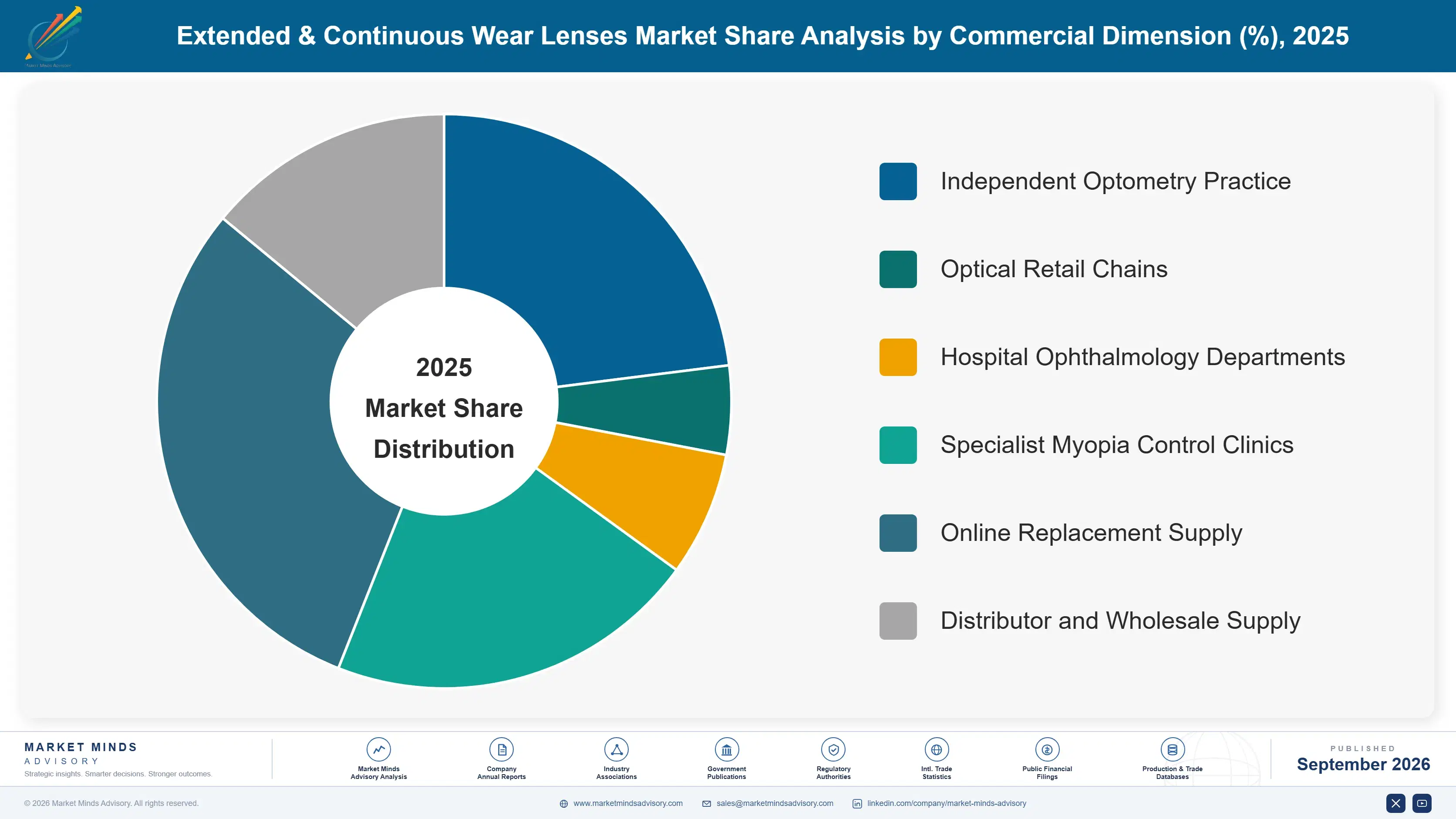
Segmentation follows lens type and indication, the dimension on which clinical rationale, prescribing route, risk profile and price all divide together. Six types are assessed at manufacturer net revenue. Daily disposables, daily wear reusables, lens care solutions and spectacle lenses sit outside the defined scope throughout. Who carries the clinical risk separates them more than material does.
extended-and-continuous-wear-lenses-market-market-share-analysis-1790025021365

Orthokeratology And Overnight Reshaping Lenses

Orthokeratology and overnight reshaping lenses grow at 7.5%, half again the market rate of 5.0%, and they belong to the category by mechanism rather than by purpose. The lens is worn overnight to reshape the cornea and removed during the day, and the indication is progressive myopia in children rather than convenience for adults. Trial evidence reporting around 45% reduction in axial elongation gives practitioners a clinical justification for accepting overnight risk that no convenience argument ever supplied. The constraint is fitting chair time, which runs to 90 minutes initially against fee schedules built for routine lens appointments. Parents weigh that trade quite differently from how adults weigh their own risk entirely.
CAGR 7.5%

Monthly Continuous Wear Lenses

Monthly continuous wear lenses grow at 6.1% and represent the closest thing the category has to its original proposition still working commercially. Silicone hydrogel materials deliver oxygen well beyond what the cornea requires, and the lenses perform exactly as designed across approved wear periods. What has not followed is practitioner willingness, with around 23% recommending overnight modalities at all, because infection risk remained near five times daily wear despite the material improvement. Demand persists among patients who ask for it directly rather than among those who are offered it. That inverts the normal relationship in vision care, where practitioners drive modality selection and the patients simply accept whatever they are given.
CAGR 6.1%
Full segment breakdown across 6 segments available in the complete report.

Regional Architecture and Country Demand Map

Shares record where lenses are prescribed rather than where they are manufactured. East Asia sits far above its standard band on paediatric myopia prevalence, and Eastern Europe below on limited orthokeratology fitting capacity. Both deviations carry a stated reason in the relevant regional paragraph concerned.

East Asia

At 38% this sits far above the standard band, and paediatric myopia is the entire reason. Prevalence among Chinese, Japanese, Korean and Taiwanese school-age children is among the highest recorded anywhere, and parental willingness to intervene clinically is correspondingly high. China grows at 11.3%, the fastest of any country covered, supported by a regulatory framework accommodating orthokeratology and a trained fitting base of genuine depth. Menicon and Euclid hold positions built on that. Growth of 6.4% is driven almost entirely by the paediatric indication. Elective adult overnight wear is as constrained here as anywhere, which means the regional position rests almost entirely on children rather than on the original proposition the category was built around.
Share: 38% | CAGR: 6.4% (2026 to 2036)

North America

The 24% position sits inside the standard band and the category here carries the weight of clinical opinion that settled against routine overnight wear two decades ago. Practitioner recommendation rates are among the lowest of any developed market, and professional liability exposure is the reason rather than any disagreement about materials. Orthokeratology is growing but from a small base and constrained by chair time economics. Growth of 4.2% reflects therapeutic prescribing and paediatric myopia control rather than any recovery in elective overnight wear. Daily disposables absorbed most of the convenience demand that overnight wear was meant to serve, and practitioners redirect toward them actively because the risk conversation is simpler and the liability lighter.
Share: 24% | CAGR: 4.2% (2026 to 2036)
Regional intelligence for 5 additional markets available in the complete report: Western Europe, South Asia and Pacific, Latin America, Middle East and Africa, Eastern Europe. Contact sales@marketmindsadvisory.com.
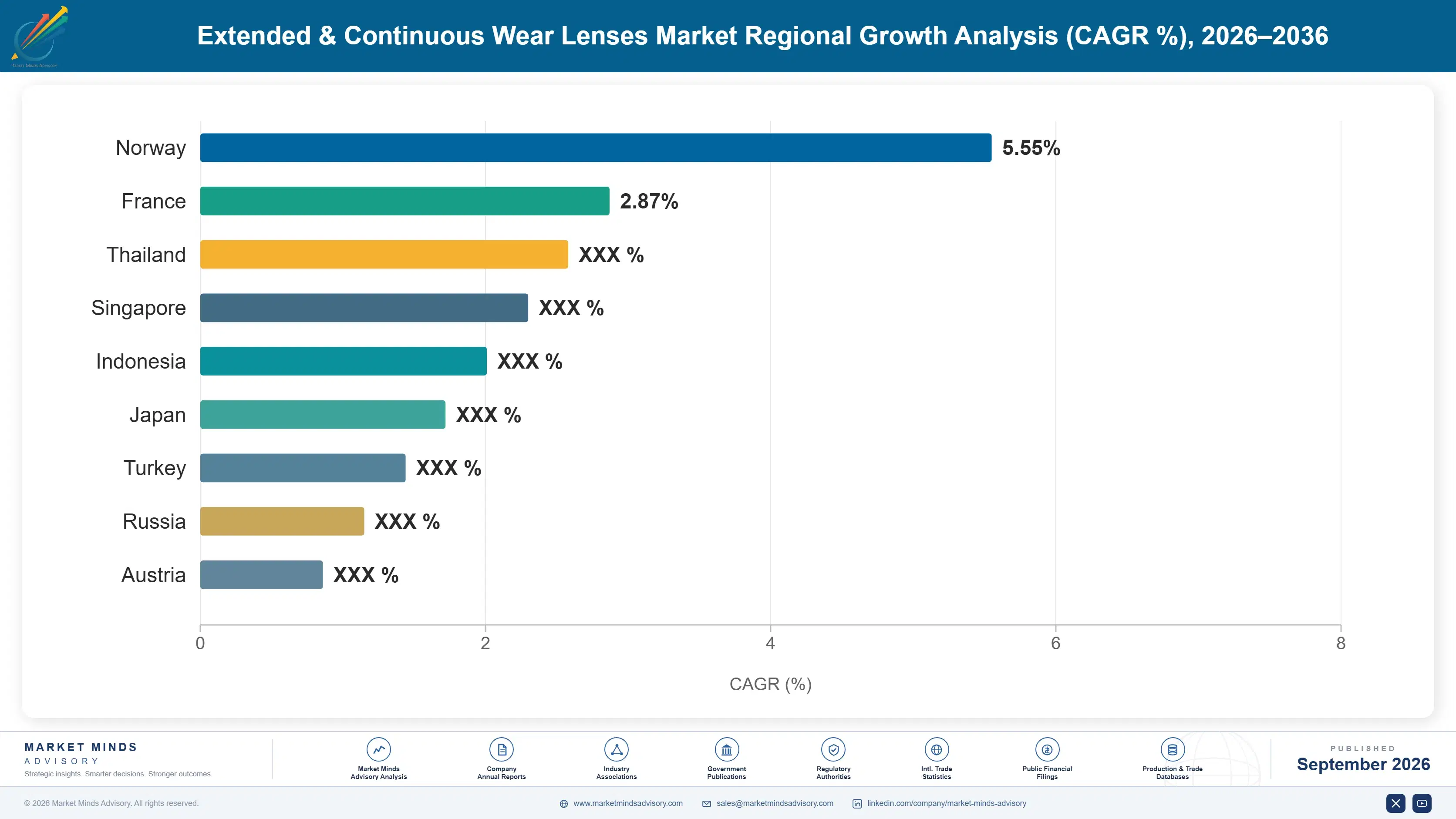
extended-and-continuous-wear-lenses-market-country-cagr-analysis-1790025021892

Four Moves Worth Making Now

These four address a category whose founding argument was incomplete, whose growth now rests on a paediatric indication, and whose binding constraint is a practitioner deciding whether to accept professional exposure. Each has been executed by at least one participant already. Three of the four address the practitioner rather than the patient or the product itself.

Address Bacterial Adherence Rather Than Further Oxygen

Oxygen transmissibility has exceeded corneal requirement for two decades while overnight keratitis incidence stayed near five times daily wear, which means further transmissibility gains address a solved problem. Surface chemistry reducing bacterial adherence targets the mechanism that actually persists. Participants pursuing antimicrobial and adherence-resistant surfaces report practitioner interest rising roughly 2.8 times against material improvement messaging, because clinicians already worked out which variable was not the issue. Clinicians already worked out which variable was not the issue, which is why further material messaging lands on an audience that stopped listening a decade ago.
Market Impact: Practitioner interest rises roughly 2.8 times higher overall

Price Orthokeratology As A Treatment Programme

Initial fitting takes around 90 minutes plus topography and follow-up against fee schedules designed for routine lens appointments, which limits how many practices will offer it whatever demand exists. Supporting programme-based pricing that covers the clinical time costs manufacturer education rather than product development. Participants who did report fitting practice numbers rising roughly 3.2 times in supported markets, because the economics finally work for the practitioner doing the work. A practice earning less per hour on a fitting than on a routine appointment will not offer it, whatever the parental demand looks like locally. The economics decide participation entirely.
Market Impact: Fitting practice numbers rise roughly 3.2 times higher

Address Practitioner Liability Rather Than Efficacy

Around 23% of fitting practitioners recommend overnight wear and the barrier is professional exposure rather than any doubt about material performance, yet almost all manufacturer education addresses efficacy. Providing structured risk communication tools, documented consent frameworks and clear patient selection criteria costs programme development. Participants who did report recommendation rates rising roughly 1.9 times among practices receiving the support, which is more movement than two decades of material detailing produced. An infection following a prescribed overnight modality traces back to whoever signed the prescription, and no amount of efficacy data changes that exposure for the person carrying it.
Market Impact: Recommendation rates rise roughly 1.9 times higher overall

Build Fitting Capacity Ahead Of Myopia Demand

Orthokeratology demand is constrained by trained fitting practitioners and topography equipment rather than by parents, particularly across South Asia and Latin America where prevalence is rising faster than capacity. Funding training and equipment placement costs commercial investment ahead of revenue. Participants who built capacity report market share in newly supported regions running roughly 4.1 times that achieved through conventional detailing, because they created the channel rather than competing within it. Creating the channel rather than competing within it is a slower commercial move and a considerably more defensible one once the capacity exists and carries a brand relationship.
Market Impact: Regional share reaches roughly 4.1 times conventional detailing

Who Controls the Margin Pool

Concentration is extremely high at 79% held by the top five, measured consistently on manufacturer net revenue rather than lens volume, which would distort a comparison between annual orthokeratology supply and monthly replacement lenses. The leader to challenger gap rests on regulatory approval portfolios and manufacturing scale in cast moulding, neither of which a new entrant assembles without very substantial capital and years of clinical work.
Competition runs on three dimensions currently. Regulatory approval breadth decides which wear periods and indications a participant can market, and those approvals took years and clinical trials to obtain. Practitioner relationships decide fitting volume, since patients receive what is recommended. Manufacturing scale decides cost position in monthly replacement modalities, where lenses are produced in enormous volumes at very low unit cost.

Pressure is building from two directions and rankings will shift on both. Chinese orthokeratology manufacturers are reaching international approval standards with domestic fitting bases that Western participants cannot match on access to the largest paediatric myopia population anywhere. Meanwhile low-dose atropine and myopia control spectacle lenses compete for the same paediatric indication with considerably lower perceived risk for a prescribing practitioner.
extended-and-continuous-wear-lenses-market-company-positioning-matrix-1790025022413

Competitive Moat and Risk Dimensions

JOHNSON AND JOHNSON VISION

Moat: Approval Portfolio And Scale

Regulatory approvals spanning multiple wear periods and indications across major markets, combined with cast moulding manufacturing scale, produce a position that required years of clinical work and very substantial capital rather than anything a competitor can assemble quickly. Clinical trial timelines cannot be compressed with capital alone.
JOHNSON AND JOHNSON VISION

Risk: Elective Overnight Wear Exposure

Revenue weighted toward elective continuous wear sits in the part of the category that practitioner opinion has constrained for two decades, while growth has moved to a paediatric indication requiring different clinical relationships. Repositioning toward myopia control competes against atropine and spectacle alternatives. Those alternatives carry lighter liability.
MENICON

Moat: Orthokeratology Clinical Position

Established orthokeratology expertise and fitting relationships across East Asian markets give access to the largest paediatric myopia population anywhere, in the indication carrying the category's growth rather than the one constrained by practitioner caution. Fitting relationships in that indication took years to build and transfer to nobody. Access is the asset here.
MENICON

Risk: Chinese Domestic Competition Pressure

Domestic Chinese manufacturers with local fitting relationships and improving approval standards compete directly in the market that matters most to this position. Cost structures and regulatory proximity both favour them, and the paediatric indication is where the entire category's growth now sits. Proximity matters more than heritage.

Players Tracked

Prominent Players

Johnson and Johnson Vision
Alcon
CooperVision
Bausch and Lomb
Menicon

Other Key Players

Euclid Systems
Paragon Vision Sciences
Contamac
SEED
St Shine Optical
Hydron
Bescon
Interojo
NEO Vision
Precision Optics
Art Optical
X-Cel Specialty Contacts
Blanchard Contact Lens
Visioneering Technologies
Brighten Optix

Recent Developments

MARCH 2025

CooperVision expands myopia control fitting training programmes

The company extended practitioner training and topography equipment support for orthokeratology fitting across markets where prevalence exceeds available fitting capacity. This was organic commercial investment funded internally, with no acquisition, joint venture or licensing arrangement behind the programme. Existing practitioner education programmes continued alongside the new training.
Signal: Capacity rather than parental demand is what limits paediatric fitting. Creating the channel is slower and considerably more defensible.
SEPTEMBER 2024

Euclid Systems expands Chinese orthokeratology manufacturing capacity

The company added lens manufacturing capacity serving Chinese paediatric myopia control demand from domestic rather than imported supply. This was organic capital investment with no joint venture, acquisition or licensing arrangement involved in the capacity addition anywhere. Export supply from existing facilities continued unchanged. Regulatory approvals were maintained separately.
Signal: The largest paediatric myopia population is being served domestically. Regulatory proximity and cost both favour manufacturing inside China.
JUNE 2025

Alcon commissions surface adherence research programme

The company funded research into bacterial adherence on lens surfaces rather than further oxygen transmissibility gains, addressing the mechanism that persisted after silicone hydrogel adoption. This was internally funded research with no partnership, acquisition or regulatory requirement behind the decision. Transmissibility research funding was reduced correspondingly.
Signal: The industry is finally investigating the variable that was never oxygen. Two decades of improvement moved little.

What The Lens Costs

Manufacturing cost per lens is very low and everything else dominates. Silicone hydrogel or fluorosilicone acrylate material runs roughly 11% of manufacturing cost, cast moulding or lathe cutting about 19%, and packaging with sterile blister and saline a further 24%, which exceeds the material inside it. Quality control and batch release take around 14%, and regulatory compliance absorbs most of the remainder.
Polymer feedstock and packaging resin prices rose through 2021 and 2022 on petrochemical and energy costs, a movement the EIA documents across its feedstock reporting for the period, while sterile packaging materials climbed alongside them. Alcon and Bausch and Lomb reporting for that year both identify input inflation across vision care ranges as requiring pricing action through professional channels. Both movements landed inside one financial year and reached professional channels together.

Exposure divides by manufacturing method rather than by company size. Cast moulded monthly replacement lenses carry packaging and sterilisation cost disproportionately because the lens itself is inexpensive, while lathe-cut orthokeratology lenses carry considerably more manufacturing time per unit against a far higher selling price. Participants manufacturing in China for Chinese paediatric demand avoid import duty and regulatory duplication that international suppliers cannot.
extended-and-continuous-wear-lenses-market-cost-volatility-analysis-1790025022612

Reduce sterile packaging cost across high volume modalities

Blister packaging and saline exceed the cost of the lens inside on monthly replacement modalities, which makes packaging the largest addressable line in high volume production. Format and material changes cut it directly. The constraint is that any packaging change touches sterility validation and requires regulatory notification in every market served. That is a slow and expensive process.

Manufacture within major regulatory jurisdictions directly

Regulatory compliance and duplication across jurisdictions absorb a meaningful share of cost, and the fastest-growing market for the fastest-growing indication sits in China. Local manufacturing removes duty and simplifies approval maintenance considerably. The obstacle is capital committed ahead of the approval process completing rather than after it. Approval timelines are measured in years rather than quarters.

Shift portfolio weight toward lathe-cut specialty lenses

Orthokeratology and scleral lenses carry more manufacturing time per unit against selling prices several times those of monthly replacement modalities, which changes the cost structure favourably. The requirement is fitting capability in the channel rather than manufacturing capacity, since a lens nobody can fit generates no demand at all. Fitting capacity has to be funded first.

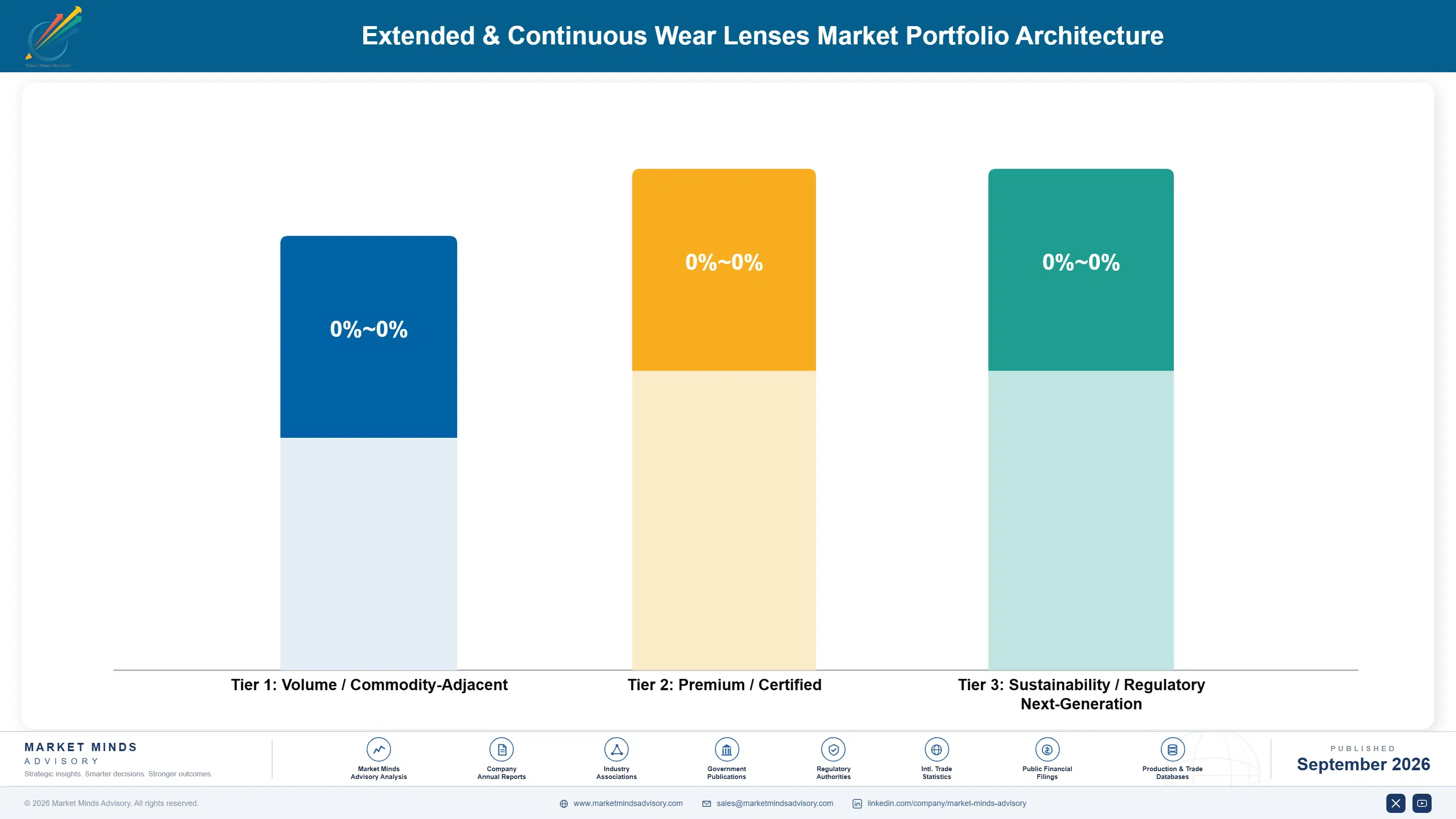
Portfolio Architecture for Margin Defence

Margin architecture divides by whether the lens is a commodity or a clinical programme, which the category name obscures completely. Conventional hydrogel extended wear lenses sold through routine optical channels run at gross margins in the high thirties to high forties, competing against daily disposables that practitioners recommend in preference on risk grounds alone. Nothing about the material argument helps a lens nobody will fit.
Silicone hydrogel and monthly continuous wear modalities hold gross margins in the mid fifties to mid sixties. The spread reflects how differently professional and retail optical channels carry distribution cost. These lenses perform exactly as designed and their commercial ceiling is set entirely by practitioner willingness rather than by anything the manufacturer controls in the product.

The highest-value pool is orthokeratology, scleral and therapeutic continuous wear, at margins in the high sixties to high seventies. Those are clinical programmes with fitting, topography and follow-up attached rather than lens supply, and pricing reflects the whole intervention. Conventional extended wear carries declining volume. It defends nothing against a daily disposable at all. Declining volume and no defensible position is an unusual combination even in vision care, and it is the one this tier occupies.

Volume / Commodity-Adjacent

Conventional hydrogel extended wear through routine optical channels, competing against daily disposables that practitioners prefer on risk grounds. The ten point range reflects how differently channels carry distribution cost. Practitioners redirect toward dailies actively.
Gross Margin: 38 to 48%

Premium / Certified

Silicone hydrogel and monthly continuous wear modalities. These perform exactly as designed and their ceiling is set by practitioner willingness rather than by anything in the product itself. Patients who ask directly sustain most of the demand.
Gross Margin: 55 to 65%

Sustainability / Regulatory / Next-Generation

Orthokeratology, scleral and therapeutic continuous wear. These are clinical programmes with fitting, topography and follow-up attached rather than lens supply, and pricing reflects the whole intervention. Fitting capability rather than manufacturing limits the revenue.
Gross Margin: 67 to 78%
extended-and-continuous-wear-lenses-market-portfolio-architecture-1790025023127

High-value Sub-segments and Strategic Watch-out

Orthokeratology And Reshaping Lenses

Highest value and fastest growth at 7.5%, carried by paediatric myopia control rather than by adult convenience. Fitting chair time against routine fee schedules is the constraint rather than any shortage of parental demand. Topography equipment and trained practitioners are what actually limit it in practice.
Gross Margin: 69 to 78%

Therapeutic And Bandage Lenses

High value and steady growth, prescribed in ophthalmology where the alternative is corneal exposure rather than daily wear. That removes the liability hesitation constraining the entire elective side of the category. The decision also sits with ophthalmology rather than optometry, which changes who has to be persuaded.
Gross Margin: 64 to 73%

Monthly Continuous Wear Lenses

Volume core and the nearest thing to the original proposition still working. Demand persists among patients who ask directly, since only about 23% of fitting practitioners recommend overnight modalities at all. The materials perform exactly as designed and the commercial ceiling is set entirely elsewhere.
Gross Margin: 55 to 64%

Conventional Hydrogel Extended Wear

Strategic watch-out. Growing slowest at 1.4% and superseded on oxygen performance while carrying the same infection risk profile. The fourteen point range reflects how differently professional and retail channels price it. Daily disposables absorbed the convenience demand this particular tier was originally built to serve.
Gross Margin: 36 to 50%

How Prescribing Actually Happens

Demand here is created by a practitioner rather than by a patient, which makes the fitting chair the only place the category is really decided. A patient receives what is recommended, and around 23% of practitioners recommend overnight wear at all, so most of the addressable population is never offered the modality. Manufacturer marketing directed at consumers therefore reaches people who cannot act on it without professional agreement.
Stickiness varies sharply by indication and by who carries the risk. Orthokeratology patients are extremely durable because the treatment programme runs for years through a child's growth and switching means requalifying with a different practitioner entirely. Therapeutic patients stay as long as the condition does. Elective continuous wear patients are the least durable, since any adverse event ends the modality permanently and frequently ends contact lens wear altogether.

Buyer profiles have shifted decisively toward paediatric indications. Parents seeking myopia control for children now represent the growing demand while adult convenience seekers have been steadily redirected to daily disposables by practitioners managing their own risk. That change has moved the category's centre of gravity from optometry retail toward clinical practice, and most commercial infrastructure was built for the former.
extended-and-continuous-wear-lenses-market-end-use-penetration-index-1790025023622

Where The Mechanism Matters

These are among the four positions where our research anticipates prominent divergence between winners and laggards over the coming forecast period. Each is grounded in the demand model, the regulatory perimeter, and the announced capacity pipeline.
01 / ADHERENCE RESEARCH REDIRECTION

Stop solving the problem already solved

Oxygen transmissibility has exceeded corneal requirement for two decades while microbial keratitis in overnight wear stayed near five times daily wear incidence, which means further transmissibility gains address a problem that no longer exists. Surface chemistry reducing bacterial adherence targets the mechanism that genuinely persists even after every material improvement. Participants pursuing adherence-resistant surfaces report practitioner interest rising roughly 2.8 times against the conventional material improvement messaging everybody else uses, because clinicians worked out which variable was not the issue.
02 / TREATMENT PROGRAMME PRICING

Pay practitioners for the chair time

An initial orthokeratology fitting consumes around ninety minutes plus topography and follow-up against fee schedules designed for routine contact lens appointments, which limits how many practices will offer it whatever demand exists. Supporting programme-based pricing that covers the clinical time costs manufacturer education work rather than product development. Participants who did it report fitting practice numbers rising roughly 3.2 times in supported markets, because the economics finally work for the practitioner, since a practice earning less per hour simply will not offer it.
03 / LIABILITY COMMUNICATION SUPPORT

Address the risk conversation, not efficacy

Only around 23% of fitting practitioners recommend overnight wear, and the barrier is professional liability exposure rather than any doubt at all about how the materials perform in the eye. Providing the structured risk communication tools, documented consent frameworks and clear patient selection criteria costs only programme development work internally. Participants who did it report recommendation rates rising roughly 1.9 times, which comfortably exceeds what two decades of material detailing achieved, because it addresses what the practitioner is actually weighing up.
04 / FITTING CAPACITY INVESTMENT

Build the channel before the demand

Orthokeratology demand is constrained by trained fitting practitioners and topography equipment rather than by parents, particularly across South Asia and Latin America where myopia prevalence is rising faster than fitting capacity can follow. Funding the training and the equipment placement costs commercial investment well ahead of any revenue arriving at all. Participants who built that capacity report market share in newly supported regions running roughly 4.1 times what conventional practitioner detailing achieved, since creating a channel is more defensible than competing within one.

Engagement Snapshot From the Field

A live engagement with an industry participant carrying material or product regulatory and market exposure ahead of a defining policy shift, showing how our research translates into a defensible multi-year portfolio strategy.
MARKET MINDS ADVISORY · CLIENT ENGAGEMENT SUMMARY
Extended & Continuous Wear Lenses Producer Strategic Portfolio Review and Transition Roadmap 2026·Investment Scenario on Extended & Continuous Wear Lenses Exposure Evaluation 2025-26
CLIENT PROFILE
A global vision care manufacturer with continuous wear revenue near USD 290 million (client-reported, unverified by MMA), weighted approximately 74% to elective silicone hydrogel modalities and 26% to orthokeratology and therapeutic. Practitioner education spending addressed material performance almost exclusively. Fitting capacity investment was absent outside established markets. Topography placement had never been funded anywhere outside two established markets.
STRATEGIC CHALLENGE
Elective continuous wear revenue had been flat for five years while the company increased practitioner detailing spend each year, and management attributed the position to competitive daily disposable marketing. A further detailing increase had been approved. Nobody had asked practitioners why they declined to recommend the modality. That question had never been put to them.
MMA APPROACH
MMA surveyed 840 fitting practitioners on reasons for not recommending overnight wear rather than on product perception. Orthokeratology fitting economics were modelled against actual chair time and prevailing fee schedules. Fitting capacity was mapped against myopia prevalence across nine markets to identify where demand exceeded supply. Findings were reconciled against fitting volume records.
KEY FINDINGS
  1. Some 68% of non-recommending practitioners cited professional liability rather than material performance, and none of the client's education addressed that concern at all.
  2. Orthokeratology fitting at prevailing fee schedules delivered practitioner revenue per hour 41% below a routine appointment, which explained low adoption more than any clinical hesitation.
  3. Four of nine mapped markets showed paediatric myopia prevalence exceeding fitting capacity by more than three times, with no manufacturer investing in training there.
  4. Elective continuous wear patients who experienced any adverse event discontinued contact lens wear entirely in 57% of cases rather than switching modality.
CLIENT PROFILE
A global vision care manufacturer with continuous wear revenue near USD 290 million (client-reported, unverified by MMA), weighted approximately 74% to elective silicone hydrogel modalities and 26% to orthokeratology and therapeutic. Practitioner education spending addressed material performance almost exclusively. Fitting capacity investment was absent outside established markets. Topography placement had never been funded anywhere outside two established markets.
STRATEGIC CHALLENGE
Elective continuous wear revenue had been flat for five years while the company increased practitioner detailing spend each year, and management attributed the position to competitive daily disposable marketing. A further detailing increase had been approved. Nobody had asked practitioners why they declined to recommend the modality. That question had never been put to them.
MMA APPROACH
MMA surveyed 840 fitting practitioners on reasons for not recommending overnight wear rather than on product perception. Orthokeratology fitting economics were modelled against actual chair time and prevailing fee schedules. Fitting capacity was mapped against myopia prevalence across nine markets to identify where demand exceeded supply. Findings were reconciled against fitting volume records.
KEY FINDINGS
  1. Some 68% of non-recommending practitioners cited professional liability rather than material performance, and none of the client's education addressed that concern at all.
  2. Orthokeratology fitting at prevailing fee schedules delivered practitioner revenue per hour 41% below a routine appointment, which explained low adoption more than any clinical hesitation.
  3. Four of nine mapped markets showed paediatric myopia prevalence exceeding fitting capacity by more than three times, with no manufacturer investing in training there.
  4. Elective continuous wear patients who experienced any adverse event discontinued contact lens wear entirely in 57% of cases rather than switching modality.
RECOMMENDED STRATEGY
Phase 1: Phase one: cancel the detailing increase and build risk communication and consent support tools for fitting practitioners. Material messaging had reached saturation. Phase 2: Phase two: fund programme-based fitting pricing frameworks and topography placement in capacity-constrained markets. Capacity has to precede the demand there. Phase 3: Phase three: redirect research funding from oxygen transmissibility toward bacterial adherence and surface chemistry. Oxygen has exceeded corneal requirement for decades.
OUTCOME
Recommendation rates among practices receiving liability support rose materially within three quarters, against no movement in the control group (client-reported, unverified by MMA). Orthokeratology fitting practice numbers more than doubled in the four capacity-constrained markets, and paediatric revenue grew faster than the elective side for the first time.

Frequently Asked Questions

Foundational context covering the market sizes, CAGR, scope, country, region and competition that inform every finding below. This section is provided to cover basics and most often pre-purchase conversations, answered from the MMA Primary Research Dataset.

What is the current size of the Extended and Continuous Wear Lenses Market?

The market was valued at USD 2.4 billion in 2025, rising to USD 2.5 billion in 2026. Sizing is at manufacturer net revenue across six lens types.

How large will the Extended and Continuous Wear Lenses Market be by 2036?

MMA forecasts USD 4.1 billion by 2036, an increase of USD 1.6 billion over the 2026 base. That represents expansion of 1.64 times across the forecast period.

What is the CAGR for the Extended and Continuous Wear Lenses Market 2026 to 2036?

The base case CAGR is 5.0%, with a bull case of 6.2% and a bear case of 3.8%. Historical growth between 2020 and 2025 ran at 3.7%.

Which segment is growing fastest?

Orthokeratology and overnight reshaping lenses grow at 7.5%, half again the market rate, on paediatric myopia control. Monthly continuous wear lenses follow at 6.1% and conventional hydrogel extended wear grows slowest at 1.4%.

Who are the major companies in the Extended and Continuous Wear Lenses Market?

Johnson and Johnson Vision, Alcon, CooperVision, Bausch and Lomb and Menicon lead on net revenue, holding a combined 79%. Regulatory approval portfolios and manufacturing scale separate them.

Which country is growing fastest?

China grows fastest at 11.3%, combining the highest recorded paediatric myopia prevalence with established orthokeratology practice and a trained fitting base. Parental willingness to intervene clinically is also unusually high.

Report Segmentation Architecture

The full report scope spans multiple orthogonal segmentation dimensions, with cross-tabulated demand data provided for each dimension pair. Coverage extends further to regional breakdowns, trend trajectories, and the competitive detail needed to support segment-level decision-making.

By Lens Type and Indication

  • Silicone Hydrogel Continuous Wear
  • Monthly Continuous Wear Lenses
  • Orthokeratology and Overnight Reshaping
  • Conventional Hydrogel Extended Wear
  • Therapeutic and Bandage Lenses
  • Scleral Extended Wear Lenses

By End-Use Indication

  • Paediatric Myopia Control
  • Adult Refractive Convenience
  • Post-Surgical Corneal Management
  • Corneal Dystrophy and Disease
  • Irregular Cornea Correction
  • Occupational and Shift Work Use

By Commercial Dimension

  • Independent Optometry Practice
  • Optical Retail Chains
  • Hospital Ophthalmology Departments
  • Specialist Myopia Control Clinics
  • Online Replacement Supply
  • Distributor and Wholesale Supply

By Region

  • East Asia
  • North America
  • Western Europe
  • South Asia and Pacific
  • Latin America
  • Middle East and Africa
  • Eastern Europe

Scope, Methodology, and Coverage

Every figure in this report is reproducible from documented input assumptions. The scope below maps the historical period, the forecast horizon, the segmentation dimensions, and the countries covered, alongside the underlying primary and qualitative methodology.
Historical Period
2020 to 2025
Forecast Period
2026 to 2036
Base Year
2025 (USD billions; MMA Primary Research Dataset, September 2026)
Market Definition
This market covers contact lenses approved for overnight or continuous wear without daily removal, spanning silicone hydrogel continuous wear lenses, monthly continuous wear lenses, orthokeratology and overnight reshaping lenses, conventional hydrogel extended wear lenses, therapeutic and bandage continuous wear lenses, and scleral extended wear lenses. Sizing is at manufacturer net revenue across independent optometry, optical retail, hospital ophthalmology, specialist clinic, online replacement and distributor channels. Daily disposable lenses, daily wear reusable lenses, lens care solutions and spectacle lenses are excluded from scope throughout.
Quantitative Units
USD billions at manufacturer net revenue; volume in millions of lenses supplied; clinical outcome in axial elongation reduction percentage.
Segmentation Dimensions
Lens type and indication, end-use indication, commercial dimension, and geographic region.
Regions Covered
East Asia, North America, Western Europe, South Asia and Pacific, Latin America, Middle East and Africa, Eastern Europe
Countries Covered
China, United States, Japan, India, Germany, Brazil
Key Companies Profiled
Johnson and Johnson Vision, Alcon, CooperVision, Bausch and Lomb, Menicon, Euclid Systems, Paragon Vision Sciences, Contamac, SEED, St Shine Optical, Hydron, Bescon, Interojo, NEO Vision, Precision Optics, Art Optical, X-Cel Specialty Contacts, Blanchard Contact Lens, Visioneering Technologies, Brighten Optix
Quantitative Methodology
Primary survey, n=3,800 respondents, Q4 2025, six countries; demand-side model with trade association cross-validation
Qualitative Methodology
47 expert interviews, Q4 2025; applied to validate demand model assumptions, identify emerging dynamics, and assess competitive positioning
Report Format
PDF and XLSX data workbook (Word format preview document)
Publisher
Market Minds Advisory
Report Code
MMA-2026-MED-816
Published
September 2026
Contact
sales@marketmindsadvisory.com | www.marketmindsadvisory.com

Purchase the full Extended & Continuous Wear Lenses Market Report (2026 to 2036).

The full report sizes the extended and continuous wear lenses market across six lens types, six end-use indications and six commercial dimensions for all seven global regions through 2036. It surveys fitting practitioners on the reasons they decline to recommend overnight modalities rather than on product perception. Orthokeratology fitting economics are modelled against measured chair time and prevailing fee schedules by market. Paediatric myopia prevalence is mapped against available fitting capacity to identify where demand exceeds supply. Competitive assessment covers 20 participants on a consistent manufacturer net revenue basis.
Practitioners surveyed on reasons for declining to recommend
Fitting economics modelled against chair time and fee schedules
Myopia prevalence mapped against available fitting capacity
Adverse event outcomes traced to modality discontinuation
Six lens types sized through 2036
Twenty participants assessed on manufacturer net revenue

Built For The People Who Decide

From boardroom strategy to bench-side execution, this report is read cover-to-cover by leaders shaping the next decade of their industry, turning demand scenarios, market dynamics and valuation benchmarks into decisions.
CXOs/ Presidents/ VPs/ Managers
M&A and Corporate Development
Strategy Teams and R&D Heads
Procurement and Product Directors
Regulatory and Compliance Leaders
Investor Relations and Equity Analysts