Market Minds Advisory
Explosive Ordnance Disposal Market

Explosive Ordnance Disposal Market: Explosive Ordnance Disposal: Survey Economics, Two Buyers and Donor Funding Cycles

Contamination estimates shrink by an order of magnitude once survey narrows them, which makes the sensor the highest-return equipment in this market and the clearance machine merely the most photographed one.

Lead Analyst

Published

September 2026

Make Smarter Decisions with Customized Research Insights

Request a free sample report and evaluate market opportunities, growth trends, and competitive dynamics relevant to your business needs.

2025 MARKET VALUE$5.4BMarket Size 2025
2036 FORECAST VALUE$12.3BBase Case , 2026 to 2036
CAGR 2026 TO 20367.8 %Bull 9.0% / Bear 6.6%
INCREMENTAL OPPORTUNITY$6.5BNet 10- year value creation
EXPANSION MULTIPLE2.12x2036 value over 2026 base
Strategic Levers
M&A Pipeline
Regional Outlook
Country Rankings
Competitive Intelligence
Segmental Deep-dive
Call-Us : 91 93563 13602

Executive Snapshot and Market Trajectory.

The costly part of clearance is not clearing. It is working out which ground actually needs it. Contamination estimates start enormous and shrink by an order of magnitude once survey narrows them, so the equipment with the highest return in this market is the sensor, not the machine.
Two buyers with opposite logic share this market. Military and police units buy capability almost without regard to price, because the alternative outcome is a casualty. Humanitarian mine action buys on cost per square metre against donor grants with annual cycles and hard reporting obligations. Detection and survey equipment grows fastest at 11.7%, half again the market rate of 7.8%, and from a modest base.
The supplier field is fragmented, with five firms holding 38%, because robots, suits, sensors, disruptors and clearance machines come from five unrelated industries that share only a customer. Geography has shifted sharply. Eastern Europe now accounts for an unusually large share of demand on the scale of Ukrainian contamination alone, and the Middle East and Africa carry legacy contamination that will occupy clearance organisations for decades after the funding attention has moved elsewhere.
Market Definition
This report covers equipment used to detect, survey, handle and dispose of explosive ordnance across military, public safety and humanitarian mine action applications. Scope includes remote handling robotic platforms, protective suits and personal equipment, detection and survey equipment, disruptors and render-safe tools, electronic countermeasure systems, and mechanical ground clearance machines. Excluded are clearance and survey services sold as labour, ammunition demilitarisation plant, chemical and biological hazard equipment, conventional combat engineering vehicles, forensic laboratory equipment, and training services sold separately from equipment.
Base Year Value
$5.4B in 2025 (MMA Primary Research Dataset, September 2026)
Forecast Period
2026 to 2036, eleven discrete annual values
CAGR
7.8% base case. Bull 9.0%. Bear 6.6%.
Fastest Growth Segment
Detection And Survey Equipment: 11.7% CAGR
Fastest Growth Country
Ukraine: 12.4% CAGR
Fastest Growth Region
South Asia and Pacific: 9.8% CAGR
Largest Region
North America: 26% of 2025 global value
Market Leaders
Teledyne FLIR, Safariland Group, Chemring Group, Rheinmetall, QinetiQ. Source: MMA Analysis based on unit shipment volume and contracted procurement value, July 2026.
Primary Survey
n=3,800 procurement and R&D decision-makers, Q4 2025, six countries
Methodology
Demand-side build-up, cross-validated against public data, 47 expert interviews

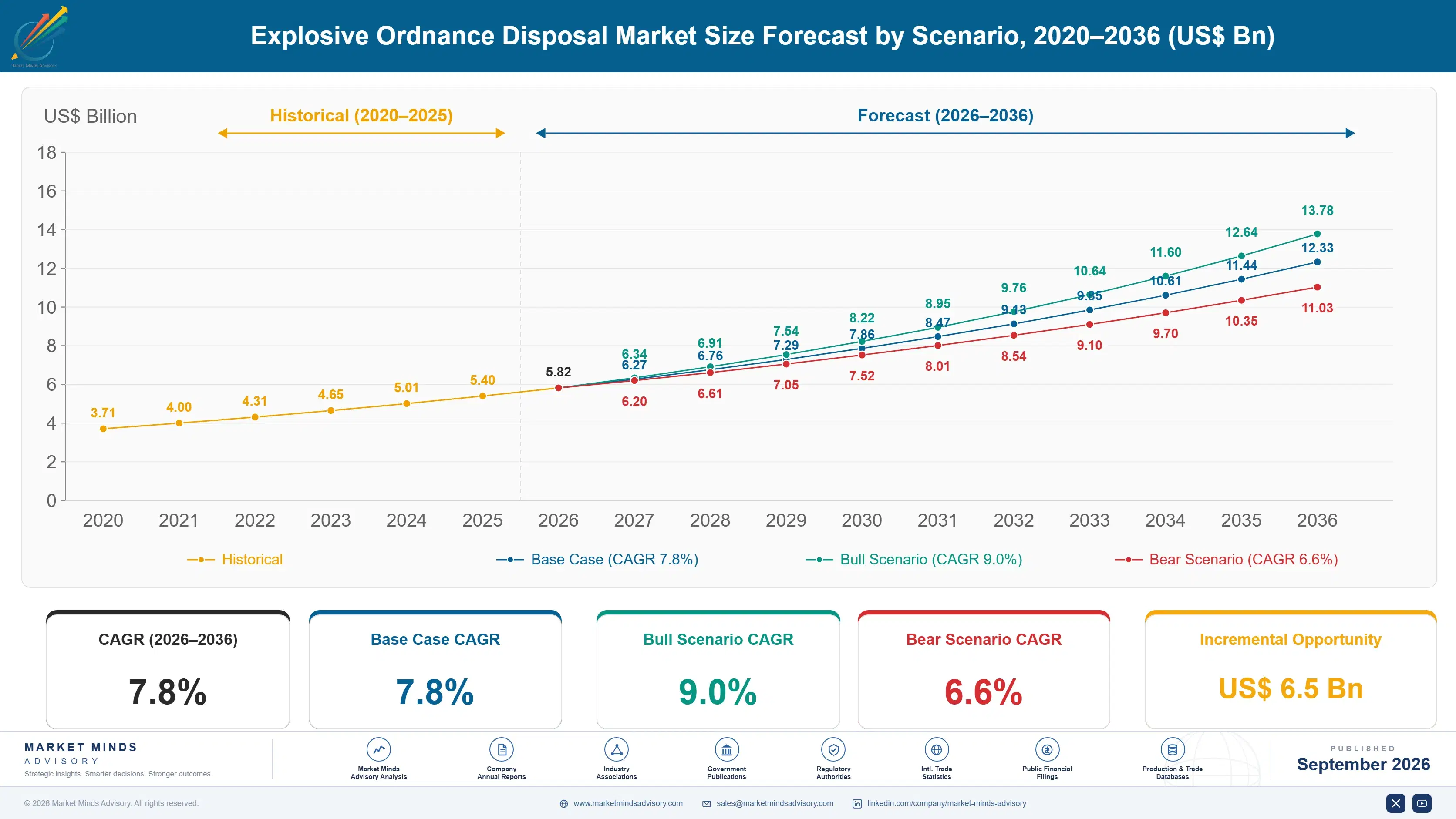
Explosive Ordnance Disposal Market Forecast Scenarios

explosive-ordnance-disposal-market-size-forecast-scenario-1790026073663
Growth averaged 6.5% across 2020 to 2025 and the driver changed completely partway through. The first two years were quiet, with military counter-improvised device procurement declining as deployments wound down and humanitarian funding flat. From 2022 the picture inverted: contamination on a scale nobody had equipment inventory for created immediate demand across survey, clearance machines and protective equipment, and suppliers spent two years catching up on delivery.
Base case growth of 7.8% rests on three mechanisms. Survey and area reduction investment rises because funders have finally understood that narrowing contaminated land estimates is cheaper than clearing land that was never contaminated. Military and police robot fleets acquired a decade ago are reaching replacement age simultaneously across several countries. And legacy contamination programmes across the Middle East, Africa and Southeast Asia continue on timelines measured in decades regardless of current attention.
The bull case at 9.0% assumes donor funding for large clearance programmes sustains at current levels through the forecast period rather than declining as political attention moves. The bear case at 6.6% follows directly from the opposite: humanitarian funding is annual, political and reversible, and suppliers who built capacity against it would find themselves holding equipment inventory nobody is buying.

Survey First, Clearance Second, Funding Throughout

Survey is where the money goes furthest and the attention goes least. Technical survey releases around 87% of suspected hazardous area without clearance, because the original estimate came from incident reports and assumptions rather than evidence. Every hectare released is a hectare nobody pays to clear. Funders have been slow to fund survey properly, partly because a clearance machine photographs better than a drone magnetometer.
FIVE-FIRM CONCENTRATION38%Five unrelated supply industries share only a common customer
AVERAGE ROBOT UNIT PRICEUSD 285kRemote handling platform across military and public safety configurations
SURVEY LAND REDUCTION RATE87%Suspected area released without clearance after technical survey
HUMANITARIAN FUNDING SHARE34%Portion of market demand funded through donor mine action grants
ROBOT FLEET REPLACEMENT AGE11 yearsTypical service interval before platform replacement becomes necessary
ARAMID COST SHARE29%Protective fibre portion of delivered suit and equipment cost
Two buyers share this market and they behave nothing alike. Military and police explosive ordnance disposal units buy capability with price as a secondary consideration, because the failure mode is a casualty and procurement is defence-funded. Humanitarian mine action operates on donor grants with annual cycles, buys against cost per square metre cleared, and reports outcomes to funders who compare organisations directly. Suppliers built around one customer consistently misjudge the other.
Funding cycles rather than contamination determine when equipment is bought. Humanitarian demand accounts for roughly 34% of the market and moves with donor political attention, which is annual, reversible and concentrated on whichever crisis is currently visible. Legacy contamination across Cambodia, Laos, Angola and Iraq has not diminished, but the funding has, and suppliers who scaled against one crisis have been caught before.
"Everybody wants to fund the machine chewing through a minefield. The thing that actually saves the money is two people with a magnetometer proving that nine tenths of the field was never mined at all."
Director, Defence and Public Safety Equipment Practice · MMA Defence and Public Safety / Hazardous Ordnance Equipment Practice · September 2026

Market Trends

Survey Technology Displaces Clearance As The Priority Purchase

Technical survey releases around 87% of suspected hazardous area without clearance, which makes survey equipment the highest-return purchase available to any clearance organisation. Drone-mounted magnetometry, multi-sensor ground penetrating radar and structured data capture have all improved sharply, and organisations applying them properly reduce clearance workload dramatically before a machine ever starts. The obstacle has been funding psychology rather than capability, since donors have historically preferred visible clearance activity to analytical work that reduces the apparent size of a problem. Cost pressure is finally shifting that preference across the major funders.
Market Impact: Covers 174,000 square kilometres

Aged Robot Fleets Reach Replacement Across Several Countries

Military and police remote handling platforms acquired during the counter-improvised device procurement wave a decade ago are reaching the end of supportable service life at roughly the same time. Replacement decisions are being made against a very different product generation, with better manipulators, lighter transport weight and open control architectures that let operators integrate their own payloads. Fleet replacement typically runs on an eleven-year interval, and the coincidence of timing across countries concentrates demand into a narrow window that suppliers must be ready for. Suppliers must be ready when that window opens.
Market Impact: Covers 2,300 civil disposal units

Market Opportunities and Growth Drivers

Eastern European Contamination Creates Unprecedented Equipment Requirements

Contamination across Ukraine covers an area no clearance organisation had equipment inventory for, and survey alone will occupy resources for years before the bulk of clearance begins. Demand has covered every equipment category simultaneously, from survey sensors and mechanical machines to protective equipment and remote handling platforms, which is unusual because most programmes emphasise one category. International funding has supported procurement at a scale the sector has not previously handled. Roughly 174,000 square kilometres require survey or clearance assessment. Every equipment category is in demand at once, which is genuinely unusual.
Market Impact: Exposes 34% of market demand

Police Bomb Squad Modernisation Expands Public Safety Procurement

Civil bomb disposal units across Europe, Asia and North America are replacing equipment acquired in the previous decade, driven by ageing platforms and by improvised device profiles that have changed since the original purchases. Public safety procurement differs from military buying in useful ways: budgets are municipal or national police rather than defence, cycles are longer, and equipment is expected to last. Around 2,300 civil bomb disposal units worldwide carry replacement requirements within the forecast period. Police procurement differs from military buying in ways that suppliers consistently underestimate at bid stage.
Market Impact: Spans 5 separate supply industries

Market Restraints and Challenges

Donor Funding Cycles Make Capacity Investment Genuinely Risky

Humanitarian mine action accounts for roughly 34% of market demand and is funded through donor grants that are annual, politically driven and reversible. The root cause is that mine action sits in development and humanitarian budgets rather than in defence budgets, so it competes with every other call on the same money. Commercially this means a supplier scaling production against a visible crisis may face a collapsed order book two years later. Mitigation runs through flexible contract manufacturing, product commonality across military and humanitarian lines, and deliberately conservative capacity commitments.
Market Impact: Releases 87% of suspected area

Fragmented Supply Industries Prevent Coherent Customer Offers

Robots, protective suits, sensors, disruptors and clearance machines come from five unrelated manufacturing industries with almost nothing in common beyond the customer. The root cause is that each product descends from a different engineering lineage, so no supplier holds credible capability across the set. Customers consequently integrate equipment themselves, which slows procurement and produces incompatible fleets. Participants are answering through acquisition of adjacent capability, open interface standards that make integration easier, and partnerships that present a combined offer without merging the underlying businesses. Customers end up integrating equipment themselves, which slows everything.
Market Impact: Replaces fleets on 11 year cycles
3 additional market trends, 4 additional growth drivers, and 2 additional restraints and challenges are covered in the full report. Contact sales@marketmindsadvisory.com to access the complete intelligence.

Segment CAGR and Growth Architecture

Equipment is segmented here by category, because category determines the supply industry, the certification path and the buying function. Mixing equipment category with application or funding source creates groups that overlap on every procurement. Six categories cover the field from survey sensors through to mechanical ground clearance machines, and growth rates between them differ more than the shared customer suggests.
explosive-ordnance-disposal-market-market-share-analysis-1790026074255

Detection And Survey Equipment

Growing at 11.7%, half again the market rate of 7.8%, this category has the best return of anything sold in this market and until recently the least funding attention. Technical survey releases around 87% of suspected hazardous area without clearance, so every dollar spent narrowing the estimate removes many dollars of clearance work. Drone-mounted magnetometry, multi-sensor ground penetrating radar and structured data capture have improved sharply over five years. The obstacle has always been funding psychology rather than technology: donors preferred visible clearance to analytical work that made a problem look smaller, and that preference is finally shifting under cost pressure. Cost pressure on funders is what is finally changing that preference.
CAGR 11.7%

Remote Handling Robotic Platforms

Remote handling platforms grow at 9.4% on the coincidence of fleet replacement across military and police users who bought during the counter-improvised device wave roughly a decade ago. The replacement generation differs substantially: lighter transport weight, better manipulator dexterity and open control architectures that let operators integrate their own payloads rather than accepting a closed system. Unit values average around USD 285,000 and fleet purchases are lumpy, which makes supplier revenue volatile between years. Public safety buyers behave differently from military ones here, favouring durability and long support horizons over capability margin, since a police unit expects a decade of service. Closed control architectures are now being excluded from these competitions outright.
CAGR 9.4%
Full segment breakdown across 6 segments available in the complete report.

Regional Architecture and Country Demand Map

Demand here follows contamination and funding rather than economic size, which produces a geographic pattern unlike any other equipment market. Eastern Europe and the Middle East and Africa both carry shares far above their usual weight, while North America leads on military and public safety procurement rather than clearance requirements.

North America

Procurement rather than contamination drives this region. United States military explosive ordnance disposal units and a large network of civil bomb squads together buy more equipment than any other national market, and replacement cycles on platforms acquired a decade ago are now falling due. Domestic contamination requiring clearance is negligible by comparison, so almost all demand is capability procurement rather than operational necessity. The region also hosts several of the largest suppliers, which shortens qualification chains. Growth of 6.9% sits below the market rate because this is a mature purchasing base rather than an expanding requirement. Capability procurement rather than operational necessity accounts for very nearly all of it here.
Share: 26% | CAGR: 6.9% (2026 to 2036)

Western Europe

Two distinct demands sit together here. Military and police procurement across Germany, France, the United Kingdom and the Nordics follows the same replacement pattern as North America, while legacy ordnance from two world wars still generates continuous disposal work, particularly in Belgium, France and Germany where construction and dredging surface munitions routinely. European suppliers also manufacture much of the world's mechanical clearance equipment and protective suits. Donor funding for overseas mine action originates disproportionately from European governments. Growth of 6.3% trails the market rate, reflecting mature procurement rather than any decline in the underlying requirement. Legacy ordnance surfaced by construction and dredging generates continuous work with no end date anywhere in sight.
Share: 21% | CAGR: 6.3% (2026 to 2036)
Regional intelligence for 5 additional markets available in the complete report: East Asia, South Asia and Pacific, Latin America, Middle East and Africa, Eastern Europe. Contact sales@marketmindsadvisory.com.
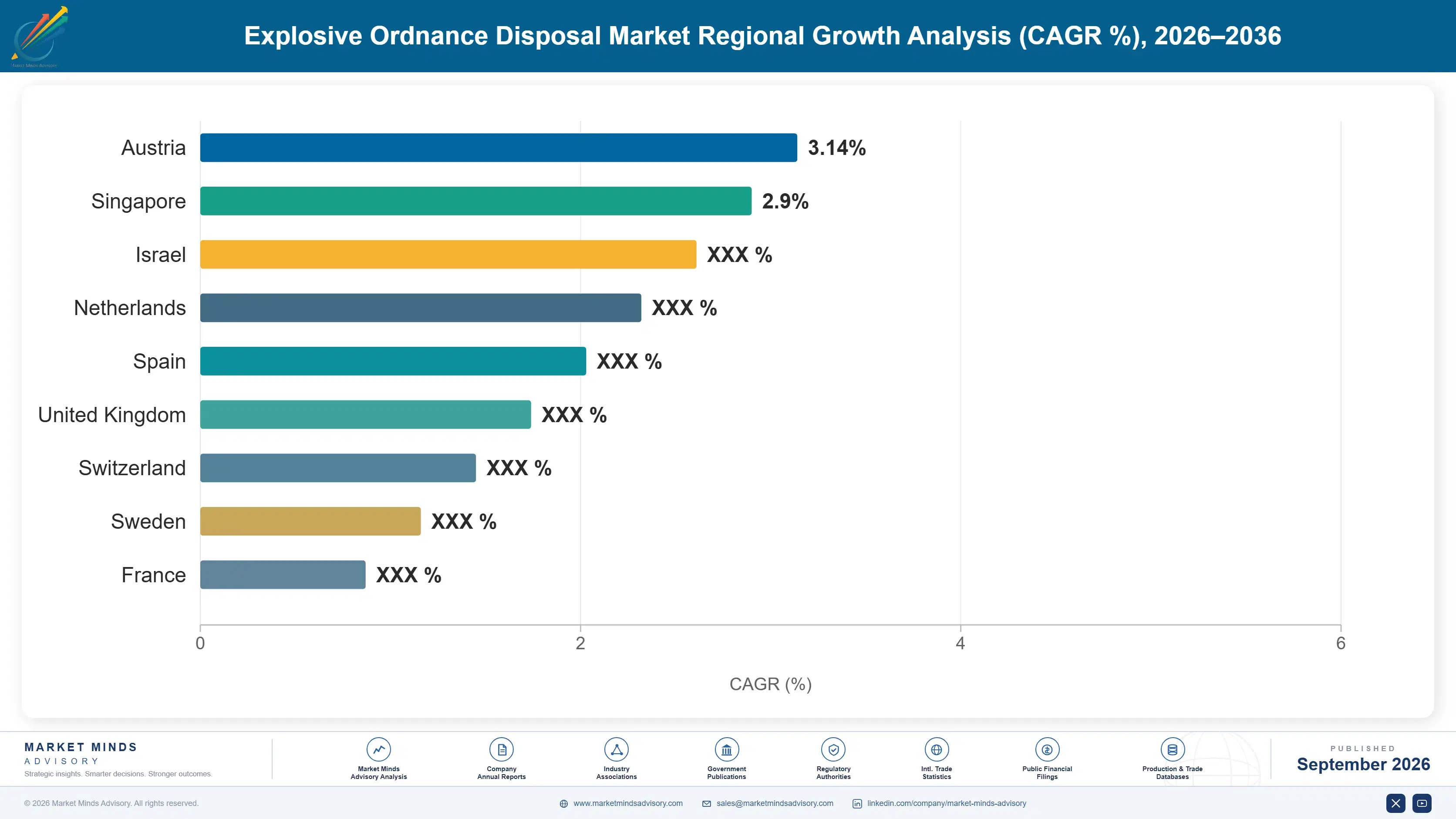
explosive-ordnance-disposal-market-country-cagr-analysis-1790026074809

Where Disposal Equipment Suppliers Earn Margin

Equipment unit sales are the visible revenue in this market and a poor guide to profitability. Survey capability, consumables and open architecture positioning decide delivered margin instead. The four levers below reflect positions participants have used to improve economics measurably rather than to win unit volume. Funding structure shapes every one of them. Unit sales mislead here.

Build Survey Capability Rather Than Clearance Hardware

Technical survey releases around 87% of suspected hazardous area without clearance, which makes survey equipment the highest-return purchase a clearance organisation can make and increasingly the one funders will approve. Survey products carry gross margin well above mechanical clearance machines and cost far less to manufacture, and demand tracks analytical need rather than headline crisis funding. Suppliers with credible survey offerings report margin roughly 21 points above clearance machine equivalents. The barrier is sensor and data capability rather than heavy engineering. Engineering lineages here simply do not transfer between the two.
Market Impact: Survey product margin runs roughly 21 points higher

Sell Consumables And Wear Parts As Recurring Revenue

Mechanical clearance machines consume flails, tines, wear steel and hydraulic components at rates that make consumables a substantial recurring line, and protective equipment requires periodic replacement regardless of use. Consumables carry better margin than the equipment and recur on operational tempo rather than on procurement cycles, which smooths revenue across the donor funding volatility that makes this sector difficult. Suppliers with disciplined consumables programmes generate roughly 1.7 times the equipment margin across a machine's service life. Machine revenue swings violently, while consumables revenue does not move with it at all.
Market Impact: Consumables return roughly 1.7 times the equipment margin

Adopt Open Control Architectures On Robotic Platforms

Customers replacing decade-old robot fleets increasingly specify open control architectures that let them integrate their own payloads rather than accepting a closed system from one supplier. Platforms offering it win competitions that closed systems lose outright, and they also sell payload-agnostic upgrades into fleets built by competitors. Suppliers with open architectures report win rates roughly 1.9 times those of closed equivalents in recent competitions. The commercial cost is conceding payload revenue that closed systems captured automatically, which several suppliers have refused to accept. Closed systems are being excluded from competitions outright now.
Market Impact: Open platform win rates roughly 1.9 times higher

Hold Product Commonality Across Military And Humanitarian Lines

Humanitarian demand is roughly 34% of the market and moves with donor politics, while military and police procurement follows defence and public safety cycles that are far steadier. Suppliers whose products serve both buyers can shift production between them as funding shifts, rather than scaling capacity against a crisis that may end abruptly. Participants holding genuine commonality report capacity utilisation roughly 26% higher through funding downturns. Achieving it means resisting the customisation each buyer requests, which requires discipline most firms lack. Each buyer asks for customisation that quietly destroys the commonality.
Market Impact: Capacity utilisation runs roughly 26% higher through downturns

Who Controls the Margin Pool

Concentration is low at 38% for the top five, measured on unit shipment volume and contracted procurement value, the basis used throughout this section. Fragmentation is a supply industry consequence rather than a competitive one: robots come from robotics, suits from protective textiles, sensors from geophysics, disruptors from ordnance and clearance machines from heavy plant, and no supplier holds credible capability across more than two of those lineages.
Competition currently turns on three dimensions. Survey and sensor capability decides who serves the fastest-growing and best-margin category. Open control architecture decides which robot platforms win replacement competitions against customers who have learned what closed systems cost. And product commonality across military and humanitarian lines decides who survives a donor funding downturn without stranding capacity.

Positions will move through acquisition rather than organic competition, because no supplier can build across five unrelated engineering lineages quickly enough to matter. Survey and sensor specialists are the obvious targets, since they hold the best margins and the fastest growth while lacking the balance sheet to scale against large programmes. Several equipment manufacturers have already begun buying rather than building that capability.
explosive-ordnance-disposal-market-company-positioning-matrix-1790026075325

Competitive Moat and Risk Dimensions

TELEDYNE FLIR

Moat: Combined Sensing And Platform Position

Teledyne FLIR holds both robotic platform and sensing capability, which is rare in a market where those lineages normally sit in separate companies. That combination lets it offer integrated detection and handling where competitors must partner, and the sensing side gives it access to the fastest-growing and best-margin category rather than only the platform business.
TELEDYNE FLIR

Risk: Military Programme Concentration

A large share of platform revenue depends on a small number of military programmes with lumpy award timing, which makes results move sharply between years for reasons unrelated to competitive performance. Humanitarian and public safety demand would diversify that exposure, but both buy differently enough that serving them requires product and commercial adjustments the company has been slow to make.
CHEMRING GROUP

Moat: Countermeasure And Sensing Breadth

Chemring combines electronic countermeasure capability with sensing and detection technology across several national programmes, which gives it positions in categories that most equipment suppliers cannot enter. Countermeasure work in particular carries security clearance and national programme relationships that take years to establish and function as an effective barrier to any new competitor.
CHEMRING GROUP

Risk: Limited Clearance Machine Presence

The company has little position in mechanical ground clearance, which is where much of the visible humanitarian funding is directed and where Eastern European demand has concentrated. Entering means heavy plant engineering with nothing in common with the firm's existing capability, and the alternative is watching a large share of current programme funding go elsewhere entirely.

Players Tracked

Prominent Players

Teledyne FLIR
Safariland Group
Chemring Group
Rheinmetall
QinetiQ

Other Key Players

Allen-Vanguard
ECA Group
Milrem Robotics
L3Harris Technologies
Elbit Systems
Israel Aerospace Industries
Leonardo
Northrop Grumman
Pearson Engineering
DOK-ING
Hydrema
Armtrac
Digger DTR
Scanjack
Cobham

Recent Developments

MARCH 2025

International funders shift mine action allocation toward survey and area reduction

Several major mine action funders revised allocation guidance to prioritise technical survey and area reduction ahead of clearance capacity expansion. This was a funding policy decision rather than any corporate transaction, and it redirects money toward the equipment category with the strongest return per dollar spent.
Signal: Funders finally pricing survey correctly changes which equipment category grows fastest for the rest of the decade
SEPTEMBER 2024

Equipment manufacturer acquires geophysical survey sensor specialist

A disposal equipment manufacturer acquired a specialist in geophysical survey sensors, adding detection capability to a portfolio previously weighted toward handling and clearance hardware. The transaction was an acquisition of the smaller firm rather than a merger, and it reflects the difficulty of building sensing capability internally.
Signal: Buying survey capability rather than building it confirms that engineering lineages here do not transfer between categories
JANUARY 2025

Military robot replacement programme specifies open control architecture requirement

A national military robot replacement programme specified open control architecture allowing operator-integrated payloads, excluding closed proprietary systems from the competition entirely. The requirement was a procurement specification rather than a corporate event, and it reflects customer experience with closed proprietary systems bought roughly a decade earlier.
Signal: Customers have learned what closed architectures cost and are now writing that lesson into their procurement specifications directly

What Drives Delivered Equipment Cost

Four inputs dominate across a varied range. Aramid and protective fibre runs roughly 29% of cost on suits and personal equipment, sensor and radio frequency electronics about 24% on detection products, hydraulics with wear steel close to 31% on clearance machines, and assembly with certification labour the balance in each case. Fibre and wear steel come from Western Europe, North America and Japan, while sensor semiconductors depend on East Asia.
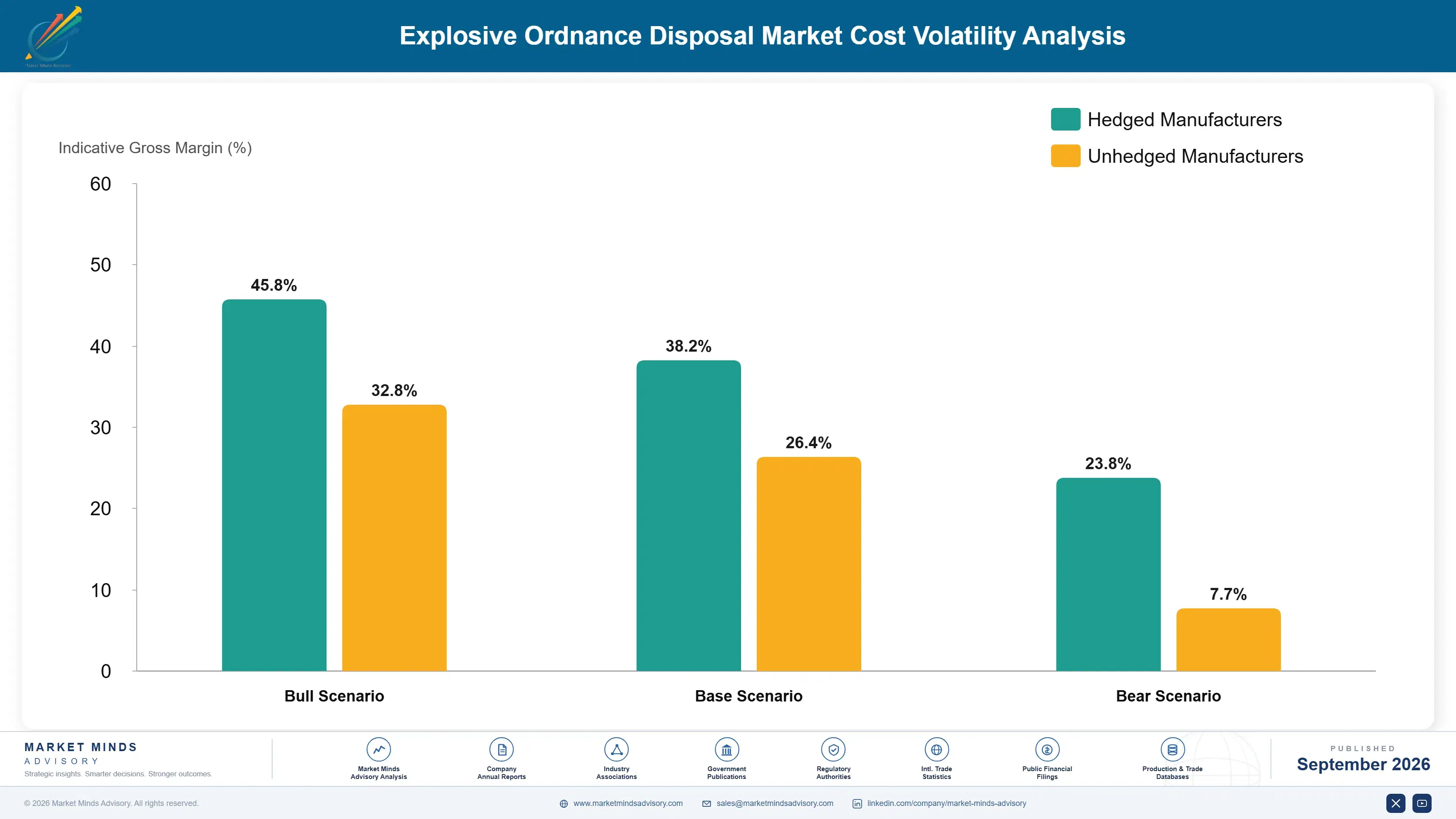
Two cost events coincided. European energy prices raised aramid and steel production costs sharply from 2022, with EIA energy price data showing the extent of the movement, while China's Ministry of Commerce export licensing on gallium tightened radio frequency component supply for detection and countermeasure products. Teledyne and Chemring both discussed input cost and supply conditions in annual reporting. Fixed-price government contracts absorbed most of both increases.

Exposure separates by product line, which is what makes it a competitive issue rather than a sector one. Suppliers weighted toward protective equipment carry fibre cost directly, clearance machine builders carry steel and hydraulics, and sensor suppliers carry semiconductor exposure. Very few carry all three, so identical market conditions produce completely different margin outcomes depending on where a firm's product weight sits.
explosive-ordnance-disposal-market-cost-volatility-analysis-1790026075520

Index government contracts to published fibre and steel indices

Government equipment contracts have traditionally been firm fixed price across multi-year delivery, which places every input movement on the supplier. Indexation to published protective fibre and steel indices shifts that risk back toward the buyer. Procurement rules requiring price certainty are the genuine obstacle rather than any reluctance to negotiate, and progress has come mainly on longer-duration framework agreements.

Qualify second-source radio frequency components ahead of need

Gallium-based radio frequency devices sit behind detection and countermeasure products, and export licensing made single-source dependency expensive. Qualifying alternatives costs test time and, on certified equipment, repeats approval work. Suppliers who did it before 2023 held delivery schedules while competitors renegotiated dates with government customers who have little tolerance for slipped commitments. Timing is everything here.

Balance product weight across fibre, steel and sensor lines

Because exposure differs so sharply by product line, a supplier concentrated in one category takes the full force of any input movement affecting it. Spreading product weight across protective, mechanical and sensing lines dilutes that, though it conflicts with the engineering focus each category rewards. Most participants accept concentration and manage the volatility rather than diversifying into unfamiliar lineages.

Portfolio Architecture for Margin Defence

Margin architecture here sorts by how much of the product is engineering and how much is steel. Mechanical clearance machines and basic protective equipment sit at the bottom, competing on price against specifications with heavy input cost exposure. Robotic platforms and countermeasure systems sit in the middle at better economics, defended by certification and programme relationships. Survey sensors, data products and consumables sit at the top, carrying the best margins in the market.
The volume-versus-premium tension follows the two buyers. Volume means clearance machines and protective equipment bought by humanitarian organisations on cost per square metre against donor budgets that end. Premium means sensors, countermeasures and robotic platforms bought by military and police users whose procurement is steadier and far less price-sensitive. Suppliers serving only the humanitarian side carry both thinner margins and the funding volatility, which is an uncomfortable combination.

High-value pools concentrate in three places: survey sensors and data products carrying margin roughly 21 points above clearance machines, consumables and wear parts returning around 1.7 times equipment margin across a service life, and countermeasure systems where security clearance and national programme access keep the competitive field very small.

Volume / Commodity-Adjacent Tier

Mechanical ground clearance machines and basic protective equipment bought against written specifications on price. Heavy steel, hydraulics and fibre cost exposure with limited pass-through. The eight point range reflects whether a supplier fabricates in-house or assembles purchased components.
Gross Margin: 14-22%

Premium / Certified Tier

Remote handling robotic platforms, disruptors and certified protective systems for military and police users. Programme relationships and certification defend pricing here. The ten point range tracks whether the platform uses open or closed control architecture, which now changes competitive exposure materially.
Gross Margin: 28-38%

Sustainability / Regulatory / Next-Generation Tier

Survey sensors, geophysical data products, electronic countermeasure systems and consumables programmes. Capability scarcity and recurring demand set pricing rather than cost. The sixteen point range spans a sensor business and a consumables business with genuinely different economics.
Gross Margin: 40-56%
explosive-ordnance-disposal-market-portfolio-architecture-1790026076023

High-value Sub-segments and Strategic Watch-out

Survey And Detection Sensors

Highest margin and fastest growth at 11.7%, releasing roughly 87% of suspected area without clearance and finally attracting proper funding attention. Sensor and data capability rather than heavy engineering is the barrier. The twelve point range reflects how differently integrated data products are priced against bare sensors.
Gross Margin: 44-56%

Consumables And Wear Parts

Genuinely recurring revenue returning roughly 1.7 times equipment margin across a machine's service life, driven by operational tempo rather than by procurement cycles. It smooths the donor funding volatility considerably. The ten point range reflects whether parts are manufactured in-house or sourced from outside third-party suppliers.
Gross Margin: 38-48%

Remote Handling Robotic Platforms

The premium volume core of the market, growing at 9.4% as decade-old fleets reach replacement across military and police users almost simultaneously. Open control architecture now decides these competitions outright. The ten point range reflects architecture choice and whether payload revenue is captured or conceded to customers.
Gross Margin: 28-38%

Mechanical Ground Clearance Machines

Thinnest margin in the market despite growing at 8.6%, bought by humanitarian organisations on cost per square metre with donor funding that can reverse. Steel and hydraulics cost exposure is carried on fixed-price contracts. Several suppliers hold this line for consumables access rather than machine margin.
Gross Margin: 14-22%

What Buyers Fund Repeatedly

The annuity here is consumables and replacement, not equipment renewal. Clearance machines consume flails, tines and wear steel continuously, protective equipment reaches replacement on calendar rather than use, and sensors require calibration and support. That recurring stream tracks operational tempo rather than procurement cycles, which makes it the steadiest revenue available in a market where capital purchasing swings violently with donor politics and defence budget timing.
Adoption depth varies enormously by buyer. Military explosive ordnance disposal units run the full equipment range with training, spares and upgrade programmes funded continuously, because capability gaps carry consequences no budget officer wants to own. Large humanitarian clearance organisations buy deeply in survey and clearance but nothing in countermeasures, and they buy against grant cycles rather than capability plans. Municipal police bomb squads sit at the shallow end: one platform, one suit set, replaced when it fails.

The buying function has shifted in humanitarian work specifically. Equipment was once chosen by operations staff on field experience. It is increasingly chosen against cost per square metre released, a measure funders now require, and that metric favours survey capability over clearance capacity in a way field preference never did.
explosive-ordnance-disposal-market-end-use-penetration-index-1790026076516

Where Suppliers Should Place Capital

These are among the four positions where our research anticipates prominent divergence between winners and laggards over the coming forecast period. Each is grounded in the demand model, the regulatory perimeter, and the announced capacity pipeline.
01 / SURVEY CAPABILITY PRIORITY

Buy or build sensing before expanding clearance hardware

Technical survey releases around 87% of suspected hazardous area without any clearance, which makes sensing the highest-return equipment a clearance organisation can buy and increasingly the category that funders will approve first. Survey products carry margin roughly 21 points above mechanical clearance machines and cost far less to manufacture as well. The barrier is sensor and data capability rather than heavy engineering, and the lineages do not transfer, which is precisely why several manufacturers have already chosen acquisition over internal development.
02 / CONSUMABLES REVENUE DISCIPLINE

Treat wear parts as the business, machines as the entry

Clearance machines consume flails, tines, wear steel and hydraulic components continuously, and protective equipment replaces on a calendar regardless of use, producing recurring revenue that returns roughly 1.7 times the equipment margin across a full service life. That revenue stream tracks operational tempo rather than procurement cycles, which smooths the donor funding volatility that makes this sector so genuinely difficult to plan around. Suppliers running disciplined consumables programmes keep earning through downturns that leave equipment-only competitors holding idle capacity instead.
03 / OPEN ARCHITECTURE POSITIONING

Concede payload revenue to win the platform competitions

Customers replacing their decade-old robot fleets have learned what closed proprietary systems cost them and are now writing open control architecture into specifications, excluding closed proprietary platforms from those competitions entirely. Suppliers offering open architectures report win rates roughly 1.9 times those of closed equivalents, and they can also sell payload-agnostic upgrades into fleets built by their competitors. The price is conceding payload revenue that closed systems captured automatically, which several manufacturers in this market have so far flatly refused to pay.
04 / FUNDING CYCLE HEDGING

Keep product commonality across military and humanitarian buyers

Humanitarian mine action is roughly 34% of market demand and moves with donor politics that are annual, reversible and focused on whichever crisis is currently visible, while military and police procurement follows far steadier cycles. Suppliers whose products serve both can shift production between them, and they report capacity utilisation roughly 26% higher through funding downturns. Achieving that means resisting the customisation each buyer asks for, which requires a discipline that most firms in this sector simply do not have.

Engagement Snapshot From the Field

A live engagement with an industry participant carrying material or product regulatory and market exposure ahead of a defining policy shift, showing how our research translates into a defensible multi-year portfolio strategy.
MARKET MINDS ADVISORY · CLIENT ENGAGEMENT SUMMARY
Explosive Ordnance Disposal Producer Strategic Portfolio Review and Transition Roadmap 2026·Investment Scenario on Explosive Ordnance Disposal Exposure Evaluation 2025-26
CLIENT PROFILE
A European manufacturer of mechanical clearance machines and protective equipment with roughly USD 160 million in annual revenue (client-reported, unverified by MMA), split about 71% humanitarian and 29% military (client-reported, unverified by MMA). The company had doubled production capacity against Eastern European demand and was now facing order intake well below the level that investment assumed, with no sensing or survey capability at all.
STRATEGIC CHALLENGE
Management read the order slowdown as a temporary funding pause and intended to hold capacity. The funding data suggested something else: donor allocation guidance had shifted toward survey and area reduction, which the company could not supply, and clearance machine demand was being deliberately constrained as a result. The board needed to decide whether to acquire sensing capability or reduce capacity.
MMA APPROACH
MMA analysed donor allocation guidance and disbursement patterns across the major mine action funders, modelled clearance machine demand under the revised funding priorities, and assessed build, partner and acquire routes into survey sensing. Expert interviews with clearance organisation operations directors established what survey capability they were actually being funded to procure.
KEY FINDINGS
  1. Donor allocation guidance had shifted decisively toward survey and area reduction, and clearance machine procurement was being constrained as a direct consequence rather than paused temporarily.
  2. Consumables and wear parts across the client's installed machine base generated roughly 34% of gross profit on about 12% of revenue, a concentration nobody in the business had quantified.
  3. Building survey sensing internally was assessed at around 31 months against an engineering lineage the company had no experience in whatsoever, and no hiring base.
  4. Military product commonality was far weaker than management believed, so the military line could not absorb humanitarian capacity when funding moved away from clearance work.
CLIENT PROFILE
A European manufacturer of mechanical clearance machines and protective equipment with roughly USD 160 million in annual revenue (client-reported, unverified by MMA), split about 71% humanitarian and 29% military (client-reported, unverified by MMA). The company had doubled production capacity against Eastern European demand and was now facing order intake well below the level that investment assumed, with no sensing or survey capability at all.
STRATEGIC CHALLENGE
Management read the order slowdown as a temporary funding pause and intended to hold capacity. The funding data suggested something else: donor allocation guidance had shifted toward survey and area reduction, which the company could not supply, and clearance machine demand was being deliberately constrained as a result. The board needed to decide whether to acquire sensing capability or reduce capacity.
MMA APPROACH
MMA analysed donor allocation guidance and disbursement patterns across the major mine action funders, modelled clearance machine demand under the revised funding priorities, and assessed build, partner and acquire routes into survey sensing. Expert interviews with clearance organisation operations directors established what survey capability they were actually being funded to procure.
KEY FINDINGS
  1. Donor allocation guidance had shifted decisively toward survey and area reduction, and clearance machine procurement was being constrained as a direct consequence rather than paused temporarily.
  2. Consumables and wear parts across the client's installed machine base generated roughly 34% of gross profit on about 12% of revenue, a concentration nobody in the business had quantified.
  3. Building survey sensing internally was assessed at around 31 months against an engineering lineage the company had no experience in whatsoever, and no hiring base.
  4. Military product commonality was far weaker than management believed, so the military line could not absorb humanitarian capacity when funding moved away from clearance work.
RECOMMENDED STRATEGY
Phase 1: Phase 1 (six months): Reduce clearance machine capacity to sustainable levels and reprice consumables programmes to reflect their actual contribution to gross profit. Phase 2: Phase 2 (15 months): Acquire a geophysical survey sensor specialist rather than attempting to build sensing capability from a standing start internally. Phase 3: Phase 3 (26 months): Rebuild military and humanitarian product commonality so capacity can shift between the two buyers as funding moves.
OUTCOME
The client reduced capacity and acquired a survey sensor business within fourteen months (client-reported, unverified by MMA). Survey products reached roughly 18% of revenue in the first full year at margins well above the machine line, and repriced consumables programmes held gross profit through a period when machine revenue fell materially.

Frequently Asked Questions

Foundational context covering the market sizes, CAGR, scope, country, region and competition that inform every finding below. This section is provided to cover basics and most often pre-purchase conversations, answered from the MMA Primary Research Dataset.

What is the current size of the Explosive Ordnance Disposal Market?

The market was worth USD 5.4 billion in 2025 and reaches USD 5.8 billion in 2026. That covers robotic platforms, protective equipment, detection and survey, disruptors, countermeasures and mechanical clearance machines.

How large will the Explosive Ordnance Disposal Market be by 2036?

MMA forecasts USD 12.3 billion by 2036, an increase of USD 6.5 billion over the 2026 base. That represents an expansion multiple of 2.12 times across the forecast period.

What is the CAGR for the Explosive Ordnance Disposal Market 2026 to 2036?

The base case CAGR is 7.8%, with a bull case of 9.0% if donor funding for large clearance programmes sustains at current levels. The bear case of 6.6% assumes humanitarian funding declines as attention moves.

Which segment is growing fastest?

Detection and survey equipment grows at 11.7%, half again the market rate of 7.8%. Technical survey releases around 87% of suspected hazardous area without clearance, which is the best return in the market.

Who are the major companies in the Explosive Ordnance Disposal Market?

Teledyne FLIR, Safariland Group, Chemring Group, Rheinmetall and QinetiQ lead on unit shipment volume and contracted procurement value. Allen-Vanguard, ECA Group and Milrem Robotics follow in the next tier.

Which country is growing fastest?

Ukraine leads at 12.4%, with roughly 174,000 square kilometres requiring survey or clearance assessment across every equipment category simultaneously. Growth elsewhere in Eastern Europe is comparatively flat.

Report Segmentation Architecture

The full report scope spans multiple orthogonal segmentation dimensions, with cross-tabulated demand data provided for each dimension pair. Coverage extends further to regional breakdowns, trend trajectories, and the competitive detail needed to support segment-level decision-making.

By Equipment Category

  • Remote Handling Robotic Platforms
  • Protective Suits And Personal Equipment
  • Detection And Survey Equipment
  • Disruptors And Render-Safe Tools
  • Electronic Countermeasure Systems
  • Mechanical Ground Clearance Machines

By End-Use Industry

  • Military Disposal Units
  • Police And Public Safety Bomb Squads
  • Humanitarian Mine Action Organisations
  • Commercial Clearance Contractors
  • Infrastructure And Construction Operators

By Commercial Dimension

  • Defence Procurement Contract
  • Donor Funded Grant Purchase
  • Public Safety Framework Agreement
  • Consumables And Support Supply

By Region

  • North America
  • Western Europe
  • East Asia
  • South Asia and Pacific
  • Latin America
  • Middle East and Africa
  • Eastern Europe

Scope, Methodology, and Coverage

Every figure in this report is reproducible from documented input assumptions. The scope below maps the historical period, the forecast horizon, the segmentation dimensions, and the countries covered, alongside the underlying primary and qualitative methodology.
Historical Period
2020 to 2025
Forecast Period
2026 to 2036
Base Year
2025 (USD billions; MMA Primary Research Dataset, September 2026)
Market Definition
This report covers equipment used to detect, survey, handle and dispose of explosive ordnance across military, public safety and humanitarian mine action applications. Scope includes remote handling robotic platforms, protective suits and personal equipment, detection and survey equipment, disruptors and render-safe tools, electronic countermeasure systems, mechanical ground clearance machines, and the consumables and wear parts supplied against them. Excluded are clearance and survey services sold as labour, ammunition demilitarisation plant, chemical and biological hazard equipment, combat engineering vehicles, forensic laboratory equipment, and separately sold training services.
Quantitative Units
USD billions (current prices); unit shipment volumes; equipment pricing by category; funding source split
Segmentation Dimensions
By Equipment Category; By End-Use Industry; By Commercial Dimension; By Region
Regions Covered
North America, Western Europe, East Asia, South Asia and Pacific, Latin America, Middle East and Africa, Eastern Europe
Countries Covered
USA, Ukraine, Germany, France, UK, Poland, Iraq, Syria, Libya, Angola, Cambodia, Laos, Vietnam, India, Sri Lanka, Colombia, Bosnia and Herzegovina, Croatia, Azerbaijan, Yemen, Somalia, Sudan, Afghanistan, Japan, South Korea, China, Australia, UAE, Saudi Arabia, Turkey, and additional markets relevant to this sector
Key Companies Profiled
Teledyne FLIR, Safariland Group, Chemring Group, Rheinmetall, QinetiQ, Allen-Vanguard, ECA Group, Milrem Robotics, L3Harris Technologies, Elbit Systems, Israel Aerospace Industries, Leonardo, Northrop Grumman, Pearson Engineering, DOK-ING, Hydrema, Armtrac, Digger DTR, Scanjack, Cobham
Quantitative Methodology
Primary survey, n=3,800 respondents, Q4 2025, six countries; demand-side model with trade association cross-validation
Qualitative Methodology
47 expert interviews, Q4 2025; applied to validate demand model assumptions, identify emerging dynamics, and assess competitive positioning
Report Format
PDF and XLSX data workbook (Word format preview document)
Publisher
Market Minds Advisory
Report Code
MMA-2026-CON-913
Published
September 2026
Contact
sales@marketmindsadvisory.com | www.marketmindsadvisory.com

Purchase the full Explosive Ordnance Disposal Market Report (2026 to 2036).

The full report sizes explosive ordnance disposal equipment across six categories and all seven regions, with unit shipments and pricing behind every figure. It separates military and public safety procurement from donor-funded humanitarian demand throughout, because the two buy on opposite logic and respond to entirely different signals. Competitive analysis covers 20 participants on shipment volume and contracted procurement value, including which of the five underlying supply industries each firm actually operates in. Donor funding allocation and disbursement patterns are tracked as the principal demand driver in humanitarian clearance. Consumables and wear part economics are modelled separately from equipment sales across a machine service life.
Six-category sizing with shipment volumes and pricing
Military procurement separated from donor-funded demand
Supply industry lineage mapped by participant
Donor allocation patterns tracked as demand driver
Consumables economics modelled across service life
Survey versus clearance return comparison quantified

Built For The People Who Decide

From boardroom strategy to bench-side execution, this report is read cover-to-cover by leaders shaping the next decade of their industry, turning demand scenarios, market dynamics and valuation benchmarks into decisions.
CXOs/ Presidents/ VPs/ Managers
M&A and Corporate Development
Strategy Teams and R&D Heads
Procurement and Product Directors
Regulatory and Compliance Leaders
Investor Relations and Equity Analysts