Market Minds Advisory
Explainable AI Market

Explainable AI Market: Explainable AI Market. Regulatory Mandates Push Interpretability From Research Tool to Compliance Requirement

Binding AI regulation and mounting model risk scrutiny are colliding as enterprises deploy interpretability tooling fast enough to satisfy auditors and regulators before high-risk AI system compliance deadlines take full effect.

Lead Analyst

Published

September 2026

Make Smarter Decisions with Customized Research Insights

Request a free sample report and evaluate market opportunities, growth trends, and competitive dynamics relevant to your business needs.

2025 MARKET VALUE$0.8BMarket Size 2025
2036 FORECAST VALUE$5.0BBase Case , 2026 to 2036
CAGR 2026 TO 203617.5 %Bull 18.8% / Bear 16.2%
INCREMENTAL OPPORTUNITY$4.0BNet 10- year value creation
EXPANSION MULTIPLE5.02x2036 value over 2026 base
Strategic Levers
M&A Pipeline
Regional Outlook
Country Rankings
Competitive Intelligence
Segmental Deep-dive
Call-Us : 91 93563 13602

Executive Snapshot and Market Trajectory.

Explainable AI is shifting from a data science research interest into a mandatory compliance requirement as regulators worldwide begin enforcing interpretability obligations for high-risk automated decision systems across financial services, healthcare, and employment screening. Enterprises are scrambling to retrofit explanation capability into already-deployed models.
Financial services and healthcare organizations lead adoption given existing model risk management obligations, while the EU AI Act's phased high-risk system requirements are pulling a broader range of industries into interpretability tooling procurement earlier than most vendors originally anticipated for their product roadmaps, forcing rapid feature development to meet documentation and audit trail requirements. Vendors that anticipated this regulatory timeline early now hold a meaningful head start over competitors still building compliance-specific reporting features.
Competitive dynamics increasingly separate governance-focused platform vendors from narrower open-source explainability libraries, as enterprises seeking audit-ready compliance documentation favor commercial platforms offering built-in reporting over assembling explainability pipelines from disparate open-source components independently, a shift that favors vendors with dedicated compliance engineering teams over pure research-oriented technology providers. This divergence reshapes vendor roadmaps considerably. Investors reward vendors demonstrating this compliance-first orientation clearly in their public messaging and product positioning strategy.
Market Definition
This report covers software platforms and tools that generate human-interpretable explanations for machine learning model predictions, including model-agnostic and model-specific interpretability methods and AI governance dashboards, measured on a global software revenue basis. It excludes general-purpose MLOps platforms without dedicated explainability functionality.
Base Year Value
$0.8B in 2025 (MMA Primary Research Dataset, September 2026)
Forecast Period
2026 to 2036, eleven discrete annual values
CAGR
17.5% base case. Bull 18.8%. Bear 16.2%.
Fastest Growth Segment
AI Governance and Compliance Dashboards: 23.5% CAGR
Fastest Growth Country
Germany: 21.0% CAGR
Fastest Growth Region
South Asia and Pacific: 19.5% CAGR
Largest Region
North America: 32% of 2025 global value
Market Leaders
Fiddler AI, Arthur AI, TruEra, IBM Watson OpenScale, DataRobot
Primary Survey
n=3,800 procurement and R&D decision-makers, Q4 2025, six countries
Methodology
Demand-side build-up, cross-validated against public data, 47 expert interviews

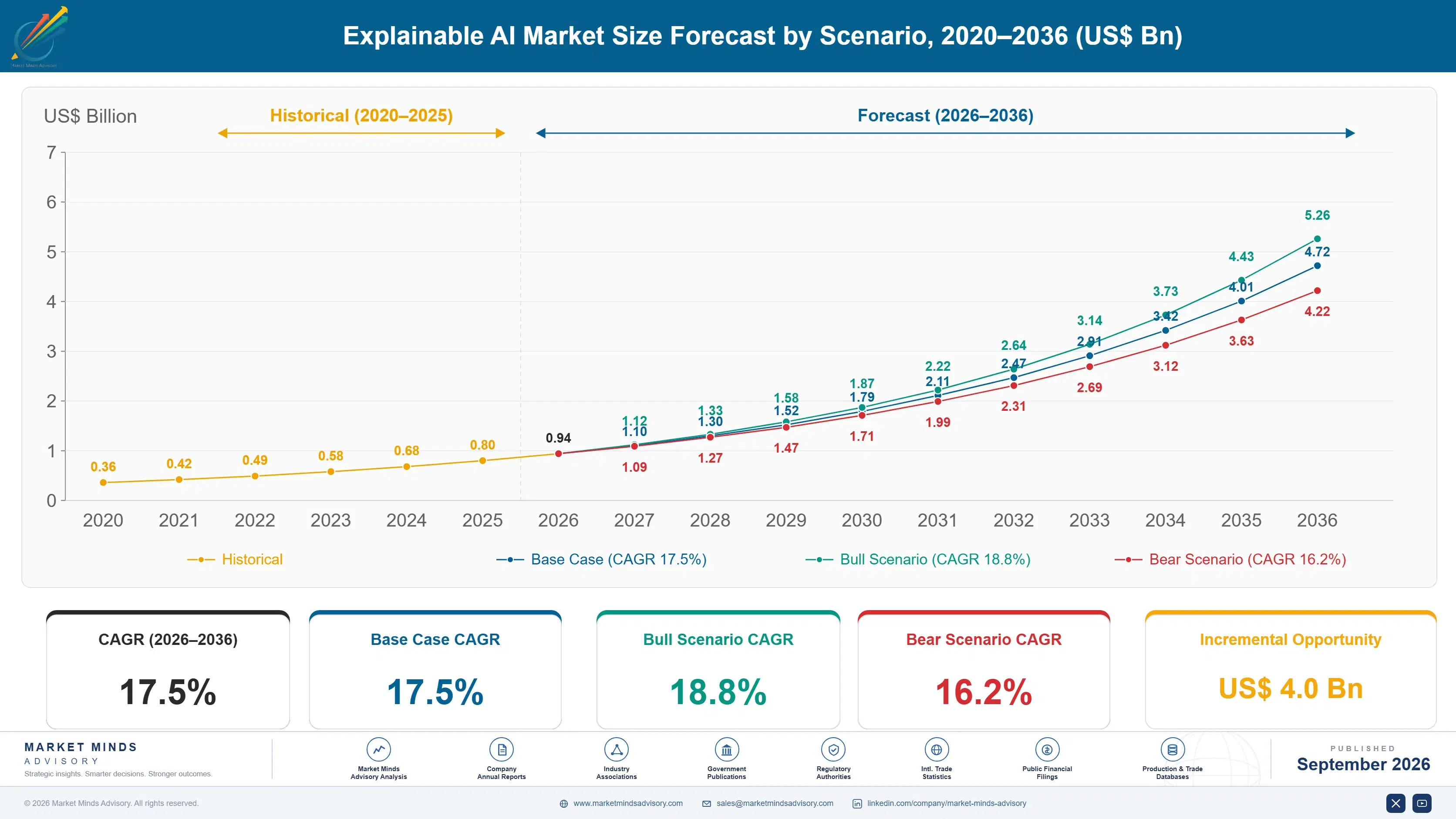
Explainable AI Market Forecast Scenarios

explainable-ai-market-size-forecast-scenario-1788413614741
Between 2020 and 2025, explainability tooling grew from an academic research niche into commercial software as early regulatory signals and internal model risk teams began requesting interpretability documentation, though adoption remained concentrated among financial services and a handful of highly regulated industries. Vendors serving this early period focused primarily on data scientist tooling rather than the audit-ready compliance documentation that now defines the broader commercial category.
The base case rests on three mechanisms holding through the forecast window: phased EU AI Act high-risk system compliance deadlines pulling broader industry adoption forward, growing enterprise AI deployment expanding the addressable model base requiring interpretability coverage, and gradual convergence toward standardized explainability reporting formats reducing integration friction for compliance teams. These mechanisms reinforce each other as regulatory pressure and enterprise AI deployment volume align. Compliance teams increasingly demand this interoperability from vendors.
A bull scenario emerges if additional jurisdictions adopt AI regulation comparable to the EU framework, pulling forward adoption timelines globally, while a bear risk centers on enforcement delays or regulatory rollback reducing the urgency driving current procurement decisions across regulated industries. Vendor consolidation will likely accelerate regardless of which scenario prevails. This trend seems likely regardless of the regulatory outcome.

Regulation Turns Interpretability Into a Purchase Requirement

Regulatory pressure, not internal data science preference, increasingly drives purchasing decisions in this category, since compliance and legal teams now sit alongside data science leaders in vendor evaluation processes that previously belonged almost entirely to technical buyers. This shift has lengthened enterprise sales cycles, since compliance stakeholders bring different evaluation criteria than the technical buying committees that historically dominated procurement in this category.
TOP REGION SHARE34%North America's share of global explainable AI software revenue today
FINANCIAL SERVICES ADOPTION48%Share of financial institutions using dedicated interpretability tooling currently
AVERAGE CONTRACT VALUE$120KTypical annual enterprise software contract for platform-level deployment
MARKET CONCENTRATION38%Combined software revenue share held by the top five vendors
OPEN-SOURCE ADOPTION SHARE42%Portion of deployments relying primarily on open-source explainability tools
AVERAGE SALES CYCLE7 monthsTypical time from initial vendor contact to signed enterprise contract
Commercial platform vendors increasingly differentiate through audit-ready reporting and regulatory documentation templates rather than raw interpretability algorithm sophistication, since most core explainability methods have become commoditized across both commercial and open-source tooling options. Vendors that built compliance-specific reporting templates early now command meaningfully stronger positioning against competitors still retrofitting audit trail capability into platforms originally designed purely for data scientist workflows and technical model debugging.
Enterprise buyers increasingly prefer platforms that integrate directly into existing MLOps pipelines over standalone explainability tools requiring separate deployment and maintenance, favoring vendors that minimize the operational burden of adding interpretability coverage to already-complex machine learning infrastructure. This integration preference favors platform vendors with established MLOps partnerships over standalone tools, even when the standalone alternative offers marginally more sophisticated interpretability algorithms for specific technical use cases.
"Explainability used to be something you bolted on if a regulator asked. Now it's something you build in because a regulator will ask."
Practice Lead, AI Governance and Enterprise Software · MMA AI Governance Practice · September 2026

Market Trends

EU AI Act Compliance Deadlines Drive Procurement Timing

The EU AI Act's phased implementation schedule, with high-risk AI system obligations taking full effect over 2026 and 2027, is compressing enterprise procurement timelines as compliance teams race to deploy interpretability tooling before binding deadlines arrive. Vendors report that roughly 45 percent of new enterprise contracts signed over the past year explicitly cited EU AI Act compliance as the primary purchasing driver, a marked shift from the model risk management and internal governance rationales that dominated purchasing decisions just two years earlier. This regulatory timeline is reshaping vendor sales cycles and feature prioritization considerably across the entire competitive field.
Market Impact: Penalties reach 7% of global revenue
Large Language Model Deployment Expands Addressable Demand

Enterprise deployment of large language models for customer-facing and decision-support applications is expanding the addressable market for explainability tooling well beyond its traditional focus on structured tabular data models used in credit scoring and fraud detection. Vendors are racing to develop interpretability methods suited to the fundamentally different architecture of transformer-based language models, where traditional feature-attribution techniques translate poorly. This expansion has roughly doubled the addressable enterprise use case count for explainability vendors capable of supporting both traditional and generative AI model types. Vendors that support both model families now hold a meaningful competitive advantage in enterprise procurement evaluations.
Market Impact: Covers 60% of large banks

Market Opportunities and Growth Drivers

EU AI Act High-Risk System Obligations Mandate Interpretability

The EU AI Act requires providers of high-risk AI systems, including those used in credit scoring, employment screening, and healthcare diagnosis, to provide documentation enabling meaningful human oversight and explanation of automated decisions. Non-compliance penalties can reach up to 35 million euros or 7 percent of global annual revenue, whichever is higher, creating a compelling financial incentive for enterprises operating in or serving European markets to invest in interpretability tooling well ahead of enforcement deadlines. Multinational enterprises increasingly standardize on one platform to satisfy the strictest applicable regulatory regime across all their operating markets.
Market Impact: Explanation fidelity drops 30% at scale

Financial Services Model Risk Management Requirements Expand

Banking regulators in the United States and Europe have progressively tightened model risk management expectations, requiring financial institutions to demonstrate that automated credit and risk models can be explained and validated independently of the original development team. Roughly 60 percent of large banks now maintain dedicated model risk management functions requiring interpretability tooling as a core operational requirement rather than an occasional audit exercise, sustaining steady baseline demand for explainability platforms across the financial services sector regardless of broader AI regulation developments. This baseline demand provides vendors a stable revenue floor even as broader AI regulation implementation timelines shift.
Market Impact: Talent gaps affect 40% of deployments

Market Restraints and Challenges

Deep Learning Model Complexity Limits Explanation Fidelity

The most sophisticated modern AI models, particularly large language models and complex deep neural networks, resist genuinely faithful explanation despite vendor marketing claims, since the mathematical approximation techniques underlying most commercial explainability tools cannot fully capture how these models actually reach their predictions. The root cause is fundamental: explanation methods approximate model behavior rather than directly observing internal reasoning, and this approximation gap widens as model complexity increases. Vendors are responding by clearly documenting explanation method limitations and confidence levels rather than overselling explanation fidelity that current technology cannot genuinely deliver.
Market Impact: Cited in 45% of contracts

Skilled Talent Shortage Constrains Enterprise Implementation

Enterprises frequently lack the specialized data science talent needed to correctly implement and interpret explainability tooling outputs, risking either superficial compliance checkbox exercises or genuinely misleading conclusions drawn from misapplied interpretability methods. The root cause is that explainability requires combining deep statistical knowledge with domain expertise that few practitioners currently possess given how recently the discipline has matured into a distinct professional specialization. Vendors are responding with simplified user interfaces and built-in guardrails designed to reduce the expertise threshold required for correct tool usage. This talent gap disproportionately affects smaller enterprises without dedicated AI governance teams already in place.
Market Impact: Doubles use cases to 2x prior
4 additional market trends, 3 additional growth drivers, and 3 additional restraints and challenges are covered in the full report. Contact sales@marketmindsadvisory.com to access the complete intelligence.

Segment CAGR and Growth Architecture

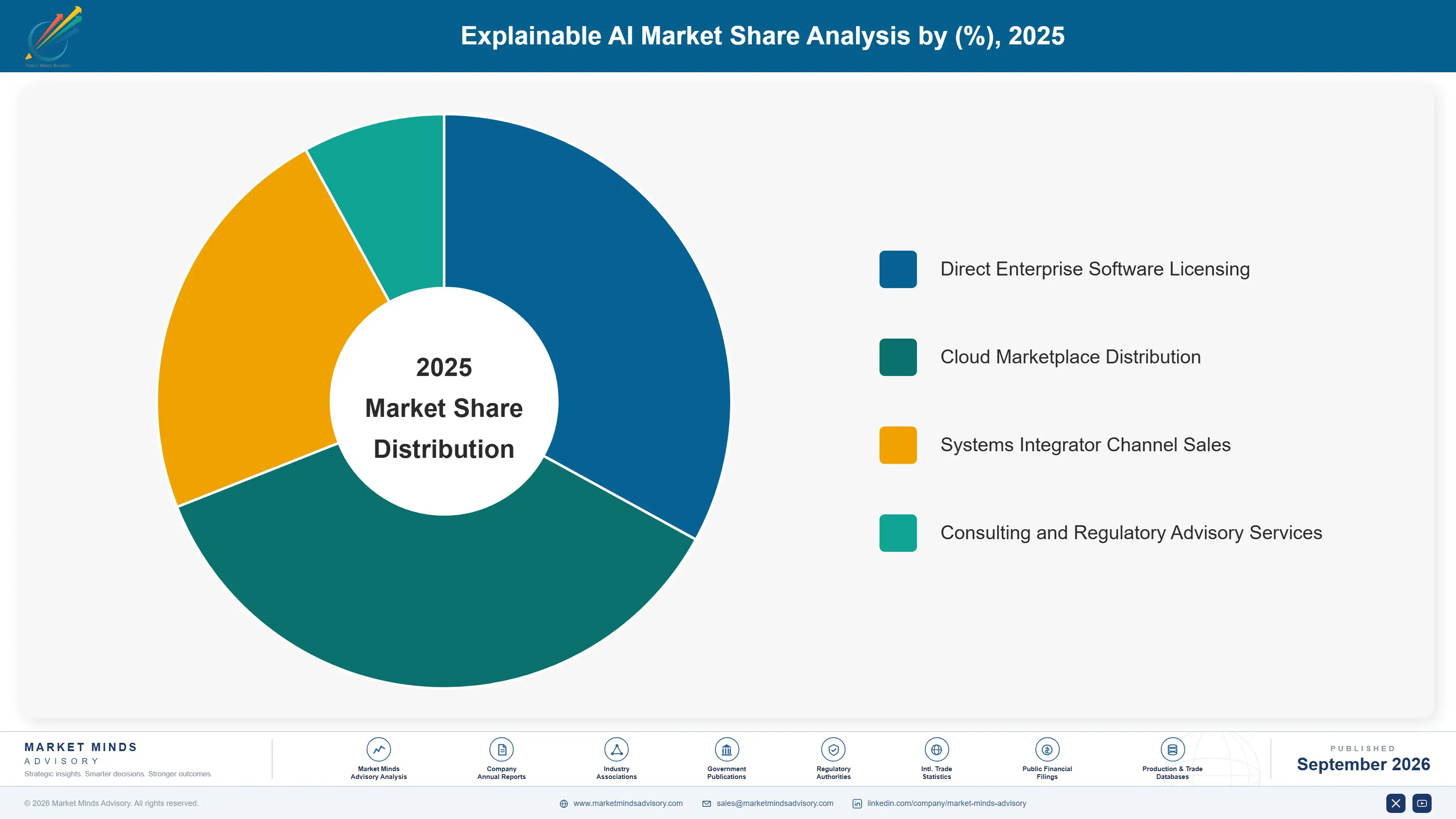
The explainable AI market splits into six product-type segments defined by interpretability approach and deployment model, from mature model-agnostic libraries through fast-growing governance and compliance dashboards. Growth diverges sharply as regulatory compliance requirements pull enterprise buyers toward audit-ready reporting rather than raw technical interpretability capability. Vendor positioning increasingly reflects this shift toward compliance-oriented product development priorities.
explainable-ai-market-market-share-analysis-1788413615377

AI Governance and Compliance Dashboards

AI governance and compliance dashboards represent the fastest-growing segment, combining interpretability outputs with audit trail documentation, risk scoring, and regulatory reporting templates that compliance teams require for EU AI Act and financial services model risk submissions. Adoption concentrates among enterprises operating in heavily regulated industries or across multiple jurisdictions with varying AI regulation requirements, where manually assembling compliance documentation from disparate technical outputs would be prohibitively labor-intensive. Vendors including Fiddler AI and Arthur AI have repositioned their platforms around this governance framing, recognizing that compliance documentation capability now drives purchasing decisions more than raw explanation algorithm sophistication. Contract sizes in this segment run meaningfully higher than pure technical interpretability tooling given the broader scope of capability delivered.
CAGR 23.5%

Explainability-as-a-Service Cloud Platforms

Explainability-as-a-service cloud platforms let enterprises access interpretability capability through API calls rather than deploying and maintaining dedicated infrastructure, appealing particularly to mid-sized enterprises lacking the specialized machine learning operations teams larger organizations maintain. This segment benefits from cloud hyperscalers increasingly bundling explainability capability into broader AI platform offerings, reducing the friction of adopting interpretability tooling for enterprises already using those cloud providers for model training and deployment infrastructure. Growth remains somewhat constrained by data governance concerns among enterprises reluctant to send sensitive model data to third-party cloud services. Enterprises in highly regulated sectors often prefer on-premises deployment despite the added operational burden this choice requires. Growth remains quite strong nonetheless.
CAGR 19.0%
Full segment breakdown across 7 segments available in the complete report.

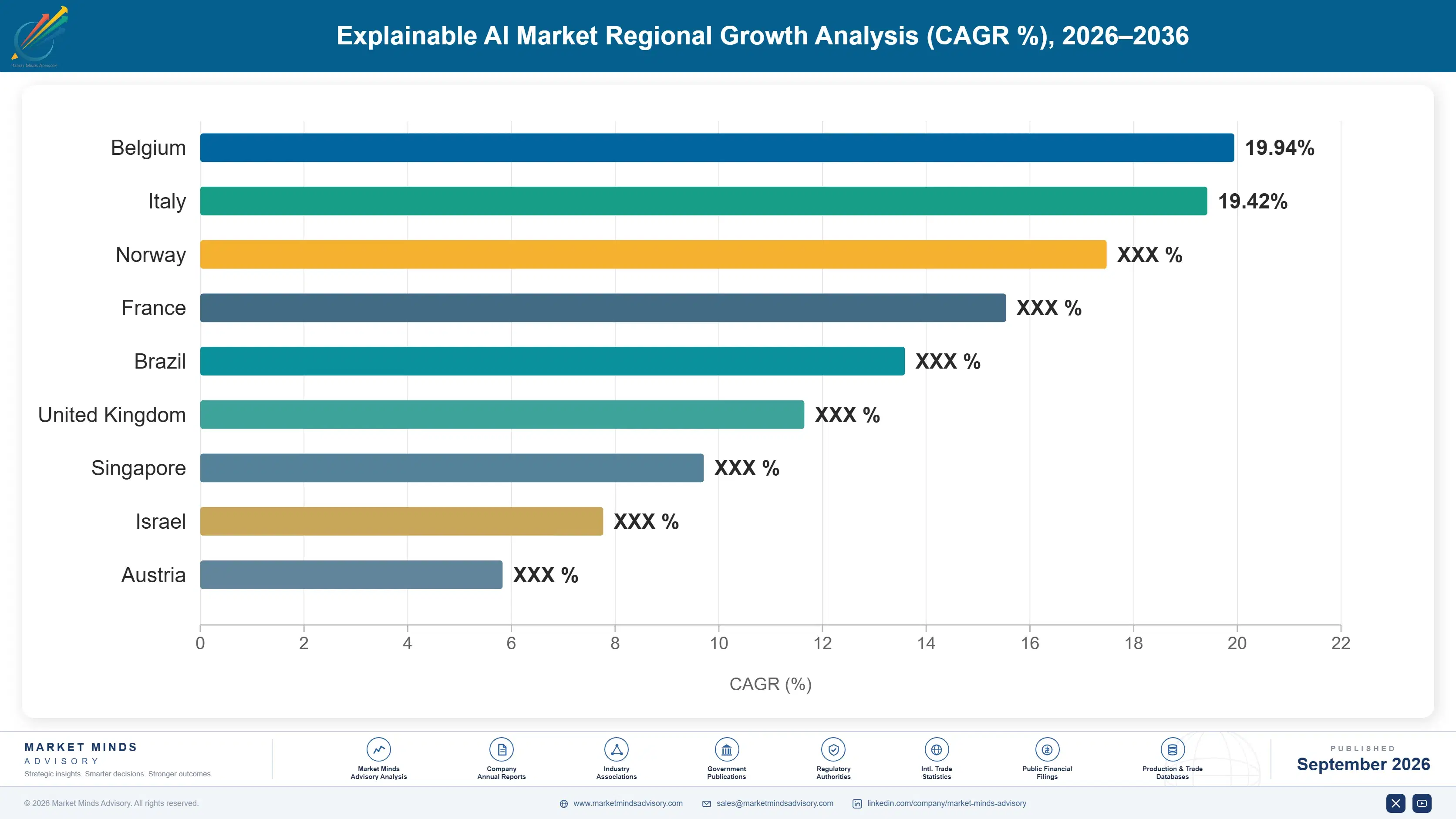
Regional Architecture and Country Demand Map

North America leads global explainable AI software revenue, anchored by concentrated enterprise AI vendor headquarters presence and strong financial services model risk management demand nationwide, while South Asia and Pacific posts the fastest regional growth rate as broader enterprise AI adoption accelerates rapidly through 2036.

North America

The United States hosts the largest concentration of explainable AI vendors and enterprise buyers, driven by state-level AI regulation, federal financial services model risk management requirements, and the sheer scale of enterprise AI deployment across technology, banking, and healthcare sectors. Fiddler AI, Arthur AI, and TruEra all maintain North American headquarters, giving the region an outsized share of vendor innovation alongside enterprise demand. Canada's smaller but growing market follows similar regulatory and adoption patterns tied to its own emerging federal AI governance framework currently under legislative development. Financial services remains the single largest vertical driving regional demand. Enterprise procurement cycles increasingly involve compliance and legal stakeholders alongside data science teams.
Share: 32% | CAGR: 17.0% (2026 to 2036)

Western Europe

The EU AI Act's binding high-risk system obligations make Western Europe the region most directly shaped by explicit regulatory mandate rather than voluntary governance best practice adoption. Germany, France, and the Netherlands host the largest concentration of enterprises subject to high-risk system compliance requirements, sustaining strong demand for audit-ready interpretability platforms. Financial services incumbents across the region maintain particularly mature model risk management practices predating the AI Act specifically. The region's second-largest global revenue share reflects genuine regulatory urgency rather than simply following North American technology adoption trends with a lag. Enforcement actions expected in coming years will likely reinforce this urgency considerably further. Momentum remains strong overall. Interest keeps rising.
Share: 23% | CAGR: 16.0% (2026 to 2036)
Regional intelligence for 5 additional markets available in the complete report: East Asia, South Asia and Pacific, Latin America, Middle East and Africa, Eastern Europe. Contact sales@marketmindsadvisory.com.
explainable-ai-market-country-cagr-analysis-1788413615904

Compliance Documentation and LLM Coverage Priorities

Vendors generate outsized returns not from raw interpretability algorithms alone but from compliance documentation depth, large language model coverage, and MLOps integration partnerships. Four levers stand out as the clearest paths to margin expansion across the forecast period, each requiring distinct engineering and regulatory expertise investment. Adoption timing and regulatory expertise increasingly separate winners from laggards across the vendor landscape.

Build Audit-Ready Compliance Reporting Templates Broadly

Developing pre-built compliance reporting templates mapped directly to specific regulatory frameworks like the EU AI Act and financial services model risk guidance captures premium pricing of 20 to 30 percent over generic interpretability tooling, since compliance teams value pre-validated documentation over assembling reports from raw technical outputs themselves. Vendors with established regulatory expertise increasingly capture disproportionate share of enterprise contracts specifically citing compliance deadline pressure as the primary purchasing driver. Fewer than a handful of vendors currently hold this preferred status across leading regulatory frameworks. Contract renewals remain historically high.
Market Impact: Commands a 20 to 30% price premium overall

Expand Large Language Model Interpretability Coverage

Developing interpretability methods suited specifically to transformer-based language models addresses a rapidly expanding addressable market as enterprises deploy generative AI for customer-facing and decision-support applications well beyond traditional structured data use cases. Vendors capable of supporting both traditional and generative AI model types capture roughly 2 times the addressable enterprise use case count compared with vendors limited to legacy tabular model interpretability alone, a meaningful competitive advantage in enterprise procurement evaluations increasingly spanning both model categories. Early movers in this segment continue building meaningful competitive advantage over slower-moving rivals. Adoption keeps expanding.
Market Impact: Doubles addressable enterprise use case count to 2x

Secure Deep MLOps Platform Integration Partnerships

Integrating directly into established MLOps platforms rather than requiring standalone deployment reduces the operational burden that drives enterprise buyers toward pre-integrated alternatives, capturing distribution advantages through existing platform sales channels. Vendors with deep MLOps integration report meaningfully faster sales cycles and higher win rates against standalone competitors, since enterprises increasingly prefer minimizing the number of separate tools their machine learning operations teams must maintain and monitor across their infrastructure. This integration advantage has compressed typical sales cycles by roughly 30 percent for vendors with the deepest platform partnerships. Renewals proceed smoothly.
Market Impact: Cuts sales cycles by 20 to 30% overall

Offer Multi-Jurisdiction Regulatory Mapping Services Broadly

Providing services that map a single interpretability deployment to multiple jurisdictions' varying regulatory requirements addresses genuine pain points for multinational enterprises seeking to standardize on one platform rather than maintaining separate compliance tooling per market. This capability commands premium consulting revenue alongside core software licensing, and vendors offering it report meaningfully higher customer retention as multinational clients become increasingly reluctant to switch providers once regulatory mapping work is complete. Vendors report retention rates 25 to 35 percent higher among clients using this mapping service. Adoption keeps expanding steadily. Renewals proceed smoothly.
Market Impact: Improves customer retention by 25 to 35% overall

Who Controls the Margin Pool

The market remains fragmented, with the top five vendors holding an estimated 38 percent combined software revenue share. Fiddler AI and Arthur AI lead the specialized governance platform category by a meaningful margin over narrower interpretability-only competitors and open-source-based offerings. Smaller regional vendors and open-source-based consultancies compete mainly through localized service and integration advantages rather than proprietary platform technology. Consolidation through acquisition continues reshaping the competitive field considerably each year.
Current competitive activity centers on compliance documentation depth, large language model coverage, and MLOps integration partnerships rather than raw interpretability algorithm competition, since core explanation methods have become largely commoditized across commercial and open-source options alike. Warranty and reliability guarantees increasingly serve as key differentiators across most vendor selection processes involving compliance-sensitive enterprise buyers.

Rankings could shift meaningfully as chip vendors' large cloud provider counterparts increasingly bundle basic explainability capability into broader AI platform offerings, pressuring specialized vendors to demonstrate meaningfully deeper compliance and governance capability to justify premium standalone pricing. Providers with strong balance sheets increasingly acquire smaller technical specialists rather than developing comparable capability organically from scratch. Chip vendors' hyperscaler counterparts remain a persistent competitive threat across most standard deployment scenarios.
explainable-ai-market-company-positioning-matrix-1788413616476

Competitive Moat and Risk Dimensions

FIDDLER AI

Moat: Governance Platform Depth Advantage

Fiddler AI's early positioning around AI governance and compliance documentation, rather than pure technical interpretability, gives it deeper enterprise compliance team relationships that narrower technical tools cannot easily replicate, supporting premium contract positioning. This positioning gives Fiddler AI a durable advantage in enterprise sales conversations increasingly led by compliance and legal stakeholders.
FIDDLER AI

Risk: Hyperscaler Bundling Competitive Pressure

Fiddler AI faces growing competition from cloud hyperscalers bundling basic explainability capability into broader AI platform offerings, potentially eroding demand for standalone governance platforms among cost-sensitive enterprise buyers. Enterprises facing budget pressure increasingly consider these bundled alternatives before committing to standalone platform investment. This trend accelerates further each quarter.
ARTHUR AI

Moat: Large Language Model Coverage Leadership

Arthur AI's early investment in large language model interpretability capability, ahead of most competitors still focused primarily on traditional structured data models, gives it a meaningful head start capturing the rapidly expanding generative AI use case segment. This early positioning strengthens Arthur AI's competitive standing as generative AI governance becomes an increasingly urgent enterprise priority.
ARTHUR AI

Risk: Narrow Technical Focus Scale Risk

Arthur AI's technical specialization leaves it more exposed to shifts in enterprise buying preference toward broader governance platforms than diversified competitors offering compliance documentation alongside core interpretability capability. Competitors offering broader governance capability increasingly win deals where compliance documentation matters more than technical sophistication. This trend continues each quarter.

Players Tracked

Prominent Players

Fiddler AI
Arthur AI
TruEra
IBM Watson OpenScale
DataRobot

Other Key Players

H2O.ai
Seldon
Weights and Biases
Domino Data Lab
Google Cloud Explainable AI
Microsoft Azure Responsible AI
AWS SageMaker Clarify
Credo AI
Giskard
Zest AI
SolasAI
Monitaur
Fairly AI
Aporia
WhyLabs

Recent Developments

FEBRUARY 2026

Fiddler AI launched expanded EU AI Act compliance reporting templates for high-risk AI system categories, targeting European enterprises facing approaching regulatory deadlines across multiple industry verticals and jurisdictions. Financial terms of the underlying product investment were not disclosed publicly by the company. Analysts view it favorably.
Signal: Signals compliance-specific product features are becoming a decisive competitive differentiator across the industry and abroad steadily
OCTOBER 2025

Arthur AI announced expanded large language model interpretability capability supporting several major foundation model providers, addressing growing enterprise demand for generative AI governance and monitoring tooling across deployment environments. Financial terms of the expanded partnership arrangements were not disclosed publicly by the company. Analysts view it positively.
Signal: Signals large language model coverage is becoming essential competitive table stakes across the industry and beyond
MAY 2025

TruEra was acquired by a larger enterprise software company seeking to add AI governance capability to its broader data and analytics platform portfolio, reflecting continued industry consolidation trends. Financial terms of the acquisition transaction were not disclosed publicly by either party. Analysts view it positively.
Signal: Signals consolidation among mid-tier vendors seeking scale and broader platform integration capability nationwide and internationally each quarter

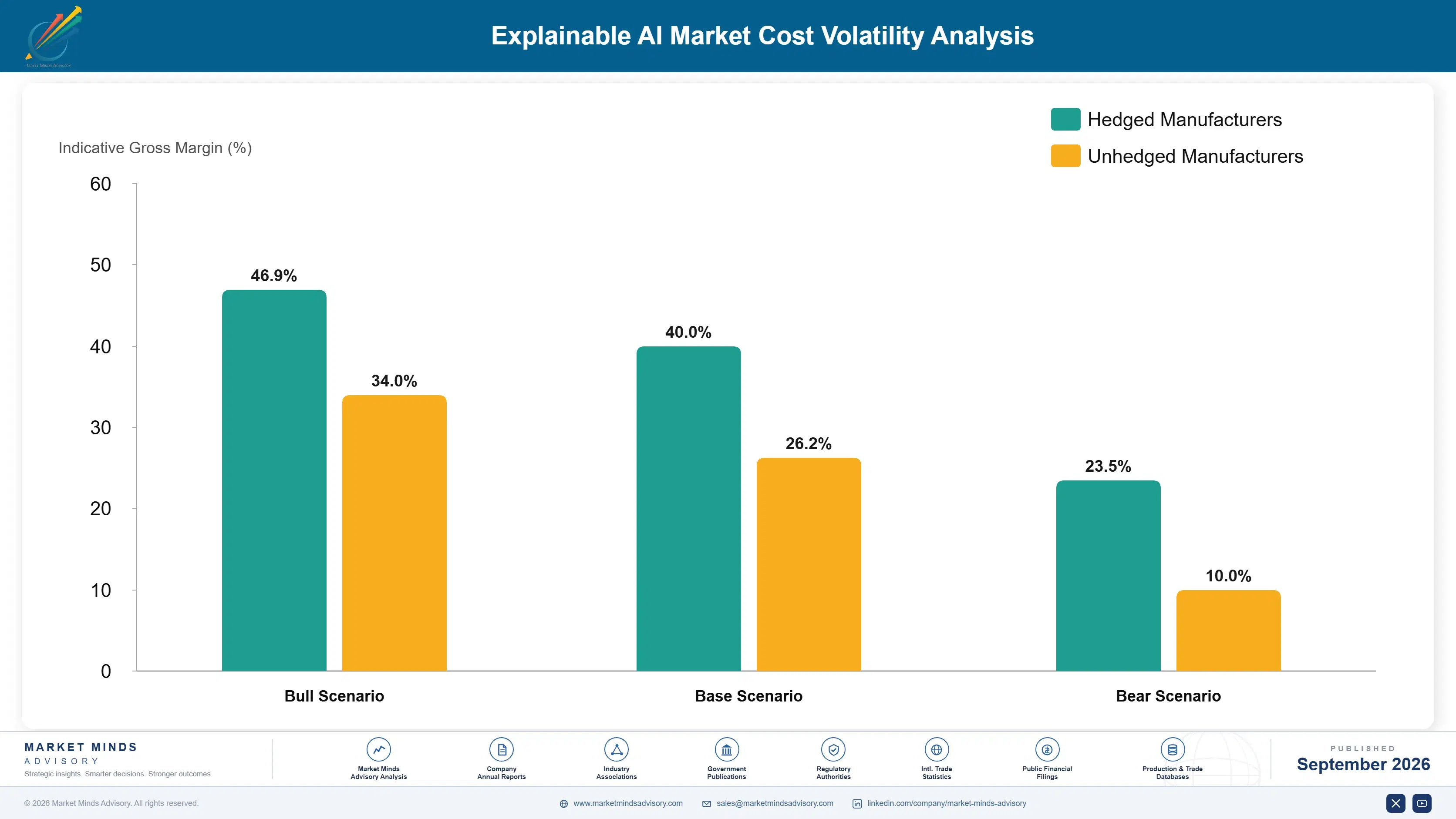
Engineering Talent Dominates Cost Structure

Specialized machine learning engineering talent and cloud computing infrastructure represent 60 to 70 percent of total operating cost for explainable AI vendors, with senior interpretability researchers commanding compensation premiums given the discipline's relative scarcity and recent professional maturation. Vendors increasingly compete on employer brand and remote work flexibility to attract talent that would otherwise gravitate toward larger technology companies offering higher base compensation.
Enterprise software salary benchmarks show senior machine learning engineers with interpretability specialization commanding compensation 20 to 30 percent above general machine learning engineering roles, according to industry compensation surveys, squeezing vendor margins as competition for scarce specialized talent intensifies across the broader technology sector. This compensation premium has prompted several vendors to invest heavily in internal training programs rather than relying entirely on external hiring to fill specialized interpretability engineering roles.

Vendors without established talent pipelines or remote hiring capability face considerably higher cost pressure than larger competitors with dedicated recruiting infrastructure and employer brand recognition. This dynamic increasingly favors well-funded vendors like Fiddler AI and Arthur AI over smaller specialists competing for the same limited talent pool. Independent specialists increasingly pursue university partnerships to build talent pipelines larger competitors cannot easily replicate.
explainable-ai-market-cost-volatility-analysis-1788413616684

Build Remote-First Talent Acquisition Programs

Establishing remote-first hiring practices expands the addressable talent pool beyond expensive technology hub locations, reducing average compensation cost while maintaining access to specialized interpretability engineering expertise across a broader geographic candidate base. Vendors with established remote-first cultures report meaningfully lower attrition rates than office-centric competitors struggling to compete on compensation alone. Adoption grows. Costs decline.

Invest in Internal Training and Upskilling

Training existing machine learning engineers in interpretability-specific techniques reduces dependence on scarce specialized hires, trading upfront training investment for meaningfully lower long-term talent acquisition and retention cost pressure. This training investment increasingly pays back within twelve to eighteen months for vendors implementing structured upskilling programs consistently. Interest remains selective. Programs continue expanding steadily across most enterprise-focused vendors.

Automate Routine Explanation Generation Workflows

Automating routine explanation generation and reporting workflows reduces the ongoing engineering hours required per customer deployment, allowing vendors to serve more customers per engineer and improve overall margin structure considerably. Vendors pursuing this automation strategy report meaningful margin improvement within the first year of implementation across their customer base. Costs decline steadily too. Costs decline.

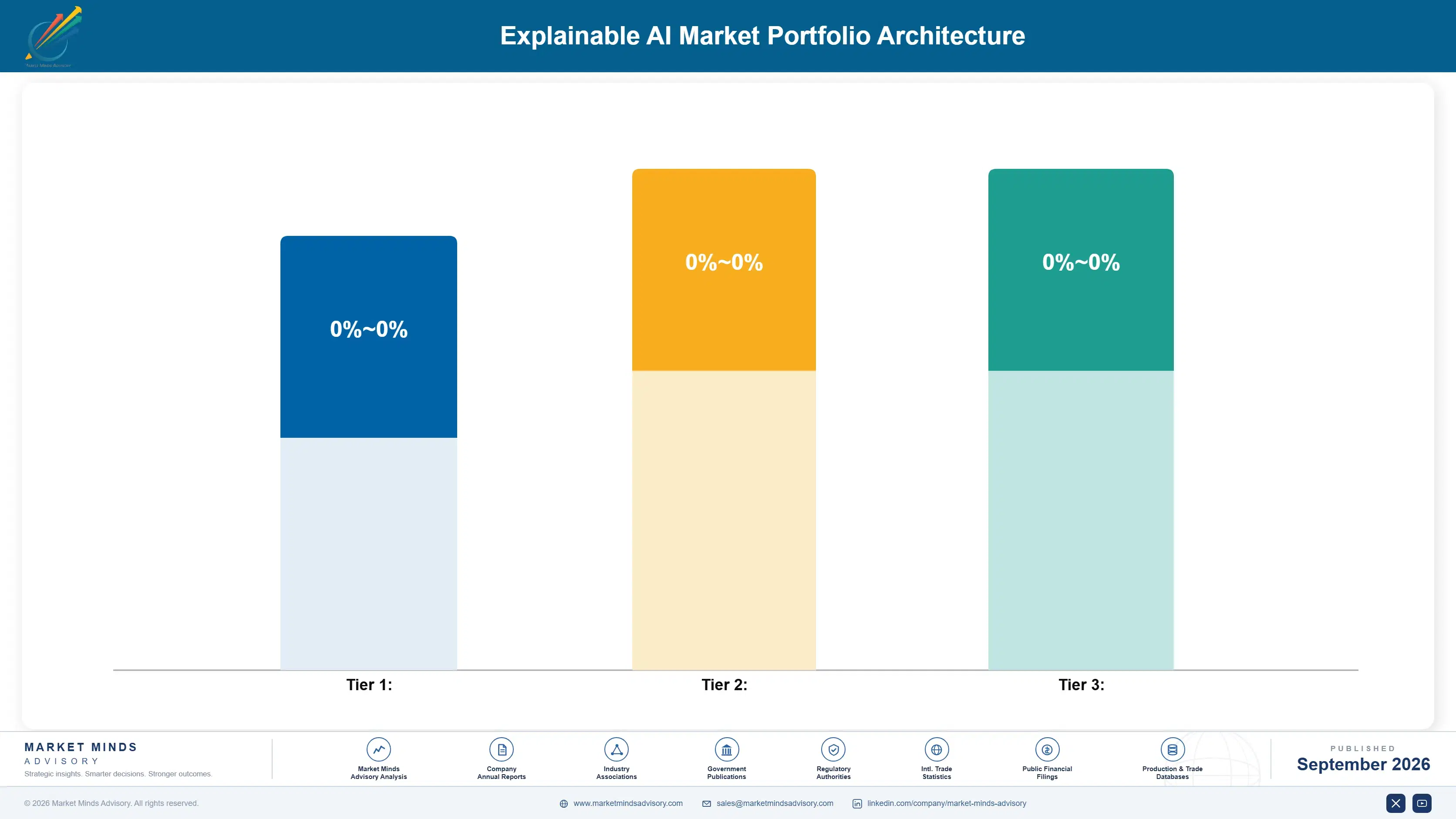
Portfolio Architecture for Margin Defence

Vendor portfolios split across three tiers: basic open-source-based interpretability tools competing on cost, certified governance platforms commanding compliance-driven premiums, and next-generation large language model interpretability still gaining commercial maturity. Margin economics diverge considerably between tiers. Investment increasingly follows this margin logic across vendor product roadmaps and go-to-market strategy. This bifurcation increasingly shapes vendor hiring and capability investment decisions.
Basic interpretability tools compete almost entirely on integration cost and ease of deployment, with thin margins that leave little room for differentiation beyond price and documentation quality. Certified governance platforms capture meaningfully wider margins through compliance documentation depth and audit-ready reporting, insulating vendors from pure technical tool price competition. Vendors without a credible compliance narrative increasingly struggle to defend premium pricing against well-positioned competitors.

High-value pools concentrate in governance and compliance dashboards and large language model interpretability, where regulatory alignment and technical differentiation reward vendors willing to invest in specialized capability. Basic open-source-adjacent tools remain the volume anchor but offer limited margin upside absent meaningful compliance service differentiation. Investment allocation increasingly follows this margin logic across most vendor strategic planning cycles. Vendors that recognized this shift early now hold a meaningful competitive advantage over slower-moving competitors.

Basic open-source-based interpretability tools competing primarily on integration cost and ease of deployment for straightforward use cases. Margins remain thin across most standard technical deployment scenarios and customer segments. Margins remain thin.
Gross Margin

Certified governance platforms with compliance documentation depth commanding premium pricing from regulated enterprise buyers. Demand grows steadily as regulatory deadlines approach across multiple jurisdictions and industries. Demand grows steadily too.
Gross Margin

Large language model interpretability and multi-jurisdiction regulatory mapping capability still gaining commercial maturity and validation. Early adoption remains concentrated among the largest, most technically sophisticated enterprise buyers. Adoption grows steadily too.
Gross Margin
explainable-ai-market-portfolio-architecture-1788413617268

High-value Sub-segments and Strategic Watch-out

AI Governance and Compliance Dashboards

The clearest high-value, high-growth pool, combining strong compliance-driven margins with a 23.5 percent CAGR as regulatory deadlines approach. Engineering firms report a growing project pipeline across most compliance-driven enterprise accounts globally today. Momentum remains strong. Adoption continues expanding steadily across most regulated industries. Momentum holds.

Explainability-as-a-Service Cloud Platforms

Strong margins and steady growth from mid-sized enterprises seeking interpretability capability without dedicated infrastructure investment or specialized talent. Cost per seat remains higher than open-source alternatives, limiting broader adoption among the most price-sensitive buyers. Interest keeps rising. Adoption continues expanding steadily across most mid-sized enterprises.

Model-Agnostic Explainability Platforms

The volume core, generating most industry revenue despite thinner margins, anchored by broad compatibility and established enterprise adoption. Price competition remains intense here as differentiation opportunities narrow considerably relative to governance-focused alternatives. Volume stays high. Demand remains resilient across most established enterprise accounts. Volume grows slowly.

Model-Specific White-Box Explainability Tools

A strategic watch-out given declining relevance as enterprises increasingly favor flexible model-agnostic approaches over narrow model-specific tooling. Vendors still serving this niche increasingly focus on legacy customer retention rather than new deployments. Decline continues steadily. Interest keeps fading across most modern enterprise deployments. Focus narrows further.

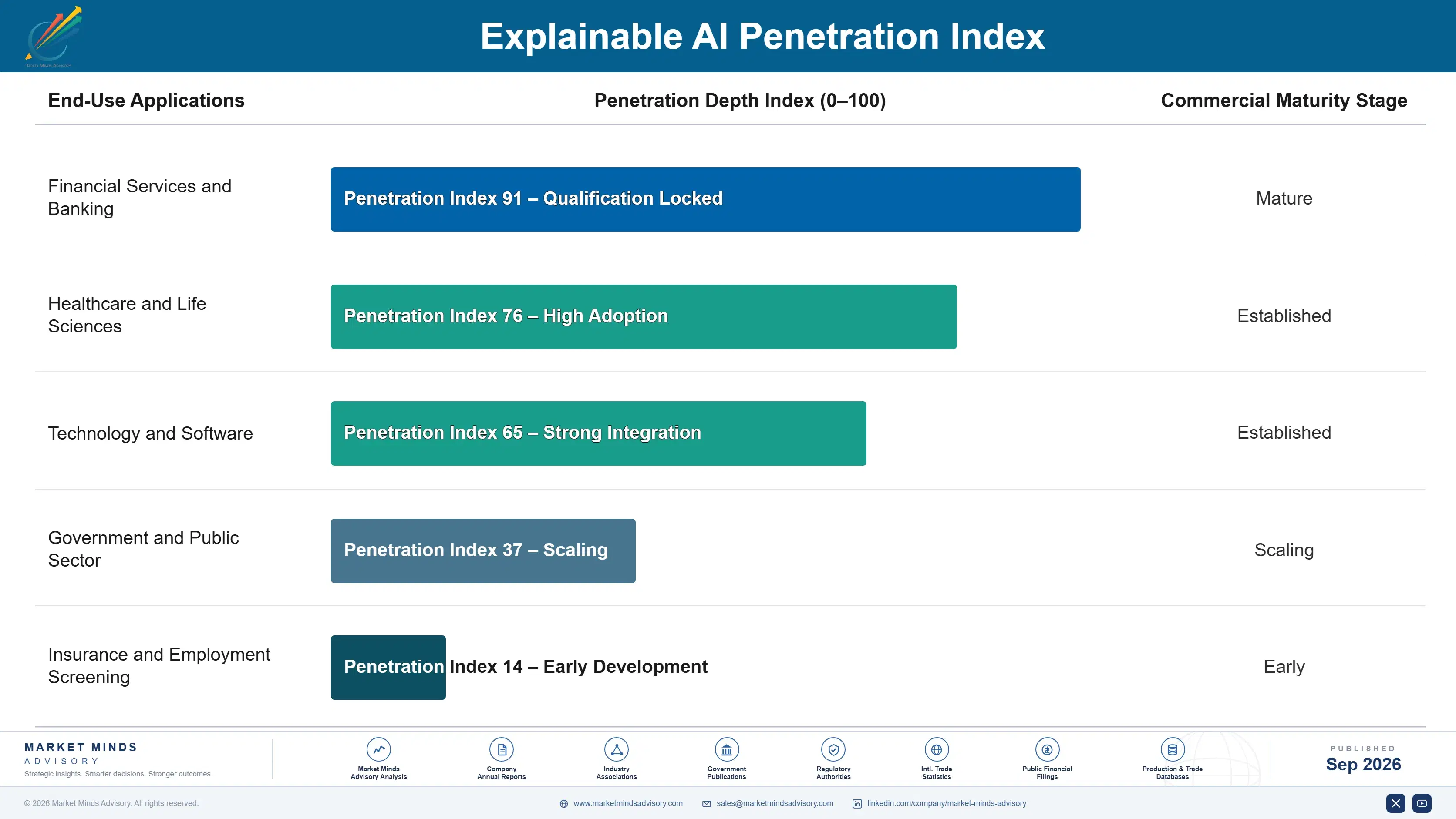
Regulatory Deadlines Anchor Recurring Renewal

Demand for explainability tooling behaves as a compliance necessity rather than discretionary purchase in regulated industries, since enterprises deploying high-risk AI systems cannot legally operate without adequate interpretability documentation, creating a demand floor tied directly to AI deployment volume rather than broader software spending cycles. This compliance-necessity framing insulates demand from the discretionary spending cuts that periodically hit other enterprise software categories during broader IT budget tightening cycles at most organizations.
Adoption depth varies considerably by industry vertical: financial services and healthcare show near-universal interpretability tooling adoption given existing model risk obligations, while less regulated industries still treat explainability as a discretionary governance investment rather than a compliance necessity. Vendors serving less regulated industries increasingly market interpretability as a competitive trust-building differentiator rather than relying purely on regulatory compliance urgency to drive purchasing decisions.

Buyer profiles are shifting as compliance and legal teams increasingly influence procurement decisions traditionally made purely by data science leadership, reflecting a generational shift toward treating explainability investment as a regulatory risk category rather than a pure technical model debugging tool. Vendors without established relationships with compliance and legal stakeholders increasingly find themselves competing only for technical proof-of-concept deployments rather than full enterprise-wide platform commitments.
explainable-ai-market-end-use-penetration-index-1788413617801

Compliance Depth and LLM Coverage Priorities

These are among the four positions where our research anticipates prominent divergence between winners and laggards over the coming forecast period. Each is grounded in the demand model, the regulatory perimeter, and the announced capacity pipeline.
01 / COMPLIANCE DOCUMENTATION STRATEGY

Build regulatory-specific reporting templates before deadlines arrive

Vendors without pre-built compliance documentation mapped to specific regulatory frameworks face a widening gap against competitors already capturing 20 to 30 percent price premiums from enterprises facing approaching EU AI Act deadlines across multiple industry verticals. Building genuinely audit-ready templates takes considerable regulatory expertise that vendors cannot develop quickly once compliance deadlines already loom close. Vendors that delay this investment risk losing the enterprise contracts most explicitly driven by compliance deadline pressure to better-prepared, earlier-moving competitors already established in this segment.
02 / LARGE LANGUAGE MODEL COVERAGE

Extend interpretability methods to generative AI models now

Enterprise deployment of large language models continues expanding faster than most vendors' interpretability methods, originally designed for structured tabular data, can practically accommodate without significant technical redevelopment and specialized engineering investment. Vendors capable of supporting both traditional and generative AI model types capture roughly double the addressable enterprise use case count compared with vendors limited to legacy interpretability techniques alone. Vendors investing now position themselves ahead of competitors still catching up to this rapidly expanding demand across most enterprise buying categories.
03 / MLOPS INTEGRATION STRATEGY

Secure deep platform partnerships to reduce deployment friction

Enterprise buyers increasingly favor interpretability tooling that integrates directly into existing MLOps pipelines over standalone deployments requiring separate maintenance and monitoring infrastructure across their broader technology stack. Vendors without established platform partnerships face meaningfully longer sales cycles than integrated competitors, since operational simplicity increasingly outweighs marginal technical sophistication differences in enterprise procurement evaluations conducted by increasingly sophisticated buying committees. Building these partnerships now positions vendors favorably as integration preference continues strengthening across the industry and buying committee structures across most large enterprise organizations broadly.
04 / MULTI-JURISDICTION SERVICE STRATEGY

Offer regulatory mapping services for multinational enterprises

Multinational enterprises increasingly seek to standardize on a single interpretability platform capable of satisfying varying regulatory requirements across multiple jurisdictions rather than maintaining fragmented per-market compliance tooling across their global operations. Vendors offering multi-jurisdiction regulatory mapping services capture premium consulting revenue alongside core software licensing while building meaningful customer switching costs that competitors struggle to overcome. Building this capability now, ahead of broader market standardization, positions vendors favorably for durable multinational customer relationships across their entire global operating footprint and customer base.

Engagement Snapshot From the Field

A live engagement with an industry participant carrying material or product regulatory and market exposure ahead of a defining policy shift, showing how our research translates into a defensible multi-year portfolio strategy.
MARKET MINDS ADVISORY · CLIENT ENGAGEMENT SUMMARY
Explainable AI Producer Strategic Portfolio Review and Transition Roadmap 2026·Investment Scenario on Explainable AI Exposure Evaluation 2025-26
CLIENT PROFILE
A mid-sized European financial services firm subject to both existing model risk management regulation and the EU AI Act's approaching high-risk system compliance deadlines sought to evaluate whether its current open-source-based interpretability tooling could meet the audit-ready documentation standards regulators would soon require of its credit scoring models. The client's compliance leadership needed a clear recommendation before its next quarterly board review of AI risk posture.
STRATEGIC CHALLENGE
The client's existing tooling, assembled from disparate open-source libraries by its internal data science team, generated technically sound explanations but lacked the standardized audit trail documentation and regulatory reporting format that compliance examiners and EU AI Act auditors would expect during upcoming supervisory reviews and formal assessments. Delaying the platform decision further risked non-compliance findings during the client's next scheduled regulatory examination cycle.
MMA APPROACH
MMA benchmarked commercial governance platform offerings against the client's existing open-source stack, evaluated migration cost and timeline for three leading vendors, and modeled compliance risk exposure under different platform selection scenarios given the client's approaching regulatory deadline and limited internal migration bandwidth and resources. Interviews with the client's compliance and model risk teams informed the final vendor recommendation and timeline.
KEY FINDINGS
  1. Migrating to a commercial governance platform could be completed within four months given the client's existing model inventory (client-reported, unverified by MMA).
  2. The client's existing open-source tooling would require quite substantial custom engineering development effort to meet audit documentation standards (client-reported, unverified by MMA).
  3. Commercial platform total cost of ownership over three years compared quite favorably against continued internal development investment costs (client-reported, unverified by MMA).
  4. Peer institutions that delayed similar migrations faced considerably compressed timelines and higher costs closer to their compliance deadlines (client-reported, unverified by MMA).
CLIENT PROFILE
A mid-sized European financial services firm subject to both existing model risk management regulation and the EU AI Act's approaching high-risk system compliance deadlines sought to evaluate whether its current open-source-based interpretability tooling could meet the audit-ready documentation standards regulators would soon require of its credit scoring models. The client's compliance leadership needed a clear recommendation before its next quarterly board review of AI risk posture.
STRATEGIC CHALLENGE
The client's existing tooling, assembled from disparate open-source libraries by its internal data science team, generated technically sound explanations but lacked the standardized audit trail documentation and regulatory reporting format that compliance examiners and EU AI Act auditors would expect during upcoming supervisory reviews and formal assessments. Delaying the platform decision further risked non-compliance findings during the client's next scheduled regulatory examination cycle.
MMA APPROACH
MMA benchmarked commercial governance platform offerings against the client's existing open-source stack, evaluated migration cost and timeline for three leading vendors, and modeled compliance risk exposure under different platform selection scenarios given the client's approaching regulatory deadline and limited internal migration bandwidth and resources. Interviews with the client's compliance and model risk teams informed the final vendor recommendation and timeline.
KEY FINDINGS
  1. Migrating to a commercial governance platform could be completed within four months given the client's existing model inventory (client-reported, unverified by MMA).
  2. The client's existing open-source tooling would require quite substantial custom engineering development effort to meet audit documentation standards (client-reported, unverified by MMA).
  3. Commercial platform total cost of ownership over three years compared quite favorably against continued internal development investment costs (client-reported, unverified by MMA).
  4. Peer institutions that delayed similar migrations faced considerably compressed timelines and higher costs closer to their compliance deadlines (client-reported, unverified by MMA).
RECOMMENDED STRATEGY
Phase 1: Phase one: select a commercial governance platform vendor with proven EU AI Act compliance templates already built. Speed to compliance readiness mattered considerably here. Phase 2: Phase two: migrate highest-risk credit scoring models first, prioritizing systems facing the earliest regulatory deadlines. Risk-based prioritization guided the sequencing decision. Phase 3: Phase three: extend platform coverage to remaining model inventory ahead of the full compliance deadline schedule. Full coverage reduces residual compliance exposure meaningfully.
OUTCOME
The client selected and began migrating to a commercial governance platform within six weeks of the engagement, completing its highest-priority model migration ahead of schedule and well before the relevant compliance deadline (client-reported, unverified by MMA). Additional model migrations continued proceeding steadily on the revised accelerated timeline.

Frequently Asked Questions

Foundational context covering the market sizes, CAGR, scope, country, region and competition that inform every finding below. This section is provided to cover basics and most often pre-purchase conversations, answered from the MMA Primary Research Dataset.

What is the current size of the Explainable AI Market?

The global explainable AI market reached an estimated $0.85 billion in 2025, driven by regulatory pressure from the EU AI Act and financial services model risk requirements. North America hosts the largest vendor and buyer concentration.

How large will the Explainable AI Market be by 2036?

MMA projects the market will reach approximately $5.02 billion by 2036, up from $1.0 billion in 2026. That represents roughly a 5.02x expansion across the ten-year forecast window.

What is the CAGR for the Explainable AI Market 2026 to 2036?

The base case forecast CAGR is 17.5% across 2026 to 2036, with a bull scenario of 18.8% and a bear scenario of 16.2% depending on regulatory enforcement pace and AI deployment growth.

Which segment is growing fastest?

AI Governance and Compliance Dashboards lead at a 23.5% CAGR, roughly 1.34 times the overall market rate, as regulatory deadlines pull enterprises toward audit-ready reporting platforms.

Who are the major companies in the Explainable AI Market?

Fiddler AI, Arthur AI, TruEra, IBM Watson OpenScale, and DataRobot lead the market, together holding an estimated combined software revenue share of 38% measured globally today.

Which country is growing fastest?

Germany leads growth at a 21.0% CAGR, driven by acute EU AI Act compliance urgency among its large industrial and financial services sectors nationwide today.

Report Segmentation Architecture

The full report scope spans multiple orthogonal segmentation dimensions, with cross-tabulated demand data provided for each dimension pair. Coverage extends further to regional breakdowns, trend trajectories, and the competitive detail needed to support segment-level decision-making.
  • Model-Agnostic Explainability Platforms
  • Model-Specific White-Box Explainability Tools
  • Explainability-as-a-Service Cloud Platforms
  • AI Governance and Compliance Dashboards
  • Counterfactual and Causal Explanation Tools
  • Explainability APIs and Embedded SDKs
  • Financial Services and Banking
  • Healthcare and Life Sciences
  • Technology and Software
  • Government and Public Sector
  • Insurance and Employment Screening
  • Direct Enterprise Software Licensing
  • Cloud Marketplace Distribution
  • Systems Integrator Channel Sales
  • Consulting and Regulatory Advisory Services

By Region

  • North America
  • Western Europe
  • East Asia
  • South Asia and Pacific
  • Latin America
  • Middle East and Africa
  • Eastern Europe

Scope, Methodology, and Coverage

Every figure in this report is reproducible from documented input assumptions. The scope below maps the historical period, the forecast horizon, the segmentation dimensions, and the countries covered, alongside the underlying primary and qualitative methodology.
Historical Period
2020 to 2025
Forecast Period
2026 to 2036
Base Year
2025 (USD billions; MMA Primary Research Dataset, September 2026)
Market Definition
This report covers software platforms and tools that generate human-interpretable explanations for machine learning model predictions, including model-agnostic and model-specific interpretability methods and AI governance dashboards, measured on a global software revenue basis. It excludes general-purpose MLOps platforms without dedicated explainability functionality.
Quantitative Units
USD billions, enterprise software licenses, and percentage CAGR
Segmentation Dimensions
Product type (model-agnostic, model-specific, explainability-as-a-service, governance dashboards, counterfactual/causal, APIs/SDKs), end-use vertical, commercial channel, and geography
Regions Covered
North America, Western Europe, East Asia, South Asia and Pacific, Latin America, Middle East and Africa, Eastern Europe
Countries Covered
United States, Germany, United Kingdom, China, India, Brazil, and 20+ additional countries across seven global regions
Key Companies Profiled
Fiddler AI, Arthur AI, TruEra, IBM Watson OpenScale, DataRobot, and 15 additional vendors across the global competitive set
Quantitative Methodology
Primary survey, n=3,800 respondents, Q4 2025, six countries; demand-side model with trade association cross-validation
Qualitative Methodology
47 expert interviews, Q4 2025; applied to validate demand model assumptions, identify emerging dynamics, and assess competitive positioning
Report Format
PDF and XLSX data workbook (Word format preview document)
Publisher
Market Minds Advisory
Report Code
MMA-2026-TEC-124
Published
September 2026
Contact
sales@marketmindsadvisory.com | www.marketmindsadvisory.com

Purchase the full Explainable AI Market Report (2026 to 2036).

This report delivers a complete assessment of the global explainable AI market across the full 2026 to 2036 forecast period ahead. It combines primary survey data from 3,800 respondents with 47 expert interviews to quantify segment, regional, and competitive dynamics in careful detail. Coverage spans model-agnostic, governance dashboard, and large language model interpretability categories, alongside detailed vendor benchmarking across twenty companies. Analysts translate raw data into actionable compliance strategy, technology investment, and market entry guidance for vendors, investors, and enterprise buyers evaluating this rapidly evolving governance software category.
Ten-year global market sizing and forecast model
Seven-region demand, pricing, and share breakdown
Twenty-company competitive benchmarking and positioning analysis
Segment-level growth, margin, and pricing analysis
Talent cost exposure and hiring risk assessment
Strategic verdict and prioritized investment guidance

Built For The People Who Decide

From boardroom strategy to bench-side execution, this report is read cover-to-cover by leaders shaping the next decade of their industry, turning demand scenarios, market dynamics and valuation benchmarks into decisions.
CXOs/ Presidents/ VPs/ Managers
M&A and Corporate Development
Strategy Teams and R&D Heads
Procurement and Product Directors
Regulatory and Compliance Leaders
Investor Relations and Equity Analysts