Market Minds Advisory
Excitation Systems Market

Excitation Systems Market: Excitation Systems Market: Generator Field Control, Retrofit and Grid Support Equipment, 2026 to 2036

Excitation equipment is a fraction of a percent of what a power station costs and causes roughly a tenth of its forced outages, which is why obsolescence notices rather than performance cases drive the orders.

Lead Analyst

Published

September 2026

Make Smarter Decisions with Customized Research Insights

Request a free sample report and evaluate market opportunities, growth trends, and competitive dynamics relevant to your business needs.

2025 MARKET VALUE$1.7BMarket Size 2025
2036 FORECAST VALUE$3.0BBase Case , 2026 to 2036
CAGR 2026 TO 20365.4 %Bull 6.6% / Bear 4.2%
INCREMENTAL OPPORTUNITY$1.2BNet 10- year value creation
EXPANSION MULTIPLE1.67x2036 value over 2026 base
Strategic Levers
M&A Pipeline
Regional Outlook
Country Rankings
Competitive Intelligence
Segmental Deep-dive
Call-Us : 91 93563 13602

Executive Snapshot and Market Trajectory.

Nobody replaces an excitation system because it could work better. They replace it because the supplier issued an obsolescence notice and the spare thyristor cards no longer exist. About 71% of orders are retrofits of installed equipment, and that single fact governs how the whole market behaves.
Inverter-based generation removed inertia and damping from networks that were never designed without them, and grid codes have caught up. Power system stabilisers and grid support modules grow at 8.1%, half again the market rate of 5.4%, as system operators impose damping obligations on the synchronous machines that remain. East Asia holds 33% of delivered value, carried by the largest synchronous fleet anywhere and by pumped storage construction that shows no sign of slowing.
Five suppliers hold 62% of delivered value, and the concentration is real rather than a counting artefact, because a generator owner will usually not fit a third-party excitation system to a machine still under original equipment support. Independent specialists win where that support has lapsed. Digital control has made retrofit cheaper than the outage it requires, which is now the binding constraint on order timing.
Market Definition
The excitation systems market covers equipment that supplies and regulates field current in synchronous generators and motors, including automatic voltage regulators and digital control units, thyristor rectifier bridges, excitation transformers, field breakers and discharge circuits, power system stabilisers, and associated protection and monitoring modules. It excludes the generators themselves, turbine governors, plant distributed control systems, and switchyard protection equipment outside the excitation boundary.
Base Year Value
$1.7B in 2025 (MMA Primary Research Dataset, September 2026)
Forecast Period
2026 to 2036, eleven discrete annual values
CAGR
5.4% base case. Bull 6.6%. Bear 4.2%.
Fastest Growth Segment
Power System Stabilisers And Grid Support Modules: 8.1% CAGR
Fastest Growth Country
India: 8.9% CAGR
Fastest Growth Region
South Asia and Pacific: 7.5% CAGR
Largest Region
East Asia: 33% of 2025 global value
Market Leaders
GE Vernova, Siemens Energy, ABB, Andritz, and Voith lead the field. Source: MMA Primary Research Dataset, July 2026.
Primary Survey
n=3,800 procurement and R&D decision-makers, Q4 2025, six countries
Methodology
Demand-side build-up, cross-validated against public data, 47 expert interviews

Excitation Systems Market Forecast Scenarios

excitation-systems-market-size-forecast-scenario-1790005600748
Between 2020 and 2025 the market grew on replacement rather than on construction. New thermal capacity additions slowed across most of the world while the installed synchronous fleet aged past the point where analogue voltage regulators could be supported, and the two trends offset each other almost exactly. Historical growth of 4.3% reflects that balance, with hydro modernisation supplying most of the movement.
The base case at 5.4% rests on three mechanisms. Grid codes now impose damping and voltage support obligations that older excitation equipment cannot demonstrably meet, which converts a deferred retrofit into a compliance deadline. Pumped storage and large hydro construction, concentrated in Asia, adds new-build demand at a scale thermal projects no longer supply. And synchronous condenser conversions of retired thermal units create a buyer with no turbine at all but a full excitation requirement.
The bull case at 6.6% turns on system operators mandating stabiliser tuning verification on a fixed cycle, which would convert an occasional project into recurring work across entire fleets. The bear case at 4.2% is deferral: excitation retrofits need a machine outage, and when generation margins tighten, plant owners postpone the outage and run obsolete equipment on scavenged spares for another cycle.

Obsolescence Notices Set The Order Book

The commercial character of this market follows from a single ratio. Excitation equipment is well under one percent of what a power station costs to build, yet roughly 9% of generator forced outages trace back to it. A component that cheap, causing failures that expensive, does not get replaced on a business case. It gets replaced when the supplier says spares have run out. That inversion explains the rest.
TOP FIVE CONCENTRATION62%Share of delivered system value held by leading suppliers
RETROFIT SHARE71%Portion of orders replacing installed equipment rather than new build
AVERAGE SELLING PRICEUSD 310,000Typical delivered price for a mid-sized machine system
INSTALLED BASE AGE27 yearsMedian age of excitation equipment currently operating worldwide
OUTAGE ATTRIBUTION9%Share of generator forced outages traced to excitation faults
COMMISSIONING WINDOW6 weeksTypical outage period required for a full retrofit
That is why the order book tracks obsolescence announcements rather than electricity demand. Median installed age across the operating fleet is 27 years, which places an enormous population of analogue regulators past supportable life. Owners know this and defer anyway, because retrofit requires a six week machine outage and the outage costs far more than the equipment. Deferral is rational right up until the failure.
What has changed is the grid side. System operators, having watched inertia and damping disappear with the thermal fleet, now write voltage support and stabiliser performance into connection conditions. That converts a deferrable maintenance item into a compliance obligation with a date attached, and it is the first genuinely new demand mechanism the category has seen in two decades. Compliance dates resist postponement.
"We keep meeting plant managers who can name the exact year their voltage regulator went out of support and have still not replaced it. The equipment is not the constraint. Finding six weeks when the machine can be off is the constraint, and no supplier has solved that."
Practice Director, Power Generation and Grid Equipment · MMA Energy Practice · September 2026

Market Trends

Grid Codes Impose Damping Duties On Remaining Synchronous Machines

As inverter-based generation displaced thermal plant, system operators lost the inertia and damping that synchronous machines supplied as a by-product. Connection conditions across several major networks now specify stabiliser performance and voltage support capability explicitly, with demonstration testing rather than declaration. Older analogue excitation cannot pass that test, and the owner has no way to argue otherwise. Around 34% of retrofit enquiries in the past two years cited a grid code obligation as the primary trigger, up from a negligible share five years earlier, and these enquiries convert to orders at roughly twice the rate of purely condition-driven ones.
Market Impact: Adds 200 GW under development

Retired Thermal Units Convert Into Synchronous Condensers

Decommissioned coal and gas units retain a generator, a foundation, and a grid connection, all of which have value to a network short of inertia. Removing the turbine and running the machine as a synchronous condenser preserves that value at a fraction of new-build cost. The conversion needs a complete modern excitation system, since voltage regulation becomes the machine's entire purpose rather than a supporting function. Roughly 180 conversions are in planning or execution across networks with high renewable penetration, and each carries excitation content well above what the same machine required in generation service.
Market Impact: Affects 27 year median fleet age

Market Opportunities and Growth Drivers

Pumped Storage Construction Concentrates New Build Demand In Asia

Thermal construction has largely stopped in the markets that once drove excitation demand, but pumped storage has not. China alone has more than 200 GW of pumped storage in construction or approved development, and India has committed to a substantial programme of its own. These machines need excitation systems designed for frequent mode changes between pumping and generating, which is a harder duty than steady thermal service and commands a higher delivered price. New build now concentrates so heavily in Asia that regional supplier positions there increasingly determine global share.
Market Impact: Costs 6 weeks of generation

Analogue Regulator Population Passes Supportable Component Life

Median installed age across the operating fleet is 27 years, which puts a very large population of analogue and early digital regulators beyond the point where semiconductors, control cards, and firmware tooling can be sourced. Suppliers issue formal obsolescence notices, and once issued the owner carries the risk of an unrepairable failure on a machine worth millions of dollars a day in lost generation. That asymmetry is what eventually moves the order, usually two to four years after the notice rather than immediately, once an outage window aligns. Nobody moves on the notice alone.
Market Impact: Sustains 62% supplier concentration

Market Restraints and Challenges

Retrofit Requires A Six Week Machine Outage

Commissioning a replacement excitation system typically needs six weeks with the generator off, and the root cause is not installation time but verification: field testing, stabiliser tuning, and grid compliance demonstration all require the machine. Lost generation revenue during that window routinely exceeds the equipment price several times over, so owners wait for a scheduled major overhaul rather than schedule work of their own. The result is an order book that arrives in unpredictable bursts. Suppliers are attacking it with pre-commissioned cabinets, hardware-in-the-loop tuning performed before the outage begins, and phased cutover designs that shorten the window materially.
Market Impact: Triggers 34% of retrofit enquiries

Original Equipment Support Blocks Third Party Access

A generator still under original manufacturer support is effectively closed to independent excitation suppliers, because fitting third-party field control can be read as voiding warranty coverage on a very expensive machine. The root cause is contractual rather than technical, since the interface itself is well understood. Commercially this keeps concentration at 62% and restricts specialists to older assets outside support. Independents respond by targeting the post-support population directly, by qualifying with utilities that self-maintain, and by building interface documentation credible enough that an owner's own engineering team will underwrite the change.
Market Impact: Covers 180 planned conversions
3 additional market trends, 4 additional growth drivers, and 2 additional restraints and challenges are covered in the full report. Contact sales@marketmindsadvisory.com to access the complete intelligence.

Segment CAGR and Growth Architecture

Segmentation follows the delivered equipment scope inside the excitation boundary. Six product segments cover the system as supplied: automatic voltage regulators and digital control units, thyristor rectifier bridges, excitation transformers, field breakers and discharge circuits, power system stabilisers and grid support modules, and protection, monitoring and diagnostic modules. Most retrofit orders cover four of the six together.
excitation-systems-market-market-share-analysis-1790005601311

Power System Stabilisers And Grid Support Modules

Stabilisers grow at 8.1%, half again the market rate of 5.4%, and grid codes are the entire reason. Damping that synchronous plant once provided incidentally is now specified, tested, and enforced through connection conditions, which turns a module many owners historically disabled into mandatory equipment with a demonstration requirement attached. The commercial character differs from the rest of the category: tuning is site-specific engineering work rather than hardware supply, and the study effort frequently costs more than the module. Suppliers with credible network study capability capture that value; those selling hardware alone find the work goes to a consultant instead, and the relationship follows the study. Hardware alone no longer wins these scopes.
CAGR 8.1%

Protection Monitoring And Diagnostic Modules

Diagnostic and protection modules grow at 7.2% on an argument owners find easier to accept than replacement. Continuous monitoring of field current, rotor earth fault, and thyristor bridge health converts an unpredictable forced outage into a planned intervention, which addresses the outage-cost problem rather than ignoring it. Because these modules can often be fitted without taking the machine off, they bypass the six week constraint that governs everything else in the category. That makes them the practical entry point for suppliers targeting an account they cannot yet win outright, and the installed monitoring frequently produces the evidence that eventually justifies the full retrofit two or three years later. It is the cheapest way into a closed account.
CAGR 7.2%
Full segment breakdown across 6 segments available in the complete report.

Regional Architecture and Country Demand Map

Regional shares reflect where excitation equipment is delivered and commissioned, which tracks the size and age of the synchronous generating fleet rather than electricity consumption. The two diverge sharply in networks that added renewable capacity without adding synchronous machines to carry it. Fleet age matters more than demand growth.

East Asia

At 33% East Asia sits above the standard band, and the justification is fleet size: China operates the largest population of synchronous machines anywhere, and more than 200 GW of pumped storage is in construction or approved development, each unit requiring excitation designed for repeated mode reversal. Japanese and Korean thermal fleets contribute a steady retrofit stream as units built in the 1980s pass supportable component life. Domestic suppliers hold a large share of Chinese awards, which shapes competitive positions globally rather than only locally. Growth of 6.5% runs above the world rate because new build and retrofit demand arrive together here, which is true in no other region. Export competition follows from that scale.
Share: 33% | CAGR: 6.5% (2026 to 2036)

North America

Retrofit dominates almost completely, since new synchronous capacity additions are limited to a small number of gas and nuclear projects. The driver is age: a very large fleet of units commissioned between 1970 and 1995 now carries excitation equipment past supportable life, and obsolescence notices from the original suppliers are arriving steadily. Synchronous condenser conversion of retired coal units is further advanced here than anywhere else, driven by interconnection studies that identified inertia shortfalls in specific network areas. Growth of 4.9% is moderate because owners defer outages aggressively, and the six week commissioning window competes directly with revenue in tight capacity markets. Monitoring modules are being fitted meanwhile, since they need no outage at all.
Share: 22% | CAGR: 4.9% (2026 to 2036)
Regional intelligence for 5 additional markets available in the complete report: Western Europe, South Asia and Pacific, Latin America, Middle East and Africa, Eastern Europe. Contact sales@marketmindsadvisory.com.
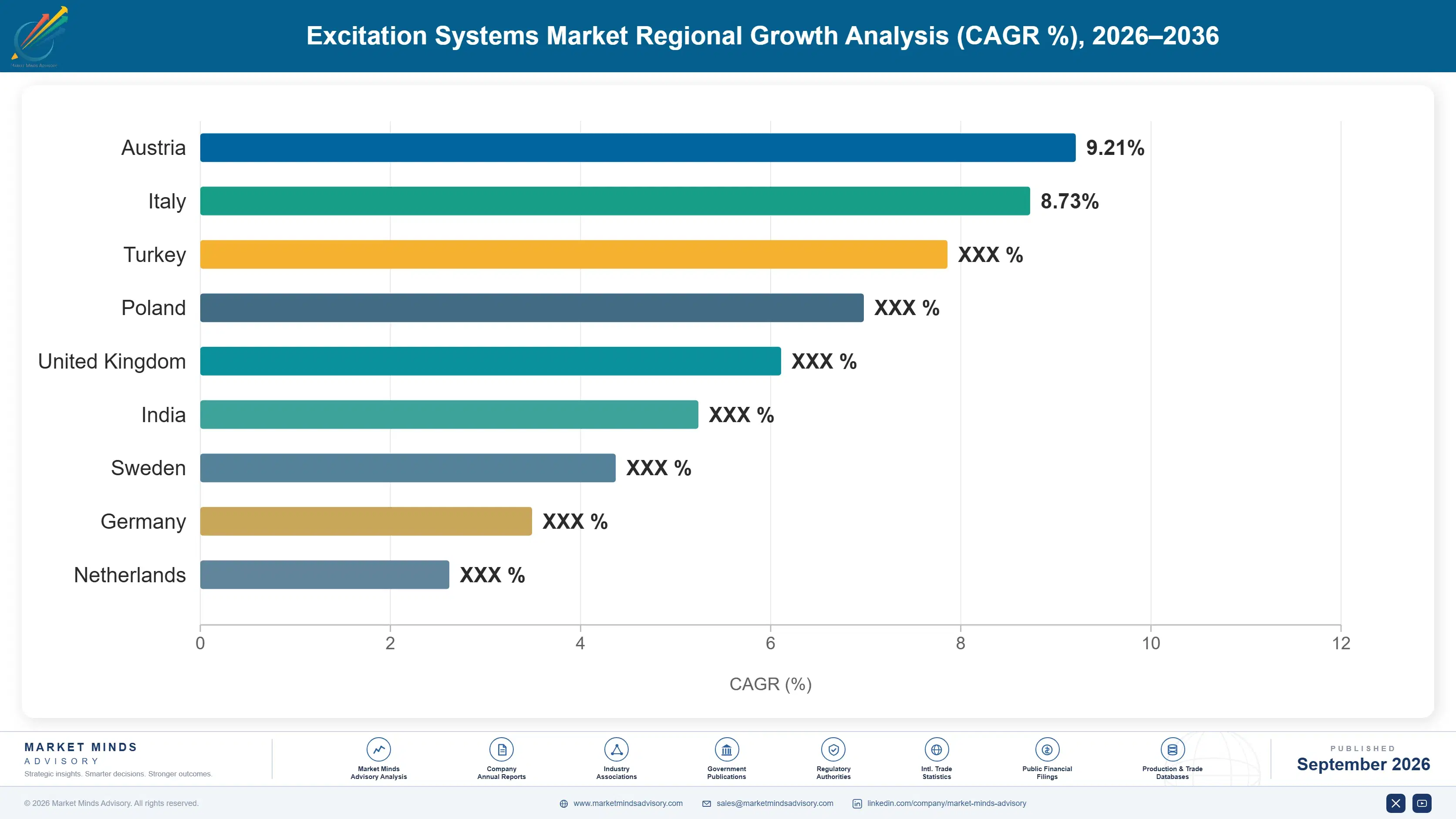
excitation-systems-market-country-cagr-analysis-1790005601834

Where Suppliers Actually Make Money

Four commercial moves separate suppliers that grow from suppliers that merely defend an installed base. Each addresses the same constraint: the customer's real cost is the outage, not the equipment, so anything that shortens or removes the outage is worth more to the buyer than a lower hardware price ever is. Hardware price ranks well below all four.

Shorten The Commissioning Outage Through Pre-Testing

Hardware-in-the-loop tuning performed against a machine model before the outage starts removes most of the on-site verification that drives the six week window. Suppliers who have industrialised this report commissioning windows of 18 to 24 days rather than 42, and owners will pay a premium several times the cost of the work because lost generation revenue dwarfs the equipment price. It also converts order timing from unpredictable to schedulable, since a shorter window fits inside routine maintenance outages that occur every year rather than requiring a major overhaul. Schedulable work is worth more than cheap work.
Market Impact: Cuts the outage from 42 to 24 days

Sell Monitoring Modules Into Machines You Cannot Retrofit

Diagnostic modules can usually be fitted with the machine running, which bypasses the outage constraint entirely and creates a supplier relationship inside an account still under a competitor's original equipment support. The data that accumulates then builds the evidence case for full replacement. Suppliers running this motion convert roughly 31% of monitoring installations into full excitation retrofits within four years, against a much lower rate for cold approaches. Entry pricing is modest and the margin is thin, which is precisely why incumbents tend not to defend against it aggressively. Incumbents rarely defend against it.
Market Impact: Converts 31% of installations into full retrofits later

Build Network Study Capability Alongside Stabiliser Supply

Stabiliser tuning requires a network study, and the study frequently costs more than the module it specifies. Suppliers without that capability watch the work go to an independent consultant who then shapes the specification, often toward a competitor. Building or acquiring study capability typically adds 40% to 60% to the value captured on a grid support scope and, more importantly, places the supplier upstream of the equipment decision. It is also defensible, because the credibility comes from accumulated network models rather than from anything a competitor can specify and purchase.
Market Impact: Adds 40% to 60% of captured scope value

Target The Post-Support Installed Base Systematically

Once original equipment support lapses, the contractual barrier that keeps independents out disappears, and the owner's engineering team becomes willing to underwrite an interface change. Tracking obsolescence notices across the fleet and approaching owners in the year they are issued puts a supplier in front of the decision two to four years before the order lands. Independents running disciplined tracking of this kind win roughly 3.2 times as many competitive retrofits as those responding to tenders alone. The work is unglamorous list maintenance and it is the single most reliable pipeline source available.
Market Impact: Wins 3.2 times more competitive retrofit awards overall

Who Controls the Margin Pool

Concentration is high and durable. Five suppliers hold 62% of delivered system value, measured consistently on that basis across every participant, and the gap between the leader and the fifth is wider than in most industrial equipment categories. The reason is contractual rather than technical: a machine under original manufacturer support is effectively closed to outside excitation suppliers, so the generator vendor inherits the field control business by default.
Competition currently turns on three things: commissioning window length, network study capability for grid support scopes, and demonstrated interface credibility on machines outside original support. Price ranks below all three, because the equipment is a small fraction of what the retrofit actually costs the owner. Domestic Chinese and Indian suppliers compete effectively on delivery and cost within their home markets and are beginning to appear in export tenders.

Pressure is building from two directions. Independent specialists are systematically working the post-support installed base, where incumbency confers nothing. At the same time, grid support scopes reward study capability that several established suppliers lack. Rankings will shift toward whoever holds the synchronous condenser conversion work, which is where the highest-content contracts in the category now sit.
excitation-systems-market-company-positioning-matrix-1790005602381

Competitive Moat and Risk Dimensions

GE VERNOVA

Moat: Original Equipment Installed Base

An enormous population of turbine generators carries the company's own excitation equipment, and support agreements on those machines keep third parties out for as long as they run. That position produces retrofit demand that arrives without a competitive process, and it renews itself as each generation of equipment reaches obsolescence under the same contractual conditions.
GE VERNOVA

Risk: Support Lapse Opens Accounts

The protection ends when a support agreement does, and a very large share of the installed base is now old enough that owners are reconsidering whether continued original manufacturer coverage is worth its cost. Independents track exactly those lapses, arriving with credible interface documentation at the moment the contractual barrier disappears entirely.
SIEMENS ENERGY

Moat: Grid Support Study Capability

Network modelling capability built for transmission work transfers directly into stabiliser tuning and synchronous condenser specification, which places the company upstream of the equipment decision on precisely the scopes growing fastest. Competitors selling hardware alone find the study, and therefore the specification, has already been written by someone else.
SIEMENS ENERGY

Risk: Hydro Retrofit Position Weaker

Hydro modernisation supplies the steadiest retrofit demand in Western Europe and Latin America, and specialists with deep hydro heritage hold entrenched positions there that thermal credentials do not displace. Competing demands machine-specific knowledge accumulated across decades of hydro service rather than transferable transmission engineering strength.

Players Tracked

Prominent Players

GE Vernova
Siemens Energy
ABB
Andritz
Voith

Other Key Players

Basler Electric
Hitachi Energy
Mitsubishi Electric
Toshiba Energy Systems and Solutions
Meidensha
Harbin Electric
Dongfang Electric
Shanghai Electric
BHEL
NR Electric
Reivax
WEG
Brush Group
Ansaldo Energia
Emerson

Recent Developments

APRIL 2026

Andritz Awarded Excitation Retrofit Across Brazilian Hydro Fleet

Andritz was selected to replace excitation systems on a group of Brazilian hydro units commissioned in the 1980s, covering voltage regulators, rectifier bridges, and stabiliser tuning, with commissioning scheduled inside existing planned overhaul windows to avoid additional lost generation. The award covers eight machines across three separate stations.
Signal: Hydro modernisation remains the steadiest retrofit demand, and outage scheduling now shapes award terms directly everywhere.
OCTOBER 2025

Siemens Energy Signs Supply Agreement For Condenser Conversions

Siemens Energy entered a multi-unit supply agreement covering excitation equipment for retired thermal generators being converted to synchronous condenser service, with scope including network studies and stabiliser specification alongside the hardware itself. Deliveries are scheduled across four network areas identified as carrying inertia shortfalls in connection studies.
Signal: Conversion work carries higher excitation content than the same machines required while still generating power commercially.
JUNE 2025

Reivax Expands Manufacturing Capacity For Export Markets

Reivax completed an organic expansion of its excitation manufacturing capacity, adding assembly and test capability aimed at hydro retrofit demand outside its home market, where machines outside original equipment support are increasingly open to independent suppliers. The added capacity targets hydro machines commissioned before 1990 outside their original supplier's coverage.
Signal: Independent specialists are scaling deliberately against the post-support population that incumbency no longer protects at all.

What Builds The Delivered Cost

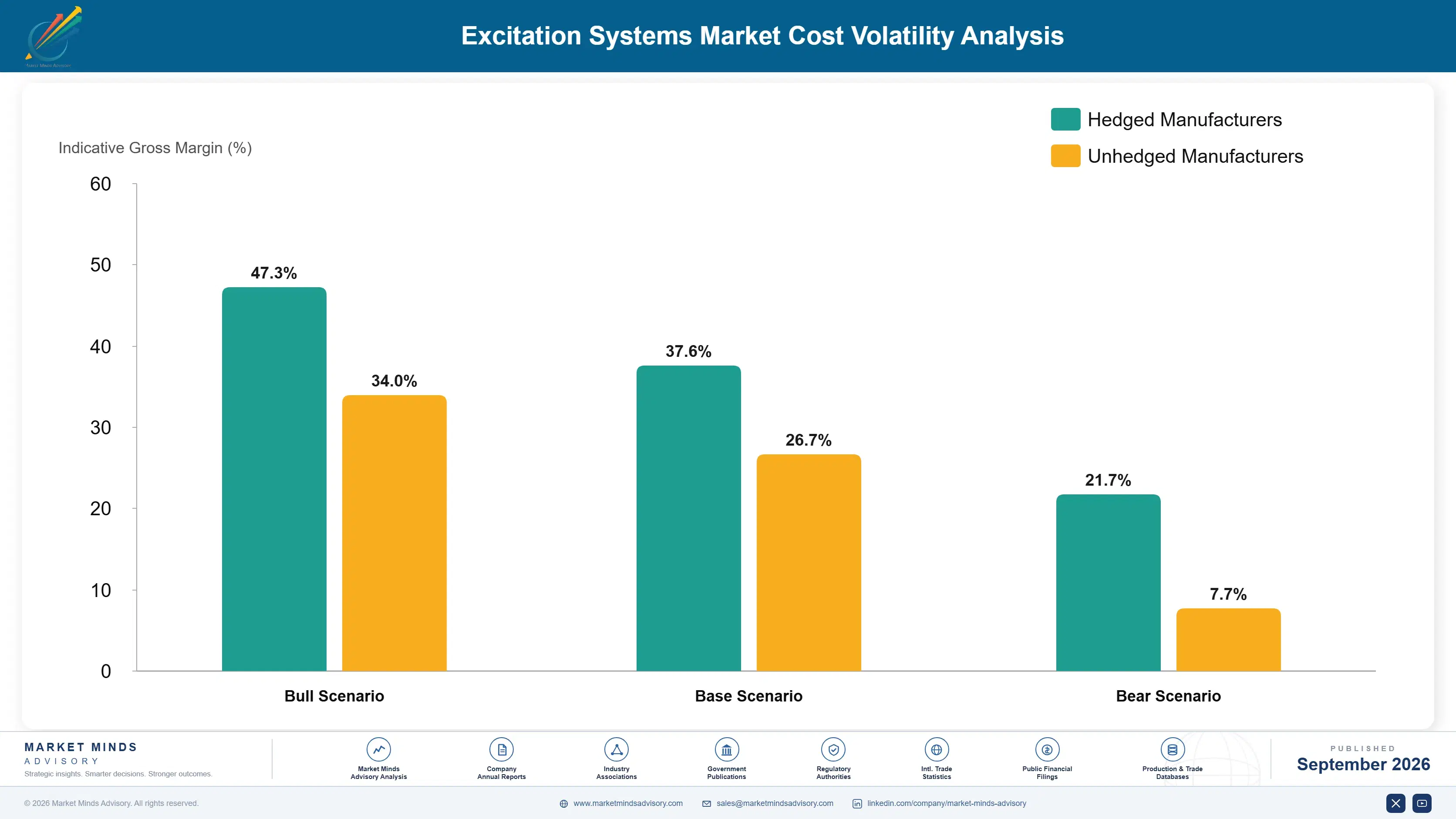
Three inputs dominate delivered cost. Power semiconductors, principally high-current thyristors and their gate drive assemblies, run 18% to 24% of cost of goods sold. Copper windings and electrical steel for excitation transformers account for 15% to 21%. Engineering and site commissioning labour, which no supplier can compress far, takes a further 22% to 28%. Semiconductor supply concentrates among a small number of qualified device manufacturers.
Copper price movement through 2024 and 2025 pressed directly on transformer and winding cost, and the IEA Global Critical Minerals Outlook documented the demand pressure behind it as grid investment accelerated worldwide. Several suppliers disclosed material cost pressure in their annual reports for that period, and fixed-price retrofit contracts signed before the movement absorbed it entirely. Escalation clauses have since become standard on multi-year frame agreements.

The competitive disadvantage mechanism runs through commissioning labour rather than materials. A supplier whose window runs six weeks carries site cost that a supplier commissioning in three does not, and cannot price against it once owners understand what the outage costs them. Exposure varies by player type. Global manufacturers amortise engineering across many projects. Regional specialists carry it per contract, and long hydro mobilisations are most exposed.
excitation-systems-market-cost-volatility-analysis-1790005602577

Qualify Second Sources For High-Current Thyristor Devices

Dual qualification of power semiconductor devices removes a single point of supply exposure on the highest-value bought-in component. Qualification is expensive and slow because the devices sit in a safety-relevant circuit, but suppliers who completed it before the last shortage held delivery commitments that competitors could not, and won repeat work on that basis alone.

Escalation Clauses Indexed To Published Metal Prices

Linking copper and electrical steel content to published index movement moves commodity exposure to the customer, who is generally better placed to carry it across a portfolio. Owners accept this readily on multi-year frame agreements and resist it on single retrofit contracts, so the mechanism works best where the commercial relationship already extends across several machines.

Move Commissioning Effort Off Site Into Simulation

Hardware-in-the-loop testing against a validated machine model shifts engineering hours from expensive site mobilisation into the factory, where the same work costs a fraction as much. The investment is a model library that accumulates across projects, so early movers hold a widening cost advantage that latecomers cannot close by spending alone. Model coverage compounds project by project.

Portfolio Architecture for Margin Defence

Margin architecture follows how much of the delivered value is engineering rather than hardware. Excitation transformers and field breakers are close to commodity, competing against general electrical equipment suppliers on price and delivery. Digital regulators and rectifier bridges earn considerably more. Network studies, stabiliser tuning, and grid compliance demonstration earn most of all, because the capability cannot be purchased and the customer has no alternative source.
The tension between volume and premium plays out through site labour. High-volume hardware supply is only profitable where commissioning effort has been industrialised, and suppliers who sell equipment cheaply then discover a six week site mobilisation lose money on every project. Premium engineering scopes carry high margin but scale only with the number of qualified network engineers available, which is a genuine constraint.

High-value pools concentrate where the machine matters more than the equipment: synchronous condenser conversions, pumped storage with frequent mode reversal, and grid code compliance retrofits on networks with inertia shortfalls. These share one property, which is that failure or non-compliance costs the owner far more than any conceivable equipment premium. Ordinary thermal retrofit, where the machine is old and the network is stable, prices very differently.

Volume / Commodity-Adjacent

Excitation transformers, field breakers, discharge circuits, and cabinet fabrication. These compete against general electrical equipment suppliers on price and delivery, with no defensible engineering content. The eight-point range reflects wide variation in whether suppliers manufacture or buy these items.
Gross Margin: 21% to 29%

Premium / Certified

Digital voltage regulators, thyristor rectifier bridges, and integrated system supply for qualified generator applications. Type approval and machine-specific interface knowledge limit the field of credible suppliers. The eight-point range separates industrialised commissioning from suppliers still mobilising engineers per project.
Gross Margin: 34% to 42%

Sustainability / Regulatory / Next-Generation

Network studies, stabiliser tuning, grid compliance demonstration, and synchronous condenser conversion engineering. Capability rests on accumulated machine and network models rather than on product, so it cannot be bought. The eleven-point range reflects how few suppliers hold genuine study depth today.
Gross Margin: 44% to 55%
excitation-systems-market-portfolio-architecture-1790005603076

High-value Sub-segments and Strategic Watch-out

Power System Stabilisers And Grid Support

Highest value and fastest growth at 8.1%, driven by grid code obligations with demonstration testing attached. Study work frequently exceeds hardware value, and it places the supplier upstream of the equipment decision. The ten-point range reflects how differently suppliers price engineering against hardware. Study depth decides the award.
Gross Margin: 46% to 56%

Synchronous Condenser Conversion Excitation

High value with moderate growth, covering roughly 180 conversions in planning or execution worldwide. Content per machine exceeds what the same unit needed in generation service, because voltage regulation becomes its whole purpose. Demand tracks network inertia studies rather than plant investment cycles. Network studies drive the timing.
Gross Margin: 42% to 50%

Thermal Fleet Retrofit Supply

The volume core of the category, driven by obsolescence notices across a fleet with a median age of 27 years. Growth tracks the market rate closely and order timing is unpredictable because it follows outage availability. Competitive access depends entirely on original equipment support status.
Gross Margin: 31% to 39%

Commodity Component Supply Without Engineering

The strategic watch-out. Selling transformers, breakers, and cabinets without the engineering scope exposes a supplier to general electrical competition and to site mobilisation cost that the price cannot carry. The eight-point range reflects the gap between manufactured and bought-in component economics entirely. Site mobilisation destroys the margin.
Gross Margin: 19% to 27%

How The Orders Actually Recur

Revenue here is lumpy at the machine level and highly predictable at the fleet level. Any individual generator needs excitation replacement perhaps twice in its operating life, so no single asset produces recurring revenue in a meaningful sense. Across a fleet of several hundred machines with a median age of 27 years, however, the replacement rate is arithmetically stable, and suppliers tracking the population rather than the tender pipeline forecast accurately.
Adoption depth varies sharply by owner type. Hydro operators, running machines for sixty years or more, treat excitation replacement as routine asset management and buy on a planned cycle. Thermal owners in competitive generation markets defer until failure risk becomes intolerable, since every outage day is revenue foregone. Network operators buying synchronous condensers behave differently again, purchasing on compliance grounds with no generation revenue to protect at all.

The buyer profile has changed materially. Plant engineering managers drove purchasing for decades and bought on maintainability and familiarity. Grid compliance officers and asset strategy teams now co-sign most significant retrofits, and their questions concern demonstration testing, damping performance, and connection agreement obligations. Suppliers selling on component reliability alone lose scopes where the criterion has moved to network behaviour.
excitation-systems-market-end-use-penetration-index-1790005603568

Where This Market Rewards

These are among the four positions where our research anticipates prominent divergence between winners and laggards over the coming forecast period. Each is grounded in the demand model, the regulatory perimeter, and the announced capacity pipeline.
01 / OUTAGE WINDOW COMPRESSION

The outage costs more than the equipment ever will

Lost generation across a six week commissioning window routinely exceeds the excitation system price several times over, which makes window length the buyer's actual decision variable rather than hardware cost. Suppliers who industrialised pre-outage tuning commission in 18 to 24 days and command a premium far above what the work costs them to perform. Competing on equipment price against that position is not a strategy, and owners increasingly say so during evaluation, once they have priced a single lost outage week properly.
02 / GRID STUDY CAPABILITY

Whoever writes the study shapes the specification

Power system stabilisers and grid support modules grow at 8.1%, half again the market rate of 5.4%, and the network study frequently costs more than the module it specifies. Suppliers without study capability watch that work go to an independent consultant who then writes a specification favouring somebody else entirely. Building the capability adds 40% to 60% to captured scope value and, more importantly, places the supplier upstream of the equipment decision itself, ahead of any hardware discussion taking place at all.
03 / POST-SUPPORT ACCOUNT ACCESS

Concentration rests on contracts, not on technology

Five suppliers hold 62% of delivered value because machines under original manufacturer support are contractually closed to outsiders, not because the interface is difficult to engineer correctly. When support lapses the barrier disappears completely, and a very large share of the installed base is now old enough for owners to question whether continued coverage is worth its cost. Independents tracking obsolescence notices systematically win 3.2 times more competitive retrofits than competitors who wait for a published tender published in an open market.
04 / MONITORING LED ENTRY

Diagnostics fit without the outage that blocks everything

Monitoring and protection modules can generally be installed with the machine running, which bypasses the six week constraint that governs every other scope in this category. That makes them the only practical way into an account still covered by a competitor's original equipment support agreement. Roughly 31% of monitoring installations convert into full excitation retrofits within four years, and the accumulated data is what eventually builds the owner's own replacement case, usually two or three years after the modules go in.

Engagement Snapshot From the Field

A live engagement with an industry participant carrying material or product regulatory and market exposure ahead of a defining policy shift, showing how our research translates into a defensible multi-year portfolio strategy.
MARKET MINDS ADVISORY · CLIENT ENGAGEMENT SUMMARY
Excitation Systems Producer Strategic Portfolio Review and Transition Roadmap 2026·Investment Scenario on Excitation Systems Exposure Evaluation 2025-26
CLIENT PROFILE
A state-owned hydro generator operating 34 units across eleven stations, with a combined capacity above 4 GW and machines commissioned between 1968 and 1991. Annual generation revenue exceeded USD 720 million (client-reported, unverified by MMA). Excitation equipment across the fleet was a mixture of original analogue regulators and partial upgrades performed inconsistently over three decades by four different suppliers.
STRATEGIC CHALLENGE
Two suppliers had issued obsolescence notices covering 19 of the 34 units, and the utility had no basis for sequencing replacement across them. A new connection code required damping performance demonstration within four years. Replacing everything at once was unaffordable, and replacing nothing risked an unrepairable failure on a large machine during peak season.
MMA APPROACH
MMA built a replacement priority model combining equipment obsolescence status, unit dispatch value, grid code exposure by connection point, and available outage windows over a six year horizon. Supplier capability was assessed on commissioning window length and network study depth rather than on hardware specification, and reference interviews tested claimed commissioning durations against delivered performance.
KEY FINDINGS
  1. Commissioning window length varied from 19 to 44 days across shortlisted suppliers, a difference worth more in lost generation than the entire equipment price on larger units.
  2. Only three of nine candidate suppliers could perform the network studies required for damping demonstration, and the rest intended to subcontract the work to consultants.
  3. Eleven of the 19 obsolete units sat at connection points where the new code created no incremental damping obligation, permitting deferral without compliance exposure.
  4. Standardising on a single supplier across the fleet reduced modelled spares and training cost by an amount roughly equal to a twelve percent equipment premium.
CLIENT PROFILE
A state-owned hydro generator operating 34 units across eleven stations, with a combined capacity above 4 GW and machines commissioned between 1968 and 1991. Annual generation revenue exceeded USD 720 million (client-reported, unverified by MMA). Excitation equipment across the fleet was a mixture of original analogue regulators and partial upgrades performed inconsistently over three decades by four different suppliers.
STRATEGIC CHALLENGE
Two suppliers had issued obsolescence notices covering 19 of the 34 units, and the utility had no basis for sequencing replacement across them. A new connection code required damping performance demonstration within four years. Replacing everything at once was unaffordable, and replacing nothing risked an unrepairable failure on a large machine during peak season.
MMA APPROACH
MMA built a replacement priority model combining equipment obsolescence status, unit dispatch value, grid code exposure by connection point, and available outage windows over a six year horizon. Supplier capability was assessed on commissioning window length and network study depth rather than on hardware specification, and reference interviews tested claimed commissioning durations against delivered performance.
KEY FINDINGS
  1. Commissioning window length varied from 19 to 44 days across shortlisted suppliers, a difference worth more in lost generation than the entire equipment price on larger units.
  2. Only three of nine candidate suppliers could perform the network studies required for damping demonstration, and the rest intended to subcontract the work to consultants.
  3. Eleven of the 19 obsolete units sat at connection points where the new code created no incremental damping obligation, permitting deferral without compliance exposure.
  4. Standardising on a single supplier across the fleet reduced modelled spares and training cost by an amount roughly equal to a twelve percent equipment premium.
RECOMMENDED STRATEGY
Phase 1: Phase one: replace excitation on the six highest dispatch value units carrying both obsolescence notices and binding damping obligations under the new connection code. Phase 2: Phase two: standardise the remaining fleet on the selected supplier, sequencing work strictly into planned overhaul windows already scheduled across the following four years. Phase 3: Phase three: fit monitoring modules across all deferred units immediately, converting unpredictable failure risk into planned intervention without requiring any machine outage.
OUTCOME
Eighteen months in, six units had been retrofitted with a mean commissioning window of 21 days against a 42 day category median, and all damping demonstrations passed at first attempt. Monitoring on deferred units identified two developing rotor earth faults before failure. Modelled lifetime programme cost fell by 17% (client-reported, unverified by MMA).

Frequently Asked Questions

Foundational context covering the market sizes, CAGR, scope, country, region and competition that inform every finding below. This section is provided to cover basics and most often pre-purchase conversations, answered from the MMA Primary Research Dataset.

What is the current size of the Excitation Systems Market?

The market was worth USD 1.7 billion in 2025 and reaches USD 1.8 billion in 2026. Value is measured on delivered equipment and associated commissioning scope.

How large will the Excitation Systems Market be by 2036?

MMA forecasts USD 3.0 billion by 2036, an increase of USD 1.2 billion across the forecast period. That represents 1.67 times the 2026 base of USD 1.8 billion.

What is the CAGR for the Excitation Systems Market 2026 to 2036?

The base case compound annual growth rate is 5.4%, with a bull case at 6.6% and a bear case at 4.2%. Historical growth from 2020 to 2025 ran at 4.3%.

Which segment is growing fastest?

Power system stabilisers and grid support modules grow at 8.1%, half again the market rate of 5.4%. Grid codes now specify damping performance with demonstration testing attached.

Who are the major companies in the Excitation Systems Market?

GE Vernova, Siemens Energy, ABB, Andritz, and Voith lead, holding 62% of delivered system value between them. Independent specialists compete on machines outside original equipment support.

Which country is growing fastest?

India grows at 8.9%, driven by flexible coal operation that accelerates equipment wear and by an ambitious pumped storage construction programme. Both demand streams arrive at once.

Report Segmentation Architecture

The full report scope spans multiple orthogonal segmentation dimensions, with cross-tabulated demand data provided for each dimension pair. Coverage extends further to regional breakdowns, trend trajectories, and the competitive detail needed to support segment-level decision-making.

By Equipment Type

  • Automatic Voltage Regulators and Digital Control Units
  • Thyristor Rectifier Bridges
  • Excitation Transformers
  • Field Breakers and Discharge Circuits
  • Power System Stabilisers and Grid Support Modules
  • Protection, Monitoring and Diagnostic Modules

By End-Use Industry

  • Hydroelectric Generation
  • Coal and Gas Thermal Generation
  • Nuclear Generation
  • Pumped Storage and Grid Balancing
  • Synchronous Condenser and Network Support
  • Industrial Captive Generation

By Commercial Dimension

  • Original Equipment Manufacturer Supply
  • Independent Retrofit Supply
  • Engineering Procurement Contractor Delivered
  • Utility Framework Agreement
  • Development Institution Funded Project
  • Aftermarket Service and Spares

By Region

  • East Asia
  • North America
  • Western Europe
  • South Asia and Pacific
  • Latin America
  • Middle East and Africa
  • Eastern Europe

Scope, Methodology, and Coverage

Every figure in this report is reproducible from documented input assumptions. The scope below maps the historical period, the forecast horizon, the segmentation dimensions, and the countries covered, alongside the underlying primary and qualitative methodology.
Historical Period
2020 to 2025
Forecast Period
2026 to 2036
Base Year
2025 (USD billions; MMA Primary Research Dataset, September 2026)
Market Definition
The excitation systems market covers equipment supplying and regulating field current in synchronous generators and motors, including automatic voltage regulators and digital control units, thyristor rectifier bridges, excitation transformers, field breakers and discharge circuits, power system stabilisers, and protection, monitoring and diagnostic modules. It excludes generators, turbine governors, plant distributed control systems, and switchyard protection equipment outside the excitation boundary.
Quantitative Units
USD billions, delivered equipment and commissioning value
Segmentation Dimensions
Equipment type, end-use industry, commercial dimension, region
Regions Covered
East Asia, North America, Western Europe, South Asia and Pacific, Latin America, Middle East and Africa, Eastern Europe
Countries Covered
China, Japan, South Korea, Taiwan, United States, Canada, Mexico, Germany, France, Italy, Spain, Norway, Sweden, Switzerland, Austria, India, Australia, Vietnam, Brazil, Chile, Colombia, Saudi Arabia, United Arab Emirates, South Africa, Poland, Romania, Turkey
Key Companies Profiled
GE Vernova, Siemens Energy, ABB, Andritz, Voith, Basler Electric, Hitachi Energy, Mitsubishi Electric, Toshiba Energy Systems and Solutions, Meidensha, Harbin Electric, Dongfang Electric, Shanghai Electric, BHEL, NR Electric, Reivax, WEG, Brush Group, Ansaldo Energia, Emerson
Quantitative Methodology
Primary survey, n=3,800 respondents, Q4 2025, six countries; demand-side model with trade association cross-validation
Qualitative Methodology
47 expert interviews, Q4 2025; applied to validate demand model assumptions, identify emerging dynamics, and assess competitive positioning
Report Format
PDF and XLSX data workbook (Word format preview document)
Publisher
Market Minds Advisory
Report Code
MMA-2026-ENE-361
Published
September 2026
Contact
sales@marketmindsadvisory.com | www.marketmindsadvisory.com

Purchase the full Excitation Systems Market Report (2026 to 2036).

The full report sizes the excitation systems market across six equipment types, seven regions, and twenty-seven countries, with forecasts to 2036 under base, bull, and bear cases. It examines why obsolescence notices rather than performance cases drive orders, and why the commissioning outage matters more to buyers than equipment price. Competitive analysis covers twenty participants evaluated consistently on delivered system value, with detailed treatment of original equipment support as a contractual barrier and of the post-support opening for independents. Cost structure, margin architecture by scope, and regional fleet age drivers are analysed in full. Primary research includes 3,800 survey responses and 47 expert interviews.
Six equipment types sized and forecast separately
Twenty participants evaluated on delivered system value
Regional fleet age and grid code drivers assessed
Margin architecture by equipment and engineering scope
Commissioning window benchmarks against delivered supplier performance
Synchronous condenser conversion pipeline with content analysis

Built For The People Who Decide

From boardroom strategy to bench-side execution, this report is read cover-to-cover by leaders shaping the next decade of their industry, turning demand scenarios, market dynamics and valuation benchmarks into decisions.
CXOs/ Presidents/ VPs/ Managers
M&A and Corporate Development
Strategy Teams and R&D Heads
Procurement and Product Directors
Regulatory and Compliance Leaders
Investor Relations and Equity Analysts