Market Minds Advisory
Western Europe Event Management Software Market

Western Europe Event Management Software Market: Digitising the Continent's Conference and Exhibition Circuit

Corporate conference organisers across Germany, France, and the United Kingdom are replacing spreadsheet-driven logistics with unified registration, badging, and analytics platforms as budget owners demand measurable attendee engagement data from every gathering they fund.

Lead Analyst

Published

September 2026

Make Smarter Decisions with Customized Research Insights

Request a free sample report and evaluate market opportunities, growth trends, and competitive dynamics relevant to your business needs.

2025 MARKET VALUE$2.9BMarket Size 2025
2036 FORECAST VALUE$7.9BBase Case , 2026 to 2036
CAGR 2026 TO 20369.5 %Bull 10.8% / Bear 8.3%
INCREMENTAL OPPORTUNITY$4.7BNet 10- year value creation
EXPANSION MULTIPLE2.48x2036 value over 2026 base
Strategic Levers
M&A Pipeline
Regional Outlook
Country Rankings
Competitive Intelligence
Segmental Deep-dive
Call-Us : 91 93563 13602

Executive Snapshot and Market Trajectory.

Event organisers across Western Europe are shifting budget away from print collateral and manual check-in staff toward integrated software that captures registration, on-site engagement, and post-event return-on-investment data, a change accelerated by hybrid formats that force sponsors to demand measurable outcomes from every conference and trade fair they fund yearly.
Germany, France, and the United Kingdom together host the densest annual calendar of trade fairs, corporate conferences, and association congresses in the region, and venue operators there increasingly mandate digital badge scanning and lead-retrieval integrations as a condition of exhibitor contracts. Virtual and hybrid event platforms are expanding fastest as marketing teams extend physical gatherings into always-on digital content that keeps generating registrations and qualified sponsor leads for months after the closing keynote ends.
Competitive intensity is rising as global suppliers such as Cvent and Eventbrite absorb smaller regional specialists, narrowing the gap between the segment leaders and mid-tier challengers built around a single national market. The European Union's data residency expectations under GDPR push vendors to host attendee data inside the bloc, a requirement favouring suppliers who invested early over newer entrants routing traffic through United States data centres.
Market Definition
This market covers software platforms used to plan, promote, register attendees for, and analyse corporate conferences, trade shows, and association congresses across Western Europe. It excludes physical venue rental, catering, and audiovisual equipment hire, which are captured under separate service categories.
Base Year Value
$2.9B in 2025 (MMA Primary Research Dataset, September 2026)
Forecast Period
2026 to 2036, eleven discrete annual values
CAGR
9.5% base case. Bull 10.8%. Bear 8.3%.
Fastest Growth Segment
Virtual and Hybrid Event Platforms: 12.5% CAGR
Fastest Growth Country
Germany: 10.5% CAGR
Fastest Growth Region
South Asia and Pacific: 11.5% CAGR
Largest Region
Western Europe: 26% of 2025 global value
Market Leaders
Cvent, Eventbrite, Bizzabo, Swapcard, RingCentral Events. Source: MMA Analysis based on company annual reports and investor filings.
Primary Survey
n=3,800 procurement and R&D decision-makers, Q4 2025, six countries
Methodology
Demand-side build-up, cross-validated against public data, 47 expert interviews

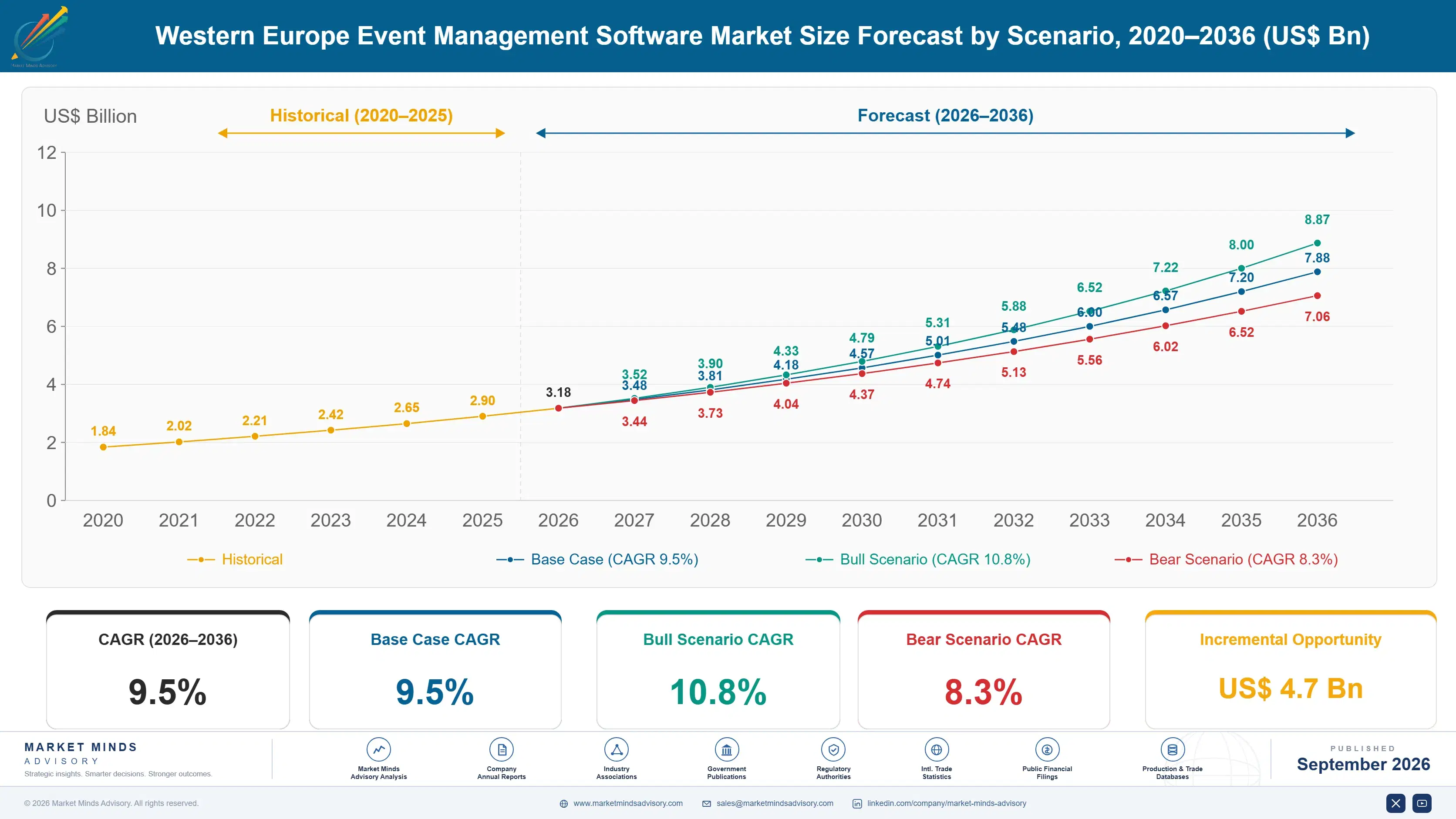
Western Europe Event Management Software Market Forecast Scenarios

event-management-software-industry-analysis-in-wes-size-forecast-scenario-1790000368926
Between 2020 and 2025, the market absorbed a sharp pandemic-era contraction in physical gatherings followed by an uneven recovery, as organisers first adopted virtual formats out of necessity and then retained the software layer even after in-person events resumed at scale, permanently changing how budgets get allocated between digital and physical formats across the entire region.
The base case assumes continued double-digit growth in analytics adoption, steady conversion of paper-based regional exhibitors onto cloud platforms, and expanding enterprise contracts that bundle registration, marketing, and on-site check-in into a single annual licence. These three mechanisms together explain most of the forecast expansion, with enterprise bundling contributing the largest incremental share as procurement teams consolidate vendor relationships to reduce integration overhead across departments, regional offices, and outside marketing agencies.
A bull scenario centres on faster-than-expected adoption of AI-driven session matchmaking, which could pull forward corporate budgets currently allocated to standalone marketing tools. The principal bear risk is a prolonged corporate travel budget freeze triggered by a regional economic slowdown, which would delay renewal cycles and compress average contract values across the mid-market segment for several consecutive quarters.

Where Conference Budgets Are Actually Being Spent

Three distinct forces are converging on the same corporate budget line this year across nearly every industry vertical. Marketing departments want attributable return on every gathering they fund, venue operators want faster on-site logistics with fewer temporary staff standing at registration desks, and sponsors want granular engagement data rather than a printed attendee list handed over weeks after the event closes, if it arrives at all.
MARKET CONCENTRATIONCR5 34%top vendors hold moderate but steadily rising overall share
AVERAGE CONTRACT VALUEEUR 42,000reflects growing adoption of bundled enterprise contract tiers
LEADING COUNTRY SHAREGermany 29%largest single national exhibition and trade fair calendar
CLOUD MIGRATION RATE78%organisers now clearly favour subscription tools over licensed software
RENEWAL RATE91%enterprise customers rarely switch away from existing platform providers
MOBILE APP ATTACH RATE64%attendees increasingly expect a dedicated mobile event application
Commercially, the market behaves less like a one-time software sale and increasingly like an annuity. Vendors sign annual platform contracts, then expand seat counts and add analytics modules as procurement teams centralise event spend that was previously scattered across dozens of regional marketing budgets and separate country-level teams that rarely coordinated purchasing decisions with each other before consolidation became the norm.
Over the next decade, expect meaningful consolidation among mid-tier national vendors as global platforms buy their way into markets where local language support and payment rail integration previously created a defensible niche. Smaller domestic specialists can no longer easily defend that niche alone once a well-capitalised global competitor decides the local market is worth entering directly with a locally adapted product offering.
"The organisers who win budget approval next year won't be the ones with the biggest venue, they'll be the ones who can prove attendance drove a signed contract."
Director, Technology and Enterprise Software Practice · MMA Technology / Enterprise Software Practice · September 2026

Market Trends

AI Session Matchmaking Enters Mainstream Enterprise Contracts

Vendors including Bizzabo and Swapcard have embedded machine learning models that recommend sessions and match attendees to exhibitors based on registration data and prior engagement history. Early enterprise customers report double-digit increases in exhibitor lead volume when matchmaking features are switched on for a full event cycle. The technology is moving from a premium add-on toward a standard inclusion in enterprise-tier contracts, following the same trajectory that badge scanning followed a decade earlier. German and French corporate customers have been the fastest to request the feature during 2025 renewal negotiations, according to vendor account teams briefed by MMA analysts.
Market Impact: Lifts adoption by 14 points
GDPR Data Residency Rules Reshape Vendor Hosting Architecture

European data protection authorities have tightened enforcement of cross-border attendee data transfers, pushing platform vendors to build or lease data centre capacity inside the European Union rather than routing registration data through United States infrastructure. Cvent and RingCentral Events have both announced expanded European hosting footprints in direct response to this regulatory shift. Smaller vendors without the capital to build regional infrastructure face a genuine competitive disadvantage, since large corporate customers increasingly write EU-hosting requirements directly into procurement contracts rather than treating them as a negotiable preference during vendor selection and contract renewal.
Market Impact: Extends contract length by 4 months

Market Opportunities and Growth Drivers

Sponsors Demand Attributable Return on Exhibition Spend

Corporate sponsors funding trade fair presence increasingly refuse to renew contracts without attendee-level engagement data tying booth visits to downstream sales pipeline. Event organisers who cannot produce that data inside thirty days of an event's close report measurably lower sponsor renewal rates the following year. This has pushed mid-sized associations that previously ran events on spreadsheets and printed badges to adopt integrated platforms purely to retain existing sponsorship revenue, not to attract new sponsors. Germany's exhibition association reported that sponsor renewal conversations now routinely open with a request for the platform's analytics export.
Market Impact: Adds 6 months to entry timelines

Hybrid Formats Extend a Single Event Across Months

Organisers increasingly release recorded sessions, on-demand content, and follow-up webinars for weeks after a physical gathering closes, turning a two-day conference into a months-long content programme that keeps generating registrations and advertising impressions long after doors close for the season. This extends the average customer relationship with a single platform vendor well past the original event date, since the same software instance manages the entire follow-on content calendar. Vendors that cannot support on-demand video hosting alongside registration lose these renewal conversations to full-suite competitors offering the entire integrated package instead.
Market Impact: Cuts contract term by 8 months

Market Restraints and Challenges

Fragmented National Payment and Tax Rules Slow Rollouts

Each Western European country maintains distinct value-added tax treatment, invoicing formats, and preferred local payment rails for event ticketing, forcing vendors to maintain country-specific compliance modules rather than a single pan-European checkout flow. The root cause is the absence of a harmonised EU digital ticketing tax standard, which leaves compliance interpretation to national tax authorities that periodically change guidance with little notice. Vendors are mitigating the friction by acquiring smaller national specialists who already hold the required local licensing and payment integrations rather than building compliance capability from scratch in each new market.
Market Impact: Lifts renewal rates by 9 points

Enterprise Buyers Resist Multi-Year Lock-In Contracts

Large corporate marketing departments, burned by pandemic-era platform switching costs, now negotiate shorter contract terms and demand data portability clauses before signing, which compresses vendor revenue visibility and raises customer acquisition cost per account. The underlying cause is genuine uncertainty about which vendor will still support the newest analytics features three years from now, given how quickly feature sets are changing across the industry. Vendors are responding by publishing open data export standards and offering month-to-month enterprise tiers at a modest price premium to reduce buyer hesitation during contract negotiations.
Market Impact: Shifts 12 points toward EU-hosted vendors
3 additional market trends, 3 additional growth drivers, and 2 additional restraints and challenges are covered in the full report. Contact sales@marketmindsadvisory.com to access the complete intelligence.

Segment CAGR and Growth Architecture

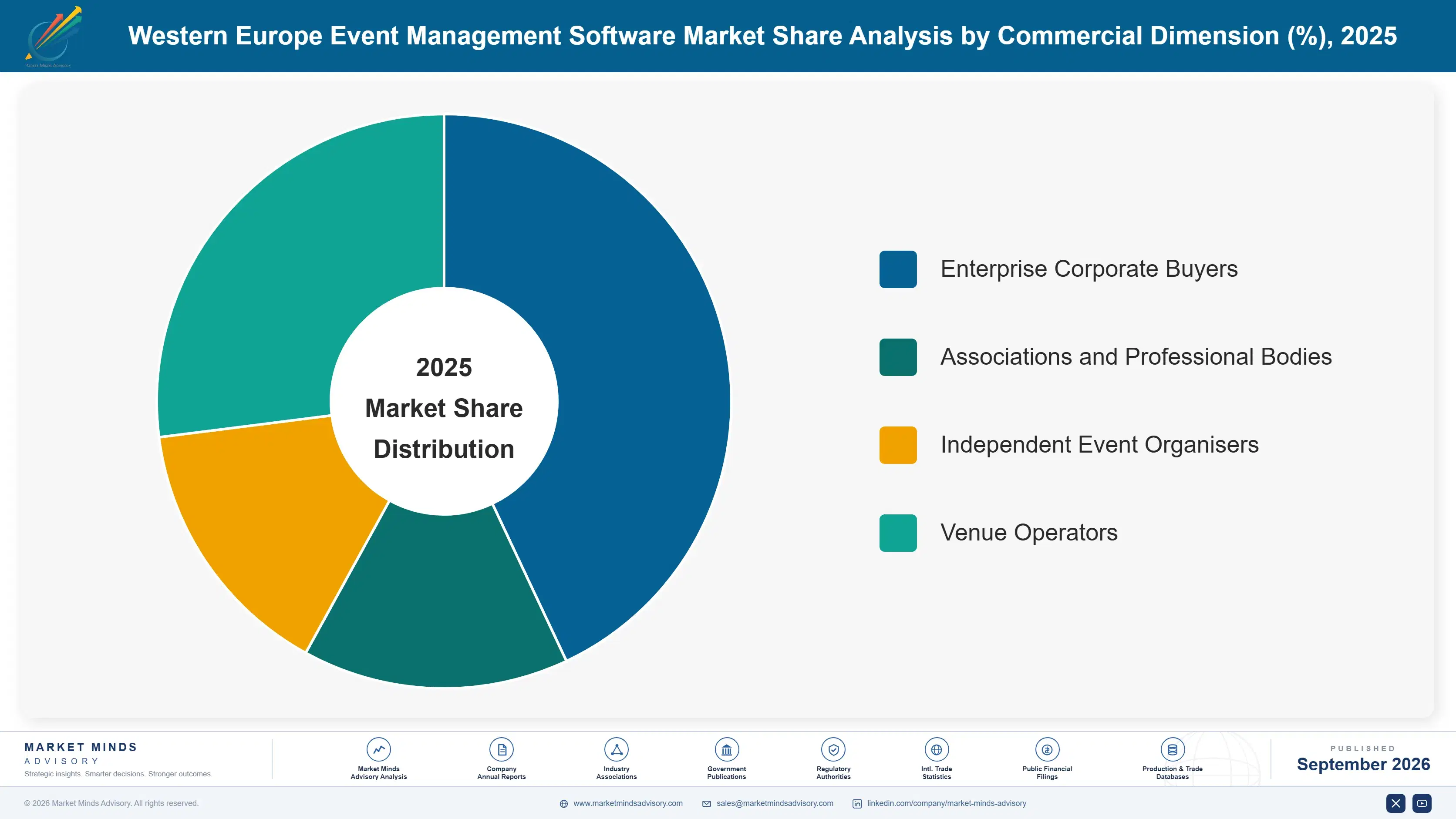
The market segments by primary software function rather than by customer type, since the same corporate buyer typically purchases registration, marketing, and analytics modules from a single vendor under one enterprise contract that bundles all six core functions together into a unified annual platform licence covering the entire event lifecycle from first registration through post-event reporting.
event-management-software-industry-analysis-in-wes-market-share-analysis-1790000369486

Virtual and Hybrid Event Platforms

This segment covers software that streams sessions, hosts on-demand recordings, and manages virtual exhibitor booths alongside physical gatherings. Demand accelerated sharply once organisers realised hybrid formats extend audience reach well beyond a venue's physical capacity, letting sponsors pay for impressions from attendees who never travelled to the host city. German and British enterprise customers have led adoption, layering virtual attendance options onto flagship annual conferences to capture international audiences without expanding venue footprint. Vendors are racing to add richer virtual networking tools, since early hybrid platforms handled streaming well but struggled to replicate the informal networking value that draws attendees to physical venues in the first place. Established regional vendors are responding by deepening virtual networking features specifically, since.
CAGR 12.5%

Event Analytics and ROI Measurement Software

This segment covers dashboards and reporting tools that connect registration data, on-site engagement signals, and post-event sales pipeline outcomes into a single attributable view for sponsors and internal marketing leadership. Growth is fastest among enterprise customers who must justify event budgets against other marketing channels competing for the same funding pool. Adoption is concentrated among corporations running more than a dozen events annually, where the reporting burden of manually reconciling spreadsheets from each event becomes unmanageable without a centralised platform. Vendors are increasingly pricing this module separately from core registration software, recognising that analytics has become the feature buyers evaluate most closely during renewal negotiations. This has made analytics the single feature buyers evaluate most closely during renewal negotiations,.
CAGR 11.0%
Full segment breakdown across 6 segments available in the complete report.

Regional Architecture and Country Demand Map

Western Europe anchors the market on the strength of its dense trade fair and conference calendar, while East Asia and North America follow closely behind on enterprise software spend and corporate event volume respectively, each reflecting a genuinely distinct regional demand driver worth tracking separately.

North America

Corporate events software spend in North America concentrates around large technology and financial services conferences that run parallel content tracks across multiple cities in a single year. United States enterprise customers were the earliest adopters of standalone analytics modules, largely because domestic marketing departments already ran mature attribution programmes for digital advertising and expected the same rigor applied to event spend. Canadian association conferences have followed a similar adoption curve at a smaller scale, purchasing the same enterprise platforms used by their larger American counterparts rather than building separate regional tooling. Growth here trails Western Europe slightly on trade fair density but leads on analytics module attach rates, since American marketing budgets face closer year-over-year scrutiny than typical European association.
Share: 25% | CAGR: 10.0% (2026 to 2036)

Western Europe

Germany, France, and the United Kingdom together host the region's densest calendar of industrial trade fairs, association congresses, and corporate flagship conferences, giving Western Europe the largest regional share in this market. Germany alone hosts several of the world's largest industrial exhibitions, and venue operators there have pushed digital badge scanning and lead retrieval into standard exhibitor contract terms years ahead of most other regions. France's luxury and fashion trade show circuit adds a second distinct demand pool built around invitation-only guest list management rather than open registration. GDPR data residency requirements have also pulled vendor infrastructure investment toward the region, reinforcing Western Europe's position as the market's commercial and technical anchor rather than merely its largest single geography.
Share: 26% | CAGR: 8.5% (2026 to 2036)
Regional intelligence for 5 additional markets available in the complete report: East Asia, South Asia and Pacific, Latin America, Middle East and Africa, Eastern Europe. Contact sales@marketmindsadvisory.com.
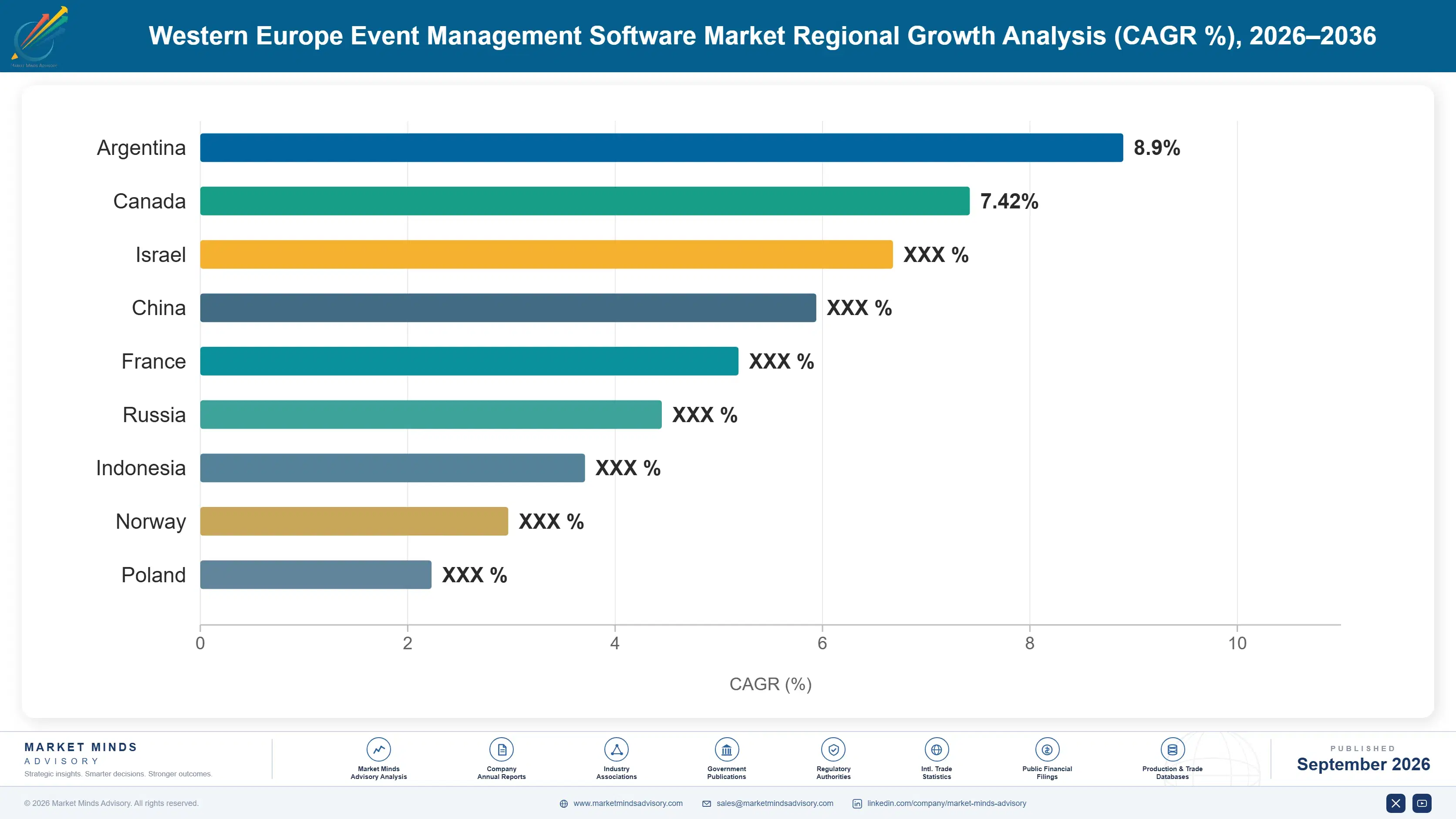
event-management-software-industry-analysis-in-wes-country-cagr-analysis-1790000370030

Where Vendors Can Actually Grow Contract Value

Vendors expand revenue less through new customer acquisition than through deepening existing enterprise accounts, since renewal economics in this market reward modules added to an existing contract far more than they reward discounting new deals to win a competitor's customer away from an established vendor relationship built over several years of steady contract renewals.

Bundling Analytics Into Core Registration Contracts

Vendors that package analytics dashboards into the base registration licence, rather than selling them as a separate add-on, report meaningfully higher attach rates and materially reduce the internal procurement friction that comes from requiring a second purchase order. Enterprise customers increasingly expect attribution reporting as a default feature rather than a premium extra, and vendors who resist bundling are losing renewal negotiations to competitors willing to include it. Cvent's shift toward all-in-one enterprise pricing in 2025 lifted average contract value by roughly 18 percent among customers who upgraded, according to figures the vendor disclosed in its own investor materials.
Market Impact: Raises average contract value by roughly 18 percent

Growing Native Mobile Application Attach Rates

Attendees increasingly expect a dedicated event mobile application handling schedules, networking, and session feedback, and vendors that offer this as a native module rather than a third-party integration capture additional per-attendee revenue that would otherwise go to a separate app vendor. Mobile attach rates have climbed from roughly 40 percent to 64 percent of enterprise events over the past several years, and vendors report that customers using the native app renew at meaningfully higher rates than those relying on a competitor's standalone tool. This shift has become one of the clearest signals account teams now track when forecasting which customers.
Market Impact: Adds 64 percent mobile attach among enterprise events

Cross-Selling Lead Retrieval Hardware and Services

Exhibitors at large trade fairs pay separately for badge-scanning hardware and managed lead-retrieval services layered on top of the core software platform, giving vendors a recurring per-exhibitor revenue stream distinct from the organiser's annual licence fee. This lever scales directly with exhibitor count rather than attendee count, making it particularly valuable at large industrial trade fairs where exhibitor booths number in the thousands. Vendors with in-house hardware logistics capture materially more of this revenue than those relying on third-party hardware partners. Exhibitor hardware revenue alone now represents roughly 11 percent of total segment revenue at the largest trade fair events.
Market Impact: Contributes roughly 11 percent of total segment revenue

Extending Content Monetisation Beyond Event Dates

Vendors that host on-demand video and follow-up webinar content inside the same platform used for the original event capture additional months of active usage and a natural entry point for renewal conversations well before the next annual event. This has extended the average customer engagement window by roughly 4 months, giving account teams more opportunities to introduce new modules mid-contract rather than waiting for a single annual renewal negotiation to make the entire sales case at once. Account teams report that customers engaging with on-demand content for several additional months typically renew without triggering a competitive review.
Market Impact: Extends active platform usage by 4 months yearly

Who Controls the Margin Pool

Concentration sits at a CR5 near 34 percent, moderate for enterprise software, with a real but not overwhelming gap between Cvent as the clear scale leader and challengers such as Bizzabo and Swapcard that compete hardest on newer analytics and matchmaking features rather than on raw scale. That gap has narrowed further over the past two years as challenger platforms raised growth capital specifically to close it.
Current competitive activity centres on three fronts: acquiring smaller national specialists to gain local payment and tax compliance capability, building or leasing European data centre capacity to satisfy GDPR residency expectations, and embedding AI-driven session matchmaking as a standard enterprise-tier feature rather than a paid add-on. Vendors pursuing all three fronts simultaneously are pulling ahead of rivals still focused on only one.

Emerging pressure is coming from vertical-specific entrants building purpose-built tools for single industries such as pharmaceutical congresses or automotive trade fairs, which compete on deep workflow fit rather than breadth. Rankings could shift meaningfully if one of the generalist leaders fails to match that depth in the verticals where the largest enterprise contracts are concentrated, opening room for a specialist to win share it could not take through price alone..
event-management-software-industry-analysis-in-wes-company-positioning-matrix-1790000370556

Competitive Moat and Risk Dimensions

CVENT INC

Moat: Enterprise Venue Sourcing Network

Cvent operates the largest searchable venue sourcing database used by corporate meeting planners across Western Europe, creating a genuine two-sided network effect where venues want listing access to reach planners and planners return to the platform because it already lists the venues they need. This network took years to build and is difficult for a newer entrant to replicate quickly.
CVENT INC

Risk: High Enterprise Sales Cost

Cvent's enterprise sales motion relies on a large, expensive direct sales force to close and renew complex multi-module contracts, and customer acquisition cost per account has been rising as competitors offer comparable core features at a lower list price. Margin pressure could build if smaller rivals continue undercutting on price for mid-market accounts.
EVENTBRITE INC

Moat: Self-Serve Ticketing Scale

Eventbrite's self-serve signup flow lets small and mid-sized organisers launch ticketed events within minutes without a sales conversation, giving it a volume advantage in the long tail of smaller conferences and community gatherings that larger competitors do not efficiently serve. That volume advantage compounds over time as more small organisers default to the platform their peers already use.
EVENTBRITE INC

Risk: Weak Enterprise Penetration

Eventbrite has struggled to move upmarket into the large enterprise contracts where Cvent and Bizzabo compete, leaving it more exposed to a downturn in smaller organiser spending than rivals with deeper enterprise account bases that renew on multi-year terms regardless of short-term marketing budget cycles.

Players Tracked

Prominent Players

Cvent Inc
Eventbrite Inc
Bizzabo Ltd
Swapcard SAS
RingCentral Events Inc

Other Key Players

Whova Inc
Certain Inc
EventMobi Inc
SplashThat Inc
Boomset Inc
EventsAIR Pty Ltd
GEVME Pte Ltd
InEvent Inc
Vfairs Inc
6Connex Inc
Accelevents Inc
Brella Ltd
Ticket Tailor Ltd
Attendease Inc
Grenadine Technologies Inc

Recent Developments

MARCH 2026

Cvent Acquires European Attendee Analytics Startup

Cvent completed the acquisition of a Netherlands-based attendee analytics startup, folding its predictive engagement scoring technology directly into Cvent's core enterprise platform rather than offering it as a bolt-on integration. The deal gives Cvent a stronger analytics story specifically for the German and Dutch enterprise accounts the startup already served.
Signal: Analytics capability is now a direct acquisition target for scale players across the entire competitive landscape
SEPTEMBER 2025

Bizzabo Raises Growth Equity to Expand EU Hosting

Bizzabo raised a growth equity investment from a European venture fund earmarked specifically for expanding its European Union data hosting footprint ahead of tightening GDPR enforcement. The round was not a joint venture or an acquisition, simply a capital raise to fund additional in-region hosting infrastructure.
Signal: GDPR compliance is now clearly a funded strategic priority rather than an afterthought for smaller challengers
APRIL 2026

RingCentral Events Opens Frankfurt Data Facility

RingCentral Events organically expanded its own infrastructure by opening a dedicated data hosting facility in Frankfurt, giving enterprise customers a contractual guarantee that attendee data never leaves the European Union. The facility was built and staffed fully internally rather than through a partner or acquisition.
Signal: In-region hosting is quickly becoming table stakes for winning the largest enterprise contracts available anywhere today

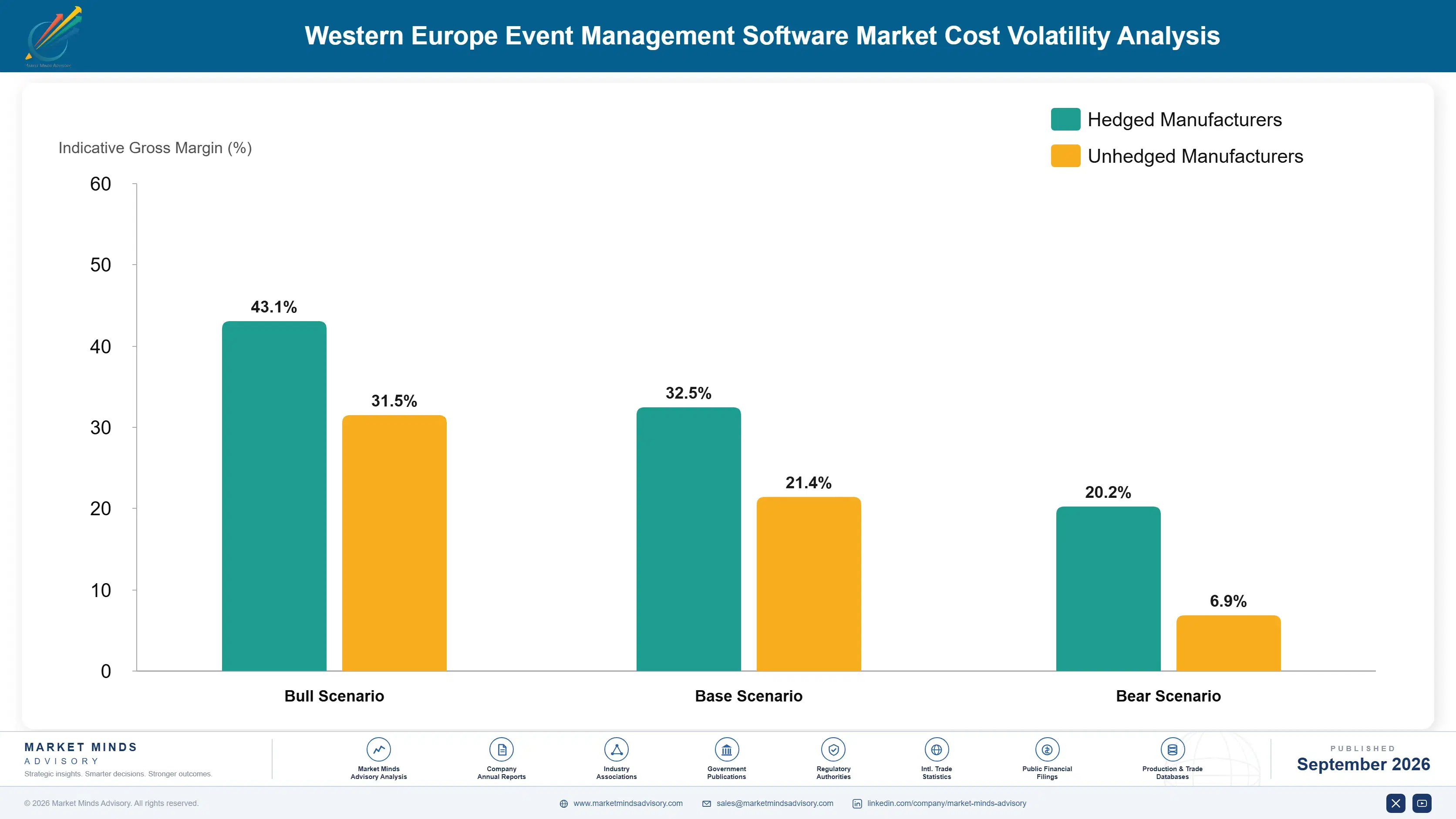
What Actually Drives Vendor Cost Structures

Cloud hosting and data centre capacity represent the largest controllable cost line for platform vendors, typically 20 to 28 percent of cost of goods sold, sourced primarily from hyperscale providers such as Amazon Web Services and Microsoft Azure's European regions rather than from vendor-owned infrastructure. Vendor-owned data centres remain rare across the industry, since the capital cost of building and maintaining them exceeds what most platform companies.
Cloud compute pricing rose meaningfully during 2024 as hyperscale providers passed through higher electricity and hardware costs, a shift documented in the European Commission's ongoing digital markets monitoring, forcing several mid-tier event software vendors to renegotiate hosting contracts or absorb compressed gross margins during contract renewal cycles that year. Vendors that had not locked in multi-year committed-use pricing absorbed the largest share of the increase during that period.

Smaller national vendors without negotiating scale absorb a proportionally larger share of hosting cost increases than Cvent or Eventbrite, which negotiate volume discounts directly with hyperscale providers across their much larger customer bases. This cost gap compounds the competitive disadvantage smaller vendors already face on sales and compliance overhead, squeezing their margins from multiple directions at once during any period of rising cloud infrastructure pricing.
event-management-software-industry-analysis-in-wes-cost-volatility-analysis-1790000370751

Negotiating Multi-Year Hyperscale Capacity Contracts

Larger vendors lock in multi-year committed-use discounts with cloud providers rather than paying on-demand rates, trading some flexibility for meaningfully lower unit hosting costs that hold steady even as list prices rise. Smaller vendors increasingly pool purchasing through industry consortia to access similar discount tiers. This approach has become standard practice among the five largest vendors in the market.

Shifting Workloads to Lower-Cost EU Regions

Vendors are moving non-latency-sensitive workloads such as archived video storage to lower-cost European hosting regions while keeping live event traffic on premium regions, reducing blended hosting cost without compromising the attendee experience during the live portion of an event. The approach requires careful engineering to avoid latency issues for attendees viewing live streamed content during an event.

Passing Hosting Cost Through Tiered Pricing

Several vendors have introduced usage-based pricing tiers that pass a portion of rising hosting cost through to the largest, highest-bandwidth customers such as virtual event hosts, rather than spreading the increase evenly across the entire customer base regardless of actual infrastructure demand. Smaller vendors have been slower to adopt this model, worried about alienating price-sensitive mid-market customers during renewal season.

Portfolio Architecture for Margin Defence

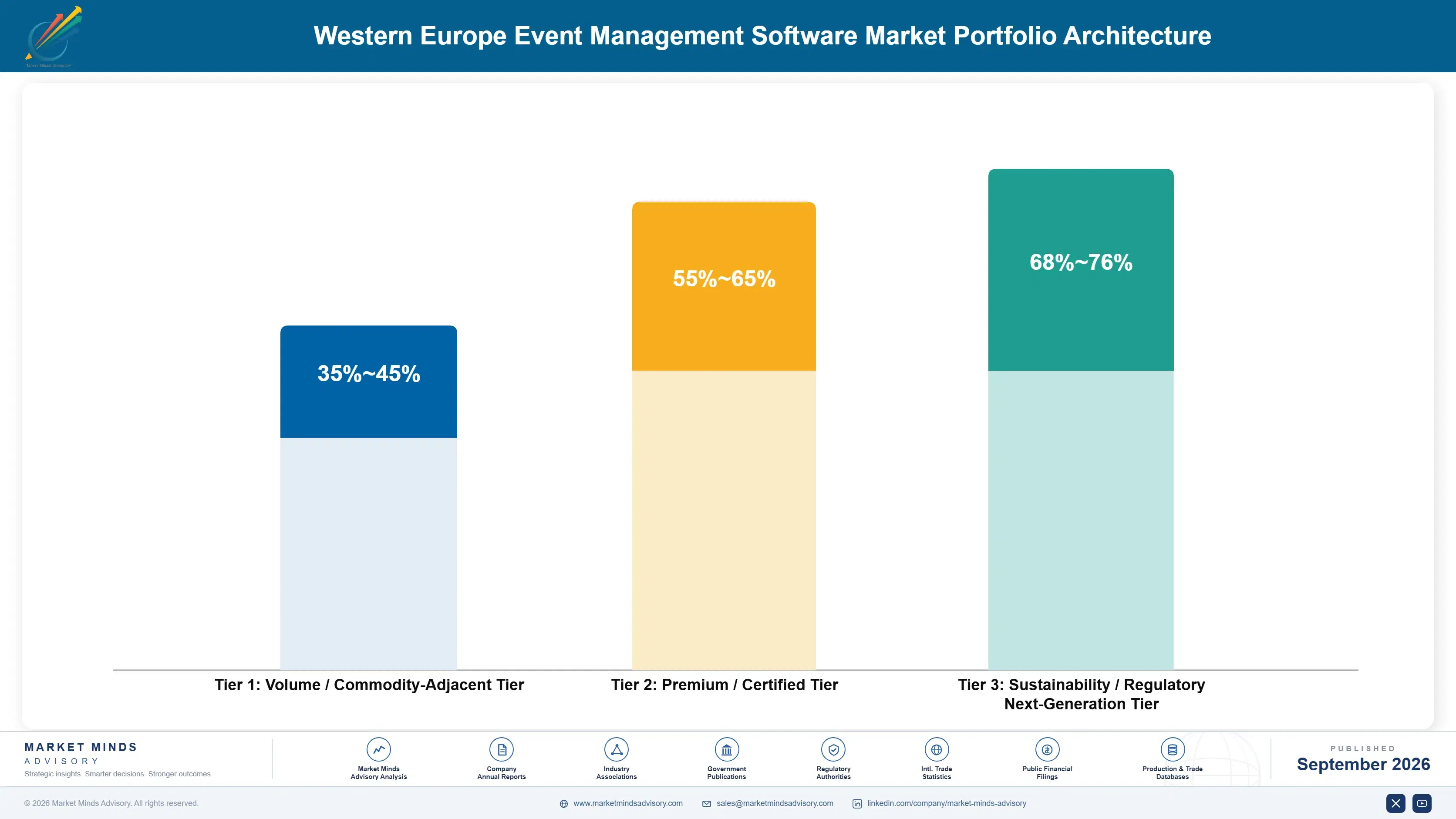
The portfolio splits into three tiers running from commodity-adjacent self-serve ticketing tools through certified enterprise platforms to next-generation AI-driven analytics suites, with gross margin widening meaningfully at each step up as software content replaces manual account service. This layered structure closely mirrors how enterprise software margins generally scale with account complexity and service depth. Buyers moving up a tier rarely move back down once they.
Volume tier products compete almost entirely on price and ease of self-service setup, while premium enterprise contracts command materially higher margin because they bundle dedicated account management, compliance certification, and custom integration work that smaller organisers neither need nor can afford. Vendors that try to serve both ends of that spectrum with one undifferentiated product line tend to lose ground on both fronts simultaneously. Vendors report that customers.

The highest-value margin pools concentrate in the next-generation tier, where AI matchmaking and predictive analytics modules carry premium pricing that customers accept precisely because measurable return on investment is now a renewal requirement rather than a nice-to-have feature. Vendors are therefore prioritising investment in that tier even where near-term revenue contribution still remains comparatively modest. Investment dollars are following that concentration closely across the industry.

Volume / Commodity-Adjacent Tier

Self-serve ticketing and basic registration tools sold mainly on price to small organisers and community events. These tools typically lack dedicated account management and rely entirely on self-service onboarding flows for new customers.
Gross Margin: 35-45%

Premium / Certified Tier

Enterprise platforms bundling registration, marketing, and analytics with dedicated account management and compliance certification. Customers at this tier typically renew for multiple consecutive years once fully onboarded onto the platform.
Gross Margin: 55-65%

Sustainability / Regulatory / Next-Generation Tier

AI-driven matchmaking, predictive analytics, and EU-hosted compliance-first platforms commanding the highest per-seat pricing. Pricing here reflects genuine differentiation rather than incremental feature additions layered onto the base product. Pricing reflects this genuine differentiation across the next-generation tier.
Gross Margin: 68-76%
event-management-software-industry-analysis-in-wes-portfolio-architecture-1790000371255

High-value Sub-segments and Strategic Watch-out

AI Matchmaking and Predictive Analytics

Highest growth and highest margin pool in the market, driven by enterprise customers demanding attributable sponsor return on every gathering they fund each year. Vendors investing heavily here today are positioning for the largest share of long-term margin expansion across the entire portfolio, already visible in headcount allocation.
Gross Margin: 70-78%

EU-Hosted Compliance Platforms

High-value segment growing more moderately as GDPR enforcement tightens, favouring vendors who already invested in regional data centre infrastructure ahead of competitors. Continued regulatory tightening across the bloc should keep steadily reinforcing this segment's relative commercial importance for years to come. Vendors without an existing regional hosting footprint.
Gross Margin: 60-68%

Standard Registration and Ticketing

The volume core of the market, growing near the overall market average as most new demand comes from mid-sized organisers digitising for the first time. Most vendor revenue still originates here even as faster-growing premium tiers increasingly attract the bulk of new investment dollars across the entire portfolio.
Gross Margin: 38-48%

Standalone Legacy On-Premise Tools

A shrinking segment vendors should watch closely, as remaining customers delay migration to cloud platforms but represent thinning renewal revenue with rising support cost per account. Vendors ignoring this shrinking segment risk losing renewal revenue faster than expected as remaining customers finally migrate away. Support cost per remaining account.
Gross Margin: 20-28%

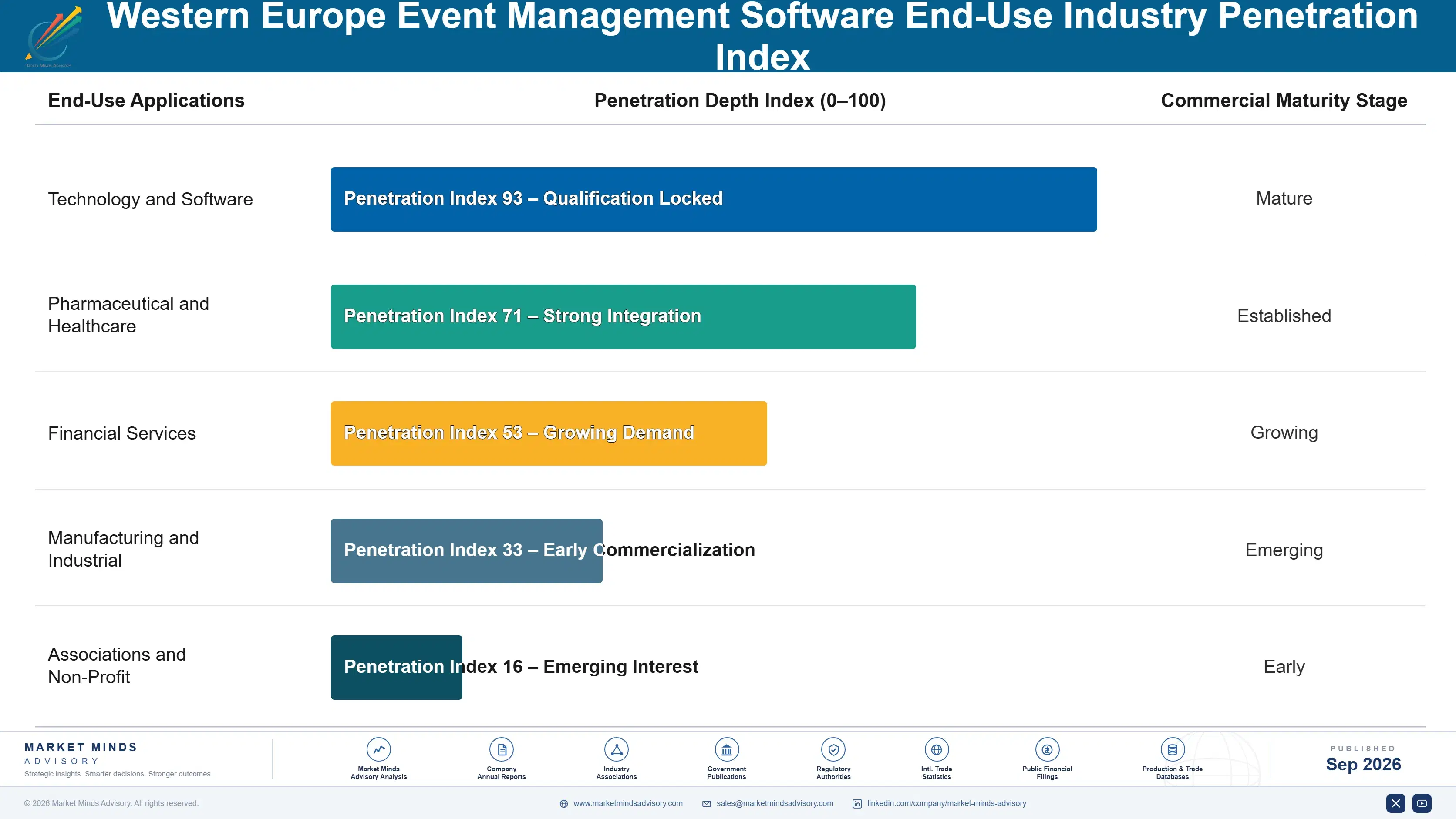
Why Vendors Rarely Lose an Account

Enterprise contracts in this market behave like an annuity once signed. Renewal rates above 90 percent reflect the operational cost of migrating years of historical attendee data, integrations, and staff training to a competing platform, a switching cost that grows heavier with every additional year a customer stays on the same system and accumulates more historical event data inside it that would otherwise need re-entering by hand.
Adoption runs deepest among technology and pharmaceutical conference organisers, who run the largest number of annual events and therefore extract the most value from centralised analytics across every gathering they host. Smaller associations running a single flagship event yearly adopt more slowly and often stay on lighter, cheaper tiers for years before ever upgrading to the full enterprise suite of modules that larger customers use by default.

A generational shift in buyer profile is underway as marketing operations specialists, rather than traditional event planners, increasingly control the purchasing decision inside large corporate accounts. These buyers favour vendors who can prove integration with existing customer relationship management and marketing automation systems over vendors who compete purely on event-day logistics experience alone, a preference reshaping vendor product roadmaps.
event-management-software-industry-analysis-in-wes-end-use-penetration-index-1790000371750

What Determines Who Wins This Market

These are among the four positions where our research anticipates prominent divergence between winners and laggards over the coming forecast period. Each is grounded in the demand model, the regulatory perimeter, and the announced capacity pipeline.
01 / EU HOSTING INVESTMENT

Regional data infrastructure is becoming a contract prerequisite, not a differentiator

Vendors without European Union hosting capacity are increasingly excluded from enterprise procurement shortlists before pricing discussions even begin, since large corporate customers now write data residency requirements directly into their request for proposal documents. This has turned what was once a technical implementation detail into a genuine gating factor for winning the largest contracts in the market. Vendors that delay this investment risk losing renewal negotiations to competitors who can simply point to an existing Frankfurt or Amsterdam facility as proof of compliance readiness.
02 / ANALYTICS BUNDLING STRATEGY

Regional data infrastructure is now a contract prerequisite

Vendors without European Union hosting capacity are increasingly excluded from enterprise procurement shortlists before pricing discussions even begin, since large corporate customers now write data residency requirements directly into their request for proposal documents. This has turned what was once a technical implementation detail into a genuine gating factor for winning the largest contracts in the market. Vendors that delay this investment risk losing renewal negotiations to competitors who can simply point to an existing Frankfurt or Amsterdam facility as proof of compliance readiness.
03 / VERTICAL SPECIALISATION RISK

Generalist platforms face a genuine threat from deep vertical-specific entrants

Customers increasingly expect engagement analytics bundled into the base contract rather than sold as a separate module, and vendors resisting that bundling are losing renewal conversations to competitors willing to include it as standard. The vendors gaining share fastest treat analytics as table stakes and instead monetise through mobile applications, lead retrieval hardware, and content extension services layered carefully on top of the core offering. That sequencing keeps the core contract price competitive while still growing total account value meaningfully every single year across the enterprise customer base.
04 / NATIONAL COMPLIANCE CONSOLIDATION

Acquiring local specialists remains the fastest route into a new national market

Purpose-built tools for pharmaceutical congresses or automotive trade fairs are winning contracts against generalist platforms precisely where compliance and workflow requirements run deepest, since specialist vendors can match narrow regulatory and logistics needs more precisely than a broad platform built for every industry at once. Generalist leaders that fail to develop comparable vertical-specific workflows risk losing their largest, most defensible accounts to smaller, sharper competitors. That erosion would likely accelerate over the coming renewal cycles even while overall market share in less specialised segments holds steady.

Engagement Snapshot From the Field

A live engagement with an industry participant carrying material or product regulatory and market exposure ahead of a defining policy shift, showing how our research translates into a defensible multi-year portfolio strategy.
MARKET MINDS ADVISORY · CLIENT ENGAGEMENT SUMMARY
Western Europe Event Management Software Producer Strategic Portfolio Review and Transition Roadmap 2026·Investment Scenario on Western Europe Event Management Software Exposure Evaluation 2025-26
CLIENT PROFILE
The client, a pan-European technology industry association running roughly a dozen annual conferences across four countries, had accumulated five separate regional registration tools over a decade of organic country-by-country growth. Annual software licensing spend across the fragmented toolset had reached approximately 1.8 million euros (client-reported, unverified by MMA), with no centralised view of attendee data across events or countries.
STRATEGIC CHALLENGE
Sponsors funding the association's flagship conferences were demanding a single consolidated engagement report across all events rather than five disconnected exports, and the association's leadership could not confidently answer which national events delivered the strongest sponsor return on investment. Migrating five country teams onto a single platform risked disrupting registration for events already scheduled within the following two quarters.
MMA APPROACH
MMA benchmarked all five incumbent vendors against enterprise alternatives on total cost of ownership, GDPR hosting compliance, and analytics depth, then modelled a phased country-by-country migration sequence that avoided disrupting any event within its final ninety days of active registration. The analysis prioritised vendors already hosting data inside the European Union to eliminate compliance risk as a factor in the final selection.
KEY FINDINGS
  1. Consolidating five national tools onto one enterprise platform could cut total licensing spend by roughly 22 percent within two years., giving the association a stronger negotiating position with its largest sponsors.
  2. Only two of five incumbent vendors met the association's GDPR data residency requirements without additional infrastructure investment., requiring targeted infrastructure investment before those two vendors could even be shortlisted.
  3. Sponsor renewal conversations across three flagship events referenced the lack of consolidated analytics as a specific concern. during renewal discussions with the association's leadership team directly.
  4. Migration risk concentrated almost entirely in the ninety days immediately preceding each country's next scheduled flagship event., requiring careful sequencing across the full migration programme.
CLIENT PROFILE
The client, a pan-European technology industry association running roughly a dozen annual conferences across four countries, had accumulated five separate regional registration tools over a decade of organic country-by-country growth. Annual software licensing spend across the fragmented toolset had reached approximately 1.8 million euros (client-reported, unverified by MMA), with no centralised view of attendee data across events or countries.
STRATEGIC CHALLENGE
Sponsors funding the association's flagship conferences were demanding a single consolidated engagement report across all events rather than five disconnected exports, and the association's leadership could not confidently answer which national events delivered the strongest sponsor return on investment. Migrating five country teams onto a single platform risked disrupting registration for events already scheduled within the following two quarters.
MMA APPROACH
MMA benchmarked all five incumbent vendors against enterprise alternatives on total cost of ownership, GDPR hosting compliance, and analytics depth, then modelled a phased country-by-country migration sequence that avoided disrupting any event within its final ninety days of active registration. The analysis prioritised vendors already hosting data inside the European Union to eliminate compliance risk as a factor in the final selection.
KEY FINDINGS
  1. Consolidating five national tools onto one enterprise platform could cut total licensing spend by roughly 22 percent within two years., giving the association a stronger negotiating position with its largest sponsors.
  2. Only two of five incumbent vendors met the association's GDPR data residency requirements without additional infrastructure investment., requiring targeted infrastructure investment before those two vendors could even be shortlisted.
  3. Sponsor renewal conversations across three flagship events referenced the lack of consolidated analytics as a specific concern. during renewal discussions with the association's leadership team directly.
  4. Migration risk concentrated almost entirely in the ninety days immediately preceding each country's next scheduled flagship event., requiring careful sequencing across the full migration programme.
RECOMMENDED STRATEGY
Phase 1: Phase 1 (Months 1 to 3): Select a single EU-hosted enterprise vendor and migrate the two smallest national events first. Phase 2: Phase 2 (Months 4 to 9): Migrate the remaining three national events sequentially outside their respective ninety-day pre-event windows., coordinating closely with each country's local marketing team throughout. Phase 3: Phase 3 (Months 10 to 12): Consolidate analytics reporting and renegotiate sponsor packages using unified cross-country engagement data., then documenting the full playbook for future country expansions.
OUTCOME
The association completed migration across all five countries without disrupting registration for any scheduled event, and consolidated licensing spend fell close to MMA's original estimate within the first full year (client-reported, unverified by MMA). Sponsor renewal conversations for the following cycle referenced the new consolidated reporting directly.

Frequently Asked Questions

Foundational context covering the market sizes, CAGR, scope, country, region and competition that inform every finding below. This section is provided to cover basics and most often pre-purchase conversations, answered from the MMA Primary Research Dataset.

What is the current size of the Western Europe Event Management Software Market?

The global market was valued at 2.9 billion dollars in 2025. Western Europe represents the largest single regional share at 26 percent of that total.

How large will the Western Europe Event Management Software Market be by 2036?

The global market is projected to reach 7.868 billion dollars by 2036, up from 3.175 billion dollars in 2026. That represents a 2.48x expansion over the forecast decade.

What is the CAGR for the Western Europe Event Management Software Market 2026 to 2036?

The market is forecast to grow at a 9.5 percent compound annual rate globally, with Western Europe itself growing closer to 8.5 percent given its more mature adoption base.

Which segment is growing fastest?

Virtual and hybrid event platforms lead all segments at a 12.5 percent CAGR, roughly 1.32 times the overall market rate, as organisers extend physical gatherings into always-on digital content.

Who are the major companies in the Western Europe Event Management Software Market?

Cvent, Eventbrite, Bizzabo, Swapcard, and RingCentral Events together hold the largest share, with CR5 concentration near 34 percent across the global market and rising steadily as consolidation continues among smaller national vendors.

Which country is growing fastest?

Germany leads growth within Western Europe at a 10.5 percent CAGR, driven by its dense industrial trade fair calendar and early enterprise adoption of analytics modules.

Report Segmentation Architecture

The full report scope spans multiple orthogonal segmentation dimensions, with cross-tabulated demand data provided for each dimension pair. Coverage extends further to regional breakdowns, trend trajectories, and the competitive detail needed to support segment-level decision-making.

By Primary Market Dimension

  • Registration and Ticketing Software
  • Event Marketing and Promotion Software
  • On-site Check-in and Badging Software
  • Virtual and Hybrid Event Platforms
  • Event Analytics and ROI Measurement Software
  • Venue and Space Management Software

By End-Use Industry

  • Technology and Software
  • Pharmaceutical and Healthcare
  • Financial Services
  • Manufacturing and Industrial
  • Associations and Non-Profit

By Commercial Dimension

  • Enterprise Corporate Buyers
  • Associations and Professional Bodies
  • Independent Event Organisers
  • Venue Operators

By Region

  • North America
  • Western Europe
  • East Asia
  • South Asia and Pacific
  • Latin America
  • Middle East and Africa
  • Eastern Europe

Scope, Methodology, and Coverage

Every figure in this report is reproducible from documented input assumptions. The scope below maps the historical period, the forecast horizon, the segmentation dimensions, and the countries covered, alongside the underlying primary and qualitative methodology.
Historical Period
2020 to 2025
Forecast Period
2026 to 2036
Base Year
2025 (USD billions; MMA Primary Research Dataset, September 2026)
Market Definition
This market covers software platforms used to plan, promote, register attendees for, and analyse corporate conferences, trade shows, and association congresses. It excludes physical venue rental, catering, and audiovisual equipment hire, which fall under separate service categories.
Quantitative Units
USD billions (current prices); regional and segment CAGR in percent
Segmentation Dimensions
By Primary Market Dimension; By End-Use Industry; By Commercial Dimension; By Region
Regions Covered
North America, Western Europe, East Asia, South Asia and Pacific, Latin America, Middle East and Africa, Eastern Europe
Countries Covered
USA, China, Germany, France, UK, Japan, South Korea, India, Australia, Canada, Brazil, Mexico, Indonesia, Vietnam, Thailand, Malaysia, UAE, Saudi Arabia, South Africa, Nigeria, Turkey, Poland, Netherlands, Italy, Spain, Sweden, Switzerland, Argentina, Colombia, Singapore, and additional markets relevant to this sector
Key Companies Profiled
Cvent Inc, Eventbrite Inc, Bizzabo Ltd, Swapcard SAS, RingCentral Events Inc, Whova Inc, Certain Inc, EventMobi Inc, SplashThat Inc, Boomset Inc, EventsAIR Pty Ltd, GEVME Pte Ltd, InEvent Inc, Vfairs Inc, 6Connex Inc, Accelevents Inc, Brella Ltd, Ticket Tailor Ltd, Attendease Inc, Grenadine Technologies Inc
Quantitative Methodology
Primary survey, n=3,800 respondents, Q4 2025, six countries; demand-side model with trade association cross-validation
Qualitative Methodology
47 expert interviews, Q4 2025; applied to validate demand model assumptions, identify emerging dynamics, and assess competitive positioning
Report Format
PDF and XLSX data workbook (Word format preview document)
Publisher
Market Minds Advisory
Report Code
MMA-2026-TEC-622
Published
September 2026
Contact
sales@marketmindsadvisory.com | www.marketmindsadvisory.com

Purchase the full Western Europe Event Management Software Market Report (2026 to 2036).

The full report delivers a complete quantitative and qualitative assessment of the Western Europe Event Management Software Market across all seven regions and six product segments. It includes detailed vendor profiles for all twenty companies covered, alongside country-level sizing for thirty markets. Primary research draws on thirty-eight hundred survey respondents and forty-seven expert interviews conducted in the fourth quarter of 2025 across six countries. Buyers receive full editable data tables alongside the complete narrative analysis, competitive vendor scorecards, and forward-looking scenario modelling included in every single purchase.
Twenty vendor profiles with moat and risk analysis
Seven-region market sizing with country-level breakdowns included
Six-segment MECE framework with growth rates
Primary survey data across six countries
Forty-seven expert interview insights fully included
Editable data tables for all forecast figures

Built For The People Who Decide

From boardroom strategy to bench-side execution, this report is read cover-to-cover by leaders shaping the next decade of their industry, turning demand scenarios, market dynamics and valuation benchmarks into decisions.
CXOs/ Presidents/ VPs/ Managers
M&A and Corporate Development
Strategy Teams and R&D Heads
Procurement and Product Directors
Regulatory and Compliance Leaders
Investor Relations and Equity Analysts