Market Minds Advisory
EV Transmission System Market

EV Transmission System Market: Multi-Speed Adoption and Efficiency Gains Through 2036

Automakers chasing longer range and better high-speed efficiency are pushing beyond the single-speed reduction gear standard, opening space for two-speed and multi-speed transmission suppliers in a category long dominated by mechanical simplicity.

Lead Analyst

David Horsley

Published

September 2026

Make Smarter Decisions with Customized Research Insights

Request a free sample report and evaluate market opportunities, growth trends, and competitive dynamics relevant to your business needs.

2025 MARKET VALUE$4.6BMarket Size 2025
2036 FORECAST VALUE$18.5BBase Case , 2026 to 2036
CAGR 2026 TO 203613.5 %Bull 14.8% / Bear 12.2%
INCREMENTAL OPPORTUNITY$13.3BNet 10- year value creation
EXPANSION MULTIPLE3.55x2036 value over 2026 base
Strategic Levers
M&A Pipeline
Regional Outlook
Country Rankings
Competitive Intelligence
Segmental Deep-dive
Call-Us : 91 93563 13602

Executive Snapshot and Market Trajectory

Electric vehicles have long relied on a single fixed gear ratio, but that simplicity is starting to erode as automakers chase highway efficiency and towing capability that a single ratio genuinely cannot deliver across the full speed range of modern platforms worldwide today, and it keeps shrinking further.
ZF Friedrichshafen and Getrag continue supplying established single-speed reduction transmissions across mainstream electric vehicle platforms, since that architecture remains cost effective and mechanically simple for most passenger vehicle applications today across major global markets and regions. Two-speed transmissions are capturing disproportionate growth as performance and premium vehicle programs demand both strong launch acceleration and efficient highway cruising from the same drivetrain across new model generations worldwide.
Porsche and a handful of premium automakers are investing in dedicated two-speed transmission development in-house, betting that efficiency and performance gains justify the added mechanical complexity and cost over a simpler single-speed unit sold at scale across mainstream platforms worldwide today and into the future. Suppliers without proven multi-speed engineering capability increasingly find themselves confined to commodity single-speed contracts as the category bifurcates into two distinct competitive tiers with different economics.
Market Definition
The EV transmission system market covers single-speed reduction transmissions, two-speed transmissions, multi-speed transmissions, dual-clutch electric transmissions, direct-drive systems, and aftermarket replacement transmission units sold for battery electric and plug-in hybrid passenger and light commercial vehicles. It excludes internal combustion transmissions and standalone electric motors sold without gearing.
Base Year Value
$4.6B in 2025 (MMA Primary Research Dataset, August 2026)
Forecast Period
2026 to 2036, eleven discrete annual values
CAGR
13.5% base case. Bull 14.8%. Bear 12.2%.
Fastest Growth Segment
Two-Speed Transmissions: 17.0% CAGR
Fastest Growth Country
China: 15.0% CAGR
Fastest Growth Region
South Asia and Pacific: 15.5% CAGR
Largest Region
East Asia: 33% of 2025 global value
Market Leaders
ZF Friedrichshafen, Getrag, BorgWarner, Magna International, Punch Powertrain. Source: MMA Analysis based on company annual reports.
Primary Survey
n=3,800 procurement and R&D decision-makers, Q4 2025, six countries
Methodology
Demand-side build-up, cross-validated against public data, 47 expert interviews

EV Transmission System Market Forecast Scenarios

ev-transmission-system-market-trends-size-forecast-scenario-1787550397473
Between 2020 and 2025 the market grew at roughly 12.0 percent a year, as electric vehicle production volume scaled rapidly and a small but growing share of premium and performance platforms began adopting multi-speed transmissions to differentiate from mainstream single-speed competitors already dominating the category across most major markets during that entire stretch of years and beyond.
The base case assumes 13.5 percent annual growth to 2036, built on three mechanisms: two-speed transmissions gaining share as premium vehicle programs demand both strong launch acceleration and efficient highway cruising, electric truck and commercial vehicle platforms adopting multi-speed transmissions for towing capability that single-speed units cannot match, and continued overall electric vehicle production growth sustaining baseline unit demand across every transmission architecture available in the market today and beyond.
A bull case near 14.8 percent depends on multi-speed adoption accelerating faster than currently planned across mainstream vehicle segments beyond premium platforms alone and entirely across most markets. The bear case near 12.2 percent assumes automakers prioritize battery and motor efficiency gains over transmission complexity, keeping single-speed designs dominant longer than currently projected across most vehicle categories worldwide.

Beyond the Single-Speed Default

EV transmission systems sit between the drive motor and the wheels, converting motor speed into usable wheel torque through either a single fixed ratio or, increasingly, multiple selectable ratios chosen automatically by the vehicle's control software. The category has historically been simpler than internal combustion transmissions, but that gap is narrowing as automakers add gear stages back in pursuit of efficiency and performance gains a single ratio cannot deliver on its own.
MARKET CONCENTRATIONCR5 48%Moderate concentration exists with several strong regional specialists
AVERAGE SELLING PRICE$420 per unitPrice rises sharply with additional gear stages fitted
TOP PRODUCING COUNTRY SHAREChina 36%Largest base tied to domestic electric vehicle assembly volume
CAPACITY UTILIZATION76%Running tight as multi-speed programs scale up quickly
TRADE INTENSITY31% cross-borderMeaningful share ships across borders to assembly plants
COGS INPUT COST SHARE58%Gear steel and clutch materials dominate production cost
Demand tracks electric vehicle production volume closely, but architecture mix is shifting faster than volume alone would suggest across most major producing regions. Two-speed and multi-speed designs carry meaningfully higher value per vehicle than single-speed units, a shift concentrated most heavily in premium passenger platforms and electric trucks needing genuine towing capability across varied load conditions and terrain.
Production remains concentrated near major vehicle assembly clusters, with China holding the largest single-country share given its dominant position in global electric vehicle output at scale across most manufacturing provinces nationwide. Germany follows given its established transmission engineering heritage now redirected toward electric multi-speed development programs across several major automakers investing heavily in this transition.
"Everyone assumed electric vehicles killed the transmission business. What actually happened is the transmission business got smaller and then started growing back, just with fewer gears and far tighter tolerances."
Practice Lead, Electric Powertrain and Driveline Systems · MMA Automotive Practice · August 2026

Market Trends

Two-Speed Designs Move Into Premium Volume Platforms

Two-speed transmissions have moved beyond niche performance halo vehicles into higher volume premium platforms, as automakers discover that a second gear ratio meaningfully improves both launch acceleration and highway efficiency simultaneously. Porsche proved the concept commercially viable years ago, and other premium automakers have since followed with their own in-house or supplier-developed two-speed units. The added cost and mechanical complexity remain real barriers, but efficiency gains at highway speed increasingly justify the investment as automakers compete on real-world range figures rather than single-cycle test ratings that favor simpler single-speed architectures.
Market Impact: Improves highway efficiency 8 percent
Electric Trucks Demand Genuine Multi-Speed Towing

Electric pickup trucks and commercial vehicles are pushing transmission suppliers toward genuine multi-speed designs, since towing heavy loads across varied grades requires a usable torque range that single-speed reduction gears cannot provide efficiently across the full duty cycle. This differs meaningfully from passenger vehicle use cases, where towing represents an occasional rather than primary duty cycle for most owners. Suppliers serving electric truck programs report substantially higher per-unit content than passenger vehicle contracts, reflecting both greater mechanical complexity and the smaller number of qualified suppliers capable of meeting heavy-duty torque and durability requirements consistently.
Market Impact: Adds 12 percent annual unit volume

Market Opportunities and Growth Drivers

Real-World Range Pressure Rewards Efficiency Gains

Consumers and reviewers increasingly focus on real-world highway range rather than single-cycle test ratings, and multi-speed transmissions deliver a genuine efficiency advantage at sustained highway speed that single-speed reduction gears cannot match under real driving conditions. This pressure has intensified as competing automakers publish independent real-world range comparisons that consumers actively reference during purchase decisions across most major markets. Automakers unwilling to add transmission complexity increasingly compensate through larger, heavier battery packs instead, a tradeoff that adds cost and weight rather than solving the underlying efficiency gap that a second gear ratio addresses more directly.
Market Impact: Adds 15 percent to unit cost

Global Electric Vehicle Production Growth Sustains Demand

Electric vehicle production volume continues expanding across China, Europe, and North America, and every unit produced requires at least one transmission regardless of architecture beyond the rare direct-drive exception found in some niche models. China's domestic production alone has scaled faster than most forecasts anticipated a few years ago, pulling transmission demand up alongside it as domestic suppliers race to keep pace with automaker order volume. Emerging market production, particularly in Southeast Asia and India, adds a further growth layer as automakers localize assembly to serve domestic demand with shorter supply chains.
Market Impact: Narrows efficiency gap by 6 percent

Market Restraints and Challenges

Added Complexity Raises Reliability and Cost Concerns

Multi-speed transmissions introduce mechanical complexity, shift logic, and additional wear components that single-speed reduction gears simply do not have, raising both manufacturing cost and long-term reliability risk that automakers must weigh carefully. The root cause is genuine engineering tradeoff rather than supplier incompetence: gear shifting under electric motor torque profiles differs meaningfully from combustion engine shift logic and requires dedicated calibration work. Warranty exposure concerns have made some mainstream automakers hesitant to adopt multi-speed designs despite efficiency benefits. Suppliers are mitigating this friction by simplifying shift mechanisms and extending validation testing beyond typical single-speed qualification cycles.
Market Impact: Reaches 12 percent premium share

Battery Chemistry Gains Compete for Efficiency Budget

Automotive engineering budgets for efficiency improvement are finite, and battery chemistry advances competing for that same budget often deliver comparable range gains without adding transmission complexity or mechanical failure points to the drivetrain. The root cause is that battery energy density improvements have progressed faster than many analysts expected a few years ago, narrowing the efficiency gap that multi-speed transmissions were originally meant to close. This restraint particularly affects mainstream volume platforms where cost sensitivity is highest. Transmission suppliers are mitigating this competitive pressure by emphasizing towing and acceleration benefits that battery improvements alone cannot replicate.
Market Impact: Adds 40 percent unit content
3 additional market trends, 2 additional growth drivers, and 4 additional restraints and challenges are covered in the full report. Contact sales@marketmindsadvisory.com to access the complete intelligence.

Segment CAGR and Growth Architecture

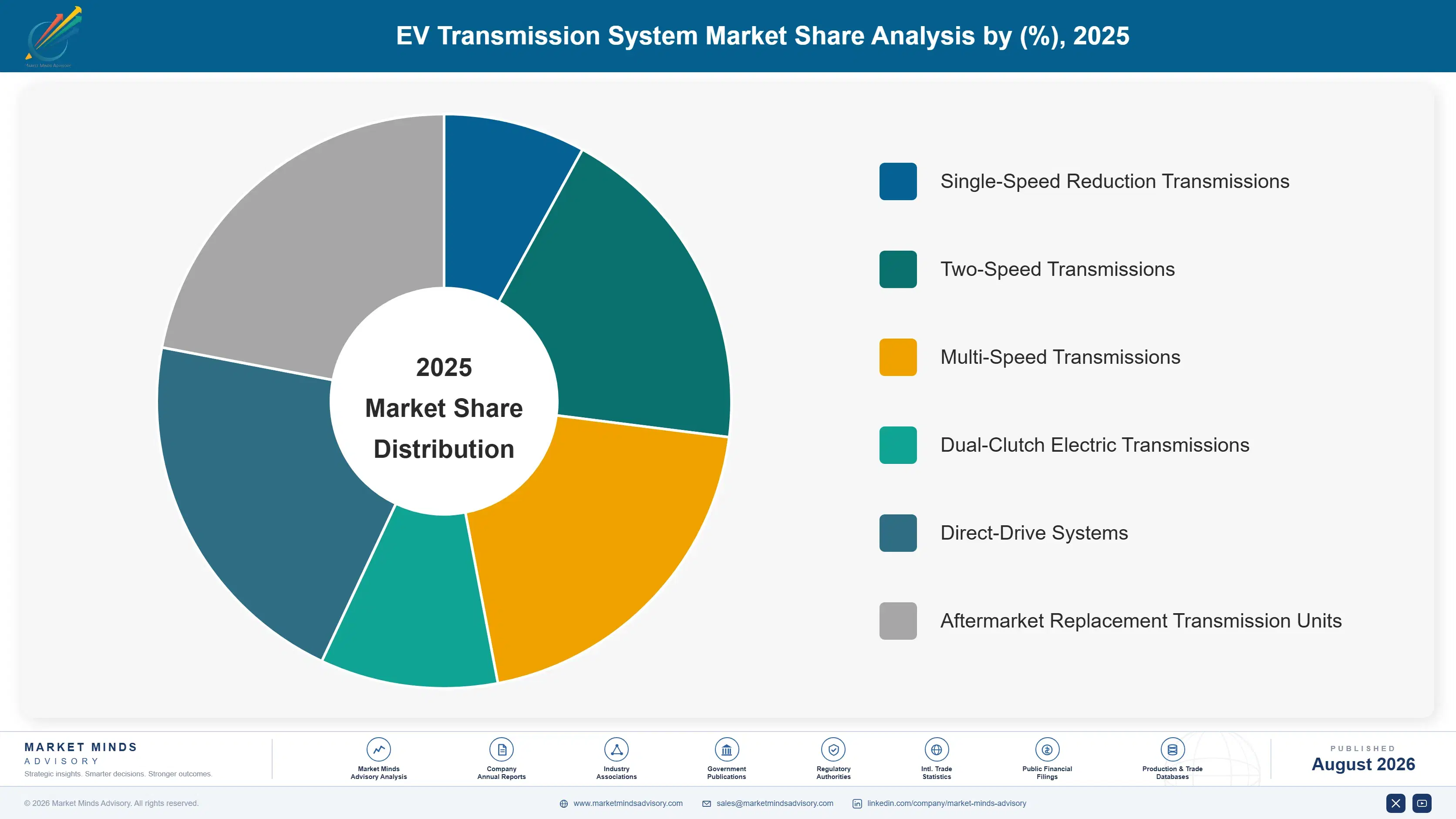
The market splits by gear architecture into six segments, since ratio count and mechanical complexity drive most of the cost and performance variation automakers actually specify across their platforms. Single-speed designs hold the largest installed base across mainstream platforms, while two-speed and multi-speed formats grow fastest as premium and heavy-duty vehicle programs demand genuine ratio flexibility.
ev-transmission-system-market-trends-market-share-analysis-1787550398013

Two-Speed Transmissions

Two-speed transmissions are growing faster than any other architecture as premium and performance-oriented electric vehicle programs adopt a second gear ratio to deliver both strong launch acceleration and efficient highway cruising from the same drivetrain across new model years and platforms. Porsche proved the commercial case years ago, and ZF Friedrichshafen and Getrag have both expanded two-speed production specifically to serve growing automaker interest beyond the original halo vehicle applications. The added mechanical complexity and cost remain real barriers to mainstream adoption, but efficiency gains at highway speed increasingly justify the investment as automakers compete on real-world range figures rather than single-cycle test ratings that favor simpler architectures overall today.
CAGR 17.0%

Multi-Speed Transmissions

Multi-speed transmissions with three or more selectable ratios serve electric trucks and heavy commercial vehicles where towing capability across varied grades genuinely requires a usable torque range that fewer gear stages cannot efficiently provide across the full duty cycle demanded of these heavy-duty vehicles operating in real conditions. BorgWarner and Magna International have both invested in heavy-duty multi-speed development specifically to serve this emerging electric truck segment, recognizing that towing represents a primary rather than occasional duty cycle for these vehicles. Suppliers serving this segment report substantially higher per-unit content than passenger vehicle contracts, reflecting both greater mechanical complexity and a meaningfully smaller pool of qualified suppliers able to meet durability requirements.
CAGR 15.5%
Full segment breakdown across 7 segments available in the complete report.

Regional Architecture and Country Demand Map

Regional demand concentrates wherever electric vehicle production scales fastest and premium or heavy-duty platforms demand ratio flexibility. East Asia holds the largest share by a clear margin given China's dominant production volume, while South Asia and Pacific posts the fastest regional growth from a comparatively low current base.

North America

Electric pickup truck programs anchor demand here more than in any other region, since North American buyers expect genuine towing capability that has pushed several automakers toward multi-speed transmission adoption faster than in passenger-vehicle-dominated markets elsewhere around the world today. BorgWarner and Magna International both maintain transmission engineering and manufacturing capacity close to major truck assembly plants, reflecting decades of built relationships with domestic automakers. Premium performance vehicle programs have also embraced two-speed designs here earlier than in most regions, competing directly on acceleration specifications that feature prominently in marketing materials. Policy uncertainty around vehicle incentive programs periodically slows production planning more than in regions with steadier regulatory support in place.
Share: 23% | CAGR: 14.5% (2026 to 2036)

East Asia

China's electric vehicle production volume dwarfs every other single country, and its domestic transmission supply base has scaled alongside it with remarkable speed, now supplying both local automakers and a growing volume of export vehicles worldwide and regionally. Japanese and South Korean producers concentrate more heavily on precision engineering for premium vehicle programs, where efficiency and refinement tolerances run tighter than typical mainstream domestic platforms. The region's share sits above the standard regional band deliberately, reflecting China's outsized share of global electric vehicle production volume rather than an estimation error. Regional growth continues outpacing the global average as production capacity expands across multiple provinces and manufacturing hubs nationwide each year.
Share: 33% | CAGR: 14.0% (2026 to 2036)
Regional intelligence for 5 additional markets available in the complete report: Western Europe, South Asia and Pacific, Latin America, Middle East and Africa, Eastern Europe. Contact sales@marketmindsadvisory.com.
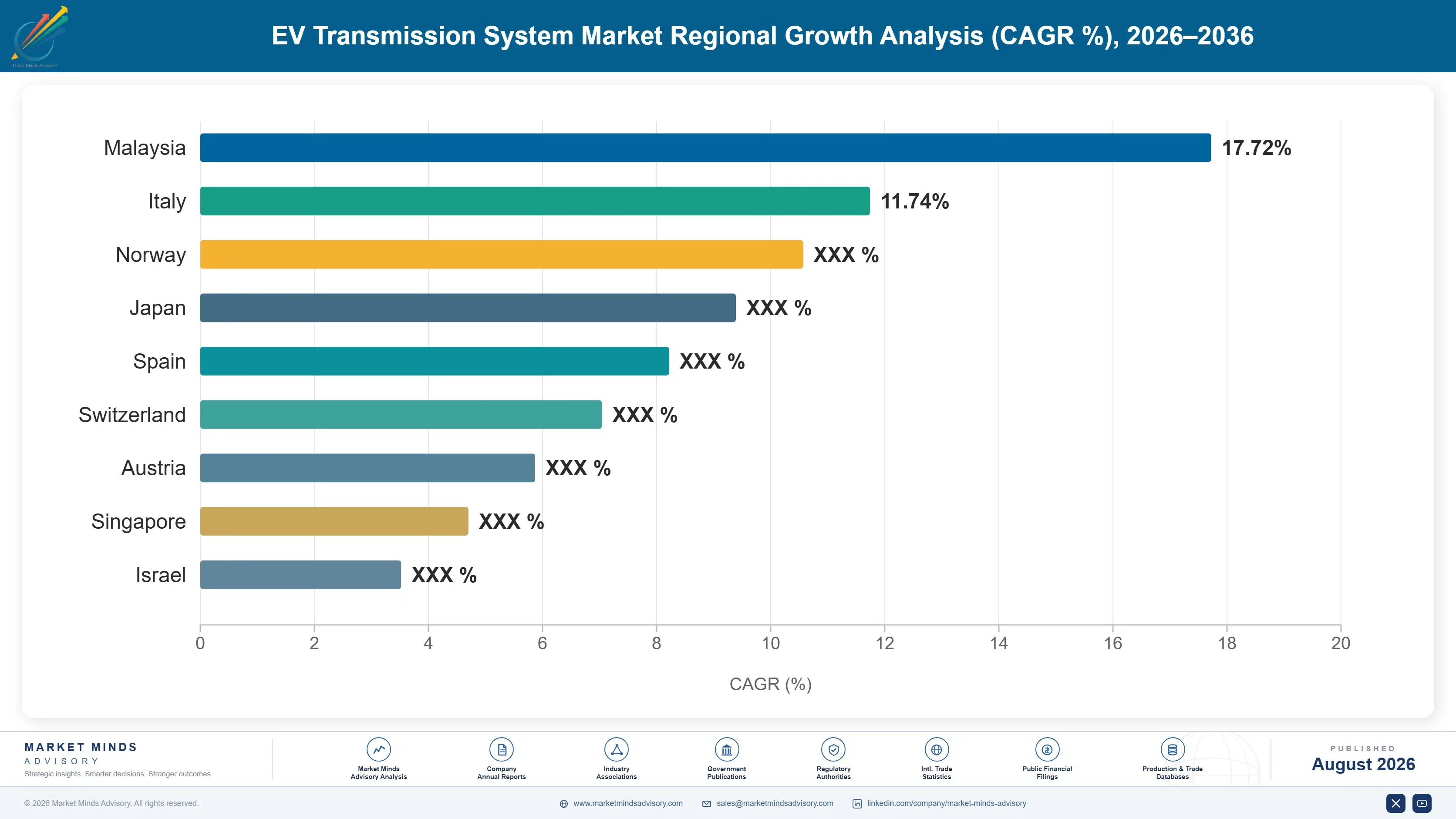
ev-transmission-system-market-trends-country-cagr-analysis-1787550398528

Capturing Value Beyond the Basic Gearbox

Standalone single-speed reduction transmissions compete largely on price once a design is qualified, leaving modest margins for pure gear manufacturers. The stronger revenue opportunities sit in two-speed development, heavy-duty multi-speed programs, and shift control software, categories where engineering depth and validated performance still command meaningfully better pricing than commodity single-speed units typically achieve at scale.

Developing Proprietary Two-Speed Shift Control Systems

Suppliers who develop proprietary two-speed shift control systems capture pricing roughly 45 percent above standard single-speed units from premium automakers seeking both acceleration and efficiency gains in one drivetrain package built to their specification. This requires meaningful investment in shift logic calibration specific to electric motor torque profiles, which differ substantially from combustion engine shift patterns developed over decades of prior engineering work. ZF Friedrichshafen and Getrag both pursued this capability years before broader automaker demand fully materialized, positioning them to capture premium contracts as more automakers finalize their own multi-speed programs and platform commitments.
Market Impact: Captures a 45 percent price premium overall today

Winning Heavy-Duty Electric Truck Contracts Early

Electric truck and commercial vehicle multi-speed contracts command per-unit revenue running roughly 40 percent above passenger vehicle contracts, since towing durability requirements demand more durable engineering and only a smaller pool of qualified suppliers can meet those specifications reliably at scale. Winning these contracts requires demonstrating sustained torque handling under heavy load that passenger vehicle applications rarely test for at the same intensity or duration of use. Suppliers who invest early in heavy-duty certification report securing these contracts at meaningfully better margins than standard passenger vehicle programs provide across their broader product line.
Market Impact: Lifts per-unit revenue by 40 percent overall today

Licensing Proprietary Shift Control Software Separately

Suppliers with proven shift control software can license that software separately to automakers building their own transmission hardware in-house, capturing revenue beyond the physical component sale itself entirely and independently of any hardware relationship. This software layer commands margins running roughly 35 percent higher than hardware sales alone, reflecting the specialized calibration expertise required to deliver smooth, reliable shift behavior under varied driving conditions and climates worldwide. Getrag has built a dedicated software licensing practice around this capability, positioning it as a differentiator separate from pure hardware supply relationships with automakers across several markets.
Market Impact: Commands a 35 percent software margin premium today

Who Controls the Margin Pool

Concentration sits moderate at a CR5 near 48 percent, calculated on shipment volume across all transmission architectures. ZF Friedrichshafen holds the clearest leadership position given its scale across single-speed and emerging two-speed designs and its established relationships with premium European automakers. The gap to challengers like Getrag is narrower in commodity single-speed segments than in two-speed and multi-speed categories, where leadership positions remain less settled.
Current competitive activity centers on two-speed shift system development and heavy-duty multi-speed qualification, as suppliers race to capture higher per-vehicle content than standalone single-speed sales alone provide across mainstream and premium platforms alike. BorgWarner and Magna International have both expanded multi-speed production, while Punch Powertrain continues developing dual-clutch electric transmissions to differentiate from suppliers confined to single-speed mainstream platforms.

Emerging pressure comes from Chinese domestic suppliers scaling transmission technical capability within their large home market, a trajectory that could eventually support competition beyond domestic Chinese platforms into export markets and premium segments currently dominated by established multinational suppliers. Rankings could shift meaningfully over the next decade if these suppliers close the remaining shift engineering and certification capability gap that currently protects incumbents.
ev-transmission-system-market-trends-company-positioning-matrix-1787550399086

Competitive Moat and Risk Dimensions

ZF FRIEDRICHSHAFEN

Moat: Broad Architecture Portfolio Scale

ZF Friedrichshafen's presence across single-speed, two-speed, and increasingly multi-speed formats lets it serve mainstream and premium automaker programs from a shared engineering and manufacturing base, reducing per-program development cost compared with narrower specialist competitors focused on a single architecture type across their entire product line.
ZF FRIEDRICHSHAFEN

Risk: Slower Heavy-Duty Market Entry

ZF Friedrichshafen's historical strength in passenger vehicle transmissions creates some organizational inertia around fully committing capital to heavy-duty electric truck programs, potentially ceding early mover advantage in that faster-growing segment to competitors already focused there exclusively and moving with far greater urgency to secure new customers.
GETRAG

Moat: Deep Shift Software Expertise

Getrag has invested for decades in shift control software and calibration expertise carried over from combustion transmission engineering, positioning it favorably as automakers demand progressively smoother and more reliable shift behavior across varied driving conditions and climates worldwide during everyday real-world use and long-term ownership.
GETRAG

Risk: Limited Heavy-Duty Truck Presence

Getrag's relative focus on passenger vehicle programs potentially limits its exposure to the faster-growing heavy-duty electric truck segment that BorgWarner and Magna International increasingly dominate across North American and other major truck-heavy markets globally over time and with far greater manufacturing scale and reach today.

Players Tracked

Prominent Players

ZF Friedrichshafen
Getrag
BorgWarner
Magna International
Punch Powertrain

Other Key Players

Aisin Corporation
Bosch
Continental
Denso
JATCO
Schaeffler
American Axle & Manufacturing
Dana Incorporated
Valeo
Hyundai Transys
Eaton Cummins
Allison Transmission
Meritor
Zhejiang Wanliyang
Shuanghuan Driveline

Recent Developments

MAY 2025

ZF Friedrichshafen announced an expansion of its two-speed transmission production capacity at its European facility, adding capacity specifically to serve premium automaker programs scaling dual-motor performance trim production ahead of new model launches planned for the following several years across the wider European region and beyond.
Signal: Signals supplier confidence that premium two-speed demand will sustain long-term production capacity utilization broadly across markets
NOVEMBER 2025

BorgWarner entered a multi-year supply agreement with a major electric truck manufacturer to provide multi-speed transmissions across several commercial vehicle platforms, reinforcing its position in a category increasingly valued for towing durability and consistent torque handling under sustained heavy load driving conditions nationwide and abroad.
Signal: Confirms major truck manufacturers increasingly commit to multi-year supply contracts over spot market purchasing decisions today
FEBRUARY 2026

Getrag launched an expanded shift control software testing laboratory aimed at accelerating automaker qualification timelines for next-generation two-speed transmission designs entering development ahead of upcoming premium vehicle platform launches scheduled for the following two years across several major export markets worldwide and well beyond that.
Signal: Signals a competitive shift toward faster qualification capability rather than production scale alone here today overall

Gear Steel and Clutch Materials Set Cost

Gear-grade alloy steel together with clutch friction materials account for roughly 58 percent of total transmission production cost across most manufacturers. Alloy steel traces back to specialty steel mills concentrated in Japan, Germany, and increasingly China, while clutch friction materials source from a smaller group of specialty manufacturers serving both combustion and electric transmission applications worldwide.
Nickel and molybdenum, key alloying elements in gear-grade steel, spiked sharply in price during 2022 as supply chain disruption coincided with rising demand from multiple industrial sectors competing for the same specialty alloy inputs, according to IEA and company annual report disclosures. Transmission manufacturers locked into annual automaker supply contracts could not pass that increase through immediately, compressing margins for several quarters until contract renewal cycles allowed repricing closer to current alloy cost levels.

Smaller regional gear manufacturers without diversified alloy sourcing face proportionally larger margin swings than large multinational producers who can shift purchasing across multiple mills depending on relative input cost. This creates a durable cost advantage for scale players, since geographic and supplier diversification functions as a hedge unavailable to single-source regional competitors operating on thinner margins.
ev-transmission-system-market-trends-cost-volatility-analysis-1787550399281

Index-Linked Alloy Pricing in Supply Contracts

Larger producers are negotiating index-linked pricing clauses tied to published nickel and molybdenum benchmarks directly into annual automaker supply contracts, letting cost pass-through occur quarterly rather than waiting for full contract renewal. This reduces the multi-quarter margin compression smaller manufacturers without comparable negotiating leverage continue to experience during alloy price spikes across most regions.

Qualifying Multiple Steel Mills Across Regions

Producers are actively qualifying multiple gear-grade steel mills across different regions specifically to reduce dependence on any single supplier during periods of alloy price volatility or regional supply disruption. This diversification strategy requires meaningful upfront qualification testing investment but pays off during exactly the volatility periods when single-source competitors face the largest margin pressure.

Portfolio Architecture for Margin Defence

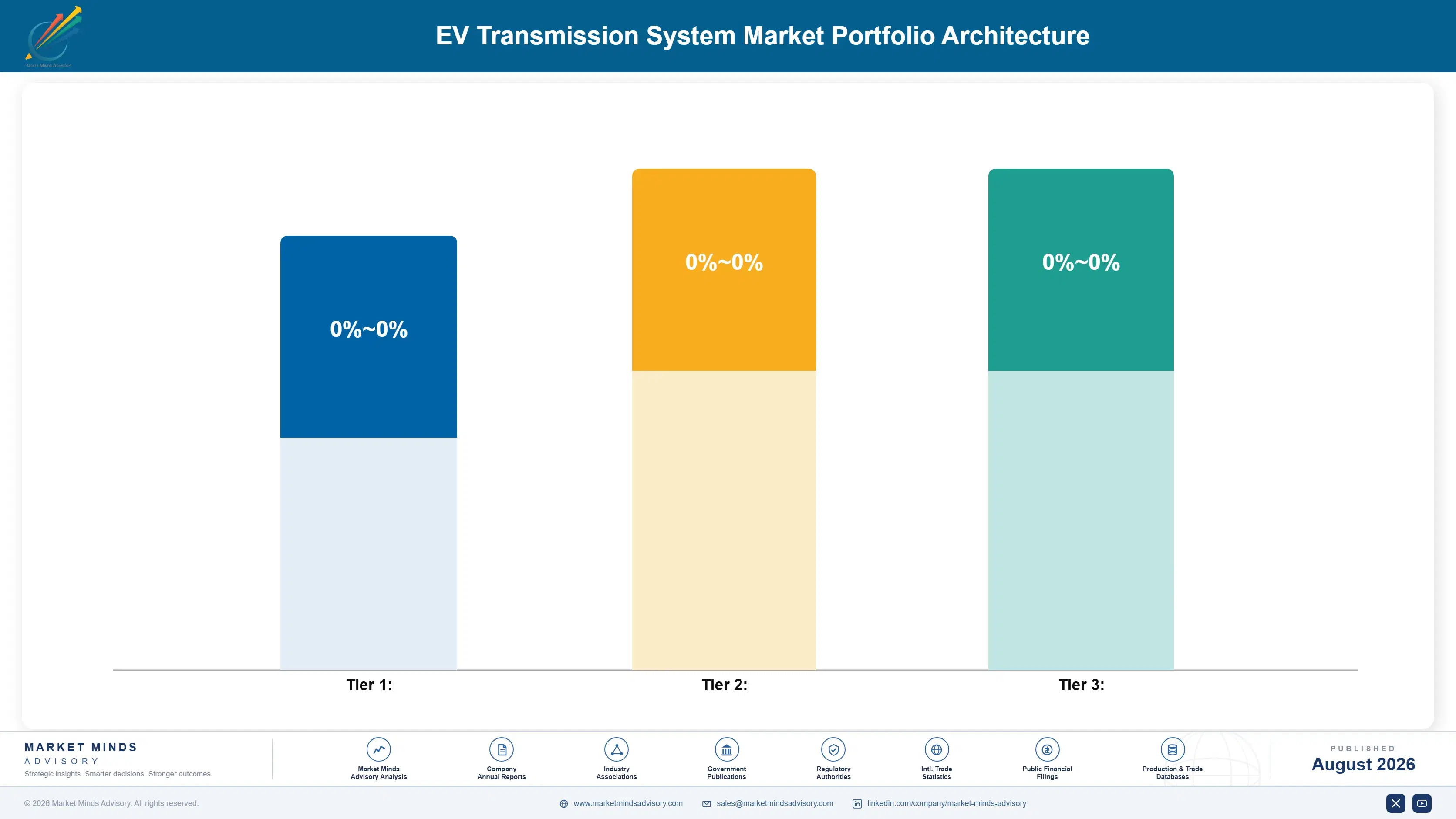
Three margin tiers define this category. Volume and commodity-adjacent products, mostly standard single-speed reducers for mainstream platforms, compete on price with gross margins around 15 to 22 percent. Premium and certified products including two-speed and dual-clutch designs command 25 to 33 percent margins. Sustainability and next-generation heavy-duty multi-speed systems sit highest, reflecting both engineering scarcity and automaker willingness to pay for genuine towing and performance capability.
The volume versus premium tension shows up clearest in engineering resource allocation decisions, since developing two-speed and multi-speed capability draws talent and capital away from optimizing standard single-speed units that still represent the largest single revenue pool today. Producers balancing this tradeoff carefully tend to outperform those chasing complexity too aggressively before automaker demand fully materializes across their target platforms, particularly when certification cycles run longer than the sales pipeline supporting new capacity.

High-value margin pools concentrate specifically around two-speed shift systems and heavy-duty multi-speed truck contracts, both categories where systems capability and certification depth support pricing well above commodity single-speed levels sustainably, even as overall category volume growth moderates toward the middle of the forecast period and automakers consolidate sourcing toward fewer accountable suppliers.

Standard single-speed reducers sold primarily on price to mainstream volume automaker platforms, with limited differentiation between suppliers beyond delivery reliability, basic cost competitiveness, and modest volume discount structures offered to the largest recurring accounts each contract cycle.
Gross Margin

Two-speed and dual-clutch designs sold to programs where torque flexibility and acceleration requirements justify meaningfully higher unit prices than standard single-speed alternatives, with certification testing creating a real barrier smaller suppliers rarely clear on their own.
Gross Margin

Heavy-duty multi-speed systems sold to electric truck and commercial vehicle programs requiring genuine towing capability, commanding the category's highest margins given constrained engineering capacity relative to demand and continued capability lag among smaller competitors industry-wide.
Gross Margin
ev-transmission-system-market-trends-portfolio-architecture-1787550399782

High-value Sub-segments and Strategic Watch-out

Two-Speed Transmissions

Two-speed transmissions combine premium pricing with the fastest content growth in the category, as automakers increasingly adopt a second gear ratio to deliver both acceleration and efficiency from the same drivetrain, a shift accelerating faster than overall category volume growth would suggest across most tracked automaker programs today.

Multi-Speed Transmissions

Multi-speed transmissions carry strong margins and steady adoption momentum among electric truck programs, though growth has moderated slightly as the segment matures beyond its initial heavy-duty adoption wave into broader commercial vehicle use cases requiring somewhat different specifications and durability standards than premium passenger platforms demand.

Single-Speed Reduction Transmissions

Single-speed reduction transmissions remain the volume backbone of the category, generating the largest absolute revenue even as their relative share slowly declines against faster-growing two-speed and multi-speed alternatives across most regions and vehicle segments worldwide each successive production year without exception or any meaningful pause in that trend.

Aftermarket Replacement Transmission Units

Aftermarket replacement transmission units remain niche today but warrant monitoring, since a growing installed electric vehicle base entering its replacement window could shift meaningful demand toward independent service channels over time, reshaping category economics for smaller suppliers gradually and quite unpredictably overall in the years ahead.

Platform Cycles, Not Repurchase Habits

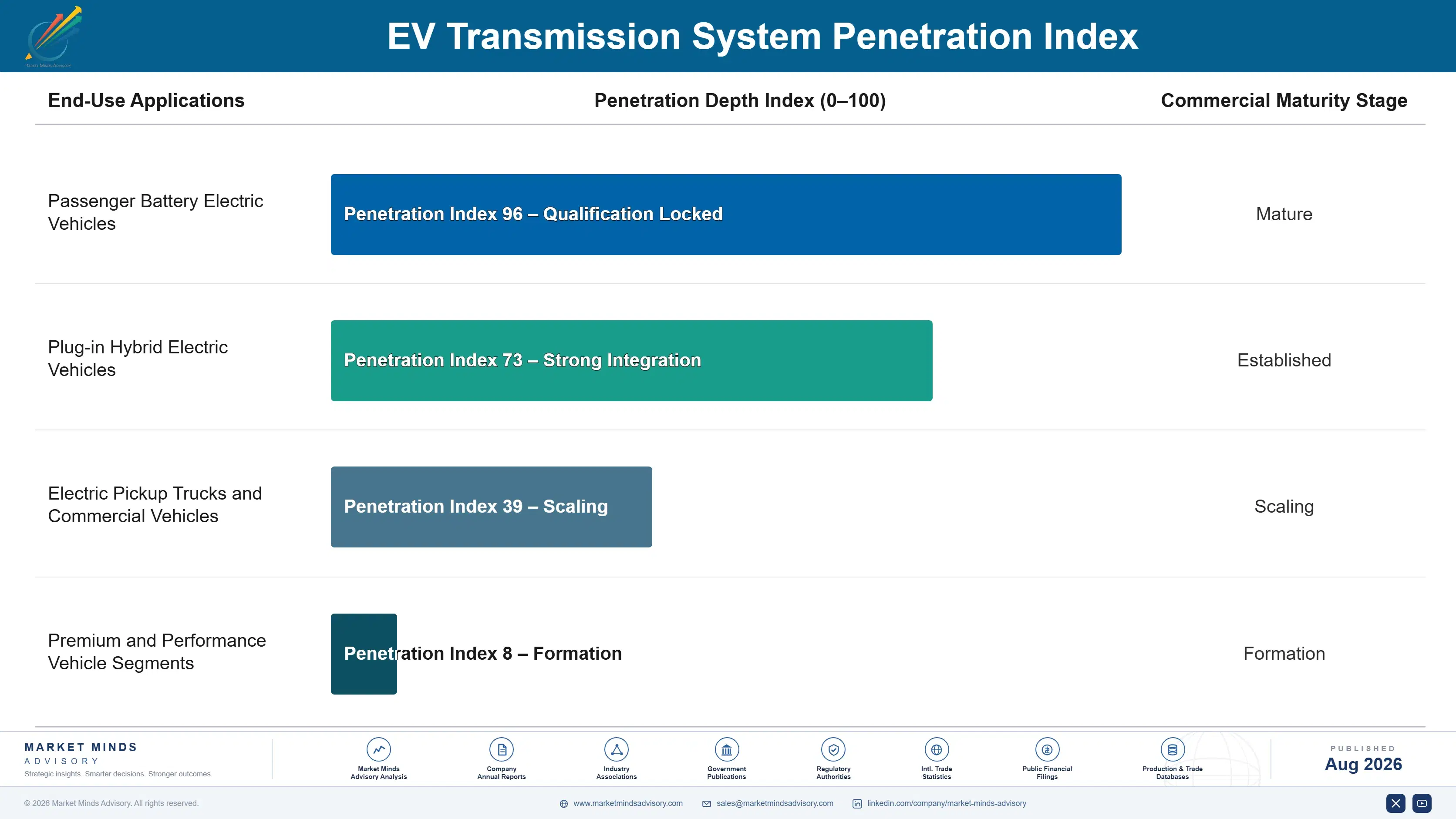
Like most driveline components, EV transmissions rarely fail within typical ownership periods, meaning demand behaves more like a platform-cycle capital good than a recurring consumable. Revenue concentrates almost entirely around new vehicle production rather than aftermarket replacement, making automaker platform award cycles the dominant rhythm suppliers must plan around rather than any ongoing service relationship with vehicle owners.
Adoption stickiness varies meaningfully by end-use vertical. Premium and heavy-duty vehicle programs show the deepest lock-in, given extensive shift calibration and torque qualification requirements that make switching suppliers mid-platform costly and slow. Mainstream single-speed platforms show shallower stickiness, since standard designs carry fewer differentiating specifications and automakers can shift suppliers between platform generations more easily when cost pressure demands it.

Buyer profiles are shifting generationally as automaker powertrain engineering teams increasingly recruit from electronics and software backgrounds rather than pure mechanical transmission expertise, changing how supplier evaluation criteria get weighted. Younger engineering staff entering these roles show more comfort evaluating shift software and hardware together as a single system rather than treating the transmission as a purely mechanical component, accelerating two-speed and multi-speed adoption faster than pure cost economics alone would predict.
ev-transmission-system-market-trends-end-use-penetration-index-1787550400263

What Wins in EV Transmissions

These are among the four positions where our research anticipates prominent divergence between winners and laggards over the coming forecast period. Each is grounded in the demand model, the regulatory perimeter, and the announced capacity pipeline.
01 / SHIFT SOFTWARE INVESTMENT

Build Calibration Capability Before Demand Peaks

Suppliers who invest in proprietary shift control software before automaker demand for two-speed designs fully materializes capture premium contracts more easily than those entering after commitments are already locked with established suppliers and long-term agreements. Building that capability after demand is visible means competing against suppliers who established documented calibration expertise years earlier through sustained investment and patient testing work. The engineering cycle itself takes long enough that late movers effectively concede the category's highest-margin segment to whoever invested first.
02 / HEAVY-DUTY TRUCK FOCUS

Prioritize Electric Truck Contracts Over Passenger Volume

Suppliers who build heavy-duty multi-speed capability capture meaningfully higher margins than those confined to mainstream single-speed passenger vehicle contracts sold purely on delivered price to volume-focused automakers seeking the lowest possible cost. This works best for suppliers who can demonstrate sustained torque handling under heavy load that passenger vehicle applications rarely test for at the same intensity or duration. Suppliers pursuing this strategy should prioritize electric truck programs with the highest production volume first, since those relationships prove hardest for competitors to displace afterward.
03 / ARCHITECTURE PORTFOLIO BREADTH

Maintain Both Single-Speed and Multi-Speed Capability

Suppliers who maintain both single-speed and multi-speed engineering capability can serve mainstream and premium automaker programs from a shared engineering base, capturing value that narrower specialist competitors cannot access as easily. Those confined to one architecture type risk losing platform awards entirely whenever automakers consolidate sourcing toward fewer, broader-capability partners able to deliver across the full range. Capital committed early to this breadth tends to compound into a durable advantage that pure single-speed or pure multi-speed producers struggle to replicate quickly.
04 / GEOGRAPHIC CAPACITY REBALANCING

Weight New Capacity Toward South Asia and Pacific

Producers concentrated in Western Europe and mature East Asian markets should weight incremental capacity investment toward South Asia and Pacific, where electric vehicle production growth is fastest but local supply relationships remain less settled than in mature markets. Waiting for demand to fully materialize before investing risks ceding early customer relationships to regional producers who move faster despite weaker technical capability and thinner certification infrastructure. Early capacity commitment there compounds into durable customer relationships as regional production volume keeps climbing.

Engagement Snapshot From the Field

A live engagement with an industry participant carrying material or product regulatory and market exposure ahead of a defining policy shift, showing how our research translates into a defensible multi-year portfolio strategy.
MARKET MINDS ADVISORY · CLIENT ENGAGEMENT SUMMARY
EV Transmission System Producer Strategic Portfolio Review and Transition Roadmap 2026·Investment Scenario on EV Transmission System Exposure Evaluation 2025-26
CLIENT PROFILE
The client is a North American electric truck manufacturer preparing to launch its next generation of pickup and commercial vehicle platforms with substantially higher rated towing capacity than its current lineup. Facing customer feedback that its existing single-speed drivetrain struggled to deliver both strong acceleration and efficient highway towing simultaneously, the engineering team needed to decide whether to adopt a multi-speed transmission architecture across its next platform generation.
STRATEGIC CHALLENGE
The client needed to determine whether a multi-speed transmission would genuinely resolve its towing efficiency complaints without introducing reliability risk or excessive added cost, and which specific supplier possessed the heavy-duty torque handling and durability track record the demanding application required across varied terrain, climates, and sustained heavy towing loads.
MMA APPROACH
MMA conducted a structured comparison of multi-speed transmission suppliers against the client's specific towing and durability requirements, supplemented by primary interviews with engineering teams at comparable electric truck programs already running multi-speed drivetrains in production across North America. The analysis modeled reliability and total cost tradeoffs across leading supplier options.
KEY FINDINGS
  1. Multi-speed transmissions improved measured towing efficiency meaningfully compared with the client's existing single-speed drivetrain across a range of tested load conditions and grades.
  2. Suppliers with established heavy-duty combustion transmission heritage showed measurably better early reliability data than newer entrants lacking that same engineering background and history.
  3. Total drivetrain cost increased meaningfully with multi-speed adoption, though the increase was smaller than initial supplier quotes suggested once volume discounts applied.
  4. Competitors who launched multi-speed electric trucks without adequate durability validation experienced measurable warranty claim increases during their very first production year overall.
CLIENT PROFILE
The client is a North American electric truck manufacturer preparing to launch its next generation of pickup and commercial vehicle platforms with substantially higher rated towing capacity than its current lineup. Facing customer feedback that its existing single-speed drivetrain struggled to deliver both strong acceleration and efficient highway towing simultaneously, the engineering team needed to decide whether to adopt a multi-speed transmission architecture across its next platform generation.
STRATEGIC CHALLENGE
The client needed to determine whether a multi-speed transmission would genuinely resolve its towing efficiency complaints without introducing reliability risk or excessive added cost, and which specific supplier possessed the heavy-duty torque handling and durability track record the demanding application required across varied terrain, climates, and sustained heavy towing loads.
MMA APPROACH
MMA conducted a structured comparison of multi-speed transmission suppliers against the client's specific towing and durability requirements, supplemented by primary interviews with engineering teams at comparable electric truck programs already running multi-speed drivetrains in production across North America. The analysis modeled reliability and total cost tradeoffs across leading supplier options.
KEY FINDINGS
  1. Multi-speed transmissions improved measured towing efficiency meaningfully compared with the client's existing single-speed drivetrain across a range of tested load conditions and grades.
  2. Suppliers with established heavy-duty combustion transmission heritage showed measurably better early reliability data than newer entrants lacking that same engineering background and history.
  3. Total drivetrain cost increased meaningfully with multi-speed adoption, though the increase was smaller than initial supplier quotes suggested once volume discounts applied.
  4. Competitors who launched multi-speed electric trucks without adequate durability validation experienced measurable warranty claim increases during their very first production year overall.
RECOMMENDED STRATEGY
Phase 1: Phase one: select a supplier with proven heavy-duty torque handling and combustion transmission heritage for the client's next platform generation. Phase 2: Phase two: extend durability validation testing well beyond standard passenger vehicle qualification cycles before committing to full production volume levels. Phase 3: Phase three: monitor early production warranty data closely, adjusting supplier relationships promptly if reliability issues emerge during the initial rollout.
OUTCOME
The client selected a multi-speed transmission supplier with proven heavy-duty heritage for its next platform generation, improving projected towing efficiency meaningfully (client-reported, unverified by MMA) while extending its durability validation timeline beyond standard cycles, according to the client's own internal engineering assessment shared during the engagement.

Frequently Asked Questions

Foundational context covering the market sizes, CAGR, scope, country, region and competition that inform every finding below. This section is provided to cover basics and most often pre-purchase conversations, answered from the MMA Primary Research Dataset.

What is the current size of the EV Transmission System Market?

The global EV transmission system market reached approximately 4.6 billion dollars in 2025. Growth is driven by rising two-speed adoption and expanding electric truck production volume.

How large will the EV Transmission System Market be by 2036?

MMA projects the market will reach approximately 18.52 billion dollars by 2036, roughly 3.55 times its 2026 value. Two-speed and multi-speed designs will drive most of that expansion.

What is the CAGR for the EV Transmission System Market 2026 to 2036?

The market is projected to grow at a 13.5 percent compound annual rate between 2026 and 2036. Bull and bear scenarios range from 12.2 to 14.8 percent depending on multi-speed adoption speed.

Which segment is growing fastest?

Two-speed transmissions are growing fastest at a 17.0 percent CAGR, roughly 1.26 times the overall market rate. Premium and performance vehicle programs drive this outperformance.

Who are the major companies in the EV Transmission System Market?

ZF Friedrichshafen, Getrag, BorgWarner, Magna International, and Punch Powertrain lead the market. Together they hold roughly 48 percent combined share on a shipment volume basis.

Which country is growing fastest?

China leads regional growth at a 15.0 percent CAGR, supported by its position as the largest single electric vehicle production base globally. India follows closely within South Asia and Pacific.

Report Segmentation Architecture

The full report scope spans multiple orthogonal segmentation dimensions, with cross-tabulated demand data provided for each dimension pair. Coverage extends further to regional breakdowns, trend trajectories, and the competitive detail needed to support segment-level decision-making.
  • Single-Speed Reduction Transmissions
  • Two-Speed Transmissions
  • Multi-Speed Transmissions
  • Dual-Clutch Electric Transmissions
  • Direct-Drive Systems
  • Aftermarket Replacement Transmission Units
  • Passenger Battery Electric Vehicles
  • Plug-in Hybrid Electric Vehicles
  • Electric Pickup Trucks and Commercial Vehicles
  • Premium and Performance Vehicle Segments
  • Original Equipment Manufacturer Sourcing
  • Tier 1 Systems Integration
  • Shift Control Software Licensing

By Region

  • North America
  • East Asia
  • Western Europe
  • South Asia and Pacific
  • Latin America
  • Middle East and Africa
  • Eastern Europe

Scope, Methodology, and Coverage

Every figure in this report is reproducible from documented input assumptions. The scope below maps the historical period, the forecast horizon, the segmentation dimensions, and the countries covered, alongside the underlying primary and qualitative methodology.
Historical Period
2020 to 2025
Forecast Period
2026 to 2036
Base Year
2025 (USD billions; MMA Primary Research Dataset, August 2026)
Market Definition
The EV transmission system market covers single-speed, two-speed, multi-speed, dual-clutch, direct-drive, and aftermarket replacement transmission units sold for battery electric and plug-in hybrid passenger and light commercial vehicles. It excludes internal combustion transmissions and standalone electric motors sold without gearing.
Quantitative Units
USD billions
Segmentation Dimensions
Regions Covered
North America, East Asia, Western Europe, South Asia and Pacific, Latin America, Middle East and Africa, Eastern Europe
Countries Covered
Key Companies Profiled
ZF Friedrichshafen, Getrag, BorgWarner, Magna International, Punch Powertrain, Aisin Corporation, Bosch, Continental, Denso, JATCO, Schaeffler, American Axle & Manufacturing, Dana Incorporated, Valeo, Hyundai Transys, Eaton Cummins, Allison Transmission, Meritor, Zhejiang Wanliyang, Shuanghuan Driveline
Quantitative Methodology
Primary survey, n=3,800 respondents, Q4 2025, six countries; demand-side model with trade association cross-validation
Qualitative Methodology
47 expert interviews, Q4 2025; applied to validate demand model assumptions, identify emerging dynamics, and assess competitive positioning
Report Format
PDF and XLSX data workbook (Word format preview document)
Publisher
Market Minds Advisory
Report Code
MMA-2026-AUT-110
Published
August 2026
Contact
sales@marketmindsadvisory.com | www.marketmindsadvisory.com

Purchase the full EV Transmission System Market Report (2026 to 2036).

This report provides a comprehensive assessment of the global EV transmission system market. It covers sizing, segmentation, competitive dynamics, and regional demand through 2036. The analysis examines the shift from standalone single-speed designs toward two-speed and multi-speed architectures driven by automaker demand for both acceleration and highway efficiency alongside genuine towing capability across passenger and commercial platforms. It includes detailed competitive profiling of leading suppliers, input cost exposure across the gear steel and clutch material supply chain, and a phased case study on multi-speed drivetrain sourcing strategy.
Ten-year market sizing and forecast scenarios
Six-segment MECE architecture classification breakdown overview
Seven-region demand and growth rate analysis
Competitive profiling of five leading suppliers
Input cost exposure across gear steel supply chains
Anonymized client case study on sourcing strategy

Built For The People Who Decide

From boardroom strategy to bench-side execution, this report is read cover-to-cover by leaders shaping the next decade of their industry, turning demand scenarios, market dynamics and valuation benchmarks into decisions.
CXOs/ Presidents/ VPs/ Managers
M&A and Corporate Development
Strategy Teams and R&D Heads
Procurement and Product Directors
Regulatory and Compliance Leaders
Investor Relations and Equity Analysts