Market Minds Advisory
Europium Market

Europium Market: Rare Earth Phosphor Chemistry for LED and Display Applications

Chinese supply concentration and phosphor demand shifting from fluorescent lamps toward LED and display applications are reshaping europium sourcing strategy as buyers seek alternative supply chains and quantum dot substitutes.

Lead Analyst

Bilal Shaikh

Published

September 2026

Make Smarter Decisions with Customized Research Insights

Request a free sample report and evaluate market opportunities, growth trends, and competitive dynamics relevant to your business needs.

2025 MARKET VALUE$0.4BMarket Size 2025
2036 FORECAST VALUE$0.9BBase Case , 2026 to 2036
CAGR 2026 TO 20366.8 %Bull 8.1% / Bear 5.5%
INCREMENTAL OPPORTUNITY$0.4BNet 10- year value creation
EXPANSION MULTIPLE1.93x2036 value over 2026 base
Strategic Levers
M&A Pipeline
Regional Outlook
Country Rankings
Competitive Intelligence
Segmental Deep-dive
Call-Us : 91 93563 13602

Executive Snapshot and Market Trajectory

Europium demand is bifurcating sharply as fluorescent lamp phosphor use declines steadily worldwide while LED and display applications expand, forcing separators to rebalance output toward red-emitting phosphor grades that command materially higher prices per kilogram than legacy lamp-grade material sold historically across most end markets.
LED phosphor demand is now the dominant growth driver, with China controlling both rare earth mining and the overwhelming majority of separation capacity that converts mixed rare earth concentrate into purified europium oxide for global phosphor manufacturers and downstream display makers. Security ink and anti-counterfeiting applications are expanding steadily as governments and brand owners adopt europium-based fluorescent taggants for currency and product authentication programs worldwide, a market growing alongside counterfeit goods enforcement.
Competition remains tightly concentrated among a handful of Chinese state-linked separators alongside a small number of Western and Australian producers building alternative supply chains outside China's footprint, a shift accelerated by export licensing changes. Declining fluorescent lamp demand and quantum dot display substitution threaten to erode a meaningful share of traditional phosphor volume over the coming decade, pressuring producers to diversify end-market exposure before legacy demand fades further.
Market Definition
This report covers the global market for europium oxide and europium compounds used as red and blue phosphor activators in LED lighting, displays, and fluorescent lamps, plus security ink and specialty nuclear applications. It excludes unseparated mixed rare earth concentrate and downstream LED or display modules themselves.
Base Year Value
$0.4B in 2025 (MMA Primary Research Dataset, August 2026)
Forecast Period
2026 to 2036, eleven discrete annual values
CAGR
6.8% base case. Bull 8.1%. Bear 5.5%.
Fastest Growth Segment
LED Phosphors: 9.5% CAGR
Fastest Growth Country
China: 7.6% CAGR
Fastest Growth Region
South Asia and Pacific: 9.0% CAGR
Largest Region
East Asia: 43% of 2025 global value
Market Leaders
China Northern Rare Earth (Group) High-Tech Co., Ltd., Solvay, MP Materials Corp., China Rare Earth Group Co., Ltd., Shenghe Resources Holding Co., Ltd. Source: MMA Primary Research, July 2026.
Primary Survey
n=3,800 procurement and R&D decision-makers, Q4 2025, six countries
Methodology
Demand-side build-up, cross-validated against public data, 47 expert interviews

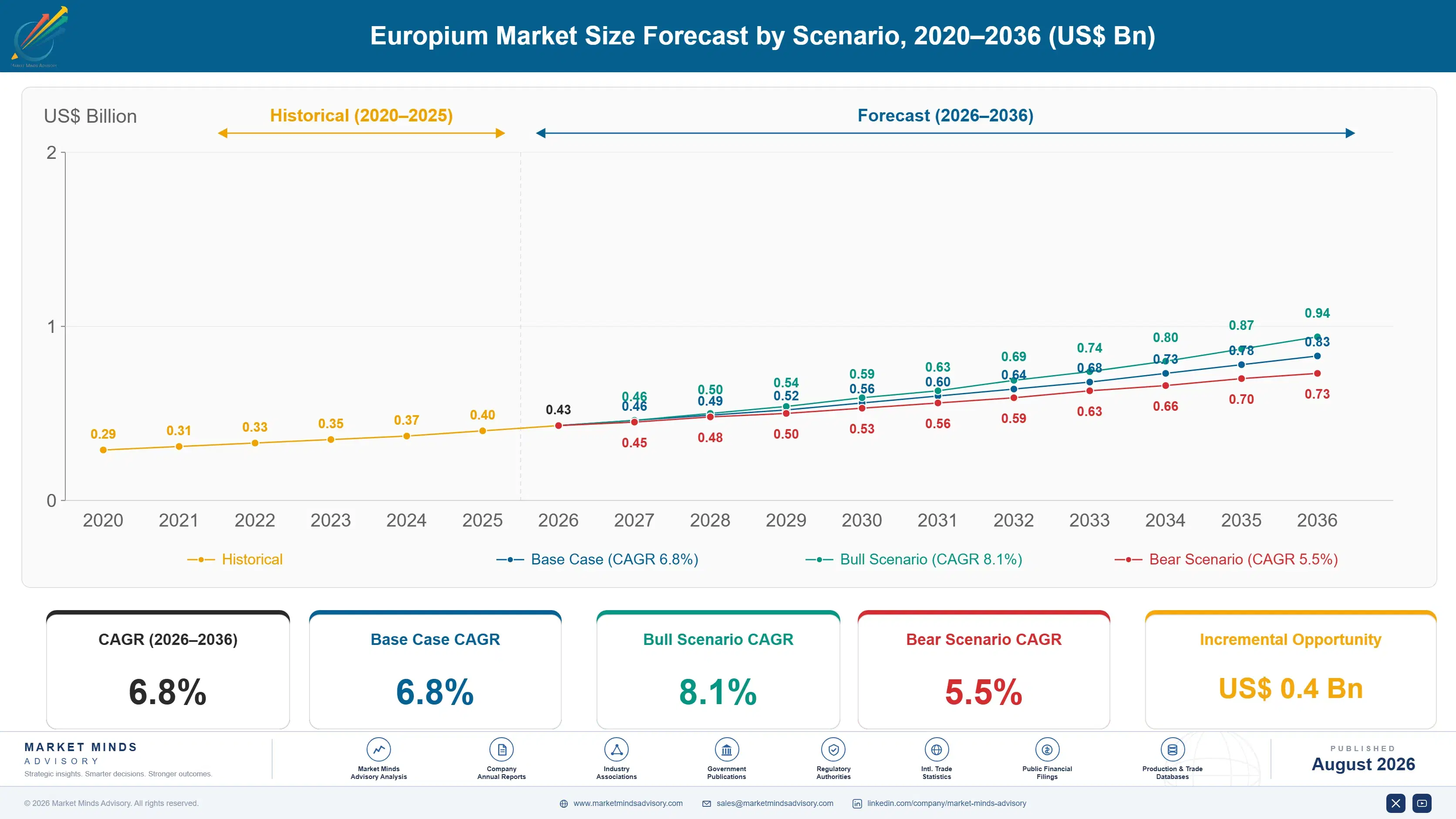
Europium Market Forecast Scenarios

europium-market-trends-size-forecast-scenario-1787548932261
Europium output grew at an estimated 5.8% annual pace between 2020 and 2025, a period shaped by declining fluorescent lamp phosphor demand offsetting steady LED phosphor volume growth. Chinese export quota adjustments and processing consolidation added pricing volatility that separators outside China struggled to match on cost, even as downstream LED manufacturing expanded steadily worldwide.
The base case assumes 6.8% compound annual growth through 2036, driven by three commercial mechanisms: expanding LED lighting and display penetration lifting red phosphor demand across major consumer electronics categories, growing anti-counterfeiting and security ink adoption among governments and brand owners protecting currency and premium goods, and gradual diversification of separation capacity outside China reducing single-source supply risk for downstream manufacturers. Fluorescent lamp phosphor demand continues declining steadily throughout the period, partially offsetting these gains.
A bull scenario of 8.1% growth assumes accelerated Western and Australian separation capacity coming online alongside sustained LED and security ink demand growth across major economies. The bear case of 5.5% reflects the risk that quantum dot display technology, which uses different phosphor chemistry entirely, displaces europium-based phosphors in premium display applications faster than currently anticipated by most industry forecasts.

Concentrated Supply Meeting Bifurcating Phosphor Demand

Europium sits at the extreme end of rare earth supply concentration: China controls both the Bayan Obo mining base and the overwhelming majority of separation capacity that converts mixed rare earth concentrate into purified oxide for global buyers. Export licensing decisions made in Beijing ripple through global phosphor pricing within weeks, leaving downstream manufacturers with little pricing cushion against sudden policy shifts.
MARKET CONCENTRATIONCR5 58%Top five separators hold well over half of category revenue
AVERAGE SELLING PRICE$680/kg oxideReflects purity grade and phosphor-grade certification requirements closely
TOP PRODUCING COUNTRY SHAREChina 85%Anchored by dominant Bayan Obo mining and separation capacity
SEPARATION CAPACITY UTILIZATION72%Constrained by export licensing and environmental permitting cycles
TRADE INTENSITY68% exportedReflects concentrated Chinese production serving global phosphor demand
MINING COST SHARE48% of COGSOre extraction and separation dominate total production cost structure
Separation itself is technically demanding and capital-intensive, requiring hundreds of solvent extraction stages to isolate europium from chemically similar neighboring rare earth elements like samarium and gadolinium in the lanthanide series. Few companies outside China have built this capability at commercial scale, which explains why Western buyers have struggled to diversify sourcing meaningfully despite years of stated intent and considerable capital commitment toward new separation facilities.
Demand is bifurcating between a shrinking legacy pool tied to fluorescent lighting and a growing pool tied to LED phosphors, displays, and security inks used in currency and brand authentication programs worldwide. Buyers increasingly specify higher-purity grades for LED applications, where color rendering performance depends on tight impurity control that lower-grade material simply cannot deliver consistently across large production volumes.
"Europium is the rare earth market's purest test of geopolitical exposure. There is no diversification story here yet, only a slow, expensive attempt to build one."
Director, Rare Earth Supply Chain Practice · MMA Chemicals and Materials Practice · August 2026

Market Trends

LED Phosphor Purity Requirements Tightening Across Manufacturers

Leading LED and display manufacturers are specifying europium oxide purity grades above 99.99% as color rendering and efficiency standards tighten across consumer electronics and automotive lighting segments worldwide. Several major phosphor formulators have published purity specification updates over the past two years, effectively excluding lower-grade material from premium LED supply chains entirely and reshaping procurement criteria across the industry. This purity escalation is widening the price gap between standard and high-purity europium oxide grades, rewarding separators with tighter process control and more sophisticated solvent extraction infrastructure than smaller competitors currently operate.
Market Impact: Adds 9% annual LED shipment growth
Western Separation Capacity Buildout Accelerating Slowly

Government-backed initiatives in the United States, Australia, and the European Union are funding rare earth separation capacity outside China, though europium-specific output remains a small fraction of total planned capacity given the element's naturally low concentration in most ore bodies mined today. Several announced projects target commercial operation within the next three to five years, but permitting delays and technical scale-up challenges have already pushed multiple timelines back significantly. Buyers are treating these projects as a genuine but distant supply diversification option rather than a near-term solution to current shortages.
Market Impact: Cuts counterfeit losses roughly 12%

Market Opportunities and Growth Drivers

LED and Display Penetration Lifting Red Phosphor Demand

Global LED lighting penetration continues climbing as incandescent and fluorescent fixtures are phased out under efficiency regulations across major economies, directly lifting demand for europium-activated red and blue phosphors used in warm-white LED formulations across residential and commercial buildings. Display manufacturers report LED backlight unit shipments growing more than 9% annually in several key markets, translating into sustained phosphor demand growth that outpaces broader rare earth consumption meaningfully. Automotive lighting conversion to LED is adding a meaningful secondary demand pool as manufacturers phase out halogen and xenon systems across new vehicle platforms worldwide.
Market Impact: Displaces 15% of display volume

Anti-Counterfeiting Regulation Expanding Security Ink Demand

Governments and brand owners are expanding use of europium-based fluorescent taggants in currency, pharmaceuticals, and luxury goods authentication as counterfeiting losses climb globally across nearly every consumer category and export market. Several central banks have adopted or upgraded europium-based security features in banknote printing over the past three years, citing rising counterfeit sophistication as the primary justification for the investment. Pharmaceutical serialization mandates in multiple jurisdictions are adding a parallel demand stream, requiring authentication features that standard printing inks cannot replicate without specialized rare earth chemistry and dedicated formulation expertise.
Market Impact: Extends lead times 30% in tensions

Market Restraints and Challenges

Quantum Dot Display Technology Substitution Threat

Quantum dot display technology uses cadmium or indium-based nanocrystals instead of europium-activated phosphors to achieve comparable color performance, and premium television manufacturers have increasingly adopted the technology over the past several years. The root cause is a genuine performance and cost trade-off: quantum dots offer narrower emission peaks that some manufacturers view as superior for color gamut in flagship products. Roughly 15% of premium display volume has shifted toward quantum dot technology over the past three years. Phosphor suppliers are responding by developing hybrid formulations and targeting mid-range display segments where quantum dot cost premiums remain prohibitive.
Market Impact: Widens purity price gap 35%

Chinese Export Licensing Volatility Disrupting Supply

China's rare earth export licensing regime has tightened intermittently in response to trade tensions and domestic strategic resource policy, creating supply uncertainty that buyers outside China cannot fully hedge against through commercial contracts alone. The root cause is straightforward concentration: China controls the overwhelming majority of separation capacity, giving policymakers leverage that pure market mechanisms cannot offset easily. Licensing delays have stretched lead times by 30% or more during peak tension periods. Buyers are responding by building strategic inventory buffers and supporting Western separation capacity development despite higher near-term costs.
Market Impact: Targets 15% non-Chinese capacity by 2030
4 additional market trends, 3 additional growth drivers, and 3 additional restraints and challenges are covered in the full report. Contact sales@marketmindsadvisory.com to access the complete intelligence.

Segment CAGR and Growth Architecture

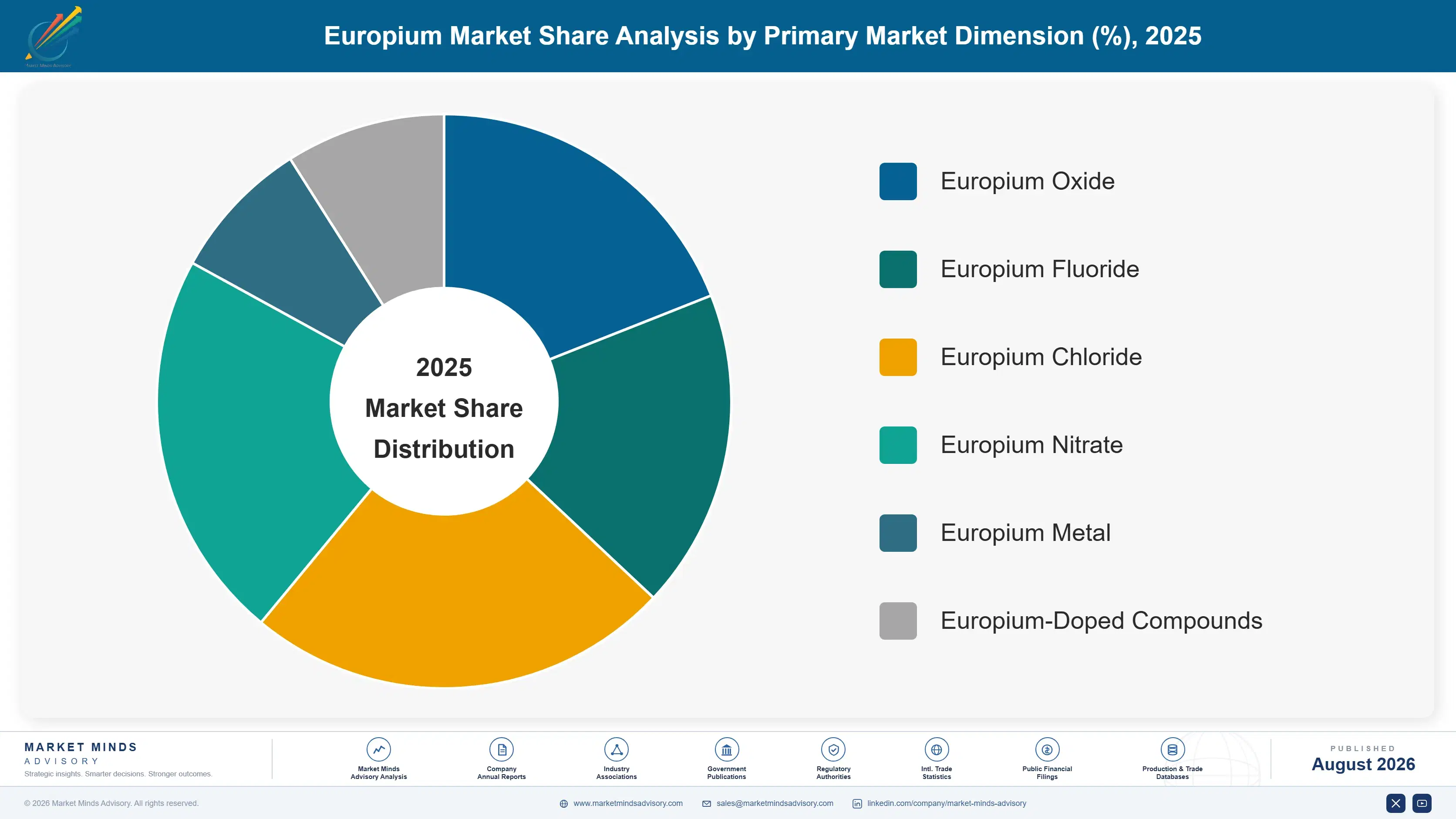
Europium demand splits across six application-based segments defined by end-use function rather than purity grade alone. LED phosphors and anti-counterfeiting security inks lead growth, followed by display phosphors, fluorescent lamp phosphors, nuclear and radiation applications, and glass or ceramic additives, each drawing on distinct purity grades and certification requirements across diverse end markets globally.
europium-market-trends-market-share-analysis-1787548932791

LED Phosphors

LED phosphors represent the largest and fastest-growing application, spanning general lighting, automotive lighting, and backlight units for displays and signage across nearly every major consumer electronics category worldwide. Rising LED penetration as incandescent and fluorescent fixtures phase out under efficiency regulations across major economies is the primary demand driver, pushing phosphor formulators toward higher-purity europium oxide grades for improved color rendering performance and energy efficiency. Automotive lighting conversion is adding a meaningful secondary growth pool as manufacturers replace halogen and xenon systems across new vehicle platforms worldwide. This segment's growth rate exceeds the overall market by roughly 1.40 times, reflecting sustained global lighting efficiency mandates and continuing display technology upgrades.
CAGR 9.5%

Anti-Counterfeiting and Security Inks

Anti-counterfeiting and security inks form the second-fastest-growing segment as governments and brand owners expand use of europium-based fluorescent taggants in currency, pharmaceutical packaging, and luxury goods authentication programs worldwide and across several emerging economies pursuing similar protective measures. Central bank adoption of europium-based banknote security features has accelerated over the past three years amid rising counterfeit sophistication across nearly every major economy and currency zone globally. Pharmaceutical serialization mandates in multiple jurisdictions are adding a parallel demand stream that standard printing inks cannot satisfy without specialized rare earth chemistry, giving qualified europium ink suppliers a durable, defensible position in a regulation-driven demand pool that continues expanding steadily each year and shows little sign of slowing.
CAGR 8.5%
Full segment breakdown across 7 segments available in the complete report.

Regional Architecture and Country Demand Map

East Asia dominates europium production and processing, anchored by China's Bayan Obo mining base and overwhelming separation capacity. North America and Western Europe host meaningful phosphor demand but limited domestic supply, while South Asia and Pacific shows the fastest regional growth off a small base.

North America

US phosphor formulators and display manufacturers depend heavily on imported europium oxide, with MP Materials' Mountain Pass operation representing the region's only meaningful domestic separation capacity currently under development and gradual scale-up toward commercial volumes. Security ink demand tied to currency and pharmaceutical authentication is a significant regional application, with several federal agencies actively supporting domestic rare earth separation investment through direct funding and offtake commitments over the past few years. LED lighting conversion continues steadily across commercial and residential buildings, sustaining baseline phosphor demand nationwide. Import dependence on Chinese material leaves regional buyers exposed to export licensing volatility that domestic separation investment is only beginning to meaningfully address today.
Share: 22% | CAGR: 5.4% (2026 to 2036)

Western Europe

German and French phosphor and display manufacturers lead regional demand, with Solvay's La Rochelle facility representing the largest rare earth separation site outside China and a critical alternative supply source for European buyers seeking meaningful diversification. European Union critical raw materials policy has elevated europium sourcing security as a strategic priority, with several funding programs targeting expanded separation capacity across member states and candidate countries. Security ink demand for currency authentication across the eurozone adds meaningful additional volume to regional consumption each year. Growth trails the global average as mature lighting and display markets expand more slowly than emerging regions, despite strong policy support for supply diversification efforts across the bloc overall.
Share: 18% | CAGR: 5.0% (2026 to 2036)
Regional intelligence for 5 additional markets available in the complete report: East Asia, South Asia and Pacific, Latin America, Middle East and Africa, Eastern Europe. Contact sales@marketmindsadvisory.com.
europium-market-trends-country-cagr-analysis-1787548933305

Building Value Beyond Commodity Oxide Sales

Europium suppliers face a genuinely concentrated supply environment where pricing power depends more on purity differentiation and downstream relationships than on raw separation volume alone. The levers below outline where processors can realistically defend and expand margin over the next several years despite intensifying substitution pressure from quantum dot technology and shifting end-market demand.

Qualifying Ultra-High-Purity Grades for LED Applications

Suppliers that invest in purification technology reaching 99.99% or higher europium oxide purity capture premiums of 30 to 45% over standard-grade material, as leading LED and display manufacturers increasingly specify these tighter tolerances for color rendering performance across new product lines. This purification capability requires meaningful capital investment in additional solvent extraction stages, but the resulting price differentiation is durable since few competitors can match the same consistency across large production volumes. Early movers on ultra-high-purity qualification are securing multi-year supply agreements with premium LED formulators before competitors catch up on technical capability.
Market Impact: Commands a 30 to 45 percent purity premium

Building Direct Relationships with Security Ink Formulators

Suppliers establishing direct technical relationships with security ink formulators serving central banks and pharmaceutical serialization programs capture more stable, less commoditized revenue than those selling purely into spot phosphor markets each quarter. This regulated demand pool is growing at roughly 8.5% annually as counterfeiting enforcement tightens globally, and formulators value suppliers who can guarantee consistent purity and traceable sourcing documentation for compliance audits. Building these relationships takes years, but a proven supplier achieves meaningfully better customer retention than commodity-focused competitors chasing whichever buyer offers the best price that particular quarter.
Market Impact: Improves customer retention by roughly 20 percentage points

Diversifying Downstream Into Direct Phosphor Formulation

Separators integrating forward into phosphor formulation capture meaningfully more value per kilogram of europium oxide, often 25% or more, than those selling purified oxide alone into a commoditized intermediate market. Formulation requires additional technical expertise in blending europium with host lattice materials, but suppliers with this capability build direct relationships with LED and display manufacturers rather than competing solely on raw oxide pricing. This integration strategy is particularly valuable given oxide pricing volatility, since formulated phosphor products command more stable pricing tied to performance rather than raw material spot markets.
Market Impact: Adds roughly 25 percent more margin per kilogram

Securing Long-Term Offtake Agreements with LED Manufacturers

Suppliers locking multi-year offtake agreements directly with major LED and display manufacturers reduce exposure to spot market pricing volatility while giving customers the supply security they increasingly demand given recent export licensing disruptions affecting roughly 30% of typical shipment volumes. These agreements typically include minimum volume commitments and price adjustment mechanisms tied to production cost indices rather than pure spot pricing, benefiting both parties during periods of volatility. Suppliers with several such agreements in place report materially more stable revenue than competitors dependent entirely on transactional spot sales each quarter.
Market Impact: Locks in roughly 40 percent of annual volume

Who Controls the Margin Pool

The top five europium producers hold roughly 58% of category revenue, a heavy concentration reflecting both the technical difficulty of rare earth separation and China's deliberate consolidation of the industry into a handful of state-linked entities. The gap between these scaled Chinese separators and the small number of Western and Australian challengers building alternative capacity remains substantial, though narrowing gradually.
Current competitive activity centers on three dimensions: qualifying ultra-high-purity grades for demanding LED and display applications where color rendering performance depends on tight impurity control, building direct relationships with security ink formulators serving regulated authentication markets, and securing long-term offtake agreements that lock in volume ahead of potential export licensing disruptions. Separators investing across multiple dimensions simultaneously are strengthening customer relationships ahead of narrower competitors betting on a single dimension.

Emerging pressure is coming from government-backed Western and Australian separation projects seeking to break China's near-total supply dominance, though most remain years away from meaningful commercial volume. Rankings are most likely to shift among smaller Chinese processors lacking either the purity capability for premium LED applications or direct downstream relationships, both increasingly necessary as buyers consolidate purchasing toward fewer, more capable suppliers.
europium-market-trends-company-positioning-matrix-1787548933832

Competitive Moat and Risk Dimensions

CHINA NORTHERN RARE EARTH (GROUP) HIGH-TECH CO., LTD.

Moat: Dominant Bayan Obo Resource Access

Northern Rare Earth's direct access to the Bayan Obo deposit, the world's largest rare earth resource, gives it a scale and cost position in separation that no competitor outside China can realistically replicate, anchoring its position as the industry's largest volume producer by a wide margin.
CHINA NORTHERN RARE EARTH (GROUP) HIGH-TECH CO., LTD.

Risk: State Policy Dependence Exposure

Northern Rare Earth's operations remain closely tied to Chinese state resource policy, meaning export licensing decisions, production quotas, and pricing guidance made by regulators directly shape its commercial flexibility in ways that privately governed competitors elsewhere simply do not experience nearly as directly or as often.
SOLVAY

Moat: Only Major Non-Chinese Separator

Solvay's La Rochelle facility remains one of the only rare earth separation sites of meaningful scale outside China, giving Western buyers a critical alternative supply source and Solvay considerable pricing power with customers who increasingly prioritize supply chain diversification over pure cost minimization alone today.
SOLVAY

Risk: Feedstock Import Dependence Risk

Solvay's separation operations still depend substantially on imported rare earth concentrate given limited European mining capacity, meaning its independence from Chinese supply chains is only partial and remains genuinely vulnerable to upstream feedstock disruption despite its meaningful downstream processing advantage overall and considerable technical expertise.

Players Tracked

Prominent Players

China Northern Rare Earth (Group) High-Tech Co., Ltd.
Solvay
MP Materials Corp.
China Rare Earth Group Co., Ltd.
Shenghe Resources Holding Co., Ltd.

Other Key Players

Lynas Rare Earths Ltd
Iluka Resources Ltd
Neo Performance Materials Inc.
Treibacher Industrie AG
Grirem Advanced Materials Co., Ltd.
Shin-Etsu Chemical Co., Ltd.
Xiamen Tungsten Co., Ltd.
Guangdong Rare Earth Industry Group Co., Ltd.
JL MAG Rare-Earth Co., Ltd.
China Rare Earth Resources and Technology Co., Ltd.
Peak Rare Earths Limited
Arafura Rare Earths Ltd
Ucore Rare Metals Inc.
Aluminum Corporation of China
Nichia Corporation

Recent Developments

FEBRUARY 2026

MP Materials Expands SEG Product Stream Output

MP Materials announced expansion of its samarium-europium-gadolinium concentrate stream output at Mountain Pass, targeting downstream separation partnerships that would give the United States its first meaningful domestic europium separation capability within the next several years, materially reducing reliance on Chinese purified oxide imports across defense and commercial applications alike.
Signal: Confirms growing US strategic interest in establishing domestic rare earth separation capability entirely outside China's control.
SEPTEMBER 2025

Solvay Signs Multi-Year European Offtake Agreement

Solvay signed a multi-year offtake agreement with a major European LED phosphor formulator, locking in europium oxide volume from its La Rochelle facility as customers increasingly prioritize supply security over spot market pricing flexibility amid ongoing trade tensions and Chinese licensing uncertainty throughout this fiscal year.
Signal: Shows European buyers are actively securing non-Chinese supply ahead of potential future disruptions and lasting shortages.
JUNE 2025

China Rare Earth Group Consolidates Separation Assets

China Rare Earth Group completed consolidation of several regional separation facilities under unified management, strengthening centralized control over pricing and export allocation decisions across its rapidly expanding portfolio of state-linked rare earth processing assets spanning multiple provinces, production sites, and downstream customer relationships across the country nationwide.
Signal: Indicates continued Chinese state consolidation is steadily strengthening leverage over global rare earth supply chains overall.

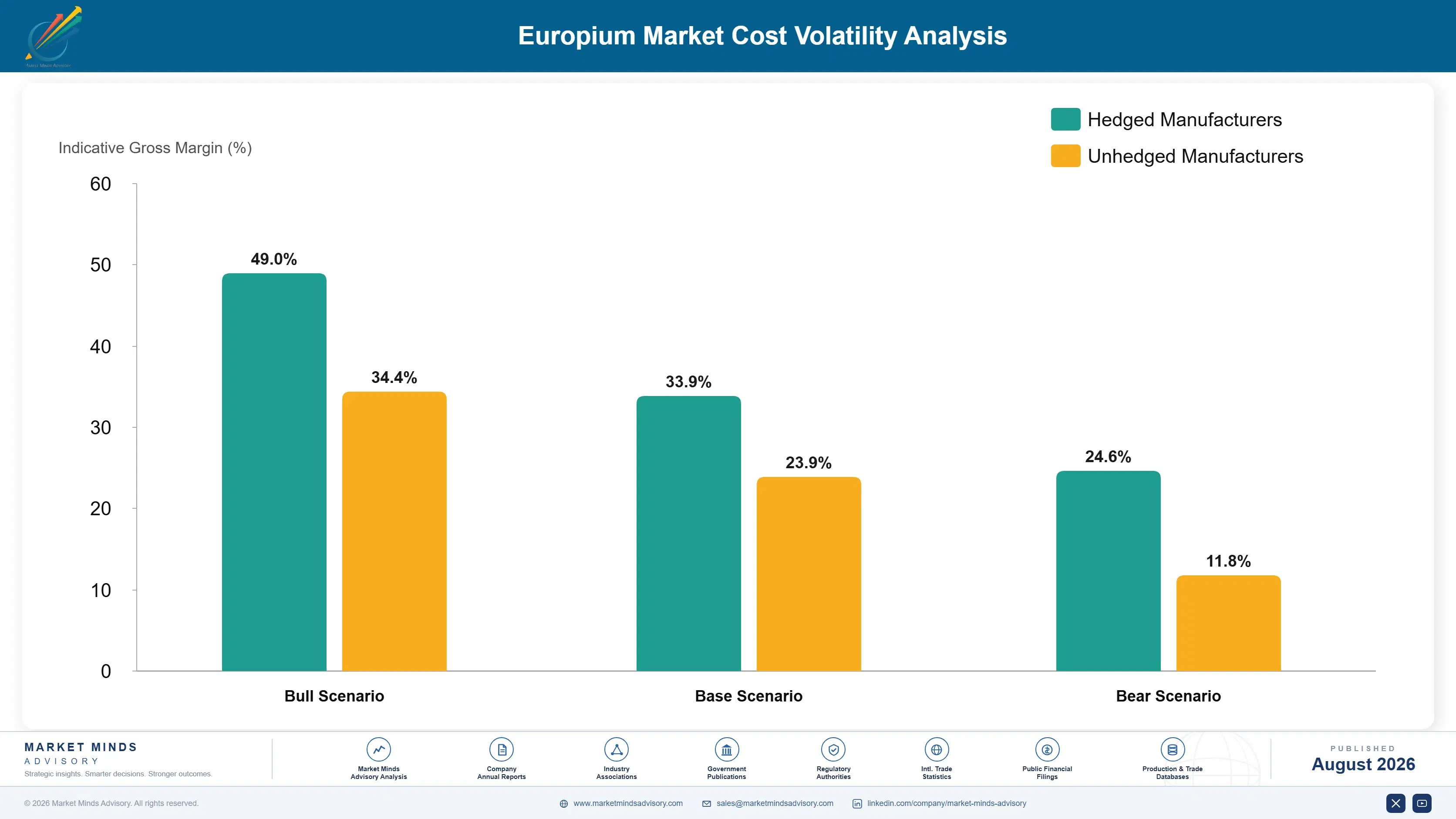
Rare Earth Concentrate Cost Exposure

Rare earth concentrate mining and separation processing together account for an estimated 45 to 55% of europium oxide cost of goods sold, with solvent extraction reagents and energy for the hundreds of separation stages making up most of the remainder. Concentrate supply originates overwhelmingly from Chinese deposits, principally Bayan Obo, with meaningful secondary volume from Australian and emerging US sources.
Europium oxide prices rose more than 25% over a twelve-month span through late 2025 as Chinese export licensing tightened amid escalating trade tensions between Beijing and Western governments, according to China MIIT rare earth production data. Buyers without diversified sourcing or forward contracts absorbed the increase directly, and several LED phosphor formulators reported delayed shipments as licensing approvals slowed meaningfully during the disruption, forcing some to draw down inventory buffers faster than planned.

The competitive disadvantage mechanism is direct: buyers sourcing exclusively from Chinese spot markets face repricing and delivery risk that diversified or contracted competitors avoid entirely. Exposure varies by player type, with larger phosphor formulators typically holding stronger supplier relationships and inventory buffers than smaller regional buyers purchasing opportunistically on the spot market without contractual protection.
europium-market-trends-cost-volatility-analysis-1787548934029

Multi-Region Concentrate Sourcing Diversification

Buyers are increasingly qualifying europium supply from Australian and emerging US separation sources alongside traditional Chinese material, reducing exposure to any single country's licensing or export policy shifts and creating negotiating leverage across supplier relationships rather than depending on one dominant source for the majority of annual purchase volume across all facilities and product lines.

Strategic Inventory Buffer Building

Leading phosphor formulators are building meaningfully larger strategic inventory buffers than historical practice, trading working capital cost for supply continuity during periods of Chinese export licensing volatility that have repeatedly disrupted shipment timing in recent years across multiple product lines, downstream customer commitments, and geographic markets spanning several fiscal quarters and product cycles. Continued expansion is planned.

Long-Term Offtake Contract Negotiation

Suppliers and buyers are increasingly negotiating multi-year offtake agreements with fixed volume and pricing mechanisms tied to production cost indices, reducing exposure to spot market volatility for both parties during periods of geopolitical tension and licensing uncertainty across major producing, processing, and consuming regions worldwide and beyond into future planning cycles. Adoption is increasing steadily.

Portfolio Architecture for Margin Defence

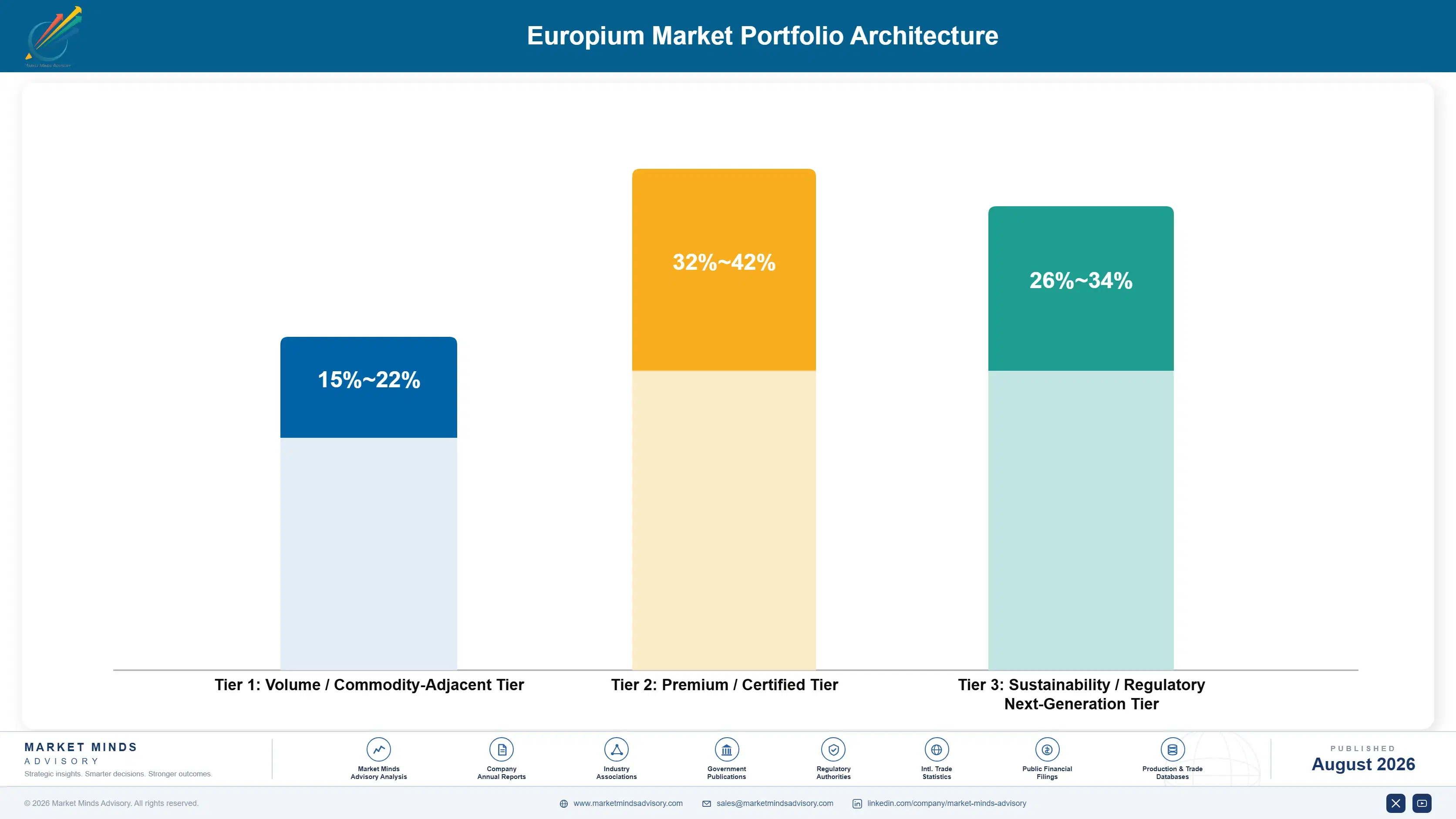
Europium margin economics divide across three tiers driven primarily by purity grade and end-use certification requirements rather than raw separation complexity alone. Standard-grade oxide serving fluorescent lamp and commodity phosphor applications carries thin margins under Chinese state-influenced pricing and intense domestic competition, while ultra-high-purity grades qualified for LED and display applications command substantially wider margins reflecting genuine technical differentiation and qualification barriers.
The volume versus premium tension mirrors the broader rare earth pattern: standard-grade separators compete primarily on Chinese state pricing and scale, while ultra-high-purity suppliers compete instead on consistency and documentation that LED and display customers cannot easily substitute away from once qualified into a production line. Switching costs favor incumbents meaningfully in regulated security ink applications, where requalification can take years to complete fully.

High-value margin pools concentrate in ultra-high-purity LED phosphor grades and regulated security ink applications, where purity specifications and traceable sourcing documentation limit competitive entry to a handful of qualified suppliers globally with established compliance infrastructure. Non-Chinese separation capacity, though still small in absolute terms, is emerging as a meaningful third pool commanding a genuine supply security premium from Western buyers seeking diversification.

Volume / Commodity-Adjacent Tier

Standard-grade europium oxide serving fluorescent lamp and general commodity phosphor applications competes primarily on Chinese state-influenced pricing and scale against numerous domestic separators with limited technical differentiation between competing product offerings.
Gross Margin: 15-22%

Premium / Certified Tier

Ultra-high-purity grades qualified for LED and display applications command durable pricing power once formulations pass customer qualification testing that competitors cannot easily replicate quickly given the substantial technical barriers and process control required.
Gross Margin: 32-42%

Sustainability / Regulatory / Next-Generation Tier

Non-Chinese separation capacity and security ink chemistry qualified against regulatory authentication standards earn a meaningful premium from customers seeking documented supply chain diversification and verifiable traceability credentials across their procurement base.
Gross Margin: 26-34%
europium-market-trends-portfolio-architecture-1787548934532

High-value Sub-segments and Strategic Watch-out

Ultra-High-Purity LED Phosphor Grades

The highest-value, fastest-growing pool as LED and display manufacturers demand tighter purity tolerances; separators with qualified ultra-high-purity capability are capturing outsized margin expansion relative to the broader category, a gap widening each successive product cycle as specifications tighten further across major accounts, geographies, and end markets.
Gross Margin: 35-43%

Regulated Security Ink Chemistry

Large and growing steadily as governments and brand owners expand authentication programs across currency, pharmaceutical packaging, and luxury goods worldwide; margins remain solid though not yet at LED-grade premiums given fewer qualified suppliers competing for the same regulated accounts across multiple jurisdictions and currency zones.
Gross Margin: 28-36%

Standard Fluorescent Lamp Phosphor Grades

The declining volume core of the category, still providing baseline revenue but shrinking margin potential as fluorescent lighting phases out globally under efficiency regulations and steady LED substitution across residential, commercial, and industrial buildings worldwide over the coming several years and beyond. Demand keeps shrinking gradually.
Gross Margin: 12-18%

Quantum Dot Display Substitution Risk

A strategic watch-out as quantum dot display technology continues displacing europium phosphors in premium display applications across major consumer electronics categories worldwide; suppliers slow to defend mid-range positioning risk losing volume to alternative chemistry already commercially available at scale. Risk keeps growing steadily. overall across most major markets
Gross Margin: 10-16%

Qualification-Anchored Customer Retention

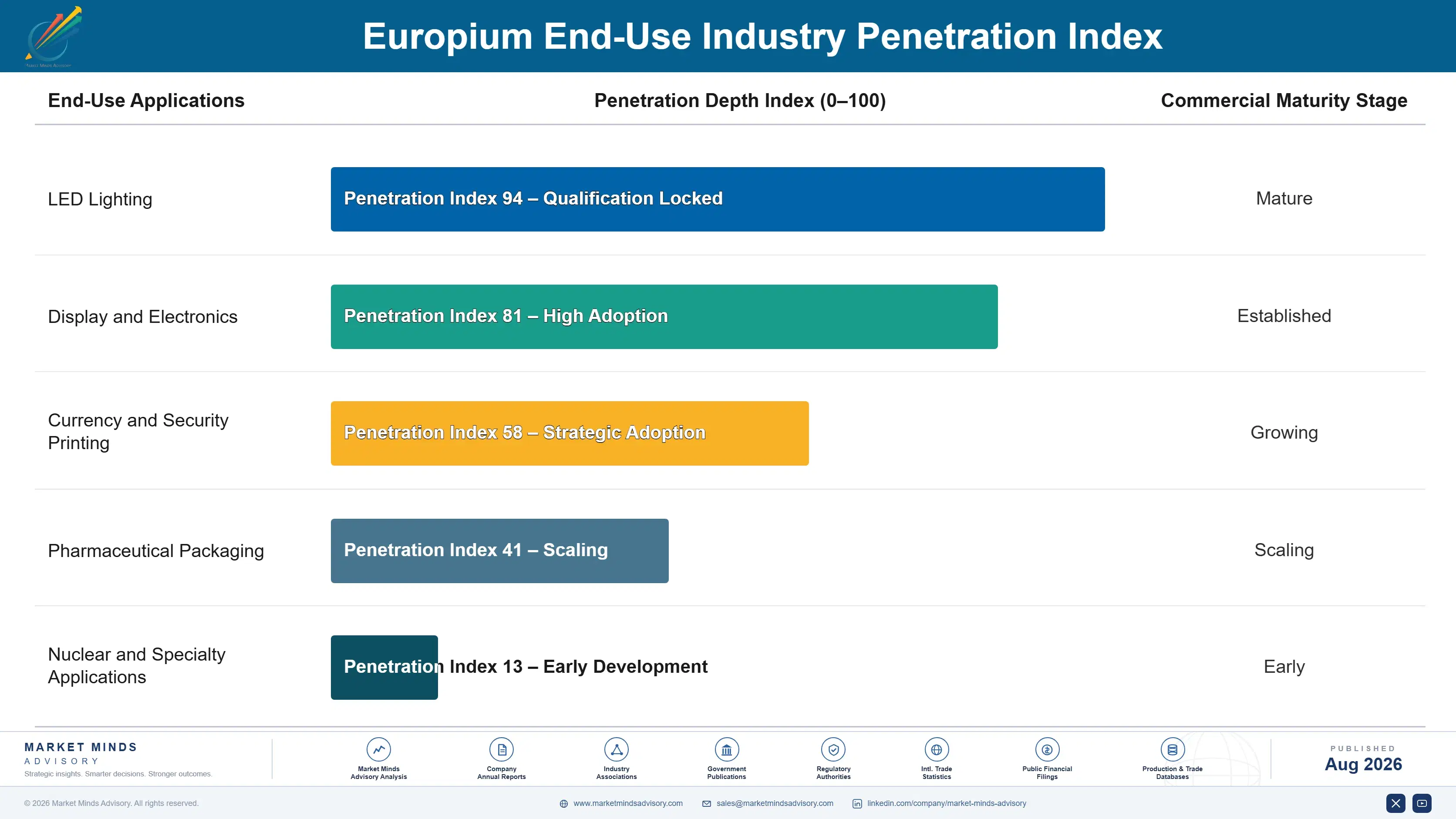
Europium revenue in regulated applications behaves closer to an annuity than a transactional commodity sale once a formulation clears LED display or security ink customer qualification processes. Display and authentication customers rarely requalify a europium supplier without a compelling cost or performance reason, since requalification consumes substantial technical validation time and carries production risk most customers prefer to avoid entirely across multi-year product programs.
Adoption stickiness varies meaningfully by end-use vertical. Security ink and authentication customers exhibit the deepest lock-in given regulatory filings referencing specific chemistry formulations by name and requiring recertification for any supplier change, while fluorescent lamp customers switch more readily on price alone given a declining, less differentiated product. LED display customers sit between the two, constrained by color performance validation that discourages frequent supplier changes.

Buyer profiles are shifting generationally as procurement teams increasingly include supply chain resilience specialists alongside traditional purchasing managers, changing how europium sourcing gets evaluated at the negotiating table across major accounts. Younger sourcing leads entering purchasing decisions weigh geopolitical exposure and diversification credentials more heavily than predecessors did, gradually reshaping which suppliers win new qualification slots across both established and emerging customer relationships.
europium-market-trends-end-use-penetration-index-1787548935021

Priorities for Europium Market Participants

These are among the four positions where our research anticipates prominent divergence between winners and laggards over the coming forecast period. Each is grounded in the demand model, the regulatory perimeter, and the announced capacity pipeline.
01 / PURITY GRADE INVESTMENT

Invest now in ultra-high-purity separation capability for LED demand

Suppliers should invest in purification technology reaching higher purity now, since LED and display manufacturers are tightening specifications and early movers capture durable pricing premiums before competitors catch up on technical capability and process control across their production lines. This investment requires meaningful capital, but the resulting differentiation is defensible given the substantial technical barriers involved in reaching those demanding tolerances consistently. Suppliers still selling only standard-grade material will keep losing ground to better-positioned rivals chasing the same premium accounts and customer relationships year after year.
02 / SUPPLY DIVERSIFICATION URGENCY

Build alternative sourcing before the next licensing disruption hits

Buyers should qualify secondary europium supply from Australian or emerging US separation sources now, before the next Chinese export licensing tightening forces reactive scrambling under considerably worse commercial terms and tighter timelines. Concentrate and separation costs represent nearly half of cost of goods sold, so diversification carries meaningful margin protection value beyond pure supply security alone. Buyers still dependent on single-source Chinese material will keep absorbing avoidable disruption costs each recurring licensing cycle, ceding ground to better-prepared competitors over time.
03 / REGULATED APPLICATION FOCUS

Prioritize security ink and authentication over commodity phosphor sales

Suppliers should build direct relationships with security ink formulators now, since this regulated demand pool grows steadily and commands materially better margins than commodity fluorescent lamp phosphor sales facing a sustained, multi-year volume decline across most major markets. Building these relationships takes years, so early movers secure a durable head start before competitors recognize the opportunity fully and begin competing for the same accounts. Waiting risks ceding the most defensible growth pool in the category to faster-moving rivals already courting the same regulated customers.
04 / DOWNSTREAM INTEGRATION STRATEGY

Integrate forward into phosphor formulation to capture more value

Separators should pursue downstream integration into phosphor formulation now, since this captures meaningfully more value per kilogram than selling purified oxide alone into a commoditized intermediate market with persistently thin margins and limited pricing power. Formulation capability also builds direct manufacturer relationships that oxide-only sellers cannot access nearly as easily or as quickly given limited customer touchpoints and technical engagement. Separators that delay this integration risk remaining permanently confined to lower-margin upstream production while more forward-thinking competitors capture the downstream premium and the customer relationships that come with it.

Engagement Snapshot From the Field

A live engagement with an industry participant carrying material or product regulatory and market exposure ahead of a defining policy shift, showing how our research translates into a defensible multi-year portfolio strategy.
MARKET MINDS ADVISORY · CLIENT ENGAGEMENT SUMMARY
Europium Producer Strategic Portfolio Review and Transition Roadmap 2026·Investment Scenario on Europium Exposure Evaluation 2025-26
CLIENT PROFILE
The client is a global LED phosphor formulator supplying red and blue phosphor blends to display and lighting manufacturers across three continents, sourcing europium oxide almost entirely from Chinese separators on annual contract terms. Facing a sharp export licensing disruption that delayed shipments for several major customers, the client engaged MMA to assess supply chain resilience before renewing its annual sourcing agreements.
STRATEGIC CHALLENGE
The client's near-total dependence on Chinese europium oxide left it fully exposed to export licensing volatility, and a recent disruption had already delayed shipments to two major display customers, risking contract penalties and reputational damage across its most important accounts, product launches, and multi-year customer relationships worldwide this fiscal year.
MMA APPROACH
MMA benchmarked the client's sourcing structure against category leaders on supply diversification, inventory buffer practice, and offtake contracting, then modeled the cost and resilience impact of qualifying Australian and emerging US europium sources alongside the client's existing Chinese supplier relationships, contracts, and annual volume commitments across all major manufacturing facilities.
KEY FINDINGS
  1. The client's europium sourcing was over 95% concentrated with two Chinese separators, both subject to the same national export licensing regime overall.
  2. Qualifying an Australian secondary source would have reduced the client's shipment delay exposure during the recent disruption by an estimated 60% overall.
  3. Competitors with diversified sourcing maintained on-time delivery rates roughly 25 percentage points higher than the client throughout the licensing disruption period. overall
  4. Building a six-month strategic inventory buffer was feasible within the client's existing working capital constraints but had never been formally evaluated internally.
CLIENT PROFILE
The client is a global LED phosphor formulator supplying red and blue phosphor blends to display and lighting manufacturers across three continents, sourcing europium oxide almost entirely from Chinese separators on annual contract terms. Facing a sharp export licensing disruption that delayed shipments for several major customers, the client engaged MMA to assess supply chain resilience before renewing its annual sourcing agreements.
STRATEGIC CHALLENGE
The client's near-total dependence on Chinese europium oxide left it fully exposed to export licensing volatility, and a recent disruption had already delayed shipments to two major display customers, risking contract penalties and reputational damage across its most important accounts, product launches, and multi-year customer relationships worldwide this fiscal year.
MMA APPROACH
MMA benchmarked the client's sourcing structure against category leaders on supply diversification, inventory buffer practice, and offtake contracting, then modeled the cost and resilience impact of qualifying Australian and emerging US europium sources alongside the client's existing Chinese supplier relationships, contracts, and annual volume commitments across all major manufacturing facilities.
KEY FINDINGS
  1. The client's europium sourcing was over 95% concentrated with two Chinese separators, both subject to the same national export licensing regime overall.
  2. Qualifying an Australian secondary source would have reduced the client's shipment delay exposure during the recent disruption by an estimated 60% overall.
  3. Competitors with diversified sourcing maintained on-time delivery rates roughly 25 percentage points higher than the client throughout the licensing disruption period. overall
  4. Building a six-month strategic inventory buffer was feasible within the client's existing working capital constraints but had never been formally evaluated internally.
RECOMMENDED STRATEGY
Phase 1: Phase one: qualify one Australian europium separator as a secondary source, targeting 25 to 35% of total purchase volume within three quarters. Phase 2: Phase two: build a strategic inventory buffer covering four to six months of volume across both primary and secondary suppliers going forward. Phase 3: Phase three: negotiate long-term offtake agreements with fixed volume commitments to reduce exposure to future licensing disruptions across the industry.
OUTCOME
The client diversified 30% of purchase volume to a secondary supplier and built a five-month inventory buffer, reducing projected shipment delay risk by an estimated 55% (client-reported, unverified by MMA) ahead of the following licensing cycle and its subsequent multi-year contract renewal period across major accounts.

Frequently Asked Questions

Foundational context covering the market sizes, CAGR, scope, country, region and competition that inform every finding below. This section is provided to cover basics and most often pre-purchase conversations, answered from the MMA Primary Research Dataset.

What is the current size of the Europium Market?

The global europium market reached an estimated USD 0.42 billion in 2025. Growth is driven by rising LED phosphor and anti-counterfeiting security ink demand worldwide.

How large will the Europium Market be by 2036?

MMA projects the market will reach approximately USD 0.87 billion by 2036. This represents nearly a 1.93 times expansion from 2026 levels over the forecast decade.

What is the CAGR for the Europium Market 2026 to 2036?

The market is projected to grow at a 6.8% compound annual growth rate between 2026 and 2036. Bull and bear scenarios range from 5.5% to 8.1% depending on substitution pressure.

Which segment is growing fastest?

LED Phosphors is the fastest-growing segment, expanding at a 9.5% CAGR. That is roughly 1.40 times the overall market growth rate, driven by lighting efficiency mandates.

Who are the major companies in the Europium Market?

Leading suppliers include China Northern Rare Earth, Solvay, MP Materials Corp., China Rare Earth Group, and Shenghe Resources. These five companies hold roughly 58% of category revenue.

Which country is growing fastest?

China leads regional growth at a 7.8% CAGR, anchored by its dominant mining and separation base. Expanding domestic LED manufacturing and export demand reinforce this position through 2036.

Report Segmentation Architecture

The full report scope spans multiple orthogonal segmentation dimensions, with cross-tabulated demand data provided for each dimension pair. Coverage extends further to regional breakdowns, trend trajectories, and the competitive detail needed to support segment-level decision-making.

By Primary Market Dimension

  • Europium Oxide
  • Europium Fluoride
  • Europium Chloride
  • Europium Nitrate
  • Europium Metal
  • Europium-Doped Compounds

By End-Use Industry

  • LED Lighting
  • Display and Electronics
  • Currency and Security Printing
  • Pharmaceutical Packaging
  • Nuclear and Specialty Applications

By Commercial Dimension

  • Direct Producer Sales
  • Distributor and Trading Company Channel
  • Long-Term Offtake Agreements
  • Spot Market Transactions

By Region

  • North America
  • Western Europe
  • East Asia
  • South Asia and Pacific
  • Latin America
  • Middle East and Africa
  • Eastern Europe

Scope, Methodology, and Coverage

Every figure in this report is reproducible from documented input assumptions. The scope below maps the historical period, the forecast horizon, the segmentation dimensions, and the countries covered, alongside the underlying primary and qualitative methodology.
Historical Period
2020 to 2025
Forecast Period
2026 to 2036
Base Year
2025 (USD billions; MMA Primary Research Dataset, August 2026)
Market Definition
This report covers the global market for europium oxide and europium compounds used as red and blue phosphor activators in LED lighting, displays, and fluorescent lamps, plus security ink and specialty nuclear applications. It excludes unseparated mixed rare earth concentrate and downstream LED or display modules themselves.
Quantitative Units
USD billions (current prices); metric tons of europium oxide equivalent where applicable
Segmentation Dimensions
By Primary Market Dimension; By End-Use Industry; By Commercial Dimension; By Region
Regions Covered
North America, Western Europe, East Asia, South Asia and Pacific, Latin America, Middle East and Africa, Eastern Europe
Countries Covered
USA, China, Germany, France, UK, Japan, South Korea, India, Australia, Canada, Brazil, Mexico, Indonesia, Vietnam, Thailand, Malaysia, UAE, Saudi Arabia, South Africa, Nigeria, Turkey, Poland, Netherlands, Italy, Spain, Sweden, Switzerland, Argentina, Colombia, Singapore, and additional markets relevant to this sector
Key Companies Profiled
China Northern Rare Earth (Group) High-Tech Co., Ltd., Solvay, MP Materials Corp., China Rare Earth Group Co., Ltd., Shenghe Resources Holding Co., Ltd., Lynas Rare Earths Ltd, Iluka Resources Ltd, Neo Performance Materials Inc., Treibacher Industrie AG, Grirem Advanced Materials Co., Ltd., Shin-Etsu Chemical Co., Ltd., Xiamen Tungsten Co., Ltd., Guangdong Rare Earth Industry Group Co., Ltd., JL MAG Rare-Earth Co., Ltd., China Rare Earth Resources and Technology Co., Ltd., Peak Rare Earths Limited, Arafura Rare Earths Ltd, Ucore Rare Metals Inc., Aluminum Corporation of China, Nichia Corporation
Quantitative Methodology
Primary survey, n=3,800 respondents, Q4 2025, six countries; demand-side model with trade association cross-validation
Qualitative Methodology
47 expert interviews, Q4 2025; applied to validate demand model assumptions, identify emerging dynamics, and assess competitive positioning
Report Format
PDF and XLSX data workbook (Word format preview document)
Publisher
Market Minds Advisory
Report Code
MMA-2026-CHM-126
Published
August 2026
Contact
sales@marketmindsadvisory.com | www.marketmindsadvisory.com

Purchase the full Europium Market Report (2026 to 2036).

The full report provides a comprehensive assessment of the global europium market, covering historical performance from 2020 through 2025 and detailed ten-year forecasts through 2036. It segments the market by compound type, end-use industry, and commercial channel, and profiles twenty leading producers with benchmarking across separation capability, purity grade, and supply diversification. Regional chapters cover all seven world regions with country-level detail for major producing and consuming markets, including China, Australia, the United States, and Japan. Clients also receive underlying data tables and a live analyst briefing upon request.
Ten-year global market sizing and forecast model
Segment-level CAGR and market share breakdowns
Twenty-company competitive benchmarking and profiling database
Seven-region demand growth and pricing analysis
Rare earth concentrate cost exposure and hedging assessment
Direct analyst briefing and underlying data table access

Built For The People Who Decide

From boardroom strategy to bench-side execution, this report is read cover-to-cover by leaders shaping the next decade of their industry, turning demand scenarios, market dynamics and valuation benchmarks into decisions.
CXOs/ Presidents/ VPs/ Managers
M&A and Corporate Development
Strategy Teams and R&D Heads
Procurement and Product Directors
Regulatory and Compliance Leaders
Investor Relations and Equity Analysts