Market Minds Advisory
Europe Vehicle Remote Diagnostic Market

Europe Vehicle Remote Diagnostic Market: Connected Fleets Force a Workshop Business Model Shift

Connected vehicle fleets are shifting diagnostic revenue away from independent repair shops and toward OEM telematics platforms, forcing a workshop business model reckoning across the continent's aftermarket service network this decade.

Lead Analyst

Published

September 2026

Make Smarter Decisions with Customized Research Insights

Request a free sample report and evaluate market opportunities, growth trends, and competitive dynamics relevant to your business needs.

2025 MARKET VALUE$3.1BMarket Size 2025
2036 FORECAST VALUE$9.2BBase Case , 2026 to 2036
CAGR 2026 TO 203610.4 %Bull 11.7% / Bear 9.1%
INCREMENTAL OPPORTUNITY$5.8BNet 10- year value creation
EXPANSION MULTIPLE2.69x2036 value over 2026 base
Strategic Levers
M&A Pipeline
Regional Outlook
Country Rankings
Competitive Intelligence
Segmental Deep-dive
Call-Us : 91 93563 13602

Executive Snapshot and Market Trajectory

Connected vehicle telematics are shifting diagnostic data capture from workshop visits to continuous over-the-air monitoring, reshaping who captures value in a repair industry built for decades around scheduled dealership inspection visits across most vehicle segments and manufacturer brands across the continent's aftermarket network of independent and authorized service providers.
OEM telematics platforms are capturing diagnostic data streams that independent repair networks historically relied on customer visits to access, fundamentally shifting negotiating leverage in the aftermarket service relationship. Adoption is fastest among fleet operators and premium vehicle owners across Germany, France, and the United Kingdom running large connected vehicle programs. Predictive fault detection is emerging as a distinct, fast-growing capability tied to reducing unplanned downtime across large commercial fleet operations spanning logistics and delivery sectors.
Software vendors and vehicle manufacturers are converging on the same fleet accounts, each building diagnostic platforms that reduce technician diagnosis time from hours to minutes through remote fault code interpretation. Rising right-to-repair regulatory pressure is accelerating adoption of data-sharing standards that give independent workshops access to manufacturer diagnostic data previously restricted entirely to authorized dealer networks under exclusive licensing arrangements negotiated years earlier under different market conditions entirely.
Market Definition
This report defines the Europe Vehicle Remote Diagnostic Market as software platforms and connected hardware that capture, transmit, and analyze vehicle diagnostic data remotely for maintenance, fault prediction, and fleet management purposes across the European market. It excludes standalone onboard diagnostic scan tools without remote connectivity, general fleet telematics platforms without dedicated diagnostic analysis capability, and vehicle infotainment systems.
Base Year Value
$3.1B in 2025 (MMA Primary Research Dataset, September 2026)
Forecast Period
2026 to 2036, eleven discrete annual values
CAGR
10.4% base case. Bull 11.7%. Bear 9.1%.
Fastest Growth Segment
Predictive Fault Detection Software Platforms: 16.2% CAGR
Fastest Growth Country
Poland: 14.1% CAGR
Fastest Growth Region
South Asia and Pacific: 12.3% CAGR
Largest Region
Western Europe: 58% of 2025 global value
Market Leaders
Bosch, Continental AG, Geotab, TomTom Telematics, and Vector Informatik lead the competitive field. Source: MMA Primary Research Dataset, July 2026.
Primary Survey
n=3,800 procurement and R&D decision-makers, Q4 2025, six countries
Methodology
Demand-side build-up, cross-validated against public data, 47 expert interviews

Europe Vehicle Remote Diagnostic Market Forecast Scenarios

europe-vehicle-remote-diagnostic-market-size-forecast-scenario-1790000585336
Between 2020 and 2025, vehicle remote diagnostic adoption across Europe grew steadily at a 9.4% historical CAGR as manufacturers integrated telematics modules into new vehicle production. Growth was concentrated among premium vehicle brands and large commercial fleets, while independent workshops relied on manual diagnostic tools instead of connected platforms during most of the historical period covered in this analysis.
The base case assumes continued strong growth through 2036 as three mechanisms compound: connected vehicle penetration keeps rising across the new vehicle parc, right-to-repair regulatory pressure keeps expanding independent workshop access to manufacturer diagnostic data, and predictive fault detection keeps proving measurable downtime reduction for fleet operators. Manufacturer consolidation around integrated telematics and diagnostic platforms further supports sustained adoption across most vehicle segments through the middle years of the forecast window.
The bull case centers on accelerated right-to-repair regulatory implementation across major European markets, which could push growth toward 11.7%. The bear case assumes automotive capital expenditure compression during a macroeconomic downturn delays telematics platform investment, pulling growth toward 9.1% as manufacturers extend existing diagnostic system generations instead of upgrading their diagnostic platform infrastructure across their vehicle model lineup.

From Workshop Visits to Continuous Vehicle Monitoring

Vehicle remote diagnostics has moved from a premium fleet management feature into a standard connectivity expectation as manufacturers integrate telematics modules into new vehicle production across nearly every price segment sold throughout the European market today, from economy hatchbacks to luxury flagships across every major manufacturer's lineup sold across the continent.
MARKET CONCENTRATIONCR5: 49%Top five vendors together hold under half of European share
AVERAGE PLATFORM COST€45 per vehicle annuallyTypical annual subscription cost per connected vehicle enrolled
CONNECTED VEHICLE PENETRATION42% of new registrationsShare of new vehicle registrations shipping with diagnostic connectivity
RIGHT-TO-REPAIR COVERAGE68% of markets regulatedShare of European markets with active data access legislation
DIAGNOSIS TIME REDUCTION55 to 70% reportedAverage technician diagnosis time reduction reported after adoption
FLEET DOWNTIME REDUCTION20 to 30% reportedAverage unplanned fleet downtime reduction reported after adoption
Vendors are racing to build predictive fault detection capability that flags component failures before they cause breakdowns, a shift that favors software providers with deep vehicle data access over independent diagnostic tool makers lacking comparable manufacturer relationships. Right-to-repair legislation is reshaping competitive dynamics as independent workshops gain access to manufacturer diagnostic data previously restricted to authorized dealers exclusively for the better part of two decades until recent legislative reform.
Pricing is shifting from one-time diagnostic tool sales toward per-vehicle subscription models tied to fleet size, which extends vendor revenue capture across the vehicle ownership lifecycle significantly. Consolidation pressure is building as diagnostic software specialists merge with broader fleet telematics platform vendors seeking integrated maintenance and compliance offerings across multiple vehicle brands and fleet management systems simultaneously across most European markets and vehicle manufacturer territories.
"Workshops used to own the diagnosis because they owned the car for the afternoon. Now the manufacturer knows what's wrong before the car ever arrives, and that changes who gets paid for the fix."
Senior Analyst, Automotive Technology Practice · MMA Automotive Practice · September 2026

Market Trends

Right-to-Repair Legislation Opens Manufacturer Data Access

European right-to-repair legislation is compelling vehicle manufacturers to share diagnostic data with independent workshops that previously had access only through authorized dealer networks, fundamentally reshaping the competitive economics of vehicle maintenance across the continent. This regulatory shift is forcing manufacturers to build standardized data access interfaces rather than maintaining proprietary, closed diagnostic systems that locked independent workshops out of higher-margin repair work. Several major manufacturers have announced compliance roadmaps within the past year specifically addressing new data access requirements across all vehicle model lines currently sold within the European Union's regulatory jurisdiction.
Market Impact: Connected fleet grows 42% yearly

Predictive Fault Detection Reduces Fleet Downtime Costs

Predictive fault detection software analyzing continuous telematics data streams is enabling fleet operators to schedule maintenance before component failures cause unplanned downtime, a capability reactive diagnostic tools were never designed to provide. This shift is particularly valuable for commercial fleet operators where unplanned vehicle downtime directly affects delivery schedules and revenue generation across their entire operation. Several software vendors have launched dedicated predictive maintenance modules this past year targeting large commercial fleet accounts specifically across logistics, delivery, and passenger transport service operators alike operating across most European countries and vehicle fleet size categories today.
Market Impact: Downtime-driven deals up 27% yearly

Market Opportunities and Growth Drivers

Connected Vehicle Penetration Expands Addressable Fleet

New vehicle registrations shipping with built-in telematics connectivity are expanding the addressable fleet for remote diagnostic services faster than the overall vehicle parc replacement rate, since nearly every new vehicle sold today ships connectivity-ready from the factory. Manufacturers increasingly view diagnostic data monetization as a standard revenue stream tied to vehicle ownership rather than an optional premium feature. Software vendors report connected vehicle penetration growth as the single fastest-growing driver of addressable market expansion this year across nearly every vehicle segment tracked in this analysis this year across most European markets covered.
Market Impact: Consent requirements add 3 weeks onboarding

Fleet Operators Demand Measurable Downtime Reduction

Commercial fleet operators facing tight delivery schedules and thin operating margins are increasingly willing to pay premium pricing for diagnostic platforms that demonstrably reduce unplanned vehicle downtime rather than tools offering only reactive fault reporting after breakdowns occur. Logistics and delivery companies show the strongest willingness to pay given the direct revenue impact of vehicles sitting idle during peak delivery windows. This dynamic is pulling budget away from reactive diagnostic tools toward proactive, predictive maintenance platforms specifically built to prevent revenue-impacting delivery delays and contractual penalty clauses tied to missed delivery windows.
Market Impact: Compliance delays affect 22% of brands

Market Restraints and Challenges

Data Privacy Regulations Constrain Diagnostic Data Sharing

European data protection regulations require explicit vehicle owner consent before diagnostic data can be shared with third-party workshops or service providers, adding compliance overhead that slows deployment timelines for platforms designed around frictionless data sharing between manufacturers and independent repair networks. The root cause is the region's stringent personal data protection framework treating vehicle telemetry as personal data subject to consent requirements. The commercial impact includes extended onboarding processes and reduced data completeness. Vendors are mitigating the gap through consent management platforms that simplify the authorization process for vehicle owners.
Market Impact: Data access rules cover 68% today

Manufacturer Resistance Slows Data Access Implementation

Some vehicle manufacturers continue resisting full compliance with right-to-repair data access requirements, citing cybersecurity concerns about third-party access to vehicle systems that could theoretically be exploited by malicious actors. The root cause is a genuine tension between regulatory data access mandates and manufacturer cybersecurity obligations that both carry legal consequences for noncompliance. The commercial impact includes delayed independent workshop access and ongoing regulatory enforcement actions. Regulators are mitigating the friction through phased compliance deadlines that give manufacturers additional time to implement secure, properly tested data access interfaces across their entire vehicle lineup.
Market Impact: Predictive tools cut downtime 30% yearly
3 additional market trends, 4 additional growth drivers, and 3 additional restraints and challenges are covered in the full report. Contact sales@marketmindsadvisory.com to access the complete intelligence.

Segment CAGR and Growth Architecture

The market splits across six categories spanning diagnostic capability, deployment model, and end-use fleet type. Predictive fault detection platforms and independent workshop data access solutions are growing fastest as right-to-repair legislation and fleet operator demand reshape who can access and act on vehicle diagnostic data across the continent's aftermarket network of workshops and dealer service centers.
Section default visual

Predictive Fault Detection Software Platforms

Predictive fault detection software platforms analyze continuous telematics data streams to flag component failures before they cause breakdowns, moving diagnostic value from reactive fault reporting toward proactive maintenance scheduling. Growth is concentrated among commercial fleet operators where unplanned downtime directly affects delivery schedules and revenue generation. Vendors in this category compete primarily on prediction accuracy against real fleet data, integration depth with existing fleet management systems, and the breadth of vehicle makes and models supported within a single unified platform interface used across dealer networks, fleet operations centers, and mobile service applications used by traveling technicians servicing remote fleet locations across the continent's most remote logistics corridors and rural service areas alike.
CAGR 16.2%

Independent Workshop Data Access Solutions

Independent workshop data access solutions give third-party repair shops standardized access to manufacturer diagnostic data previously restricted to authorized dealer networks, addressing right-to-repair regulatory requirements spreading across European markets. Adoption is accelerating fastest inside independent workshop networks that previously lost higher-margin diagnostic and repair work to authorized dealers exclusively. Vendors differentiate on the breadth of manufacturer brands covered, data completeness relative to dealer-level access, and their track record maintaining compliance with evolving data privacy regulations across every European jurisdiction served across the continent's fragmented regulatory landscape spanning dozens of distinct national implementation frameworks and enforcement timelines that vary meaningfully by member state and specific manufacturer compliance posture across the vehicle brand portfolio.
CAGR 13.5%
Full segment breakdown across 7 segments available in the complete report.

Regional Architecture and Country Demand Map

This report is scoped to the European vehicle remote diagnostic market specifically, so Western and Eastern Europe together account for the overwhelming majority of share. The remaining five regions reflect minor adjacent vendor activity outside the report's defined geographic scope, consistent with its explicit European focus.

Western Europe

Germany's automotive manufacturing base, hosting several of the continent's largest vehicle brands, drives the region's position as the largest vehicle remote diagnostic market by both vehicle parc size and telematics adoption depth. France's fleet management sector is adopting predictive maintenance platforms rapidly as commercial delivery operators seek measurable downtime reduction. The United Kingdom's right-to-repair enforcement is among the most active in the region, pushing manufacturer data access compliance faster than in less regulated neighboring markets. Share sits far above the standard global regional band because this report is explicitly scoped to the European vehicle remote diagnostic market rather than the global technology landscape this vendor category serves worldwide across every major automotive manufacturing hub.
Share: 58% | CAGR: 9.0% (2026 to 2036)

Eastern Europe

Poland's expanding automotive component manufacturing and logistics sector is driving the fastest growth within the region as fleet operators digitize maintenance operations to match Western European service standards. Romania's growing vehicle parc and expanding commercial transport sector are adopting connected diagnostic platforms as fleet operators modernize aging vehicle inventories. The Czech Republic's automotive supply chain integration with Western manufacturers is generating demand for compatible diagnostic standards across their shared cross-border production networks. Share sits well above the standard global regional band because this report is explicitly scoped to the European vehicle remote diagnostic market rather than the global technology landscape this vendor category serves worldwide across every major automotive manufacturing hub.
Share: 27% | CAGR: 9.5% (2026 to 2036)
Regional intelligence for 5 additional markets available in the complete report: North America, East Asia, South Asia and Pacific, Latin America, Middle East and Africa. Contact sales@marketmindsadvisory.com.
europe-vehicle-remote-diagnostic-market-market-share-analysis-1790000585921

Beyond Diagnostics to Sustained Fleet Revenue

Vendors are expanding revenue beyond one-time diagnostic tool sales through predictive maintenance subscriptions, data access licensing, and fleet analytics services offered directly to fleet operators and workshops. These layered revenue streams generate materially higher lifetime value per account than standalone tool sales while deepening customer retention across multiple fleet renewal cycles rather than a single upfront transaction.

Expand Predictive Maintenance Subscription Tiers Further

Vendors bundling predictive maintenance analytics alongside core diagnostic tools capture materially higher recurring revenue than hardware-only sales, since predictive subscriptions typically add 20 to 28% on top of base platform pricing per vehicle annually. Fleet operators lacking in-house data science capability are the fastest-growing buyer segment for these bundled offerings, since they eliminate the need to build internal analytics teams. Vendors that built predictive capability early are now winning renewal decisions against competitors offering reactive diagnostics alone without any predictive component built into their base product offering of any meaningful kind at all.
Market Impact: Predictive subscriptions add 20 to 28% annual revenue

License Diagnostic Data Access to Independent Workshops

Manufacturers licensing standardized diagnostic data access to independent workshops under right-to-repair frameworks generate new revenue streams that did not previously exist, typically priced at 15 to 22% of what authorized dealer access historically cost. Independent workshop networks facing right-to-repair compliance deadlines represent a rapidly expanding buyer segment for this licensed access. Manufacturers with efficient licensing programs are capturing this new revenue faster than competitors still building compliant data access infrastructure from scratch under regulatory pressure and shortening compliance windows imposed by national regulators across every member state simultaneously across the entire union.
Market Impact: Data licensing generates 15 to 22% new revenue

Monetize Aggregated Fleet Performance Benchmark Data

Vendors are packaging anonymized, aggregated vehicle performance and failure pattern data across their customer base into benchmark reports sold to fleet insurers and vehicle manufacturers, generating high-margin revenue independent of individual subscriptions, at premium pricing roughly 14 to 19% above base platform fees. This revenue stream requires no additional hardware deployment and scales directly with existing installed vehicle base size, making it highly attractive to vendors with the largest fleet customer accounts already collecting comparable performance data across thousands of individual vehicles spanning multiple fleet operators and geographic markets across the continent.
Market Impact: Benchmark data licensing adds 14 to 19% margin

Extend Onboarding Services Into Ongoing Support Contracts

Initial platform onboarding services are increasingly being converted into ongoing quarterly support contracts that keep diagnostic algorithms calibrated against evolving vehicle model lineups and reduce false fault detection rates by roughly 16% over time. This shift converts a one-time services fee into a recurring revenue stream with gross margins comparable to core software licensing. Fleet operators running diverse vehicle fleets show the highest willingness to pay for ongoing support, since static configurations degrade detection accuracy within months of deployment as vehicle model lineups evolve continuously across every manufacturer's annual refresh cycle.
Market Impact: Ongoing support contracts cut false detections by 16%

Who Controls the Margin Pool

The market remains moderately fragmented with a CR5 of 49%, reflecting the diversity of vendors spanning vehicle manufacturers, tier-one automotive suppliers, and dedicated fleet telematics specialists. Bosch and Continental AG lead through broad automotive supplier relationships and established hardware integration, while smaller challengers like Geotab compete on fleet analytics depth rather than portfolio breadth. The gap between the top two vendors and the next tier remains moderate on fleet account count.
Current competitive activity centers on predictive analytics development and right-to-repair compliance infrastructure, as vendors race to prove data access compliance without sacrificing proprietary diagnostic algorithm advantages. Several vendors have announced expanded predictive maintenance product lines within the past year, while others pursue acquisition of specialized fleet analytics firms to accelerate integrated development timelines.

Emerging pressure is coming from independent software vendors building right-to-repair compliant platforms that bypass manufacturer-controlled data channels entirely, threatening to commoditize manufacturer diagnostic access as a regulated utility rather than a proprietary advantage. Rankings could shift meaningfully if a major technology company enters the market with a unified cross-brand diagnostic platform, pressuring established vendors to prove differentiated value beyond basic data access provision.
europe-vehicle-remote-diagnostic-market-country-cagr-analysis-1790000586449

Competitive Moat and Risk Dimensions

BOSCH

Moat: Tier-One Automotive Supplier Scale

Bosch's position as a leading tier-one automotive supplier gives it direct integration access to vehicle electronic architecture across nearly every major European manufacturer, letting it embed diagnostic capability at the component level that standalone software vendors cannot easily replicate without comparable manufacturing relationships built over many decades.
BOSCH

Risk: Diversified Focus Slows Specialization

Bosch's enormous diversified product portfolio spanning far beyond diagnostics can slow its focus on specialized predictive analytics development relative to dedicated fleet software specialists investing exclusively in that category, potentially ceding fastest-growing segments to more focused competitors investing entirely in software rather than balancing hardware and software priorities simultaneously.
GEOTAB

Moat: Independent Cross-Brand Platform Reach

Geotab's positioning as an equipment-agnostic fleet analytics provider lets it serve fleet operators running mixed-brand vehicles, a meaningful advantage over manufacturer-tied diagnostic platforms restricted to single-brand fleets and unable to serve diverse commercial vehicle portfolios spanning multiple manufacturer brands and vehicle types simultaneously at scale.
GEOTAB

Risk: Lacks Direct Vehicle Manufacturing Access

Geotab lacks the direct vehicle manufacturing relationships that tier-one suppliers use to embed diagnostic capability at the factory level, requiring more expensive aftermarket hardware installation to access the same vehicle data streams competitors capture natively at the point of vehicle manufacture without additional aftermarket cost.

Players Tracked

Prominent Players

Bosch
Continental AG
Geotab
TomTom Telematics
Vector Informatik

Other Key Players

Denso Corporation
ZF Friedrichshafen
Valeo
Marelli
Snap-on Diagnostics
Autel Europe
Launch Tech Europe
Delphi Technologies
Texa
Actia Group
Hella GmbH
Fleet Complete
Verizon Connect
Samsara
Trakm8

Recent Developments

FEBRUARY 2026

Bosch acquired a specialized predictive analytics startup to accelerate development of fault prediction models trained on real fleet telematics data. The acquisition adds machine learning engineering talent with deep expertise in time-series forecasting specifically tuned for European vehicle diagnostic datasets across multiple manufacturer brands and vehicle model generations.
Signal: Signals that major automotive suppliers are racing to close predictive analytics capability gaps quickly and decisively.
OCTOBER 2025

Continental AG entered a multi-year supply agreement with a major European logistics operator to embed its diagnostic platform directly within the operator's fleet management system. The agreement expands Continental's addressable reach into fleet accounts that had not previously purchased dedicated diagnostic tooling on their own initiative.
Signal: Shows fleet operators increasingly becoming key distribution channels for embedded diagnostic vendors across the entire industry.
JUNE 2025

Geotab expanded engineering and support capacity for its fleet analytics platform following sustained demand growth across logistics and delivery accounts in Western and Eastern Europe. The expansion includes new regional support centers designed to reduce deployment timelines substantially across mid-size regional fleet accounts spanning multiple countries.
Signal: Reflects sustained enterprise demand growth pulling new capacity investment directly into analytics platform specialists nationwide today.

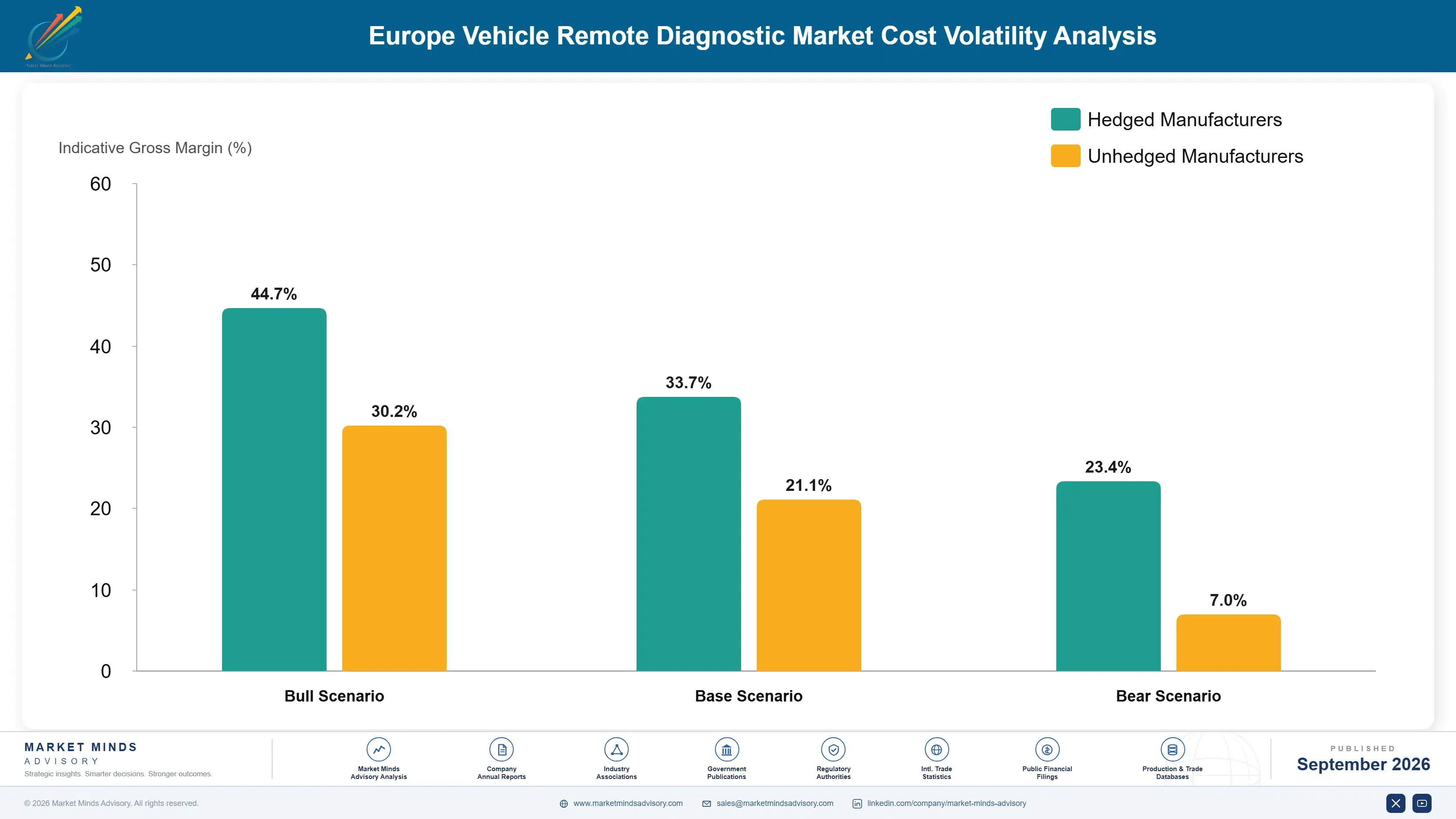
Cloud Compute and Talent Cost Exposure

Cloud compute and storage capacity for processing telematics data at scale represents roughly 24% of vendor cost of goods sold, sourced primarily from the same hyperscale providers that vendors also compete against for enterprise fleet analytics budget. Specialized machine learning engineering talent represents a further 23% of operating cost, sourced from a scarce labor pool concentrated in a handful of European technology hubs.
A 2025 cloud compute pricing adjustment from a major hyperscale provider raised processing costs for telematics data pipelines by an estimated 10% for vendors running at scale, compressing gross margins for providers without long-term committed-use pricing agreements in place. Smaller vendors lacking negotiating leverage with hyperscale providers absorbed the increase directly, according to company annual report disclosures covering the affected period, with several noting the increase directly in quarterly earnings commentary.

Vendors dependent on a single cloud provider for compute capacity face greater cost exposure than those maintaining multi-cloud processing architecture, since single-provider dependency removes negotiating leverage during pricing renegotiation cycles. Larger vendors with committed-use discounts and in-house infrastructure engineering teams can absorb these cost shifts more easily than smaller competitors operating on standard public pricing tiers without volume commitments.
europe-vehicle-remote-diagnostic-market-company-positioning-matrix-1790000586644

Negotiate Committed-Use Cloud Pricing Agreements Early

Vendors are locking in multi-year committed-use pricing agreements with hyperscale cloud providers before processing volume scales further, securing discounted rates that shield margins from future list-price increases across the contract term. Early movers report meaningfully lower effective compute costs than competitors negotiating later in the cycle, a gap that compounds meaningfully across a multi-year contract horizon.

Diversify Processing Across Multiple Cloud Providers

Multi-cloud processing architecture reduces single-vendor pricing leverage risk and improves negotiating position during renewal cycles, though it adds engineering complexity that smaller vendors sometimes struggle to justify given limited internal infrastructure engineering headcount available for managing several parallel environments across different geographic regions and billing structures simultaneously, an operational burden that grows with each additional relationship.

Build In-House Infrastructure for High-Volume Workloads

Larger vendors are shifting the highest-volume processing workloads onto owned infrastructure rather than public cloud capacity, trading upfront capital expenditure for long-term cost predictability that public cloud pricing cycles cannot reliably guarantee over time, particularly during periods of sustained industry-wide compute demand growth that public cloud vendors periodically pass through as list-price increases across the broader industry.

Portfolio Architecture for Margin Defence

Portfolio economics split across three tiers running from commodity reactive diagnostic tools to premium certified predictive platforms and forward-looking right-to-repair compliance and data licensing services. Gross margins widen considerably moving up the tier structure, reflecting the specialized machine learning engineering effort required to build reliable predictive fault detection models that hold up reliably across diverse vehicle types and operating conditions.
Volume-tier diagnostic tools face persistently lower long-term returns as commoditization pressure intensifies from open-source alternatives and bundled features inside broader fleet telematics suites. Premium predictive platforms retain pricing power because customers cannot easily replicate proprietary models trained on years of accumulated fleet data across diverse vehicle types and driving conditions accumulated over many years of continuous refinement.

High-value revenue pools concentrate in fleet accounts requiring compliance-grade reporting and predictive maintenance services layered atop core diagnostic platforms, where switching costs run highest and renewal rates stay strongest. Vendors positioning purely on price compete for shrinking margin in the volume tier, while those investing in predictive accuracy and proprietary model development capture disproportionate value as the market matures further over the coming decade of continued regulatory evolution.

Reactive diagnostic scan tools competing primarily on price against open-source alternatives, with gross margins concentrated in the 30 to 40% range across most vendors in this segment of the market.
Gross Margin

Predictive maintenance platforms with proprietary machine learning models and formal accuracy certifications, carrying gross margins typically between 55 and 65% across the premium vendor base overall, well above commodity-tier tool pricing.
Gross Margin

Right-to-repair compliance and data licensing platforms purpose-built for regulated data access, commanding gross margins above 65% given specialized compliance engineering investment required to build and continuously maintain them against evolving regulatory requirements.
Gross Margin
europe-vehicle-remote-diagnostic-market-cost-volatility-analysis-1790000587140

Diagnostics as a Vehicle-Life Annuity

Vehicle remote diagnostic platforms generate durable, multi-year revenue because subscription enrollment ties to the vehicle ownership lifecycle rather than a single transaction, making replacement costly and operationally disruptive once integrated into a fleet's maintenance workflow and technician training programs built around a specific vendor's platform interface.
Adoption stickiness varies by end-use vertical: commercial fleet operators show the deepest platform dependence given integration with dispatch and maintenance scheduling systems, while individual vehicle owners show comparatively higher willingness to switch providers as newer capability becomes available in the broader market. Independent workshops adopt more cautiously but retain platforms longer once integrated, given the complexity and cost of retraining technicians on alternative systems mid-operation without disrupting daily service delivery.

Buyer profiles are shifting generationally as younger fleet managers increasingly favor cloud-connected, API-driven diagnostic platforms over the manual scan-tool procurement processes that defined earlier generations of fleet maintenance decisions. Younger managers entering decision-making roles show stronger preference for consumption-based pricing and self-service deployment models over the multi-year hardware contracts that previously anchored purchasing decisions across most large fleet organizations of the prior fleet management generation across most European markets.
Section default visual

Where MMA Sees the Advantage

These are among the four positions where our research anticipates prominent divergence between winners and laggards over the coming forecast period. Each is grounded in the demand model, the regulatory perimeter, and the announced capacity pipeline.
01 / PREDICTIVE PLATFORM INVESTMENT

Prioritize predictive diagnostics over reactive scan tools

Manufacturers and software vendors should direct new product development budget toward predictive fault detection platforms rather than incremental reactive scan tool upgrades, since predictive capability is becoming the primary differentiator across most large fleet accounts today. The fastest-growing segment expands at 16.2% CAGR, roughly 1.56 times the overall market rate, concentrated heavily among commercial fleet operators in Germany, France, and Poland. Vendors slow to make this shift risk falling behind competitors already capturing this growth across every major European geography tracked in this analysis.
02 / DATA LICENSING EXPANSION

License diagnostic data to independent workshops proactively

Manufacturers should expand standardized diagnostic data licensing to independent workshops rather than resisting right-to-repair compliance, since this creates new revenue streams worth 15 to 22% of historical dealer-only access value. Manufacturers with efficient licensing programs are already capturing this new revenue ahead of slower-moving competitors. Manufacturers without compliant licensing infrastructure risk regulatory enforcement action and lost goodwill among independent repair networks that regulators actively monitor for compliance across every member state currently, a scrutiny level unlikely to relax anytime soon.
03 / WESTERN EUROPEAN CONCENTRATION

Concentrate expansion investment across Western Europe first

Western Europe holds 58% of this report's defined market share and remains the largest single region given Germany's automotive manufacturing base and the United Kingdom's active right-to-repair enforcement. Vendors should prioritize localized product development and manufacturer partnership investment there before expanding into Eastern European markets. Renewal rates and average contract value both run higher across Western Europe than the broader regional average tracked in this report's full seven-region coverage spanning the entire continent's automotive service and fleet management landscape this report evaluates in full depth.
04 / DATA PRIVACY COMPLIANCE RISK

Address consent management gaps before scaling data sharing

Strict European data protection requirements threaten to extend onboarding timelines and reduce data completeness if left unaddressed by vendors racing to expand diagnostic data sharing capability. The root cause is the region's stringent personal data framework treating vehicle telemetry as data requiring explicit owner consent. Vendors investing in efficient consent management platforms will outcompete rivals relying on manual, paper-based authorization processes that slow onboarding considerably and frustrate fleet operators seeking rapid deployment across their entire connected vehicle fleet without unnecessary administrative delay.

Engagement Snapshot From the Field

A live engagement with an industry participant carrying material or product regulatory and market exposure ahead of a defining policy shift, showing how our research translates into a defensible multi-year portfolio strategy.
MARKET MINDS ADVISORY · CLIENT ENGAGEMENT SUMMARY
Europe Vehicle Remote Diagnostic Producer Strategic Portfolio Review and Transition Roadmap 2026·Investment Scenario on Europe Vehicle Remote Diagnostic Exposure Evaluation 2025-26
CLIENT PROFILE
The client is a pan-European logistics operator running a mixed-brand delivery fleet across a dozen countries, operating legacy reactive diagnostic tools that required vehicles to return to depot before technicians could identify fault codes. Facing rising unplanned downtime costs affecting delivery schedules, leadership sought an independent assessment of which predictive diagnostic platform could deliver measurable downtime reduction across its diverse vehicle fleet.
STRATEGIC CHALLENGE
The operator's fleet management team lacked a consistent framework for evaluating predictive platforms across cross-brand compatibility, prediction accuracy, and integration with existing dispatch systems, since prior diagnostic decisions had been made independently by regional country managers. Competing vendor relationships across countries created fragmented data standards and duplicated licensing costs across the operator's network.
MMA APPROACH
MMA evaluated five leading predictive diagnostic vendors against a standardized scoring framework covering cross-brand compatibility, prediction accuracy, and total cost of ownership across the operator's actual fleet composition. The engagement combined vendor pilot testing across representative delivery routes, reference customer interviews within European logistics, and negotiated group pricing modeling across a five-year contract horizon.
KEY FINDINGS
  1. Two of five evaluated vendors demonstrated meaningfully broader cross-brand compatibility, a critical requirement given the operator's diverse, multi-manufacturer delivery fleet spanning several vehicle categories.
  2. Negotiating group pricing across the full pan-European fleet rather than country-specific agreements reduced projected five-year cost by an estimated 20% across the entire network.
  3. Predictive fault detection reduced unplanned downtime incidents by roughly 26% during pilot testing across three representative delivery regions during the trial period.
  4. Country-level support and training coverage varied considerably across vendors, with only two offering adequate presence across all twelve of the countries the operator serves.
CLIENT PROFILE
The client is a pan-European logistics operator running a mixed-brand delivery fleet across a dozen countries, operating legacy reactive diagnostic tools that required vehicles to return to depot before technicians could identify fault codes. Facing rising unplanned downtime costs affecting delivery schedules, leadership sought an independent assessment of which predictive diagnostic platform could deliver measurable downtime reduction across its diverse vehicle fleet.
STRATEGIC CHALLENGE
The operator's fleet management team lacked a consistent framework for evaluating predictive platforms across cross-brand compatibility, prediction accuracy, and integration with existing dispatch systems, since prior diagnostic decisions had been made independently by regional country managers. Competing vendor relationships across countries created fragmented data standards and duplicated licensing costs across the operator's network.
MMA APPROACH
MMA evaluated five leading predictive diagnostic vendors against a standardized scoring framework covering cross-brand compatibility, prediction accuracy, and total cost of ownership across the operator's actual fleet composition. The engagement combined vendor pilot testing across representative delivery routes, reference customer interviews within European logistics, and negotiated group pricing modeling across a five-year contract horizon.
KEY FINDINGS
  1. Two of five evaluated vendors demonstrated meaningfully broader cross-brand compatibility, a critical requirement given the operator's diverse, multi-manufacturer delivery fleet spanning several vehicle categories.
  2. Negotiating group pricing across the full pan-European fleet rather than country-specific agreements reduced projected five-year cost by an estimated 20% across the entire network.
  3. Predictive fault detection reduced unplanned downtime incidents by roughly 26% during pilot testing across three representative delivery regions during the trial period.
  4. Country-level support and training coverage varied considerably across vendors, with only two offering adequate presence across all twelve of the countries the operator serves.
RECOMMENDED STRATEGY
Phase 1: Phase one negotiates a pan-European pricing agreement with the two highest-compatibility vendors, structured to serve the operator's full delivery fleet. Phase 2: Phase two sequences country-level rollout starting with countries showing the strongest pilot testing results and management enthusiasm for adoption during the initial testing phase. Phase 3: Phase three establishes a standardized vendor evaluation framework for future pan-European diagnostic technology purchasing decisions across all future contract renewal cycles.
OUTCOME
The operator approved a pan-European pricing agreement covering its full delivery fleet with a projected five-year technology spend of approximately €38 million (client-reported, unverified by MMA). Fleet management reporting credited the standardized framework with resolving prior country-level purchasing disputes and reducing downtime meaningfully faster than the operator's original multi-year rollout timeline.

Frequently Asked Questions

Foundational context covering the market sizes, CAGR, scope, country, region and competition that inform every finding below. This section is provided to cover basics and most often pre-purchase conversations, answered from the MMA Primary Research Dataset.

What is the current size of the Europe Vehicle Remote Diagnostic Market?

The Europe Vehicle Remote Diagnostic market reached $3.1 billion in 2025. Growth is driven primarily by connected vehicle penetration and right-to-repair regulatory pressure across the continent.

How large will the Europe Vehicle Remote Diagnostic Market be by 2036?

The market is projected to reach $9.2 billion by 2036. This reflects sustained demand for predictive diagnostics across fleet, dealer, and independent workshop channels throughout Europe.

What is the CAGR for the Europe Vehicle Remote Diagnostic Market 2026 to 2036?

The market is forecast to grow at a 10.4% CAGR between 2026 and 2036. This accelerates from the 9.4% historical CAGR recorded over 2020 to 2025.

Which segment is growing fastest?

Predictive Fault Detection Software Platforms is the fastest-growing segment, expanding at 16.2% CAGR, roughly 1.56 times the overall market rate. Fleet operators concentrate demand in this category.

Who are the major companies in the Europe Vehicle Remote Diagnostic Market?

Bosch, Continental AG, Geotab, TomTom Telematics, and Vector Informatik lead the competitive landscape, together holding an estimated 49% combined share. Each competes on integration depth and analytics accuracy.

Which country is growing fastest?

Poland is the fastest-growing country market, expanding at 14.1% CAGR. Expanding automotive manufacturing and logistics sectors are driving accelerated diagnostic platform adoption across the entire country's fleet base.

Report Segmentation Architecture

The full report scope spans multiple orthogonal segmentation dimensions, with cross-tabulated demand data provided for each dimension pair. Coverage extends further to regional breakdowns, trend trajectories, and the competitive detail needed to support segment-level decision-making.

By Platform Type (Predictive, Reactive, Data Access Licensing)

    By End-Use Fleet Type (Commercial Fleet, Individual Owner, Workshop)

      By Commercial Dimension (Direct Sale, Subscription, Data Licensing)

        By Region

        • Western Europe
        • Eastern Europe
        • North America
        • East Asia
        • South Asia and Pacific
        • Latin America
        • Middle East and Africa

        Scope, Methodology, and Coverage

        Every figure in this report is reproducible from documented input assumptions. The scope below maps the historical period, the forecast horizon, the segmentation dimensions, and the countries covered, alongside the underlying primary and qualitative methodology.
        Historical Period
        2020 to 2025
        Forecast Period
        2026 to 2036
        Base Year
        2025 (USD billions; MMA Primary Research Dataset, September 2026)
        Market Definition
        This report defines the Europe Vehicle Remote Diagnostic Market as software platforms and connected hardware that capture, transmit, and analyze vehicle diagnostic data remotely for maintenance, fault prediction, and fleet management purposes across the European market. It excludes standalone onboard diagnostic scan tools without remote connectivity, general fleet telematics platforms without dedicated diagnostic analysis capability, and vehicle infotainment systems.
        Quantitative Units
        USD billions, market share percentages, CAGR percentages
        Segmentation Dimensions
        Platform type, end-use fleet type, commercial dimension, region
        Regions Covered
        Western Europe, Eastern Europe, North America, East Asia, South Asia and Pacific, Latin America, Middle East and Africa
        Countries Covered
        Germany, France, United Kingdom, Italy, Spain, Poland, Netherlands, Romania, and 14 additional European markets
        Key Companies Profiled
        Bosch, Continental AG, Geotab, TomTom Telematics, Vector Informatik, and 15 additional participants
        Quantitative Methodology
        Primary survey, n=3,800 respondents, Q4 2025, six countries; demand-side model with trade association cross-validation
        Qualitative Methodology
        47 expert interviews, Q4 2025; applied to validate demand model assumptions, identify emerging dynamics, and assess competitive positioning
        Report Format
        PDF and XLSX data workbook (Word format preview document)
        Publisher
        Market Minds Advisory
        Report Code
        MMA-2026-AUT-128
        Published
        September 2026
        Contact
        sales@marketmindsadvisory.com | www.marketmindsadvisory.com

        Purchase the full Europe Vehicle Remote Diagnostic Market Report (2026 to 2036).

        This report examines the European vehicle remote diagnostic market across predictive, reactive, and data access licensing categories through the year 2036, covering both established fleet buyers and emerging independent workshop segments. It quantifies demand shifts driven by right-to-repair legislation and connected vehicle penetration. Profiles of five leading vendors sit alongside fifteen additional participants, assessed on a common concentration and capability basis. Regional adoption patterns are detailed across Western and Eastern Europe in the underlying dataset. Coverage also includes forecast scenarios, cost exposure, and portfolio margin economics across three equipment tiers.
        Ten-year demand forecast by platform category
        Vendor compliance and pricing benchmarking analysis
        Regional adoption pattern analysis across Europe
        Cloud compute cost exposure and mitigation assessment
        Portfolio margin economics across three product tiers
        Competitive positioning and moat durability assessment

        Built For The People Who Decide

        From boardroom strategy to bench-side execution, this report is read cover-to-cover by leaders shaping the next decade of their industry, turning demand scenarios, market dynamics and valuation benchmarks into decisions.
        CXOs/ Presidents/ VPs/ Managers
        M&A and Corporate Development
        Strategy Teams and R&D Heads
        Procurement and Product Directors
        Regulatory and Compliance Leaders
        Investor Relations and Equity Analysts