Market Minds Advisory
Europe Small UAV Market

Europe Small UAV Market: Regulatory Friction, Consumable Economics and Supply Chain Provenance

Europe wrote the most complete small drone rulebook anywhere and then found it was the binding constraint, while defence buyers turned the same platforms into consumables priced by the sortie.

Lead Analyst

Published

September 2026

Make Smarter Decisions with Customized Research Insights

Request a free sample report and evaluate market opportunities, growth trends, and competitive dynamics relevant to your business needs.

2025 MARKET VALUE$2.4BMarket Size 2025
2036 FORECAST VALUE$8.4BBase Case , 2026 to 2036
CAGR 2026 TO 203612.0 %Bull 13.3% / Bear 10.8%
INCREMENTAL OPPORTUNITY$5.7BNet 10- year value creation
EXPANSION MULTIPLE3.11x2036 value over 2026 base
Strategic Levers
M&A Pipeline
Regional Outlook
Country Rankings
Competitive Intelligence
Segmental Deep-dive
Call-Us : 91 93563 13602

Executive Snapshot and Market Trajectory

Europe wrote the world's most complete small drone rulebook and then discovered the rulebook was the constraint. Approval in the specific category still takes many months, national authorities read the same risk assessment differently, and cross-border operation, which was the entire point, still needs per-state coordination today.
Defence spending has reshaped the commercial picture entirely. European armies are buying small platforms at volumes and unit costs no civil operator ever generated, and they treat them as consumables rather than as durable equipment. That rewards manufacturing throughput over product refinement. Attritable single-use platforms grow fastest at 18.0%, half again the market rate of 12.0%, from a base that scarcely existed in 2021.
This is among the most fragmented markets in aerospace, with five firms holding 22%, and it is fragmenting further rather than consolidating. Dozens of manufacturers reached credible volume after 2022, many of them founded since. The dividing line now is supply chain provenance: procurement increasingly requires motors, controllers and cells from vetted sources, which raises the bill of materials substantially and separates manufacturers that re-sourced early from those still assembling Chinese components at lower cost.
Market Definition
This report covers small unmanned aircraft systems operated within Europe, meaning platforms with maximum take-off mass at or below 25 kilograms as framed by European Union aviation rules. Scope includes fixed-wing reconnaissance platforms, multirotor inspection platforms, vertical take-off fixed-wing platforms, attritable single-use platforms, tethered persistent platforms and cargo delivery platforms, together with the ground control equipment sold with them. Excluded are tactical and larger unmanned aircraft above 25 kilograms, counter-unmanned-aircraft systems, air traffic and U-space service provision, payload sensors sold separately, and data processing software sold independently of a platform.
Base Year Value
$2.4B in 2025 (MMA Primary Research Dataset, September 2026)
Forecast Period
2026 to 2036, eleven discrete annual values
CAGR
12.0% base case. Bull 13.3%. Bear 10.8%.
Fastest Growth Segment
Attritable Single-Use Platforms: 18.0% CAGR
Fastest Growth Country
Poland: 16.4% CAGR
Fastest Growth Region
South Asia and Pacific: 14.0% CAGR
Largest Region
Western Europe: 52% of 2025 global value
Market Leaders
Quantum-Systems, Delair, Wingcopter, Parrot, Tekever. Source: MMA Analysis based on platform unit shipments and contracted programme value, July 2026.
Primary Survey
n=3,800 procurement and R&D decision-makers, Q4 2025, six countries
Methodology
Demand-side build-up, cross-validated against public data, 47 expert interviews

Europe Small UAV Market Forecast Scenarios

europe-small-uav-market-industry-size-forecast-scenario-1790026055064
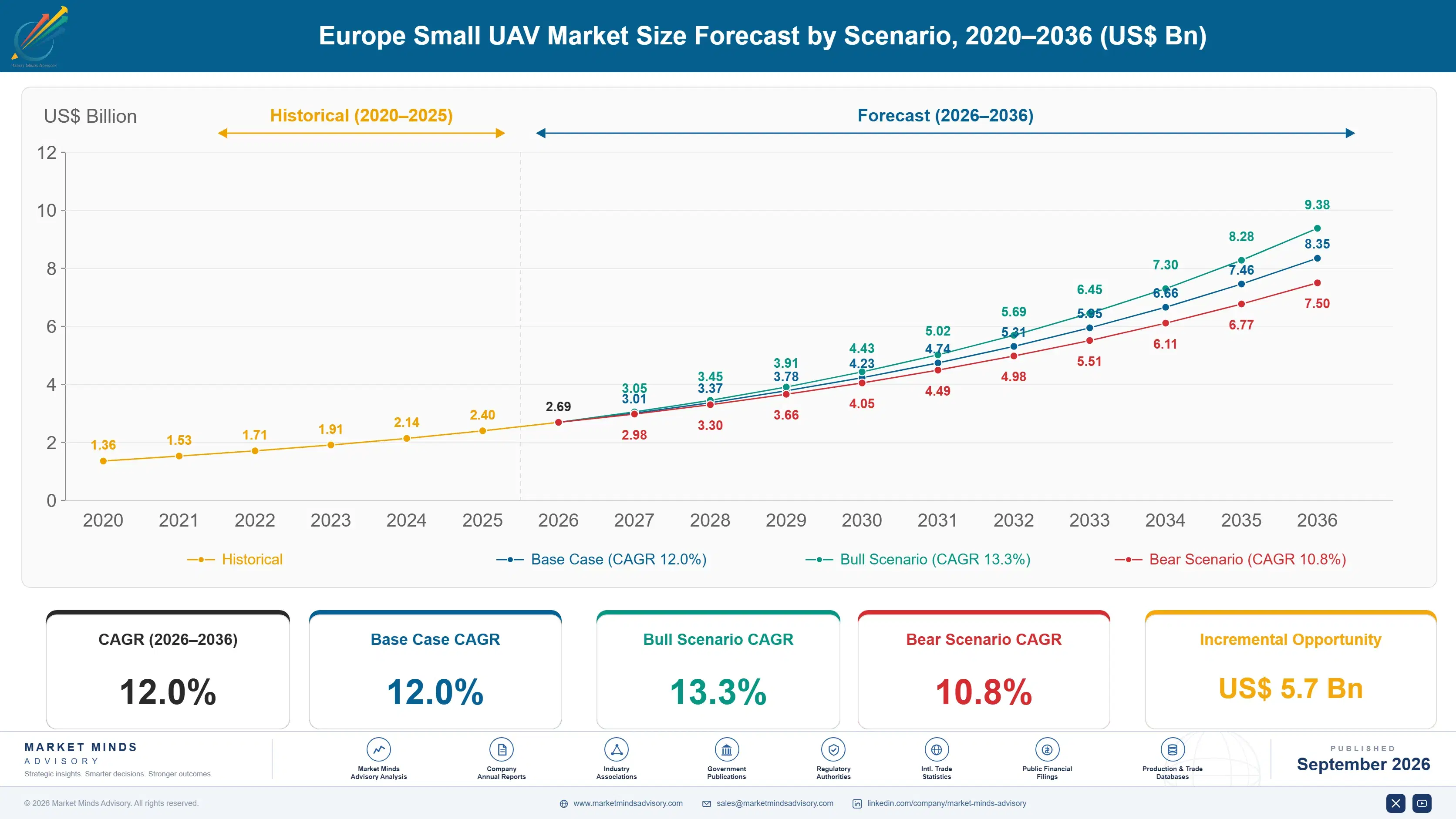
The 2020 to 2025 period contains two different markets. Until 2022 this was a civil business selling durable survey and inspection platforms to utilities, surveyors and farmers, growing steadily but modestly. From 2022 defence procurement arrived at a scale that dwarfed all of it, and demand composition changed faster than any supplier's production planning. Growth averaged 10.9% across the period, with the last three years far above that.
Base case growth of 12.0% rests on three mechanisms. European defence budgets now fund small platform procurement as a recurring consumable line rather than as a capital purchase, which makes volume repeatable rather than one-off. Grid, rail and wind inspection programmes expand civil demand on a separate, steadier track. And vetted supply chain requirements are redirecting procurement toward European manufacture, which raises unit prices and captures value that previously left the region.
The bull case at 13.3% assumes cross-border operating approval genuinely harmonises, which would let civil operators scale across member states instead of rebuilding permissions in each one. The bear case at 10.8% follows from defence budgets reverting toward equipment rather than consumables, which would strand capacity built for volume and expose manufacturers who abandoned the civil market to reach it.

Two Markets Wearing the Same Airframe

The same airframe now serves two businesses with opposite economics. Civil inspection buyers want a durable platform that flies for years, and will pay for reliability, service and data workflow. Defence buyers want units by the hundred at the lowest cost, accept a life measured in sorties, and value throughput above everything. Few European manufacturers were built for both, and several have chosen.
FIVE-FIRM CONCENTRATION22%Fragmentation still increasing rather than consolidating across the region
AVERAGE PLATFORM UNIT PRICEUSD 34kBlended across civil inspection and defence procurement platforms
SPECIFIC CATEGORY APPROVAL TIME7 monthsMedian from application to operational authorisation across member states
VETTED SOURCING COST PREMIUM38%Bill of materials increase from non-Chinese component sourcing
DEFENCE SHARE OF DEMAND61%Portion of regional platform volume bought by defence
ATTRITABLE PLATFORM SERVICE LIFE3 sortiesAverage flights achieved before loss on single-use platforms
Regulation is where the civil side keeps stalling. The European framework was designed to harmonise operation across member states, but approval in the specific category still runs around seven months at the median and national authorities interpret identical risk assessments differently. An operator authorised in one country routinely rebuilds its permissions in the next. That friction is the largest reason civil adoption trails the technology's capability rather than any shortage of demand.
Supply chain provenance has become the commercial dividing line. Procurement increasingly requires motors, flight controllers and cells from vetted sources, and re-sourcing away from Chinese components raises the bill of materials by roughly 38%. Manufacturers who started that work early can bid contracts that others cannot, and they price the premium rather than absorbing it. Those still assembling Chinese parts remain cheaper and increasingly ineligible.
"Half the companies in this market think they are selling aircraft and the other half have realised they are selling ammunition. Those are not the same business, and the factories do not look alike either."
Director, Unmanned Systems and Autonomy Practice · MMA Technology / Unmanned Aircraft Systems Practice · September 2026

Market Trends

Defence Buyers Treat Small Platforms As Consumable Stock

Procurement has shifted from capital equipment purchasing to recurring consumable lines, with platforms expected to achieve a handful of sorties rather than years of service. That changes almost every commercial assumption: warranty becomes irrelevant, production rate becomes decisive, and unit cost matters far more than capability margin. Manufacturers built around low-volume precision assembly are struggling to reach the rates required, while entrants with consumer electronics manufacturing backgrounds compete credibly for the first time. Defence now accounts for roughly 61% of regional platform volume. Production rate capability now decides these awards outright.
Market Impact: Commits 340,000 platform units regionally
Vetted Component Sourcing Splits The Supplier Field

Procurement rules across several member states now require motors, flight controllers, radios and cells from approved supply chains, which in practice means non-Chinese. Re-sourcing raises the bill of materials by around 38% and takes eighteen months or more to qualify properly. The effect is a two-tier supplier field: manufacturers who moved early bid contracts their cheaper competitors are formally excluded from, and they hold pricing because the comparison is unavailable. European component manufacturing is expanding to serve this, though capacity remains well behind demand. Compliance eligibility now matters more than platform design merit.
Market Impact: Covers 27 major inspection programmes

Market Opportunities and Growth Drivers

European Defence Budget Growth Funds Recurring Platform Procurement

Defence spending increases across the region since 2022 have created small platform procurement lines that renew annually rather than periodically, and several states have moved them into ammunition-style budget categories. That makes the demand repeatable and forecastable in a way capital equipment purchasing never was. Polish, Baltic, Nordic and German programmes are the largest contributors, and each has attached domestic production expectations. Roughly 340,000 platform units across the region are covered by multi-year procurement commitments over the forecast period. Budget category placement is what makes this demand genuinely repeatable year after year.
Market Impact: Adds 7 months before operation

Grid, Rail And Wind Inspection Programmes Expand Civil Demand

European transmission operators, rail infrastructure managers and wind farm owners have moved from trial deployments to programme-scale inspection using small platforms, driven by asset ageing and inspection labour cost. The work is recurring and contractually specified, which makes it the steadiest demand in the market. It also rewards platform endurance and data workflow rather than unit cost, which suits established civil manufacturers. Around 27 major infrastructure inspection programmes across the region now specify unmanned aircraft inspection as standard practice. Contracted inspection cycles make this by far the steadiest demand available.
Market Impact: Rate gap excludes 71% of manufacturers

Market Restraints and Challenges

Specific Category Approval Remains Slow And Nationally Inconsistent

Operations beyond the open category require a risk assessment and authorisation that takes around seven months at the median, and national aviation authorities apply the same methodology to different conclusions. The root cause is that authorisation remains a national competence even under a harmonised framework, so no operator or manufacturer can shorten it. Commercially this caps civil scaling and pushes operators toward simpler missions than the technology permits. Mitigation runs through standard scenario declarations, pre-approved operational packages sold with platforms, and authorisation support services. National competence is what keeps the friction in place.
Market Impact: Defence reaches 61% of volume

Production Rate Capability Limits Access To Defence Volume

Defence procurement now specifies unit quantities that most European manufacturers cannot physically build, having been established to produce tens or hundreds of platforms annually rather than tens of thousands. The root cause is an engineering and assembly culture built for precision low-volume work, which does not convert quickly into rate manufacturing. The commercial effect is that contracts go to whoever can deliver rather than to whoever designs best. Participants are answering with contract manufacturing partnerships, design simplification for assembly, and dedicated high-rate production lines separate from existing plants. Design capability counts for little without delivery capacity.
Market Impact: Sourcing premium reaches 38% higher
4 additional market trends, 3 additional growth drivers, and 2 additional restraints and challenges are covered in the full report. Contact sales@marketmindsadvisory.com to access the complete intelligence.

Segment CAGR and Growth Architecture

Platforms are segmented here by class, because class determines the buyer, the certification path and the unit economics. Mixing platform class with payload type or mission application produces categories that overlap on nearly every programme. Six classes cover the field from attritable single-use platforms through to tethered persistent systems, and the economics between them could hardly differ more.
europe-small-uav-market-industry-market-share-analysis-1790026055619

Attritable Single-Use Platforms

Growing at 18.0%, half again the market rate of 12.0%, this class scarcely existed in Europe before 2021 and now drives most of the market's volume growth. Platforms are designed for a handful of sorties, built from commercial propulsion and simplified airframes, and bought in quantities that resemble ammunition procurement rather than equipment purchasing. Unit prices sit far below conventional platforms, which is the entire point, and margin per unit is correspondingly thin. What matters commercially is production rate and vetted component supply, not capability margin. European manufacturers built for precision low-volume assembly have found this genuinely difficult to serve profitably. Rate capability and component provenance decide these awards, not capability margin.
CAGR 18.0%

Fixed-Wing Reconnaissance Platforms

Fixed-wing reconnaissance platforms grow at 13.4% on sustained defence demand for endurance and area coverage that multirotors cannot provide. These are durable equipment rather than consumables, bought with spares, training and support, which makes the revenue per customer considerably higher and the relationship longer. Payload integration is where the value concentrates, since a platform without a qualified electro-optical or signals payload is an airframe looking for a purpose. Several of the region's strongest manufacturers sit in this class, and it is the one where European engineering depth translates most directly into competitive advantage against cheaper imports. Payload qualification rather than airframe design is where the genuinely defensible position actually sits.
CAGR 13.4%
Full segment breakdown across 6 segments available in the complete report.

Regional Architecture and Country Demand Map

This is a region-scoped report, so the regional table records where the platforms and major components serving European operators are manufactured rather than where demand sits. Western European manufacture dominates, with Eastern European capacity rising sharply and East Asian components still substantial despite procurement restrictions.

Western Europe

Western European manufacture accounts for 52% of supply, far above the 18 to 26% band used for this region elsewhere in this report, because the report scope is European small unmanned aircraft and most platform design and final assembly sits here by definition. German, French and Portuguese manufacturers lead on platform volume, with Swiss and Nordic specialists strong in inspection and tethered applications. The region also holds most of the design authority and airworthiness expertise, which matters as defence procurement adds qualification requirements. Growth of 10.6% trails the regional market rate because Eastern European capacity is expanding faster from a smaller base and taking incremental volume. Design authority sits here even where assembly moves.
Share: 52% | CAGR: 10.6% (2026 to 2036)

Eastern Europe

At 14%, well above the 2 to 5% band applied elsewhere, Eastern European manufacture has grown faster than any other source of supply since 2022. Polish, Estonian, Latvian and Lithuanian manufacturers moved from small workshops to genuine production operations in a very short period, helped by domestic procurement that prioritised local supply and by proximity to the demand that created it. Several of these firms are now exporting within the region rather than only serving national customers. Growth of 11.2% understates the trajectory, because much of the capacity came on stream recently and is still filling. Production rate capability here has outpaced Western European manufacturers. Capacity here came on stream recently and is still filling.
Share: 14% | CAGR: 11.2% (2026 to 2036)
Regional intelligence for 5 additional markets available in the complete report: East Asia, North America, Middle East and Africa, South Asia and Pacific, Latin America. Contact sales@marketmindsadvisory.com.
europe-small-uav-market-industry-country-cagr-analysis-1790026056126

Where Small Platform Businesses Earn Margin

Platform unit sales are the visible revenue in this market and increasingly the thinnest part of it. Vetted sourcing position, authorisation support and payload integration decide delivered margin instead. The four levers below reflect positions European participants have used to improve economics measurably rather than to win unit volume. Rate capability underpins several of them.

Qualify Vetted Component Supply Ahead Of Requirements

Re-sourcing motors, controllers, radios and cells away from Chinese supply raises the bill of materials by roughly 38% and takes eighteen months or more to qualify. Manufacturers who completed it early bid contracts that cheaper competitors are formally excluded from, and they price the premium rather than absorbing it. Realised unit pricing on vetted-sourcing contracts has run around 44% above open-market equivalents. The cost is carrying a higher bill of materials during the period before procurement rules made it mandatory. None of it can be done once a tender has appeared.
Market Impact: Vetted contract pricing runs roughly 44% higher overall

Sell Operational Authorisation With The Platform

Specific category approval takes around seven months and stops many civil operators from buying at all. Manufacturers supplying pre-built operational packages, standard scenario documentation and authorisation support convert a regulatory obstacle into a service revenue line, and they shorten their own sales cycle considerably. Platforms sold with authorisation support have closed roughly 2.6 times faster than equipment-only proposals. The requirement is regulatory expertise rather than engineering, which most manufacturers have treated as somebody else's problem. Most manufacturers have treated approval as the customer's problem entirely, which leaves the revenue on the table.
Market Impact: Sales cycle closes roughly 2.6 times faster overall

Build Rate Capacity Separately From Precision Assembly

Defence volumes now exceed what most European manufacturers can physically build, and attempting high rates inside a precision low-volume plant fails on both counts. Establishing a separate line with simplified designs, commercial components and different labour reaches the rates required. Manufacturers who did this have achieved unit costs roughly 57% below their conventional platform equivalents. The organisational difficulty is real, because it means running two manufacturing cultures and accepting much lower margin per unit in one of them. Running two manufacturing cultures under one roof is the real cost here.
Market Impact: Attritable unit cost falls roughly 57% lower overall

Own Payload Integration Rather Than Airframe Supply

A reconnaissance platform without a qualified payload is an airframe without a purpose, and payload integration carries gross margin well above the airframe it sits on. Manufacturers holding qualified electro-optical, thermal and signals payload integration capture the content buyers actually specify, and they can integrate onto competitors' airframes where the customer already owns a fleet. Payload content typically represents around 41% of delivered programme value on reconnaissance platforms. The barrier here is sensor qualification work rather than any mechanical integration difficulty. Fitting competitors' airframes also reaches programmes the manufacturer never won itself.
Market Impact: Payload holds roughly 41% of delivered programme value

Who Controls the Margin Pool

Concentration is exceptionally low at 22% for the top five, measured on platform unit shipments and contracted programme value, the basis used throughout this section. More unusually the field is still fragmenting: dozens of manufacturers reached credible volume after 2022, so the gap to the next tier reflects production capacity and contract access rather than any durable technical distance.
Competition currently turns on three dimensions. Vetted component sourcing decides which contracts a manufacturer may bid at all. Production rate capability decides who can deliver the quantities defence procurement now specifies. And payload integration capability decides who captures the content buyers actually pay for on reconnaissance platforms. Established civil manufacturers are strongest on the third and weakest on the second, which is the wrong way round for current demand.

Rankings will move on rate capability, and the entrants are not traditional aerospace firms. Building platforms by the tens of thousands is a consumer electronics manufacturing problem rather than an aerospace one, and firms with that background are taking attritable contracts directly. Eastern European manufacturers have also scaled faster than Western incumbents from a standing start, and several are now exporting within the region rather than serving national customers alone.
europe-small-uav-market-industry-company-positioning-matrix-1790026056656

Competitive Moat and Risk Dimensions

QUANTUM-SYSTEMS

Moat: Vertical Take-Off Platform Position

Quantum-Systems holds a strong position in vertical take-off fixed-wing platforms, which combine multirotor launch flexibility with fixed-wing endurance and are consequently specified where neither alternative works. The company has converted that product position into defence programme access across several member states, and its qualification history with those customers is difficult for a newer entrant to approach quickly.
QUANTUM-SYSTEMS

Risk: Attritable Volume Rate Gap

The firm's manufacturing base was built for capable, durable platforms rather than for the tens of thousands of attritable units defence procurement now buys. Serving that demand means a separate production line, simplified designs and a different cost base, and competitors from consumer electronics manufacturing backgrounds start that race considerably closer to the finish.
TEKEVER

Moat: Operational Service Delivery Model

Tekever sells surveillance outcomes as a service rather than only platforms, operating systems on the customer's behalf under contract. That model removes the customer's need for authorisation, training and maintenance capability entirely, which is a genuine barrier in European civil and maritime work, and it produces contract durations and revenue visibility that unit sales cannot match.
TEKEVER

Risk: Service Model Scaling Limits

Operating platforms for customers requires crews, permissions and local presence in each theatre, which scales with headcount rather than with production. As defence demand shifts toward high-volume consumable procurement that customers operate themselves, a service-weighted business participates less in the fastest-growing part of the market than a manufacturer would.

Players Tracked

Prominent Players

Quantum-Systems
Delair
Wingcopter
Parrot
Tekever

Other Key Players

Helsing
Stark Defence
Elistair
Flyability
AgEagle Aerial Systems
Nordic Unmanned
Robot Aviation
Origin Robotics
Atlas Aerospace
Threod Systems
Schiebel
Leonardo
Thales
Airbus Defence and Space
Alpha Unmanned Systems

Recent Developments

MARCH 2025

Baltic manufacturers win regional supply contracts on production rate capability

Several Baltic small platform manufacturers secured multi-year regional supply contracts specifying delivery quantities rather than platform capability. These were competitive procurement awards rather than corporate transactions, and they went to firms able to demonstrate rate capacity rather than to Western European platform designers of longer standing.
Signal: Rate capability has displaced design capability as the deciding factor in European attritable platform awards entirely now
SEPTEMBER 2024

Member state procurement rules extend vetted sourcing to components

Procurement rules in several member states were extended from finished platforms to major components including motors, flight controllers and cells, requiring approved supply chains. This was a regulatory development rather than a corporate event, and it separated manufacturers who had re-sourced from those who had not.
Signal: Component provenance requirements now formally exclude cheaper assemblers regardless of any platform design merit they hold at all
JANUARY 2025

European manufacturer establishes separate high-rate attritable production line

A European platform manufacturer commissioned a dedicated high-rate line for attritable platforms, physically separate from its existing precision assembly operation and using commercial propulsion and avionics. The investment was organic rather than an acquisition, and it acknowledges that the two product classes need different factories.
Signal: Confirms attritable production requires a separate manufacturing culture rather than merely a simplified version of an existing line

What Sets Delivered Platform Cost

Four inputs dominate. Electric propulsion, meaning motors and speed controllers, runs roughly 17% of cost of goods sold. Lithium cells account for about 15%, flight control and radio semiconductors close to 21%, and airframe composites with assembly labour the remaining 47%. Propulsion, controllers and cells originate overwhelmingly from Chinese manufacture, while flight control semiconductors come from European, North American and Japanese suppliers.
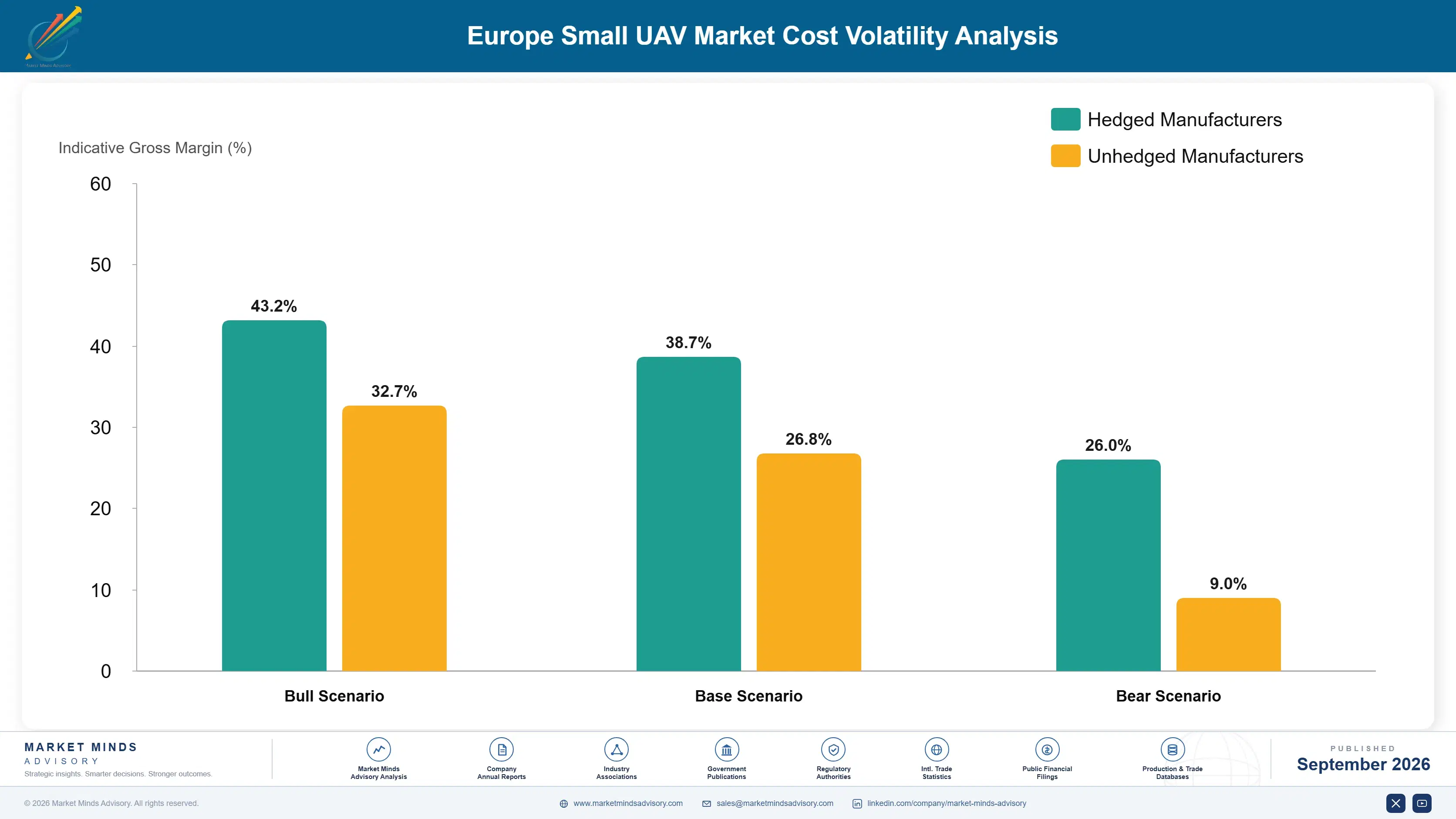
The cost event here is regulatory rather than cyclical. Procurement rules requiring approved component supply chains forced re-sourcing of motors, controllers and cells away from Chinese manufacture, raising the bill of materials by around 38%. Cell pricing moved favourably over the same period, with IEA battery price data showing continued decline, but vetted alternatives cost far more than the market average. Parrot discussed component sourcing and cost pressure in its annual reporting.

The disadvantage mechanism is stark. Manufacturers who re-sourced carry a 38% higher bill of materials but can bid contracts their cheaper competitors are excluded from, while those still assembling Chinese components hold a cost advantage in a shrinking addressable market. Eastern European manufacturers have generally re-sourced faster because their domestic procurement demanded it earliest, giving them compliance and rate capability ahead of Western incumbents.
europe-small-uav-market-industry-cost-volatility-analysis-1790026056852

Qualify European and allied propulsion supply on multi-year terms

Vetted motor and controller capacity in Europe remains well behind demand, so multi-year offtake agreements secure allocation that spot buyers cannot obtain. Early agreements have also been priced before the current scarcity emerged. The cost is volume commitment against procurement rules that could still shift, which is a genuine risk rather than a theoretical one given how recently they changed.

Design attritable platforms around commercially available vetted parts

Specifying components that are already available from approved sources, rather than optimising performance and then seeking compliant equivalents, avoids most of the re-sourcing premium. It constrains performance, which matters little on a platform expected to fly three sorties. Manufacturers designing this way from the outset have reached compliant unit costs that competitors retrofitting compliance cannot approach.

Separate civil and defence bills of materials deliberately

Civil inspection customers do not require vetted sourcing and will not pay the premium, while defence customers require it absolutely. Maintaining separate component specifications for the two lines preserves civil competitiveness without compromising defence eligibility. The overhead is dual qualification and inventory, which smaller manufacturers find difficult, and it is why several have simply abandoned one market or the other.

Portfolio Architecture for Margin Defence

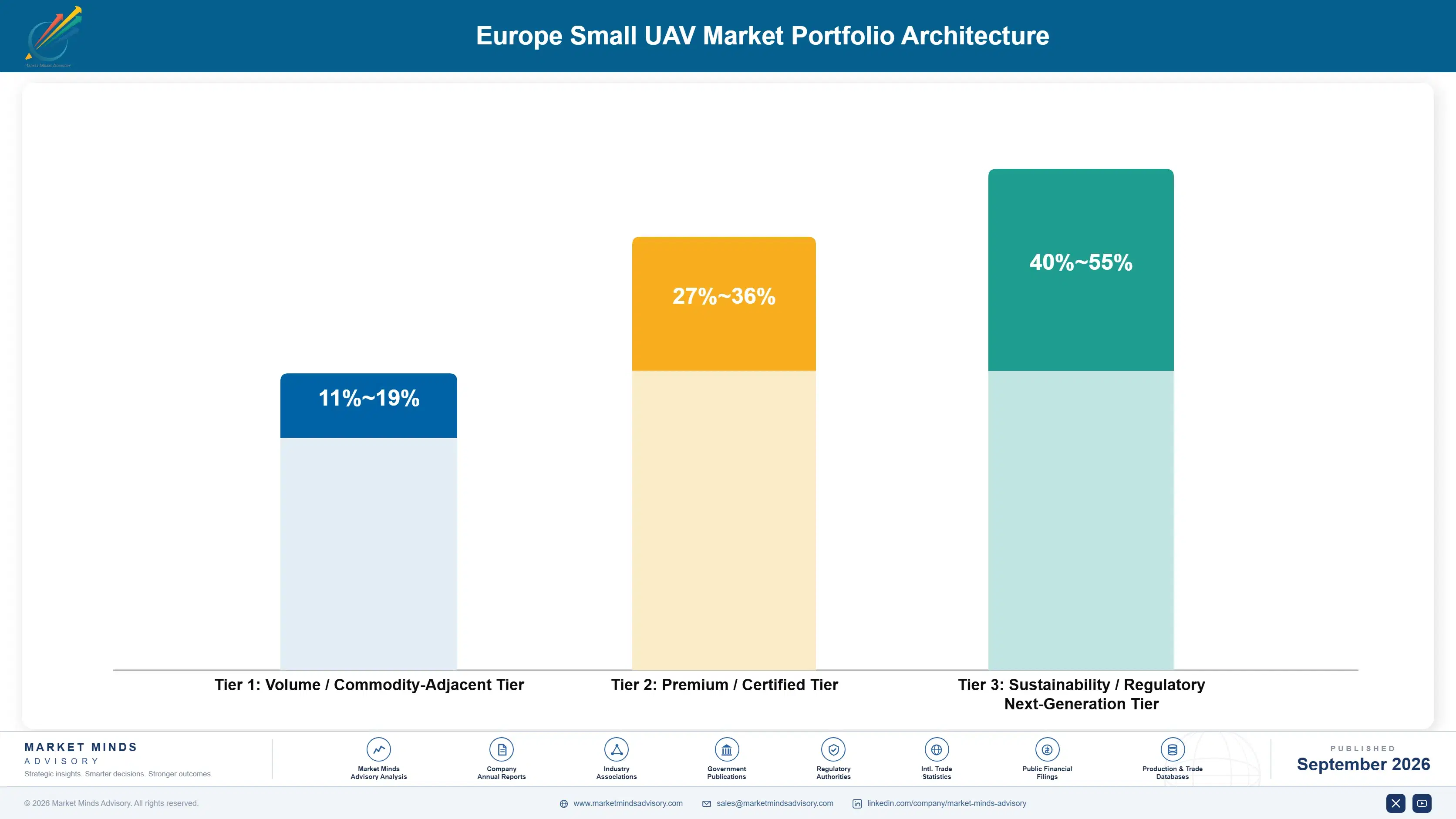
Margin architecture here separates by whether a product is consumed or operated. Attritable platforms sit at the bottom, competitive on unit cost with thin margins and volumes that make rate capability the only thing that matters. Durable reconnaissance and inspection platforms sit in the middle at better economics, defended by payload qualification and support relationships. Payload integration, authorisation services and operated service contracts sit at the top.
The volume-versus-premium tension is sharper here than in most markets because the two tiers need different factories. Volume means simplified designs, commercial components and assembly lines built for rate, and it delivers thin margins on contracts won by delivery capability. Premium means qualified payloads, certification depth and service delivery, and it delivers strong margins on relationships built over years. Manufacturers attempting both inside one operation have generally failed at the volume end.

High-value pools concentrate in three places: payload integration that captures around 41% of delivered programme value on reconnaissance platforms, authorisation and operational support that removes the regulatory barrier civil buyers face, and operated service contracts where the customer buys an outcome rather than equipment. None of the three is won on platform unit price.

Volume / Commodity-Adjacent Tier

Attritable single-use platforms and basic multirotor inspection airframes sold on unit cost against delivery quantity requirements. Margin is thin and rate capability decides awards. The eight point range reflects whether the manufacturer built a dedicated high-rate line or adapted precision assembly.
Gross Margin: 11-19%

Premium / Certified Tier

Durable fixed-wing and vertical take-off reconnaissance platforms with qualified payloads, spares and training. Payload qualification and programme history defend pricing here. The nine point range tracks whether the manufacturer holds vetted component sourcing, which changes contract eligibility entirely.
Gross Margin: 27-36%

Sustainability / Regulatory / Next-Generation Tier

Payload integration content, authorisation and operational support services, and operated surveillance service contracts. Priced against the customer's alternative rather than against hardware. The fifteen point range spans an integration business and a service business with genuinely different economics.
Gross Margin: 40-55%
europe-small-uav-market-industry-portfolio-architecture-1790026057349

High-value Sub-segments and Strategic Watch-out

Payload Integration Content

Highest margin content in the market at roughly 41% of delivered reconnaissance programme value, and sellable onto competitors' airframes where a customer already holds a fleet. Sensor qualification is the barrier. The ten point range reflects how differently integration is priced when bundled against sold separately.
Gross Margin: 42-52%

Authorisation And Operational Support

Strong margin service content that removes the seven-month approval barrier civil buyers face, and it shortens sales cycles by roughly 2.6 times. Requires regulatory expertise rather than any engineering capability at all. The twelve point range reflects immature pricing across a service most manufacturers still ignore entirely today.
Gross Margin: 38-50%

Durable Reconnaissance Platforms

The premium volume core of the market, growing at 13.4% on sustained defence demand for endurance and area coverage that multirotors cannot deliver. Sold with spares, training and support content, which lengthens the customer relationship considerably. Margin depends heavily on whether vetted component sourcing has already been qualified.
Gross Margin: 27-36%

Attritable Platform Supply

Fastest growing at 18.0% and the thinnest margin in the market, with awards decided on delivery rate rather than design merit. Consumer electronics manufacturers compete credibly here for the first time. The eight point range reflects whether production sits on a dedicated line or an adapted one.
Gross Margin: 11-19%

What Buyers Keep Funding

The annuity differs completely between the two halves of this market. Defence attritable procurement is an annuity by construction, because the platforms are consumed and the budget line renews, which makes it repeatable but price-competitive every cycle. Civil inspection produces a different annuity through data workflow subscriptions, spares and authorisation support, where the platform is a one-time sale and everything afterwards recurs at better margin.
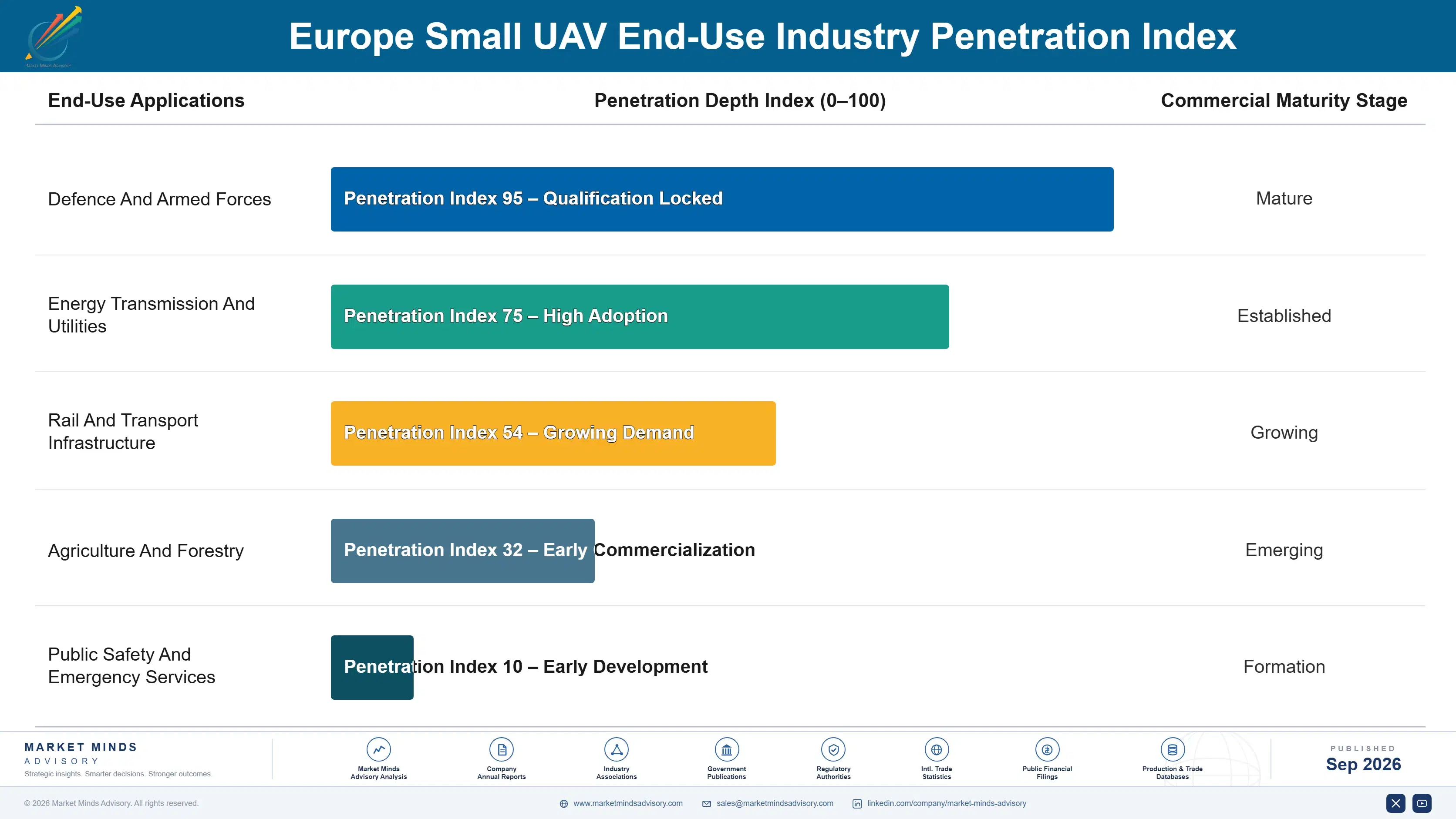
Adoption depth varies sharply by buyer type. Transmission and rail infrastructure operators run the deepest civil programmes, with contracted inspection cycles, integrated data workflows and trained internal crews, and they fund upgrades continuously because inspection labour cost makes the case. Smaller utilities and surveying firms buy platforms and use them shallowly. Defence buyers sit apart entirely: enormous volumes, minimal support content, and procurement driven by budget category rather than by capability roadmap.

The buyer profile has changed twice in five years. Small platforms were bought by surveying and inspection specialists who cared about sensor quality and endurance. Then defence procurement arrived asking about unit cost and monthly delivery rate, and neither question had ever appeared in a civil sales conversation.
europe-small-uav-market-industry-end-use-penetration-index-1790026057842

Where European Manufacturers Should Commit

These are among the four positions where our research anticipates prominent divergence between winners and laggards over the coming forecast period. Each is grounded in the demand model, the regulatory perimeter, and the announced capacity pipeline.
01 / COMPONENT PROVENANCE TIMING

Qualify vetted component supply before procurement rules demand it

Re-sourcing motors, controllers, radios and cells away from Chinese supply raises the bill of materials by roughly 38% and takes eighteen months or more to qualify properly, which means it cannot be done once a tender appears. Manufacturers who completed it early bid contracts that cheaper competitors are formally excluded from, realising unit pricing around 44% above open-market equivalents. Carrying the higher bill of materials before the rules mandated it was the price of that position, and it has paid.
02 / RATE MANUFACTURING SEPARATION

Build attritable volume on a separate line, not a simplified one

Attritable platforms grow at 18.0%, half again the market rate of 12.0%, and awards go to whoever can deliver the quantity rather than to whoever designs best. Attempting high rates inside a precision low-volume plant fails at both, while a dedicated line using simplified designs and commercial components has reached unit costs roughly 57% below conventional equivalents. Running two manufacturing cultures is genuinely difficult, but the alternative is conceding the market's entire volume growth to entrants from consumer electronics manufacturing.
03 / AUTHORISATION SERVICE CONTENT

Sell regulatory approval alongside the platform itself

Specific category authorisation takes around seven months at the median and national authorities reach different conclusions from identical risk assessments, which stops a great many civil operators from buying at all. Manufacturers supplying standard scenario documentation, pre-built operational packages and authorisation support have closed sales roughly 2.6 times faster than their equipment-only competitors. The capability needed here is regulatory expertise rather than engineering, and almost every manufacturer in this market has so far treated it as somebody else's problem entirely.
04 / PAYLOAD VALUE CAPTURE

Own payload integration, treat the airframe as carriage

Payload content represents around 41% of delivered programme value on reconnaissance platforms and carries gross margin well above the airframe it flies on, because the sensor is what the buyer actually specifies. Manufacturers holding qualified electro-optical, thermal and signals integration can also fit competitors' airframes where a customer already operates a fleet, reaching programmes they never won. The barrier is sensor qualification work rather than mechanical integration, and the resulting position is considerably more defensible than any airframe design advantage.

Engagement Snapshot From the Field

A live engagement with an industry participant carrying material or product regulatory and market exposure ahead of a defining policy shift, showing how our research translates into a defensible multi-year portfolio strategy.
MARKET MINDS ADVISORY · CLIENT ENGAGEMENT SUMMARY
Europe Small UAV Producer Strategic Portfolio Review and Transition Roadmap 2026·Investment Scenario on Europe Small UAV Exposure Evaluation 2025-26
CLIENT PROFILE
A Western European manufacturer of fixed-wing and vertical take-off platforms with roughly USD 120 million in annual revenue (client-reported, unverified by MMA), split about 74% civil inspection and 26% defence (client-reported, unverified by MMA). The company held strong payload integration capability and three national defence customers, but had lost two large attritable platform contracts to Baltic competitors and had not begun component re-sourcing.
STRATEGIC CHALLENGE
Management believed the attritable losses reflected aggressive pricing by newer firms and planned to bid lower. Award records showed the decisions had turned on monthly delivery rate, which the company could not meet at any price, and on vetted component sourcing it did not hold. The board needed to decide whether to build rate capacity, concede the volume segment, or restructure around payload content.
MMA APPROACH
MMA modelled attritable demand and required delivery rates across the client's defence customer base, costed a dedicated high-rate line against adapting existing assembly, and quantified the component re-sourcing premium and qualification timeline. Expert interviews with defence procurement staff established how rate capability and component provenance were actually being scored in evaluations.
KEY FINDINGS
  1. Both lost contracts were decided on monthly delivery rate and component provenance, with unit price ranked third by every procurement officer interviewed about the awards.
  2. Adapting existing precision assembly could reach at most a fifth of the required rate, and doing so would have degraded output quality on the profitable durable platform line.
  3. Payload integration already generated roughly 44% of the client's gross profit on around a quarter of its revenue, a concentration management had never quantified explicitly.
  4. Component re-sourcing would take about nineteen months and raise the durable platform bill of materials by roughly 38%, but was a precondition for every defence contract examined.
CLIENT PROFILE
A Western European manufacturer of fixed-wing and vertical take-off platforms with roughly USD 120 million in annual revenue (client-reported, unverified by MMA), split about 74% civil inspection and 26% defence (client-reported, unverified by MMA). The company held strong payload integration capability and three national defence customers, but had lost two large attritable platform contracts to Baltic competitors and had not begun component re-sourcing.
STRATEGIC CHALLENGE
Management believed the attritable losses reflected aggressive pricing by newer firms and planned to bid lower. Award records showed the decisions had turned on monthly delivery rate, which the company could not meet at any price, and on vetted component sourcing it did not hold. The board needed to decide whether to build rate capacity, concede the volume segment, or restructure around payload content.
MMA APPROACH
MMA modelled attritable demand and required delivery rates across the client's defence customer base, costed a dedicated high-rate line against adapting existing assembly, and quantified the component re-sourcing premium and qualification timeline. Expert interviews with defence procurement staff established how rate capability and component provenance were actually being scored in evaluations.
KEY FINDINGS
  1. Both lost contracts were decided on monthly delivery rate and component provenance, with unit price ranked third by every procurement officer interviewed about the awards.
  2. Adapting existing precision assembly could reach at most a fifth of the required rate, and doing so would have degraded output quality on the profitable durable platform line.
  3. Payload integration already generated roughly 44% of the client's gross profit on around a quarter of its revenue, a concentration management had never quantified explicitly.
  4. Component re-sourcing would take about nineteen months and raise the durable platform bill of materials by roughly 38%, but was a precondition for every defence contract examined.
RECOMMENDED STRATEGY
Phase 1: Phase 1 (eight months): Begin vetted component qualification immediately for the durable platform line, since every defence contract now requires it. Phase 2: Phase 2 (16 months): Partner with a contract manufacturer for attritable volume rather than building a dedicated line internally from scratch. Phase 3: Phase 3 (24 months): Reposition payload integration as a standalone offering, qualified onto competitor airframes as well as the company's own.
OUTCOME
Component qualification completed in month seventeen and made the client eligible for three contracts it had previously been excluded from (client-reported, unverified by MMA). The contract manufacturing partnership delivered attritable volume without disturbing the durable line, and payload integration won its first placement on a competitor airframe, adding revenue the company had written off.

Frequently Asked Questions

Foundational context covering the market sizes, CAGR, scope, country, region and competition that inform every finding below. This section is provided to cover basics and most often pre-purchase conversations, answered from the MMA Primary Research Dataset.

What is the current size of the Europe Small UAV Market?

The market was worth USD 2.4 billion in 2025 and reaches USD 2.7 billion in 2026. That covers platforms at or below 25 kilograms across civil inspection, surveying and defence applications with their ground control equipment.

How large will the Europe Small UAV Market be by 2036?

MMA forecasts USD 8.4 billion by 2036, an increase of USD 5.7 billion over the 2026 base. That represents an expansion multiple of 3.11 times across the forecast period.

What is the CAGR for the Europe Small UAV Market 2026 to 2036?

The base case CAGR is 12.0%, with a bull case of 13.3% if cross-border operating approval genuinely harmonises. The bear case of 10.8% assumes defence budgets revert toward equipment rather than consumables.

Which segment is growing fastest?

Attritable single-use platforms grow at 18.0%, half again the market rate of 12.0%. The class scarcely existed in Europe before 2021 and awards now turn on production rate rather than design merit.

Who are the major companies in the Europe Small UAV Market?

Quantum-Systems, Delair, Wingcopter, Parrot and Tekever lead on platform unit shipments and contracted programme value. Helsing, Stark Defence, Origin Robotics and Threod Systems follow in the next tier.

Which country is growing fastest?

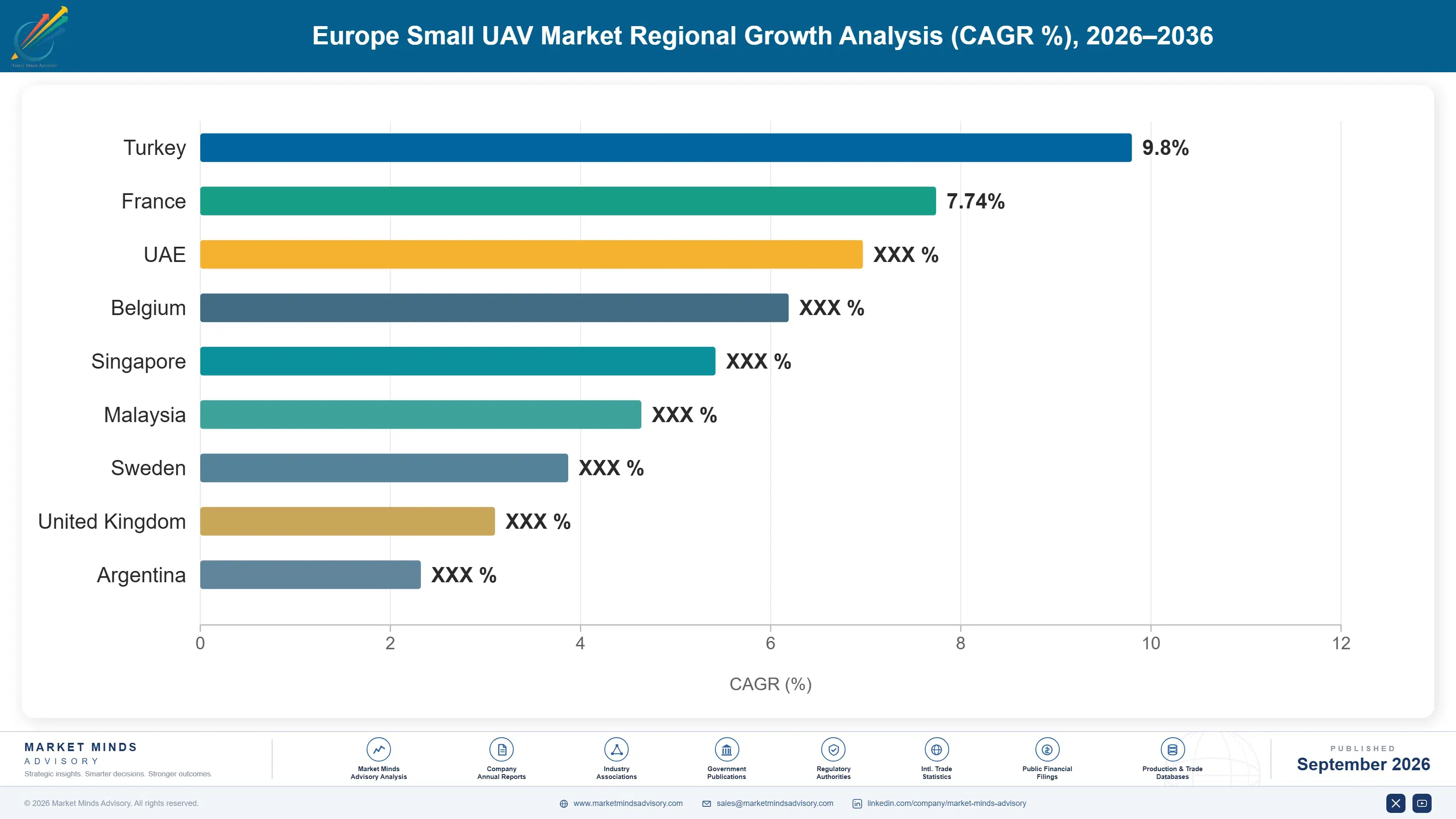
Within this region-scoped report, Poland leads at 16.4%, driven by procurement scale alongside rapid domestic manufacturing expansion. Countries outside Europe are assessed only as sources of platform and component supply.

Report Segmentation Architecture

The full report scope spans multiple orthogonal segmentation dimensions, with cross-tabulated demand data provided for each dimension pair. Coverage extends further to regional breakdowns, trend trajectories, and the competitive detail needed to support segment-level decision-making.

By Platform Class

  • Fixed-Wing Reconnaissance Platforms
  • Multirotor Inspection Platforms
  • Vertical Take-Off Fixed-Wing Platforms
  • Attritable Single-Use Platforms
  • Tethered Persistent Platforms
  • Cargo And Delivery Platforms

By End-Use Industry

  • Defence And Armed Forces
  • Energy Transmission And Utilities
  • Rail And Transport Infrastructure
  • Agriculture And Forestry
  • Public Safety And Emergency Services

By Commercial Dimension

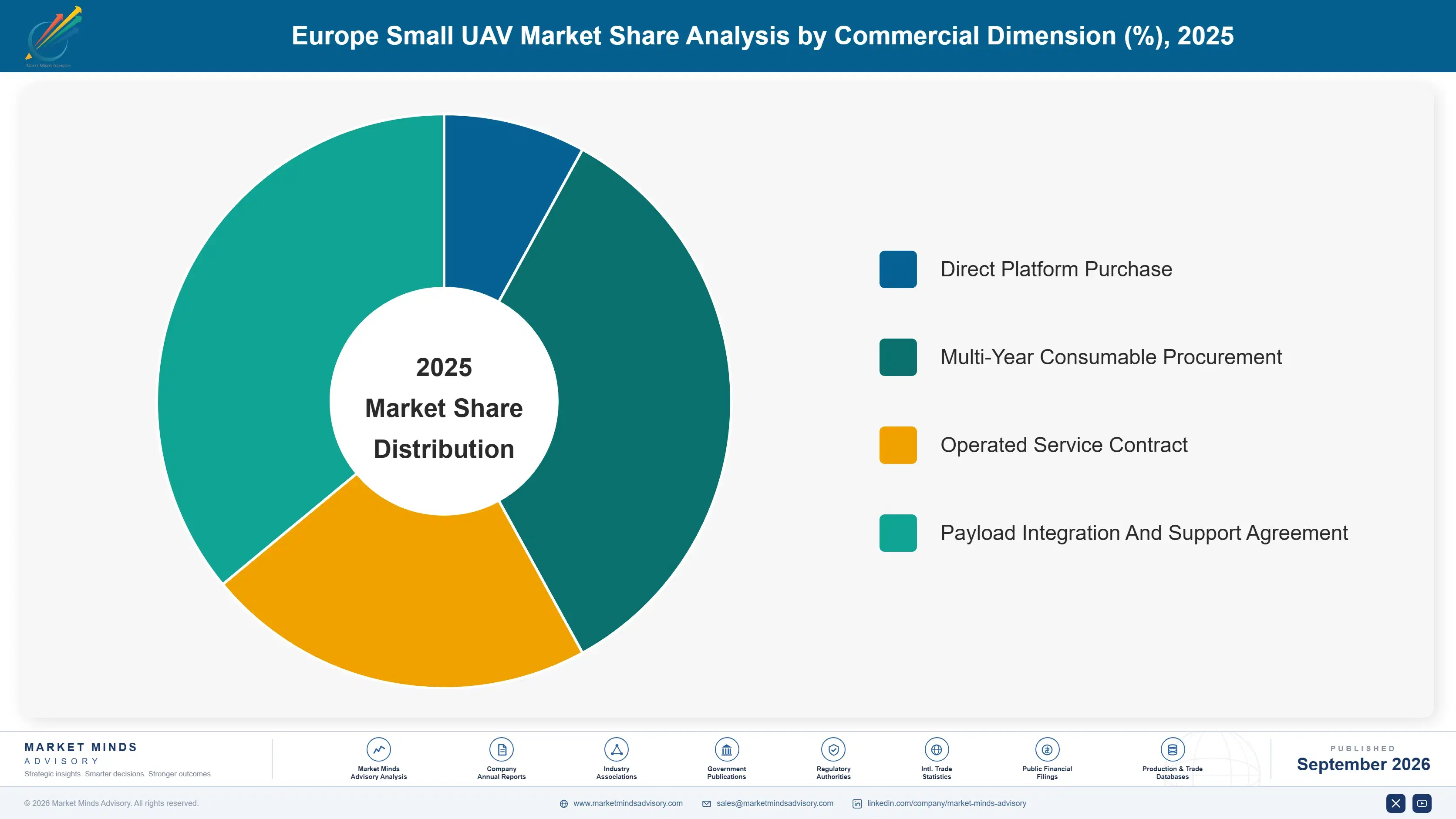
  • Direct Platform Purchase
  • Multi-Year Consumable Procurement
  • Operated Service Contract
  • Payload Integration And Support Agreement

By Region

  • Western Europe
  • Eastern Europe
  • East Asia
  • North America
  • Middle East and Africa
  • South Asia and Pacific
  • Latin America

Scope, Methodology, and Coverage

Every figure in this report is reproducible from documented input assumptions. The scope below maps the historical period, the forecast horizon, the segmentation dimensions, and the countries covered, alongside the underlying primary and qualitative methodology.
Historical Period
2020 to 2025
Forecast Period
2026 to 2036
Base Year
2025 (USD billions; MMA Primary Research Dataset, September 2026)
Market Definition
This report covers small unmanned aircraft systems operated within Europe, meaning platforms with maximum take-off mass at or below 25 kilograms as framed by European Union aviation rules. Scope includes fixed-wing reconnaissance platforms, multirotor inspection platforms, vertical take-off fixed-wing platforms, attritable single-use platforms, tethered persistent platforms, cargo and delivery platforms, and the ground control equipment sold with them. Excluded are unmanned aircraft above 25 kilograms, counter-unmanned-aircraft systems, U-space and air traffic service provision, separately sold payload sensors, and data processing software sold independently of a platform.
Quantitative Units
USD billions (current prices); platform unit shipments; average unit pricing by class; component sourcing cost premium
Segmentation Dimensions
By Platform Class; By End-Use Industry; By Commercial Dimension; By Region
Regions Covered
Western Europe, Eastern Europe, East Asia, North America, Middle East and Africa, South Asia and Pacific, Latin America
Countries Covered
Germany, France, UK, Poland, Netherlands, Italy, Spain, Sweden, Switzerland, Portugal, Norway, Denmark, Finland, Estonia, Latvia, Lithuania, Czech Republic, Romania, Austria, Belgium, Ireland, Greece, Hungary, and additional European markets relevant to this sector, with platform and component supply origin also assessed across the USA, China, Japan, India, Israel and Turkey
Key Companies Profiled
Quantum-Systems, Delair, Wingcopter, Parrot, Tekever, Helsing, Stark Defence, Elistair, Flyability, AgEagle Aerial Systems, Nordic Unmanned, Robot Aviation, Origin Robotics, Atlas Aerospace, Threod Systems, Schiebel, Leonardo, Thales, Airbus Defence and Space, Alpha Unmanned Systems
Quantitative Methodology
Primary survey, n=3,800 respondents, Q4 2025, six countries; demand-side model with trade association cross-validation
Qualitative Methodology
47 expert interviews, Q4 2025; applied to validate demand model assumptions, identify emerging dynamics, and assess competitive positioning
Report Format
PDF and XLSX data workbook (Word format preview document)
Publisher
Market Minds Advisory
Report Code
MMA-2026-TEC-909
Published
September 2026
Contact
sales@marketmindsadvisory.com | www.marketmindsadvisory.com

Purchase the full Europe Small UAV Market Report (2026 to 2036).

The full report sizes the European small unmanned aircraft market across six platform classes with unit shipments and pricing behind every figure, and assesses where the platforms and components serving European operators are actually manufactured. It separates consumable defence procurement from durable civil demand throughout, because the two carry opposite economics and are served by different factories. Competitive analysis covers 20 participants on unit shipments and contracted programme value, including vetted component sourcing status and demonstrated production rate. Specific category authorisation timelines are quantified by member state, since that friction governs civil adoption more than technology does. Component re-sourcing premiums are modelled per manufacturer as a contract eligibility question.
Six-class sizing with unit shipments and pricing
Consumable defence demand separated from durable civil
Vetted component sourcing status by manufacturer
Production rate capability assessed per participant
Authorisation timelines quantified by member state
Payload integration value share by platform class

Built For The People Who Decide

From boardroom strategy to bench-side execution, this report is read cover-to-cover by leaders shaping the next decade of their industry, turning demand scenarios, market dynamics and valuation benchmarks into decisions.
CXOs/ Presidents/ VPs/ Managers
M&A and Corporate Development
Strategy Teams and R&D Heads
Procurement and Product Directors
Regulatory and Compliance Leaders
Investor Relations and Equity Analysts