

Market Minds Advisory
Europe Rubber-Derived Unrefined Pyrolysis Oil Market

Europe Rubber-Derived Unrefined Pyrolysis Oil Market: Tyre Pyrolysis Oil: Contamination Economics, Cracker Offtake Requirements, and the Scale Problem Nobody Solved

Petrochemical companies want this oil as circular feedstock and cannot use it raw, because the sulphur and chlorine that come out of a tyre poison exactly the catalysts they need to protect.

Lead Analyst

Bilal Shaikh

Published

September 2026

Make Smarter Decisions with Customized Research Insights

Request a free sample report and evaluate market opportunities, growth trends, and competitive dynamics relevant to your business needs.

2025 MARKET VALUE$0.6BMarket Size 2025
2036 FORECAST VALUE$2.6BBase Case , 2026 to 2036
CAGR 2026 TO 203614.2 %Bull 15.5% / Bear 12.9%
INCREMENTAL OPPORTUNITY$1.9BNet 10- year value creation
EXPANSION MULTIPLE3.77x2036 value over 2026 base
Strategic Levers
M&A Pipeline
Regional Outlook
Country Rankings
Competitive Intelligence
Segmental Deep-dive
Call-Us : 91 93563 13602

Executive Snapshot and Market Trajectory

A tyre yields about 42% of its mass as liquid oil, and that oil arrives carrying 1.2% sulphur along with chlorine, nitrogen, and silicon. Every commercial question in this market follows from what those contaminants prevent the oil from being used for. Nothing else here matters half as much commercially.
Commercial power sits with producers who can deliver consistent specification at offtake scale rather than with anyone able to heat rubber without oxygen. Microwave-assisted processes grow fastest at 21.6%, roughly 1.52 times the market, though from a base that barely exists commercially. Western Europe holds 26% of global value, the largest position, reflecting end-of-life tyre regulation and petrochemical offtake commitments made here first.
Concentration is extraordinarily low at roughly 18% for the top five, because most plants run at a fraction of the scale any cracker offtake requires. Only 23% of output reaches petrochemical use, with the rest burned as low-value fuel. Recovered carbon black frequently earns more than the oil does. Producers financed as local waste treatment projects rather than as feedstock suppliers now find themselves excluded from the market that actually pays properly.
Market Definition
The market comprises unrefined pyrolysis oil produced from end-of-life tyres and rubber waste, covering batch reactor output, continuous rotary kiln output, continuous screw and auger reactor output, fluidised bed output, and microwave-assisted pyrolysis output. Value is measured at producer level across fuel and petrochemical feedstock sales. Hydrotreated and upgraded pyrolysis oil, recovered carbon black and steel co-products, plastic-derived pyrolysis oil, pyrolysis equipment and plant supply, and tyre collection services fall outside scope. Coverage is global with European market detail prioritised throughout.
Base Year Value
$0.6B in 2025 (MMA Primary Research Dataset, August 2026)
Forecast Period
2026 to 2036, eleven discrete annual values
CAGR
14.2% base case. Bull 15.5%. Bear 12.9%.
Fastest Growth Segment
Microwave-Assisted Pyrolysis Oil: 21.6% CAGR
Fastest Growth Country
India: 17.8% CAGR
Fastest Growth Region
South Asia and Pacific: 16.4% CAGR
Largest Region
Western Europe: 26% of 2025 global value
Market Leaders
Scandinavian Enviro Systems, Pyrum Innovations, Wastefront, Contec, and Klean Industries lead on unrefined tyre pyrolysis oil output. Source: company annual reports and MMA Analysis, July 2026.
Primary Survey
n=3,800 procurement and R&D decision-makers, Q4 2025, six countries
Methodology
Demand-side build-up, cross-validated against public data, 47 expert interviews

Europe Rubber-Derived Unrefined Pyrolysis Oil Market Forecast Scenarios

europe-rubber-derived-unrefined-pyrolysis-oil-mark-size-forecast-scenario-1787549584967
Between 2020 and 2025 the industry attracted capital faster than it built credibility. Petrochemical companies and tyre manufacturers announced circular feedstock commitments, investors funded plant construction, and a substantial number of projects failed to reach nameplate output or consistent specification. Oil prices swung sharply and moved the fuel-grade alternative underneath the business. The 12.8% historical growth reflects capacity announcements converting into production far more slowly than projected.
The 14.2% base case rests on three mechanisms. Petrochemical offtake for circular feedstock continues expanding as brand commitments to recycled content require material that mechanical routes cannot supply for rubber and carbon black. End-of-life tyre regulation across Europe keeps directing volume away from landfill and cement kilns toward material recovery. And continuous process technology is finally delivering the specification consistency that offtake contracts demand rather than merely promising it. at last.
The 15.5% bull case assumes cracker offtake contracts scale as announced and upgrading capacity develops alongside production. The 12.9% bear case reflects continued project failures damaging investor confidence, cement kilns outbidding pyrolysis for feedstock when energy prices rise, and contamination proving harder to manage at scale than demonstration plants suggested. Feedstock competition from cement kilns sits underneath both cases as a constant.

Two Markets Separated by a Sulphur Specification

Three things set the commercial shape of this market. Contamination comes first, because sulphur at 1.2% along with chlorine and silicon determines whether the oil sells as low-value fuel or as circular feedstock at several times the price. Scale comes second, since offtake contracts require volumes most plants cannot produce. Feedstock access comes third and pits pyrolysis against cement kilns for the same tyres.
TOP-FIVE CONCENTRATION18%Share of global unrefined oil output held by leading producers
AVERAGE SELLING PRICEUSD 480 per tonneBlended pricing across fuel and feedstock grade sales
OIL YIELD PER TONNE42%Portion of tyre input mass recovered as liquid oil
SULPHUR CONTENT LEVEL1.2%Typical sulphur present before any upgrading takes place
CRACKER FEEDSTOCK SHARE23%Portion of output sold into petrochemical rather than fuel use
FEEDSTOCK COLLECTION COSTUSD 95 per tonneTypical gate cost of shredded tyre input material
The two-market split is the defining structure. Burned in an industrial boiler the oil competes with heavy fuel oil and earns accordingly, while sold into a steam cracker as circular feedstock it earns a substantial premium tied to mass balance certified polymer value. Only 23% reaches the second market, because most producers cannot deliver the consistency and cleanliness required.
Co-product economics complicate every assessment. A tonne of tyres yields oil, recovered carbon black, steel, and gas, and the carbon black frequently earns more than the oil does while the gas usually fuels the process. Anybody evaluating pyrolysis oil economics in isolation from those co-products is analysing a fragment of the business rather than the whole of it. That mistake appears constantly in investor materials.
"The pitch is always circular feedstock for a cracker, and then you look at the specification sheet and see one and a bit percent sulphur going into a plant that measures contaminants in parts per million. That gap has closed for a handful of operators and remains wide open for everybody else, which is why the failure rate has been what it has."
Practice Director, Circular Materials and Waste Valorisation · MMA Energy and Circular Materials Practice · August 2026

Market Trends

Cracker Offtake Demands Specification Most Producers Cannot Meet

Petrochemical companies want circular feedstock to support mass balance certified polymers and recycled content commitments, and they cannot feed a stream carrying 1.2% sulphur plus chlorine and silicon into equipment that measures contaminants in parts per million. That gap splits the market into a fuel business earning heavy fuel oil economics and a feedstock business earning several times more. Only 23% of output currently clears it. Producers who invested in continuous processing, feedstock preparation, and filtration reach the premium market while the rest sell into boilers, and the gap in realised value is enormous.
Market Impact: Commitments target above 40% content
Continuous Processing Replaces Batch on Consistency Grounds

Batch reactors are cheap to build and produce oil whose composition varies between charges, which is tolerable for a boiler and disqualifying for any offtake contract specifying properties. Continuous rotary kiln, screw, and auger systems cost considerably more and deliver the consistency that petrochemical buyers write into contracts. Offtakers increasingly require demonstrated stability over months rather than a favourable single analysis. That requirement has quietly eliminated a large part of the industry from the premium market regardless of what any individual batch measures, and it explains why continuous processes grow while batch does not.
Market Impact: Gate costs reach $95 per tonne

Market Opportunities and Growth Drivers

Tyre Maker Circular Content Commitments Create Pull Demand

Michelin, Bridgestone, and Continental have all committed publicly to recycled and renewable material content in tyres, and rubber and carbon black cannot be mechanically recycled back into new tyre compounds at the quality required. Pyrolysis is the practical route, which makes those commitments direct demand for both the oil and the recovered carbon black. Tyre manufacturers have invested in and contracted with pyrolysis operators rather than waiting for a market to form. That pull is what distinguishes this from waste treatment businesses where the producer must find buyers for whatever emerges.
Market Impact: Top five hold only 18% share

European Tyre Regulation Directs Feedstock Toward Material Recovery

Landfill bans and extended producer responsibility schemes across European member states fund collection of end-of-life tyres and increasingly favour material recovery over energy recovery in waste hierarchy terms. That both secures feedstock supply and, where gate fees apply, means an operator can be paid to accept the input rather than paying 95 dollars a tonne for it. The economics differ enormously between those two situations. Regulatory direction toward material recovery rather than cement kiln combustion is the single most important policy variable in this business anywhere. Operators without that direction compete for tyres on price alone.
Market Impact: Kilns bid above $95 per tonne

Market Restraints and Challenges

Plant Scale Falls Far Below What Offtake Contracts Require

Most operating plants process a fraction of what a petrochemical offtake agreement specifies, and a cracker will not restructure its feedstock logistics around a supplier delivering a few thousand tonnes annually with uncertain continuity. The root cause is that pyrolysis plants were financed as waste treatment projects sized to local tyre collection rather than as feedstock suppliers sized to customer requirements. Producers mitigate through aggregation arrangements between operators, multi-site consolidation, and staged capacity expansion, and none of these fully resolves the mismatch quickly. Offtake conversations stall on volume long before oil quality is ever discussed.
Market Impact: Only 23% reaches petrochemical use

Cement Kilns Compete Directly for the Same Feedstock

Whole and shredded tyres burn well in cement kilns, substituting for coal and delivering both energy and iron from the steel belt into the clinker, which makes cement producers a persistent competing bidder for end-of-life tyres. The root cause is that combustion requires no specification and no processing investment. When energy prices rise, kilns bid feedstock away from pyrolysis operators whose economics cannot follow. Mitigation runs through long-term collection contracts, regulatory recognition of material recovery over energy recovery, and gate fee arrangements that combustion cannot match. None of these holds when energy prices move sharply.
Market Impact: Batch output grows at only 6.4%
4 additional market trends, 3 additional growth drivers, and 2 additional restraints and challenges are covered in the full report. Contact sales@marketmindsadvisory.com to access the complete intelligence.

Segment CAGR and Growth Architecture

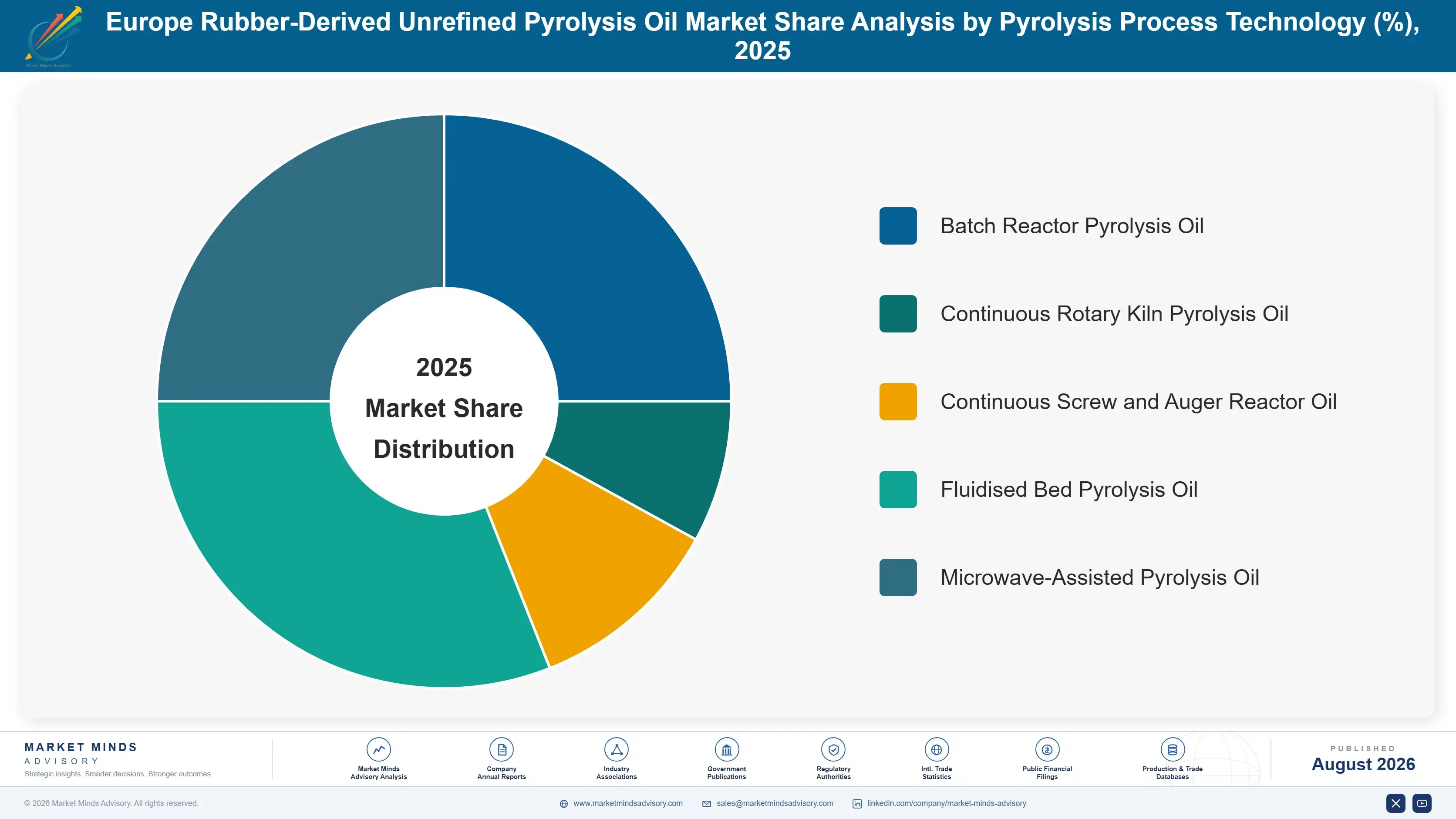
Segmentation follows pyrolysis process technology, because the process determines oil consistency, contaminant profile, yield, capital intensity, and therefore which market the output can reach. Five process types cover commercial supply, and the distinction between batch and continuous operation matters more commercially than any difference in the chemistry each produces. Capital intensity separates the two more sharply than anything else.
europe-rubber-derived-unrefined-pyrolysis-oil-mark-market-share-analysis-1787549585502

Microwave-Assisted Pyrolysis Oil

The fastest-growing process at 21.6%, roughly 1.52 times the market, and barely commercial anywhere. Microwave heating transfers energy directly into the rubber rather than conducting it through a vessel wall, which allows lower bulk temperatures, faster response, and potentially a cleaner and more consistent oil with fewer heavy aromatic species. Scale-up has proved genuinely difficult, since microwave field uniformity across a large reactor volume is not a solved problem. Capital cost per tonne of capacity runs well above conventional processes. The growth rate reflects a very small base and considerable investor interest rather than any established production position. Several European and Asian developers are running pilot units, and none has yet demonstrated sustained commercial output at contract scale.
CAGR 21.6%

Continuous Screw and Auger Reactor Oil

Second fastest at 17.6%, and the process most offtake contracts are actually being signed against. Continuous feeding through a heated screw or auger gives residence time control and thermal consistency that batch reactors cannot approach, producing oil whose properties hold steady across months rather than varying between charges. That stability is precisely what petrochemical buyers write into contracts and verify before committing. Capital cost sits well above batch equipment and below fluidised bed alternatives. Feedstock preparation requirements are demanding, since consistent particle size matters considerably more here than in processes tolerant of mixed input. Screw and auger systems now account for most new European capacity being built for petrochemical offtake rather than fuel markets.
CAGR 17.6%
Full segment breakdown across 5 segments available in the complete report.

Regional Architecture and Country Demand Map

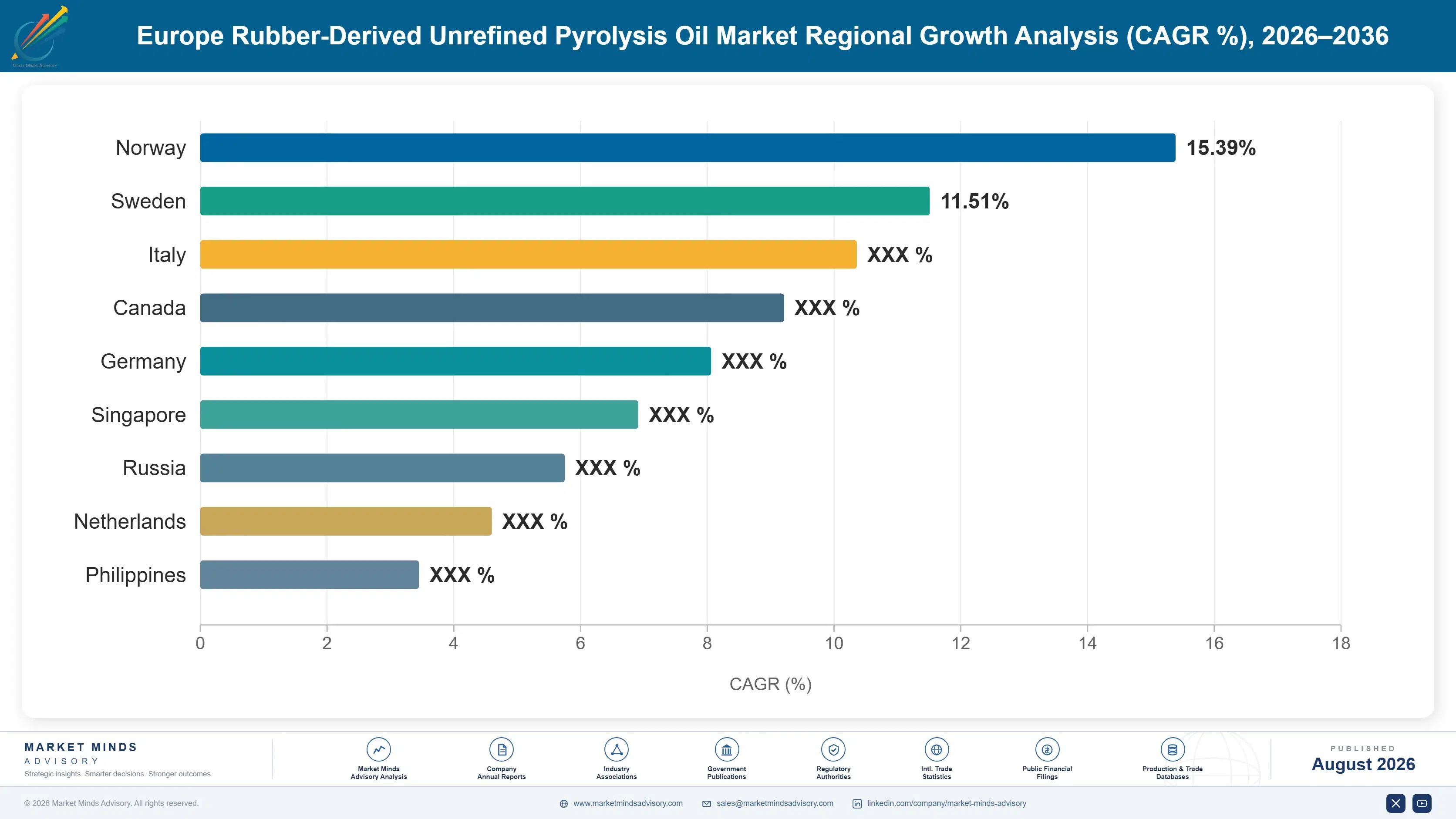
Regional shares follow end-of-life tyre regulation and petrochemical offtake commitment rather than tyre arisings alone. Coverage here is global with European detail prioritised, since European regulation and offtake agreements have shaped how this industry developed everywhere else. Tyre arisings alone predict very little about where value sits.

North America

Tyre arisings are enormous and collection infrastructure well established, though regulation directs far less material toward pyrolysis than European rules do and cement kilns take a substantial share as tyre-derived fuel. Petrochemical offtake interest has grown as brand owners commit to recycled content, and several operators have secured agreements with cracker operators along the Gulf Coast. Bolder Industries and Alterra hold notable positions. Investor funding has been abundant and project failure rates high, which has made subsequent capital harder to raise. Growth of 14.8% depends on offtake contracts converting into sustained production rather than on any shortage of available feedstock. Tyre-derived fuel remains the default destination for most of the material collected here.
Share: 22% | CAGR: 14.8% (2026 to 2036)

Western Europe

The largest regional position at 26%, and the reason is regulatory: landfill bans, extended producer responsibility schemes funding collection, and waste hierarchy rules favouring material recovery over energy recovery together direct end-of-life tyres toward pyrolysis in ways no other region matches. Gate fee arrangements mean operators are frequently paid to accept feedstock rather than paying for it, which transforms project economics. Tyre manufacturers headquartered here have invested directly in operators and contracted output. Pyrum, Enviro, Contec, and Wastefront all operate regionally. Growth of 12.5% is the slowest in the report because the earliest and best-supported projects here have already been built. Gate fee access rather than technology explains most of the margin difference between operators.
Share: 26% | CAGR: 12.5% (2026 to 2036)
Regional intelligence for 5 additional markets available in the complete report: East Asia, South Asia and Pacific, Latin America, Middle East and Africa, Eastern Europe. Contact sales@marketmindsadvisory.com.
europe-rubber-derived-unrefined-pyrolysis-oil-mark-country-cagr-analysis-1787549586027

Four Moves That Change the Economics

Advantage here comes from specification consistency, feedstock security, and offtake scale rather than from pyrolysis itself, which is thermally simple and widely replicated. Four moves are worth capital and management attention across the forecast period, and the first determines which of the two markets a producer can actually reach. The rest follow only once that question is settled.

Invest in consistency before chasing cracker offtake

Petrochemical buyers verify specification stability over months before committing, and a producer presenting one favourable analysis from a batch process will not pass that assessment however good the sample looks. Continuous processing, feedstock preparation, and filtration deliver the consistency that offtake contracts require, and only 23% of industry output currently clears it. The value gap between fuel and feedstock markets runs to several times the price per tonne. Capital cost is substantial and the alternative is competing permanently against heavy fuel oil pricing. Batch operators are excluded before their oil is ever tested.
Market Impact: Only 23% of all output reaches feedstock markets

Secure gate fee feedstock rather than purchasing tyres

Extended producer responsibility schemes pay for end-of-life tyre treatment in several European markets, which means an operator can be paid to accept feedstock rather than paying 95 dollars a tonne for it. That swing of roughly 190 dollars per tonne of input transforms project economics more than any process improvement could. Securing gate fee positions requires registration, permitting, and relationships with collection scheme operators rather than technology. Producers who financed plants assuming purchased feedstock frequently find the economics never work at fuel-grade pricing. Registration typically takes under a year to complete.
Market Impact: Swings roughly $190 on every input tonne processed

Aggregate output across sites to reach offtake scale

A cracker will not restructure feedstock logistics around a supplier delivering a few thousand tonnes annually with uncertain continuity, and most plants operate far below what offtake contracts specify. Aggregation between operators, multi-site consolidation, and pooled storage all create the volume and continuity that individual plants cannot. Coordination and specification alignment across sites are the practical obstacles rather than any commercial reluctance. Producers who solved it reach contracts that no single plant of their size could have been considered for at all. Pooling three sites can reach volumes a single plant needs 10 years to build.
Market Impact: The entire top five hold only 18% of output

Value the whole product slate rather than the oil alone

A tonne of tyres yields oil, recovered carbon black, steel, and process gas, and the carbon black frequently earns more per tonne than the oil while the gas usually fuels the process at no cost. Operators optimising purely for oil yield leave carbon black quality unmanaged and forfeit the better revenue line. Carbon black quality depends on process conditions that oil yield optimisation actively degrades. Balancing the slate deliberately typically improves total revenue per tonne of feedstock by 15 to 25%. Carbon black quality is set in the reactor, not afterwards.
Market Impact: Improves total revenue per feedstock tonne by 15 to 25%

Who Controls the Margin Pool

Concentration is extraordinarily low at roughly 18% for the top five, reflecting an industry of small plants financed as local waste treatment projects rather than as feedstock supply businesses. Scandinavian Enviro Systems and Pyrum Innovations have built positions through tyre manufacturer relationships and continuous process technology. Wastefront and Contec compete with larger single-site capacity, and Klean Industries approaches from a technology licensing position rather than as an operator.
Competitive activity runs on three fronts. Specification consistency is the first and determines whether a producer sells fuel or feedstock. Feedstock security is the second, and gate fee positions transform economics in ways process improvements cannot. Offtake scale is the third, and it excludes most operators from the premium market regardless of what their oil analysis shows. Nothing about the reactor itself differentiates anybody.

Pressure is building from two directions. Cement kilns bid feedstock away whenever energy prices rise, and their economics require no specification at all. And project failures have made capital harder to raise for everybody, including operators whose technology genuinely works. Rankings will shift toward operators holding gate fee positions and verified offtake rather than toward whoever builds the most capacity.
europe-rubber-derived-unrefined-pyrolysis-oil-mark-company-positioning-matrix-1787549586557

Competitive Moat and Risk Dimensions

SCANDINAVIAN ENVIRO SYSTEMS

Moat: Tyre manufacturer investment and offtake

Direct investment and offtake relationships with tyre manufacturers pursuing recycled content commitments give Enviro demand certainty that operators selling into fuel markets simply do not have. Those manufacturers need recovered carbon black and oil for their own commitments, which makes the relationship a partnership rather than a supply arrangement subject to competitive tender.
SCANDINAVIAN ENVIRO SYSTEMS

Risk: Execution against announced capacity

This industry's record of converting announced capacity into sustained production at specification is genuinely poor, and investor patience has thinned considerably after repeated disappointments across the sector. Delivering plants that reach nameplate output and hold specification is the whole test, and technology validation at demonstration scale has repeatedly failed to predict it.
PYRUM INNOVATIONS

Moat: Continuous process specification stability

Continuous processing delivering oil whose properties hold steady across months rather than varying between batches is precisely what petrochemical offtakers verify before contracting, and Pyrum has demonstrated it in commercial rather than demonstration operation. Petrochemical partnership arrangements built on that record are difficult for batch operators to approach at any price.
PYRUM INNOVATIONS

Risk: Scale relative to offtake requirements

Even successful operators run at volumes far below what a cracker would prefer to contract, which limits how much of a petrochemical customer's circular feedstock requirement any single site can serve. Expanding requires capital in a sector where project failures have made funding harder to raise, and aggregation with other operators brings specification alignment problems.

Players Tracked

Prominent Players

Scandinavian Enviro Systems
Pyrum Innovations
Wastefront
Contec
Klean Industries

Other Key Players

Bolder Industries
Alterra Energy
Quantafuel
Neste
BASF
Michelin
Bridgestone
Continental
Pyrocrat Systems India
Ecolomondo
Tyre Recycling Solutions
Genan
Circtec
Hi Green Carbon
Radhe Group

Recent Developments

FEBRUARY 2025

Petrochemical offtake requires extended specification verification

A cracker operator contracted circular feedstock only after verifying oil property stability across several months of continuous production rather than accepting demonstration analyses. Batch process operators presenting favourable single samples were excluded from consideration entirely during the qualification process. Continuous operation had become an entry requirement.
Signal: Offtakers now verify stability over months, which quietly excludes most of the industry from premium markets
JUNE 2025

Tyre manufacturer contracts recovered carbon black and oil together

A tyre producer agreed multi-year offtake covering both recovered carbon black and pyrolysis oil from the same operator, treating the product slate as a whole rather than contracting either separately. Recycled content commitments in tyre compounds required both materials rather than only one. Neither could be sourced separately.
Signal: Slate contracting reflects how the economics actually work, since carbon black often earns more than oil
OCTOBER 2025

Cement kilns outbid pyrolysis for tyre feedstock

Rising energy prices led cement producers to bid more aggressively for end-of-life tyres as alternative fuel, tightening feedstock availability for pyrolysis operators without long-term collection contracts. Combustion requires no specification or preparation, which gives kilns a permanently lower cost threshold. Operators without long-term collection contracts lost volume.
Signal: Kilns will always outbid when energy prices rise, because burning tyres requires no specification or preparation at all

What Sets the Cost Base

Feedstock is the largest and most variable line, near 95 dollars per tonne of shredded input where tyres are purchased and negative where gate fees apply, making it either roughly 38% of cost or a revenue item. Process energy takes 19%, partly offset where pyrolysis gas is burned internally. Labour, maintenance, and emissions control absorb 24%. Capital charges consume the balance.
Energy prices moved sharply through 2022 and 2023, raising both process costs and the value of the fuel-grade alternative that competes for feedstock. Cement producers bid tyres away more aggressively as coal substitution economics improved. Enviro and Pyrum both referenced feedstock availability and energy cost conditions across their reporting for those years. Plants running below nameplate carried fixed costs across reduced output, which is the recurring problem this industry has failed to solve.

Exposure divides on gate fee access and utilisation rather than on scale. Operators with registered positions in producer responsibility schemes are paid to accept feedstock while others purchase it, a swing of roughly 190 dollars per input tonne. Utilisation is the second divide, since capital charges dominate for plants that never reach design output and disappear for those that do. Neither divide involves pyrolysis technology itself.
europe-rubber-derived-unrefined-pyrolysis-oil-mark-cost-volatility-analysis-1787549586752

Register for producer responsibility gate fee positions

Extended producer responsibility schemes pay for end-of-life tyre treatment in several European markets, turning the largest cost line into a revenue item worth roughly 190 dollars per tonne of swing. Registration, permitting, and scheme operator relationships are what secure it rather than any technology. Producers who financed plants assuming purchased feedstock frequently find fuel-grade economics never work without it.

Recover and burn pyrolysis gas for process heat

Pyrolysis produces a gas fraction with real calorific value that can supply much of the process heat requirement, reducing purchased energy substantially where the system is properly integrated. Many smaller plants flare it instead because gas handling adds complexity and capital. Integration is well understood engineering rather than any development challenge, and the saving applies across the whole operating life.

Optimise process conditions for the whole product slate

Conditions maximising oil yield frequently degrade recovered carbon black quality, and carbon black often earns more per tonne than the oil does. Optimising for total revenue rather than for oil yield alone typically improves realised value materially. It requires understanding both product markets rather than treating carbon black as a residue, which is how many operators still regard it.

Portfolio Architecture for Margin Defence

Margin follows specification and feedstock arrangement rather than volume, and the spread between the two markets is enormous for a product that comes from the same reactor. Fuel-grade oil sold into industrial boilers competes against heavy fuel oil and earns accordingly, with no premium available for its origin. Certified circular feedstock reaching a cracker earns several times that, because the buyer is purchasing recycled content attribution rather than hydrocarbon energy.
The volume and premium tension shows in utilisation rather than in product mix, which is unusual. A plant below nameplate output carries capital charges across reduced volume and frequently produces less consistent oil at the same time, which pushes it toward fuel markets and worsens the economics further. Reaching design output and specification together is what separates viable operators from the substantial number that have failed.

High-value pools concentrate in three places: certified feedstock reaching petrochemical offtake, gate fee feedstock positions, and recovered carbon black quality that most operators treat as a residue. Each is defended by process capability, regulatory position, or market understanding rather than by scale. Each also requires a decision made before the plant was built.

Volume / Commodity-Adjacent Tier

Fuel-grade oil sold into industrial boilers and marine fuel blending against heavy fuel oil pricing. No premium attaches to its origin at all. The range reflects large differences in feedstock arrangement and plant utilisation.
Gross Margin: 5%-14%

Premium / Certified Tier

Specification-verified oil supplied into petrochemical offtake under mass balance certification. The buyer purchases recycled content attribution rather than hydrocarbon, and consistency verified over months is what qualifies a supplier. at all.
Gross Margin: 24%-38%

Sustainability / Regulatory / Next-Generation Tier

Slate contracting covering oil and recovered carbon black together for tyre manufacturer recycled content commitments. Brand obligations rather than energy value drive pricing. The range is wide because slate pricing varies considerably by contract.
Gross Margin: 28%-44%
europe-rubber-derived-unrefined-pyrolysis-oil-mark-portfolio-architecture-1787549587261

High-value Sub-segments and Strategic Watch-out

Certified Petrochemical Feedstock Supply

Only 23% of industry output clears the specification, and the value gap against fuel markets runs to several times per tonne. Offtakers verify stability across months rather than accepting single analyses. Consistency is the entire barrier here. Process choice at the plant design stage decides it.
Gross Margin: 26%-38%

Gate Fee Feedstock Positions

Being paid to accept tyres rather than paying 95 dollars a tonne is a swing of roughly 190 dollars per input tonne, which transforms economics more than any process improvement could. Registration and permitting secure it. Technology has nothing whatever to do with capturing this particular pool.
Gross Margin: 30%-44%

Recovered Carbon Black Slate Value

Carbon black frequently earns more per tonne than the oil while most operators treat it as a residue and optimise conditions against its quality. Balancing the slate improves total revenue per feedstock tonne materially. Optimising for oil yield actively degrades the quality that earns more.
Gross Margin: 28%-42%

Fuel Grade Oil Sales

The strategic watch-out. Competing against heavy fuel oil with no premium for origin, on a product whose contamination is the reason it is there. It covers variable cost and rarely much more than that. Utilisation and gate fee access decide whether it clears anything at all.
Gross Margin: 5%-13%

How Demand Actually Reaches Producers

Two demand types operate here on completely different terms. Fuel buyers purchase on calorific value against heavy fuel oil pricing, take whatever specification arrives, and switch instantly when a cheaper alternative appears. Petrochemical and tyre manufacturer offtake contracts run multiple years, specify properties tightly, verify consistency before signing, and pay several times fuel pricing for material that is chemically similar. Which market a producer reaches is determined at plant design rather than negotiated commercially afterwards.
Adoption depth varies sharply by buyer type. Tyre manufacturers with recycled content commitments contract the whole product slate and invest in operators directly. Petrochemical companies contract oil under mass balance schemes after extended verification. Industrial fuel users buy spot on price. Marine fuel blenders take material that meets sulphur limits after blending and pay accordingly.

The buyer has shifted decisively toward sustainability and procurement compliance functions at brand owners. Those teams evaluate mass balance certification and audit trails rather than any fuel property. A decade ago the counterparty was a fuel trader who cared about calorific value and sulphur limits and nothing else at all. Certification literacy now matters more than any commercial relationship.
europe-rubber-derived-unrefined-pyrolysis-oil-mark-end-use-penetration-index-1787549587753

Where the Money Sits

These are among the four positions where our research anticipates prominent divergence between winners and laggards over the coming forecast period. Each is grounded in the demand model, the regulatory perimeter, and the announced capacity pipeline.
01 / SPECIFICATION CONSISTENCY INVESTMENT

Build for stability, because offtakers verify across months

Petrochemical buyers assess property stability over sustained continuous production rather than accepting a favourable single analysis, which quietly excludes batch operators from the premium market whatever their best sample shows. Only 23% of industry output currently clears that bar, and the value gap between fuel and feedstock markets runs to several times the price per tonne. Continuous processing, feedstock preparation, and filtration cost real capital, and the alternative is competing permanently against heavy fuel oil pricing with no premium available.
02 / GATE FEE POSITION SECURITY

Get paid for feedstock rather than paying for it

Extended producer responsibility schemes fund end-of-life tyre treatment in several European markets, which means a registered operator can be paid to accept material rather than paying 95 dollars a tonne to buy it. That swing of roughly 190 dollars per tonne of input transforms project economics more decisively than any process improvement available. Securing it needs registration, permitting, and collection scheme relationships rather than technology, and producers who financed plants assuming purchased feedstock frequently never make the numbers work at fuel-grade pricing.
03 / OFFTAKE SCALE AGGREGATION

Pool the output, because crackers will not restructure for you

A petrochemical operator will not rebuild feedstock logistics around a supplier delivering a few thousand tonnes annually with uncertain continuity, and most plants were financed as local waste projects rather than as feedstock businesses. Aggregation between operators, multi-site consolidation, and pooled storage create the volume and continuity that individual sites cannot reach alone. Specification alignment across sites is the practical obstacle rather than any commercial reluctance, and solving it reaches contracts no single plant would be considered for on its own merits.
04 / PRODUCT SLATE OPTIMISATION

Stop optimising for oil, because carbon black earns more

A tonne of tyres yields oil, recovered carbon black, steel, and process gas, and the carbon black frequently earns more per tonne than the oil does while most operators still treat it as a residue. Process conditions maximising oil yield actively degrade carbon black quality, which means the usual optimisation target destroys the better revenue line. Balancing the slate deliberately improves total revenue per tonne of feedstock by 15 to 25%, and it requires understanding both product markets properly rather than only one.

Engagement Snapshot From the Field

A live engagement with an industry participant carrying material or product regulatory and market exposure ahead of a defining policy shift, showing how our research translates into a defensible multi-year portfolio strategy.
MARKET MINDS ADVISORY · CLIENT ENGAGEMENT SUMMARY
Europe Rubber-Derived Unrefined Pyrolysis Oil Producer Strategic Portfolio Review and Transition Roadmap 2026·Investment Scenario on Europe Rubber-Derived Unrefined Pyrolysis Oil Exposure Evaluation 2025-26
CLIENT PROFILE
A European operator running two batch pyrolysis plants selling oil into industrial fuel markets and carbon black to rubber compounders, with revenue near EUR 18 million (client-reported, unverified by MMA). Feedstock was purchased on the open market, no producer responsibility registration existed, and no petrochemical offtake had ever been secured. Both plants ran well below nameplate output.
STRATEGIC CHALLENGE
Fuel-grade pricing left the business barely above variable cost while competitors with continuous plants had signed petrochemical offtake at multiples of that value. Cement kilns had begun bidding feedstock away as energy prices rose, and the client had no long-term collection contracts protecting its input supply at all. Margin had narrowed for three consecutive years.
MMA APPROACH
MMA compared realised pricing against specification and offtake structure, assessed producer responsibility registration requirements and gate fee availability, and modelled continuous process conversion against aggregation with other operators. Forty-seven expert interviews with cracker operators, tyre manufacturers, collection schemes, and compounders established what each buyer actually requires. Gate fee arrangements were modelled separately by member state.
KEY FINDINGS
  1. Petrochemical offtakers had rejected the client without testing its oil, because batch process operation alone disqualified it from a verification regime requiring months of stable continuous production.
  2. Producer responsibility registration was achievable within a year and would have converted a purchased feedstock cost into a gate fee revenue worth more than the client's entire operating margin.
  3. Carbon black quality had never been optimised because process conditions were set entirely for oil yield, and compounders were paying accordingly for a material worth considerably more if managed.
  4. Three regional operators faced identical scale barriers and had discussed aggregation informally without any of them taking the specification alignment work seriously enough to proceed.
CLIENT PROFILE
A European operator running two batch pyrolysis plants selling oil into industrial fuel markets and carbon black to rubber compounders, with revenue near EUR 18 million (client-reported, unverified by MMA). Feedstock was purchased on the open market, no producer responsibility registration existed, and no petrochemical offtake had ever been secured. Both plants ran well below nameplate output.
STRATEGIC CHALLENGE
Fuel-grade pricing left the business barely above variable cost while competitors with continuous plants had signed petrochemical offtake at multiples of that value. Cement kilns had begun bidding feedstock away as energy prices rose, and the client had no long-term collection contracts protecting its input supply at all. Margin had narrowed for three consecutive years.
MMA APPROACH
MMA compared realised pricing against specification and offtake structure, assessed producer responsibility registration requirements and gate fee availability, and modelled continuous process conversion against aggregation with other operators. Forty-seven expert interviews with cracker operators, tyre manufacturers, collection schemes, and compounders established what each buyer actually requires. Gate fee arrangements were modelled separately by member state.
KEY FINDINGS
  1. Petrochemical offtakers had rejected the client without testing its oil, because batch process operation alone disqualified it from a verification regime requiring months of stable continuous production.
  2. Producer responsibility registration was achievable within a year and would have converted a purchased feedstock cost into a gate fee revenue worth more than the client's entire operating margin.
  3. Carbon black quality had never been optimised because process conditions were set entirely for oil yield, and compounders were paying accordingly for a material worth considerably more if managed.
  4. Three regional operators faced identical scale barriers and had discussed aggregation informally without any of them taking the specification alignment work seriously enough to proceed.
RECOMMENDED STRATEGY
Phase 1: Phase one: pursue producer responsibility registration immediately, since gate fee access transforms economics faster and more cheaply than any process investment could. Phase 2: Phase two: optimise process conditions for total slate value rather than oil yield, recovering carbon black revenue the business currently forfeits through neglect. Phase 3: Phase three: lead an aggregation arrangement with regional operators, building the specification alignment that would make joint offtake supply genuinely credible.
OUTCOME
The client completed producer responsibility registration within eleven months and moved to gate fee feedstock across both sites. Slate optimisation raised carbon black realisation materially, an aggregation agreement with two operators reached offtake discussion, and blended gross margin improved 9.3 percentage points (client-reported, unverified by MMA).

Frequently Asked Questions

Foundational context covering the market sizes, CAGR, scope, country, region and competition that inform every finding below. This section is provided to cover basics and most often pre-purchase conversations, answered from the MMA Primary Research Dataset.

What is the current size of the Europe Rubber-Derived Unrefined Pyrolysis Oil Market?

The market was valued at USD 0.6 billion in 2025 globally, rising to an estimated USD 0.69 billion in 2026. Western Europe holds the largest regional share at 26% of value.

How large will the Europe Rubber-Derived Unrefined Pyrolysis Oil Market be by 2036?

MMA forecasts USD 2.58 billion by 2036 under the base case, an expansion multiple of 3.77 times the 2026 value. That represents USD 1.89 billion of incremental value across the forecast period.

What is the CAGR for the Europe Rubber-Derived Unrefined Pyrolysis Oil Market 2026 to 2036?

The base case CAGR is 14.2%, with a bull case of 15.5% and a bear case of 12.9%. The spread reflects uncertainty over offtake conversion and feedstock competition from cement kilns.

Which segment is growing fastest?

Microwave-assisted pyrolysis grows fastest at 21.6%, roughly 1.52 times the market rate, from a barely commercial base. Continuous screw and auger reactors follow at 17.6% on specification consistency.

Who are the major companies in the Europe Rubber-Derived Unrefined Pyrolysis Oil Market?

Scandinavian Enviro Systems, Pyrum Innovations, Wastefront, Contec, and Klean Industries lead on output. The top five hold only 18%, since most plants were financed as local waste projects.

Which country is growing fastest?

India grows fastest at 17.8%, as producer responsibility rules formalise feedstock flows toward registered recyclers. Domestic tyre manufacturers have begun contracting output directly from operators.

Report Segmentation Architecture

The full report scope spans multiple orthogonal segmentation dimensions, with cross-tabulated demand data provided for each dimension pair. Coverage extends further to regional breakdowns, trend trajectories, and the competitive detail needed to support segment-level decision-making.

By Pyrolysis Process Technology

  • Batch Reactor Pyrolysis Oil
  • Continuous Rotary Kiln Pyrolysis Oil
  • Continuous Screw and Auger Reactor Oil
  • Fluidised Bed Pyrolysis Oil
  • Microwave-Assisted Pyrolysis Oil

By End-Use Industry

  • Petrochemical Cracker Feedstock
  • Tyre and Rubber Compound Manufacturing
  • Industrial Boiler and Kiln Fuel
  • Marine Fuel Blending
  • Power Generation and District Heating

By Sales Model

  • Long-Term Petrochemical Offtake Contracts
  • Product Slate Contracting with Tyre Makers
  • Industrial Fuel Spot Supply
  • Aggregated Multi-Site Supply Agreements
  • Technology Licensing with Output Rights

By Region

  • North America
  • Western Europe
  • East Asia
  • South Asia and Pacific
  • Latin America
  • Middle East and Africa
  • Eastern Europe

Scope, Methodology, and Coverage

Every figure in this report is reproducible from documented input assumptions. The scope below maps the historical period, the forecast horizon, the segmentation dimensions, and the countries covered, alongside the underlying primary and qualitative methodology.
Historical Period
2020 to 2025
Forecast Period
2026 to 2036
Base Year
2025 (USD billions; MMA Primary Research Dataset, August 2026)
Market Definition
The market comprises unrefined pyrolysis oil produced from end-of-life tyres and rubber waste, covering batch reactor output, continuous rotary kiln output, continuous screw and auger reactor output, fluidised bed output, and microwave-assisted pyrolysis output. Value is measured at producer level across petrochemical feedstock, tyre manufacturing, industrial fuel, and marine blending sales. Hydrotreated and upgraded pyrolysis oil, recovered carbon black and steel co-products sold separately, plastic-derived pyrolysis oil, pyrolysis plant and equipment supply, and end-of-life tyre collection services fall outside scope. Coverage is global with European market detail prioritised throughout the analysis.
Quantitative Units
USD billions (current prices); thousand tonnes of unrefined oil produced annually; USD per tonne by process route and specification grade
Segmentation Dimensions
By Pyrolysis Process Technology; By End-Use Industry; By Sales Model; By Region
Regions Covered
North America, Western Europe, East Asia, South Asia and Pacific, Latin America, Middle East and Africa, Eastern Europe
Countries Covered
Germany, Netherlands, Sweden, Norway, France, United Kingdom, Spain, Italy, Belgium, Finland, Poland, Czechia, Romania, Hungary, United States, Canada, Mexico, China, Japan, South Korea, India, Australia, Indonesia, Brazil, Chile, Argentina, Saudi Arabia, United Arab Emirates, Egypt, South Africa
Key Companies Profiled
Scandinavian Enviro Systems, Pyrum Innovations, Wastefront, Contec, Klean Industries, Bolder Industries, Alterra Energy, Quantafuel, Neste, BASF, Michelin, Bridgestone, Continental, Pyrocrat Systems India, Ecolomondo, Tyre Recycling Solutions, Genan, Circtec, Hi Green Carbon, Radhe Group
Quantitative Methodology
Primary survey, n=3,800 respondents, Q4 2025, six countries; demand-side model with trade association cross-validation
Qualitative Methodology
47 expert interviews, Q4 2025; applied to validate demand model assumptions, identify emerging dynamics, and assess competitive positioning
Report Format
PDF and XLSX data workbook (Word format preview document)
Publisher
Market Minds Advisory
Report Code
MMA-2026-ENE-196
Published
August 2026
Contact
sales@marketmindsadvisory.com | www.marketmindsadvisory.com

Purchase the full Europe Rubber-Derived Unrefined Pyrolysis Oil Market Report (2026 to 2036).

The full report sizes unrefined tyre pyrolysis oil supply across five process technologies, five end-use categories, and seven regions with 2026 to 2036 forecasts under base, bull, and bear cases, with European detail prioritised throughout. It separates fuel-grade sales from certified petrochemical feedstock, since the two earn entirely different prices for chemically similar material. Competitive profiles cover twenty producers assessed consistently on output, specification consistency, and offtake position. Cost analysis traces feedstock arrangement and utilisation exposure, which matter far more than process choice. Commercial guidance addresses consistency investment, gate fee positions, offtake aggregation, and product slate optimisation.
Five process technologies sized separately by region
Fuel-grade sales separated from certified feedstock supply
Gate fee availability mapped across producer responsibility schemes
Cement kiln feedstock competition modelled against energy prices
Product slate economics quantified including recovered carbon black
Plant utilisation assessed against announced versus achieved capacity

Built For The People Who Decide

From boardroom strategy to bench-side execution, this report is read cover-to-cover by leaders shaping the next decade of their industry, turning demand scenarios, market dynamics and valuation benchmarks into decisions.
CXOs/ Presidents/ VPs/ Managers
M&A and Corporate Development
Strategy Teams and R&D Heads
Procurement and Product Directors
Regulatory and Compliance Leaders
Investor Relations and Equity Analysts