Market Minds Advisory
Europe Photovoltaic Mounting System Market

Europe Photovoltaic Mounting System Market: Rooftop Mandates and Utility-Scale Tracker Adoption Redraw a Fragmented Racking Industry

European rooftop solar mandates and utility-scale tracker adoption are pulling mounting system demand toward higher-value tracking and building-integrated hardware faster than fragmented regional fabricators can consolidate capacity to match it.

Lead Analyst

David Horsley

Published

August 2026

Make Smarter Decisions with Customized Research Insights

Request a free sample report and evaluate market opportunities, growth trends, and competitive dynamics relevant to your business needs.

2025 MARKET VALUE$1.6BMarket Size 2025
2036 FORECAST VALUE$3.9BBase Case , 2026 to 2036
CAGR 2026 TO 20368.4 %Bull 9.6% / Bear 7.2%
INCREMENTAL OPPORTUNITY$2.1BNet 10- year value creation
EXPANSION MULTIPLE2.24x2036 value over 2026 base
Strategic Levers
M&A Pipeline
Regional Outlook
Country Rankings
Competitive Intelligence
Segmental Deep-dive
Call-Us : 91 93563 13602

Executive Snapshot and Market Trajectory

Photovoltaic mounting system demand is shifting decisively from static rooftop racking toward tracking and floating hardware as European utilities and rooftop mandate compliance push installers toward equipment that squeezes more energy yield from constrained land and roof area across the continent.
Single-axis trackers and floating mounting systems are pulling capital investment fastest as utility-scale developers chase yield gains that fixed-tilt racking cannot match at comparable land footprint. Rooftop mounting for residential and commercial buildings follows closely behind, driven directly by binding solar installation mandates now active in several member states. Western Europe commands the largest demand pool, anchored by Germany's installed base and the European Union's rooftop solar obligation reshaping new construction standards across the region.
Thirty five percent of category revenue concentrates among five manufacturers, leaving considerable share open to regional fabricators competing on price in fixed-tilt segments across smaller national markets. A technology transition toward tracking hardware and floating platforms, combined with binding rooftop mandates across several member states, is reshaping which suppliers win the largest utility and commercial developer contracts over the coming decade and beyond.
Market Definition
The market comprises structural hardware that secures photovoltaic modules to rooftops, ground surfaces, and water bodies across Europe, including fixed-tilt racking, single-axis and dual-axis tracker systems, rooftop mounting hardware, floating platforms, and ballasted systems. It excludes the photovoltaic modules themselves, inverters, cabling, and monitoring software sold as separate equipment categories.
Base Year Value
$1.6B in 2025 (MMA Primary Research Dataset, August 2026)
Forecast Period
2026 to 2036, eleven discrete annual values
CAGR
8.4% base case. Bull 9.6%. Bear 7.2%.
Fastest Growth Segment
Floating PV Mounting Systems: 13.5% CAGR
Fastest Growth Country
Poland: 12.8% CAGR
Fastest Growth Region
South Asia and Pacific: 10.5% CAGR
Largest Region
Western Europe: 26% of 2025 global value
Market Leaders
Nextracker Inc., Array Technologies, Inc., GameChange Solar, Schletter Group, Valmont Solar. Source: MMA Analysis based on company annual reports.
Primary Survey
n=3,800 procurement and R&D decision-makers, Q4 2025, six countries
Methodology
Demand-side build-up, cross-validated against public data, 47 expert interviews

Europe Photovoltaic Mounting System Market Forecast Scenarios

europe-photovoltaic-mounting-system-market-size-forecast-scenario-1787301573116
Between 2020 and 2025 the market grew at a historical pace of 7.4 percent as early utility-scale tracker adoption and initial rooftop mandate announcements built a foundation for the faster growth phase now underway across most major European solar markets, a transition that has since broadened well beyond its original utility-scale origins into rooftop and floating deployment.
The base case rests on three commercial mechanisms holding together over the decade: binding rooftop solar mandates taking effect across new commercial and residential construction in several member states, utility-scale developers converting fixed-tilt capacity to single-axis tracking to capture higher energy yield per hectare of available land, and floating mounting systems opening new deployment surface area in countries where ground and rooftop space remains genuinely constrained across most producing regions.
A bull scenario hinges on additional member states adopting binding rooftop mandates faster than current national timelines suggest, pulling forward tracker and rooftop hardware demand considerably ahead of current industry roadmaps. The bear case centers on grid interconnection delays across several transmission operators that would slow utility-scale project commissioning and defer tracker orders tied directly to those delayed projects across the pipeline.

Fragmented Racking Meets a Tracking and Rooftop Mandate Wave

Three forces are converging on this fragmented industry at once: a large installed base of aging fixed-tilt racking still anchoring replacement revenue, a fast-scaling tracker and floating segment paying meaningfully higher prices per watt, and binding rooftop mandates in several member states pulling entirely new commercial and residential demand into the category that did not previously exist at comparable scale.
MARKET CONCENTRATIONCR5 35%top five manufacturers hold roughly a third of category revenue
AVERAGE SYSTEM PRICE€0.09/wattblended average selling price per installed watt of mounting capacity
LEADING DEPLOYMENT COUNTRYGermany, 24% sharelargest single-country installed base by mounted capacity nationwide
TRACKER REVENUE SHARE38% of revenueproportion of category revenue tied to single and dual-axis trackers
SYSTEM SERVICE LIFE25 to 30 yearstypical structural warranty period before major component replacement
METAL COST SHARE42% of COGSstructural raw material proportion of finished mounting system cost
Commercially, the market increasingly splits along project type rather than pure hardware category. Utility-scale developers evaluate suppliers on energy yield gain, bankability, and total cost of ownership across a project's full operating life, while residential and small commercial installers still buy largely on price, delivery speed, and ease of installation across a much shorter sales cycle overall across most national markets today.
Over the next decade, tracker reliability data and floating platform engineering depth will matter as much as raw price competitiveness across nearly every project type. Suppliers who move fastest to publish verified yield gain data and secure floating platform reference installations will capture a disproportionate share of the largest utility contracts before regional fabricators can close that credibility gap industry-wide.
"Mounting hardware used to be the part of a solar project nobody debated. Now developers argue over tracker algorithms the way they used to argue over module efficiency, and that argument is worth real money."
Director, Solar Infrastructure Practice · MMA Solar Energy Infrastructure Practi

Market Trends

Binding Rooftop Solar Mandates Reshape New Construction

Several European Union member states have enacted binding requirements mandating solar installation on new commercial buildings and, in some jurisdictions, new residential construction, creating a rooftop mounting demand pool that did not exist at comparable scale before these obligations took effect. The European Union's broader rooftop solar strategy set a phased implementation timeline extending across new and renovated buildings through this decade, giving suppliers unusually clear multi-year demand visibility. Suppliers who secured early qualification with national building certification bodies are winning a disproportionate share of new mandate-driven rooftop contracts, since certification lead times prevent late entrants from competing for the earliest deadlines facing developers.
Market Impact: Queues exceed 3x installed capacity

Utility Developers Convert Fixed-Tilt Capacity to Tracking

Utility-scale solar developers across Europe are increasingly specifying single-axis tracker systems over fixed-tilt racking for new ground-mount projects, since trackers deliver meaningfully higher energy yield per hectare of land committed, a critical advantage in countries where land availability constrains total addressable project size. Several major developers have disclosed that trackers now account for the majority of new utility-scale capacity under construction across Southern and Central Europe specifically. This conversion trend is reshaping supplier selection criteria toward proven tracker reliability and bankability data rather than pure fixed-tilt racking price competitiveness that dominated procurement decisions in prior years.
Market Impact: Adds 5% yield from water cooling

Market Opportunities and Growth Drivers

Grid Interconnection Queue Growth Sustains Project Pipeline

Utility-scale solar project applications continue accumulating in national grid interconnection queues across several major European markets, representing a substantial pipeline of future mounting system demand even as individual project commissioning timelines stretch under transmission capacity constraints. Several transmission system operators have disclosed queue volumes representing multiples of currently installed national solar capacity, evidence of sustained developer commitment to new projects despite near-term interconnection friction. This queued pipeline provides mounting system suppliers with multi-year order visibility that supports capacity investment decisions even during periods of slower near-term commissioning activity across the broader project pipeline.
Market Impact: Ties 42% of cost to metals

Floating PV Opens Constrained Land Markets

Countries with limited available ground-mount land, particularly the Netherlands and parts of France, are increasingly deploying floating photovoltaic systems on reservoirs, quarry lakes, and other water bodies, opening an entirely new mounting system category that did not meaningfully exist five years ago. Floating platform pilot projects completed in recent years have demonstrated energy yield gains attributable to natural water cooling effects on module temperature, a performance advantage fixed ground-mount systems cannot replicate. This nascent but rapidly scaling segment rewards suppliers who invest early in floating platform engineering and environmental permitting expertise ahead of broader market recognition.
Market Impact: Delays orders 6 to 18 months

Market Restraints and Challenges

Steel and Aluminum Price Volatility Compresses Margin

Steel and aluminum together account for a substantial share of finished mounting system cost, leaving manufacturers directly exposed to the same commodity price swings that affect broader construction and industrial metals markets, with limited ability to pass through sudden cost increases on already-signed fixed-price contracts. The root cause is that mounting hardware carries thin engineering differentiation in fixed-tilt segments, forcing manufacturers to compete primarily on price even as input costs move independently of what the finished product can command. The commercial impact falls hardest on smaller fabricators lacking hedging capability or long-term supply contracts. Manufacturers are mitigating this through fixed-price steel agreements and design substitution toward lighter profiles.
Market Impact: Covers new builds in 12 states

Grid Interconnection Delays Defer Utility-Scale Orders

Extended grid interconnection queues across several national transmission operators are pushing utility-scale project commissioning dates later than developers originally planned, directly deferring the tracker and racking orders tied to those specific projects even after equipment has already been contracted. The root cause is transmission grid capacity expansion proceeding more slowly than the pace of new solar project applications entering national interconnection queues across the region. The commercial impact concentrates among tracker suppliers most exposed to project timing risk. Manufacturers are mitigating this through flexible delivery scheduling agreements that shift working capital risk onto project developers.
Market Impact: Lifts yield by up to 25%
4 additional market trends, 3 additional growth drivers, and 3 additional restraints and challenges are covered in the full report. Contact sales@marketmindsadvisory.com to access the complete intelligence.

Segment CAGR and Growth Architecture

Segmentation follows mounting hardware type, the dimension developers and installers use to specify equipment for a given project's land, roof, or water surface constraints. Floating PV mounting is treated as a distinct category given its fundamentally different buoyancy engineering requirements relative to ground and rooftop hardware sold separately across the industry, since buyers evaluate each format on genuinely different criteria.
europe-photovoltaic-mounting-system-market-market-share-analysis-1787301573654

Floating PV Mounting Systems

Floating PV mounting systems are the fastest-growing category, engineered as buoyant platforms that secure photovoltaic modules on reservoirs, quarry lakes, and other water bodies in countries where ground-mount land availability constrains project development. Demand concentrates in the Netherlands, France, and parts of Southern Europe, where water surface area represents a genuinely underused deployment resource relative to increasingly constrained land markets. Production capacity for this specialized equipment remains limited to a small number of suppliers with proven environmental permitting and buoyancy engineering expertise, a barrier that differs from conventional racking design experience most established fixed-tilt players already possess. Suppliers with completed reference installations and verified durability data are winning a disproportionate share of new floating tenders, since developers remain cautious about unproven platform designs given the category's short operating track record.
CAGR 13.5%

Single-Axis Tracker Systems

Single-axis tracker systems, which rotate photovoltaic modules along one axis to follow the sun's daily path, form the second-fastest-growing category as utility-scale developers increasingly favor tracking hardware over fixed-tilt racking to capture higher energy yield per hectare of committed land. Demand concentrates among utility-scale developers in Southern and Central Europe, where higher solar irradiance amplifies the yield advantage tracking delivers relative to fixed installations at comparable capital cost. Growth tracks the broader utility-scale project pipeline closely, since tracker adoption now represents the majority of new ground-mount capacity under construction across several major national markets today. Suppliers with proven tracker reliability data and strong bankability credentials hold a meaningful advantage over fixed-tilt specialists attempting to extend into this technically demanding and closely scrutinized segment overall.
CAGR 11.0%
Full segment breakdown across 6 segments available in the complete report.

Regional Architecture and Country Demand Map

Western Europe commands the largest demand pool given this report's regional focus and the European Union's binding rooftop solar mandate, while South Asia and Pacific is the fastest-growing region globally on rapid utility-scale capacity additions across several national solar programs and tender pipelines expanding nationwide.

North America

The United States sustains substantial utility-scale tracker demand, supported by tax credit provisions that continue favoring domestic mounting system manufacturing capacity investment across several announced production facilities nationwide today. Domestic content requirements tied to federal incentive programs have pulled meaningful tracker and racking manufacturing capacity onshore over the past several years, reshaping supply chains that previously relied more heavily on imported components. Canada's utility-scale solar sector remains smaller in absolute scale but continues adding tracker capacity tied to provincial renewable procurement programs across several regions nationwide. Mexico's growing utility-scale solar pipeline, supported by strong regional irradiance, is driving increasing fixed-tilt and tracker demand across its expanding project pipeline nationwide and near the border.
Share: 24% | CAGR: 7.6% (2026 to 2036)

Western Europe

Germany anchors the region's demand as the largest single national market, driven by its substantial existing installed base and continued rooftop mandate compliance across new commercial and residential construction nationwide. France and the Netherlands both show accelerating floating PV deployment tied to constrained ground-mount land availability, giving the region a genuinely distinct mounting hardware mix relative to other global markets. Spain and Italy sustain strong utility-scale tracker demand given their high solar irradiance and active project development pipelines across their southern regions specifically. The European Union's binding rooftop solar obligation, phased across new and renovated buildings through the remainder of this decade, gives the region unusually clear multi-year rooftop mounting demand visibility overall.
Share: 26% | CAGR: 7.0% (2026 to 2036)
Regional intelligence for 5 additional markets available in the complete report: East Asia, South Asia and Pacific, Latin America, Middle East and Africa, Eastern Europe. Contact sales@marketmindsadvisory.com.
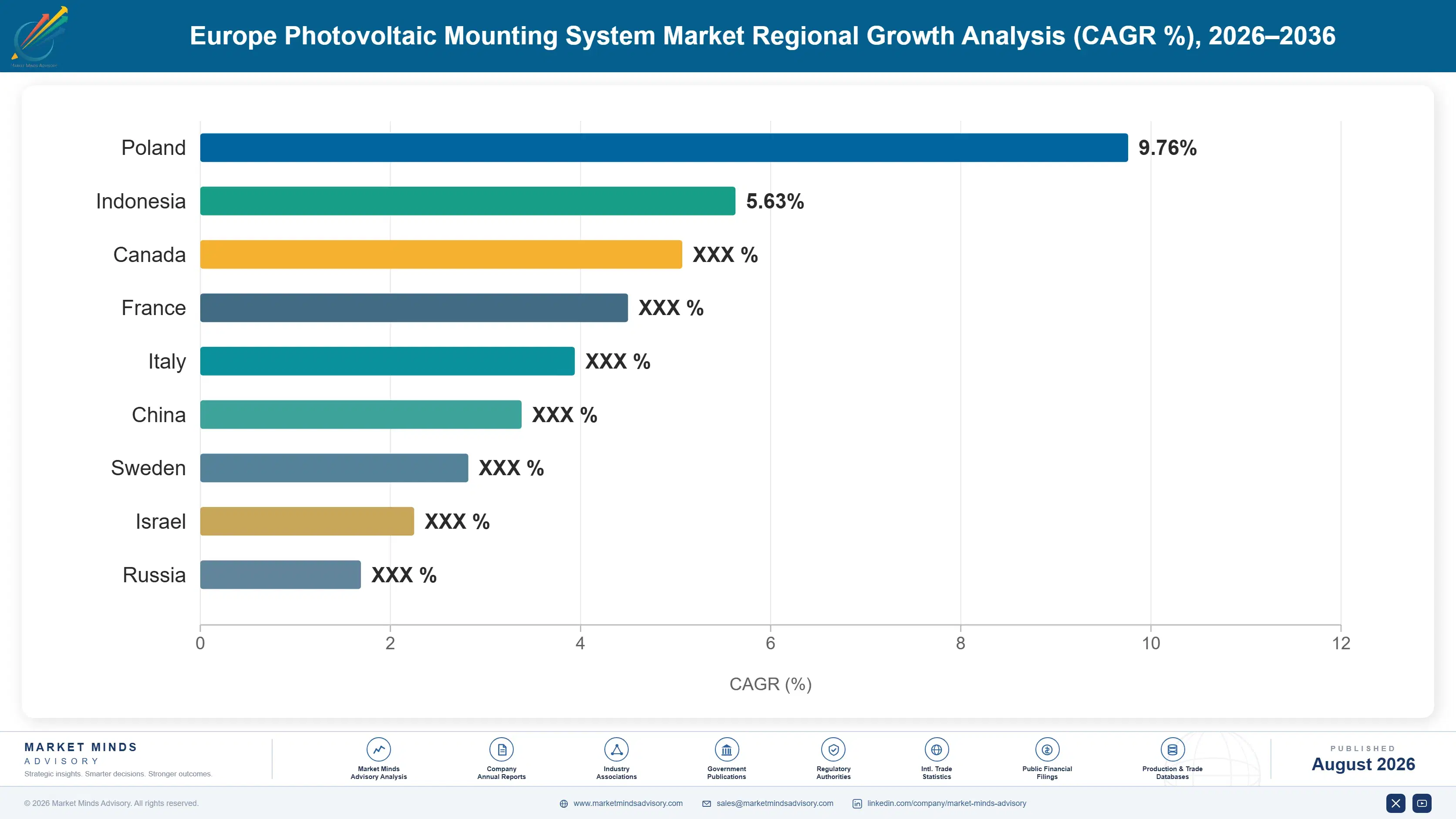
europe-photovoltaic-mounting-system-market-country-cagr-analysis-1787301574164

Where Suppliers Can Defend Category Margin

As fixed-tilt racking pricing compresses under regional fabricator competition, suppliers are shifting commercial strategy toward tracker reliability data, floating platform expertise, and mandate compliance certification to defend margin across the fastest-growing project types over the coming decade and beyond, a shift that rewards suppliers who move first across every national market they currently serve.

Publish Verified Long-Term Tracker Yield Data

Suppliers who publish verified, third-party audited energy yield data from operating tracker installations are winning a disproportionate share of utility-scale contracts, since developers increasingly demand bankable performance evidence before committing capital to a specific tracker supplier over established fixed-tilt alternatives. Suppliers with published multi-year yield data report win rates roughly 2x higher than competitors relying solely on manufacturer-modeled performance projections without independent verification behind them. This lever requires sustained field data collection investment but converts into a durable competitive advantage that unproven entrants cannot replicate quickly regardless of pricing across the industry.
Market Impact: Doubles tracker win rate to roughly

Secure Early National Rooftop Mandate Certification

Suppliers who secure early qualification with national building certification bodies overseeing rooftop solar mandate compliance are capturing a disproportionate share of new mandate-driven construction contracts, since certification lead times of several months prevent late entrants from competing for the earliest compliance deadlines facing developers and building owners across multiple jurisdictions. Suppliers with early certification report meaningfully higher win rates, in several cases exceeding 40 percent, on mandate-driven rooftop projects than competitors still pursuing certification. This lever requires upfront regulatory investment but secures a multi-year first-mover position across newly mandated construction categories nationwide.
Market Impact: Wins over 40% of contracts nationwi

Build Floating Platform Engineering Expertise Early

Suppliers who invest early in floating platform buoyancy engineering and environmental permitting expertise are positioned to capture a disproportionate share of the nascent but rapidly scaling floating PV segment before broader market recognition draws in additional competitors lacking comparable reference installations. Suppliers with completed floating reference projects report contract win rates roughly 3x higher than competitors without demonstrated floating platform track records in front of cautious project developers. This lever requires meaningful upfront engineering and permitting investment but converts into a durable, multi-year revenue relationship worth defending against later entrants.
Market Impact: Triples floating project win rate t

Establish Long-Term Utility Developer Framework Agreements

Suppliers who establish multi-year framework supply agreements directly with major utility-scale developers, rather than competing project by project, are building deeper commercial relationships that guarantee order volume across a developer's full multi-year project pipeline rather than a single tender won once transactionally. Suppliers with established framework agreements report contract values roughly 30 percent higher than comparable one-off project awards for similar total installed capacity delivered across their developer accounts region-wide. This lever requires sustained relationship investment but delivers outsized revenue predictability once established across the account base overall today.
Market Impact: Lifts total contract value roughly

Who Controls the Margin Pool

The top five manufacturers hold roughly 35 percent of revenue on a company-revenue basis, a fragmented structure reflecting how fixed-tilt racking segments remain accessible to numerous regional fabricators even as tracker and floating segments concentrate among a narrower set of specialists with proven bankability credentials across the industry. The gap between Nextracker and Array Technologies, the two largest players, and the broader field remains meaningful but leaves substantial room for r
Current competitive activity centers on three fronts: verified yield data races to win the largest utility-scale tracker contracts, rooftop mandate certification expansion designed to capture the earliest compliance-driven construction demand, and floating platform engineering investment intended to secure reference installations ahead of broader market recognition and competition across the continent.

Pressure is building from Chinese tracker and racking manufacturers, who are moving into European markets with meaningfully lower pricing than established Western suppliers can currently match on comparable specifications and delivery terms. Several have already won reference contracts with utility-scale developers in Southern Europe, evidence that could accelerate their share gains faster than established incumbents currently expect across the broader region overall.
europe-photovoltaic-mounting-system-market-company-positioning-matrix-1787301574675

Competitive Moat and Risk Dimensions

NEXTRACKER INC.

Moat: Deepest Verified Tracker Yield Data

Nextracker has accumulated one of the industry's largest bases of verified, operating tracker installations, giving it a bankability advantage with utility-scale developers that newer tracker entrants cannot replicate without years of comparable field performance data behind them across every major market it currently serves worldwide.
NEXTRACKER INC.

Risk: Premium Pricing Invites Chinese Competition

Nextracker's premium positioning and pricing create an opening for well-capitalized Chinese tracker manufacturers offering comparable core functionality at meaningfully lower prices, particularly in cost-sensitive Southern European utility-scale tenders where price weighs heavily in developer selection criteria today across the region.
ARRAY TECHNOLOGIES, INC.

Moat: Strong Utility Developer Relationships

Array Technologies has built deep, multi-year relationships with several of Europe's largest utility-scale developers, giving it repeat contract visibility that newer tracker suppliers must compete hard to displace through aggressive pricing or unproven differentiated technology alone across the wider industry today.
ARRAY TECHNOLOGIES, INC.

Risk: Concentrated Utility-Scale Exposure

Array Technologies' revenue concentration in utility-scale tracker projects leaves it more exposed than diversified competitors to grid interconnection delays and project financing disruptions that can defer or cancel large individual contracts across its developer customer base overall today.

Players Tracked

Prominent Players

Nextracker Inc.
Array Technologies, Inc.
GameChange Solar
Schletter Group
Valmont Solar

Other Key Players

Soltec Power Holdings, S.A.
PV Hardware (PVH)
Arctech Solar Holding Co., Ltd.
TrinaTracker
Esdec
K2 Systems GmbH
Renusol GmbH
Mounting Systems GmbH
Clenergy
IronRidge, Inc.
Van der Valk Solar Systems
Convert Italia S.p.A.
STI Norland
Ideematec Deutschland GmbH
Sunfin Renewables Pvt. Ltd.

Recent Developments

FEBRUARY 2025

Nextracker Launches New Tracker Platform With Enhanced Bifacial Yield Software

Nextracker introduced an organic product launch of a new single-axis tracker platform incorporating enhanced bifacial yield optimization software, designed to increase energy capture without requiring separate third-party performance modeling tools from outside vendors across its growing installed fleet worldwide, including across Europe.
Signal: Established tracker manufacturers are inve
JUNE 2025

Array Technologies Signs Multi-Year Framework Agreement With Major European Developer

Array Technologies signed a multi-year framework supply agreement, not an acquisition or joint venture, with a major European utility-scale developer to provide tracker systems across the customer's expanding project pipeline, securing predictable order revenue tied directly to that developer's disclosed multi-year pipeline.
Signal: Utility-scale developers are increasingly
NOVEMBER 2025

Schletter Group Acquires Floating Platform Engineering Specialist

Schletter Group completed the acquisition of a specialty floating platform engineering firm, adding proprietary buoyancy and environmental permitting capability rather than continuing to rely on third-party floating platform partnerships for its growing water-based mounting product lines going forward across Europe and neighboring export markets beyond it.
Signal: Established mounting manufacturers are acq

Steel and Aluminum Structural Cost Exposure

Steel and aluminum together account for roughly 42 percent of cost of goods sold across the category, with fabrication, coating, and assembly labor making up most of the remainder of finished mounting system cost across most producers. Structural steel supply concentrates among a relatively small number of major European mills, while aluminum extrusion capacity draws on both domestic and imported feedstock sources across the continent.
European steel prices tightened meaningfully during the 2021 to 2022 energy crisis period, when several major mills disclosed in annual reports that natural gas cost spikes forced temporary production curtailments across their smelting and rolling operations across the continent. Several smaller mounting system fabricators disclosed order fulfillment delays and margin compression during this period as steel supply constraints affected delivery timelines across the broader industry considerably that year.

Exposure varies by company scale and hedging sophistication. Larger diversified manufacturers with long-term steel supply agreements or captive fabrication capacity absorbed the volatility with comparatively limited disruption, while smaller regional fabricators reliant entirely on spot-market steel purchasing faced sharper cost swings that occasionally opened share for better-hedged competitors during the tightest supply quarters of the crisis.
europe-photovoltaic-mounting-system-market-cost-volatility-analysis-1787301574870

Secure Multi-Year Fixed-Price Steel Agreements

Leading manufacturers are increasingly securing multi-year fixed-price agreements directly with major European steel mills, trading some pricing flexibility for meaningfully greater supply certainty during periods of tight global steel and energy market volatility across the industry, particularly during the sharpest phases of the recent crisis that hit smaller fabricators hardest.

Substitute Toward Lighter Structural Profiles

Manufacturers are redesigning racking and tracker structures toward lighter aluminum and high-strength steel profiles that reduce total material input per installed watt, partially insulating finished system cost from broader commodity price swings across the supply chain and export markets they serve.

Invest In Captive Fabrication Capacity

Several of the largest suppliers have built or acquired captive steel fabrication and coating capacity, insulating a meaningful share of production from third-party fabricator pricing pressure and allowing faster new product development cycles across their broader mounting portfolios and regional manufacturing footprints today.

Portfolio Architecture for Margin Defence

The market splits into three commercial tiers with distinct margin economics. Standard fixed-tilt racking competes largely on price and delivery speed across a fragmented regional fabricator channel, rooftop mounting hardware carries meaningfully higher margin tied to mandate compliance certification, and tracker and floating systems command the highest margin given their engineering differentiation and constrained qualified supplier base across the industry.
The tension between volume and premium positioning shapes how manufacturers allocate engineering investment: fixed-tilt racking still represents meaningful unit volume across smaller residential and commercial projects, but nearly all incremental profit growth over the forecast period concentrates in tracker and floating applications, where leading suppliers increasingly direct yield engineering and reliability data investment across their broader product lines and regional manufacturing footprints.

High-value margin pools concentrate specifically in single-axis trackers serving the current utility-scale conversion wave and in floating platforms serving land-constrained European markets directly. Both pools reward manufacturers who invest ahead of demand in reliability data and permitting expertise rather than those who compete purely on fixed-tilt racking price across the broader replacement channel and smaller residential segments.

Volume / Commodity-Adjacent Tier

Standard fixed-tilt ground-mount racking sold largely on price and delivery speed across a fragmented regional fabricator channel serving smaller residential and commercial projects on tight budgets across most national markets nationwide.
Gross Margin: 12-20%

Premium / Certified Tier

Rooftop mounting hardware with mandate compliance certification and single-axis trackers with verified yield data, commanding meaningful premiums tied to compliance and performance evidence across audited reference installations and lender diligence.
Gross Margin: 24-34%

Sustainability / Regulatory / Next-Generation Tier

Floating PV platforms and dual-axis trackers, carrying the category's highest margins given engineering differentiation and a constrained pool of qualified suppliers able to deliver them at scale today across export markets.
Gross Margin: 36-46%
europe-photovoltaic-mounting-system-market-portfolio-architecture-1787301575367

Capital Projects Meet Multi-Decade Structural Life

Mounting systems behave as a genuine long-cycle capital purchase, generating a large upfront installation sale followed by twenty-five to thirty years of minimal maintenance revenue rather than a recurring subscription-like relationship, reflecting the category's exceptionally long structural warranty period across most deployment types and buyer segments worldwide.
Adoption depth varies sharply by end-use vertical across the market. Utility-scale developers show the fastest tracker-driven purchasing cycle given rapid conversion from fixed-tilt racking, residential rooftop buyers remain the slowest-cycling segment given their equipment's exceptional durability, and commercial rooftop owners sit between the two, tied more closely to mandate compliance deadlines than to pure equipment age or structural wear alone.

A generational shift in buyer profile is underway as utility developer procurement teams increasingly include dedicated bankability and performance data specialists rather than pure civil engineers trained under an older lowest-cost racking selection model. Rooftop mandate compliance officers are also reshaping how suppliers must present certification documentation earlier in the building permit approval process, well before construction begins in earnest across most jurisdictions.
europe-photovoltaic-mounting-system-market-end-use-penetration-index-1787301575859

Where This Market Goes Next

These are among the four positions where our research anticipates prominent divergence between winners and laggards over the coming forecast period. Each is grounded in the demand model, the regulatory perimeter, and the announced capacity pipeline.
01 / TRACKER YIELD VERIFICATION

Verified performance data will decide who captures utility-scale growth

Utility-scale developers reward tracker suppliers who publish verified, third-party audited yield data first, because bankability requirements make lenders and developers deeply reluctant to finance unproven equipment during large capital commitments. Suppliers who built verified yield data programs early are already winning a disproportionate share of new utility-scale tracker tenders across major European markets. This gap should widen rather than narrow as qualified suppliers accumulate operating history that later entrants cannot replicate quickly regardless of how much capital they eventually commit to catching up.
02 / ROOFTOP MANDATE CERTIFICATION

Early compliance certification is winning the fastest-growing contracts

Building owners and developers increasingly weigh mandate compliance certification as heavily as core hardware quality when selecting rooftop mounting suppliers, rewarding suppliers who invest in certification with national building authorities ahead of formal procurement processes across multiple jurisdictions. Suppliers with early certification are already reporting meaningfully higher win rates than competitors still pursuing approval from national certification bodies. Manufacturers who underinvest in certification risk losing deals to better-positioned competitors regardless of underlying hardware quality differences across their broader rooftop product lines and service offerings.
03 / FLOATING PLATFORM EXPERTISE

Reference installations are opening a defensible new category

Land-constrained European markets with genuine deployment needs but limited ground-mount availability represent an underserved segment that suppliers investing early in floating platform engineering are increasingly capturing away from ground-mount-only competitors across the industry. Suppliers with completed floating reference projects report meaningfully higher win rates than competitors lacking demonstrated platform track records in front of cautious developers. This lever requires sustained engineering and permitting investment but expands the addressable market beyond the category's traditional land-based deployment concentration.
04 / UTILITY FRAMEWORK AGREEMENTS

Multi-year developer relationships are reshaping order predictability

Utility-scale developers increasingly prefer consolidating mounting equipment supply under fewer, deeper supplier relationships covering their full multi-year project pipeline rather than negotiating each tender as a standalone transaction separately. Suppliers with established framework agreements report contract values and order book visibility meaningfully higher than competitors competing for individual project tenders one at a time today across the industry overall and across national borders. This consolidation trend should continue as more developers announce multi-year capacity pipelines requiring sustained equipment supply relationships rather than isolated one-off tenders going forward across the region.

Engagement Snapshot From the Field

A live engagement with an industry participant carrying material or product regulatory and market exposure ahead of a defining policy shift, showing how our research translates into a defensible multi-year portfolio strategy.
MARKET MINDS ADVISORY · CLIENT ENGAGEMENT SUMMARY
Europe Photovoltaic Mounting System Producer Strategic Portfolio Review and Transition Roadmap 2026·Investment Scenario on Europe Photovoltaic Mounting System Exposure Evaluation 2025-26
CLIENT PROFILE
The client is a regional utility-scale solar developer operating a multi-country European project pipeline, with several gigawatts of announced ground-mount capacity across Southern and Central Europe representing substantial planned capital deployment over the coming years (client-reported, unverified by MMA). The company needed to select a tracker supplier capable of meeting its yield and bankability requirements across multiple simultaneous projects.
STRATEGIC CHALLENGE
Leadership needed to select a tracker supplier capable of meeting lender bankability requirements while completing supplier selection within a compressed timeline set by construction financing commitments already secured with several project lenders across multiple national jurisdictions and permitting regimes, without disrupting existing construction schedules already agreed with contractors across each site.
MMA APPROACH
MMA benchmarked candidate tracker suppliers against verified yield data, delivery timeline, and total cost of ownership including financing terms, modeled expected energy yield under three distinct tracker configurations, and recommended a supplier selection and phased project rollout sequence prioritized by financing deadline and available capital budget across all projects.
KEY FINDINGS
  1. Only four of eleven candidate tracker suppliers evaluated offered verified, third-party audited yield data meeting the client's lender bankability requirements without additional documentation gaps.
  2. Modeled energy yield varied by roughly 8 percent across candidate tracker configurations, a meaningful factor given the client's project-level financing return requirements already committed.
  3. Delivery timelines varied by more than four months across candidate suppliers, materially affecting which suppliers could realistically meet the client's construction financing deadlines across projects.
  4. Modeled yield differences across candidate tracker configurations translated into a meaningful revenue impact over each project's operating life (client-reported, unverified by MMA).
CLIENT PROFILE
The client is a regional utility-scale solar developer operating a multi-country European project pipeline, with several gigawatts of announced ground-mount capacity across Southern and Central Europe representing substantial planned capital deployment over the coming years (client-reported, unverified by MMA). The company needed to select a tracker supplier capable of meeting its yield and bankability requirements across multiple simultaneous projects.
STRATEGIC CHALLENGE
Leadership needed to select a tracker supplier capable of meeting lender bankability requirements while completing supplier selection within a compressed timeline set by construction financing commitments already secured with several project lenders across multiple national jurisdictions and permitting regimes, without disrupting existing construction schedules already agreed with contractors across each site.
MMA APPROACH
MMA benchmarked candidate tracker suppliers against verified yield data, delivery timeline, and total cost of ownership including financing terms, modeled expected energy yield under three distinct tracker configurations, and recommended a supplier selection and phased project rollout sequence prioritized by financing deadline and available capital budget across all projects.
KEY FINDINGS
  1. Only four of eleven candidate tracker suppliers evaluated offered verified, third-party audited yield data meeting the client's lender bankability requirements without additional documentation gaps.
  2. Modeled energy yield varied by roughly 8 percent across candidate tracker configurations, a meaningful factor given the client's project-level financing return requirements already committed.
  3. Delivery timelines varied by more than four months across candidate suppliers, materially affecting which suppliers could realistically meet the client's construction financing deadlines across projects.
  4. Modeled yield differences across candidate tracker configurations translated into a meaningful revenue impact over each project's operating life (client-reported, unverified by MMA).
RECOMMENDED STRATEGY
Phase 1: Phase 1 (Months 1-3): Complete supplier evaluation and finalize tracker selection based on yield, bankability, and delivery fit overall today. Phase 2: Phase 2 (Months 4-10): Execute tracker installation and commissioning across the first two priority projects identified in the initial plan. Phase 3: Phase 3 (Months 11-16): Complete remaining project rollout and establish ongoing yield performance monitoring across the full commissioned project portfolio.
OUTCOME
Sixteen months into the engagement, the client reported successful tracker deployment across its full priority project pipeline with energy yield performance matching modeled projections across every commissioned site (client-reported, unverified by MMA), validating MMA's supplier selection recommendation and phased rollout sequence fully across the entire development program.

Frequently Asked Questions

Foundational context covering the market sizes, CAGR, scope, country, region and competition that inform every finding below. This section is provided to cover basics and most often pre-purchase conversations, answered from the MMA Primary Research Dataset.

What is the current size of the Europe Photovoltaic Mounting System Market?

The market is valued at approximately 1.6 billion dollars in 2025, expanding to roughly 1.73 billion dollars in 2026 as rooftop mandates and tracker conversion continue driving demand.

How large will the Europe Photovoltaic Mounting System Market be by 2036?

MMA forecasts the market reaching approximately 3.89 billion dollars by 2036, roughly 2.24 times its 2026 value, driven primarily by binding rooftop mandates and utility-scale tracker adoption.

What is the CAGR for the Europe Photovoltaic Mounting System Market 2026 to 2036?

The base-case compound annual growth rate is 8.4 percent, with a bull scenario of 9.6 percent and a bear scenario of 7.2 percent depending on mandate expansion pace and interconnection timelines.

Which segment is growing fastest?

Floating PV mounting systems are growing fastest at a 13.5 percent CAGR, roughly 1.61 times the overall market rate, driven by constrained ground-mount land availability in several countries.

Who are the major companies in the Europe Photovoltaic Mounting System Market?

Nextracker Inc., Array Technologies, Inc., GameChange Solar, Schletter Group, and Valmont Solar lead the market, together holding roughly 35 percent of revenue on a company-revenue basis.

Which country is growing fastest?

Poland is the fastest-growing country at a 12.8 percent CAGR, driven by rapid utility-scale and rooftop capacity additions tied to national energy security policy and reduced fossil fuel dependence.

Report Segmentation Architecture

The full report scope spans multiple orthogonal segmentation dimensions, with cross-tabulated demand data provided for each dimension pair. Coverage extends further to regional breakdowns, trend trajectories, and the competitive detail needed to support segment-level decision-making.

By Mounting Hardware Type

  • Fixed-Tilt Ground-Mount Racking
  • Single-Axis Tracker Systems
  • Dual-Axis Tracker Systems
  • Rooftop Mounting Systems
  • Floating PV Mounting Systems
  • Ballasted and Building-Integrated Systems

By End-Use Industry

  • Utility-Scale Power Generation
  • Commercial and Industrial Rooftop
  • Residential Rooftop
  • Agrivoltaic and Land-Constrained Deployment

By Commercial Dimension

  • Direct Developer and EPC Contracts
  • Authorized Distributor Channel
  • Rooftop Installer Network
  • Framework Supply Agreements

By Region

  • North America
  • Western Europe
  • East Asia
  • South Asia and Pacific
  • Latin America
  • Middle East and Africa
  • Eastern Europe

Scope, Methodology, and Coverage

Every figure in this report is reproducible from documented input assumptions. The scope below maps the historical period, the forecast horizon, the segmentation dimensions, and the countries covered, alongside the underlying primary and qualitative methodology.
Historical Period
2020 to 2025
Forecast Period
2026 to 2036
Base Year
2025 (USD billions; MMA Primary Research Dataset, August 2026)
Market Definition
The market covers structural hardware that secures photovoltaic modules to rooftops, ground surfaces, and water bodies across Europe, including fixed-tilt racking, single-axis and dual-axis tracker systems, rooftop mounting hardware, floating platforms, and ballasted systems. Photovoltaic modules, inverters, cabling, and monitoring software are excluded.
Quantitative Units
USD billions (current prices); installed capacity in gigawatts where cited
Segmentation Dimensions
By Mounting Hardware Type; By End-Use Industry; By Commercial Dimension; By Region
Regions Covered
North America, Western Europe, East Asia, South Asia and Pacific, Latin America, Middle East and Africa, Eastern Europe
Countries Covered
Germany, France, Netherlands, Spain, Italy, Poland, Romania, Hungary, Czech Republic, UK, USA, China, Japan, South Korea, India, Australia, Brazil, Chile, Mexico, Colombia, Saudi Arabia, UAE, South Africa, Vietnam, Philippines, and additional markets relevant to this sector
Key Companies Profiled
Nextracker Inc., Array Technologies, Inc., GameChange Solar, Schletter Group, Valmont Solar, Soltec Power Holdings, S.A., PV Hardware (PVH), Arctech Solar Holding Co., Ltd., TrinaTracker, Esdec, K2 Systems GmbH, Renusol GmbH, Mounting Systems GmbH, Clenergy, IronRidge, Inc., Van der Valk Solar Systems, Convert Italia S.p.A., STI Norland, Ideematec Deutschland GmbH, Sunfin Renewables Pvt. Ltd.
Quantitative Methodology
Primary survey, n=3,800 respondents, Q4 2025, six countries; demand-side model with trade association cross-validation
Qualitative Methodology
47 expert interviews, Q4 2025; applied to validate demand model assumptions, identify emerging dynamics, and assess competitive positioning
Report Format
PDF and XLSX data workbook (Word format preview document)
Publisher
Market Minds Advisory
Report Code
MMA-2026-ENE-522
Published
August 2026
Contact
sales@marketmindsadvisory.com | www.marketmindsadvisory.com

Purchase the full Europe Photovoltaic Mounting System Market Report (2026 to 2036).

The full report delivers a complete quantitative and strategic assessment of the European photovoltaic mounting system market across all seven regions and more than twenty five countries covered in this study. It includes detailed segment-level forecasts through 2036, competitive benchmarking across twenty profiled manufacturers, and primary research drawn from 3,800 survey respondents and 47 expert interviews conducted in Q4 2025. Buyers receive editable data tables and full regional narrative detail beyond the two regions previewed in this summary document. A dedicated appendix covers rooftop mandate timelines and floating platform permitting requirements by country.
Fully editable Excel data tables and models
All seven full regional narratives fully included
Twenty full company competitive profiles included
Rooftop mandate timeline appendix provided in full
Segment-level 2026-2036 detailed annual forecasts
Full primary survey and expert interview data included fully

Built For The People Who Decide

From boardroom strategy to bench-side execution, this report is read cover-to-cover by leaders shaping the next decade of their industry, turning demand scenarios, market dynamics and valuation benchmarks into decisions.
CXOs/ Presidents/ VPs/ Managers
M&A and Corporate Development
Strategy Teams and R&D Heads
Procurement and Product Directors
Regulatory and Compliance Leaders
Investor Relations and Equity Analysts