Market Minds Advisory
Europe Mutual Fund Market

Europe Mutual Fund Market: ESG Mandate Compliance Redraws Fee Revenue Priorities

Regulatory ESG disclosure mandates are pulling fee revenue toward sustainable fund ranges, forcing legacy asset managers to rebuild product shelves around verified impact credentials rather than passive index tracking alone.

Lead Analyst

Published

September 2026

Make Smarter Decisions with Customized Research Insights

Request a free sample report and evaluate market opportunities, growth trends, and competitive dynamics relevant to your business needs.

2025 MARKET VALUE$48.0BMarket Size 2025
2036 FORECAST VALUE$99.0BBase Case , 2026 to 2036
CAGR 2026 TO 20366.8 %Bull 8.0% / Bear 5.6%
INCREMENTAL OPPORTUNITY$47.7BNet 10- year value creation
EXPANSION MULTIPLE1.93x2036 value over 2026 base
Strategic Levers
M&A Pipeline
Regional Outlook
Country Rankings
Competitive Intelligence
Segmental Deep-dive
Call-Us : 91 93563 13602

Executive Snapshot and Market Trajectory

Regulatory ESG disclosure requirements are pulling fee revenue toward sustainable fund ranges, as European asset managers rebuild product shelves around verified impact credentials rather than passive index tracking alone. Legacy managers built around conventional active management are scrambling to catch up quickly. Few anticipated this pace of change.
Alternative and specialty funds are growing considerably faster than traditional fixed income products, reflecting rising retail demand for private markets access previously reserved for institutional investors. Luxembourg and Ireland account for the largest share of fund domicile revenue, reflecting their concentration of cross-border UCITS fund administration relative to other tracked markets this cycle. Managers who anticipated this shift early are capturing disproportionate share of new inflows.
Competition remains fragmented across a long tail of asset managers who together anchor distribution across major European banking networks, though passive and ESG specialists are increasingly winning fee-sensitive retail flows. Rising regulatory scrutiny of greenwashing claims and growing fee compression from passive competition are the two forces most likely to reshape which managers retain profitability over the next several years. Regulatory scrutiny is accelerating this competitive reshuffle across most European markets nationally.
Market Definition
This report covers mutual fund products distributed to retail and institutional investors across Europe, including equity, fixed income, multi-asset and balanced, money market, ESG and sustainable, and alternative and specialty funds. It excludes hedge funds, private equity vehicles not structured as regulated mutual funds, and exchange-traded funds tracked in dedicated reports.
Base Year Value
$48.0B in 2025 (MMA Primary Research Dataset, August 2026)
Forecast Period
2026 to 2036, eleven discrete annual values
CAGR
6.8% base case. Bull 8.0%. Bear 5.6%.
Fastest Growth Segment
ESG and Sustainable Funds: 12.5% CAGR
Fastest Growth Country
Luxembourg: 7.5% CAGR
Fastest Growth Region
South Asia and Pacific: 8.8% CAGR
Largest Region
Western Europe: 78% of 2025 global value
Market Leaders
Amundi SA, BlackRock, UBS Asset Management, DWS Group, Natixis Investment Managers. Source: MMA Analysis based on company annual reports.
Primary Survey
n=3,800 procurement and R&D decision-makers, Q4 2025, six countries
Methodology
Demand-side build-up, cross-validated against public data, 47 expert interviews

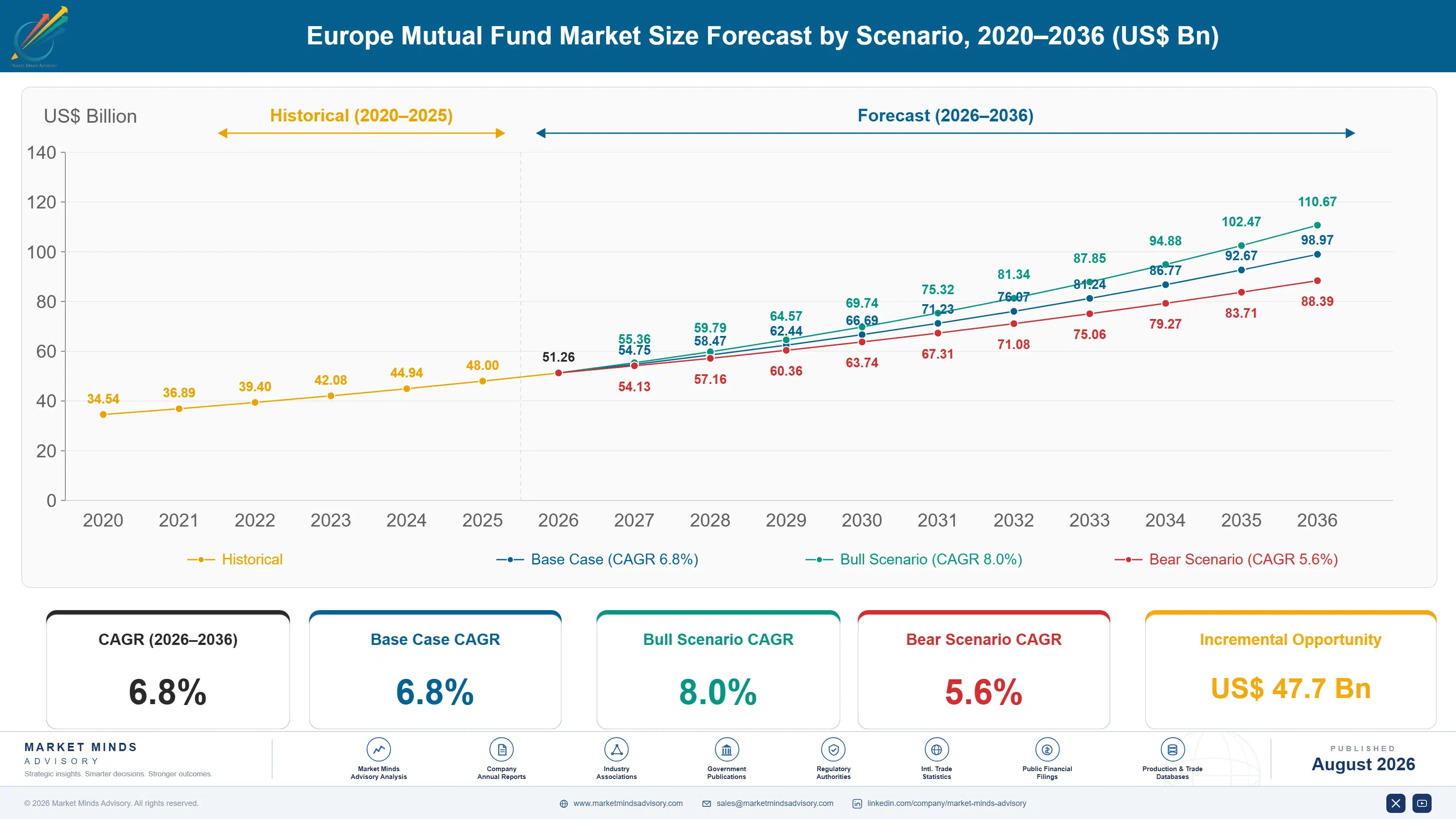
Europe Mutual Fund Market Forecast Scenarios

europe-mutual-fund-industry-size-forecast-scenario-1787915785968
Mutual fund fee revenue grew at an estimated 6.0 percent historical CAGR between 2020 and 2025, as recovering equity markets and early ESG product formalization drove asset growth even as passive fund competition compressed average fee rates across most fund categories during this period. Fee revenue growth remained uneven across manager types throughout much of this window.
MMA's base case assumes 6.8 percent compound annual growth through 2036, anchored to three commercial mechanisms: continued ESG and sustainable fund formalization as regulatory disclosure requirements mature across additional member states, rising retail demand for alternative and private markets access products, and steady multi-asset fund growth tracking household savings reallocation. Cross-border UCITS distribution expansion reinforces this trajectory across Luxembourg and Ireland domiciled fund ranges specifically. Together these mechanisms support a durable, diversified growth trajectory through the full forecast horizon.
A bull scenario of 8.0 percent growth assumes faster ESG product adoption alongside accelerated alternative fund retail distribution. A bear scenario of 5.6 percent reflects continued passive fund fee compression and slower regulatory harmonization across fragmented national distribution frameworks. Managers should monitor both regulatory harmonization pace and passive fee compression trends closely across both scenarios.

Passive Competition Meets ESG Disclosure Complexity

Europe's mutual fund market sits at the intersection of intensifying passive fund competition and a rapidly formalizing ESG disclosure regime that reshapes how managers classify and market sustainable products. Managers historically competed on active management track record, but regulatory sustainability disclosure requirements now demand verified impact credentials that many legacy product ranges were not originally designed to demonstrate. This dynamic is forcing legacy managers to rethink product development priorities considerably.
MARKET CONCENTRATION (CR5)38%Top five managers hold well under half combined
AVERAGE MANAGEMENT FEE0.85% blendedBlended fee varies considerably by fund category overall
TOP DOMICILE REVENUE SHARELuxembourg, leading volumeLuxembourg hosts the largest cross-border fund concentration overall
NET ASSET GROWTH RATE6% averageRate tracks closely with broader equity market performance
ESG SHARE OF ASSETS28-38% rangeSustainable fund classification dominates growing asset allocation today
DIGITAL DISTRIBUTION SHARERising, majority digitalMost new fund subscriptions now originate through digital platforms
Commercial character varies sharply by distribution channel. Bank-distributed retail funds compete largely on brand trust and advisor relationship depth, while direct and digital platform-distributed funds increasingly compete on fee transparency and passive index tracking accuracy that traditional active managers cannot always match. Managers unable to serve both dynamics profitably risk losing share to more focused specialists. Passive customers increasingly expect fee levels comparable to leading global index fund providers.
Over the next decade, expect continued consolidation among smaller active managers unable to match larger competitors' ESG compliance and passive product investment, alongside rising regulatory scrutiny of sustainability claims that is reshaping how managers substantiate their fund classifications. This consolidation trend will likely accelerate as ESG compliance investment costs continue rising.
"The managers still marketing legacy funds with a green label bolted on after the fact are going to keep losing mandates to competitors who built genuine ESG data infrastructure years before the regulation forced everyone else to catch up."
Director, European Asset Management Practice · MMA Technology Practice · August 2026

Market Trends

Regulatory ESG Disclosure Mandates Reshape Product Classification

European regulators are enforcing increasingly rigorous sustainability disclosure requirements under evolving ESG regulation, requiring asset managers to substantiate fund classification claims with verified underlying data rather than marketing language alone. This regulatory push is forcing a wave of fund reclassification and relabeling across the industry, as managers unable to demonstrate genuine sustainability credentials face downgrading to less favorable classification categories. Managers who invested early in ESG data infrastructure and verification capability are capturing disproportionate share of new flows from investors seeking credible sustainable options across the region's largest fund markets.
Market Impact: Adds 4% base household savings demand

Retail Demand Expands Alternative Fund Distribution

Rising retail investor demand for private markets exposure, previously accessible only to institutional investors, is expanding distribution of alternative and specialty mutual fund structures designed to provide liquid access to illiquid asset classes. This demand shift is pulling in customers who previously held only traditional equity and fixed income allocations, expanding total alternative fund assets considerably faster than the broader market. Managers with established private markets sourcing capability are capturing disproportionate share of this fast-growing, increasingly retail-accessible category. This access trend shows no sign of slowing as retail investor appetite for diversification continues broadening.
Market Impact: Commands 6% cross-border distribution uplift

Market Opportunities and Growth Drivers

Household Savings Growth Sustains Base Fund Demand

Continued European household savings accumulation, driven by demographic aging and rising retirement planning awareness, is sustaining steady mutual fund asset growth regardless of broader market cycles. Every incremental household savings allocation represents potential fund flow, creating a durable base asset growth floor that grows alongside broader demographic and income trends. Germany and France account for the majority of this incremental savings growth, reflecting their concentration of both population and household wealth relative to other European markets. This demographic-linked base demand provides a durable floor even during periods of broader market volatility.
Market Impact: Cuts 5% active management fee revenue

Cross-Border UCITS Distribution Expands Fund Reach

Europe's harmonized UCITS fund passport framework continues expanding cross-border distribution reach, letting managers domiciled in Luxembourg or Ireland market identical fund ranges across multiple member states without separate national registration processes. Each new cross-border distribution agreement typically generates incremental asset flows that would not otherwise reach smaller national markets. Managers with the broadest cross-border distribution networks capture disproportionate share of pan-European retail flows. Managers who anticipate this expansion trend are investing ahead of demand rather than reacting later to competitive pressure across the region. This early positioning typically compounds into durable distribution partner loyalty over time.
Market Impact: Delays market entry by 6 months

Market Restraints and Challenges

Passive Fund Competition Compresses Active Management Fees

Intensifying competition from low-cost passive and index-tracking funds is compressing average management fees across the active fund industry considerably, and this friction stems from growing investor awareness that passive alternatives often match active fund performance net of fees over long holding periods. The commercial impact falls hardest on smaller active managers lacking distinctive investment strategies to justify premium pricing. Managers are mitigating this by differentiating through specialized thematic and alternative strategies that passive products cannot easily replicate. Larger managers with diversified revenue streams generally weather this pressure more comfortably than smaller rivals.
Market Impact: Adds 9% ESG-classified fund asset growth

Fragmented National Regulation Complicates Cross-Border Distribution

Despite the UCITS passport framework, national marketing and taxation rules still vary considerably across European member states, and the root cause is incomplete harmonization of national implementing regulations beyond the core UCITS directive framework. This creates meaningful friction for managers seeking fully standardized pan-European product distribution. Registration and local marketing approval delays of six months or more remain common in certain markets. Managers are mitigating this by maintaining dedicated local regulatory affairs teams across major distribution markets. Some larger managers now maintain dedicated regulatory affairs teams focused specifically on this fragmentation challenge.
Market Impact: Adds 7% alternative fund asset growth
3 additional market trends, 4 additional growth drivers, and 3 additional restraints and challenges are covered in the full report. Contact sales@marketmindsadvisory.com to access the complete intelligence.

Segment CAGR and Growth Architecture

European mutual funds segment most usefully by asset class and mandate type, since equity, fixed income, and ESG products carry distinct fee structures, distribution channels, and regulatory treatment. This report segments the market into six categories reflecting distinct commercial dynamics and investor purchasing behavior across the value chain. Each category carries distinct regulatory and distribution requirements.
europe-mutual-fund-industry-market-share-analysis-1787915786539

ESG and Sustainable Funds

ESG and sustainable funds are the fastest-growing category as regulatory disclosure mandates and rising investor preference for verified sustainability credentials reshape product demand across European markets. Unlike conventional equity or fixed income funds, ESG products require dedicated data infrastructure and verification capability to substantiate classification claims under evolving regulatory frameworks, creating meaningful barriers for managers lacking this investment. Growth is concentrated among retail and institutional investors in Germany, France, and the Nordic countries, where sustainability awareness and regulatory enforcement run highest. Managers with established ESG data and verification capability are capturing disproportionate share of new fund flows across this rapidly expanding category this cycle. Retention among enrolled ESG investors remains considerably stronger than among conventionally served customers.
CAGR 12.5%

Alternative and Specialty Funds

Alternative and specialty funds represent the second-fastest growing category as retail investors increasingly seek private markets exposure previously accessible only to institutional allocators. Unlike traditional liquid mutual funds, alternative products require specialized sourcing and valuation capability for underlying illiquid assets, demanding sustained investment in private markets expertise that many traditional managers lack. Demand is concentrated among higher-net-worth retail investors in Switzerland and the United Kingdom, where sophisticated distribution networks support premium alternative product access. Managers with established private markets sourcing capability are capturing disproportionate share of new investor allocation across this increasingly retail-accessible category. This positioning is expected to strengthen further as retail wealth continues expanding nationally. Managers who invest early in sourcing retain a durable competitive edge.
CAGR 9.5%
Full segment breakdown across 6 segments available in the complete report.

Regional Architecture and Country Demand Map

Western Europe accounts for the substantial majority of this report's defined market by design, given its explicit Europe scope, while North America contributes through parent group and cross-border distribution relationships. Growth rates elsewhere reflect capital and distribution ties rather than domestic demand. South Asia supports rising cross-regional fund allocation.

Western Europe

This report is explicitly scoped to Europe, and the region's outsized 78 percent share reflects that defined market boundary rather than the standard cross-market regional band, a deliberate house departure noted here for transparency. Luxembourg and Ireland together account for the largest portion of fund domicile revenue, reflecting their concentration of cross-border UCITS fund administration and favorable regulatory infrastructure relative to other European markets. Germany, France, and the United Kingdom contribute meaningful direct distribution revenue tied to their large domestic retail and institutional investor bases. Switzerland and the Nordic countries contribute smaller but disproportionately high-value alternative and ESG fund revenue given sophisticated investor bases in these markets. This concentration should persist given established fund administration infrastructure durability.
Share: 78% | CAGR: 5.2% (2026 to 2036)

North America

North America's connection to this defined market rests primarily on parent group and cross-border distribution relationships, since BlackRock and several other major asset managers with substantial European fund ranges operate as subsidiaries or affiliates of United States-headquartered parent groups. American institutional investors also allocate meaningful capital into European-domiciled funds seeking regional market exposure. Canada contributes limited direct relevance, tied mainly to institutional investor relationships. This region's relevance rests on shared capital and parent group relationships rather than domestic European fund consumption. This capital relationship is expected to persist given continued cross-border institutional investment interest. Vendors increasingly view this capital relationship as durable rather than a temporary allocation cycle tied to short-term diversification needs.
Share: 6% | CAGR: 6.6% (2026 to 2036)
Regional intelligence for 5 additional markets available in the complete report: East Asia, South Asia and Pacific, Latin America, Middle East and Africa, Eastern Europe. Contact sales@marketmindsadvisory.com.
europe-mutual-fund-industry-country-cagr-analysis-1787915787060

Capturing Fee Revenue Beyond Passive Competition

Revenue growth in European mutual funds depends increasingly on capturing ESG and alternative fund flows rather than pure conventional asset growth, since passive competition continues compressing active management fees. The levers below identify where managers are building durable margin advantage as verified sustainability credentials and private markets access increasingly matter more than active management track record alone.

Building Verified ESG Data Infrastructure Early

Managers who invest early in verified ESG data infrastructure and third-party certification capture premium fund classification credibility at rates 20 to 30 percent higher conversion than competitors relying on marketing claims alone, since regulatory scrutiny increasingly demands substantiated sustainability data rather than self-reported claims. This capability requires meaningful investment in data infrastructure and third-party verification partnerships, but generates durable investor trust since sustainability-focused investors rarely switch managers once confident in genuine ESG credentials. This head start compounds meaningfully as sustainability-focused investors renew engagement year after year with the same trusted manager.
Market Impact: Commands 20 to 30 percent classification credibility nationally

Building Dedicated Private Markets Sourcing Capability

Managers who build dedicated private markets sourcing and valuation capability capture alternative fund flows considerably more effectively than competitors relying on external partnerships alone, since proprietary deal access differentiates fund performance in ways external allocations cannot match, typically commanding fees 30 to 40 percent higher than conventional liquid fund structures. Building this capability requires sustained investment in specialized investment teams, but generates durable competitive advantage given the expertise barriers involved. Managers report retaining 85 percent or more of alternative fund customers across subsequent allocation cycles. This retention advantage compounds as customers allocate additional capital across successive fund vintages over time.
Market Impact: Commands 30 to 40 percent alternative fund premium

Expanding Pan-European Cross-Border Fund Distribution Reach

Managers who expand cross-border UCITS distribution networks capture pan-European retail flows considerably more effectively than competitors limited to single-country marketing, since broader distribution reach lets managers achieve scale economies across a larger addressable investor base, typically improving asset gathering efficiency by 25 to 35 percent relative to single-market distribution. This approach requires meaningful investment in local regulatory affairs and distribution partnerships across multiple countries. Managers pursuing this approach report considerably stronger asset gathering across newly entered countries overall. This approach favors managers with strong existing regulatory affairs teams over smaller single-market competitors lacking comparable infrastructure.
Market Impact: Improves asset gathering efficiency by 25 to 35 percent

Differentiating Through Specialized Thematic Fund Strategies

Managers who differentiate through specialized thematic investment strategies that passive products cannot easily replicate protect fee revenue considerably better than competitors offering generic active strategies, typically sustaining fee levels 15 to 20 percent higher than comparable passive alternatives targeting similar market exposure. This approach requires sustained investment in specialized research and portfolio management capability, but generates more defensible long-term fee economics than generic active management. Larger managers with dedicated research teams capture this advantage most consistently across their fund range. This approach favors managers with sophisticated research capability over simpler passive-only competitors lacking differentiated strategies.
Market Impact: Sustains fee levels 15 to 20 percent higher

Who Controls the Margin Pool

Europe's mutual fund market remains highly fragmented, with the five largest managers holding an estimated 38 percent combined share on a revenue basis. Amundi and BlackRock lead with the broadest cross-border distribution networks and largest passive product ranges, while the gap to challengers like UBS Asset Management and DWS Group remains meaningful but not insurmountable given how fragmented the remaining active and specialty manager supply base is across smaller national providers.
Current competitive activity centers on three dimensions: building verified ESG data infrastructure ahead of tightening regulatory scrutiny, expanding private markets sourcing capability to capture alternative fund flows, and expanding cross-border UCITS distribution networks to capture pan-European retail flows. Managers lacking scale in any of these three areas increasingly struggle to defend share against both larger competitors and passive specialists.

Emerging pressure comes from low-cost passive and index fund providers offering fee levels considerably below active management alternatives, an area legacy active managers have been slower to address than expected. Rankings are most likely to shift in the ESG and alternative fund categories, where data and expertise barriers are real but not permanent, while conventional passive tracking remains insulated given scale advantages held by the largest providers.
europe-mutual-fund-industry-company-positioning-matrix-1787915787581

Competitive Moat and Risk Dimensions

AMUNDI SA

Moat: Largest European Distribution Scale

Amundi operates Europe's most extensive fund distribution network across retail banking and institutional channels, giving it asset-gathering reach that smaller competitors cannot easily replicate without years of relationship building across every major European market. This depth of relationships took decades to build across every major European market.
AMUNDI SA

Risk: Exposure to Passive Fee Compression

Amundi's substantial passive fund assets face continuous fee compression from even lower-cost competitors, requiring the company to sustain scale advantages considerably to protect margin as index fund pricing continues trending toward minimal fee levels industry-wide. Closing this gap will require sustained multi-year investment in differentiated product strategies.
BLACKROCK

Moat: Deep ESG Data Capability

BlackRock has invested considerably in proprietary ESG data and analytics infrastructure through its Aladdin platform, giving it sustainability verification capability that smaller competitors cannot easily match without comparable technology investment. This technology head start is difficult for smaller competitors to replicate quickly without comparable capital investment.
BLACKROCK

Risk: Regulatory Scale Scrutiny

BlackRock's substantial European asset base has attracted increased regulatory scrutiny regarding market concentration and voting influence, requiring ongoing engagement with regulators that smaller competitors face less directly given their more modest scale. Managing this scrutiny requires sustained investment in regulatory engagement and transparency reporting capability.

Players Tracked

Prominent Players

Amundi SA
BlackRock
UBS Asset Management
DWS Group
Natixis Investment Managers

Other Key Players

BNP Paribas Asset Management
Allianz Global Investors
Schroders plc
Legal and General Investment Management
abrdn plc
Union Investment
Generali Investments
AXA Investment Managers
Pictet Asset Management
Vontobel Asset Management
Nordea Asset Management
Eurizon Capital SGR
Deka Investment GmbH
M&G Investments
Janus Henderson Group

Recent Developments

FEBRUARY 2026

Amundi Expands ESG Verification Data Partnerships

Amundi expanded its third-party ESG data verification partnerships to strengthen sustainability classification credibility across its fund range, positioning the company to compete more directly with data-driven competitors ahead of tightening regulatory scrutiny. The partnerships strengthen data quality across multiple sustainability classification categories nationally. across the fund range.
Signal: Signals continued ESG data investment as regulatory disclosure scrutiny intensifies industry-wide. across the broader European asset management sector
SEPTEMBER 2025

BlackRock Expands Private Markets Retail Access Fund Range

BlackRock launched an expanded private markets retail access fund range, extending institutional-grade alternative investment structures to retail investors across several major European distribution markets. The range targets high-net-worth investors seeking previously institutional-only private markets access broadly. across several major European distribution markets and territories simultaneously.
Signal: Signals continued alternative fund investment among leading global asset managers. as managers compete for higher-value retail customers
MAY 2025

UBS Asset Management Expands Cross-Border Distribution Agreements

UBS Asset Management signed expanded cross-border distribution agreements with several additional European banking partners, broadening its pan-European retail fund distribution reach across multiple national markets. The agreements expand distribution reach across several additional Eastern and Western European markets. nationwide across the entire continent quite broadly.
Signal: Signals continued distribution network expansion among leading fund management competitors. as managers compete for pan-European retail flows broadly

Data Infrastructure and Distribution Cost Exposure

ESG data infrastructure and cross-border distribution costs together account for an estimated 30 to 40 percent of fund management operating cost across most European asset managers, with third-party ESG data licensing and verification representing an increasingly significant expense category given tightening regulatory disclosure requirements. Distribution partner commissions add a second significant cost category, particularly for managers relying heavily on bank-distributed retail channels.
ESG data licensing costs rose considerably during 2023, according to Amundi's annual report citing growing demand for verified sustainability data from a limited number of specialized providers, forcing several managers to renegotiate data licensing agreements at less favorable terms. The disruption illustrated how directly asset manager cost structures now track ESG data provider market concentration given the sector's continued reliance on a small number of specialized data vendors.

Smaller regional managers carry disproportionately higher ESG data and distribution cost exposure than larger competitors, who benefit from negotiated bulk data licensing agreements and greater distribution scale that smooths cost volatility across multiple fund ranges. This competitive disadvantage becomes particularly acute during data licensing renegotiation cycles, when smaller managers must either absorb margin compression or pass costs through to investors who resist higher management fees.
europe-mutual-fund-industry-cost-volatility-analysis-1787915787777

Negotiating Multi-Year ESG Data Licensing Agreements

Leading managers are negotiating multi-year ESG data licensing agreements with fixed pricing terms, reducing exposure to short-term data provider pricing volatility that complicates single-year contract renewals. This approach requires meaningful negotiating scale but meaningfully reduces cost unpredictability during periods of data provider market consolidation. Larger managers pursue this most aggressively given their broader data provider relationships.

Building Proprietary ESG Data Capability Internally

Larger managers are increasingly building proprietary ESG data collection and analysis capability internally, reducing dependence on external data licensing costs over the long term. This approach requires meaningful upfront capital investment but reduces ongoing cost exposure to external data provider pricing considerably. Smaller managers often lack the capital scale to pursue this path independently.

Diversifying Distribution Channels Beyond Bank Partnerships

Managers are increasingly diversifying distribution across direct digital platforms and independent financial advisors rather than relying entirely on bank partnership channels, reducing exposure to any single distribution partner's commission demands. This approach requires meaningful platform investment but supports more predictable distribution cost planning across multiple fiscal cycles. This approach remains at an early stage across most of the industry.

Portfolio Architecture for Margin Defence

European mutual fund portfolios span three distinct tiers, from commodity-adjacent passive and index-tracking funds sold largely on price, through premium and certified active and ESG-classified products that command meaningful margin for verified credentials and specialized expertise, to next-generation alternative and private markets access funds requiring sophisticated sourcing and valuation capability. Gross margins vary considerably across these tiers, reflecting differences in product complexity and distribution channel economics.
The volume versus premium tension is stark: passive and index-tracking funds account for meaningful asset volume given fee-sensitive investor demand, but a comparatively modest share of industry fee revenue, while ESG and alternative tiers represent a smaller asset volume share but disproportionate profitability. Managers face continuous pressure to expand specialty tier capability without abandoning the passive volume base that funds much of their distribution scale.

High-value margin pools concentrate most heavily in alternative funds backed by proprietary private markets sourcing and ESG products backed by verified data infrastructure, categories where expertise and compliance barriers protect established managers from pure price competition across most investor segments. Managers investing early in these categories are best placed to capture disproportionate share of industry profit growth over the coming decade.

Volume / Commodity-Adjacent Tier

Passive and index-tracking funds sold primarily on price and fee transparency, competing mainly on expense ratio rather than active management differentiation across most retail channels. Margins remain thin given intense price competition among numerous passive providers.
Gross Margin: 8-14%

Premium / Certified Tier

Active and ESG-classified funds backed by verified sustainability data and specialized investment expertise, commanding meaningful margin premiums for demonstrated credentials and performance differentiation. These products require ongoing verification investment to maintain investor trust.
Gross Margin: 20-28%

Sustainability / Regulatory / Next-Generation Tier

Alternative and private markets access funds requiring sophisticated sourcing and valuation capability, commanding the highest margin premiums given expertise differentiation and structural complexity. Adoption is accelerating as retail appetite for diversification continues expanding nationally.
Gross Margin: 26-36%
europe-mutual-fund-industry-portfolio-architecture-1787915788283

High-value Sub-segments and Strategic Watch-out

Verified ESG Data-Backed Fund Products

Verified ESG data-backed fund products combine improving classification credibility with rising investor demand, driven by tightening regulatory disclosure enforcement. Managers with proven data infrastructure are capturing outsized share of this high-margin, fast-growing segment ahead of slower-moving conventional competitors. Managers are extending data investment to defend this position further.
Gross Margin: 28-36%

Retail-Accessible Alternative Fund Structures

Retail-accessible alternative fund structures command premium fees and growing asset value tied to expanding investor appetite for private markets exposure, though growth remains somewhat dependent on continued sourcing capability and regulatory access framework development. Managers are extending sourcing capability to sustain growth momentum ahead. overall.
Gross Margin: 24-32%

Passive and Index-Tracking Fund Products

Passive and index-tracking fund products remain the volume core of the industry, generating steady but thin-margin revenue from investors who prioritize fee transparency over active management differentiation across most retail segments. Managers compete mainly on fee transparency rather than active differentiation. across most retail markets.
Gross Margin: 6-12%

Low-Cost Passive Provider Competitive Pressure

Low-cost passive fund providers offering minimal fee levels are expanding into segments previously served by traditional active managers, pressuring fee economics and forcing established managers to accelerate differentiation investment across specialty categories. This threat merits close ongoing monitoring by established active managers. and improve capability.
Gross Margin: 5-10%

Advisory-Anchored Recurring Fund Demand

European mutual fund demand carries meaningful annuity characteristics because retirement savings and long-term investment plans typically involve sustained fund holdings over years or decades rather than short-term trading activity. Once an investor establishes a fund holding through a financial advisor or retirement plan, switching requires disrupting established investment strategy and potentially triggering tax consequences, giving incumbent managers durable, recurring fee revenue.
Adoption depth varies considerably by investor vertical. Retail mass-market investors show relatively high price sensitivity and willingness to switch toward passive alternatives given standardized product features, while institutional and high-net-worth investors show much deeper manager loyalty given customized mandate relationships and specialized reporting requirements. Pension fund customers, in particular, often maintain multi-year relationships with a specific manager familiar with their liability profile rather than switching frequently.

A generational shift in buyer profile is underway as younger European investors increasingly expect verified sustainability credentials and digital self-service investment platforms that older, advisor-loyal investors rarely demanded. These buyers are more receptive to ESG-classified funds and direct digital distribution than the purchasing generation they are replacing, gradually easing the path for managers pursuing higher-margin specialty fund categories.
europe-mutual-fund-industry-end-use-penetration-index-1787915788772

Where European Asset Managers Should Focus

These are among the four positions where our research anticipates prominent divergence between winners and laggards over the coming forecast period. Each is grounded in the demand model, the regulatory perimeter, and the announced capacity pipeline.
01 / ESG DATA INFRASTRUCTURE INVESTMENT

Build verified data capability before regulatory scrutiny intensifies further

Managers still marketing sustainability claims without verified underlying data are chasing a shrinking share of the fastest-growing segment of this market, while dedicated ESG data infrastructure is capturing considerably higher classification credibility among sustainability-focused investors. Capital allocated toward verified data infrastructure today will likely generate stronger returns than equivalent investment in conventional product expansion. Managers who build this capability now will be considerably better positioned than competitors who wait until regulatory scrutiny has already forced reactive reclassification across the industry.
02 / PRIVATE MARKETS EXPANSION

Build sourcing capability ahead of accelerating retail demand

Retail investor demand for private markets exposure is expanding considerably faster than most managers anticipated only a few years ago, and private markets sourcing capability takes considerably longer to build than conventional liquid fund management expertise. Managers who build this capability now will be positioned to capture premium alternative fund fees as retail demand accelerates further, while competitors who delay development risk losing these investors to managers who already guarantee proprietary deal access. This window will not stay open indefinitely as more managers pursue similar private markets expansion nationwide.
03 / DISTRIBUTION NETWORK EXPANSION

Expand cross-border reach before pan-European consolidation accelerates

Cross-border UCITS distribution consolidation is proceeding considerably faster than most managers anticipated, and managers who expand distribution networks now will capture disproportionate share of pan-European retail flows before competitors establish comparable reach. Waiting until distribution consolidation has already concentrated volume with rival managers risks permanent exclusion from the region's largest and most valuable cross-border distribution channels for years to come. Managers who expand distribution first will build considerably stronger investor relationships than late-moving competitors still building comparable pan-European distribution reach.
04 / FEE DIFFERENTIATION STRATEGY

Differentiate through specialized strategies before passive compression deepens

Passive fund competition is compressing active management fees faster than most managers anticipated only a few years ago, and managers who differentiate through specialized thematic strategies now will sustain considerably better fee economics than competitors offering generic active products indistinguishable from lower-cost passive alternatives. This differentiation strategy will only grow more important as passive fee compression continues intensifying across conventional fund categories. This response should be treated as a standing strategic priority rather than a reactive one-time initiative across the industry.

Engagement Snapshot From the Field

A live engagement with an industry participant carrying material or product regulatory and market exposure ahead of a defining policy shift, showing how our research translates into a defensible multi-year portfolio strategy.
MARKET MINDS ADVISORY · CLIENT ENGAGEMENT SUMMARY
Europe Mutual Fund Producer Strategic Portfolio Review and Transition Roadmap 2026·Investment Scenario on Europe Mutual Fund Exposure Evaluation 2025-26
CLIENT PROFILE
A regional independent financial advisory firm serving retail clients across Germany and Austria approached MMA seeking guidance on selecting an ESG fund platform partner ahead of expanding its sustainable investment offering. The firm had historically relied on a narrow set of conventional fund recommendations and had limited experience evaluating ESG fund classification credibility across competing asset manager offerings.
STRATEGIC CHALLENGE
Advisory firm leadership needed to determine which asset manager offered the most credible ESG data verification and most suitable fund range for its predominantly sustainability-conscious client base, without disrupting existing client relationships built around conventional fund recommendations. Leadership was also concerned about regulatory liability given increasing scrutiny of advisor sustainability claims made to clients.
MMA APPROACH
MMA benchmarked candidate asset managers' ESG data verification methodology and fund classification credibility against the advisory firm's specific client sustainability preferences, drawing on proprietary survey data examining how comparable advisory firms structured ESG fund platform partnerships. The engagement team modeled client conversion potential and regulatory compliance risk before presenting recommendations to firm leadership.
KEY FINDINGS
  1. One candidate asset manager demonstrated meaningfully more credible ESG data verification methodology relative to competitors. This finding held even after accounting for methodology differences across data providers.
  2. Client interest in verified sustainable fund options exceeded the advisory firm's initial internal expectations considerably. This demand exceeded projections across nearly every client segment evaluated during the review.
  3. Regulatory compliance documentation varied meaningfully across candidate managers, affecting the firm's own liability exposure. This variation required careful legal review before finalizing the platform partnership agreement.
  4. Bundling ESG fund recommendations with existing client portfolio reviews improved adoption considerably versus standalone proposals. This bundling approach reduced friction for clients already engaged in routine portfolio discussions.
CLIENT PROFILE
A regional independent financial advisory firm serving retail clients across Germany and Austria approached MMA seeking guidance on selecting an ESG fund platform partner ahead of expanding its sustainable investment offering. The firm had historically relied on a narrow set of conventional fund recommendations and had limited experience evaluating ESG fund classification credibility across competing asset manager offerings.
STRATEGIC CHALLENGE
Advisory firm leadership needed to determine which asset manager offered the most credible ESG data verification and most suitable fund range for its predominantly sustainability-conscious client base, without disrupting existing client relationships built around conventional fund recommendations. Leadership was also concerned about regulatory liability given increasing scrutiny of advisor sustainability claims made to clients.
MMA APPROACH
MMA benchmarked candidate asset managers' ESG data verification methodology and fund classification credibility against the advisory firm's specific client sustainability preferences, drawing on proprietary survey data examining how comparable advisory firms structured ESG fund platform partnerships. The engagement team modeled client conversion potential and regulatory compliance risk before presenting recommendations to firm leadership.
KEY FINDINGS
  1. One candidate asset manager demonstrated meaningfully more credible ESG data verification methodology relative to competitors. This finding held even after accounting for methodology differences across data providers.
  2. Client interest in verified sustainable fund options exceeded the advisory firm's initial internal expectations considerably. This demand exceeded projections across nearly every client segment evaluated during the review.
  3. Regulatory compliance documentation varied meaningfully across candidate managers, affecting the firm's own liability exposure. This variation required careful legal review before finalizing the platform partnership agreement.
  4. Bundling ESG fund recommendations with existing client portfolio reviews improved adoption considerably versus standalone proposals. This bundling approach reduced friction for clients already engaged in routine portfolio discussions.
RECOMMENDED STRATEGY
Phase 1: Phase one introduced the selected ESG fund range to a subset of sustainability-interested existing clients. to validate client response before broader firm-wide rollout. Phase 2: Phase two expanded recommendations across the broader client base once initial adoption proved favorable. once initial adoption data confirmed favorable client reception overall. Phase 3: Phase three renegotiated platform terms with the asset manager reflecting the firm's now-larger referred asset volume. reflecting the firm's now-larger referred asset volume commitment.
OUTCOME
The advisory firm completed its ESG platform rollout within seven months and reported (client-reported, unverified by MMA) an estimated 25 percent increase in client assets under advice following the sustainable fund range introduction. Leadership credited the phased rollout approach with managing regulatory compliance risk throughout the transition.

Frequently Asked Questions

Foundational context covering the market sizes, CAGR, scope, country, region and competition that inform every finding below. This section is provided to cover basics and most often pre-purchase conversations, answered from the MMA Primary Research Dataset.

What is the current size of the Europe Mutual Fund Market?

The European mutual fund market reached an estimated 48.0 billion US dollars in management fee revenue in 2025. Growth is driven by ESG fund formalization and rising alternative fund demand.

How large will the Europe Mutual Fund Market be by 2036?

MMA projects the market will reach approximately 99.0 billion US dollars by 2036. This reflects sustained ESG product growth and continued cross-border UCITS distribution expansion.

What is the CAGR for the Europe Mutual Fund Market 2026 to 2036?

The market is forecast to grow at a compound annual growth rate of 6.8 percent between 2026 and 2036. Bull and bear scenarios range from 8.0 percent to 5.6 percent depending on regulatory harmonization pace.

Which segment is growing fastest?

ESG and sustainable funds are growing fastest, at an estimated 12.5 percent CAGR through 2036. Regulatory disclosure mandates are driving this shift away from conventional fund classifications.

Who are the major companies in the Europe Mutual Fund Market?

Leading participants include Amundi SA, BlackRock, UBS Asset Management, DWS Group, and Natixis Investment Managers. These five companies collectively hold an estimated 38 percent combined market share.

Which country is growing fastest?

Luxembourg is the fastest-growing country market, expanding at an estimated 7.5 percent CAGR through 2036. Its dominant cross-border fund domicile role is driving this acceleration.

Report Segmentation Architecture

The full report scope spans multiple orthogonal segmentation dimensions, with cross-tabulated demand data provided for each dimension pair. Coverage extends further to regional breakdowns, trend trajectories, and the competitive detail needed to support segment-level decision-making.

By Asset Class and Mandate Type

  • Equity Mutual Funds
  • Fixed Income Mutual Funds
  • Multi-Asset and Balanced Funds
  • Money Market Funds
  • ESG and Sustainable Funds
  • Alternative and Specialty Funds

By End-Use Investor

  • Retail Mass-Market Investors
  • High-Net-Worth Individual Investors
  • Institutional and Pension Fund Investors
  • Corporate Treasury Investors
  • Sustainability-Focused Investors

By Commercial Dimension

  • Bank Distribution Channel
  • Independent Financial Advisor Channel
  • Direct Digital Platform Distribution
  • Cross-Border UCITS Distribution Channel

By Region

  • North America
  • Western Europe
  • East Asia
  • South Asia and Pacific
  • Latin America
  • Middle East and Africa
  • Eastern Europe

Scope, Methodology, and Coverage

Every figure in this report is reproducible from documented input assumptions. The scope below maps the historical period, the forecast horizon, the segmentation dimensions, and the countries covered, alongside the underlying primary and qualitative methodology.
Historical Period
2020 to 2025
Forecast Period
2026 to 2036
Base Year
2025 (USD billions; MMA Primary Research Dataset, August 2026)
Market Definition
This report covers mutual fund products distributed to retail and institutional investors across Europe, including equity, fixed income, multi-asset and balanced, money market, ESG and sustainable, and alternative and specialty funds. It excludes hedge funds, private equity vehicles not structured as regulated mutual funds, and exchange-traded funds tracked in dedicated reports.
Quantitative Units
USD billions (management fee revenue, current prices); assets under management (where cited)
Segmentation Dimensions
Asset Class and Mandate Type; End-Use Investor; Commercial Dimension; By Region
Regions Covered
North America, Western Europe, East Asia, South Asia and Pacific, Latin America, Middle East and Africa, Eastern Europe
Countries Covered
USA, China, Germany, France, UK, Japan, South Korea, India, Australia, Canada, Brazil, Mexico, Indonesia, Vietnam, Thailand, Malaysia, UAE, Saudi Arabia, South Africa, Nigeria, Turkey, Poland, Netherlands, Italy, Spain, Sweden, Switzerland, Argentina, Colombia, Singapore, and additional markets relevant to this sector
Key Companies Profiled
Amundi SA, BlackRock, UBS Asset Management, DWS Group, Natixis Investment Managers, BNP Paribas Asset Management, Allianz Global Investors, Schroders plc, Legal and General Investment Management, abrdn plc, Union Investment, Generali Investments, AXA Investment Managers, Pictet Asset Management, Vontobel Asset Management, Nordea Asset Management, Eurizon Capital SGR, Deka Investment GmbH, M&G Investments, Janus Henderson Group
Quantitative Methodology
Primary survey, n=3,800 respondents, Q4 2025, six countries; demand-side model with trade association cross-validation
Qualitative Methodology
47 expert interviews, Q4 2025; applied to validate demand model assumptions, identify emerging dynamics, and assess competitive positioning
Report Format
PDF and XLSX data workbook (Word format preview document)
Publisher
Market Minds Advisory
Report Code
MMA-2026-TEC-103
Published
August 2026
Contact
sales@marketmindsadvisory.com | www.marketmindsadvisory.com

Purchase the full Europe Mutual Fund Market Report (2026 to 2036).

This report delivers a complete strategic assessment of the European mutual fund market, covering sizing, segmentation, regional dynamics, and competitive positioning through 2036. It draws on MMA's proprietary primary survey of 3,800 respondents and 47 expert interviews conducted in the fourth quarter of 2025 across six countries. Analysts translate these findings into actionable guidance on ESG data infrastructure investment, private markets expansion, and distribution network expansion for participants across the value chain. The report is designed for executives evaluating capital allocation decisions across the European mutual fund category.
Detailed six-segment MECE asset class-based market segmentation
Full seven-region demand architecture with growth drivers
Competitive benchmarking across twenty tracked global managers
Data infrastructure and distribution cost exposure analysis
Portfolio tiering and margin economics by fund tier
Anonymized client case study with strategic recommendations

Built For The People Who Decide

From boardroom strategy to bench-side execution, this report is read cover-to-cover by leaders shaping the next decade of their industry, turning demand scenarios, market dynamics and valuation benchmarks into decisions.
CXOs/ Presidents/ VPs/ Managers
M&A and Corporate Development
Strategy Teams and R&D Heads
Procurement and Product Directors
Regulatory and Compliance Leaders
Investor Relations and Equity Analysts