

Market Minds Advisory
Europe Light And Very Light Jets Market

Europe Light And Very Light Jets Market: Europe Light and Very Light Jets: Charter Economics, Airport Access and Blending Mandate Exposure

The very light jet was conceived as an owner-flown aircraft and in Europe it never became one, so the fleet sits with charter operators who buy on dispatch reliability rather than pilot appeal.

Lead Analyst

Published

September 2026

Make Smarter Decisions with Customized Research Insights

Request a free sample report and evaluate market opportunities, growth trends, and competitive dynamics relevant to your business needs.

2025 MARKET VALUE$3.2BMarket Size 2025
2036 FORECAST VALUE$6.2BBase Case , 2026 to 2036
CAGR 2026 TO 20366.2 %Bull 7.4% / Bear 5.0%
INCREMENTAL OPPORTUNITY$2.8BNet 10- year value creation
EXPANSION MULTIPLE1.82x2036 value over 2026 base
Strategic Levers
M&A Pipeline
Regional Outlook
Country Rankings
Competitive Intelligence
Segmental Deep-dive
Call-Us : 91 93563 13602

Executive Snapshot and Market Trajectory.

The very light jet was designed to be flown by its owner. In Europe it never was. Crewing rules, handling charges, insurance and airport access made single-pilot owner operation uneconomic, so the European fleet sits with charter operators flying two crew, which is a different aircraft sale entirely.
Two forces shape demand now. Charter and fractional operators buy on dispatch reliability and utilisation economics rather than on pilot appeal, which favours aircraft with strong despatch records and dense support networks. Meanwhile airport access is the real ceiling, since the airports business aviation actually uses are movement-constrained. Super versatile rough-field jets grow fastest at 9.3%, half again the market rate of 6.2%.
Five manufacturers hold 79% of the European fleet, the tightest position in any aviation segment, because certifying a light jet costs several hundred million and the annual delivery volume will never repay a new entrant. What changes is the operating environment rather than the field. Blending mandates raise fuel cost disproportionately on small aircraft uplifting at airports where supply is thin, and political restriction on business aviation is real in several countries rather than rhetorical.
Market Definition
This report covers light and very light business jets operated within Europe, meaning turbofan aircraft below roughly 20,000 pounds maximum take-off mass. Scope includes very light jets, single-engine personal jets, entry-level light jets, mid-light jets, upper-light jets and super versatile rough-field capable light jets, together with the propulsion, avionics and support content delivered into that fleet. Excluded are midsize and large-cabin business jets, turboprop business aircraft, very light aircraft and piston types, airline regional jets, military trainers, and charter brokerage or fractional programme services sold separately from aircraft.
Base Year Value
$3.2B in 2025 (MMA Primary Research Dataset, September 2026)
Forecast Period
2026 to 2036, eleven discrete annual values
CAGR
6.2% base case. Bull 7.4%. Bear 5.0%.
Fastest Growth Segment
Super Versatile And Rough-Field Light Jets: 9.3% CAGR
Fastest Growth Country
Poland: 10.2% CAGR
Fastest Growth Region
South Asia and Pacific: 8.1% CAGR
Largest Region
North America: 48% of 2025 global value
Market Leaders
Embraer, Textron Aviation, Pilatus Aircraft, Cirrus Aircraft, Honda Aircraft Company. Source: MMA Analysis based on European fleet participation and delivered content value, July 2026.
Primary Survey
n=3,800 procurement and R&D decision-makers, Q4 2025, six countries
Methodology
Demand-side build-up, cross-validated against public data, 47 expert interviews

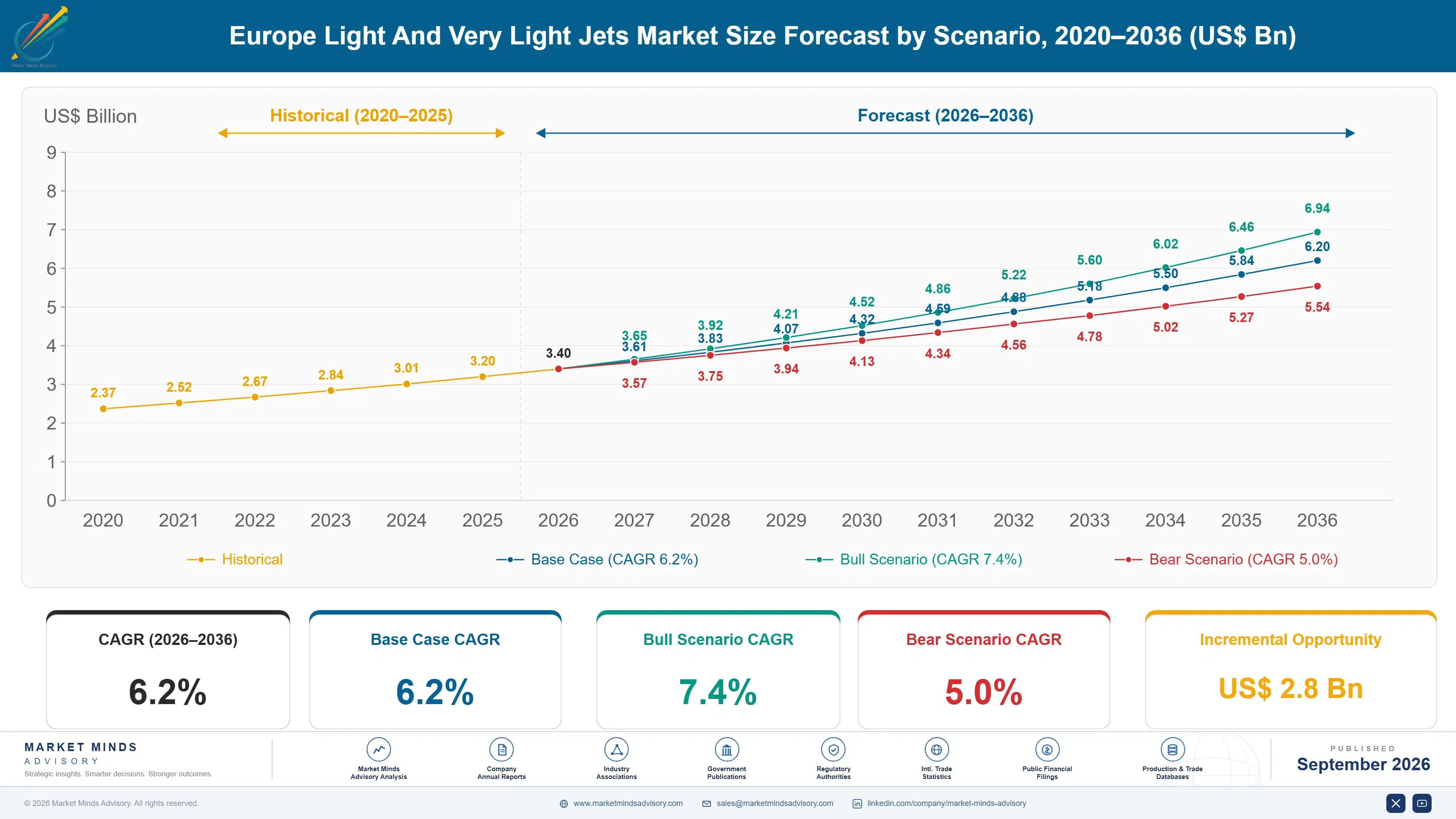
Europe Light And Very Light Jets Market Forecast Scenarios

europe-light-and-very-light-jets-market-size-forecast-scenario-1790026036618
Growth averaged 5.3% across 2020 to 2025 and the shape of it was strange. Deliveries fell hard in 2020, then charter demand surged from 2021 as travellers avoided scheduled aviation, which pushed utilisation on the existing fleet to records before any new aircraft arrived. Operators bought aggressively from 2022 to catch up, and supply chain constraint rather than demand set the delivery rate for most of the following three years.
Base case growth of 6.2% rests on three mechanisms. Charter and fractional operators continue replacing ageing fleet with aircraft chosen for dispatch reliability, which sustains delivery volume independently of any ownership demand. Rough-field capable aircraft open airports that slot-constrained hubs cannot serve, which expands where the fleet can usefully operate. And support content grows faster than aircraft deliveries as the installed European fleet ages and utilisation stays above pre-2020 levels.
The bull case at 7.4% assumes blending mandate costs prove absorbable and political restriction stays confined to rhetoric in most member states. The bear case at 5.0% follows from the opposite: fuel cost rises materially against thin charter margins while movement restrictions spread from Geneva and Nice to other constrained airports, capping utilisation on the fleet already delivered.

Charter Utilisation, Airport Access and Fuel Exposure

European buyers are mostly not owners, and that changes the product. Roughly 68% of the regional fleet sits with charter and fractional operators who buy on dispatch reliability, hourly operating cost and how fast a support network returns an aircraft to service. Pilot workload, single-pilot certification and cabin styling matter far less than North American marketing assumes.
FIVE-FIRM FLEET CONCENTRATION79%Certification cost makes new entry economically impossible here
AVERAGE DELIVERED AIRCRAFT PRICEUSD 8.4MBlended across very light and upper-light jet classes
CHARTER OPERATED FLEET SHARE68%Portion of regional fleet held by commercial operators
ANNUAL UTILISATION HOURS512 hoursAverage yearly flight hours across the operated regional fleet
CONSTRAINED AIRPORT MOVEMENT SHARE44%Regional departures from airports with movement or slot limits
BLENDING MANDATE COST IMPACT6.1%Trip cost increase attributable to fuel blending obligations
Airport access caps the market more effectively than any economic factor. Business aviation concentrates on few airports, and around 44% of regional departures come from fields carrying movement caps, slot constraints or curfews. Geneva and Nice have both moved to restrict activity, and others are considering it. That is why rough-field capability has become commercially valuable: an aircraft able to use an unpaved or short runway reaches airports where nobody counts movements.
Fuel blending obligations land harder on this segment than on airlines. Requirements apply at departure airports where supply is thin, uplift volumes are small enough that surcharges dominate, and the cost divides across very few passengers. Trip cost has risen roughly 6.1% on that account already, and the mandated proportion rises through the forecast period. Operators absorb it now because charter rates are firm, which will not hold indefinitely.
"Manufacturers still sell these aircraft as though a doctor in Stuttgart is going to fly one himself. The actual customer runs forty aircraft and wants to know the dispatch rate and how fast you ship a part to Palma."
Director, Business Aviation and Rotorcraft Practice · MMA Aerospace / Business Aviation Aircraft Practice · September 2026

Market Trends

Rough-Field Capability Becomes A Commercial Access Argument

Short-field and unpaved runway capability was once a niche engineering feature and is now a route to airports that constrained hubs cannot offer. Operators flying into Alpine, Nordic and island destinations can serve fields where no movement cap applies and where handling costs are a fraction of the major business aviation airports. That capability commands a clear premium on both new aircraft and residual values. Around 44% of regional departures currently come from airports carrying movement or slot constraints. Backlogs on the few capable types now run years ahead of demand.
Market Impact: Utilisation reaches 512 annual hours

Fractional Programmes Displace Individual Aircraft Ownership

European buyers who would once have bought an aircraft increasingly buy hours in a fractional or block charter programme instead, because ownership brings crewing, maintenance, hangarage and regulatory obligations that a programme absorbs. The commercial consequence for manufacturers is fewer, larger customers with harder purchasing functions and genuine fleet negotiating weight. Programme operators also specify differently, favouring commonality and support network density over configuration choice. Fractional and charter operators now hold roughly 68% of the regional fleet. Purchasing functions here are considerably harder and better informed than any individual owner ever was.
Market Impact: Adds 140 Central European aircraft

Market Opportunities and Growth Drivers

Charter Utilisation Above Pre-2020 Levels Sustains Fleet Replacement

Regional charter utilisation has settled well above where it sat before 2020, averaging around 512 hours annually across the operated fleet, and higher utilisation consumes airframe and engine life faster than the previous pattern. That pulls replacement decisions forward and makes operators far more sensitive to dispatch reliability, since an aircraft on the ground costs contracted revenue rather than personal convenience. Replacement demand from operators is now the steadiest source of delivery volume in the region and largely independent of ownership sentiment. Aircraft on the ground now costs contracted revenue, not convenience.
Market Impact: Constrains 44% of regional departures

Central European Wealth Growth Expands The Regional Customer Base

Business aviation demand in Poland, the Czech Republic and the Baltic states has grown faster than in established Western European markets, driven by corporate expansion and by poor scheduled connectivity between secondary cities. Operators based in the region have added light jets rather than larger aircraft because mission lengths are short and the economics suit the class precisely. Support infrastructure is following the fleet rather than preceding it. Roughly 140 additional light and very light jets are expected in Central European fleets over the forecast period. Mission lengths here suit the class almost exactly.
Market Impact: Raises trip cost 6.1% already

Market Restraints and Challenges

Airport Movement Restrictions Cap Where The Fleet Operates

Business aviation concentrates on a small number of European airports, and around 44% of regional departures come from fields with movement caps, slot constraints or night curfews. Geneva and Nice have both moved to restrict activity and others are examining it. The root cause is that these airports serve dense catchments with limited physical capacity, so business aviation competes directly with scheduled traffic for movements. Operators are responding through secondary and regional airfields, rough-field capable aircraft, and repositioning flights that add cost without revenue. Physical capacity, not policy sentiment, is the underlying cause.
Market Impact: Avoids constraints on 44% of departures

Blending Obligations Raise Trip Cost Disproportionately On Small Aircraft

Fuel blending requirements apply at departure airports regardless of aircraft size, and business aviation uplifts small volumes at fields where blended supply is scarce, so surcharges rather than commodity pricing dominate. The root cause is that supply infrastructure was built around airline uplift volumes. Trip cost has already risen around 6.1% and the mandated proportion increases through the period. Participants are answering with book-and-claim arrangements, multi-airport supply agreements and operational efficiency measures that reduce fuel burn per trip. Charter rates are firm enough to absorb it today, which will not hold.
Market Impact: Operators hold 68% of fleet
3 additional market trends, 4 additional growth drivers, and 2 additional restraints and challenges are covered in the full report. Contact sales@marketmindsadvisory.com to access the complete intelligence.

Segment CAGR and Growth Architecture

Aircraft are segmented here by class, because class determines mission, operating cost and the operator that buys it. Mixing aircraft class with ownership model or mission type produces categories that overlap on every fleet decision. Six classes cover the field from single-engine personal jets through to upper-light aircraft, and growth rates across them differ more than cabin dimensions suggest.
europe-light-and-very-light-jets-market-market-share-analysis-1790026037158

Super Versatile And Rough-Field Light Jets

Growing at 9.3%, half again the market rate of 6.2%, this class sells on airport access rather than on cabin or performance. An aircraft certified for short and unpaved runways reaches Alpine, Nordic and island fields where no movement cap applies and handling costs are a fraction of the main business aviation airports, which is a commercial argument rather than an engineering one. Cargo door and quick-change cabin capability extend it further into medical and utility work that pure passenger aircraft cannot take. Supply is the constraint: very few types offer the capability and order backlogs run years, which supports both new pricing and residual values. Access, not performance, is what buyers are paying for.
CAGR 9.3%

Single-Engine Personal Jets

Single-engine personal jets grow at 8.1% and occupy a genuinely distinct position, priced well below twin-engine very light jets and flown on missions that would otherwise use a high-performance turboprop. In Europe the class has found its market with owner-pilots more successfully than the twin-engine very light jet ever did, helped by lower operating cost and by whole-aircraft parachute provision that changes the insurance conversation. Charter use remains limited because single-engine turbine commercial operation faces additional conditions in several member states. Growth therefore comes from private ownership, which is the opposite of the rest of this market. Ownership demand rather than operator demand drives this class, which makes it behave unlike everything around it.
CAGR 8.1%
Full segment breakdown across 6 segments available in the complete report.

Regional Architecture and Country Demand Map

This is a region-scoped report, so the regional table records where the aircraft and their major content serving European operators are manufactured rather than where demand sits. North American airframes and engines dominate supply, with Brazilian aircraft an unusually large second source and European manufacture concentrated in specialist types.

North America

North American manufacture supplies 48% of delivered content, far above the 22 to 32% band used elsewhere in this report, because the light jet industry was largely built there and its supply chain remains anchored in it. Airframes from Kansas, Minnesota and North Carolina account for most of the class, and the propulsion that powers nearly every light jet in European service comes from United States engine manufacturers. Avionics suites follow the same pattern. Growth of 5.7% sits below the regional market rate because Brazilian and European specialist types are taking incremental share, not because North American output is declining. Brazilian and European specialist types have been taking incremental share instead.
Share: 48% | CAGR: 5.7% (2026 to 2036)

Western Europe

European manufacture holds 26% and its composition is specific rather than broad. Swiss production accounts for the rough-field capable class that is growing fastest, French manufacture contributes both aircraft and substantial systems content, and European suppliers provide landing gear, nacelles and interior completion across types built elsewhere. The region is strong in the high-value specialist end and largely absent from volume light jet airframe production. Growth of 4.8% trails the regional rate, but that figure conceals a divergence: specialist airframe demand is growing strongly while general systems content tracks a slower overall delivery cycle. Completion and interior work adds a further layer of regional content that delivery figures alone do not capture.
Share: 26% | CAGR: 4.8% (2026 to 2036)
Regional intelligence for 5 additional markets available in the complete report: Latin America, East Asia, South Asia and Pacific, Middle East and Africa, Eastern Europe. Contact sales@marketmindsadvisory.com.
europe-light-and-very-light-jets-market-country-cagr-analysis-1790026037673

Where Light Jet Programmes Earn Margin

Aircraft deliveries are the visible revenue in this market and carry the thinnest margins in it. Support network density, guaranteed maintenance programmes and residual value management decide delivered economics instead. The four levers below reflect positions manufacturers have used to improve returns measurably rather than to win order volume. Support is where most of it accumulates.

Sell Guaranteed Hourly Maintenance Across The Fleet

Operators flying 512 hours annually want predictable maintenance cost far more than they want a lower purchase price, and hourly cost programmes convert an unpredictable expense into a contracted line. For the manufacturer this is recurring revenue at gross margin well above aircraft delivery, and it locks the customer to the support network for the aircraft's life. Programme enrolment runs around 74% on newer types and generates revenue roughly 1.9 times the original aircraft margin across a service life. The requirement is parts availability discipline rather than engineering. Cost certainty is what operators are buying.
Market Impact: Support returns roughly 1.9 times the delivery margin

Build Support Density Where Operators Actually Fly

Charter operators select aircraft partly on how fast a part reaches an aircraft stuck in Palma, Olbia or Innsbruck on a summer Saturday. Manufacturers with dense European parts and service coverage win fleet decisions their competitors lose on paper superiority. Density also raises programme enrolment and residual values simultaneously. Operators report dispatch reliability differences of roughly 2.4 percentage points between well-supported and thinly supported types, which on contracted charter revenue is decisive. The investment is inventory and staffing in expensive locations. Inventory and staffing in expensive locations is the whole cost.
Market Impact: Dispatch reliability improves by roughly 2.4 points overall

Certify Short And Unpaved Runway Capability Deliberately

Around 44% of regional departures come from airports carrying movement or slot constraints, and an aircraft certified for short or unpaved runways reaches fields where no such limits apply. That capability is an access argument rather than a performance one, and buyers pay for it accordingly: rough-field capable types command pricing roughly 21% above comparable light jets and hold residual values markedly better. Certification is expensive and must be designed in from the outset, which is why so few types offer it and why backlogs run years. Retrofitting the capability is not possible.
Market Impact: Rough-field aircraft pricing runs roughly 21% higher overall

Manage Residual Values As An Active Programme

Fractional and charter operators finance fleets against residual value assumptions, so a type with weak residuals is expensive to operate regardless of its purchase price. Manufacturers who manage the pre-owned market actively, through certified pre-owned programmes, upgrade paths and controlled inventory release, protect those assumptions directly. Types under active residual management have held roughly 12% more value at five years than comparable aircraft left to the open market. The cost is capital tied up in inventory and a willingness to slow deliveries occasionally. Financing arithmetic decides standardisation more often than aircraft merit.
Market Impact: Five-year residual values hold roughly 12% better overall

Who Controls the Margin Pool

Concentration is the highest in any aviation segment covered here, with five manufacturers holding 79% of European fleet participation and delivered content value, the basis used throughout this section. Certification of a new light jet costs several hundred million against an annual delivery volume that cannot repay it, so the field is closed by arithmetic rather than by competitive conduct, and the gap to the next tier is permanent.
Competition among the five turns on three dimensions. Support network density decides fleet selections by charter operators, who weigh part availability above almost everything. Guaranteed maintenance programme quality decides who captures the recurring revenue that exceeds delivery margin. And airport access capability, meaning short and unpaved runway certification, decides who serves the growing portion of demand constrained by movement caps. Pricing barely features in these decisions.

Positions will shift through support and residuals rather than through new aircraft. A manufacturer improving European parts coverage moves fleet decisions within a season, while a new airframe takes a decade and several hundred million. The pre-owned market is the other lever: types with actively managed residuals cost operators less to finance, and that arithmetic increasingly decides fleet standardisation among the larger programme operators.
europe-light-and-very-light-jets-market-company-positioning-matrix-1790026038197

Competitive Moat and Risk Dimensions

EMBRAER

Moat: European Operator Fleet Standardisation

Embraer's light jet family has become the standardised type across several of Europe's largest charter and fractional operators, which compounds through crew commonality, shared spares pools and maintenance familiarity. Displacing a standardised type means retraining crews and rebuilding inventory, so the position outlasts individual aircraft competitions and gives the company unusual visibility into replacement cycles.
EMBRAER

Risk: Currency And Supply Chain Exposure

Manufacturing in Brazil while selling into Europe in dollars and euros leaves the company exposed to currency movement on a cost base it cannot relocate quickly. Supply chain constraint since 2022 has also affected delivery schedules, and in a market where operators buy on dispatch reliability, late aircraft damage exactly the reputation the company competes on.
PILATUS AIRCRAFT

Moat: Rough-Field Certification Position

Pilatus holds the strongest position in short and unpaved runway capable light jets, which has become an airport access argument rather than a performance one as movement restrictions spread. The capability had to be designed in from the outset and cannot be retrofitted, so competitors cannot answer it within the forecast period, and order backlogs consequently run years ahead.
PILATUS AIRCRAFT

Risk: Single Type Concentration Risk

The company's position in this market rests on one aircraft type, which makes it exposed to any certification issue, supply interruption or competitor response affecting that single programme. Backlog depth cushions the risk in the near term, but a concentrated product position also limits the ability to serve operators whose missions do not require rough-field capability.

Players Tracked

Prominent Players

Embraer
Textron Aviation
Pilatus Aircraft
Cirrus Aircraft
Honda Aircraft Company

Other Key Players

Bombardier
Dassault Aviation
Gulfstream Aerospace
Daher
AML Global Eclipse
Williams International
Pratt and Whitney Canada
Honeywell Aerospace
Garmin
Collins Aerospace
Safran
Rolls-Royce
GE Aerospace
Liebherr-Aerospace
Diamond Aircraft

Recent Developments

MAY 2025

Alpine airport confirms further movement restrictions on business aviation

A major Alpine business aviation airport confirmed tighter movement limits and operating hour restrictions affecting light jet traffic. This was a regulatory and airport authority decision rather than any corporate transaction, and it pushes operators toward secondary fields and toward aircraft able to use them.
Signal: Movement restrictions convert short and unpaved runway capability from a niche feature into a commercial requirement
OCTOBER 2024

European fractional operator standardises fleet on single light jet type

A large European fractional programme committed to standardising its light jet fleet on one type, citing crew commonality, spares pooling and dispatch reliability. The commitment was a multi-year purchase agreement rather than any equity arrangement, and it removes several years of demand from competitive supply.
Signal: Fleet standardisation decisions remove years of demand from competition and outlast individual aircraft campaigns entirely by a wide margin
FEBRUARY 2025

Manufacturer expands European parts distribution and field service coverage

A light jet manufacturer opened additional European parts distribution and field service locations, targeting the Mediterranean and Alpine destinations where charter aircraft most often go unserviceable. The expansion was organic investment rather than an acquisition of any existing network, and it addresses charter dispatch reliability directly.
Signal: Support density moves fleet decisions within a season, which no new aircraft programme can possibly match

What Sets Delivered Aircraft Cost

Four inputs dominate. Propulsion runs roughly 22% of delivered aircraft cost, avionics suites about 14%, airframe structure and materials close to 18%, and assembly, interior completion and certification labour the remaining 46%. Engine supply comes almost entirely from two United States manufacturers, avionics from a similarly narrow field, and material supply from North American, European and Japanese producers with European aluminium the most energy-exposed.
Supply chain constraint rather than commodity pricing drove the recent cost story. Engine and casting lead times extended sharply from 2022 as the wider aerospace recovery absorbed capacity, and European industrial energy costs raised aluminium and completion input costs simultaneously, with EIA energy price data showing the scale of that movement. Textron and Embraer both discussed supply chain and delivery constraint in annual reporting through the period.

Exposure divides by where a manufacturer sits and how it contracts. Airframers carry engine and avionics cost under long-term agreements with limited pass-through, while completion and support businesses carry labour rather than materials. The competitive asymmetry is currency: manufacturers with a cost base outside the euro and dollar area carry translation exposure on every delivery, which is a disadvantage no amount of manufacturing efficiency offsets when rates move.
europe-light-and-very-light-jets-market-cost-volatility-analysis-1790026038392

Contract engine and avionics supply on multi-year volume terms

Propulsion and avionics together approach two fifths of delivered cost and come from very narrow supplier fields, so allocation matters more than unit price during constrained periods. Multi-year agreements have protected delivery schedules where spot buyers slipped. The commitment risk is order book volatility, historically severe in business aviation, so agreements need volume flexibility built in.

Shift revenue mix toward support and hourly cost programmes

Support revenue carries almost no exposure to engine, avionics or raw material cost, and it grows with fleet utilisation rather than delivery volume. Moving mix in that direction hedges input cost and improves earnings quality at the same time. The requirement is parts inventory and service coverage in expensive European locations, which ties up capital that delivery-focused manufacturers deploy elsewhere.

Hedge currency exposure across the delivery cycle deliberately

Manufacturers with cost bases outside the euro and dollar area carry translation exposure on every European delivery, and business aviation order-to-delivery cycles are long enough for rates to move substantially. Structured hedging across the delivery cycle rather than at contract signature limits the damage. It cannot eliminate a sustained adverse move, and no operational improvement compensates for one either.

Portfolio Architecture for Margin Defence

Margin architecture in this market runs opposite to the headlines. Aircraft delivery, the number that appears in every announcement, sits at the bottom with thin margins and heavy input cost exposure. Guaranteed maintenance programmes and parts supply sit in the middle at considerably better economics and recur for the aircraft's life. Rough-field capable types and actively managed pre-owned programmes sit at the top, the first on scarcity and the second on financing arithmetic.
The volume-versus-premium tension is unusual because volume here is small by any industrial standard. A successful light jet programme delivers perhaps a hundred aircraft a year worldwide, so scale economics barely exist and the money has to come from what happens after delivery. Manufacturers organised around delivery numbers compete on price and discount into thin margins, while those organised around fleet support earn across decades from the same aircraft.

High-value pools concentrate in three places: hourly maintenance programmes that return roughly 1.9 times the original aircraft margin over a service life, rough-field capable aircraft priced around 21% above comparable types on access rather than performance, and certified pre-owned programmes that protect the residual assumptions operators finance against.

Volume / Commodity-Adjacent Tier

New aircraft deliveries of conventional very light and entry-level light jets, discounted in competitive fleet campaigns. Engine and avionics cost is carried with limited pass-through. The eight point range reflects campaign discounting depth and where a programme sits in its production learning curve.
Gross Margin: 9-17%

Premium / Certified Tier

Guaranteed hourly maintenance programmes, parts supply and field service across the installed European fleet. Network density and parts availability defend pricing here. The nine point range tracks how much service coverage a manufacturer operates directly rather than through authorised third parties.
Gross Margin: 26-35%

Sustainability / Regulatory / Next-Generation Tier

Rough-field capable aircraft, certified pre-owned programmes and upgrade content including blending-compatible fuel system and efficiency modifications. Scarcity and financing arithmetic set pricing rather than cost. The fourteen point range spans aircraft sales and programme services with different economics.
Gross Margin: 38-52%
europe-light-and-very-light-jets-market-portfolio-architecture-1790026038900

High-value Sub-segments and Strategic Watch-out

Guaranteed Hourly Maintenance Programmes

The best recurring revenue available in this market, enrolled on roughly 74% of newer aircraft and returning around 1.9 times the original delivery margin across a service life. It also locks operators to the support network. The ten point range reflects direct versus authorised service coverage models.
Gross Margin: 34-44%

Rough-Field Capable Aircraft

Fastest growing at 9.3% and priced roughly 21% above comparable light jets on airport access rather than performance. Backlogs run years ahead because very few types offer the capability at all. The ten point range reflects how differently configured aircraft are priced within this small class.
Gross Margin: 30-40%

European Parts And Field Service

The volume core of profitable revenue, growing with fleet utilisation at 512 annual hours rather than with deliveries. Dispatch reliability differences of around 2.4 points decide entire fleet selections. The ten point range reflects location cost, since Mediterranean and Alpine coverage is expensive to establish and operate.
Gross Margin: 28-38%

Conventional Very Light Jet Deliveries

Slowest growing at 5.1% and the thinnest margin in the market, discounted heavily in fleet campaigns against a class that never found its intended owner-pilot buyer in Europe. Several manufacturers now treat it as a route into the support relationship rather than as a profit line.
Gross Margin: 9-17%

What Operators Fund Every Year

The annuity in this market is the aircraft's service life, not its sale. A light jet flying 512 hours a year consumes engine, airframe and component life on a predictable schedule, and the manufacturer holding the hourly maintenance programme collects across every hour of it. Across a typical service life that support revenue returns roughly 1.9 times the original delivery margin, and enrolment reaches around 74% on newer types because operators want cost certainty above almost everything.
Adoption depth varies sharply by operator type. Large fractional and charter programmes run the full relationship, enrolling in hourly cost programmes, standardising types for crew and spares commonality, and funding upgrade content continuously because utilisation makes the payback quick. Smaller charter operators buy pre-owned aircraft and maintain them transactionally. Private owners sit apart entirely: very low utilisation, high sensitivity to fixed cost, and maintenance decisions driven by resale preparation rather than by operational need.

The buyer profile has changed decisively. These aircraft were sold to individuals who wanted to fly them, and the marketing still reflects that. The people signing fleet orders now run operations departments, compare dispatch statistics and financing residuals, and have never read a pilot report in their lives.
europe-light-and-very-light-jets-market-end-use-penetration-index-1790026039392

Where Manufacturers Should Concentrate

These are among the four positions where our research anticipates prominent divergence between winners and laggards over the coming forecast period. Each is grounded in the demand model, the regulatory perimeter, and the announced capacity pipeline.
01 / SUPPORT REVENUE PRIORITY

Organise around fleet support, not delivery announcements

A successful light jet programme delivers perhaps a hundred aircraft annually worldwide, so scale economics barely exist and delivery margin stays thin regardless of how disciplined the campaign is. Hourly maintenance programmes return roughly 1.9 times the original delivery margin across a service life, enrol on around 74% of newer aircraft and then recur for decades. Manufacturers organised around delivery numbers discount into thin margins, while those organised around fleet support earn repeatedly from aircraft they delivered many years ago.
02 / AIRPORT ACCESS CAPABILITY

Certify rough-field capability before restrictions spread further

Roughly 44% of regional departures already come from airports carrying movement caps, slot constraints or curfews, and Geneva and Nice have both moved to restrict activity with others examining it. Rough-field capable aircraft reach fields where none of that applies and command pricing around 21% above comparable types on that access alone. The capability has to be designed in from the outset rather than retrofitted, which is exactly why so few types offer it at all and backlogs run years ahead.
03 / SERVICE NETWORK DENSITY

Put parts and engineers where charter aircraft actually break

Charter operators select aircraft substantially on how fast a part reaches an unserviceable aircraft in Palma, Olbia or Innsbruck during peak season, because a grounded aircraft costs contracted charter revenue rather than personal convenience. Dispatch reliability differences of roughly 2.4 percentage points between well-supported and thinly supported types decide entire fleet campaigns outright. Coverage in those locations is expensive to establish and operate, which is precisely why it remains a genuine competitive separator rather than a commodity anyone can buy.
04 / RESIDUAL VALUE MANAGEMENT

Treat the pre-owned market as a financing input you control

Fractional and charter operators finance fleets against residual value assumptions, so a type with weak residuals costs more to operate no matter what it cost to buy. Manufacturers managing the pre-owned market actively, through certified programmes, upgrade paths and controlled inventory release, have held roughly 12% more value at five years than comparable aircraft left to the open market. The cost is inventory capital and occasionally slowing deliveries, which is considerably cheaper than losing fleet standardisation decisions to a competitor.

Engagement Snapshot From the Field

A live engagement with an industry participant carrying material or product regulatory and market exposure ahead of a defining policy shift, showing how our research translates into a defensible multi-year portfolio strategy.
MARKET MINDS ADVISORY · CLIENT ENGAGEMENT SUMMARY
Europe Light And Very Light Jets Producer Strategic Portfolio Review and Transition Roadmap 2026·Investment Scenario on Europe Light And Very Light Jets Exposure Evaluation 2025-26
CLIENT PROFILE
A European charter and fractional operator running roughly 46 light and very light jets across four bases, with approximately USD 240 million in annual revenue (client-reported, unverified by MMA). The fleet spanned four aircraft types acquired opportunistically over a decade, and the company had been unable to explain why its dispatch reliability trailed competitors despite comparable maintenance spending per aircraft.
STRATEGIC CHALLENGE
Management assumed the reliability gap reflected maintenance provider quality and had changed vendors twice without effect. The pattern actually tracked aircraft type: two of the four types had thin European parts coverage, and delays occurred at Mediterranean destinations rather than at base. The board needed to decide whether to standardise the fleet, and on which type, before committing to a replacement cycle.
MMA APPROACH
MMA reconstructed unserviceability events by type, location and root cause across three years, modelled parts availability against each manufacturer's European coverage, and compared total cost of ownership including residual value assumptions under four standardisation options. Expert interviews with manufacturer support leadership established what coverage commitments were genuinely available and enforceable in practice.
KEY FINDINGS
  1. Dispatch reliability differences between types reached 2.4 percentage points and traced almost entirely to parts availability at Mediterranean destinations rather than to any maintenance provider performance.
  2. Standardising on a single type would cut crew training and spares holding cost by roughly 19% annually, a saving management had estimated at well under half that figure.
  3. Two of the four types carried residual value assumptions that no longer held in the pre-owned market, which was quietly raising the financing cost of the whole fleet.
  4. Rough-field capability on one candidate type would open eleven additional destinations currently unreachable, worth an estimated 7% uplift in charter revenue opportunity.
CLIENT PROFILE
A European charter and fractional operator running roughly 46 light and very light jets across four bases, with approximately USD 240 million in annual revenue (client-reported, unverified by MMA). The fleet spanned four aircraft types acquired opportunistically over a decade, and the company had been unable to explain why its dispatch reliability trailed competitors despite comparable maintenance spending per aircraft.
STRATEGIC CHALLENGE
Management assumed the reliability gap reflected maintenance provider quality and had changed vendors twice without effect. The pattern actually tracked aircraft type: two of the four types had thin European parts coverage, and delays occurred at Mediterranean destinations rather than at base. The board needed to decide whether to standardise the fleet, and on which type, before committing to a replacement cycle.
MMA APPROACH
MMA reconstructed unserviceability events by type, location and root cause across three years, modelled parts availability against each manufacturer's European coverage, and compared total cost of ownership including residual value assumptions under four standardisation options. Expert interviews with manufacturer support leadership established what coverage commitments were genuinely available and enforceable in practice.
KEY FINDINGS
  1. Dispatch reliability differences between types reached 2.4 percentage points and traced almost entirely to parts availability at Mediterranean destinations rather than to any maintenance provider performance.
  2. Standardising on a single type would cut crew training and spares holding cost by roughly 19% annually, a saving management had estimated at well under half that figure.
  3. Two of the four types carried residual value assumptions that no longer held in the pre-owned market, which was quietly raising the financing cost of the whole fleet.
  4. Rough-field capability on one candidate type would open eleven additional destinations currently unreachable, worth an estimated 7% uplift in charter revenue opportunity.
RECOMMENDED STRATEGY
Phase 1: Phase 1 (six months): Exit the two types with weak parts coverage and deteriorating residuals, timing disposals against the pre-owned market rather than accounting dates. Phase 2: Phase 2 (18 months): Standardise on a single type and negotiate hourly maintenance programme terms tied to committed European coverage levels. Phase 3: Phase 3 (30 months): Add rough-field capable aircraft for destinations the standard type cannot reach, accepting a two-type fleet deliberately rather than accidentally.
OUTCOME
The operator exited both weak types within fourteen months and raised fleet dispatch reliability by 2.1 percentage points (client-reported, unverified by MMA). Standardisation cut spares and training cost broadly as modelled, and the first rough-field aircraft opened destinations that competitors serving the same clients could not reach at all.

Frequently Asked Questions

Foundational context covering the market sizes, CAGR, scope, country, region and competition that inform every finding below. This section is provided to cover basics and most often pre-purchase conversations, answered from the MMA Primary Research Dataset.

What is the current size of the Europe Light And Very Light Jets Market?

The market was worth USD 3.2 billion in 2025 and reaches USD 3.4 billion in 2026. That covers aircraft deliveries and delivered propulsion, avionics and support content across the European light jet fleet.

How large will the Europe Light And Very Light Jets Market be by 2036?

MMA forecasts USD 6.2 billion by 2036, an increase of USD 2.8 billion over the 2026 base. That represents an expansion multiple of 1.82 times across the forecast period.

What is the CAGR for the Europe Light And Very Light Jets Market 2026 to 2036?

The base case CAGR is 6.2%, with a bull case of 7.4% if blending mandate costs prove absorbable and political restriction stays rhetorical. The bear case of 5.0% assumes movement restrictions spread.

Which segment is growing fastest?

Super versatile and rough-field light jets grow at 9.3%, half again the market rate of 6.2%. They sell on airport access rather than performance, reaching fields where no movement cap applies.

Who are the major companies in the Europe Light And Very Light Jets Market?

Embraer, Textron Aviation, Pilatus Aircraft, Cirrus Aircraft and Honda Aircraft Company lead on European fleet participation and delivered content value. Bombardier, Dassault Aviation and Williams International follow.

Which country is growing fastest?

Within this region-scoped report, Poland leads at 10.2%, driven by corporate expansion and poor scheduled connectivity between secondary cities. Countries outside Europe are assessed only as sources of aircraft and content supply.

Report Segmentation Architecture

The full report scope spans multiple orthogonal segmentation dimensions, with cross-tabulated demand data provided for each dimension pair. Coverage extends further to regional breakdowns, trend trajectories, and the competitive detail needed to support segment-level decision-making.

By Aircraft Class

  • Very Light Jets
  • Single-Engine Personal Jets
  • Entry-Level Light Jets
  • Mid-Light Jets
  • Upper-Light Jets
  • Super Versatile And Rough-Field Light Jets

By End-Use Industry

  • Charter And Air Taxi Operators
  • Fractional Ownership Programmes
  • Corporate Flight Departments
  • Private Owner Operators
  • Medical And Special Mission Operators

By Commercial Dimension

  • New Aircraft Delivery
  • Pre-Owned Aircraft Transaction
  • Guaranteed Hourly Maintenance Programme
  • Parts And Field Service Supply

By Region

  • North America
  • Western Europe
  • Latin America
  • East Asia
  • South Asia and Pacific
  • Middle East and Africa
  • Eastern Europe

Scope, Methodology, and Coverage

Every figure in this report is reproducible from documented input assumptions. The scope below maps the historical period, the forecast horizon, the segmentation dimensions, and the countries covered, alongside the underlying primary and qualitative methodology.
Historical Period
2020 to 2025
Forecast Period
2026 to 2036
Base Year
2025 (USD billions; MMA Primary Research Dataset, September 2026)
Market Definition
This report covers light and very light business jets operated within Europe, meaning turbofan aircraft below roughly 20,000 pounds maximum take-off mass. Scope includes very light jets, single-engine personal jets, entry-level light jets, mid-light jets, upper-light jets and super versatile rough-field capable light jets, together with the propulsion, avionics, parts and support content delivered into that fleet. Excluded are midsize and large-cabin business jets, turboprop business aircraft, piston and very light aircraft, regional airline jets, military trainers, and charter brokerage or fractional programme services sold separately from aircraft.
Quantitative Units
USD billions (current prices); aircraft deliveries and fleet counts; delivered content value; annual utilisation hours
Segmentation Dimensions
By Aircraft Class; By End-Use Industry; By Commercial Dimension; By Region
Regions Covered
North America, Western Europe, Latin America, East Asia, South Asia and Pacific, Middle East and Africa, Eastern Europe
Countries Covered
Germany, France, UK, Switzerland, Italy, Spain, Austria, Netherlands, Belgium, Portugal, Poland, Czech Republic, Sweden, Norway, Denmark, Finland, Greece, Ireland, Monaco, Luxembourg, Malta, Romania, Hungary, and additional European markets relevant to this sector, with aircraft and content supply origin also assessed across the USA, Canada, Brazil, Japan, India and Israel
Key Companies Profiled
Embraer, Textron Aviation, Pilatus Aircraft, Cirrus Aircraft, Honda Aircraft Company, Bombardier, Dassault Aviation, Gulfstream Aerospace, Daher, AML Global Eclipse, Williams International, Pratt and Whitney Canada, Honeywell Aerospace, Garmin, Collins Aerospace, Safran, Rolls-Royce, GE Aerospace, Liebherr-Aerospace, Diamond Aircraft
Quantitative Methodology
Primary survey, n=3,800 respondents, Q4 2025, six countries; demand-side model with trade association cross-validation
Qualitative Methodology
47 expert interviews, Q4 2025; applied to validate demand model assumptions, identify emerging dynamics, and assess competitive positioning
Report Format
PDF and XLSX data workbook (Word format preview document)
Publisher
Market Minds Advisory
Report Code
MMA-2026-CON-910
Published
September 2026
Contact
sales@marketmindsadvisory.com | www.marketmindsadvisory.com

Purchase the full Europe Light And Very Light Jets Market Report (2026 to 2036).

The full report sizes the European light and very light jet market across six aircraft classes with fleet counts, deliveries and delivered content value behind every figure. It separates aircraft delivery economics from fleet support throughout, because support returns roughly twice the delivery margin across a service life and manufacturers consistently underweight it. Competitive analysis covers 20 participants on European fleet participation and delivered content value, including parts and service coverage mapped against where charter aircraft actually go unserviceable. Airport movement constraints are quantified by field, since access rather than economics now caps where the fleet can operate. Blending mandate cost exposure is modelled per trip rather than per litre.
Six-class sizing with fleet counts and deliveries
Support economics separated from delivery margin
Service coverage mapped against unserviceability locations
Airport movement constraints quantified by field
Blending mandate cost modelled per trip
Residual value performance assessed by aircraft type

Built For The People Who Decide

From boardroom strategy to bench-side execution, this report is read cover-to-cover by leaders shaping the next decade of their industry, turning demand scenarios, market dynamics and valuation benchmarks into decisions.
CXOs/ Presidents/ VPs/ Managers
M&A and Corporate Development
Strategy Teams and R&D Heads
Procurement and Product Directors
Regulatory and Compliance Leaders
Investor Relations and Equity Analysts