Market Minds Advisory
Europe Clearing Houses And Settlements Market

Europe Clearing Houses And Settlements Market: EMIR 2.2 Active Account Rules Redraw Euro Clearing Flows

EU regulators are pushing to relocate euro-denominated interest rate swap clearing away from London under EMIR 2.2's active account rules, forcing dealers to split liquidity pools while T+1 settlement migration strains legacy depository infrastructure.

Lead Analyst

Published

September 2026

Make Smarter Decisions with Customized Research Insights

Request a free sample report and evaluate market opportunities, growth trends, and competitive dynamics relevant to your business needs.

2025 MARKET VALUE$9.2BMarket Size 2025
2036 FORECAST VALUE$18.2BBase Case , 2026 to 2036
CAGR 2026 TO 20366.4 %Bull 7.6% / Bear 5.2%
INCREMENTAL OPPORTUNITY$8.4BNet 10- year value creation
EXPANSION MULTIPLE1.86x2036 value over 2026 base
Strategic Levers
M&A Pipeline
Regional Outlook
Country Rankings
Competitive Intelligence
Segmental Deep-dive
Call-Us : 91 93563 13602

Executive Snapshot and Market Trajectory

Europe's clearing and settlement industry sits under direct regulatory pressure: EMIR 2.2's active account requirement is forcing derivatives dealers to route meaningful euro clearing volume onto EU-domiciled central counterparties, ending London's decades-long dominance over euro interest rate swap clearing well before most market participants expected.
Collateral management and optimization services are expanding fastest as Basel III Endgame capital rules and CSDR settlement discipline penalties push banks toward more efficient collateral mobilization, growing at roughly 1.5 times the market's overall pace. Cross-border settlement and correspondent clearing follow closely behind. Western Europe still concentrates the overwhelming majority of clearing and settlement revenue, anchored by London, Frankfurt, Paris, and Amsterdam infrastructure, though EU relocation mandates are gradually redistributing volume toward continental hubs.
The competitive landscape remains moderately concentrated among a handful of vertically integrated clearing and settlement groups, with LCH, Clearstream, Euroclear, and Euronext Clearing holding entrenched network positions that smaller national depositories struggle to challenge directly. Regulatory divergence after Brexit, DORA operational resilience requirements, and early distributed ledger settlement pilots are simultaneously reshaping how participants compete, rewarding groups that can absorb compliance costs while modernizing legacy settlement technology fastest.
Market Definition
This report covers central counterparty (CCP) clearing services and central securities depository (CSD) settlement services for exchange-traded and over-the-counter securities and derivatives transactions across Europe, including associated collateral management, trade reporting, and cross-border settlement infrastructure. It excludes retail payment processing, correspondent banking payment rails, and primary securities issuance and underwriting activity, which fall outside the defined clearing and settlement value chain.
Base Year Value
$9.2B in 2025 (MMA Primary Research Dataset, August 2026)
Forecast Period
2026 to 2036, eleven discrete annual values
CAGR
6.4% base case. Bull 7.6%. Bear 5.2%.
Fastest Growth Segment
Collateral Management and Optimization Services: 9.5% CAGR
Fastest Growth Country
Ireland: 8.6% CAGR
Fastest Growth Region
South Asia and Pacific: 8.3% CAGR
Largest Region
Western Europe: 78% of 2025 global value
Market Leaders
LCH Group, Deutsche Börse Clearstream, Euronext Clearing, Euroclear, SIX Group. Source: MMA Primary Research Dataset, July 2026.
Primary Survey
n=3,800 procurement and R&D decision-makers, Q4 2025, six countries
Methodology
Demand-side build-up, cross-validated against public data, 47 expert interviews

Europe Clearing Houses And Settlements Market Forecast Scenarios

europe-clearing-houses-and-settlements-market-size-forecast-scenario-1787915767495
Europe's clearing and settlement revenue grew at an estimated 5.7 percent historical pace between 2020 and 2025, propelled by post-pandemic trading volume recovery, mandatory central clearing expansion under EMIR refit rules, and steady exchange-traded derivatives open interest growth. Momentum was uneven, though, as pandemic-era volatility gave way to a calmer, institutionally driven settlement base by 2024.
The base case assumes 6.4 percent annual growth through 2036, driven by three commercial mechanisms. First, EMIR 2.2's active account requirement redirects meaningful euro clearing volume onto EU-domiciled central counterparties, expanding Euronext Clearing and Deutsche Börse Clearstream's revenue base. Second, T+1 settlement cycle harmonization with US markets forces continent-wide infrastructure upgrades and creates new compliance-driven service demand. Third, rising collateral velocity requirements under Basel III Endgame push banks toward paid optimization services, lifting fee income across the collateral management segment.
The bull case centers on faster-than-expected EU clearing relocation, where regulators tighten active account thresholds sooner and push a larger share of euro swaps volume onto EU central counterparties early. The bear case centers on prolonged industry litigation and political pushback against forced relocation, which could delay EMIR 2.2 enforcement, keep incumbent London clearing volume intact longer, and slow projected EU settlement infrastructure investment.

Regulatory Relocation Reshapes European Clearing Economics

Europe's clearing and settlement industry sits at an unusual regulatory inflection point. Decades of London-centered euro clearing dominance are being deliberately unwound by EU policymakers who view concentrated offshore clearing as a financial stability risk after Brexit removed the UK from EU supervisory reach. That policy pressure is now the single largest determinant of where clearing revenue accrues across the continent.
MARKET CONCENTRATION (CR5)68%Top five clearing groups hold well over half share
AVERAGE CLEARING FEE MARGIN2.8 bpsBasis points charged per notional cleared transaction value
TOP HUB COUNTRY SHARE34%London still retains the largest single national clearing share
SETTLEMENT FAIL RATE1.2%Share of transactions missing contractual settlement date deadline
COLLATERAL REHYPOTHECATION RATE58%Posted collateral reused across multiple concurrent margin obligations
CROSS-BORDER SETTLEMENT SHARE41%Transactions settling across two or more national depositories
Beneath the relocation story, the industry is also absorbing a genuine technology transition. T+1 settlement harmonization with US markets compresses the operational window for matching, confirming, and funding trades, forcing national depositories to modernize systems built for a T+2 world. Smaller CSDs without capital for rapid system upgrades risk losing direct participant relationships to larger, better-capitalized platforms, a dynamic already visible in early outsourcing discussions across several Eastern European markets.
Collateral management has become a genuine profit center rather than a back-office cost function. Basel III Endgame capital rules and CSDR settlement discipline penalties are pushing banks to pay for sophisticated collateral optimization tools that reduce funding costs, and the clearing groups that built this capability early are capturing disproportionate fee growth relative to peers still selling commodity clearing access on thin, competitively squeezed margins.
"The active account requirement isn't really about London versus the EU anymore; it's about which clearing groups built euro-denominated liquidity pools deep enough to survive a forced migration without blowing up margin costs for their members."
Director, European Market Infrastructure Practice · MMA Technology Practice · August 2026

Market Trends

EMIR 2.2 Active Account Rules Force Euro Clearing Relocation

EU regulators are enforcing the active account requirement under EMIR 2.2, compelling banks and asset managers subject to EU clearing obligations to maintain operationally active accounts at EU-domiciled central counterparties alongside any UK clearing relationships. The rule specifically targets euro-denominated interest rate swaps and short-term euro repo clearing, the two product categories where LCH's London operation has historically held the deepest liquidity pool in Europe. Euronext Clearing and Deutsche Börse's Eurex Clearing are the principal beneficiaries, both expanding clearing member onboarding teams and margin model approvals to absorb redirected volume. Full compliance thresholds tighten through 2027.
Market Impact: Adds 18% newly mandated notional volume
T+1 Settlement Harmonization Forces Infrastructure Modernization

Europe is preparing to align its securities settlement cycle with the US move to T+1, compressing the window available for trade matching, affirmation, and funding from two days to one. The change forces national central securities depositories to modernize matching engines, extend operating hours to cover overlapping US and European time zones, and tighten straight-through processing rates that today still leave a meaningful share of institutional trades requiring manual intervention. Depositories missing tighter matching deadlines face rising CSDR refit penalties. Euroclear and Clearstream have both announced multi-year technology investment programs targeting settlement cycle compression ahead of the transition date.
Market Impact: Grows cross-border settlement volume 12%

Market Opportunities and Growth Drivers

Mandatory Derivatives Clearing Obligations Expand Volume Base

EU and UK mandatory clearing obligations under EMIR and onshored UK EMIR continue to widen the scope of derivatives contracts that must clear through a central counterparty rather than settle bilaterally, steadily expanding the addressable notional base for clearing groups. Newly captured product categories include additional swap tenors and a broadening set of credit default swap indices, both carrying higher per-trade margin than legacy cleared products. Buy-side firms, including pension funds that previously held exemptions, are being phased into clearing obligations on a rolling schedule, adding a durable new client segment clearing groups actively compete to onboard.
Market Impact: Adds 30 bps indirect spread

Capital Markets Union Push Deepens Cross-Border Settlement Demand

The European Commission's continued push toward a genuine Capital Markets Union is gradually reducing regulatory barriers to cross-border securities investment, and every incremental cross-border trade requires settlement coordination between two or more national depositories rather than a single domestic settlement leg. Harmonization initiatives covering withholding tax procedures, corporate action processing standards, and shareholder disclosure rules are specifically designed to make cross-border investing operationally simpler for institutional investors, and early evidence shows rising cross-border settlement instruction volumes at Euroclear and Clearstream's international central securities depository platforms as a direct result. Depositories with proven cross-border reliability increasingly win this business.
Market Impact: Adds 30% cost premium

Market Restraints and Challenges

High Membership Capital Requirements Limit Direct Clearing Access

Direct clearing membership at Europe's major central counterparties requires clearing members to post substantial default fund contributions and maintain minimum regulatory capital thresholds that most small and mid-sized banks and asset managers cannot economically justify. The root cause is the mutualized default waterfall structure underpinning CCP risk management, where existing members collectively absorb losses beyond a defaulting member's own margin, making CCPs understandably selective about admitting undercapitalized new members. Smaller firms are pushed toward indirect clearing arrangements through larger clearing members, paying meaningfully wider intermediation spreads. Some CCPs now pilot tiered membership categories with reduced contributions for client-segregated flow.
Market Impact: Redirects 15% euro swap clearing volume

Fragmented National Settlement Infrastructure Raises Cross-Border Costs

Europe still operates roughly thirty separate national central securities depositories, each with distinct technical interfaces, settlement finality rules, and corporate action processing conventions, a legacy of pre-euro national capital market structures that consolidation efforts have only partially addressed. The root cause is decades of path-dependent national market infrastructure investment that predates the single currency and single market project. The commercial impact is materially higher operational cost and settlement fail risk for any cross-border trade compared with a domestic settlement leg. Euroclear and Clearstream's international platforms, along with the Eurosystem's T2S engine, are the primary mitigation pathway participants use.
Market Impact: Cuts settlement window by 24 hours
3 additional market trends, 2 additional growth drivers, and 3 additional restraints and challenges are covered in the full report. Contact sales@marketmindsadvisory.com to access the complete intelligence.

Segment CAGR and Growth Architecture

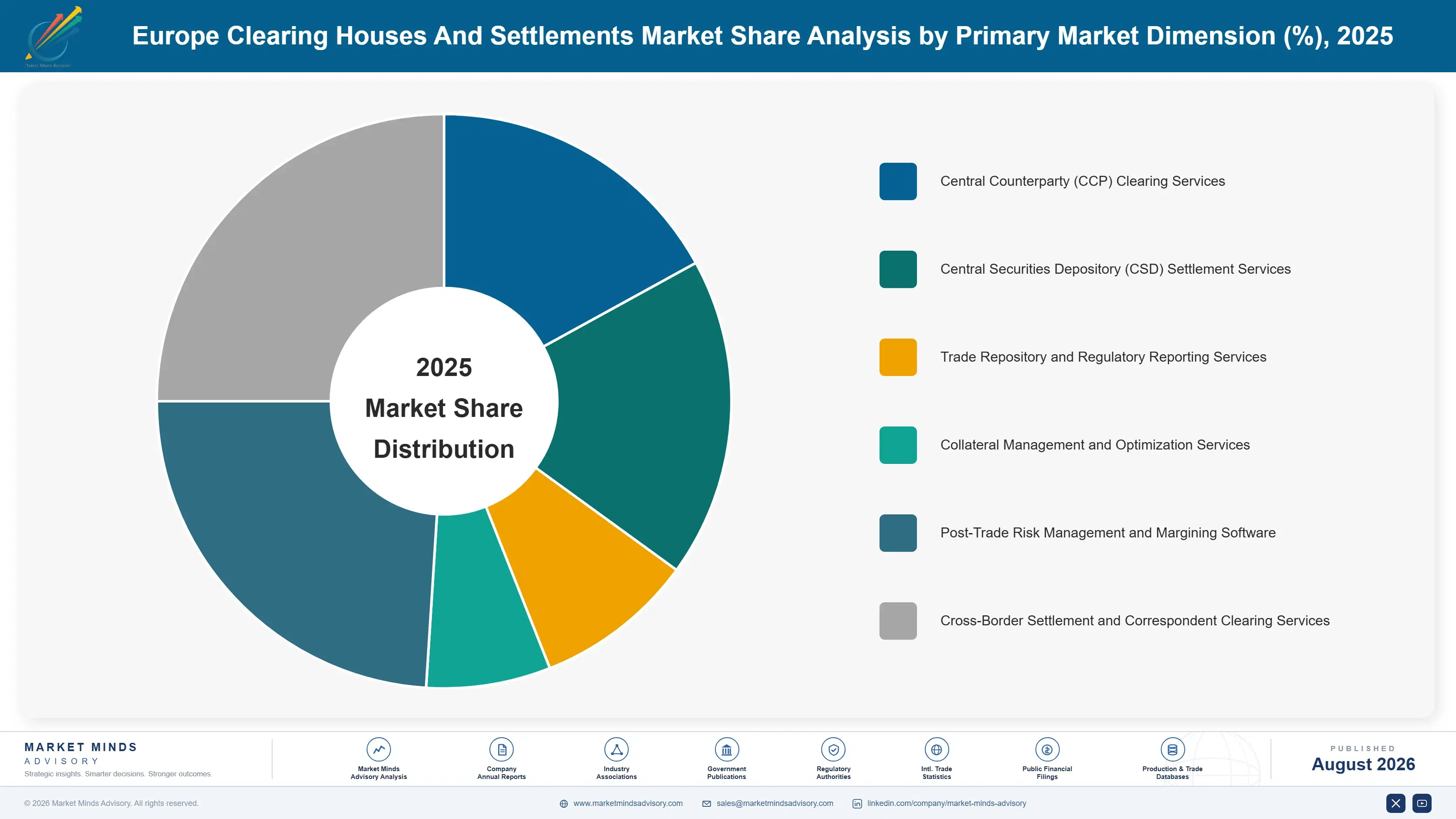
Europe's clearing and settlement market segments most usefully by service function performed across the post-trade value chain, from central counterparty risk mutualization through securities settlement, collateral optimization, and cross-border correspondent linkage, rather than by product asset class or participant type. This lens keeps upstream risk mutualization distinct from downstream settlement execution and collateral services.
europe-clearing-houses-and-settlements-market-market-share-analysis-1787915768039

Collateral Management and Optimization Services

Collateral management and optimization services are growing fastest, expanding at roughly 1.5 times the market's overall pace as Basel III Endgame capital rules and CSDR settlement discipline penalties push banks toward more efficient collateral mobilization. These services help clearing members identify, price, and mobilize the cheapest eligible collateral across multiple CCP and CSD relationships simultaneously, reducing funding costs that would otherwise sit on bank balance sheets as idle high-quality assets. Euroclear's collateral highway and Clearstream's Global Liquidity Hub have both captured substantial fee growth from this shift, and smaller clearing groups are racing to build comparable capability rather than cede this profitable layer. Buy-side firms newly subject to clearing rely heavily on these tools given thin pools.
CAGR 9.5%

Cross-Border Settlement and Correspondent Clearing Services

Cross-border settlement and correspondent clearing services form the second-fastest growing segment, propelled directly by Capital Markets Union harmonization initiatives that are gradually reducing the operational friction of pan-European securities investment. Every incremental cross-border trade requires coordination between two or more national depositories, and demand for reliable correspondent settlement links is rising fastest among asset managers building diversified pan-European fixed income and equity portfolios. Euroclear and Clearstream's international central securities depository platforms, alongside the Eurosystem's T2S settlement engine, capture the majority of this cross-border flow today. Smaller national CSDs increasingly route cross-border instructions through these larger international platforms rather than maintaining costly bilateral settlement links with every other national depository, reinforcing platform-level concentration.
CAGR 8.8%
Full segment breakdown across 6 segments available in the complete report.

Regional Architecture and Country Demand Map

This report is scoped to Europe, so Western Europe concentrates the overwhelming majority of clearing and settlement revenue, anchored by London, Frankfurt, Paris, and Amsterdam infrastructure. Other regions reflect indirect exposure through correspondent settlement links, not domestic infrastructure. Every other region reflects only indirect correspondent settlement exposure.

Western Europe

Western Europe's 78% share sits well above the standard 18 to 26% band, and the deviation is intentional: this report defines its scope as the European clearing and settlement market specifically, and London, Frankfurt, Paris, and Amsterdam host the overwhelming majority of the continent's central counterparty and central securities depository infrastructure. LCH's London operation, Deutsche Börse's Eurex Clearing in Frankfurt, Euronext Clearing spanning Paris, Amsterdam, and Milan, and Euroclear's Brussels-headquartered international settlement platform together account for the substantial majority of regional clearing fee revenue. EMIR 2.2 is redistributing volume within the region itself, shifting euro swap clearing from London toward Frankfurt and Paris rather than pulling revenue outside Western Europe, keeping the region's share durably dominant.
Share: 78% | CAGR: 5.0% (2026 to 2036)

North America

North America connects to this market mainly through US and Canadian dealers that maintain direct or indirect clearing membership at European central counterparties to clear euro-denominated derivatives and settle European securities holdings. The 6% share sits below the standard 22 to 32% band because North American firms are clearing participants in, rather than hosts of, European clearing infrastructure; the region's own domestic clearing activity through DTCC and CME falls outside this Europe-scoped market definition entirely. Growth here tracks US and Canadian asset managers expanding pan-European fixed income exposure and the incremental compliance cost of maintaining EU active accounts alongside existing London clearing relationships. American custodian banks also maintain sub-custody relationships with Euroclear and Clearstream for client demand.
Share: 6% | CAGR: 7.5% (2026 to 2036)
Regional intelligence for 5 additional markets available in the complete report: East Asia, South Asia and Pacific, Latin America, Middle East and Africa, Eastern Europe. Contact sales@marketmindsadvisory.com.
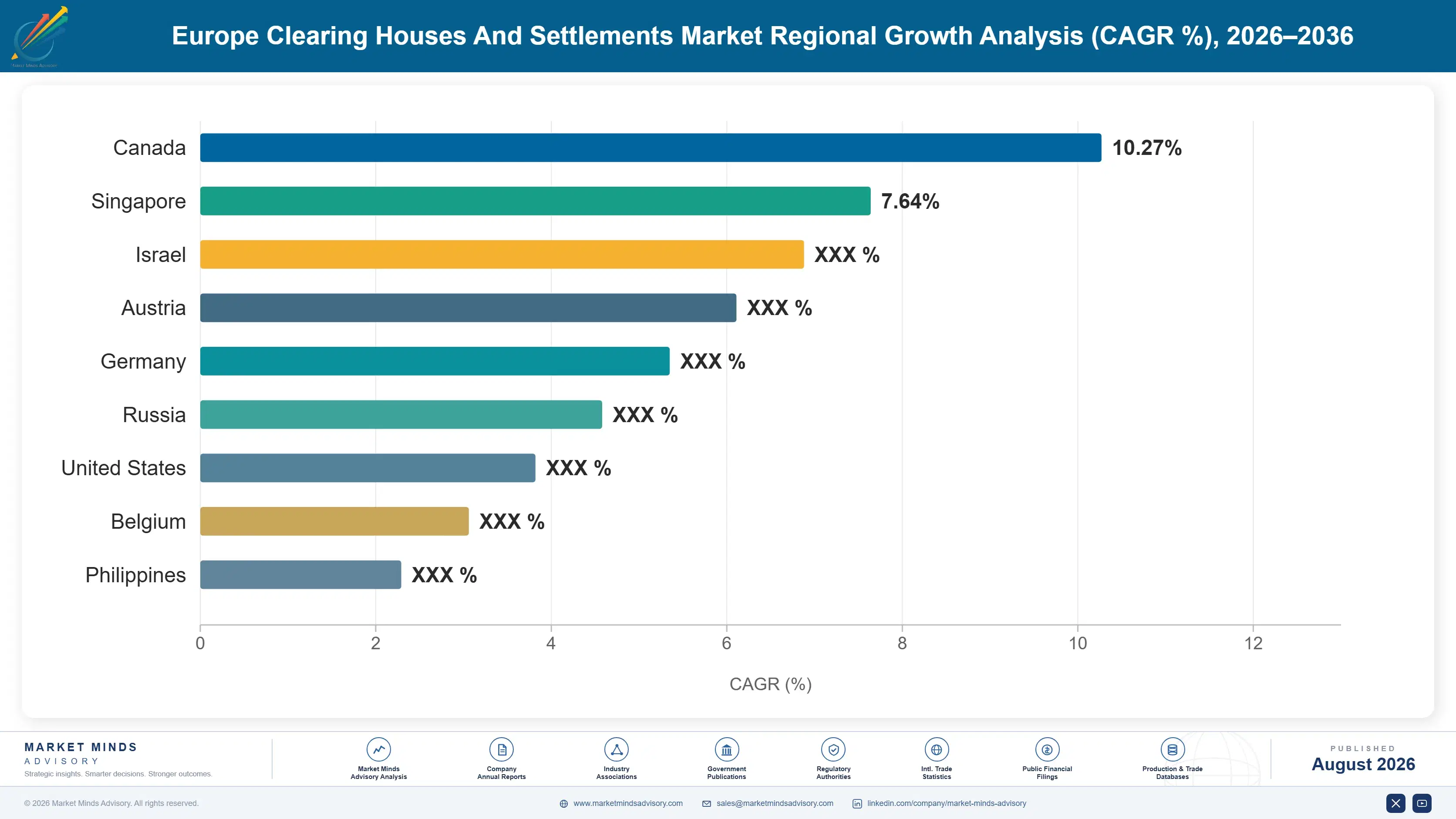
europe-clearing-houses-and-settlements-market-country-cagr-analysis-1787915768567

Capturing Fee Growth Beyond Relocation Volume

Revenue growth in European clearing and settlement increasingly depends on services layered on top of core clearing and settlement fees rather than on notional volume alone, as relocation-driven volume gains concentrate among a handful of already well-positioned groups. Groups layering paid technology and optimization services on top of core membership are pulling ahead of fee-only peers.

Building EU-Domiciled Clearing Capacity Ahead of Deadlines

Clearing groups that expanded EU-domiciled central counterparty capacity and secured member margin model approvals ahead of EMIR 2.2's phased compliance deadlines are capturing redirected euro swap volume before competitors can onboard equivalent capacity. Euronext Clearing and Eurex Clearing both accelerated clearing member onboarding specifically to absorb this relocation window, and early movers are reporting notional volume gains of 20 to 30 percent in affected product lines compared with groups still finalizing regulatory approvals. The logic rewards speed, since switching costs make displacing an established relationship difficult for late movers. Later entrants typically absorb higher onboarding costs to win comparable volume.
Market Impact: Captures 20 to 30 percent redirected notional volume

Selling Collateral Optimization as a Standalone Fee Service

Packaging collateral mobilization and optimization capability as a standalone fee-based service, rather than bundling it into core clearing membership costs, lets clearing groups monetize a capability that previously sat as an uncompensated member benefit. Euroclear's collateral highway and Clearstream's Global Liquidity Hub both generate meaningful standalone fee revenue today, with optimization fees reportedly adding 8 to 12 percent incremental revenue per client relationship beyond base clearing and settlement charges. Buy-side clients newly subject to mandatory clearing obligations are particularly receptive to paid optimization tools given their comparatively thin collateral pools and correspondingly higher funding cost sensitivity.
Market Impact: Adds 8 to 12 percent incremental client fee revenue

Offering Tiered Membership for Undercapitalized Participants

Introducing tiered clearing membership categories with reduced default fund contributions for firms clearing only client-segregated flow expands the addressable direct membership base beyond large, well-capitalized banks. This directly captures fee revenue currently lost to indirect clearing intermediaries who charge wide spreads to smaller firms unable to meet standard membership capital thresholds. Pilot programs at several European CCPs converted roughly 15 percent of previously indirect clearing relationships into direct membership within eighteen months, and the approach also improves risk transparency since indirectly cleared flow was harder for CCPs to monitor at the underlying participant level.
Market Impact: Converts 15 to 20 percent indirect flow to direct

Who Controls the Margin Pool

Europe's clearing and settlement market is moderately concentrated, with a CR5 of 68 percent on a clearing and settlement fee revenue basis held across LCH Group, Deutsche Börse Clearstream, Euronext Clearing, Euroclear, and SIX Group. LCH remains the clear leader in euro and sterling swap clearing despite EMIR 2.2 pressure, while Euronext Clearing and Eurex Clearing are still years from matching its liquidity depth.
Current competitive activity centers on onboarding speed: clearing groups are racing to secure member margin model approvals, expand default fund capacity, and win active account mandates before EMIR 2.2 thresholds tighten further. Parallel investment in collateral optimization services and T+1 settlement readiness has become a second competitive front, with Euroclear and Clearstream both expanding fee-based collateral mobilization offerings well beyond core custody and settlement functions.

Emerging pressure comes from two directions. Smaller national CSDs face consolidation or outsourcing pressure as DORA and CSDR refit compliance costs outpace their transaction volume, likely compressing the long tail of regional participants over the next several years. Distributed ledger settlement pilots under the EU's DLT Pilot Regime could also reshuffle rankings if a challenger platform achieves regulatory approval for production-scale tokenized securities settlement before incumbents adapt.
europe-clearing-houses-and-settlements-market-company-positioning-matrix-1787915769100

Competitive Moat and Risk Dimensions

LCH GROUP

Moat: Deepest Euro Swap Liquidity Pool

LCH's SwapClear service holds the deepest multilateral netting pool for euro and sterling interest rate swaps in Europe, built over more than a decade of member participation. This depth reduces margin costs for members relative to fragmenting flow across smaller counterparties, giving LCH a durable retention advantage.
LCH GROUP

Risk: Exposure to Forced EU Relocation

EMIR 2.2's active account requirement directly targets LCH's core euro swap clearing franchise, and phased compliance thresholds will keep redirecting incremental volume toward EU-domiciled counterparties regardless of LCH's liquidity advantage. Continued political pressure for full relocation, rather than parallel active accounts, remains a live tail risk to LCH's long-term euro clearing market position.
DEUTSCHE BÖRSE CLEARSTREAM

Moat: Integrated Clearing And Settlement Stack

Deutsche Börse's combined Eurex Clearing and Clearstream settlement platform gives it a rare vertically integrated position spanning derivatives clearing, securities settlement, and collateral management under one corporate umbrella. This integration lets it offer bundled pricing and single-platform operational efficiency that pure-play competitors handling only one function in the value chain cannot easily replicate.
DEUTSCHE BÖRSE CLEARSTREAM

Risk: Complex Multi-Regulator Oversight Burden

Operating across clearing, settlement, and custody functions simultaneously subjects Deutsche Börse's Clearstream franchise to overlapping supervision from multiple European regulators, multiplying compliance program complexity relative to single-function competitors. Any regulatory finding against one business line risks reputational spillover into its other integrated post-trade services, a concentration risk narrower competitors do not carry.

Players Tracked

Prominent Players

LCH Group
Deutsche Börse Clearstream
Euronext Clearing
Euroclear
SIX Group

Other Key Players

Nasdaq Clearing
Cboe Clear Europe
KDPW_CCP
Iberclear
OeKB CSD
VP Securities
LuxCSD
KELER CCP
CDCP
National Bank of Belgium Securities Settlement System
Monte Titoli
Interbolsa
BME Clearing
Depozitarul Central Romania
Baltic CSD

Recent Developments

MARCH 2026

Euronext Clearing Expands Euro Swap Clearing Member Onboarding

Euronext Clearing accelerated onboarding of new clearing members for euro-denominated interest rate swap clearing, adding margin model approvals for several major European dealers ahead of the next EMIR 2.2 active account compliance threshold. The expansion targets volume redirected from LCH's London operation, positioning Euronext Clearing to capture more relocating notional.
Signal: Signals EU clearing groups racing hard to lock in redirected relocation volume before compliance deadlines tighten further
JANUARY 2026

Clearstream Launches Expanded Collateral Optimization Platform

Clearstream launched an expanded version of its Global Liquidity Hub collateral optimization platform, adding automated collateral substitution across a broader range of eligible assets. The upgrade responds directly to rising demand from banks managing Basel III Endgame capital requirements and buy-side firms newly subject to mandatory clearing obligations under EMIR.
Signal: Signals collateral optimization is fast becoming a standalone, monetizable competitive battleground across the whole clearing industry
NOVEMBER 2025

Euroclear Announces T+1 Settlement Readiness Investment Program

Euroclear announced a multi-year technology investment program targeting settlement cycle compression ahead of Europe's planned T+1 transition, covering matching engine upgrades, extended operating hours, and straight-through processing rate improvements across its international central securities depository platform serving cross-border European settlement flow. The program keeps Euroclear ahead of peers on readiness.
Signal: Signals major depositories are front-loading T+1 readiness investment years ahead of the actual regional transition deadline

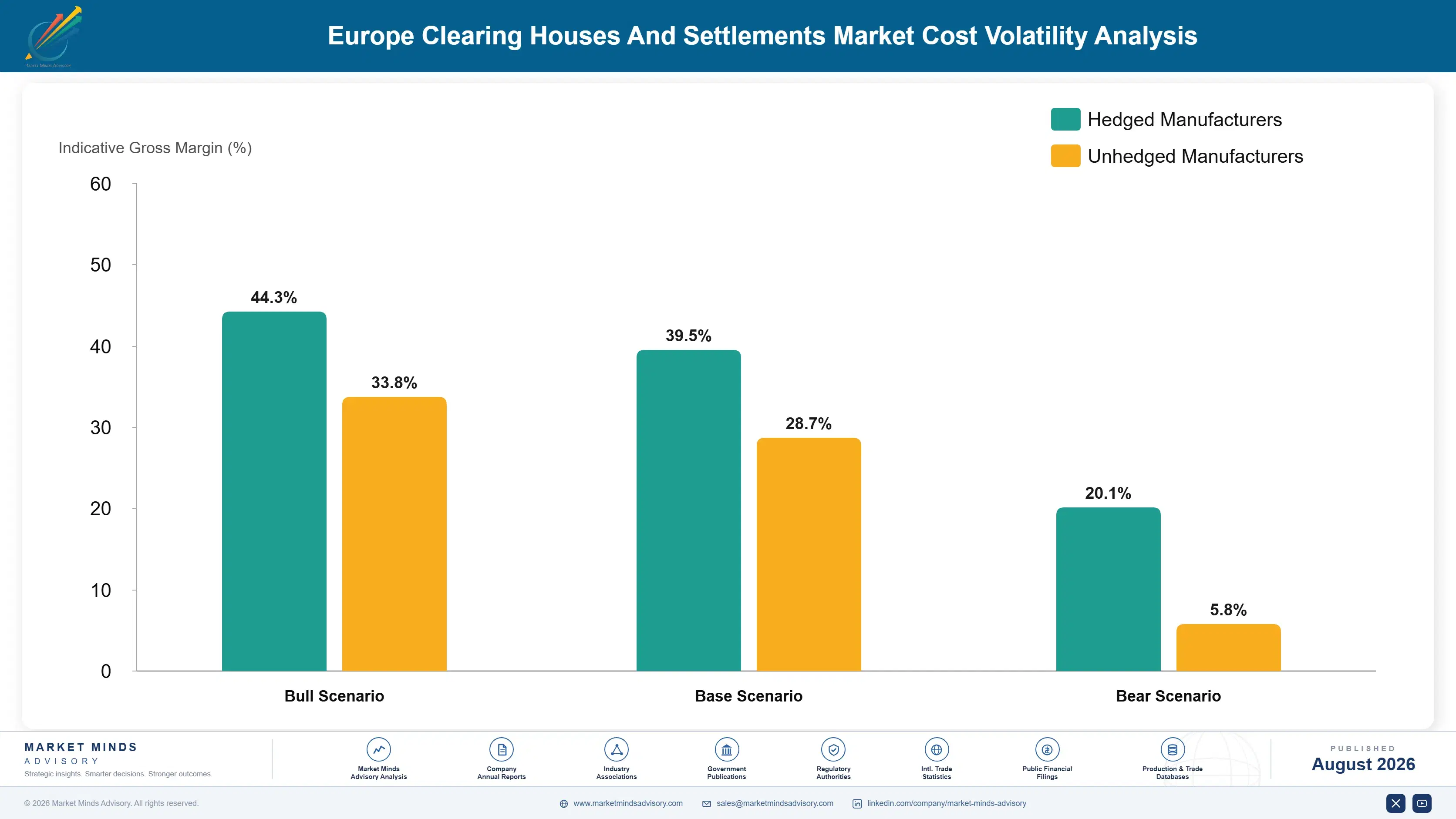
Technology and Regulatory Compliance Cost Pressure

Technology infrastructure and regulatory compliance staffing together represent the two largest cost inputs for European clearing and settlement providers, running roughly 35 to 45 percent of operating cost base combined. Settlement engine software is increasingly sourced from specialized European fintech vendors and in-house teams concentrated in London, Frankfurt, and Paris, while compliance staffing scales with new EU rules.
The clearest recent volatility event was the operational cost spike triggered by DORA's January 2025 full compliance deadline, which required every regulated clearing and settlement entity to complete third-party ICT risk mapping, resilience testing, and incident reporting system build-outs simultaneously. Deutsche Börse Group's 2025 annual report disclosed materially higher technology and compliance spending, attributing much of the increase to DORA implementation costs layered atop EMIR 2.2 and CSDR refit work.

The competitive disadvantage mechanism is straightforward: fixed compliance technology costs fall disproportionately on smaller national depositories and regional CCPs that lack the transaction volume to amortize the same absolute spending across a comparable revenue base as Euroclear, Clearstream, or LCH. Exposure varies by geography too, since smaller Eastern European CSDs face identical obligations to platforms handling far higher settlement volume.
europe-clearing-houses-and-settlements-market-cost-volatility-analysis-1787915769302

Sharing Compliance Technology Costs Through Industry Utilities

Smaller depositories are pooling DORA and CSDR compliance technology spending through shared industry utility platforms rather than each building duplicate resilience testing and reporting infrastructure independently, splitting fixed technology costs across multiple participants and narrowing the per-transaction cost gap against larger platforms. This cost-sharing approach has already reduced per-participant compliance technology spending meaningfully for several smaller Eastern European depositories.

Outsourcing Settlement Technology to International CSD Platforms

Several smaller national depositories are outsourcing core settlement matching and technology operations to Euroclear or Clearstream's international platforms under service agreements, converting a large fixed technology investment into a variable per-transaction cost that scales more predictably with actual settlement volume handled. The arrangement lets smaller depositories retain direct member relationships while shedding the heaviest technology maintenance burden.

Phasing Compliance Spending Across Multi-Year Investment Cycles

Groups are sequencing DORA, CSDR refit, and T+1 readiness technology investment across overlapping multi-year budget cycles rather than absorbing all three simultaneously, smoothing annual capital expenditure spikes and reducing the risk of compliance deadline collisions that previously forced compressed, higher-cost implementation timelines. This sequencing approach has already helped several mid-sized platforms avoid the worst of the 2025 DORA cost spike.

Portfolio Architecture for Margin Defence

European clearing and settlement portfolios span three distinct economic tiers separated primarily by regulatory complexity and switching cost rather than product type alone. Commodity clearing access for standardized, liquid derivatives and equities carries thin margins driven almost entirely by competitive fee pressure among substitutable counterparties. Regulatory complexity, not product risk, determines where a service line sits in this hierarchy.
Certified and premium services, including active EU account clearing relationships and international cross-border settlement links, command materially better economics because switching counterparties requires costly member onboarding and margin model re-approval. The highest-value pool concentrates in collateral optimization and next-generation settlement infrastructure, where technology differentiation, not just regulatory positioning, drives the widest margins across the industry. Platform scale reinforces this, since the same infrastructure serves growing volume at falling marginal cost.

Volume-tier clearing remains necessary for maintaining overall market share and member relationships, even though its margin contribution lags behind premium and next-generation tiers substantially, creating an ongoing tension between defending broad membership scale and reallocating investment toward the higher-margin services that increasingly determine which clearing groups lead the industry. Groups that under-invest here risk ceding the most attractive part of the value chain permanently to better-capitalized rivals.

Volume / Commodity-Adjacent Tier

Standardized derivatives and equity clearing sold primarily on fee competitiveness among largely substitutable counterparties, with limited differentiation beyond price and liquidity depth. Providers compete almost entirely on headline fee rates and liquidity depth, leaving little room for meaningful margin differentiation.
Gross Margin: 10-16%

Premium / Certified Tier

Active EU account clearing relationships and cross-border settlement services carrying meaningful switching costs from member onboarding and margin model re-approval requirements. Providers earn a durable premium here because switching counterparties requires costly re-onboarding and fresh margin model approval.
Gross Margin: 24-32%

Sustainability / Regulatory / Next-Generation Tier

Collateral optimization platforms, DORA-compliant resilience infrastructure, and distributed ledger settlement pilots commanding the industry's highest margins through genuine technology differentiation. These offerings command the industry's strongest pricing power because genuine technology differentiation, not regulatory positioning alone, drives client selection.
Gross Margin: 34-42%
europe-clearing-houses-and-settlements-market-portfolio-architecture-1787915769799

High-value Sub-segments and Strategic Watch-out

Collateral Optimization Platform Services

Collateral optimization platforms combine strong margin economics with the fastest growth in the market, as Basel III Endgame and CSDR settlement discipline penalties push banks toward paid mobilization tools across every major European clearing relationship simultaneously. Providers here are best positioned to keep expanding margin ahead of the broader market.
Gross Margin: 30-38%

Cross-Border Correspondent Settlement Services

Cross-border correspondent settlement services pair solid margins with steady growth from Capital Markets Union harmonization, as pan-European portfolio construction steadily increases the share of trades requiring multi-depository settlement coordination. This segment offers a dependable growth and margin combination without the volatility risk carried by earlier-stage next-generation services.
Gross Margin: 22-28%

Standardized Domestic Clearing Access

Standardized domestic clearing access remains the volume core of the industry, generating dependable fee revenue from liquid, exchange-traded products even as margins stay compressed by competitive substitutability among counterparties. Providers here should defend share carefully even as investment priorities shift toward higher-margin adjacent services. Underinvestment risks slow share erosion.
Gross Margin: 10-15%

Distributed Ledger Settlement Pilots

Distributed ledger settlement pilots under the EU DLT Pilot Regime represent the industry's clearest strategic watch-out, since a successful production-scale tokenized settlement platform could bypass traditional CSD intermediation entirely within the next decade. Incumbents should monitor pilot outcomes closely rather than assume traditional CSD intermediation stays permanently protected.
Gross Margin: N/A, pilot stage

Regulatory-Anchored Recurring Clearing Demand

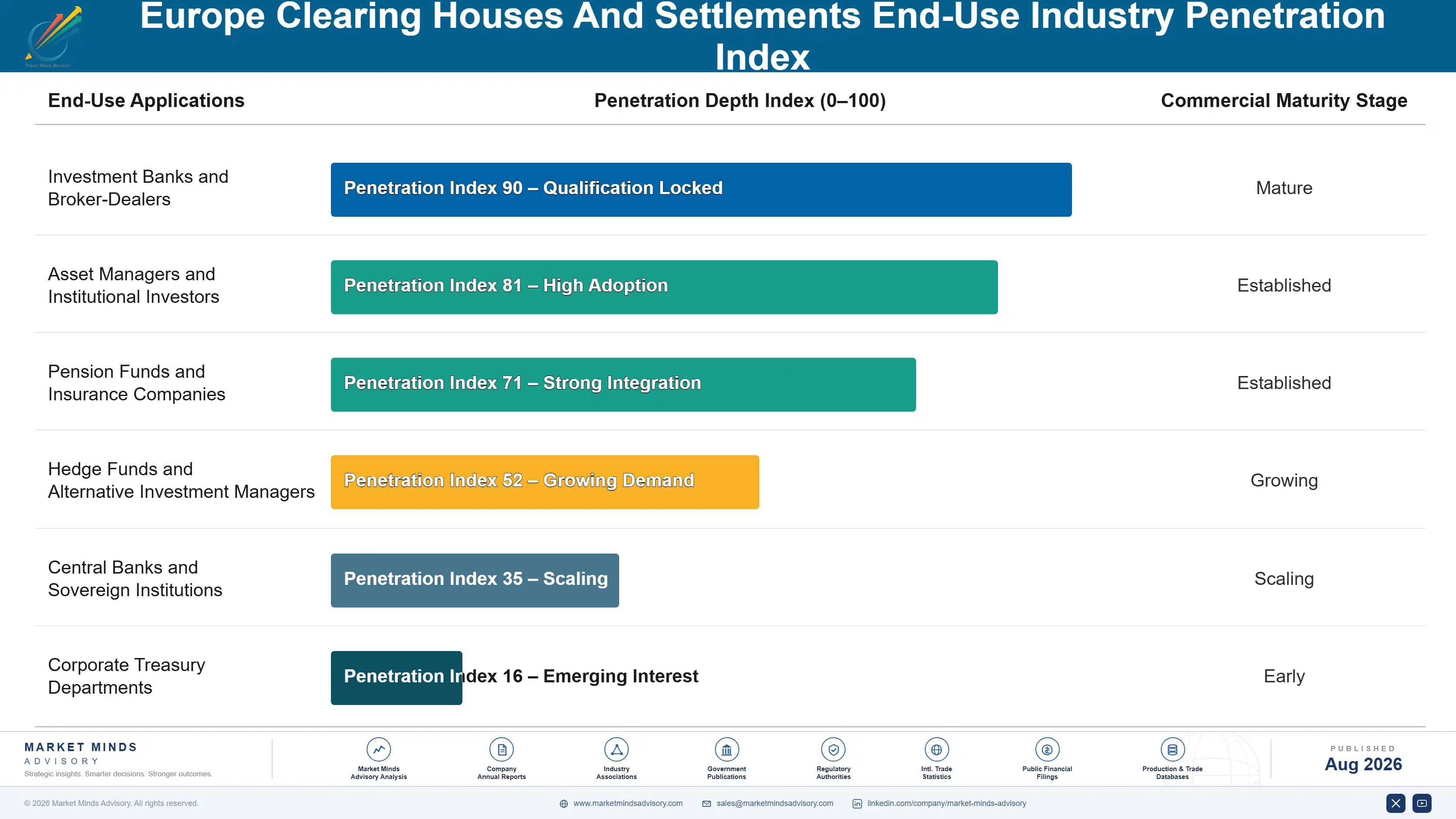
Clearing and settlement demand carries strong annuity characteristics because mandatory clearing obligations and settlement finality requirements are regulatory necessities, not discretionary purchases, giving providers unusually predictable recurring fee revenue once a clearing member relationship is established and margin model approvals are in place. This recurring revenue base is further reinforced by long default fund contribution lock-ups and margin model approvals that make switching counterparties operationally costly once established.
Stickiness varies meaningfully by end-use vertical, though. Large sell-side dealers exhibit the deepest switching costs given the operational complexity of migrating margin models and default fund contributions between counterparties, while buy-side firms newly captured by expanding mandatory clearing obligations show comparatively shallower loyalty, since many are choosing initial clearing relationships for the first time and remain more price-sensitive during this onboarding phase.

A generational buyer shift is also underway. Compliance and treasury functions, rather than pure trading desks, increasingly drive clearing counterparty selection decisions, prioritizing collateral efficiency and regulatory relationship depth over marginal fee differences. This shift favors clearing groups that can demonstrate integrated collateral optimization and resilience credentials over those competing purely on headline clearing fee rates. Groups without credible collateral credentials risk losing relevance with this newer buyer generation.
europe-clearing-houses-and-settlements-market-end-use-penetration-index-1787915770299

Where European Clearing Groups Should Focus

These are among the four positions where our research anticipates prominent divergence between winners and laggards over the coming forecast period. Each is grounded in the demand model, the regulatory perimeter, and the announced capacity pipeline.
01 / EU RELOCATION CAPACITY BUILDOUT

Secure EU-domiciled clearing capacity before tightening deadlines

Clearing groups without meaningful EU-domiciled euro swap clearing capacity risk losing the relocation window entirely to Euronext Clearing and Eurex Clearing, which moved early to secure member onboarding and margin model approvals. EMIR 2.2's phased compliance schedule rewards speed, since dealers rarely switch active account relationships once established, making early capacity the deciding factor in who captures redirected volume over the next several years. Groups that hesitate now will find remaining clearing member relationships already committed elsewhere by the time they act.
02 / COLLATERAL OPTIMIZATION INVESTMENT

Monetize collateral optimization as a standalone premium service

Collateral management is shifting from an uncompensated back-office function into a genuine profit center, and clearing groups that packaged this capability as a standalone fee service early are already capturing disproportionate revenue growth. Basel III Endgame and CSDR settlement discipline penalties will keep expanding demand for optimization tools, and groups without a competitive offering risk ceding this increasingly profitable layer permanently to Euroclear and Clearstream. The window to build this reputation is narrowing as more clearing groups recognize collateral services as a genuine profit center.
03 / T+1 INFRASTRUCTURE READINESS

Front-load settlement technology investment ahead of T+1 transition

Depositories that delay matching engine and straight-through processing upgrades risk compressed implementation timelines and higher settlement fail penalties once Europe's T+1 transition date arrives, since compliance deadlines will not shift regardless of individual readiness. Euroclear and Clearstream have already begun multi-year investment programs, and smaller national CSDs that wait risk falling permanently behind on operational reliability metrics that increasingly influence participant counterparty selection. Buy-side clients increasingly weight operational reliability heavily when selecting settlement counterparties for new mandates, and reputational damage from a public settlement failure could prove costly.
04 / SMALLER CSD CONSOLIDATION STRATEGY

Pursue outsourcing or consolidation before compliance costs compound

Smaller national depositories facing DORA and CSDR refit compliance costs that outpace their transaction volume should evaluate outsourcing core settlement technology to larger international platforms before fixed compliance spending erodes margins further. Waiting risks a forced, less favorable consolidation later, whereas proactive partnership agreements let smaller CSDs retain member relationships while converting fixed technology costs into more predictable variable expenses tied to actual transaction volume. Early movers on outsourcing partnerships will likely negotiate better commercial terms than depositories forced into consolidation later.

Engagement Snapshot From the Field

A live engagement with an industry participant carrying material or product regulatory and market exposure ahead of a defining policy shift, showing how our research translates into a defensible multi-year portfolio strategy.
MARKET MINDS ADVISORY · CLIENT ENGAGEMENT SUMMARY
Europe Clearing Houses And Settlements Producer Strategic Portfolio Review and Transition Roadmap 2026·Investment Scenario on Europe Clearing Houses And Settlements Exposure Evaluation 2025-26
CLIENT PROFILE
The client was a pan-European asset manager with roughly forty billion euros in fixed income and derivatives assets under management, newly subject to expanding mandatory clearing obligations covering additional interest rate swap tenors under EMIR. The firm had historically relied on a single London-based clearing relationship for the substantial majority of its derivatives book. The firm's derivatives book was concentrated in euro interest rate swaps subject to the new obligations.
STRATEGIC CHALLENGE
Firm leadership needed to determine whether to maintain its existing London clearing relationship, open a parallel EU-domiciled active account under EMIR 2.2, or migrate entirely to an EU-domiciled counterparty, while managing member onboarding costs and margin model transition risk across whichever option leadership ultimately selected. Leadership also needed to weigh client reporting continuity against the operational disruption any transition would create.
MMA APPROACH
MMA benchmarked candidate EU-domiciled central counterparties against the client's existing London relationship across margin efficiency, collateral optimization tool availability, and onboarding timeline, drawing on primary interviews with clearing operations staff at comparable pan-European asset managers who had already completed similar transitions. The assessment also incorporated published regulatory guidance on active account compliance thresholds and phased enforcement timelines.
KEY FINDINGS
  1. One candidate EU counterparty offered materially better collateral optimization tooling than the client's existing London relationship compared with pricing at the client's existing London relationship (client-reported, unverified by MMA).
  2. Parallel active account setup added meaningfully higher near-term operational cost than a full migration would have required (client-reported, unverified by MMA). (client-reported, unverified by MMA)
  3. Margin model re-approval timelines varied by several months across candidate counterparties, directly affecting the sequencing of the client's transition plan and internal resourcing.
  4. Buy-side peers who delayed EU account setup faced compressed onboarding windows as compliance deadlines tightened further across the broader European dealer community.
CLIENT PROFILE
The client was a pan-European asset manager with roughly forty billion euros in fixed income and derivatives assets under management, newly subject to expanding mandatory clearing obligations covering additional interest rate swap tenors under EMIR. The firm had historically relied on a single London-based clearing relationship for the substantial majority of its derivatives book. The firm's derivatives book was concentrated in euro interest rate swaps subject to the new obligations.
STRATEGIC CHALLENGE
Firm leadership needed to determine whether to maintain its existing London clearing relationship, open a parallel EU-domiciled active account under EMIR 2.2, or migrate entirely to an EU-domiciled counterparty, while managing member onboarding costs and margin model transition risk across whichever option leadership ultimately selected. Leadership also needed to weigh client reporting continuity against the operational disruption any transition would create.
MMA APPROACH
MMA benchmarked candidate EU-domiciled central counterparties against the client's existing London relationship across margin efficiency, collateral optimization tool availability, and onboarding timeline, drawing on primary interviews with clearing operations staff at comparable pan-European asset managers who had already completed similar transitions. The assessment also incorporated published regulatory guidance on active account compliance thresholds and phased enforcement timelines.
KEY FINDINGS
  1. One candidate EU counterparty offered materially better collateral optimization tooling than the client's existing London relationship compared with pricing at the client's existing London relationship (client-reported, unverified by MMA).
  2. Parallel active account setup added meaningfully higher near-term operational cost than a full migration would have required (client-reported, unverified by MMA). (client-reported, unverified by MMA)
  3. Margin model re-approval timelines varied by several months across candidate counterparties, directly affecting the sequencing of the client's transition plan and internal resourcing.
  4. Buy-side peers who delayed EU account setup faced compressed onboarding windows as compliance deadlines tightened further across the broader European dealer community.
RECOMMENDED STRATEGY
Phase 1: Phase one opened a parallel EU-domiciled active account specifically for the swap tenors newly subject to mandatory clearing obligations under EMIR. Phase 2: Phase two migrated a growing share of new trade flow to the EU counterparty while maintaining the existing London relationship for legacy positions. Phase 3: Phase three evaluated full migration economics annually as EMIR 2.2 compliance thresholds kept tightening on the regulator's published enforcement schedule.
OUTCOME
The client successfully established its parallel EU active account well ahead of the applicable compliance deadline and reported meaningfully improved collateral efficiency across its newly cleared swap positions within the first two quarters of operation (client-reported, unverified by MMA). Leadership credited the phased approach with avoiding the operational disruption a full migration would have caused.

Frequently Asked Questions

Foundational context covering the market sizes, CAGR, scope, country, region and competition that inform every finding below. This section is provided to cover basics and most often pre-purchase conversations, answered from the MMA Primary Research Dataset.

What is the current size of the Europe Clearing Houses And Settlements Market?

The European clearing houses and settlements market reached an estimated 9.2 billion dollars in 2025. Growth has been propelled by expanding mandatory clearing obligations and post-pandemic derivatives volume recovery.

How large will the Europe Clearing Houses And Settlements Market be by 2036?

The market is projected to reach approximately 18.2 billion dollars by 2036. This reflects sustained regulatory-driven clearing relocation and cross-border settlement demand through the forecast period.

What is the CAGR for the Europe Clearing Houses And Settlements Market 2026 to 2036?

The base case CAGR is 6.4 percent annually. Bull and bear scenarios range between 5.2 and 7.6 percent depending on the pace of EU clearing relocation.

Which segment is growing fastest?

Collateral management and optimization services lead at 9.5 percent CAGR, roughly 1.5 times the overall market pace. Basel III Endgame capital rules are the primary driver behind this segment's acceleration.

Who are the major companies in the Europe Clearing Houses And Settlements Market?

Leading providers include LCH Group, Deutsche Börse Clearstream, Euronext Clearing, Euroclear, and SIX Group. These five groups hold a combined 68 percent share on a clearing and settlement fee revenue basis.

Which country is growing fastest?

Ireland leads at an estimated 8.6 percent CAGR, driven by post-Brexit EU clearing relocation activity and expanding fund settlement operations. This growth builds off a comparatively small existing base.

Report Segmentation Architecture

The full report scope spans multiple orthogonal segmentation dimensions, with cross-tabulated demand data provided for each dimension pair. Coverage extends further to regional breakdowns, trend trajectories, and the competitive detail needed to support segment-level decision-making.

By Primary Market Dimension

  • Central Counterparty (CCP) Clearing Services
  • Central Securities Depository (CSD) Settlement Services
  • Trade Repository and Regulatory Reporting Services
  • Collateral Management and Optimization Services
  • Post-Trade Risk Management and Margining Software
  • Cross-Border Settlement and Correspondent Clearing Services

By End-Use Industry

  • Investment Banks and Broker-Dealers
  • Asset Managers and Institutional Investors
  • Pension Funds and Insurance Companies
  • Hedge Funds and Alternative Investment Managers
  • Central Banks and Sovereign Institutions
  • Corporate Treasury Departments

By Commercial Dimension

  • Direct Clearing Members
  • Indirect Clearing Clients
  • Cross-Border Correspondent Relationships
  • Buy-Side Institutional Clients
  • Sell-Side Dealer Clients
  • Regulatory and Compliance Service Buyers

By Region

  • North America
  • Western Europe
  • East Asia
  • South Asia and Pacific
  • Latin America
  • Middle East and Africa
  • Eastern Europe

Scope, Methodology, and Coverage

Every figure in this report is reproducible from documented input assumptions. The scope below maps the historical period, the forecast horizon, the segmentation dimensions, and the countries covered, alongside the underlying primary and qualitative methodology.
Historical Period
2020 to 2025
Forecast Period
2026 to 2036
Base Year
2025 (USD billions; MMA Primary Research Dataset, August 2026)
Market Definition
This report covers central counterparty (CCP) clearing services and central securities depository (CSD) settlement services for exchange-traded and over-the-counter securities and derivatives transactions across Europe, including associated collateral management, trade reporting, and cross-border settlement infrastructure. It excludes retail payment processing, correspondent banking payment rails, and primary securities issuance and underwriting activity.
Quantitative Units
USD billions (clearing and settlement fee revenue, current prices); notional volume in EUR trillions where cited.
Segmentation Dimensions
Primary Market Dimension (clearing and settlement service function); End-Use Industry; Commercial Dimension.
Regions Covered
North America, Western Europe, East Asia, South Asia and Pacific, Latin America, Middle East and Africa, Eastern Europe
Countries Covered
UK, Germany, France, Netherlands, Belgium, Ireland, Poland, Hungary, Italy, Spain, Denmark, Luxembourg, Switzerland, Austria, Romania.
Key Companies Profiled
LCH Group, Deutsche Börse Clearstream, Euronext Clearing, Euroclear, SIX Group.
Quantitative Methodology
Primary survey, n=3,800 respondents, Q4 2025, six countries; demand-side model with trade association cross-validation
Qualitative Methodology
47 expert interviews, Q4 2025; applied to validate demand model assumptions, identify emerging dynamics, and assess competitive positioning
Report Format
PDF and XLSX data workbook (Word format preview document)
Publisher
Market Minds Advisory
Report Code
MMA-2026-TEC-105
Published
August 2026
Contact
sales@marketmindsadvisory.com | www.marketmindsadvisory.com

Purchase the full Europe Clearing Houses And Settlements Market Report (2026 to 2036).

This report delivers a complete strategic assessment of the European clearing houses and settlements market through 2036. It combines primary survey data from 3,800 respondents across six countries with 47 expert interviews conducted in the fourth quarter of 2025. Coverage spans market sizing, six-segment MECE service function segmentation, competitive benchmarking across twenty profiled companies, and regional analysis across all seven global regions. The analysis is designed to support clearing membership strategy, technology investment prioritization, and counterparty selection decisions. Buyers gain a structured basis for evaluating clearing membership economics against alternative counterparty relationships.
Six-segment MECE clearing and settlement function breakdown
Seven-region market sizing with country-level detail
Twenty-company competitive benchmarking and moat analysis
EMIR 2.2 relocation impact quantification and scenarios
Collateral optimization and T+1 readiness investment guidance
Anonymized client case study with recommended strategy phases

Built For The People Who Decide

From boardroom strategy to bench-side execution, this report is read cover-to-cover by leaders shaping the next decade of their industry, turning demand scenarios, market dynamics and valuation benchmarks into decisions.
CXOs/ Presidents/ VPs/ Managers
M&A and Corporate Development
Strategy Teams and R&D Heads
Procurement and Product Directors
Regulatory and Compliance Leaders
Investor Relations and Equity Analysts