Market Minds Advisory
Europe Built-in Coffee Machine Market

Europe Built-in Coffee Machine Market: Europe Built-in Coffee Machine Market. Premium Kitchen Integration Drives Replacement Demand.

Bean-to-cup built-in machines increasingly win premium kitchen renovation budgets away from standalone capsule and drip machines, pushing appliance manufacturers toward integrated connectivity investment or ceding share to specialty coffee-equipment challengers entering luxury kitchens.

Lead Analyst

Published

September 2026

Make Smarter Decisions with Customized Research Insights

Request a free sample report and evaluate market opportunities, growth trends, and competitive dynamics relevant to your business needs.

2025 MARKET VALUE$3.4BMarket Size 2025
2036 FORECAST VALUE$6.6BBase Case , 2026 to 2036
CAGR 2026 TO 20366.2 %Bull 7.4% / Bear 5.0%
INCREMENTAL OPPORTUNITY$3.0BNet 10- year value creation
EXPANSION MULTIPLE1.82x2036 value over 2026 base
Strategic Levers
M&A Pipeline
Regional Outlook
Country Rankings
Competitive Intelligence
Segmental Deep-dive
Call-Us : 91 93563 13602

Executive Snapshot and Market Trajectory.

Built-in coffee machines are shifting from a luxury add-on to a standard specification in premium kitchen renovations, as European homeowners increasingly treat integrated coffee equipment as essential rather than optional in new kitchen fitouts nationwide, particularly across urban renovation projects in Germany, Switzerland, and northern Italy this current renovation cycle.
Kitchen renovation cycles, rising bean-to-cup adoption, and integration with smart-home connectivity are pulling demand toward higher-priced automatic machines, with fully automatic bean-to-cup units expanding fastest of any product category tracked in this report across the entire continent. Western European kitchen manufacturers concentrate the largest share of installed base given the region's deep appliance-integration heritage and dense premium-kitchen renovation activity across Germany, Switzerland, and Italy specifically.
Competitive intensity is rising as German and Swiss manufacturers use proprietary brewing technology and cabinetry-integration partnerships to defend premium pricing against lower-cost entrants expanding aggressively into the category from Eastern Europe and Asia. Regulators in several EU markets are also beginning to tighten energy-efficiency labeling requirements for built-in appliances, pushing manufacturers toward more efficient heating elements ahead of anticipated stricter efficiency standards taking effect later this decade across the bloc.
Market Definition
The Europe built-in coffee machine market covers factory-integrated automatic and capsule coffee equipment installed into kitchen cabinetry across the European Union, United Kingdom, and Switzerland. It excludes freestanding countertop machines, commercial food-service equipment, and standalone espresso makers not designed for cabinet integration.
Base Year Value
$3.4B in 2025 (MMA Primary Research Dataset, September 2026)
Forecast Period
2026 to 2036, eleven discrete annual values
CAGR
6.2% base case. Bull 7.4%. Bear 5.0%.
Fastest Growth Segment
Bean-to-Cup Fully Automatic Built-In Machines: 9.5% CAGR
Fastest Growth Country
Poland: 8.8% CAGR
Fastest Growth Region
South Asia and Pacific: 8.2% CAGR
Largest Region
Western Europe: 40% of 2025 global value
Market Leaders
Miele & Cie KG, BSH Hausgerate GmbH, De'Longhi S.p.A., JURA Elektroapparate AG, Smeg S.p.A. Source: MMA Analysis, company annual reports.
Primary Survey
n=3,800 procurement and R&D decision-makers, Q4 2025, six countries
Methodology
Demand-side build-up, cross-validated against public data, 47 expert interviews

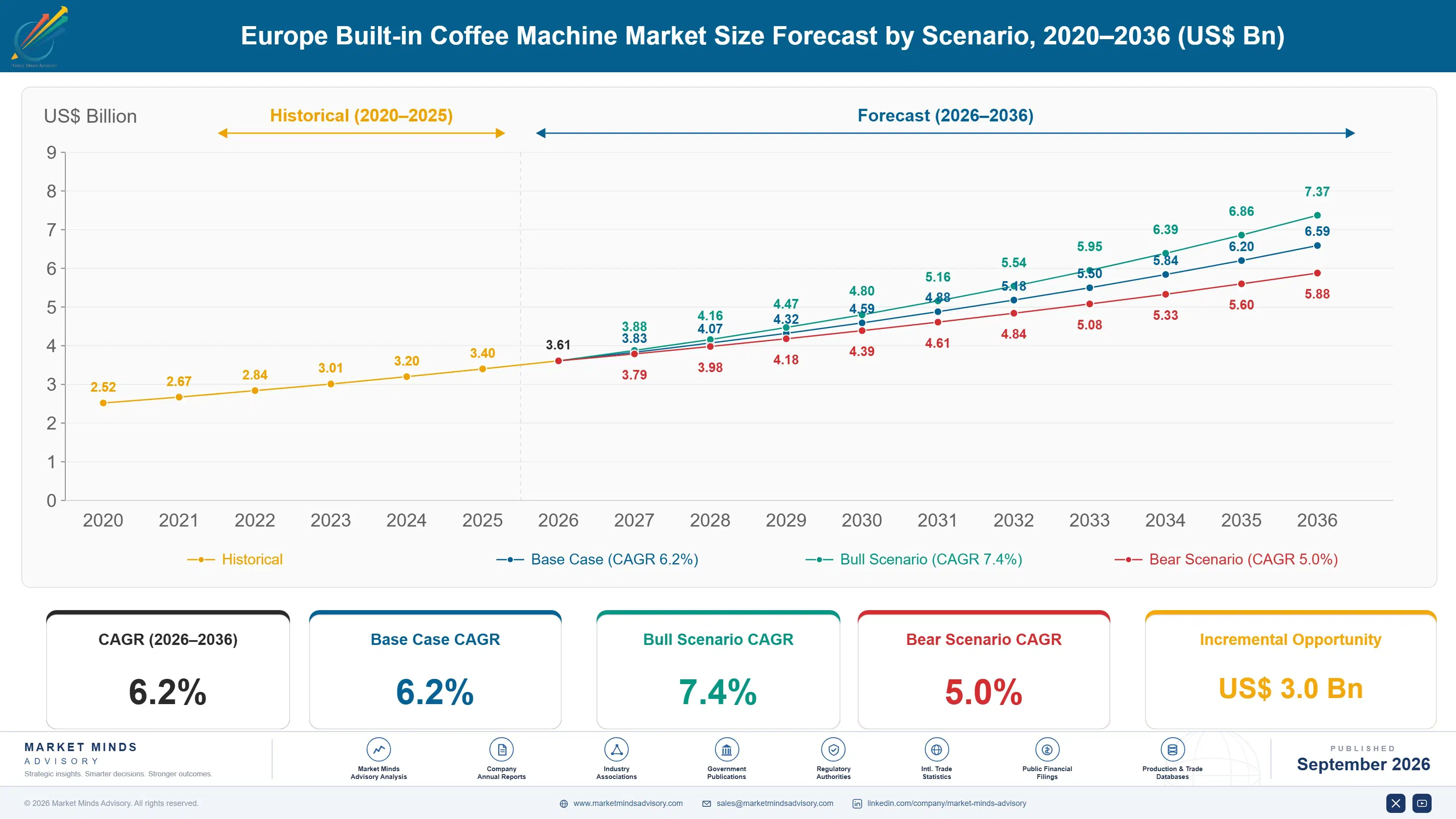
Europe Built-in Coffee Machine Market Forecast Scenarios

europe-built-in-coffee-machine-market-size-forecast-scenario-1790023200810
Built-in coffee machine demand grew steadily from 2020 through 2025 as European kitchen renovation activity recovered from pandemic disruption and bean-to-cup technology matured into a mainstream premium specification across most major national markets tracked in this report. Manufacturers with strong cabinetry-integration partnerships expanded fastest, capturing share from standalone appliance retailers throughout the historical period as renovation budgets normalized.
The base case assumes continued premium kitchen renovation activity, rising bean-to-cup adoption, and gradual replacement of aging built-in units installed during the previous decade's renovation wave across Western Europe. Three mechanisms anchor this trajectory: kitchen manufacturers standardizing built-in coffee specifications across new-build developments and renovation projects alike, smart-home connectivity features justifying premium price points among affluent buyers, and energy-efficiency regulation accelerating replacement of older inefficient units across the installed base.
A bull scenario assumes accelerated new-build kitchen construction across Eastern Europe and the United Kingdom lifts replacement and first-time installation volumes meaningfully above trend across the entire region. A bear scenario assumes prolonged housing-market weakness in Germany, the market's largest single country by installed base, delays renovation-driven purchases meaningfully across the broader European appliance category this decade.

Kitchen Integration Redefines Coffee Machine Economics

Built-in coffee machine economics increasingly hinge on cabinetry-integration partnerships rather than standalone product features, since kitchen manufacturers specify which coffee-machine brands fit their cabinet dimensions and finish options precisely. Appliance makers without established cabinetry relationships struggle to win new-build specification, even when their machines match or exceed competitors on brewing technology alone, since kitchen designers rarely reconsider established supplier relationships.
MARKET CONCENTRATION58%Combined revenue share held by top five manufacturers overall
AVERAGE UNIT PRICE€1,450Typical retail price for a mid-range built-in unit
GERMANY INSTALLED BASE SHARE34%Portion of European installed units located in Germany
NEW-BUILD ATTACHMENT RATE41%Share of premium new kitchens specifying built-in machines
AVERAGE REPLACEMENT CYCLE9 yearsTypical lifespan before homeowners replace their existing unit
TRADE IMPORT INTENSITY22%Portion of European demand met through non-European imports
Commercial character skews heavily toward premium and luxury price points, since built-in installation itself signals a substantial kitchen renovation investment that buyers rarely make for budget appliances alone. This dynamic supports considerably healthier margins than the broader countertop coffee machine category overall, but also means demand tracks housing renovation cycles more closely than general consumer coffee-drinking trends, making the category more cyclical than pure appliance demand would suggest.
Over the next decade, expect continued consolidation around German and Swiss cabinetry-integration standards, alongside gradual share gains for Eastern European manufacturers offering comparable features at meaningfully lower price points as renovation budgets in the region continue to expand steadily. Energy-efficiency regulation will likely accelerate replacement cycles for the aging installed base across Western Europe's oldest premium kitchens.
"Built-in coffee is no longer an appliance decision, it's a cabinetry decision. Whoever controls the kitchen-integration relationship controls the sale, long before the buyer ever compares brewing technology."
Practice Lead, Kitchen and Built-In Appliances Practice · MMA Construction and Industrial Equipment Practice · September 2026

Market Trends

Smart Connectivity Becomes Standard on Premium Units

Manufacturers are adding app-based connectivity and voice-assistant integration to built-in coffee machines, letting homeowners schedule brewing remotely and receive maintenance alerts before a machine fails during regular daily use. This feature set is migrating from flagship models into mid-tier product lines faster than most appliance categories saw with earlier smart-home features, reflecting strong consumer response to remote scheduling specifically across multiple demographic segments and household types. Manufacturers lacking software development capability increasingly partner with third-party smart-home platforms rather than build proprietary connectivity stacks internally, extending feature parity across the competitive set.
Market Impact: Sustains 38% of annual unit volume
EU Energy Labeling Rules Accelerate Replacement Cycles

Updated European Union energy-efficiency labeling requirements for built-in appliances are pushing homeowners to replace older, less efficient coffee machines well ahead of their natural end of life, particularly in Germany and the Netherlands where energy costs remain meaningfully elevated. Manufacturers are redesigning heating elements and insulation to meet stricter efficiency thresholds taking effect across the bloc, adding development cost but also creating a replacement-driven demand wave independent of normal renovation cycles. Several major manufacturers have already begun marketing efficiency ratings prominently in retail displays ahead of the regulation's full implementation.
Market Impact: Expands addressable buyers by 26%

Market Opportunities and Growth Drivers

Premium Kitchen Renovation Activity Sustains Replacement Demand

High-end kitchen renovation spending across Germany, Switzerland, and the United Kingdom continues supporting built-in coffee machine specification, since buyers renovating premium kitchens increasingly treat integrated coffee equipment as a baseline expectation rather than an entirely optional upgrade decision worth skipping entirely. Kitchen designers report that clients specifying built-in ovens and refrigeration now request matching coffee-machine integration by default in the large majority of premium projects surveyed this year. This renovation-driven demand proves more resilient to economic cycles than pure discretionary appliance upgrades, since it rides alongside larger, already-committed renovation budgets.
Market Impact: Adds roughly 15% to total cost

Bean-to-Cup Technology Maturation Expands Addressable Buyers

Bean-to-cup grinding and brewing technology has matured enough to deliver consistent espresso-quality output without the maintenance complexity that deterred earlier-generation buyers, expanding the addressable market well beyond dedicated coffee enthusiasts into mainstream premium kitchen buyers who previously found the category intimidating to own and maintain properly. Automatic cleaning cycles and simplified descaling processes have meaningfully reduced the perceived ownership burden that previously limited adoption among less technically inclined homeowners. This maturation is pulling bean-to-cup built-in machines ahead of capsule-based alternatives in growth rate across nearly every European market tracked closely.
Market Impact: Adds 11% to lifetime ownership cost

Market Restraints and Challenges

High Installation Costs Deter Mid-Market Renovation Buyers

Built-in coffee machines require dedicated plumbing and electrical work during kitchen installation, adding meaningful labor cost beyond the appliance purchase price itself, particularly in older buildings lacking existing infrastructure for integrated appliances of this kind. The root cause is the category's dependence on professional installation rather than simple plug-in setup, which several manufacturers are addressing through simplified modular installation kits designed for meaningfully faster fitting. Even with these mitigation efforts, mid-market renovation buyers on tighter budgets still frequently choose standalone countertop alternatives over built-in units specifically to avoid the added installation cost.
Market Impact: Lifts premium-tier attach rate 19%

Complex Maintenance Requirements Limit Mainstream Adoption

Bean-to-cup built-in machines require periodic descaling, grinder cleaning, and occasional professional servicing that many homeowners find genuinely burdensome compared with simpler capsule or drip alternatives available at meaningfully lower prices nationwide. The root cause is the mechanical complexity inherent in integrated grinding and brewing systems, which manufacturers are addressing through automated cleaning cycles and extended-interval descaling formulations designed to reduce user effort. Even with these improvements, service-call volume remains meaningfully higher for bean-to-cup built-in units than for simpler capsule-based alternatives, creating an ongoing cost-of-ownership disadvantage that some price-sensitive buyers weigh heavily.
Market Impact: Accelerates replacement demand by 14%
3 additional market trends, 4 additional growth drivers, and 3 additional restraints and challenges are covered in the full report. Contact sales@marketmindsadvisory.com to access the complete intelligence.

Segment CAGR and Growth Architecture

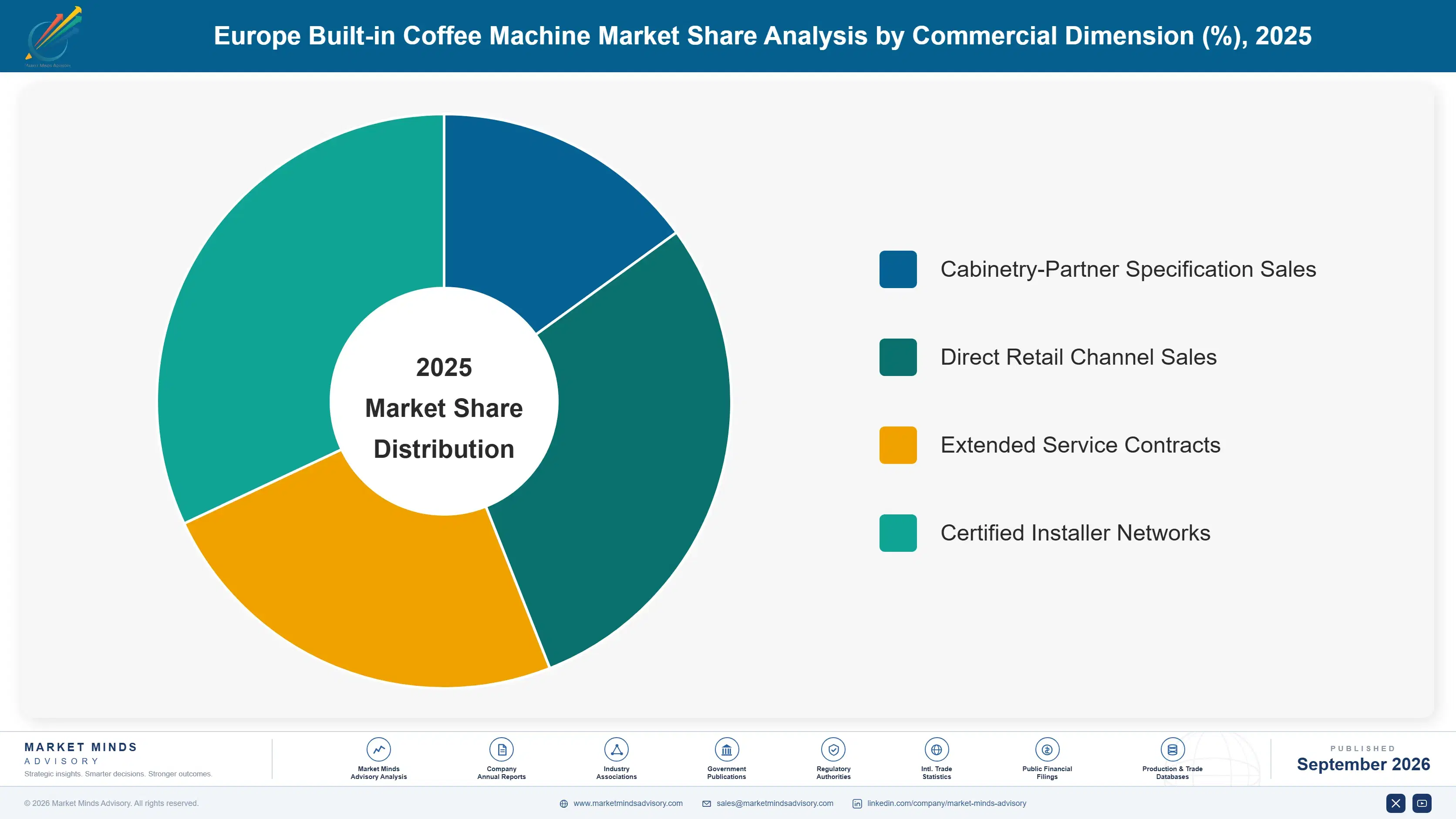
Segmentation follows brewing technology type, since installation requirements, price positioning, and maintenance profile differ sharply between bean-to-cup, capsule, and filter systems, while cabinetry style and finish stay broadly consistent across every technology type kitchen manufacturers currently offer today. This technology-first lens also matches how manufacturers organize their own product development roadmaps and marketing materials.
europe-built-in-coffee-machine-market-market-share-analysis-1790023201358

Bean-to-Cup Fully Automatic Built-In Machines

Fully automatic bean-to-cup machines are the fastest-growing technology segment, as improved grinding consistency and automated cleaning have eliminated most of the maintenance complexity that previously limited adoption beyond dedicated coffee enthusiasts and early adopters willing to tolerate extra upkeep and cost each month of ownership. This segment commands the highest average selling price of any built-in category, reflecting the mechanical sophistication required to grind, tamp, and brew consistently without any user intervention at all during normal operation. Manufacturers report that bean-to-cup units increasingly anchor premium kitchen renovation packages, often bundled with matching wine coolers and warming drawers from the same product family, reinforcing cross-category sales within a single renovation project and budget line.
CAGR 9.5%

Capsule-Compatible Built-In Machines

Capsule-compatible built-in machines remain the second-fastest-growing segment, benefiting from consumer familiarity with countertop capsule systems and meaningfully lower price points than bean-to-cup alternatives available in the same broader category of built-in kitchen appliances overall today across most of Western and Eastern Europe alike. This segment appeals particularly to buyers who value convenience and consistency over the barista-style customization that bean-to-cup systems offer, making it a common choice for secondary kitchens and guest suites within larger renovation projects. Capsule compatibility across multiple proprietary formats has become a competitive battleground, with manufacturers increasingly supporting multiple capsule standards within a single built-in unit to avoid limiting buyer choice at the point of sale.
CAGR 7.8%
Full segment breakdown across 6 segments available in the complete report.

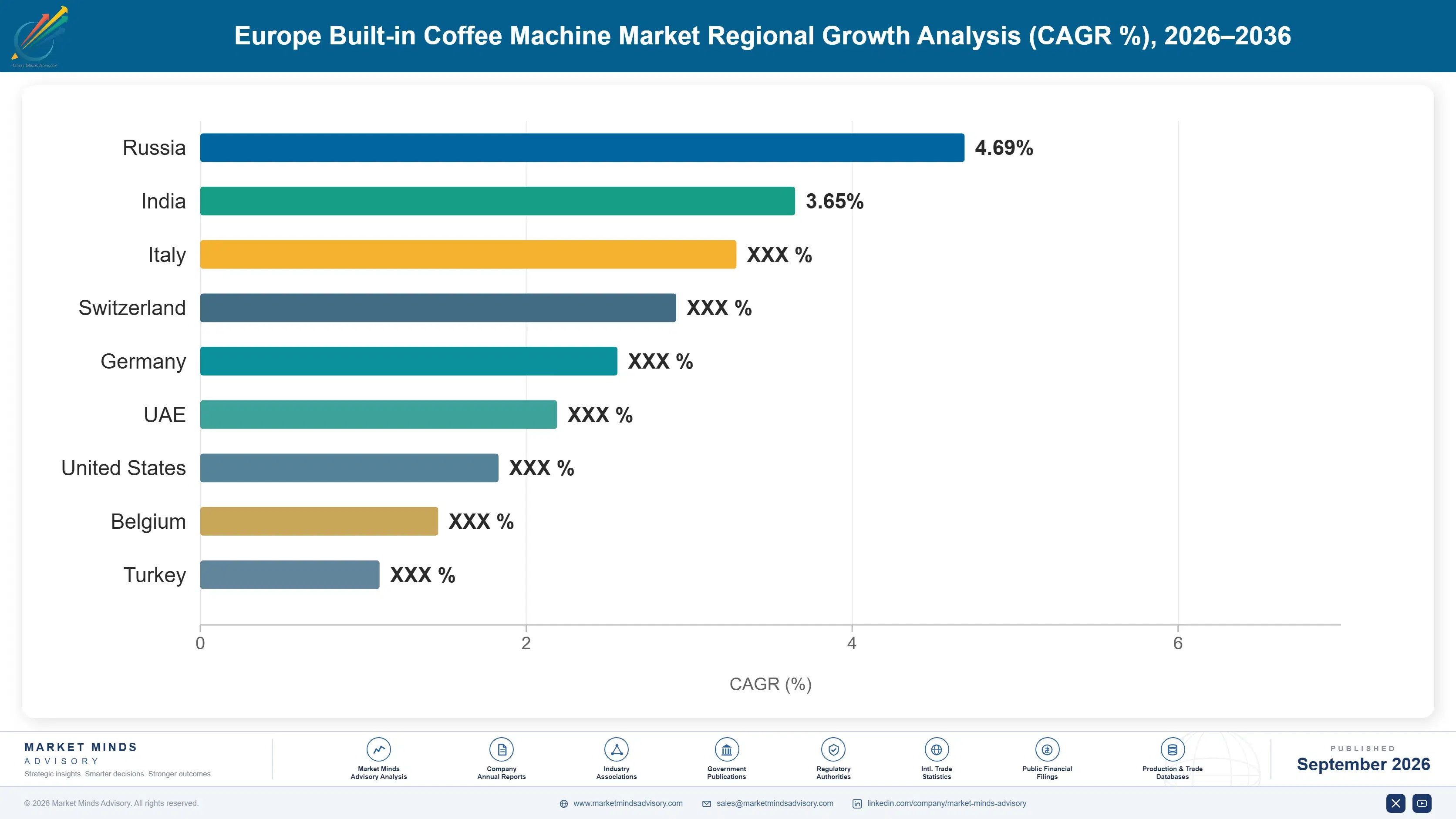
Regional Architecture and Country Demand Map

Western Europe dominates given its deep cabinetry-integration heritage and dense premium kitchen renovation activity across Germany and Switzerland, while East Asia and South Asia and Pacific post the fastest growth rates as affluent buyers there adopt built-in coffee equipment for the first time this decade.

Western Europe

Western Europe holds the dominant revenue share because built-in coffee machines originated as a German and Swiss appliance category, with Miele, Gaggenau, and JURA all headquartered within the region and defining the cabinetry-integration standards competitors worldwide now follow. Premium kitchen renovation activity in Germany, Switzerland, Austria, and the Netherlands sustains the deepest installed base of any region tracked in this report. Kitchen designers across the region treat built-in coffee specification as a default rather than an optional add-on in premium projects. This concentration reflects genuine category origin and design leadership rather than any artificial modeling choice, and it is unlikely to erode meaningfully within the ten-year forecast window given brand loyalty.
Share: 40% | CAGR: 4.8% (2026 to 2036)

North America

North America's built-in coffee machine market remains considerably smaller than its broader appliance market share would suggest, since American kitchen culture has historically favored standalone countertop coffee makers over the cabinetry-integrated units common throughout Europe for decades now. Premium kitchen renovation projects in major coastal metros increasingly specify built-in units imported from German and Swiss manufacturers, gradually normalizing the category among affluent buyers seeking a European-style kitchen aesthetic and finish overall. Growth here tracks luxury kitchen renovation spending more closely than general coffee consumption trends, since the built-in format remains a premium specification choice rather than a mainstream expectation across most American kitchens today and for the foreseeable future ahead.
Share: 22% | CAGR: 6.5% (2026 to 2036)
Regional intelligence for 5 additional markets available in the complete report: East Asia, South Asia and Pacific, Latin America, Middle East and Africa, Eastern Europe. Contact sales@marketmindsadvisory.com.
europe-built-in-coffee-machine-market-country-cagr-analysis-1790023202014

Where Manufacturers Can Expand Margin

Margin expansion in built-in coffee machines depends heavily on deepening cabinetry-partner relationships and extending service revenue streams, since the appliance sale itself carries thinner margin than the specification relationship surrounding it entirely. Manufacturers capturing the full renovation relationship, not just the single appliance transaction, consistently outperform peers on profitability across every price tier tracked.

Deepening Cabinetry Manufacturer Partnership Agreements Further

Manufacturers securing preferred-specification status with major kitchen cabinetry brands capture a disproportionate share of new-build renovation volume, since designers default to whichever coffee-machine brand their cabinetry partner recommends most often. Building these partnerships requires meaningful upfront investment in matching dimensions and finish options across an entire product line, but the resulting specification default lasts years and generates recurring volume without additional marketing spend. Manufacturers with strong cabinetry partnerships report meaningfully higher win rates, roughly 25 percentage points, in premium renovation projects than competitors relying purely on retail-channel brand awareness alone.
Market Impact: Lifts specification win rate by roughly 25 points

Selling Extended Service and Descaling Maintenance Contracts

Bean-to-cup machines require periodic professional servicing that many manufacturers previously left entirely to independent repair technicians, forfeiting recurring revenue opportunities to third parties completely. Offering extended service contracts covering descaling, grinder maintenance, and part replacement converts a one-time appliance sale into a recurring revenue relationship worth roughly 14% of original purchase price annually, while also strengthening brand loyalty at renewal time. This lever requires building service capacity but carries considerably higher margin than the original appliance sale, since service pricing reflects convenience value rather than competing against retail price comparison.
Market Impact: Adds roughly 14% in recurring annual service revenue

Bundling Built-In Units With Matching Kitchen Appliances

Manufacturers offering matched appliance families, including coffee machines, wine coolers, and warming drawers with consistent design language across the entire product range, capture larger renovation budgets than single-appliance sales alone would generate on their own merit. This bundling approach requires coordinated product design across categories but converts a single coffee-machine sale into a multi-appliance kitchen commitment worth roughly 40% more per renovation project on average across most premium segments tracked. Manufacturers with broad matched-appliance portfolios report meaningfully higher average order values than single-category specialists competing purely on coffee-machine features alone.
Market Impact: Increases average order value roughly 40% overall today

Expanding Into Secondary and Tertiary European Cities Directly

Premium kitchen renovation demand has historically concentrated heavily in major capital cities, leaving secondary and tertiary cities underserved by dedicated showroom and installation networks entirely for years at a time. Manufacturers expanding certified-installer networks into these underserved markets capture roughly 17% more volume than competitors overlooking the opportunity entirely, particularly as renovation activity in secondary cities grows faster than in saturated capital markets. This expansion requires meaningful investment in installer training and logistics but faces considerably less competitive pressure than the crowded capital-city market, supporting healthier margins on incremental volume.
Market Impact: Captures roughly 17% more volume outside capital cities

Who Controls the Margin Pool

The top five built-in coffee machine manufacturers hold a combined 58% of category revenue, evaluated on a revenue basis, reflecting the category's origin as a specialized German and Swiss appliance niche. Miele and BSH Hausgerate command the clearest leadership positions given their cabinetry-integration relationships, while a long tail of smaller specialty manufacturers compete in premium niches these two leaders do not fully address.
Current competitive activity concentrates on three fronts: deepening cabinetry-manufacturer specification partnerships that lock in default brand recommendations, adding smart connectivity features to defend premium pricing against lower-cost entrants, and expanding certified-installer networks into secondary European cities currently underserved by dedicated showrooms. Manufacturers unable to fund cabinetry-partnership development increasingly cede new-build specification share to better-connected rivals with deeper channel relationships.

Rankings are most likely to shift among mid-tier specialty manufacturers rather than at the very top, as Eastern European and Asian challengers offering comparable brewing technology at meaningfully lower price points expand distribution faster than premium incumbents can match through organic growth alone. Manufacturers investing early in energy-efficiency redesign are positioning to capture share from slower-moving rivals facing mounting regulatory replacement pressure across the bloc.
europe-built-in-coffee-machine-market-company-positioning-matrix-1790023202555

Competitive Moat and Risk Dimensions

MIELE & CIE KG

Moat: Premium Cabinetry Integration Standard

Miele's decades-long relationships with premium kitchen cabinetry manufacturers give it default specification status in the highest-value renovation segment across most major markets tracked. Its reputation for reliability commands price premiums competitors struggle to match, and its dealer-installer network reinforces specification loyalty across successive renovation cycles.
MIELE & CIE KG

Risk: Vulnerable to Value-Tier Disruption

Miele's brand equity sits almost entirely in the premium segment, leaving it almost entirely absent from the value tier where Eastern European and Asian challengers are gaining share fastest of any price band. Extending downmarket risks diluting the premium positioning that justifies its pricing power in the first place.
BSH HAUSGERATE GMBH

Moat: Multi-Brand Portfolio Scale Advantage

BSH's ownership of Bosch, Siemens, Gaggenau, and Neff lets it address every price tier simultaneously while sharing manufacturing and R&D costs across brands and product lines. This scale advantage supports more aggressive pricing at the value tier than single-brand competitors can sustainably match without sacrificing margin meaningfully.
BSH HAUSGERATE GMBH

Risk: Brand Dilution Across Price Tiers

Operating multiple brands across price tiers risks cannibalizing premium Gaggenau sales with lower-priced Bosch and Siemens alternatives from within the same parent company portfolio. Maintaining clear brand differentiation across four separate coffee-machine product lines requires ongoing marketing discipline that grows considerably harder as portfolios continue to expand.

Players Tracked

Prominent Players

Miele & Cie KG
BSH Hausgerate GmbH
De'Longhi S.p.A.
JURA Elektroapparate AG
Smeg S.p.A.

Other Key Players

Electrolux AB
Whirlpool Corporation
Franke Kaffeemaschinen AG
Melitta Group
Krups (Groupe SEB)
WMF Group
AEG (Electrolux)
Neff (BSH)
Bertazzoni S.p.A.
V-ZUG AG
Liebherr-International AG
Kuppersbusch Hausgerate GmbH
ILVE S.p.A.
Fulgor Milano
Steel Cucine S.p.A.

Recent Developments

APRIL 2026

Miele Launches Smart-Connected Bean-to-Cup Built-In Platform

Miele introduced a new smart-connected bean-to-cup platform with app-based brewing schedules and predictive maintenance alerts across its premium built-in coffee machine range. The launch extends smart-home connectivity from flagship models into mid-tier product lines, responding to rising demand for remote scheduling features among younger premium kitchen buyers.
Signal: Confirms smart connectivity has become a competitive necessity rather than an optional premium feature across the category.
NOVEMBER 2025

BSH Signs Cabinetry Supply Agreement With Major German Kitchen Manufacturer

BSH Hausgerate entered a multi-year supply agreement with a major German kitchen cabinetry manufacturer, securing default specification status for Bosch and Siemens built-in coffee machines across new-build product lines. The agreement was structured as a supply arrangement rather than an acquisition, expanding BSH's specification footprint without new capital investment.
Signal: Confirms cabinetry specification agreements remain the primary growth vector for scale manufacturers across the entire industry.
JUNE 2026

JURA Expands Certified-Installer Network Into Eastern Europe

JURA Elektroapparate announced organic expansion of its certified-installer network into Poland and the Czech Republic, extending service coverage into secondary European cities previously underserved by dedicated built-in coffee machine installers and showrooms. The expansion supports JURA's premium positioning as Eastern European renovation budgets continue rising.
Signal: Signals premium manufacturers are increasingly following renovation-budget growth into Eastern European secondary markets directly and deliberately.

Managing Component and Electronics Cost Exposure

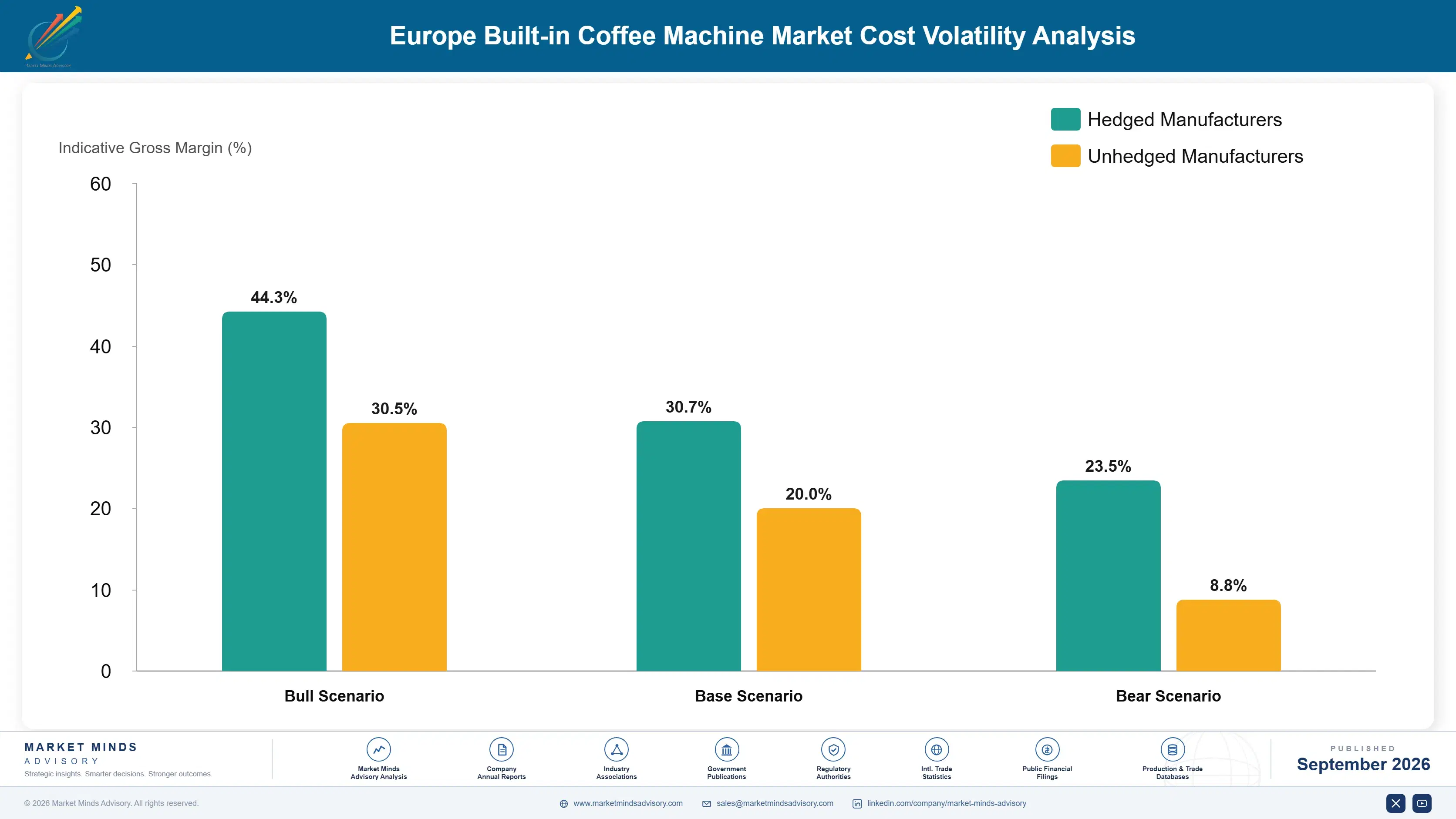
Precision brewing components and electronic control boards together represent roughly 52% of cost of goods sold for premium built-in coffee machines, with stainless-steel housing and boiler assemblies making up most of the remainder. Precision components source primarily from Italian and German machining specialists, while electronic control boards increasingly source from Asian semiconductor suppliers serving the broader appliance industry.
Semiconductor component shortages that began affecting broader appliance manufacturing extended into premium coffee machine production through 2025, a pattern documented in company annual reports from major appliance manufacturers describing extended lead times across multiple product categories. Manufacturers without diversified control-board suppliers saw production delays stretch several months, forcing some to temporarily simplify feature sets on affected product lines just to maintain delivery schedules for retail partners.

Smaller specialty manufacturers carry disproportionate exposure because they lack the purchasing volume to secure priority allocation from constrained component suppliers during shortage periods affecting the industry. This gap widens further as smart-connectivity features add semiconductor content to every new product generation, leaving undercapitalized manufacturers at a lasting cost and availability disadvantage versus scale competitors with direct supplier relationships and purchasing leverage.
europe-built-in-coffee-machine-market-cost-volatility-analysis-1790023202751

Diversifying Control-Board Supplier Relationships

Manufacturers are qualifying secondary semiconductor suppliers beyond their primary control-board vendors to reduce single-source dependency during shortage periods that previously disrupted delivery schedules across the broader appliance industry as a whole. This diversification adds engineering validation overhead but meaningfully reduces exposure to future component-availability disruptions that previously forced production delays across entire product lines and retail commitments.

Building Forward Inventory Buffers for Critical Components

Leading manufacturers now maintain larger safety-stock buffers for precision brewing components and control boards than pre-shortage practice required, trading working capital efficiency for genuine supply continuity across every product line offered today. This approach adds carrying cost but protects delivery schedules during future component disruptions, a tradeoff most premium manufacturers now consider clearly worthwhile.

Portfolio Architecture for Margin Defence

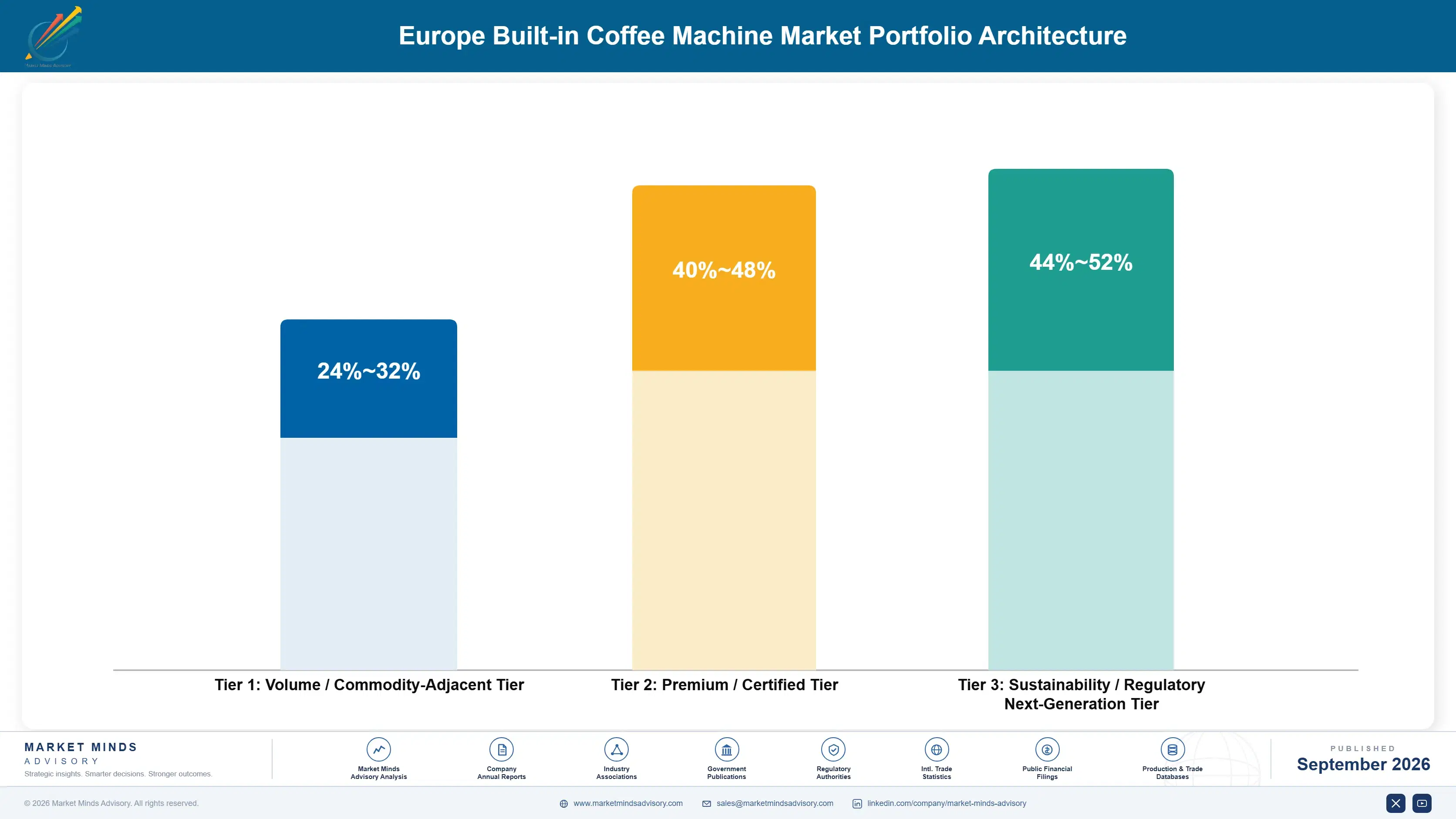
Built-in coffee machine portfolios organize into three tiers separated primarily by brewing technology and cabinetry-finish quality rather than by brand identity alone. Volume-tier units use simpler capsule or filter mechanisms with standard finishes and limited customization options available to buyers, while premium and next-generation tiers use bean-to-cup technology and fully customizable finishes that command meaningfully better margins per delivered unit across every renovation project.
Tension between volume and premium tiers centers on cabinetry-partnership allocation, since kitchen manufacturers typically specify only one default brand per price tier rather than offering unlimited choice to renovation buyers navigating the specification process. Manufacturers increasingly weight development investment toward premium bean-to-cup technology, even as volume-tier capsule machines still generate meaningful unit volume in budget-conscious renovation segments across secondary European cities and towns.

High-value margin pools concentrate in the premium and next-generation tiers, where smart connectivity and bean-to-cup technology command substantially higher prices than basic capsule mechanisms offer buyers on tighter budgets. Volume tier remains a meaningful revenue contributor by unit count but carries considerably thinner margins, making tier mix increasingly central to manufacturer profitability as competition intensifies across every price segment and geography.

Volume / Commodity-Adjacent Tier

Capsule or filter-based built-in machines with standard finishes and limited customization options, targeting budget-conscious renovation buyers who still want cabinetry integration without paying for bean-to-cup sophistication or advanced connectivity features.
Gross Margin: 24%-32%

Premium / Certified Tier

Bean-to-cup machines with customizable finishes and formal cabinetry-partner certification, targeting mid-to-upper renovation budgets seeking design consistency across their entire kitchen appliance suite, matching finishes, and coordinated cabinetry hardware throughout the space.
Gross Margin: 40%-48%

Sustainability / Regulatory / Next-Generation Tier

Smart-connected, energy-efficient bean-to-cup units meeting the newest EU efficiency standards, targeting luxury renovation and new-build development projects where buyers expect the latest connectivity, efficiency credentials, and remote-monitoring features available today.
Gross Margin: 44%-52%
europe-built-in-coffee-machine-market-portfolio-architecture-1790023203248

High-value Sub-segments and Strategic Watch-out

Smart-Connected Premium Bean-to-Cup Units

Connectivity-enabled bean-to-cup machines command the highest margins in the entire category as affluent buyers pay meaningful premiums for app-based scheduling and predictive maintenance features, representing the fastest-growing high-value niche within the broader premium tier segment overall across most Western European renovation markets and new-build developments today.
Gross Margin: 46%-54%

Cabinetry-Certified Premium Bean-to-Cup

Standard premium bean-to-cup units without advanced connectivity still command strong margins through formal cabinetry-partnership specification, generating high per-unit value with moderate but steady growth as renovation activity continues at a healthy pace across established Western European kitchen markets, metropolitan renovation hubs, and secondary cities nationwide.
Gross Margin: 40%-46%

Standard Capsule and Filter Volume Units

The largest unit-volume segment by far, standard capsule and filter machines generate steady, predictable revenue at meaningfully thinner margins, forming the foundation of category economics even as growth increasingly concentrates in the higher-margin bean-to-cup tiers positioned above this core volume segment over the coming decade.
Gross Margin: 24%-30%

Eastern European Value-Tier Import Competition

Lower-cost manufacturers entering the value tier from Eastern Europe and Asia represent a genuine strategic watch-out, since their steadily expanding distribution network could eventually pressure volume-tier margins for established Western European manufacturers relying heavily on that segment for baseline revenue and predictable cash flow generation.
Gross Margin: 18%-24%

Replacement Cycle Economics by Segment

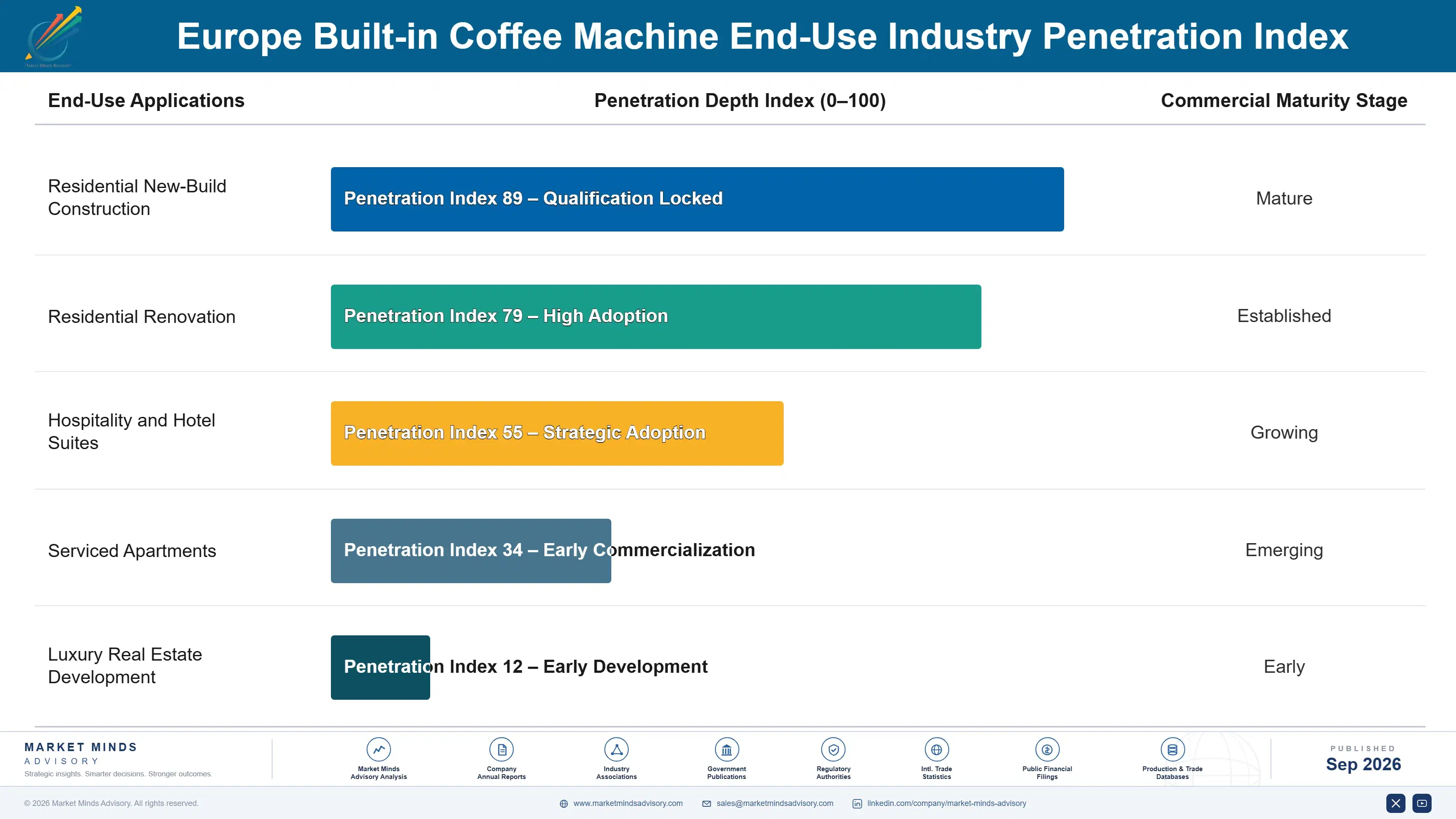
Built-in coffee machine economics differ from most appliances in that the replacement decision is coupled tightly to kitchen renovation cycles rather than standalone product failure, creating a distinctly different demand rhythm than standalone appliance categories where breakdown alone drives replacement timing and purchase decisions independent of any broader home improvement project or cabinetry work.
Adoption depth varies meaningfully by renovation vertical: luxury new-build developments show the deepest specification consistency since developers standardize on a single brand across dozens of residential units simultaneously, while individual home renovations show considerably more brand variation as homeowners make independent choices influenced by personal taste and local showroom availability. Rental property renovations sit between these extremes, with property managers standardizing on cost-effective volume-tier units across their entire property portfolios.

Generational buyer shifts favor premium bean-to-cup adoption as younger renovation buyers, having grown up with specialty coffee culture and third-wave cafe expectations, view integrated coffee equipment as a genuine kitchen essential rather than a luxury indulgence their parents' generation considered optional or unnecessary. This normalization suggests durable long-term demand for premium built-in categories rather than a temporary aesthetic preference that fades with trends.
europe-built-in-coffee-machine-market-end-use-penetration-index-1790023203742

MMA Built-In Coffee Machine Playbook

These are among the four positions where our research anticipates prominent divergence between winners and laggards over the coming forecast period. Each is grounded in the demand model, the regulatory perimeter, and the announced capacity pipeline.
01 / CABINETRY PARTNERSHIP STRATEGY

Specification defaults matter more than retail brand awareness

Manufacturers winning cabinetry-partner default status capture new-build renovation volume that retail marketing alone cannot reach, since most premium buyers accept whatever brand their kitchen designer recommends without independent research of their own. MMA recommends manufacturers prioritize cabinetry-partnership development over consumer advertising spend, since specification defaults compound over years while advertising campaigns require continuous reinvestment each quarter. This shift in resource allocation requires patience, since cabinetry relationships take considerably longer to establish than a single advertising campaign but deliver far more durable returns over time.
02 / SERVICE REVENUE DEVELOPMENT

Extended service contracts capture underused recurring revenue

Bean-to-cup machines generate meaningful ongoing maintenance need that manufacturers currently forfeit to independent repair technicians rather than capturing that revenue directly for themselves across the installed base. MMA recommends manufacturers build formal extended-service programs covering descaling and grinder maintenance, converting a currently uncaptured revenue stream into a recurring relationship that also strengthens brand loyalty at renewal time. This lever requires building service capacity but delivers considerably higher margin than the original appliance sale, since service pricing reflects convenience rather than direct retail price competition.
03 / REGIONAL EXPANSION PRIORITY

Eastern European growth deserves earlier strategic attention

Manufacturers treating Eastern Europe as a lower priority than Western Europe are underweighting a region where renovation budgets are rising considerably faster than in the mature Western European market this decade. MMA recommends manufacturers accelerate certified-installer network expansion into Poland and the Czech Republic now, before Eastern European and Asian challengers establish entrenched distribution relationships that become considerably more expensive to displace later on. Early movers into underserved secondary cities typically retain meaningful first-mover advantage for years afterward across the region.
04 / ENERGY EFFICIENCY INVESTMENT

Regulatory compliance investment should precede mandatory deadlines

Manufacturers waiting until EU efficiency regulations take full effect risk a costly compressed redesign timeline that better-prepared competitors will avoid entirely by acting considerably sooner in the product development cycle. MMA recommends manufacturers begin heating-element and insulation redesign work now, using the regulatory transition period as a genuine marketing opportunity rather than treating it purely as a compliance burden to minimize at all costs. Manufacturers marketing efficiency credentials early typically capture replacement-driven demand before competitors even begin their own redesign process internally.

Engagement Snapshot From the Field

A live engagement with an industry participant carrying material or product regulatory and market exposure ahead of a defining policy shift, showing how our research translates into a defensible multi-year portfolio strategy.
MARKET MINDS ADVISORY · CLIENT ENGAGEMENT SUMMARY
Europe Built-in Coffee Machine Producer Strategic Portfolio Review and Transition Roadmap 2026·Investment Scenario on Europe Built-in Coffee Machine Exposure Evaluation 2025-26
CLIENT PROFILE
The client is a mid-sized German built-in appliance manufacturer with annual coffee machine revenue reported by the client at approximately $180 million (client-reported, unverified by MMA). The company held strong retail brand recognition but had not developed formal cabinetry-partnership relationships, relying instead on retail-channel sales that left it absent from the new-build specification process where premium volume increasingly concentrates.
STRATEGIC CHALLENGE
Management wanted to expand new-build specification share but lacked visibility into how competitors secured cabinetry-partner default status and whether the client's existing product line met the technical integration requirements that major kitchen manufacturers expect from certified partners before granting default specification status across their entire new-build development pipeline and portfolio.
MMA APPROACH
MMA conducted primary interviews with kitchen cabinetry manufacturers and benchmarked competitor specification agreements to identify the technical and commercial requirements for partnership consideration across the category. The engagement assessed the client's product-line compatibility against leading cabinetry dimensional standards and modeled expected specification-share gains under several partnership investment scenarios and staffing configurations.
KEY FINDINGS
  1. Cabinetry manufacturers prioritized dimensional consistency and finish matching over brand recognition alone, a requirement the client's product line already satisfied without any modification.
  2. Competitor partnership agreements typically included co-marketing commitments and dedicated technical support staff rather than pure supply arrangements alone with no ongoing collaboration.
  3. The client's existing retail brand recognition provided meaningful negotiating leverage that newer market entrants lacked when approaching established cabinetry manufacturers directly for partnership.
  4. A dedicated partnership development hire generated a formal cabinetry agreement within three quarters based on comparable-manufacturer benchmark timelines observed across the category.
CLIENT PROFILE
The client is a mid-sized German built-in appliance manufacturer with annual coffee machine revenue reported by the client at approximately $180 million (client-reported, unverified by MMA). The company held strong retail brand recognition but had not developed formal cabinetry-partnership relationships, relying instead on retail-channel sales that left it absent from the new-build specification process where premium volume increasingly concentrates.
STRATEGIC CHALLENGE
Management wanted to expand new-build specification share but lacked visibility into how competitors secured cabinetry-partner default status and whether the client's existing product line met the technical integration requirements that major kitchen manufacturers expect from certified partners before granting default specification status across their entire new-build development pipeline and portfolio.
MMA APPROACH
MMA conducted primary interviews with kitchen cabinetry manufacturers and benchmarked competitor specification agreements to identify the technical and commercial requirements for partnership consideration across the category. The engagement assessed the client's product-line compatibility against leading cabinetry dimensional standards and modeled expected specification-share gains under several partnership investment scenarios and staffing configurations.
KEY FINDINGS
  1. Cabinetry manufacturers prioritized dimensional consistency and finish matching over brand recognition alone, a requirement the client's product line already satisfied without any modification.
  2. Competitor partnership agreements typically included co-marketing commitments and dedicated technical support staff rather than pure supply arrangements alone with no ongoing collaboration.
  3. The client's existing retail brand recognition provided meaningful negotiating leverage that newer market entrants lacked when approaching established cabinetry manufacturers directly for partnership.
  4. A dedicated partnership development hire generated a formal cabinetry agreement within three quarters based on comparable-manufacturer benchmark timelines observed across the category.
RECOMMENDED STRATEGY
Phase 1: Phase 1 (Months 1 to 3): Hire a dedicated partnership development lead and audit product-line dimensional compatibility against cabinetry standards. Phase 2: Phase 2 (Months 4 to 9): Approach two target cabinetry manufacturers with formal partnership proposals and detailed, structured co-marketing commitments. Phase 3: Phase 3 (Months 10 to 12): Expand the successful partnership structure to two additional cabinetry manufacturers in adjacent geographic markets.
OUTCOME
Within twelve months, the client secured a formal cabinetry-partnership agreement with a major German kitchen manufacturer, adding an estimated $22 million in annualized new-build specification revenue (client-reported, unverified by MMA). New-build specification now represents roughly 15% of total revenue, up from effectively zero before the engagement began, meaningfully diversifying the client's revenue base.

Frequently Asked Questions

Foundational context covering the market sizes, CAGR, scope, country, region and competition that inform every finding below. This section is provided to cover basics and most often pre-purchase conversations, answered from the MMA Primary Research Dataset.

What is the current size of the Europe Built-in Coffee Machine Market?

The Europe built-in coffee machine market reached $3.4 billion in 2025, covering factory-integrated automatic and capsule coffee equipment installed into kitchen cabinetry across the European Union, United Kingdom, and Switzerland.

How large will the Europe Built-in Coffee Machine Market be by 2036?

MMA projects the market will reach $6.6 billion by 2036, roughly 1.82 times its 2026 value as premium kitchen renovation activity continues expanding steadily across Europe.

What is the CAGR for the Europe Built-in Coffee Machine Market 2026 to 2036?

The market is projected to grow at a 6.2% compound annual growth rate between 2026 and 2036, supported by rising bean-to-cup adoption across premium European kitchens.

Which segment is growing fastest?

Bean-to-cup fully automatic built-in machines lead growth at a 9.5% CAGR, roughly 1.53 times the overall market rate, as automated cleaning meaningfully reduces maintenance complexity.

Who are the major companies in the Europe Built-in Coffee Machine Market?

Leading manufacturers include Miele, BSH Hausgerate, De'Longhi, JURA Elektroapparate, and Smeg, together holding an estimated 58% of total category revenue across Europe as of today.

Which country is growing fastest?

Poland leads country-level growth at an 8.8% CAGR, as Eastern European renovation budgets rise and buyers increasingly adopt Western European kitchen specification standards and finishes.

Report Segmentation Architecture

The full report scope spans multiple orthogonal segmentation dimensions, with cross-tabulated demand data provided for each dimension pair. Coverage extends further to regional breakdowns, trend trajectories, and the competitive detail needed to support segment-level decision-making.

By Brewing Technology Type

  • Bean-to-Cup Fully Automatic Machines
  • Capsule-Compatible Machines
  • Filter and Drip Machines
  • Combination Coffee and Steam-Oven Units
  • Machines with Integrated Cooling Systems
  • Basic Entry-Level Machines

By End-Use Industry

  • Residential New-Build Construction
  • Residential Renovation
  • Hospitality and Hotel Suites
  • Serviced Apartments
  • Luxury Real Estate Development

By Commercial Dimension

  • Cabinetry-Partner Specification Sales
  • Direct Retail Channel Sales
  • Extended Service Contracts
  • Certified Installer Networks

By Region

  • North America
  • Western Europe
  • East Asia
  • South Asia and Pacific
  • Latin America
  • Middle East and Africa
  • Eastern Europe

Scope, Methodology, and Coverage

Every figure in this report is reproducible from documented input assumptions. The scope below maps the historical period, the forecast horizon, the segmentation dimensions, and the countries covered, alongside the underlying primary and qualitative methodology.
Historical Period
2020 to 2025
Forecast Period
2026 to 2036
Base Year
2025 (USD billions; MMA Primary Research Dataset, September 2026)
Market Definition
The Europe built-in coffee machine market covers factory-integrated automatic and capsule coffee equipment installed into kitchen cabinetry across the European Union, United Kingdom, and Switzerland. It excludes freestanding countertop machines, commercial food-service equipment, and standalone espresso makers not designed for cabinet integration.
Quantitative Units
USD billions (current prices); unit volume where applicable
Segmentation Dimensions
By Brewing Technology Type; By End-Use Industry; By Commercial Dimension; By Region
Regions Covered
North America, Western Europe, East Asia, South Asia and Pacific, Latin America, Middle East and Africa, Eastern Europe
Countries Covered
USA, China, Germany, France, UK, Japan, South Korea, India, Australia, Canada, Brazil, Mexico, Indonesia, Vietnam, Thailand, Malaysia, UAE, Saudi Arabia, South Africa, Nigeria, Turkey, Poland, Netherlands, Italy, Spain, Sweden, Switzerland, Argentina, Colombia, Singapore, and additional markets relevant to this sector
Key Companies Profiled
Miele & Cie KG, BSH Hausgerate GmbH, De'Longhi S.p.A., JURA Elektroapparate AG, Smeg S.p.A., Electrolux AB, Whirlpool Corporation, Franke Kaffeemaschinen AG, Melitta Group, Krups (Groupe SEB), WMF Group, AEG (Electrolux), Neff (BSH), Bertazzoni S.p.A., V-ZUG AG, Liebherr-International AG, Kuppersbusch Hausgerate GmbH, ILVE S.p.A., Fulgor Milano, Steel Cucine S.p.A.
Quantitative Methodology
Primary survey, n=3,800 respondents, Q4 2025, six countries; demand-side model with trade association cross-validation
Qualitative Methodology
47 expert interviews, Q4 2025; applied to validate demand model assumptions, identify emerging dynamics, and assess competitive positioning
Report Format
PDF and XLSX data workbook (Word format preview document)
Publisher
Market Minds Advisory
Report Code
MMA-2026-CON-199
Published
September 2026
Contact
sales@marketmindsadvisory.com | www.marketmindsadvisory.com

Purchase the full Europe Built-in Coffee Machine Market Report (2026 to 2036).

This report delivers a full analysis of the Europe built-in coffee machine market. It covers demand drivers, competitive positioning, and regional dynamics across all seven MMA-tracked regions worldwide. The report includes detailed segmentation by brewing technology type, twenty profiled companies spanning German, Swiss, and Italian manufacturers, and a ten-year forecast through 2036 built on primary survey data collected across six countries. The deliverable also contains input-cost analysis, portfolio-tier economics, and a strategic verdict section designed specifically for cabinetry manufacturers and appliance brand executives evaluating this category.
Full Ten-Year Market Forecast Through 2036
Twenty Company Competitive Profiles Included Here
Seven-Region Demand and Growth Rate Analysis
Full Brewing-Technology Segmentation Analytical Framework Overview
Detailed Input Cost and Margin Analysis
Anonymized MMA Client Engagement Case Study

Built For The People Who Decide

From boardroom strategy to bench-side execution, this report is read cover-to-cover by leaders shaping the next decade of their industry, turning demand scenarios, market dynamics and valuation benchmarks into decisions.
CXOs/ Presidents/ VPs/ Managers
M&A and Corporate Development
Strategy Teams and R&D Heads
Procurement and Product Directors
Regulatory and Compliance Leaders
Investor Relations and Equity Analysts