Market Minds Advisory
Europe Automotive Night Vision System Market

Europe Automotive Night Vision System Market: Rating Protocols, Detector Cost Decline, and the Move From Comfort Feature to Safety System

Thermal cameras see pedestrians nearly three hundred metres away in complete darkness, and the feature has stayed a luxury option because nobody sold it as safety until rating protocols made them.

Lead Analyst

David Horsley

Published

September 2026

Make Smarter Decisions with Customized Research Insights

Request a free sample report and evaluate market opportunities, growth trends, and competitive dynamics relevant to your business needs.

2025 MARKET VALUE$3.6BMarket Size 2025
2036 FORECAST VALUE$9.7BBase Case , 2026 to 2036
CAGR 2026 TO 20369.4 %Bull 10.7% / Bear 8.2%
INCREMENTAL OPPORTUNITY$5.7BNet 10- year value creation
EXPANSION MULTIPLE2.46x2036 value over 2026 base
Strategic Levers
M&A Pipeline
Regional Outlook
Country Rankings
Competitive Intelligence
Segmental Deep-dive
Call-Us : 91 93563 13602

Executive Snapshot and Market Trajectory

Roughly 38% of pedestrian fatalities happen in darkness, and a thermal camera detects a person at 280 metres where headlamps reach perhaps sixty. That gap existed for two decades while the technology was marketed as a luxury convenience. The positioning changed, not the physics. Rating protocols finally forced the reframing.
Commercial power sits with suppliers holding automotive-qualified detector supply rather than with anyone able to integrate a camera. Thermal fusion multi-sensor systems grow fastest at 16.8%, roughly 1.79 times the market, because thermal resolves precisely the cases that defeat visible cameras. Western Europe holds 26% of global value, the largest regional position, reflecting where the technology originated and where rating protocols now reward it.
Concentration is high at roughly 63% for the top five, and detector manufacturing rather than system integration explains it. Penetration reaches only 18% of luxury vehicle production despite the safety case. Chinese detector producers have cut costs sharply and are now entering automotive supply. Automotive qualification is the only barrier they still face, and several are within about a year of clearing it, which would open vehicle segments current pricing excludes entirely.
Market Definition
The market comprises automotive night vision systems and their sensing components, covering near infrared active systems, far infrared passive thermal systems, uncooled microbolometer core modules, thermal fusion multi-sensor systems, and short-wave infrared systems. Value is measured at supplier level across original equipment fitment and aftermarket installation. Visible-light cameras and driver monitoring systems, radar and lidar sensors, headlamp and adaptive lighting hardware, thermal imaging for non-automotive use, and complete driver assistance software platforms fall outside scope. Coverage is global with European market detail prioritised throughout.
Base Year Value
$3.6B in 2025 (MMA Primary Research Dataset, August 2026)
Forecast Period
2026 to 2036, eleven discrete annual values
CAGR
9.4% base case. Bull 10.7%. Bear 8.2%.
Fastest Growth Segment
Thermal Fusion Multi-Sensor Systems: 16.8% CAGR
Fastest Growth Country
China: 11.8% CAGR
Fastest Growth Region
South Asia and Pacific: 11.6% CAGR
Largest Region
Western Europe: 26% of 2025 global value
Market Leaders
Teledyne FLIR, Autoliv, Robert Bosch, Continental, and Valeo lead on automotive night vision system supply. Source: company annual reports and MMA Analysis, July 2026.
Primary Survey
n=3,800 procurement and R&D decision-makers, Q4 2025, six countries
Methodology
Demand-side build-up, cross-validated against public data, 47 expert interviews

Europe Automotive Night Vision System Market Forecast Scenarios

europe-automotive-night-vision-system-market-size-forecast-scenario-1787549564390
Between 2020 and 2025 the technology waited for a reason to exist. German premium manufacturers offered night vision for years as an expensive option few buyers selected, and a comfort feature near two thousand euros rarely sells itself. Detector costs fell substantially across the period as consumer and industrial thermal volumes grew. The 8.1% historical growth reflects falling cost more than rising adoption.
The 9.4% base case rests on three mechanisms. Consumer rating protocols now test night-time pedestrian detection, which turns thermal sensing from an option a buyer declines into a specification a manufacturer needs to protect a star rating. Detector costs keep falling as wafer-level packaging and Chinese production capacity scale. And automated driving development requires sensing modalities that see through darkness and glare rather than merely improving visible camera processing. Two of the three come from engineering rather than marketing.
The 10.7% bull case assumes protocols weight night-time performance heavily and detector costs reach mainstream vehicles. The 8.2% bear case reflects manufacturers meeting night-time requirements through improved visible cameras and lighting instead, detector costs plateauing above the mainstream threshold, and premium option take rates staying stubbornly low. Protocol weighting decides more than any technical development here.

A Safety System Sold as a Luxury Option

Three things set the commercial shape of this market. Rating protocol treatment comes first, because a manufacturer chasing a five star result specifies what the test rewards and ignores what it does not. Detector cost comes second at 44% of system value and determines whether the technology can reach anything beyond luxury vehicles. Sensing physics comes third and is the reason thermal keeps returning to the conversation.
TOP-FIVE CONCENTRATION63%Share of global night vision system supply held by leaders
AVERAGE SYSTEM PRICEUSD 640 per vehicleTypical fitted cost across thermal and near infrared systems
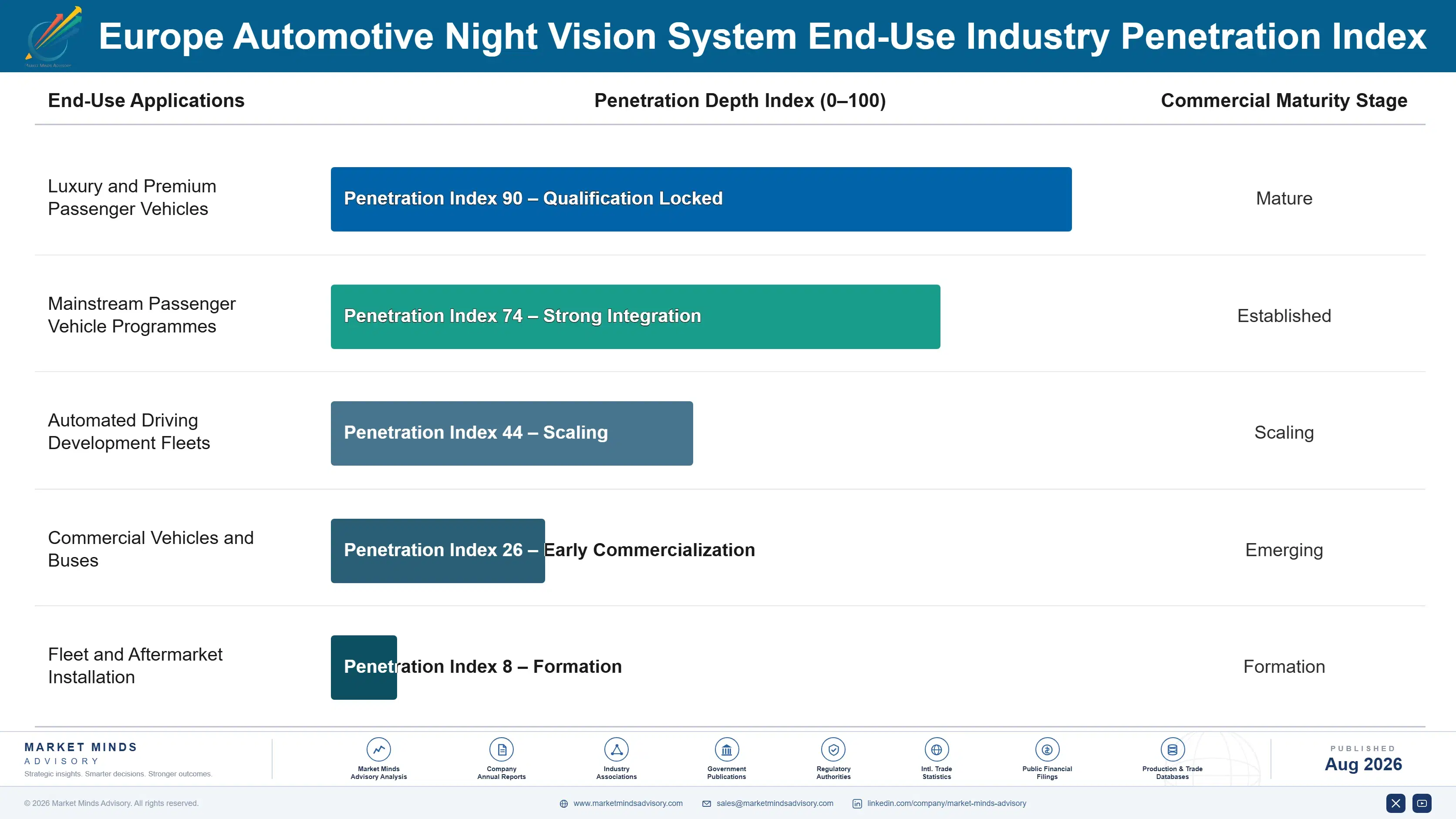
PREMIUM SEGMENT PENETRATION18%Share of luxury vehicle production fitted with night vision
DETECTOR COST SHARE44%Infrared detector within total night vision system cost
PEDESTRIAN DETECTION RANGE280 metresTypical thermal detection distance well beyond headlamp illumination
NIGHT CRASH SHARE38%Portion of pedestrian fatalities occurring in darkness conditions
The physics argument is genuinely strong and has been poorly made for twenty years. Thermal detects a human body by its heat against a cooler background, which works in complete darkness, through glare from oncoming headlamps, and regardless of what the pedestrian is wearing. Visible cameras fail in exactly those conditions, and they are the conditions in which 38% of pedestrian fatalities occur.
Cost decline is what changes the market rather than any new capability. Uncooled microbolometer detectors have fallen steadily as wafer-level packaging matured and consumer, industrial, and Chinese production volumes grew, and each step down brings automotive fitment closer to vehicle segments that could never justify two thousand euros for an option. Each reduction brings the feature closer to segments that could never have justified it before.
"For two decades this was sold as a gadget that let you see deer at night, which is a hard case to make to a buyer already choosing between options. The moment a rating protocol scores night-time pedestrian detection, it stops being a gadget and becomes something a chief engineer has to solve. That is the whole story."
Practice Director, Vehicle Safety Systems and Sensing · MMA Automotive Components Practice · August 2026

Market Trends

Rating Protocols Convert Night Vision Into a Specification

Consumer safety rating programmes have extended automatic emergency braking assessment into night-time pedestrian scenarios, which changes the commercial nature of thermal sensing completely. A manufacturer protecting a five star result specifies what the protocol tests, and night-time detection performance is difficult to achieve with visible cameras alone in the conditions the tests replicate. That turns a declined option into an engineering requirement. Suppliers positioned with automotive-qualified thermal systems are being consulted at platform development rather than pitching an accessory to marketing departments as they did for the previous two decades.
Market Impact: Fusion systems grow at 16.8%

Chinese Detector Production Resets the Cost Structure

Uncooled microbolometer detectors historically came from Western suppliers with defence heritage and pricing that reflected it, and Chinese producers including Raytron, Guide, and Infiray have driven costs down sharply through consumer and industrial volume. Automotive qualification is the remaining barrier, and several are pursuing it seriously rather than opportunistically. Detector cost is 44% of system value, so a material reduction there moves the whole feature closer to mainstream vehicle segments. Established suppliers face a cost position they cannot match while holding onto qualification and integration advantages that still matter considerably.
Market Impact: Detects at 280 metres range

Market Opportunities and Growth Drivers

Automated Driving Requires Sensing That Darkness Does Not Defeat

Visible cameras fail in darkness, glare, and poor contrast, and several high-profile automated driving failures involved pedestrians that a thermal sensor would have detected clearly at distance. Development programmes have consequently added thermal as a fusion input rather than relying on camera, radar, and lidar alone. Thermal fusion systems grow at 16.8% as a result. What matters commercially is that this demand comes from engineering rather than from marketing, which means it survives option take rate problems that have constrained the feature for two decades in consumer vehicles. Engineering demand survives take rate problems.
Market Impact: Penetration reaches only 18%

Detection Range Beyond Headlamps Enables Earlier Intervention

A thermal camera detects a pedestrian at around 280 metres in complete darkness while low beam headlamps illuminate perhaps sixty, which gives an automatic braking system several additional seconds to act at highway speed. That difference is the entire safety argument and it is measurable rather than theoretical. Systems intervening earlier reduce impact speed substantially even where a collision cannot be avoided entirely. Manufacturers pursuing genuine safety outcomes rather than rating compliance alone find the range argument compelling, and it applies at speeds where most fatal outcomes actually occur. The argument is measurable rather than theoretical.
Market Impact: Systems cost 640 dollars fitted

Market Restraints and Challenges

Premium Option Pricing Kept Penetration at Eighteen Percent

Night vision has been offered on luxury vehicles for two decades and reaches only 18% of that production, because a buyer configuring a car weighs it against other options and rarely chooses it. The root cause is positioning rather than technology: presented as a convenience that helps you see animals, it competes with heated seats and better speakers. Manufacturers are repositioning it within safety packages and standard fitment on higher trims, which changes the decision from an option a buyer declines into content a buyer receives. Standard fitment changes the arithmetic entirely.
Market Impact: Darkness covers 38% of fatalities

Detector Cost Still Exceeds Mainstream Vehicle Budgets

The infrared detector represents 44% of a system costing around 640 dollars fitted, which remains well above what a mainstream vehicle programme allocates for any single sensing function. The root cause is that microbolometer manufacturing requires vacuum packaging and specialised processing that conventional image sensors avoid entirely. Wafer-level packaging and rising volumes keep reducing it. Suppliers mitigate through lower resolution detectors adequate for pedestrian detection, shared optics with other sensors, and processing that extracts more from cheaper sensing hardware. Wafer-level packaging and volume keep reducing the gap steadily, and each step brings mainstream segments closer to reach.
Market Impact: Detector is 44% of system cost
4 additional market trends, 3 additional growth drivers, and 2 additional restraints and challenges are covered in the full report. Contact sales@marketmindsadvisory.com to access the complete intelligence.

Segment CAGR and Growth Architecture

Segmentation follows sensing technology, because the technology determines what the system detects, in what conditions, at what range, and at what cost. Five technologies cover commercial supply, and they differ fundamentally rather than incrementally, since active illumination and passive thermal sensing solve the darkness problem through entirely unrelated physics. Cost per system varies threefold across them.
europe-automotive-night-vision-system-market-market-share-analysis-1787549564923

Thermal Fusion Multi-Sensor Systems

The fastest-growing category at 16.8%, roughly 1.79 times the market, and the one driven by engineering rather than by consumer option selection. Combining thermal with visible camera, radar, and increasingly lidar within a fused perception stack addresses the failure cases that have caused automated driving incidents, since a pedestrian invisible to a camera in darkness registers clearly against a cooler background on thermal. Development programmes specify it as an input rather than offering it as a feature. Integration complexity and calibration across modalities are the technical work, and suppliers who can deliver fused output rather than a raw thermal stream hold considerably stronger positions. Delivering fused output rather than a raw stream is the position worth holding.
CAGR 16.8%

Short-Wave Infrared Systems

Second fastest at 13.6%, occupying ground between visible imaging and thermal by detecting reflected rather than emitted radiation in a band that penetrates haze and certain obscurants better than visible light manages. Detector cost has historically been prohibitive for automotive, and germanium-free and quantum dot approaches are changing that arithmetic. The imagery looks more like conventional video than thermal does, which matters for driver-facing displays where thermal images require interpretation. Automotive qualification remains limited and most current activity is development rather than production, which makes the growth rate a function of programme wins rather than established volume. Programme wins rather than established volume determine how quickly the category actually scales from here.
CAGR 13.6%
Full segment breakdown across 5 segments available in the complete report.

Regional Architecture and Country Demand Map

Regional shares follow premium vehicle production, rating protocol stringency, and increasingly automated driving development activity. Coverage here is global with European detail prioritised, since the technology originated on European premium platforms and European protocols now drive much of the specification change. Detector sourcing then differs sharply between them.

North America

Automated driving development concentrates here more heavily than anywhere, and thermal sensing has entered fusion stacks after incidents demonstrated that visible cameras fail in exactly the conditions where pedestrians are most vulnerable. Teledyne FLIR holds a strong domestic position built on defence and industrial thermal heritage that transfers usefully into automotive qualification. Premium vehicle night vision fitment follows European practice at lower take rates. Rural highway pedestrian and large animal collisions provide a safety case distinct from urban European conditions. Federal rating programmes have moved more slowly than European equivalents on night-time testing. Growth of 9.8% blends automated driving development with premium fitment. Rural collision patterns differ from European conditions.
Share: 25% | CAGR: 9.8% (2026 to 2036)

Western Europe

The largest regional position at 26%, and the reason is historical and regulatory together: German premium manufacturers introduced automotive night vision and European consumer rating protocols have now extended into night-time pedestrian scenarios that reward thermal sensing. Mercedes, BMW, and Audi have offered the feature longest and understand its limitations and value better than anyone. Autoliv, Bosch, Continental, and Valeo all hold significant supply positions developed alongside those programmes. Urban pedestrian safety priorities across European cities give the technology a clear application. Growth of 8.0% is the slowest in the report because penetration here already exceeds other regions and vehicle production is declining. Protocol changes originate here and travel outward.
Share: 26% | CAGR: 8.0% (2026 to 2036)
Regional intelligence for 5 additional markets available in the complete report: East Asia, South Asia and Pacific, Latin America, Middle East and Africa, Eastern Europe. Contact sales@marketmindsadvisory.com.
europe-automotive-night-vision-system-market-country-cagr-analysis-1787549565442

Four Moves That Change the Economics

Advantage here comes from detector supply, automotive qualification, and fusion integration rather than from camera assembly, which many suppliers manage adequately. Four moves are worth capital and management attention across the forecast period, and the first reframes a product that has been mis-sold for twenty years. The remaining three address cost, capability, and geography in turn.

Sell against rating protocols rather than to marketing

Night vision reached only 18% of luxury production while it was offered as a convenience competing against heated seats in a configurator. Rating protocols testing night-time pedestrian detection change the buyer inside the manufacturer from a marketing function to a chief engineer protecting a star result, and that person does not decline options. Suppliers repositioning their commercial approach accordingly reach specification decisions two to three years earlier in platform development, which is where sensing content is actually determined and locked. Content is locked years before production begins anywhere. Marketing conversations no longer decide anything.
Market Impact: Penetration currently reaches only 18% of luxury production

Secure automotive-qualified low cost detector supply

The detector is 44% of a system costing around 640 dollars fitted, and Chinese producers have driven microbolometer costs well below Western defence-derived pricing through consumer and industrial volume. Automotive qualification is the remaining barrier and several are pursuing it seriously. Suppliers securing qualified low cost detector supply reach vehicle segments that could never justify current pricing, expanding the addressable market rather than competing harder within it. The alternative is defending premium positions in a segment representing a small fraction of vehicle production. Expanding the market beats competing harder within it.
Market Impact: Detector is fully 44% of total system cost

Deliver fused perception output, not a thermal stream

Automated driving programmes want sensing inputs integrated into a fused perception stack rather than a separate thermal image requiring their own integration work, and fusion systems grow at 16.8% while standalone thermal grows far slower. Suppliers providing calibrated fused output across thermal, visible, and radar hold considerably stronger positions than those delivering a raw sensor. The capability is perception software and multi-modal calibration rather than detector manufacturing, which makes it accessible to integrators who will never make a microbolometer themselves. Software rather than manufacturing capability is required. Programmes want inputs, not another display.
Market Impact: Fusion systems are growing at 16.8% each year

Engineer for high ambient temperature markets deliberately

Thermal contrast between a human body and the background collapses as ambient temperature approaches body temperature, which degrades detection in exactly the Gulf, African, and South Asian conditions where unlit road hazards are most severe. Suppliers addressing it through detector sensitivity, processing, and algorithm design open markets that temperate products serve poorly, and Gulf premium fitment already runs above 30%. It is a genuine technical problem rather than a marketing one, and solving it credibly differentiates in regions where premium fitment rates already run above global averages. Solving it credibly differentiates in those markets.
Market Impact: Detection degrades above 35 degrees of ambient temperature

Who Controls the Margin Pool

Concentration is high at roughly 63% for the top five, and detector manufacturing rather than system integration explains most of it, since microbolometer production requires vacuum packaging capability that few companies possess. Teledyne FLIR holds the strongest detector position built on defence and industrial heritage. Autoliv, Bosch, Continental, and Valeo compete as tier one integrators with vehicle manufacturer relationships that detector specialists lack entirely.
Competitive activity runs on three fronts. Detector cost and supply is the first and determines which vehicle segments a system can reach. Automotive qualification is the second, and it excludes the consumer thermal suppliers whose volumes drove costs down. Fusion integration capability is the third, and it is where automated driving demand is concentrating fastest. System integration alone confers remarkably little advantage.

Pressure is building from two directions. Chinese detector producers are pursuing automotive qualification with cost positions Western suppliers cannot match. And specialist automotive thermal entrants including Adasky and Owl are competing with purpose-designed products rather than adapted industrial sensors. The first threatens established cost positions directly while the second competes on purpose-built design rather than adapted industrial hardware, and neither is easily answered.
europe-automotive-night-vision-system-market-company-positioning-matrix-1787549565963

Competitive Moat and Risk Dimensions

TELEDYNE FLIR

Moat: Detector manufacturing and thermal depth

Microbolometer production capability combined with decades of thermal imaging expertise across defence, industrial, and consumer applications gives Teledyne control of the component representing 44% of system cost. Integrators buying detectors rather than making them carry that supplier's margin and its availability decisions on the most critical part of the system.
TELEDYNE FLIR

Risk: Chinese detector cost competition

Chinese producers have driven microbolometer costs well below Western pricing through consumer and industrial volume, and automotive qualification is the only remaining barrier they face. Defence heritage brings cost structures suited to low volume high value markets rather than to automotive, which is exactly the transition this market is now attempting to make.
AUTOLIV

Moat: Vehicle safety system relationships

Established positions across occupant and pedestrian safety systems with essentially every vehicle manufacturer place Autoliv inside the conversations where rating protocol responses are decided, which is precisely where night vision specification now happens. Safety credibility built over decades transfers directly as thermal shifts from comfort feature to safety content.
AUTOLIV

Risk: Dependence on external detector supply

Without detector manufacturing, the 44% cost line is purchased from suppliers who may also compete for the same integration work or prioritise other customers during any shortage. That sets a floor under cost position and creates supply exposure on the component that determines whether a system can reach mainstream vehicle segments at all.

Players Tracked

Prominent Players

Teledyne FLIR
Autoliv
Robert Bosch
Continental
Valeo

Other Key Players

Denso
HELLA
Magna International
ZF Friedrichshafen
Aptiv
Adasky
Owl Autonomous Imaging
Lynred
Guide Sensmart
Raytron Technology
Hikvision
InfiRay
Sony Semiconductor Solutions
OmniVision
Veoneer

Recent Developments

FEBRUARY 2025

Rating protocol extends into night-time pedestrian scenarios

Consumer safety assessment added night-time automatic emergency braking scenarios that visible camera systems struggle to pass reliably in the conditions replicated. Manufacturers protecting star ratings began evaluating thermal sensing at platform level rather than treating it as an optional convenience feature. Several began supplier evaluation.
Signal: Rating protocols turn declined options into engineering requirements, which is the change this market waited for
JUNE 2025

Chinese detector producer pursues automotive qualification

A microbolometer manufacturer with consumer and industrial volume began formal automotive qualification, targeting cost levels well below established Western supply. Qualification rather than detector performance had been the barrier keeping low cost thermal sensing out of vehicle programmes entirely. Cost targets were well below incumbents.
Signal: Cost structures built on consumer volume are entering automotive, and qualification is the only remaining barrier
SEPTEMBER 2025

Automated driving programme adds thermal to fusion stack

A development programme incorporated thermal sensing alongside visible cameras, radar, and lidar after darkness and glare scenarios demonstrated visible camera limitations that processing improvements could not resolve. Thermal was specified as a fused perception input rather than as a separate driver display. Calibration work followed the decision.
Signal: Engineering demand for thermal is now replacing marketing demand, which survives option take rate problems entirely

What Sets the Cost Base

The infrared detector dominates at roughly 44% of system manufacturing cost, reflecting vacuum packaging and specialised processing that conventional image sensors avoid entirely. Germanium or chalcogenide optics contribute 17%, since standard glass is opaque to the wavelengths thermal sensing uses. Processing electronics and image pipeline hardware take 15%. Housing, calibration, automotive qualification testing, and warranty provision absorb the balance across typical production programmes.
Germanium supply tightened notably through 2023 and 2024 following export restrictions from the dominant producing country, which affected thermal optics across every application simultaneously. Teledyne and Lynred both referenced component supply and cost conditions across their reporting for those years. Detector costs moved in the opposite direction as wafer-level packaging matured and Chinese production scaled, which partly offset the optics problem for suppliers able to source both flexibly.

Exposure divides on detector integration and optics sourcing rather than on scale. Suppliers manufacturing their own detectors control the largest cost line while integrators purchase it from parties who may compete with them. Germanium exposure affects everybody and has driven genuine work on chalcogenide and polymer alternatives that were previously considered inferior. Automotive qualification cost is amortised across programme volumes, which punishes suppliers holding few platform wins severely.
europe-automotive-night-vision-system-market-cost-volatility-analysis-1787549566159

Qualify chalcogenide and alternative optics against germanium

Germanium supply concentrated in one producing country tightened sharply under export restrictions, affecting every thermal application at once. Chalcogenide glasses and moulded polymer optics offer viable alternatives at some performance cost that automotive pedestrian detection can frequently tolerate. Qualification requires optical and environmental validation before any shortage, and suppliers deferring it found programmes constrained by an optic.

Adopt lower resolution detectors adequate for detection

Pedestrian detection at range requires far less resolution than a driver-facing display image does, and specifying detector resolution to the actual algorithmic requirement rather than to visual quality reduces the 44% cost line materially. The trade-off is losing the display feature that originally sold the system, which matters less once positioned as safety content.

Share optics and housing across multiple sensing functions

Thermal, visible, and other sensors mounted separately duplicate housings, mounts, cleaning provision, and calibration work on a vehicle where every front-end position is contested. Integrated multi-sensor modules remove that duplication and simplify vehicle assembly. Engineering complexity rises and the resulting module suits fusion architectures that programmes increasingly specify anyway, which makes the additional effort worth accepting.

Portfolio Architecture for Margin Defence

Margin follows integration depth and qualification rather than volume. Standalone thermal camera modules supplied to integrators earn moderate returns, because the buyer adds the perception work and compares suppliers on detector performance and price. Fused perception systems and safety-specified content earn considerably more, since the manufacturer is purchasing a rating protocol response rather than a sensor and cannot easily substitute one supplier's calibrated output for another.
The volume and premium tension shows in detector amortisation rather than in assembly capacity. Automotive qualification costs are fixed per platform and must be recovered across whatever volume that programme delivers, which punishes suppliers holding few wins and rewards those specified across several. That dynamic favours incumbents and makes each platform award more consequential than its immediate revenue suggests. Each award therefore carries value beyond its own revenue.

High-value pools concentrate in three places: fused perception systems for automated driving programmes, safety-specified fitment responding to rating protocols, and detector supply to integrators who cannot make their own. Each is defended by software, relationship, or manufacturing capability rather than by price. Price competition arrives in each only when a competitor builds perception capability, secures a platform relationship, or acquires detector manufacturing.

Volume / Commodity-Adjacent Tier

Standalone thermal camera modules supplied to integrators and aftermarket channels. Competes on detector performance and delivered price. The range reflects large differences between detector manufacturers and module assemblers buying components.
Gross Margin: 18%-28%

Premium / Certified Tier

Automotive qualified systems specified into platform programmes with rating protocol performance commitments attached. The manufacturer purchases a star rating response rather than a sensor, and substitution requires requalification. Requalification costs exceed any saving.
Gross Margin: 30%-42%

Sustainability / Regulatory / Next-Generation Tier

Fused perception systems combining thermal with visible and radar for automated driving programmes. Software and calibration rather than hardware drive the value. The range is wide because fusion pricing has not settled across programmes.
Gross Margin: 34%-50%
europe-automotive-night-vision-system-market-portfolio-architecture-1787549566655

High-value Sub-segments and Strategic Watch-out

Fused Perception Multi-Sensor Systems

Automated driving programmes want integrated perception output rather than a separate thermal image needing their own work. Growing at 16.8% and driven by engineering rather than by consumer option selection, which makes it durable. Partner for software rather than building it. Move now. Act early.
Gross Margin: 36%-50%

Rating Protocol Specified Fitment

Night-time pedestrian testing turns a declined option into content a chief engineer must specify, which is the change this technology waited two decades for. Reach platform development early, since content locks years ahead. Engineering rather than marketing decides now. Reach engineering early. Do it soon.
Gross Margin: 32%-44%

Detector Supply to Integrators

Microbolometer manufacturing requires vacuum packaging capability few companies possess, and it represents 44% of system cost. Selling detectors earns from competitors' system wins as well as one's own programmes. Vacuum packaging capability is the barrier. Very few companies possess it. Sell to integrators too. Worth pursuing.
Gross Margin: 30%-42%

Standalone Module and Aftermarket Supply

The strategic watch-out. Buyers compare detector specification and price, add their own perception work, and switch when a cheaper qualified module appears. It builds volume for detector amortisation and little else. Use it to amortise qualification cost only. Expect nothing beyond volume. Nothing else here.
Gross Margin: 18%-27%

How Demand Actually Reaches Suppliers

The annuity here is platform specification rather than any replacement cycle. A sensing system specified into a vehicle programme supplies it for the production run, typically five to seven years, and volumes follow assembly schedules with no discretion once the content is locked. That makes each award highly valuable and effectively unavailable between model cycles, which is why reaching platform development early matters more than any commercial effort applied afterwards. Aftermarket demand is negligible, since these systems require calibration and integration that retrofit rarely achieves properly.
Adoption depth varies sharply by manufacturer type. European premium brands have the longest experience and understand the technology's real limitations. Chinese electric vehicle manufacturers adopt fastest and specify at price points others consider impossible. Automated driving developers want fused inputs rather than driver displays. Mainstream manufacturers wait for cost to reach their segment and for protocols to force the question.

The buyer has shifted from marketing functions choosing option content toward safety engineering responding to rating protocols. That single change is what alters this market's trajectory. Suppliers still organised around the first group are pitching to people who no longer make the decision.
europe-automotive-night-vision-system-market-end-use-penetration-index-1787549567145

Where the Money Sits

These are among the four positions where our research anticipates prominent divergence between winners and laggards over the coming forecast period. Each is grounded in the demand model, the regulatory perimeter, and the announced capacity pipeline.
01 / RATING PROTOCOL POSITIONING

Sell to the safety engineer, not to the option catalogue

Night vision reached only 18% of luxury vehicle production across two decades of being offered as a convenience competing against heated seats in a configurator. Rating protocols testing night-time pedestrian detection move the decision to a chief engineer protecting a star result, and that person specifies content rather than declining an option. Suppliers repositioning their commercial approach reach platform decisions two to three years earlier, which is exactly when sensing content is determined and then locked for the whole production run.
02 / DETECTOR COST ACCESS

Secure cheap qualified detectors, because that opens the market

The infrared detector is 44% of a system costing around 640 dollars fitted, and Chinese producers have driven microbolometer costs well below Western defence-derived pricing on consumer and industrial volume. Automotive qualification is now the only barrier remaining in their way and several producers are pursuing it seriously right now. Suppliers securing qualified low cost detector supply reach vehicle segments that could never justify current pricing, which expands the addressable market considerably rather than intensifying competition inside a small premium niche.
03 / FUSION OUTPUT CAPABILITY

Deliver perception, because nobody wants another raw sensor

Automated driving programmes want thermal integrated into a fused perception stack rather than arriving as a separate image stream requiring their own calibration and integration work. Fusion systems grow at 16.8% while standalone thermal grows considerably more slowly, and the demand comes from engineering rather than marketing so it survives the option take rate problems that constrained this technology for two decades. The capability is perception software rather than detector manufacturing, which puts it within reach of integrators who will never manufacture a detector themselves.
04 / HOT CLIMATE ENGINEERING

Solve high ambient contrast, because those roads need it most

Thermal contrast between a human body and its background collapses as ambient temperature approaches body temperature, which degrades detection in precisely the Gulf, African, and South Asian conditions where unlit roads and pedestrian exposure make the safety case strongest. Suppliers addressing it through detector sensitivity, processing, and algorithm design open markets that temperate-market products serve poorly. This is a genuine technical problem rather than a positioning one, and Gulf premium fitment rates already exceed global averages by a considerable margin.

Engagement Snapshot From the Field

A live engagement with an industry participant carrying material or product regulatory and market exposure ahead of a defining policy shift, showing how our research translates into a defensible multi-year portfolio strategy.
MARKET MINDS ADVISORY · CLIENT ENGAGEMENT SUMMARY
Europe Automotive Night Vision System Producer Strategic Portfolio Review and Transition Roadmap 2026·Investment Scenario on Europe Automotive Night Vision System Exposure Evaluation 2025-26
CLIENT PROFILE
A European supplier of automotive thermal camera systems selling into premium vehicle programmes, with revenue near EUR 74 million (client-reported, unverified by MMA). Detectors were purchased from a Western supplier, commercial effort targeted vehicle manufacturer marketing functions, and no fused perception capability existed within the business at all. Take rates had disappointed consistently. Cost pressure was mounting.
STRATEGIC CHALLENGE
Option take rates on the client's fitted programmes remained stubbornly low, and two automated driving development programmes had selected competitors offering fused perception output the client could not provide. Chinese detector pricing was meanwhile making the client's system cost uncompetitive for any programme outside the premium segment entirely. Options were narrowing quickly.
MMA APPROACH
MMA analysed programme wins against commercial engagement route, sized fusion capability requirements against build and partner options, and assessed qualified detector sourcing alternatives including Chinese suppliers pursuing automotive qualification. Forty-seven expert interviews with safety engineers, platform managers, and perception developers established how specification decisions are actually made. Routes to decision mattered most.
KEY FINDINGS
  1. Every programme win in four years had originated with a safety engineering conversation rather than a marketing one, yet the commercial organisation was structured entirely around the latter.
  2. Rating protocol changes had moved night-time pedestrian detection onto platform requirement lists at three manufacturers, none of whom the client had approached through its safety engineering contacts.
  3. Fused perception capability could be reached through partnership with a software developer far faster and more cheaply than by building it internally, which management had not seriously evaluated.
  4. Two Chinese detector producers were within roughly a year of automotive qualification at costs that would have made the client's system viable in mainstream vehicle segments for the first time.
CLIENT PROFILE
A European supplier of automotive thermal camera systems selling into premium vehicle programmes, with revenue near EUR 74 million (client-reported, unverified by MMA). Detectors were purchased from a Western supplier, commercial effort targeted vehicle manufacturer marketing functions, and no fused perception capability existed within the business at all. Take rates had disappointed consistently. Cost pressure was mounting.
STRATEGIC CHALLENGE
Option take rates on the client's fitted programmes remained stubbornly low, and two automated driving development programmes had selected competitors offering fused perception output the client could not provide. Chinese detector pricing was meanwhile making the client's system cost uncompetitive for any programme outside the premium segment entirely. Options were narrowing quickly.
MMA APPROACH
MMA analysed programme wins against commercial engagement route, sized fusion capability requirements against build and partner options, and assessed qualified detector sourcing alternatives including Chinese suppliers pursuing automotive qualification. Forty-seven expert interviews with safety engineers, platform managers, and perception developers established how specification decisions are actually made. Routes to decision mattered most.
KEY FINDINGS
  1. Every programme win in four years had originated with a safety engineering conversation rather than a marketing one, yet the commercial organisation was structured entirely around the latter.
  2. Rating protocol changes had moved night-time pedestrian detection onto platform requirement lists at three manufacturers, none of whom the client had approached through its safety engineering contacts.
  3. Fused perception capability could be reached through partnership with a software developer far faster and more cheaply than by building it internally, which management had not seriously evaluated.
  4. Two Chinese detector producers were within roughly a year of automotive qualification at costs that would have made the client's system viable in mainstream vehicle segments for the first time.
RECOMMENDED STRATEGY
Phase 1: Phase one: redirect commercial effort toward vehicle manufacturer safety engineering functions responding to rating protocols, since every win has originated there rather than in marketing. Phase 2: Phase two: partner for fused perception output rather than building it internally, reaching automated driving programmes years before internal development could deliver anything. Phase 3: Phase three: qualify a low cost detector source alongside the incumbent, opening vehicle segments the current cost structure excludes entirely.
OUTCOME
The client restructured its commercial approach within six months and secured two platform specifications through safety engineering routes. A perception partnership delivered fused output in the second year, alternative detector qualification began, and blended gross margin improved 5.1 percentage points (client-reported, unverified by MMA). Take rates rose materially.

Frequently Asked Questions

Foundational context covering the market sizes, CAGR, scope, country, region and competition that inform every finding below. This section is provided to cover basics and most often pre-purchase conversations, answered from the MMA Primary Research Dataset.

What is the current size of the Europe Automotive Night Vision System Market?

The market was valued at USD 3.6 billion in 2025 globally, rising to an estimated USD 3.94 billion in 2026. Western Europe holds the largest regional share at 26% of value.

How large will the Europe Automotive Night Vision System Market be by 2036?

MMA forecasts USD 9.67 billion by 2036 under the base case, an expansion multiple of 2.46 times the 2026 value. That represents USD 5.73 billion of incremental value across the forecast period.

What is the CAGR for the Europe Automotive Night Vision System Market 2026 to 2036?

The base case CAGR is 9.4%, with a bull case of 10.7% and a bear case of 8.2%. The spread reflects uncertainty over rating protocol weighting and detector cost decline.

Which segment is growing fastest?

Thermal fusion multi-sensor systems grow fastest at 16.8%, roughly 1.79 times the market rate, driven by automated driving programmes. Short-wave infrared systems follow at 13.6% from a development base.

Who are the major companies in the Europe Automotive Night Vision System Market?

Teledyne FLIR, Autoliv, Robert Bosch, Continental, and Valeo lead on system supply. The top five hold roughly 63%, with detector manufacturing capability explaining most of that concentration.

Which country is growing fastest?

China grows fastest at 11.8%, as domestic electric vehicle manufacturers fit thermal sensing at price points European brands considered impossible. Domestic detector producers supply that demand cheaply.

Report Segmentation Architecture

The full report scope spans multiple orthogonal segmentation dimensions, with cross-tabulated demand data provided for each dimension pair. Coverage extends further to regional breakdowns, trend trajectories, and the competitive detail needed to support segment-level decision-making.

By Sensing Technology

  • Near Infrared Active Systems
  • Far Infrared Passive Thermal Systems
  • Uncooled Microbolometer Core Modules
  • Thermal Fusion Multi-Sensor Systems
  • Short-Wave Infrared Systems

By End-Use Industry

  • Luxury and Premium Passenger Vehicles
  • Mainstream Passenger Vehicle Programmes
  • Automated Driving Development Fleets
  • Commercial Vehicles and Buses
  • Fleet and Aftermarket Installation

By Sales Model

  • Platform Specified Original Equipment Supply
  • Tier One Integration Supply
  • Detector and Core Module Supply
  • Perception Software Licensing
  • Aftermarket and Retrofit Channel

By Region

  • North America
  • Western Europe
  • East Asia
  • South Asia and Pacific
  • Latin America
  • Middle East and Africa
  • Eastern Europe

Scope, Methodology, and Coverage

Every figure in this report is reproducible from documented input assumptions. The scope below maps the historical period, the forecast horizon, the segmentation dimensions, and the countries covered, alongside the underlying primary and qualitative methodology.
Historical Period
2020 to 2025
Forecast Period
2026 to 2036
Base Year
2025 (USD billions; MMA Primary Research Dataset, August 2026)
Market Definition
The market comprises automotive night vision systems and their core sensing components, covering near infrared active systems, far infrared passive thermal systems, uncooled microbolometer core modules, thermal fusion multi-sensor systems, and short-wave infrared systems. Value is measured at supplier level across original equipment platform fitment, tier one integration supply, and aftermarket installation. Visible-light cameras and driver monitoring systems, radar and lidar sensors, adaptive headlamp hardware, thermal imaging for non-automotive applications, and complete driver assistance software platforms fall outside scope. Coverage is global with European market detail prioritised throughout the analysis.
Quantitative Units
USD billions (current prices); systems shipped annually; USD per vehicle by sensing technology and integration level
Segmentation Dimensions
By Sensing Technology; By End-Use Industry; By Sales Model; By Region
Regions Covered
North America, Western Europe, East Asia, South Asia and Pacific, Latin America, Middle East and Africa, Eastern Europe
Countries Covered
Germany, France, United Kingdom, Italy, Spain, Sweden, Netherlands, Belgium, Austria, Czechia, Slovakia, Hungary, Poland, Romania, United States, Canada, Mexico, China, Japan, South Korea, India, Australia, Thailand, Brazil, Argentina, Saudi Arabia, United Arab Emirates, South Africa
Key Companies Profiled
Teledyne FLIR, Autoliv, Robert Bosch, Continental, Valeo, Denso, HELLA, Magna International, ZF Friedrichshafen, Aptiv, Adasky, Owl Autonomous Imaging, Lynred, Guide Sensmart, Raytron Technology, Hikvision, InfiRay, Sony Semiconductor Solutions, OmniVision, Veoneer
Quantitative Methodology
Primary survey, n=3,800 respondents, Q4 2025, six countries; demand-side model with trade association cross-validation
Qualitative Methodology
47 expert interviews, Q4 2025; applied to validate demand model assumptions, identify emerging dynamics, and assess competitive positioning
Report Format
PDF and XLSX data workbook (Word format preview document)
Publisher
Market Minds Advisory
Report Code
MMA-2026-AUT-221
Published
August 2026
Contact
sales@marketmindsadvisory.com | www.marketmindsadvisory.com

Purchase the full Europe Automotive Night Vision System Market Report (2026 to 2036).

The full report sizes automotive night vision demand across five sensing technologies, five vehicle categories, and seven regions with 2026 to 2036 forecasts under base, bull, and bear cases, with European market detail prioritised throughout. It models rating protocol changes against platform specification timing, since that shift determines whether this technology reaches beyond luxury vehicles. Competitive profiles cover twenty suppliers assessed consistently on night vision revenue, detector capability, and fusion integration. Cost analysis traces detector and germanium optics exposure across sourcing routes. Commercial guidance addresses rating protocol positioning, detector cost access, fusion output capability, and hot climate engineering.
Five sensing technologies sized separately by region
Rating protocol changes mapped to platform specification timing
Detector cost decline modelled against vehicle segment reach
Fusion demand separated from driver display fitment
Germanium optics supply exposure assessed across suppliers
European premium platform practice examined in detail

Built For The People Who Decide

From boardroom strategy to bench-side execution, this report is read cover-to-cover by leaders shaping the next decade of their industry, turning demand scenarios, market dynamics and valuation benchmarks into decisions.
CXOs/ Presidents/ VPs/ Managers
M&A and Corporate Development
Strategy Teams and R&D Heads
Procurement and Product Directors
Regulatory and Compliance Leaders
Investor Relations and Equity Analysts