Market Minds Advisory
Europe Aluminum Oxide Market

Europe Aluminum Oxide Market: Energy Costs Reshape Refining Geography

European alumina refining capacity is contracting under sustained energy cost pressure even as global demand keeps expanding, forcing smelter-grade producers toward specialty high-purity grades where energy intensity matters far less.

Lead Analyst

Bilal Shaikh

Published

September 2026

Make Smarter Decisions with Customized Research Insights

Request a free sample report and evaluate market opportunities, growth trends, and competitive dynamics relevant to your business needs.

2025 MARKET VALUE$68.5BMarket Size 2025
2036 FORECAST VALUE$107.7BBase Case , 2026 to 2036
CAGR 2026 TO 20364.2 %Bull 5.4% / Bear 2.9%
INCREMENTAL OPPORTUNITY$36.3BNet 10- year value creation
EXPANSION MULTIPLE1.51x2036 value over 2026 base
Strategic Levers
M&A Pipeline
Regional Outlook
Country Rankings
Competitive Intelligence
Segmental Deep-dive
Call-Us : 91 93563 13602

Executive Snapshot and Market Trajectory

Aluminum oxide is splitting between bulk smelter-grade material tracking global aluminum metal demand, and specialty high-purity grades serving battery, electronics, and advanced ceramics applications that grow largely independent of primary aluminum production cycles worldwide, a divide reshaping investment priorities considerably across the broader industry landscape today.
East Asia holds the largest regional share, reflecting China's dominant position in both bauxite refining and downstream aluminum smelting capacity that consumes the bulk of global alumina volume. Specialty high-purity alumina is growing fastest of any grade as battery separator coating and advanced ceramics applications expand. India is growing fastest of any single country, driven by expanding domestic bauxite refining and aluminum smelting capacity.
The competitive field is moderately concentrated, with the top five producers holding roughly two-fifths of global supply, split between vertically integrated mining majors and diversified aluminum producers with substantial bauxite reserves. European producers face mounting pressure from energy costs that has driven several smelter-grade refining curtailments, pushing the region's remaining capacity toward higher-margin specialty grades less exposed to energy intensity. Refiners lacking renewable energy strategies increasingly face growing capacity and competitiveness risk over time ahead.
Market Definition
The aluminum oxide market covers alumina produced through the Bayer process from bauxite ore, including smelter-grade alumina used as feedstock for primary aluminum production and non-metallurgical specialty grades used in abrasives, refractories, technical ceramics, and catalyst substrate applications. It excludes raw bauxite ore and finished aluminum metal production, which are distinct upstream and downstream markets respectively.
Base Year Value
$68.5B in 2025 (MMA Primary Research Dataset, August 2026)
Forecast Period
2026 to 2036, eleven discrete annual values
CAGR
4.2% base case. Bull 5.4%. Bear 2.9%.
Fastest Growth Segment
Specialty High-Purity Alumina: 7.8% CAGR
Fastest Growth Country
India: 6.7% CAGR
Fastest Growth Region
South Asia and Pacific: 6.2% CAGR
Largest Region
East Asia: 30% of 2025 global value
Market Leaders
Alcoa Corporation, Rio Tinto, Chinalco, Hindalco Industries, and Norsk Hydro ASA lead global supply. Source: MMA Analysis based on company annual reports.
Primary Survey
n=3,800 procurement and R&D decision-makers, Q4 2025, six countries
Methodology
Demand-side build-up, cross-validated against public data, 47 expert interviews

Europe Aluminum Oxide Market Forecast Scenarios

europe-aluminum-oxide-market-trends-size-forecast-scenario-1787549736741
Between 2020 and 2025, aluminum oxide demand grew at an estimated 3.6% annually as global aluminum production recovered from pandemic-era disruption even as European refining capacity faced mounting energy cost pressure following the broader continental energy crisis. Alcoa and Rio Tinto both maintained production discipline through the period amid volatile regional energy pricing. Customers reported growing satisfaction with supply reliability.
MMA's base case projects 4.2% annual growth to 2036 on three mechanisms: continued global aluminum production growth driven by automotive lightweighting and construction demand, expanding specialty high-purity alumina adoption in battery and advanced ceramics applications, and steady refractory and abrasive-grade demand from industrial manufacturing modernization. Indian bauxite refining capacity expansion is adding a fourth, smaller growth channel through new domestic smelting investment. Recycled aluminum content growth is emerging as a smaller fifth contributor to overall category demand.
A bull catalyst comes from faster-than-expected global aluminum demand growth driven by accelerating vehicle lightweighting programs across major automotive markets. The bear risk is European deindustrialization: if sustained energy cost pressure forces additional European smelter-grade refining capacity offline permanently, regional supply could tighten further, disrupting downstream aluminum producers dependent on domestic alumina sourcing. Producers are hedging by diversifying refining capacity across lower-cost regions.

Energy Intensity Separates Winners From Strugglers

Aluminum oxide sits at an unglamorous but essential position in the industrial supply chain: the intermediate refined product standing between raw bauxite ore and the aluminum metal used across automotive, construction, packaging, and aerospace applications worldwide. Few industrial materials sit this close to the surface of everyday life while remaining almost entirely invisible to end consumers.
MARKET CONCENTRATION42%Top five producers hold roughly two-fifths of supply
AVERAGE SELLING PRICE$340/tonneReflects blended smelter-grade and specialty alumina pricing overall
TOP PRODUCING COUNTRYChinaLargest bauxite refining and aluminum smelting consumption base
CAPACITY UTILIZATION81%Energy cost pressure constrains overall European refining throughput
FEEDSTOCK COST SHARE52% of COGSBauxite ore and caustic soda dominate total production cost
TRADE INTENSITY46% exportedNearly half of finished alumina volume crosses national borders
Commercially, energy intensity increasingly separates competitive refiners from struggling ones. The Bayer process refining bauxite into alumina requires substantial energy input, and producers in regions with elevated electricity and natural gas costs face lasting cost disadvantages against producers in lower-cost energy markets. European refiners have felt this pressure most acutely since the continental energy crisis began reshaping industrial cost structures.
Over the next decade, expect specialty high-purity alumina to grow meaningfully faster than bulk smelter-grade material, since most margin upside comes from battery and advanced ceramics applications rather than incremental primary aluminum production growth. Producers investing in specialty-grade capability are best positioned to capture this expanding, less energy-exposed segment of demand. Producers still weighted heavily toward standard smelter-grade volume risk losing the highest-margin part of future contracts to better-prepared rivals.
"Alumina refining used to be a straightforward volume business tied to aluminum demand. Now energy cost has become the dividing line between refiners that survive and refiners that quietly shut down a production line every winter."
Director, Refined Industrial Minerals and Ceramics Feedstock Practice · MMA Refined Industrial Minerals and Ceramics Feedstock Practice · August 2026

Market Trends

European Energy Costs Force Refining Curtailments

Sustained elevated European energy costs following the continental energy crisis have forced several alumina refiners to curtail production or permanently close energy-intensive capacity, reshaping the region's refining footprint meaningfully. Producers with European operations have both adjusted capacity utilization over the past two years specifically in response to volatile regional energy pricing. At least a handful of major European refining lines have reduced output or closed entirely since 2023, and producers report remaining European capacity increasingly focuses on higher-margin specialty grades less exposed to energy cost pressure. Industry analysts expect this consolidation trend to continue reshaping the region's refining footprint further.
Market Impact: Sustains 5%+ automotive-linked growth
Battery Applications Expand Specialty Alumina Demand

Battery manufacturers are increasingly specifying high-purity alumina for separator coating applications, valuing the material's thermal stability and safety performance improvement over uncoated separator alternatives in lithium-ion battery construction. Producers with specialty alumina capability have expanded production over the past two years specifically to serve this growing battery materials demand. At least several dozen major battery manufacturers have adopted alumina-coated separator specifications since 2023, and producers report this application now represents a meaningfully larger share of specialty alumina demand than it did just a few years earlier. Battery manufacturers view this coating technology as increasingly essential for safety compliance.
Market Impact: Expands ceramics-linked demand 6%+ yearly

Market Opportunities and Growth Drivers

Automotive Lightweighting Sustains Aluminum Demand Growth

Continued automotive lightweighting across both traditional and electric vehicle platforms sustains steady growth in primary aluminum demand, directly supporting smelter-grade alumina consumption as the essential feedstock for aluminum metal production. Industry data show aluminum content per vehicle has grown considerably across major automotive markets over the past several years, directly supporting alumina demand growth. Producers report this automotive-linked demand provides meaningful commercial stability underpinning the broader smelter-grade segment. Producers expect this automotive-linked demand to continue growing steadily as lightweighting trends deepen across additional vehicle segments and manufacturers. Suppliers report order backlogs have lengthened accordingly.
Market Impact: Adds 20%+ cost disadvantage versus peers

Advanced Ceramics Manufacturing Expands Steadily Now

Growing advanced ceramics manufacturing for electronics, cutting tools, and industrial wear-resistant components continues expanding demand for ceramic-grade alumina independent of primary aluminum production cycles. Industry surveys show advanced ceramics manufacturing capacity has grown considerably across major industrial markets over the past several years. Producers report this application provides meaningful commercial diversification beyond the category's traditional smelter-grade base. Producers expect this diversification trend to continue supporting demand for several more years ahead across the broader manufacturing sector. Distributors report growing interest across multiple industrial markets simultaneously, particularly among electronics and cutting tool manufacturers seeking documented wear-resistance performance.
Market Impact: Policy shifts have occurred 4+ times

Market Restraints and Challenges

European Energy Costs Undermine Refining Competitiveness

Elevated European electricity and natural gas costs following the continental energy crisis have undermined the competitiveness of energy-intensive Bayer process refining relative to producers in lower-cost energy markets, and the root cause is that European industrial energy pricing remains persistently higher than in major competing refining regions given the continent's energy import dependence and policy choices. This cost disadvantage has already driven several refining curtailments and threatens further capacity losses if energy prices remain elevated. Refiners without diversified energy sourcing face the steepest competitiveness exposure. Refiners are mitigating this through renewable energy power purchase agreements.
Market Impact: Cuts European capacity 15%+

Bauxite Supply Concentration Creates Sourcing Risk

Global bauxite ore supply remains concentrated among a handful of major producing countries, and the root cause is that economically viable bauxite deposits with favorable ore quality and mining infrastructure exist in a limited number of geological formations worldwide. This concentration creates sourcing risk for refiners dependent on imported ore, particularly when producing countries adjust export policies or mining regulations with limited advance notice. Refiners without diversified bauxite sourcing relationships face the steepest supply disruption exposure. Refiners are mitigating this by qualifying multiple bauxite supplier relationships across different producing countries.
Market Impact: Grows battery-linked demand 16%+ yearly
3 additional market trends, 4 additional growth drivers, and 3 additional restraints and challenges are covered in the full report. Contact sales@marketmindsadvisory.com to access the complete intelligence.

Segment CAGR and Growth Architecture

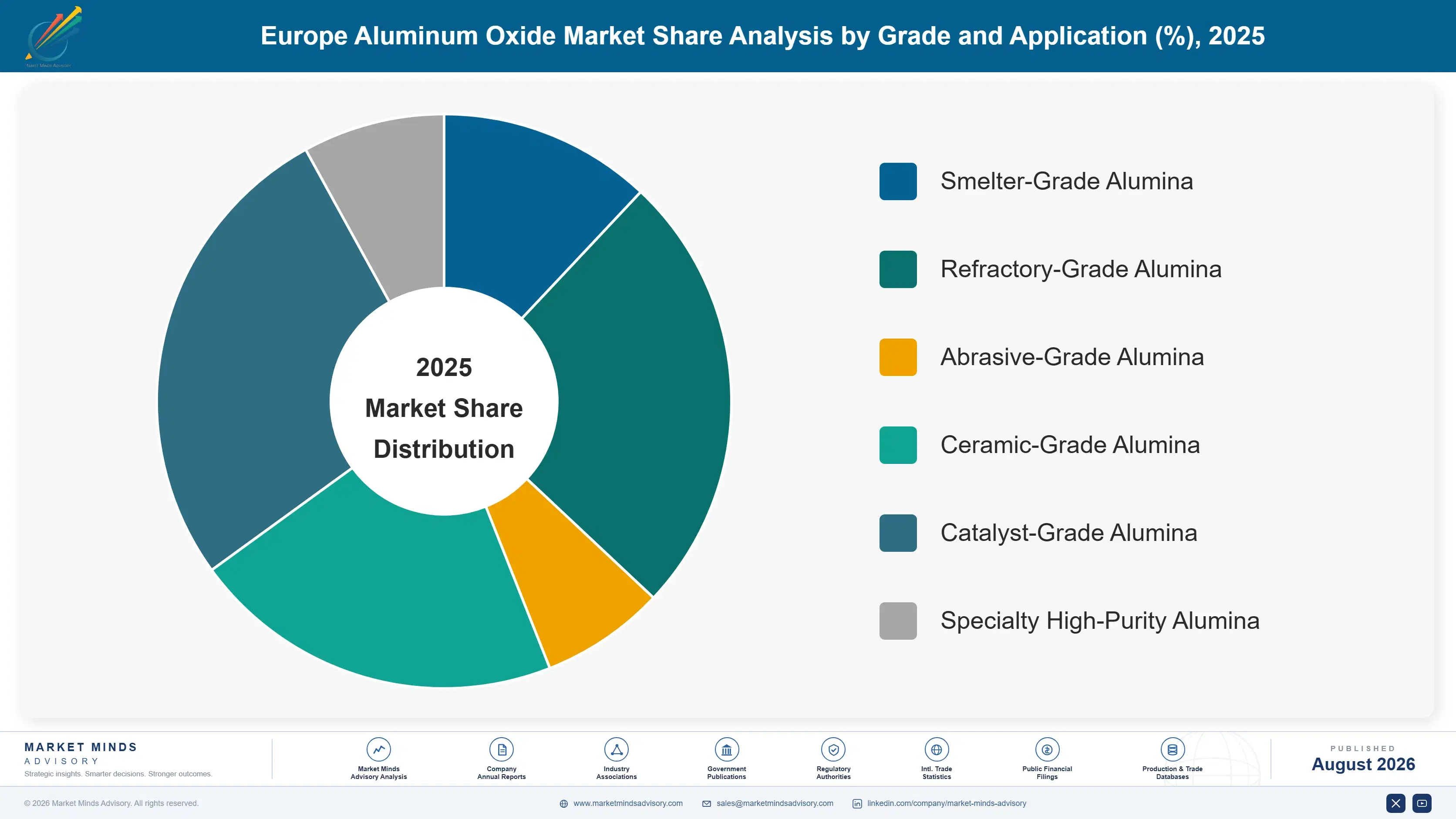
The aluminum oxide market is segmented by grade and application, the classification that determines purity requirements, energy intensity, and end-use pathway: smelter-grade, refractory-grade, abrasive-grade, ceramic-grade, catalyst-grade, and specialty high-purity alumina each serve distinct purposes entirely separate. Upstream bauxite mining and downstream aluminum smelting sit in separate discussions entirely, each requiring distinct analysis. for buyers and regulators alike.
europe-aluminum-oxide-market-trends-market-share-analysis-1787549737273

Specialty High-Purity Alumina

Specialty high-purity alumina is the fastest-growing segment as battery separator coating and advanced ceramics applications expand independent of primary aluminum production cycles across the broader industry. Alcoa and Rio Tinto both maintain meaningful specialty purification capability that standard smelter-grade refiners have not developed to comparable purity levels. Battery and electronics manufacturers increasingly specify alumina by documented purity grade and particle size distribution rather than accepting generic specialty claims, reflecting growing application sophistication. Production costs remain meaningfully above standard smelter-grade material, but battery and electronics customer pricing power more than compensates producers with genuine high-purity purification capability. Buyers increasingly expect multi-year supply roadmaps aligned with their own battery manufacturing expansion plans.
CAGR 7.8%

Ceramic-Grade Alumina

Ceramic-grade alumina is scaling steadily as advanced ceramics manufacturing expands for electronics, cutting tools, and industrial wear-resistant component applications across major manufacturing economies. Chinalco and Norsk Hydro both maintain established ceramics industry distribution relationships that specialty battery-focused producers have not developed to the same degree. Ceramics manufacturers increasingly specify alumina by documented particle morphology and sintering performance rather than accepting generic ceramic-grade claims, reflecting growing technical ceramics sophistication. Pricing remains comparable to standard refractory-grade material, supporting steady adoption across cost-conscious industrial ceramics manufacturing programs. Buyers increasingly request documented sintering and morphology testing before finalizing large-scale industrial supply agreements. This documentation burden favors larger, established alumina producers with existing testing infrastructure.
CAGR 5.6%
Full segment breakdown across 6 segments available in the complete report.

Regional Architecture and Country Demand Map

East Asia clearly leads the entire global aluminum oxide market by overall regional share today, reflecting China's continued dominant position in both bauxite refining and downstream aluminum smelting capacity broadly, while North America follows on the strength of its substantial specialty alumina production base nationwide.

East Asia

China anchors regional demand and supply through its dominant position in both bauxite refining and downstream aluminum smelting capacity, consuming the bulk of global alumina volume across its extensive industrial base. Chinalco maintains substantial domestic refining infrastructure supplying both domestic smelters and export customers worldwide. Japan and South Korea maintain meaningful demand through established manufacturing sectors requiring both smelter-grade and specialty alumina imports. Regional growth outpaces most other regions because both aluminum production and specialty alumina applications continue expanding rapidly across the region's major manufacturing economies. South Korea's smaller but sophisticated aluminum industry adds meaningful incremental demand for higher-purity imported material. Government manufacturing and energy policy support continues reinforcing this concentrated regional refining advantage.
Share: 30% | CAGR: 5.2% (2026 to 2036)

North America

The United States drives most of the region's demand through its substantial specialty alumina production base and growing battery materials manufacturing capacity supporting domestic electric vehicle supply chains. Alcoa maintains extensive domestic refining and technical support infrastructure supplying both smelter-grade and specialty customers simultaneously. Canada's smaller aluminum smelting sector contributes modest additional demand through established supply chain integration. Growth here is accelerating as battery materials manufacturing increasingly supplements the region's traditionally smelter-grade-dominated demand base. Suppliers increasingly maintain dedicated engineering teams supporting both smelter-grade and specialty battery materials customers across major production centers. Government critical minerals and infrastructure funding programs continue reinforcing this expanding domestic investment structure across multiple states and regions.
Share: 23% | CAGR: 3.7% (2026 to 2036)
Regional intelligence for 5 additional markets available in the complete report: Western Europe, South Asia and Pacific, Latin America, Middle East and Africa, Eastern Europe. Contact sales@marketmindsadvisory.com.
europe-aluminum-oxide-market-trends-country-cagr-analysis-1787549737796

Where Producers Can Capture Margin

Margin capture in aluminum oxide increasingly depends on specialty high-purity capability and energy cost management rather than raw smelter-grade volume alone. Producers that can deliver documented purity performance, renewable energy sourcing, and diversified bauxite supply are commanding meaningfully better pricing than producers competing purely on standard smelter-grade cost. Standard-only producers increasingly struggle to defend pricing here.

Investing in Specialty High-Purity Refining Capability

Producers that invest in specialty high-purity refining capability addressing battery and advanced ceramics requirements are capturing premium pricing from customers facing limited qualified supplier options. Alcoa's expanded high-purity capability, upgraded in 2024, reportedly commands a 30 to 40 percent price premium over standard smelter-grade equivalent material. Producers without dedicated specialty refining capability are increasingly partnering with materials research institutions to access comparable capability. Few competitors match this depth quickly. Purchasing committees at leading battery manufacturers now routinely request this specific purity documentation before finalizing supplier agreements. Few competitors match this depth of purification research quickly.
Market Impact: Commands a 30 to 40 percent price premium

Developing Renewable Energy Power Purchase Agreements

Producers that secure renewable energy power purchase agreements are capturing premium positioning among customers seeking documented low-carbon supply chain credentials alongside cost stability benefits. Renewable-powered refiners reportedly maintain 20 to 30 percent more stable production costs through energy price volatility cycles than refiners relying entirely on spot market energy purchasing. This energy strategy requires sustained capital investment that smaller producers often cannot justify. That stability compounds over multiple years. Customers increasingly cite this stability advantage when selecting among otherwise comparable qualified producers. That stability compounds meaningfully across successive multi-year energy contract cycles over time.
Market Impact: Improves cost stability by 20 to 30 percent

Building Diversified Bauxite Supply Relationships Now

Producers that establish diversified bauxite supply relationships across multiple producing countries are capturing premium positioning among customers seeking supply chain resilience against single-country sourcing risk. Diversified-sourcing producers reportedly maintain 20 to 30 percent more stable production continuity than producers dependent on a single bauxite supply relationship. This diversification requires sustained procurement investment that smaller producers often cannot justify building independently. Customers increasingly view this diversification as central when evaluating competing alumina suppliers. That trust compounds meaningfully across successive supply agreement renewal cycles over many years. Few competitors match this reach.
Market Impact: Improves supply continuity by 20 to 30 percent

Expanding Low-Carbon Certified Alumina Programs Now

Producers that offer documented low-carbon certified alumina, verifying reduced emissions intensity through the refining process, are capturing premium pricing from downstream automakers and aerospace manufacturers facing tightening emissions disclosure requirements. Certified low-carbon material reportedly commands a 15 to 25 percent price premium over standard equivalent material. This certification investment requires dedicated emissions verification infrastructure that smaller producers often cannot justify. Automakers increasingly favor suppliers with established certification documentation over uncertified alternatives. That trust compounds meaningfully across successive certification renewal cycles over multiple years. Few competitors match this depth of certification infrastructure quickly.
Market Impact: Commands a 15 to 25 percent price premium

Who Controls the Margin Pool

Five producers hold roughly two-fifths of global supply on a production-volume basis, reflecting a market split between vertically integrated mining majors with substantial bauxite reserves and diversified aluminum producers managing refining as part of a broader integrated metal production business. The gap between producers with genuine specialty high-purity capability and those remaining focused purely on smelter-grade volume is widening as battery and ceramics applications reshape margin distribution. That gap makes specialty refining capability disproportionately important across the industry.
Current competitive activity centers on three fronts: specialty high-purity refining capability investment to capture battery materials demand, renewable energy power purchase agreement development to manage European energy cost exposure, and diversified bauxite sourcing to build supply chain resilience. Alcoa and Rio Tinto have both announced meaningful investment in these fronts over the past two years.

Emerging pressure is coming from Chinese and Indian producers expanding refining capacity at lower energy cost, threatening the competitive position established European producers have historically held. Rankings could shift meaningfully over the next several years if European energy costs remain persistently elevated relative to Asian competing refining regions, accelerating the shift of smelter-grade capacity away from the continent entirely.
europe-aluminum-oxide-market-trends-company-positioning-matrix-1787549738317

Competitive Moat and Risk Dimensions

ALCOA CORPORATION

Moat: Broadest Global Refining Footprint

Alcoa Corporation maintains the broadest global refining footprint in the industry, spanning multiple continents through decades of accumulated bauxite mining and Bayer process refining infrastructure investment. That geographic breadth gives Alcoa supply diversification advantages that regionally concentrated competitors cannot easily replicate during localized disruption events.
ALCOA CORPORATION

Risk: Exposure to Aluminum Price Cycles

Alcoa Corporation's alumina business remains closely tied to broader aluminum metal price cycles, exposing the company to cyclical swings in global aluminum demand that affect its refining volume and pricing alongside its integrated smelting operations. A sustained aluminum price downturn could compress Alcoa's alumina margins more than competitors with more diversified specialty-grade exposure.
NORSK HYDRO ASA

Moat: Largest Single Refining Facility Globally

Norsk Hydro ASA operates the Alunorte refinery in Brazil, the world's largest single alumina refining facility, giving the company meaningful scale advantages and cost efficiency that smaller, more fragmented competitors cannot easily replicate. That scale lets Norsk Hydro serve substantial export volume while maintaining competitive per-unit production costs.
NORSK HYDRO ASA

Risk: Exposure to Energy Costs

Norsk Hydro ASA's substantial European refining operations expose the company to the energy cost pressure that has already forced curtailments across the continent's broader refining sector. Continued elevated European energy costs could further compress Norsk Hydro's regional refining margins relative to its lower-cost Brazilian operations.

Players Tracked

Prominent Players

Alcoa Corporation
Rio Tinto
Chinalco
Hindalco Industries
Norsk Hydro ASA

Other Key Players

Rusal
South32
Alumina Limited
Vedanta Limited
National Aluminium Company
Emirates Global Aluminium
Mytilineos Energy and Metals
Aluminium Bahrain
China Hongqiao Group
Yunnan Aluminium
Century Aluminum Company
Alba Group
Queensland Alumina Limited
Guinea Alumina Corporation
East Hope Group

Recent Developments

FEBRUARY 2024

Alcoa Expands Specialty High-Purity Refining Capacity

Alcoa Corporation expanded its specialty high-purity alumina refining capacity in February 2024, targeting growing battery separator coating demand as electric vehicle battery manufacturers scale production across multiple major manufacturing regions worldwide. Battery manufacturers welcomed the expansion as further evidence of improved supply reliability across the industry.
Signal: Signals established refiners are investing well ahead of confirmed battery demand across future automotive platform generations.
SEPTEMBER 2023

Norsk Hydro Announces Renewable Energy Agreement

Norsk Hydro ASA announced an expanded renewable energy power purchase agreement in September 2023, targeting reduced long-term energy cost exposure across its European refining operations amid continued continental energy market volatility. Analysts view the agreement as a meaningful step toward stabilizing regional refining economics. Adoption is expected to expand further.
Signal: Signals energy cost management is emerging as a genuine competitive differentiator within the broader European refining industry.
JANUARY 2025

Hindalco Announces Expanded Domestic Refining Capacity

Hindalco Industries announced expanded domestic bauxite refining capacity in January 2025, targeting growing Indian aluminum smelting demand supported by government manufacturing incentive programs and rising domestic automotive production volume. Industry observers view the expansion as strategically significant for future regional aluminum demand. Adoption is expected to grow considerably.
Signal: Signals Indian refining investment is accelerating well ahead of broader regional aluminum demand growth expectations currently.

Bauxite Ore and Caustic Soda Cost Exposure

Bauxite ore and caustic soda together account for roughly fifty-two percent of total production cost, reflecting the core Bayer process refining requirements shared across smelter-grade and specialty alumina production alike. Bauxite pricing tracks mining royalty and export policy conditions in producing countries, while caustic soda costs track broader chlor-alkali chemical manufacturing input trends across the industry.
Bauxite and caustic soda prices rose meaningfully during 2021 and 2022 following broader commodity and energy market disruption, according to trade association reporting and company annual disclosures, increasing alumina production costs across the industry. Refiners without long-term bauxite supply contracts faced the steepest cost increases, since securing alternative bauxite sourcing requires extended commercial negotiation before substitution becomes feasible at meaningful scale. Several refiners reported similar cost trends in subsequent quarterly earnings disclosures publicly.

Smaller refiners relying on open-market bauxite purchases carry meaningfully more cost exposure than larger, vertically integrated producers like Alcoa or Rio Tinto, which control substantial bauxite mining assets directly. This exposure disadvantage compounds for refiners competing on price against integrated competitors with deeper sourcing relationships and greater negotiating scale across their broader mining portfolios. This exposure compounds further given the additional scale advantages integrated producers hold.
europe-aluminum-oxide-market-trends-cost-volatility-analysis-1787549738514

Diversify Bauxite Sourcing Across Countries

Larger refiners are qualifying bauxite supply from multiple producing countries simultaneously rather than relying on a single source, reducing the odds that one country's export policy shift cuts total ore availability. This diversification adds procurement complexity but has measurably reduced cost volatility for adopters. Smaller refiners often lack the purchasing scale to secure comparable supplier terms.

Negotiate Long-Term Bauxite Supply Agreements

Refiners are negotiating longer-term supply agreements with bauxite mining operators, reducing exposure to spot market price volatility affecting the broader mining sector. This approach requires meaningful working capital commitment but has kept production costs more stable for adopters. Smaller refiners often lack the negotiating leverage to secure comparable long-term contract terms. This requires sustained supplier relationship management over time.

Invest in Vertically Integrated Bauxite Mining

Larger refiners are investing directly in bauxite mining assets, reducing dependence on third-party ore suppliers entirely for a meaningful portion of total requirements. This approach requires substantial capital investment but has improved overall cost resilience for producers that pursued it. Larger refiners benefit most from this approach given existing capital resources. This approach also improves overall supply predictability meaningfully.

Portfolio Architecture for Margin Defence

Producers in this market operate a three-tier portfolio spanning standard smelter-grade alumina sold largely on price into mainstream aluminum smelting customers, refractory and ceramic-grade material commanding premium pricing from industrial manufacturing customers, and specialty high-purity alumina positioned for the highest-margin battery and electronics accounts. Gross margins vary sharply across these tiers, from modest levels on standard smelter-grade material to well above forty percent on qualified high-purity specialty grades.
The volume versus premium tension is intensifying as more producers chase specialty and battery-linked margins, but standard smelter-grade material still represents the overwhelming majority of shipped volume and remains essential for covering fixed refining costs across the industry's large aluminum smelting customer base. Producers that abandon standard volume too quickly risk underutilizing capacity built for broad industrial scale.

High-value margin pools concentrate specifically in specialty high-purity alumina sold to battery and electronics manufacturers and in certified low-carbon material sold to emissions-conscious automotive and aerospace customers. Standard smelter-grade material remains the volume anchor but carries thinner margins as energy cost pressure squeezes European producers particularly hard. Manufacturers positioned only in the middle premium tier increasingly face pressure from both higher-margin and lower-cost directions simultaneously.

Volume / Commodity-Adjacent Tier

Standard smelter-grade alumina sold primarily on price into mainstream aluminum smelting customers with established specification requirements. Buyer familiarity and established smelter supply relationships dominate purchasing decisions at this level. Price competition among established producers remains intense in this segment.
Gross Margin: 10-18%

Premium / Certified Tier

Refractory and ceramic-grade material sold into industrial manufacturing customers, commanding premium pricing through documented performance specifications. Buyers select producers here mainly based on documented performance data and consistent delivery quality.
Gross Margin: 22-30%

Sustainability / Regulatory / Next-Generation Tier

Specialty high-purity alumina positioned for battery and electronics accounts paying the category's highest per-tonne prices for verified purity. Purchasing decisions here center on documented purity and consistency credentials rather than cost alone.
Gross Margin: 36-46%
europe-aluminum-oxide-market-trends-portfolio-architecture-1787549739012

High-value Sub-segments and Strategic Watch-out

Specialty High-Purity Alumina

Specialty high-purity alumina is capturing the highest margins in the category as battery materials demand expands, and established producers are accelerating purification investment to defend this premium positioning against emerging competition industry-wide. Battery manufacturers increasingly drive purchasing preference toward producers with proven purification track records.
Gross Margin: 36-46%

Certified Low-Carbon Alumina

Low-carbon certified material is gaining share among emissions-conscious automotive and aerospace customers, though renewable energy sourcing credibility remains concentrated among a small number of established producers. Growing emissions scrutiny continues to strengthen interest in this documented approach. Expect continued certification investment to accelerate across the broader industry.
Gross Margin: 22-30%

Standard Smelter-Grade Alumina

Standard smelter-grade material sold into mainstream aluminum smelting customers remains the category's volume core, anchored by established relationships but facing intensifying energy cost pressure. Established scale advantages continue sustaining steady global demand within this dominant segment. Expect price competition here to intensify as Asian producers expand further.
Gross Margin: 10-18%

European Energy-Intensive Legacy Capacity

Legacy European smelter-grade refining capacity facing persistently elevated energy costs continues losing competitiveness against lower-cost Asian producers, a segment operators should actively reallocate away from. Operators still tolerating this category face growing competitiveness and closure risk. Expect further closures as energy costs remain persistently elevated.
Gross Margin: 2-8%

Smelter Contracts Meet Specialty Qualification Cycles

Aluminum oxide demand behaves like a long-term supply relationship in the smelter-grade segment, because aluminum smelters typically commit to multi-year alumina supply contracts tied directly to their production capacity rather than purchasing opportunistically on the spot market. That structure gives incumbent refiners durable, multi-year revenue visibility once a smelter contract is won, though it also means losing an initial contract locks a competitor out of that smelter's full contract term.
Adoption depth varies sharply by end-use vertical. Battery and electronics manufacturers adopt new specialty alumina suppliers relatively cautiously given extended qualification and purity validation requirements, while refractory and abrasive customers move considerably faster, switching suppliers whenever price or availability considerations favor doing so without meaningful qualification burden. Refractory and abrasive customers fall somewhere between these two extremes, balancing cost sensitivity against growing performance documentation expectations.

Generational buyer shifts are visible mainly among newer battery materials engineering teams building purity and consistency requirements directly into supplier qualification criteria, while legacy smelter operators remain anchored to established alumina suppliers they have used successfully across previous supply contract generations spanning decades of reliable delivery performance. This generational divide will widen as purity and sustainability documentation requirements expand across additional application categories.
europe-aluminum-oxide-market-trends-end-use-penetration-index-1787549739500

Where Alumina Value Concentrates

These are among the four positions where our research anticipates prominent divergence between winners and laggards over the coming forecast period. Each is grounded in the demand model, the regulatory perimeter, and the announced capacity pipeline.
01 / SPECIALTY PURIFICATION INVESTMENT

Invest in high-purity refining ahead of battery demand scaling

Battery materials demand continues expanding, and producers with documented specialty high-purity refining capability are capturing this premium demand fastest. Alcoa has already demonstrated meaningful commercial traction with its expanded high-purity capability, confirming genuine battery manufacturer demand exists for this specialized expertise. MMA recommends producers without comparable specialty capability invest in it now, before battery materials demand scaling consolidates around already-established purification leaders across additional applications over the next several years of accelerating battery manufacturing growth across nearly every major automotive market worldwide.
02 / RENEWABLE ENERGY SOURCING STRATEGY

Secure renewable energy agreements ahead of continued volatility

European energy cost pressure continues threatening refining competitiveness, and producers with renewable energy power purchase agreements are maintaining more stable production economics accordingly. Norsk Hydro has already demonstrated meaningful commercial traction through its expanded renewable energy agreement, confirming genuine value in this energy strategy. MMA recommends producers without comparable renewable sourcing invest in it now, before continued energy volatility further erodes European refining margins relative to lower-cost Asian and North American refining regions currently expanding capacity aggressively year after year.
03 / BAUXITE SUPPLY DIVERSIFICATION

Diversify bauxite sourcing ahead of export policy volatility

Global bauxite supply concentration creates genuine sourcing risk when producing countries adjust export policies with limited notice, and producers with diversified sourcing relationships maintain more stable production continuity accordingly. Producers dependent on a single bauxite source increasingly risk supply disruption relative to diversified competitors. MMA recommends producers without diversified sourcing invest in additional supplier relationships now, before the next export policy shift exposes single-source dependency across the broader refining industry and its downstream aluminum smelting, ceramics, and manufacturing customers worldwide.
04 / LOW-CARBON CERTIFICATION DEVELOPMENT

Build low-carbon certification ahead of emissions disclosure tightening

Automotive and aerospace customers face tightening emissions disclosure requirements that increasingly extend to upstream material sourcing decisions, and producers with documented low-carbon certified alumina are capturing this premium demand fastest. Early movers in low-carbon certification are positioned to define the emissions standard other competitors will eventually need to match. MMA recommends producers without certification capability invest in it now, while this advantage remains underdeveloped across much of the fragmented supplier base competing for these fast-growing automotive and aerospace accounts across multiple regions.

Engagement Snapshot From the Field

A live engagement with an industry participant carrying material or product regulatory and market exposure ahead of a defining policy shift, showing how our research translates into a defensible multi-year portfolio strategy.
MARKET MINDS ADVISORY · CLIENT ENGAGEMENT SUMMARY
Europe Aluminum Oxide Producer Strategic Portfolio Review and Transition Roadmap 2026·Investment Scenario on Europe Aluminum Oxide Exposure Evaluation 2025-26
CLIENT PROFILE
The client is a mid-sized European alumina refiner generating an estimated one hundred ten million dollars in annual revenue (client-reported, unverified by MMA), operating a smelter-grade refining facility exposed to volatile continental energy pricing. The client faced a decision about whether to pursue a long-term renewable energy power purchase agreement or continue relying on spot market energy purchasing.
STRATEGIC CHALLENGE
Sustained energy cost volatility was eroding the client's refining margins to the point where several competing European facilities had already announced permanent curtailments, creating urgent pressure for the client to secure more predictable long-term energy costs or risk following those competitors into reduced operation. Executive leadership needed to act decisively to avoid following peers into permanent operational curtailment.
MMA APPROACH
MMA conducted a structured evaluation of renewable energy power purchase agreement options, benchmarking available contract terms, pricing stability projections, and required capital investment against the client's existing energy cost structure and refining margin economics over a multi-year planning horizon. Findings were presented directly to the client's executive leadership team for final investment decision-making.
KEY FINDINGS
  1. The client's existing spot market energy exposure created meaningfully greater cost volatility than comparable European refiners already operating under long-term renewable energy agreements.
  2. Available renewable energy power purchase agreement terms offered meaningfully more stable projected costs than continued spot market exposure over a ten-year planning horizon.
  3. Transitioning to the recommended renewable energy agreement required upfront contract negotiation investment but no direct capital expenditure on the client's part. given the agreement's favorable structuring
  4. The client's decision to proceed with the renewable energy agreement reportedly stabilized projected energy costs and preserved continued refining operation (client-reported, unverified by MMA).
CLIENT PROFILE
The client is a mid-sized European alumina refiner generating an estimated one hundred ten million dollars in annual revenue (client-reported, unverified by MMA), operating a smelter-grade refining facility exposed to volatile continental energy pricing. The client faced a decision about whether to pursue a long-term renewable energy power purchase agreement or continue relying on spot market energy purchasing.
STRATEGIC CHALLENGE
Sustained energy cost volatility was eroding the client's refining margins to the point where several competing European facilities had already announced permanent curtailments, creating urgent pressure for the client to secure more predictable long-term energy costs or risk following those competitors into reduced operation. Executive leadership needed to act decisively to avoid following peers into permanent operational curtailment.
MMA APPROACH
MMA conducted a structured evaluation of renewable energy power purchase agreement options, benchmarking available contract terms, pricing stability projections, and required capital investment against the client's existing energy cost structure and refining margin economics over a multi-year planning horizon. Findings were presented directly to the client's executive leadership team for final investment decision-making.
KEY FINDINGS
  1. The client's existing spot market energy exposure created meaningfully greater cost volatility than comparable European refiners already operating under long-term renewable energy agreements.
  2. Available renewable energy power purchase agreement terms offered meaningfully more stable projected costs than continued spot market exposure over a ten-year planning horizon.
  3. Transitioning to the recommended renewable energy agreement required upfront contract negotiation investment but no direct capital expenditure on the client's part. given the agreement's favorable structuring
  4. The client's decision to proceed with the renewable energy agreement reportedly stabilized projected energy costs and preserved continued refining operation (client-reported, unverified by MMA).
RECOMMENDED STRATEGY
Phase 1: Phase 1 (Weeks 1 to 5): Benchmark available renewable energy agreement terms against the client's existing cost structure and margin economics. Phase 2: Phase 2 (Weeks 6 to 10): Validate projected cost stability against comparable European refiner outcomes under similar agreements. against comparable European facilities Phase 3: Phase 3 (Weeks 11 to 16): Finalize contract negotiation and transition to the renewable energy supply arrangement. ahead of the coming winter season
OUTCOME
The client successfully secured a long-term renewable energy power purchase agreement and stabilized its projected energy costs (client-reported, unverified by MMA). The agreement also preserved the client's continued refining operation amid broader European industry curtailments. The agreement also strengthened the client's standing among lenders evaluating continued facility investment.

Frequently Asked Questions

Foundational context covering the market sizes, CAGR, scope, country, region and competition that inform every finding below. This section is provided to cover basics and most often pre-purchase conversations, answered from the MMA Primary Research Dataset.

What is the current size of the Europe Aluminum Oxide Market?

The global aluminum oxide market is valued at approximately $68.50 billion in 2025. Growth is driven by continued aluminum production demand alongside expanding specialty high-purity applications.

How large will the Europe Aluminum Oxide Market be by 2036?

MMA projects the market will reach approximately $107.68 billion by 2036, roughly 1.5 times its 2026 base value. Specialty high-purity alumina will account for a growing share of that expansion.

What is the CAGR for the Europe Aluminum Oxide Market 2026 to 2036?

The market is expected to grow at a compound annual growth rate of 4.2% between 2026 and 2036. Bull and bear scenarios range from 2.9% to 5.4% depending on energy cost conditions.

Which segment is growing fastest?

Specialty high-purity alumina is the fastest-growing segment, expanding at roughly 7.8% annually, about 1.9 times the overall market rate. Battery materials demand is the primary driver.

Who are the major companies in the Europe Aluminum Oxide Market?

Alcoa Corporation, Rio Tinto, Chinalco, Hindalco Industries, and Norsk Hydro ASA lead global supply. The top five producers together hold roughly two-fifths of global supply.

Which country is growing fastest?

India is growing fastest, driven by rapidly expanding domestic bauxite refining and aluminum smelting capacity across the country. Government manufacturing incentive programs continue reinforcing this growth.

Report Segmentation Architecture

The full report scope spans multiple orthogonal segmentation dimensions, with cross-tabulated demand data provided for each dimension pair. Coverage extends further to regional breakdowns, trend trajectories, and the competitive detail needed to support segment-level decision-making.

By Grade and Application

  • Smelter-Grade Alumina
  • Refractory-Grade Alumina
  • Abrasive-Grade Alumina
  • Ceramic-Grade Alumina
  • Catalyst-Grade Alumina
  • Specialty High-Purity Alumina

By End-Use Industry

  • Primary Aluminum Production
  • Battery and Electronics Manufacturing
  • Advanced Ceramics and Refractories
  • Industrial Abrasives
  • Catalysis and Chemical Processing

By Commercial Dimension

  • Long-Term Smelter Supply Contracts
  • Specialty Grade Spot and Contract Sales
  • Certified Low-Carbon Supply Agreements
  • Vertically Integrated Mining Supply

By Region

  • North America
  • Western Europe
  • East Asia
  • South Asia and Pacific
  • Latin America
  • Middle East and Africa
  • Eastern Europe

Scope, Methodology, and Coverage

Every figure in this report is reproducible from documented input assumptions. The scope below maps the historical period, the forecast horizon, the segmentation dimensions, and the countries covered, alongside the underlying primary and qualitative methodology.
Historical Period
2020 to 2025
Forecast Period
2026 to 2036
Base Year
2025 (USD billions; MMA Primary Research Dataset, August 2026)
Market Definition
The aluminum oxide market covers alumina produced through the Bayer process from bauxite ore, including smelter-grade alumina used as feedstock for primary aluminum production and non-metallurgical specialty grades used in abrasives, refractories, technical ceramics, and catalyst substrate applications. It excludes raw bauxite ore and finished aluminum metal production, which are distinct upstream and downstream markets respectively.
Quantitative Units
USD billions (current prices); million metric tons of alumina produced annually where applicable
Segmentation Dimensions
By Grade and Application; By End-Use Industry; By Commercial Dimension; By Region
Regions Covered
North America, Western Europe, East Asia, South Asia and Pacific, Latin America, Middle East and Africa, Eastern Europe
Countries Covered
USA, Canada, China, Japan, South Korea, Norway, Ireland, Germany, France, India, Australia, Indonesia, Brazil, Mexico, Argentina, UAE, Guinea, South Africa, Poland, Russia, Romania, Hungary, and additional markets relevant to this sector
Key Companies Profiled
Alcoa Corporation, Rio Tinto, Chinalco, Hindalco Industries, Norsk Hydro ASA, Rusal, South32, Alumina Limited, Vedanta Limited, National Aluminium Company, Emirates Global Aluminium, Mytilineos Energy and Metals, Aluminium Bahrain, China Hongqiao Group, Yunnan Aluminium, Century Aluminum Company, Alba Group, Queensland Alumina Limited, Guinea Alumina Corporation, East Hope Group
Quantitative Methodology
Primary survey, n=3,800 respondents, Q4 2025, six countries; demand-side model with trade association cross-validation
Qualitative Methodology
47 expert interviews, Q4 2025; applied to validate demand model assumptions, identify emerging dynamics, and assess competitive positioning
Report Format
PDF and XLSX data workbook (Word format preview document)
Publisher
Market Minds Advisory
Report Code
MMA-2026-CHM-506
Published
August 2026
Contact
sales@marketmindsadvisory.com | www.marketmindsadvisory.com

Purchase the full Europe Aluminum Oxide Market Report (2026 to 2036).

This report delivers a complete assessment of the global aluminum oxide market across all major grades, end-use industries, and geographic regions through 2036, with particular attention to European refining dynamics amid sustained energy cost pressure. It includes competitive profiling of twenty companies and segmentation distinguishing smelter-grade, refractory, abrasive, ceramic, catalyst, and specialty high-purity alumina. Regional demand modeling spans all seven MMA-covered geographies. Buyers will find quantified forecasts for market size, segment growth, and regional CAGR alongside analysis of European energy cost exposure, bauxite supply concentration risk, and battery materials demand growth.
Twenty-company competitive profiling with moat and risk analysis
Seven-region demand model with justified share and CAGR bands
Grade and application segmentation across six MECE categories
Quantified revenue lever framework for margin capture strategies
Bauxite ore and caustic soda cost exposure analysis
Anonymized case study on European refiner energy strategy

Built For The People Who Decide

From boardroom strategy to bench-side execution, this report is read cover-to-cover by leaders shaping the next decade of their industry, turning demand scenarios, market dynamics and valuation benchmarks into decisions.
CXOs/ Presidents/ VPs/ Managers
M&A and Corporate Development
Strategy Teams and R&D Heads
Procurement and Product Directors
Regulatory and Compliance Leaders
Investor Relations and Equity Analysts