Market Minds Advisory
Europe Advanced Aerospace Coatings Market

Europe Advanced Aerospace Coatings Market: Thermal Barrier Demand Meets a Mature Corrosion Category

European aerospace coatings suppliers now face accelerating thermal barrier demand tied to next-generation engine efficiency targets, Airbus and Safran production ramp-up schedules, and qualification timelines that keep new formulations waiting years for approval.

Lead Analyst

Bilal Shaikh

Published

September 2026

Make Smarter Decisions with Customized Research Insights

Request a free sample report and evaluate market opportunities, growth trends, and competitive dynamics relevant to your business needs.

2025 MARKET VALUE$1.8BMarket Size 2025
2036 FORECAST VALUE$3.4BBase Case , 2026 to 2036
CAGR 2026 TO 20366.0 %Bull 7.2% / Bear 4.7%
INCREMENTAL OPPORTUNITY$1.5BNet 10- year value creation
EXPANSION MULTIPLE1.79x2036 value over 2026 base
Strategic Levers
M&A Pipeline
Regional Outlook
Country Rankings
Competitive Intelligence
Segmental Deep-dive
Call-Us : 91 93563 13602

Executive Snapshot and Market Trajectory

Engine manufacturers are qualifying next-generation thermal barrier coatings faster than suppliers can complete the multi-year airframe certification process, creating a widening approval backlog even as Airbus and engine makers accelerate production rates toward pre-pandemic delivery targets. Suppliers unprepared for this shift risk losing qualification.
Thermal barrier and anti-icing coatings are pulling category growth well ahead of conventional corrosion-resistant primers, as engine manufacturers and airframe integrators increasingly specify advanced formulations supporting higher operating temperatures and improved fuel efficiency. Western Europe commands an outsized share of category revenue given its concentration of Airbus, Safran, and Rolls-Royce manufacturing, while North America follows given Boeing's comparable production scale. Germany contributes additional demand tied to aerostructures.
Competitive structure remains fairly concentrated among established aerospace coatings specialists, with the top five holding a dominant combined share on a revenue basis. Lengthy airframe qualification timelines are compounding barriers to new entrant competition, pushing suppliers toward deeper original equipment manufacturer partnership relationships rather than relying on transactional sales alone. Emerging regional developers are increasingly entering from adjacent materials science backgrounds. today. Regional production diversification is gradually reshaping the competitive map as well nationwide.
Market Definition
The Europe advanced aerospace coatings market covers specialty coatings applied to commercial and military aircraft structures and engines, including corrosion-resistant coatings, thermal barrier coatings, anti-icing and de-icing coatings, radar-absorbent coatings, primers and basecoats, and specialty sealants and topcoats. It excludes interior cabin finishes not providing structural or environmental protection and excludes general industrial coatings not qualified to aerospace specifications.
Base Year Value
$1.8B in 2025 (MMA Primary Research Dataset, August 2026)
Forecast Period
2026 to 2036, eleven discrete annual values
CAGR
6.0% base case. Bull 7.2%. Bear 4.7%.
Fastest Growth Segment
Thermal Barrier Coatings: 8.5% CAGR
Fastest Growth Country
France: 7.0% CAGR
Fastest Growth Region
South Asia and Pacific: 8.0% CAGR
Largest Region
Western Europe: 42% of 2025 global value
Market Leaders
PPG Aerospace, AkzoNobel Aerospace Coatings, Mankiewicz Gebr and Co, Sherwin-Williams Aerospace Coatings, and Hentzen Coatings. Source: MMA Analysis based on company annual reports.
Primary Survey
n=3,800 procurement and R&D decision-makers, Q4 2025, six countries
Methodology
Demand-side build-up, cross-validated against public data, 47 expert interviews

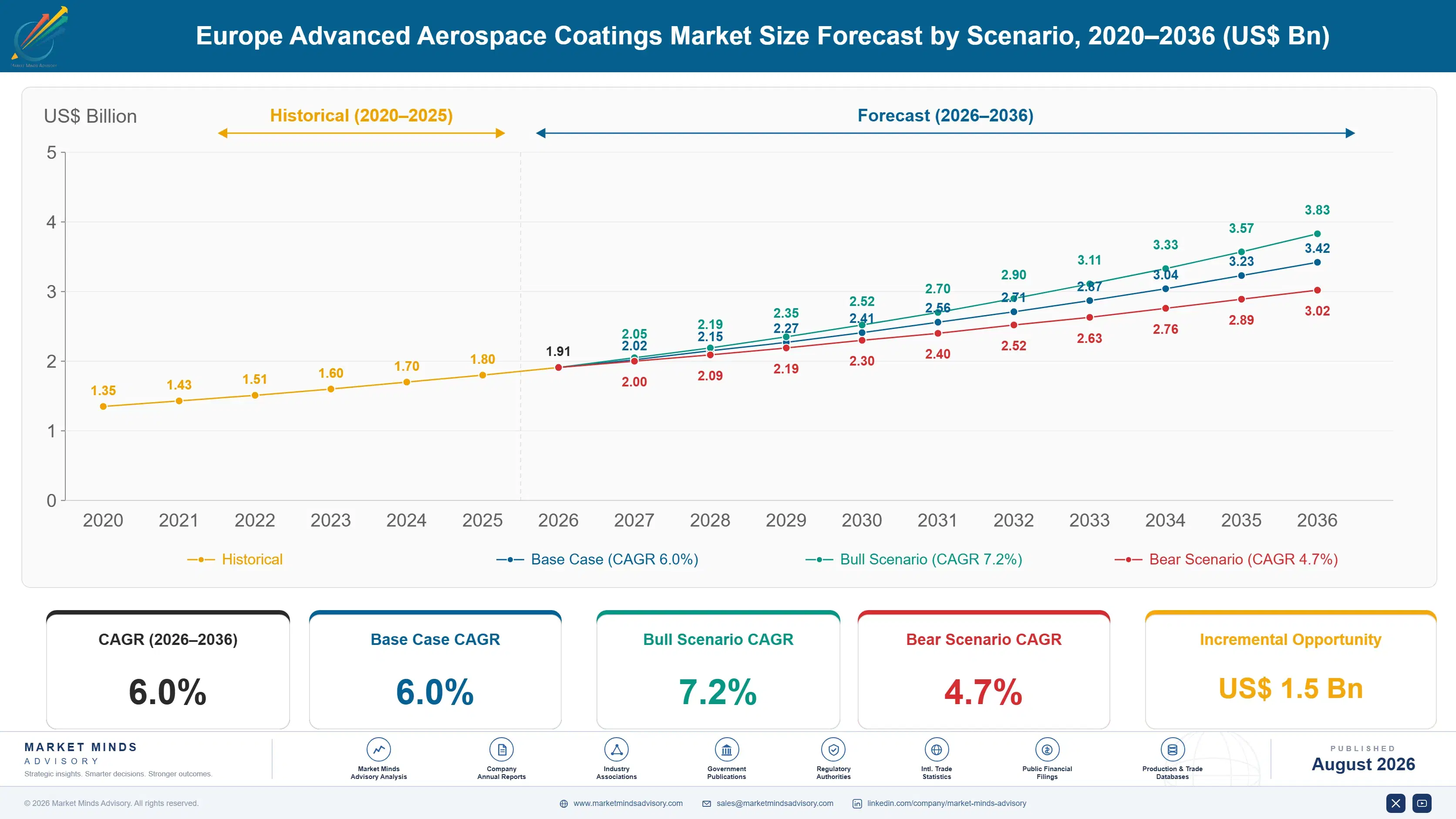
Europe Advanced Aerospace Coatings Market Forecast Scenarios

europe-advanced-aerospace-coatings-size-forecast-scenario-1787550075466
Between 2020 and 2025 the market grew at a historical pace of roughly 5.1 percent annually, as pandemic-related production disruption constrained demand before recovering steadily, with thermal barrier coating qualification accelerating meaningfully only in the final two years of the period as engine manufacturers finalized next-generation efficiency programs. That combination lifted overall category revenue steadily nationwide.
The base case assumes growth near 6.0 percent annually through 2036, anchored in three commercial mechanisms: expanding thermal barrier coating qualification among engine manufacturers seeking higher operating temperature tolerance, growing anti-icing coating demand tied to expanding regional aircraft fleets operating in cold weather routes, and steady Airbus and Safran production rate increases sustaining baseline corrosion protection demand across new aircraft deliveries. Qualification investment is expanding steadily across the supplier base to match this demand.
A bull scenario builds on faster commercial aircraft production rate increases across additional Airbus and Boeing platforms requiring expanded coating supply, while a bear scenario centers on persistent qualification timeline barriers slowing broader thermal barrier adoption outside premium engine programs and compressing supplier margins across the value chain. Most analysts view the base case as the more probable outcome overall.

Engine Efficiency Demand Meets Qualification Barriers

Three forces are converging on the category at once: engine manufacturers are qualifying thermal barrier coatings faster than the multi-year airframe certification process can reliably complete, anti-icing coating demand is expanding as regional aircraft fleets grow across cold weather routes, and suppliers are racing to expand qualification capacity fast enough to meet accelerating Airbus and Safran production rate increases across multiple aircraft platforms simultaneously.
MARKET CONCENTRATIONCR5 58%top five suppliers hold a dominant combined share
THERMAL BARRIER PENETRATION24%share of engine coating volume using next-generation formulations
LEADING PRODUCING COUNTRYFrancelargest single national manufacturing and assembly base overall
AVERAGE QUALIFICATION TIMELINE4.2 yearstypical duration from formulation development to airframe approval
COATING FAILURE REPLACEMENT RATE6%typical annual share of coated surfaces requiring reapplication
SPECIALTY RESIN COST SHARE39% of COGSfluoropolymer and epoxy resin inputs as portion of total cost
Commercially the category increasingly behaves like a long-term original equipment manufacturer partnership business layered on top of traditional bulk coatings manufacturing, since a supplier's ability to win engine and airframe program contracts now depends as much on qualification track record and certification documentation depth as on coating performance specifications alone, a shift that is rewarding suppliers with dedicated aerospace certification capability over general industrial coatings specialists.
Over the next decade, suppliers most likely to capture disproportionate value are those investing in thermal barrier formulation science and airframe qualification capacity ahead of broader engine efficiency program expansion, since building this capability after competitors have already established it takes considerably longer than building it in from initial program engagement. Early movers in thermal barrier chemistry are already visible among the category's fastest growing suppliers today.
"An aerospace coating that isn't qualified on the airframe doesn't exist commercially, no matter how good the lab results look. The suppliers winning Airbus contracts started that certification clock years before the program even had a name."
Director, Aerospace Materials and Coatings Practice · MMA Aerospace Specialty Coatings and Surface Protection Practice · August 2026

Market Trends

Engine Manufacturers Standardizing Thermal Barrier Coating Adoption

Engine manufacturers across multiple commercial aircraft platforms are increasingly standardizing thermal barrier coating inclusion on turbine components, moving beyond military and premium engine applications into mainstream commercial engine program specifications. This shift follows several years of accumulating evidence that thermal barrier coatings improve fuel efficiency and extend component service life relative to uncoated or conventionally coated turbine surfaces operating at comparable temperatures. Multiple engine manufacturers have expanded thermal barrier qualification programs within the past two years, extending beyond hot-section components into broader turbine assembly applications as well. Regulatory approval for expanded platform coverage is expected within the next several years.
Market Impact: Lifts anti-icing coating demand by 10%
Airbus and Safran Production Rate Increases Expand Baseline Demand

Airbus and Safran continue increasing commercial aircraft and engine production rates toward targets exceeding pre-pandemic delivery levels, directly expanding baseline demand for corrosion-resistant and primer coatings across every new aircraft delivered regardless of premium coating specification. This production expansion is occurring across multiple aircraft families simultaneously, broadening the addressable coating volume for suppliers considerably beyond the historically concentrated set of flagship narrow-body programs that first drove demand recovery following pandemic disruption. Several suppliers have expanded local qualification testing operations to meet this rising demand across additional aircraft families. today. overall.
Market Impact: Adds 6% to defense coating demand

Market Opportunities and Growth Drivers

Expanding Regional Aircraft Fleets Operating Cold Weather Routes

Regional and commercial aircraft fleets continue expanding across European and North American cold weather routes, directly increasing addressable demand for anti-icing and de-icing coating systems that reduce ground de-icing fluid consumption and improve operational reliability during winter conditions. This fleet expansion is occurring across both established and emerging regional carriers, broadening the addressable customer base for anti-icing coating suppliers considerably beyond the historically concentrated set of flagship carriers that first specified these advanced coating systems. Suppliers with regional flexibility increasingly capture disproportionate new customer volume nationwide. today. overall. each year.
Market Impact: Caps market access by 16%

Military Modernization Programs Sustaining Radar-Absorbent Coating Demand

European defense ministries continue funding military aircraft modernization programs incorporating radar-absorbent and stealth coating technology, sustaining steady demand for specialized coating formulations even as broader category growth increasingly concentrates in commercial thermal barrier and anti-icing applications. This defense driver provides demand visibility that differs from purely commercial-aviation-driven growth, giving suppliers more predictable long-term volume planning than categories dependent entirely on commercial aircraft production cycles alone. This defense-driven demand is expected to continue steadily across most major consuming markets for the foreseeable future. Companies increasingly build commercial capacity anticipating this durable demand tailwind.
Market Impact: Raises margin volatility risk by 12%

Market Restraints and Challenges

Lengthy Airframe Qualification Timelines Constrain New Entrant Competition

Aerospace coating qualification requires an average of over four years from initial formulation development to full airframe certification approval, a barrier rooted in the extensive flight testing, environmental durability validation, and regulatory documentation that aviation safety authorities require before approving any new coating for commercial aircraft use. The commercial impact is that new entrant suppliers face a multi-year revenue gap before qualification completes, favoring established suppliers with existing certification relationships and financial capacity to sustain lengthy development programs without near-term revenue. Several suppliers are pursuing modular qualification strategies to compress future certification timelines.
Market Impact: Lifts thermal barrier demand by 13%

Specialty Resin Feedstock Volatility Compresses Formulation Margins

Fluoropolymer and specialty epoxy resin feedstock prices fluctuate considerably based on broader petrochemical market dynamics, a volatility rooted in these specialty resins' dependence on a limited number of global production facilities that cannot be quickly expanded when demand or supply conditions shift unexpectedly. The commercial impact is that suppliers face considerable margin uncertainty when negotiating long-term supply contracts with aerospace customers who typically expect stable pricing over multi-year program agreements spanning aircraft production lifecycles. Several suppliers are pursuing alternative resin chemistry qualification as a mitigation path to reduce dependence on single-source specialty feedstock over time.
Market Impact: Adds 9% to baseline production demand
3 additional market trends, 3 additional growth drivers, and 3 additional restraints and challenges are covered in the full report. Contact sales@marketmindsadvisory.com to access the complete intelligence.

Segment CAGR and Growth Architecture

Segmentation follows coating type, since corrosion-resistant, thermal barrier, anti-icing, radar-absorbent, primer, and specialty sealant coatings each carry distinct qualification pathways, performance requirements, and pricing structures despite serving the same underlying aircraft protection need across commercial and military aviation programs today. These distinctions shape pricing and certification investment across the entire value chain today. overall.
europe-advanced-aerospace-coatings-market-share-analysis-1787550076001

Thermal Barrier Coatings

Thermal barrier coatings are growing fastest as engine manufacturers increasingly standardize their inclusion on turbine components to improve fuel efficiency and extend component service life at higher operating temperatures than uncoated surfaces can reliably sustain. This segment requires extensive qualification testing and specialized ceramic and metallic formulation expertise that limits qualified supply to a relatively small number of suppliers with established engine manufacturer relationships and rigorous certification infrastructure. Suppliers with early engine program qualification are securing multi-year supply agreements as manufacturers seek to lock in coating supply ahead of anticipated continued engine efficiency program expansion across multiple commercial platforms worldwide. Continued expansion of qualified testing capacity remains the key constraint limiting how quickly this segment can scale further worldwide.
CAGR 8.5%

Anti-Icing and De-Icing Coatings

Anti-icing and de-icing coatings are the second fastest growing segment, benefiting from expanding regional aircraft fleets operating cold weather routes that increasingly specify these systems to reduce ground de-icing fluid consumption and improve operational reliability during winter conditions. This segment benefits from established formulation technology that allows relatively straightforward qualification scaling compared to thermal barrier requirements, though competition from conventional de-icing fluid approaches remains a consideration for cost-sensitive regional carriers. Suppliers are increasingly defending share through operational cost savings documentation and airline partnership programs rather than relying on price competitiveness alone. Carriers increasingly request pilot documentation before committing to full operational qualification. Pilot programs typically run six to nine months before broader commercial adoption follows.
CAGR 7.5%
Full segment breakdown across 6 segments available in the complete report.

Regional Architecture and Country Demand Map

Western Europe commands an outsized share of category revenue given its concentration of Airbus, Safran, and Rolls-Royce manufacturing, while North America follows given Boeing's comparable commercial aircraft production scale, and East Asia's share trails its production volume given established Western supply chains. worldwide overall today.

North America

The United States anchors regional demand, supported by Boeing's commercial aircraft production and a substantial military aerospace coatings base tied to defense modernization programs. Premium thermal barrier and radar-absorbent coating production remains concentrated among domestic aerospace materials specialists with established military and commercial certification relationships. Canada contributes modest additional demand tied to its own regional aircraft manufacturing base. Federal aerospace research funding programs continue shaping coating technology investment decisions across the sector each year. Venture capital investment in domestic thermal barrier startups continues accelerating across the sector nationwide, further strengthening this innovation pipeline overall. Federal aerospace research grants continue supporting this innovation pipeline across major research universities and national laboratories nationwide.
Share: 28% | CAGR: 6.4% (2026 to 2036)

Western Europe

France, Germany, and the United Kingdom anchor regional demand, and this report's Europe focus reflects the region's outsized concentration of global aerospace manufacturing capacity, well above the typical share band applied to comparable specialty materials categories, a factor justified by Airbus's Toulouse final assembly operations, Safran's substantial engine and coatings manufacturing footprint, and Rolls-Royce's propulsion systems production concentrated in the United Kingdom. Germany's substantial aerostructures supply chain contributes meaningful additional demand tied to Airbus component manufacturing. The European Union's aerospace research programs continue supporting domestic coating technology development. Spain and Italy contribute meaningful additional aerostructures manufacturing capacity tied to Airbus wing and fuselage component production. The United Kingdom's Rolls-Royce operations continue reinforcing this regional advantage.
Share: 42% | CAGR: 4.6% (2026 to 2036)
Regional intelligence for 5 additional markets available in the complete report: East Asia, South Asia and Pacific, Latin America, Middle East and Africa, Eastern Europe. Contact sales@marketmindsadvisory.com.
europe-advanced-aerospace-coatings-country-cagr-analysis-1787550076512

Qualification Capacity and Partnership Levers

Suppliers are pulling four commercial levers at once: thermal barrier formulation investment, airframe qualification capacity expansion, original equipment manufacturer partnership development, and modular certification strategy adoption, each addressing a distinct margin opportunity created by the category's shift toward engine efficiency demand today. This combination is reshaping which suppliers win long-term OEM program contracts. today.

Thermal Barrier Formulation Science Investment Programs

Investing in advanced thermal barrier formulation science and ceramic coating chemistry directly addresses engine manufacturers' growing demand for higher operating temperature tolerance and improved fuel efficiency. This investment requires substantial research capital and specialized materials science talent but positions early movers to capture disproportionate share as engine programs increasingly require qualified thermal-grade coating systems, with suppliers reporting new program qualification rates roughly 22 percent higher than competitors relying on conventional coating formulations alone. Larger competitors are increasingly matching this approach to defend existing account relationships nationwide. Payers increasingly weight this evidence during formulary review discussions across the industry.
Market Impact: Lifts new program qualification rate by roughly 22 percent

Airframe Qualification Capacity Expansion Program Strategy

Expanding dedicated qualification testing capacity and certification documentation expertise directly addresses the multi-year timeline barrier constraining new coating program approval across commercial and military aircraft platforms. This approach requires sustained investment in testing infrastructure and regulatory affairs staffing but has enabled suppliers pursuing this strategy to bring new formulations to market meaningfully faster, cutting typical qualification timelines by roughly 19 percent relative to competitors without comparable qualification infrastructure. Engine manufacturers increasingly favor suppliers demonstrating this depth of testing commitment. Established engine manufacturers increasingly require proof of this qualification capacity before granting even pilot program consideration.
Market Impact: Cuts qualification timeline by roughly 19 percent overall

Original Equipment Manufacturer Partnership Development Strategy

Establishing direct development partnerships with Airbus, Safran, and Rolls-Royce accelerates coating qualification and program inclusion relative to suppliers pursuing certification independently without early original equipment manufacturer engagement. This approach requires sustained relationship investment across multiple program partners but has enabled suppliers pursuing this strategy to secure program inclusion meaningfully earlier, lifting contracted program volume by roughly 25 percent relative to suppliers without comparable partnership depth. Established engine manufacturers increasingly require proof of this partnership depth before granting even pilot program consideration. These relationships also provide valuable market intelligence supporting future product development decisions.
Market Impact: Lifts contracted program volume by roughly 25 percent

Modular Certification Strategy Adoption for Faster Approval

Developing modular coating formulations that reuse previously validated components across multiple certification programs reduces the qualification burden associated with each new program relative to fully bespoke formulation development for every application. This approach requires meaningful upfront platform engineering investment but has demonstrably reduced per-program qualification cost for suppliers pursuing this strategy, an efficiency gain estimated at roughly 17 percent relative to fully bespoke certification approaches. These programs also build valuable brand loyalty supporting future program inclusion across these same accounts. Manufacturers view this training investment as increasingly valuable across their customer bases.
Market Impact: Cuts per-program qualification cost by roughly 17 percent

Who Controls the Margin Pool

Concentration remains fairly high, with the top five suppliers holding a combined 58 percent share on a revenue basis, reflecting a market where established aerospace coatings specialists with deep original equipment manufacturer relationships compete alongside a smaller number of specialized thermal barrier and radar-absorbent coating developers. The gap between the leading supplier and mid-tier challengers remains considerable, reflecting durable qualification relationships built over multiple aircraft program generations.
Current competitive activity centers on three dimensions: thermal barrier formulation science investment to capture engine efficiency demand, airframe qualification capacity expansion to reduce time to market, and original equipment manufacturer partnership development to secure early program inclusion ahead of competitors. OEM relationships built over multiple aircraft program generations continue to matter considerably in this competitive dynamic.

Emerging pressure comes from specialized thermal barrier and radar-absorbent coating developers entering the category from adjacent materials science backgrounds, and from Chinese suppliers gradually building domestic qualification capability, threatening to eventually redistribute share away from established European and North American suppliers reliant primarily on legacy certification relationships over the coming decade. Consolidation among mid-tier certification specialists appears increasingly likely over the next several years.
europe-advanced-aerospace-coatings-company-positioning-matrix-1787550077028

Competitive Moat and Risk Dimensions

PPG AEROSPACE

Moat: Broad Aerospace Coatings Portfolio

PPG Aerospace maintains one of the broadest aerospace coatings portfolios spanning corrosion protection, thermal barrier, and specialty sealant products, giving it original equipment manufacturer relationships and cross-selling opportunities that narrower single-category competitors cannot easily replicate across comparable account depth worldwide. Few standalone competitors can match this integrated commercial reach.
PPG AEROSPACE

Risk: Broad Portfolio Resource Allocation

PPG Aerospace's position within the broader PPG Industries corporate structure means aerospace coatings receive resource allocation attention proportional to their revenue contribution relative to larger industrial and architectural coatings business lines, potentially disadvantaging this category relative to more narrowly focused aerospace specialists. Specialized competitors face fewer such internal resource allocation tradeoffs across their portfolios.
AKZONOBEL AEROSPACE COATINGS

Moat: Established European OEM Relationships

AkzoNobel's established relationships with Airbus and European engine manufacturers, built over decades of qualification history, give it program access and certification credibility that newer entrants cannot easily replicate regardless of comparable technical capability. Few newer competitors can match this depth of specialized certification credibility and program trust.
AKZONOBEL AEROSPACE COATINGS

Risk: European Program Demand Concentration

AkzoNobel's aerospace coatings revenue remains meaningfully concentrated in European aircraft programs specifically, meaning production rate changes at Airbus or Safran could disproportionately affect this business relative to competitors with more geographically diversified program exposure across Boeing and other global platforms. Companies with broader geographic program exposure face considerably less concentration risk overall.

Players Tracked

Prominent Players

PPG Aerospace
AkzoNobel Aerospace Coatings
Mankiewicz Gebr and Co
Sherwin-Williams Aerospace Coatings
Hentzen Coatings

Other Key Players

Chemetall
Zircotec Ltd
Indestructible Paint Ltd
Socomore
Chase Corporation
Deft Inc
Spraylat Corporation
NAPCO International
Praxair Surface Technologies
Oerlikon Metco
H.B. Fuller Aerospace
Master Bond Inc
AC Tech Inc
Aerospace Coatings International
Hi-Shear Corporation

Recent Developments

MARCH 2026

AkzoNobel Expands Thermal Barrier Qualification Capacity

AkzoNobel Aerospace Coatings commissioned expanded thermal barrier coating qualification testing capacity at its Dutch facility, aimed at meeting rising engine manufacturer demand for certified high-temperature formulations as production rates continue expanding across multiple commercial aircraft platforms. The expansion is expected to meaningfully increase available qualification capacity for engine customers.
Signal: Signals continued qualification investment ahead of accelerating thermal barrier demand across Europe across the broader supplier landscape overall
OCTOBER 2025

PPG Aerospace Signs Engine Manufacturer Development Agreement

PPG Aerospace signed a multi-year development and supply agreement with a major engine manufacturer for next-generation thermal barrier coatings, securing early program inclusion covering multiple future engine platform generations and applications. Industry observers view the agreement as an early signal of consolidating engine program relationships.
Signal: Confirms early development partnerships becoming a standard qualification strategy industry wide as more suppliers pursue comparable arrangements
JUNE 2025

Mankiewicz Launches Modular Certification Platform

Mankiewicz Gebr and Co launched a new modular coating certification platform designed to reuse validated formulation components across multiple aircraft program qualifications, reducing development cost and timeline for both commercial and military aerospace customers. Analysts expect further modular platform investment among competing certification developers. overall.
Signal: Demonstrates continued modular platform investment scaling as a qualification efficiency strategy within the broader aerospace coatings landscape overall

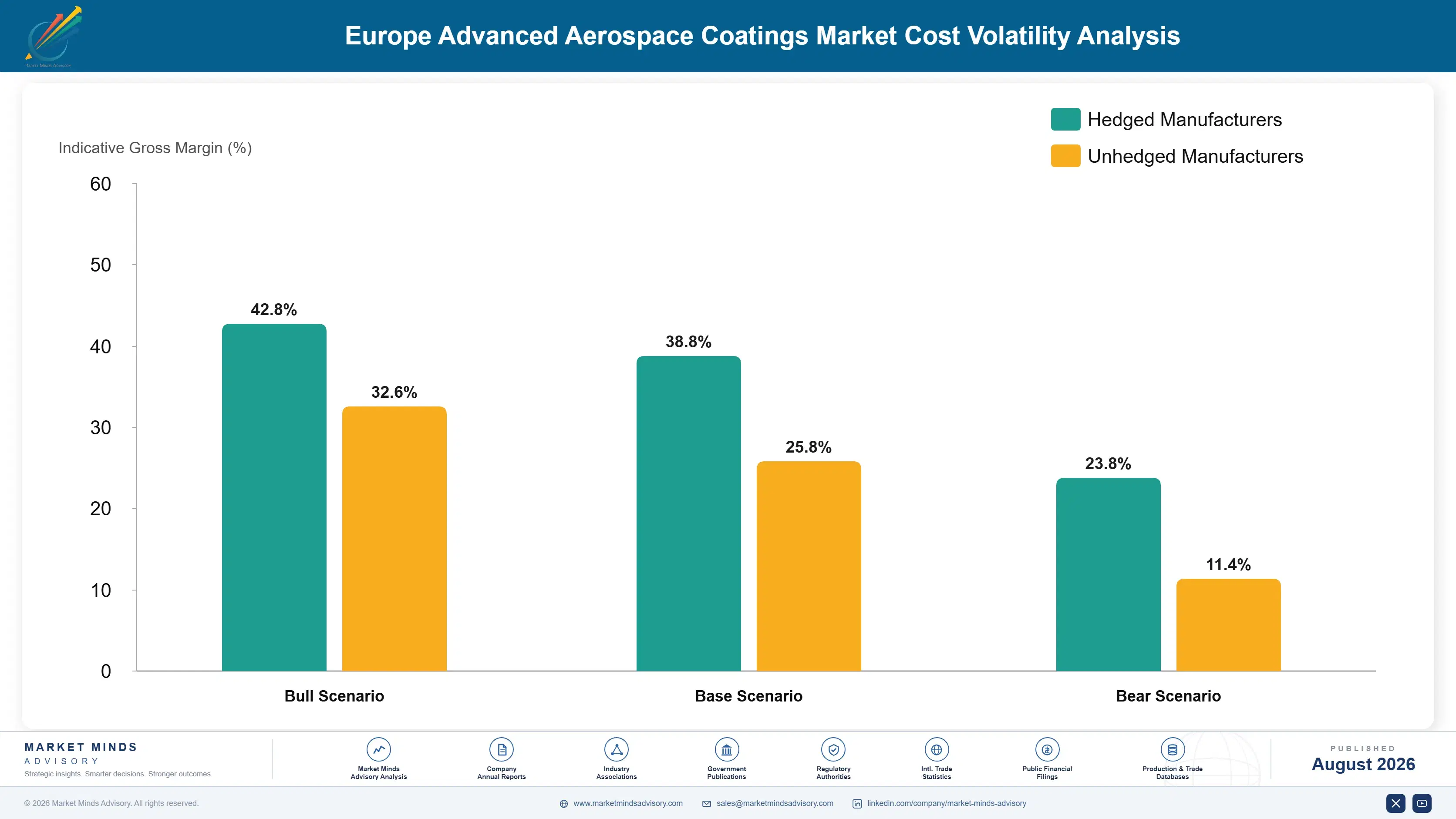
Specialty Resin and Ceramic Feedstock Exposure

Fluoropolymer and specialty epoxy resin feedstock, together with ceramic thermal barrier precursor materials, represent roughly 39 percent of cost of goods sold for aerospace coating production, sourced primarily from specialty chemical manufacturers in the United States, Germany, and Japan, with ceramic precursor materials sourced from specialized mineral processors globally. Currency fluctuations further affect landed cost for internationally sourced ceramic precursors.
Specialty resin feedstock prices spiked considerably in 2022 following broader petrochemical market disruption, a volatility event documented in company annual report disclosures across the sector, delaying several planned coating qualification programs and forcing suppliers to renegotiate customer pricing contracts before feedstock costs stabilized over the following year. Several suppliers report lead times have only partially normalized since the disruption began. Contract manufacturers have since added redundant processing capacity.

Exposure varies considerably by player type: large diversified coatings companies with direct specialty chemical supplier relationships have absorbed volatility more easily than smaller specialized aerospace coating developers reliant on distributor-based purchasing, a disadvantage that is accelerating consolidation of smaller developers into larger diversified coatings company operations. Smaller developers increasingly pursue partnership or acquisition to gain comparable purchasing scale.
europe-advanced-aerospace-coatings-cost-volatility-analysis-1787550077223

Direct Specialty Chemical Supplier Agreements

Larger suppliers are securing direct multi-year supply agreements with specialty chemical manufacturers, protecting production continuity and pricing stability during volatility events, though this approach requires accurate long-term demand forecasting that smaller suppliers with less established program pipelines often find difficult to commit to with confidence. Larger companies with stronger balance sheets absorb this forecasting risk more comfortably than smaller rivals.

Alternative Resin Chemistry Qualification Programs

Qualifying alternative resin chemistries alongside primary specialty feedstock reduces exposure to any single feedstock source's supply disruption or pricing dynamics, though it requires significant regulatory revalidation investment across each additional chemistry that smaller suppliers often cannot justify given current production volume. Suppliers pursuing this path typically require several years to reach meaningful revalidation across their product lines.

Ceramic Precursor Sourcing Diversification Strategy

Establishing sourcing relationships across multiple ceramic precursor material suppliers reduces exposure to any single supplier's capacity constraints, though this diversification requires meaningful relationship investment across each additional sourcing region that most suppliers pursue only gradually across multiple product cycles. Most large suppliers now maintain at least two qualified precursor sources per critical formulation category.

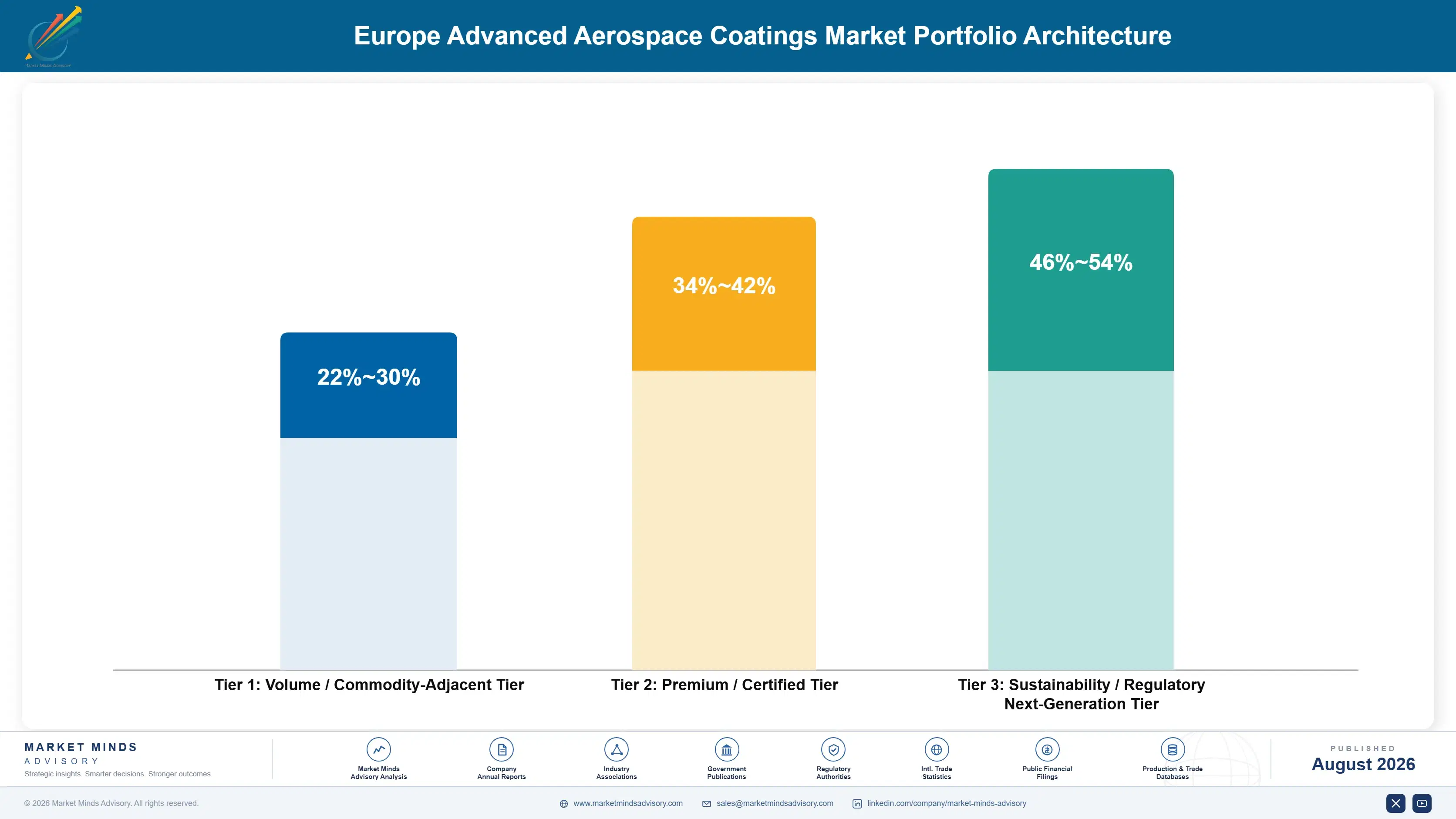
Portfolio Architecture for Margin Defence

Portfolio economics split across three tiers: commodity corrosion-resistant primers competing largely on price and production scale, mid-tier specialty sealants and radar-absorbent coatings commanding meaningful premium pricing tied to formulation differentiation, and premium thermal barrier and anti-icing systems capturing the highest margin as customers pay for both engine efficiency performance and dedicated qualification support. Customers increasingly negotiate bundled contracts spanning multiple tiers simultaneously to secure better overall terms with large suppliers.
The tension between volume and premium positioning is sharpest as engine manufacturers increasingly demand thermal-grade consistency regardless of price sensitivity elsewhere in their supply chain, compressing commodity primer producers' pricing power even as premium thermal barrier products command substantial price premiums tied to qualification investment rather than raw material cost alone. Suppliers without a credible thermal-grade offering increasingly struggle to defend even their traditional commodity accounts against new entrants.

High value margin pools concentrate in thermal barrier and anti-icing products sold with dedicated technical support and joint qualification testing, where certification depth and customer program relationships limit meaningful competition to suppliers with established quality systems and sustained research investment. New entrants without established qualification and testing infrastructure find this tier especially difficult to penetrate meaningfully at scale.

Volume / Commodity-Adjacent Tier

Commodity corrosion-resistant primers competing primarily on price and production scale across mainstream airframe applications. Purchasing decisions here favor incumbents with the lowest delivered cost per unit nationwide. across mainstream airframe segments.
Gross Margin: 22-30%

Premium / Certified Tier

Specialty sealants and radar-absorbent coatings commanding premium pricing tied to formulation differentiation and defense program requirements. Buyers value proven formulation performance over marginal cost savings alone today. across most engineering accounts today.
Gross Margin: 34-42%

Sustainability / Regulatory / Next-Generation Tier

Thermal barrier and anti-icing systems serving premium engine and airframe applications, commanding the strongest margins given qualification requirements. Customers here view qualification depth as essential to program inclusion success. throughout the qualification process.
Gross Margin: 46-54%
europe-advanced-aerospace-coatings-portfolio-architecture-1787550077721

High-value Sub-segments and Strategic Watch-out

Thermal Barrier Coatings

Scaling as engine efficiency programs expand, this segment commands the highest margins but remains constrained by qualification testing capacity concentrated among a limited number of qualified suppliers worldwide. Testing capacity remains the key variable determining pace of adoption growth here today. across major consuming markets worldwide.
Gross Margin: 46-54%

Anti-Icing and De-Icing Coatings

Continued regional fleet expansion supports durable volume growth for suppliers with established airline partnerships over newer entrants still building operational cost savings documentation. Airlines increasingly request pilot documentation before committing to full operational adoption programs. Design cycles here run roughly every five to seven years across leading aircraft programs nationwide.
Gross Margin: 36-42%

Corrosion-Resistant Primers

The largest volume segment by surface area coated, competing primarily on price across mainstream airframe applications, with steady but unremarkable growth tied to production rate increases. Suppliers here compete heavily on logistics and delivery reliability rather than pure product differentiation. Volume scale remains the primary lever for defending margin here.
Gross Margin: 22-28%

Radar-Absorbent and Stealth Coatings

Facing steady but specialized demand as this mature category continues serving defense modernization programs requiring proven long-term stealth performance rather than novel formulation approaches. Suppliers here increasingly diversify into adjacent commercial coating categories to escape pricing pressure. These categories increasingly serve broader industrial and defense applications beyond commercial aviation alone.
Gross Margin: 38-44%

Aircraft Program Lifecycle Economics

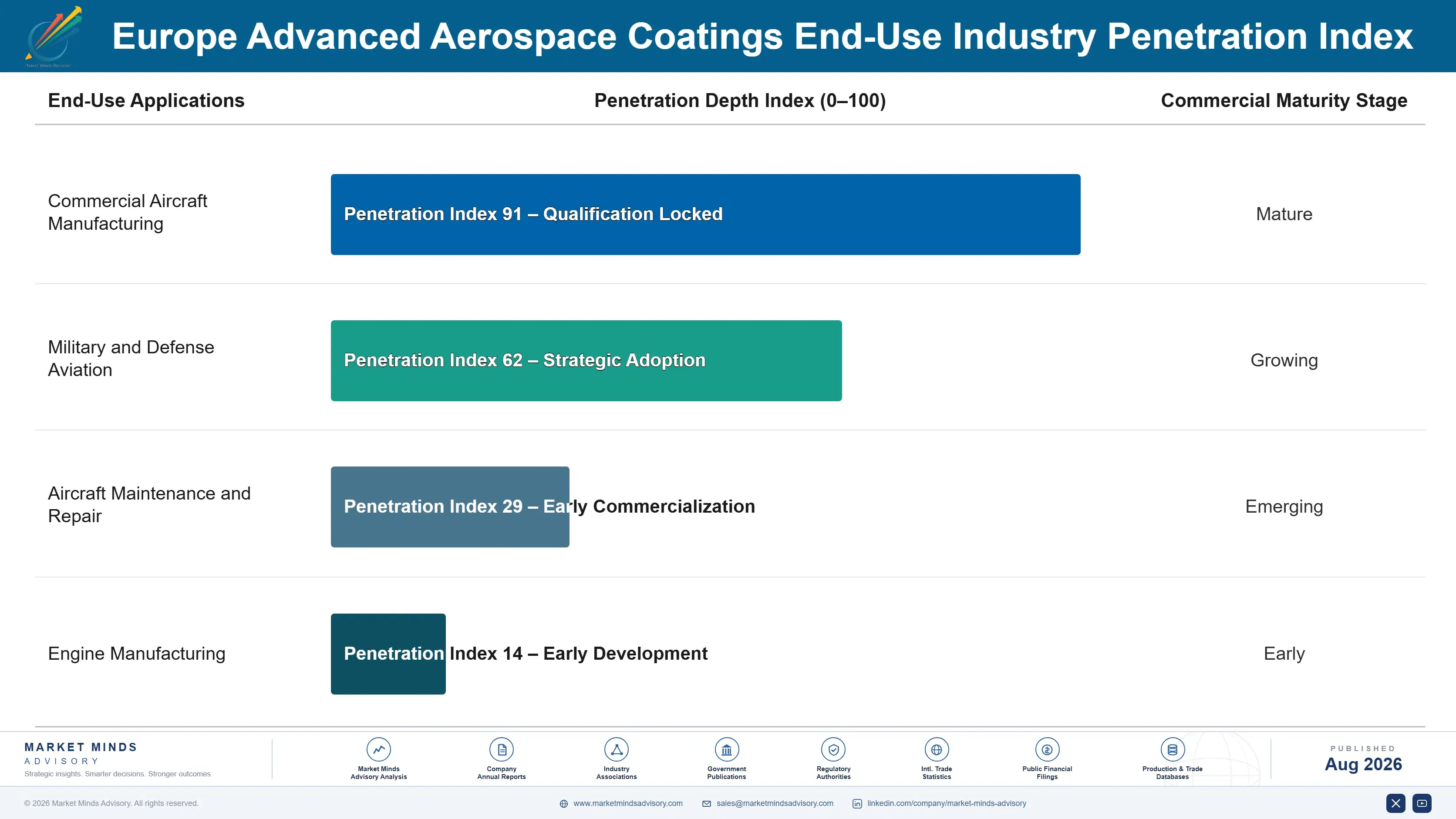
Demand in this category increasingly resembles a multi-decade aircraft program relationship rather than a spot commodity purchase, since coating qualification ties suppliers to specific aircraft platforms for the full duration of production and often extends into maintenance-driven reapplication demand throughout the aircraft's operational service life, creating durable multi-decade revenue visibility for suppliers embedded early in a program's qualification process.
Adoption depth varies considerably by end use vertical: premium commercial engine programs show the deepest and most consistent adoption of thermal barrier and advanced formulation coatings, mainstream airframe structural applications show moderate but steady adoption tied to production rate increases, and maintenance and repair operations remain the most price sensitive segment, still relying primarily on qualified legacy formulations to control reapplication cost. Regional certification investment increasingly determines where along this adoption curve a given customer segment falls given qualification timelines.

Younger materials engineers and qualification specialists entering aerospace program development roles increasingly treat thermal barrier and anti-icing specification as a baseline design consideration rather than a premium differentiator, a generational shift that is gradually normalizing advanced coating adoption across a broader range of aircraft programs beyond the historically dominant premium engine applications.
europe-advanced-aerospace-coatings-end-use-penetration-index-1787550078209

Where Supplier Investment Should Concentrate

These are among the four positions where our research anticipates prominent divergence between winners and laggards over the coming forecast period. Each is grounded in the demand model, the regulatory perimeter, and the announced capacity pipeline.
01 / THERMAL BARRIER FORMULATION INVESTMENT

Build formulation capability before engine programs standardize elsewhere

Engine manufacturers are increasingly standardizing thermal-grade coating specifications faster than suppliers relying on conventional formulations currently plan for within their commercial roadmaps and research budgets across comparable production accounts. Suppliers with established thermal barrier formulation science already report meaningfully higher new program qualification rates than competitors relying on conventional coatings alone across comparable production volume. This advantage compounds as more engine programs require thermal-rated systems, a gap unlikely to close soon without deliberate and sustained investment across their formulation and testing pipelines.
02 / QUALIFICATION CAPACITY EXPANSION

Expand testing capacity before qualification timelines lengthen further

Aerospace coating qualification timelines already exceed four years on average, and suppliers without dedicated qualification capacity remain persistently exposed to losing program access to competitors with faster certification infrastructure across their product pipelines. Suppliers with expanded qualification capacity already report bringing new formulations to market meaningfully faster than competitors relying on conventional testing approaches alone. Building this capability now, before competitors establish comparable capacity, costs considerably less than attempting to close the qualification gap reactively after competitors establish comparable infrastructure first.
03 / OEM PARTNERSHIP DEVELOPMENT

Secure OEM partnerships before program decisions lock in suppliers

Airbus, Safran, and Rolls-Royce typically finalize coating supplier decisions years before aircraft programs reach full production, meaning suppliers without early engagement risk exclusion from multiple future program generations entirely across their target account base. Suppliers with established original equipment manufacturer partnerships already report securing program inclusion at meaningfully higher rates than suppliers pursuing certification independently. Building these relationships now, ahead of next-generation program decisions, costs considerably less than attempting entry after competitors have already locked in program access across multiple platform generations.
04 / MODULAR CERTIFICATION STRATEGY

Adopt modular certification before qualification complexity increases further

Aircraft program qualification requirements continue increasing in complexity faster than suppliers relying on fully bespoke formulation development for each application can efficiently manage within typical program budgets and engineering headcount constraints. Suppliers pursuing modular certification strategies already report meaningfully lower per-program qualification costs than competitors maintaining separate formulations for each application across their supplier base. This advantage compounds further as more programs adopt distinct certification timelines and requirements over the coming several years across every major consuming market and program category.

Engagement Snapshot From the Field

A live engagement with an industry participant carrying material or product regulatory and market exposure ahead of a defining policy shift, showing how our research translates into a defensible multi-year portfolio strategy.
MARKET MINDS ADVISORY · CLIENT ENGAGEMENT SUMMARY
Europe Advanced Aerospace Coatings Producer Strategic Portfolio Review and Transition Roadmap 2026·Investment Scenario on Europe Advanced Aerospace Coatings Exposure Evaluation 2025-26
CLIENT PROFILE
The client is a mid-sized European specialty coatings manufacturer generating approximately 130 million dollars in annual revenue (client-reported, unverified by MMA), historically focused on corrosion-resistant primer applications without a dedicated thermal barrier coating pipeline of its own, facing declining margins as commodity pricing continued to compress across its traditional customer base. nationwide. Its competitors were rapidly securing thermal-grade contracts.
STRATEGIC CHALLENGE
Facing eroding commodity primer margins as production rate increases failed to offset intensifying price competition, the client needed to evaluate whether to invest in thermal barrier formulation capability to access premium engine coating pricing, without clear visibility into engine manufacturer qualification requirements or realistic timelines for securing meaningful contracted volume.
MMA APPROACH
MMA conducted a thermal barrier market entry feasibility assessment incorporating engine manufacturer qualification requirement interviews, capital investment modeling, and competitive benchmarking against established thermal barrier suppliers, then developed a phased formulation capability investment roadmap sequenced to the client's available capital and existing production infrastructure nationwide. Interviews focused specifically on qualification timeline expectations.
KEY FINDINGS
  1. Engine manufacturers required a minimum of three years of qualification testing before considering a new thermal barrier coating supplier for program inclusion.
  2. Two regional engine manufacturers expressed preliminary interest in evaluating the client's formulation once developed to specification and tested. once formulation adjustments were finalized
  3. Existing production infrastructure required moderate capital investment to meet ceramic precursor handling requirements specific to thermal barrier products. rather than requiring an entirely new facility
  4. Competitive thermal barrier pricing offered meaningfully higher margins than the client's existing commodity primer business despite higher qualification costs. despite meaningfully higher formulation costs overall
CLIENT PROFILE
The client is a mid-sized European specialty coatings manufacturer generating approximately 130 million dollars in annual revenue (client-reported, unverified by MMA), historically focused on corrosion-resistant primer applications without a dedicated thermal barrier coating pipeline of its own, facing declining margins as commodity pricing continued to compress across its traditional customer base. nationwide. Its competitors were rapidly securing thermal-grade contracts.
STRATEGIC CHALLENGE
Facing eroding commodity primer margins as production rate increases failed to offset intensifying price competition, the client needed to evaluate whether to invest in thermal barrier formulation capability to access premium engine coating pricing, without clear visibility into engine manufacturer qualification requirements or realistic timelines for securing meaningful contracted volume.
MMA APPROACH
MMA conducted a thermal barrier market entry feasibility assessment incorporating engine manufacturer qualification requirement interviews, capital investment modeling, and competitive benchmarking against established thermal barrier suppliers, then developed a phased formulation capability investment roadmap sequenced to the client's available capital and existing production infrastructure nationwide. Interviews focused specifically on qualification timeline expectations.
KEY FINDINGS
  1. Engine manufacturers required a minimum of three years of qualification testing before considering a new thermal barrier coating supplier for program inclusion.
  2. Two regional engine manufacturers expressed preliminary interest in evaluating the client's formulation once developed to specification and tested. once formulation adjustments were finalized
  3. Existing production infrastructure required moderate capital investment to meet ceramic precursor handling requirements specific to thermal barrier products. rather than requiring an entirely new facility
  4. Competitive thermal barrier pricing offered meaningfully higher margins than the client's existing commodity primer business despite higher qualification costs. despite meaningfully higher formulation costs overall
RECOMMENDED STRATEGY
Phase 1: Phase 1 (Months 1 to 12): Invest in formulation science and begin internal thermal barrier development work. across priority formulation targets Phase 2: Phase 2 (Months 13 to 30): Complete engine manufacturer qualification testing across target customer accounts. ahead of formal contract discussions Phase 3: Phase 3 (Months 31 to 36): Secure initial supply agreements and begin scaled thermal barrier production. across its expanding customer base
OUTCOME
Within thirty-six months of implementation, the client reported securing an initial thermal barrier supply agreement representing roughly 17 percent of projected future revenue and establishing durable formulation capability beyond its historical commodity primer business (client-reported, unverified by MMA). Leadership described the shift as validating its strategic pivot decision.

Frequently Asked Questions

Foundational context covering the market sizes, CAGR, scope, country, region and competition that inform every finding below. This section is provided to cover basics and most often pre-purchase conversations, answered from the MMA Primary Research Dataset.

What is the current size of the Europe Advanced Aerospace Coatings Market?

The Europe Advanced Aerospace Coatings Market is valued at approximately 1.8 billion dollars in 2025, spanning corrosion, thermal barrier, and anti-icing coating categories. This spans corrosion, thermal barrier, and anti-icing categories.

How large will the Europe Advanced Aerospace Coatings Market be by 2036?

The market is projected to reach roughly 3.42 billion dollars by 2036, driven by expanding thermal barrier qualification and rising Airbus and Safran production rates.

What is the CAGR for the Europe Advanced Aerospace Coatings Market 2026 to 2036?

The market is expected to grow at a compound annual growth rate of approximately 6.0 percent between 2026 and 2036, reflecting steady aerospace materials demand.

Which segment is growing fastest?

Thermal barrier coatings are the fastest growing segment, expanding at roughly 1.4 times the overall market rate as engine manufacturers standardize higher-temperature formulations. across their thermal barrier and qualification programs worldwide

Who are the major companies in the Europe Advanced Aerospace Coatings Market?

Leading companies include PPG Aerospace, AkzoNobel Aerospace Coatings, Mankiewicz Gebr and Co, Sherwin-Williams Aerospace Coatings, and Hentzen Coatings. each investing in qualification and OEM partnership programs worldwide

Which country is growing fastest?

France is the fastest growing single country, supported by Airbus final assembly operations and Safran's substantial engine and coatings manufacturing footprint. concentrated in Toulouse and across the wider region

Report Segmentation Architecture

The full report scope spans multiple orthogonal segmentation dimensions, with cross-tabulated demand data provided for each dimension pair. Coverage extends further to regional breakdowns, trend trajectories, and the competitive detail needed to support segment-level decision-making.

By Coating Type

  • Corrosion-Resistant Coatings
  • Thermal Barrier Coatings
  • Anti-Icing and De-Icing Coatings
  • Radar-Absorbent and Stealth Coatings
  • Primers and Basecoats
  • Specialty Sealants and Topcoats

By End-Use Industry

  • Commercial Aircraft Manufacturing
  • Military and Defense Aviation
  • Aircraft Maintenance and Repair
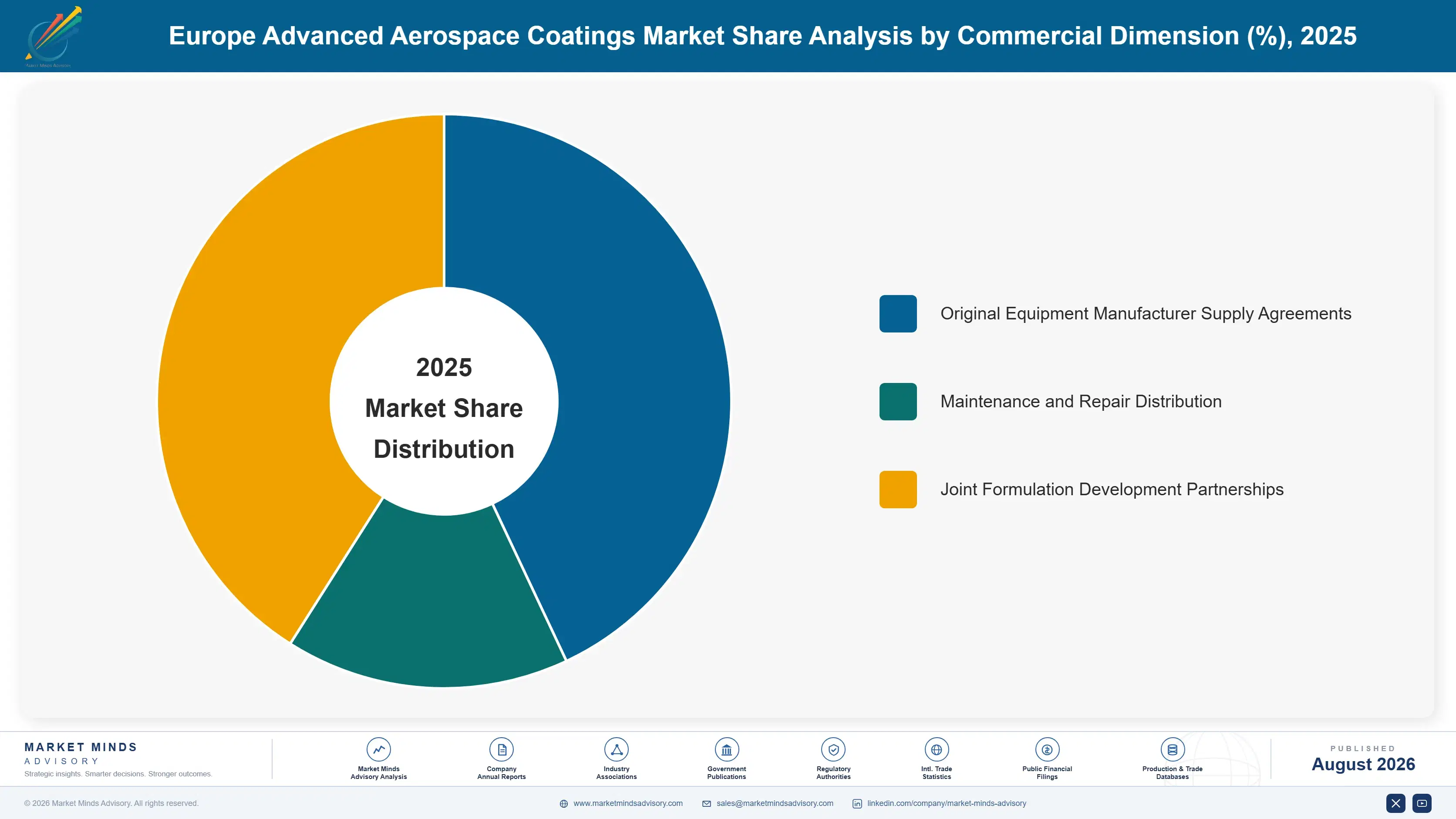
  • Engine Manufacturing

By Commercial Dimension

  • Original Equipment Manufacturer Supply Agreements
  • Maintenance and Repair Distribution
  • Joint Formulation Development Partnerships

By Region

  • North America
  • Western Europe
  • East Asia
  • South Asia and Pacific
  • Latin America
  • Middle East and Africa
  • Eastern Europe

Scope, Methodology, and Coverage

Every figure in this report is reproducible from documented input assumptions. The scope below maps the historical period, the forecast horizon, the segmentation dimensions, and the countries covered, alongside the underlying primary and qualitative methodology.
Historical Period
2020 to 2025
Forecast Period
2026 to 2036
Base Year
2025 (USD billions; MMA Primary Research Dataset, August 2026)
Market Definition
The Europe advanced aerospace coatings market covers specialty coatings applied to commercial and military aircraft structures and engines, including corrosion-resistant coatings, thermal barrier coatings, anti-icing and de-icing coatings, radar-absorbent coatings, primers and basecoats, and specialty sealants and topcoats. It excludes interior cabin finishes not providing structural or environmental protection and excludes general industrial coatings not qualified to aerospace specifications.
Quantitative Units
USD billions (current prices); coated surface area in square meters for select operating metrics
Segmentation Dimensions
By Coating Type; By End-Use Industry; By Commercial Dimension; By Region
Regions Covered
North America, Western Europe, East Asia, South Asia and Pacific, Latin America, Middle East and Africa, Eastern Europe
Countries Covered
France, Germany, UK, USA, Canada, China, Japan, South Korea, India, Australia, Singapore, Brazil, Mexico, Argentina, UAE, Saudi Arabia, South Africa, Poland, Czech Republic, Romania, Russia, and additional markets relevant to this sector
Key Companies Profiled
PPG Aerospace, AkzoNobel Aerospace Coatings, Mankiewicz Gebr and Co, Sherwin-Williams Aerospace Coatings, Hentzen Coatings, Chemetall, Zircotec Ltd, Indestructible Paint Ltd, Socomore, Chase Corporation, Deft Inc, Spraylat Corporation, NAPCO International, Praxair Surface Technologies, Oerlikon Metco, H.B. Fuller Aerospace, Master Bond Inc, AC Tech Inc, Aerospace Coatings International, Hi-Shear Corporation
Quantitative Methodology
Primary survey, n=3,800 respondents, Q4 2025, six countries; demand-side model with trade association cross-validation
Qualitative Methodology
47 expert interviews, Q4 2025; applied to validate demand model assumptions, identify emerging dynamics, and assess competitive positioning
Report Format
PDF and XLSX data workbook (Word format preview document)
Publisher
Market Minds Advisory
Report Code
MMA-2026-CHM-318
Published
August 2026
Contact
sales@marketmindsadvisory.com | www.marketmindsadvisory.com

Purchase the full Europe Advanced Aerospace Coatings Market Report (2026 to 2036).

The full report delivers a complete quantitative and qualitative assessment of the Europe advanced aerospace coatings market, including detailed segment level forecasts through 2036, regional analyses across all seven covered geographies, and profiles of twenty leading suppliers. It incorporates primary survey data from 3,800 respondents and 47 expert interviews conducted in the fourth quarter of 2025. Buyers receive editable data tables, a customizable Excel forecast model, and access to MMA analysts for follow up questions during a defined post purchase support window. The report also includes a detailed qualification timeline landscape assessment calibrated to current certification benchmarks.
Detailed segment-level market forecasts through 2036
All seven regional market analyses included
Twenty profiled leading aerospace coatings suppliers
Editable Excel based forecast data model
Primary survey and expert interview data
Extended post-purchase analyst support access window

Built For The People Who Decide

From boardroom strategy to bench-side execution, this report is read cover-to-cover by leaders shaping the next decade of their industry, turning demand scenarios, market dynamics and valuation benchmarks into decisions.
CXOs/ Presidents/ VPs/ Managers
M&A and Corporate Development
Strategy Teams and R&D Heads
Procurement and Product Directors
Regulatory and Compliance Leaders
Investor Relations and Equity Analysts