Market Minds Advisory
Ethylamine Market

Ethylamine Market: The Co-Production Problem, Agrochemical Exposure, and Why the Weakest Amine Sets the Economics

One reaction produces all three amines together and the ratio barely moves, which means a producer sells whatever the chemistry makes rather than what any customer happens to want. Surplus placement decides everything.

Lead Analyst

Bilal Shaikh

Published

September 2026

Make Smarter Decisions with Customized Research Insights

Request a free sample report and evaluate market opportunities, growth trends, and competitive dynamics relevant to your business needs.

2025 MARKET VALUE$1.6BMarket Size 2025
2036 FORECAST VALUE$3.0BBase Case , 2026 to 2036
CAGR 2026 TO 20365.8 %Bull 7.0% / Bear 4.6%
INCREMENTAL OPPORTUNITY$1.3BNet 10- year value creation
EXPANSION MULTIPLE1.76x2036 value over 2026 base
Strategic Levers
M&A Pipeline
Regional Outlook
Country Rankings
Competitive Intelligence
Segmental Deep-dive
Call-Us : 91 93563 13602

Executive Snapshot and Market Trajectory

Reacting ethanol with ammonia produces mono, di, and triethylamine simultaneously, and adjusting conditions shifts that ratio by perhaps eighteen percent. A producer therefore sells what the reaction makes, which is the single fact governing every commercial decision in this market. Nothing else in the business escapes that constraint.
Commercial power sits with producers holding downstream derivative capacity that absorbs whichever amine the market does not want. Salts and formulated solutions grow fastest at 8.6%, roughly 1.48 times the market, because they convert bulk amine into products customers can handle safely. East Asia holds 30% of global value, built on Chinese capacity and agrochemical intermediate demand that dwarfs any other region.
Concentration is high at roughly 61% for the top five, reflecting a market where handling flammable corrosive amines requires infrastructure most chemical companies never built. Agrochemicals take 42% of volume and expose producers to crop protection cycles and to active ingredient withdrawals nobody forecasts. The weakest amine sets the economics for all three. Derivative capacity that consumes whichever species the market rejects is what separates producers running at full rate from those repeatedly cutting output.
Market Definition
The market comprises ethylamines produced by reacting ethanol with ammonia, covering monoethylamine, diethylamine, triethylamine, mixed and co-produced ethylamine streams, and ethylamine salts and formulated solutions. Value is measured at producer level across agrochemical, pharmaceutical, rubber chemical, water treatment, and foundry applications. Methylamines and higher alkylamines, ethanolamines, ammonia and ethanol as feedstocks, downstream crop protection active ingredients, and formulated end products fall outside scope.
Base Year Value
$1.6B in 2025 (MMA Primary Research Dataset, August 2026)
Forecast Period
2026 to 2036, eleven discrete annual values
CAGR
5.8% base case. Bull 7.0%. Bear 4.6%.
Fastest Growth Segment
Ethylamine Salts and Formulated Solutions: 8.6% CAGR
Fastest Growth Country
India: 9.2% CAGR
Fastest Growth Region
South Asia and Pacific: 7.9% CAGR
Largest Region
East Asia: 30% of 2025 global value
Market Leaders
BASF, Eastman Chemical, Balaji Amines, Alkyl Amines Chemicals, and Arkema lead on ethylamine production capacity. Source: company annual reports and MMA Analysis, July 2026.
Primary Survey
n=3,800 procurement and R&D decision-makers, Q4 2025, six countries
Methodology
Demand-side build-up, cross-validated against public data, 47 expert interviews

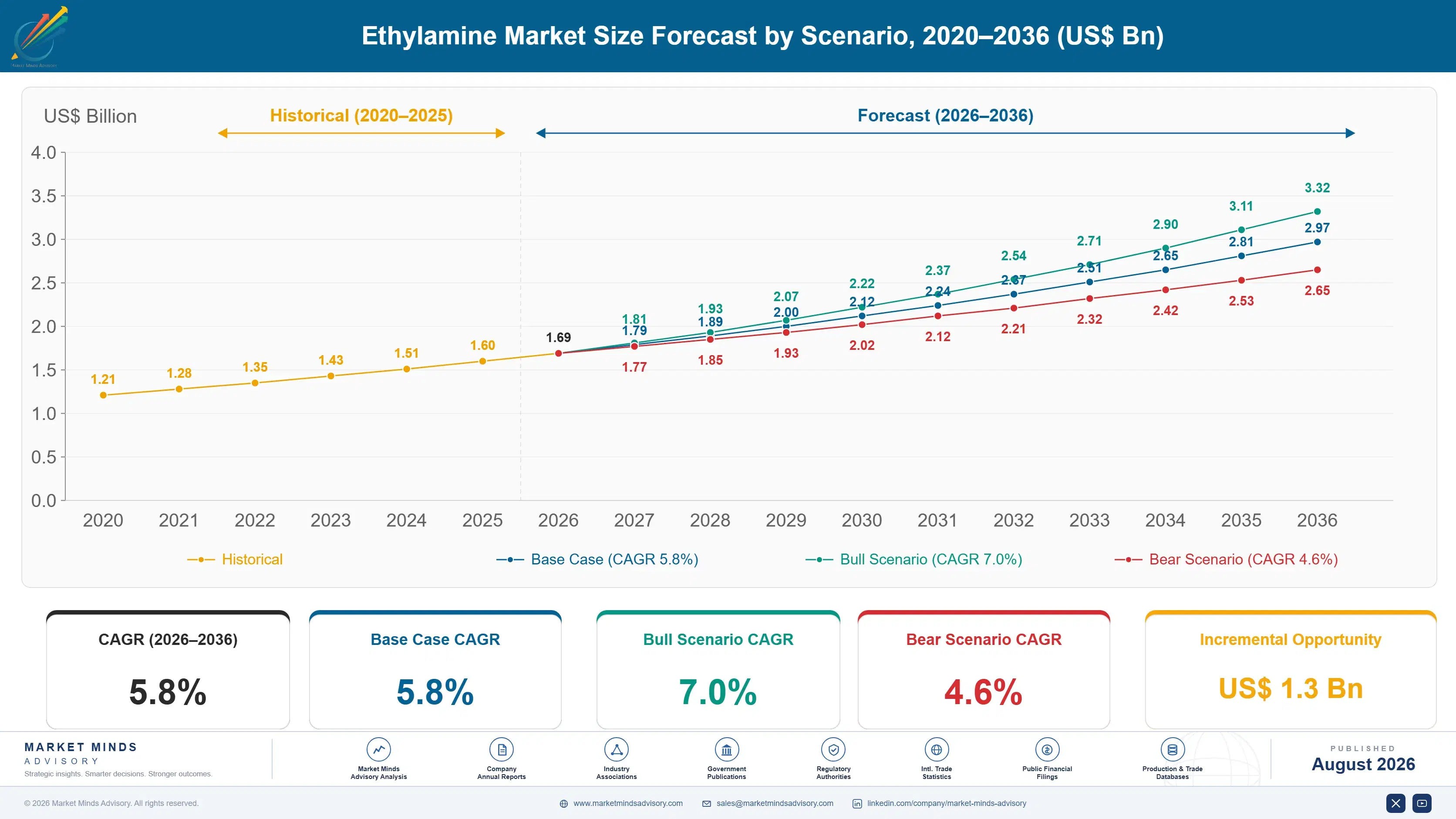
Ethylamine Market Forecast Scenarios

ethylamine-market-trends-size-forecast-scenario-1787549544758
Between 2020 and 2025 agrochemical cycles moved this market more than anything else. Crop protection demand surged with commodity prices through 2021 and 2022 and then corrected sharply as distributors destocked, and ethylamine volumes followed directly given the intermediate exposure. Chinese capacity additions pressured export pricing throughout. The 4.7% historical growth reflects an agrochemical boom and correction rather than any underlying trend in the amine business itself.
The 5.8% base case rests on three mechanisms. Crop protection intermediate demand recovers as distributor inventories normalise and acreage requirements reassert themselves across major growing regions. Pharmaceutical and specialty applications requiring higher purity grades grow faster than bulk volumes and carry better pricing. And formulated salts and solutions keep taking share because customers increasingly prefer not to handle flammable corrosive amines themselves at all. None of the three requires any change to reaction chemistry.
The 7.0% bull case assumes agrochemical demand recovers strongly and renewable ethanol sourcing earns certified premiums in pharmaceutical applications. The 4.6% bear case reflects further active ingredient withdrawals removing intermediate demand permanently, Chinese overcapacity persisting in export markets, and foundry demand contracting with industrial casting volumes. Agrochemical policy decides far more than any technical development.

Selling Whatever the Reaction Decides to Make

Three things set the commercial shape of this market. Co-production comes first, because the reaction makes all three amines together and shifting the ratio beyond about eighteen percent is not possible with conventional technology. Agrochemical exposure comes second at 42% of volume, which ties this business to crop cycles and active ingredient regulation. Handling infrastructure comes third and keeps the field narrow.
TOP-FIVE CONCENTRATION61%Share of global ethylamine capacity held by leading producers
AVERAGE SELLING PRICEUSD 2,450 per tonneBlended pricing across the three principal amine species
AGROCHEMICAL DEMAND SHARE42%Portion of volume consumed by crop protection intermediate synthesis
ETHANOL COST SHARE38%Feedstock input within total ethylamine production cost base
PRODUCT RATIO FLEXIBILITY18%Range within which producers can shift species output mix
FOUNDRY CATALYST SHARE14%Portion of triethylamine consumed in metal casting operations
The co-production consequence deserves stating plainly. A producer running for strong monoethylamine demand generates diethylamine and triethylamine whether or not anybody wants them, and if either accumulates the producer must discount it, store it, or reduce total output including the profitable product. The weakest of the three therefore sets the economics for all three simultaneously. That inversion of normal commercial logic catches new entrants repeatedly.
Handling explains the concentration. Ethylamines are flammable, corrosive, strongly alkaline, and smell overwhelmingly of ammonia at concentrations far below any hazard threshold, which means dedicated tankage, pressurised transport, vapour recovery, and community relations that most chemical producers have no reason to develop. That infrastructure is the barrier rather than the chemistry, which is entirely conventional. Chemistry is entirely conventional and confers nothing.
"Everybody in this industry has a warehouse of the amine nobody currently wants. You cannot make one without making the others, so the commercial skill is finding a home for the surplus before it forces you to cut the product that actually pays. The best operators have derivative units precisely for that."
Practice Director, Fine Chemicals and Agrochemical Intermediates · MMA Chemicals and Materials Practice · August 2026

Market Trends

Formulated Solutions Displace Bulk Amine Handling at Customers

Ethylamines are flammable, corrosive, and require pressurised storage with vapour recovery, and a growing number of downstream users would rather not operate that infrastructure for a raw material representing a modest share of their input cost. Salts, aqueous solutions, and stabilised formulations shift the handling burden back to the producer who already has the equipment. Those forms grow at 8.6% against a market growing 5.8% and carry conversion margin the bulk product never earns. Producers with formulation and packaging capability capture value that pure bulk supply forfeits entirely. Bulk supply forfeits that value entirely.
Market Impact: Agrochemicals take 42% of volume
Certified Renewable Ethanol Sourcing Creates a Premium Segment

Ethanol supplies 38% of production cost and can be sourced from fermentation rather than from ethylene hydration, which makes mass balance certified renewable carbon available in the finished amine without any process change. Pharmaceutical and personal care customers under corporate carbon commitments have begun specifying it, and the molecules are analytically identical to conventional product. The premium rests on certification documentation rather than on anything measurable. Volumes remain small and the commercial mechanism is well understood from other chemical markets, which means adoption depends on customer commitment rather than on technical development.
Market Impact: Foundries take 14% of triethylamine

Market Opportunities and Growth Drivers

Crop Protection Intermediate Demand Recovers From Destocking

Agrochemicals take 42% of ethylamine volume as intermediates for herbicides, fungicides, and thiocarbamate chemistry, and that demand collapsed through the distributor destocking cycle that followed the commodity price surge rather than through any change in underlying acreage requirements. Inventories have largely normalised and application volumes reflect planted area rather than speculative purchasing. Recovery restores demand that never actually disappeared at the farm level. What producers cannot forecast is which active ingredients will face regulatory withdrawal, since each removal takes intermediate demand permanently rather than cyclically. Withdrawals remove volume permanently rather than cyclically.
Market Impact: Ratio shifts only 18%

Foundry Cold Box Casting Sustains Steady Triethylamine Demand

Triethylamine catalyses the cold box process that produces sand cores for metal castings, consuming 14% of triethylamine output in an application most people outside foundries have never heard of. Demand tracks automotive, industrial equipment, and pipe casting volumes rather than any chemical market dynamic. The application is technically entrenched because alternative catalysts perform worse and the process equipment is designed around the amine. That makes it unusually stable demand for a commodity chemical, and it absorbs triethylamine that co-production generates regardless of what other applications want. Alternative catalysts perform measurably worse.
Market Impact: Withdrawals affect above 20 actives

Market Restraints and Challenges

Co-Production Ratios Cannot Be Matched to Market Demand

One reaction produces mono, di, and triethylamine together, and adjusting temperature, pressure, ammonia ratio, and recycle shifts the distribution by perhaps eighteen percent at most. The root cause is reaction kinetics rather than process design, since ethanol amination proceeds through sequential substitution that no operating adjustment fully controls. A producer facing weak demand for one amine must discount it, accumulate inventory, or reduce total output including profitable products. Mitigation runs through derivative units that consume surplus species, swap arrangements between producers, and export placement at whatever price clears. Reaction kinetics rather than plant design impose it.
Market Impact: Formulated grades grow at 8.6%

Active Ingredient Withdrawals Remove Intermediate Demand Permanently

Crop protection actives face regulatory review and periodic withdrawal, and each removal eliminates the intermediate demand behind it rather than transferring it to a replacement that may use entirely different chemistry. The root cause is that agrochemical registration is increasingly demanding and older actives frequently fail modern assessment. Producers cannot forecast which will go. Mitigation runs through customer diversification across many actives, growth in pharmaceutical and industrial applications that face different regulatory dynamics, and derivative capacity that provides outlets independent of any single crop protection molecule. Nobody in the industry forecasts these outcomes.
Market Impact: Ethanol supplies 38% of cost
4 additional market trends, 3 additional growth drivers, and 2 additional restraints and challenges are covered in the full report. Contact sales@marketmindsadvisory.com to access the complete intelligence.

Segment CAGR and Growth Architecture

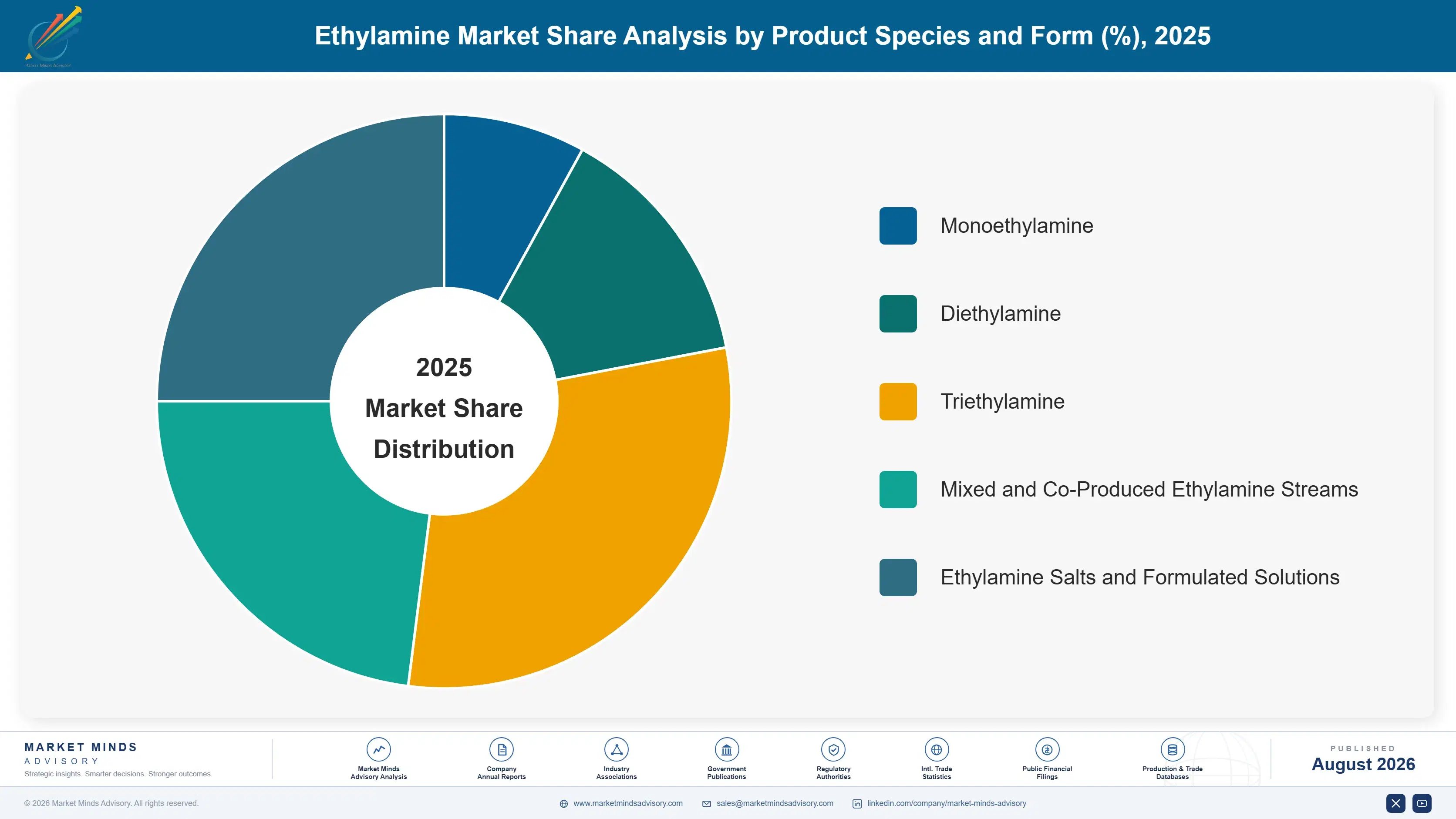
Segmentation follows product species and form, because each amine serves different applications, commands different pricing, and arrives from the same reactor whether or not anyone wants it. Five product forms cover commercial supply, and their relative volumes are set by reaction chemistry rather than by demand, which is the defining oddity of this market.
ethylamine-market-trends-market-share-analysis-1787549545293

Ethylamine Salts and Formulated Solutions

The fastest-growing form at 8.6%, roughly 1.48 times the market, and growing because customers would rather not handle the bulk material. Hydrochlorides, aqueous solutions, and stabilised formulations remove the pressurised storage, vapour recovery, and flammability management that bulk amine demands, shifting that burden to a producer who already operates the infrastructure. Conversion adds margin that bulk supply never earns and creates switching friction, since a customer who has removed amine handling equipment cannot easily return to bulk purchasing. Packaging and formulation capability rather than reaction chemistry is what a producer needs to participate in this form. Customers who remove handling equipment following a safety review cannot easily reverse the decision afterwards.
CAGR 8.6%

Triethylamine

Second fastest at 6.8%, and unusual in having a large application most of the chemical industry has never considered. Cold box foundry core making consumes 14% of triethylamine output as a catalyst, and demand there tracks metal casting volumes rather than anything happening in chemicals. Pharmaceutical synthesis, rubber accelerators, and corrosion inhibition take the balance. Because co-production generates triethylamine whether or not it is wanted, having a stable outlet of this size matters considerably to overall plant economics. Producers without foundry customer relationships find surplus triethylamine harder to place than either of the other two species. That outlet matters disproportionately to plant economics given co-production. Producers without foundry relationships struggle to place it at all.
CAGR 6.8%
Full segment breakdown across 5 segments available in the complete report.

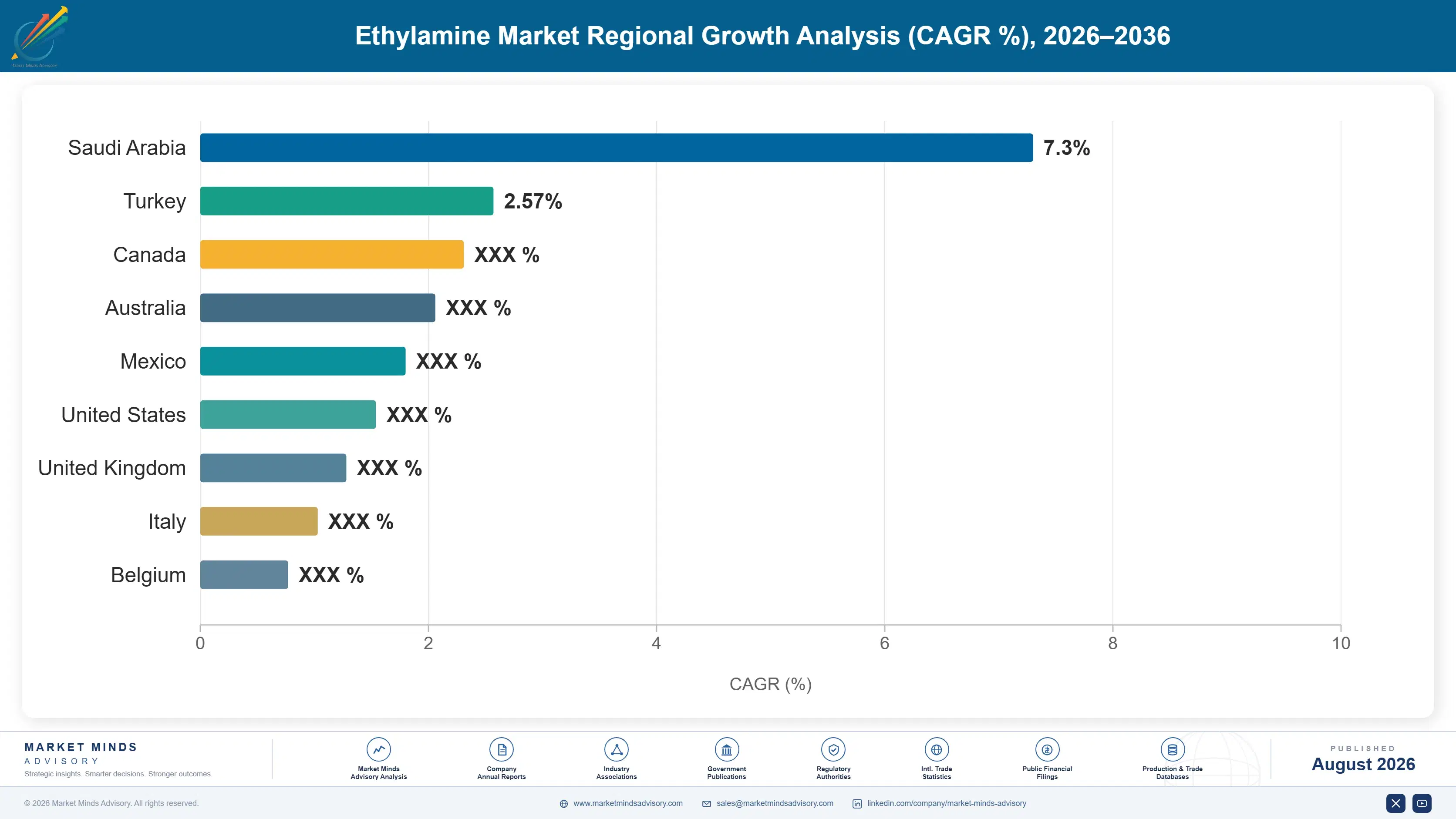
Regional Architecture and Country Demand Map

Regional shares follow agrochemical intermediate manufacturing and ethylamine capacity, which sit largely in the same places. Foundry and pharmaceutical demand then adds regional variation on top, reflecting where metal casting and fine chemical synthesis actually happen. Chinese export behaviour then sets pricing in every market it reaches.

North America

Agrochemical intermediate manufacturing and pharmaceutical synthesis together supply most regional demand, with crop protection formulation concentrated across the Midwest and the Gulf Coast. Foundry demand tracks automotive and industrial casting, which has consolidated considerably but remains substantial in absolute terms. Eastman holds significant domestic capacity, and handling infrastructure for flammable corrosive amines is well established at both producer and customer sites. Regulatory review of specific crop protection actives has removed intermediate demand periodically without warning. Pharmaceutical demand for higher purity grades earns better pricing than bulk agrochemical supply. Growth of 6.2% blends agrochemical recovery with steady pharmaceutical and specialty consumption across the region. Handling capability is well established at both ends.
Share: 23% | CAGR: 6.2% (2026 to 2036)

Western Europe

Crop protection active ingredient withdrawals have been more aggressive here than anywhere, and each removal takes ethylamine intermediate demand permanently rather than transferring it to a replacement using the same chemistry. That has capped regional volume growth despite strong pharmaceutical and specialty chemical demand. BASF and Arkema hold substantial capacity serving regional and export markets. Handling regulation and community sensitivity around amine odour are stricter than elsewhere, which raises operating cost and limits where capacity can sit. Foundry demand has declined with European casting volumes. Growth of 4.2% is the slowest in the report, reflecting regulatory attrition on the largest application. Odour sensitivity constrains where capacity can sit. Pharmaceutical demand partly offsets the losses.
Share: 18% | CAGR: 4.2% (2026 to 2036)
Regional intelligence for 5 additional markets available in the complete report: East Asia, South Asia and Pacific, Latin America, Middle East and Africa, Eastern Europe. Contact sales@marketmindsadvisory.com.
ethylamine-market-trends-country-cagr-analysis-1787549545806

Four Moves That Change the Economics

Advantage here comes from surplus placement, formulation capability, and application diversification rather than from reaction technology, which is conventional and universally understood. Four moves are worth capital and management attention across the forecast period, and the first addresses the constraint that defines this entire market. Two of them require no capital investment at all.

Build derivative capacity that consumes the surplus amine

Co-production makes all three amines together and the ratio shifts by only eighteen percent, so a producer facing weak demand for one must discount, store, or cut total output including profitable products. Downstream derivative units consuming the surplus species convert a commercial problem into a product line and remove the constraint that the weakest amine imposes on the whole plant. Derivative capacity typically costs $15 million to $35 million and improves overall plant margin 4 to 8 percentage points by allowing full-rate operation regardless of species demand balance. Full-rate operation is worth more than the derivative margin itself.
Market Impact: Improves overall plant margin 4 to 8 points

Convert bulk supply into formulated solutions and salts

Customers increasingly prefer not to operate pressurised storage, vapour recovery, and flammability management for an input representing a modest share of their cost, and shifting that burden to the producer who already has the infrastructure carries conversion margin bulk supply never earns. Formulated forms grow at 8.6% against a market at 5.8%. Once a customer removes amine handling equipment from a site, returning to bulk purchasing requires reinstalling it, which creates switching friction that pricing alone would never generate. Equipment removal makes the switch effectively permanent for that customer. Infrastructure is the barrier competitors face.
Market Impact: Grows at 8.6% against a 5.8% wider market

Diversify beyond agrochemical intermediate exposure entirely

Crop protection takes 42% of volume and faces both cyclical destocking and permanent active ingredient withdrawals that no producer forecasts, with above 20 actives affected across recent review cycles. Pharmaceutical, rubber chemical, water treatment, and foundry applications face entirely different regulatory and demand dynamics. Building positions across them reduces the correlation that currently makes ethylamine revenue behave like an agrochemical stock. Diversification requires purity capability and application development rather than any additional reactor capacity being built at all. Purity capability rather than reactor capacity is what it requires. Correlation with crop cycles falls substantially.
Market Impact: Reduces a 42% agrochemical demand concentration risk materially

Secure foundry relationships to place triethylamine

Cold box core making consumes 14% of triethylamine in an application technically entrenched because alternative catalysts perform worse and equipment is designed around the amine. That demand tracks metal casting rather than chemical cycles, which makes it a genuinely uncorrelated outlet for a species co-production generates regardless of what anyone wants. Producers without foundry customer relationships find surplus triethylamine considerably harder to place than the other two species. Building them requires application knowledge and technical service rather than any manufacturing change. Application knowledge rather than manufacturing change is required. The outlet is genuinely uncorrelated with chemicals.
Market Impact: Places fully 14% of triethylamine output reliably onward

Who Controls the Margin Pool

Concentration is high at roughly 61% for the top five, and handling infrastructure rather than reaction technology explains it, since ethylamine chemistry is conventional while flammable corrosive amine logistics are not. BASF and Eastman hold substantial integrated positions with derivative capacity absorbing surplus species. Balaji Amines and Alkyl Amines have built genuine international positions from Indian agrochemical demand, and Arkema competes with specialty and pharmaceutical grade focus.
Competitive activity runs on three fronts. Surplus placement capability is the first, because a producer unable to home the amine nobody wants must cut the one that pays. Formulation and packaging is the second and captures value bulk supply forfeits. Application diversification is the third, and it determines how much agrochemical volatility a producer actually carries. Reaction technology is universally available and contributes nothing to competitive position.

Pressure is building from two directions. Chinese producers export aggressively when domestic agrochemical demand softens, which has repeatedly pressured global pricing. And active ingredient withdrawals keep removing intermediate demand permanently rather than cyclically. The first is cyclical and the second is permanent, which means diversification away from crop protection matters more than surviving any single price cycle does.
ethylamine-market-trends-company-positioning-matrix-1787549546328

Competitive Moat and Risk Dimensions

BASF

Moat: Derivative capacity absorbing surplus species

Downstream units consuming whichever amine the market does not currently want let BASF run plants at full rate regardless of species demand balance, which is the constraint that governs every competitor without that outlet. Integrated ammonia supply and established handling infrastructure compound the advantage across a business where logistics matter more than chemistry.
BASF

Risk: European regulatory attrition on actives

European capacity serves agrochemical intermediate demand facing the most aggressive active ingredient withdrawal programme anywhere, and each removal takes volume permanently rather than shifting it to a replacement. Rebuilding that demand elsewhere means competing against Asian producers with lower cost positions in markets where handling advantages matter considerably less.
BALAJI AMINES

Moat: Indian cost and proximity

Manufacturing cost discipline built serving Indian agrochemical customers, combined with proximity to a crop protection industry that has become a substantial global exporter, gives Balaji a position that translates into competitive export supply. Handling and derivative capability developed alongside means surplus species have domestic outlets rather than requiring distress placement.
BALAJI AMINES

Risk: Concentration in agrochemical demand

A position built on crop protection intermediates carries the full weight of destocking cycles and active ingredient withdrawals that periodically remove demand without warning. Pharmaceutical and specialty diversification requires purity capability and customer qualification that take years, and competitors with established positions there are not standing still while it develops.

Players Tracked

Prominent Players

BASF
Eastman Chemical
Balaji Amines
Alkyl Amines Chemicals
Arkema

Other Key Players

Dow
Nouryon
Daicel Corporation
Menadiona
Shandong Lianmeng Chemical
Zhejiang Jianye Chemical
Jiangsu Huachang Chemical
Celanese
Huntsman
Mitsubishi Gas Chemical
Koei Chemical
Tosoh Corporation
SABIC
Clariant
Solvay

Recent Developments

MARCH 2025

Producer commissions derivative unit for surplus triethylamine

A downstream derivative plant was brought into service specifically to consume triethylamine that co-production generates beyond market demand, allowing the upstream unit to run at full rate. Surplus placement had previously forced periodic output reductions affecting the profitable amine species as well. Rates have held since.
Signal: Derivative capacity is the only practical answer to co-production, and producers lacking it keep cutting rates
JULY 2025

Customer converts from bulk amine to formulated solution

A pharmaceutical intermediate manufacturer moved from bulk amine receipt to a stabilised formulated solution, removing pressurised storage and vapour recovery equipment from its site entirely. Handling burden rather than material cost had driven the decision after a site safety review. Bulk volume moved with it.
Signal: Handling avoidance is now driving conversion to formulated grades, and equipment removal makes the switch irreversible
OCTOBER 2025

Active ingredient withdrawal removes intermediate demand

A regulatory review concluded with withdrawal of a crop protection active whose synthesis consumed ethylamine intermediate, removing that demand permanently rather than transferring it to any replacement chemistry. Producers had no advance visibility of the outcome or its volume consequences. No replacement chemistry used the same intermediate.
Signal: Active withdrawals remove intermediate volume permanently, and no producer can forecast which actives will go next

What Sets the Cost Base

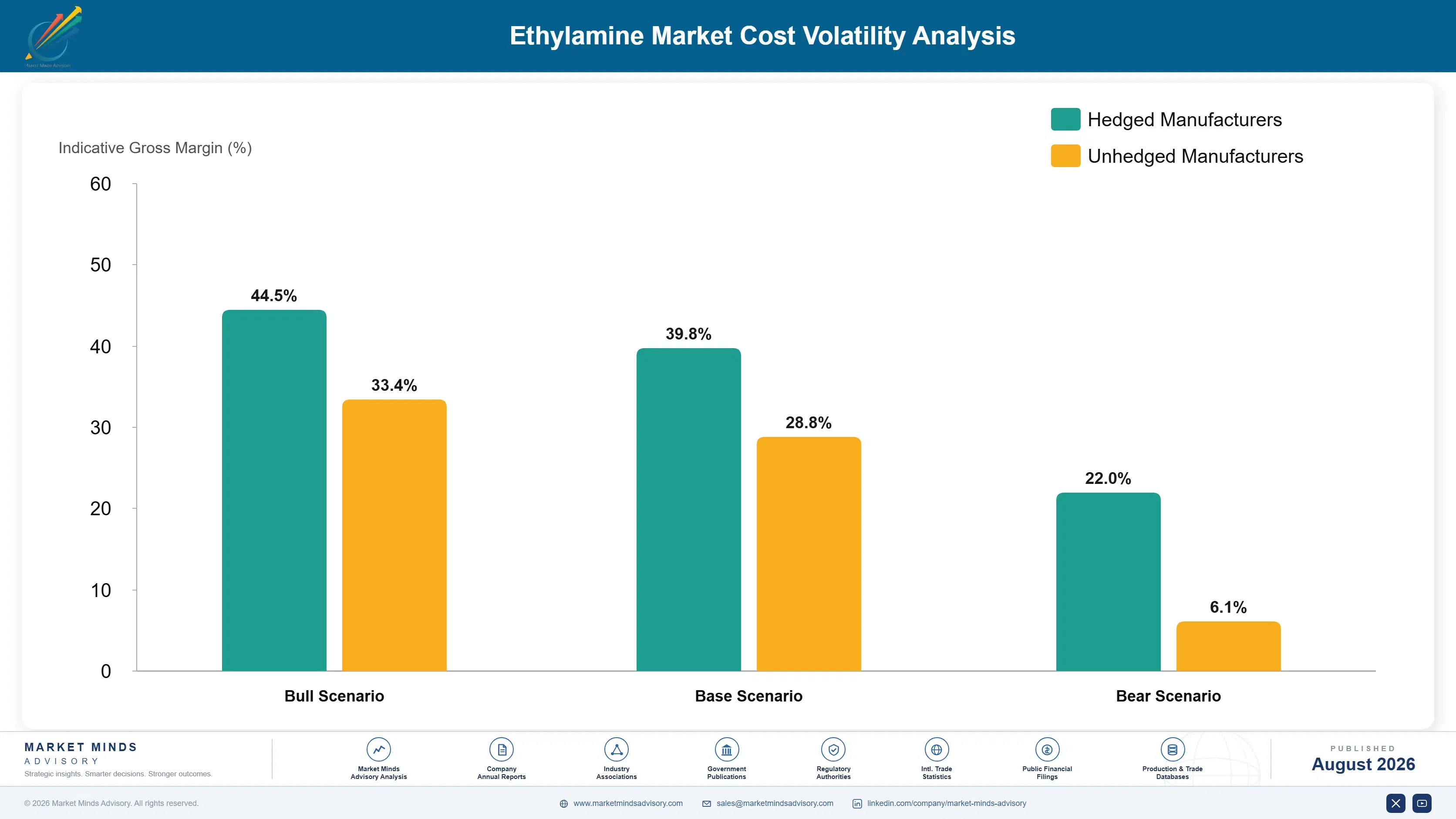
Ethanol accounts for roughly 38% of production cost, sourced either from fermentation or from ethylene hydration depending on region and price. Ammonia contributes a further 21% and tracks natural gas pricing directly, which links this business to energy markets through an unexpected route. Process energy for reaction, separation, and the distillation train that splits three closely boiling amines takes 16%. Handling, pressurised storage, and hazardous transport absorb the balance.
Ammonia prices moved violently through 2021 and 2022 as European gas costs rose and fertiliser demand competed for supply, while ethanol followed agricultural and fuel policy conditions on a separate path. BASF and Eastman both referenced feedstock and energy cost pressure across their reporting for those years. European producers faced the sharper problem, since ammonia and process energy moved against them together. Distillation duty separating three closely boiling amines is genuinely energy intensive.

Exposure divides on feedstock integration and energy geography rather than on scale. Producers with captive ammonia convert internally while merchant buyers face fertiliser market competition for the same molecules. Ethanol exposure differs by sourcing route, with fermentation ethanol following agricultural conditions and synthetic ethanol following ethylene. European operations carry process energy costs that Asian and American producers avoid.
ethylamine-market-trends-cost-volatility-analysis-1787549546524

Contract ammonia against published fertiliser benchmarks

Ammonia is 21% of cost and competes with fertiliser demand that periodically bids it away entirely, making availability as much a risk as price. Multi-year contracts indexed to published benchmarks secure both without pretending to remove the exposure. Suppliers concede indexation more readily than fixed pricing, and availability matters most when spot buyers cannot obtain material at all.

Improve separation train energy efficiency through heat integration

Distilling three closely boiling amines apart is genuinely energy intensive and takes a substantial share of the 16% energy line. Heat integration between columns, vapour recompression, and improved control all reduce duty measurably. Capital cost is moderate and payback depends heavily on regional energy pricing, which makes the case far stronger for European operations than for Indian or American ones.

Source fermentation ethanol where certification earns premium

Ethanol from fermentation carries renewable carbon that mass balance certification can pass through to the finished amine without any process change whatsoever. Pharmaceutical and personal care customers under carbon commitments pay for it. The cost differential against synthetic ethanol varies by region and season, and certification administration is modest against the premium available where customers actually want it.

Portfolio Architecture for Margin Defence

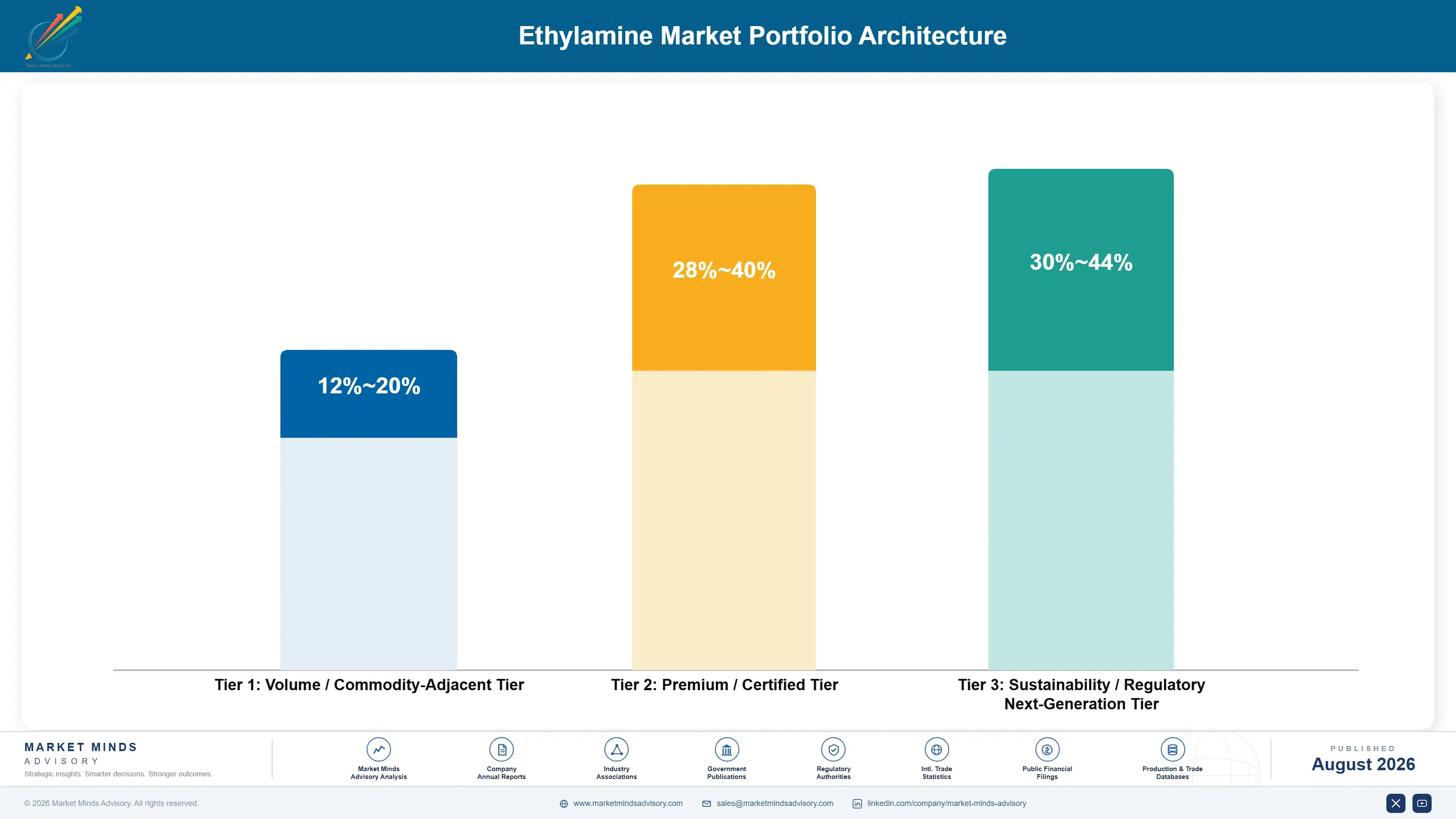
Margin follows form and purity rather than species, since all three amines emerge from the same reaction at essentially the same cost. Bulk agrochemical intermediate supply earns modest returns, because volumes are large, specifications undemanding, and Chinese producers set the export price whenever domestic demand softens. Pharmaceutical grade material and formulated solutions earn considerably more, since purity qualification and handling avoidance both create genuine switching friction.
The volume and premium tension is unusual because it operates across species rather than across products. A producer must place all three amines to run at rate, so premium demand for one does not help if another is accumulating in tankage. That makes surplus placement capability more valuable than premium positioning in any single species, which is counterintuitive and frequently missed.

High-value pools concentrate in three places: formulated solutions removing customer handling burden, pharmaceutical grade material carrying qualification barriers, and derivative products consuming surplus species internally. Each is defended by infrastructure, qualification, or asset position rather than by reaction cost. Price competition arrives in each only when a competitor builds handling infrastructure, completes qualification, or commissions derivative capacity, and none of those happens inside a year.

Volume / Commodity-Adjacent Tier

Bulk amine supplied into agrochemical intermediate synthesis on delivered price. Competes against Chinese export material whenever domestic demand there softens. The range reflects large differences in feedstock integration and energy position.
Gross Margin: 12%-20%

Premium / Certified Tier

Pharmaceutical and high purity grades qualified into regulated synthesis with documentation and impurity control. The customer purchases qualification continuity rather than chemistry, and requalification costs far exceed any price difference.
Gross Margin: 28%-40%

Sustainability / Regulatory / Next-Generation Tier

Formulated solutions and salts removing customer handling burden, plus certified renewable ethanol derived grades. Infrastructure avoidance and carbon documentation drive the premium. The range is wide because formulation value varies by customer situation.
Gross Margin: 30%-44%
ethylamine-market-trends-portfolio-architecture-1787549547024

High-value Sub-segments and Strategic Watch-out

Formulated Solutions and Salts

Customers removing pressurised storage and vapour recovery from their sites cannot easily return to bulk, which makes the switch effectively permanent. Growing at 8.6% with conversion margin bulk supply never earns. Infrastructure is the barrier competitors face. Build formulation and packaging capability deliberately. Move early.
Gross Margin: 32%-44%

Pharmaceutical Grade Material

Qualification into regulated synthesis creates switching friction that price alone never overcomes, and impurity documentation is the actual product being purchased. It also faces regulatory dynamics entirely different from agrochemical intermediate demand. Qualification takes time and holds for years. Different regulatory dynamics apply here. Qualify now.
Gross Margin: 30%-42%

Derivative Products From Surplus Species

Converting the amine nobody wants into a saleable product removes the constraint that the weakest species imposes on the whole plant. It permits full-rate operation regardless of demand balance, which is worth more than the derivative margin alone. Full-rate operation is the real prize here.
Gross Margin: 26%-38%

Bulk Agrochemical Intermediate Supply

The strategic watch-out. Chinese exports set the price whenever their domestic demand softens, and active withdrawals remove volume permanently without warning. It carries the plant's volume base and very little of its margin. Carry it for volume and expect nothing. Price it for contribution only.
Gross Margin: 12%-19%

How Demand Actually Reaches Producers

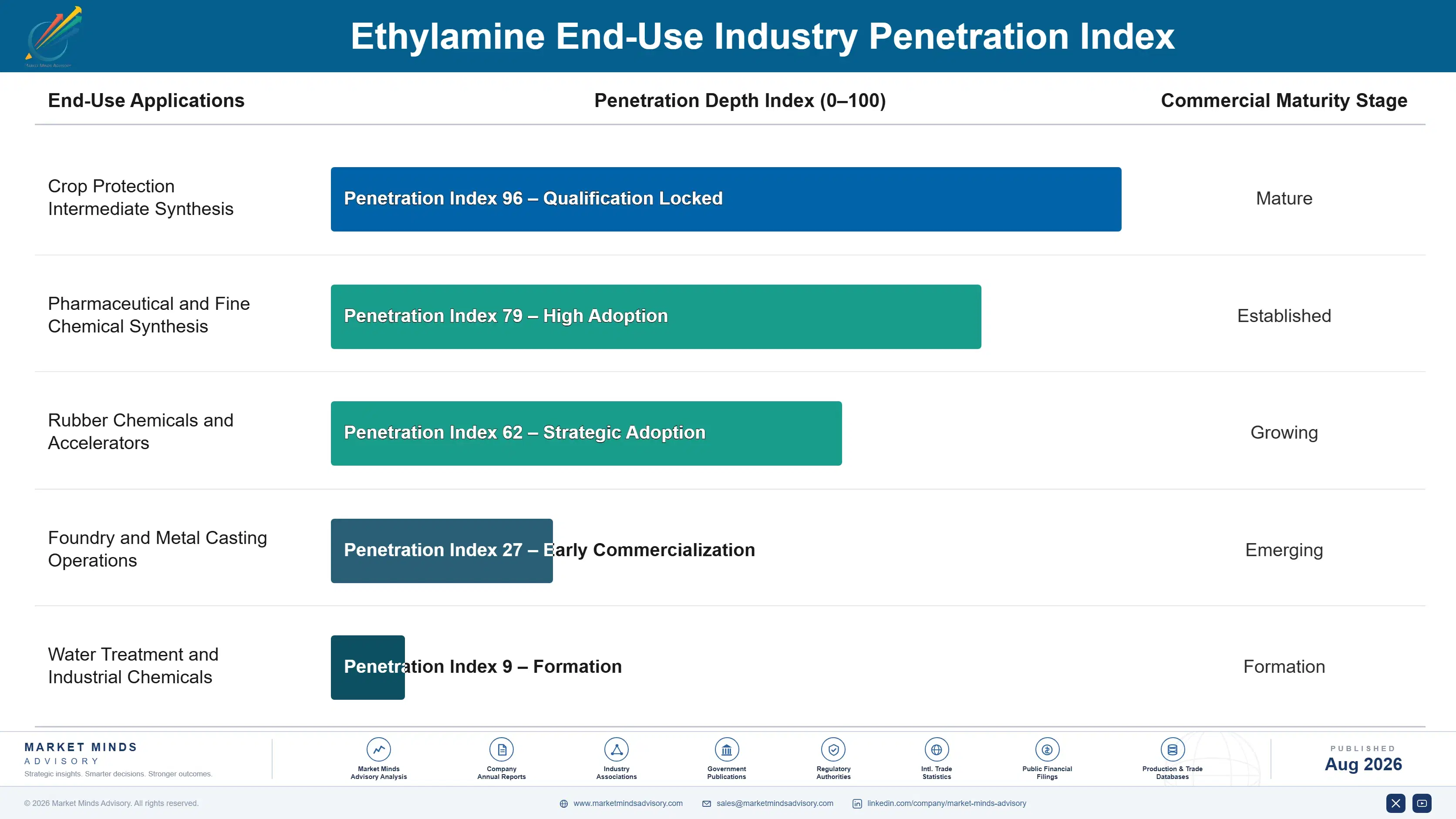
The annuity here is qualification in the pharmaceutical and specialty applications and contract supply in agrochemicals, which behave quite differently. A pharmaceutical intermediate qualified into a regulated synthesis stays there for the product's manufacturing life because requalification costs far exceed any price difference. Agrochemical intermediate supply contracts annually and moves on price, though the underlying application persists until an active ingredient is withdrawn entirely rather than gradually declining.
Adoption depth varies sharply by customer type. Pharmaceutical manufacturers qualify slowly, document extensively, and hold suppliers for years. Agrochemical producers buy large volumes on annual contracts and switch on delivered price. Foundries buy triethylamine to a technical specification and change reluctantly because process equipment is tuned around it. Water treatment and rubber chemical buyers sit between the two extremes. Understanding which type a customer is matters more than any pricing decision a supplier makes toward them.

The buyer has shifted toward site safety and engineering functions on the handling question specifically. A safety review recommending removal of amine storage decides the purchasing format entirely. A supplier able to arrive with a formulated alternative at that moment captures a decision that would otherwise have gone to whoever the safety consultant happened to mention.
ethylamine-market-trends-end-use-penetration-index-1787549547510

Where the Money Sits

These are among the four positions where our research anticipates prominent divergence between winners and laggards over the coming forecast period. Each is grounded in the demand model, the regulatory perimeter, and the announced capacity pipeline.
01 / SURPLUS PLACEMENT CAPACITY

Build the derivative unit, because co-production leaves no choice

One reaction produces all three amines together and operating adjustments shift the ratio by only eighteen percent, so weak demand for any one forces discounting, accumulation, or output cuts that hit the profitable products too. Derivative capacity consuming the surplus species converts that commercial problem into a product line and permits full-rate operation regardless of demand balance. At $15 million to $35 million it improves overall plant margin 4 to 8 percentage points, which is far more than the derivative product itself contributes.
02 / HANDLING BURDEN TRANSFER

Sell the solution, because customers want the equipment gone

Ethylamines demand pressurised storage, vapour recovery, and flammability management that a growing number of downstream users would rather not operate for an input representing a modest share of their cost. Formulated solutions and salts move that burden to a producer who already has the infrastructure, earning conversion margin bulk supply never captures and growing at 8.6% against a 5.8% market. Once a customer removes amine handling equipment following a site safety review, returning to bulk purchasing requires reinstalling it entirely.
03 / APPLICATION BASE DIVERSIFICATION

Reduce the crop protection exposure before it reduces itself

Agrochemicals take 42% of volume and bring both destocking cycles and permanent active ingredient withdrawals that producers have no way of forecasting, with above 20 actives affected across the most recent review rounds alone. Pharmaceutical, rubber chemical, water treatment, and foundry applications face entirely different regulatory and demand dynamics and reduce the correlation that currently makes this revenue behave like an agrochemical position. Diversification needs purity capability and patient application development rather than any additional reactor capacity being built at all.
04 / FOUNDRY OUTLET DEVELOPMENT

Court the foundries, because triethylamine has nowhere else

Cold box core making takes 14% of triethylamine output in an application entrenched because alternative catalysts perform worse and casting equipment is designed around the amine specifically. That demand follows metal casting volumes rather than chemical cycles, which makes the outlet genuinely uncorrelated with everything else that consumes ethylamines. Producers lacking foundry relationships find surplus triethylamine markedly harder to place than either other species, and building those relationships requires application knowledge and technical service rather than any manufacturing change whatsoever.

Engagement Snapshot From the Field

A live engagement with an industry participant carrying material or product regulatory and market exposure ahead of a defining policy shift, showing how our research translates into a defensible multi-year portfolio strategy.
MARKET MINDS ADVISORY · CLIENT ENGAGEMENT SUMMARY
Ethylamine Producer Strategic Portfolio Review and Transition Roadmap 2026·Investment Scenario on Ethylamine Exposure Evaluation 2025-26
CLIENT PROFILE
An Asian producer operating a single ethylamine complex supplying agrochemical intermediate manufacturers regionally, with revenue near USD 96 million (client-reported, unverified by MMA). No derivative capacity existed, all product shipped in bulk, and agrochemical customers accounted for the large majority of volume across a small customer base. Rate reductions had become routine. Surplus placement was ad hoc.
STRATEGIC CHALLENGE
An agrochemical destocking cycle had left triethylamine accumulating in tankage until the plant was forced to reduce rates, cutting monoethylamine output that remained profitable throughout. Two customers had also requested formulated solutions the client could not supply, and one active ingredient withdrawal had removed a meaningful volume permanently. Options appeared limited.
MMA APPROACH
MMA analysed plant economics under species demand imbalance, sized derivative and formulation opportunities against capital requirements, and assessed foundry and pharmaceutical demand as alternative outlets. Forty-seven expert interviews with agrochemical formulators, foundry operators, and pharmaceutical intermediate manufacturers established what was commercially reachable. Outlets existed that nobody had pursued. Capital needs were modest.
KEY FINDINGS
  1. Rate reductions forced by triethylamine accumulation had cost more in lost monoethylamine margin across two years than a derivative unit would have cost to build outright.
  2. Regional foundries consumed triethylamine in cold box operations at volumes that would have absorbed the client's entire surplus, and none had ever been approached commercially.
  3. Two agrochemical customers requesting formulated solutions had subsequently sourced them from a competitor, taking bulk volume with them rather than merely the formulated portion.
  4. Pharmaceutical intermediate demand regionally paid substantially above agrochemical pricing and required purity capability the client could reach with modest investment in its existing separation train.
CLIENT PROFILE
An Asian producer operating a single ethylamine complex supplying agrochemical intermediate manufacturers regionally, with revenue near USD 96 million (client-reported, unverified by MMA). No derivative capacity existed, all product shipped in bulk, and agrochemical customers accounted for the large majority of volume across a small customer base. Rate reductions had become routine. Surplus placement was ad hoc.
STRATEGIC CHALLENGE
An agrochemical destocking cycle had left triethylamine accumulating in tankage until the plant was forced to reduce rates, cutting monoethylamine output that remained profitable throughout. Two customers had also requested formulated solutions the client could not supply, and one active ingredient withdrawal had removed a meaningful volume permanently. Options appeared limited.
MMA APPROACH
MMA analysed plant economics under species demand imbalance, sized derivative and formulation opportunities against capital requirements, and assessed foundry and pharmaceutical demand as alternative outlets. Forty-seven expert interviews with agrochemical formulators, foundry operators, and pharmaceutical intermediate manufacturers established what was commercially reachable. Outlets existed that nobody had pursued. Capital needs were modest.
KEY FINDINGS
  1. Rate reductions forced by triethylamine accumulation had cost more in lost monoethylamine margin across two years than a derivative unit would have cost to build outright.
  2. Regional foundries consumed triethylamine in cold box operations at volumes that would have absorbed the client's entire surplus, and none had ever been approached commercially.
  3. Two agrochemical customers requesting formulated solutions had subsequently sourced them from a competitor, taking bulk volume with them rather than merely the formulated portion.
  4. Pharmaceutical intermediate demand regionally paid substantially above agrochemical pricing and required purity capability the client could reach with modest investment in its existing separation train.
RECOMMENDED STRATEGY
Phase 1: Phase one: approach regional foundries directly for triethylamine placement, since the outlet exists, is uncorrelated with agrochemicals, and requires no capital investment at all. Phase 2: Phase two: add formulation and packaging capability to serve customers requesting solutions, recovering the bulk volume already lost to a competitor offering both. Phase 3: Phase three: upgrade separation capability for pharmaceutical grade material, diversifying away from the agrochemical concentration that forced this review. Modest investment is required.
OUTCOME
The client secured foundry placement covering most surplus triethylamine within eight months and stopped rate reductions entirely. Formulation capability followed in the second year and recovered one lost customer, pharmaceutical grade qualification began, and blended gross margin improved 6.2 percentage points (client-reported, unverified by MMA).

Frequently Asked Questions

Foundational context covering the market sizes, CAGR, scope, country, region and competition that inform every finding below. This section is provided to cover basics and most often pre-purchase conversations, answered from the MMA Primary Research Dataset.

What is the current size of the Ethylamine Market?

The market was valued at USD 1.6 billion in 2025, rising to an estimated USD 1.69 billion in 2026. East Asia holds the largest regional share at 30% of global value.

How large will the Ethylamine Market be by 2036?

MMA forecasts USD 2.97 billion by 2036 under the base case, an expansion multiple of 1.76 times the 2026 value. That represents USD 1.28 billion of incremental value across the forecast period.

What is the CAGR for the Ethylamine Market 2026 to 2036?

The base case CAGR is 5.8%, with a bull case of 7.0% and a bear case of 4.6%. The spread reflects uncertainty over agrochemical recovery and active ingredient withdrawals.

Which segment is growing fastest?

Ethylamine salts and formulated solutions grow fastest at 8.6%, roughly 1.48 times the market rate, as customers avoid handling bulk amine. Triethylamine follows at 6.8% on foundry demand.

Who are the major companies in the Ethylamine Market?

BASF, Eastman Chemical, Balaji Amines, Alkyl Amines Chemicals, and Arkema lead on production capacity. The top five hold roughly 61%, with handling infrastructure explaining that concentration.

Which country is growing fastest?

India grows fastest at 9.2%, driven by an agrochemical export industry and domestic producers who have built genuine international ethylamine positions from that base. Pharmaceutical demand adds further growth.

Report Segmentation Architecture

The full report scope spans multiple orthogonal segmentation dimensions, with cross-tabulated demand data provided for each dimension pair. Coverage extends further to regional breakdowns, trend trajectories, and the competitive detail needed to support segment-level decision-making.

By Product Species and Form

  • Monoethylamine
  • Diethylamine
  • Triethylamine
  • Mixed and Co-Produced Ethylamine Streams
  • Ethylamine Salts and Formulated Solutions

By End-Use Industry

  • Crop Protection Intermediate Synthesis
  • Pharmaceutical and Fine Chemical Synthesis
  • Rubber Chemicals and Accelerators
  • Foundry and Metal Casting Operations
  • Water Treatment and Industrial Chemicals

By Sales Model

  • Bulk Contract Supply
  • Formulated Solution and Packaged Supply
  • Qualified Pharmaceutical Grade Supply
  • Distributor and Trader Channel
  • Internal Derivative Conversion

By Region

  • North America
  • Western Europe
  • East Asia
  • South Asia and Pacific
  • Latin America
  • Middle East and Africa
  • Eastern Europe

Scope, Methodology, and Coverage

Every figure in this report is reproducible from documented input assumptions. The scope below maps the historical period, the forecast horizon, the segmentation dimensions, and the countries covered, alongside the underlying primary and qualitative methodology.
Historical Period
2020 to 2025
Forecast Period
2026 to 2036
Base Year
2025 (USD billions; MMA Primary Research Dataset, August 2026)
Market Definition
The market comprises ethylamines produced by the catalytic reaction of ethanol with ammonia, covering monoethylamine, diethylamine, triethylamine, mixed and co-produced ethylamine streams, and ethylamine salts and formulated solutions. Value is measured at producer level across crop protection intermediates, pharmaceutical and fine chemical synthesis, rubber chemicals, foundry catalysis, and water treatment applications. Methylamines and higher alkylamines, ethanolamines and alkanolamines, ammonia and ethanol as feedstocks, finished crop protection active ingredients, and formulated end products fall outside scope.
Quantitative Units
USD billions (current prices); thousand tonnes supplied annually; USD per tonne by species, grade, and form
Segmentation Dimensions
By Product Species and Form; By End-Use Industry; By Sales Model; By Region
Regions Covered
North America, Western Europe, East Asia, South Asia and Pacific, Latin America, Middle East and Africa, Eastern Europe
Countries Covered
United States, Canada, Mexico, Germany, France, Netherlands, Belgium, Italy, Spain, United Kingdom, Poland, Hungary, Romania, Czechia, China, Japan, South Korea, India, Indonesia, Vietnam, Thailand, Australia, Brazil, Argentina, Colombia, Israel, Egypt, Morocco, Saudi Arabia, South Africa
Key Companies Profiled
BASF, Eastman Chemical, Balaji Amines, Alkyl Amines Chemicals, Arkema, Dow, Nouryon, Daicel Corporation, Menadiona, Shandong Lianmeng Chemical, Zhejiang Jianye Chemical, Jiangsu Huachang Chemical, Celanese, Huntsman, Mitsubishi Gas Chemical, Koei Chemical, Tosoh Corporation, SABIC, Clariant, Solvay
Quantitative Methodology
Primary survey, n=3,800 respondents, Q4 2025, six countries; demand-side model with trade association cross-validation
Qualitative Methodology
47 expert interviews, Q4 2025; applied to validate demand model assumptions, identify emerging dynamics, and assess competitive positioning
Report Format
PDF and XLSX data workbook (Word format preview document)
Publisher
Market Minds Advisory
Report Code
MMA-2026-CHM-284
Published
August 2026
Contact
sales@marketmindsadvisory.com | www.marketmindsadvisory.com

Purchase the full Ethylamine Market Report (2026 to 2036).

The full report sizes ethylamine demand across five product species and forms, five end-use industries, and seven regions with 2026 to 2036 forecasts under base, bull, and bear cases. It models co-production ratio constraints explicitly, since the inability to match output to demand governs plant economics more than any market factor. Competitive profiles cover twenty producers assessed consistently on ethylamine capacity, derivative outlets, and formulation capability. Cost analysis traces ethanol, ammonia, and separation energy exposure by feedstock integration and geography. Commercial guidance addresses surplus placement, handling burden transfer, application diversification, and foundry outlet development.
Five product species and forms sized separately by region
Co-production ratio constraints modelled against demand balance
Agrochemical concentration risk quantified by active ingredient
Formulated solution conversion tracked as handling avoidance
Foundry triethylamine demand assessed as uncorrelated outlet
Twenty producers compared on derivative and formulation capability

Built For The People Who Decide

From boardroom strategy to bench-side execution, this report is read cover-to-cover by leaders shaping the next decade of their industry, turning demand scenarios, market dynamics and valuation benchmarks into decisions.
CXOs/ Presidents/ VPs/ Managers
M&A and Corporate Development
Strategy Teams and R&D Heads
Procurement and Product Directors
Regulatory and Compliance Leaders
Investor Relations and Equity Analysts