Market Minds Advisory
Ethyl Tertiary Butyl Ether Market

Ethyl Tertiary Butyl Ether Market: The Blend Wall Workaround, Fossil Isobutylene Dependence, and Regional Policy Divergence

This molecule exists because ethanol is difficult to blend directly into petrol, and roughly half its mass is renewable while the other half remains stubbornly fossil isobutylene. Policy chose it deliberately.

Lead Analyst

Bilal Shaikh

Published

September 2026

Make Smarter Decisions with Customized Research Insights

Request a free sample report and evaluate market opportunities, growth trends, and competitive dynamics relevant to your business needs.

2025 MARKET VALUE$5.2BMarket Size 2025
2036 FORECAST VALUE$8.5BBase Case , 2026 to 2036
CAGR 2026 TO 20364.6 %Bull 5.7% / Bear 3.4%
INCREMENTAL OPPORTUNITY$3.1BNet 10- year value creation
EXPANSION MULTIPLE1.57x2036 value over 2026 base
Strategic Levers
M&A Pipeline
Regional Outlook
Country Rankings
Competitive Intelligence
Segmental Deep-dive
Call-Us : 91 93563 13602

Executive Snapshot and Market Trajectory

Ethanol raises vapour pressure, attracts water, and cannot travel in product pipelines, which caps how much of it can go directly into petrol. This molecule exists to solve exactly that, converting ethanol into something that behaves like a hydrocarbon. The whole product exists because of a blending constraint.
Commercial power sits with refiners holding integrated isobutylene supply rather than with anyone able to run an etherification unit. Bio-isobutylene routes grow fastest at 16.4%, roughly 3.57 times the market, because they would make the molecule fully renewable rather than the 47% it currently manages. Western Europe holds 42% of global value, far above any normal band, because European policy chose this route while America chose another.
Concentration is moderate at roughly 44% for the top five, and units are largely owned by refiners rather than by merchant chemical producers. Isobutylene is 52% of production cost and remains fossil. Existing plants can switch between this product and its methanol equivalent, which gives producers genuine optionality. Switching a unit between the two ether products costs very little and takes weeks. Producers maintaining that flexibility follow the economics; others cannot.
Market Definition
The market comprises ethyl tertiary butyl ether supplied as a gasoline oxygenate and octane component, covering refinery integrated production from catalytic cracker isobutylene, steam cracker raffinate route production, dedicated isobutane dehydrogenation route production, advanced and waste-based ethanol production, and bio-isobutylene route production. Value is measured at producer level across contract and spot gasoline blending sales. Methyl tertiary butyl ether, direct ethanol blending, other gasoline oxygenates, isobutylene sold as a chemical intermediate, and finished gasoline fall outside scope.
Base Year Value
$5.2B in 2025 (MMA Primary Research Dataset, August 2026)
Forecast Period
2026 to 2036, eleven discrete annual values
CAGR
4.6% base case. Bull 5.7%. Bear 3.4%.
Fastest Growth Segment
Bio-Isobutylene Route ETBE: 16.4% CAGR
Fastest Growth Country
India: 7.4% CAGR
Fastest Growth Region
South Asia and Pacific: 6.6% CAGR
Largest Region
Western Europe: 42% of 2025 global value
Market Leaders
TotalEnergies, Repsol, Moeve, Neste, and LyondellBasell lead on ethyl tertiary butyl ether production capacity. Source: company annual reports and MMA Analysis, July 2026.
Primary Survey
n=3,800 procurement and R&D decision-makers, Q4 2025, six countries
Methodology
Demand-side build-up, cross-validated against public data, 47 expert interviews

Ethyl Tertiary Butyl Ether Market Forecast Scenarios

ethyl-tertiary-butyl-ether-etbe-market-size-forecast-scenario-1787549525506
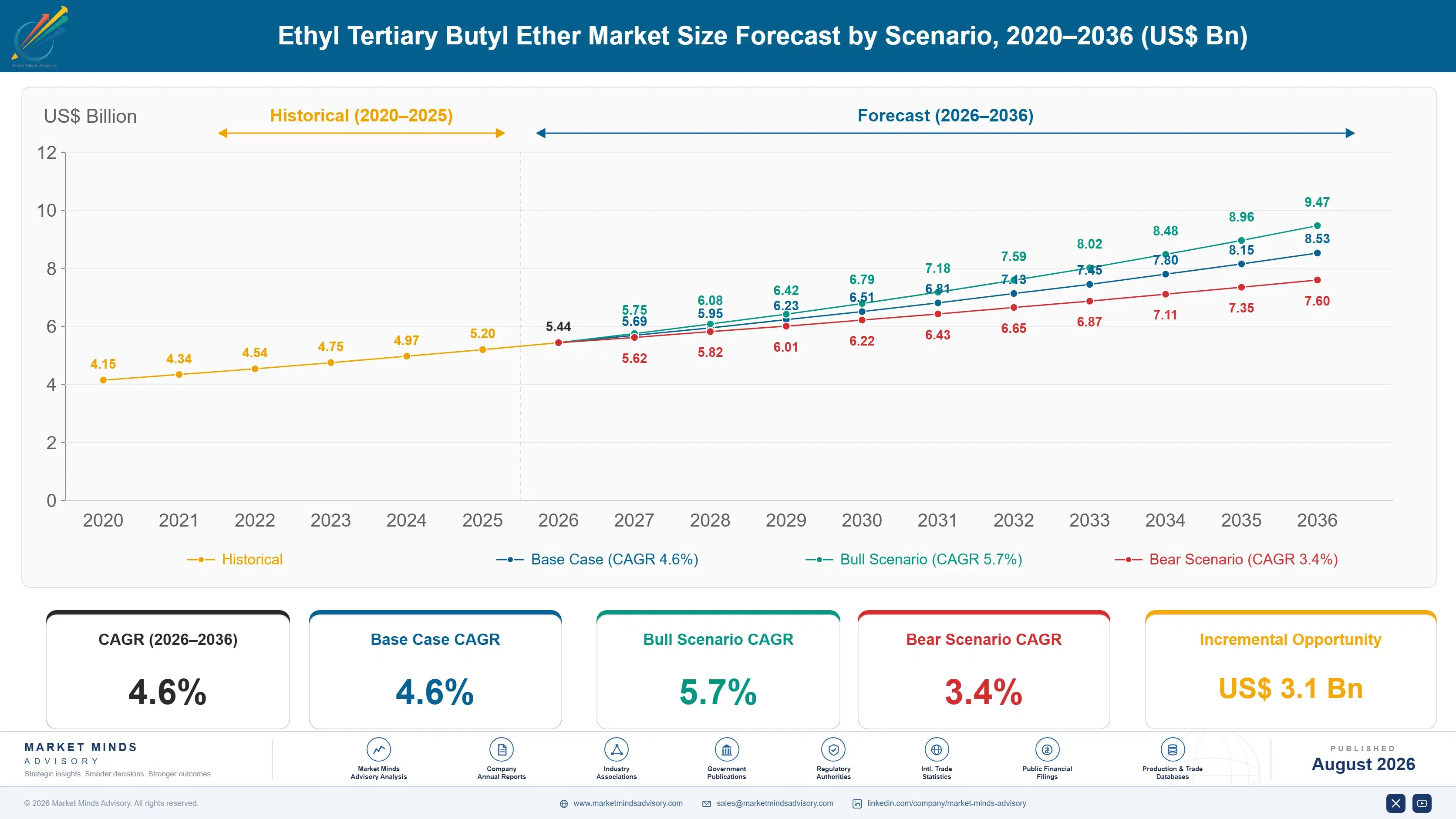
Between 2020 and 2025 renewable fuel policy carried the market while gasoline demand did not. European and Japanese blending obligations kept rising, which supported volumes even as vehicle fleets began electrifying and petrol consumption flattened. Ethanol and isobutylene prices both moved sharply through the middle of the period. The 3.6% historical growth reflects mandate-driven demand offsetting a gasoline pool that has stopped growing in the regions that use this product.
The 4.6% base case rests on three mechanisms. Renewable content obligations continue rising in Europe and Japan, and this route lets refiners increase renewable share without exceeding the ethanol volume limits that direct blending runs into. Advanced and waste-based ethanol earns multiple counting under several schemes, which raises value per tonne substantially. And Indian and Southeast Asian refiners are examining the route as direct ethanol blending reaches its practical ceiling.
The 5.7% bull case assumes obligations tighten on schedule and bio-isobutylene reaches commercial scale, making the molecule fully renewable. The 3.4% bear case reflects electrification eroding the gasoline pool faster than mandates rise, policy shifting toward direct electrification rather than liquid fuel decarbonisation, and producers switching plants back to the methanol equivalent on economics. Fleet electrification pace decides the outcome.

A Molecule Invented to Work Around Ethanol

Three things set the commercial shape of this market. Renewable fuel policy comes first, because without blending obligations there would be little reason to make this molecule rather than its cheaper methanol equivalent. Isobutylene supply comes second at 52% of cost and remains fossil-derived almost everywhere. Gasoline pool size comes third and is shrinking in exactly the regions that use the product.
TOP-FIVE CONCENTRATION44%Share of global production capacity held by leading producers
AVERAGE SELLING PRICEUSD 940 per tonneBlended pricing across contract and spot gasoline blending sales
RENEWABLE CONTENT SHARE47%Portion of molecule mass derived from bioethanol feedstock
ISOBUTYLENE COST SHARE52%Hydrocarbon feedstock input within total production cost base
BLENDING VOLUME LIMIT22%Maximum permitted addition under prevailing gasoline blending specifications
OCTANE BLENDING VALUE112 RONTypical research octane contribution within finished gasoline blends
The blend wall explains the whole rationale. Direct ethanol blending runs into vapour pressure limits, water sensitivity, and pipeline incompatibility that cap practical inclusion around ten percent in most gasoline. Converting that ethanol into an ether removes all three problems and lets a refiner blend up to 22% by volume while carrying renewable content on 47% of the molecule's mass.
Policy divergence produced the regional pattern and it is permanent. Europe and Japan adopted the ether route as the practical way to raise renewable content, while the United States banned the methanol equivalent after groundwater contamination and standardised on direct ethanol blending instead. Neither region is going to reverse that choice, which is why this remains a European and Japanese product with limited presence elsewhere.
"The awkward fact about this molecule is that it is half renewable and entirely dependent on a fossil feedstock for the other half. Everybody in the industry knows bio-isobutylene would fix that and nobody has made it work at scale yet. Until somebody does, this is a partial answer that policy happens to reward."
Practice Director, Refining and Transport Fuels · MMA Energy and Fuels Practice · August 2026

Market Trends

Bio-Isobutylene Would Make the Molecule Fully Renewable

Roughly 47% of this ether's mass comes from bioethanol and the balance from fossil isobutylene, which caps how much renewable credit a tonne can carry under any counting scheme. Producing isobutylene from sugars or waste feedstocks would close that gap entirely and transform the product's regulatory value. Several developers have demonstrated the chemistry at pilot and demonstration scale without reaching commercial economics. Growth at 16.4% comes off a base near zero. What makes it commercially interesting is that the resulting molecule would be chemically identical to the current product and drop straight into existing units.
Market Impact: Blending permitted to 22% volume
Advanced Ethanol Feedstock Earns Multiple Counting Credit

Renewable fuel schemes across Europe count ethanol from waste, residues, and non-food feedstocks at multiples of its energy content, which raises the credit value of an ether made from it well above one made from conventional crop ethanol. Producers securing advanced ethanol supply therefore earn considerably more per tonne for a chemically identical product. Supply of certified advanced ethanol is limited and contested by direct blenders as well, which keeps pricing firm. Verification and chain of custody documentation matter as much as the molecule, since the credit rests on origin evidence rather than analysis.
Market Impact: Contributes 112 research octane

Market Opportunities and Growth Drivers

Blending Obligations Rise While Direct Ethanol Hits Its Ceiling

Renewable transport fuel obligations continue increasing across European member states and Japan, and refiners meeting them through direct ethanol blending run into vapour pressure limits, water sensitivity, and pipeline incompatibility that cap practical inclusion near ten percent. Converting that ethanol into an ether removes those constraints and permits blending up to 22% by volume. That makes this route the standard answer for obligated parties needing renewable content beyond what direct blending delivers. Obligation increases translate almost directly into demand, which is unusually predictable for a fuel component. Obligation increases translate almost directly.
Market Impact: Gasoline pool falling above 2%

Octane Value Supports Demand Independently of Renewable Credit

This ether contributes around 112 research octane into a gasoline blend, which is considerably above the base pool most refineries produce and valuable in its own right as premium grades and higher compression engines demand more octane. That means a refiner blending it earns both renewable credit and octane value from one component, and the octane portion would justify some use even without any policy support. Where octane is tight, blending economics work on that basis alone. This dual value is what makes the product resilient to policy changes that would otherwise threaten it directly.
Market Impact: Isobutylene is 52% of cost

Market Restraints and Challenges

Gasoline Pool Contraction Removes the Underlying Demand Base

Vehicle electrification is reducing petrol consumption across Europe and Japan, which are precisely the regions where this product is used, and a shrinking gasoline pool shrinks the volume any blending percentage applies to. The root cause is that renewable content obligations are expressed as a share, so a smaller pool means less absolute renewable volume required even as the percentage rises. Producers mitigate by pursuing markets where gasoline demand still grows, by capturing higher value through advanced feedstock credit, and by retaining the option to switch units to other products.
Market Impact: Renewable content reaches 47%

Fossil Isobutylene Dependence Caps Renewable Credit Permanently

Isobutylene supplies 52% of production cost and rather more than half the molecule's carbon, and it comes from refinery catalytic crackers, steam cracker raffinate, or dedicated dehydrogenation, all of which are fossil. The root cause is that no bio-isobutylene route has reached commercial economics despite demonstrated chemistry. That caps renewable content at 47% regardless of how the ethanol is sourced. Producers mitigate through advanced ethanol credit multipliers, offtake agreements with bio-isobutylene developers, and accepting that a partial answer is what policy currently rewards. Partial renewability is what policy currently rewards.
Market Impact: Advanced routes grow at 11.8%
4 additional market trends, 3 additional growth drivers, and 2 additional restraints and challenges are covered in the full report. Contact sales@marketmindsadvisory.com to access the complete intelligence.

Segment CAGR and Growth Architecture

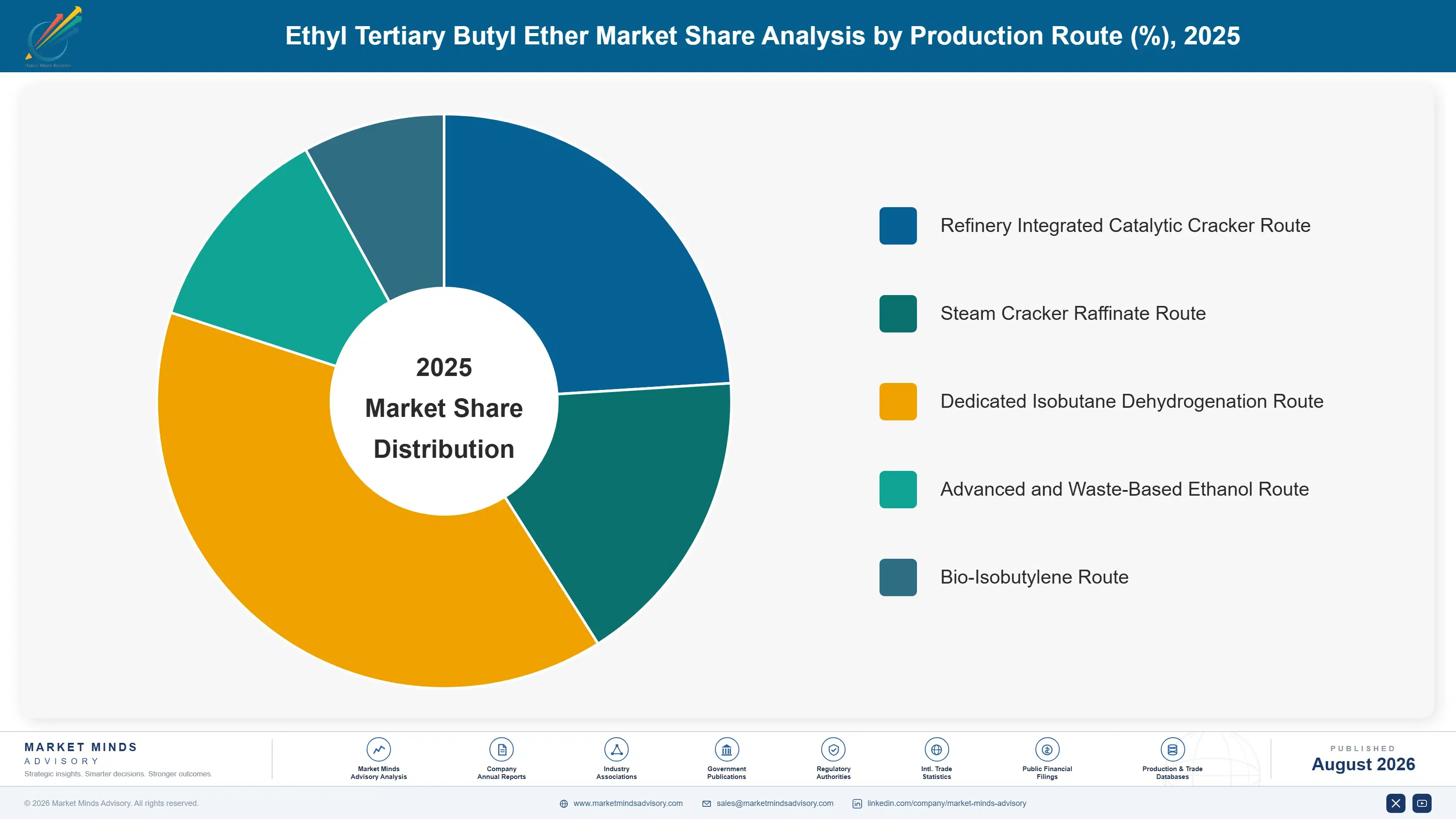
Segmentation follows production route, because the route determines isobutylene source, feedstock cost, renewable credit eligibility, and whether a producer controls its own hydrocarbon supply. Five routes cover commercial supply, and the distinction between fossil and biological isobutylene is the one that will matter most across the forecast period rather than any difference in the finished molecule.
ethyl-tertiary-butyl-ether-etbe-market-market-share-analysis-1787549526037

Bio-Isobutylene Route ETBE

The fastest-growing route at 16.4%, roughly 3.57 times the market, and effectively pre-commercial at present. Producing isobutylene from sugars, agricultural residues, or waste gas would raise renewable content from 47% to essentially complete, transforming the credit value of every tonne under any counting scheme. Several developers have proven the chemistry at demonstration scale and none has reached economics that compete with fossil isobutylene at current prices. The resulting molecule is chemically identical and drops into existing etherification units without modification, which means adoption would be immediate if the feedstock economics ever worked properly. Adoption would be immediate if feedstock economics ever worked properly at scale. Nobody has reached those economics yet.
CAGR 16.4%

Advanced and Waste-Based Ethanol ETBE

Second fastest at 11.8%, using ethanol from waste, residues, and non-food feedstocks that renewable schemes count at multiples of energy content. That multiple counting raises credit value per tonne well above conventional crop ethanol routes for a chemically indistinguishable product, which makes the feedstock certificate rather than the chemistry the commercial asset. Certified advanced ethanol supply is limited and contested by direct blenders competing for the same volumes, keeping pricing firm. Chain of custody verification matters as much as the material itself, since credit rests entirely on documented origin rather than on anything analysis could establish. Direct blenders compete for the same certified volumes, which keeps the premium firm and availability rather than price the real constraint.
CAGR 11.8%
Full segment breakdown across 5 segments available in the complete report.

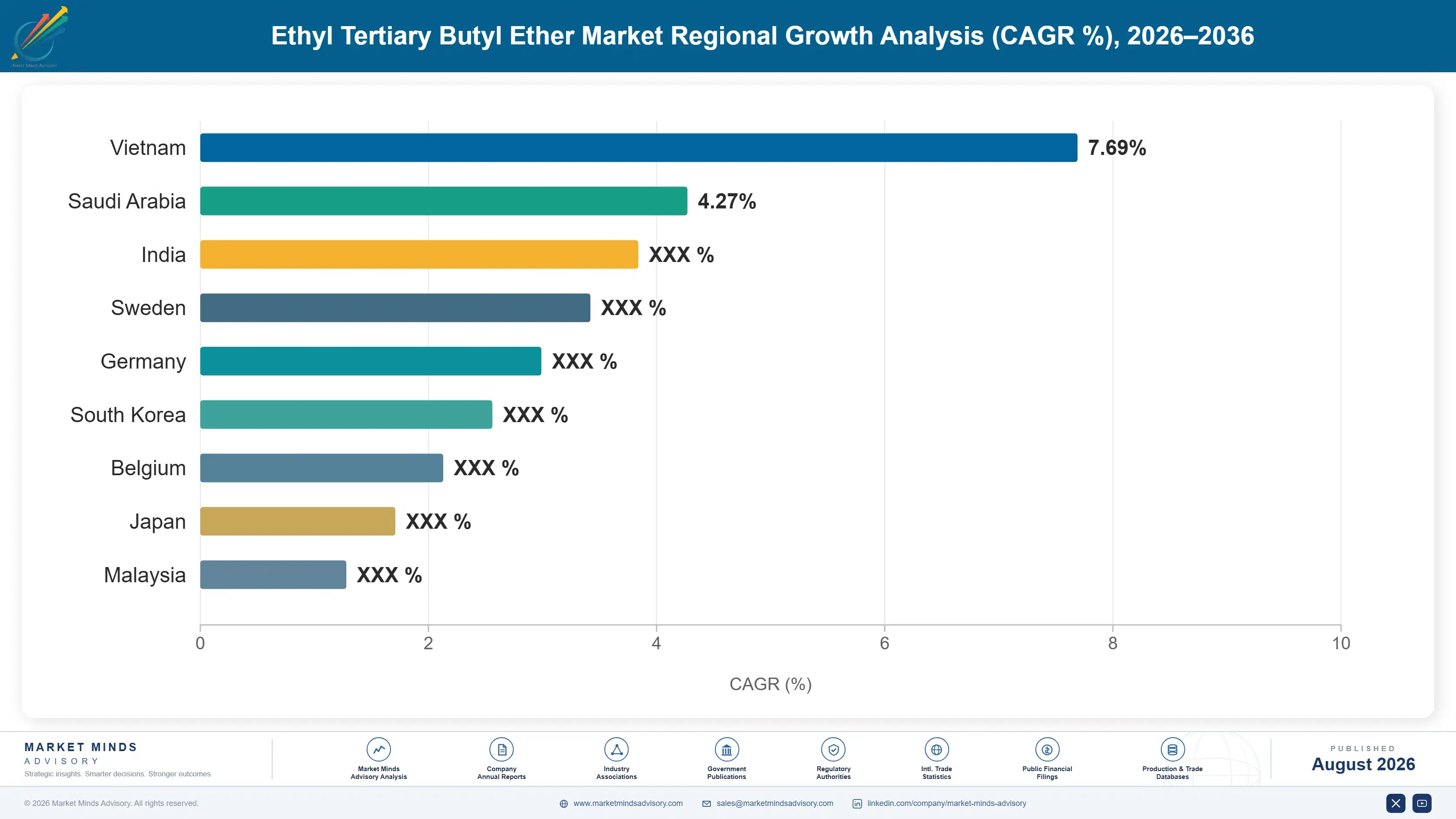
Regional Architecture and Country Demand Map

Regional shares here depart sharply from normal distribution because renewable fuel policy diverged permanently between regions decades ago. Several regions sit well outside typical bands, and the justification for each appears in the relevant commentary below rather than being asserted generally. Gasoline pool direction then varies between them as well.

North America

At 8% this region sits far below its normal share band, and the justification is a policy choice made decades ago: after groundwater contamination from the methanol equivalent, ethers were banned or effectively abandoned across most states and renewable content is delivered through direct ethanol blending instead. The infrastructure, specifications, and regulatory framework all assume that route. What ether production remains serves export and specific octane applications rather than domestic renewable obligations. Refinery isobutylene is instead directed toward alkylate and other octane components. Growth of 4.0% comes from octane demand and export supply rather than from any change in domestic renewable fuel policy. No reversal of that policy choice appears likely.
Share: 8% | CAGR: 4.0% (2026 to 2036)

Western Europe

At 42% this region sits far above its normal band, and the justification is straightforward: European renewable transport obligations combined with tight vapour pressure specifications made the ether route the practical way to raise renewable content beyond direct ethanol limits. Spanish, French, Dutch, German, and Belgian refiners all operate units, frequently converted from methanol ether production when policy shifted. TotalEnergies, Repsol, and Moeve hold substantial capacity. Advanced ethanol credit multipliers under the renewable energy framework raise value per tonne considerably. Growth of 3.2% is the slowest in the report because the gasoline pool this applies to is contracting as electrification advances across the region. Conversions from methanol ether units were widespread.
Share: 42% | CAGR: 3.2% (2026 to 2036)
Regional intelligence for 5 additional markets available in the complete report: East Asia, South Asia and Pacific, Latin America, Middle East and Africa, Eastern Europe. Contact sales@marketmindsadvisory.com.
ethyl-tertiary-butyl-ether-etbe-market-country-cagr-analysis-1787549526551

Four Moves That Change the Economics

Advantage here comes from isobutylene position, feedstock certification, and unit flexibility rather than from etherification technology, which is mature and universally available. Four moves are worth capital and management attention across the forecast period, and one of them is simply retaining an option most producers already hold. The other three require contracts rather than any capital investment.

Secure certified advanced ethanol supply contractually

Renewable schemes count ethanol from waste and residues at multiples of energy content, which raises credit value per tonne for a chemically identical ether well above conventional crop ethanol routes. Certified supply is limited and contested by direct blenders chasing the same volumes, so contracted access rather than spot buying determines who can serve the premium demand. Advanced routes grow at 11.8% against a market at 4.6%, and the premium runs 15 to 30% per tonne. Chain of custody documentation matters as much as the molecule itself does. Availability rather than price is the binding constraint.
Market Impact: Premium runs 15 to 30% higher per tonne

Retain the option to switch between ether products

Etherification units run on either ethanol or methanol with modest modification, producing this molecule or its methanol equivalent depending on which economics and policy favour at any point. Producers preserving that flexibility can follow relative feedstock costs and credit values rather than being locked into one product through a cycle. Switching typically costs under $2 million and takes weeks rather than months. Producers who allowed the capability to lapse through neglect find themselves committed to whichever product the market happens to be punishing at the time. Restoring lapsed capability costs most when it is needed.
Market Impact: Switching costs under $2 million for each unit

Contract bio-isobutylene offtake before scale arrives

Bio-isobutylene would raise renewable content from 47% to essentially complete and drop straight into existing units without any modification whatsoever. Several developers have proven the chemistry and none has reached commercial economics, which makes early offtake agreements cheap to secure now and valuable if any of them succeeds. The molecule produced would be chemically identical, so no requalification or specification work is required at all. Producers signing offtake at demonstration stage hold an option on the transformation this market is waiting for. No requalification or specification work would be needed.
Market Impact: Would lift renewable content beyond the 47% ceiling

Integrate or contract isobutylene supply securely

Isobutylene represents 52% of production cost and comes from catalytic crackers, steam cracker raffinate, or dedicated dehydrogenation, all of which have competing uses in alkylation and polymer chemistry. Refiners with integrated supply convert their own stream at cost while merchant producers buy from parties who may value it more highly elsewhere. That difference sets a permanent floor under merchant cost position. Long-term supply agreements are the practical alternative to integration, and they matter most exactly when octane markets tighten and isobutylene finds better uses. Terms improve when octane markets are soft.
Market Impact: Isobutylene is fully 52% of total production cost

Who Controls the Margin Pool

Concentration is moderate at roughly 44% for the top five, and integration rather than scale explains most of it, since units sit inside refineries whose isobutylene they consume. TotalEnergies, Repsol, and Moeve hold substantial European capacity built around obligation-driven domestic demand. Neste approaches from a renewable fuels position with feedstock certification capability, and LyondellBasell brings chemical producer discipline to what is otherwise a refining business.
Competitive activity runs on three fronts. Isobutylene access is the first and sets cost position permanently, since merchant buyers compete against alkylation and polymer uses. Feedstock certification is the second and determines who can serve the premium advanced ethanol demand. Product flexibility is the third, and it decides who can follow economics between ether products through a cycle. Etherification technology itself is universally available and confers nothing.

Pressure is building from two directions. Electrification erodes the gasoline pool in exactly the regions where this product is used and no commercial response addresses that. And direct ethanol blending advocates argue the ether route adds cost and fossil content for renewable credit that could be delivered more simply. The first is permanent and the second is an argument producers can at least contest on the practical evidence.
ethyl-tertiary-butyl-ether-etbe-market-company-positioning-matrix-1787549527068

Competitive Moat and Risk Dimensions

TOTALENERGIES

Moat: Integrated refining and isobutylene supply

Producing this ether inside refineries that generate their own isobutylene from catalytic cracking removes the 52% cost line that merchant producers must purchase at market prices set by competing alkylation demand. That integration also lets the company direct isobutylene to whichever use earns most at any point, which merchant etherification operators cannot do at all.
TOTALENERGIES

Risk: European gasoline pool contraction

Capacity concentrated in exactly the region where vehicle electrification is reducing petrol consumption fastest means the volume base shrinks regardless of how obligations rise, since a percentage of a smaller pool is less absolute product. Redirecting that capacity requires either export markets or a product switch, and neither fully replaces obligation-driven domestic demand.
NESTE

Moat: Renewable feedstock certification capability

Established capability in sourcing, certifying, and documenting waste and residue feedstocks transfers directly into securing advanced ethanol that earns multiple counting credit, which is where the premium in this market now sits. Chain of custody infrastructure built for renewable diesel serves this purpose without needing to be recreated from nothing.
NESTE

Risk: Limited isobutylene integration position

Without refinery catalytic cracker isobutylene, the 52% feedstock line must be purchased in a market where alkylation and polymer producers may value the molecule more highly. That sets a cost floor no operational improvement crosses, and it becomes most painful precisely when octane demand tightens and isobutylene alternatives become attractive to other buyers.

Players Tracked

Prominent Players

TotalEnergies
Repsol
Moeve
Neste
LyondellBasell

Other Key Players

Eni
PKN Orlen
Shell
SABIC
ENEOS
Idemitsu Kosan
Mitsubishi Chemical
OMV
MOL Group
Preem
Evonik
Gevo
Global Bioenergies
INEOS
Sasol

Recent Developments

MARCH 2025

Producer contracts advanced ethanol supply for credit multiplier

A multi-year agreement secured certified waste-based ethanol qualifying for multiple counting under European renewable rules, raising credit value per tonne of finished ether substantially. Certified supply had tightened as direct blenders competed for the same limited volumes across the region. Volumes were multi-year and substantial.
Signal: Feedstock certificates rather than any chemistry now determine the whole premium available on chemically identical molecules
JULY 2025

Refiner switches unit between ether products on economics

An etherification unit was converted from methanol to ethanol feed to capture renewable credit value that had moved decisively in favour of the ethyl product. Conversion took weeks and cost a fraction of what building dedicated capacity would have required for either product. Margins recovered quickly.
Signal: Unit flexibility lets producers follow the economics that fixed single-product operators simply cannot chase at all
OCTOBER 2025

Indian refiners study ether route beyond ethanol blend wall

Feasibility work began on ether production capacity as direct ethanol blending approached vapour pressure and vehicle compatibility limits that cap practical inclusion. No capital commitment followed, and the assessment covered isobutylene availability alongside blending economics. Isobutylene availability was assessed alongside blending economics and vehicle compatibility questions.
Signal: The blend wall is pushing new markets toward this route, though capital commitment remains genuinely uncertain

What Sets the Cost Base

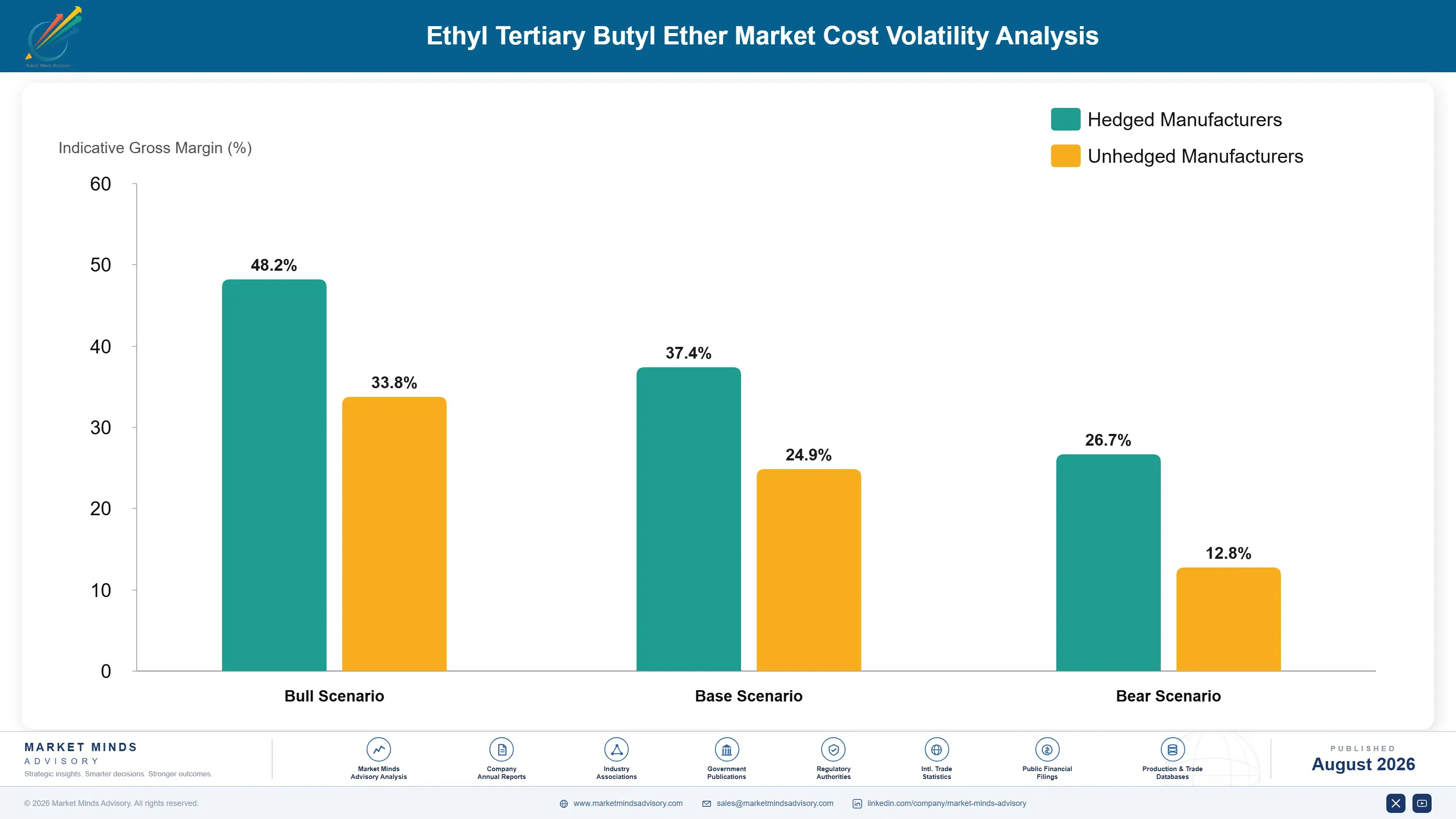
Isobutylene dominates at roughly 52% of production cost, sourced from refinery catalytic crackers, steam cracker raffinate streams, or dedicated isobutane dehydrogenation depending on the site. Ethanol contributes a further 34%, with certified advanced grades costing considerably more than conventional crop ethanol. Catalyst, utilities, and process energy take 8%. Storage, blending logistics, and certification administration absorb the balance across typical producer operations.
Ethanol prices moved sharply through 2021 and 2022 on agricultural conditions and competing demand, while isobutylene followed refinery operating rates and alkylation economics on a quite separate path. TotalEnergies and Neste both referenced feedstock cost and renewable policy effects across their reporting for those years. Certified advanced ethanol tightened further as direct blenders competed for limited supply, which pushed its premium over conventional grades wider than the credit multiplier alone would justify.

Exposure divides on integration rather than on scale. Refiners converting their own isobutylene carry an internal transfer cost while merchant producers buy against alkylation demand that periodically values the molecule more highly. Ethanol exposure divides differently again, with certified advanced supply behaving as a separate and tighter market from conventional grades. Producers holding neither integration nor certified supply occupy the weakest position available in this market.
ethyl-tertiary-butyl-ether-etbe-market-cost-volatility-analysis-1787549527262

Contract advanced ethanol on multi-year certified terms

Certified waste and residue ethanol earns multiple counting credit and is contested by direct blenders chasing the same limited volumes, which makes availability rather than price the binding constraint. Multi-year agreements with certified suppliers secure both. The cost is volume commitment through periods when conventional ethanol would be cheaper, which matters far less than losing premium demand entirely.

Maintain dual feed capability on etherification units

Units run on either ethanol or methanol with modest modification, and preserving that capability lets a producer follow whichever product economics and policy favour. Maintenance costs are modest and the flexibility is worth far more than it costs during any period when relative values move. Producers letting it lapse discover restoration costs most when needed.

Secure isobutylene through long-term supply agreements

Merchant producers compete for isobutylene against alkylation and polymer demand that periodically values it more highly, which creates both price and availability exposure on 52% of cost. Long-term agreements with refiners or dehydrogenation operators secure the stream. Suppliers resist committing volume they may want elsewhere, and terms improve considerably when octane markets are soft rather than tight.

Portfolio Architecture for Margin Defence

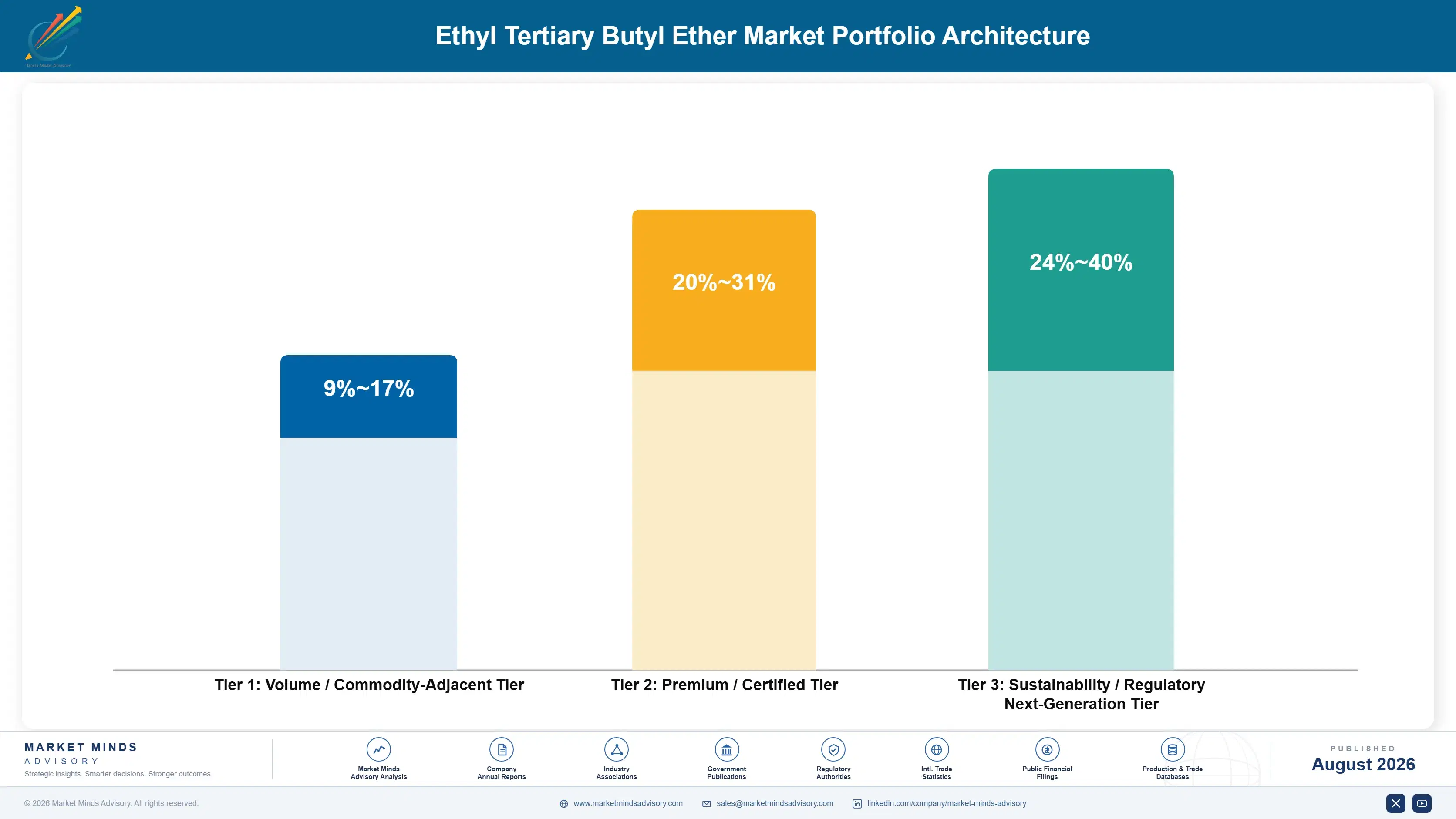
Margin follows credit eligibility and integration rather than volume, on a molecule that is chemically identical whoever makes it. Conventional crop ethanol product sold into obligation markets earns modest returns, because credit value is standard and buyers compare delivered price directly. Advanced feedstock product earns considerably more, since multiple counting raises what an obligated party will pay for the same tonne of identical material. That gap widened as credit multipliers took effect.
The volume and premium tension shows in feedstock allocation rather than in plant loading. A producer with partial certified ethanol access must decide which customers receive the premium product, and the credit is worth far more to an obligated party than to a spot buyer. Allocating it badly wastes a feedstock position that took contracting effort to secure.

High-value pools concentrate in three places: advanced feedstock product earning multiple counting, integrated production converting internal isobutylene, and flexible units able to follow economics between ether products. Each is defended by contracts, asset position, or maintained capability rather than by any technology. Price competition arrives in each only when a competitor secures certified supply, acquires integration, or restores unit flexibility, and the middle one is rarely available at all.

Volume / Commodity-Adjacent Tier

Conventional crop ethanol product sold into obligation markets and spot octane blending. Competes on delivered price against identical material. The wide range reflects large differences between integrated and merchant isobutylene positions.
Gross Margin: 9%-17%

Premium / Certified Tier

Advanced and waste feedstock product carrying multiple counting credit under renewable schemes. The obligated party purchases compliance value rather than the molecule, and chain of custody documentation is the product.
Gross Margin: 20%-31%

Sustainability / Regulatory / Next-Generation Tier

Bio-isobutylene derived product raising renewable content beyond the current ceiling and offtake positions on developing capacity. Regulatory value drives returns entirely. The range is wide because no commercial pricing yet exists.
Gross Margin: 24%-40%
ethyl-tertiary-butyl-ether-etbe-market-portfolio-architecture-1787549527763

High-value Sub-segments and Strategic Watch-out

Advanced Feedstock Certified Product

Multiple counting raises credit value per tonne on chemically identical material, which makes the feedstock certificate the actual product being sold. Certified supply is contested by direct blenders too. Contract it rather than buying spot. Documentation is what actually gets sold. Contract it now. Audit matters.
Gross Margin: 22%-32%

Integrated Refinery Production

Converting internal catalytic cracker isobutylene removes the 52% cost line merchant producers must purchase against competing alkylation demand. That difference is permanent and no operational programme closes it for anyone buying externally. No operational programme closes that gap. Merchant buyers pay more. Integration wins. Buy access.
Gross Margin: 18%-28%

Bio-Isobutylene Offtake Positions

Would raise renewable content beyond the current 47% ceiling and drop into existing units with no modification required at all. Offtake at demonstration stage is cheap and valuable if any developer reaches commercial economics. Sign while terms remain undemanding. Move on offtake early. Cheap today.
Gross Margin: 26%-40%

Conventional Spot Blending Supply

The strategic watch-out. Identical molecules competing on delivered price into a gasoline pool contracting in exactly the regions that use the product. It loads units and covers fixed costs, and nothing more than that. Expect the pool beneath it to shrink. Price it for loading.
Gross Margin: 9%-16%

How Demand Actually Reaches Producers

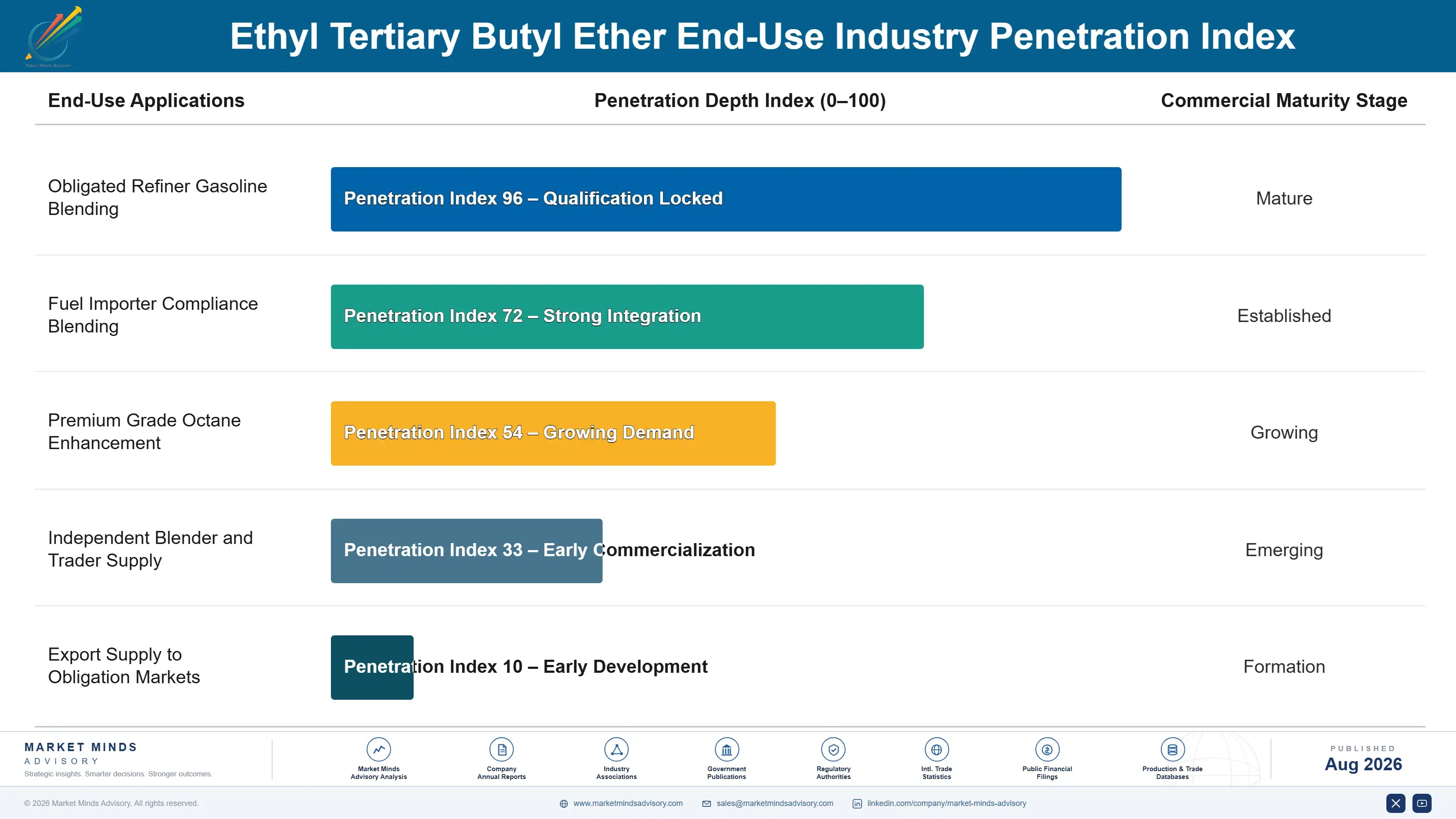
The annuity here is the obligation rather than any customer relationship. Renewable transport fuel obligations require obligated parties to deliver a defined renewable share annually, and this product is one of the few routes to exceeding what direct ethanol blending permits, which makes demand a function of policy arithmetic rather than commercial preference. Obligations rise on published schedules, giving producers unusual forward visibility. What the schedules cannot offset is a gasoline pool contracting beneath the percentage being applied to it.
Adoption depth varies sharply by buyer type. Obligated refiners and importers in Europe and Japan buy to meet legal requirements and cannot substitute freely. Blenders serving premium grades buy for octane value and would continue at reduced volumes without any policy. Spot traders arbitrage between regions and products. Markets using direct ethanol blending do not buy at all, whatever the price.

The buyer has shifted toward compliance and trading functions rather than refinery procurement. Those teams evaluate credit value per tonne, never the chemistry. A producer explaining process advantages to a compliance team is answering a question nobody asked, since what that buyer needs is renewable credit delivered against an obligation with documentation that will survive audit.
ethyl-tertiary-butyl-ether-etbe-market-end-use-penetration-index-1787549528249

Where the Money Sits

These are among the four positions where our research anticipates prominent divergence between winners and laggards over the coming forecast period. Each is grounded in the demand model, the regulatory perimeter, and the announced capacity pipeline.
01 / CERTIFIED FEEDSTOCK CONTRACTING

Lock in advanced ethanol, because the certificate is the product

Renewable schemes count waste and residue ethanol at multiples of its energy content, which raises credit value per tonne of a chemically identical ether well above what conventional crop ethanol routes achieve. Certified supply is limited and contested by direct blenders pursuing exactly the same volumes, so contracted access rather than spot purchasing decides who can serve premium demand at all. The premium runs 15 to 30% per tonne, and chain of custody documentation matters every bit as much as the molecule itself.
02 / UNIT FLEXIBILITY MAINTENANCE

Keep the switch working, because economics move both ways

Etherification units run on either ethanol or methanol with modest modification, producing this molecule or its methanol equivalent depending on which relative economics and policy happen to favour at the time. Switching costs under $2 million and takes weeks rather than months, which makes the option genuinely cheap to hold. Producers who allowed that capability to lapse through neglect find themselves committed to whichever product the market is currently punishing, and restoring flexibility costs most exactly when it is needed.
03 / BIO-ISOBUTYLENE OPTION BUILDING

Sign offtake now, because the molecule needs no requalification

Bio-isobutylene would raise renewable content from the current 47% ceiling to essentially complete and drops straight into existing etherification units with no modification or requalification required whatsoever. Several developers have already demonstrated the chemistry without reaching commercial economics, which makes offtake agreements at this stage cheap to secure and extremely valuable if any of them succeeds. Producers signing early hold a genuine option on the transformation that this entire market has been waiting on for well over a decade now.
04 / ISOBUTYLENE POSITION SECURITY

Own or contract the hydrocarbon half of the molecule

Isobutylene supplies 52% of production cost and comes from catalytic crackers, cracker raffinate, or dehydrogenation, all with competing uses in alkylation and polymer chemistry that periodically value it more highly. Refiners converting internal streams carry a transfer cost while merchant producers pay whatever the alternative use will bear, which sets a permanent floor beneath their whole cost position. Long-term supply agreements remain the only practical alternative available, and the terms available improve considerably when octane markets are soft rather than tight.

Engagement Snapshot From the Field

A live engagement with an industry participant carrying material or product regulatory and market exposure ahead of a defining policy shift, showing how our research translates into a defensible multi-year portfolio strategy.
MARKET MINDS ADVISORY · CLIENT ENGAGEMENT SUMMARY
Ethyl Tertiary Butyl Ether Producer Strategic Portfolio Review and Transition Roadmap 2026·Investment Scenario on Ethyl Tertiary Butyl Ether Exposure Evaluation 2025-26
CLIENT PROFILE
A European merchant producer operating etherification capacity without refinery integration, buying isobutylene on the open market and conventional ethanol on annual contracts, with revenue near EUR 210 million (client-reported, unverified by MMA). Dual feed capability had lapsed through deferred maintenance, and no certified advanced ethanol supply existed. Margin had proved unusually volatile. Integration was never an option.
STRATEGIC CHALLENGE
Integrated refiner competitors were undercutting the client on obligation supply while capturing advanced feedstock premiums it could not access without certified ethanol. An isobutylene price spike driven by alkylation demand had eliminated a year of margin, and the lapsed dual feed capability prevented any switch to the methanol product. Something had to change.
MMA APPROACH
MMA analysed margin against isobutylene sourcing and competitor integration, sized the advanced ethanol premium and certified supply availability, and costed restoration of dual feed capability against its option value. Forty-seven expert interviews with obligated parties, ethanol certifiers, and isobutylene traders established what was contractually achievable. Assumptions proved wrong throughout. Options existed.
KEY FINDINGS
  1. Merchant isobutylene purchasing had cost more across two years than the entire margin earned on obligation supply, and every integrated competitor had been insulated from the same movement.
  2. Certified advanced ethanol commanded a premium the client had assumed was unavailable to merchant producers, and two suppliers were willing to contract multi-year volumes immediately.
  3. Restoring dual feed capability would cost well under two million euros and would have allowed a profitable switch during the period when isobutylene pricing destroyed the client's margin entirely.
  4. Two bio-isobutylene developers were seeking offtake partners at demonstration stage on terms that carried almost no cost until commercial production actually began.
CLIENT PROFILE
A European merchant producer operating etherification capacity without refinery integration, buying isobutylene on the open market and conventional ethanol on annual contracts, with revenue near EUR 210 million (client-reported, unverified by MMA). Dual feed capability had lapsed through deferred maintenance, and no certified advanced ethanol supply existed. Margin had proved unusually volatile. Integration was never an option.
STRATEGIC CHALLENGE
Integrated refiner competitors were undercutting the client on obligation supply while capturing advanced feedstock premiums it could not access without certified ethanol. An isobutylene price spike driven by alkylation demand had eliminated a year of margin, and the lapsed dual feed capability prevented any switch to the methanol product. Something had to change.
MMA APPROACH
MMA analysed margin against isobutylene sourcing and competitor integration, sized the advanced ethanol premium and certified supply availability, and costed restoration of dual feed capability against its option value. Forty-seven expert interviews with obligated parties, ethanol certifiers, and isobutylene traders established what was contractually achievable. Assumptions proved wrong throughout. Options existed.
KEY FINDINGS
  1. Merchant isobutylene purchasing had cost more across two years than the entire margin earned on obligation supply, and every integrated competitor had been insulated from the same movement.
  2. Certified advanced ethanol commanded a premium the client had assumed was unavailable to merchant producers, and two suppliers were willing to contract multi-year volumes immediately.
  3. Restoring dual feed capability would cost well under two million euros and would have allowed a profitable switch during the period when isobutylene pricing destroyed the client's margin entirely.
  4. Two bio-isobutylene developers were seeking offtake partners at demonstration stage on terms that carried almost no cost until commercial production actually began.
RECOMMENDED STRATEGY
Phase 1: Phase one: restore dual feed capability immediately, since the option costs little and would have prevented the margin loss that prompted this review. Phase 2: Phase two: contract certified advanced ethanol on multi-year terms, accessing a premium the business had wrongly assumed integrated competitors monopolised. Phase 3: Phase three: negotiate long-term isobutylene supply and sign bio-isobutylene offtake at demonstration stage while terms remain undemanding. Both cost little now.
OUTCOME
The client restored dual feed capability within four months and contracted certified ethanol covering 46% of throughput. Advanced feedstock product reached premium pricing, an isobutylene supply agreement removed the spot exposure, and blended gross margin improved 5.8 percentage points (client-reported, unverified by MMA). Volatility narrowed considerably too.

Frequently Asked Questions

Foundational context covering the market sizes, CAGR, scope, country, region and competition that inform every finding below. This section is provided to cover basics and most often pre-purchase conversations, answered from the MMA Primary Research Dataset.

What is the current size of the Ethyl Tertiary Butyl Ether Market?

The market was valued at USD 5.2 billion in 2025, rising to an estimated USD 5.44 billion in 2026. Western Europe holds the largest regional share at 42% of global value.

How large will the Ethyl Tertiary Butyl Ether Market be by 2036?

MMA forecasts USD 8.53 billion by 2036 under the base case, an expansion multiple of 1.57 times the 2026 value. That represents USD 3.09 billion of incremental value across the forecast period.

What is the CAGR for the Ethyl Tertiary Butyl Ether Market 2026 to 2036?

The base case CAGR is 4.6%, with a bull case of 5.7% and a bear case of 3.4%. The spread reflects uncertainty over gasoline pool contraction and renewable obligation trajectories.

Which segment is growing fastest?

The bio-isobutylene route grows fastest at 16.4%, roughly 3.57 times the market rate, from an effectively pre-commercial base. Advanced and waste-based ethanol routes follow at 11.8%.

Who are the major companies in the Ethyl Tertiary Butyl Ether Market?

TotalEnergies, Repsol, Moeve, Neste, and LyondellBasell lead on production capacity. The top five hold roughly 44%, with most units sitting inside refineries rather than merchant plants.

Which country is growing fastest?

India grows fastest at 7.4%, as direct ethanol blending reaches the practical ceiling and refiners examine the ether route beyond it. No significant capacity operates there today.

Report Segmentation Architecture

The full report scope spans multiple orthogonal segmentation dimensions, with cross-tabulated demand data provided for each dimension pair. Coverage extends further to regional breakdowns, trend trajectories, and the competitive detail needed to support segment-level decision-making.

By Production Route

  • Refinery Integrated Catalytic Cracker Route
  • Steam Cracker Raffinate Route
  • Dedicated Isobutane Dehydrogenation Route
  • Advanced and Waste-Based Ethanol Route
  • Bio-Isobutylene Route

By End-Use Industry

  • Obligated Refiner Gasoline Blending
  • Fuel Importer Compliance Blending
  • Premium Grade Octane Enhancement
  • Independent Blender and Trader Supply
  • Export Supply to Obligation Markets

By Sales Model

  • Long-Term Obligation Supply Contracts
  • Certified Feedstock Premium Supply
  • Spot and Cargo Trading
  • Internal Refinery Transfer
  • Tolling and Processing Agreements

By Region

  • North America
  • Western Europe
  • East Asia
  • South Asia and Pacific
  • Latin America
  • Middle East and Africa
  • Eastern Europe

Scope, Methodology, and Coverage

Every figure in this report is reproducible from documented input assumptions. The scope below maps the historical period, the forecast horizon, the segmentation dimensions, and the countries covered, alongside the underlying primary and qualitative methodology.
Historical Period
2020 to 2025
Forecast Period
2026 to 2036
Base Year
2025 (USD billions; MMA Primary Research Dataset, August 2026)
Market Definition
The market comprises ethyl tertiary butyl ether supplied as a gasoline oxygenate, octane component, and renewable content carrier, covering refinery integrated production from catalytic cracker isobutylene, steam cracker raffinate route production, dedicated isobutane dehydrogenation route production, advanced and waste-based ethanol production, and bio-isobutylene route production. Value is measured at producer level across contract, spot, and internal transfer sales. Methyl tertiary butyl ether, direct ethanol blending into gasoline, other oxygenates including tertiary amyl ethers, isobutylene sold as a chemical intermediate, and finished gasoline fall outside scope.
Quantitative Units
USD billions (current prices); million tonnes supplied annually; USD per tonne by production route and feedstock certification
Segmentation Dimensions
By Production Route; By End-Use Industry; By Sales Model; By Region
Regions Covered
North America, Western Europe, East Asia, South Asia and Pacific, Latin America, Middle East and Africa, Eastern Europe
Countries Covered
Spain, France, Netherlands, Germany, Belgium, Italy, Portugal, Finland, Sweden, United Kingdom, Poland, Hungary, Czechia, Romania, Slovakia, Japan, South Korea, China, India, Indonesia, Australia, United States, Canada, Mexico, Brazil, Colombia, Argentina, Saudi Arabia, United Arab Emirates, Egypt, South Africa
Key Companies Profiled
TotalEnergies, Repsol, Moeve, Neste, LyondellBasell, Eni, PKN Orlen, Shell, SABIC, ENEOS, Idemitsu Kosan, Mitsubishi Chemical, OMV, MOL Group, Preem, Evonik, Gevo, Global Bioenergies, INEOS, Sasol
Quantitative Methodology
Primary survey, n=3,800 respondents, Q4 2025, six countries; demand-side model with trade association cross-validation
Qualitative Methodology
47 expert interviews, Q4 2025; applied to validate demand model assumptions, identify emerging dynamics, and assess competitive positioning
Report Format
PDF and XLSX data workbook (Word format preview document)
Publisher
Market Minds Advisory
Report Code
MMA-2026-ENE-183
Published
August 2026
Contact
sales@marketmindsadvisory.com | www.marketmindsadvisory.com

Purchase the full Ethyl Tertiary Butyl Ether Market Report (2026 to 2036).

The full report sizes ethyl tertiary butyl ether demand across five production routes, five end-use categories, and seven regions with 2026 to 2036 forecasts under base, bull, and bear cases. It models renewable obligation trajectories against gasoline pool contraction, since the two work against one another directly. Competitive profiles cover twenty producers assessed consistently on production capacity, isobutylene integration, and feedstock certification position. Cost analysis traces isobutylene and ethanol exposure across integrated and merchant positions. Commercial guidance addresses certified feedstock contracting, unit flexibility, bio-isobutylene optionality, and isobutylene supply security.
Five production routes sized separately by region
Renewable obligations modelled against gasoline pool contraction
Advanced feedstock credit multipliers quantified per tonne
Isobutylene integration compared with merchant cost positions
Unit switching economics assessed between ether products
Bio-isobutylene development status tracked across announced projects

Built For The People Who Decide

From boardroom strategy to bench-side execution, this report is read cover-to-cover by leaders shaping the next decade of their industry, turning demand scenarios, market dynamics and valuation benchmarks into decisions.
CXOs/ Presidents/ VPs/ Managers
M&A and Corporate Development
Strategy Teams and R&D Heads
Procurement and Product Directors
Regulatory and Compliance Leaders
Investor Relations and Equity Analysts