Market Minds Advisory
Epoxy Curing Agents Market

Epoxy Curing Agents Market: Amine, Anhydride, and Bio-Based Low-VOC Demand Through 2036

A wind turbine blade cured with the wrong hardener chemistry fails a fatigue test years before anyone expected, and that delayed failure risk is what keeps curing agent selection a formulation decision nobody treats casually.

Lead Analyst

Bilal Shaikh

Published

September 2026

Make Smarter Decisions with Customized Research Insights

Request a free sample report and evaluate market opportunities, growth trends, and competitive dynamics relevant to your business needs.

2025 MARKET VALUE$5.6BMarket Size 2025
2036 FORECAST VALUE$11.1BBase Case , 2026 to 2036
CAGR 2026 TO 20366.4 %Bull 7.6% / Bear 5.2%
INCREMENTAL OPPORTUNITY$5.1BNet 10- year value creation
EXPANSION MULTIPLE1.86x2036 value over 2026 base
Strategic Levers
M&A Pipeline
Regional Outlook
Country Rankings
Competitive Intelligence
Segmental Deep-dive
Call-Us : 91 93563 13602

Executive Snapshot and Market Trajectory

Epoxy curing agents have moved from a formulation afterthought into a specified performance input, as composite manufacturers and electronics assemblers demand documented cure kinetics and mechanical performance that generic hardener chemistries cannot reliably deliver, reshaping how formulators think about cure kinetics as a specified engineering deliverable.
Bio-based and low-VOC curing agents are now the fastest-growing segment, expanding near 10.2% annually as coatings and composites manufacturers respond to tightening environmental regulation, well over 55% faster than the wider market's pace. East Asia anchors close to three tenths of global value through China's dominant coatings, composites, and electronics manufacturing base, while India's expanding composites and electronics manufacturing pulls South Asian demand higher each year, outpacing most other regional and applications-based growth pathways combined.
Competitive intensity concentrates around five global specialty chemical majors that hold decades of formulation expertise and industrial customer relationships, even as regional Chinese and Indian manufacturers compete aggressively on cost for standard amine-based formats. Bio-based formulation capability and documented electronics-grade purity increasingly determine which suppliers capture premium composites and electronics contracts beyond commodity coatings volume, particularly as electronics-grade purity validation becomes a genuine competitive differentiator industry-wide.
Market Definition
The epoxy curing agents market covers commercial production and sale of amine-based, anhydride-based, polyamide and polyamidoamine, latent and heat-activated, bio-based and low-VOC, and specialty electronics-grade curing agents used to cross-link epoxy resins across coatings, composites, adhesives, and electronics applications. It excludes the epoxy resins themselves and downstream cured composite and coating products, which the industry classifies as separate product categories.
Base Year Value
$5.6B in 2025 (MMA Primary Research Dataset, August 2026)
Forecast Period
2026 to 2036, eleven discrete annual values
CAGR
6.4% base case. Bull 7.6%. Bear 5.2%.
Fastest Growth Segment
Bio-Based and Low-VOC Curing Agents: 10.2% CAGR
Fastest Growth Country
India: 9.8% CAGR
Fastest Growth Region
South Asia and Pacific: 8.4% CAGR
Largest Region
East Asia: 30% of 2025 global value
Market Leaders
Huntsman Corporation, Olin Corporation, Cardolite Corporation, Evonik Industries AG, Aditya Birla Chemicals. Source: MMA Analysis based on company annual reports.
Primary Survey
n=3,800 procurement and R&D decision-makers, Q4 2025, six countries
Methodology
Demand-side build-up, cross-validated against public data, 47 expert interviews

Epoxy Curing Agents Market Forecast Scenarios

epoxy-curing-agents-market-trends-size-forecast-scenario-1787549910822
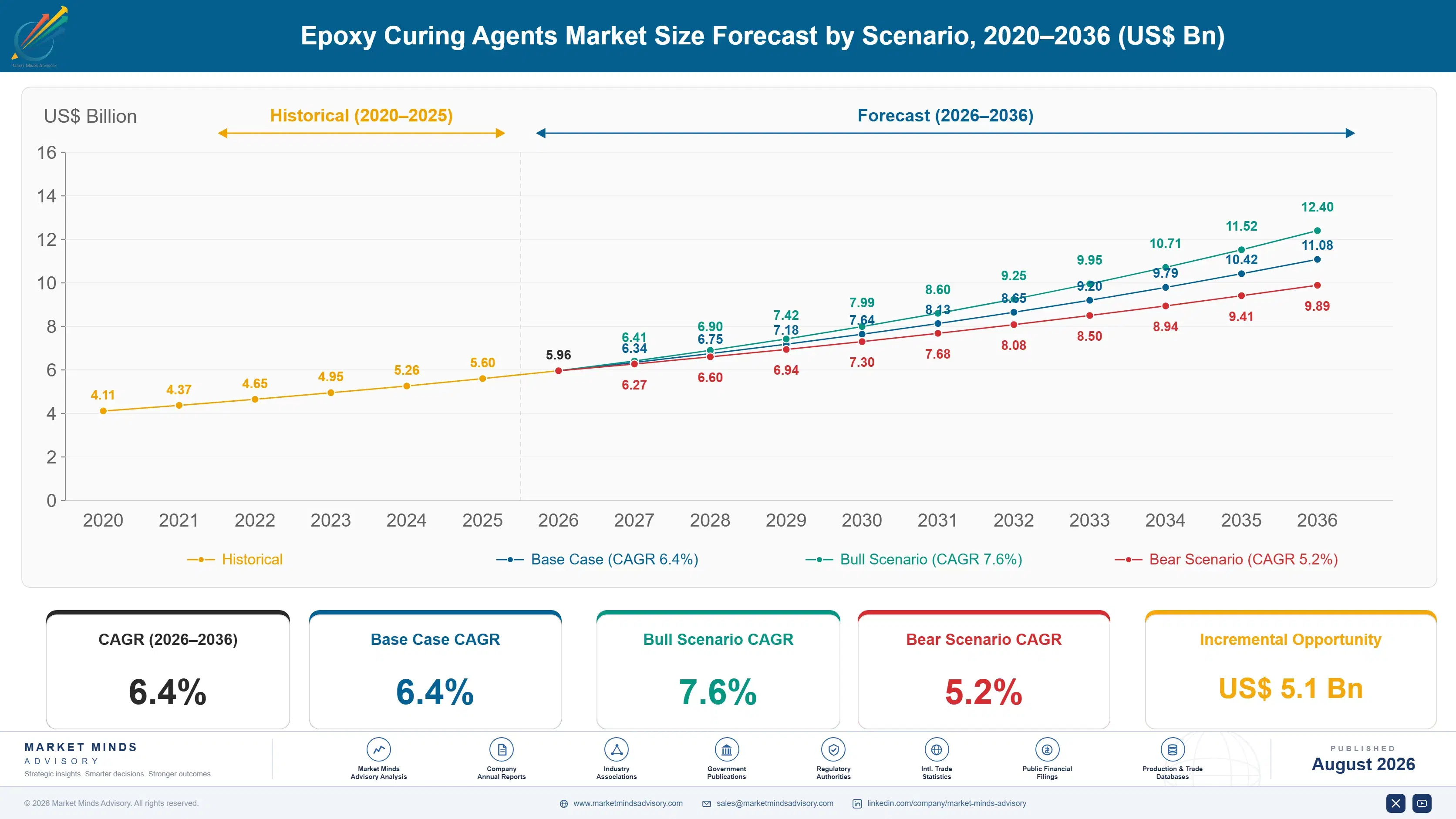
Epoxy curing agent demand grew unevenly from 2020 to 2025, as pandemic-era industrial production disruption briefly constrained volume before bio-based formulation adoption accelerated growth from 2023 onward. Chinese and Indian manufacturing capacity expanded steadily across the period. The market grew at a 5.7% historical CAGR, slower than the forecast pace as bio-based demand only scaled meaningfully in the final two years.
The base case carries epoxy curing agents to a 6.4% CAGR through 2036 on three mechanisms. First, wind energy and composites manufacturers keep specifying advanced curing chemistries to extend blade and structural component fatigue life. Second, environmental regulation keeps tightening across major industrial markets, pushing buyers toward bio-based and lower-VOC formulations. Third, electronics packaging manufacturers keep expanding specialty curing agent specification as semiconductor and EV battery assembly volume grows, particularly across battery packaging and semiconductor encapsulation applications.
The bull case, 7.6%, assumes bio-based and electronics-grade adoption accelerates faster than currently projected as more mid-sized industrial buyers specify the chemistry across a broader range of applications. The bear case, 5.2%, assumes petrochemical feedstock cost inflation and industrial capital spending caution cap premium formulation specification, keeping growth concentrated in standard amine-based formats tied to baseline coatings volume alone.

Curing Chemistry Becomes a Specified Performance Input

Epoxy curing agents now split along a regulatory and performance line rather than a purely commodity one. Standard amine and polyamide formulations, the volume backbone of the category, meet baseline cross-linking requirements at pricing closer to commodity specialty chemicals. Bio-based and electronics-grade formulations instead serve buyers facing tightening discharge regulation or demanding purity requirements, commanding meaningfully higher pricing for documented environmental and performance differentiation across the full product and reliability lifecycle.
MARKET CONCENTRATIONCR5: 42%Top five suppliers hold under half of global sales
AVERAGE SELLING PRICEUSD 4.20 per kilogramPricing varies sharply between standard and specialty formats
TOP PRODUCING COUNTRYChina: 28% of global production volumeDominant coatings and composites manufacturing base anchors output
EXPORT TRADE INTENSITY38% of output crosses a borderCross border trade links formulation hubs to global industrial buyers
FEEDSTOCK COST SHARE44% to 56% of COGSAmine and anhydride feedstock pricing drives significant cost volatility
CURE CYCLE QUALIFICATION TIME6 to 10 months per new applicationQualification timeline shapes recurring specification and renewal revenue
Buyers split sharply by industry segment and sourcing sophistication. Composites and wind energy manufacturers specify advanced curing chemistries engineered for fatigue-resistant structural performance to protect against costly failure and unplanned downtime, requiring cure kinetics data and formulation expertise that commodity suppliers struggle to match consistently. Standard coatings buyers instead specify commodity formulations, competing largely on price per kilogram rather than deep technical differentiation across their broader manufacturing and application portfolios.
Over the next decade, bio-based and electronics-grade formulations should keep pulling value toward higher-margin premium tiers, while Chinese and Indian manufacturing keeps driving the largest underlying volume base for standard formats. Environmental discharge regulation, not composites capital spending alone, increasingly looks like the most durable driver of category-wide formulation upgrades across industrial segments and international markets worldwide.
"A curing agent used to be a maintenance line item nobody scrutinized. Now an engineer can point to a specific hardener chemistry and explain exactly how many fatigue cycles it bought a wind blade."
Director, Specialty Chemicals and Composites Materials Practice · MMA Chemicals and Materials Practice · August 2026

Market Trends

Wind Energy Manufacturers Standardize Advanced Fatigue Chemistries

Wind energy and composites manufacturers have increasingly specified advanced curing agent chemistries engineered for fatigue-resistant structural performance as standard blade manufacturing protocol, treating curing agent selection as a direct lever on component service life rather than a routine commodity purchase handled without technical review. Several major manufacturers now require documented fatigue and cure kinetics testing rather than accepting generic hardener fitment common across earlier composites programs. Suppliers including Huntsman and Olin have invested in dedicated fatigue performance development teams, recognizing that manufacturer contracts increasingly hinge on demonstrated structural life extension data rather than traditional price-per-kilogram metrics alone.
Market Impact: Composites growth adds 3.8 million units

Bio-Based Formulations Expand Beyond Coatings Applications

Bio-based curing agent formulations, once concentrated almost entirely in coatings applications, have expanded meaningfully into composites and adhesives manufacturing, since improved formulation performance and falling production costs have made the chemistry commercially viable across a considerably broader range of applications than earlier generations supported. Several suppliers have already launched bio-based composites-grade product lines priced within reach of mainstream industrial buyers, reflecting genuine technology diffusion rather than incremental feature addition. Suppliers with established bio-based formulation capability are capturing these contracts well ahead of competitors still building comparable green chemistry expertise across nearly every major composites product line.
Market Impact: Compliance-driven demand grows 8.6% annually

Market Opportunities and Growth Drivers

Growing Composites Demand Drives Structural Chemistry Need

Wind energy, aerospace, and automotive manufacturers continue expanding composite structural component specification across their full product range, forcing curing agent suppliers to maintain advanced fatigue-resistant chemistry capability across their full product portfolio rather than treating structural performance as a discretionary formulation choice. Several major composites manufacturers have signaled further structural component investment through the current forecast period specifically, giving suppliers a durable, quantified demand timeline that shapes multi-year production investment rather than one-off program response. That structural durability distinguishes composites curing agent demand from more discretionary standard coatings purchasing elsewhere in the category.
Market Impact: Feedstock volatility compresses margins 13%

Tightening Discharge Regulation Lifts Bio-Based Demand

Persistent regulatory tightening on industrial wastewater discharge continues lifting demand for bio-based and lower-VOC curing agent formulations marketed explicitly on documented environmental compliance, a purchase driver largely absent from standard chemical specification historically. Regulators have responded by publishing stricter discharge threshold requirements directly into industrial permitting processes, a practice that barely existed at current scope before 2022 and now shapes procurement decisions among regulated industrial buyers specifically. Several suppliers have expanded bio-based production capacity to meet this compliance-conscious demand segment particularly across manufacturers operating in jurisdictions where discharge enforcement has intensified measurably in recent years.
Market Impact: Price sensitivity caps uptake at 32%

Market Restraints and Challenges

Amine Feedstock Volatility Compresses Margins Considerably

Amine and anhydride feedstocks together account for over half of production cost for epoxy curing agents, and both inputs face significant price volatility tied to broader petrochemical and specialty amine markets that formulators cannot easily hedge through long-term contracts alone. The underlying cause is that curing agent feedstock production competes directly against broader chemical intermediate demand for the same limited petrochemical capacity, giving formulators limited alternative sourcing options during supply shortfalls. That volatility compresses margins hardest for formulators without vertically integrated feedstock production. Several suppliers are responding by expanding bio-based and recycled material substitution research.
Market Impact: Advanced fatigue chemistry grows 9.0%

Premium Pricing Limits Standard Industrial Adoption

Bio-based and electronics-grade curing agent chemistries carry meaningful pricing premiums over standard formulations, and many industrial buyers, in price-sensitive coatings segments, continue choosing conventional amine formats despite documented performance and compliance benefits that premium chemistries offer over the coating's service life. The underlying cause is that coatings buyers typically weigh upfront chemical spend more heavily than lifecycle performance value, especially where capital budgets remain constrained across broader industrial operations. That price sensitivity limits how quickly premium chemistry penetration can grow in cost-conscious industrial markets. Suppliers are responding by developing tiered bio-based options priced closer to standard formulations.
Market Impact: Bio-based formulation demand grows 10.2% yearly
3 additional market trends, 4 additional growth drivers, and 3 additional restraints and challenges are covered in the full report. Contact sales@marketmindsadvisory.com to access the complete intelligence.

Segment CAGR and Growth Architecture

Segmentation follows chemistry type, a single classification logic separating epoxy curing agents by cross-linking mechanism rather than by sales channel or customer type. Amine, anhydride, polyamide, latent, bio-based, and electronics-grade formats each carry distinct manufacturing requirements and buyer occasions, keeping upstream chemistry and downstream application channels from blurring together across industrial segments across composites and electronics channels alike.
epoxy-curing-agents-market-trends-market-share-analysis-1787549911352

Bio-Based and Low-VOC Curing Agents

Bio-based and low-VOC curing agents are growing at 10.2% annually, well over 55% faster than the wider market's 6.4% pace, as coatings and composites manufacturers respond to tightening environmental discharge regulation that standard amine-based formulations increasingly struggle to satisfy. This format requires green chemistry formulation expertise distinct from conventional curing agent manufacturing, since matching bio-based compound performance to established amine and anhydride benchmarks demands considerable research investment across cure kinetics and mechanical performance testing. Retail and industrial pricing for bio-based curing agents runs well above standard formats, reflecting both formulation investment and buyer willingness to pay for documented environmental compliance. Huntsman and Olin have both prioritized capital investment in dedicated bio-based production, positioning the segment to capture continuing regulatory-driven growth.
CAGR 10.2%

Specialty Electronics-Grade Curing Agents

Specialty electronics-grade curing agents grow at 9.0% annually, driven by semiconductor packaging and EV battery assembly manufacturers specifying ultra-high-purity formulations that standard industrial-grade chemistries cannot adequately serve. This segment commands meaningful premium pricing over standard formats, reflecting both formulation complexity and the genuine purity validation involved in matching electronics-grade specifications across varied packaging and assembly conditions. Several suppliers have expanded electronics-grade specification across broader semiconductor and battery programs, extending a technology once reserved for specialized aerospace applications into mainstream electronics manufacturing. Capacity expansion has proceeded among established electronics-grade suppliers, though specialized purity control expertise limits how quickly new entrants can credibly compete in this demanding segment across an expanding range of semiconductor packaging platforms.
CAGR 9.0%
Full segment breakdown across 6 segments available in the complete report.

Regional Architecture and Country Demand Map

Epoxy curing agent production and consumption concentrate in East Asia, anchored by China's dominant coatings, composites, and electronics manufacturing base. India carries the fastest country-level growth, as its expanding composites and electronics manufacturing pulls South Asian demand higher across the forecast period Established Chinese manufacturing continues reinforcing this concentration.

North America

United States demand anchors North American epoxy curing agent consumption, driven by the country's large wind energy and composites manufacturing base and extensive industrial coatings infrastructure requiring continuous formulation supply. Huntsman and Olin maintain substantial domestic manufacturing and formulation engineering capacity serving both composites and coatings channels simultaneously. Canada follows a similar consumption pattern at smaller scale, with comparable wind energy and industrial coatings trends. Mexico's growing petrochemical manufacturing role adds further regional production capacity supporting cross-border industrial supply chains. Growth here tracks close to the global average, reflecting a mature, diversified buyer base spanning both premium bio-based fitment and steady standard coatings demand Growing indie composites manufacturing activity adds further incremental demand nationwide.
Share: 23% | CAGR: 6.2% (2026 to 2036)

Western Europe

Western Europe's epoxy curing agent demand centers on Germany, France, and the United Kingdom, where Evonik and established European chemical manufacturers maintain deep regional formulation engineering presence built around decades of European industrial chemistry leadership. The European Union's tightening environmental discharge regulation forces manufacturers to maintain comprehensive bio-based product coverage rather than offering green chemistry as a niche option. Italy and the Netherlands contribute additional demand tied to expanding wind energy and industrial processing infrastructure across the region specifically. Growth trails East Asia and South Asia and Pacific as the region's industrial base is already mature, with incremental regulatory tightening representing gradual formulation upgrades rather than underlying capacity expansion Poland's growing chemical manufacturing role adds modest supporting demand.
Share: 19% | CAGR: 5.0% (2026 to 2036)
Regional intelligence for 5 additional markets available in the complete report: East Asia, South Asia and Pacific, Latin America, Middle East and Africa, Eastern Europe. Contact sales@marketmindsadvisory.com.
epoxy-curing-agents-market-trends-country-cagr-analysis-1787549911874

Where Formulators Can Capture Margin

Margin defense in epoxy curing agents increasingly depends on moving beyond commodity chemistry pricing toward positioning that lets a formulator charge for documented bio-based compliance, fatigue performance data, or electronics-grade purity. The four moves below target the fastest-growing buyer segments most willing to pay well above standard pricing for genuine differentiation across composites and electronics channels.

Build Bio-Based Formulation Capability Broadly Now

Bio-based curing agents engineered for documented environmental compliance command retail and industrial pricing running well above standard amine formulations, and demand from regulated industrial buyers has grown faster than the industry's dedicated green chemistry capability currently available across major specialty chemical makers. Suppliers that invest in bio-based formulation research now capture premium industrial contracts before competitors establish comparable technical capability, since regulators increasingly push buyers toward lower-VOC chemistry as a baseline requirement. The formulation investment requires meaningful research capacity, but the roughly 27% margin uplift over standard formats justifies the cost for most established formulators.
Market Impact: Bio-based formulation typically commands roughly a 27% premium

Expand Fatigue Performance Data Partnerships Now

Advanced fatigue-resistant chemistries backed by documented structural life extension data command premium pricing over standard formulations, and demand from wind energy and composites manufacturers has grown faster than the industry's dedicated fatigue testing capability currently available across established formulators. Suppliers that secure fatigue performance partnerships with manufacturers now capture premium contracts before competitors establish comparable validated performance data, since manufacturers increasingly favor documented structural life extension in supplier qualification criteria. The testing investment requires field deployment and monitoring infrastructure, but the roughly 21% pricing premium and reduced component failure risk it provides justifies the cost for suppliers pursuing composites-linked growth.
Market Impact: Fatigue performance data typically commands a 21% premium

Develop Electronics-Grade Purity Capability Rapidly Now

Electronics-grade curing agents command substantial premium pricing over standard industrial formats, and demand from semiconductor packaging and EV battery manufacturers has grown faster than the industry's dedicated purity validation capacity currently available across established suppliers. Suppliers that invest in purity control infrastructure now capture contracts from manufacturers specifying ultra-high-purity chemistry as standard equipment across expanding electronics and battery programs. The purity investment requires meaningful capital and specialized testing infrastructure, but the roughly 24% margin premium this segment commands justifies the cost for suppliers serving precision-sensitive markets well ahead of broader category adoption.
Market Impact: Electronics-grade purity typically adds roughly a 24% premium

Secure Long-Term Industrial Supply Contracts Now

Industrial buyers increasingly prefer multi-year curing agent supply commitments over spot purchasing across major manufacturing and capital programs, since supply disruption during scheduled production windows carries operational continuity risk that buyers cannot easily absorb given coordinated shutdown scheduling. Suppliers that secure these contracts now lock in demand and pricing before competitors capture the same industrial accounts, since buyers rarely switch curing agent suppliers once a formulation has been validated for a specific asset. The contracting investment requires engineering capacity, but the multi-year revenue visibility, typically locking in roughly 19% more contracted volume than spot sourcing, justifies the cost for formulators.
Market Impact: Long-term contracts typically lock in 19% more volume

Who Controls the Margin Pool

Competitive concentration sits at a moderate CR5 of 42%, reflecting a market split between large global specialty chemical majors competing on formulation expertise and industrial customer relationships, and regional Chinese and Indian manufacturers competing on cost for standard amine-based formats. The gap between category leaders and mid-tier challengers remains built on decades of formulation engineering expertise and industrial sourcing relationships.
Competitive activity currently runs along three lines. Global specialty chemical majors compete on bio-based formulation depth and fatigue performance program breadth, applying research expertise smaller competitors cannot easily replicate. Regional Chinese and Indian manufacturers compete on cost and proximity to expanding domestic industrial production. Electronics-grade specialists compete on purity validation and formulation precision, since access to documented purity data increasingly determines who wins premium semiconductor packaging contracts.

Pressure is building from two directions. Chinese domestic manufacturers are moving upmarket into premium bio-based formulation, challenging global majors on territory once defensible through decades of research investment. Fatigue performance data is becoming a differentiator, rewarding suppliers willing to fund testing infrastructure over those competing on generic formulation pricing. Rankings over the next five years will favor whoever combines bio-based formulation depth with credible fatigue performance validation.
epoxy-curing-agents-market-trends-company-positioning-matrix-1787549912395

Competitive Moat and Risk Dimensions

HUNTSMAN CORPORATION

Moat: Deep formulation research scale

Huntsman holds decades of curing agent chemistry research and industrial sourcing relationships across major global composites and coatings buyers that newer entrants, domestic or international, cannot replicate on any reasonable timeline, giving it program access and formulation credibility that smaller specialized competitors genuinely struggle to match across industrial and composites segments alike.
HUNTSMAN CORPORATION

Risk: Exposed to commodity margin pressure

Huntsman's substantial standard formulation revenue base remains exposed to continuing pricing pressure from Chinese and Indian manufacturers, and the company must increasingly rely on bio-based and electronics-grade segment growth to offset that persistent margin headwind facing its largest historical revenue category over the next several years across multiple product categories and geographic markets simultaneously.
OLIN CORPORATION

Moat: Established composites industry relationships

Olin maintains substantial composites and wind energy industry sourcing relationships and formulation support expertise built through decades of North American industrial chemistry presence, giving it commercial credibility and program access that competitors lacking comparable composites relationships cannot easily replicate across similarly demanding structural performance programs spanning multiple product categories and markets.
OLIN CORPORATION

Risk: Smaller electronics-grade capability scale

Olin's more limited direct electronics-grade purity validation scale relative to specialized suppliers limits how quickly it can capture premium semiconductor packaging contracts, potentially constraining its ability to capture the full electronics growth opportunity without additional validation investment or a strategic partner across multiple product categories and geographic markets simultaneously.

Players Tracked

Prominent Players

Huntsman Corporation
Olin Corporation
Cardolite Corporation
Evonik Industries AG
Aditya Birla Chemicals

Other Key Players

Hexion Inc
Kukdo Chemical Co Ltd
Atul Ltd
Gabriel Performance Products Inc
Air Products and Chemicals Inc
BASF SE
Solvay SA
Sika AG
Anhui Sun-Chemical Co Ltd
Wuxi Xingda Resin Co Ltd
Nan Ya Plastics Corporation
Mitsubishi Chemical Corporation
Songwon Industrial Co Ltd
Chang Chun Group
Wanhua Chemical Group Co Ltd

Recent Developments

APRIL 2024

Huntsman launches next-generation bio-based curing agent platform

Huntsman launched a new bio-based curing agent platform engineered specifically for regulated coatings and composites applications, integrating documented biodegradability data with expanded compatibility testing for premium industrial programs. The launch was an organic product introduction, not a joint venture or acquisition of any competing supplier.
Signal: Signals established specialty chemical majors investing directly in bio-based formulation ahead of confirmed regulatory tightening requirements.
SEPTEMBER 2024

Kukdo Chemical expands electronics-grade production capacity in South Korea

Kukdo Chemical announced expanded electronics-grade curing agent production capacity at its domestic Korean facilities, responding directly to growing semiconductor manufacturer demand for ultra-high-purity chemistry ahead of continued packaging demand growth. The expansion was an organic capacity investment, not a joint venture or acquisition of any regional manufacturer.
Signal: Signals established electronics-grade suppliers scaling advanced capability well ahead of continued semiconductor packaging demand growth trajectory.
JANUARY 2025

Olin acquires minority stake in fatigue testing venture

Olin acquired a minority equity stake in a composites fatigue testing technology venture to strengthen its direct structural validation presence across North America ahead of anticipated wind energy demand growth. The transaction was a minority equity investment, not a full acquisition, merger, or joint venture arrangement.
Signal: Signals established formulators building dedicated fatigue testing capability rather than relying entirely on third-party technology suppliers alone.

Amine and Anhydride Costs Set The Floor

Amine and anhydride feedstocks account for 44% to 56% of production cost for epoxy curing agents, sourced from traded petrochemical supply chains whose pricing tracks plastics and chemical intermediate markets rather than any curing-agent-specific supply and demand pattern. Bio-based formulation production carries a different feedstock cost structure than conventional formats, reflecting the agricultural and biological input sourcing needed for green chemistry manufacturing.
The 2022 petrochemical price spike illustrated input cost exposure directly. EIA and commodity market data recorded key petrochemical intermediate prices reaching multi-year highs through 2022 as refining capacity tightened following pandemic-era disruption and supply constraints. Formulators without hedged contracts or diversified sourcing absorbed cost increases, passing some cost through to industrial customers who had few alternative sourcing options at the time particularly across smaller regional refining operations lacking diversified crude sourcing.

Exposure falls hardest on smaller regional formulators without long-term feedstock contracts or diversified sourcing relationships, who must buy amine and anhydride inputs closer to spot pricing and absorb whatever margin compression results from commodity market volatility. Larger diversified specialty chemical majors with established feedstock hedging and geographic sourcing diversification smooth that volatility considerably better than smaller, less capitalized regional competitors currently exposed to full commodity market swings.
epoxy-curing-agents-market-trends-cost-volatility-analysis-1787549912590

Lock Long-Term Feedstock Supply Contracts

Formulators negotiating multi-year amine and anhydride supply agreements convert volatile spot pricing into a planned input cost, protecting downstream industrial pricing that resists frequent adjustments across long maintenance program cycles. This favors larger established formulators with existing purchasing relationships, but smaller formulators can access similar terms through regional purchasing consortia rather than negotiating individually across multiple production sites.

Diversify Feedstock Sourcing Across Suppliers

Formulators reduce single-source commodity exposure by sourcing amine and anhydride intermediates across multiple regional suppliers rather than depending entirely on any single relationship for the majority of material volume. That diversification smooths input availability across different regional commodity cycles, though it adds supplier qualification complexity across each additional sourcing relationship a formulator incorporates into its network.

Accelerate Bio-Based Feedstock Substitution

Formulators reduce petrochemical dependence by substituting agricultural and biologically derived feedstocks into curing agent formulations, capturing input diversification that pure petrochemical sourcing cannot achieve at comparable scale. This substitution strategy suits larger formulators with dedicated research capacity best, but delivers durable cost stability that persists regardless of future petrochemical market volatility across multiple industrial segments.

Portfolio Architecture for Margin Defence

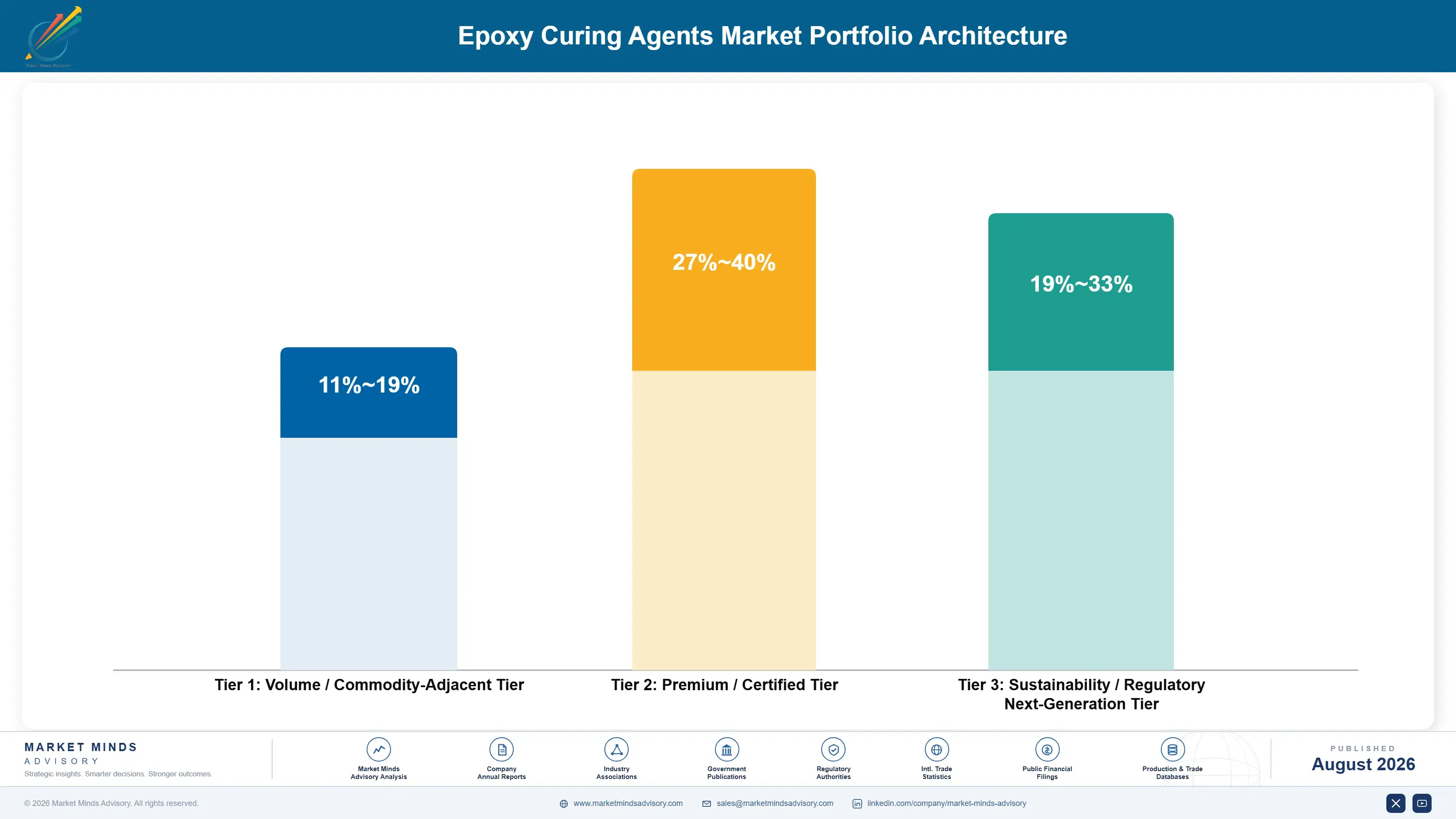
Epoxy curing agents' portfolio splits into three tiers with meaningfully different margin economics. Volume standard amine and polyamide formulations, sold through established industrial distribution channels on price and delivered volume, compete on cost and earn steady but thin margins. Bio-based and electronics-grade premium chemistries earn substantially more, since documented environmental compliance and purity differentiation create switching costs commodity formulators cannot replicate quickly.
The tension for formulators is capital allocation between two economics. Volume standard chemistry production generates dependable cash flow that funds operations and formulation research, while bio-based and electronics-grade capacity requires meaningful research and specialized manufacturing investment before generating comparable returns at much higher margin. Formulators leaning entirely on standard volume risk losing share to faster-growing differentiated competitors, while those chasing premium investment too aggressively risk underutilized capacity if regulatory-driven demand proves slower than currently projected.

High-value margin pools concentrate in bio-based and electronics-grade chemistries carrying genuine environmental or purity differentiation that standard formats cannot match. Frontier opportunity sits in combining verified bio-based compliance with credible fatigue performance validation, letting formulators capture premium pricing from both composites and electronics channels while retaining steady standard chemistry revenue simultaneously.

Volume / Commodity-Adjacent Tier

Standard amine and polyamide formulations sold through established industrial distribution channels on price and delivered volume, priced close to comparable specialty chemicals with minimal differentiation between competing regional formulators reflecting minimal differentiation across the broad commodity segment.
Gross Margin: 11-19%

Premium / Certified Tier

Bio-based and electronics-grade chemistries carrying documented environmental compliance and purity validation that commands sustained premiums over standard formats across regulated industrial buyers and electronics manufacturers worldwide reflecting genuine environmental and purity differentiation across the category.
Gross Margin: 27-40%

Sustainability / Regulatory / Next-Generation Tier

Emerging fully biodegradable and next-generation ultra-high-purity formulation formats designed to serve increasingly demanding environmental and precision requirements ahead of continued regulatory tightening, though feedstock scale-up economics remain largely unproven at full commercial volume today.
Gross Margin: 19-33%
epoxy-curing-agents-market-trends-portfolio-architecture-1787549913093

High-value Sub-segments and Strategic Watch-out

Bio-Based and Low-VOC Curing Agents

Bio-based demand grows fastest at 10.2% annually and already commands pricing well above conventional formulations. Global majors investing in green chemistry capability and regulated buyers expanding compliance-driven programs both continue growing, and rising environmental scrutiny should keep margin strong through the forecast period ahead considerably.
Gross Margin: 27-40%

Specialty Electronics-Grade Curing Agents

Electronics-grade demand grows at a healthy 9.0% annually, driven by semiconductor packaging specification, though specialized purity control expertise limits how quickly new entrants can credibly compete in this technically demanding and quality-critical segment currently commanding strong margins near the category's premium range near the upper end of the range.
Gross Margin: 25-38%

Amine-Based Curing Agents

Amine-based formulations remain the largest format by volume, anchored by decades of established maintenance specification across mainstream industrial operations globally. Margins stay steady but modest, competing on price and delivered volume rather than differentiation, but the segment anchors baseline category revenue across nearly every market worldwide.
Gross Margin: 11-19%

Anhydride-Based Curing Agents

Anhydride-based demand faces gradual competitive pressure as bio-based and amine formats increasingly specify comparable protection performance under tightening environmental scrutiny, narrowing the addressable market for legacy anhydride chemistry. Producers concentrated purely in this segment risk volume erosion absent diversification into premium formats across nearly every regional market tracked.
Gross Margin: 13-21%

Why Industrial Supply Contracts Run Long

Epoxy curing agent demand behaves like an annuity within industrial supply relationships, since buyers validate a formulation through extended field and compatibility testing and then source against that formulation for the asset maintenance lifecycle rather than re-tendering routinely, given the failure and warranty risk of switching mid-program. Standard maintenance buyers behave less predictably, since purchasing decisions follow individual budget cycles and spot availability rather than long-term supply commitment.
Stickiness varies sharply by buyer type and asset criticality. Composites and wind energy manufacturers rarely switch curing agent suppliers once a formulation has been validated for a specific asset, given the requalification and structural failure exposure involved in switching mid-program across a multi-year cycle. Standard industrial buyers show less loyalty, comparing compatible formulations on price and delivery reliability for each purchase decision. Regulated electronics programs sit in between, valuing compliance expertise without the single-supplier commitment standard maintenance procurement lacks.

Buyer profiles are shifting generationally within both composites and industrial channels specifically. Environmental compliance officers increasingly treat bio-based formulation as a non-negotiable purchase criterion rather than a routine maintenance decision, a shift that favors suppliers offering documented environmental and fatigue performance differentiation over those competing purely on generic price compliance alone.
epoxy-curing-agents-market-trends-end-use-penetration-index-1787549913581

Where Formulators Should Bet

These are among the four positions where our research anticipates prominent divergence between winners and laggards over the coming forecast period. Each is grounded in the demand model, the regulatory perimeter, and the announced capacity pipeline.
01 / BIO-BASED FORMULATION PRIORITY

Build green chemistry capability before regulatory demand outpaces supply

Bio-based demand is growing well over 55% faster than the wider market's pace, and premium formulations already command meaningful pricing above standard chemistries, yet most formulators still lack dedicated green chemistry capability at meaningful commercial scale. Formulators that invest now in bio-based research position ahead of continuing regulatory-driven demand growth across every major industrial market. Waiting risks ceding the category's fastest-growing and highest-margin segment permanently to competitors currently building that formulation capability at meaningful commercial scale across every major regional market and production line configuration.
02 / FATIGUE PERFORMANCE DATA STRATEGY

Secure manufacturer testing partnerships before validated data becomes scarce

Advanced fatigue chemistries command meaningful premium pricing, and demand from wind energy and composites manufacturers has grown considerably faster than the industry's dedicated fatigue testing capability currently available across established formulators. Suppliers that secure fatigue performance partnerships now capture premium contracts before competitors establish comparable validated performance data, since manufacturers increasingly favor documented structural life extension in supplier qualification. Every formulator without a testing strategy today risks losing this genuine differentiation opportunity to competitors already locking in field validation, leaving significant pricing power on the table.
03 / ELECTRONICS PURITY DEVELOPMENT

Build purity control capability before precision demand accelerates further

Electronics-grade curing agents command substantial premium pricing, and demand from semiconductor packaging and EV battery manufacturers has grown considerably faster than the industry's dedicated purity validation capacity currently available across established suppliers. Suppliers that invest now in purity control capture contracts from manufacturers before competitors establish comparable specialized manufacturing capability. Every supplier relying purely on standard industrial-grade formats risks missing this fast-growing, technically differentiated revenue opportunity entirely, ceding ground to competitors already scaling specialized capacity across multiple electronics programs across every major regional market.
04 / LONG-TERM PROGRAM CONTRACTS

Lock industrial buyers into multi-year supply agreements now

Industrial buyers increasingly prefer multi-year curing agent supply commitments over spot purchasing across new maintenance and capital program development, since supply disruption during scheduled maintenance windows carries genuine operational continuity risk that buyers cannot comfortably absorb given tightly coordinated shutdown scheduling. Suppliers that secure these contracts now lock in demand and pricing before competitors capture the same industrial accounts, since buyers rarely switch curing agent suppliers once a formulation has been validated. Every supplier relying purely on spot sales risks missing the category's most durable and valuable revenue opportunity entirely.

Engagement Snapshot From the Field

A live engagement with an industry participant carrying material or product regulatory and market exposure ahead of a defining policy shift, showing how our research translates into a defensible multi-year portfolio strategy.
MARKET MINDS ADVISORY · CLIENT ENGAGEMENT SUMMARY
Epoxy Curing Agents Producer Strategic Portfolio Review and Transition Roadmap 2026·Investment Scenario on Epoxy Curing Agents Exposure Evaluation 2025-26
CLIENT PROFILE
A mid-sized North American wind turbine blade component manufacturer approached MMA while evaluating whether to transition its curing agent product line toward bio-based formulations ahead of anticipated environmental regulation tightening. The client reported annual chemical procurement spending near USD 38 million, with standard petrochemical-based formulations representing roughly 80% of volume and facing gradual multi-year regulatory pressure (client-reported, unverified by MMA).
STRATEGIC CHALLENGE
Management faced a strategic decision between investing in bio-based formulation qualification ahead of anticipated regulation or continuing with standard formulations until compliance requirements forced a transition. The engineering team worried qualification investment would strain budgets before regulatory certainty existed, while the commercial team worried delayed transition would leave the company scrambling to comply once new discharge rules took effect.
MMA APPROACH
MMA benchmarked bio-based qualification investment requirements and typical customer conversion rates across comparable composites manufacturers that had completed similar transitions, assessed the client's existing engineering capability relative to bio-based formulation requirements, and evaluated which customer segments offered the most commercially attractive early transition pathway given the client's current product portfolio.
KEY FINDINGS
  1. Comparable manufacturers that transitioned to bio-based formulations ahead of regulatory deadlines captured meaningfully higher customer retention than manufacturers that waited for mandatory compliance timelines.
  2. Formulation qualification costs, while substantial, were largely recoverable within roughly three years given the premium pricing bio-based contracts commanded over standard petrochemical formulations.
  3. The client's existing engineering team possessed transferable formulation chemistry experience from prior product development, reducing the incremental research investment required compared with a fully new entrant.
  4. A phased transition approach targeting the client's most regulation-exposed customer segment first allowed validation of the conversion model before committing to broader portfolio-wide reformulation.
CLIENT PROFILE
A mid-sized North American wind turbine blade component manufacturer approached MMA while evaluating whether to transition its curing agent product line toward bio-based formulations ahead of anticipated environmental regulation tightening. The client reported annual chemical procurement spending near USD 38 million, with standard petrochemical-based formulations representing roughly 80% of volume and facing gradual multi-year regulatory pressure (client-reported, unverified by MMA).
STRATEGIC CHALLENGE
Management faced a strategic decision between investing in bio-based formulation qualification ahead of anticipated regulation or continuing with standard formulations until compliance requirements forced a transition. The engineering team worried qualification investment would strain budgets before regulatory certainty existed, while the commercial team worried delayed transition would leave the company scrambling to comply once new discharge rules took effect.
MMA APPROACH
MMA benchmarked bio-based qualification investment requirements and typical customer conversion rates across comparable composites manufacturers that had completed similar transitions, assessed the client's existing engineering capability relative to bio-based formulation requirements, and evaluated which customer segments offered the most commercially attractive early transition pathway given the client's current product portfolio.
KEY FINDINGS
  1. Comparable manufacturers that transitioned to bio-based formulations ahead of regulatory deadlines captured meaningfully higher customer retention than manufacturers that waited for mandatory compliance timelines.
  2. Formulation qualification costs, while substantial, were largely recoverable within roughly three years given the premium pricing bio-based contracts commanded over standard petrochemical formulations.
  3. The client's existing engineering team possessed transferable formulation chemistry experience from prior product development, reducing the incremental research investment required compared with a fully new entrant.
  4. A phased transition approach targeting the client's most regulation-exposed customer segment first allowed validation of the conversion model before committing to broader portfolio-wide reformulation.
RECOMMENDED STRATEGY
Phase 1: Phase 1 (0 to 9 months): Develop and validate bio-based formulations for the client's most regulation-exposed customer segment to test the conversion model. Phase 2: Phase 2 (9 to 24 months): Expand bio-based formulation availability across additional customer segments based on validated conversion performance from the initial phase. Phase 3: Phase 3 (24 to 42 months): Complete full portfolio transition to bio-based formulations and formalize long-term customer supply agreements ahead of regulatory deadlines.
OUTCOME
The client completed its initial bio-based formulation phase and secured meaningfully higher retention among its most regulation-exposed customers within the first year of the engagement. The client is now evaluating expansion to additional customer segments based on the initial phase's documented performance (client-reported, unverified by MMA).

Frequently Asked Questions

Foundational context covering the market sizes, CAGR, scope, country, region and competition that inform every finding below. This section is provided to cover basics and most often pre-purchase conversations, answered from the MMA Primary Research Dataset.

What is the current size of the Epoxy Curing Agents Market?

The global epoxy curing agents market reached USD 5.96 billion in 2026, based on MMA Primary Research Dataset findings. Growth increasingly reflects bio-based and electronics-grade demand rather than standard coatings volume alone.

How large will the Epoxy Curing Agents Market be by 2036?

MMA's base case projects the market reaching USD 11.08 billion by 2036, an incremental opportunity of roughly USD 5.12 billion over the 2026 to 2036 forecast period.

What is the CAGR for the Epoxy Curing Agents Market 2026 to 2036?

The base case CAGR is 6.4%, with a bull case of 7.6% and a bear case of 5.2% depending on bio-based adoption pace and petrochemical feedstock cost conditions.

Which segment is growing fastest?

Bio-based and low-VOC curing agents lead at a 10.2% CAGR, well over 55% faster than the overall market rate, as coatings and composites manufacturers respond to tightening environmental discharge regulation.

Who are the major companies in the Epoxy Curing Agents Market?

Leading participants include Huntsman Corporation, Olin Corporation, Cardolite Corporation, Evonik Industries AG, and Aditya Birla Chemicals, assessed on formulation and testing program breadth worldwide across composites, coatings, and electronics application segments.

Which country is growing fastest?

India leads country-level growth at 9.8% annually, driven by its rapidly expanding composites and electronics manufacturing, ahead of every other emerging chemical manufacturing market and its rapidly growing electronics assembly sector.

Report Segmentation Architecture

The full report scope spans multiple orthogonal segmentation dimensions, with cross-tabulated demand data provided for each dimension pair. Coverage extends further to regional breakdowns, trend trajectories, and the competitive detail needed to support segment-level decision-making.

By Chemistry Type

  • Amine-Based Curing Agents
  • Anhydride-Based Curing Agents
  • Polyamide and Polyamidoamine Curing Agents
  • Latent and Heat-Activated Curing Agents
  • Bio-Based and Low-VOC Curing Agents
  • Specialty Electronics-Grade Curing Agents

By End-Use Industry

  • Wind Energy and Composites Manufacturing
  • Industrial Coatings and Protective Finishes
  • Electronics and Semiconductor Packaging
  • Adhesives and Structural Bonding
  • Automotive and Aerospace Manufacturing

By Commercial Dimension

  • Direct Industrial Supply Contracts
  • Distributor and Channel Sales
  • Fatigue Testing and Validation Services
  • Bio-Based Formulation Licensing Partnerships

By Region

  • North America
  • Western Europe
  • East Asia
  • South Asia and Pacific
  • Latin America
  • Middle East and Africa
  • Eastern Europe

Scope, Methodology, and Coverage

Every figure in this report is reproducible from documented input assumptions. The scope below maps the historical period, the forecast horizon, the segmentation dimensions, and the countries covered, alongside the underlying primary and qualitative methodology.
Historical Period
2020 to 2025
Forecast Period
2026 to 2036
Base Year
2025 (USD billions; MMA Primary Research Dataset, August 2026)
Market Definition
The epoxy curing agents market covers commercial production and sale of amine-based, anhydride-based, polyamide and polyamidoamine, latent and heat-activated, bio-based and low-VOC, and specialty electronics-grade curing agents used to cross-link epoxy resins across coatings, composites, adhesives, and electronics applications. It excludes the epoxy resins themselves and downstream cured composite and coating products, which the industry classifies as separate product categories.
Quantitative Units
USD billions (current prices); metric tons of curing agent produced and sold where applicable
Segmentation Dimensions
By Chemistry Type; By End-Use Industry; By Commercial Dimension; By Region
Regions Covered
North America, Western Europe, East Asia, South Asia and Pacific, Latin America, Middle East and Africa, Eastern Europe
Countries Covered
USA, China, Germany, France, UK, Japan, South Korea, India, Australia, Canada, Brazil, Mexico, Indonesia, Vietnam, Thailand, Malaysia, UAE, Saudi Arabia, South Africa, Nigeria, Turkey, Poland, Netherlands, Italy, Spain, Sweden, Switzerland, Argentina, Colombia, Singapore, and additional markets relevant to this sector
Key Companies Profiled
Huntsman Corporation, Olin Corporation, Cardolite Corporation, Evonik Industries AG, Aditya Birla Chemicals, Hexion Inc, Kukdo Chemical Co Ltd, Atul Ltd, Gabriel Performance Products Inc, Air Products and Chemicals Inc, BASF SE, Solvay SA, Sika AG, Anhui Sun-Chemical Co Ltd, Wuxi Xingda Resin Co Ltd, Nan Ya Plastics Corporation, Mitsubishi Chemical Corporation, Songwon Industrial Co Ltd, Chang Chun Group, Wanhua Chemical Group Co Ltd
Quantitative Methodology
Primary survey, n=3,800 respondents, Q4 2025, six countries; demand-side model with trade association cross-validation
Qualitative Methodology
47 expert interviews, Q4 2025; applied to validate demand model assumptions, identify emerging dynamics, and assess competitive positioning
Report Format
PDF and XLSX data workbook (Word format preview document)
Publisher
Market Minds Advisory
Report Code
MMA-2026-CHM-105
Published
August 2026
Contact
sales@marketmindsadvisory.com | www.marketmindsadvisory.com

Purchase the full Epoxy Curing Agents Market Report (2026 to 2036).

The full MMA Epoxy Curing Agents report sizes the market across six chemistry type segments, five end-use industries, four commercial supply models, and seven regions through 2036. It profiles twenty participants on a consistent basis of formulation and testing program breadth across standard, bio-based, and electronics-grade formats, scoring each on green chemistry investment, fatigue validation depth, and electronics purity readiness. Scenario models quantify how regulatory tightening, composites demand, and feedstock cost conditions move both category volume and pricing. The report includes petrochemical cost modeling, a bio-based formulation benchmark, and fatigue performance validation pathway assessment built for industrial and investment strategy teams.
Six-chemistry demand model with compliance-adjusted pricing
Amine and anhydride cost volatility modeling
Bio-based formulation pathway benchmarking scoring model
Twenty-company competitive profiling on consistent program basis
Seven-region demand map with country-level growth detail
Fatigue performance and electronics purity assessment

Built For The People Who Decide

From boardroom strategy to bench-side execution, this report is read cover-to-cover by leaders shaping the next decade of their industry, turning demand scenarios, market dynamics and valuation benchmarks into decisions.
CXOs/ Presidents/ VPs/ Managers
M&A and Corporate Development
Strategy Teams and R&D Heads
Procurement and Product Directors
Regulatory and Compliance Leaders
Investor Relations and Equity Analysts