Market Minds Advisory
Enterprise A2P SMS Market

Enterprise A2P SMS Market: Enterprise A2P SMS Market. Trends and Forecast 2026 to 2036

Rich communication services adoption and rising OTP fraud concerns are pushing enterprises toward richer, more secure business messaging channels, forcing legacy plain SMS aggregators to defend volume against faster-moving RCS-native platform entrants.

Lead Analyst

Published

September 2026

Make Smarter Decisions with Customized Research Insights

Request a free sample report and evaluate market opportunities, growth trends, and competitive dynamics relevant to your business needs.

2025 MARKET VALUE$21.5BMarket Size 2025
2036 FORECAST VALUE$55.5BBase Case , 2026 to 2036
CAGR 2026 TO 20369.0 %Bull 10.2% / Bear 7.8%
INCREMENTAL OPPORTUNITY$32.0BNet 10- year value creation
EXPANSION MULTIPLE2.37x2036 value over 2026 base
Strategic Levers
M&A Pipeline
Regional Outlook
Country Rankings
Competitive Intelligence
Segmental Deep-dive
Call-Us : 91 93563 13602

Executive Snapshot and Market Trajectory.

Enterprise A2P SMS volume keeps growing steadily even as buyers shift budget toward richer RCS business messaging, since one-time password verification and transactional alerts still require the universal reach only plain SMS delivers reliably. Enterprises treat SMS as a compliance-critical fallback channel even while shifting marketing budget toward richer formats.
Demand concentrates around one-time password verification, banking alerts, and e-commerce order confirmation, where enterprises value guaranteed delivery over messaging richness entirely. RCS business messaging is emerging as the fastest growing category, since brands want verified sender badges and rich media within regulated marketing campaigns. Geographic concentration remains heaviest across East Asia's massive mobile subscriber base, though India's enterprise messaging volume is expanding rapidly alongside its digital payments infrastructure growth.
Competitive intensity concentrates among five providers holding a combined 38% revenue share, reflecting a fragmented aggregator market where regional carriers and CPaaS platforms compete simultaneously for enterprise contracts. Artificial intelligence-driven fraud filtering is reshaping vendor roadmaps, as operators increasingly block unverified sender traffic reaching consumers without spam screening. Suppliers lacking this filtering risk losing contracts to rivals with stronger carrier ties. This filtering shift is reshaping which providers even qualify for large enterprise contracts.
Market Definition
This report covers application-to-person SMS and RCS business messaging services purchased by enterprises for transactional, promotional, and authentication communications with consumers through mobile carrier networks. It excludes person-to-person consumer SMS traffic, over-the-top messaging apps like WhatsApp and WeChat operating outside carrier billing relationships, and voice or email-based enterprise communications channels.
Base Year Value
$21.5B in 2025 (MMA Primary Research Dataset, September 2026)
Forecast Period
2026 to 2036, eleven discrete annual values
CAGR
9.0% base case. Bull 10.2%. Bear 7.8%.
Fastest Growth Segment
RCS Business Messaging Platforms: 15.5% CAGR
Fastest Growth Country
India: 12.5% CAGR
Fastest Growth Region
South Asia and Pacific: 11.4% CAGR
Largest Region
East Asia: 28% of 2025 global value
Market Leaders
Leading participants include Sinch, Twilio, Infobip, Vonage, and MessageBird. Source: MMA Primary Research Dataset, July 2026.
Primary Survey
n=3,800 procurement and R&D decision-makers, Q4 2025, six countries
Methodology
Demand-side build-up, cross-validated against public data, 47 expert interviews

Enterprise A2P SMS Market Forecast Scenarios

enterprise-application-to-person-sms-market-size-forecast-scenario-1788678310273
Enterprise A2P SMS demand grew roughly 8.0% between 2020 and 2025, as pandemic-driven e-commerce and digital banking adoption pushed enterprises toward SMS-based verification carrier networks worked steadily to accommodate across most global markets. Suppliers report demand rebuilding steadily as digital transformation initiatives accelerated messaging platform integration across banking and retail verticals. Suppliers report demand rebuilding steadily throughout this period.
The base case assumes 9.0% growth through 2036, anchored by three commercial mechanisms. First, rising OTP fraud concerns are pushing enterprises toward AI-driven fraud filtering services commanding premium pricing over basic messaging. Second, RCS business messaging is accelerating as major mobile operating systems default consumers into rich messaging. Third, emerging market payment growth is driving transactional messaging volume beyond mature markets alone. These mechanisms compound as enterprises bundle SMS, RCS, and fraud filtering into single platform contracts.
The bull case centers on RCS carrier interoperability spreading faster than currently rolled out across additional networks, opening richer revenue sooner than expected. The bear case centers on over-the-top apps displacing SMS for consumer communications, limiting A2P growth to transactional use cases with fewer promotional opportunities. Both scenarios hinge on carrier interoperability pace and messaging app adoption trends across the largest markets MMA tracks.

Where Delivery Trust Determines Vendor Selection

A2P SMS providers compete on delivery reliability and carrier relationship depth rather than unit price alone, since enterprises pay a considerable premium for guaranteed delivery of time-sensitive authentication and transactional messages. Providers that cannot demonstrate this reliability lose enterprise contracts entirely regardless of underlying cost advantages. This barrier sustains higher margins over bulk consumer messaging, since enterprises rarely switch providers once a delivery relationship proves consistent across peak periods.
MARKET CONCENTRATIONCR5 38%Five providers hold under half the total revenue
AVERAGE MESSAGE PRICE$0.004 per SMSOTP messages command a considerable pricing premium above this
TOP PRODUCING COUNTRY SHAREChina 22%Largest single national contributor to global message volume
DELIVERY RATE REQUIREMENT99.5% minimumEnterprise contracts increasingly specify strict guaranteed delivery thresholds
RCS SHARE OF REVENUE14% of totalRich messaging formats command a growing share of spending
FRAUD FILTERING ADOPTIONRising across all segmentsEnterprises increasingly demand AI-driven sender verification capability today
RCS business messaging is displacing basic SMS across marketing and promotional use cases, since rich media and verified sender badges directly improve consumer engagement and brand trust. This shift favors providers with strong carrier interoperability relationships over those optimized purely for basic SMS delivery volume. Providers investing early in verified sender registration are capturing design wins ahead of rivals optimized purely for basic text-based messaging.
AI-driven fraud filtering represents an emerging competitive differentiator beyond traditional delivery reliability, as mobile operators increasingly block unverified sender traffic that previously reached consumers unchecked. This diversification is creating new competitive openings for providers with strong data science and carrier relationship capability. Providers with established operator partnerships are best positioned, while pure aggregators without direct carrier relationships face a longer path here.
"Enterprises don't buy SMS on price anymore. They buy it because a competitor's OTP message got flagged as spam during a launch, and nobody wants that call twice."
Senior Analyst, Enterprise Communications and Messaging Practice · MMA Technology Practice · September 2026

Market Trends

RCS Business Messaging Displaces Basic SMS Marketing

Major mobile operating system defaults are pushing consumers into rich communication services messaging experiences, giving enterprises verified sender badges and rich media capability that basic SMS marketing campaigns cannot match. This shift is happening faster than most aggregators' product roadmaps anticipated, since carrier interoperability rollout accelerated meaningfully once major device manufacturers committed to universal RCS support. Providers with mature RCS carrier relationships are winning new enterprise contracts across retail and financial services, while providers optimized purely for basic SMS delivery are being excluded from these premium marketing budget allocations entirely.
Market Impact: OTP volume grew 32% overall

AI-Driven Fraud Filtering Becomes Carrier Requirement

Mobile operators in multiple countries are mandating AI-driven sender verification and fraud filtering before allowing enterprise traffic onto their networks, responding to rising consumer complaints about fraudulent OTP and phishing messages reaching subscribers unchecked. This regulatory-style requirement is large enough that several aggregators are now developing dedicated fraud filtering product lines specifically to maintain carrier network access rather than treating this as an optional value-added service. Aggregators able to demonstrate compliant filtering are retaining carrier relationships that competitors lacking this capability are losing entirely. This shift is only accelerating further as consumer complaints continue rising.
Market Impact: Payment messaging grew 38%

Market Opportunities and Growth Drivers

Rising OTP Volume Drives Sustained Message Traffic

Enterprises across banking, e-commerce, and digital identity verification are requiring one-time password confirmation for a growing share of consumer transactions, driving sustained message volume growth even as other communication channels shift toward richer formats. This demand carries genuine urgency since regulatory requirements around transaction authentication in several major markets mandate SMS-based verification for certain financial services categories. Providers with the deepest carrier network reach and highest delivery reliability enjoy meaningfully stronger enterprise retention than newer entrants, since a single delivery failure during a critical authentication moment can end an enterprise relationship immediately.
Market Impact: OTT displacement cut SMS volume 22%

Digital Payment Expansion Fuels Emerging Market Growth

Rapid digital payment adoption across emerging markets, particularly India and Southeast Asia, is driving substantial new enterprise messaging demand as banks and payment providers send transaction confirmations, balance alerts, and fraud notifications to a rapidly expanding base of first-time digital finance users. This growth is concentrated among providers with strong local carrier relationships and regulatory compliance capability specific to each national market's messaging requirements. Providers able to navigate local sender registration and content approval processes are capturing a disproportionate share of this emerging market growth ahead of competitors. This trend is only strengthening further.
Market Impact: Compliance adds 30% to launch timelines

Market Restraints and Challenges

Over-the-Top Apps Displace SMS for Consumer Use

WhatsApp, WeChat, and similar over-the-top messaging apps continue displacing traditional SMS for everyday consumer communication in many markets, reducing the baseline consumer familiarity that once made SMS the default enterprise messaging channel. The root cause is these apps offering richer features, lower marginal cost for consumers, and cross-border functionality SMS cannot easily replicate given carrier-based pricing structures. The commercial impact is enterprises increasingly treating SMS as a compliance-critical fallback rather than a primary engagement channel. Providers are mitigating this shift by expanding into omnichannel messaging platforms spanning SMS, RCS, and popular messaging apps together.
Market Impact: RCS adoption grew 45% since 2023

Fragmented Regulatory Requirements Complicate Cross-Border Messaging

Enterprises operating across multiple countries face genuinely different sender registration, content approval, and data privacy requirements in each national jurisdiction, unlike a harmonized global messaging standard that would simplify multinational campaign deployment. This fragmentation is rooted in each country's independent telecommunications and consumer protection regulatory framework, with no international coordination mechanism forcing alignment. The commercial impact is longer, costlier multinational campaign launches requiring separate compliance configuration per country. Providers are mitigating this friction by building modular, country-specific compliance packs that can be assembled without full platform reconfiguration. This burden falls hardest on smaller providers lacking dedicated compliance teams.
Market Impact: Fraud filtering covers 40% of carriers
4 additional market trends, 3 additional growth drivers, and 2 additional restraints and challenges are covered in the full report. Contact sales@marketmindsadvisory.com to access the complete intelligence.

Segment CAGR and Growth Architecture

Enterprise A2P messaging demand splits across six segments by message type and use case, reflecting how authentication, transactional, and promotional messaging diverge sharply across delivery requirements and pricing models. RCS business messaging is growing fastest as rich media adoption accelerates. Promotional SMS campaigns remain the slowest-growing category, serving established use cases with limited displacement risk near term.
enterprise-application-to-person-sms-market-market-share-analysis-1788678310833

RCS Business Messaging Platforms

This segment covers rich communication services messaging that embeds verified sender badges, high-resolution images, interactive buttons, and carousel product displays directly within the native messaging app rather than requiring a separate branded app download. Demand is concentrated among retail and financial services enterprises seeking richer consumer engagement than basic SMS can deliver while retaining the universal reach messaging apps requiring installation cannot match. Providers with mature carrier interoperability relationships across major mobile networks are capturing the overwhelming majority of new enterprise contracts in this segment, while providers optimized purely for basic SMS delivery struggle to compete on the rich media capability these programs increasingly specify as a baseline requirement. MMA expects this share to keep growing.
CAGR 15.5%

AI-Driven Fraud Filtering and Sender Verification

This segment covers AI-driven systems that verify sender authenticity and filter fraudulent or spam messages before they reach mobile network delivery infrastructure, addressing rising consumer complaints about phishing and scam messages reaching subscribers unchecked. Demand is accelerating as mobile operators increasingly mandate this filtering as a condition of network access rather than treating it as an optional enterprise add-on service. Providers able to demonstrate compliant, effective filtering are retaining carrier relationships that competitors lacking this capability are losing entirely, creating a distinct competitive dynamic where data science capability, not just messaging volume, determines market access. Vendors serving multiple national markets report stronger revenue growth than those relying on a single regulatory jurisdiction alone.
CAGR 13.0%
Full segment breakdown across 6 segments available in the complete report.

Regional Architecture and Country Demand Map

Regional demand tracks mobile subscriber base and digital payment adoption closely. East Asia leads through massive enterprise messaging volume, while South Asia and Pacific expands rapidly through digital finance growth across large mobile-first economies. Fragmented sender registration requirements shape which providers can scale efficiently across these fastest-growing secondary markets.

North America

The United States hosts the largest concentration of CPaaS platform headquarters globally, anchored by Twilio, Vonage, and Sinch North American operations serving enterprise customers across banking, retail, and healthcare verticals directly. Strict regulatory requirements around consumer consent and spam prevention shape provider compliance investment more heavily here than in less regulated markets. Canada contributes a smaller but meaningful share through banking and telecom sector transactional messaging tied closely to its own financial services regulatory framework and cross-border enterprise relationships with the United States. This regulatory environment favors established providers with dedicated compliance teams over newer entrants without comparable investment in consent management infrastructure. Canada's smaller market benefits directly from shared compliance infrastructure and cross-border enterprise messaging relationships.
Share: 24% | CAGR: 8.0% (2026 to 2036)

Western Europe

Germany, France, and the United Kingdom maintain substantial enterprise messaging volume, though growth here trails the global average as mature markets already completed most of their initial SMS adoption during the prior decade. GDPR-driven consent requirements push regional providers toward stricter compliance processes than less regulated markets require. RCS carrier interoperability rollout across the region has progressed more slowly than in North America, limiting near-term upside for providers positioned primarily around rich messaging capability rather than basic transactional volume. Several providers are now focusing investment on fraud filtering and compliance automation rather than raw messaging volume growth, seeking genuine differentiation. Early results suggest this focus is paying off among enterprises prioritizing brand safety over raw volume.
Share: 19% | CAGR: 7.3% (2026 to 2036)
Regional intelligence for 5 additional markets available in the complete report: East Asia, South Asia and Pacific, Latin America, Middle East and Africa, Eastern Europe. Contact sales@marketmindsadvisory.com.
enterprise-application-to-person-sms-market-country-cagr-analysis-1788678311427

How Providers Grow Enterprise Contract Value

Providers serving enterprise messaging customers are shifting revenue strategy beyond basic per-message pricing toward fraud filtering subscriptions, rich messaging upsell, and multi-country compliance packages that deepen enterprise dependency and lift retained contract value considerably over time. Filtering depth, rich messaging capability, and compliance automation now separate providers expanding wallet share from those merely defending existing volume contracts.

Bundle Fraud Filtering Into Core Messaging Contracts

Providers are folding AI-driven fraud filtering directly into base messaging pricing rather than billing separately, removing a recurring negotiation point that previously created renewal friction with cost-sensitive enterprise customers. This bundling raises perceived value without requiring a separate sales conversation, since customers increasingly view carrier-mandated filtering as a baseline expectation rather than a premium add-on. Providers report this approach lifts average contract value by roughly 20% compared to itemized filtering billing while also reducing customer churn risk during carrier compliance audits. Several providers now market this bundling explicitly as a compliance guarantee to strengthen renewal conversations with risk-averse customers.
Market Impact: Bundled filtering lifts contract value by roughly 20%

Cross-Sell RCS Rich Messaging Into Existing Accounts

Providers are running structured upsell campaigns targeting existing SMS customers who have not yet adopted RCS business messaging, rather than treating rich messaging as a feature reserved for new customer acquisition alone. This approach converts an already-committed customer base into incremental revenue without the acquisition cost of a competitive sales cycle. Providers executing disciplined cross-sell programs report RCS attach rates reaching roughly 26% of the installed base within eighteen months of launch. Providers with dedicated customer success teams report meaningfully higher attach rates than those relying on account managers alone for this upsell.
Market Impact: Cross-sell campaigns reach roughly 26% of all accounts

Offer Multi-Country Compliance Packages for Global Brands

Providers are packaging sender registration, content approval, and data privacy compliance across multiple countries into a single managed service for multinational enterprise customers, removing the burden of navigating fragmented regulatory requirements independently. This packaging captures recurring compliance management revenue that previously went uncaptured once initial campaign launch concluded. Providers offering this bundled compliance report renewal contract value roughly 25% higher than providers selling messaging without an attached compliance management commitment. Multinational brands increasingly cite this managed compliance service as a deciding factor during competitive provider evaluations across regions. This service also deepens the provider relationship considerably.
Market Impact: Compliance packages lift renewal value by 25% overall

License Fraud Detection Models to Smaller Aggregators

Providers with mature fraud detection capability are licensing their detection models to smaller regional aggregators lacking the data science investment to build comparable capability independently, capturing licensing revenue while strengthening relationships with potential future acquisition targets. This licensing arrangement also spreads fraud detection capability across a broader industry base than any single provider could support alone. Providers pursuing this strategy report licensing revenue capturing roughly 12% of the licensee's total messaging revenue. This arrangement also strengthens relationships that could lead to future acquisition opportunities as smaller aggregators seek exit paths.
Market Impact: Licensing captures roughly 12% of the licensee's revenue

Who Controls the Margin Pool

Five providers hold a combined 38% revenue share, a fragmented concentration reflecting how regional carriers and local aggregators still capture meaningful volume alongside global platforms. Sinch and Twilio lead as the two largest providers with the broadest carrier coverage, while the gap to smaller regional challengers remains narrower than in more consolidated categories. Infobip, Vonage, and MessageBird round out the top five, each defending distinct regional strongholds.
Activity centers on delivery reliability and fraud filtering rather than price, since enterprises weight guaranteed delivery and compliance far above per-message cost. Providers are racing to demonstrate RCS carrier interoperability ahead of competitors, since being first to secure rich messaging in a market often locks out rivals during that cycle. Providers unable to demonstrate this speed risk losing contracts to rivals with stronger relationships in that market.

Emerging pressure is coming from regional aggregators in fast-growing markets like India narrowing the gap with global platforms faster than anticipated, aided by deep local carrier relationships. Rankings could shift if RCS adoption accelerates further, favoring providers with the strongest carrier interoperability over those optimized primarily for basic SMS volume. Providers with strong local compliance capability inside key growth markets are best positioned for this shift.
enterprise-application-to-person-sms-market-company-positioning-matrix-1788678311959

Competitive Moat and Risk Dimensions

SINCH

Moat: Broadest Global Carrier Coverage

Sinch maintains direct carrier relationships across more countries than most competitors, built through years of acquisitions consolidating regional aggregators into a unified global platform. This breadth lets multinational enterprises manage messaging across every market from a single vendor relationship, a convenience large brands value highly during platform consolidation.
SINCH

Risk: Integration Complexity Across Acquisitions

Sinch's carrier coverage stems from multiple acquisitions carrying distinct legacy billing and technical architectures, creating internal integration complexity that can slow unified product roadmap execution compared with smaller, more focused rivals moving faster on new capability. Rivals with unified, purpose-built platforms can iterate faster on new features without reconciling multiple legacy technical architectures.
TWILIO

Moat: Strong Developer Platform Adoption

Twilio built its reputation on developer-friendly APIs and extensive documentation that made it the default choice for software teams building messaging into applications, creating switching costs once engineering teams have deeply integrated its platform into production systems. This depth is difficult for newer, less mature platforms to replicate given the years of developer trust already built.
TWILIO

Risk: Higher Pricing Than Regional Rivals

Twilio's premium developer experience commands pricing that regional aggregators with direct carrier relationships and lower overhead can frequently undercut, particularly in price-sensitive emerging markets where enterprises weigh cost more heavily than platform sophistication. This gap is narrowing gradually as Twilio expands lower-cost tiers to compete more directly in these price-sensitive segments.

Players Tracked

Prominent Players

Sinch
Twilio
Infobip
Vonage
MessageBird

Other Key Players

Route Mobile
Kaleyra
CLX Communications
Tanla Platforms
Karix Mobile
AMD Telecom
BICS
iBasis
Comviva
Mitto AG
Plivo
TeleSign
Prestige IT Solutions
Gupshup
textmarketer

Recent Developments

AUGUST 2025

Sinch acquired a regional aggregator specializing in Indian carrier relationships in August 2025 to strengthen its position in the country's rapidly expanding digital payment messaging market, addressing a segment where local competitors previously held significant share. The acquisition closed within the same quarter across all target markets.
Signal: Signals providers racing to capture fast-growing digital payment demand through targeted acquisition ahead of expected rival moves in this segment
NOVEMBER 2025

Twilio entered a partnership with a major RCS technology provider in November 2025 to accelerate carrier interoperability rollout for enterprise customers, securing earlier access to rich messaging capability than competitors relying solely on internal development timelines. The partnership targets deployment across several major carrier networks simultaneously.
Signal: Signals providers pursuing partnerships to accelerate rich messaging capability ahead of rivals where Twilio previously had limited direct presence
FEBRUARY 2026

Infobip launched an expanded AI-driven fraud filtering product line in February 2026, targeting enterprise customers facing rising OTP phishing attempts and carrier-mandated compliance requirements. The launch followed eighteen months of dedicated data science investment aimed specifically at closing the detection gap with specialized fraud filtering vendors.
Signal: Signals providers investing in fraud detection to meet rising carrier compliance requirements where fraud concerns are rising fastest industry-wide

Carrier Termination Fees Drive Cost Structure

Mobile carrier termination fees paid for message delivery to end subscribers account for roughly 55 to 65% of cost of goods sold for A2P SMS providers, a substantially higher share than typical software cost structures carry. Termination fee rates are set directly by mobile network operators in each country, since providers have no alternative delivery path to reach subscribers on a given carrier network.
The GSMA's 2025 annual report noted continued termination fee increases in several high-growth markets as carriers sought greater revenue share from surging enterprise messaging traffic. Providers report termination fees rose roughly 12% between 2024 and 2025 in key emerging markets as carriers renegotiated rates upward given rapidly growing enterprise messaging volume they previously underpriced. Providers without long-term committed volume contracts bore the brunt of this increase, since carriers prioritized their largest, longest-standing customers first.

Providers without direct carrier relationships face a genuine competitive disadvantage against larger incumbents who negotiated favorable termination rates through high committed volume agreements. This exposure concentrates among smaller aggregators reselling capacity through intermediary routes, while established providers like Sinch and Twilio absorb cost volatility through direct carrier agreements accumulated over years of committed volume relationships.
enterprise-application-to-person-sms-market-cost-volatility-analysis-1788678312158

Negotiate Direct Carrier Termination Rate Agreements

Providers are negotiating direct termination rate agreements with mobile network operators rather than routing traffic through intermediary aggregators, securing more favorable pricing through committed volume commitments. These agreements shield gross margins from the markup intermediary routes otherwise add to delivery cost. Several providers report this approach delivered meaningfully more stable delivery costs than relying on shared intermediary routing infrastructure.

Diversify Message Routing Across Multiple Carriers

Providers are building routing infrastructure that dynamically selects the lowest-cost reliable delivery path across multiple carrier relationships for a given destination, reducing dependence on any single carrier's pricing decisions and improving overall delivery cost efficiency across the enterprise customer base. Several providers report this dynamic routing meaningfully improved overall delivery cost efficiency across their global enterprise customer base.

Portfolio Architecture for Margin Defence

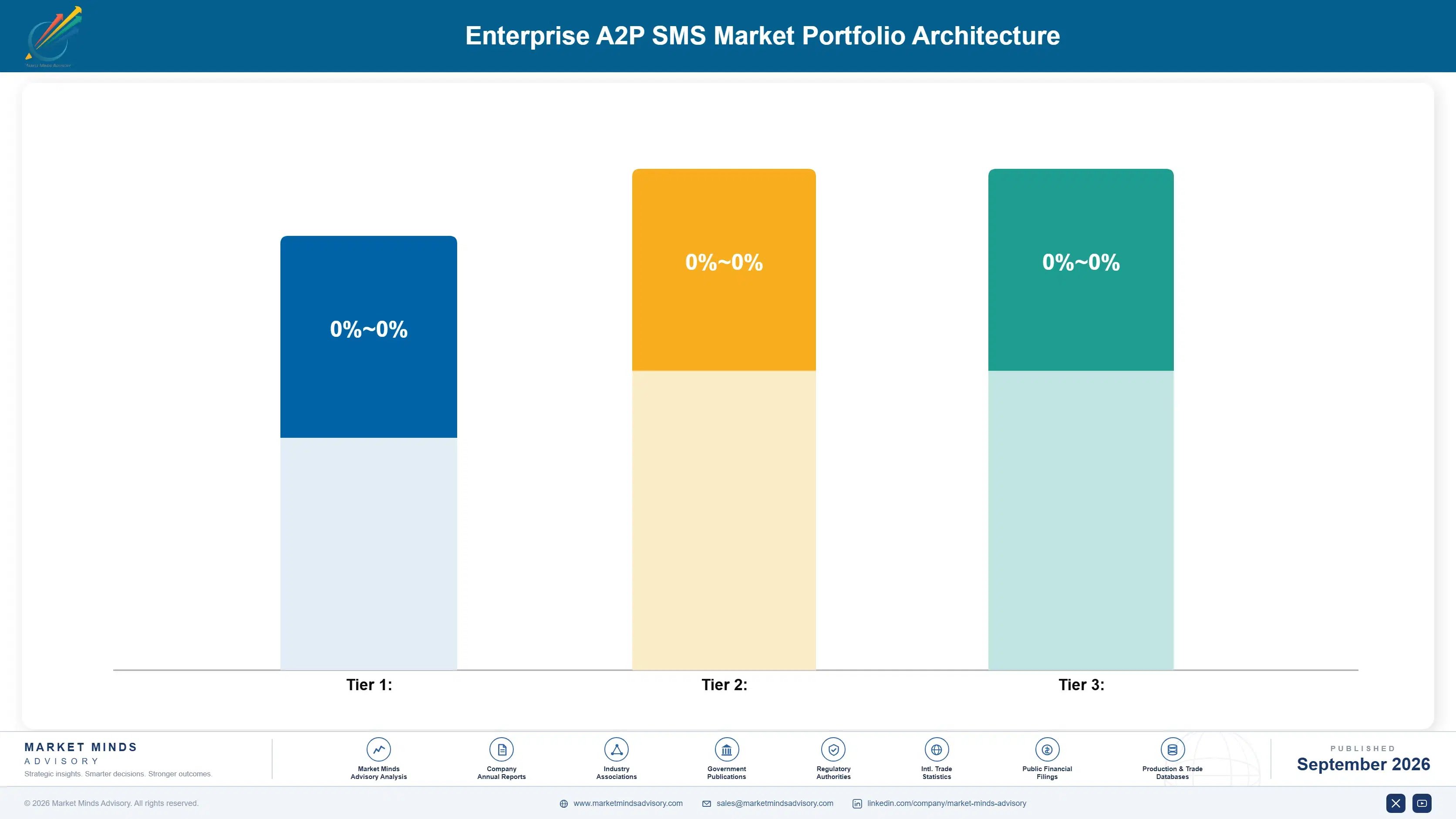
Provider economics in this market split along three tiers. Commodity-adjacent basic SMS delivery competes on price and volume, generating gross margins in the 15 to 22% range given the high pass-through carrier termination fees represent. Certified enterprise messaging with guaranteed delivery and reporting command 25 to 32% gross margins, reflecting the reliability premium enterprises pay once a delivery relationship proves consistent across critical business communications.
RCS business messaging and AI-driven fraud filtering occupy the premium tier, with margins reaching 38 to 45% where providers demonstrate genuine technical differentiation over commodity SMS pass-through. Volume basic messaging contracts remain necessary to sustain carrier relationship scale, but the highest-value pools concentrate where providers sell verified, differentiated messaging capability rather than raw delivery volume alone. Providers purchasing at this tier consolidate carrier relationships across multiple markets to justify the fraud detection investment specialty capability requires.

This tension between volume basic delivery and premium differentiated messaging margins defines provider strategy today. Providers increasingly prioritize investment toward RCS and fraud filtering capability over commodity SMS pass-through, pushing value capture toward services proving measurable differentiation rather than raw message volume. Providers failing to demonstrate this depth risk displacement by rivals even where core delivery infrastructure remains competitive.

Basic SMS delivery sold on per-message pricing with thin differentiation, competing primarily on price and delivery volume across established carrier relationships and aggregator networks. Contract cycles run twelve months typically, and buyers frequently multi-source across two providers to preserve negotiating leverage and delivery redundancy.
Gross Margin

Guaranteed delivery enterprise messaging with detailed reporting and service level agreements, commanding higher retention and pricing power once a delivery relationship proves consistent across critical communications. Expansion revenue accrues as enterprises expand messaging volume across additional business units and geographic markets over successive contract years.
Gross Margin

RCS business messaging and AI-driven fraud filtering addressing emerging rich media demand and carrier-mandated compliance requirements protecting consumers from fraudulent messaging. Pricing power remains strongest among providers demonstrating both rich media capability and fraud detection accuracy within a single unified platform offering.
Gross Margin
enterprise-application-to-person-sms-market-portfolio-architecture-1788678312662

High-value Sub-segments and Strategic Watch-out

RCS Business Messaging Platforms

Highest growth and highest value pool as brands shift budget toward rich media engagement, commanding premium pricing and the strongest momentum across the competitive set today. Providers here increasingly price on engagement lift, and enterprise buyers report willingness to pay a premium for verified rich media performance.

AI-Driven Fraud Filtering and Sender Verification

Strong growth and healthy margins as carriers mandate this capability industry-wide, though data science investment requirements keep the supplier base meaningfully smaller than basic messaging categories. Providers with proprietary detection models retain pricing power even as more generic filtering vendors attempt to enter this fast-growing segment.

One-Time Password and Authentication Messaging

The volume core generating steady installed base revenue, characterized by mature technology, high reliability requirements, and intense price competition among established carrier-connected providers. Consolidation among smaller basic-messaging providers is likely as larger platforms absorb this steady category into broader enterprise messaging portfolios. Growth here is stable but unremarkable.

Promotional and Marketing SMS Campaigns

A strategic watch-out segment where growth trails the broader market, but RCS migration could rapidly reshape vendor priority and margin structure within the coming several years. Providers positioned early around RCS migration could capture disproportionate promotional budget if this shift accelerates faster than currently anticipated by most participants.

Delivery Trust Anchors Recurring Contracts

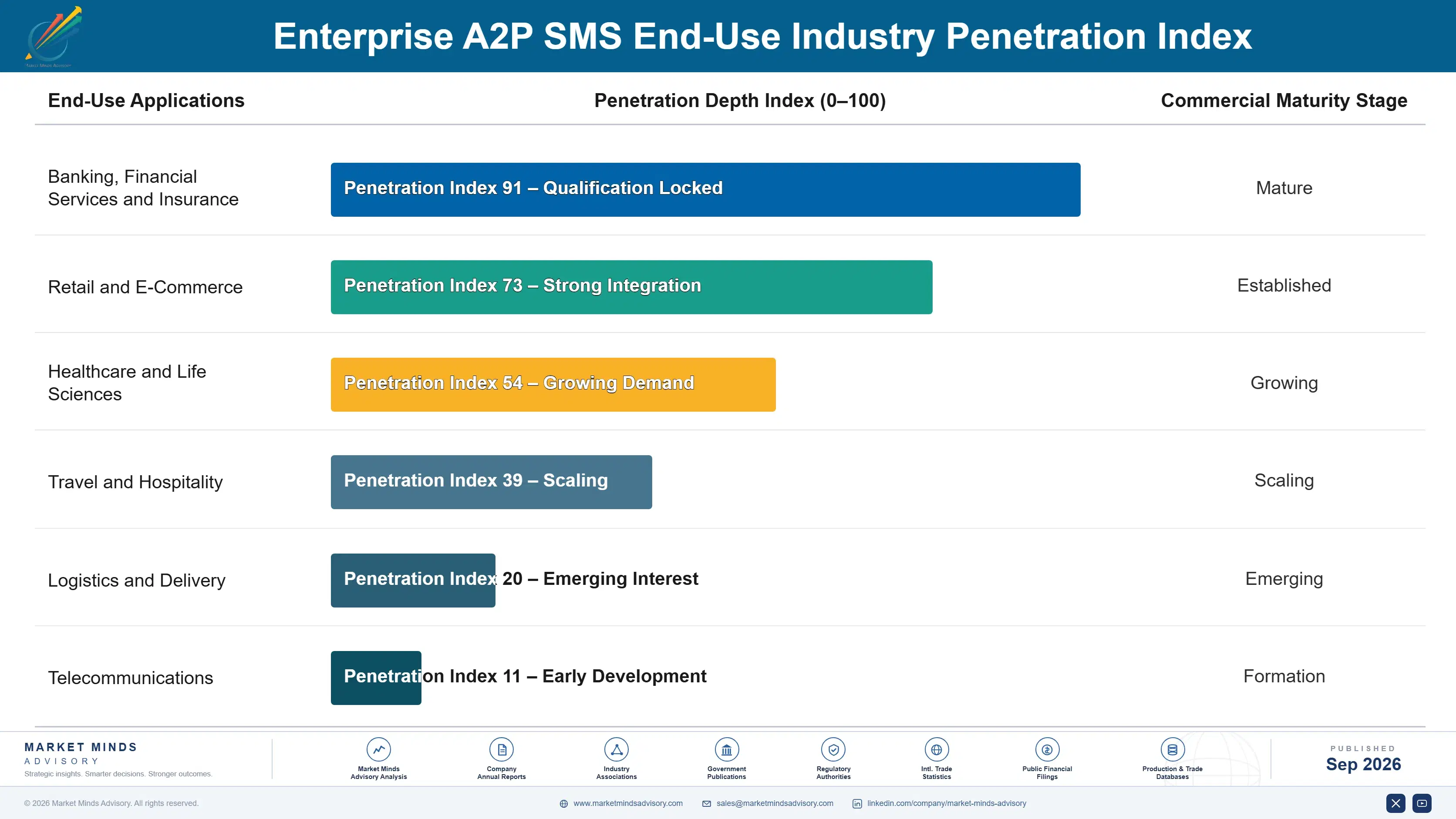
Enterprise A2P messaging runs on recurring per-message billing tied to ongoing transaction and authentication volume rather than one-time contracts, giving providers predictable revenue once embedded in an enterprise's transactional workflow. Net revenue retention above 108% is common among leading providers, driven by organic message volume growth as enterprises expand transaction volume over time. This annuity quality supports valuation multiples well above one-time software licensing businesses.
Adoption depth varies sharply by end-use vertical. Banking enterprises embed messaging deeply into authentication and fraud alert workflows, producing switching costs that keep churn below 5% annually. Retail and marketing-focused buyers adopt more selectively, running multiple providers simultaneously for campaigns rather than standardizing, which keeps churn meaningfully higher. Healthcare buyers tie renewal decisions directly to delivery reliability, making provider displacement a compliance risk few enterprises accept.

Buyer profiles are shifting generationally as newer marketing and communications leaders increasingly prioritize rich media engagement and verified sender trust over pure message volume their predecessors optimized for throughout most of the prior decade. This shift favors providers offering RCS-native platforms and fraud filtering over rivals still selling undifferentiated basic SMS capacity. This shift is reshaping provider roadmaps toward measurable engagement and trust metrics rather than raw throughput.
enterprise-application-to-person-sms-market-end-use-penetration-index-1788678313142

Where MMA Sees the Advantage

These are among the four positions where our research anticipates prominent divergence between winners and laggards over the coming forecast period. Each is grounded in the demand model, the regulatory perimeter, and the announced capacity pipeline.
01 / RCS MIGRATION PRIORITY

Build RCS carrier interoperability ahead of basic SMS rivals

Enterprises are shifting marketing budget decisively toward rich communication services as major device manufacturers default consumers into these richer messaging experiences, and this transition is happening faster than most aggregators' product roadmaps assumed. Providers still optimizing purely for basic SMS delivery are being excluded from premium marketing budget allocations entirely, regardless of established carrier relationships. Providers investing now in RCS carrier interoperability will keep winning these premium contracts as adoption spreads across more networks over the coming several years across every major market.
02 / FRAUD FILTERING INVESTMENT

Invest in fraud detection before carrier mandates tighten further

Mobile operators in multiple countries are mandating AI-driven fraud filtering as a condition of network access, and providers without this capability are already losing carrier relationships to competitors who invested early. This filtering requirement is only intensifying as consumer complaints about phishing and scam messages continue rising across most major markets. Providers slow to build proprietary detection capability risk losing carrier network access entirely, a far more severe consequence than losing a single enterprise contract to a faster-moving rival already positioned.
03 / EMERGING MARKET EXPANSION

Deepen local carrier relationships in fast-growing digital payment markets

India and other rapidly digitalizing markets are generating the fastest enterprise messaging growth of any region MMA tracks, driven by first-time digital finance users receiving transaction confirmations and fraud alerts at unprecedented scale. Providers with deep local carrier relationships and regulatory compliance expertise are capturing disproportionate share of this growth ahead of global platforms still navigating unfamiliar local requirements. Providers slow to build this local presence risk ceding the fastest-growing region entirely to more locally embedded competitors already scaling quickly.
04 / DIRECT CARRIER AGREEMENTS

Negotiate direct carrier termination agreements before rates rise further

Carrier termination fees are the single largest cost component in this market, and providers without direct carrier relationships are absorbing intermediary markup that erodes margin considerably compared with competitors holding negotiated committed-volume agreements. Providers that secured favorable termination rates through direct carrier relationships are protecting margin while smaller aggregators face rising costs from intermediary routing. Providers slow to negotiate direct agreements risk losing competitive bids to rivals with meaningfully lower delivery costs locked in well ahead of the next rate increase.

Engagement Snapshot From the Field

A live engagement with an industry participant carrying material or product regulatory and market exposure ahead of a defining policy shift, showing how our research translates into a defensible multi-year portfolio strategy.
MARKET MINDS ADVISORY · CLIENT ENGAGEMENT SUMMARY
Enterprise A2P SMS Producer Strategic Portfolio Review and Transition Roadmap 2026·Investment Scenario on Enterprise A2P SMS Exposure Evaluation 2025-26
CLIENT PROFILE
The client is a global retail bank operating across twelve countries with several million active mobile banking customers, sending transaction alerts, OTP verification, and fraud notifications through six separate regional messaging providers accumulated over a decade of decentralized country-level procurement decisions. The bank had never operated a unified enterprise messaging platform across all markets simultaneously.
STRATEGIC CHALLENGE
The bank needed to consolidate onto a smaller number of messaging providers capable of meeting delivery reliability and fraud filtering requirements across all twelve countries while reducing the operational complexity of managing six separate vendor relationships with inconsistent reporting standards. Prior vendor sales presentations offered conflicting delivery reliability claims the bank needed to verify independently.
MMA APPROACH
MMA benchmarked five candidate consolidated providers against the bank's specific multi-country delivery reliability, fraud filtering, and reporting requirements, combining primary survey data with direct reference calls to comparable global banking customers. The engagement produced a weighted scoring framework prioritizing multi-country carrier coverage alongside fraud detection capability. Reference calls focused specifically on multi-country deployment experience rather than single-market implementations.
KEY FINDINGS
  1. Two of the six existing providers reported materially different delivery success rates for identical message types, undermining confidence in consolidated reporting entirely.
  2. Consolidating onto two providers was projected to reduce annual messaging cost by approximately 22% (client-reported, unverified by MMA) once volume discounts applied.
  3. Annual licensing and integration cost across six fragmented providers exceeded the cost of two consolidated contracts by roughly $3.8 million (client-reported, unverified by MMA).
  4. Regional procurement autonomy, not vendor capability, was the primary root cause of the bank's fragmented messaging infrastructure across its twelve country operations.
CLIENT PROFILE
The client is a global retail bank operating across twelve countries with several million active mobile banking customers, sending transaction alerts, OTP verification, and fraud notifications through six separate regional messaging providers accumulated over a decade of decentralized country-level procurement decisions. The bank had never operated a unified enterprise messaging platform across all markets simultaneously.
STRATEGIC CHALLENGE
The bank needed to consolidate onto a smaller number of messaging providers capable of meeting delivery reliability and fraud filtering requirements across all twelve countries while reducing the operational complexity of managing six separate vendor relationships with inconsistent reporting standards. Prior vendor sales presentations offered conflicting delivery reliability claims the bank needed to verify independently.
MMA APPROACH
MMA benchmarked five candidate consolidated providers against the bank's specific multi-country delivery reliability, fraud filtering, and reporting requirements, combining primary survey data with direct reference calls to comparable global banking customers. The engagement produced a weighted scoring framework prioritizing multi-country carrier coverage alongside fraud detection capability. Reference calls focused specifically on multi-country deployment experience rather than single-market implementations.
KEY FINDINGS
  1. Two of the six existing providers reported materially different delivery success rates for identical message types, undermining confidence in consolidated reporting entirely.
  2. Consolidating onto two providers was projected to reduce annual messaging cost by approximately 22% (client-reported, unverified by MMA) once volume discounts applied.
  3. Annual licensing and integration cost across six fragmented providers exceeded the cost of two consolidated contracts by roughly $3.8 million (client-reported, unverified by MMA).
  4. Regional procurement autonomy, not vendor capability, was the primary root cause of the bank's fragmented messaging infrastructure across its twelve country operations.
RECOMMENDED STRATEGY
Phase 1: Phase one: consolidate messaging onto the two selected providers for the three highest-volume countries within two quarters. These countries carried the highest concentration of messaging volume and fraud exposure. Phase 2: Phase two: migrate remaining country operations onto the consolidated providers over twelve months, retiring legacy contracts as they expire. This phased approach minimized workflow disruption for regional teams. Phase 3: Phase three: standardize fraud filtering and delivery reporting across all twelve countries under a single unified dashboard. This consolidated view had never previously existed within the bank.
OUTCOME
The bank selected two consolidated providers and completed migration of its three highest-volume countries within the first two quarters. Unified fraud filtering and delivery reporting became standardized ahead of schedule, and the bank reported meaningfully improved visibility into cross-country messaging performance (client-reported, unverified by MMA).

Frequently Asked Questions

Foundational context covering the market sizes, CAGR, scope, country, region and competition that inform every finding below. This section is provided to cover basics and most often pre-purchase conversations, answered from the MMA Primary Research Dataset.

What is the current size of the Enterprise A2P SMS Market?

The market was valued at approximately $21.5 billion in 2025. Growth is being driven by rising OTP authentication volume and expanding digital payment adoption globally.

How large will the Enterprise A2P SMS Market be by 2036?

MMA projects the market will reach approximately $55.5 billion by 2036. This reflects sustained enterprise messaging investment across authentication, transactional, and RCS rich media categories.

What is the CAGR for the Enterprise A2P SMS Market 2026 to 2036?

The market is projected to grow at a compound annual growth rate of 9.0% between 2026 and 2036. This rate reflects both authentication volume and RCS adoption.

Which segment is growing fastest?

RCS Business Messaging Platforms is the fastest growing segment, expanding at 15.5% annually, roughly 1.72x the overall market rate. Rich media adoption is driving this acceleration.

Who are the major companies in the Enterprise A2P SMS Market?

Leading companies include Sinch, Twilio, Infobip, Vonage, and MessageBird. These five providers hold a combined 38% revenue share across the global enterprise messaging market today.

Which country is growing fastest?

India is the fastest growing country market, expanding at approximately 12.5% annually. Rapid digital payment adoption is driving this acceleration across the country's mobile-first population.

Report Segmentation Architecture

The full report scope spans multiple orthogonal segmentation dimensions, with cross-tabulated demand data provided for each dimension pair. Coverage extends further to regional breakdowns, trend trajectories, and the competitive detail needed to support segment-level decision-making.

By Primary Market Dimension

  • RCS Business Messaging Platforms
  • One-Time Password and Authentication Messaging
  • Transactional and Order Confirmation Messaging
  • Promotional and Marketing SMS Campaigns
  • AI-Driven Fraud Filtering and Sender Verification
  • Two-Way Conversational Messaging Platforms

By End-Use Industry

  • Banking, Financial Services and Insurance
  • Retail and E-Commerce
  • Healthcare and Life Sciences
  • Travel and Hospitality
  • Logistics and Delivery
  • Telecommunications

By Commercial Dimension

  • Direct Enterprise Sales
  • CPaaS Platform Resale
  • Managed Service Providers
  • Regional Aggregator Partnerships
  • Self-Service API Adoption

By Region

  • North America
  • Western Europe
  • East Asia
  • South Asia and Pacific
  • Latin America
  • Middle East and Africa
  • Eastern Europe

Scope, Methodology, and Coverage

Every figure in this report is reproducible from documented input assumptions. The scope below maps the historical period, the forecast horizon, the segmentation dimensions, and the countries covered, alongside the underlying primary and qualitative methodology.
Historical Period
2020 to 2025
Forecast Period
2026 to 2036
Base Year
2025 (USD billions; MMA Primary Research Dataset, September 2026)
Market Definition
This report covers application-to-person SMS and RCS business messaging services purchased by enterprises for transactional, promotional, and authentication communications with consumers through mobile carrier networks. It excludes person-to-person consumer SMS traffic, over-the-top messaging apps like WhatsApp and WeChat operating outside carrier billing relationships, and voice or email-based enterprise communications channels.
Quantitative Units
USD Billion, CAGR (%), 2020-2036
Segmentation Dimensions
By Primary Market Dimension, By End-Use Industry, By Commercial Dimension, By Region
Regions Covered
North America, Western Europe, East Asia, South Asia and Pacific, Latin America, Middle East and Africa, Eastern Europe
Countries Covered
United States, Canada, Germany, United Kingdom, France, China, Japan, South Korea, India, Australia, Brazil, Mexico, Saudi Arabia, UAE, South Africa, Poland
Key Companies Profiled
Sinch, Twilio, Infobip, Vonage, MessageBird, Route Mobile, Kaleyra, CLX Communications, Tanla Platforms, Karix Mobile, AMD Telecom, BICS, iBasis, Comviva, Mitto AG, Plivo, TeleSign, Prestige IT Solutions, Gupshup, textmarketer
Quantitative Methodology
Primary survey, n=3,800 respondents, Q4 2025, six countries; demand-side model with trade association cross-validation
Qualitative Methodology
47 expert interviews, Q4 2025; applied to validate demand model assumptions, identify emerging dynamics, and assess competitive positioning
Report Format
PDF and XLSX data workbook (Word format preview document)
Publisher
Market Minds Advisory
Report Code
MMA-2026-TEC-805
Published
September 2026
Contact
sales@marketmindsadvisory.com | www.marketmindsadvisory.com

Purchase the full Enterprise A2P SMS Market Report (2026 to 2036).

This report provides a comprehensive assessment of the global enterprise A2P messaging market, covering historical performance from 2020 to 2025 and a detailed forecast through 2036. It examines segmentation across authentication, transactional, promotional, and rich messaging categories, alongside regional demand dynamics across all seven world regions. The competitive landscape section profiles twenty companies and benchmarks the five leading providers on a revenue basis. Analysis includes input cost exposure, portfolio margin economics, and strategic recommendations for market participants. The report also includes an anonymized client case study demonstrating practical messaging platform consolidation in a real global banking engagement.
Ten-year market sizing and forecast model
Six-segment MECE market segmentation framework analysis
All seven world regional markets profiled fully
Twenty-company competitive benchmarking dataset included here
Carrier termination cost and margin risk analysis
Anonymized client case study with strategy

Built For The People Who Decide

From boardroom strategy to bench-side execution, this report is read cover-to-cover by leaders shaping the next decade of their industry, turning demand scenarios, market dynamics and valuation benchmarks into decisions.
CXOs/ Presidents/ VPs/ Managers
M&A and Corporate Development
Strategy Teams and R&D Heads
Procurement and Product Directors
Regulatory and Compliance Leaders
Investor Relations and Equity Analysts