Market Minds Advisory
End-of-Pipe Air Pollution Control Equipment Market

End-of-Pipe Air Pollution Control Equipment Market: Trends and Forecast 2026 to 2036

Coal-fired power plants and heavy industrial facilities across Asia are racing to retrofit aging stacks with modern scrubbers, filters, and catalytic systems as national emissions standards tighten faster than old equipment fleets can be replaced.

Lead Analyst

David Horsley

Published

September 2026

Make Smarter Decisions with Customized Research Insights

Request a free sample report and evaluate market opportunities, growth trends, and competitive dynamics relevant to your business needs.

2025 MARKET VALUE$18.5BMarket Size 2025
2036 FORECAST VALUE$35.9BBase Case , 2026 to 2036
CAGR 2026 TO 20366.2 %Bull 7.5% / Bear 4.9%
INCREMENTAL OPPORTUNITY$16.2BNet 10- year value creation
EXPANSION MULTIPLE1.82x2036 value over 2026 base
Strategic Levers
M&A Pipeline
Regional Outlook
Country Rankings
Competitive Intelligence
Segmental Deep-dive
Call-Us : 91 93563 13602

Executive Snapshot and Market Trajectory

Emissions compliance has stopped being a one-time capital project and become a recurring retrofit cycle, as regulators in China, India, and the European Union revise particulate, sulfur, and nitrogen oxide limits faster than most industrial operators can plan around comfortably or budget for well in advance of enforcement dates.
Coal-fired power generation and heavy industrial sectors, cement, steel, and chemical processing chief among them, drive the bulk of demand, since these facilities face the tightest scrutiny and the largest legacy equipment fleets still running decades-old designs. Selective catalytic reduction systems are the fastest-growing technology category, expanding well ahead of scrubbers and fabric filters, as nitrogen oxide limits tighten across major industrial economies. Demand concentrates heavily in China and increasingly India.
Competitive dynamics favor engineering-heavy incumbents over new entrants, since retrofit projects require site-specific design work and long-standing relationships with utility and industrial procurement teams built over multiple prior project cycles and many years of accumulated delivery history across regions. Regulatory divergence between regions adds complexity: equipment validated for EU standards does not always meet Chinese or Indian specifications without meaningful redesign work being done first.
Market Definition
The end-of-pipe air pollution control equipment market covers electrostatic precipitators, fabric filters, wet and dry scrubbers, and selective catalytic and non-catalytic reduction systems installed to treat exhaust gas before atmospheric release. It excludes process-integrated emissions reduction technologies and standalone continuous emissions monitoring hardware.
Base Year Value
$18.5B in 2025 (MMA Primary Research Dataset, August 2026)
Forecast Period
2026 to 2036, eleven discrete annual values
CAGR
6.2% base case. Bull 7.5%. Bear 4.9%.
Fastest Growth Segment
Selective Catalytic Reduction (SCR) Systems: 9.3% CAGR
Fastest Growth Country
India: 9.6% CAGR
Fastest Growth Region
South Asia and Pacific: 8.5% CAGR
Largest Region
East Asia: 34% of 2025 global value
Market Leaders
Leading suppliers: GE Vernova, Babcock and Wilcox, Andritz, Thermax, and FLSmidth. Source: MMA Primary Research Dataset, July 2026.
Primary Survey
n=3,800 procurement and R&D decision-makers, Q4 2025, six countries
Methodology
Demand-side build-up, cross-validated against public data, 47 expert interviews

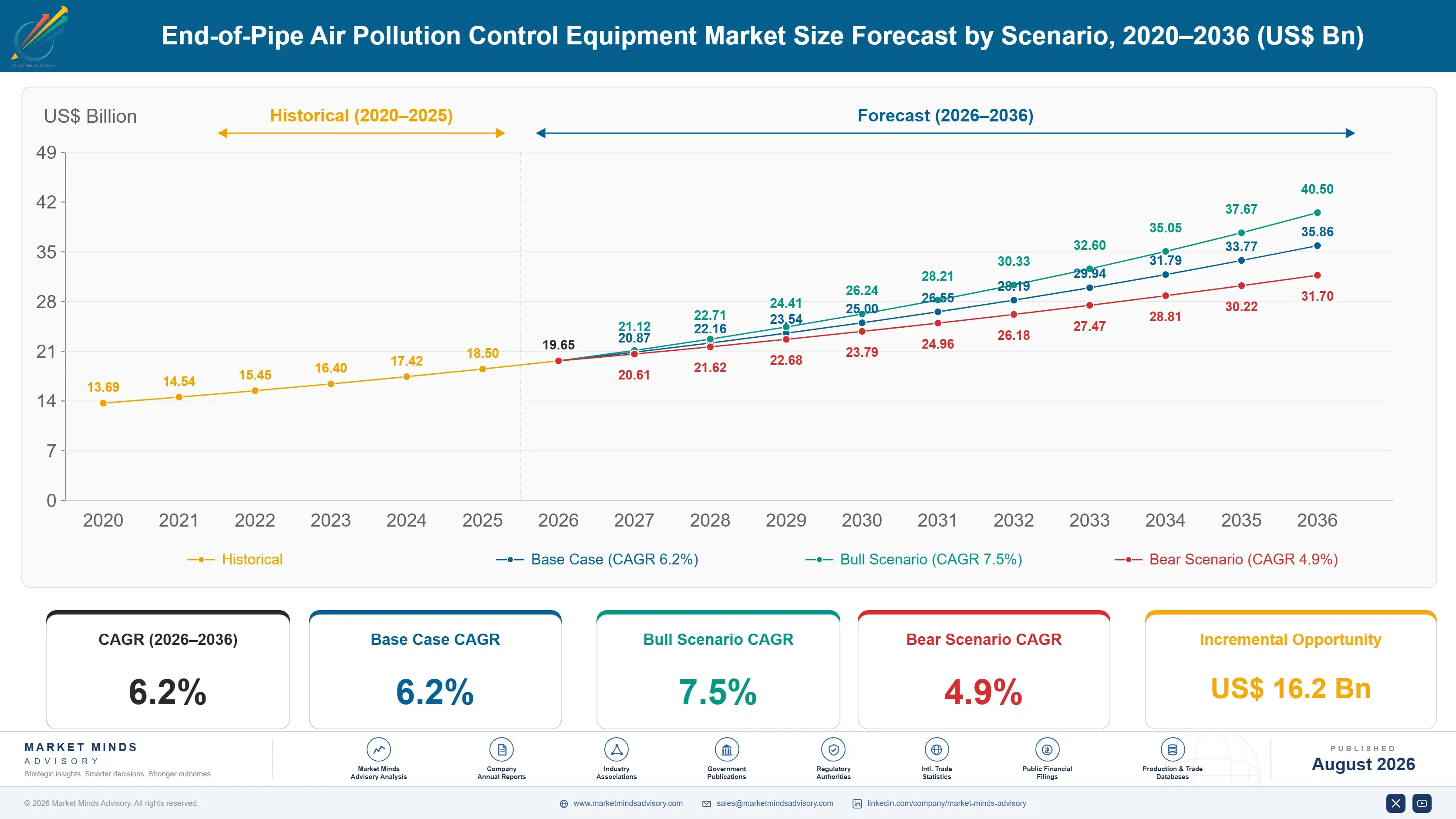
End-of-Pipe Air Pollution Control Equipment Market Forecast Scenarios

end-of-pipe-air-pollution-control-equipment-market-size-forecast-scenario-1787548752214
Between 2020 and 2025 the market grew at an estimated 5.4% annually as China completed the bulk of its ultra-low emissions retrofit program while India and Southeast Asia began scaling their own regulatory enforcement more gradually, producing steadier but less dramatic growth than the earlier 2015 to 2020 Chinese retrofit wave that dominated the prior decade's demand.
The base case assumes 6.2% annual growth through 2036, anchored in three commercial mechanisms: India's accelerating industrial emissions enforcement following its own national clean air program, continued nitrogen oxide standard tightening across the European Union and China pushing selective catalytic reduction adoption, and aging equipment fleets across multiple regions reaching replacement age simultaneously. Selective catalytic reduction systems carry the base case forward fastest, reflecting where regulatory pressure is intensifying most sharply right now.
The bull case, 7.5%, assumes faster Indian and Southeast Asian regulatory enforcement timelines than currently scheduled, pulling forward retrofit demand across multiple industrial sectors simultaneously and ahead of the base case forecast window. The bear case, 4.9%, reflects a scenario where economic slowdown delays planned industrial capacity additions and associated equipment retrofits, particularly across price-sensitive emerging markets still building enforcement capacity.

Retrofit Cycles Replace One-Time Compliance Spending

The market has shifted from episodic large-scale compliance mandates toward a steadier retrofit and replacement cycle, since much of China's ultra-low emissions program is now complete and demand growth increasingly comes from India, Southeast Asia, and equipment nearing the end of its operating life across multiple older installations worldwide. That shift rewards suppliers with strong aftermarket and parts businesses over those built solely around large new installation contracts.
TOP-5 SUPPLIER CONCENTRATION42%Reflects a market still split among many regional engineering specialists
AVERAGE RETROFIT PROJECT VALUE$8.5 millionTracks typical contract size for a full installation package
CHINA INSTALLED BASE SHARE36%Shows how concentrated global equipment installations have become domestically
STEEL SHARE OF COGS28% to 36%Captures how exposed margins are to steel and fabrication costs
EQUIPMENT REPLACEMENT CYCLE15 to 20 yearsMarks how often facilities typically replace major control system components
ORDER BACKLOG COVERAGE12 to 18 monthsIndicates how far ahead supplier order books are currently booked
Order backlog coverage runs 12 to 18 months across most major suppliers, reflecting steady project pipeline visibility rather than the boom-bust pattern seen during China's earlier retrofit wave. Average retrofit project value sits around 8.5 million dollars, though full plant-wide multi-system installations at large coal or cement facilities can run considerably higher depending on facility size and technology scope required.
Steel and fabrication inputs represent 28% to 36% of cost of goods sold, exposing margins to construction material pricing cycles that suppliers only partially control through fixed-price project contracts negotiated well in advance. Suppliers with in-house fabrication capacity carry a meaningful cost advantage over those subcontracting heavy fabrication work, particularly during periods when steel pricing runs volatile across major producing regions.
"Everyone assumes this industry is about winning the next big plant. It's really about who still answers the phone ten years later when a filter bag needs replacing at three in the morning."
Principal Analyst, Industrial Equipment and Environmental Systems Practice · MMA Construction and Industrial Equipment Practice · August 2026

Market Trends

India's National Clean Air Programme Drives Retrofit Wave

India's National Clean Air Programme targets a 40% reduction in particulate matter concentration across 130-plus non-attainment cities by 2026, pushing state pollution control boards to mandate retrofit installations at thermal power plants, cement kilns, and steel mills that previously operated with minimal emissions treatment. This regulatory push is creating the fastest order growth MMA tracks anywhere in the market currently. Suppliers with existing India operations and government procurement relationships are winning the bulk of early contracts, while new entrants face lengthy vendor registration processes before qualifying for public sector tenders at all.
Market Impact: Extends limits to sectors by 2027
Suppliers Shift From Equipment Sales to Service Contracts

Leading suppliers are increasingly structuring deals as long-term operations and maintenance service contracts rather than one-time equipment sales, with service revenue now representing an estimated 25% to 30% of total supplier revenue at several major firms today, up considerably from a much smaller share just a decade earlier in the industry's history. This shift smooths revenue across economic cycles and deepens customer relationships beyond the initial installation, since operators prefer a single accountable party for performance guarantees rather than juggling multiple parts and service vendors separately across a facility's entire operating lifetime.
Market Impact: Covers 52,000 installations, deadlines through 2029

Market Opportunities and Growth Drivers

China's Ultra-Low Emissions Standard Extends to Cement and Steel

China's ultra-low emissions standard, first applied to coal power plants, is now being extended to cement kilns and steel mills nationwide, requiring particulate, sulfur dioxide, and nitrogen oxide limits comparable to the power sector's already-strict thresholds by 2027. This extension opens a second wave of retrofit demand across industrial sectors that previously operated under looser standards than power generation faced during the original 2014 to 2020 retrofit program. Suppliers with proven power-sector track records are winning early industrial contracts, since procurement teams favor vendors with demonstrated compliance history over unproven industrial specialists lacking comparable regulatory experience.
Market Impact: Projects cost 5 to 15 million

EU Industrial Emissions Directive Tightens Sector-Specific Limits

The revised EU Industrial Emissions Directive is tightening Best Available Techniques reference document limits across large combustion plants, chemical facilities, and waste incineration sites, with compliance deadlines phased through 2029 for most affected installations. Roughly 52,000 industrial installations across the European Union fall under the directive's scope, and many still operate control equipment installed under the prior, looser reference standards from over a decade earlier. This is driving a meaningful upgrade cycle among European industrial operators facing enforcement deadlines that leave limited room for further delay without meaningful compliance penalties.
Market Impact: Steel is 28-36% of COGS

Market Restraints and Challenges

High Capital Cost Deters Smaller Industrial Operators

A full multi-system retrofit installation at a mid-size industrial facility can cost between 5 million and 15 million dollars depending on technology scope, a burden that falls disproportionately on smaller operators without access to the financing terms larger utilities and multinational manufacturers can secure. The root cause is that pollution control equipment delivers no production output of its own, making it a pure compliance cost rather than a revenue-generating investment that finance committees readily approve. Some smaller operators are mitigating this by pooling procurement through industry associations or leasing equipment through third-party financing arrangements rather than purchasing outright.
Market Impact: Targets 40% particulate reduction, 130 cities

Steel Price Volatility Compresses Fixed-Price Project Margins

Steel and fabrication inputs, representing 28% to 36% of cost of goods sold, expose suppliers to construction material pricing swings that hit projects hardest when contracts are quoted at fixed prices months before fabrication actually begins. The root cause is that most large retrofit contracts require fixed-price bidding at the tender stage, well before material procurement, leaving suppliers to absorb any subsequent steel price increase themselves. Larger suppliers are mitigating this by negotiating price escalation clauses into contracts or hedging steel purchases ahead of major project awards to limit exposure.
Market Impact: Service revenue reaches 25% to 30%
2 additional market trends, 4 additional growth drivers, and 3 additional restraints and challenges are covered in the full report. Contact sales@marketmindsadvisory.com to access the complete intelligence.

Segment CAGR and Growth Architecture

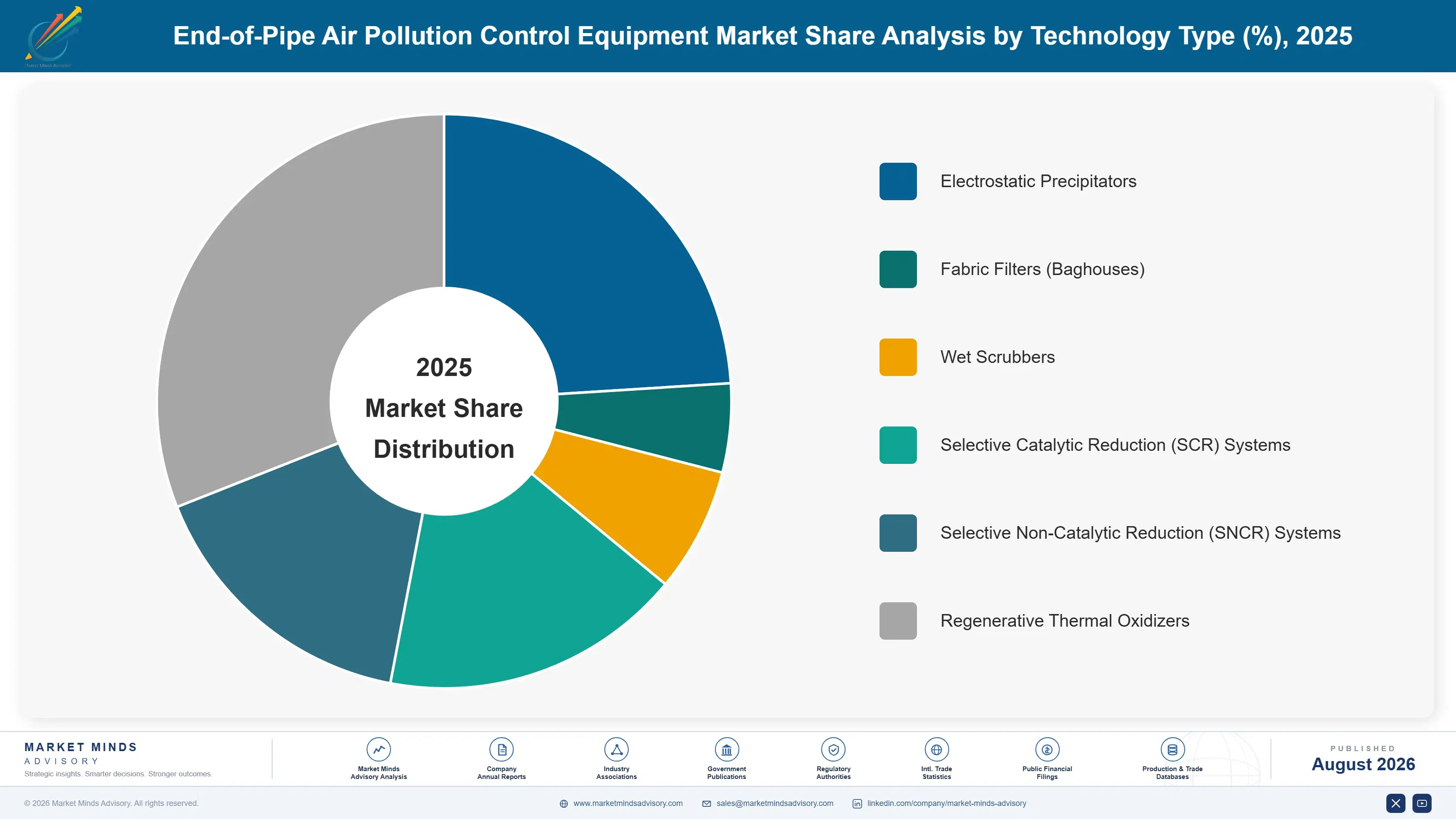
Segmentation follows control technology type, the classification regulators and procurement teams use when specifying compliance solutions, since each technology addresses a distinct pollutant class through fundamentally different engineering principles rather than a shared design or installation pathway, and each typically involves a separate specialist supplier base, technical certification requirement, and maintenance skill set entirely.
end-of-pipe-air-pollution-control-equipment-market-market-share-analysis-1787548752751

Selective Catalytic Reduction (SCR) Systems

Selective catalytic reduction systems are the fastest-growing segment, expanding at 9.3% annually as nitrogen oxide limits tighten across China's cement and steel sectors and India's thermal power fleet simultaneously and in close regulatory succession across both countries. These systems require catalyst replacement every three to five years, creating a recurring aftermarket revenue stream beyond the initial installation that other technologies in this category generally lack to the same degree or frequency of ongoing service need. Demand concentrates heavily in Asia, where regulatory tightening is happening fastest, though European and North American replacement demand adds a steady secondary contribution as older SCR installations reach catalyst end-of-life and require servicing across their remaining operating years.
CAGR 9.3%

Wet Scrubbers

Wet scrubbers, the second-fastest segment at 7.8% annually, are gaining share as multi-pollutant regulations increasingly require simultaneous sulfur dioxide, particulate, and mercury capture from a single system rather than separate dedicated units for each individual pollutant category and control stage across a plant's exhaust train and stack configuration. This consolidation favors wet scrubber technology's inherent multi-pollutant capability over combinations of narrower single-purpose systems that together often cost considerably more to install and maintain across a facility's full operating lifetime and equipment footprint. Growth concentrates in coal power and industrial boiler applications where multi-pollutant compliance is becoming the regulatory norm rather than the exception across most major industrial markets worldwide today.
CAGR 7.8%
Full segment breakdown across 6 segments available in the complete report.

Regional Architecture and Country Demand Map

Demand concentrates heavily around China's vast installed base of coal-fired power and heavy industrial facilities, with East Asia broadly commanding the largest regional share by a wide margin, while North America, Western Europe, and increasingly South Asia hold meaningful positions across most technology categories worldwide today.

East Asia

China anchors East Asian demand through the sheer scale of its coal-fired power and heavy industrial base, still the largest in the world despite years of retrofit activity, and this dominance pushes the region's share meaningfully above MMA's standard band, a deliberate house-rule deviation reflecting China's genuinely outsized installed base relative to any other region on earth. Japan and South Korea contribute technically sophisticated demand from established manufacturers exporting equipment globally, while Chinese domestic suppliers scale production fastest to serve local industrial retrofit projects across the country. Regional growth remains moderate relative to South Asia since much of China's initial retrofit wave already concluded during the prior decade's regulatory push.
Share: 34% | CAGR: 6.9% (2026 to 2036)

North America

Legacy Clean Air Act compliance obligations, combined with ongoing equipment replacement as decades-old installations reach end-of-life, sustain steady North American demand even without major new regulatory mandates driving fresh installations right now across most states. Utility-scale coal retirements are gradually shrinking the traditional power-sector customer base, pushing suppliers to pursue industrial applications in cement, steel, and chemical processing instead to offset the decline over the coming years. Replacement parts and service revenue increasingly outweigh new equipment sales across most established American accounts, reflecting the market's maturity relative to faster-scaling regions elsewhere in the world. Canadian mining and oil sands facilities add a smaller, steady secondary contribution to regional demand overall.
Share: 24% | CAGR: 5.8% (2026 to 2036)
Regional intelligence for 5 additional markets available in the complete report: Western Europe, South Asia and Pacific, Latin America, Middle East and Africa, Eastern Europe. Contact sales@marketmindsadvisory.com.
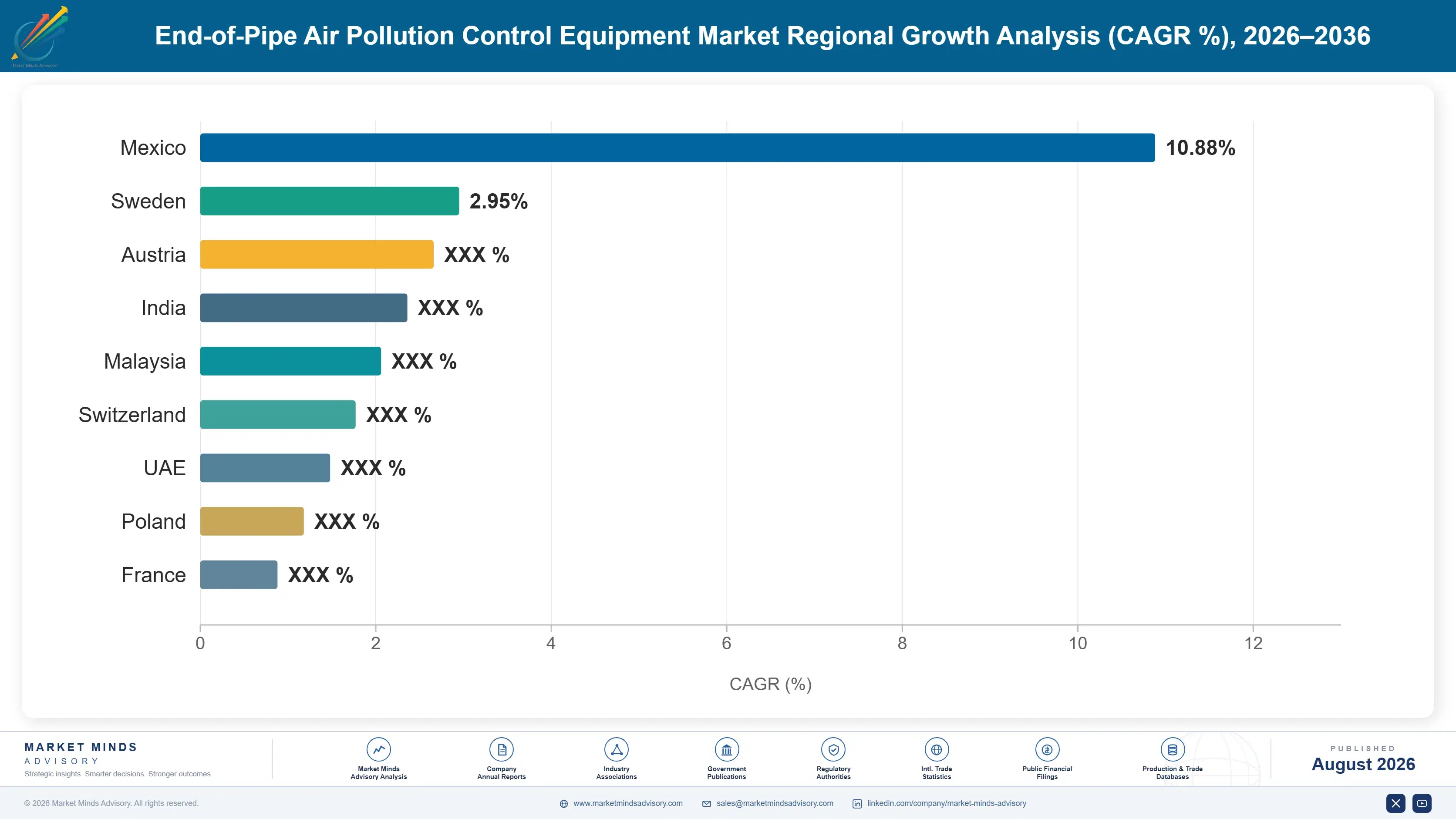
end-of-pipe-air-pollution-control-equipment-market-country-cagr-analysis-1787548753316

Where Suppliers Can Capture Recurring Margin

Four commercial levers determine which suppliers capture disproportionate margin as the market shifts from one-time installation sales toward a recurring retrofit and service cycle: building long-term service contracts, localizing engineering for regional compliance, entering India's fast-growing retrofit wave through partnerships, and diversifying into adjacent water and waste treatment applications that share similar engineering capability.

Expand Into Long-Term Service and Parts Contracts

Service revenue now represents an estimated 25% to 30% of total supplier revenue at leading firms, up considerably from a much smaller share a decade ago, reflecting operators' growing preference for a single accountable party across a facility's entire operating life rather than juggling multiple vendors. Suppliers building dedicated service and parts businesses smooth revenue across installation cycles that otherwise track lumpy capital project timing, and they gain recurring visibility into customer equipment health that supports earlier renewal and upgrade conversations before competitors even learn a replacement decision is being considered.
Market Impact: Service revenue reaches 25% to 30% of total

Build Regional Engineering Teams for Local Compliance

Equipment validated for European Union standards does not always meet Chinese or Indian specifications without meaningful redesign, meaning suppliers relying on a single global engineering team face slower bid response times than competitors with regionally embedded technical staff who understand local code nuances directly and can respond to tenders quickly. Building or acquiring regional engineering capacity, even at meaningful upfront cost, shortens proposal and design cycles by an estimated 20% to 30% relative to routing every regional project through a centralized headquarters team unfamiliar with local regulatory particulars and procurement norms.
Market Impact: Shortens supplier proposal and design cycles by 20% to 30%

Enter India's Retrofit Wave Through Local Partnerships

India's National Clean Air Programme is driving the fastest order growth MMA tracks anywhere in this market, but public sector tenders require lengthy vendor registration processes that favor suppliers with existing domestic operations and government relationships already firmly established over many years. Partnering with or acquiring an established Indian engineering firm shortcuts this registration timeline meaningfully, letting international suppliers bid on early contracts tied to the programme's 40% particulate reduction target rather than waiting years to qualify independently while competitors already positioned locally capture the bulk of near-term project awards.
Market Impact: The Clean Air Programme targets a 40% reduction by 2026

Diversify Into Adjacent Water and Waste Treatment

Many air pollution control suppliers already hold engineering and fabrication capability that transfers reasonably well into adjacent water treatment and industrial waste handling equipment, categories facing similarly tightening environmental standards and a comparably fragmented competitive landscape today across most major global markets. Suppliers extending into these adjacent categories capture incremental revenue from facilities they already serve on the air side, cross-selling into an estimated 15% to 20% larger addressable spend per customer account rather than building entirely new customer relationships from scratch in a market they have not previously served.
Market Impact: Expands addressable customer spend by 15% to 20%

Who Controls the Margin Pool

Concentration is moderate, with a CR5 near 42% on an annual equipment revenue basis and a real but not overwhelming gap separating the five established leaders from a substantial tail of regional specialists still building comparable project references and long-term customer relationships across their respective home markets.
Current competitive activity centers on three fronts: pursuing India's rapidly expanding retrofit tenders, extending into cement and steel sectors as China's ultra-low emissions standard broadens beyond power generation, and building long-term service and parts businesses that smooth revenue across lumpy project timing across multiple regions. Several suppliers are also investing in regional engineering offices to shorten proposal cycles for locally specific regulatory requirements.

Emerging pressure comes from Chinese domestic suppliers scaling production and engineering capability fast enough to compete for projects outside China itself, particularly across Southeast Asia and increasingly parts of Africa where price sensitivity favors lower-cost bidders. Rankings could shift meaningfully over the next several years if Indian and Chinese engineering firms close the technical gap on the most demanding selective catalytic reduction applications, a transition several established Western suppliers are watching closely and preparing contingency responses for already.
end-of-pipe-air-pollution-control-equipment-market-company-positioning-matrix-1787548753838

Competitive Moat and Risk Dimensions

GE VERNOVA

Moat: Deep Legacy Utility Relationships

GE Vernova has supplied power generation equipment and controls for decades, giving it existing procurement relationships with utilities worldwide before pollution control became a distinct purchasing category of its own. This history lets GE Vernova bundle emissions equipment into broader power plant service agreements more readily than pure-play environmental specialists lacking comparable utility account depth.
GE VERNOVA

Risk: Slower on Smaller Industrial Accounts

GE Vernova's sales organization is built around large utility accounts and major capital projects, making it comparatively slower to pursue the smaller cement, steel, and chemical industrial accounts now driving much of India's and China's newest retrofit demand. Nimbler regional specialists focused specifically on these smaller accounts are winning share GE Vernova's larger deal teams often overlook.
ANDRITZ AG

Moat: Broad Multi-Technology Engineering Portfolio

Andritz offers electrostatic precipitators, fabric filters, and scrubbers under one engineering organization, letting it propose multi-technology solutions for facilities needing several pollutant categories addressed simultaneously rather than coordinating separate vendors. This breadth wins complex multi-system retrofit contracts that narrower single-technology competitors cannot bid on as a complete package.
ANDRITZ AG

Risk: Limited Direct Presence in India

Andritz has a smaller direct engineering and manufacturing presence in India compared to domestic specialists like Thermax, leaving it more reliant on partnerships or agents to compete for the country's rapidly expanding retrofit tenders. This gap in local presence could cost Andritz meaningful share as India's National Clean Air Programme accelerates procurement activity nationwide.

Players Tracked

Prominent Players

GE Vernova
Babcock and Wilcox
Andritz AG
Thermax Limited
FLSmidth

Other Key Players

Hamon Group
CECO Environmental
Fuel Tech Inc
Nederman Holding
Durr AG
Mitsubishi Heavy Industries
Doosan Lentjes
Clyde Bergemann
Envea
Ducon Technologies
Longking Environmental Protection
Wuhan Kaidi Electric Power
Beijing SPC Environment Protection Technology
Babcock Power
John Wood Group

Recent Developments

APRIL 2025

Thermax Wins Multi-Plant SCR Retrofit Contract in India

Thermax won a multi-plant selective catalytic reduction contract from a major Indian state power utility, covering retrofits across four thermal power units as part of the state's compliance program under India's National Clean Air Programme. The contract was a direct commercial award, not a joint venture or acquisition.
Signal: Confirms Indian state utilities are moving from pilot projects to multi-plant retrofit commitments at real scale.
AUGUST 2025

Andritz Acquires Chinese Fabric Filter Manufacturer

Andritz acquired a smaller Chinese fabric filter manufacturer to expand its direct manufacturing footprint inside China, adding domestic production capacity that reduces import tariff exposure on future Chinese industrial contracts. The acquisition closed after regulatory review confirming no antitrust concerns given the target's modest market share.
Signal: Shows Western suppliers acquiring domestic Chinese manufacturing capability rather than competing purely through imported equipment alone.
DECEMBER 2025

GE Vernova Extends European Utility Service Agreement

GE Vernova signed a long-term service agreement with a European utility covering scrubber and precipitator maintenance across six coal-fired units through their planned retirement dates over the coming decade ahead. The agreement was a service contract extension, not an equity stake or new equipment sale.
Signal: Signals suppliers extending service relationships even at plants approaching retirement rather than losing that revenue early.

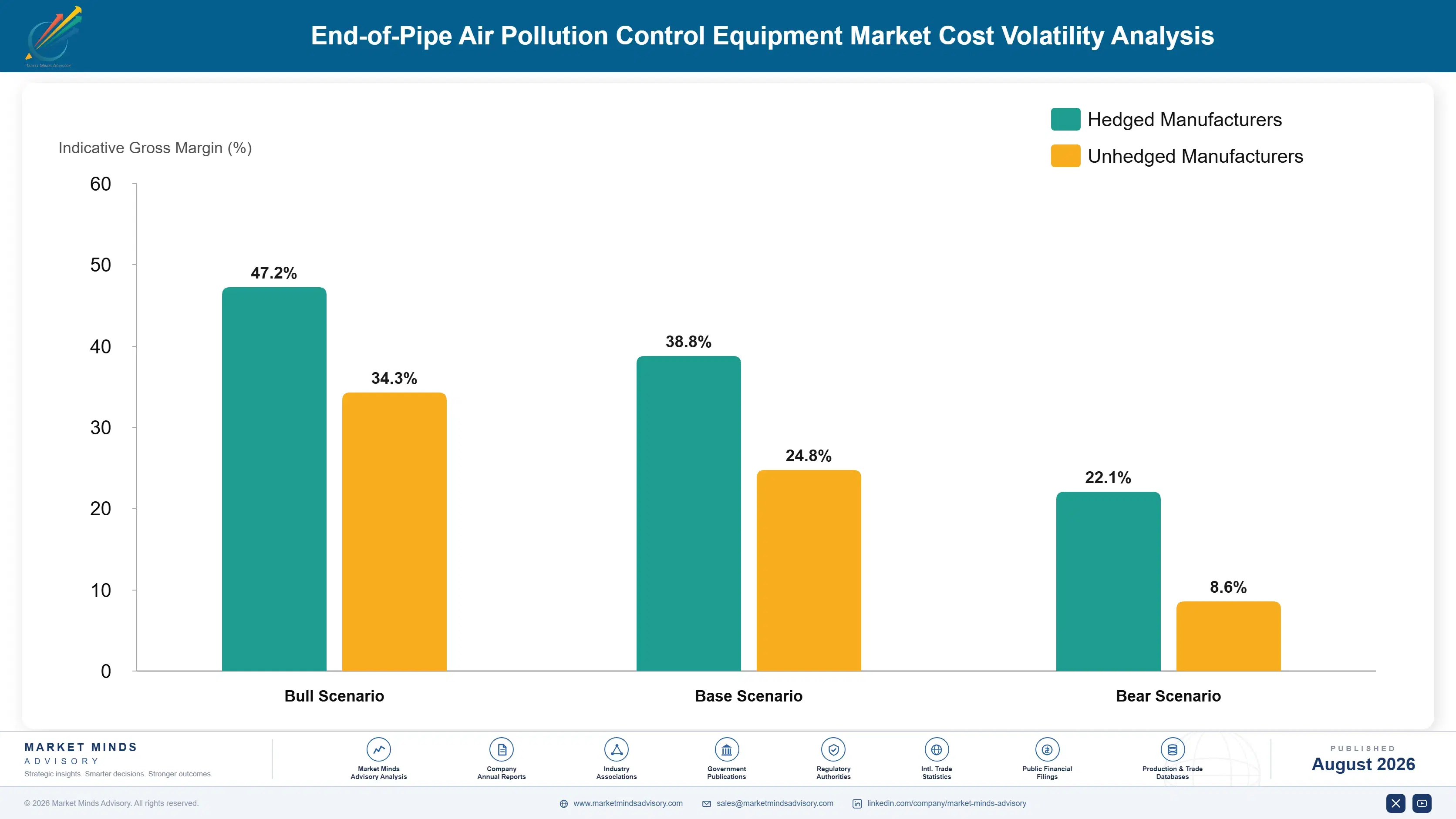
Steel and Catalyst Cost Exposure

Structural steel and fabrication inputs represent 28% to 36% of cost of goods sold for equipment suppliers, sourced primarily from domestic steel mills in each region to avoid import tariff complications on large fabricated components. Catalyst materials, vanadium, titanium dioxide, and tungsten for selective catalytic reduction systems, add a smaller but volatile secondary input cost tied to global specialty metals markets.
Vanadium prices, tracked in EIA and USGS mineral commodity summaries, rose sharply through 2024 as Chinese export policy changes tightened global supply available to catalyst manufacturers outside the country. Selective catalytic reduction system suppliers without long-term vanadium supply contracts saw catalyst input costs rise by an estimated 25% to 35% within a single year, compressing margins on fixed-price contracts signed before the price movement occurred and before suppliers could adjust their bidding accordingly.

Exposure varies meaningfully by player type: suppliers with in-house catalyst manufacturing or long-term vanadium supply agreements absorb price swings better than those purchasing finished catalyst modules from third-party specialists, and this gap becomes a genuine competitive disadvantage during volatile pricing periods. Geographic exposure differs too, since Chinese suppliers sit closer to vanadium production than European or American competitors reliant on longer, more complex supply chains.
end-of-pipe-air-pollution-control-equipment-market-cost-volatility-analysis-1787548754035

Secure Long-Term Vanadium Supply Contracts

Negotiating multi-year vanadium supply agreements directly with mining or processing companies protects catalyst input costs against the kind of export-policy-driven volatility that hit prices hard through 2024, giving SCR suppliers genuinely predictable costs to plan bidding and production scheduling around, rather than absorbing spot-market swings directly into project margins unpredictably every single project cycle.

Develop In-House Catalyst Manufacturing Capability

Larger suppliers with sufficient capital can integrate catalyst manufacturing capability fully in-house rather than purchasing finished modules from third-party specialists, capturing the margin that would otherwise flow entirely to catalyst producers while also gaining direct control over formulation quality and delivery timing during periods of broader market tightness across the wider industry supply chain.

Index Contract Pricing to Steel and Metals Benchmarks

Building steel and catalyst metal price escalation clauses into fixed-price project contracts shares volatility risk with customers rather than leaving suppliers to absorb the entire burden of a price spike alone. Suppliers already using this approach reported meaningfully smoother margin performance during the 2024 vanadium price spike than competitors bidding at pure fixed prices.

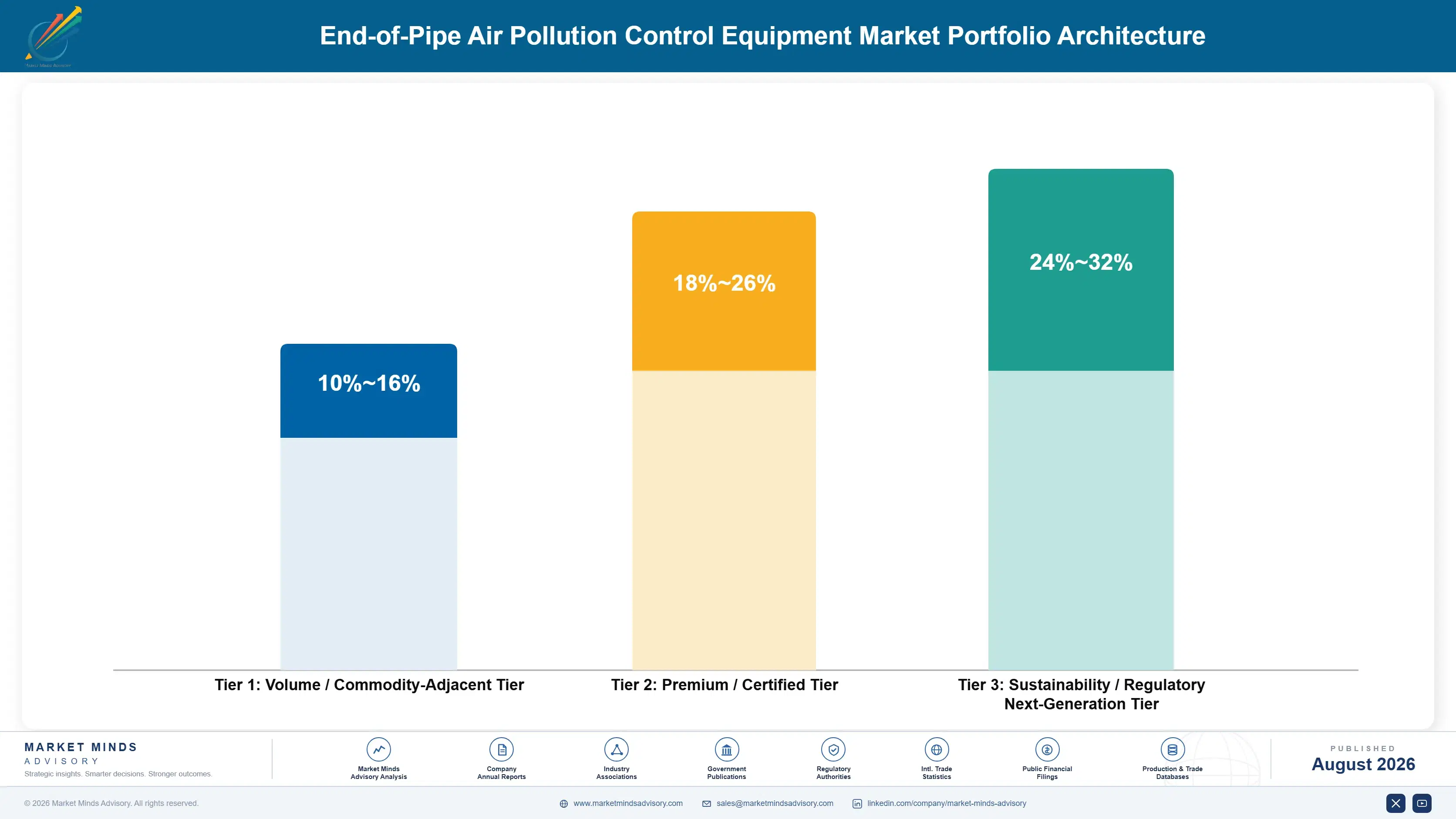
Portfolio Architecture for Margin Defence

The portfolio splits into three tiers with meaningful margin separation tied to technology complexity and service depth rather than raw fabrication cost alone. Commodity-adjacent electrostatic precipitators and basic fabric filters compete mainly on price and delivery timing, while certified selective catalytic reduction systems command durable premiums tied to catalyst performance guarantees and long-term service relationships.
The tension between volume hardware and certification premium sharpens as India's retrofit wave and China's extended emissions standards push demand toward higher-margin selective catalytic reduction and multi-pollutant scrubber systems faster than commodity precipitator demand grows, pulling supplier investment toward these tiers even though basic filtration equipment remains a large and stable installed base globally. Suppliers maintaining a foothold across all three tiers preserve optionality, while those chasing only premium contracts risk losing steady service revenue that commodity equipment still reliably generates.

High-value margin pools concentrate specifically in selective catalytic reduction systems and multi-pollutant scrubber packages meeting the newest regulatory standards, both requiring genuine catalyst and process engineering investment that basic filtration producers must build or acquire rather than simply extend from existing capability. Commodity-adjacent precipitators and fabric filters, by contrast, remain a large but slower-growing volume base offering thinner margins for most participants going forward.

Volume / Commodity-Adjacent Tier

Commodity-adjacent electrostatic precipitators and basic fabric filters sold primarily on price and delivery reliability into mainstream industrial retrofits without multi-pollutant or catalyst-based requirements yet, particularly across cost-sensitive markets worldwide today.
Gross Margin: 10%-16%

Premium / Certified Tier

Certified wet scrubbers and standard SNCR systems integrated into regulator-approved compliance packages commanding durable premiums tied to performance guarantees and a proven multi-year track record with utilities and industrial buyers worldwide.
Gross Margin: 18%-26%

Sustainability / Regulatory / Next-Generation Tier

Next-generation selective catalytic reduction and multi-pollutant systems built specifically for the newest regulatory thresholds emerging across Asia and Europe, representing the most technically demanding corner of the entire product portfolio sold globally.
Gross Margin: 24%-32%
end-of-pipe-air-pollution-control-equipment-market-portfolio-architecture-1787548754535

High-value Sub-segments and Strategic Watch-out

Selective Catalytic Reduction (SCR) Systems

High value with strong growth, tied directly to India's National Clean Air Programme and China's extended emissions standards scaling independent of broader mainstream replacement cycles across most industrial segments worldwide today. Validated catalyst performance increasingly decides which supplier wins long-term retrofit contracts across most major regulators and buyers worldwide.
Gross Margin: 24%-30%

Wet Scrubbers

High value with moderate growth, anchored in multi-pollutant wet scrubber platforms where operators value proven simultaneous capture performance over the fastest possible technical iteration across most industrial segments and production regions today. Suppliers here compete on reliability and installed-base track record more than on the newest performance metrics alone.
Gross Margin: 20%-26%

Electrostatic Precipitators

The volume core, serving mainstream industrial retrofits across most global markets regardless of catalyst-based or multi-pollutant system adoption pace currently underway across the broader industry today. Steady growth tracks industrial facility count and replacement cycles rather than any specific technology transition emerging across the wider category today.
Gross Margin: 10%-14%

Fabric Filters (Baghouses)

The strategic watch-out, facing accelerating price competition as Chinese and Indian domestic suppliers scale engineering capability for cost-sensitive industrial segments worldwide across nearly every price tier and geography today. Remaining international supplier volume concentrates in accounts still requiring proven validation history and established track records built over many years.
Gross Margin: 9%-13%

The Service Annuity in Compliance

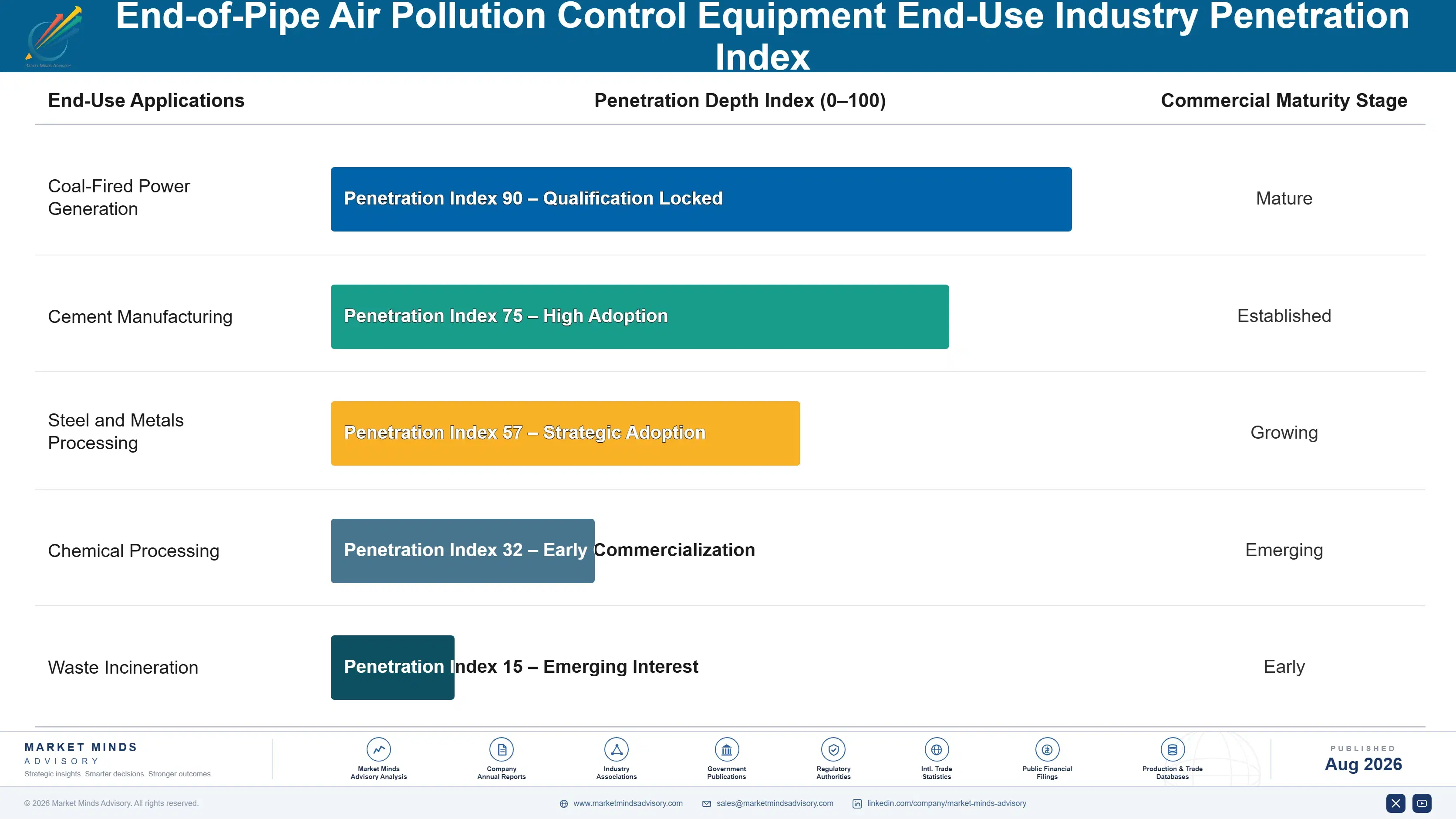
Pollution control equipment revenue behaves like an annuity tied to plant operating life rather than a one-time capital sale, since a facility's control system, once installed and validated, typically runs for 15 to 20 years with associated service, parts, and catalyst replacement contracts generating recurring revenue throughout that entire operating period and beyond.
Adoption depth varies by end-use vertical: coal-fired power generation adopted comprehensive multi-pollutant control earliest given the tightest regulatory scrutiny, while cement and steel sectors are still catching up as China's and India's revised standards extend beyond power generation into these previously less-regulated industrial categories entirely. Chemical processing and waste incineration remain earlier-stage verticals, with adoption depth still building as facility-specific regulations phase in gradually across different jurisdictions and enforcement timelines worldwide.

Buyer profiles are shifting generationally as environmental compliance officers, rather than purely plant engineering staff, now approve equipment sourcing decisions inside major industrial operators and utilities alike across most facility types worldwide today. This younger buyer cohort weighs total lifecycle service cost and regulatory documentation alongside conventional equipment performance, reshaping which suppliers get invited to long-term retrofit and service partnership discussions.
end-of-pipe-air-pollution-control-equipment-market-end-use-penetration-index-1787548755033

Priorities for Pollution Control Suppliers

These are among the four positions where our research anticipates prominent divergence between winners and laggards over the coming forecast period. Each is grounded in the demand model, the regulatory perimeter, and the announced capacity pipeline.
01 / GEOGRAPHIC EXPANSION STRATEGY

Prioritize India market entry over incremental China share gains

India's National Clean Air Programme is driving 9.6% annual country-level growth, roughly 1.55 times the overall market's 6.2% pace, and that gap will widen further as state pollution control boards mandate retrofits across more industrial sectors nationwide through the entire 2036 forecast period. Suppliers still focused primarily on incremental China share risk missing India's faster-growing opportunity while lengthy vendor registration processes lock out late entrants entirely. The near-term priority is establishing local partnerships or registration standing before the programme's tender pipeline matures further.
02 / PRODUCT PORTFOLIO STRATEGY

Shift investment toward selective catalytic reduction over legacy precipitators

Selective catalytic reduction systems are growing at 9.3% annually, roughly 1.5 times the overall market's 6.2% pace, as nitrogen oxide limits tighten across China's cement and steel sectors and India's thermal power fleet simultaneously through the entire forecast period ahead. Suppliers still weighted toward legacy electrostatic precipitators risk ceding the highest-margin retrofit contracts to competitors who invested early in catalyst engineering and service capability. The near-term priority is building or acquiring SCR capability before competitors lock in early mover advantage.
03 / FEEDSTOCK RISK MANAGEMENT

Lock in vanadium supply contracts before the next price spike

Vanadium catalyst input costs rose by an estimated 25% to 35% within a single year following 2024 Chinese export policy changes, exposing suppliers without long-term supply contracts to margin compression on fixed-price project bids signed before the movement occurred. Suppliers still purchasing vanadium entirely on the open market remain exposed to the next feedstock shock in exactly the same way, eroding margin unpredictably each time. Securing multi-year contracts or in-house catalyst production now protects margin ahead of the next inevitable spike.
04 / SERVICE MODEL TRANSFORMATION

Build recurring service revenue ahead of installation demand slowdown

Service revenue already represents an estimated 25% to 30% of total supplier revenue at leading firms, and that share will likely grow further as China's initial retrofit wave matures and new installation volume growth naturally slows relative to the earlier boom years. Suppliers still organized primarily around one-time equipment sales risk losing the steadier, higher-margin revenue stream that dedicated service businesses increasingly capture from existing installed accounts. Building service capability now, rather than after installation volume peaks, positions suppliers for the coming transition.

Engagement Snapshot From the Field

A live engagement with an industry participant carrying material or product regulatory and market exposure ahead of a defining policy shift, showing how our research translates into a defensible multi-year portfolio strategy.
MARKET MINDS ADVISORY · CLIENT ENGAGEMENT SUMMARY
End-of-Pipe Air Pollution Control Equipment Producer Strategic Portfolio Review and Transition Roadmap 2026·Investment Scenario on End-of-Pipe Air Pollution Control Equipment Exposure Evaluation 2025-26
CLIENT PROFILE
The client is a mid-size cement producer operating four plants across South Asia with annual revenue of approximately 480 million dollars (client-reported, unverified by MMA), facing new emissions standards extending China-style ultra-low limits to the cement sector for the first time. The company had never previously installed selective catalytic reduction equipment at any of its facilities.
STRATEGIC CHALLENGE
Leadership needed to retrofit all four plants within a compressed regulatory compliance window, but limited internal engineering expertise in catalyst-based systems left management uncertain whether to phase installations sequentially or pursue all four simultaneously despite the substantially higher upfront capital requirement that simultaneous approach would demand across the entire portfolio.
MMA APPROACH
MMA combined primary interviews with regional SCR suppliers and a phased-versus-simultaneous cost modeling exercise accounting for compliance deadline penalties, financing costs, and supplier capacity constraints, quantifying which sequencing approach genuinely minimized total compliance cost while meeting each plant's individual regulatory deadline without incurring any penalty exposure whatsoever across the portfolio.
KEY FINDINGS
  1. Compliance deadlines varied by six months across the four plants due to differing regional enforcement timelines, an important nuance the client's initial planning had not fully accounted for.
  2. Simultaneous installation across all four plants would have required financing 40% more capital upfront than sequential installation phased across eighteen months instead.
  3. Client-reported internal data (client-reported, unverified by MMA) showed one plant faced meaningfully higher penalty exposure than the other three given its earlier deadline.
  4. Regional SCR suppliers had limited simultaneous installation capacity, meaning a sequential approach also reduced execution risk from supplier resource constraints across projects.
CLIENT PROFILE
The client is a mid-size cement producer operating four plants across South Asia with annual revenue of approximately 480 million dollars (client-reported, unverified by MMA), facing new emissions standards extending China-style ultra-low limits to the cement sector for the first time. The company had never previously installed selective catalytic reduction equipment at any of its facilities.
STRATEGIC CHALLENGE
Leadership needed to retrofit all four plants within a compressed regulatory compliance window, but limited internal engineering expertise in catalyst-based systems left management uncertain whether to phase installations sequentially or pursue all four simultaneously despite the substantially higher upfront capital requirement that simultaneous approach would demand across the entire portfolio.
MMA APPROACH
MMA combined primary interviews with regional SCR suppliers and a phased-versus-simultaneous cost modeling exercise accounting for compliance deadline penalties, financing costs, and supplier capacity constraints, quantifying which sequencing approach genuinely minimized total compliance cost while meeting each plant's individual regulatory deadline without incurring any penalty exposure whatsoever across the portfolio.
KEY FINDINGS
  1. Compliance deadlines varied by six months across the four plants due to differing regional enforcement timelines, an important nuance the client's initial planning had not fully accounted for.
  2. Simultaneous installation across all four plants would have required financing 40% more capital upfront than sequential installation phased across eighteen months instead.
  3. Client-reported internal data (client-reported, unverified by MMA) showed one plant faced meaningfully higher penalty exposure than the other three given its earlier deadline.
  4. Regional SCR suppliers had limited simultaneous installation capacity, meaning a sequential approach also reduced execution risk from supplier resource constraints across projects.
RECOMMENDED STRATEGY
Phase 1: Phase 1 (Months 1 to 6): Install SCR systems at the plant facing the earliest compliance deadline and highest penalty exposure. Phase 2: Phase 2 (Months 7 to 12): Sequentially retrofit the second and third plants using lessons learned from the initial installation. Phase 3: Phase 3 (Months 13 to 18): Complete the fourth plant retrofit and consolidate long-term catalyst service contracts across all sites.
OUTCOME
The client completed all four retrofits within eighteen months, meeting every plant's compliance deadline without penalty exposure, and reported an estimated 22% capital cost saving versus the simultaneous approach originally under consideration (client-reported, unverified by MMA). Leadership credited the sequencing analysis MMA delivered early in the engagement.

Frequently Asked Questions

Foundational context covering the market sizes, CAGR, scope, country, region and competition that inform every finding below. This section is provided to cover basics and most often pre-purchase conversations, answered from the MMA Primary Research Dataset.

What is the current size of the End-of-Pipe Air Pollution Control Equipment Market?

The global end-of-pipe air pollution control equipment market reached an estimated 18.5 billion dollars in 2025. Growth is driven by expanding retrofit demand across China, India, and Southeast Asia.

How large will the End-of-Pipe Air Pollution Control Equipment Market be by 2036?

MMA projects the market will reach approximately 35.9 billion dollars by 2036. That represents roughly 1.82 times the 2026 market size over the forecast decade.

What is the CAGR for the End-of-Pipe Air Pollution Control Equipment Market 2026 to 2036?

The base case CAGR is 6.2% annually across the 2026 to 2036 forecast period. Bull and bear scenarios range from 7.5% to 4.9% depending on enforcement pace.

Which segment is growing fastest?

Selective Catalytic Reduction Systems are the fastest-growing segment, expanding at 9.3% annually, roughly 1.5 times the overall market rate. This reflects tightening nitrogen oxide limits across Asia's industrial sectors.

Who are the major companies in the End-of-Pipe Air Pollution Control Equipment Market?

Leading suppliers include GE Vernova, Babcock and Wilcox, Andritz AG, Thermax Limited, and FLSmidth, evaluated on an annual equipment revenue basis. Together these five suppliers hold an estimated 42% combined share.

Which country is growing fastest?

India leads country-level growth at 9.6% annually, outpacing the broader South Asia and Pacific regional average. The National Clean Air Programme's retrofit mandates drive this acceleration.

Report Segmentation Architecture

The full report scope spans multiple orthogonal segmentation dimensions, with cross-tabulated demand data provided for each dimension pair. Coverage extends further to regional breakdowns, trend trajectories, and the competitive detail needed to support segment-level decision-making.

By Technology Type

  • Electrostatic Precipitators
  • Fabric Filters (Baghouses)
  • Wet Scrubbers
  • Selective Catalytic Reduction (SCR) Systems
  • Selective Non-Catalytic Reduction (SNCR) Systems
  • Regenerative Thermal Oxidizers

By End-Use Industry

  • Coal-Fired Power Generation
  • Cement Manufacturing
  • Steel and Metals Processing
  • Chemical Processing
  • Waste Incineration

By Commercial Dimension

  • New Installation Contracts
  • Retrofit and Upgrade Contracts
  • Long-Term Service and Parts Contracts
  • Turnkey EPC Project Contracts

By Region

  • East Asia
  • North America
  • Western Europe
  • South Asia and Pacific
  • Latin America
  • Middle East and Africa
  • Eastern Europe

Scope, Methodology, and Coverage

Every figure in this report is reproducible from documented input assumptions. The scope below maps the historical period, the forecast horizon, the segmentation dimensions, and the countries covered, alongside the underlying primary and qualitative methodology.
Historical Period
2020 to 2025
Forecast Period
2026 to 2036
Base Year
2025 (USD billions; MMA Primary Research Dataset, August 2026)
Market Definition
The end-of-pipe air pollution control equipment market covers electrostatic precipitators, fabric filters, wet and dry scrubbers, and selective catalytic and non-catalytic reduction systems installed to treat exhaust gas before atmospheric release. It excludes process-integrated emissions reduction technologies and standalone continuous emissions monitoring hardware.
Quantitative Units
USD billions (current prices); installed unit count where applicable
Segmentation Dimensions
By Technology Type; By End-Use Industry; By Commercial Dimension; By Region
Regions Covered
East Asia, North America, Western Europe, South Asia and Pacific, Latin America, Middle East and Africa, Eastern Europe
Countries Covered
USA, China, Germany, France, UK, Japan, South Korea, India, Australia, Canada, Brazil, Mexico, Indonesia, Vietnam, Thailand, Malaysia, UAE, Saudi Arabia, South Africa, Nigeria, Turkey, Poland, Netherlands, Italy, Spain, Sweden, Switzerland, Argentina, Colombia, Singapore, and additional markets relevant to this sector
Key Companies Profiled
GE Vernova, Babcock and Wilcox, Andritz AG, Thermax Limited, FLSmidth, Hamon Group, CECO Environmental, Fuel Tech Inc, Nederman Holding, Durr AG, Mitsubishi Heavy Industries, Doosan Lentjes, Clyde Bergemann, Envea, Ducon Technologies, Longking Environmental Protection, Wuhan Kaidi Electric Power, Beijing SPC Environment Protection Technology, Babcock Power, John Wood Group
Quantitative Methodology
Primary survey, n=3,800 respondents, Q4 2025, six countries; demand-side model with trade association cross-validation
Qualitative Methodology
47 expert interviews, Q4 2025; applied to validate demand model assumptions, identify emerging dynamics, and assess competitive positioning
Report Format
PDF and XLSX data workbook (Word format preview document)
Publisher
Market Minds Advisory
Report Code
MMA-2026-CON-207
Published
August 2026
Contact
sales@marketmindsadvisory.com | www.marketmindsadvisory.com

Purchase the full End-of-Pipe Air Pollution Control Equipment Market Report (2026 to 2036).

This report provides a complete assessment of the global end-of-pipe air pollution control equipment market across the 2026 to 2036 forecast period, covering sizing, segmentation, and regional demand patterns. It profiles the five leading suppliers and fifteen additional participants on a consistent annual equipment revenue basis, detailing competitive positioning, recent corporate developments, and moat and risk analysis for the top two players. The report also examines input cost exposure, portfolio margin architecture, and revenue lever opportunities tied to India's retrofit wave. A dedicated regional chapter breaks down demand across all seven MMA-tracked regions.
Ten-year global market sizing and CAGR forecast model
Six-segment MECE technology breakdown and analysis
Seven-region demand share and growth rate analysis
Twenty-company competitive benchmarking and positioning dataset
Input cost exposure and portfolio margin modeling detail
Anonymized client engagement case study with outcomes

Built For The People Who Decide

From boardroom strategy to bench-side execution, this report is read cover-to-cover by leaders shaping the next decade of their industry, turning demand scenarios, market dynamics and valuation benchmarks into decisions.
CXOs/ Presidents/ VPs/ Managers
M&A and Corporate Development
Strategy Teams and R&D Heads
Procurement and Product Directors
Regulatory and Compliance Leaders
Investor Relations and Equity Analysts