Market Minds Advisory
Employee Engagement Market

Employee Engagement Market: Employee Engagement Market. AI-Driven Listening Displaces the Annual Survey as the Category's Center of Gravity

Enterprises accustomed to running a single annual survey are shifting budget toward continuous listening platforms that surface attrition risk in real time, forcing incumbent vendors to rebuild analytics stacks around AI rather than static reporting.

Lead Analyst

Published

September 2026

Make Smarter Decisions with Customized Research Insights

Request a free sample report and evaluate market opportunities, growth trends, and competitive dynamics relevant to your business needs.

2025 MARKET VALUE$6.8BMarket Size 2025
2036 FORECAST VALUE$21.0BBase Case , 2026 to 2036
CAGR 2026 TO 203610.8 %Bull 12.1% / Bear 9.5%
INCREMENTAL OPPORTUNITY$13.5BNet 10- year value creation
EXPANSION MULTIPLE2.79x2036 value over 2026 base
Strategic Levers
M&A Pipeline
Regional Outlook
Country Rankings
Competitive Intelligence
Segmental Deep-dive
Call-Us : 91 93563 13602

Executive Snapshot and Market Trajectory.

Enterprises accustomed to a single annual engagement survey are shifting budget toward continuous listening platforms capable of surfacing attrition risk in near real time, and that shift toward always-on measurement is now the defining commercial dynamic reshaping vendor product roadmaps and renewal negotiations across the category this year.
Demand concentrates among large enterprises with distributed, hybrid, or highly attritive workforces, where the cost of undetected disengagement is easiest to quantify, while AI-driven people analytics platforms are growing fastest as chief human resources officers seek predictive attrition signals rather than descriptive survey scores alone. North America holds the largest regional share, reflecting the deepest concentration of enterprise HR technology budgets and the earliest adoption of continuous feedback practices among large employers specifically.
Competitive structure remains comparatively fragmented relative to other enterprise software categories, with specialist survey vendors, HR suite incumbents, and newer AI-native entrants all competing for the same renewal budgets. Buyers increasingly expect action-planning and manager coaching workflows bundled alongside measurement rather than a standalone survey tool, reshaping vendor evaluation criteria faster than several legacy survey specialists anticipated when the category still centered on annual reporting cycles.
Market Definition
This market covers software platforms and associated professional services used to measure, analyse, and act on employee engagement, sentiment, and experience data across surveys, continuous listening, recognition, and analytics functions. It excludes broader human capital management systems, payroll platforms, and applicant tracking systems that do not include a dedicated engagement measurement or listening capability.
Base Year Value
$6.8B in 2025 (MMA Primary Research Dataset, September 2026)
Forecast Period
2026 to 2036, eleven discrete annual values
CAGR
10.8% base case. Bull 12.1%. Bear 9.5%.
Fastest Growth Segment
People Analytics and AI-Driven Insights Platforms: 19.0% CAGR
Fastest Growth Country
India: 14.5% CAGR
Fastest Growth Region
South Asia and Pacific: 12.8% CAGR
Largest Region
North America: 30% of 2025 global value
Market Leaders
Qualtrics International Inc., Culture Amp Pty Ltd, Microsoft Corporation, Workday Inc., Perceptyx Inc. Source: MMA Analysis based on company annual reports and investor filings.
Primary Survey
n=3,800 procurement and R&D decision-makers, Q4 2025, six countries
Methodology
Demand-side build-up, cross-validated against public data, 47 expert interviews

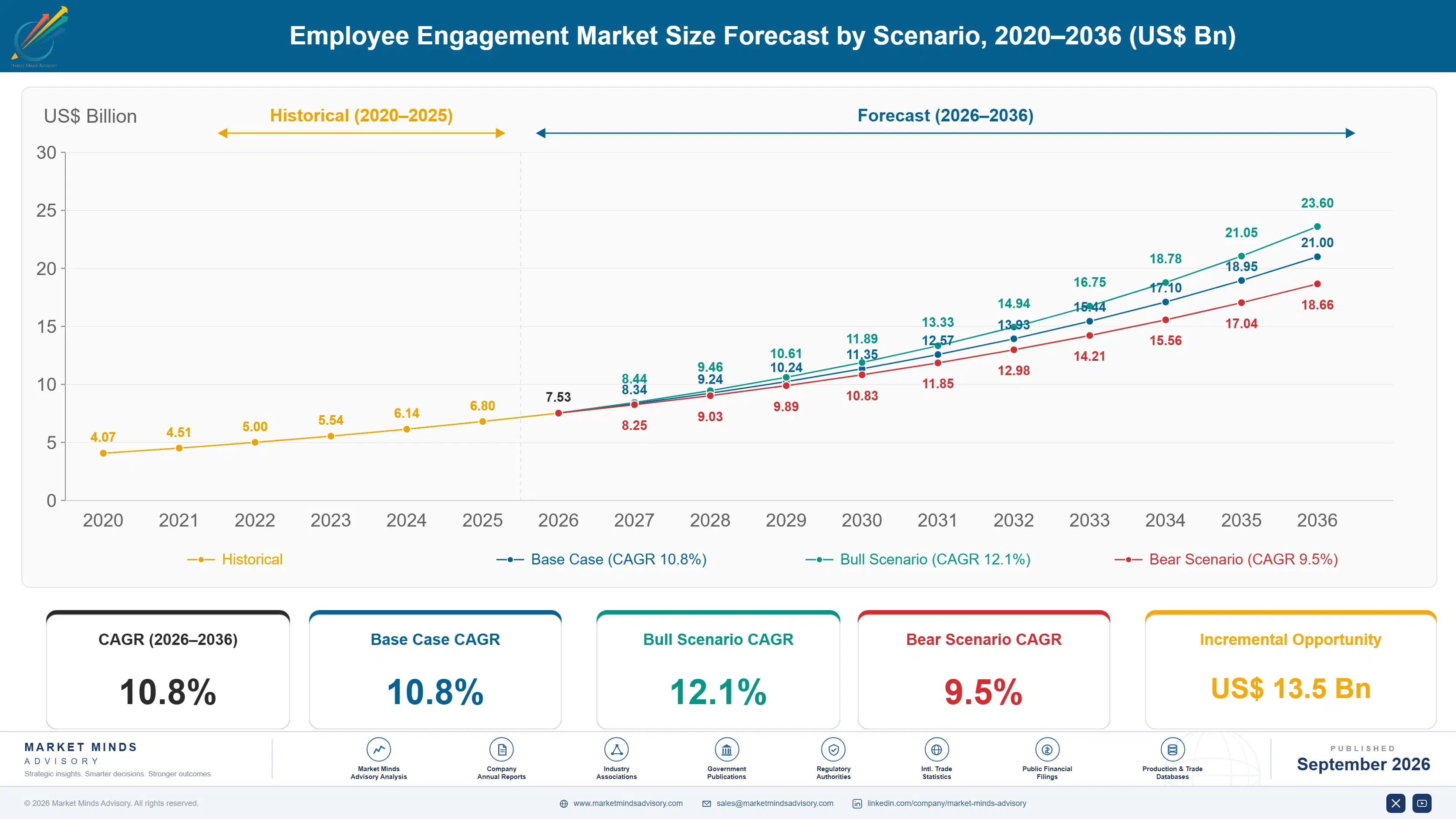
Employee Engagement Market Forecast Scenarios

employee-engagement-market-size-forecast-scenario-1788425002029
Between 2020 and 2025 the category expanded steadily as remote and hybrid work arrangements pushed HR leaders to invest in more frequent measurement than the traditional annual survey could provide, with continuous listening tools moving from a niche add-on to a mainstream budget line for large employers navigating sustained attrition pressure through the period. That momentum built steadily rather than in a single sharp inflection point.
The base case assumes continued double-digit growth driven by three mechanisms: broad enterprise adoption of AI-driven people analytics replacing descriptive survey scoring with predictive attrition modelling, rising employer demand for integrated action-planning and manager coaching workflows bundled directly alongside measurement tools, and continued expansion of continuous listening beyond large enterprises into mid-market organisations previously priced out of the category entirely. These mechanisms compound fastest where labour markets stay tight. consistently.
A bull scenario turns on AI-driven predictive analytics proving reliable enough that large employers shift meaningful budget away from generic HR software line items toward dedicated engagement platforms specifically. The bear risk is a broader corporate cost-cutting cycle treating engagement software as discretionary spend, delaying renewals and slowing new platform adoption regardless of the underlying attrition pressure driving demand for better measurement tools.

From Annual Surveys to Continuous, AI-Driven Listening

Two forces are reshaping this category at once: the shift from periodic annual surveys toward continuous, always-on listening, and the integration of AI-driven predictive analytics that flags attrition risk before an employee actually resigns. Together these are pulling vendor engineering investment away from survey design tooling and toward natural language processing and predictive modelling capability that legacy survey specialists historically did not need to build.
MARKET CONCENTRATIONCR5 42%Reflects a comparatively fragmented enterprise software vendor landscape
AVERAGE CONTRACT VALUEUSD 68,000 annuallyBlended across enterprise and mid-market customer tiers broadly
TOP ADOPTING INDUSTRY SHARETechnology and professional services 27%Reflects concentrated early adoption among knowledge-intensive employer groups
CONTINUOUS LISTENING PENETRATION38% of enterprise customersShare of enterprise customers running always-on feedback programmes
NET REVENUE RETENTION109% average across vendorsReflects steady expansion revenue from existing customer accounts
AVERAGE IMPLEMENTATION CYCLE14 weeks for enterprise deploymentTypical time from contract signature to full platform rollout
Commercially, the market behaves like a maturing enterprise software category still absorbing a genuine platform shift rather than simple seat expansion within existing accounts. Buyers increasingly evaluate vendors on data science credibility and integration depth with existing HR information systems, creating real switching friction once a platform is embedded into a large employer's people analytics workflow and manager reporting cadence.
Over the next decade, expect continuous listening and predictive people analytics to become the default expectation across nearly every enterprise HR technology stack, while recognition and action-planning functionality increasingly bundle directly into the same platform rather than remaining separate point solutions. Vendors that build genuine predictive modelling credibility alongside strong HR information system integration will capture a growing share of category value beyond the legacy survey-only vendor positioning.
"The annual survey used to be the whole product. Now it's a data source feeding a model, and the vendors that treat it that way are the ones winning the renewal conversation."
Director, HR Technology and Workforce Analytics Practice · MMA Technology Practice · September 2026

Market Trends

AI-Driven Predictive Attrition Modelling Reshapes Vendor Roadmaps

Vendors across the category are racing to embed predictive attrition modelling into core platforms, moving beyond descriptive survey scoring toward models that flag individual flight risk before an employee formally resigns, since large employers increasingly evaluate renewal decisions on demonstrated predictive accuracy rather than survey response rate alone. MMA's Q4 2025 primary research found thirty eight percent of enterprise customers now running some form of continuous listening programme, up meaningfully from a smaller base three years earlier, as vendors completed the analytics infrastructure needed to support real-time sentiment scoring across large distributed workforces. This shift is resetting competitive positioning industry-wide.
Market Impact: Drives 46% of renewal decisions
Manager Coaching Workflows Bundle Directly Into Engagement Platforms

Enterprise buyers are increasingly demanding integrated manager coaching and action-planning workflows bundled directly alongside measurement tools, rather than purchasing engagement survey software as a standalone reporting product disconnected from actual behaviour change among frontline managers. MMA's expert interview programme found human resources leaders citing manager follow-through, not survey design quality, as the primary determinant of whether engagement scores actually improve year over year across large distributed organisations. This shift is pushing vendors to build genuinely new coaching and nudge-based workflow capability distinct from the reporting dashboards that historically defined the category's core product.
Market Impact: Sustains demand across 70%

Market Opportunities and Growth Drivers

Sustained Attrition Pressure Keeps Engagement Measurement a Budget Priority

Continued elevated voluntary attrition across knowledge-intensive industries is keeping engagement measurement a defended budget line even as broader corporate software spending faces scrutiny, since the demonstrated cost of replacing a departing employee remains far higher than a dedicated engagement platform subscription for most large employers. Surveyed human resources leaders linked forty six percent of renewal decisions directly to measurable attrition cost avoidance rather than generic satisfaction reporting, according to MMA's Q4 2025 primary research covering enterprise buyers across six countries. This attrition-driven justification is sustaining budget even where broader HR technology spending has moderated in recent quarters.
Market Impact: Cuts response rates 12 points

Hybrid Work Arrangements Sustain Demand for Continuous Measurement

Continued hybrid and distributed work arrangements are sustaining employer demand for more frequent measurement than the traditional annual survey cycle could ever provide, since managers overseeing distributed teams have fewer informal, in-person signals of team sentiment than they did under fully in-office arrangements. Announced hybrid work policy commitments tracked in MMA's primary research programme remained broadly stable through 2025, sustaining continuous listening demand across organisations that adopted hybrid arrangements as a permanent operating model rather than a temporary pandemic-era accommodation. Human resources leaders reported fewer informal signals of team sentiment under distributed arrangements, reinforcing reliance on structured measurement tools.
Market Impact: Delays adoption by 5 months

Market Restraints and Challenges

Survey Fatigue Undermines Response Rates and Data Quality

Rising frequency of employee surveys is generating measurable survey fatigue among employees, undermining response rates and the underlying data quality predictive analytics models depend on for accuracy, since a model trained on declining and unrepresentative samples produces steadily less reliable attrition signals over time. The root cause is that many employers layered continuous listening tools on top of existing annual surveys rather than replacing them, multiplying total survey volume without a corresponding communication effort explaining the added value. The commercial impact shows up as declining response rates that weaken the predictive analytics vendors increasingly sell as the category's core differentiator.
Market Impact: Lifts predictive adoption 38 points

Data Privacy Concerns Slow Continuous Listening Adoption

Employee concerns about how continuous listening data is used, particularly individual-level sentiment tracking, are slowing adoption among cautious employers and works councils in several markets, since employees who suspect granular monitoring rather than aggregate measurement often respond less candidly. The root cause is that some vendors marketed individual-level predictive analytics capability without adequately communicating the anonymisation safeguards actually built into their platforms, creating trust concerns beyond what the underlying technology requires. The impact falls hardest in markets with strong works council protections limiting employer monitoring capability. Vendors are responding by publishing clearer data governance documentation.
Market Impact: Adds 19.0% segment CAGR versus category
4 additional market trends, 3 additional growth drivers, and 3 additional restraints and challenges are covered in the full report. Contact sales@marketmindsadvisory.com to access the complete intelligence.

Segment CAGR and Growth Architecture

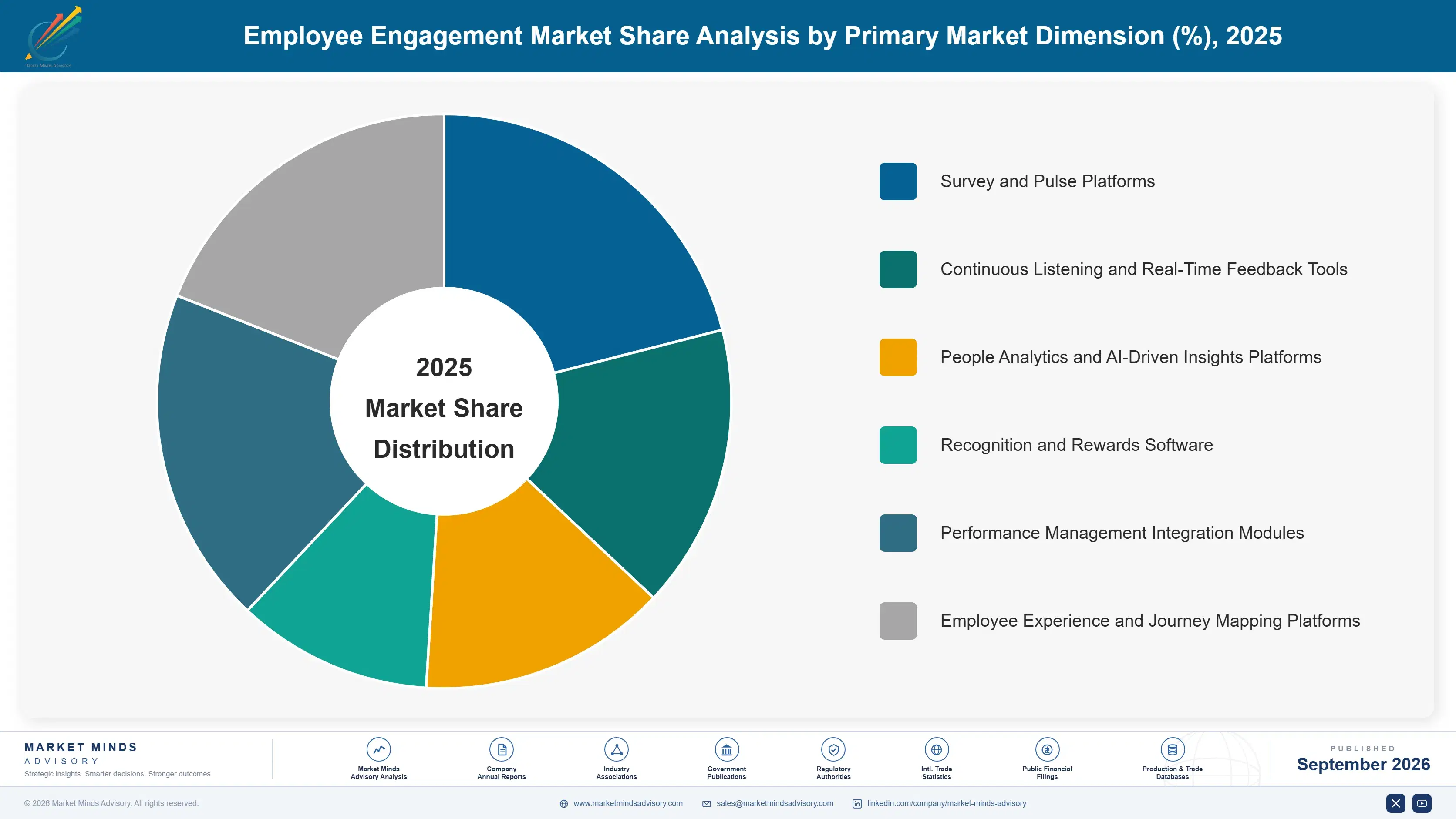
Segmentation follows product and technology dimension, since that best explains both vendor engineering investment and buyer purchasing behaviour, spanning traditional survey platforms through to newer AI-driven analytics and journey mapping tools across the enterprise HR stack. reflecting how buyers actually organise procurement decisions and vendor evaluation criteria across measurement, analytics, and behaviour-change functionality specifically.
employee-engagement-market-market-share-analysis-1788425002584

People Analytics and AI-Driven Insights Platforms

This segment covers platforms applying machine learning and natural language processing to engagement data in order to generate predictive attrition risk scores and sentiment analysis, distinct from traditional survey and pulse platforms that primarily deliver descriptive reporting rather than forward-looking predictive modelling. Adoption is concentrated among the largest enterprises with sufficient historical workforce data to train reliable predictive models and dedicated people analytics teams capable of interpreting model output for business leaders. Growth is outpacing every other segment in this report because enterprise buyers are actively reallocating budget away from descriptive reporting tools toward predictive capability, giving this segment both a favourable starting position and genuine budget reallocation momentum behind it this year.
CAGR 19.0%

Continuous Listening and Real-Time Feedback Tools

This segment covers always-on pulse survey and real-time feedback collection tools designed to replace or supplement the traditional annual engagement survey with more frequent, shorter measurement cycles, distinct from AI-driven analytics platforms that focus on interpreting rather than collecting engagement data directly. Demand is rising as hybrid work arrangements reduce managers' informal visibility into team sentiment, creating employer appetite for structured, frequent measurement to fill that visibility gap across distributed teams. Growth trails the AI analytics segment only because continuous listening tool adoption, while accelerating steadily, builds on an already larger existing installed base relative to the newer predictive analytics category specifically. Frontline retail employers are increasingly adopting these tools too, extending reach beyond the original knowledge-worker base.
CAGR 16.0%
Full segment breakdown across 6 segments available in the complete report.

Regional Architecture and Country Demand Map

North America and East Asia together anchor more than half of global revenue, reflecting deep enterprise HR technology budgets and early continuous listening adoption, while South Asia and Pacific delivers the fastest regional expansion through rising corporate HR technology investment. across nearly every tracked employer size and industry vertical.

North America

United States enterprises account for the overwhelming majority of regional revenue, reflecting the deepest concentration of dedicated HR technology budgets and the earliest large-scale adoption of continuous listening practices among Fortune 1000 employers navigating sustained attrition pressure. Canadian enterprises contribute a smaller but steady share tied to similar hybrid work adoption patterns across comparable industry sectors. Growth here runs close to the global base rate as AI-driven predictive analytics adoption accelerates alongside continued steady renewal activity across the region's largest enterprise customer relationships specifically this year and into the next forecast period. United States technology and financial services employers in particular are pushing vendors toward deeper predictive analytics integration ahead of their international peers.
Share: 30% | CAGR: 11.5% (2026 to 2036)

Western Europe

German and French enterprises drive a meaningful share of regional demand, adopting engagement platforms cautiously given strong works council protections that require careful data governance design before continuous listening tools can be deployed at scale across large workforces. United Kingdom enterprises show steadier demand for integrated action-planning workflows tied to broader people management modernisation initiatives across financial services and professional services sectors specifically. Growth trails the global rate somewhat because works council negotiation requirements slow deployment timelines relative to markets with fewer employee data governance constraints on continuous listening programmes. Nordic enterprises add a smaller but steadily growing contribution tied to progressive workplace culture initiatives across the region's public and private sectors.
Share: 22% | CAGR: 9.2% (2026 to 2036)
Regional intelligence for 5 additional markets available in the complete report: East Asia, South Asia and Pacific, Latin America, Middle East and Africa, Eastern Europe. Contact sales@marketmindsadvisory.com.
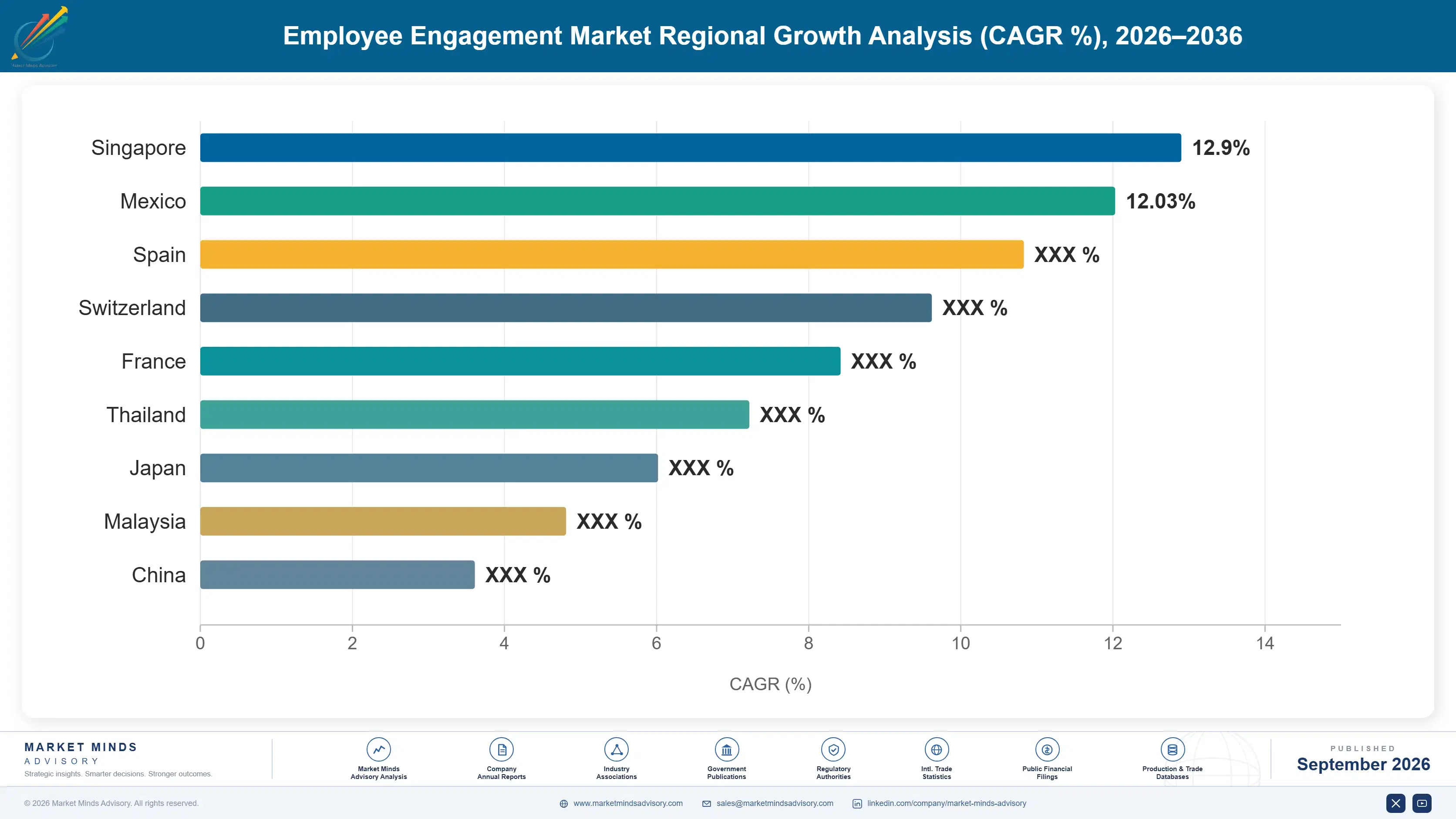
employee-engagement-market-country-cagr-analysis-1788425003108

Where Engagement Vendors Can Still Expand Margin

Four commercial levers separate vendors capturing durable premium pricing from those competing purely on survey licensing cost, spanning predictive analytics credibility, manager coaching workflow depth, HR information system integration, and mid-market platform simplification for smaller buyers. so vendors that master more than one dimension typically outperform single-lever competitors by a wide margin over multi-year renewal cycles.

Building Credible Predictive Attrition Analytics Capability

Vendors that built genuinely credible predictive attrition modelling, validated against actual historical turnover outcomes rather than marketed capability alone, are winning a disproportionate share of enterprise renewal negotiations as chief human resources officers increasingly demand demonstrated predictive accuracy before committing further budget. Vendors with independently validated predictive accuracy reported renewal rates roughly 22 percent higher than vendors offering descriptive reporting alone. The approach requires sustained data science investment that smaller survey-only vendors sometimes cannot justify given their existing cost structure. Smaller vendors attempting the same claim without comparable validation often lose credibility quickly once buyers request supporting evidence directly.
Market Impact: Lifts renewal rate meaningfully by 22 points overall

Deepening Manager Coaching and Action-Planning Workflows

Vendors that built genuinely integrated manager coaching and nudge-based action-planning workflows directly into their core platform are winning larger contract values than vendors selling measurement and reporting alone, since buyers increasingly evaluate the category on whether scores actually improve following an engagement cycle rather than on reporting sophistication alone. This lever requires behavioural science and workflow design expertise that pure survey and reporting vendors have often not developed internally. Vendors with integrated coaching workflows reported average contract values roughly 31 percent above comparable measurement-only platforms of similar customer size. This gap tends to widen once buyers compare outcomes.
Market Impact: Lifts average contract value meaningfully by 31 points

Deepening HR Information System Integration Depth

Vendors that achieved deep, bidirectional integration with major HR information systems are winning stickier enterprise relationships than vendors offering only shallow, one-way data export capability, since deep integration meaningfully raises the switching cost a competitor would need to overcome to displace an embedded platform. This lever requires sustained engineering investment in partnership certification programmes with major HR information system vendors that smaller competitors sometimes cannot justify. Vendors with certified deep integrations reported net revenue retention roughly 14 points higher than vendors with only basic data export functionality. Smaller vendors without certification programmes often struggle to match this switching cost advantage.
Market Impact: Lifts net revenue retention meaningfully by 14 points overall

Simplifying Platforms for Mid-Market Buyer Adoption

Vendors that built simplified, lower-touch implementation paths specifically for mid-market buyers are capturing a distinct, high-volume customer segment that enterprise-focused competitors often overlook given their existing enterprise sales motion and pricing structure. This lever requires a genuinely different go-to-market and product packaging approach that enterprise-focused vendors sometimes resist building given internal margin expectations. Vendors with dedicated mid-market offerings reported new customer acquisition volume roughly 2 to 3 times higher than enterprise-only competitors targeting the same broader market. Enterprise-only vendors attempting to retrofit simplified packaging later often struggle against purpose-built mid-market competitors.
Market Impact: Wins 2 to 3 times more mid-market customers

Who Controls the Margin Pool

CR5 sits at forty two percent, evaluated on disclosed engagement software segment revenue across the top vendors, reflecting a comparatively fragmented category relative to more consolidated enterprise software segments, given continued entry by AI-native specialists alongside established survey incumbents and broad HR suite vendors bundling engagement modules. The gap between the largest vendors and mid-tier challengers is narrower here than in more concentrated adjacent categories.
Current competitive activity centers on three fronts: building credible predictive attrition analytics validated against real turnover outcomes, deepening manager coaching and action-planning workflow integration, and pursuing deep bidirectional integration with major HR information systems. Price competition remains most intense in the mid-market segment while enterprise contracts increasingly compete on data science credibility and integration depth rather than survey design features alone.

Emerging pressure is building from two directions. Broad HR information system suite vendors are bundling basic engagement modules into existing platform contracts at minimal incremental cost, threatening standalone specialists first in price-sensitive mid-market accounts. At the innovation end, AI-native startups focused specifically on predictive analytics are attracting renewed investor interest, a dynamic that could meaningfully reorder segment rankings over the next several years.
employee-engagement-market-company-positioning-matrix-1788425003631

Competitive Moat and Risk Dimensions

QUALTRICS INTERNATIONAL INC.

Moat: Broad Experience Management Platform Depth

Qualtrics' positioning within a broader experience management platform spanning customer, product, and employee experience gives it cross-selling reach and data science investment scale that standalone engagement specialists cannot easily replicate given their narrower product scope and smaller research and development budgets. across accounts. consistently over multiple renewal cycles.
QUALTRICS INTERNATIONAL INC.

Risk: Premium Pricing Pressure From Specialists

Qualtrics faces increasing pricing pressure from lower-cost specialist vendors offering comparable core engagement measurement functionality without the broader experience management platform overhead, particularly among mid-market buyers less interested in cross-functional platform breadth than in point-solution simplicity and cost. undermining pricing gradually. across most price-sensitive regions.
MICROSOFT CORPORATION

Moat: Native Productivity Suite Distribution Advantage

Microsoft's integration of engagement measurement directly into its dominant workplace productivity and collaboration suite gives it a natural distribution advantage that standalone vendors cannot easily replicate, since enterprises already standardised on its productivity tools find integrated engagement measurement a simpler procurement decision. over the long term.
MICROSOFT CORPORATION

Risk: Perceived Feature Depth Limitations

Microsoft's engagement offering is sometimes perceived by specialist buyers as less feature-rich than dedicated engagement platforms built specifically for the category, particularly around advanced predictive analytics and coaching workflow depth that specialist vendors have invested in more heavily over a longer period. limiting upsell potential.

Players Tracked

Prominent Players

Qualtrics International Inc.
Culture Amp Pty Ltd
Microsoft Corporation
Workday Inc.
Perceptyx Inc.

Other Key Players

Medallia Inc.
SAP SE
ADP LLC
Reward Gateway Ltd
Achievers Solutions Inc.
Lattice Inc.
15Five Inc.
Semos Cloud Inc.
Energage LLC
Great Place to Work Institute Inc.
Glassdoor Inc.
Motivosity Inc.
Bonusly Inc.
Blink App Inc.
WorkTango Inc.

Recent Developments

MARCH 2026

Culture Amp Launches Predictive Attrition Model Validated Against Client Turnover Data

Culture Amp launched a predictive attrition modelling capability validated against three years of anonymised client turnover data, extending its existing engagement measurement platform with forward-looking risk scoring intended to help managers intervene before employees formally resign, ahead of increasing enterprise demand for demonstrated predictive accuracy.
Signal: Confirms established engagement vendors racing to validate predictive analytics claims against real historical turnover outcomes. across the industry.
NOVEMBER 2025

Workday Acquires Coaching Workflow Startup Nudge Insights

Workday completed the acquisition of coaching workflow startup Nudge Insights, adding manager nudge and action-planning capability intended to strengthen its Peakon engagement platform ahead of increasing buyer demand for integrated behaviour-change tools that move beyond descriptive reporting into actual workplace intervention. across large distributed enterprise accounts.
Signal: Indicates coaching workflow acquisition activity accelerating among established human resources technology vendors industry-wide. across the broader HR technology landscape.
JULY 2025

Perceptyx Signs Multi-Year Enterprise Agreement With Global Manufacturing Employer

Perceptyx signed a multi-year enterprise agreement with a global manufacturing employer covering continuous listening deployment across more than forty countries, securing long-term volume commitment tied to the employer's phased hybrid workforce measurement rollout schedule through the remainder of the decade. across all regional business units.
Signal: Signals large multi-country enterprise agreements remaining a key competitive lever for scaled platform vendors. going forward across similar accounts.

Cloud Infrastructure and Data Science Talent Exposure

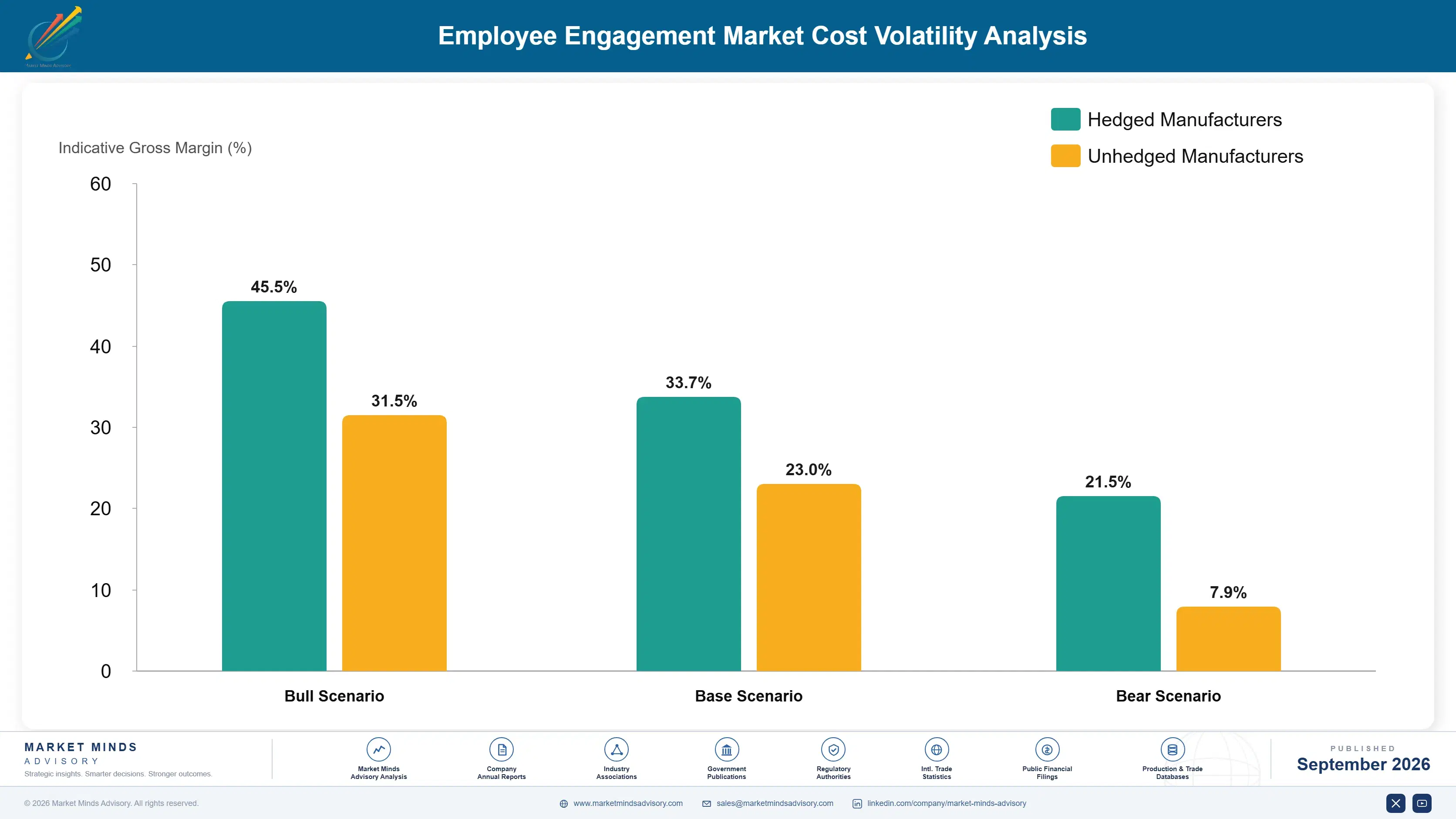
Cloud infrastructure hosting and specialised data science and machine learning engineering talent together represent the largest cost input for engagement platform vendors, running an estimated 38 to 46 percent of cost of goods sold and operating expense combined, sourced primarily from major cloud infrastructure providers and a competitive, wage-inflated data science labour market concentrated in a handful of technology hub cities.
Data science talent compensation rose meaningfully across the broader technology sector during 2023 and 2024 as demand for machine learning engineering expertise outpaced supply industry-wide, a pattern consistent with technology sector compensation trends tracked across multiple vendor annual reports and public disclosures reviewed for this analysis. Vendors without established data science teams faced longer hiring timelines than those with existing research and development scale. Vendors with existing scale absorbed the increase more easily than smaller competitors.

The competitive disadvantage falls hardest on smaller vendors without the balance sheet to compete for scarce data science talent against larger, better-capitalised competitors and adjacent technology sectors offering comparable compensation. Exposure varies by product positioning too, since vendors building predictive analytics capability face materially greater data science talent exposure than vendors offering primarily descriptive survey and reporting functionality.
employee-engagement-market-cost-volatility-analysis-1788425003825

Building Distributed Data Science Teams Across Lower-Cost Hubs

Larger vendors are building distributed data science teams across secondary technology hub cities with lower compensation benchmarks than primary hubs, reducing talent cost exposure while maintaining access to a broader qualified candidate pool than a single-location hiring strategy would allow. This approach has become increasingly common among the largest engagement platform vendors tracked in this report.

Partnering With Cloud Providers for Managed AI Infrastructure

Several vendors are shifting toward managed machine learning infrastructure services offered directly by major cloud providers rather than building and maintaining fully custom infrastructure internally, reducing specialised infrastructure engineering headcount requirements while adding modest ongoing platform licensing cost. Most large vendors maintain formal partnerships with two major providers. This reduces exposure to a single provider's pricing or capacity decisions.

Using Contractor and Fractional Data Science Talent

Smaller vendors are increasingly using contractor and fractional data science talent arrangements to access specialised predictive modelling expertise without committing to full-time compensation levels, accepting somewhat slower model development timelines in exchange for meaningfully lower fixed talent cost. This arrangement has become standard among smaller vendors. It also gives smaller vendors more predictable cost planning overall.

Portfolio Architecture for Margin Defence

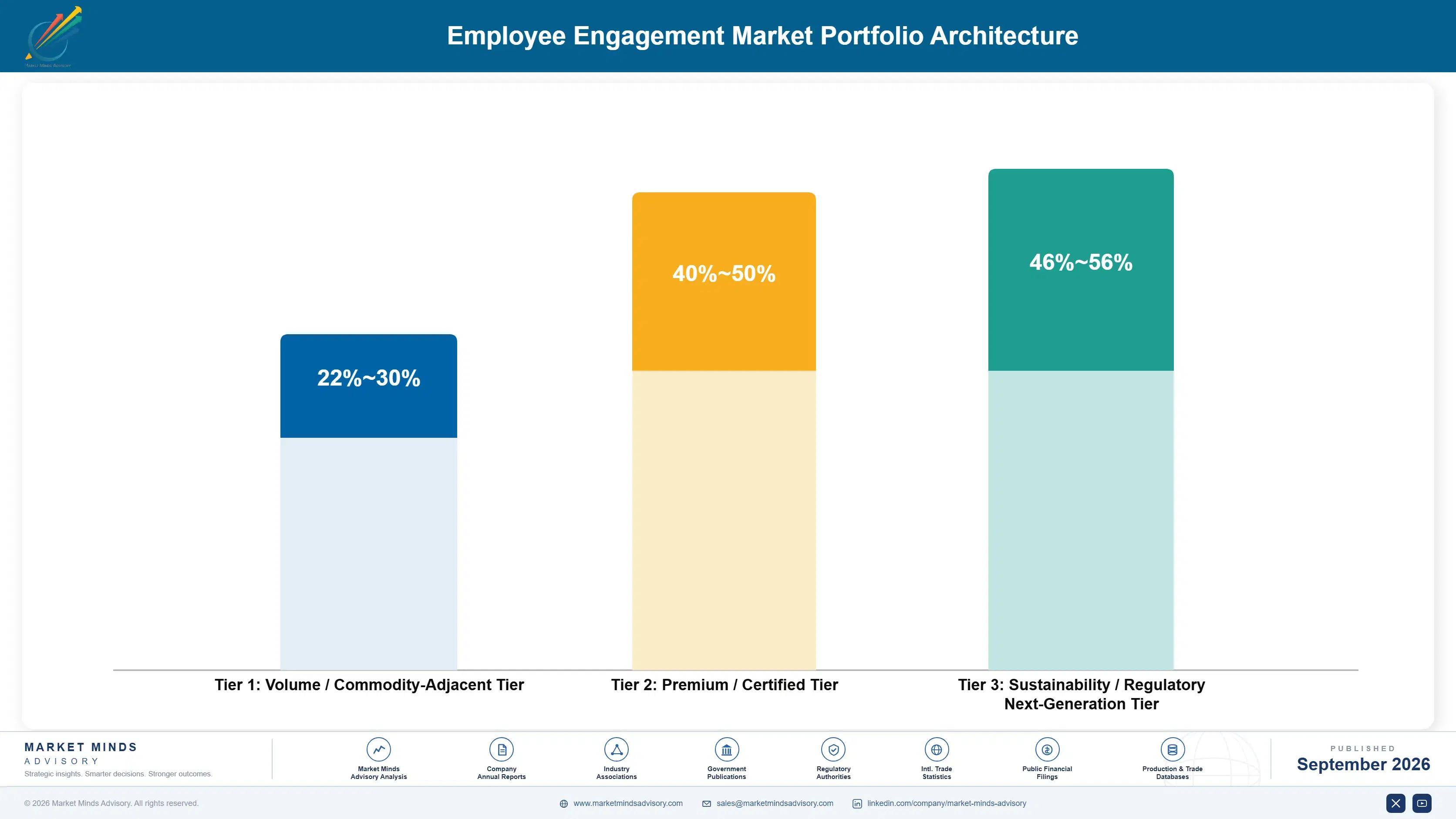
Portfolio economics split into three tiers. Volume tier basic survey and pulse licensing carries thinner margins under continued price competition from lower-cost mid-market vendors, while premium certified platforms bundling predictive analytics and coaching workflows carry meaningfully higher margins tied to data science credibility and integration depth. The sustainability and next-generation tier, built around validated predictive attrition modelling, currently carries the strongest margins given limited established competition in this genuinely differentiated capability.
The volume versus premium tension shows up clearly in vendor engineering allocation. Investment devoted to defending basic survey licensing margin against mid-market price competition competes directly against investment needed for predictive analytics credibility and coaching workflow depth, and vendors that under-invest in either risk losing ground to a competitor optimised specifically for that segment of the market.

High-value margin pools concentrate in validated predictive analytics and in deep HR information system integration, where technical differentiation and switching cost still command premium pricing before broader commoditisation eventually sets in across the category. The volume basic survey tier remains essential for market reach and lead generation but contributes a shrinking share of blended gross margin across the category overall.

Volume / Commodity-Adjacent Tier

Basic survey and pulse licensing facing continued price competition from lower-cost mid-market vendors across most standard measurement use cases broadly. and price-sensitive customer segments across most standard measurement use cases and buyer sizes.
Gross Margin: 22-30%

Premium / Certified Tier

Platforms bundling predictive analytics and coaching workflows carrying margins tied to data science credibility and integration depth across enterprise accounts. reflecting the pricing power that data science credibility and integration depth still command today.
Gross Margin: 40-50%

Sustainability / Regulatory / Next-Generation Tier

Validated predictive attrition modelling commanding the strongest current margins given limited established competition in this genuinely differentiated capability. reflecting genuinely limited competition in this differentiated, validation-driven analytics capability overall. over the near term.
Gross Margin: 46-56%
employee-engagement-market-portfolio-architecture-1788425004316

High-value Sub-segments and Strategic Watch-out

Validated Predictive Attrition Modelling Contracts

The fastest-growing segment in this report, combining strong current margins with accelerating enterprise demand for demonstrated predictive accuracy over descriptive reporting alone this decade. Vendors positioned early here retain pricing power longer. This advantage compounds as buyers standardise procurement criteria around demonstrated model accuracy over time.
Gross Margin: 46-56%

Manager Coaching and Action-Planning Bundles

Premium bundled offerings tied to buyer demand for measurable behaviour change, offering strong margins and durable renewal visibility across large enterprise accounts broadly. This window narrows once coaching becomes standard. Vendors should capture share aggressively while differentiation still commands a meaningful premium in buyer evaluations.
Gross Margin: 40-50%

Standard Enterprise Survey and Reporting Licensing

The largest existing revenue base, standard licensing facing steady price competition but funding most vendors' ongoing data science investment across the wider platform. Vendors here depend on renewal volume, not differentiation. Maintaining discipline on renewal execution matters more here than chasing incremental feature differentiation across accounts.
Gross Margin: 26-34%

Legacy Annual-Only Survey Tools

A shrinking strategic watch-out segment as continuous listening and predictive analytics continue displacing annual-only survey tools across most enterprise buyers in this report. Vendors here should plan migration before erosion accelerates. Vendors that wait too long risk losing accounts entirely once buyers complete their next platform evaluation cycle.
Gross Margin: 14-22%

Renewal Lock-In and Data Depth Economics

Revenue behaves like a multi-year annuity once a platform becomes embedded into an enterprise's core people analytics and manager reporting workflow, since switching engagement platforms means losing years of accumulated historical sentiment data that predictive models depend on, and that data lock-in explains most of this category's meaningful revenue visibility once a customer moves beyond a single survey cycle into sustained continuous measurement.
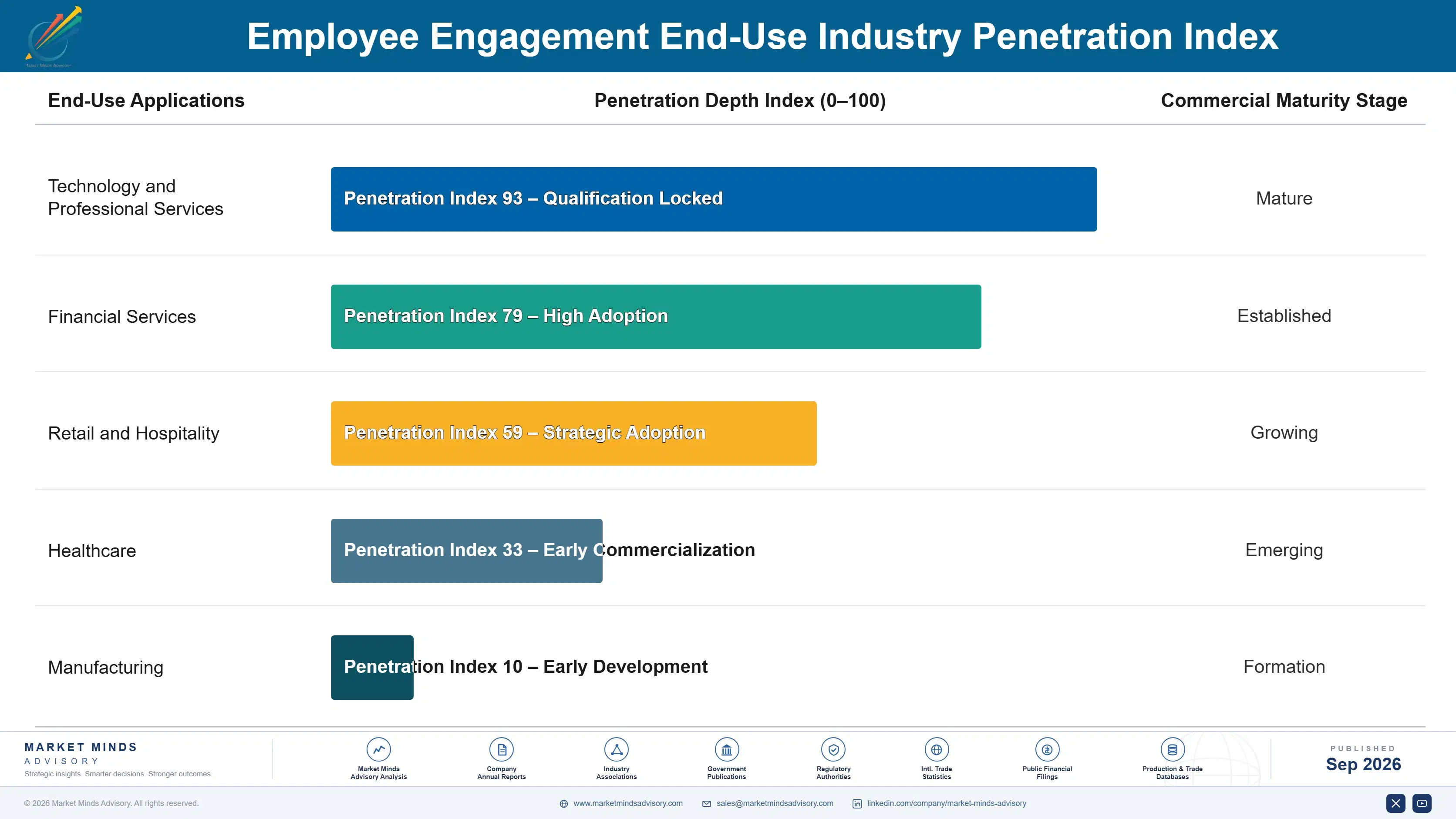
Adoption depth varies sharply by end-use vertical. Technology and professional services employers integrate engagement measurement deeply into broader talent retention strategy and executive reporting, creating durable multi-year platform relationships, while retail and hospitality employers with higher baseline turnover treat engagement measurement more transactionally around specific locations or seasons, creating shallower platform loyalty and greater exposure to competitive switching at each contract renewal cycle.

Buyer profiles are shifting generationally too. Human resources leaders who came up through the annual survey era still favour proven, extensively validated vendor relationships even at a price premium, while newer people analytics leaders increasingly default to evaluating predictive modelling and data science credibility as a standard procurement consideration, a difference in buying philosophy that is already shaping which vendors win newly launched enterprise programmes versus established legacy platform renewals.
employee-engagement-market-end-use-penetration-index-1788425004803

Where the Category Reorders Next

These are among the four positions where our research anticipates prominent divergence between winners and laggards over the coming forecast period. Each is grounded in the demand model, the regulatory perimeter, and the announced capacity pipeline.
01 / PREDICTIVE ANALYTICS INVESTMENT

Validated predictive modelling is separating category leaders from generalists

Vendors that built genuinely validated predictive attrition modelling, tested against real historical turnover outcomes rather than marketed capability, are capturing a disproportionate share of enterprise renewal budget as the category's competitive center of gravity shifts. Vendors without validated predictive credibility risk being relegated to descriptive reporting positioning carrying materially lower contract value than analytics leaders currently command. Building this credibility now, while enterprise buyers are actively reallocating budget, looks like the more urgent investment priority for most vendors, since that window won't stay open indefinitely as competitors close the gap.
02 / COACHING WORKFLOW DEPTH

Behaviour-change tooling is compounding into durable renewal advantage

Vendors that built genuinely integrated manager coaching and action-planning workflows are capturing a disproportionate share of renewal decisions as buyers increasingly evaluate the category on whether scores actually improve rather than on reporting sophistication alone. This dynamic rewards vendors willing to invest in behavioural science expertise well ahead of confirmed enterprise-wide adoption. Vendors without established coaching credentials should prioritise smaller pilot programmes to build track record before pursuing full enterprise-wide rollout contracts, since pilot evidence tends to travel further internally than broad claims made without a documented track record.
03 / MID-MARKET PLATFORM SIMPLIFICATION

Simplified offerings remain a genuinely underexploited growth opportunity

Simplified, lower-touch platforms built specifically for mid-market buyers remain underexploited relative to their clear volume potential as continuous listening adoption continues expanding beyond the largest enterprises into smaller organisations previously priced out of the category. Vendors building dedicated mid-market packaging now are positioning for meaningful customer acquisition volume as adoption continues broadening across company sizes. Treating mid-market as a secondary afterthought rather than a distinct go-to-market motion risks underinvesting in a genuinely important growth segment, since delaying this investment risks ceding the fastest-growing customer segment to purpose-built challengers.
04 / LEGACY SURVEY-ONLY POSITIONING

Vendors without analytics depth face continued renewal erosion

Vendors remaining concentrated in legacy annual-only survey positioning without predictive analytics or coaching workflow differentiation face continued renewal erosion as buyer expectations shift decisively toward continuous, action-oriented platforms across most enterprise accounts tracked in this report. Vendors should actively diversify toward predictive analytics, coaching workflows, or deep HR system integration rather than defending survey-only positioning alone. Treating legacy positioning as a stable long-term stance rather than a declining one risks meaningfully understating the category's ongoing competitive transition, a shift already visible in disclosed renewal figures.

Engagement Snapshot From the Field

A live engagement with an industry participant carrying material or product regulatory and market exposure ahead of a defining policy shift, showing how our research translates into a defensible multi-year portfolio strategy.
MARKET MINDS ADVISORY · CLIENT ENGAGEMENT SUMMARY
Employee Engagement Producer Strategic Portfolio Review and Transition Roadmap 2026·Investment Scenario on Employee Engagement Exposure Evaluation 2025-26
CLIENT PROFILE
The client is a global retail employer generating approximately four hundred twenty million dollars in annual revenue (client-reported, unverified by MMA), historically running three separate engagement and recognition tools across different regions and business units without a unified view of workforce sentiment or attrition risk across the combined organisation. The organisation operates across roughly forty countries with highly variable regional turnover rates.
STRATEGIC CHALLENGE
Leadership needed to consolidate onto a single engagement platform capable of supporting predictive attrition analytics across a highly distributed, high-turnover retail workforce without the internal analytics expertise to independently validate competing vendors' predictive accuracy claims against the client's own historical data. Board-level attention to attrition costs added further urgency to the consolidation timeline.
MMA APPROACH
MMA benchmarked candidate vendors against disclosed predictive validation methodology and existing client references in comparable high-turnover retail environments, prioritising vendors demonstrating genuine data science rigor over marketing claims alone. The engagement included structured interviews with the client's regional HR leadership to validate realistic consolidation timelines and change management requirements. MMA also modelled realistic cost savings from tool consolidation to support the internal budget approval process.
KEY FINDINGS
  1. Two of the three incumbent tools had materially overlapping functionality, suggesting genuine consolidation savings were achievable without losing meaningful measurement capability across regions.
  2. Several vendors claiming validated predictive accuracy in marketing materials had not actually tested their models against the client's specific high-turnover retail environment before the engagement began.
  3. A phased regional consolidation sequence starting with the client's highest-turnover region reduced change management risk considerably compared to a simultaneous global rollout.
  4. Frontline manager adoption of the new coaching workflow features exceeded initial expectations once regional pilot results were shared transparently across the wider organisation.
CLIENT PROFILE
The client is a global retail employer generating approximately four hundred twenty million dollars in annual revenue (client-reported, unverified by MMA), historically running three separate engagement and recognition tools across different regions and business units without a unified view of workforce sentiment or attrition risk across the combined organisation. The organisation operates across roughly forty countries with highly variable regional turnover rates.
STRATEGIC CHALLENGE
Leadership needed to consolidate onto a single engagement platform capable of supporting predictive attrition analytics across a highly distributed, high-turnover retail workforce without the internal analytics expertise to independently validate competing vendors' predictive accuracy claims against the client's own historical data. Board-level attention to attrition costs added further urgency to the consolidation timeline.
MMA APPROACH
MMA benchmarked candidate vendors against disclosed predictive validation methodology and existing client references in comparable high-turnover retail environments, prioritising vendors demonstrating genuine data science rigor over marketing claims alone. The engagement included structured interviews with the client's regional HR leadership to validate realistic consolidation timelines and change management requirements. MMA also modelled realistic cost savings from tool consolidation to support the internal budget approval process.
KEY FINDINGS
  1. Two of the three incumbent tools had materially overlapping functionality, suggesting genuine consolidation savings were achievable without losing meaningful measurement capability across regions.
  2. Several vendors claiming validated predictive accuracy in marketing materials had not actually tested their models against the client's specific high-turnover retail environment before the engagement began.
  3. A phased regional consolidation sequence starting with the client's highest-turnover region reduced change management risk considerably compared to a simultaneous global rollout.
  4. Frontline manager adoption of the new coaching workflow features exceeded initial expectations once regional pilot results were shared transparently across the wider organisation.
RECOMMENDED STRATEGY
Phase 1: Phase 1 (Months 1 to 2): Benchmark vendors against validated predictive accuracy specific to high-turnover retail environments. Include client reference calls in comparable retail environments. Phase 2: Phase 2 (Months 3 to 7): Consolidate the highest-turnover region first to validate the platform under real operating conditions. Document lessons learned before extending to additional regions. Phase 3: Phase 3 (Months 8 to 12): Extend consolidation across remaining regions based on initial rollout performance and manager feedback. Formalise change management support for regional HR teams throughout.
OUTCOME
Twelve months after the engagement began, the client successfully consolidated onto a single global engagement platform, reporting measurably improved visibility into cross-regional attrition risk and moderately reduced overall software licensing spend relative to the three-tool baseline (client-reported, unverified by MMA). Leadership also reported improved confidence in using predictive analytics to prioritise retention interventions.

Frequently Asked Questions

Foundational context covering the market sizes, CAGR, scope, country, region and competition that inform every finding below. This section is provided to cover basics and most often pre-purchase conversations, answered from the MMA Primary Research Dataset.

What is the current size of the Employee Engagement Market?

The Employee Engagement Market reached an estimated USD 6.8 billion in global revenue in 2025, according to MMA Analysis based on primary research and company disclosures. This base year figure anchors the forecast period beginning in 2026.

How large will the Employee Engagement Market be by 2036?

MMA projects the market will reach approximately USD 21.0 billion by 2036 under the base case scenario. That represents roughly a 2.79 times expansion from the 2026 starting value of USD 7.5 billion.

What is the CAGR for the Employee Engagement Market 2026 to 2036?

The base case compound annual growth rate is 10.8% across the 2026 to 2036 forecast window. Bull and bear scenarios range from 9.5% to 12.1% depending on predictive analytics adoption pace and broader corporate technology spending trends.

Which segment is growing fastest?

People Analytics and AI-Driven Insights Platforms lead all segments at a 19.0% CAGR, roughly 1.76 times the overall market rate. This segment benefits from active enterprise budget reallocation toward predictive capability over descriptive reporting.

Who are the major companies in the Employee Engagement Market?

Leading vendors include Qualtrics International Inc., Culture Amp Pty Ltd, Microsoft Corporation, Workday Inc., and Perceptyx Inc. Together these five hold an estimated 42% combined share on a disclosed segment revenue basis.

Which country is growing fastest?

India leads national growth at an estimated 14.5% CAGR, driven by rapidly expanding technology and business process outsourcing employment adopting continuous listening at scale. Singapore and Malaysia follow within the same South Asia and Pacific region.

Report Segmentation Architecture

The full report scope spans multiple orthogonal segmentation dimensions, with cross-tabulated demand data provided for each dimension pair. Coverage extends further to regional breakdowns, trend trajectories, and the competitive detail needed to support segment-level decision-making.

By Primary Market Dimension

  • Survey and Pulse Platforms
  • Continuous Listening and Real-Time Feedback Tools
  • People Analytics and AI-Driven Insights Platforms
  • Recognition and Rewards Software
  • Performance Management Integration Modules
  • Employee Experience and Journey Mapping Platforms

By End-Use Industry

  • Technology and Professional Services
  • Financial Services
  • Retail and Hospitality
  • Healthcare
  • Manufacturing

By Commercial Dimension

  • Direct Enterprise Sales
  • Mid-Market Self-Service Channels
  • HR Suite Bundled Distribution
  • Consulting Partner Implementation Channels

By Region

  • North America
  • Western Europe
  • East Asia
  • South Asia and Pacific
  • Latin America
  • Middle East and Africa
  • Eastern Europe

Scope, Methodology, and Coverage

Every figure in this report is reproducible from documented input assumptions. The scope below maps the historical period, the forecast horizon, the segmentation dimensions, and the countries covered, alongside the underlying primary and qualitative methodology.
Historical Period
2020 to 2025
Forecast Period
2026 to 2036
Base Year
2025 (USD billions; MMA Primary Research Dataset, September 2026)
Market Definition
This report covers software platforms and associated professional services used to measure, analyse, and act on employee engagement, sentiment, and experience data across surveys, continuous listening, recognition, and analytics functions. It excludes broader human capital management systems, payroll platforms, and applicant tracking systems that do not include a dedicated engagement measurement or listening capability.
Quantitative Units
USD billions (current prices); customer counts; average contract value
Segmentation Dimensions
By Primary Market Dimension; By End-Use Industry; By Commercial Dimension; By Region
Regions Covered
North America, Western Europe, East Asia, South Asia and Pacific, Latin America, Middle East and Africa, Eastern Europe
Countries Covered
USA, Canada, Germany, France, UK, China, Japan, South Korea, India, Australia, Singapore, Malaysia, Brazil, Mexico, UAE, Saudi Arabia, South Africa, Nigeria, Poland, Czech Republic, Netherlands, Italy, Spain, Sweden, Switzerland, Argentina, Colombia, Indonesia, Vietnam, and additional markets relevant to this sector
Key Companies Profiled
Qualtrics International Inc.; Culture Amp Pty Ltd; Microsoft Corporation; Workday Inc.; Perceptyx Inc.; Medallia Inc.; SAP SE; ADP LLC; Reward Gateway Ltd; Achievers Solutions Inc.; Lattice Inc.; 15Five Inc.; Semos Cloud Inc.; Energage LLC; Great Place to Work Institute Inc.; Glassdoor Inc.; Motivosity Inc.; Bonusly Inc.; Blink App Inc.; WorkTango Inc.
Quantitative Methodology
Primary survey, n=3,800 respondents, Q4 2025, six countries; demand-side model with trade association cross-validation
Qualitative Methodology
47 expert interviews, Q4 2025; applied to validate demand model assumptions, identify emerging dynamics, and assess competitive positioning
Report Format
PDF and XLSX data workbook (Word format preview document)
Publisher
Market Minds Advisory
Report Code
MMA-2026-TEC-456
Published
September 2026
Contact
sales@marketmindsadvisory.com | www.marketmindsadvisory.com

Purchase the full Employee Engagement Market Report (2026 to 2036).

The full report delivers complete segmentation data across all six product and technology segments, all seven regional markets, and detailed competitive profiles for all twenty companies named in this summary. It includes the underlying primary survey dataset of three thousand eight hundred respondents and forty seven expert interviews conducted during the fourth quarter of 2025. Buyers also receive downloadable data tables covering historical 2020 to 2025 figures alongside the full 2026 to 2036 annual forecast. A dedicated appendix addresses predictive analytics validation benchmarks across three vendor scenarios.
Full Seven-Region Regional Data Tables and Charts
All Twenty Company Competitive Profiles and Rankings
Ten-Year Annual Forecast Model With Scenarios
Primary Survey Raw Data Access and Tables
Predictive Analytics Validation Benchmark Appendix and Guide
Quarterly Update Subscription Option for Buyers

Built For The People Who Decide

From boardroom strategy to bench-side execution, this report is read cover-to-cover by leaders shaping the next decade of their industry, turning demand scenarios, market dynamics and valuation benchmarks into decisions.
CXOs/ Presidents/ VPs/ Managers
M&A and Corporate Development
Strategy Teams and R&D Heads
Procurement and Product Directors
Regulatory and Compliance Leaders
Investor Relations and Equity Analysts