Market Minds Advisory
Emission Control Catalyst for Motorcycle Market

Emission Control Catalyst for Motorcycle Market: Cold Start Chemistry, Precious Metal Exposure, and a Shrinking Vehicle Base

Tightening standards keep raising catalyst content per machine while electrification removes machines from the addressable base entirely, and those two forces are now racing each other directly. Precious metal decides the economics.

Lead Analyst

Bilal Shaikh

Published

September 2026

Make Smarter Decisions with Customized Research Insights

Request a free sample report and evaluate market opportunities, growth trends, and competitive dynamics relevant to your business needs.

2025 MARKET VALUE$2.2BMarket Size 2025
2036 FORECAST VALUE$3.9BBase Case , 2026 to 2036
CAGR 2026 TO 20365.4 %Bull 6.6% / Bear 4.1%
INCREMENTAL OPPORTUNITY$1.6BNet 10- year value creation
EXPANSION MULTIPLE1.69x2036 value over 2026 base
Strategic Levers
M&A Pipeline
Regional Outlook
Country Rankings
Competitive Intelligence
Segmental Deep-dive
Call-Us : 91 93563 13602

Executive Snapshot and Market Trajectory

Almost all motorcycle emissions happen in the first minute, before the catalyst reaches its activation temperature of around 260 degrees Celsius. Every regulatory tightening since has therefore been an attack on cold start, and every technical answer has been an attempt to light off faster. Everything else follows from that.
Commercial power sits with suppliers who can hold conversion performance while reducing precious metal loading, since palladium and rhodium are 63% of converter cost. Electrically heated systems grow fastest at 15.6%, roughly 2.89 times the market, from a base that barely exists on two-wheelers today. South Asia and Pacific holds 46% of global value, far above any normal band, because Indian and Southeast Asian production dominates world motorcycle output.
Concentration is high at roughly 59% for the top five, since precious metal handling and catalyst formulation exclude most component suppliers. Electrification removes roughly 14% of new sales from the addressable base annually in the fastest-converting markets. Content per machine is rising almost as quickly as units are disappearing. Value per machine and machine count are moving in opposite directions at comparable speed, which makes the aggregate forecast unusually sensitive to the pace of each.
Market Definition
The market comprises catalytic emission control components for two-wheeled and three-wheeled combustion vehicles, covering palladium-rhodium three-way catalysts, platinum-based oxidation catalysts, close-coupled high cell density catalysts, electrically heated catalyst systems, and low precious metal and substituted formulations. Value is measured at catalyst and converter supplier level across original equipment fitment and replacement. Complete exhaust systems, mufflers and silencers, passenger car and commercial vehicle catalysts, marine and small engine catalysts, and electric two-wheeler components fall outside scope.
Base Year Value
$2.2B in 2025 (MMA Primary Research Dataset, August 2026)
Forecast Period
2026 to 2036, eleven discrete annual values
CAGR
5.4% base case. Bull 6.6%. Bear 4.1%.
Fastest Growth Segment
Electrically Heated Catalyst Systems: 15.6% CAGR
Fastest Growth Country
India: 8.2% CAGR
Fastest Growth Region
South Asia and Pacific: 7.4% CAGR
Largest Region
South Asia and Pacific: 46% of 2025 global value
Market Leaders
Umicore, Johnson Matthey, BASF Environmental Catalyst and Metal Solutions, Cataler Corporation, and NGK Insulators lead on motorcycle catalyst supply. Source: company annual reports and MMA Analysis, July 2026.
Primary Survey
n=3,800 procurement and R&D decision-makers, Q4 2025, six countries
Methodology
Demand-side build-up, cross-validated against public data, 47 expert interviews

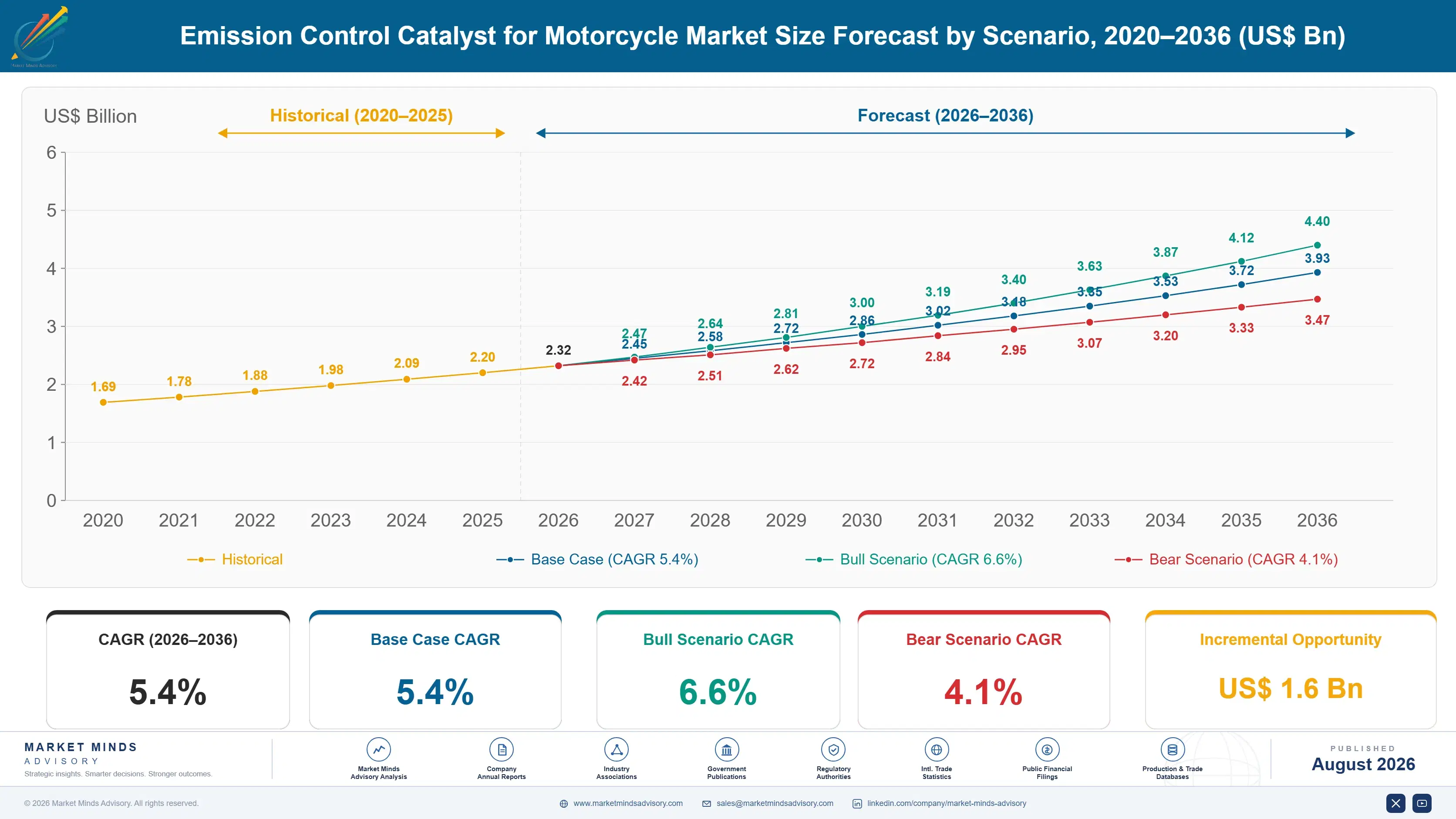
Emission Control Catalyst for Motorcycle Market Forecast Scenarios

emission-control-catalyst-for-motorcycle-size-forecast-scenario-1787549467870
Between 2020 and 2025 regulation raised content while electrification began removing units. Indian Bharat Stage VI and European Euro 5 requirements both increased catalyst loading and added onboard diagnostics, raising value per machine considerably. Electric two-wheeler adoption accelerated across China and India through the same window. Palladium and rhodium prices moved violently in both directions. The 4.4% historical growth conceals two opposing forces of similar magnitude.
The 5.4% base case rests on three mechanisms. Standards continue tightening toward cold start performance that current close-coupled catalysts cannot fully deliver, which raises content and eventually forces electrically heated systems. Precious metal thrifting and substitution reduce cost per unit while preserving supplier margin where formulation capability exists. And motorcycle production across South and Southeast Asia and Africa keeps growing even as electric share rises within it. Only the third of those three adds units rather than content.
The 6.6% bull case assumes standards tighten faster than expected and electrification slows outside China. The 4.1% bear case reflects electric two-wheeler adoption accelerating across India and Southeast Asia, precious metal price weakness deflating market value, and regulators pausing further tightening while fleets electrify anyway. Consumer adoption rather than any regulatory decision separates the two cases.

Racing Electrification With Better Cold Start

Three things set the commercial shape of this market. Cold start performance comes first, because a motorcycle emits most of its regulated pollutants before the catalyst reaches activation temperature, and every standard revision attacks that window. Precious metal cost comes second at 63% of converter value, the highest share of almost any vehicle component. Electrification comes third and is quietly removing the vehicles this industry serves.
TOP-FIVE CONCENTRATION59%Share of global two-wheeler catalyst supply held by leading producers
AVERAGE CATALYST VALUEUSD 31 per vehicleTypical converter content fitted at each motorcycle assembly
PRECIOUS METAL COST SHARE63%Palladium and rhodium loading within total converter cost
TWO-WHEELER FITMENT RATE88%Share of new machines fitted with catalytic aftertreatment
ELECTRIFICATION SUBSTITUTION RATE14%Annual share of new sales shifting to battery propulsion
CATALYST LIGHT-OFF TEMPERATURE260 degreesTypical activation threshold governing cold start emissions performance
The packaging constraint shapes every technical answer. A motorcycle catalyst must fit in almost no space, survive vibration and exhaust temperatures a car never sees, light off within seconds, and cost tens of dollars rather than hundreds. Solutions that work on a passenger car simply do not transfer, which is why this is a distinct engineering discipline rather than a scaled-down version of automotive.
The two opposing forces are worth stating plainly. Regulatory tightening raises catalyst content per machine while electrification removes machines from the base at roughly 14% of new sales annually in the fastest markets. Value per unit and unit count are moving in opposite directions at comparable speed, which makes the aggregate forecast unusually sensitive to how quickly each proceeds.
"This industry is in a race between regulators making each remaining motorcycle worth more and consumers buying electric ones instead. Both are moving quickly and neither is under anybody's control. The suppliers who will do well are those thrifting precious metal hard enough to stay profitable while the volume base slowly disappears beneath them."
Practice Director, Automotive Emissions and Powertrain Components · MMA Automotive Components Practice · August 2026

Market Trends

Cold Start Requirements Push Toward Electrically Heated Catalysts

A motorcycle emits the majority of its regulated pollutants in the first minute of operation, before the catalyst reaches roughly 260 degrees Celsius and begins converting. Close-coupled positioning and high cell density substrates reduce that window and cannot eliminate it, which is why standards attacking cold start eventually require heating the catalyst electrically before or during start. Systems doing that grow at 15.6% from a base barely existing on two-wheelers, constrained by the electrical power a motorcycle can supply and by cost on a machine selling for very little. The engineering problem is genuinely different from the passenger car equivalent.
Market Impact: Fitment reaches 88% of machines

Precious Metal Thrifting Becomes the Central Formulation Discipline

Palladium and rhodium represent 63% of converter cost, which is the highest precious metal exposure of almost any vehicle component and makes loading reduction worth more than any other engineering improvement available. Washcoat design, metal dispersion, substrate cell density, and partial substitution toward platinum all reduce loading while holding conversion, and formulations doing so grow at 11.2%. Suppliers who thrift successfully keep margin that metal price movement would otherwise take, and those who cannot find their economics dictated entirely by markets they neither influence nor predict. Nothing else moves margin comparably.
Market Impact: Standards now cover 88% of output

Market Opportunities and Growth Drivers

Motorcycle Production Growth Continues Across South Asia and Africa

Personal mobility demand keeps rising across India, Indonesia, Vietnam, Nigeria, and much of Africa, and the motorcycle remains the affordable answer in markets where cars are out of reach for most households. Combustion machines still take the large majority of those sales despite electric growth, and fitment rates reach 88% as standards extend to smaller displacement categories previously exempt. Production volumes at this scale mean even modest content per machine aggregates into a substantial market. Growth here partly offsets electrification in markets converting faster, which is what keeps the aggregate positive.
Market Impact: Electrification takes 14% annually

Standards Extension Into Smaller Displacement Raises Fitment

Emission standards originally applied to larger motorcycles have progressively extended down into mopeds, scooters, and three-wheelers that were previously exempt or lightly regulated, particularly across India and Southeast Asia. Each extension converts an unfitted machine into a fitted one, which adds catalyst content where none previously existed rather than merely increasing existing content. Small displacement engines present their own difficulties, since exhaust temperatures run lower and packaging space is even tighter. Suppliers with formulations suited to those conditions capture volume that larger-engine expertise does not automatically address. Lower exhaust temperatures demand different formulations.
Market Impact: Prices moved above 300% historically

Market Restraints and Challenges

Electrification Removes Vehicles From the Addressable Base

Battery two-wheelers take roughly 14% of new sales annually in the fastest-converting markets and considerably more in Chinese cities, and every one sold is a machine that will never need a catalyst. The root cause is that two-wheelers suit electrification better than cars do, with short trips, low speeds, and modest battery requirements making the economics work far earlier. Suppliers mitigate by concentrating on markets converting more slowly, by raising content on remaining combustion machines, and by developing components for electric two-wheelers, which is a quite different business. No content increase reverses a shrinking base.
Market Impact: Light-off needs 260 degrees Celsius

Precious Metal Volatility Dominates Cost With No Hedge Available

Palladium and rhodium prices have moved by multiples within single years on supply concentration and automotive demand shifts, and at 63% of converter cost that swamps every other variable. The root cause is that both metals come overwhelmingly from two countries and respond to passenger car demand this industry does not influence. Motorcycle suppliers are price takers on their dominant input. Mitigation runs through metal pass-through clauses, customer-supplied metal arrangements, thrifting, and recovery from scrapped converters, and each transfers rather than removes the exposure. Suppliers here remain price takers on their dominant input.
Market Impact: Precious metal is 63% of cost
4 additional market trends, 3 additional growth drivers, and 2 additional restraints and challenges are covered in the full report. Contact sales@marketmindsadvisory.com to access the complete intelligence.

Segment CAGR and Growth Architecture

Segmentation follows catalyst technology, because technology determines conversion performance, cold start behaviour, precious metal loading, packaging demands, and cost per machine. Five technologies cover commercial supply, and movement between them is driven by regulatory tightening and metal prices rather than by any preference expressed by the manufacturers fitting them. Metal loading differs substantially across them.
emission-control-catalyst-for-motorcycle-market-share-analysis-1787549468406

Electrically Heated Catalyst Systems

The fastest-growing technology at 15.6%, roughly 2.89 times the market, and barely present on two-wheelers today. Heating the catalyst electrically before or immediately after start addresses the cold start window that dominates motorcycle emissions and that close-coupled positioning alone cannot close. The constraints are electrical power, since a motorcycle's charging system supplies far less than a car's, and cost on machines selling for a fraction of a vehicle price. Passenger car solutions do not transfer. Suppliers developing systems within motorcycle power and cost budgets are positioned for a requirement that regulatory direction makes close to inevitable over the forecast period. Standards drafting makes this requirement close to inevitable within the forecast period.
CAGR 15.6%

Low Precious Metal and Substituted Formulations

Second fastest at 11.2%, and growing on cost rather than on performance improvement. With palladium and rhodium at 63% of converter cost, reducing loading while holding conversion is worth more than any other available engineering gain, and washcoat design, metal dispersion, and partial platinum substitution all contribute. Success requires genuine catalyst science rather than simple dilution, since conversion efficiency and durability both degrade if loading falls without compensating formulation work. Suppliers who thrift well retain margin that metal markets would otherwise capture, which is the clearest technical advantage available anywhere in this market. Durability across the full useful life requirement rather than fresh conversion performance is where reduced loading formulations actually fail.
CAGR 11.2%
Full segment breakdown across 5 segments available in the complete report.

Regional Architecture and Country Demand Map

Regional shares here depart sharply from typical distribution because motorcycle production and use concentrate overwhelmingly in Asia. Several regions sit well outside normal bands, and the justification for each appears in the relevant regional commentary below rather than being asserted here. Standards coverage then varies on top of that.

North America

At 4% this region sits far below its normal share band, and the justification is straightforward: motorcycles here are recreational rather than transport, sold in volumes that are trivial beside Asian markets. Large displacement machines dominate, which raises catalyst content per unit well above the global average without producing meaningful aggregate volume. Environmental Protection Agency and Californian standards are demanding and applied to a small population of high-value machines. Off-road and powersports applications add further volume under separate requirements. Replacement demand from an ageing recreational fleet is proportionally more significant here than anywhere. Growth of 4.8% reflects content value rather than any unit expansion. Content per machine runs well above global averages.
Share: 4% | CAGR: 4.8% (2026 to 2036)

Western Europe

At 7% this region also sits well below its normal band, because motorcycles serve leisure and urban commuting rather than mass transport, and annual volumes are a small fraction of Asian production. Euro 5 and subsequent requirements are the most demanding applied to two-wheelers anywhere and set technical direction that other regions follow years later, which gives this region influence disproportionate to its volume. Urban low emission zones have pushed scooter electrification faster than elsewhere in the developed world. Italian, German, and Austrian manufacturers specify to premium standards. Growth of 3.9% is the slowest in the report, reflecting electrification alongside flat underlying demand. Technical direction set here reaches other regions later.
Share: 7% | CAGR: 3.9% (2026 to 2036)
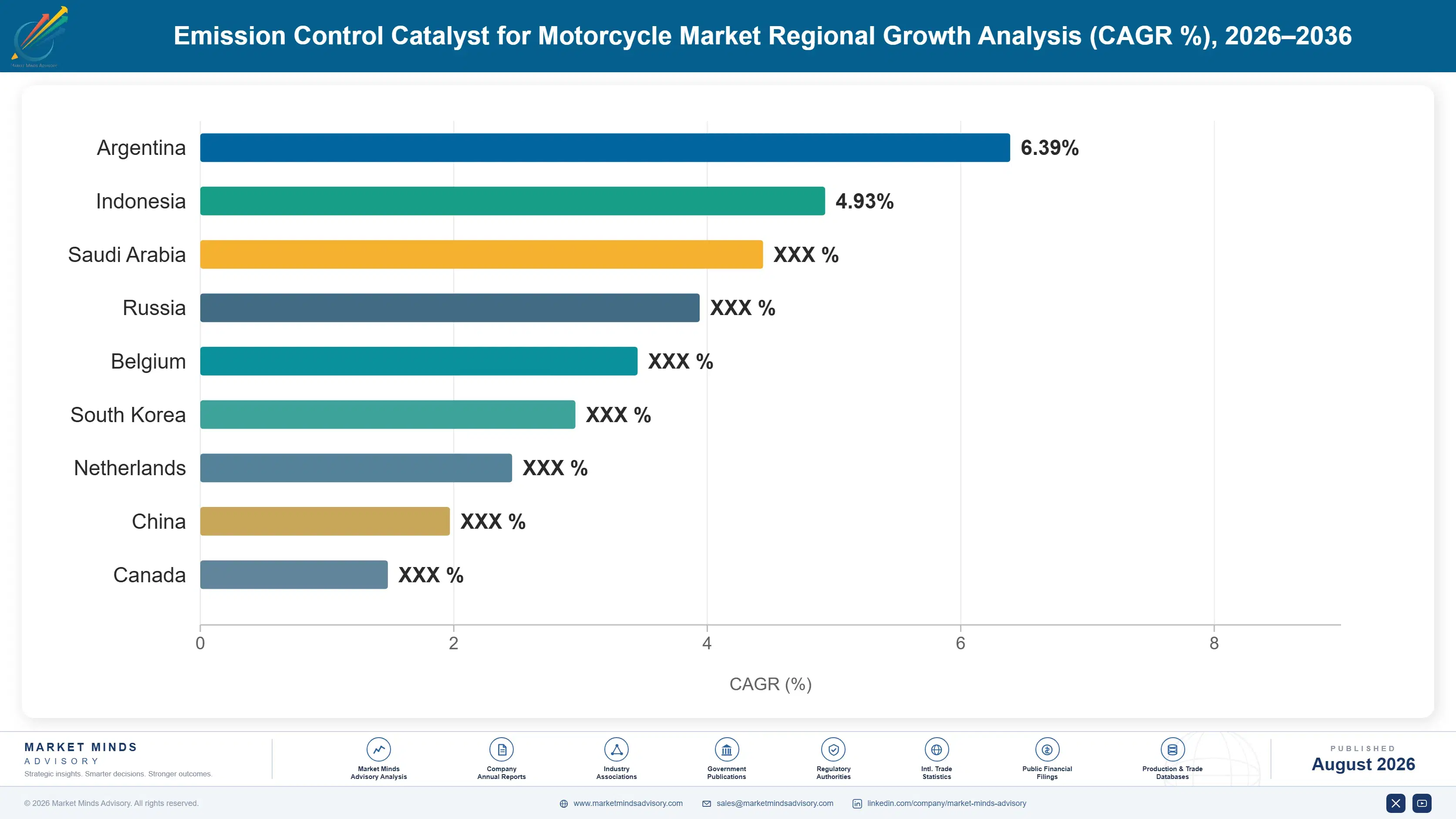
Regional intelligence for 5 additional markets available in the complete report: East Asia, South Asia and Pacific, Latin America, Middle East and Africa, Eastern Europe. Contact sales@marketmindsadvisory.com.
emission-control-catalyst-for-motorcycle-country-cagr-analysis-1787549468927

Four Moves That Change the Economics

Advantage here comes from precious metal thrifting, cold start engineering, and metal recovery rather than from converter manufacturing, which many suppliers do adequately. Four moves are worth capital and management attention across the forecast period, and the first addresses the cost line that governs everything else. The remaining three respond to where volume and regulation are actually heading.

Thrift precious metal loading through formulation science

Palladium and rhodium are 63% of converter cost, which makes loading reduction worth more than every other engineering improvement combined on a component selling for around thirty dollars. Washcoat design, metal dispersion, and partial platinum substitution can cut loading 15 to 30% while holding conversion, provided the work is genuine catalyst science rather than dilution. Suppliers who thrift well keep margin that metal markets would otherwise take, and those who cannot have their economics set by two producing countries they cannot influence in any way. Durability testing rather than fresh conversion is the barrier.
Market Impact: Cuts precious metal loading by 15 to 30%

Develop electrically heated systems within motorcycle power budgets

Cold start dominates motorcycle emissions and close-coupled positioning cannot close the window before light-off at around 260 degrees Celsius, which makes electrical heating close to inevitable as standards tighten further. Passenger car systems do not transfer, because a motorcycle charging system supplies far less power and the machine sells for a fraction of a car's price. Suppliers solving it within those constraints reach a requirement growing at 15.6% with very few credible competitors, and the engineering lead compounds as standards firm. The engineering lead compounds as standards firm up. Standards drafting makes it close to inevitable.
Market Impact: Serves a segment now growing at 15.6% annually

Build converter recovery and metal recycling capability

Scrapped converters contain recoverable palladium and rhodium, and recovery secures metal outside a market dominated by two producing countries while generating margin on material a supplier already sold once. Recovery typically returns 85 to 95% of contained metal from properly collected units. The obstacle is collection logistics across fragmented two-wheeler scrappage rather than any processing difficulty. Suppliers who built collection relationships with dismantlers and scrap networks hold a feedstock position competitors buying entirely on the open market simply cannot match. Margin on recovered metal is attractive in itself. Open market buyers cannot match that position.
Market Impact: Recovers 85 to 95% of all contained metal

Target markets where standards are extending downward

Emission requirements keep extending into smaller displacement mopeds, scooters, and three-wheelers previously exempt, particularly across India, Southeast Asia, and Latin America, and each extension converts an unfitted machine into one carrying roughly $31 of content. That adds content where none existed rather than raising existing content, which is a far better growth mechanism. Small engines run cooler and package tighter, so formulations suited to them are genuinely different. Suppliers positioned for those conditions capture volume that larger displacement expertise does not automatically reach. Formulations for cooler exhaust are genuinely different.
Market Impact: Raises fitment toward 88% of total unit coverage

Who Controls the Margin Pool

Concentration is high at roughly 59% for the top five, and precious metal handling combined with catalyst formulation capability excludes most component suppliers from participating at all. Umicore and Johnson Matthey lead through catalyst science depth and metal management infrastructure developed across automotive applications. BASF Environmental Catalyst and Metal Solutions competes on comparable terms, while Cataler holds strong Japanese manufacturer relationships and NGK supplies substrates that most coaters depend on.
Competitive activity runs on three fronts. Thrifting capability is the first and determines who keeps margin when metal prices move. Cold start engineering is the second and decides who is positioned for the standards now being drafted. Metal recovery and supply security is the third, and it separates suppliers who control their dominant input from those who purchase it entirely. Manufacturing capability contributes very little.

Pressure is building from two directions. Chinese catalyst producers have gained substantial share on cost in domestic and export production. And electrification is removing the underlying vehicle base faster in some markets than any competitive dynamic operating within the industry. The second is the more fundamental, since no competitive position defends a supplier against the vehicle itself disappearing from the market.
emission-control-catalyst-for-motorcycle-company-positioning-matrix-1787549469455

Competitive Moat and Risk Dimensions

UMICORE

Moat: Catalyst science and metal management

Combining catalyst formulation depth with precious metal refining, recycling, and trading infrastructure lets Umicore manage the input representing 63% of converter cost in ways coaters buying metal on the open market cannot. That integration also secures supply during the periods of scarcity that periodically affect palladium and rhodium markets without warning.
UMICORE

Risk: Exposure to two-wheeler electrification

The addressable vehicle base shrinks as electric two-wheelers take roughly 14% of new sales annually in the fastest markets, and no amount of content growth on remaining machines reverses a declining unit population indefinitely. Passenger car catalyst business faces the same pressure on a longer timeline, which limits the diversification available within the wider portfolio.
CATALER CORPORATION

Moat: Japanese manufacturer relationships

Deep and long-established relationships with Japanese motorcycle manufacturers who design globally and set technical benchmarks give Cataler positions across machines built and sold worldwide. Those manufacturers change catalyst suppliers very rarely, and the engineering collaboration involved in meeting each new standard together deepens the relationship rather than reopening it.
CATALER CORPORATION

Risk: Concentration in few customers

Depending heavily on a small number of Japanese manufacturers concentrates exposure to their production decisions, model strategies, and electrification pace in a way broader supplier bases avoid. Those manufacturers are also moving toward electric models in developed markets, which reduces combustion volume within exactly the customer group the position depends upon.

Players Tracked

Prominent Players

Umicore
Johnson Matthey
BASF Environmental Catalyst and Metal Solutions
Cataler Corporation
NGK Insulators

Other Key Players

Corning Incorporated
Tenneco
Forvia
Eberspächer
Yutaka Giken
Futaba Industrial
Sango
Friedrich Boysen
Sharda Motor Industries
Bosal
Klarius Products
Shandong Sinocat Environmental Technology
Weifu High-Technology
Heraeus
Solvay

Recent Developments

MARCH 2025

Supplier demonstrates reduced loading formulation

A washcoat and dispersion package achieving equivalent conversion at materially reduced palladium loading was validated on small displacement engines, addressing the cost line that dominates converter economics. Durability across the full useful life requirement had been the obstacle preventing earlier loading reductions from reaching production.
Signal: Thrifting is where margin is actually defended, and durability rather than fresh conversion is the barrier
JULY 2025

Standards extended to smaller displacement categories

An Asian market extended emission requirements to moped and small scooter categories previously outside the framework, converting a substantial unfitted population into machines requiring catalytic aftertreatment. Lower exhaust temperatures on those engines demanded formulations different from larger displacement equivalents. Fitment volumes rose immediately across the affected categories.
Signal: Downward standards extension adds fitment where none existed, which beats content growth on machines already fitted
OCTOBER 2025

Recovery programme launched for scrapped two-wheeler converters

A collection and recovery arrangement with regional dismantler networks was established to reclaim palladium and rhodium from scrapped motorcycle converters. Collection logistics across highly fragmented two-wheeler scrappage rather than processing capability had prevented earlier attempts from reaching viable scale. Refining capacity was never the constraint.
Signal: Collection logistics rather than refining capability is really what has always held back two-wheeler metal recovery

What Sets the Cost Base

Palladium and rhodium dominate at roughly 63% of converter manufacturing cost, the highest precious metal share of almost any vehicle component and a proportion that leaves very little room for anything else to matter. Ceramic or metallic substrates contribute 14%, supplied by a narrow group of specialist producers. Washcoat materials including alumina, ceria, and zirconia take 9%. Canning, mat wrapping, welding, and testing absorb the balance.
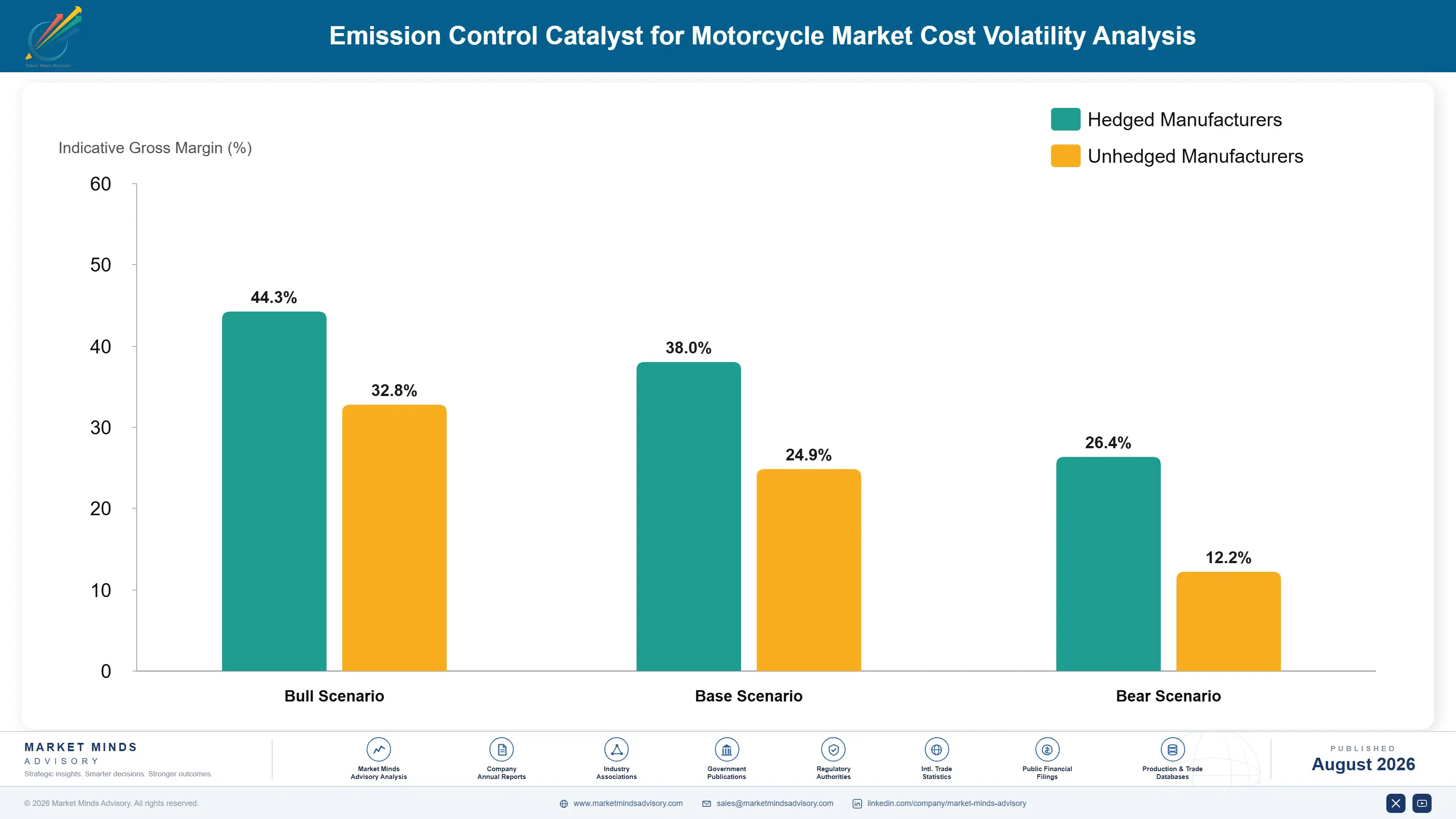
Rhodium prices moved by multiples through 2020 and 2021 before falling sharply, and palladium followed a comparable if less extreme path across the same window. Umicore and Johnson Matthey both referenced precious metal price movement and its effect on reported revenue across their reporting for those years. Substrate supply tightened during the same period as automotive demand recovered. Suppliers could not hedge, since customer pricing is annual while metal moves daily.

Exposure divides on metal arrangement rather than on scale. Suppliers operating customer-supplied metal or pass-through structures carry conversion margin only, while those buying metal into their own pricing carry the full swing on 63% of cost. Recovery capability creates a further divide, giving integrated suppliers a feedstock position that open market coaters lack. Collection logistics rather than refining is what limits recovery scale.
emission-control-catalyst-for-motorcycle-cost-volatility-analysis-1787549469650

Move customers onto metal pass-through or supplied arrangements

Palladium and rhodium are 63% of cost and move daily while customer pricing is agreed annually, which is impossible to carry. Pass-through clauses or customer-supplied metal structures leave the supplier earning conversion margin without the price exposure. Manufacturers resist because it complicates their purchasing, and accept readily after any period when supplier pricing reopened.

Build collection networks for scrapped converter recovery

Recovery returns 85 to 95% of contained metal from properly collected units and secures feedstock outside a market dominated by two producing countries. Two-wheeler scrappage is highly fragmented, which makes collection logistics rather than processing the genuine obstacle. Suppliers who built dismantler relationships early hold a supply position competitors cannot replicate quickly, and recovered metal margin is attractive itself.

Qualify multiple substrate suppliers across geometries

Ceramic and metallic substrates come from a narrow group of specialist producers, and supply tightened noticeably when automotive demand recovered after the pandemic disruption. Qualifying alternatives across the geometries a motorcycle range requires takes engineering time and validation before any shortage begins. Suppliers who deferred that work found deliveries constrained by a modest cost component.

Portfolio Architecture for Margin Defence

Margin follows formulation capability rather than volume, because precious metal at 63% of cost passes through and only the conversion and technology content earns anything. Standard three-way converters supplied against established specifications earn thin returns, since several suppliers meet the requirement and manufacturers negotiate hard on the portion they can actually influence. Thrifted formulations and cold start technology earn considerably more, as both reduce customer cost or meet requirements competitors cannot.
The volume and premium tension shows in metal working capital rather than in plant loading. Carrying precious metal inventory against production ties up capital that moves in value daily, so suppliers pursue volume to justify the metal position while that same position exposes them to markets they cannot forecast. Customer-supplied metal arrangements resolve it and reduce reported revenue considerably, which some organisations resist for presentational reasons.

High-value pools concentrate in three places: thrifted low loading formulations, electrically heated cold start systems, and recovered metal from collection networks. Each is defended by catalyst science, engineering, or logistics rather than by manufacturing cost. Price competition arrives in each only when a competitor develops equivalent formulation science, solves the heating problem, or builds collection networks, and none of those is quick.

Volume / Commodity-Adjacent Tier

Standard three-way and oxidation converters supplied against established specifications on conversion cost. Competes among qualified suppliers on the small portion of value that is not metal. The range reflects large differences in metal arrangement and scale.
Gross Margin: 12%-19%

Premium / Certified Tier

Thrifted low loading formulations validated for full useful life durability at reduced precious metal content. The manufacturer purchases a lower total cost rather than a component, and the saving is shared rather than passed entirely.
Gross Margin: 26%-38%

Sustainability / Regulatory / Next-Generation Tier

Electrically heated cold start systems and recovered metal supply addressing regulation and material security together. Engineering scarcity and feedstock position drive returns. The range is wide because heated system pricing has not yet settled.
Gross Margin: 30%-46%
emission-control-catalyst-for-motorcycle-portfolio-architecture-1787549470157

High-value Sub-segments and Strategic Watch-out

Thrifted Low Loading Formulations

Cutting palladium and rhodium loading 15 to 30% while holding conversion is worth more than any other engineering gain available on this component. Durability across useful life rather than fresh performance is the real barrier. Catalyst science defends it. Develop formulation capability rather than licensing it.
Gross Margin: 28%-40%

Electrically Heated Cold Start Systems

Standards attacking the pre-light-off window make electrical heating close to inevitable, and passenger car solutions do not transfer to motorcycle power and cost budgets. Growing at 15.6% with very few credible competitors currently developing anything. Very few competitors are even attempting this. Move now. Act early.
Gross Margin: 32%-46%

Recovered Precious Metal Supply

Recovery returns 85 to 95% of contained metal and secures feedstock outside a market dominated by two producing countries. Collection logistics across fragmented scrappage is the obstacle rather than any processing difficulty involved. Build dismantler relationships before competitors do. Logistics is the whole problem. Start collecting.
Gross Margin: 30%-44%

Standard Converter Supply

The strategic watch-out. Metal passes through, several suppliers qualify, and manufacturers negotiate hard on the small remaining portion. It holds platform positions and plant loading, and the vehicle base beneath it is shrinking. Expect the base beneath it to keep shrinking. Price it accordingly. Plan its decline.
Gross Margin: 12%-18%

How Demand Actually Reaches Suppliers

The annuity here is platform fitment rather than replacement. Winning a catalyst position on a motorcycle model means supplying it for the production run, which typically lasts five to eight years before a model change or a standards revision reopens the specification. Volumes follow assembly directly with no discretion, which makes revenue predictable once won and effectively unavailable between model cycles. Replacement demand exists but is far smaller than in passenger cars, since motorcycles are often scrapped rather than repaired at the age when converters fail.
Adoption depth varies sharply by manufacturer type. Japanese and European manufacturers design globally, qualify slowly, and hold suppliers across model generations. Indian manufacturers move faster and negotiate harder on cost, given machines selling at very low prices. Chinese export producers fit to destination standards at minimum compliance. Small regional assemblers buy whatever is cheapest and qualified.

The buyer has shifted toward powertrain compliance engineering rather than component purchasing. Those engineers evaluate conversion data across the full useful life requirement, never unit price. A supplier without full useful life durability data will not be evaluated at all, whatever its fresh conversion figures show on a testbed.
emission-control-catalyst-for-motorcycle-end-use-penetration-index-1787549470659

Where the Money Sits

These are among the four positions where our research anticipates prominent divergence between winners and laggards over the coming forecast period. Each is grounded in the demand model, the regulatory perimeter, and the announced capacity pipeline.
01 / PRECIOUS METAL THRIFTING

Cut the loading, because everything else is a rounding error

Palladium and rhodium represent 63% of converter cost on a component selling for around thirty dollars, which makes loading reduction worth more than every other engineering improvement available combined. Washcoat design, metal dispersion, and partial platinum substitution can cut loading 15 to 30% while holding conversion, provided the work is genuine catalyst science rather than simple dilution that fails durability testing. Suppliers who thrift well keep margin that metal markets would otherwise capture entirely, and those who cannot have their economics set elsewhere.
02 / COLD START SYSTEM DEVELOPMENT

Solve light-off, because that is where the regulation is going

A motorcycle emits most of its regulated pollutants before the catalyst reaches roughly 260 degrees Celsius, and close-coupled positioning alone cannot close that window as standards keep tightening around it. Electrical heating is the answer and passenger car systems do not transfer, because a motorcycle charging system supplies far less power and the machine costs a fraction of a car. Suppliers solving it within those constraints reach a segment growing at 15.6% with remarkably few credible competitors currently even attempting the problem.
03 / METAL RECOVERY POSITION

Collect the scrap, because feedstock security is worth owning

Scrapped converters return 85 to 95% of contained palladium and rhodium when properly collected, which secures feedstock outside a market dominated by two producing countries and earns margin on material the supplier already sold once before. The genuine obstacle is collection logistics across highly fragmented two-wheeler scrappage rather than any processing difficulty at all. Suppliers who built dismantler and scrap network relationships early hold a supply position that competitors buying entirely on the open market simply cannot replicate at any speed.
04 / DOWNWARD STANDARDS TARGETING

Follow the rules into smaller engines, where fitment is new

Emission requirements keep extending into mopeds, scooters, and three-wheelers previously exempt across India, Southeast Asia, and Latin America, and each extension converts an entirely unfitted machine into one needing a catalyst. That adds content where none existed rather than incrementally raising it on machines already fitted, which is a far better growth mechanism in a market losing units to electrification. Small engines run cooler and package tighter, so the required formulations genuinely differ from anything larger displacement work has produced.

Engagement Snapshot From the Field

A live engagement with an industry participant carrying material or product regulatory and market exposure ahead of a defining policy shift, showing how our research translates into a defensible multi-year portfolio strategy.
MARKET MINDS ADVISORY · CLIENT ENGAGEMENT SUMMARY
Emission Control Catalyst for Motorcycle Producer Strategic Portfolio Review and Transition Roadmap 2026·Investment Scenario on Emission Control Catalyst for Motorcycle Exposure Evaluation 2025-26
CLIENT PROFILE
An Asian manufacturer of catalytic converters for two-wheeler assemblers across South and Southeast Asia, with revenue near USD 148 million (client-reported, unverified by MMA). Precious metal was purchased into the client's own pricing, washcoat formulation was licensed rather than developed, and no metal recovery capability existed anywhere in the business. Margin had eroded steadily. Platform losses were mounting.
STRATEGIC CHALLENGE
A rhodium price spike had wiped out two years of margin under annual customer pricing that could not be reopened, while competitors offering thrifted formulations were winning platforms on total cost. Standards extension into smaller displacement categories was creating volume the client's larger engine formulations addressed poorly. Both problems needed answering.
MMA APPROACH
MMA analysed margin erosion against metal arrangement structure, assessed formulation development options against licensing, and sized the recovery opportunity across regional scrappage volumes. Forty-seven expert interviews with manufacturer compliance engineers, dismantlers, and metal refiners established what was commercially achievable at the client's scale. Options were narrower than management assumed. Timing mattered greatly.
KEY FINDINGS
  1. Metal price exposure under annual fixed pricing had cost more across two years than the entire conversion margin earned on the client's largest platform, and every major competitor had already moved to pass-through structures.
  2. Licensed washcoat formulations left the client unable to thrift independently, and platforms lost on total cost had all gone to suppliers developing their own catalyst chemistry internally.
  3. Small displacement standards extension represented volume larger than the client's existing business, and its formulations performed poorly at the lower exhaust temperatures those engines produce.
  4. Regional scrappage volumes could support recovery economics, but no dismantler collection relationships existed and competitors had begun establishing them within the past eighteen months.
CLIENT PROFILE
An Asian manufacturer of catalytic converters for two-wheeler assemblers across South and Southeast Asia, with revenue near USD 148 million (client-reported, unverified by MMA). Precious metal was purchased into the client's own pricing, washcoat formulation was licensed rather than developed, and no metal recovery capability existed anywhere in the business. Margin had eroded steadily. Platform losses were mounting.
STRATEGIC CHALLENGE
A rhodium price spike had wiped out two years of margin under annual customer pricing that could not be reopened, while competitors offering thrifted formulations were winning platforms on total cost. Standards extension into smaller displacement categories was creating volume the client's larger engine formulations addressed poorly. Both problems needed answering.
MMA APPROACH
MMA analysed margin erosion against metal arrangement structure, assessed formulation development options against licensing, and sized the recovery opportunity across regional scrappage volumes. Forty-seven expert interviews with manufacturer compliance engineers, dismantlers, and metal refiners established what was commercially achievable at the client's scale. Options were narrower than management assumed. Timing mattered greatly.
KEY FINDINGS
  1. Metal price exposure under annual fixed pricing had cost more across two years than the entire conversion margin earned on the client's largest platform, and every major competitor had already moved to pass-through structures.
  2. Licensed washcoat formulations left the client unable to thrift independently, and platforms lost on total cost had all gone to suppliers developing their own catalyst chemistry internally.
  3. Small displacement standards extension represented volume larger than the client's existing business, and its formulations performed poorly at the lower exhaust temperatures those engines produce.
  4. Regional scrappage volumes could support recovery economics, but no dismantler collection relationships existed and competitors had begun establishing them within the past eighteen months.
RECOMMENDED STRATEGY
Phase 1: Phase one: move all customer contracts to metal pass-through or customer-supplied structures at renewal, accepting lower reported revenue in exchange for removing an unmanageable exposure. Phase 2: Phase two: build internal washcoat formulation capability rather than licensing, since thrifting independently is what defends margin and wins platforms on total cost. Phase 3: Phase three: establish dismantler collection relationships for converter recovery before competitors complete their own networks across the same regional scrappage base.
OUTCOME
The client converted 91% of contracts to pass-through within a year and recruited a formulation team that delivered a reduced loading package in the second. Small displacement platform wins followed, collection agreements covered three regional markets, and conversion margin improved 8.1 percentage points (client-reported, unverified by MMA).

Frequently Asked Questions

Foundational context covering the market sizes, CAGR, scope, country, region and competition that inform every finding below. This section is provided to cover basics and most often pre-purchase conversations, answered from the MMA Primary Research Dataset.

What is the current size of the Emission Control Catalyst for Motorcycle Market?

The market was valued at USD 2.2 billion in 2025, rising to an estimated USD 2.32 billion in 2026. South Asia and Pacific holds the largest regional share at 46% of global value.

How large will the Emission Control Catalyst for Motorcycle Market be by 2036?

MMA forecasts USD 3.92 billion by 2036 under the base case, an expansion multiple of 1.69 times the 2026 value. That represents USD 1.60 billion of incremental value across the forecast period.

What is the CAGR for the Emission Control Catalyst for Motorcycle Market 2026 to 2036?

The base case CAGR is 5.4%, with a bull case of 6.6% and a bear case of 4.1%. The spread reflects the race between tightening standards and two-wheeler electrification.

Which segment is growing fastest?

Electrically heated catalyst systems grow fastest at 15.6%, roughly 2.89 times the market rate, from a base barely present today. Low precious metal formulations follow at 11.2% on cost pressure.

Who are the major companies in the Emission Control Catalyst for Motorcycle Market?

Umicore, Johnson Matthey, BASF Environmental Catalyst and Metal Solutions, Cataler, and NGK Insulators lead on supply. The top five hold roughly 59%, since metal handling excludes most component suppliers.

Which country is growing fastest?

India grows fastest at 8.2%, producing around twenty million machines annually with Bharat Stage VI standards raising content and extending fitment into smaller displacement categories previously exempt.

Report Segmentation Architecture

The full report scope spans multiple orthogonal segmentation dimensions, with cross-tabulated demand data provided for each dimension pair. Coverage extends further to regional breakdowns, trend trajectories, and the competitive detail needed to support segment-level decision-making.

By Catalyst Technology

  • Palladium-Rhodium Three-Way Catalysts
  • Platinum-Based Oxidation Catalysts
  • Close-Coupled High Cell Density Catalysts
  • Electrically Heated Catalyst Systems
  • Low Precious Metal and Substituted Formulations

By End-Use Industry

  • Commuter Motorcycles and Scooters
  • Premium and Large Displacement Motorcycles
  • Three-Wheeler Passenger and Cargo Vehicles
  • Mopeds and Small Displacement Machines
  • Off-Road and Powersports Vehicles

By Sales Model

  • Original Equipment Platform Supply
  • Customer-Supplied Metal Conversion
  • Exhaust System Integrator Supply
  • Aftermarket Replacement Channel
  • Recovered Metal and Recycling Supply

By Region

  • North America
  • Western Europe
  • East Asia
  • South Asia and Pacific
  • Latin America
  • Middle East and Africa
  • Eastern Europe

Scope, Methodology, and Coverage

Every figure in this report is reproducible from documented input assumptions. The scope below maps the historical period, the forecast horizon, the segmentation dimensions, and the countries covered, alongside the underlying primary and qualitative methodology.
Historical Period
2020 to 2025
Forecast Period
2026 to 2036
Base Year
2025 (USD billions; MMA Primary Research Dataset, August 2026)
Market Definition
The market comprises catalytic emission control components for two-wheeled and three-wheeled combustion vehicles, covering palladium-rhodium three-way catalysts, platinum-based oxidation catalysts, close-coupled high cell density catalysts, electrically heated catalyst systems, and low precious metal and substituted formulations. Value is measured at catalyst and converter supplier level across original equipment fitment and aftermarket replacement. Complete exhaust systems, mufflers and silencers, passenger car and commercial vehicle catalysts, marine and stationary small engine catalysts, and electric two-wheeler drivetrain components fall outside scope.
Quantitative Units
USD billions (current prices); converter units shipped annually; USD per vehicle by displacement class and standard
Segmentation Dimensions
By Catalyst Technology; By End-Use Industry; By Sales Model; By Region
Regions Covered
North America, Western Europe, East Asia, South Asia and Pacific, Latin America, Middle East and Africa, Eastern Europe
Countries Covered
India, Indonesia, Vietnam, Thailand, Philippines, Bangladesh, Pakistan, China, Japan, Taiwan, South Korea, Brazil, Colombia, Argentina, Mexico, Italy, Germany, France, Spain, Austria, United Kingdom, Poland, Czechia, United States, Canada, Nigeria, Kenya, Uganda, Egypt, Morocco
Key Companies Profiled
Umicore, Johnson Matthey, BASF Environmental Catalyst and Metal Solutions, Cataler Corporation, NGK Insulators, Corning Incorporated, Tenneco, Forvia, Eberspächer, Yutaka Giken, Futaba Industrial, Sango, Friedrich Boysen, Sharda Motor Industries, Bosal, Klarius Products, Shandong Sinocat Environmental Technology, Weifu High-Technology, Heraeus, Solvay
Quantitative Methodology
Primary survey, n=3,800 respondents, Q4 2025, six countries; demand-side model with trade association cross-validation
Qualitative Methodology
47 expert interviews, Q4 2025; applied to validate demand model assumptions, identify emerging dynamics, and assess competitive positioning
Report Format
PDF and XLSX data workbook (Word format preview document)
Publisher
Market Minds Advisory
Report Code
MMA-2026-AUT-208
Published
August 2026
Contact
sales@marketmindsadvisory.com | www.marketmindsadvisory.com

Purchase the full Emission Control Catalyst for Motorcycle Market Report (2026 to 2036).

The full report sizes motorcycle emission catalyst demand across five technologies, five vehicle categories, and seven regions with 2026 to 2036 forecasts under base, bull, and bear cases. It models the opposing forces of standards tightening and two-wheeler electrification explicitly, since the aggregate depends entirely on their relative pace. Competitive profiles cover twenty suppliers assessed consistently on motorcycle catalyst revenue, formulation capability, and metal management position. Cost analysis traces palladium and rhodium exposure against contract structures and recovery capability. Commercial guidance addresses thrifting, cold start development, metal recovery, and downward standards targeting.
Five catalyst technologies sized separately by region
Standards tightening modelled against electrification substitution
Precious metal exposure traced by contract structure
Fitment rates mapped by displacement class and jurisdiction
Cold start requirements assessed against heated system readiness
Converter recovery economics quantified across regional scrappage

Built For The People Who Decide

From boardroom strategy to bench-side execution, this report is read cover-to-cover by leaders shaping the next decade of their industry, turning demand scenarios, market dynamics and valuation benchmarks into decisions.
CXOs/ Presidents/ VPs/ Managers
M&A and Corporate Development
Strategy Teams and R&D Heads
Procurement and Product Directors
Regulatory and Compliance Leaders
Investor Relations and Equity Analysts