Market Minds Advisory
Electroplating Market

Electroplating Market: Electronics Precision Finishing, Automotive Corrosion Protection, and Precious Metal Chemistry

Semiconductor and connector manufacturers are pulling electroplating chemistry toward tighter thickness tolerances as component miniaturization accelerates, forcing platers to master precision deposition control that decorative and automotive applications never demanded.

Lead Analyst

Bilal Shaikh

Published

September 2026

Make Smarter Decisions with Customized Research Insights

Request a free sample report and evaluate market opportunities, growth trends, and competitive dynamics relevant to your business needs.

2025 MARKET VALUE$17.8BMarket Size 2025
2036 FORECAST VALUE$33.9BBase Case , 2026 to 2036
CAGR 2026 TO 20366.0 %Bull 7.2% / Bear 4.8%
INCREMENTAL OPPORTUNITY$15.0BNet 10- year value creation
EXPANSION MULTIPLE1.79x2036 value over 2026 base
Strategic Levers
M&A Pipeline
Regional Outlook
Country Rankings
Competitive Intelligence
Segmental Deep-dive
Call-Us : 91 93563 13602

Executive Snapshot and Market Trajectory

Electroplating remains a foundational surface finishing process across manufacturing, yet the electronics and semiconductor applications driving its fastest growth increasingly reward chemical suppliers who can deliver nanometer-level deposition precision rather than the decorative chrome finishes the process built its reputation on today worldwide. Suppliers investing early are winning qualification.
China's massive electronics manufacturing base and automotive production anchor global electroplating demand, with domestic and international chemical suppliers scaling capacity to serve semiconductor packaging and connector plating applications that continue growing considerably faster than traditional decorative and industrial hardware segments. Precious metal plating chemistry is commanding a widening price premium as component miniaturization pushes thickness tolerances tighter. across nearly every major electronics manufacturing program today.
No single company commands outright pricing power despite meaningful concentration among the three largest chemical suppliers, because downstream platers across automotive, electronics, and industrial sectors dual-source aggressively and specify chemistry based on application-specific performance requirements rather than brand loyalty. Environmental regulation on wastewater discharge and heavy metal handling keeps compliance costs elevated relative to most specialty chemical categories. Buyers should expect continued investment in wastewater treatment infrastructure across the sector this decade.
Market Definition
The electroplating market covers the chemicals, processes, and services used to deposit metal coatings onto substrate surfaces for corrosion protection, conductivity, wear resistance, or decorative purposes across automotive, electronics, industrial, and consumer applications. It excludes physical vapor deposition and other non-electrochemical coating technologies sold as separate categories.
Base Year Value
$17.8B in 2025 (MMA Primary Research Dataset, August 2026)
Forecast Period
2026 to 2036, eleven discrete annual values
CAGR
6.0% base case. Bull 7.2%. Bear 4.8%.
Fastest Growth Segment
Electronics and Semiconductor Grade Plating: 9.0% CAGR
Fastest Growth Country
China: 7.8% CAGR
Fastest Growth Region
South Asia and Pacific: 8.0% CAGR
Largest Region
East Asia: 43% of 2025 global value
Market Leaders
MacDermid Alpha Electronics Solutions, Atotech, Coventya Holding SAS, Umicore Group, Technic Inc. Source: MMA Analysis based on company annual reports.
Primary Survey
n=3,800 procurement and R&D decision-makers, Q4 2025, six countries
Methodology
Demand-side build-up, cross-validated against public data, 47 expert interviews

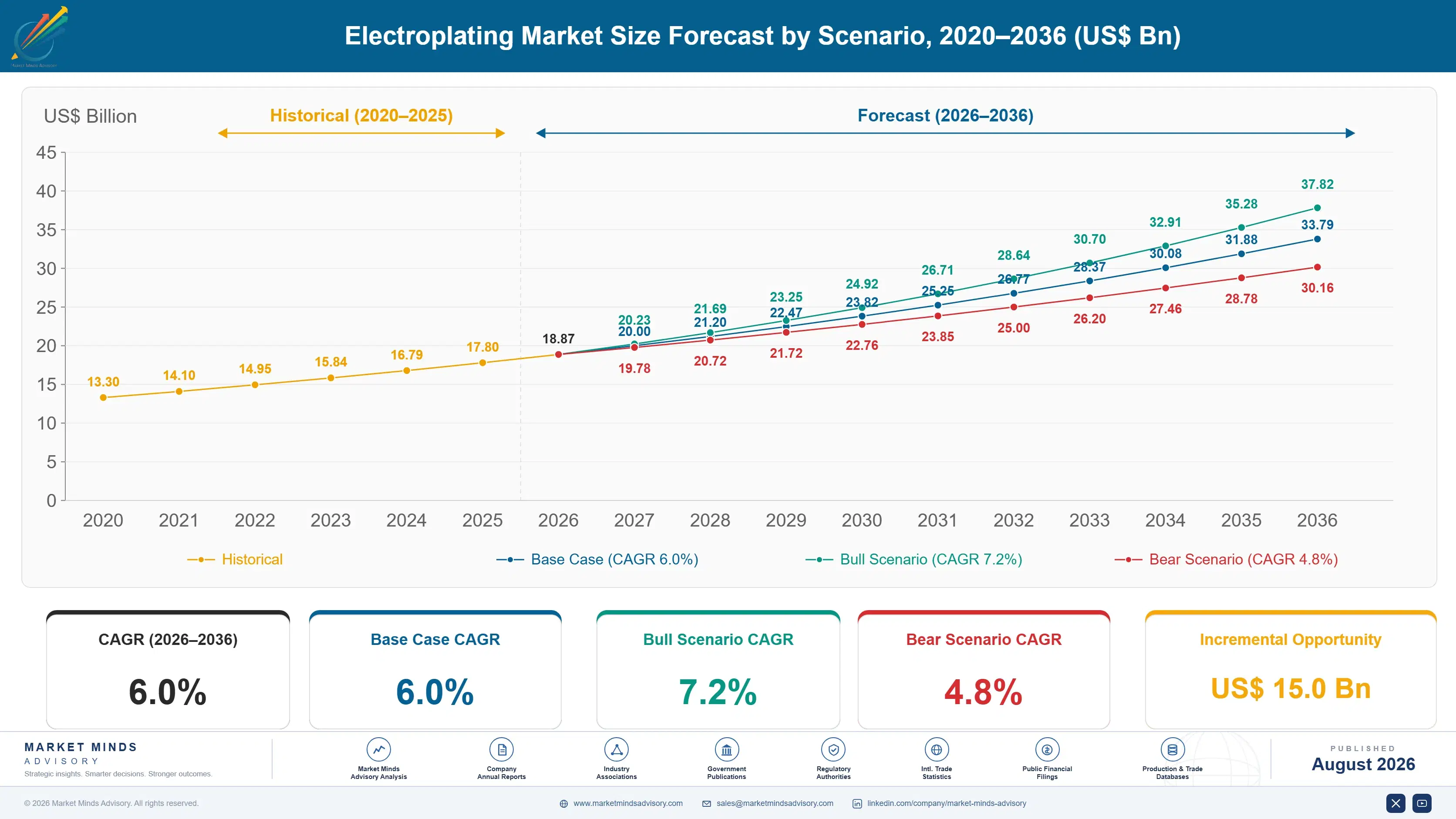
Electroplating Market Forecast Scenarios

electroplating-market-trends-size-forecast-scenario-1787548893060
Between 2020 and 2025 electroplating demand tracked global electronics and automotive production through a volatile stretch of semiconductor shortages and shifting manufacturing volumes, with the sharpest swings concentrated in connector and precious metal plating tied to consumer electronics demand cycles. Several suppliers faced repeated demand volatility tied to consumer electronics inventory cycles that persisted well beyond the initial pandemic disruption period itself.
The base case assumes three commercial mechanisms drive growth beyond overall manufacturing volume alone: continued semiconductor packaging demand requiring precision precious metal plating, rising electric vehicle production requiring corrosion-resistant plating across an expanding range of components, and China's continued electronics manufacturing capacity expansion anchoring the largest share of global demand. Together these forces keep the market growing considerably faster than overall industrial production alone would suggest. Producers investing across all three mechanisms simultaneously are outpacing narrower competitors considerably.
The bull case rests on semiconductor packaging demand accelerating faster than currently forecast as electronics miniaturization continues across multiple product categories. The bear case centers on environmental regulation tightening around heavy metal wastewater discharge, potentially constraining capacity additions even as underlying demand continues growing steadily. Producers positioned for both scenarios simultaneously hold the strongest long-term outlook across the industry today.

Precision Deposition Economics and Regulatory Compliance

Electroplating economics split sharply between base metal chemistry, which competes largely on cost and consistent supply for automotive and industrial hardware applications, and precious metal chemistry, where semiconductor and connector customers negotiate directly on deposition precision and consistent quality rather than pure cost. Suppliers straddling both tiers run distinctly different sales and quality assurance organizations to manage this divide effectively across their operations.
TOP PRODUCER SHAREChina, 32%Share of global electroplating chemical revenue concentrated domestically
MARKET CONCENTRATIONCR5 48%Combined share held by the five largest global chemical suppliers
AVERAGE SELLING PRICE$8-2,400 per kgTypical price range across base metal and precious metal chemistry
DEPOSITION THICKNESS RANGE0.05-25 micronsTypical coating thickness range across major application categories
PRECIOUS METAL COST SHARE52% of COGSGold, silver, and palladium share of premium chemistry cost
CAPACITY UTILIZATION74%Average utilization across major global plating facilities today
The commercial character of the market increasingly rewards chemical suppliers who can serve both commodity and precision applications simultaneously, since many manufacturers operate mixed product lines spanning decorative, industrial, and electronics-grade finishing requiring genuine breadth across the chemistry portfolio. Few suppliers manage this breadth equally well without meaningful internal friction between commodity and precision-focused teams. Companies positioned across multiple dynamics simultaneously hold the strongest long-term competitive outlook overall.
Over the next decade, semiconductor packaging growth, electric vehicle component plating demand, and environmental regulation on wastewater discharge will decide which suppliers capture the industry's fastest growth and which remain confined to smaller, commodity-focused chemistry niches. The pace of specification change is accelerating each successive year across nearly every major manufacturing customer category. Suppliers positioned across both dynamics simultaneously capture the strongest long-term position.
"Chrome bumpers built this industry's reputation, but gold-plated connector pins are what actually pay the bills now. Most suppliers still price like it's 1985, and that mismatch is where the real margin opportunity sits."
Director, Surface Finishing Chemicals Practice · MMA Surface Finishing Chemicals and Processing Practice · August 2026

Market Trends

Semiconductor Packaging Precision Plating Demand Rising

Semiconductor packaging and connector manufacturers are specifying increasingly precise deposition thickness tolerances as component miniaturization continues across smartphones, electric vehicles, and data center hardware, pushing electroplating chemical suppliers toward more sophisticated process control than decorative applications ever required. Several major semiconductor packaging companies have published updated supplier qualification standards requiring deposition uniformity well beyond previous industry norms, forcing chemistry suppliers to invest in additional process monitoring and analytical capability. Suppliers with established precision plating qualification and technical support capability are winning disproportionate share of this higher-value business, while commodity-focused suppliers remain confined to lower-margin decorative and industrial applications.
Market Impact: Adds $2.4B in electronics demand
Electric Vehicle Component Plating Demand Expansion

Electric vehicle production requires corrosion-resistant plating across an expanding range of battery connector, busbar, and thermal management components that traditional internal combustion vehicles never needed at comparable scale, directly expanding the addressable electroplating market beyond conventional automotive applications. Several major automakers have specified nickel and tin plating for high-current battery connections given the electrical performance and corrosion resistance requirements unique to electric powertrains. Suppliers with established automotive electronics plating capability are capturing disproportionate share of this EV-driven demand growth as production volumes continue expanding globally. Momentum keeps building steadily across the industry.
Market Impact: Adds 2.8 points to protection demand

Market Opportunities and Growth Drivers

Sustained Global Electronics Manufacturing Growth Continues

Global electronics manufacturing continues expanding across smartphones, data center hardware, and consumer devices, each product requiring precious metal and specialty base metal plating for connector, circuit board, and semiconductor packaging applications that represent the fastest-growing end-use category for electroplating chemistry globally. Rising demand for artificial intelligence data center infrastructure is specifically driving new connector and circuit board plating demand well beyond historical consumer electronics growth rates alone. Suppliers with established relationships with major electronics manufacturers are capturing disproportionate share of this demand growth as production volumes continue expanding across multiple product categories.
Market Impact: Adds $8-15M in compliance costs

Rising Corrosion Protection Standards Across Industries

Automotive, industrial, and aerospace manufacturers continue tightening corrosion protection specifications as products face longer warranty periods and harsher operating environments, directly expanding plating thickness and quality requirements beyond historical industry norms. Several major automakers have extended corrosion warranty coverage to periods well beyond a decade, requiring plating chemistry and process control considerably more rigorous than earlier generations of vehicles ever specified. Suppliers with established corrosion testing and certification capability are capturing disproportionate share of this standards-driven demand growth across multiple industrial categories. This trend is expected to accelerate further as extended warranty coverage becomes increasingly standard across the industry.
Market Impact: Swings input cost 15-25% per cycle

Market Restraints and Challenges

Wastewater Discharge Regulation Raising Compliance Costs

Tightening environmental regulation on heavy metal wastewater discharge across several jurisdictions is forcing plating operations to invest substantially in treatment and recycling infrastructure, raising compliance costs that particularly burden smaller regional operators lacking the capital scale larger companies can spread across broader operations. The root cause is genuine environmental concern around heavy metal contamination from plating wastewater, which regulators are scrutinizing more closely following documented water quality incidents in several manufacturing regions. Suppliers are mitigating the impact by investing in closed-loop recycling systems and by consolidating smaller operations into larger, better-capitalized facilities.
Market Impact: Adds $180-260 per kg premium chemistry

Precious Metal Price Volatility Compressing Margins

Gold, silver, and palladium price volatility directly compresses margins for precious metal chemistry suppliers, given these materials account for over half of premium chemistry production cost, forcing suppliers to renegotiate customer contracts frequently or absorb unpredictable cost swings that fixed-price agreements rarely accommodate gracefully. The root cause is precious metals' exposure to global commodity investment cycles that automotive and electronics supply contracts were never designed to absorb smoothly. Suppliers are mitigating exposure through index-linked pricing clauses and metal hedging strategies, though smaller suppliers lack the financial sophistication larger competitors deploy routinely.
Market Impact: Adds 4.2 points to EV growth
4 additional market trends, 3 additional growth drivers, and 3 additional restraints and challenges are covered in the full report. Contact sales@marketmindsadvisory.com to access the complete intelligence.

Segment CAGR and Growth Architecture

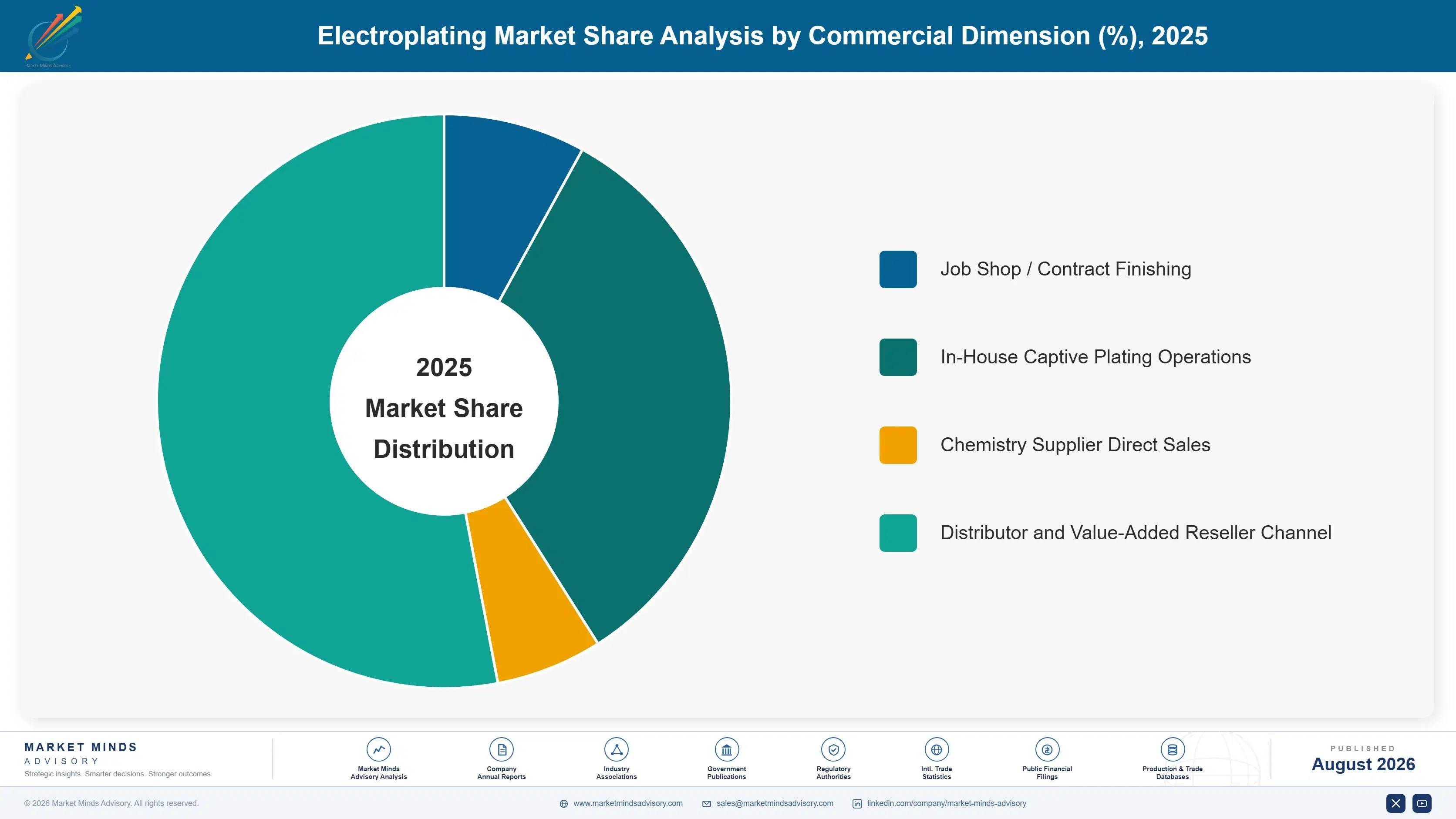
Segmentation follows end-use application and chemistry grade, the dimension manufacturers specify against when awarding plating supply contracts, rather than by distribution channel or contract length, both of which sit outside this defined market scope and belong instead to adjacent commercial and channel-level analysis kept entirely separate from this specific market research report. and its stated scope.
electroplating-market-trends-market-share-analysis-1787548893593

Electronics and Semiconductor Grade Plating

Electronics and semiconductor grade plating covers precious metal and specialty base metal chemistry engineered for connector, circuit board, and semiconductor packaging applications requiring nanometer-level deposition thickness control that decorative applications never demanded. Semiconductor packaging companies are specifying this grade earliest on the most technically demanding applications, where deposition uniformity directly determines device reliability and performance outcomes. Suppliers need sophisticated process monitoring and analytical capability alongside traditional chemistry formulation expertise, a combination only a handful of global suppliers currently hold at meaningful scale. Pricing commands a substantial premium over commodity base metal chemistry, and the segment is pulling research investment toward precision deposition technology across nearly every major supplier's expansion roadmap today.
CAGR 9.0%

Medical Device Grade Plating

Medical device grade plating addresses biocompatibility and corrosion resistance requirements for surgical instruments, implantable devices, and diagnostic equipment, representing a specialized application requiring regulatory certification distinct from both electronics and commodity industrial grades. Rising demand for minimally invasive surgical devices and implantable technology is pulling sustained growth in this application, particularly across developed healthcare markets with sophisticated medical device manufacturing bases. Suppliers need medical-grade regulatory certification and dedicated production lines segregated from industrial-grade manufacturing to avoid cross-contamination risk. Gross margin on this segment benefits from specialized certification requirements, making it a priority investment area for suppliers seeking to diversify beyond commodity chemistry pricing pressure entirely across the industry. Momentum continues building.
CAGR 7.5%
Full segment breakdown across 6 segments available in the complete report.

Regional Architecture and Country Demand Map

East Asia's dominant electronics manufacturing base, anchored overwhelmingly by China, accounts for the largest share of global electroplating demand, while North America and Western Europe carry the richest precious metal chemistry content value per application across their established industrial customer bases. today. overall. today. now.

North America

US production remains anchored by established chemical suppliers including MacDermid Alpha and Technic, supplying both semiconductor packaging and automotive electronics plating markets across the continent. Aerospace and defense manufacturing continues supporting steady growth in specialized precious metal plating demand even as overall industrial hardware volume tracks broader manufacturing production trends. Canadian production remains comparatively modest but growing, particularly serving regional automotive and industrial markets. Regional growth trails East Asia given the region's already mature and consolidated production base. Insurance and warranty coverage requirements increasingly shape which chemistry suppliers achieve broad manufacturer adoption. Manufacturers continue prioritizing precision chemistry investment across most active supplier relationships. Growth stays modest. Investment continues expanding steadily.
Share: 22% | CAGR: 4.7% (2026 to 2036)

Western Europe

Germany and France anchor regional demand through Atotech and Coventya's established chemical manufacturing operations, both companies representing the industry's most established European suppliers by scale and technical reputation across multiple end-use applications. European Union environmental permitting standards remain among the world's strictest, positioning established suppliers with existing wastewater treatment infrastructure at genuine competitive advantage. Regional automotive production has grown only modestly this decade, which caps overall volume upside even as precious metal content value per application continues climbing steadily. France and Italy contribute meaningful volume through mid-market automotive and industrial finishing applications specifically. Regulatory harmonization across the bloc also simplifies multi-country commercial rollout considerably. Producer margins remain steady. now. Trends persist.
Share: 18% | CAGR: 4.5% (2026 to 2036)
Regional intelligence for 5 additional markets available in the complete report: East Asia, South Asia and Pacific, Latin America, Middle East and Africa, Eastern Europe. Contact sales@marketmindsadvisory.com.
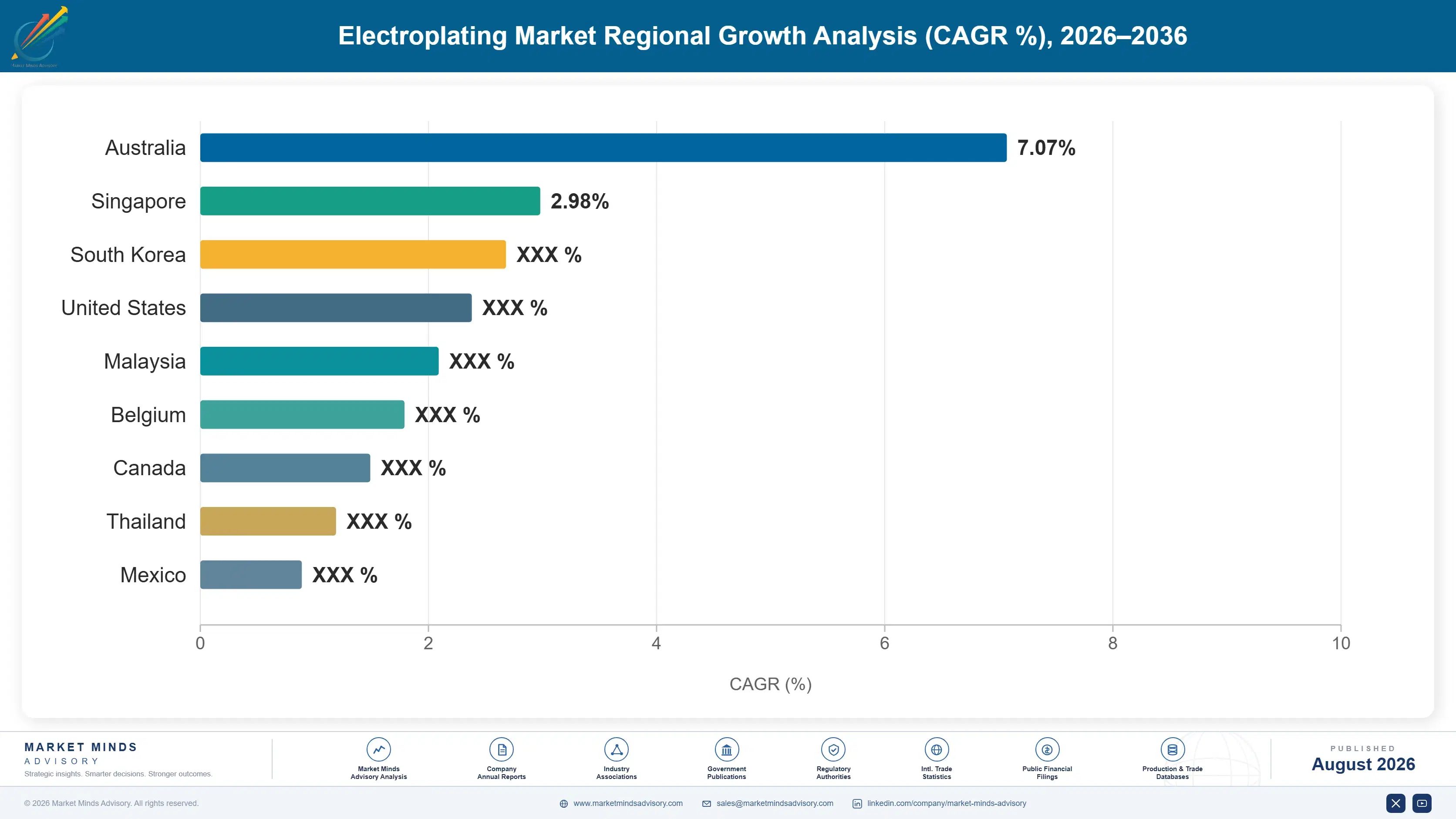
electroplating-market-trends-country-cagr-analysis-1787548894103

Where Chemistry Suppliers Can Defend Margin

Suppliers facing commodity pricing pressure on standard base metal chemistry have four realistic paths to defend and expand margin without waiting for overall manufacturing volume alone to drive growth across every market they currently serve, plan to enter, or hope eventually to win business in over the coming years. ahead of competitors moving more slowly across the industry.

Investing Early in Precision Deposition Technology

Suppliers that invest in process monitoring and analytical capability for precision deposition can capture $180-260 per kg premium pricing from semiconductor packaging customers seeking tighter thickness tolerances, well above commodity base metal chemistry margins. The capability requires meaningful upfront capital investment and technical support infrastructure, but suppliers who move early are securing multi-year semiconductor supply contracts that competitors entering later will struggle to match given the qualification timeline involved. Sponsors increasingly treat this qualification as a genuine competitive necessity rather than an optional upgrade, particularly as deposition thickness tolerances continue tightening across major semiconductor packaging programs.
Market Impact: Adds \$180-260 per kg in premium pricing today

Investing in Wastewater Recycling Infrastructure Now

Investing in closed-loop wastewater recycling systems ahead of tightening regulatory deadlines positions suppliers to retain operating licenses and capture market share from competitors forced into permanent closure, absorbing the $8-15 million compliance cost while smaller operators cannot. This investment requires substantial capital commitment, but suppliers with compliant facilities are winning long-term contracts that customers increasingly restrict to environmentally compliant partners specifically. Producers without this compliance investment increasingly find themselves excluded from customer sourcing shortlists during formal vendor evaluation reviews conducted each year. Regulatory deadlines are approaching faster than many mid-tier producers have prepared for across several jurisdictions.
Market Impact: Secures long-term contracts worth \$8-15M in yearly savings

Pursuing Precious Metal Hedging Strategy Investment

Building index-linked pricing clauses and metal hedging capability into customer contracts protects suppliers from the roughly 15-25% precious metal cost swings that fixed-price agreements otherwise absorb entirely, a sophistication smaller regional competitors increasingly cannot match. This investment requires meaningful financial infrastructure and treasury expertise, but suppliers succeeding here are protecting margin during commodity price cycles that erode unprepared competitors' profitability considerably. Suppliers without this sophistication increasingly find themselves undercut by better-hedged rivals during periods of commodity price volatility across major precious metal markets. Larger buyers increasingly favor suppliers demonstrating this financial sophistication.
Market Impact: Protects producer margin against roughly 15-25% price swings

Expanding Electric Vehicle Component Plating Capability

Establishing or expanding manufacturing capacity for electric vehicle battery connector and busbar plating, where demand continues growing at roughly 4% annually beyond conventional automotive plating, gives suppliers access to genuinely new addressable demand that traditional internal combustion vehicles never generated. Domestic automotive suppliers already hold meaningful incumbency here, so global suppliers need genuinely competitive technical qualification and cost structures to win contracts rather than assuming automotive expertise transfers directly. These relationships typically require years of technical qualification before formal supply agreements are finalized with major automotive customers. today. widely. overall.
Market Impact: Captures share of a 4% EV plating growth pool

Who Controls the Margin Pool

The five largest electroplating chemical suppliers hold roughly half of category revenue, a meaningful concentration reflecting the substantial technical and regulatory barriers that keep smaller challengers largely confined to niche regional and commodity applications rather than the technically demanding electronics segment. The gap between scaled precision chemistry leaders and regional commodity suppliers is widening as semiconductor and electric vehicle applications increasingly reward technical sophistication over price alone.
Current competitive activity centers on three dimensions: precision deposition technology investment that determines semiconductor qualification eligibility, wastewater recycling infrastructure investment that protects operating licenses against tightening discharge regulation, and electric vehicle component plating capability where unit volume growth remains fastest across the entire forecast window. Suppliers investing across all three simultaneously are pulling meaningfully ahead of narrowly focused competitors still betting on a single dimension.

Emerging pressure is coming from Chinese domestic suppliers scaling capacity to serve both export markets and China's own massive electronics manufacturing demand, threatening established Western suppliers' historical hold on precision chemistry premiums. Rankings are most likely to shift among mid-tier suppliers lacking either precision deposition capability or environmental compliance infrastructure, both of which are becoming necessary rather than optional for long-term survival in this category.
electroplating-market-trends-company-positioning-matrix-1787548894619

Competitive Moat and Risk Dimensions

MACDERMID ALPHA ELECTRONICS SOLUTIONS

Moat: Broad Electronics Chemistry Portfolio

MacDermid Alpha's combination of precision precious metal chemistry and broad electronics finishing portfolio gives it genuine technical depth across semiconductor packaging, connector, and circuit board applications that narrower competitors cannot easily replicate at comparable scale or with comparable global manufacturing reach and technical support infrastructure.
MACDERMID ALPHA ELECTRONICS SOLUTIONS

Risk: Consumer Electronics Cyclicality Exposure

MacDermid Alpha's substantial exposure to consumer electronics demand cycles leaves it more vulnerable than diversified competitors to inventory corrections and demand swings tied to smartphone and consumer device manufacturing seasonality specifically, a pattern that has recurred across multiple prior downturns in the category over the past decade.
ATOTECH

Moat: Deep Semiconductor Packaging Expertise

Atotech's decades of semiconductor packaging and precision deposition expertise give it established qualification and regulatory documentation across the industry's most technically demanding applications, a position new entrants cannot easily replicate given the multi-year qualification timeline and documentation burden involved across major customer accounts worldwide.
ATOTECH

Risk: Integration Complexity Risk

Atotech's position within a larger diversified industrial technology parent creates genuine organizational complexity as it balances resource allocation against other business units competing for the same capital investment priorities across the broader corporate portfolio each annual budgeting cycle, occasionally slowing decision speed on major investments.

Players Tracked

Prominent Players

MacDermid Alpha Electronics Solutions
Atotech
Coventya Holding SAS
Umicore Group
Technic Inc.

Other Key Players

Interplex Industries Inc.
Pioneer Metal Finishing LLC
Roy Metal Finishing
Allied Finishing Inc.
Metalor Technologies International SA
Heimerle + Meule GmbH
Sharretts Plating Company Inc.
Peninsula Metal Finishing Inc.
Bajaj Electroplaters Inc.
Kuntz Electroplating Inc.
Electroplating Engineers of Japan Ltd.
Johnson Matthey Plc
Tanaka Holdings Co. Ltd.
Nihon Kagaku Sangyo Co. Ltd.
DuPont de Nemours Inc.

Recent Developments

FEBRUARY 2026

Atotech Expands Precision Deposition Chemistry Line

Atotech launched a new precision deposition chemistry line specifically engineered for advanced semiconductor packaging applications, targeting customers seeking tighter thickness tolerances as chip miniaturization continues across the electronics industry, with initial qualification runs already underway at several major accounts across Asia this year.
Signal: Confirms established suppliers continue investing heavily in precision chemistry as a key competitive differentiator.
SEPTEMBER 2025

MacDermid Alpha Expands Wastewater Recycling Capacity

MacDermid Alpha expanded closed-loop wastewater recycling capacity at several major manufacturing facilities, targeting tightening environmental regulation on heavy metal discharge ahead of upcoming compliance deadlines across multiple jurisdictions, reinforcing its operating license in several key manufacturing regions worldwide this year.
Signal: Shows established suppliers investing proactively in compliance infrastructure to defend operating licenses long-term.
JUNE 2025

Umicore Expands EV Battery Connector Plating Capacity

Umicore announced expansion of its electric vehicle battery connector and busbar plating capacity, targeting rising demand from automakers seeking corrosion-resistant chemistry for high-current battery connections across multiple vehicle platforms, with new capacity scheduled to come online within the next two years across two facilities.
Signal: Indicates established suppliers are prioritizing electric vehicle applications as a key growth diversification strategy.

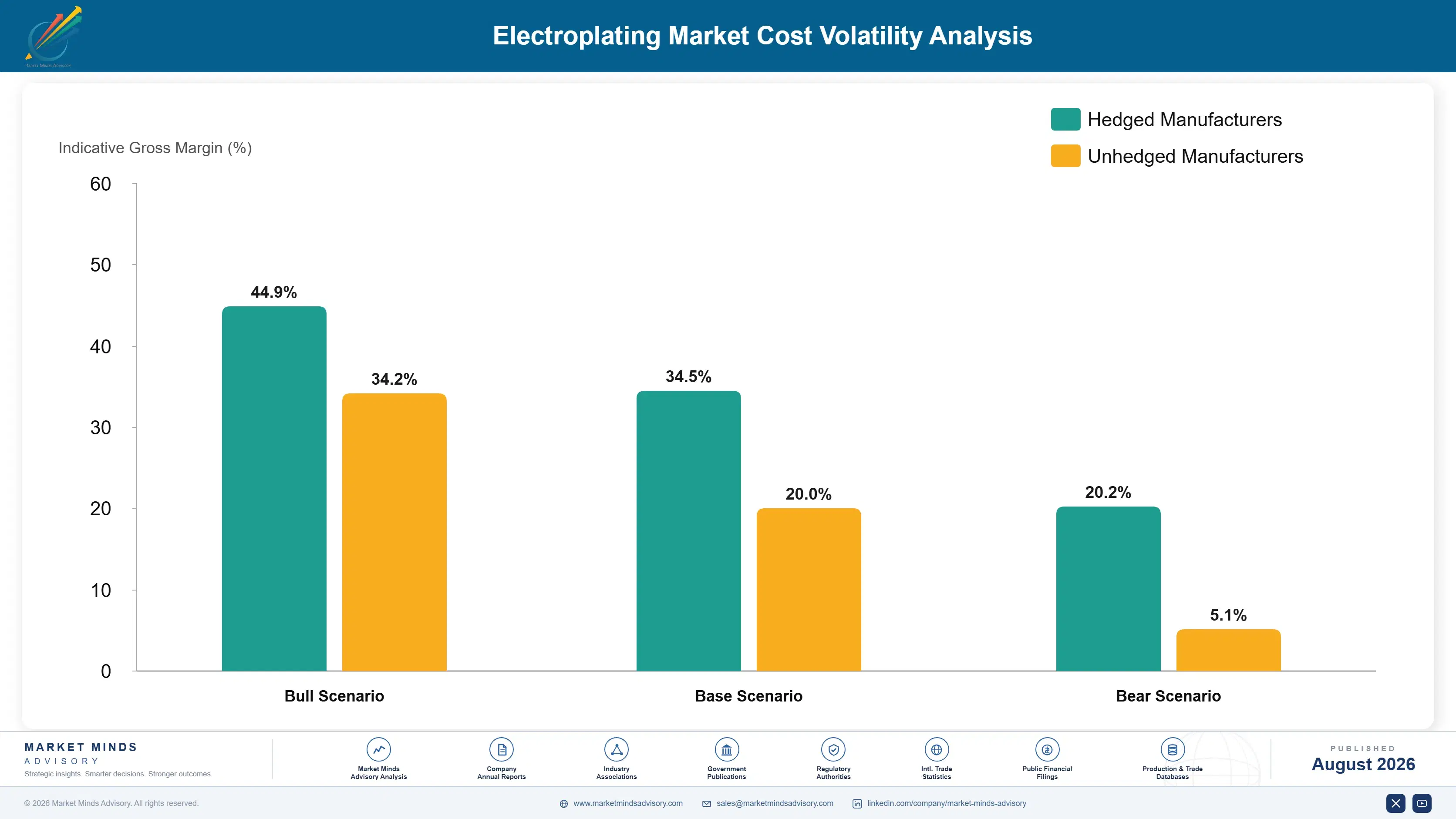
Precious Metal Price Exposure

Precious metals, principally gold, silver, palladium, and rhodium, account for an estimated 35 to 45% of chemistry cost of goods sold across precision electroplating applications, with base metal salts and proprietary organic additives making up most of the remainder. Precious metal supply originates largely from South African, Russian, and Peruvian mining output, concentrating geopolitical exposure in a handful of producing countries with limited substitute sourcing available.
Rhodium prices surged more than 80% during a twelve-month span through mid-2025 amid tight South African supply and automotive catalyst demand competing directly with electronics plating consumption for the same constrained metal pool, according to IEA critical minerals price tracking data. Suppliers without hedging programs absorbed significant margin compression before partially passing costs through to customers on a lagged quarterly basis, damaging near-term profitability meaningfully.

The mechanism creating competitive disadvantage is straightforward: suppliers lacking hedging infrastructure or long-term metal supply contracts must reprice frequently, damaging customer relationships and ceding share to competitors offering price stability. Exposure varies meaningfully by player type, with larger diversified suppliers able to negotiate better contract terms than regional finishers who typically buy precious metals on the spot market at less favorable pricing.
electroplating-market-trends-cost-volatility-analysis-1787548894815

Forward Metal Purchasing Contracts

Leading suppliers increasingly lock multi-month forward contracts directly with metal refiners to smooth input cost volatility, trading some upside flexibility for predictable budgeting that customers value highly when negotiating annual chemistry supply agreements across major electronics and automotive accounts during renewal negotiations each cycle, particularly for accounts requiring multi-year price stability commitments before signing new long-term contracts.

Precious Metal Reclamation Programs

Suppliers are expanding rhodium and palladium reclamation from spent plating baths and rinse water streams, recovering meaningful volumes that offset virgin metal purchases and reduce net exposure to spot price swings, while simultaneously addressing wastewater discharge compliance requirements at the same manufacturing facilities where reclamation equipment is already installed, operating, and generating measurable cost savings.

Formulation Substitution Research

Chemistry developers are researching reduced-loading and alternative-metal formulations that maintain plating performance while cutting precious metal content per unit surface area, a multi-year research effort aimed at durably lowering exposure across entire product lines rather than merely hedging cost after the purchase, with several formulations now entering customer qualification trials across multiple end markets.

Portfolio Architecture for Margin Defence

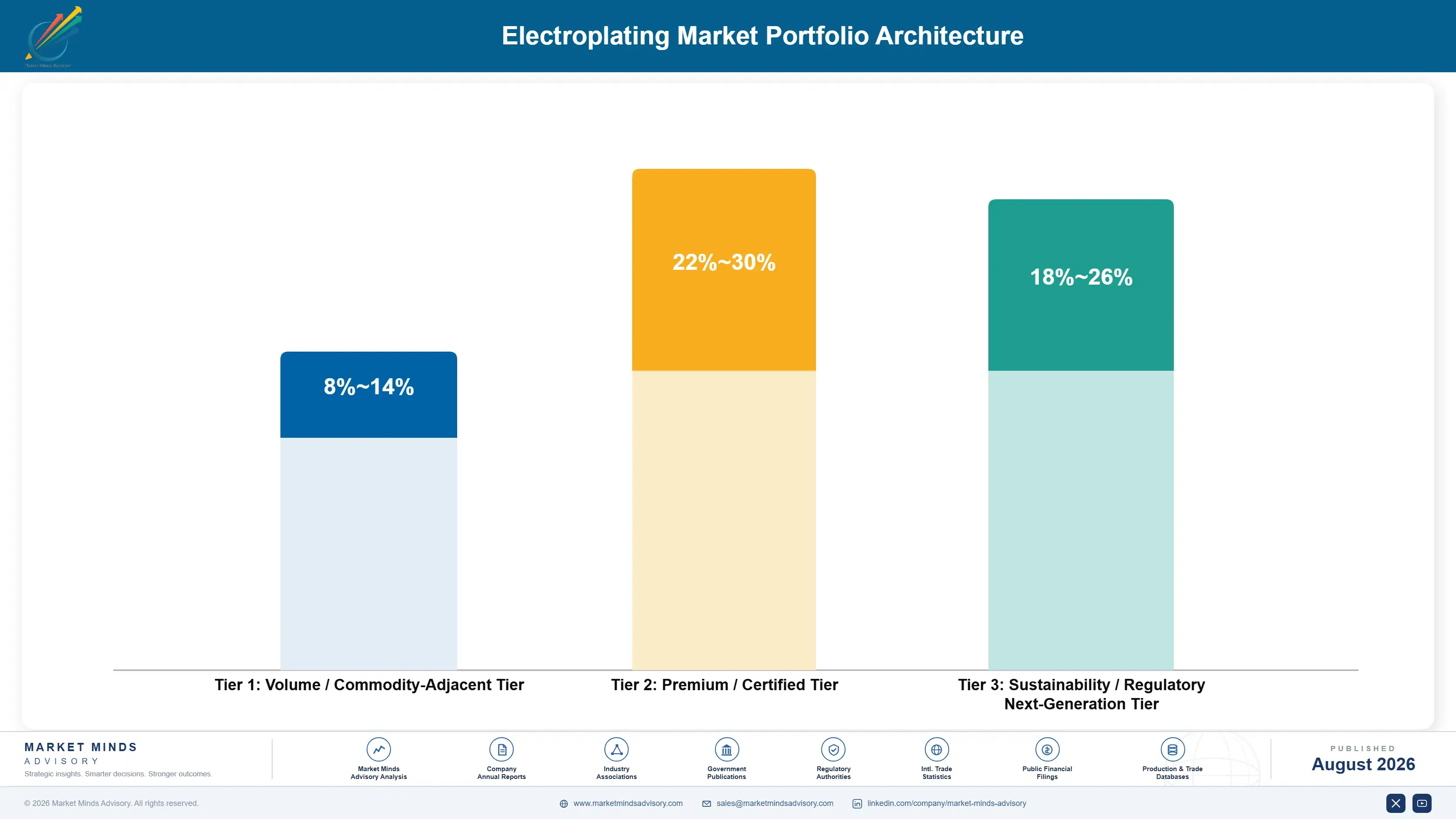
Electroplating chemistry margin economics divide cleanly across three tiers that reflect formulation complexity far more than raw material cost. Volume commodity-adjacent chemistry for general metal finishing carries thin gross margins under sustained regional price competition, while precious metal precision chemistry for semiconductor and electric vehicle applications commands substantially wider margins reflecting formulation complexity and multi-year customer qualification barriers that limit competitive pricing pressure meaningfully.
The volume versus premium tension is fundamental to the category: commodity finishers compete primarily on price and delivery reliability against numerous regional rivals, while precision suppliers compete instead on technical specification and regulatory documentation that customers cannot easily substitute away from once qualified into a production line. Switching costs favor incumbents heavily once a formulation passes customer qualification testing, often taking twelve months or longer to complete.

High-value margin pools concentrate overwhelmingly in semiconductor packaging and medical device chemistry, where formulation performance directly affects end-product reliability and customers tolerate premium pricing for qualified, documented supply chains. Sustainability-linked chemistry, particularly reduced-discharge and reclamation-compatible formulations, is emerging rapidly as a third distinct pool as environmental compliance costs rise sharply across major manufacturing regions worldwide.

Volume / Commodity-Adjacent Tier

General metal finishing chemistry for consumer hardware, fasteners, and decorative applications competes primarily on price and delivery reliability against numerous regional commodity suppliers with limited technical differentiation between competing offerings across most order volumes.
Gross Margin: 8-14%

Premium / Certified Tier

Precision chemistry qualified for semiconductor packaging, connector, and medical device applications commands durable pricing power once formulations pass customer qualification testing cycles that competitors cannot easily replicate quickly given the lengthy validation timelines involved.
Gross Margin: 22-30%

Sustainability / Regulatory / Next-Generation Tier

Reduced-discharge and reclamation-compatible chemistry earns a meaningful premium from customers facing tightening wastewater regulation and seeking documented compliance pathways ahead of upcoming permitting deadlines across several major manufacturing jurisdictions worldwide this decade.
Gross Margin: 18-26%
electroplating-market-trends-portfolio-architecture-1787548895316

High-value Sub-segments and Strategic Watch-out

Semiconductor Packaging Chemistry

The highest-value, fastest-growing pool as chip miniaturization demands tighter deposition tolerances; suppliers with qualified precision formulations are capturing outsized margin expansion relative to the broader category, a gap that keeps widening each successive product cycle as chipmakers push tolerances toward sub-nanometer precision levels industry-wide.
Gross Margin: 26-32%

Electric Vehicle Component Plating

Large and growing steadily as battery connector and busbar volumes scale with vehicle electrification programs across major automakers worldwide; margins remain solid though not yet at semiconductor-tier premiums given more competitive qualification dynamics among several capable suppliers chasing the same large original equipment manufacturer accounts.
Gross Margin: 20-25%

General Industrial Metal Finishing

The volume core of the category, providing stable baseline revenue but limited margin expansion potential given intense regional price competition among numerous commodity chemistry suppliers with broadly comparable technical capability and few meaningful barriers to entry for new regional competitors actively seeking share this year.
Gross Margin: 10-15%

PFAS-Free Chemistry Transition

A strategic watch-out as regulatory pressure against PFAS-based additives accelerates across major jurisdictions worldwide; suppliers slow to reformulate risk losing qualified positions to competitors with proven alternative chemistry already commercially available and moving steadily through customer qualification pipelines at several major accounts.
Gross Margin: 18-24%

Qualification Lock-In Economics

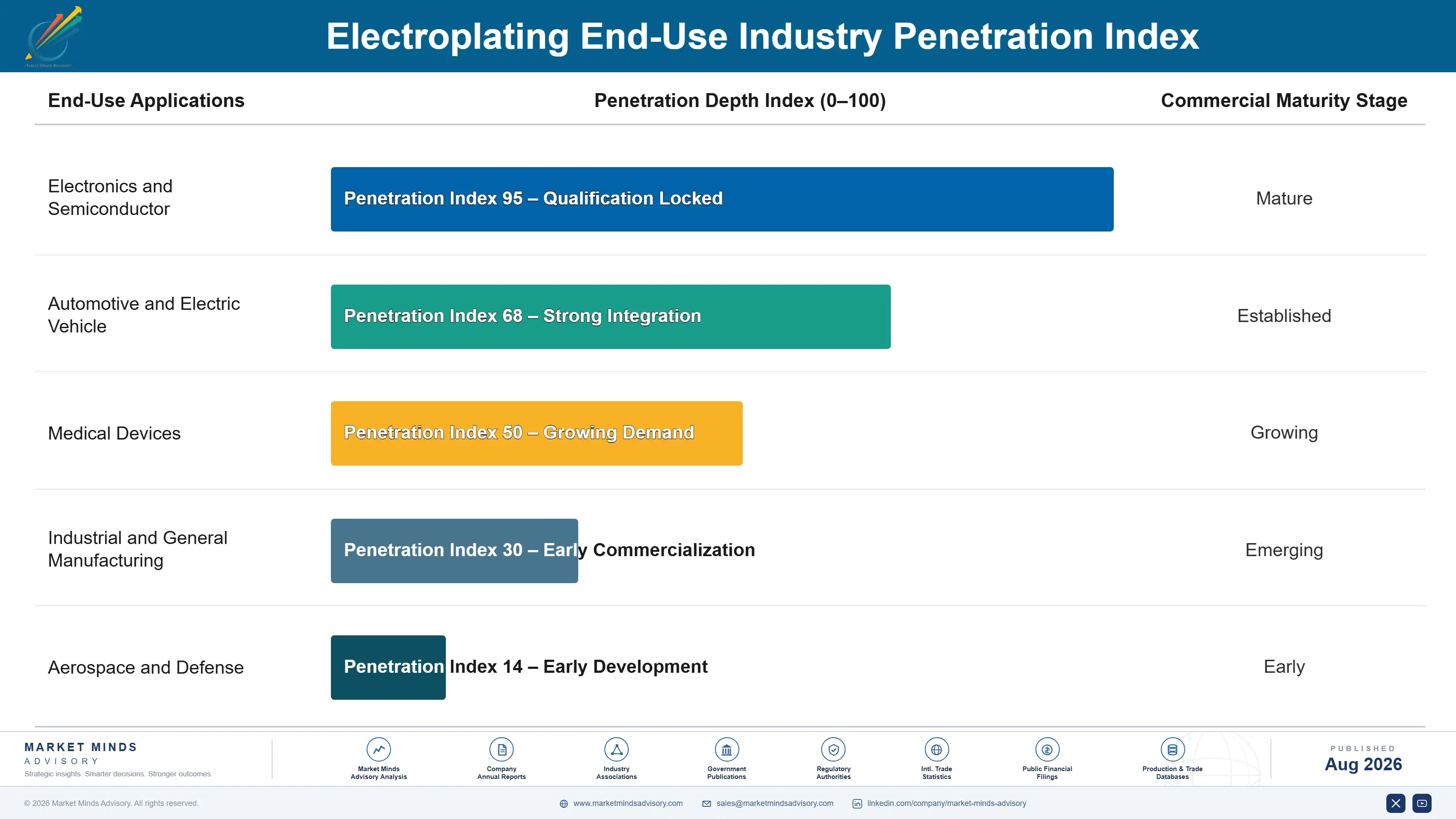
Electroplating chemistry revenue behaves closer to an annuity than a transactional commodity sale once a formulation clears customer qualification. Semiconductor and medical device manufacturers rarely requalify a plating chemistry supplier without a compelling cost or performance reason, since requalification consumes substantial engineering time and carries meaningful production risk that most customers prefer to avoid entirely across multi-year production runs spanning several device generations.
Adoption stickiness varies meaningfully by end-use vertical. Semiconductor packaging customers exhibit the deepest lock-in given multi-year qualification cycles and strict documentation requirements tied to device reliability standards, while general industrial finishing customers switch suppliers more readily on price alone given lower switching costs. Medical device customers sit between the two, constrained by regulatory filings that reference specific chemistry formulations by name and require costly amendment if changed.

Buyer profiles are shifting generationally as procurement teams increasingly include sustainability and compliance specialists alongside traditional purchasing managers, changing how plating chemistry gets evaluated at the negotiating table. Younger engineering leads entering purchasing decisions weigh environmental compliance documentation and reclamation compatibility more heavily than predecessors did, gradually reshaping which suppliers win new qualification slots across both established and emerging accounts.
electroplating-market-trends-end-use-penetration-index-1787548895803

Where Suppliers Should Focus Next

These are among the four positions where our research anticipates prominent divergence between winners and laggards over the coming forecast period. Each is grounded in the demand model, the regulatory perimeter, and the announced capacity pipeline.
01 / TECHNOLOGY INVESTMENT PRIORITY

Prioritize precision deposition capability for semiconductor demand

Suppliers should direct capital toward precision deposition chemistry qualified for semiconductor packaging, since this segment carries the fastest growth and widest margins in the entire category through 2036, outpacing every other application by a meaningful margin. Delaying investment risks ceding qualification slots to competitors already running customer trials at leading chipmakers this year, a lead that compounds the longer it persists. The technical barrier to entry protects early movers for years once qualification is secured, making early capital commitment the single highest-leverage decision facing chemistry suppliers today.
02 / COMPLIANCE INFRASTRUCTURE TIMING

Build wastewater recycling capacity ahead of tightening regulation

Suppliers lacking wastewater recycling infrastructure face rising compliance risk as discharge regulation tightens across major manufacturing jurisdictions worldwide over the coming decade, particularly in East Asia and Western Europe where enforcement is intensifying fastest of all regions. Building this capacity proactively, rather than reactively after enforcement action, preserves operating licenses and avoids costly production interruptions that competitors slower to act will likely experience. Early movers can also market compliance readiness as a customer-facing differentiator against rivals still catching up on infrastructure investment.
03 / METAL HEDGING DISCIPLINE

Formalize precious metal hedging before the next volatility spike

Precious metal price swings have repeatedly compressed margins for suppliers without hedging programs, and rhodium volatility in particular shows no sign of stabilizing given constrained South African supply through the forecast period and rising automotive catalyst demand competing for the same metal pool. Formal forward purchasing programs protect margin and support the pricing stability that large accounts increasingly demand in renewal negotiations across multi-year contracts. Suppliers that delay formalizing hedging discipline will keep absorbing avoidable margin shocks each time metal prices spike unexpectedly.
04 / ELECTRIC VEHICLE POSITIONING

Expand electric vehicle component qualification before competitors scale

Battery connector and busbar plating volumes are scaling quickly as vehicle electrification accelerates across major automotive markets worldwide, and qualification slots at leading automakers are filling steadily each quarter as production ramps continue across multiple vehicle platforms. Suppliers that secure qualification now lock in multi-year supply relationships before competitive density increases and pricing power erodes across the segment meaningfully over subsequent years. Waiting even a single product cycle risks losing the account permanently to a faster-moving competitor already courting the same customer.

Engagement Snapshot From the Field

A live engagement with an industry participant carrying material or product regulatory and market exposure ahead of a defining policy shift, showing how our research translates into a defensible multi-year portfolio strategy.
MARKET MINDS ADVISORY · CLIENT ENGAGEMENT SUMMARY
Electroplating Producer Strategic Portfolio Review and Transition Roadmap 2026·Investment Scenario on Electroplating Exposure Evaluation 2025-26
CLIENT PROFILE
The client is a tier-1 automotive electronics supplier manufacturing connectors and battery interconnects for several major original equipment manufacturers, operating plating lines across three continents with annual chemistry spend in the tens of millions. Facing rising precious metal costs and tightening wastewater discharge regulation simultaneously, the client engaged MMA to evaluate its chemistry supplier base and identify exposure before renewing annual contracts.
STRATEGIC CHALLENGE
The client's existing plating chemistry suppliers offered no hedging protection against precious metal volatility, and one major facility faced a compliance deadline for wastewater discharge that its current supplier's chemistry could not meet without reformulation, risking a costly production interruption across a facility supplying multiple vehicle programs and several tier-one accounts.
MMA APPROACH
MMA benchmarked the client's supplier base against category leaders on hedging practice, reclamation-compatible formulation availability, and qualification lead time, then modeled the cost and switching risk of consolidating toward a smaller set of suppliers offering forward metal contracts and compliant chemistry lines across all three continents where the client's facilities currently operate.
KEY FINDINGS
  1. Two of the client's four incumbent chemistry suppliers lacked forward metal purchasing programs, exposing roughly 30% of total plating spend to unhedged volatility.
  2. One incumbent's chemistry line could not meet the client's upcoming wastewater discharge deadline without a twelve-month reformulation and requalification cycle at that facility.
  3. Suppliers offering reclamation-compatible chemistry quoted premiums of 8 to 12% versus incumbents, but modeled compliance risk avoidance more than offset the incremental cost.
  4. Consolidating toward two hedged suppliers reduced projected precious metal cost volatility exposure by an estimated 40% across the client's full plating spend portfolio.
CLIENT PROFILE
The client is a tier-1 automotive electronics supplier manufacturing connectors and battery interconnects for several major original equipment manufacturers, operating plating lines across three continents with annual chemistry spend in the tens of millions. Facing rising precious metal costs and tightening wastewater discharge regulation simultaneously, the client engaged MMA to evaluate its chemistry supplier base and identify exposure before renewing annual contracts.
STRATEGIC CHALLENGE
The client's existing plating chemistry suppliers offered no hedging protection against precious metal volatility, and one major facility faced a compliance deadline for wastewater discharge that its current supplier's chemistry could not meet without reformulation, risking a costly production interruption across a facility supplying multiple vehicle programs and several tier-one accounts.
MMA APPROACH
MMA benchmarked the client's supplier base against category leaders on hedging practice, reclamation-compatible formulation availability, and qualification lead time, then modeled the cost and switching risk of consolidating toward a smaller set of suppliers offering forward metal contracts and compliant chemistry lines across all three continents where the client's facilities currently operate.
KEY FINDINGS
  1. Two of the client's four incumbent chemistry suppliers lacked forward metal purchasing programs, exposing roughly 30% of total plating spend to unhedged volatility.
  2. One incumbent's chemistry line could not meet the client's upcoming wastewater discharge deadline without a twelve-month reformulation and requalification cycle at that facility.
  3. Suppliers offering reclamation-compatible chemistry quoted premiums of 8 to 12% versus incumbents, but modeled compliance risk avoidance more than offset the incremental cost.
  4. Consolidating toward two hedged suppliers reduced projected precious metal cost volatility exposure by an estimated 40% across the client's full plating spend portfolio.
RECOMMENDED STRATEGY
Phase 1: Phase one: requalify one reclamation-compatible chemistry line at the facility facing the nearest compliance deadline, prioritizing production continuity above all else. Phase 2: Phase two: renegotiate remaining contracts to require forward metal purchasing commitments from all retained chemistry suppliers going forward into next year. Phase 3: Phase three: consolidate spend toward two suppliers offering both compliance and hedging, improving negotiating leverage on future contract renewals overall.
OUTCOME
The client avoided a projected production interruption at its compliance-constrained facility and reduced modeled precious metal cost volatility exposure by roughly 40% (client-reported, unverified by MMA) within twelve months of implementing the recommended supplier consolidation strategy across its global manufacturing footprint and vehicle program portfolio.

Frequently Asked Questions

Foundational context covering the market sizes, CAGR, scope, country, region and competition that inform every finding below. This section is provided to cover basics and most often pre-purchase conversations, answered from the MMA Primary Research Dataset.

What is the current size of the Electroplating Market?

The global electroplating chemistry market reached an estimated USD 17.8 billion in 2025. Growth is being driven by rising demand from semiconductor packaging and electric vehicle component manufacturing worldwide.

How large will the Electroplating Market be by 2036?

MMA projects the market will reach approximately USD 33.9 billion by 2036. This represents nearly a 1.79 times expansion from 2026 levels over the forecast decade.

What is the CAGR for the Electroplating Market 2026 to 2036?

The market is projected to grow at a 6.0% compound annual growth rate between 2026 and 2036. Bull and bear scenarios range from 4.8% to 7.2% depending on demand conditions.

Which segment is growing fastest?

Electronics and Semiconductor Grade Plating is the fastest-growing segment, expanding at a 9.0% CAGR. That is 1.5 times the overall market growth rate, driven by chip miniaturization trends.

Who are the major companies in the Electroplating Market?

Leading suppliers include MacDermid Alpha Electronics Solutions, Atotech, Coventya Holding SAS, Umicore Group, and Technic Inc. These five companies hold roughly half of total category revenue.

Which country is growing fastest?

China leads regional growth at a 7.8% CAGR, supported by its dominant electronics manufacturing base. Rapid semiconductor and electric vehicle production expansion is reinforcing this position through 2036.

Report Segmentation Architecture

The full report scope spans multiple orthogonal segmentation dimensions, with cross-tabulated demand data provided for each dimension pair. Coverage extends further to regional breakdowns, trend trajectories, and the competitive detail needed to support segment-level decision-making.

By Primary Market Dimension

  • Precious Metal Plating Chemistry
  • Base Metal Plating Chemistry
  • Electroless Plating Chemistry
  • Anodizing and Conversion Coating Chemistry
  • Plating Equipment and Line Systems
  • Wastewater Treatment and Reclamation Chemistry

By End-Use Industry

  • Electronics and Semiconductor
  • Automotive and Electric Vehicle
  • Medical Devices
  • Industrial and General Manufacturing
  • Aerospace and Defense

By Commercial Dimension

  • Job Shop / Contract Finishing
  • In-House Captive Plating Operations
  • Chemistry Supplier Direct Sales
  • Distributor and Value-Added Reseller Channel

By Region

  • North America
  • Western Europe
  • East Asia
  • South Asia and Pacific
  • Latin America
  • Middle East and Africa
  • Eastern Europe

Scope, Methodology, and Coverage

Every figure in this report is reproducible from documented input assumptions. The scope below maps the historical period, the forecast horizon, the segmentation dimensions, and the countries covered, alongside the underlying primary and qualitative methodology.
Historical Period
2020 to 2025
Forecast Period
2026 to 2036
Base Year
2025 (USD billions; MMA Primary Research Dataset, August 2026)
Market Definition
This report covers the global market for electroplating and related surface finishing chemistry, including precious metal, base metal, electroless, and conversion coating formulations sold to contract finishers and in-house plating operations. It excludes plating equipment hardware, physical vapor deposition systems, and general industrial coatings unrelated to electrochemical or electroless metal deposition.
Quantitative Units
USD billions (current prices); metric tons of chemistry volume where applicable
Segmentation Dimensions
By Primary Market Dimension; By End-Use Industry; By Commercial Dimension; By Region
Regions Covered
North America, Western Europe, East Asia, South Asia and Pacific, Latin America, Middle East and Africa, Eastern Europe
Countries Covered
USA, China, Germany, France, UK, Japan, South Korea, India, Australia, Canada, Brazil, Mexico, Indonesia, Vietnam, Thailand, Malaysia, UAE, Saudi Arabia, South Africa, Nigeria, Turkey, Poland, Netherlands, Italy, Spain, Sweden, Switzerland, Argentina, Colombia, Singapore, and additional markets relevant to this sector
Key Companies Profiled
MacDermid Alpha Electronics Solutions, Atotech, Coventya Holding SAS, Umicore Group, Technic Inc., Interplex Industries Inc., Pioneer Metal Finishing LLC, Roy Metal Finishing, Allied Finishing Inc., Metalor Technologies International SA, Heimerle + Meule GmbH, Sharretts Plating Company Inc., Peninsula Metal Finishing Inc., Bajaj Electroplaters Inc., Kuntz Electroplating Inc., Electroplating Engineers of Japan Ltd., Johnson Matthey Plc, Tanaka Holdings Co. Ltd., Nihon Kagaku Sangyo Co. Ltd., DuPont de Nemours Inc.
Quantitative Methodology
Primary survey, n=3,800 respondents, Q4 2025, six countries; demand-side model with trade association cross-validation
Qualitative Methodology
47 expert interviews, Q4 2025; applied to validate demand model assumptions, identify emerging dynamics, and assess competitive positioning
Report Format
PDF and XLSX data workbook (Word format preview document)
Publisher
Market Minds Advisory
Report Code
MMA-2026-CHM-124
Published
August 2026
Contact
sales@marketmindsadvisory.com | www.marketmindsadvisory.com

Purchase the full Electroplating Market Report (2026 to 2036).

The full report provides a comprehensive assessment of the global electroplating chemistry market, covering historical performance from 2020 through 2025 and detailed ten-year forecasts through 2036. It segments the market by chemistry type, end-use industry, and commercial channel, and profiles twenty leading suppliers with benchmarking across hedging practice, compliance readiness, and technical capability. Regional chapters cover all seven world regions with country-level detail for major manufacturing markets, including China, the United States, Germany, and Japan. Clients also receive underlying data tables and a live analyst briefing upon request.
Ten-year global market sizing and forecast model
Segment-level CAGR and market share breakdowns
Twenty-company competitive benchmarking and profiling database
Seven-region demand growth and pricing analysis
Precious metal cost exposure and hedging assessment
Direct analyst briefing and underlying data table access

Built For The People Who Decide

From boardroom strategy to bench-side execution, this report is read cover-to-cover by leaders shaping the next decade of their industry, turning demand scenarios, market dynamics and valuation benchmarks into decisions.
CXOs/ Presidents/ VPs/ Managers
M&A and Corporate Development
Strategy Teams and R&D Heads
Procurement and Product Directors
Regulatory and Compliance Leaders
Investor Relations and Equity Analysts