Market Minds Advisory
Electronics Adhesives Market

Electronics Adhesives Market: Thermal Path Engineering, Repairability Rules, and Qualification Lock-In

Power density has risen far enough that the adhesive under a chip is now a heat transfer component rather than a fastening, and repairability rules are simultaneously demanding it come apart again.

Lead Analyst

Bilal Shaikh

Published

September 2026

Make Smarter Decisions with Customized Research Insights

Request a free sample report and evaluate market opportunities, growth trends, and competitive dynamics relevant to your business needs.

2025 MARKET VALUE$8.4BMarket Size 2025
2036 FORECAST VALUE$20.0BBase Case , 2026 to 2036
CAGR 2026 TO 20368.2 %Bull 9.4% / Bear 7.0%
INCREMENTAL OPPORTUNITY$10.9BNet 10- year value creation
EXPANSION MULTIPLE2.20x2036 value over 2026 base
Strategic Levers
M&A Pipeline
Regional Outlook
Country Rankings
Competitive Intelligence
Segmental Deep-dive
Call-Us : 91 93563 13602

Executive Snapshot and Market Trajectory

An adhesive under a semiconductor die stopped being a fastening some years ago. It is now the thermal path carrying heat away from a device that would otherwise destroy itself, which changed both the specification and who is qualified to supply it. Thermal engineers now specify what adhesive chemists supply.
Commercial power sits with formulators holding qualified positions inside device production processes rather than with anyone able to mix a filled epoxy. Thermally conductive adhesives grow fastest at 13.8%, roughly 1.68 times the market, driven by power electronics running hotter than any previous generation. East Asia holds 30% of global value on semiconductor packaging and electronics assembly concentrated across the region.
Concentration is high at roughly 47% for the top five, and qualification taking sixteen months explains most of it. Repairability regulation is pulling in the opposite direction to everything else, requiring adhesives in consumer devices that release on demand rather than bonding permanently. Reconciling those two demands is the central formulation challenge. Formulators are being asked to solve two requirements that genuinely contradict each other. Reconciling them is the central formulation challenge of the decade.
Market Definition
The market comprises adhesives and bonding materials used in electronic device manufacture, covering surface mount and assembly adhesives, die attach adhesives, underfill and encapsulation materials, thermally conductive adhesives and interface materials, electrically conductive adhesives, and optically clear adhesives. Value is measured at supplier level across semiconductor packaging, circuit assembly, display, and device assembly applications. Conformal coatings, solder pastes and fluxes, structural adhesives outside electronics, dispensing equipment, and printed circuit laminates fall outside scope.
Base Year Value
$8.4B in 2025 (MMA Primary Research Dataset, August 2026)
Forecast Period
2026 to 2036, eleven discrete annual values
CAGR
8.2% base case. Bull 9.4%. Bear 7.0%.
Fastest Growth Segment
Thermally Conductive Adhesives and Interface Materials: 13.8% CAGR
Fastest Growth Country
India: 11.6% CAGR
Fastest Growth Region
South Asia and Pacific: 10.4% CAGR
Largest Region
East Asia: 30% of 2025 global value
Market Leaders
Henkel, HB Fuller, Dow, Shin-Etsu Chemical, and Parker LORD lead on electronic adhesive supply. Source: company annual reports and MMA Analysis, July 2026.
Primary Survey
n=3,800 procurement and R&D decision-makers, Q4 2025, six countries
Methodology
Demand-side build-up, cross-validated against public data, 47 expert interviews

Electronics Adhesives Market Forecast Scenarios

electronics-adhesives-market-trends-size-forecast-scenario-1787549420871
Between 2020 and 2025 thermal requirements did most of the work. Processor and power device heat densities rose faster than package designs could accommodate passively, which turned adhesive selection into a thermal engineering decision and raised material value considerably. Semiconductor cycles moved volumes sharply both ways, and silicone and epoxy costs rose. The 6.9% historical growth blends genuine content gain with a volatile production backdrop.
The 8.2% base case rests on three mechanisms. Wide bandgap power devices in vehicle inverters and industrial drives run at junction temperatures conventional die attach cannot survive, which forces sintered and high-performance materials at multiples of previous prices. Advanced packaging with finer pitch and thinner dies requires underfill to manage thermal expansion mismatch that would otherwise crack interconnects. And repairability rules are creating a genuinely new category of debondable adhesive for consumer devices.
The 9.4% bull case assumes wide bandgap adoption accelerates and advanced packaging volumes scale as forecast. The 7.0% bear case reflects a prolonged semiconductor downcycle, device makers deferring advanced packaging investment, and repairability requirements being met through mechanical fastening rather than through new adhesive chemistry. Device architecture decides more of this than chemistry does. Nothing else moves it much.

The Bond Line Became a Heat Sink

Three things set the commercial shape of this market. Thermal performance comes first, because heat that cannot escape a device destroys it, and the adhesive layer is often the narrowest part of that escape route. Qualification comes second, since approving a material into device production takes sixteen months of reliability and thermal cycling work. Dispensing behaviour comes third and decides whether a material works on a real production line at all.
TOP-FIVE CONCENTRATION47%Share of global electronic adhesive supply held by leading producers
AVERAGE SELLING PRICEUSD 285 per kilogramBlended pricing across assembly and semiconductor grade materials
SEMICONDUCTOR PACKAGING SHARE36%Portion of value consumed in device packaging and die attach
BASE RESIN COST SHARE42%Silicone and epoxy input within total formulation cost
QUALIFICATION CYCLE LENGTH16 monthsTypical time to approve a material into device production
THERMAL CONDUCTIVITY REQUIREMENT8 W/mKTypical heat transfer specification for power device applications
The dispensing point is routinely underestimated. A material with excellent bulk properties that will not jet reliably, cures too slowly for line rate, or draws strings between dispense points is commercially useless regardless of what its datasheet claims. Suppliers who understand the equipment as well as the chemistry qualify materials that better-performing formulations lose to. Equipment understanding is as valuable as formulation skill, and far rarer.
Repairability regulation pulls directly against everything else. Rules requiring portable device batteries to be replaceable by users, and broader right to repair provisions, demand adhesives that release cleanly on command after years of holding firmly. That is genuinely difficult chemistry, and it sits awkwardly beside a thermal specification that wants maximum contact and minimum bond line thickness.
"The bond line under a power device is now measured in microns and expected to move eight watts per metre kelvin, which is a thermal engineering specification wearing an adhesive's clothes. Meanwhile a regulator wants the phone battery to come out with a tug. Formulators are being asked to solve two problems that genuinely contradict each other."
Practice Director, Electronic Materials and Assembly Chemistry · MMA Chemicals and Materials Practice · August 2026

Market Trends

Wide Bandgap Power Devices Force New Die Attach Chemistry

Silicon carbide and gallium nitride devices in vehicle inverters, chargers, and industrial drives operate at junction temperatures and switching speeds that conventional epoxy die attach and standard solder cannot survive over a design life. Sintered silver and high-temperature materials handle it and cost several times more, which raises material value per device sharply. Thermal conductivity requirements around eight watts per metre kelvin are now routine where two would once have sufficed. Suppliers with sintering process knowledge and equipment partnerships hold positions that formulation capability alone cannot reach, since the application process matters as much as the material.
Market Impact: Packaging takes 36% of value
Repairability Rules Demand Adhesives That Release on Command

Regulation requiring portable device batteries to be replaceable and broader right to repair provisions have created demand for adhesives that hold reliably for years and then debond cleanly when heated, stretched, or exposed to a specific trigger. That is a genuinely difficult chemistry problem sitting directly against thermal and structural requirements that want maximum permanent contact. Device makers are redesigning assembly processes around it rather than treating it as a material substitution. Suppliers who developed debondable systems early are supplying a category that did not commercially exist three years ago at all.
Market Impact: Content exceeds 2 kilograms per vehicle

Market Opportunities and Growth Drivers

Advanced Packaging Requires Underfill at Finer Pitch

Chiplet architectures, fan-out packaging, and increasingly thin dies all create thermal expansion mismatch between silicon and substrate that would crack interconnects within a normal product life if left unsupported. Underfill fills that gap and distributes stress, and requirements tighten as pitch falls and dies thin further. Semiconductor packaging already takes 36% of market value and the advanced portion of it grows considerably faster than the whole. Flow behaviour at very fine gaps, void freedom, and cure stress all matter more than bulk adhesion, which narrows the field of suppliers able to compete credibly.
Market Impact: Qualification runs 16 months

Vehicle Electrification Multiplies Bonded Thermal Interfaces

A battery electric vehicle contains battery module bonding, cell-to-pack structural adhesive, inverter die attach, motor magnet bonding, and thermal interfaces at every power electronics assembly, none of which exist in a combustion equivalent. Content per vehicle runs into kilograms rather than grams, which is unusual in a market normally measured in micrograms per device. Automotive qualification also holds for the platform life once won, typically seven years or more. That combination of high content and long lock-in makes electrification the most attractive single demand pool in this market. Nothing else in this market compares.
Market Impact: Bond lines under 50 microns

Market Restraints and Challenges

Qualification Timelines Make Every Position Slow to Win

Approving an adhesive into device production takes around sixteen months of thermal cycling, humidity, mechanical shock, and reliability testing, because a bond line failure appears as a field return years later rather than on the production line. The root cause is that adhesive failures are latent and only accelerated testing reveals them. That protects incumbents and punishes anyone attempting to displace them on performance or price. Suppliers mitigate by engaging at device design stage before any incumbent exists, providing reliability data proactively, and targeting new product platforms rather than running production.
Market Impact: Requires 8 watts per metre kelvin

Thermal and Debonding Requirements Genuinely Contradict

A thermal interface wants maximum contact area, minimum bond line thickness, and permanent intimate adhesion, while a repairability requirement wants clean release on demand after years of service. The root cause is physical rather than a formulation gap: the properties that transfer heat well are the properties that resist separation. Compromise materials underperform on both counts. Suppliers are pursuing triggered debonding through heat, mechanical strain, or expanding microspheres, and each approach adds cost and complexity to a bond that also has to survive the device's ordinary operating life. Neither requirement is going away.
Market Impact: Rules cover above 25 device categories
4 additional market trends, 3 additional growth drivers, and 2 additional restraints and challenges are covered in the full report. Contact sales@marketmindsadvisory.com to access the complete intelligence.

Segment CAGR and Growth Architecture

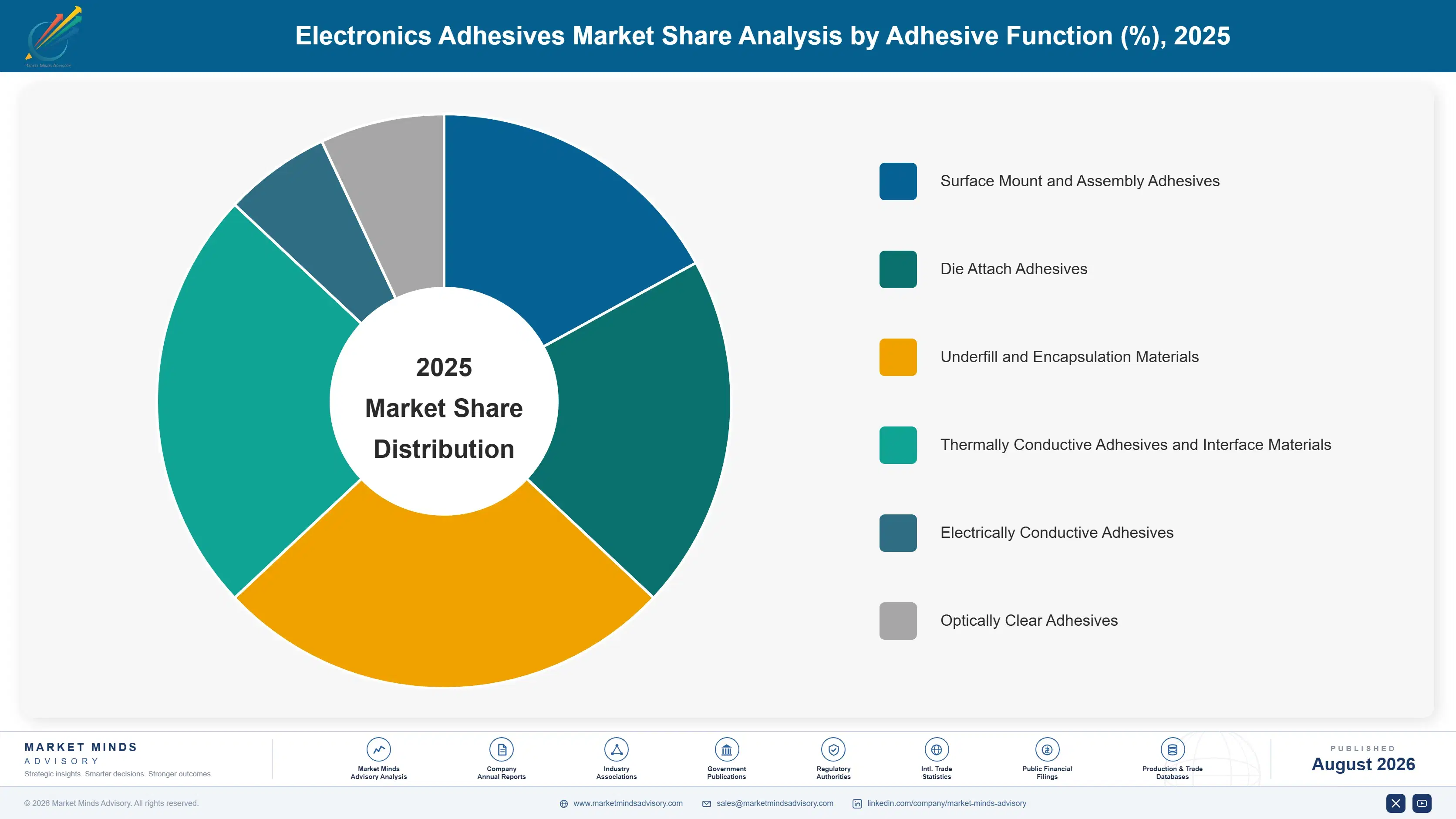
Segmentation follows adhesive function, because function determines the performance property that matters, the qualification burden involved, the dispensing process required, and the price the material commands. Six functional categories cover commercial supply, and they are used together within one device rather than competing, which means share shifts happen through device design changes rather than substitution.
electronics-adhesives-market-trends-market-share-analysis-1787549421405

Thermally Conductive Adhesives and Interface Materials

The fastest-growing category at 13.8%, roughly 1.68 times the market, and the one where the adhesive has become a thermal component rather than a fastening. Power densities in processors, vehicle inverters, and industrial drives have risen to the point where heat removal governs device life, and the bond line is frequently the narrowest constriction in that path. Requirements around eight watts per metre kelvin are routine where two once sufficed, achieved through heavy ceramic or metallic filler loading that makes dispensing considerably harder. Wide bandgap devices push requirements further still. Suppliers combining thermal formulation with dispensing process knowledge hold positions that chemistry capability alone cannot reach. Filler loading above seventy percent makes dispensing the practical constraint.
CAGR 13.8%

Underfill and Encapsulation Materials

Second fastest at 11.2%, and growing directly with advanced packaging complexity rather than with device volumes. Thermal expansion mismatch between silicon and substrate cracks fine-pitch interconnects over a normal product life unless underfill distributes the stress, and the requirement tightens as pitch falls and dies thin. Capillary flow behaviour at gaps measured in tens of microns, complete void freedom, and low cure stress all matter more than bulk adhesive strength, which excludes most general formulators from competing at all. Chiplet and fan-out architectures multiply the interfaces requiring it, making this demand a direct function of packaging sophistication rather than unit output. Requalification reopens whenever packaging geometry tightens beyond what an approved material can achieve without voiding.
CAGR 11.2%
Full segment breakdown across 6 segments available in the complete report.

Regional Architecture and Country Demand Map

Regional shares follow semiconductor packaging and electronics assembly location rather than device consumption. Automotive electronics production adds a second demand pattern that concentrates differently, and qualification decisions frequently originate where devices are designed rather than built. Design authority and manufacturing location are frequently in different regions entirely.

North America

Semiconductor design and advanced packaging development concentrate here even where volume manufacturing happens elsewhere, which means qualification decisions are frequently made in this region for materials consumed across the Pacific. Federal incentive programmes have funded fabrication and packaging capacity now coming into operation, which adds genuine domestic consumption alongside the specification authority. Automotive electronics manufacturing across the southern states consumes thermal and structural adhesives at volumes electrification keeps raising. Defence and aerospace electronics specify to demanding reliability standards and qualify very slowly. Henkel, Dow, and Parker LORD all hold substantial regional positions. Growth of 8.8% blends specification influence with genuine new packaging capacity coming online. Specification authority exceeds actual consumption here.
Share: 24% | CAGR: 8.8% (2026 to 2036)

Western Europe

Automotive electronics dominates regional consumption, and vehicle electrification has raised adhesive content per vehicle into kilograms where it was previously measured in grams. German, French, and Italian tier one suppliers qualify materials for platform lifetimes and hold them, which makes each position durable and each contest infrequent. Industrial power electronics adds further demand as drives and converters adopt wide bandgap devices. Semiconductor packaging capacity is limited relative to design activity. Repairability regulation originated here and is driving debondable adhesive development from European device makers first. Growth of 6.5% is the slowest in the report, constrained by falling vehicle production despite rising content per unit. Repairability development originates in this region. Platform positions hold for many years.
Share: 19% | CAGR: 6.5% (2026 to 2036)
Regional intelligence for 5 additional markets available in the complete report: East Asia, South Asia and Pacific, Latin America, Middle East and Africa, Eastern Europe. Contact sales@marketmindsadvisory.com.
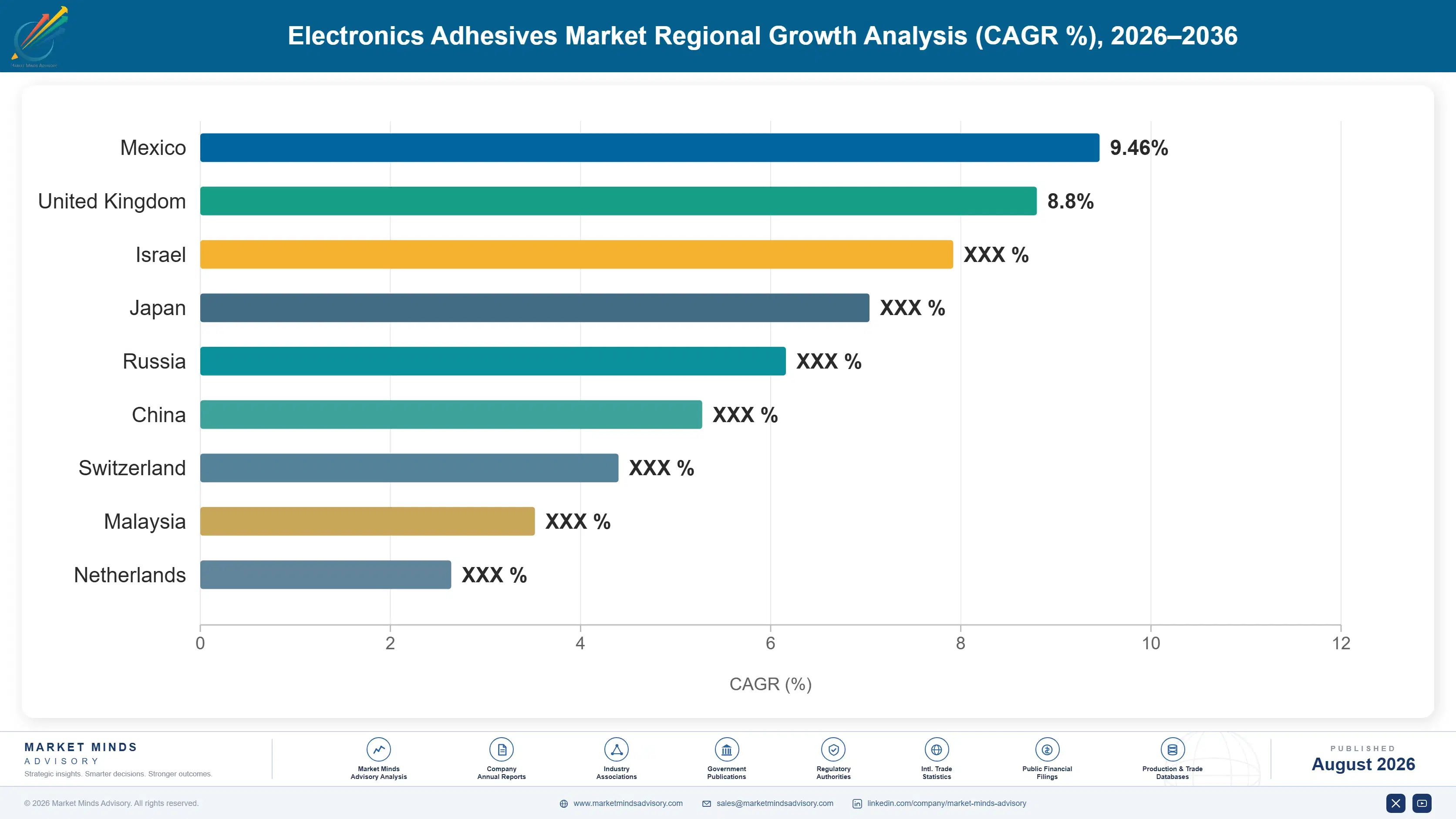
electronics-adhesives-market-trends-country-cagr-analysis-1787549421911

Four Moves That Change the Economics

Advantage here comes from qualification position, dispensing process knowledge, and design stage access rather than from formulation alone, which competent chemists replicate given time. Four moves are worth capital and management attention across the forecast period, and the first addresses the barrier that defines the whole market structure. Two of them require capability most formulators have never built.

Engage at device design stage before incumbents exist

Qualification takes sixteen months of reliability testing, which makes displacing an approved material almost impossible on performance or price once a device is in production. The only cheap entry is at design stage, when no incumbent exists and the engineer is choosing rather than replacing. Design stage engagement costs applications engineering time rather than capital, and it converts at 5 to 8 times the rate of attempting to displace a qualified material later. Suppliers organised around existing accounts consistently arrive after the selection has already been made. Most suppliers are organised entirely around the wrong moment.
Market Impact: Converts 5 to 8 times better than displacement

Sell dispensing process capability with the material

A material with excellent bulk properties that will not jet reliably or draws strings between dispense points is commercially useless whatever its datasheet says, and thermal materials loaded above 70% by weight are the hardest to dispense. Suppliers providing dispensing development, equipment partnership, and line qualification support win materials that better-performing formulations lose. That capability also protects the position afterwards, since a line tuned around one material's rheology resists change. Applications engineering rather than chemistry investment is what this requires. Line tuning around one rheology resists change afterwards. Applications engineering rather than chemistry is the requirement.
Market Impact: Fillers exceed 70% of the material by weight

Build sintered and high-temperature die attach capability

Wide bandgap devices operate at junction temperatures conventional epoxy and standard solder cannot survive across a design life, and sintered silver handles it at 4 to 7 times conventional pricing. Vehicle electrification and industrial drives are adopting these devices steadily, and the materials carry content value per device far above anything they replace. The process requires pressure, temperature control, and equipment knowledge as much as material capability. Suppliers building both together are positioned in the fastest-growing high-value application in this entire market. Both halves must be built together to succeed.
Market Impact: Commands 4 to 7 times conventional epoxy pricing

Develop debondable systems for repairability compliance

Regulation requiring replaceable portable device batteries and broader repair provisions has created demand for adhesives that hold for years and then release cleanly on a trigger, covering above 25 device categories already. That is genuinely difficult chemistry working directly against thermal and structural requirements, which is exactly why the field is narrow. Device makers are redesigning assembly processes around these materials rather than substituting them casually. Suppliers who developed them early supply a category that did not commercially exist three years ago and faces very little competition. Early positions in it are unusually durable.
Market Impact: Covers above 25 regulated consumer device categories already

Who Controls the Margin Pool

Concentration is high at roughly 47% for the top five, and qualification lock-in rather than manufacturing scale explains most of it. Henkel leads on breadth across assembly, thermal, and semiconductor applications with applications laboratories in every major manufacturing region. HB Fuller and Dow compete across overlapping ranges from different chemistry bases, while Shin-Etsu brings silicone depth and Parker LORD holds strong positions in thermal and structural electronics bonding.
Competitive activity runs on three fronts. Design stage access is the first, because a material chosen during device development becomes an incumbent nobody displaces afterwards. Dispensing and applications capability is the second, and it decides whether a chemically superior material ever reaches production. Thermal performance is the third, and it is where the highest-value demand is concentrating fastest. Formulation quality alone decides almost nothing.

Pressure is building from two directions. Japanese and Korean specialists with deep semiconductor materials capability are strong in exactly the packaging applications growing fastest. And sintering process specialists are entering die attach from an equipment rather than a chemistry background entirely. Both pressures reach the highest-value applications first, which is uncomfortable for broad-line suppliers whose strength lies in coverage rather than in depth.
electronics-adhesives-market-trends-company-positioning-matrix-1787549422432

Competitive Moat and Risk Dimensions

HENKEL

Moat: Applications laboratories in every region

Applications engineering capability positioned close to device manufacturers in every major region lets Henkel engage at design stage where materials are actually selected, and support dispensing qualification where chemically capable competitors fail. That presence converts formulation breadth into qualified positions, which is the only currency that matters in a market defined by sixteen month approval cycles.
HENKEL

Risk: Specialist depth in semiconductor packaging

Advanced packaging materials demand purity, flow behaviour at very fine gaps, and reliability characteristics where Japanese specialists hold genuinely deep positions built over decades. Those are the fastest-growing and highest-value applications, and breadth across many categories does not substitute for the accumulated materials science that packaging customers evaluate.
SHIN-ETSU CHEMICAL

Moat: Silicone chemistry and semiconductor depth

Integrated silicone production combined with decades of semiconductor materials experience gives Shin-Etsu both cost position and technical credibility in thermal interface and encapsulation applications where purity and reliability determine selection. Semiconductor customers evaluating a material for a decade of production weigh that accumulated record heavily against any newer alternative.
SHIN-ETSU CHEMICAL

Risk: Limited breadth outside silicone

Epoxy-based die attach, sintered metal systems, and debondable chemistries all sit outside a silicone-centred capability, and several of them are exactly where growth is concentrating. Customers increasingly want a supplier covering the whole assembly rather than one excellent category, which favours broader competitors in consolidating supplier lists.

Players Tracked

Prominent Players

Henkel
HB Fuller
Dow
Shin-Etsu Chemical
Parker LORD

Other Key Players

3M
DuPont
Panacol-Elosol
Master Bond
Epoxy Technology
Nagase ChemteX
Resonac Holdings
Kyocera
Sumitomo Bakelite
ThreeBond
DELO Industrial Adhesives
Arkema
Sika
Momentive Performance Materials
Indium Corporation

Recent Developments

FEBRUARY 2025

Supplier launches sintered silver die attach system

A pressure-assisted sintered silver die attach material and process package was introduced for wide bandgap power devices operating beyond conventional epoxy temperature limits. The offer combined material, process parameters, and equipment partnership rather than supplying the paste against a specification alone. Equipment partnership was central to the offer.
Signal: Process capability is now being sold alongside the material, because sintering simply fails without both together
JUNE 2025

Device maker adopts debondable battery adhesive

A consumer electronics manufacturer moved to a heat-triggered debondable adhesive for battery attachment, meeting replaceability requirements while retaining bond strength through normal device life. Assembly and repair processes were redesigned around the material rather than the material fitted to existing processes. Bond strength held through normal service.
Signal: Repairability compliance is now redesigning whole assembly processes rather than merely substituting one adhesive for another
SEPTEMBER 2025

Underfill requirements tighten at finer package pitch

Advanced packaging designs at reduced interconnect pitch pushed capillary underfill flow requirements beyond what several qualified materials could achieve without voiding. Packaging houses began requalification programmes with suppliers able to demonstrate void-free flow at the tighter geometries involved. Several qualified materials failed the tighter requirement.
Signal: Packaging geometry keeps outrunning material capability, which reopens qualifications that had previously appeared to be permanently settled

What Sets the Cost Base

Base resins dominate at roughly 42% of formulation cost, split between silicone and epoxy systems that track quite different feedstock markets. Functional fillers contribute 26% and rise sharply for thermal materials, where ceramic and metallic loadings exceed seventy percent by weight and silver-based systems cost far more again. Curing agents, adhesion promoters, and rheology modifiers take 11%. Purity control, packaging under controlled conditions, and cold chain absorb the balance.
Silicone and epoxy feedstocks both moved sharply through 2021 and 2022 as siloxane capacity tightened and epichlorohydrin supply was disrupted, while silver pricing rose through 2024 and affected sintered and conductive systems specifically. Henkel and Dow both referenced raw material cost inflation and pricing actions across their reporting for those years. Customers on annual contracts absorbed increases slowly, and semiconductor grade materials repriced more readily than commodity assembly adhesives did.

Exposure divides on filler chemistry and resin integration rather than on scale. Silver-loaded systems carry precious metal exposure that moves independently of everything else in the portfolio, while ceramic-filled thermal materials track alumina and boron nitride markets instead. Resin-integrated suppliers hold cost positions that formulators buying base polymers cannot match, particularly in silicone where the producer base is narrow.
electronics-adhesives-market-trends-cost-volatility-analysis-1787549422629

Qualify alternative thermal fillers alongside primary sources

Boron nitride, alumina, and aluminium nitride behave differently in thermal performance and rheology, and each has a distinct supplier base with its own constraints. Qualifying alternatives within a formulation platform preserves flexibility when one tightens. The work requires reformulation and customer requalification where properties shift materially, which is why it must be done before a shortage rather than during one.

Index silver-loaded product pricing to metal benchmarks

Sintered and electrically conductive systems carry silver content whose price moves independently of every other input and can shift materially inside a quarter. Indexing those specific products to published metal benchmarks separates precious metal exposure from formulation margin. Customers accept metal indexation far more readily than general price increases, since the mechanism is transparent and verifiable against a public reference.

Design formulations around lower filler loading

Thermal performance conventionally comes from filler loading above seventy percent by weight, which raises cost, complicates dispensing, and stresses the resin matrix. Filler morphology optimisation, particle size distribution, and surface treatment can deliver comparable conductivity at lower loading. Development effort is substantial and the payoff appears in both material cost and dispensing reliability, which customers value separately.

Portfolio Architecture for Margin Defence

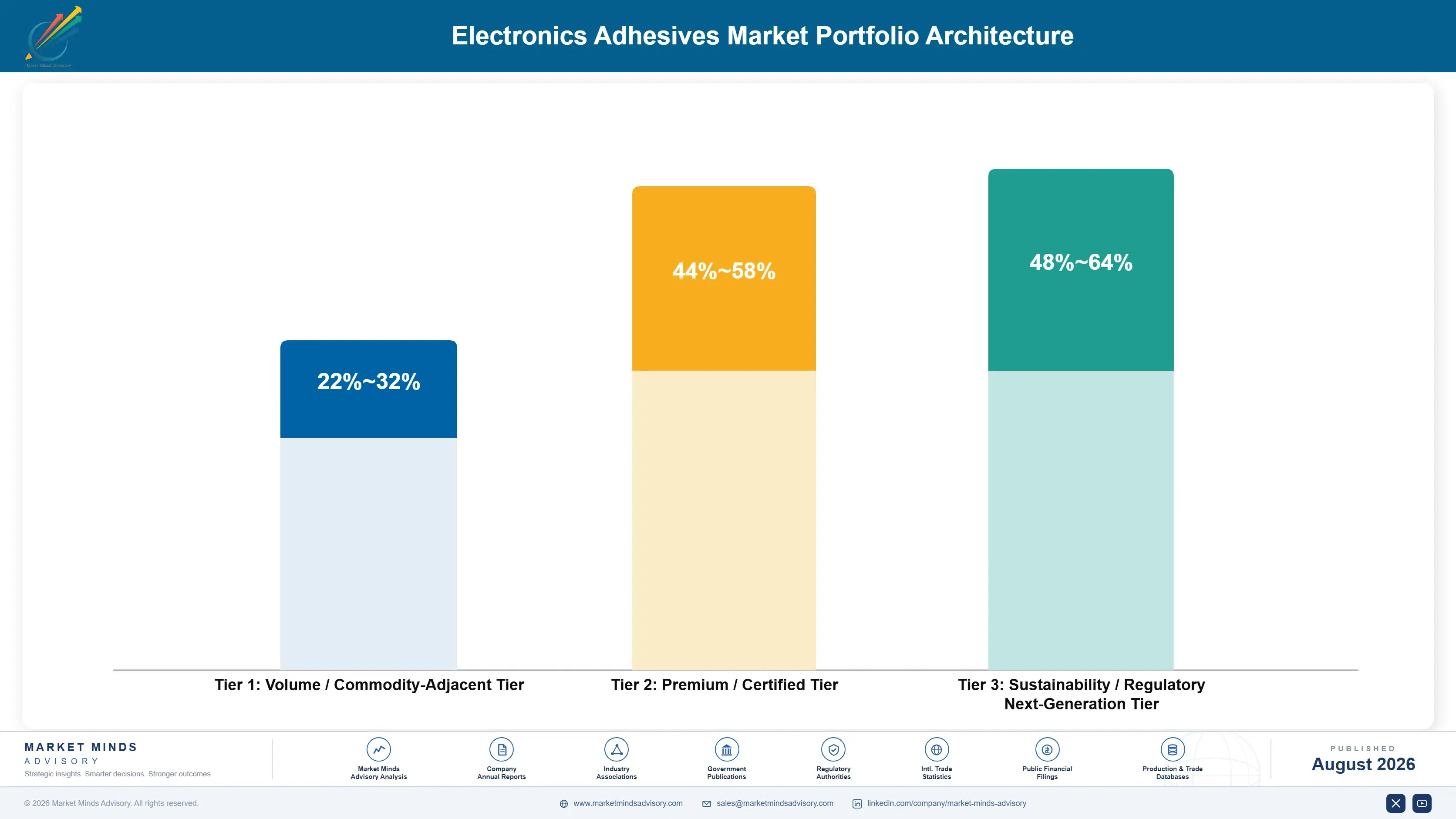
Margin follows qualification depth and performance demand rather than volume. General assembly adhesives sold into circuit board manufacture earn moderate returns, because several suppliers meet the specification and purchasing compares price per kilogram directly. Semiconductor grade underfill, sintered die attach, and high-conductivity thermal materials earn several times that, since qualification takes sixteen months and few suppliers can pass it at the tightest specifications.
The volume and premium tension shows in applications engineering capacity rather than in plant loading. Applications engineers are the scarce resource, and supporting a general assembly account consumes the same specialist who could be qualifying a semiconductor material worth many times more per kilogram. Allocating that resource by account value rather than by whoever asks first is the single most consequential operational decision these businesses make.

High-value pools concentrate in three places: sintered die attach for wide bandgap devices, advanced packaging underfill at fine pitch, and debondable systems meeting repairability requirements. Each is defended by qualification, process capability, or chemistry difficulty rather than by price. Price competition arrives in each only when a competitor completes qualification, builds process capability, or solves the debonding contradiction, and none of those is a quarterly matter.

Volume / Commodity-Adjacent Tier

General surface mount and assembly adhesives supplied into circuit board manufacture on price and delivery. Competes against many qualified alternatives. The range reflects large differences in resin sourcing and regional formulation cost.
Gross Margin: 22%-32%

Premium / Certified Tier

Semiconductor grade underfill, die attach, and thermal materials qualified into device production over sixteen months. The customer purchases reliability across a decade of field life, and requalification costs far more than any price difference.
Gross Margin: 44%-58%

Sustainability / Regulatory / Next-Generation Tier

Sintered metal die attach for wide bandgap devices and debondable systems meeting repairability rules. Technical scarcity and regulation drive the premium together. The range is wide because sintering and debonding pricing have not settled.
Gross Margin: 48%-64%
electronics-adhesives-market-trends-portfolio-architecture-1787549423134

High-value Sub-segments and Strategic Watch-out

Sintered Die Attach for Wide Bandgap

Junction temperatures beyond conventional epoxy and solder limits leave sintered silver as the practical answer at four to seven times the price. Process capability matters as much as material. Vehicle electrification drives the volume behind it. Build the process capability alongside the material. Move now.
Gross Margin: 50%-64%

Advanced Packaging Underfill

Capillary flow at gaps measured in tens of microns with complete void freedom excludes most formulators from competing at all. Requirements tighten as pitch falls, which reopens qualifications that had looked permanently settled. Flow behaviour rather than adhesion decides selection. Test on real lines. Test early.
Gross Margin: 46%-60%

Debondable Repairability Systems

Regulation created a category that did not commercially exist three years ago, and the chemistry works directly against thermal and structural requirements. Device makers redesign assembly around these materials. Competition remains genuinely thin. Early entrants face very little competition here. Enter deliberately and early. Move fast.
Gross Margin: 48%-62%

General Assembly Adhesive Supply

The strategic watch-out. Several qualified alternatives, purchasing comparing price per kilogram, and applications engineers consumed supporting accounts that will never justify their time. It holds relationships and plant loading only. Do not staff it with applications engineers. Resource it minimally instead. Price for loading only.
Gross Margin: 22%-31%

How Demand Actually Reaches Suppliers

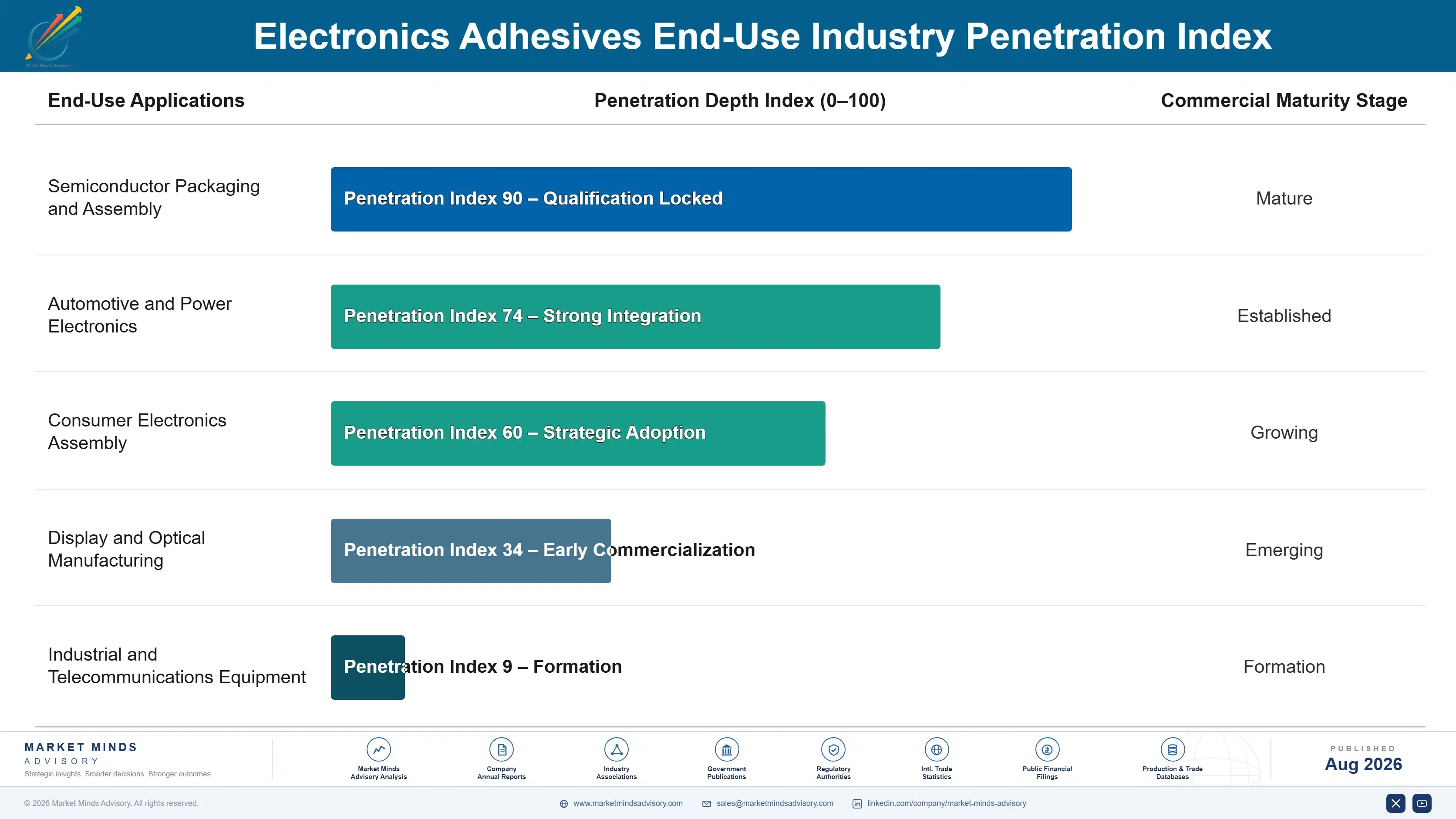
The annuity here comes from qualification rather than from any replacement cycle. A material approved into a device production process stays there for the product's manufacturing life, which runs years and sometimes a decade in automotive and industrial applications, because requalification costs far more than any price difference could recover. That makes each position durable and each contest infrequent, and it explains why design stage engagement matters more than anything a sales organisation does afterwards.
Adoption depth varies sharply by customer type. Semiconductor packaging houses qualify most rigorously and hold longest, since a bond failure appears as a field return years later. Automotive tier one suppliers qualify for platform lifetimes measured in years. Consumer electronics assemblers move faster and weigh cost more heavily. Contract manufacturers qualify to their customers' specifications rather than forming their own view.

The buyer has shifted toward device and package design engineering rather than materials purchasing. Those engineers select during development and purchasing merely executes afterwards. A supplier whose relationships end at the purchasing department will discover a material decision only after it has been made, and by then sixteen months of qualification stand between them and any chance of revisiting it.
electronics-adhesives-market-trends-end-use-penetration-index-1787549423624

Where the Money Sits

These are among the four positions where our research anticipates prominent divergence between winners and laggards over the coming forecast period. Each is grounded in the demand model, the regulatory perimeter, and the announced capacity pipeline.
01 / DESIGN STAGE ENGAGEMENT

Reach the engineer before an incumbent exists at all

Qualification takes sixteen months of thermal cycling and reliability testing, which makes displacing an approved material on performance or price effectively impossible once a device reaches production. The only affordable entry point is during device development, when the engineer is selecting rather than replacing and no incumbent has to be dislodged. Design stage engagement costs applications engineering time rather than capital and converts at 5 to 8 times the rate of later displacement attempts, which most suppliers still organise themselves to pursue.
02 / DISPENSING PROCESS CAPABILITY

Own the application, because rheology defeats good chemistry

Heavily filled thermal materials exceed seventy percent filler by weight and behave badly on production equipment, and a material that will not jet reliably or draws strings between dispense points is worthless whatever its datasheet claims. Suppliers providing dispensing development, equipment partnership, and line qualification win materials that chemically superior formulations lose outright. The capability also defends the position afterwards, since a line tuned around one material's rheology resists change far more firmly than any supply contract could ever manage to.
03 / SINTERED ATTACH INVESTMENT

Build sintering capability where the value is concentrating

Wide bandgap devices operate at junction temperatures conventional epoxy and standard solder cannot survive across a design life, and sintered silver handles it at four to seven times conventional pricing. Vehicle electrification and industrial drives are adopting those devices steadily, which places this squarely in the fastest-growing high-value application found anywhere in the market. Success requires pressure and thermal process knowledge alongside material capability, and suppliers who build only one half of that consistently lose out to competitors building both together.
04 / DEBONDABLE CHEMISTRY DEVELOPMENT

Solve the contradiction, because regulation will not withdraw it

Rules requiring replaceable portable device batteries and broader repair provisions demand adhesives that hold for years and release cleanly on a trigger, across above 25 device categories already covered. The chemistry works directly against the thermal and structural properties everything else in this market optimises for, which is precisely why the competitive field is so thin. Device makers are redesigning assembly processes around these materials rather than substituting casually, which is what makes early positions in this category unusually durable once they have been established.

Engagement Snapshot From the Field

A live engagement with an industry participant carrying material or product regulatory and market exposure ahead of a defining policy shift, showing how our research translates into a defensible multi-year portfolio strategy.
MARKET MINDS ADVISORY · CLIENT ENGAGEMENT SUMMARY
Electronics Adhesives Producer Strategic Portfolio Review and Transition Roadmap 2026·Investment Scenario on Electronics Adhesives Exposure Evaluation 2025-26
CLIENT PROFILE
A European formulator of electronic assembly and thermal adhesives serving automotive tier one and industrial electronics customers, with revenue near EUR 96 million (client-reported, unverified by MMA). Applications engineering was centralised at one site, no sintered die attach capability existed, and the business had never engaged a customer before a specification was issued. Content per vehicle was rising quickly.
STRATEGIC CHALLENGE
Vehicle electrification was raising adhesive content per vehicle substantially while the client kept losing those positions to competitors engaged during platform development. Wide bandgap inverter programmes were specifying sintered die attach the business could not supply. Management needed to know where applications capability should sit and what to develop. Timing was the recurring problem.
MMA APPROACH
MMA analysed win rates against engagement timing, mapped applications engineering coverage against customer development locations, and assessed sintered die attach entry requirements including process and equipment partnership. Forty-seven expert interviews with tier one engineers, packaging specialists, and dispensing equipment suppliers established how materials are actually selected. Engagement timing explained everything.
KEY FINDINGS
  1. Every position won in four years had involved engagement before a specification was issued, and the client learned of most programmes only when a request for quotation arrived far too late.
  2. Applications engineering centralised at one site could not reach customer development teams across five countries, and competitors with distributed applications support won consistently.
  3. Sintered die attach content on wide bandgap inverter programmes was worth several times the conventional adhesive value on the same assemblies, and the client could not bid for any of it.
  4. Dispensing support during line qualification had decided three contests the client won on chemistry and then nearly lost on rheology, which management had recorded as product problems.
CLIENT PROFILE
A European formulator of electronic assembly and thermal adhesives serving automotive tier one and industrial electronics customers, with revenue near EUR 96 million (client-reported, unverified by MMA). Applications engineering was centralised at one site, no sintered die attach capability existed, and the business had never engaged a customer before a specification was issued. Content per vehicle was rising quickly.
STRATEGIC CHALLENGE
Vehicle electrification was raising adhesive content per vehicle substantially while the client kept losing those positions to competitors engaged during platform development. Wide bandgap inverter programmes were specifying sintered die attach the business could not supply. Management needed to know where applications capability should sit and what to develop. Timing was the recurring problem.
MMA APPROACH
MMA analysed win rates against engagement timing, mapped applications engineering coverage against customer development locations, and assessed sintered die attach entry requirements including process and equipment partnership. Forty-seven expert interviews with tier one engineers, packaging specialists, and dispensing equipment suppliers established how materials are actually selected. Engagement timing explained everything.
KEY FINDINGS
  1. Every position won in four years had involved engagement before a specification was issued, and the client learned of most programmes only when a request for quotation arrived far too late.
  2. Applications engineering centralised at one site could not reach customer development teams across five countries, and competitors with distributed applications support won consistently.
  3. Sintered die attach content on wide bandgap inverter programmes was worth several times the conventional adhesive value on the same assemblies, and the client could not bid for any of it.
  4. Dispensing support during line qualification had decided three contests the client won on chemistry and then nearly lost on rheology, which management had recorded as product problems.
RECOMMENDED STRATEGY
Phase 1: Phase one: distribute applications engineers to customer development locations rather than centralising them, since selection happens where devices are designed rather than built. Phase 2: Phase two: build sintered die attach capability with an equipment partner, since the process and material must be developed and sold together to succeed. Phase 3: Phase three: establish programme tracking to reach platform development teams before specifications are issued rather than responding to quotation requests.
OUTCOME
The client distributed applications engineers across three additional countries within a year and partnered on sintering process capability. Design stage engagement rose sharply, win rate improved from 26% to 49% across two years, and blended gross margin improved 6.8 percentage points (client-reported, unverified by MMA).

Frequently Asked Questions

Foundational context covering the market sizes, CAGR, scope, country, region and competition that inform every finding below. This section is provided to cover basics and most often pre-purchase conversations, answered from the MMA Primary Research Dataset.

What is the current size of the Electronics Adhesives Market?

The market was valued at USD 8.4 billion in 2025, rising to an estimated USD 9.09 billion in 2026. East Asia holds the largest regional share at 30% of global value.

How large will the Electronics Adhesives Market be by 2036?

MMA forecasts USD 19.99 billion by 2036 under the base case, an expansion multiple of 2.20 times the 2026 value. That represents USD 10.90 billion of incremental value across the forecast period.

What is the CAGR for the Electronics Adhesives Market 2026 to 2036?

The base case CAGR is 8.2%, with a bull case of 9.4% and a bear case of 7.0%. The spread reflects uncertainty over wide bandgap adoption and advanced packaging investment.

Which segment is growing fastest?

Thermally conductive adhesives and interface materials grow fastest at 13.8%, roughly 1.68 times the market rate. Underfill and encapsulation materials follow at 11.2% on advanced packaging complexity.

Who are the major companies in the Electronics Adhesives Market?

Henkel, HB Fuller, Dow, Shin-Etsu Chemical, and Parker LORD lead on electronic adhesive supply. The top five hold roughly 47%, with qualification lock-in explaining most of that concentration.

Which country is growing fastest?

India grows fastest at 11.6%, driven by electronics manufacturing incentives pulling assembly and packaging operations into the country. New facilities qualify materials from scratch rather than inheriting incumbents.

Report Segmentation Architecture

The full report scope spans multiple orthogonal segmentation dimensions, with cross-tabulated demand data provided for each dimension pair. Coverage extends further to regional breakdowns, trend trajectories, and the competitive detail needed to support segment-level decision-making.

By Adhesive Function

  • Surface Mount and Assembly Adhesives
  • Die Attach Adhesives
  • Underfill and Encapsulation Materials
  • Thermally Conductive Adhesives and Interface Materials
  • Electrically Conductive Adhesives
  • Optically Clear Adhesives

By End-Use Industry

  • Semiconductor Packaging and Assembly
  • Automotive and Power Electronics
  • Consumer Electronics Assembly
  • Display and Optical Manufacturing
  • Industrial and Telecommunications Equipment

By Sales Model

  • Design Stage Qualified Supply
  • Material and Dispensing Process Packages
  • Contract Manufacturer Specification Supply
  • Distributor and Technical Reseller Channel
  • Development Partnership Agreements

By Region

  • North America
  • Western Europe
  • East Asia
  • South Asia and Pacific
  • Latin America
  • Middle East and Africa
  • Eastern Europe

Scope, Methodology, and Coverage

Every figure in this report is reproducible from documented input assumptions. The scope below maps the historical period, the forecast horizon, the segmentation dimensions, and the countries covered, alongside the underlying primary and qualitative methodology.
Historical Period
2020 to 2025
Forecast Period
2026 to 2036
Base Year
2025 (USD billions; MMA Primary Research Dataset, August 2026)
Market Definition
The market comprises adhesives and bonding materials used in electronic device manufacture, covering surface mount and assembly adhesives, die attach adhesives, underfill and encapsulation materials, thermally conductive adhesives and interface materials, electrically conductive adhesives, and optically clear adhesives. Value is measured at supplier level across semiconductor packaging, automotive and power electronics, consumer electronics, display, and industrial equipment applications. Conformal coatings, solder pastes and fluxes, structural adhesives used outside electronics, dispensing and curing equipment, and printed circuit laminates fall outside scope.
Quantitative Units
USD billions (current prices); tonnes of adhesive supplied annually; USD per kilogram by function and grade
Segmentation Dimensions
By Adhesive Function; By End-Use Industry; By Sales Model; By Region
Regions Covered
North America, Western Europe, East Asia, South Asia and Pacific, Latin America, Middle East and Africa, Eastern Europe
Countries Covered
United States, Canada, Mexico, Germany, France, Italy, United Kingdom, Netherlands, Ireland, Czechia, Slovakia, Hungary, Poland, Romania, China, Japan, South Korea, Taiwan, India, Vietnam, Thailand, Malaysia, Singapore, Brazil, Israel, Turkey, Morocco, Saudi Arabia, South Africa
Key Companies Profiled
Henkel, HB Fuller, Dow, Shin-Etsu Chemical, Parker LORD, 3M, DuPont, Panacol-Elosol, Master Bond, Epoxy Technology, Nagase ChemteX, Resonac Holdings, Kyocera, Sumitomo Bakelite, ThreeBond, DELO Industrial Adhesives, Arkema, Sika, Momentive Performance Materials, Indium Corporation
Quantitative Methodology
Primary survey, n=3,800 respondents, Q4 2025, six countries; demand-side model with trade association cross-validation
Qualitative Methodology
47 expert interviews, Q4 2025; applied to validate demand model assumptions, identify emerging dynamics, and assess competitive positioning
Report Format
PDF and XLSX data workbook (Word format preview document)
Publisher
Market Minds Advisory
Report Code
MMA-2026-CHM-238
Published
August 2026
Contact
sales@marketmindsadvisory.com | www.marketmindsadvisory.com

Purchase the full Electronics Adhesives Market Report (2026 to 2036).

The full report sizes electronic adhesive demand across six functional categories, five end-use industries, and seven regions with 2026 to 2036 forecasts under base, bull, and bear cases. It models thermal performance requirements against wide bandgap device adoption, since that shift is redefining what these materials must achieve. Competitive profiles cover twenty suppliers assessed consistently on electronic adhesive revenue, qualification depth, and applications engineering reach. Cost analysis traces resin and functional filler exposure including precious metal content by product family. Commercial guidance addresses design stage engagement, dispensing capability, sintered attach investment, and debondable chemistry development.
Six adhesive functions sized separately by region
Thermal requirements mapped against wide bandgap device adoption
Advanced packaging underfill demand modelled by interconnect pitch
Repairability regulation traced across affected device categories
Qualification timelines quantified by application and customer type
Twenty suppliers assessed on applications engineering coverage

Built For The People Who Decide

From boardroom strategy to bench-side execution, this report is read cover-to-cover by leaders shaping the next decade of their industry, turning demand scenarios, market dynamics and valuation benchmarks into decisions.
CXOs/ Presidents/ VPs/ Managers
M&A and Corporate Development
Strategy Teams and R&D Heads
Procurement and Product Directors
Regulatory and Compliance Leaders
Investor Relations and Equity Analysts