Market Minds Advisory
Electronic Soap Dispenser Market

Electronic Soap Dispenser Market: Electronic Soap Dispenser Market: Refill Lock-In, Battery Service Cost and the Hygiene Argument That Never Held

Touchless dispensing was sold on infection control and delivers dose control instead, and battery replacement across a large estate frequently costs more within two years than the hardware itself did.

Lead Analyst

Published

September 2026

Make Smarter Decisions with Customized Research Insights

Request a free sample report and evaluate market opportunities, growth trends, and competitive dynamics relevant to your business needs.

2025 MARKET VALUE$1.6BMarket Size 2025
2036 FORECAST VALUE$3.8BBase Case , 2026 to 2036
CAGR 2026 TO 20368.4 %Bull 9.6% / Bear 7.2%
INCREMENTAL OPPORTUNITY$2.1BNet 10- year value creation
EXPANSION MULTIPLE2.24x2036 value over 2026 base
Strategic Levers
M&A Pipeline
Regional Outlook
Country Rankings
Competitive Intelligence
Segmental Deep-dive
Call-Us : 91 93563 13602

Executive Snapshot and Market Trajectory.

The hygiene argument was always weak and the cost argument was always strong. A touchless dispenser adds little to transmission control next to the handwash itself. It cuts soap use by roughly 31% per wash through dose control, and that is a procurement line rather than a health claim.
Powder and tablet reconstituting dispensers grow at 12.6%, half again the market rate of 8.4%, because shipping water across a continent has become difficult to defend on either cost or carbon grounds. Dual-output soap and sanitiser units follow at 10.2%. Liquid soap dispensers grow slowest at 6.8%, losing ground to foam formats that clog less often and use less product per actuation.
Refills carry the business and hardware is close to a placement cost. Roughly 71% of commercial units accept only proprietary cartridges, which is the same economics that razors and printers run on. The vulnerability sits underneath: battery replacement accounts for about 58% of commercial service calls, and that labour cost overtakes the hardware within two years. Almost nobody has quantified it across their own base. It is the largest unexamined liability in the category.
Market Definition
This market covers electronically actuated soap and hand hygiene dispensers using infrared, capacitive or ultrasonic sensing, spanning liquid, foam, spray, gel sanitiser, dual-output and powder or tablet reconstituting formats, across commercial washroom, healthcare, food service and consumer household applications. Sizing is at manufacturer wholesale value for dispensing hardware. Soap, sanitiser and refill consumables, manual pump dispensers, integrated tap-mounted systems sold as plumbing fixtures, and washroom fit-out services are excluded.
Base Year Value
$1.6B in 2025 (MMA Primary Research Dataset, September 2026)
Forecast Period
2026 to 2036, eleven discrete annual values
CAGR
8.4% base case. Bull 9.6%. Bear 7.2%.
Fastest Growth Segment
Powder And Tablet Reconstituting Dispensers: 12.6% CAGR
Fastest Growth Country
India: 11.6% CAGR
Fastest Growth Region
South Asia and Pacific: 10.4% CAGR
Largest Region
East Asia: 30% of 2025 global value
Market Leaders
Essity, Kimberly-Clark Professional, GOJO Industries, Bobrick Washroom Equipment, SC Johnson Professional. Source: MMA Primary Research Dataset, July 2026.
Primary Survey
n=3,800 procurement and R&D decision-makers, Q4 2025, six countries
Methodology
Demand-side build-up, cross-validated against public data, 47 expert interviews

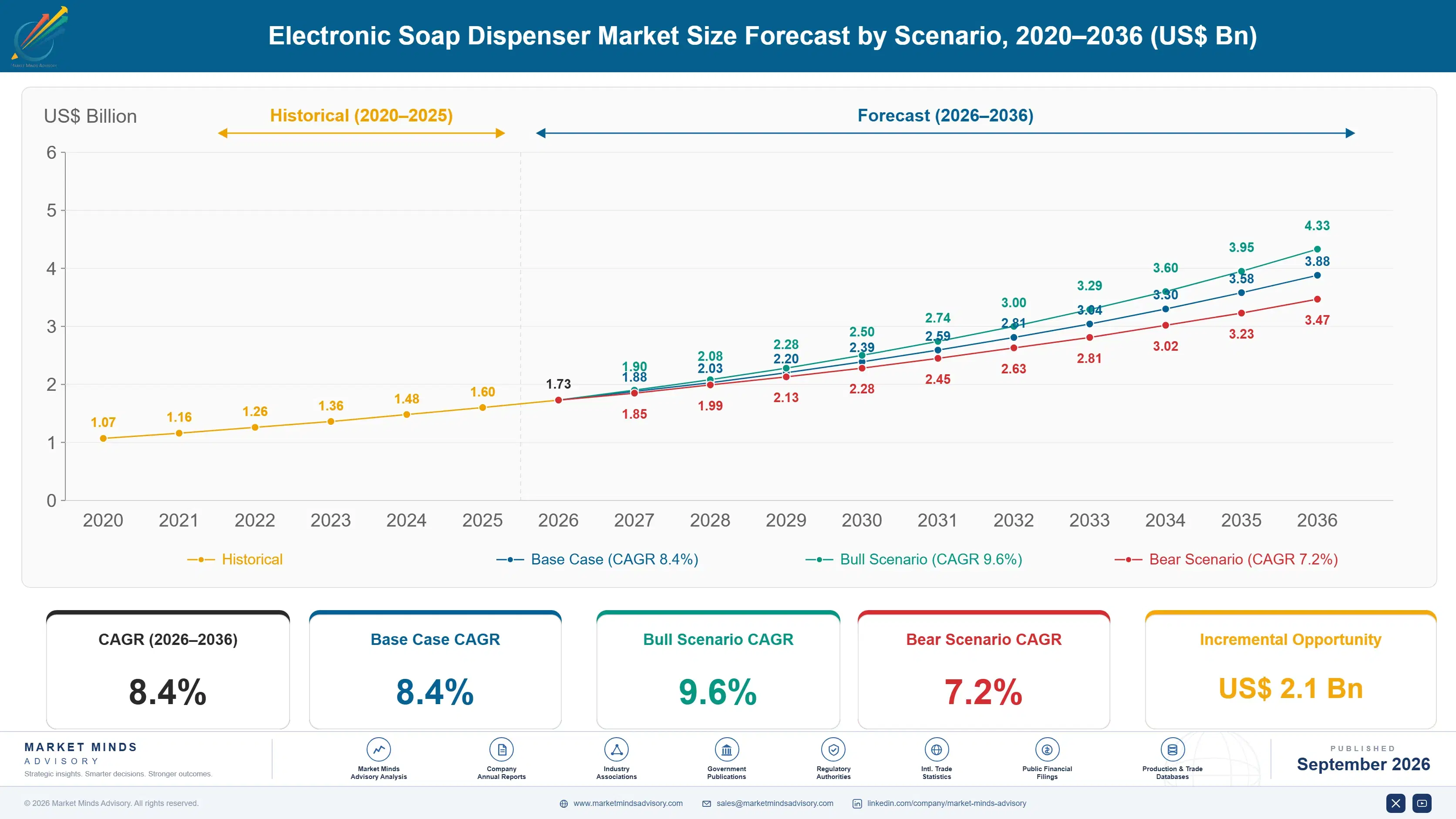
Electronic Soap Dispenser Market Forecast Scenarios

electronic-soap-dispenser-market-size-forecast-scenario-1790021340867
Growth of 7.3% between 2020 and 2025 came almost entirely from one eighteen-month period and then had to survive the correction. Pandemic installation across offices, transport hubs and retail pushed 2020 and 2021 volumes to levels the category had never approached, and 2022 and 2023 then fell as those buildings emptied and installed units simply sat unused. Recovery since has come from replacement and from consumer households.
Three mechanisms carry the base case. Concentrate and tablet formats grow at 12.6% because shipping diluted product is increasingly hard to justify against either freight cost or corporate carbon reporting. Consumer countertop adoption keeps expanding, and India grows at 11.6% as urban bathroom fit-out standards rise. Refill lock-in on roughly 71% of commercial units converts every placement into a consumables annuity that persists for the five year field life of the hardware.
The bull case is telemetry. If consumption reporting becomes a facilities management purchasing requirement, dispensers become monitored assets rather than fittings and pricing moves accordingly. The bear case is battery economics. Service labour on battery replacement already runs at about 58% of commercial calls, and any facilities group that costs it properly may revert to manual dispensers across large low-traffic estates.

Why Facilities Managers Actually Buy

The category was sold on infection control and it survives on consumables. A touchless dispenser adds very little to transmission control alongside the handwash itself, which is the intervention that does the work. What it delivers reliably is dose control: about 31% less soap per wash than a manual pump, which across a large estate is a procurement line item rather than a health claim.
TOP FIVE CONCENTRATION34%Combined unit share held by the five largest manufacturers
BATTERY SERVICE SHARE58%Commercial service calls attributable to battery replacement alone
AVERAGE UNIT PRICEUSD 38Weighted global wholesale price across commercial and consumer formats
SOAP SAVED PER WASH31%Product reduction from dose control against manual pump dispensers
PROPRIETARY REFILL SHARE71%Commercial units accepting only the manufacturer's own cartridges
FIELD LIFE EXPECTANCY5.2 yearsAverage service life before a commercial unit is replaced
Refill lock-in is the actual business model and it is not disguised. Roughly 71% of commercial units accept only proprietary cartridges, hardware is frequently placed at or below cost, and the margin sits in a consumables stream that runs for the 5.2 year field life of the unit. Facilities managers understand this arrangement and negotiate accordingly, which is why hardware pricing has almost no floor.
Batteries rather than sensors are what fail. Infrared modules are cheap and reliable, and 58% of commercial service calls are battery replacement. Across a large estate that labour cost overtakes the hardware within two years, and mains-wired or induction-charged units address it at an installation cost most buyers decline to pay. Across a large estate the labour line quietly decides whether the installation survives its second renewal.
"Every specification sheet in this category talks about sensor range and none of them talks about who changes four thousand batteries. That is the number that decides whether an estate stays touchless, and almost nobody puts it in front of the buyer."
Principal Analyst, Facilities and Hygiene Systems Practice · MMA Consumer and Industrial Goods Practice · September 2026

Market Trends

Concentrate Formats Remove Water From The Freight Bill

Shipping diluted soap across a continent has become difficult to defend on freight cost and impossible to defend in a corporate carbon report, and powder and tablet reconstituting dispensers resolve both at once. They grow at 12.6% against a category rate of 8.4%. The dispenser holds a water reservoir and doses concentrate into it, which adds mechanical complexity and a descaling requirement in hard water areas. Facilities groups with published emissions targets are specifying these ahead of cost parity, which is unusual in a category that normally decides on consumables price alone.
Market Impact: India grows 3.2 points faster
Consumption Telemetry Turns Dispensers Into Monitored Assets

Connected dispensers reporting fill level, actuation count and battery state let facilities teams route cleaning staff by need rather than by schedule, which is where the labour saving in washroom servicing actually sits. Manufacturers offering telemetry hold contract renewal rates several points above equivalent unconnected ranges. The reporting also entrenches refill lock-in further, since consumption data flows to the manufacturer rather than to the customer. Adoption remains concentrated in airports, stadiums and large office estates where servicing labour is a genuine budget line rather than a rounding error. Elsewhere the argument has not landed yet.
Market Impact: Cuts soap use by 31%

Market Opportunities and Growth Drivers

Indian Commercial Fit-Out Standards Raise Washroom Specification

Office, retail and hospitality construction across Indian metropolitan areas increasingly specifies touchless washroom fittings as standard rather than as an upgrade, following international tenant expectations in grade A commercial space. India grows at 11.6%, the fastest national market covered here, and the demand is new installation rather than replacement. Domestic manufacturers and Chinese imports hold most of the volume at price points international brands cannot approach. Consumer countertop adoption is following commercial exposure, which is the sequence the category has taken in every market it has entered. Open-fill units dominate there, so no refill annuity follows.
Market Impact: 58% of service calls

Dose Control Delivers A Measurable Consumables Saving

A manual pump delivers whatever the user decides to take, which is consistently more than a wash requires. Electronic dosing cuts soap consumption by roughly 31% per wash, and across a large estate that translates directly into a procurement line that finance can see. This is the argument that actually closes commercial sales, and it survives scrutiny in a way the infection control argument never did. Foam formats compound the effect further, since a foaming actuation uses less liquid product than an equivalent liquid dose delivers. Finance departments see the procurement line directly, which is why the argument closes.
Market Impact: Drives 19% of failures

Market Restraints and Challenges

Battery Replacement Labour Overtakes Hardware Cost Quickly

About 58% of commercial service calls are battery replacement, and the root cause is a design choice: alkaline cells were specified because they made the dispenser cheap to place and someone else pays for the labour later. Across a large estate that labour cost passes the hardware cost within roughly two years, and facilities groups costing it properly sometimes revert to manual units in low-traffic areas. Manufacturers are responding with mains-wired options, lithium cells with longer service intervals and battery state telemetry that at least makes replacement routes efficient. None of it addresses the underlying specification choice.
Market Impact: Grows 4.2 points above category

Viscosity Mismatch Produces Clogging And Poor Dispensing

Foam dispensers require soap formulated for foaming, and a great many are refilled with whatever liquid product a facilities team has in stock. The root cause is that proprietary cartridge systems train buyers to expect compatibility while open-fill units offer no guidance at all. Commercially it produces clogged pumps, service calls attributed to hardware failure and reputational damage that lands on the dispenser rather than the soap. Manufacturers are addressing it with viscosity-tolerant pump designs and clearer refill specification, though open-fill units remain the persistent problem. Roughly 19% of reported hardware failures trace to this rather than to components.
Market Impact: Lifts renewal rates 7 points
3 additional market trends, 4 additional growth drivers, and 2 additional restraints and challenges are covered in the full report. Contact sales@marketmindsadvisory.com to access the complete intelligence.

Segment CAGR and Growth Architecture

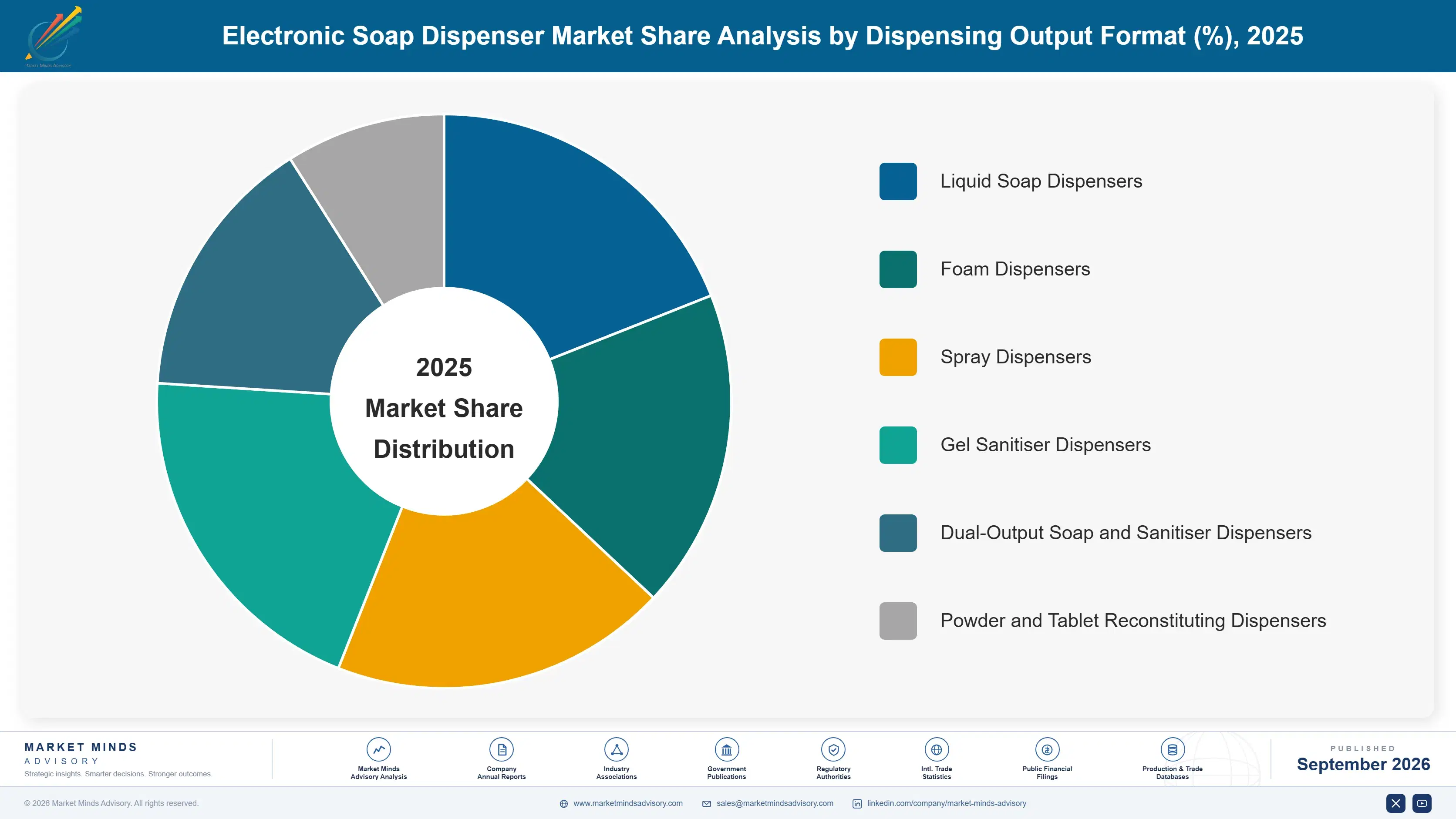
Segmentation follows dispensing output format, the dimension on which pump design, refill chemistry, cartridge compatibility and buyer specification all divide together. Six output formats are assessed at manufacturer wholesale value for hardware. Soap and sanitiser consumables, manual pump dispensers and tap-integrated plumbing fixtures sit outside the defined scope entirely. Refill consumables are discussed but not sized here.
electronic-soap-dispenser-market-market-share-analysis-1790021341404

Powder And Tablet Reconstituting Dispensers

Powder and tablet reconstituting units grow at 12.6%, half again the market rate of 8.4%, and freight economics rather than performance explain most of it. Shipping soap that is mostly water across a continent costs real money and appears awkwardly in any corporate emissions report, and a dispenser holding a water reservoir with concentrate dosed into it removes both problems. Mechanical complexity rises, since the unit now needs a reservoir, a dosing mechanism and descaling attention in hard water areas. Facilities groups with published emissions targets are specifying these ahead of cost parity, which is genuinely unusual in a category that otherwise decides on consumables price alone. Descaling is the operational detail nobody mentions.
CAGR 12.6%

Dual-Output Soap And Sanitiser Dispensers

Dual-output units delivering both soap and sanitiser from one housing grow at 10.2%, and healthcare and food service account for most of that demand. The clinical logic is straightforward: hand hygiene protocols in those settings require both, and a single wall position with one service visit is considerably cheaper to maintain than two units. Cartridge management becomes more complicated, since the two consumables deplete at different rates and a partially empty unit still needs a visit. Manufacturers holding both chemistries in their own range benefit most, because the format deepens refill lock-in rather than merely extending it across two products. Hand hygiene auditing tied to accreditation makes these placements unusually durable once made.
CAGR 10.2%
Full segment breakdown across 6 segments available in the complete report.

Regional Architecture and Country Demand Map

Regional shares measure dispenser hardware demand at wholesale value where units are installed rather than where they are manufactured, which matters because Chinese assembly supplies most of the category. All seven regions sit inside their standard bands. Open-fill and proprietary cartridge markets behave very differently.

East Asia

The 30% position reflects both installation demand and the fact that Chinese assembly supplies most of the category globally, which keeps domestic pricing well below anywhere else. Japanese public washroom fitting standards have specified touchless dispensing for years, and Korean commercial construction follows the same convention. Chinese consumer countertop adoption is running ahead of Western markets, with Xiaomi and Svavo selling capable sensor units at prices international brands cannot approach. Commercial refill lock-in is weaker here than elsewhere, since open-fill units dominate and buyers refill with whatever is available locally. Growth runs at 9.5%. The region contributes far more to unit volume than to consumables revenue. Domestic brands set the price expectation.
Share: 30% | CAGR: 9.5% (2026 to 2036)

North America

At 27% this is the highest-value region per unit and the one where refill lock-in operates most completely. Roughly three quarters of commercial units accept only proprietary cartridges, and Essity, Kimberly-Clark Professional and GOJO all place hardware at or below cost to secure the consumables stream that follows. Healthcare and food service specification is the deepest of any region, driven by hand hygiene auditing tied to accreditation. Consumer countertop demand grows through Simplehuman and similar premium positions. Growth of 7.6% reflects a market where replacement rather than new installation carries most volume. Battery service labour is beginning to enter facilities budgets explicitly here, and the accounts costing it are the ones renegotiating dispenser counts at renewal rather than at tender.
Share: 27% | CAGR: 7.6% (2026 to 2036)
Regional intelligence for 5 additional markets available in the complete report: Western Europe, South Asia and Pacific, Latin America, Middle East and Africa, Eastern Europe. Contact sales@marketmindsadvisory.com.
electronic-soap-dispenser-market-country-cagr-analysis-1790021341957

Four Ways To Defend Refills

These four address the two commercial facts that decide this market: hardware is a placement cost and refills are the business, while battery service labour quietly threatens the whole arrangement. Each has been executed by at least one participant already, three of the four work on the existing installed base, and none requires new tooling.

Cost Battery Labour Into The Customer Proposal

About 58% of commercial service calls are battery replacement, and almost no manufacturer puts that number in front of a buyer during specification. Presenting total cost of ownership including service labour, then offering mains-wired or long-interval lithium options against it, converts a hidden liability into a premium specification. Participants doing this report realised hardware pricing around 1.6 times the equivalent alkaline placement. The alternative is a facilities group discovering the labour cost independently and reverting to manual dispensers, which loses the refill annuity entirely. Facilities groups costing it independently reach the same conclusion less favourably.
Market Impact: Lifts hardware pricing to roughly 1.6 times higher

Build Viscosity Tolerant Pumps Into Open Fill Ranges

Foam dispensers refilled with non-foaming liquid soap clog, and open-fill units offer buyers no guidance at all about what belongs in them. Roughly 19% of reported hardware failures trace to viscosity mismatch rather than to any component fault. Pump designs tolerant across a wider viscosity range cost a few cents more and remove a failure mode that gets attributed to the dispenser rather than the soap. In markets where open-fill dominates, including most of East Asia and Latin America, this is the single clearest quality differentiator available. The failure gets logged against the dispenser rather than the soap every time.
Market Impact: Removes roughly 19% of all reported hardware failures

Sell Telemetry As Servicing Labour Reduction

Connected dispensers reporting fill level, actuation count and battery state let cleaning staff be routed by need rather than by fixed schedule, and washroom servicing labour is where the money actually is for a facilities group. Manufacturers positioning telemetry this way rather than as a technology feature hold contract renewal rates roughly 7 points above unconnected ranges. The data also flows to the manufacturer rather than the customer, which deepens refill lock-in. Airports, stadiums and large office estates are where the labour argument lands hardest. Positioning it as a technology feature has consistently failed to sell.
Market Impact: Raises contract renewal rates by roughly 7 points

Move Emissions Reporting Customers To Concentrate Formats

Shipping soap that is mostly water is difficult to defend in any corporate emissions report, and concentrate and tablet dispensers grow at 12.6% largely because of that. Facilities groups with published targets are specifying them ahead of cost parity, which is rare in a category that otherwise decides on consumables price. Manufacturers leading with the freight and carbon arithmetic rather than the product win specification earlier in the tender cycle. Hard water areas need a descaling protocol built into the service schedule, which is a solvable operational detail. Tender conversations opened this way begin earlier in the cycle.
Market Impact: Targets the fastest growing format, expanding at 12.6%

Who Controls the Margin Pool

Concentration is low at 34% held by the top five, measured consistently on unit shipments of electronic dispensing hardware rather than on revenue. The leader to challenger gap is wide in installed base and cartridge compatibility, where a placement made years ago still generates consumables revenue today, and narrow in the hardware itself, where Chinese manufacturers build to comparable quality at far lower cost.
Competition runs on three dimensions currently. Installed base decides refill revenue, and it was largely fixed by placement decisions made during and shortly after the pandemic. Facilities management relationships decide access to large estates, since the specification is rarely made building by building. Hardware price decides the open-fill and consumer segments, where no refill annuity exists to subsidise the unit and Chinese manufacturers hold most of the volume.

Pressure is building on the battery question and on concentrate formats, and both are where rankings will move. Participants whose installed base runs entirely on alkaline cells face facilities groups that are beginning to cost the service labour properly. Manufacturers without a concentrate or tablet range are absent from the fastest-growing format and from the tender conversations that emissions reporting now opens.
electronic-soap-dispenser-market-company-positioning-matrix-1790021342488

Competitive Moat and Risk Dimensions

ESSITY

Moat: Installed Base And Cartridge Lock

The Tork installed base across European and North American commercial estates generates proprietary refill revenue from placements made years earlier, and cartridge geometry means those accounts do not shop the consumables. Facilities management relationships at group level place hardware across whole estates rather than building by building, which compounds the position further.
ESSITY

Risk: Mature Regions Grow Slowest

Revenue weighting toward Western Europe and North America places the business in the two slowest-growing regions, where installed penetration is high and replacement rather than new placement drives volume. The growth is in Indian and Chinese commercial fit-out, where open-fill units dominate and the refill lock-in model does not operate at all.
KIMBERLY-CLARK PROFESSIONAL

Moat: Washroom System Specification Position

Selling dispensers alongside paper, wipers and washroom systems places the company inside a facilities specification conversation rather than a dispenser purchase. That breadth means a soap dispenser decision arrives attached to a much larger contract, which is difficult for a specialist competitor to contest on hardware merit alone.
KIMBERLY-CLARK PROFESSIONAL

Risk: Hardware Commoditisation From Asia

Chinese manufacturers build comparable sensor hardware at a fraction of the cost, and in open-fill markets no refill annuity exists to subsidise a premium unit. As Indian and Southeast Asian commercial fit-out carries more of the category growth, hardware merit competes directly on price in exactly the segments expanding fastest.

Players Tracked

Prominent Players

Essity
Kimberly-Clark Professional
GOJO Industries
Bobrick Washroom Equipment
SC Johnson Professional

Other Key Players

Simplehuman
Xiaomi
Sloan Valve Company
American Specialties
Bradley Corporation
TOTO
LIXIL
Delta Faucet
Moen
Diversey
Zenith Hygiene
Vectair Systems
Svavo
Rubbermaid Commercial Products
Ecolab

Recent Developments

JANUARY 2025

Essity introduces telemetry enabled Tork dispenser range

The company launched connected dispensers reporting fill level, actuation count and battery state to facilities management platforms. This was internal product development with no partnership, licensing arrangement or acquisition involved, and the range uses existing cartridge geometry throughout. Existing installed units cannot be retrofitted to report.
Signal: Servicing labour reduction is becoming the commercial argument rather than any hygiene or technology claim. Labour is the argument now.
AUGUST 2024

Kimberly-Clark Professional consolidates dispenser manufacturing footprint

The company concentrated washroom dispenser assembly into fewer facilities as part of a wider operational cost programme. This was an internal manufacturing decision taken on cost grounds, with no external capacity partner, joint venture or divestiture involved at any stage. Cartridge production remained at its existing sites.
Signal: Hardware cost pressure from Asian manufacturing is now reaching the largest incumbent participants directly. Asian cost structures now reach incumbents.
MAY 2025

SC Johnson Professional signs facilities management supply agreement

The company entered a multi-year supply agreement with a European facilities management group covering dispenser placement and refill supply across its managed estate. The arrangement is a commercial supply contract involving no equity stake or joint venture structure. Existing hardware across the estate will be replaced progressively.
Signal: Estate level specification through facilities groups continues to outweigh building by building purchasing decisions. Estates are specified once, centrally.

What The Dispenser Costs To Build

The infrared sensor module and microcontroller together account for roughly 29% of bill of materials, sourced from Chinese, Taiwanese and Japanese suppliers with a narrow set of alternatives at the required price point. The pump motor and dosing mechanism add about 22%, with reconstituting formats considerably higher because of the reservoir and dosing assembly. Injection-moulded housing, battery contacts and cartridge interface account for most of the remainder.
The 2021 and 2022 microcontroller shortage exposed how narrow the supply base is. Allocation moved decisively toward automotive and consumer electronics customers, and lead times on the low-cost controllers this category depends on extended past forty weeks while spot pricing rose several times over. Essity and Kimberly-Clark annual reports for those years both identify component availability and input cost inflation as material factors requiring repeated pricing action.

Exposure varies by scale and by sourcing position, which decides who can hold a tender price. Large participants buying controllers across multiple product categories command allocation that dispenser volumes alone never would. Chinese manufacturers using domestic controller designs avoided the shortage almost entirely. Smaller specialist manufacturers buying on spot lost tender commitments they had already priced.
electronic-soap-dispenser-market-cost-volatility-analysis-1790021342684

Qualify a second microcontroller family before allocation tightens

The low-cost controllers this category depends on come from a narrow supplier base, and requalification requires firmware work and a compliance retest. Doing it ahead of shortage costs a development cycle and preserves the ability to quote a tender price with confidence. Most manufacturers begin only after they have already missed a committed delivery.

Specify lithium cells or mains wiring on high traffic placements

Battery replacement drives 58% of commercial service calls, and the labour lands on the customer rather than the manufacturer, which is why alkaline cells persist. Specifying longer-interval chemistry on high-traffic placements costs a little more per unit and materially protects the refill annuity that the whole business depends on. Low-traffic placements can stay on alkaline cells.

Design one pump platform across liquid foam and spray formats

Manufacturers frequently run separate pump designs across output formats for historical reasons that no longer hold, which multiplies tooling, spare parts and qualification cost. A single viscosity-tolerant platform across formats reduces all three and removes the clogging failure mode simultaneously. The engineering review is short and the purchasing benefit persists across the platform life.

Portfolio Architecture for Margin Defence

Margin architecture here separates hardware from consumables so completely that treating them together produces misleading conclusions. Open-fill and consumer dispensers sold on hardware merit alone run at gross margins in the high teens to low twenties, and Chinese manufacturers compete there at cost structures that Western platforms cannot match at any volume. Consumer countertop units behave the same way, since a retail buyer has no cartridge commitment attached.
Proprietary cartridge commercial hardware holds gross margins in the low to high thirties, and the spread reflects whether the placement carries an estate-level facilities contract behind it. A unit placed through a facilities management group across hundreds of buildings supports pricing that a single-site sale never obtains, because the specification decision was made once and applies everywhere.

The genuinely high-value pool sits in the refill consumables and telemetry services that hardware exists to place, at margins in the high fifties to mid sixties. Roughly 71% of commercial units accept only proprietary cartridges, and the annuity runs for the 5.2 year field life of the unit. Hardware margin is almost beside the point. Placement is the objective. Every decision here should be judged against how many cartridge positions it creates.

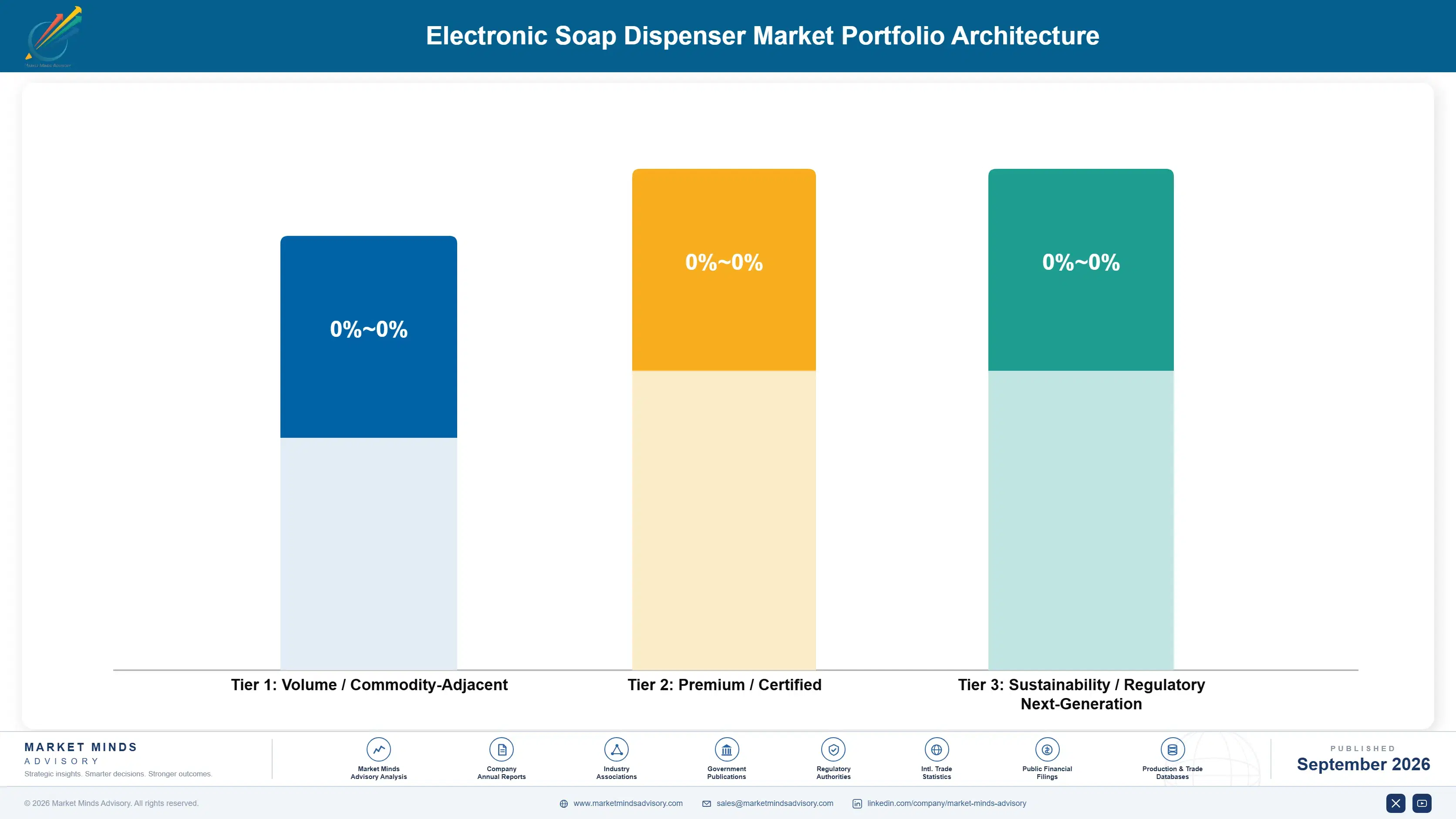
Volume / Commodity-Adjacent

Open-fill commercial units and consumer countertop dispensers sold on hardware merit alone. Chinese manufacturers build comparable sensor hardware at far lower cost, and no refill annuity exists to subsidise a premium position here.
Gross Margin: 16 to 22%

Premium / Certified

Proprietary cartridge commercial dispensers placed through washroom specification. The eight-point range reflects whether an estate-level facilities contract sits behind the placement, since a single-site sale never obtains comparable pricing. The decision is made once and applies everywhere.
Gross Margin: 30 to 38%

Sustainability / Regulatory / Next-Generation

Refill consumables and telemetry service subscriptions that hardware placement exists to secure. The eight-point range reflects cartridge chemistry and telemetry attach, both of which vary substantially by region and by customer type.
Gross Margin: 58 to 66%
electronic-soap-dispenser-market-portfolio-architecture-1790021343187

High-value Sub-segments and Strategic Watch-out

Proprietary Refill Consumables Streams

High value and high growth. Roughly 71% of commercial units accept only the manufacturer's own cartridges, and the annuity runs for the 5.2 year field life of the hardware. Placement rather than hardware margin is the objective throughout. Switching means remounting hardware across an entire estate.
Gross Margin: 60 to 66%

Concentrate And Tablet Dispensers

High value and moderate growth at 12.6%. Freight and corporate emissions reporting drive specification ahead of cost parity, which is rare here. Hard water areas need a descaling protocol built into the service schedule from the start. Very few participants currently offer a range at all.
Gross Margin: 34 to 40%

Open-Fill Commercial Dispensers

Volume core in East Asia and Latin America, where import duties and local soap supply make proprietary cartridges commercially unattractive. No refill annuity exists, so hardware competes directly on price against Chinese manufacturers. Volume here contributes far more to unit share than it does to profit.
Gross Margin: 16 to 21%

Alkaline Battery Installed Base

Strategic watch-out. Battery replacement drives 58% of commercial service calls, and any facilities group costing that labour properly may revert to manual units. The whole refill annuity sits on top of that unexamined liability. Almost nobody has quantified that exposure across their own installed base.
Gross Margin: 28 to 36%

How Placements Turn Into Revenue

The annuity here is hardware-anchored and cartridge-locked, which makes it unusually durable once established. A dispenser mounted on a washroom wall generates proprietary refill revenue for its full 5.2 year field life, and roughly 71% of commercial units accept nothing else. Switching means removing hardware across an estate and remounting, which facilities teams avoid unless something else has gone wrong first.
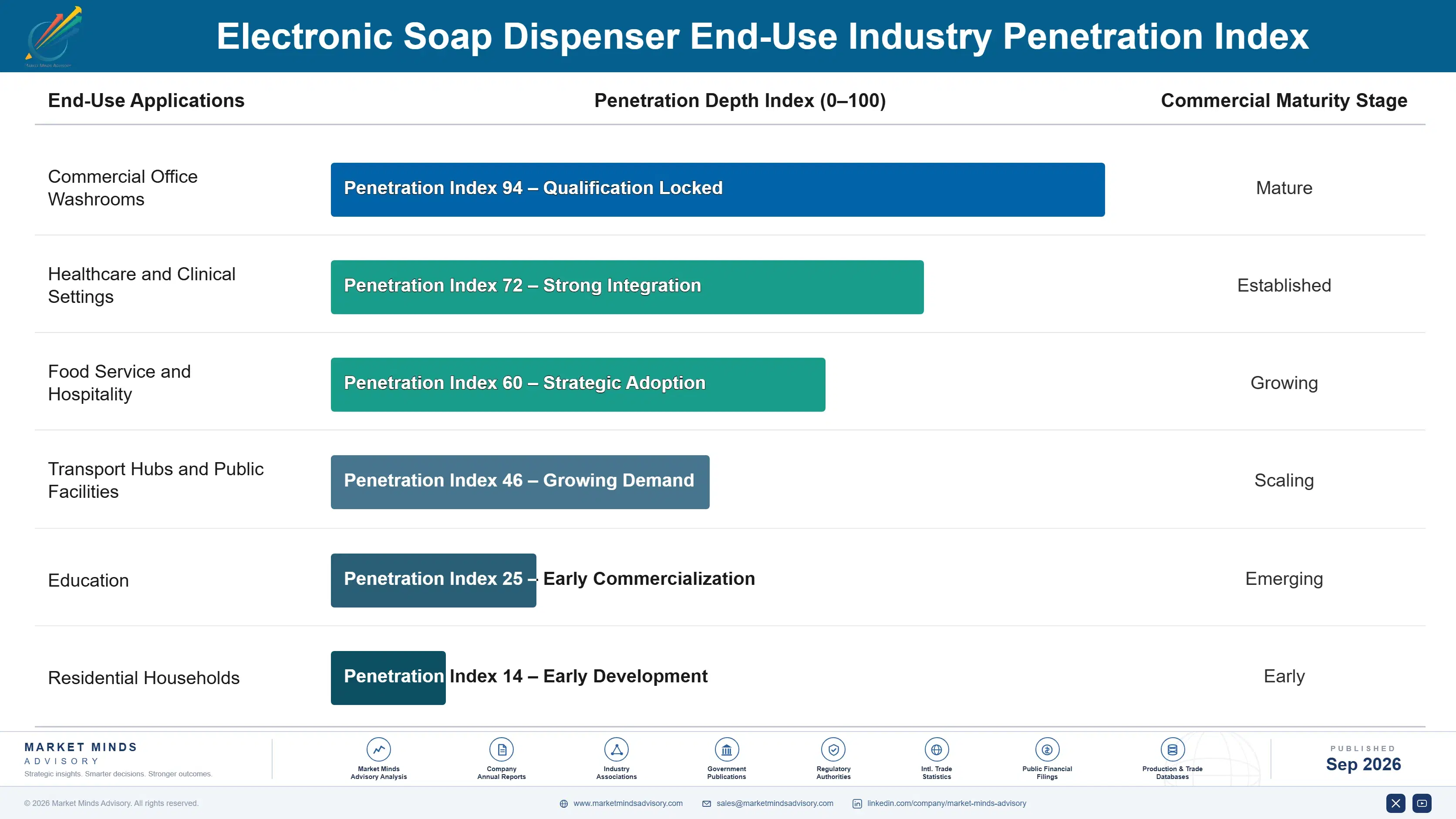
Stickiness varies sharply by how the placement was made. Estate-level specification through a facilities management group is the most durable, because the decision was made once and applies across hundreds of buildings that nobody revisits individually. Healthcare placements hold well, since hand hygiene auditing ties consumables to accreditation records. Single-site commercial placements and consumer households are the least sticky by a wide margin.

Buyer profiles have shifted in one specific direction since 2022. Facilities managers who installed touchless dispensing during the pandemic on infection control grounds are now being asked to justify the ongoing cost, and they have discovered the battery service line. That group evaluates total cost of ownership rather than unit price, and it responds to servicing labour arguments where the previous cohort responded to hygiene claims.
electronic-soap-dispenser-market-end-use-penetration-index-1790021343681

Where The Money Actually Is

These are among the four positions where our research anticipates prominent divergence between winners and laggards over the coming forecast period. Each is grounded in the demand model, the regulatory perimeter, and the announced capacity pipeline.
01 / TOTAL OWNERSHIP COSTING

Put the battery labour number in the proposal

Battery replacement drives about 58% of commercial service calls, and almost no manufacturer presents that figure during specification because the labour falls on the customer afterwards. Presenting total cost of ownership including service labour, then offering mains-wired or long-interval lithium against it, turns a hidden liability into a premium specification. Participants doing this report realised hardware pricing around 1.6 times the equivalent alkaline placement, and they keep the refill annuity that reverting to manual units would end, which is what a facilities group costing the labour independently tends to do.
02 / VISCOSITY TOLERANT ENGINEERING

Stop losing failures that belong to the soap

Foam dispensers refilled with non-foaming liquid clog, and roughly 19% of reported hardware failures trace to viscosity mismatch rather than any component fault. Open-fill units give buyers no guidance about what belongs in them, so the failure gets attributed to the dispenser. A pump platform tolerant across a wider viscosity range costs a few cents more and removes the failure mode, which matters most in East Asia and Latin America where open-fill dominates the installed base, where open refilling is the norm rather than the exception.
03 / TELEMETRY LABOUR POSITIONING

Sell connectivity as cleaning routes, not technology

Connected dispensers reporting fill level and battery state let cleaning staff be routed by need rather than by fixed schedule, and washroom servicing labour is the budget line facilities groups actually manage. Manufacturers positioning telemetry this way hold contract renewal rates roughly 7 points above unconnected ranges. The consumption data also flows to the manufacturer rather than the customer, which quietly deepens the refill lock-in that carries the entire business model, and positioning connectivity as a technology feature has consistently failed to close tenders.
04 / CONCENTRATE FORMAT ENTRY

Lead tenders with the freight and carbon arithmetic

Powder and tablet reconstituting dispensers grow at 12.6% because shipping soap that is mostly water is difficult to defend in any corporate emissions report. Facilities groups with published targets are specifying them ahead of cost parity, which almost never happens in this category. Manufacturers without a concentrate range are absent from the fastest-growing format and from tender conversations that open earlier in the cycle than price-led ones ever do, and hard water descaling is an operational detail rather than a genuine commercial obstacle.

Engagement Snapshot From the Field

A live engagement with an industry participant carrying material or product regulatory and market exposure ahead of a defining policy shift, showing how our research translates into a defensible multi-year portfolio strategy.
MARKET MINDS ADVISORY · CLIENT ENGAGEMENT SUMMARY
Electronic Soap Dispenser Producer Strategic Portfolio Review and Transition Roadmap 2026·Investment Scenario on Electronic Soap Dispenser Exposure Evaluation 2025-26
CLIENT PROFILE
A European manufacturer of commercial washroom dispensing systems with revenue near USD 174 million (client-reported, unverified by MMA), of which roughly 68% came from refill consumables and the remainder from hardware. The installed base ran to about 1.4 million dispensers across facilities management and direct commercial accounts. Every unit in the range operated on alkaline cells, and no telemetry option existed anywhere in the portfolio.
STRATEGIC CHALLENGE
Two large facilities management accounts had reduced dispenser counts at renewal, citing servicing cost, and a third was reviewing. Management interpreted this as hardware price pressure and had prepared a discount response. Nobody had established what the servicing cost actually consisted of, or whether discounting hardware would address it in any way.
MMA APPROACH
MMA analysed service call records across 340,000 installed units over two years, coding each call by cause and costing the associated labour. Battery consumption was modelled against traffic level by placement type. Twenty-six facilities managers were interviewed about how dispenser servicing enters their budgets and what would change a renewal decision.
KEY FINDINGS
  1. Battery replacement accounted for 61% of service calls across the analysed estate, above the category norm of 58%, and the labour cost exceeded hardware cost within 21 months at typical traffic levels.
  2. Hardware price ranked fifth among stated reasons for reducing dispenser counts, well behind servicing labour, cleaner routing inefficiency and cartridge delivery scheduling.
  3. Roughly 19% of calls logged as hardware failure traced to viscosity mismatch in open-fill units rather than to any component defect in the dispenser itself.
  4. No competitor serving these accounts offered battery state reporting, leaving the servicing labour argument entirely unoccupied across every tender examined in the review.
CLIENT PROFILE
A European manufacturer of commercial washroom dispensing systems with revenue near USD 174 million (client-reported, unverified by MMA), of which roughly 68% came from refill consumables and the remainder from hardware. The installed base ran to about 1.4 million dispensers across facilities management and direct commercial accounts. Every unit in the range operated on alkaline cells, and no telemetry option existed anywhere in the portfolio.
STRATEGIC CHALLENGE
Two large facilities management accounts had reduced dispenser counts at renewal, citing servicing cost, and a third was reviewing. Management interpreted this as hardware price pressure and had prepared a discount response. Nobody had established what the servicing cost actually consisted of, or whether discounting hardware would address it in any way.
MMA APPROACH
MMA analysed service call records across 340,000 installed units over two years, coding each call by cause and costing the associated labour. Battery consumption was modelled against traffic level by placement type. Twenty-six facilities managers were interviewed about how dispenser servicing enters their budgets and what would change a renewal decision.
KEY FINDINGS
  1. Battery replacement accounted for 61% of service calls across the analysed estate, above the category norm of 58%, and the labour cost exceeded hardware cost within 21 months at typical traffic levels.
  2. Hardware price ranked fifth among stated reasons for reducing dispenser counts, well behind servicing labour, cleaner routing inefficiency and cartridge delivery scheduling.
  3. Roughly 19% of calls logged as hardware failure traced to viscosity mismatch in open-fill units rather than to any component defect in the dispenser itself.
  4. No competitor serving these accounts offered battery state reporting, leaving the servicing labour argument entirely unoccupied across every tender examined in the review.
RECOMMENDED STRATEGY
Phase 1: Phase one: withdraw the planned hardware discount and rebuild account proposals around total cost of ownership including service labour. Discounting would not have addressed it. Phase 2: Phase two: introduce a long-interval lithium option and battery state telemetry on high-traffic placements across the two largest accounts. Route cleaning staff by reported need. Phase 3: Phase three: move the pump platform to a viscosity-tolerant design and add a concentrate format for emissions-reporting customers. Both changes use existing tooling partners.
OUTCOME
Both reviewing accounts renewed at increased dispenser counts (client-reported, unverified by MMA), with realised hardware pricing rising roughly 14% rather than falling. Service calls across the converted placements fell by about half, and the refill consumables stream that funds the business was preserved intact across all three accounts.

Frequently Asked Questions

Foundational context covering the market sizes, CAGR, scope, country, region and competition that inform every finding below. This section is provided to cover basics and most often pre-purchase conversations, answered from the MMA Primary Research Dataset.

What is the current size of the Electronic Soap Dispenser Market?

The market was valued at USD 1.6 billion in 2025, rising to USD 1.7 billion in 2026. Sizing covers dispensing hardware at wholesale value and excludes refill consumables.

How large will the Electronic Soap Dispenser Market be by 2036?

MMA forecasts USD 3.8 billion by 2036, an increase of USD 2.1 billion over the 2026 base. That represents expansion of 2.24 times across the forecast period.

What is the CAGR for the Electronic Soap Dispenser Market 2026 to 2036?

The base case CAGR is 8.4%, with a bull case of 9.6% and a bear case of 7.2%. Historical growth between 2020 and 2025 ran at 7.3%.

Which segment is growing fastest?

Powder and tablet reconstituting dispensers grow at 12.6%, half again the market rate, because shipping diluted soap is hard to defend on freight or carbon grounds. Dual-output units follow at 10.2%.

Who are the major companies in the Electronic Soap Dispenser Market?

Essity, Kimberly-Clark Professional, GOJO Industries, Bobrick and SC Johnson Professional lead on unit shipments, holding a combined 34%. Chinese manufacturers including Svavo and Xiaomi dominate open-fill and consumer segments.

Which country is growing fastest?

India grows fastest at 11.6%, driven by grade A commercial fit-out specifying touchless washroom fittings as standard rather than as an upgrade for international tenants.

Report Segmentation Architecture

The full report scope spans multiple orthogonal segmentation dimensions, with cross-tabulated demand data provided for each dimension pair. Coverage extends further to regional breakdowns, trend trajectories, and the competitive detail needed to support segment-level decision-making.

By Dispensing Output Format

  • Liquid Soap Dispensers
  • Foam Dispensers
  • Spray Dispensers
  • Gel Sanitiser Dispensers
  • Dual-Output Soap and Sanitiser Dispensers
  • Powder and Tablet Reconstituting Dispensers

By End-Use Industry

  • Commercial Office Washrooms
  • Healthcare and Clinical Settings
  • Food Service and Hospitality
  • Transport Hubs and Public Facilities
  • Education
  • Residential Households

By Customer Type

  • Facilities Management Groups
  • Direct Commercial Accounts
  • Healthcare Procurement
  • Building Contractors and Fit-Out
  • Retail and E-Commerce Consumers
  • Hygiene Product Distributors

By Region

  • East Asia
  • North America
  • Western Europe
  • South Asia and Pacific
  • Latin America
  • Middle East and Africa
  • Eastern Europe

Scope, Methodology, and Coverage

Every figure in this report is reproducible from documented input assumptions. The scope below maps the historical period, the forecast horizon, the segmentation dimensions, and the countries covered, alongside the underlying primary and qualitative methodology.
Historical Period
2020 to 2025
Forecast Period
2026 to 2036
Base Year
2025 (USD billions; MMA Primary Research Dataset, September 2026)
Market Definition
This market covers electronically actuated soap and hand hygiene dispensers using infrared, capacitive or ultrasonic sensing, spanning liquid, foam, spray, gel sanitiser, dual-output and powder or tablet reconstituting output formats, across commercial washroom, healthcare, food service, transport and consumer household applications. Sizing is at manufacturer wholesale value for dispensing hardware only. Soap, sanitiser and refill consumables, manual pump dispensers, tap-integrated systems sold as plumbing fixtures, and washroom fit-out or installation services are excluded throughout.
Quantitative Units
USD billions at manufacturer wholesale value; volume in millions of units; service calls per installed unit annually.
Segmentation Dimensions
Dispensing output format, end-use industry, customer type, and geographic region.
Regions Covered
East Asia, North America, Western Europe, South Asia and Pacific, Latin America, Middle East and Africa, Eastern Europe
Countries Covered
China, United States, Germany, India, Japan, Brazil
Key Companies Profiled
Essity, Kimberly-Clark Professional, GOJO Industries, Bobrick Washroom Equipment, SC Johnson Professional, Simplehuman, Xiaomi, Sloan Valve Company, American Specialties, Bradley Corporation, TOTO, LIXIL, Delta Faucet, Moen, Diversey, Zenith Hygiene, Vectair Systems, Svavo, Rubbermaid Commercial Products, Ecolab
Quantitative Methodology
Primary survey, n=3,800 respondents, Q4 2025, six countries; demand-side model with trade association cross-validation
Qualitative Methodology
47 expert interviews, Q4 2025; applied to validate demand model assumptions, identify emerging dynamics, and assess competitive positioning
Report Format
PDF and XLSX data workbook (Word format preview document)
Publisher
Market Minds Advisory
Report Code
MMA-2026-CON-768
Published
September 2026
Contact
sales@marketmindsadvisory.com | www.marketmindsadvisory.com

Purchase the full Electronic Soap Dispenser Market Report (2026 to 2036).

The full report sizes the electronic soap dispenser market across six dispensing output formats, six end-use industries and six customer types for all seven global regions. It includes service call analysis across a large installed base, coding each event by cause and costing the associated labour against hardware value. Refill lock-in is quantified by region and customer type, separating proprietary cartridge estates from open-fill installations. Battery consumption is modelled against traffic level by placement type. Component cost is decomposed by output format, and competitive assessment covers 20 manufacturers on a consistent unit shipment basis.
Service calls coded by cause and costed
Refill lock-in quantified by region and customer
Battery consumption modelled against placement traffic
Component cost decomposed by output format
Six output formats sized through 2036
Twenty manufacturers assessed on unit shipments

Built For The People Who Decide

From boardroom strategy to bench-side execution, this report is read cover-to-cover by leaders shaping the next decade of their industry, turning demand scenarios, market dynamics and valuation benchmarks into decisions.
CXOs/ Presidents/ VPs/ Managers
M&A and Corporate Development
Strategy Teams and R&D Heads
Procurement and Product Directors
Regulatory and Compliance Leaders
Investor Relations and Equity Analysts