Market Minds Advisory
Electronic Power Steering Market

Electronic Power Steering Market: Redundancy Requirements, Rack-Assist Migration and the Arrival of Steer-by-Wire

Hands-off driver assistance is forcing redundant motors and dual controllers into every system sold, rack-assist architectures are displacing column designs on force requirements, and steer-by-wire has finally reached series production.

Lead Analyst

David Horsley

Published

September 2026

Make Smarter Decisions with Customized Research Insights

Request a free sample report and evaluate market opportunities, growth trends, and competitive dynamics relevant to your business needs.

2025 MARKET VALUE$33.0BMarket Size 2025
2036 FORECAST VALUE$68.0BBase Case , 2026 to 2036
CAGR 2026 TO 20366.8 %Bull 8.0% / Bear 5.6%
INCREMENTAL OPPORTUNITY$32.8BNet 10- year value creation
EXPANSION MULTIPLE1.93x2036 value over 2026 base
Strategic Levers
M&A Pipeline
Regional Outlook
Country Rankings
Competitive Intelligence
Segmental Deep-dive
Call-Us : 91 93563 13602

Executive Snapshot and Market Trajectory

Electric power steering finished replacing hydraulic years ago, and everyone treated the story as over. It was not over at all. Driver assistance turned the steering system into a safety-critical actuator that has to keep working when a component fails, and that requirement is rewriting what the hardware actually contains.
Steer-by-wire systems grow at 10.2%, a full 1.50 times the market rate, because removing the mechanical column frees interior packaging, allows variable ratios impossible with a fixed rack and suits electric platforms that no longer need a shaft threading through the firewall. East Asia holds 35% of global value, above the standard regional band, because China builds roughly 30 million vehicles annually and Japan hosts the deepest steering engineering base found anywhere.
Concentration runs at 57% for the top five, which is high for a chassis component and reflects how much of the value now sits in motor design, torque sensing and functional safety software. A steering rack is machining anybody can do. A redundant actuator certified to automotive safety integrity level D is not, and that capability gap keeps widening with every programme cycle that passes.
Market Definition
This report covers electric power steering systems for on-highway vehicles, spanning column-assist, single-pinion, dual-pinion and rack-assist architectures plus steer-by-wire systems, including the assist motor, torque sensor, controller and mechanical steering gear supplied as a system. Hydraulic and electro-hydraulic steering, steering wheels and airbag modules, intermediate shafts sold separately, rear-axle steering actuators and complete chassis assemblies are excluded.
Base Year Value
$33.0B in 2025 (MMA Primary Research Dataset, August 2026)
Forecast Period
2026 to 2036, eleven discrete annual values
CAGR
6.8% base case. Bull 8.0%. Bear 5.6%.
Fastest Growth Segment
Steer-by-Wire System: 10.2% CAGR
Fastest Growth Country
India: 9.4% CAGR
Fastest Growth Region
South Asia and Pacific: 9.0% CAGR
Largest Region
East Asia: 35% of 2025 global value
Market Leaders
JTEKT, Nexteer Automotive, Robert Bosch, NSK and ZF Friedrichshafen lead on system shipment volume. Source: MMA Analysis, July 2026.
Primary Survey
n=3,800 procurement and R&D decision-makers, Q4 2025, six countries
Methodology
Demand-side build-up, cross-validated against public data, 47 expert interviews

Electronic Power Steering Market Forecast Scenarios

electronic-power-steering-market-trends-size-forecast-scenario-1787315849952
Between 2020 and 2025 the market compounded at 5.6%, and content rather than penetration explains almost all of it. Passenger vehicle electric assist adoption was already above 90% at the start of the period, so conversion contributed very little. What lifted value was redundancy: driver assistance requirements pushed dual-winding motors and dual controllers into mainstream programmes at prices well above the single-channel systems they replaced.
The base case at 6.8% rests on three mechanisms. Advanced driver assistance regulation keeps raising the functional safety requirement, which adds motor windings, controllers and sensor channels to systems that would otherwise be settled technology. Architecture migration continues from column-assist toward rack-assist and dual-pinion designs carrying higher rack forces and higher prices. Emerging market penetration, particularly across India and Brazil, adds genuine conversion volume in entry segments where hydraulic steering persisted much longer.
The bull case at 8.0% turns on steer-by-wire adoption accelerating beyond current programme commitments, which would raise content per vehicle sharply on platforms that adopt it. The bear case at 5.6% is passenger vehicle production staying flat while redundancy content matures into a settled specification, leaving little to add and returning this market to something close to unit growth alone.

What Now Drives Steering System Value

The original commercial case for electric steering was fuel economy. A hydraulic pump runs off the engine continuously whether the driver is turning or not, and replacing it with a motor that draws current only on demand delivers around 4% on a regulatory drive cycle. That argument won, and by 2020 it was finished.
TOP FIVE CONCENTRATION57%Share held by the five largest global steering suppliers
AVERAGE SYSTEM PRICE$285Typical realised price for a passenger vehicle system
PASSENGER CAR PENETRATION94%Share of new passenger vehicles fitted with electric assist
ELECTRONICS COST SHARE43% of COGSMotor, sensor and controller portion of system cost
EFFICIENCY GAIN4%Fuel consumption benefit against a hydraulic steering system
PROGRAMME LENGTH7 yearsTypical production run before a vehicle platform changes
What replaced it is far more valuable. A vehicle offering lane keeping, emergency steering intervention or hands-off highway driving needs a steering system that can be commanded by software and, critically, that keeps working when something inside it fails. That means dual motor windings, dual controllers, redundant torque and position sensing, and a functional safety case certified at the highest automotive integrity level. Each of those additions carries cost, and the resulting systems sell at prices single-channel designs never approached.
Architecture is migrating alongside. Column-assist systems are cheap and adequate for small cars, but they cannot generate the rack forces that heavier vehicles need, and they place the motor inside the cabin where noise matters. Rack-assist and dual-pinion designs handle both problems, cost more and now take a growing share of every programme above compact class.
"The steering business stopped being about steering somewhere around 2019. What suppliers actually sell now is a certified redundant actuator with a safety case attached, and the companies still thinking of themselves as gear manufacturers are the ones losing programmes they used to win easily."
Practice Director, Automotive Components, Market Minds Advisory · MMA Automotive

Market Trends

Redundancy Requirements Reshape System Hardware Architecture

Hands-off highway assistance and emergency steering intervention both require the steering system to keep operating after a single component failure, which cannot be achieved with one motor winding and one controller. Systems now carry dual three-phase windings, independent controller channels and redundant torque and position sensing, all certified to the highest automotive safety integrity level. That content adds roughly 35% to system price against a single-channel equivalent of comparable rack force. Certification runs 18 to 24 months and demands documentary evidence that suppliers without functional safety capability cannot produce at all.
Market Impact: Covers 100% of European fleet
Steer-by-Wire Reaches Series Production On Multiple Platforms

Removing the mechanical column between wheel and rack has moved from concept to series production, appearing first on premium and electric platforms where interior packaging freedom and variable steering ratios justify the engineering. The technical requirement is severe: full redundancy across actuation, sensing, power supply and communication, with no mechanical fallback to catch a failure. Regulatory acceptance took years to secure and remains genuinely uneven between one market and the next. Realised prices run roughly 2.7 times a conventional rack-assist system, and the software calibration behind steering feel is where suppliers now genuinely differentiate.
Market Impact: Converts 6% remaining penetration

Market Opportunities and Growth Drivers

Safety Regulation Mandates Electrically Actuated Steering Intervention

European General Safety Regulation requirements covering lane keeping and emergency steering apply to every new vehicle sold in the region, and broadly comparable rules are now tightening across North America and much of Asia too. Delivering those functions requires steering that software can command with certified reliability, which hydraulic systems cannot provide at any price. The demand mechanism here is regulatory rather than commercial, which makes it considerably more predictable than most automotive content and effectively immune to consumer preference shifting in some other direction entirely. Suppliers can plan capacity against it.
Market Impact: Requires 24 months to certify

Emerging Market Penetration Headroom Remains Genuinely Substantial

Electric assist already reaches roughly 94% of new passenger vehicles globally, but that average conceals wide variation. Indian and Brazilian entry price segments retained hydraulic and even manual steering far longer than Western markets, and conversion there is still running rather than finished. Commercial vehicles present a second and larger pool, where rack force requirements and 24 volt electrical architecture delayed adoption but fuel economics are now pulling it forward. Both pools add genuine unit volume rather than merely content per system, which is rare in a market this mature.
Market Impact: Exposes 20% of system cost

Market Restraints and Challenges

Functional Safety Certification Excludes Suppliers Lacking Capability

Certifying a redundant steering actuator at the highest automotive safety integrity level takes 18 to 24 months and demands architectural evidence, failure mode analysis and diagnostic coverage documentation that mechanical engineering organisations are not structured to produce. The root cause is regulatory rather than technical difficulty. Commercially this protects incumbents and starves the market of price competition, but it also means manufacturers cannot second-source quickly. Participants without the capability are responding by acquiring it, partnering with electronics specialists, or retreating toward component supply sitting beneath a certified system integrator instead.
Market Impact: Adds 35% to system price

Rare Earth Magnet Exposure Concentrates Supply Chain Risk

Permanent magnet assist motors depend on neodymium and dysprosium, and Chinese export controls tightened materially through 2024 and 2025. The root cause is geological and processing concentration rather than any commercial choice available to suppliers. Commercially this exposes roughly a fifth of system cost to pricing and availability outside anybody's control, and steering is safety-critical enough that any substitution simply cannot be rushed through. Participants are responding by qualifying externally excited and reluctance motor architectures, by contracting magnet supply on multi-year terms, and by recycling recovered magnet material back into new motor production.
Market Impact: Prices 2.7 times rack-assist
4 additional market trends, 3 additional growth drivers, and 2 additional restraints and challenges are covered in the full report. Contact sales@marketmindsadvisory.com to access the complete intelligence.

Segment CAGR and Growth Architecture

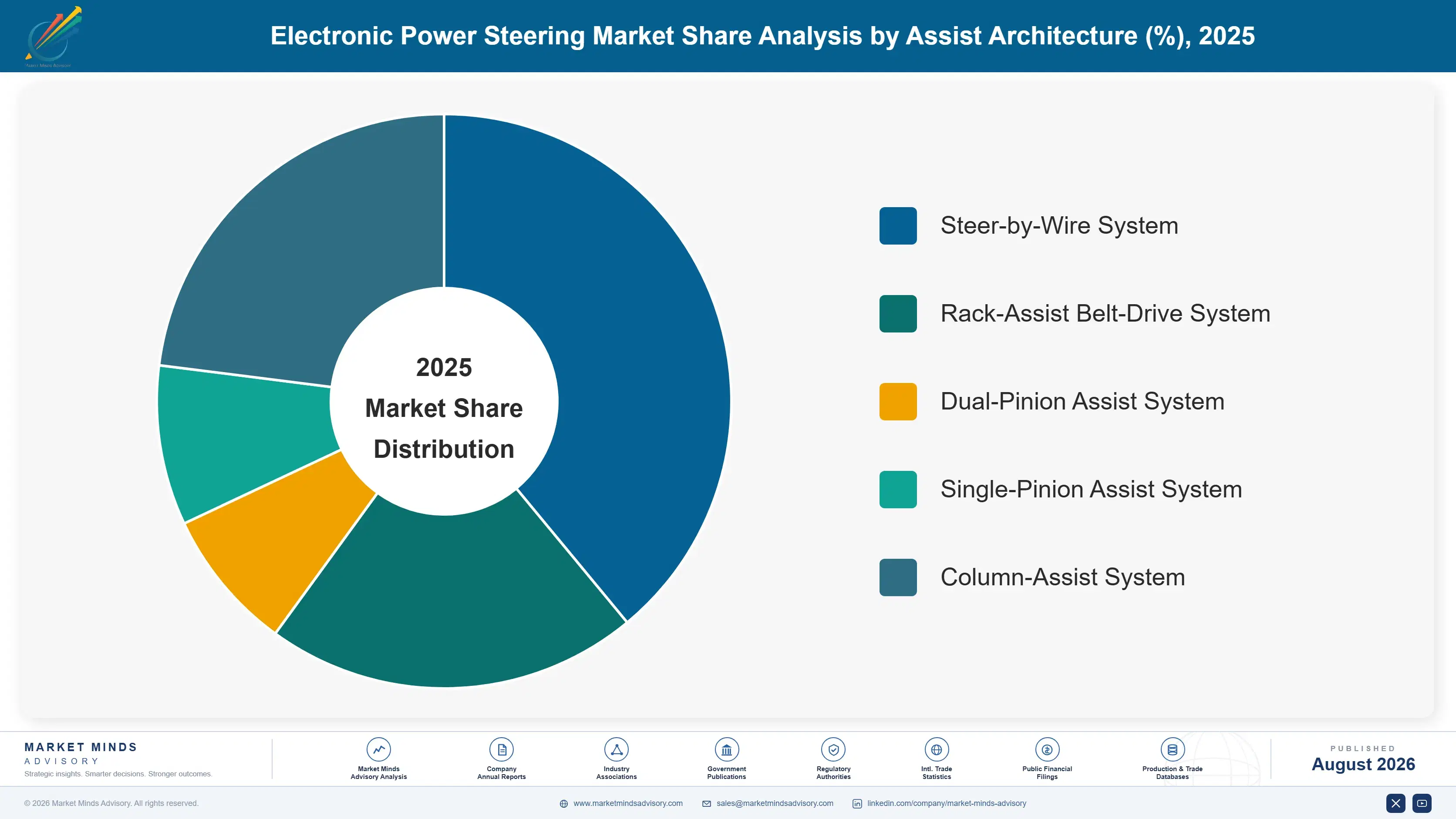
Segmentation follows assist architecture, because where the motor acts on the steering system determines achievable rack force, cabin noise behaviour, packaging, redundancy design, manufacturing cost and realised price per unit. Vehicle class, safety integrity level and software content all sit downstream of that architectural decision and are priced directly against it during platform development.
electronic-power-steering-market-trends-market-share-analysis-1787315850495

Steer-by-Wire System

The fastest segment at 10.2%, a full 1.50 times the market rate, covering systems with no mechanical connection between the steering wheel and the road wheels, where driver input is sensed, transmitted electrically and reproduced by an actuator at the rack. Packaging and ratio freedom drive adoption. Removing the column frees interior space that electric platforms want, allows steering ratios that vary continuously with speed, and eliminates the shaft threading awkwardly through a firewall. The engineering requirement is severe, since full redundancy across actuation, sensing, power supply and communication must exist with no mechanical fallback. Realised pricing runs roughly 2.7 times conventional rack-assist, and steering feel calibration is now genuinely a software discipline.
CAGR 10.2%

Rack-Assist Belt-Drive System

Growing at 8.4% on systems where the assist motor drives a ball nut on the steering rack through a toothed belt, generating rack forces that column-mounted architectures cannot approach. Vehicle weight is what drives adoption. Pickups, sport utility vehicles and larger passenger cars all need forces beyond what a column motor delivers, and moving the motor out of the cabin removes a noise path that customers notice on quiet electric platforms. The architecture also accommodates redundant windings more comfortably than tighter column packages allow. What limits it is cost and packaging, since a belt drive and ball nut assembly demands both space around the rack and considerably more machining than simpler designs require.
CAGR 8.4%
Full segment breakdown across 5 segments available in the complete report.

Regional Architecture and Country Demand Map

East Asia holds 35% of global value on Chinese vehicle output and the deepest steering engineering base in the industry. North America follows on rack forces that larger vehicles demand, while growth runs fastest across South Asia and Pacific on the penetration headroom that still remains there.

East Asia

Note: East Asia holds 35% against a 22 to 30% band because China builds roughly 30 million vehicles annually and Japan hosts the deepest steering engineering base anywhere in the industry. JTEKT and NSK between them supply systems that Western manufacturers specify on their own platforms, and Hitachi Astemo adds further capability. Chinese suppliers around Zhejiang and Hubei have moved from column-assist commodity work into rack-assist and increasingly steer-by-wire development, driven by domestic electric vehicle manufacturers who treat steering feel as a software problem. Korean output through HL Mando and Hyundai Mobis serves both domestic platforms and substantial export programmes across several regions. Software rather than machining is where regional competition is now concentrating.
Share: 35% | CAGR: 8.0% (2026 to 2036)

North America

Vehicle size shapes this region more than technology does. Full-size pickups and body-on-frame utilities need rack forces that column-assist architectures cannot deliver, so North American content skews heavily toward rack-assist and dual-pinion systems carrying considerably higher realised value per unit than the world average. Nexteer holds a strong domestic position built on that segment. Advanced driver assistance requirements are the second force: hands-off highway systems demand redundant motor windings and dual controllers, and the resulting content increase applies regardless of powertrain. Commercial vehicle conversion from hydraulic steering is progressing faster here than anywhere, driven by fleet fuel economics. Content per vehicle here runs well above the world average, and the platforms carrying it are electrifying slowly.
Share: 23% | CAGR: 6.3% (2026 to 2036)
Regional intelligence for 5 additional markets available in the complete report: Western Europe, South Asia and Pacific, Latin America, Middle East and Africa, Eastern Europe. Contact sales@marketmindsadvisory.com.
electronic-power-steering-market-trends-country-cagr-analysis-1787315851008

Where Steering System Margin Is Won

Four commercial positions separate the suppliers capturing modern steering value from those machining racks and housings at component rates: holding functional safety certification capability internally, owning motor and controller design rather than buying it, winning the architecture decision during platform definition, and reducing rare earth magnet exposure well before the next export restriction happens to arrive.

Hold Functional Safety Certification Capability Internally

Certifying a redundant steering actuator at the highest automotive safety integrity level takes between 18 and 24 months and demands architectural evidence and diagnostic coverage documentation that mechanical engineering organisations cannot produce. Suppliers holding that capability entirely internally reach market a full year ahead of competitors routing their certification work through external assessment houses, and they realise roughly 35% higher prices than single-channel systems of comparable rack force. The investment required is systems engineers and validation programmes rather than any manufacturing capital, which makes it achievable considerably faster than a factory.
Market Impact: Realises 35% higher pricing across

Own Motor And Controller Design Rather Than Purchasing

Motor, sensor and controller content reaches roughly 43% of total system cost, and suppliers buying those elements finished surrender most of the value that redundancy created while still retaining the entire warranty exposure themselves. Holding the motor winding design, the controller architecture and the steering feel calibration software internally retains 13 to 18 points more gross margin on otherwise identical programmes. It also makes the redundancy architecture possible at all, because a genuine dual-channel design simply cannot be bolted onto components that were procured as single-channel parts from a third party.
Market Impact: Retains 18 additional points of gro

Win Architecture Decisions During Platform Definition

Assist architecture is fixed early in vehicle development and almost never revisited afterwards, and the resulting position then runs for a seven year production programme without any competitive review at all. Suppliers embedded in platform engineering teams steer that decision toward architectures they already hold, which converts an ordinary engineering relationship into locked revenue worth 10 to 16 times the development contract itself. Those arriving after architecture freeze quote against a specification already written around a competitor's design, and they win on price or they do not win at all.
Market Impact: Locks revenue across a full 7 year

Reduce Rare Earth Magnet Exposure Before Restrictions Tighten

Permanent magnet assist motors depend directly on neodymium and dysprosium, and Chinese export controls tightened materially through 2024 and 2025, exposing roughly a fifth of total system cost to pricing that nobody outside China influences. Suppliers qualifying externally excited or reluctance motor architectures alongside their permanent magnet designs cut that exposure sharply, and they can then quote whichever architecture the programme economics happen to favour at the time. The trade involved is efficiency and package size, both of which matter in a steering system but considerably less than uninterrupted production continuity does.
Market Impact: Cuts 20% of system cost exposure to

Who Controls the Margin Pool

Concentration sits at 57% for the top five measured on system shipment volume, the basis used throughout this section, and it is high for a chassis component. JTEKT and Nexteer lead on breadth across Japanese, Western and Chinese platforms, while Bosch and ZF hold the strongest European positions and NSK competes across column and rack-assist architectures. The gap to the next tier is wide, because functional safety capability rather than manufacturing scale separates the groups now.
Competitive activity runs on three fronts. Redundancy architecture is the first, since it decides who can quote a hands-off assistance programme at all. Steer-by-wire development is the second, where the competitive field remains thin and the certification burden is genuinely severe. The third is motor architecture, where suppliers are qualifying designs that reduce rare earth exposure ahead of the next export restriction rather than after it.

Pressure arrives from two directions. Chinese suppliers have moved from column-assist commodity work into rack-assist and steer-by-wire development, funded by domestic electric vehicle manufacturers treating steering feel as software. Separately, vertical integration by some manufacturers removes addressable volume. Rankings will shift on who holds credible steer-by-wire positions when volume platforms adopt it after 2029.
electronic-power-steering-market-trends-company-positioning-matrix-1787315851536

Competitive Moat and Risk Dimensions

JTEKT

Moat: Architecture breadth and engineering depth

Positions across column, single-pinion, dual-pinion and rack-assist architectures on Japanese, Western and Chinese platforms mean no single programme loss materially damages the business, and vehicle manufacturers defining new platforms find an existing qualified supplier already holding comparable scope. Bearing and driveline capability alongside spreads engineering cost across volumes steering-only competitors cannot match.
JTEKT

Risk: Domestic production volume decline

Substantial revenue depends on Japanese manufacturers whose domestic output has drifted down for a decade as production moved closer to end markets. Following those customers overseas means competing against established local suppliers on their own cost base, and Chinese competitors entering rack-assist and steer-by-wire attack exactly the higher-value positions that justify current pricing.
NEXTEER AUTOMOTIVE

Moat: Rack-assist and truck platform strength

Deep positions on North American full-size pickup and body-on-frame utility programmes, where rack forces demand architectures that column-assist cannot deliver, secure the highest content per vehicle available anywhere in this market. Those platforms are also electrifying more slowly than any other segment, which extends the programme life behind that content considerably.
NEXTEER AUTOMOTIVE

Risk: Concentrated platform and ownership exposure

Revenue concentrates on a relatively small number of large North American truck programmes, so a single manufacturer's volume decision moves results sharply. Ownership structure also complicates commercial relationships with certain customers and creates procurement scrutiny that competitors without that association simply do not have to manage at all.

Players Tracked

Prominent Players

JTEKT
Nexteer Automotive
Robert Bosch
NSK
ZF Friedrichshafen

Other Key Players

HL Mando
Hyundai Mobis
Thyssenkrupp Presta
Hitachi Astemo
Denso
Mitsubishi Electric
Schaeffler
China Automotive Systems
Zhejiang Shibao
NTN Corporation
Marelli
Sona BLW Precision Forgings
Rane Group
Knorr-Bremse
Zhuzhou Elite Electromechanical

Recent Developments

FEBRUARY 2025

Steer-by-wire system enters series production on electric platform

A supplier began series production of a complete steer-by-wire system for a premium battery electric platform, which delivers full redundancy across actuation, sensing, power supply and communication paths with no mechanical fallback available at all to catch any single component failure anywhere in the chain.
Signal: Steer-by-wire has now moved from demonstra
JUNE 2025

Reluctance motor architecture qualified to reduce magnet dependence

A steering supplier qualified an externally excited motor architecture for its assist applications, removing rare earth magnet dependence from a portion of its range after Chinese export controls tightened and exposed roughly a fifth of total system cost to pricing entirely outside its own control.
Signal: Magnet supply security is now driving moto
OCTOBER 2025

Redundant dual-channel system certified for hands-off assistance

A leading supplier completed full functional safety certification at the highest automotive integrity level covering a dual-winding, dual-controller redundant steering system supporting hands-off highway assistance functions on production vehicles, which is a capability that excludes competitors without internal systems engineering from bidding on those same programmes entirely.
Signal: Certification capability rather than mecha

What Drives Steering System Cost

Electronics dominate this bill of materials. Assist motor, torque and position sensors and the controller together reach roughly 43% of system cost, with permanent magnet content alone accounting for about a fifth of the total. Machined rack, pinion, housings and the ball nut or belt drive assembly add around 24%. Bearings, seals and mounting hardware contribute a further 11%, and validation plus certification labour roughly 8%.
Rare earth magnet pricing moved sharply through 2024 and 2025 as Chinese export controls tightened on neodymium and dysprosium, and steering suppliers absorbed increases they could not pass through under fixed multi-year programme pricing. Semiconductor availability remains the second concern after the 2021 shortage stopped lines outright. JTEKT Annual Report 2025 and Robert Bosch Annual Report 2025 both identify raw material and electronic component cost as continuing pressure on automotive margins.

The disadvantage mechanism is magnet architecture rather than purchasing scale. A supplier whose entire range depends on permanent magnet motors carries exposure that a competitor holding qualified reluctance or externally excited designs simply does not, and during an export restriction the difference is production continuity. Exposure varies geographically too: Chinese suppliers source magnets domestically at prices and availability no importer matches.
electronic-power-steering-market-trends-cost-volatility-analysis-1787315851731

Qualify motor architectures that avoid rare earth magnets

Externally excited synchronous and switched reluctance designs remove neodymium and dysprosium dependence entirely, at some cost in efficiency and package size. In a steering system, where packaging is tight but not impossible, that trade is genuinely acceptable on many programmes. Suppliers holding both architectures quote whichever the programme economics favour rather than being locked into one exposed supply position.

Index multi-year programme pricing to published magnet benchmarks

Seven-year platform contracts written against published magnet, copper and semiconductor indices move volatility onto a formula both parties can verify rather than leaving it entirely with whoever signed first. Manufacturers resist because it complicates their own cost planning. Across a programme of that length, though, absorbing input moves nobody forecast routinely eliminates the entire margin.

Design controller architecture accepting multiple semiconductor vendors

Controllers designed so comparable microcontrollers and gate drivers from two or three vendors can be substituted without requalifying the safety case remove the single-point exposure that allocation creates. The cost is duplicated validation at design stage, which is trivial against a stopped production line. The 2021 shortage demonstrated that arithmetic expensively across the whole industry.

Portfolio Architecture for Margin Defence

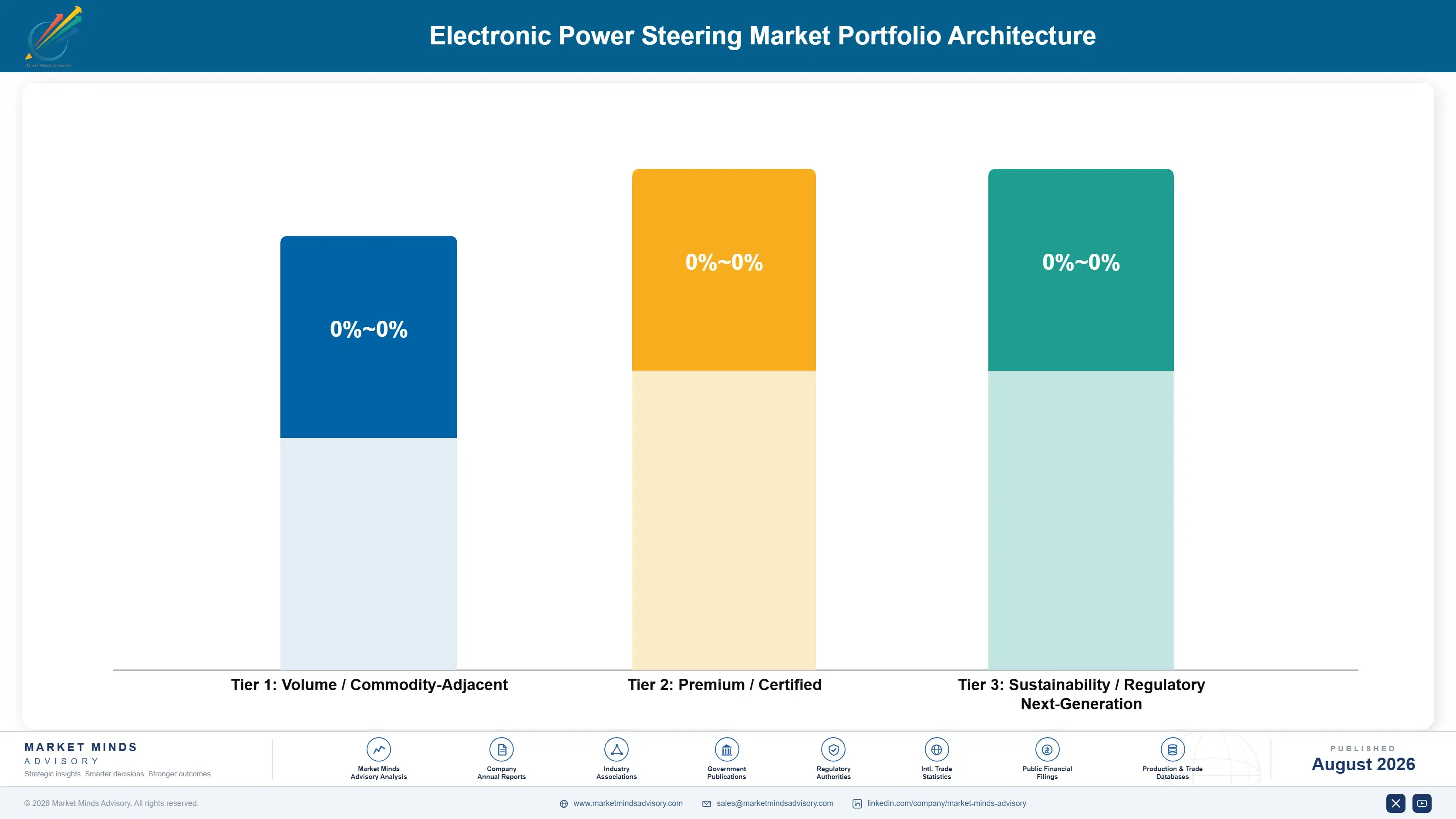
Portfolio economics here divide on safety content rather than on mechanical sophistication. Single-channel column-assist systems for compact and entry vehicles earn gross margins in the low to mid teens, because the technology is entirely settled, rack forces are modest, several suppliers quote comparable specification and manufacturers negotiate seven-year programmes hard at signature. Volume secures the relationship rather than the margin here.
The premium tier is redundant rack-assist and dual-pinion systems certified for driver assistance. Dual windings, independent controllers, redundant sensing and a certified safety case together raise realised price roughly 35% above single-channel equivalents, and the certification requirement thins the competitive field considerably. Margins run in the high twenties to mid thirties. Certification depth is what decides where in that range a supplier lands.

Above both sits steer-by-wire, where the engineering requirement is severe and the competitive field genuinely narrow. Full redundancy with no mechanical fallback demands systems engineering that few suppliers hold, realised pricing runs roughly 2.7 times conventional rack-assist, and the steering feel calibration behind it is software that carries margins mechanical content never approaches. Margins reach the high thirties, and positions won now run for a decade.

Volume / Commodity-Adjacent

Single-channel column-assist systems for compact and entry vehicles. Settled technology, modest rack forces and several suppliers quoting comparable specification into seven-year programmes negotiated hard at signature keep margin near the floor.
Gross Margin: 13 to 18%

Premium / Certified

Redundant rack-assist and dual-pinion systems certified for driver assistance functions. The range reflects how much redundancy and software content a given programme actually specifies, which varies considerably between one manufacturer and the next.
Gross Margin: 27 to 35%

Sustainability / Regulatory / Next-Generation

Steer-by-wire systems with full redundancy and no mechanical fallback. The range is wide because early programmes carry development recovery while later ones price against a thin but growing competitive field.
Gross Margin: 34 to 42%
electronic-power-steering-market-trends-portfolio-architecture-1787315852234

High-value Sub-segments and Strategic Watch-out

Steer-by-Wire Platform Programmes

High value and high growth sitting squarely together. Full redundancy without mechanical fallback demands systems engineering very few suppliers hold, pricing runs a long way above conventional rack-assist systems, and the steering feel calibration software behind it carries margins that mechanical content has never once approached.
Gross Margin: 36 to 43%

Certified Redundant Rack-Assist Systems

High value running on genuinely strong growth. Hands-off assistance regulation now makes redundant architecture mandatory rather than optional, the certification requirements behind it thin the competitive field considerably, and heavier vehicles need rack forces that column-mounted architectures simply cannot deliver at any price at all.
Gross Margin: 29 to 36%

Single-Pinion Volume Assist Systems

The volume core that keeps machining and assembly capacity properly loaded between higher-value programmes. Margins sit only moderate because several suppliers quote comparable specification against each other, but the scope secures exactly the platform relationships that go on to carry certified redundant system business later.
Gross Margin: 18 to 25%

Column-Assist Legacy Programmes

The strategic watch-out sitting squarely inside this particular portfolio. Volumes remain genuinely large in compact and entry vehicles right across emerging markets, but redundancy requirements and rising vehicle weight now push nearly every new programme toward the rack-mounted architectures that this segment simply cannot serve.
Gross Margin: 13 to 18%

How Steering Demand Repeats

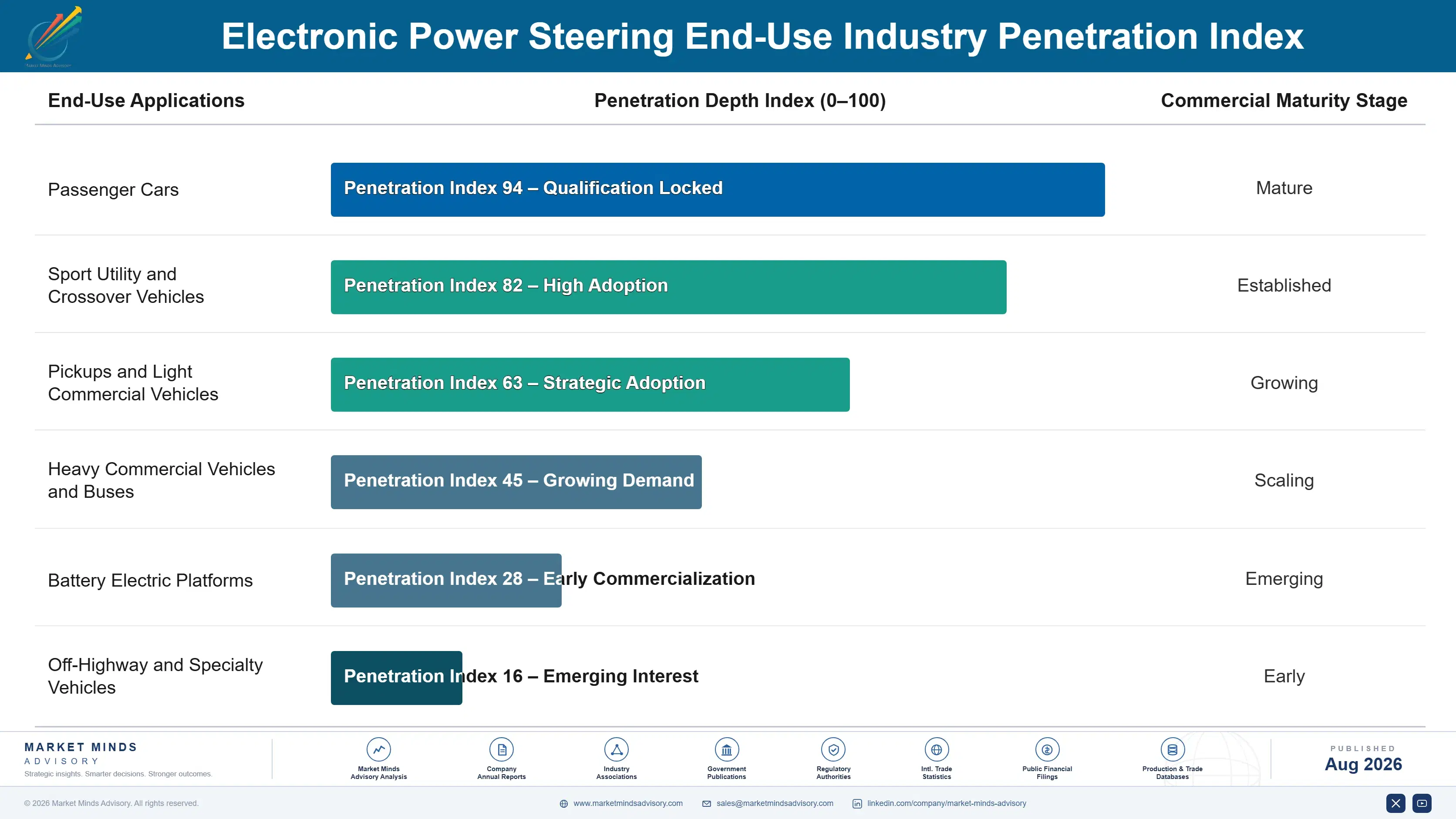
The repeat business is the vehicle platform rather than any individual order. A steering system qualified onto a platform ships for roughly seven years of production against release schedules that arrive regardless of anything else, and the architecture is almost never revisited mid-programme because requalifying a safety case is expensive and slow. Winning the original architecture decision is therefore worth many multiples of the development contract that precedes it.
Stickiness varies considerably by end-use. Commercial vehicle positions are deepest, since fleet operators judge suppliers across a fifteen year service life and requalification is rare. Passenger platform positions are locked for the programme but fully contestable at each redesign, and redesigns are becoming more frequent as manufacturers chase assistance capability. Steer-by-wire programmes are stickiest of all, because the software calibration behind steering feel ties into vehicle dynamics in ways that make supplier substitution genuinely impractical.

The buyer profile has shifted decisively. Steering specification once sat with chassis engineers evaluating effort, feel and durability in isolation. Today it sits with assistance and vehicle dynamics teams weighing functional safety architecture, software interfaces, redundancy strategy and over-the-air update capability together, which favours suppliers arriving with systems engineers rather than only with sample hardware.
electronic-power-steering-market-trends-end-use-penetration-index-1787315852722

Where To Compete And Why

These are among the four positions where our research anticipates prominent divergence between winners and laggards over the coming forecast period. Each is grounded in the demand model, the regulatory perimeter, and the announced capacity pipeline.
01 / FUNCTIONAL SAFETY CAPABILITY

Certification decides the shortlist not the price

Certifying a redundant steering actuator at the highest automotive safety integrity level takes 18 to 24 months and demands architectural evidence and diagnostic documentation mechanical organisations cannot produce. Suppliers holding that capability internally reach market a full year ahead of competitors routing certification externally, and they realise roughly 35% higher prices than single-channel systems of comparable rack force. The investment is systems engineers and validation programmes rather than manufacturing capital, which makes it achievable considerably faster than building any new factory would be.
02 / MOTOR ELECTRONICS OWNERSHIP

Redundancy pays only if you own the channels

Motor, sensor and controller content reaches roughly 43% of total system cost, and suppliers buying those elements finished surrender most of the value redundancy created while retaining the warranty exposure anyway. Holding motor winding design, controller architecture and steering feel calibration software internally retains 13 to 18 points more gross margin on identical programmes. It also enables the redundancy architecture itself, because a genuine dual-channel design cannot be bolted onto components that were procured as single-channel parts from somebody else.
03 / PLATFORM ARCHITECTURE TIMING

Architecture freezes early and rarely reopens

Assist architecture is fixed during platform definition and almost never revisited, which locks the winning supplier into a seven year production programme with no competitive review along the way. Suppliers embedded in platform engineering teams steer that decision toward architectures they already hold, converting an engineering relationship into revenue worth 10 to 16 times the development contract. Those arriving after architecture freeze quote against a specification already written around a competitor's design, and they win on price alone or not at all.
04 / MAGNET EXPOSURE REDUCTION

Architect around the restriction already imposed

Permanent magnet assist motors depend directly on neodymium and dysprosium, and Chinese export controls tightened through 2024 and 2025, exposing roughly a fifth of system cost to pricing nobody outside China influences at all. Suppliers qualifying externally excited or reluctance architectures alongside their magnet designs cut that exposure sharply, and they quote whichever architecture the programme actually favours. The trade involved is efficiency and package size, both of which matter in steering but considerably less than uninterrupted production continuity does.

Engagement Snapshot From the Field

A live engagement with an industry participant carrying material or product regulatory and market exposure ahead of a defining policy shift, showing how our research translates into a defensible multi-year portfolio strategy.
MARKET MINDS ADVISORY · CLIENT ENGAGEMENT SUMMARY
Electronic Power Steering Producer Strategic Portfolio Review and Transition Roadmap 2026·Investment Scenario on Electronic Power Steering Exposure Evaluation 2025-26
CLIENT PROFILE
A European manufacturer of steering systems operating four plants, with annual revenue near $890 million (client-reported, unverified by MMA), roughly 74% of it from single-channel column and single-pinion assist systems supplied to European vehicle platforms. The business held strong mechanical engineering and long manufacturer relationships but limited internal functional safety capability, and it had been screened out of six hands-off assistance programmes in two years.
STRATEGIC CHALLENGE
European vehicle production was declining while the programmes replacing lost volume all demanded redundant architectures the client could not certify internally. Management needed to decide between building functional safety capability organically, acquiring an electronics and systems engineering business, or partnering with a controller specialist on a revenue share that would surrender much of the value redundancy created.
MMA APPROACH
MMA modelled steering architecture demand across 44 European and Asian vehicle platforms through 2038, mapped assistance regulation timelines against platform redesign schedules, and assessed organic build, acquisition and partnership economics for each route. Twenty-six expert interviews with chassis engineers, assistance system leads and procurement directors tested where architecture decisions were genuinely being made and when.
KEY FINDINGS
  1. Every hands-off assistance programme studied required redundant dual-channel architecture certified internally, and the client had been screened out before commercial discussion in all six cases it attempted.
  2. Partnership structures returned roughly 45% of the margin that internal capability would deliver, because the controller partner captured the software and certification value manufacturers actually paid a premium for.
  3. Organic capability build would take approximately 40 months to first certified production, which missed the redesign window on eleven of the fourteen platforms the client currently supplied.
  4. Rare earth magnet exposure across the client's motor range ran above the peer average, creating a second and largely unmanaged risk that the same electronics investment could address alongside redundancy.
CLIENT PROFILE
A European manufacturer of steering systems operating four plants, with annual revenue near $890 million (client-reported, unverified by MMA), roughly 74% of it from single-channel column and single-pinion assist systems supplied to European vehicle platforms. The business held strong mechanical engineering and long manufacturer relationships but limited internal functional safety capability, and it had been screened out of six hands-off assistance programmes in two years.
STRATEGIC CHALLENGE
European vehicle production was declining while the programmes replacing lost volume all demanded redundant architectures the client could not certify internally. Management needed to decide between building functional safety capability organically, acquiring an electronics and systems engineering business, or partnering with a controller specialist on a revenue share that would surrender much of the value redundancy created.
MMA APPROACH
MMA modelled steering architecture demand across 44 European and Asian vehicle platforms through 2038, mapped assistance regulation timelines against platform redesign schedules, and assessed organic build, acquisition and partnership economics for each route. Twenty-six expert interviews with chassis engineers, assistance system leads and procurement directors tested where architecture decisions were genuinely being made and when.
KEY FINDINGS
  1. Every hands-off assistance programme studied required redundant dual-channel architecture certified internally, and the client had been screened out before commercial discussion in all six cases it attempted.
  2. Partnership structures returned roughly 45% of the margin that internal capability would deliver, because the controller partner captured the software and certification value manufacturers actually paid a premium for.
  3. Organic capability build would take approximately 40 months to first certified production, which missed the redesign window on eleven of the fourteen platforms the client currently supplied.
  4. Rare earth magnet exposure across the client's motor range ran above the peer average, creating a second and largely unmanaged risk that the same electronics investment could address alongside redundancy.
RECOMMENDED STRATEGY
Phase 1: Phase one: acquire a systems engineering and controller business rather than building organically, on timeline grounds rather than on any cost comparison. Phase 2: Phase two: certify a redundant dual-channel architecture against the platform redesign windows opening earliest across the client's existing customer base. Phase 3: Phase three: qualify a reluctance motor architecture using the acquired electronics capability, reducing rare earth magnet exposure across the wider product range.
OUTCOME
The client completed the acquisition in thirteen months and reported first certified redundant production nine months later (client-reported, unverified by MMA). Four assistance programmes were won that the business had previously been excluded from, blended gross margin improved by roughly six points, and reluctance motor qualification is now underway across two product families.

Frequently Asked Questions

Foundational context covering the market sizes, CAGR, scope, country, region and competition that inform every finding below. This section is provided to cover basics and most often pre-purchase conversations, answered from the MMA Primary Research Dataset.

What is the current size of the Electronic Power Steering Market?

The global electronic power steering market was valued at $33.00 billion in 2025, reaching an estimated $35.24 billion in 2026. That covers complete electric assist steering systems across all architectures and vehicle classes.

How large will the Electronic Power Steering Market be by 2036?

MMA forecasts the market reaching $68.04 billion by 2036, an increase of $32.80 billion over the 2026 base. That represents an expansion multiple of 1.93 times across the forecast period.

What is the CAGR for the Electronic Power Steering Market 2026 to 2036?

The base case compound annual growth rate is 6.8%, with a bull case of 8.0% and a bear case of 5.6%. Historical growth between 2020 and 2025 ran at 5.6% annually.

Which segment is growing fastest?

Steer-by-wire systems grow at 10.2%, a full 1.50 times the market rate, on packaging freedom and variable ratio capability. Rack-assist belt-drive systems follow at 8.4% on rising vehicle weight.

Who are the major companies in the Electronic Power Steering Market?

JTEKT, Nexteer Automotive, Robert Bosch, NSK and ZF Friedrichshafen lead on system shipment volume. Together they account for roughly 57% of global shipments across all assist architectures.

Which country is growing fastest?

India grows fastest at 9.4% annually, driven by remaining conversion headroom in entry price segments where hydraulic steering persisted far longer. Brazil and Vietnam follow on similar penetration logic.

Report Segmentation Architecture

The full report scope spans multiple orthogonal segmentation dimensions, with cross-tabulated demand data provided for each dimension pair. Coverage extends further to regional breakdowns, trend trajectories, and the competitive detail needed to support segment-level decision-making.

By Assist Architecture

  • Steer-by-Wire System
  • Rack-Assist Belt-Drive System
  • Dual-Pinion Assist System
  • Single-Pinion Assist System
  • Column-Assist System

By End-Use Industry

  • Passenger Cars
  • Sport Utility and Crossover Vehicles
  • Pickups and Light Commercial Vehicles
  • Heavy Commercial Vehicles and Buses
  • Battery Electric Platforms
  • Off-Highway and Specialty Vehicles

By Commercial Dimension

  • Vehicle Platform Direct Supply
  • Tier One Chassis Integrator Supply
  • Software and Calibration Engineering Scope
  • Original Equipment Service Parts Channel
  • Contract Machining and Assembly Supply

By Region

  • North America
  • Western Europe
  • East Asia
  • South Asia and Pacific
  • Latin America
  • Middle East and Africa
  • Eastern Europe

Scope, Methodology, and Coverage

Every figure in this report is reproducible from documented input assumptions. The scope below maps the historical period, the forecast horizon, the segmentation dimensions, and the countries covered, alongside the underlying primary and qualitative methodology.
Historical Period
2020 to 2025
Forecast Period
2026 to 2036
Base Year
2025 (USD billions; MMA Primary Research Dataset, August 2026)
Market Definition
This report covers electric power steering systems for on-highway vehicles, spanning column-assist, single-pinion, dual-pinion and rack-assist belt-drive architectures plus steer-by-wire systems, valued as complete systems including assist motor, torque and position sensing, controller and mechanical steering gear across passenger cars, light and heavy commercial vehicles and battery electric platforms. Hydraulic and electro-hydraulic steering, steering wheels and airbag modules, separately sold intermediate shafts, rear-axle steering actuators and complete chassis assemblies are excluded from the sizing.
Quantitative Units
USD billions at manufacturer realised value; system shipments in millions of units; average realised price in USD per system.
Segmentation Dimensions
By assist architecture; by end-use industry; by commercial dimension; by region.
Regions Covered
North America, Western Europe, East Asia, South Asia and Pacific, Latin America, Middle East and Africa, Eastern Europe
Countries Covered
United States, Canada, Mexico, United Kingdom, Germany, France, Italy, Spain, Sweden, Japan, South Korea, China, India, Thailand, Indonesia, Brazil, South Africa, Turkey, Poland, Czech Republic.
Key Companies Profiled
JTEKT, Nexteer Automotive, Robert Bosch, NSK, ZF Friedrichshafen, HL Mando, Hyundai Mobis, Thyssenkrupp Presta, Hitachi Astemo, Denso, Mitsubishi Electric, Schaeffler, China Automotive Systems, Rane Group and others.
Quantitative Methodology
Primary survey, n=3,800 respondents, Q4 2025, six countries; demand-side model with trade association cross-validation
Qualitative Methodology
47 expert interviews, Q4 2025; applied to validate demand model assumptions, identify emerging dynamics, and assess competitive positioning
Report Format
PDF and XLSX data workbook (Word format preview document)
Publisher
Market Minds Advisory
Report Code
MMA-2026-AUT-949
Published
August 2026
Contact
sales@marketmindsadvisory.com | www.marketmindsadvisory.com

Purchase the full Electronic Power Steering Market Report (2026 to 2036).

The full report sizes the electronic power steering market across five assist architectures, six end-use industries and seven regions, with unit shipment and realised pricing detail behind every value estimate. It profiles twenty global suppliers on functional safety capability, motor and controller ownership and steer-by-wire development progress. Regional chapters cover assistance regulation timelines, vehicle production outlook and remaining penetration headroom by market. Architecture analysis quantifies migration from column toward rack-mounted designs by vehicle class. Cost analysis tracks rare earth magnet and semiconductor exposure across motor architectures.
System shipment and pricing detail by assist architecture
Functional safety certification capability by supplier
Steer-by-wire programme commitments tracked through 2036
Rare earth magnet exposure across motor architectures
Competitive position assessments across twenty global suppliers
Remaining penetration headroom by regional market

Built For The People Who Decide

From boardroom strategy to bench-side execution, this report is read cover-to-cover by leaders shaping the next decade of their industry, turning demand scenarios, market dynamics and valuation benchmarks into decisions.
CXOs/ Presidents/ VPs/ Managers
M&A and Corporate Development
Strategy Teams and R&D Heads
Procurement and Product Directors
Regulatory and Compliance Leaders
Investor Relations and Equity Analysts