Market Minds Advisory
Electron High Barrier Packaging Film Market

Electron High Barrier Packaging Film Market: Electron Beam Curing, the Aluminium Problem, and Recyclability Without Foil

Aluminium foil is the best oxygen barrier in packaging and the one thing no recycling stream can separate, which is why converters have spent a decade trying to replace something that works perfectly.

Lead Analyst

Bilal Shaikh

Published

September 2026

Make Smarter Decisions with Customized Research Insights

Request a free sample report and evaluate market opportunities, growth trends, and competitive dynamics relevant to your business needs.

2025 MARKET VALUE$6.8BMarket Size 2025
2036 FORECAST VALUE$16.0BBase Case , 2026 to 2036
CAGR 2026 TO 20368.1 %Bull 9.3% / Bear 6.9%
INCREMENTAL OPPORTUNITY$8.7BNet 10- year value creation
EXPANSION MULTIPLE2.18x2036 value over 2026 base
Strategic Levers
M&A Pipeline
Regional Outlook
Country Rankings
Competitive Intelligence
Segmental Deep-dive
Call-Us : 91 93563 13602

Executive Snapshot and Market Trajectory

A few microns of aluminium foil stops oxygen almost completely, costs very little and has done the job for eighty years. It also makes a laminate unrecyclable in every stream that exists, which is the entire reason this category is growing. Regulation priced the problem, and the market appeared.
Electron beam cured barrier coatings compound at 12.2%, a full 1.50x the market rate, because curing without solvent or heat allows coatings on films that thermal processes would distort. East Asia holds the largest share at 33%, on Chinese and Japanese film conversion capacity that supplies flexible packaging worldwide regardless of where the pack is eventually filled. Producer responsibility fees near $0.34 per kilogram did more than a decade of sustainability pledges.
Concentration is moderate at 44%, split between resin producers, film converters and coating specialists who each control a different part of the stack. No barrier alternative matches foil on oxygen transmission at foil's cost, so every substitution accepts a performance or price penalty somewhere. Qualifying a replacement structure into an existing pack takes roughly 18 months, so reformulation is the only realistic entry point.
Market Definition
This market covers polymer films engineered to restrict oxygen, moisture, aroma or light transmission for packaging applications, spanning electron beam cured barrier coatings, transparent oxide coated films, ethylene vinyl alcohol coextruded structures, metallised polymer films, and mono-material recyclable barrier structures. Aluminium foil and foil laminates, rigid barrier containers, glass and metal packaging, coating and curing equipment, and adhesives or inks supplied independently of the film are excluded.
Base Year Value
$6.8B in 2025 (MMA Primary Research Dataset, August 2026)
Forecast Period
2026 to 2036, eleven discrete annual values
CAGR
8.1% base case. Bull 9.3%. Bear 6.9%.
Fastest Growth Segment
Electron Beam Cured Barrier Coatings: 12.2% CAGR
Fastest Growth Country
India: 11.8% CAGR
Fastest Growth Region
South Asia and Pacific: 10.3% CAGR
Largest Region
East Asia: 33% of 2025 global value
Market Leaders
Amcor, Toppan Holdings, Mitsubishi Chemical, Toray Industries, and Constantia Flexibles. Source: MMA Primary Research Dataset, July 2026.
Primary Survey
n=3,800 procurement and R&D decision-makers, Q4 2025, six countries
Methodology
Demand-side build-up, cross-validated against public data, 47 expert interviews

Electron High Barrier Packaging Film Market Forecast Scenarios

electron-high-barrier-packaging-film-market-size-forecast-scenario-1787307241527
Growth ran near 6.9% from 2020 to 2025 and packaging regulation drove more of it than any technical advance did. Extended producer responsibility schemes across Europe and Asia began pricing unrecyclable structures explicitly, which put a cost on aluminium foil laminates that had never previously existed. Converters responded by qualifying alternatives, and that qualification work is what actually built this market.
Base case growth of 8.1% rests on three mechanisms. Producer responsibility fees keep rising and keep widening to cover more materials, which raises the cost of foil structures every year without any technical argument. Mono-material recyclable designs continue displacing multi-material laminates as brand owners commit to recyclability targets. And electron beam curing keeps opening coating applications that solvent and thermal processes cannot serve. None of the three depends on a barrier breakthrough that has not already happened.
The bull case at 9.3% assumes producer responsibility fee differentials widen sharply enough to make barrier alternatives cheaper than foil on a landed basis rather than merely more defensible. The bear case at 6.9% reflects brand owners deferring conversion where shelf life cannot be maintained without foil, which is a genuine constraint in several food and pharmaceutical applications.

Barrier Films: Replacing What Already Works

Aluminium foil is an almost perfect oxygen barrier. A few microns transmit essentially nothing, the material costs very little, and it has protected food and pharmaceuticals reliably for eighty years. Nothing in polymer chemistry matches it at the price. The reason an entire industry is working to replace it is that a foil laminate cannot be separated in any recycling stream that operates at scale anywhere.
TOP FIVE CONCENTRATION44%Split between resin producers, film converters and coating specialists
FOIL OXYGEN TRANSMISSION0.02 unitsTransmission rate that alternative barrier structures must approach closely
BARRIER FILM COST PREMIUM2.7xPrice against conventional non-barrier film of comparable gauge
PRODUCER RESPONSIBILITY FEE$0.34 per kilogramCharge applied to unrecyclable multi-material structures in leading schemes
QUALIFICATION CYCLE LENGTH18 monthsTime to qualify a replacement structure into an existing pack
MONO-MATERIAL CONVERSION SHARE31%Flexible barrier structures now designed for single-polymer recycling streams
Producer responsibility schemes turned that from an environmental point into a line on an invoice. Fees now reach around $0.34 per kilogram on unrecyclable multi-material structures in leading schemes, applied annually and rising. That charge does what no sustainability commitment achieved: it gives a procurement function a number, and procurement functions act on numbers rather than on principles.
The alternatives all involve a compromise. Oxide coated films approach foil performance and cost considerably more. Coextruded structures deliver good barrier and complicate recycling in their own way. Electron beam cured coatings allow barrier layers on substrates that thermal curing would distort, which opens applications the others cannot serve. Qualification into an existing pack takes around 18 months regardless of which route a converter chooses.
"The technical conversation is about oxygen transmission and the commercial conversation is about a fee schedule. Brand owners did nothing for years while this was a sustainability argument, then producer responsibility gave procurement a cost per kilogram and the qualification programmes started within months. Regulation priced the problem and the market appeared."
Principal Analyst, Flexible Packaging and Barrier Materials Practice · MMA Packa

Market Trends

Producer responsibility fees price recyclability into procurement

Extended producer responsibility schemes now apply differentiated fees reaching around $0.34 per kilogram on unrecyclable multi-material structures, which converts recyclability from an environmental commitment into a cost line that procurement functions manage directly. That single change did more for barrier film substitution than a decade of sustainability pledges achieved. Fees are rising annually and widening to cover more materials, so the cost of a foil laminate increases every year without any change in its technical performance at all. Procurement functions act on a number that appears on an invoice, which is what sustainability commitments never provided them with.
Market Impact: Segment compounding at 12.2% annual

Mono-material design reshapes what a barrier structure looks like

Brand owners committing to recyclable packaging targets are specifying single-polymer structures, which means barrier has to be delivered within a polyethylene or polypropylene family rather than by laminating dissimilar materials together. Roughly 31% of flexible barrier structures are now designed this way. That constraint rules out several established solutions entirely and favours coating approaches that add barrier to a base film without introducing a second polymer, which is precisely where electron beam curing performs well. Thermal curing routes cannot serve the thin substrates involved. Coating approaches that add barrier without introducing a second polymer therefore gain ground.
Market Impact: Barrier priced at 2.7x conventional

Market Opportunities and Growth Drivers

Electron beam curing serves substrates thermal processes damage

Curing a coating with an electron beam requires no solvent and generates almost no heat, which allows barrier layers on thin oriented films that thermal or ultraviolet curing would distort or shrink. That opens applications the alternatives cannot serve, particularly on the thin polypropylene and polyethylene substrates that mono-material designs require. Line speeds are also high enough to suit converting economics rather than laboratory work, and the segment compounds at 12.2% against a market rate of 8.1% as a result. Equipment capital cost is the principal barrier to entry, and converters without the capability are excluded from mono-material work.
Market Impact: Foil transmitting near 0.02 units

Shelf life extension carries value beyond the packaging cost

A barrier film costing roughly 2.7 times conventional material can extend shelf life by weeks, which reduces waste, widens distribution range and allows production consolidation into fewer plants. Brand owners calculating total supply chain cost rather than packaging cost alone reach a different conclusion than procurement working from a material price list. Food waste reduction targets have also given several large brand owners an internal metric that barrier performance improves directly, which is a rare alignment. That alignment reaches beyond the packaging function entirely. Food waste targets give brand owners an internal metric this improves directly.
Market Impact: Qualification running 18 months typ

Market Restraints and Challenges

Nothing matches foil on performance at foil's cost

Aluminium foil transmits essentially no oxygen at a few microns and costs very little, and every alternative accepts a penalty on performance, price or both. The root cause is that a continuous metal layer is physically superior to any polymer or oxide coating at blocking gas transmission. Commercial impact is that substitution happens where regulation prices the difference rather than where performance justifies it. Participants respond by targeting applications with moderate barrier requirements first and by combining coating technologies to narrow the gap. Nobody wins that comparison on merit. Regulation prices it instead.
Market Impact: Fees reaching $0.34 per kilogram

Qualification takes eighteen months brand owners resist starting

Replacing a barrier structure in an existing pack requires shelf life studies, machinability trials on filling lines and regulatory documentation, running around 18 months in total. The root cause is that packaging failure damages product and brand, so nobody accepts a change on supplier assurance alone. Commercial impact is that conversion happens at product launches and reformulations rather than continuously. Participants respond by targeting new product development cycles and by supporting qualification work directly rather than waiting to be asked. Product launches are the natural entry point. Supporting the work directly is faster than waiting.
Market Impact: Mono-material reaching 31% of struc
4 additional market trends, 3 additional growth drivers, and 2 additional restraints and challenges are covered in the full report. Contact sales@marketmindsadvisory.com to access the complete intelligence.

Segment CAGR and Growth Architecture

Five structure classes divide this market by how barrier is achieved rather than by application, which is the dimension that determines both cost and recyclability. The division separates approaches that add a coating to a base film from those that build barrier into the film structure itself, and their recycling outcomes differ completely. Recyclability outcome follows directly from that choice.
electron-high-barrier-packaging-film-market-market-share-analysis-1787307242264

Electron Beam Cured Barrier Coatings

Compounding at 12.2%, a full 1.50x the market rate, electron beam curing polymerises a coating without solvent and with almost no heat, which permits barrier layers on thin oriented films that thermal processes would distort. That capability matters specifically because mono-material designs require thin polyolefin substrates that tolerate heat poorly. Line speeds suit commercial converting rather than laboratory work, and the absence of solvent removes emissions handling that alternative coating routes require. Capital cost of beam equipment is the principal barrier to entry for converters considering the technology. Absence of solvent also removes emissions handling that competing coating routes require converters to manage. Capital cost of beam equipment is the entry barrier for converters considering it.
CAGR 12.2%

Transparent Oxide Coated Films

Growing at 9.4%, silicon oxide and aluminium oxide coatings deposited under vacuum deliver barrier approaching foil while remaining transparent and, crucially, microwave transparent. Transparency matters commercially because it allows product visibility that foil structures cannot offer, which brand owners value in food categories where appearance sells. Cost sits well above metallised alternatives and vacuum deposition throughput limits capacity expansion. Flex cracking during converting and filling remains the practical weakness, and coating adhesion under mechanical stress is where suppliers genuinely differentiate. Vacuum deposition throughput constrains how quickly capacity can expand against demand, and capital intensity is high enough that utilisation rather than material cost decides the economics of a line. Adhesion under stress is where suppliers differentiate.
CAGR 9.4%
Full segment breakdown across 5 segments available in the complete report.

Regional Architecture and Country Demand Map

Regional distribution follows film conversion capacity and producer responsibility regulation, which sit in different places. Asian converters supply structures that European regulation is driving demand for, so manufacturing share and regulatory pressure are largely decoupled across this market. Regulation and capacity sit in different places entirely.

East Asia

Thirty-three per cent of global value, the largest regional position, and conversion capacity explains it rather than regulation. Note: this exceeds the 22 to 30% band because Japanese and Chinese converters supply high barrier film structures into flexible packaging worldwide, and Japanese producers in particular hold long-established positions in oxide coating and coextrusion technology. Toppan, Toray and Mitsubishi Chemical developed much of the transparent barrier technology now being deployed elsewhere. Chinese capacity competes on cost in metallised and coextruded structures while Japanese producers hold the technical positions. Much of the transparent barrier technology now being deployed under European regulation was developed in Japan decades earlier. Chinese capacity competes on cost while Japanese producers hold the technical positions.
Share: 33% | CAGR: 9.1% (2026 to 2036)

North America

Twenty-two per cent of value, driven by brand owner recyclability commitments rather than by regulation, since producer responsibility schemes here remain limited to a small number of states. That produces a different adoption pattern: large consumer goods companies convert voluntarily against public targets while smaller brands continue using foil laminates without any cost penalty. Shelf life extension arguments carry more weight here than recyclability ones, particularly across long-distribution food categories where transit distances are considerable and waste reduction is measured. Voluntary conversion produces a slower and less uniform transition than a fee schedule does, and smaller brands face no cost penalty for continuing with foil laminates at all. Shelf life extension carries more argumentative weight here than recyclability does.
Share: 22% | CAGR: 7.5% (2026 to 2036)
Regional intelligence for 5 additional markets available in the complete report: Western Europe, South Asia and Pacific, Latin America, Middle East and Africa, Eastern Europe. Contact sales@marketmindsadvisory.com.
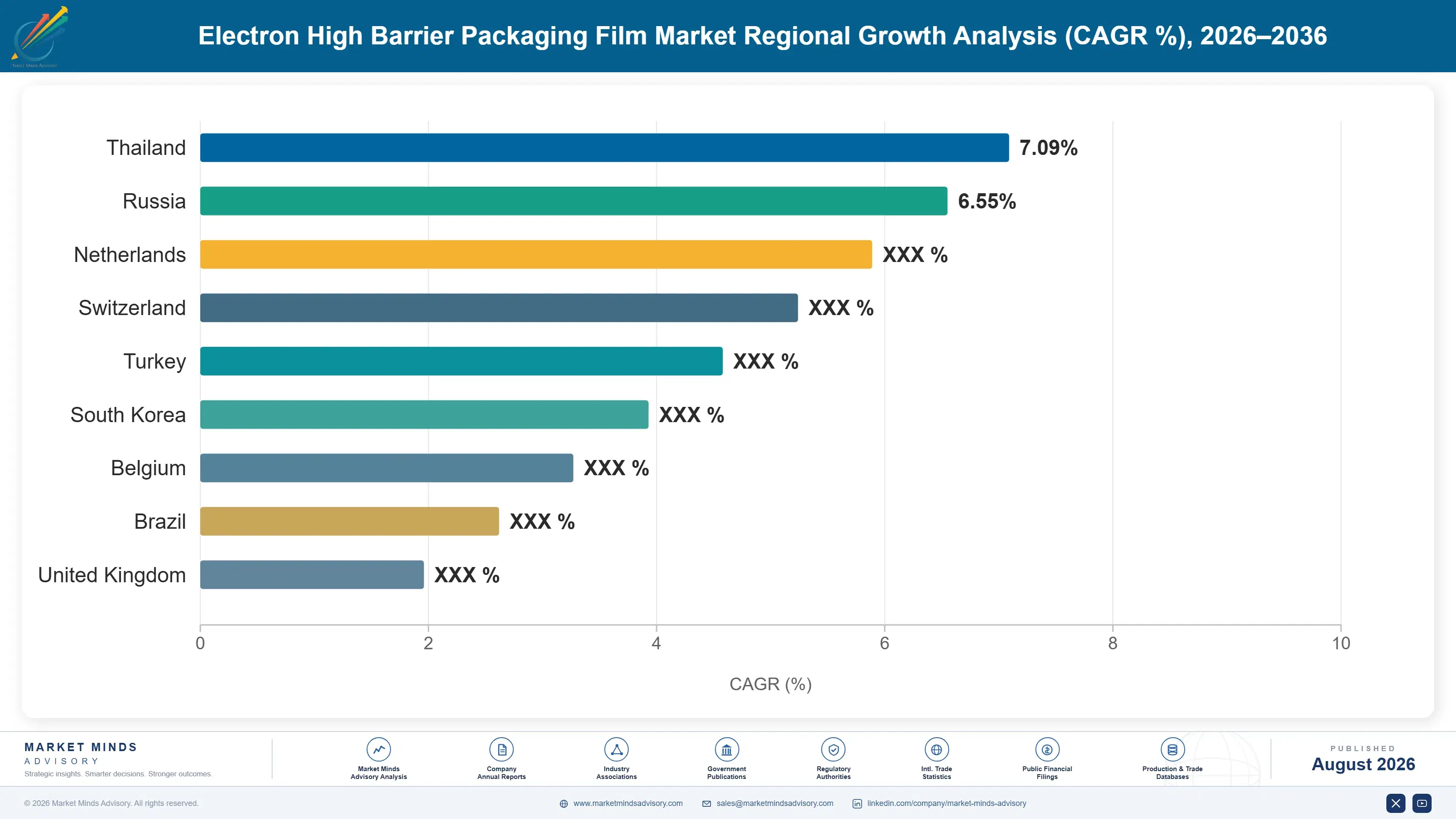
electron-high-barrier-packaging-film-market-country-cagr-analysis-1787307242883

Where Barrier Film Value Actually Sits

Nothing in this category beats aluminium foil on performance at foil's cost, so nobody wins by claiming to. Value comes from applications where regulation has priced foil out, from substrates that only certain curing routes can coat, and from qualification support that converts an eighteen-month obstacle into a relationship. Foil wins the technical argument permanently.

Sell against the fee schedule, not against foil performance

Barrier film at roughly 2.7 times conventional material loses a technical comparison with foil every time and wins a landed cost comparison wherever producer responsibility fees reach around $0.34 per kilogram. Procurement functions act on that number because it appears on an invoice annually and rises. Suppliers presenting total landed cost including fee exposure reported conversion roughly 45% higher than those presenting barrier performance data. The technical argument persuades packaging technologists who do not control the budget. Packaging technologists do not control the budget. Fee exposure appears annually and keeps rising.
Market Impact: Conversion roughly 45% higher on fe

Own the substrates thermal curing cannot handle

Mono-material designs require thin oriented polyolefin substrates that distort under thermal or ultraviolet curing, and electron beam curing generates almost no heat while running at commercial line speeds. That capability serves applications the alternatives simply cannot reach, which is a genuine technical position rather than a marginal advantage. The segment compounds at 12.2%, and beam equipment capital cost is what keeps the field narrow. Converters without that capability are excluded from the fastest-growing part of this market entirely. Capital cost keeps the competing field narrow. Mono-material substrates require exactly this capability.
Market Impact: Beam segment compounding at 12.2% i

Fund the qualification rather than waiting for it

Replacing a barrier structure requires shelf life studies, filling line trials and regulatory documentation running around 18 months, which brand owners resist starting without a compelling reason. Suppliers that fund and run the qualification work directly convert an obstacle into a relationship and reach specification before competitors are invited. Product launches and reformulations are the natural entry points, since qualification is happening anyway. Waiting to be asked means arriving after the structure has already been chosen by somebody else. Arriving afterward means the structure was chosen already. Reformulations are where the work gets funded anyway.
Market Impact: Qualification running 18 months for

Position on shelf life economics in unregulated markets

Where producer responsibility fees do not apply, recyclability carries no cost and the barrier argument has to stand on shelf life instead. Extension of several weeks reduces waste, widens distribution range and permits production consolidation, all of which brand owners quantify when asked properly. India compounds at 11.8% on performance requirements driven by heat and humidity rather than by any regulation at all. Suppliers leading with recyclability in those markets are answering a question nobody has asked them. Answering a question nobody asked wastes the conversation. Shelf life extension is quantifiable when brand owners are asked.
Market Impact: India compounding at 11.8% in every

Who Controls the Margin Pool

The top five hold 44% of the market measured on revenue from high barrier packaging film products, the basis used throughout this section. The structure is unusual because participants control different layers of the same stack: resin producers supply barrier polymers, film converters produce and coat substrates, and coating specialists hold deposition and curing technology. Amcor and Toppan lead through positions spanning more than one of those layers.
Competitive activity runs along three lines. Japanese producers are licensing and deploying oxide coating technology developed over decades into markets where recyclability regulation now creates demand for it. Converters are investing in electron beam capability to serve mono-material substrates that thermal curing cannot handle. And resin producers are developing barrier polymers designed to remain within single-polymer recycling streams rather than requiring lamination.

Pressure comes from two directions. Producer responsibility fees keep rising, which expands the addressable market for everybody and rewards whoever holds qualified structures when a brand owner converts. And qualification timelines mean incumbency in an existing pack is extremely durable. Rankings shift on who is specified during new product development, because that is when the eighteen-month barrier is being paid for anyway.
electron-high-barrier-packaging-film-market-company-positioning-matrix-1787307243601

Competitive Moat and Risk Dimensions

AMCOR

Moat: Converting scale across regions

Flexible packaging conversion capacity across many regions lets the company qualify a barrier structure once with a multinational brand owner and supply it wherever that brand fills, which regional converters cannot offer at all. Qualification taking around 18 months means a structure approved across several geographies simultaneously is worth considerably more than the same structure approved in one market alone.
AMCOR

Risk: Technology sourced rather than owned

Much of the underlying barrier coating and deposition technology is licensed or purchased rather than developed internally, which means the company competes on converting scale and customer relationships rather than on the technical position itself. If a coating technology confers genuine advantage, its owner captures value that a converter deploying it cannot fully retain over time.
TOPPAN HOLDINGS

Moat: Transparent barrier technology depth

Decades of development in transparent oxide barrier coating produced technology positions that competitors have struggled to replicate, particularly on adhesion and flex crack resistance where oxide coatings typically fail. That capability serves food applications requiring both barrier and product visibility, a combination foil cannot offer at any price and one that brand owners value directly at the shelf.
TOPPAN HOLDINGS

Risk: Vacuum deposition throughput limits

Oxide coating requires vacuum deposition with throughput constraints that limit how quickly capacity can expand against demand growth, and capital intensity is high. Coating routes that operate at atmospheric pressure and higher line speeds, including electron beam curing, may serve mono-material applications more economically even where barrier performance is somewhat lower.

Players Tracked

Prominent Players

Amcor
Toppan Holdings
Mitsubishi Chemical
Toray Industries
Constantia Flexibles

Other Key Players

Mondi
Berry Global
Sealed Air
Uflex
Jindal Poly Films
Cosmo Films
Taghleef Industries
Treofan
Innovia Films
Dai Nippon Printing
Kuraray
Celanese
Wipak
Sudpack
Huhtamaki Flexibles

Recent Developments

JANUARY 2022

Producer responsibility fees differentiate on recyclability

European extended producer responsibility schemes introduced fee modulation applying materially higher charges to unrecyclable multi-material packaging structures. These were regulatory fee mechanisms rather than any commercial development, and they converted recyclability from a corporate commitment into a cost line that procurement functions manage annually. Qualification programmes followed within months.
Signal: Regulation priced the whole problem, and q
APRIL 2023

Packaging regulation sets recyclability requirements by date

European packaging and packaging waste regulation advanced with recyclability requirements attached to specific implementation dates, giving brand owners a deadline rather than an aspiration. This was a legislative development rather than any technical or commercial event, and it converted conversion planning from optional into scheduled work.
Signal: A dated requirement forces the qualificati
SEPTEMBER 2024

Mono-material structures reach mainstream food applications

Major brand owners moved mono-material recyclable barrier structures from pilot into mainstream food packaging across multiple categories, having completed qualification programmes begun when fee differentials appeared. These were commercial deployment decisions rather than regulatory milestones, and they demonstrated the structures performing at commercial filling line speeds.
Signal: Mono-material moved from technically possi

What Actually Costs Money Here

Polymer resin and coating materials dominate, and both track petrochemical markets that no converter influences. Base film resins including polypropylene, polyethylene and polyester account for roughly 41% of cost of goods, purchased from petrochemical producers on contracts that reprice frequently. Barrier coating materials, whether oxide precursors, ethylene vinyl alcohol resin or curable formulations, add a further 17% at considerably higher cost per kilogram.
Polymer resin pricing moved sharply through 2021 and 2022 on energy and feedstock costs, and converters holding annual brand owner contracts absorbed the increase before repricing became possible. Flexible packaging sector reporting documented that margin compression clearly. Electricity for vacuum deposition and electron beam operation is also material, and European energy costs during the same period widened the cost gap against Asian converting capacity noticeably.

Exposure varies most by process route and by contract structure. Vacuum deposition carries high capital and energy intensity with throughput limits that make utilisation decisive. Electron beam curing carries substantial equipment capital and low running cost, which rewards volume once installed. Converters on fixed annual terms absorb resin movement entirely while index-linked clauses pass it through, and that difference decides profitability more than process choice does.
electron-high-barrier-packaging-film-market-cost-volatility-analysis-1787307243822

Index-linked resin clauses in converting contracts

Annual fixed-price terms through a resin cycle cost converters a full year of compressed margin with no recovery mechanism available. Index adjustment transfers that exposure, and brand owners increasingly accept it because they face comparable input volatility across their own ingredient and energy purchasing and recognise the structure without argument. Recognition of the structure comes quickly.

Utilisation discipline on vacuum deposition capacity

Oxide coating lines carry high capital and energy cost with limited throughput, which makes utilisation the dominant economic variable rather than material cost. Participants running deposition below capacity find the fixed cost per square metre rising sharply, and capacity commitments therefore need demand certainty that qualification timelines make difficult to obtain. Demand certainty is genuinely hard to obtain.

Qualification cost recovered through structure exclusivity

Funding an eighteen-month qualification programme for a brand owner is expensive and produces a structure that competitors can subsequently supply unless commercial terms prevent it. Negotiating supply exclusivity or extended terms as a condition of funding the work converts a cost into a defended position, and brand owners accept it more readily than converters expect.

Portfolio Architecture for Margin Defence

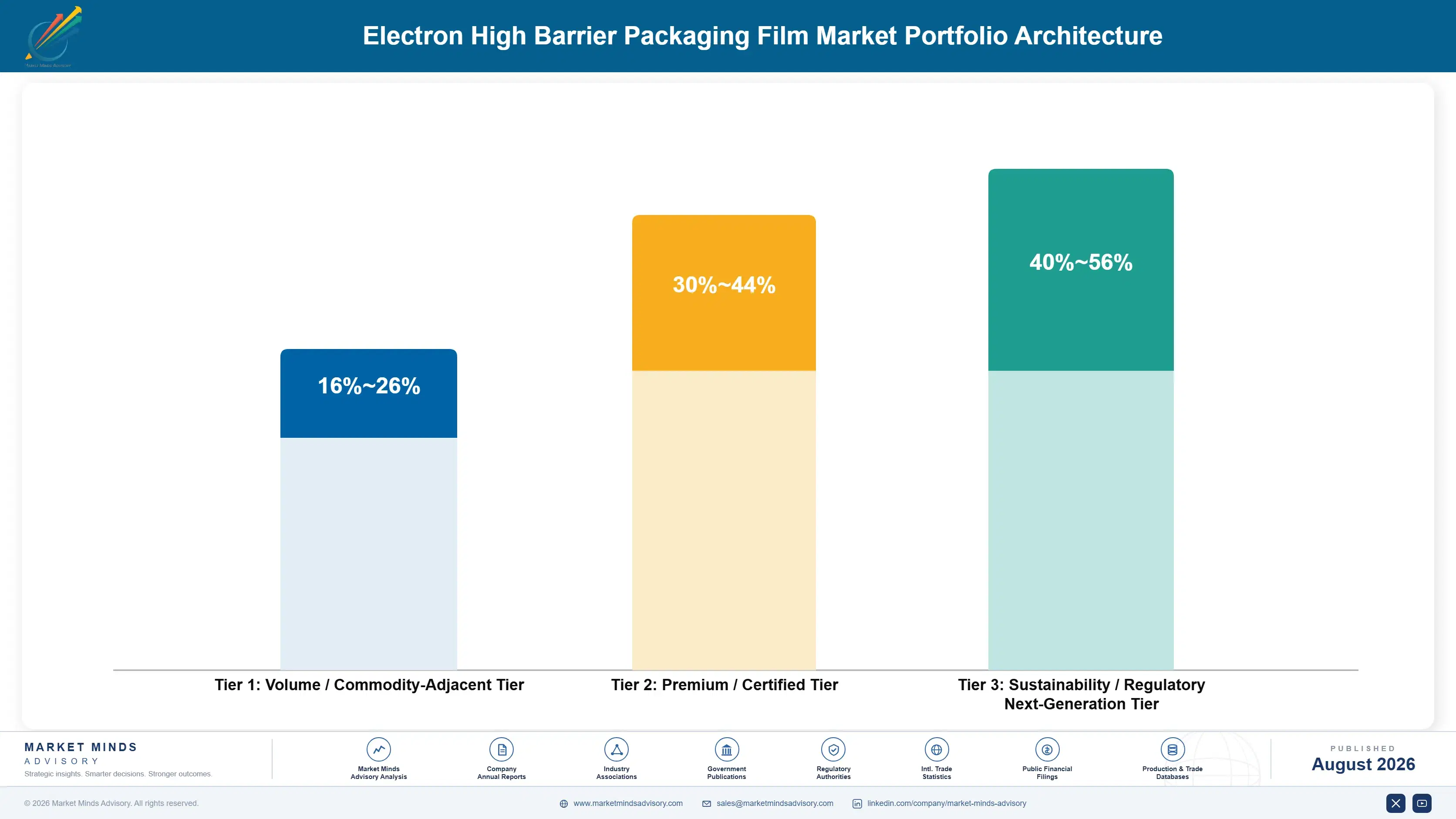
Margin architecture separates by whether a structure is qualified into a specific pack. Commodity metallised and coextruded films sold into general flexible packaging compete against every converter with comparable equipment and clear gross margins in the high teens. Structures qualified into a named brand owner's pack carry an eighteen-month switching barrier and clear roughly double, from lines that are frequently running the same base substrate.
The tension is between volume and qualification. Commodity barrier film fills converting lines, spreads equipment and energy overhead across the asset base and provides the technical credibility that qualification programmes rest on. It also earns very little. Qualified structures carry the margin and reach far fewer applications, and no converter has built a viable position on qualified work alone. Line utilisation is what makes qualified work viable at all.

High-value pools concentrate where a structure solves a problem the alternatives cannot. Electron beam coatings on heat-sensitive mono-material substrates, transparent oxide barriers where product visibility matters, and any structure qualified into a pack facing producer responsibility fee exposure all sit there. Everything competing on barrier performance per unit cost competes against aluminium foil, which wins that comparison permanently.

Volume / Commodity-Adjacent Tier

Metallised and standard coextruded barrier films sold into general flexible packaging where multiple converters hold comparable capability and delivered price decides awards across most tender processes. Nothing here is defensible for long.
Gross Margin: 16-26%

Premium / Certified Tier

Barrier structures qualified into named brand owner packs after shelf life and filling line validation, protected by an eighteen-month requalification barrier that brand owners will not undertake without cause. Reformulation is the only realistic entry point.
Gross Margin: 30-44%

Sustainability / Regulatory / Next-Generation Tier

Electron beam cured coatings on heat-sensitive substrates and mono-material recyclable structures, defended by curing equipment capability and by producer responsibility fee exposure that foil laminates cannot escape. Equipment capability narrows the competing field.
Gross Margin: 40-56%
electron-high-barrier-packaging-film-market-portfolio-architecture-1787307244382

High-value Sub-segments and Strategic Watch-out

Electron Beam Cured Barrier Coatings

High value and the fastest growth at 12.2%, serving thin polyolefin substrates that thermal curing distorts. Equipment capital keeps the field narrow, and converters without the capability are excluded from mono-material work entirely. Substrate compatibility decides participation. Solvent-free operation removes emissions handling too. Capital is the barrier.
Gross Margin: 40-56%

Transparent Oxide Coated Films

High value at 9.4%, delivering near-foil barrier with product visibility and microwave transparency that foil cannot offer. Vacuum throughput limits capacity expansion, and flex cracking remains the practical weakness suppliers must manage. Visibility is worth real money in food. Microwave transparency is a further advantage.
Gross Margin: 38-52%

Metallised Polymer Films

The volume core at 5.6%, filling converting lines and spreading equipment overhead across the asset base. Recyclability pressure is narrowing its applications steadily, and multiple converters produce comparable product at similar cost. Applications narrow every year under fee pressure. Overhead spreading is what it contributes.
Gross Margin: 16-26%

Mono-Material Recyclable Structures

The strategic watch-out at 11.0%. Regulatory tailwind is powerful and growing, but barrier performance within a single polymer family remains genuinely harder than laminating dissimilar materials ever was. Single-polymer barrier is genuinely harder than lamination. Regulatory tailwind is powerful and growing. Barrier physics remains unforgiving.
Gross Margin: 34-48%

Who Specifies and What Locks

Revenue here is durable once a structure is qualified, because replacing it means repeating around 18 months of shelf life studies, filling line trials and documentation that a brand owner will not undertake without a compelling reason. That makes qualified positions unusually defensible and displacement close to impossible outside a reformulation. It also means commercial effort spent on established packs is largely wasted, since those decisions were made and locked years earlier.
Lock-in depth varies by application sensitivity. Pharmaceutical and infant nutrition structures are the most locked, since regulatory documentation compounds the switching barrier considerably. Long shelf life food follows closely. Short shelf life and non-food applications are considerably looser, with converters switching on price where barrier requirements are modest and qualification is straightforward to repeat if necessary.

The specifying function has broadened in a way that changes commercial approach. Barrier structures were once chosen by packaging technologists on shelf life performance. They now involve procurement managing producer responsibility fee exposure, sustainability functions tracking recyclability commitments, and regulatory affairs assessing documentation. Converters selling technical performance to packaging technologists alone are addressing one of several people who now have to agree on the decision.
electron-high-barrier-packaging-film-market-end-use-penetration-index-1787307244903

Where Value Actually Sits

These are among the four positions where our research anticipates prominent divergence between winners and laggards over the coming forecast period. Each is grounded in the demand model, the regulatory perimeter, and the announced capacity pipeline.
01 / FEE EXPOSURE SELLING

Procurement acts on invoices, not on principles

Barrier film priced at roughly 2.7 times conventional material loses every technical comparison against aluminium foil and yet wins the landed cost comparison wherever producer responsibility fees reach around $0.34 per kilogram annually. Procurement functions act on that particular number because it appears on an invoice each year and keeps on rising steadily. Suppliers that present a total landed cost including fee exposure reported their conversion running roughly 45% higher than those presenting comparative barrier performance data instead of it.
02 / CURING ROUTE CAPABILITY

Thermal curing cannot touch mono-material substrates

Mono-material recyclable pack designs require thin oriented polyolefin substrates that distort or shrink under thermal and ultraviolet curing, which rules those routes out of the fastest-growing part of this market entirely. Electron beam curing generates almost no heat at all while running at full commercial converting line speeds, and the segment compounds at 12.2% on precisely that single capability. Beam equipment capital cost keeps the competing field narrow, and converters lacking that capability are simply excluded from mono-material work altogether.
03 / QUALIFICATION PROGRAMME FUNDING

Eighteen months is an obstacle or a relationship

Replacing a barrier structure demands shelf life studies, filling line machinability trials and regulatory documentation running around 18 months, which brand owners resist beginning without a genuinely compelling reason to do so. Suppliers that fund and run that qualification work themselves convert the obstacle into a durable relationship, and they reach specification before competitors are even invited to quote against them. Product launches and reformulations are therefore the natural entry points, since qualification work is happening at those moments regardless.
04 / UNREGULATED MARKET POSITIONING

Recyclability is worth nothing without a fee

Where producer responsibility fees do not yet apply, recyclability carries no cost whatsoever and the barrier argument then has to stand entirely on shelf life extension instead of on regulation. Extension of several weeks reduces food waste, widens distribution range and permits production consolidation into fewer plants, all of which brand owners quantify readily enough when they are asked properly. India compounds at 11.8% on performance requirements driven purely by heat, humidity and distribution distance rather than by any recyclability regulation whatsoever.

Engagement Snapshot From the Field

A live engagement with an industry participant carrying material or product regulatory and market exposure ahead of a defining policy shift, showing how our research translates into a defensible multi-year portfolio strategy.
MARKET MINDS ADVISORY · CLIENT ENGAGEMENT SUMMARY
Electron High Barrier Packaging Film Producer Strategic Portfolio Review and Transition Roadmap 2026·Investment Scenario on Electron High Barrier Packaging Film Exposure Evaluation 2025-26
CLIENT PROFILE
A flexible packaging converter with annual revenue near $720 million (client-reported, unverified by MMA), operating film conversion and lamination capacity across four European plants serving food and personal care brand owners. Leadership faced a capital decision between vacuum oxide deposition and electron beam curing capability, and internal analysis had produced conflicting recommendations from the technical and commercial teams.
STRATEGIC CHALLENGE
The technical team favoured oxide deposition on barrier performance grounds while commercial leadership suspected that mono-material qualification demand mattered more than absolute barrier numbers. The company could fund one route properly and needed to know which applications each would reach, and how brand owner specification behaviour was actually changing under producer responsibility fees.
MMA APPROACH
We analysed 140 brand owner packaging specifications issued over three years to track how barrier and recyclability requirements were changing. Thirty-one packaging technologists, procurement managers and sustainability leads were interviewed on how structures are now selected. We modelled both capital routes against addressable application volume and qualification pipeline over five years.
KEY FINDINGS
  1. Recyclability requirements appeared in 71% of specifications issued in the final year examined against 24% at the start, and most now named single-polymer structures explicitly.
  2. Procurement managers described producer responsibility fee exposure as the deciding factor in 19 of 31 interviews, while packaging technologists ranked barrier performance first in almost all of them.
  3. Mono-material substrates in the client's target applications were predominantly thin oriented polypropylene, which thermal and ultraviolet curing routes handled poorly and electron beam handled well.
  4. Oxide deposition reached higher barrier performance but served fewer of the applications the client's customers were actually converting, and its throughput constrained the volumes involved.
CLIENT PROFILE
A flexible packaging converter with annual revenue near $720 million (client-reported, unverified by MMA), operating film conversion and lamination capacity across four European plants serving food and personal care brand owners. Leadership faced a capital decision between vacuum oxide deposition and electron beam curing capability, and internal analysis had produced conflicting recommendations from the technical and commercial teams.
STRATEGIC CHALLENGE
The technical team favoured oxide deposition on barrier performance grounds while commercial leadership suspected that mono-material qualification demand mattered more than absolute barrier numbers. The company could fund one route properly and needed to know which applications each would reach, and how brand owner specification behaviour was actually changing under producer responsibility fees.
MMA APPROACH
We analysed 140 brand owner packaging specifications issued over three years to track how barrier and recyclability requirements were changing. Thirty-one packaging technologists, procurement managers and sustainability leads were interviewed on how structures are now selected. We modelled both capital routes against addressable application volume and qualification pipeline over five years.
KEY FINDINGS
  1. Recyclability requirements appeared in 71% of specifications issued in the final year examined against 24% at the start, and most now named single-polymer structures explicitly.
  2. Procurement managers described producer responsibility fee exposure as the deciding factor in 19 of 31 interviews, while packaging technologists ranked barrier performance first in almost all of them.
  3. Mono-material substrates in the client's target applications were predominantly thin oriented polypropylene, which thermal and ultraviolet curing routes handled poorly and electron beam handled well.
  4. Oxide deposition reached higher barrier performance but served fewer of the applications the client's customers were actually converting, and its throughput constrained the volumes involved.
RECOMMENDED STRATEGY
Phase 1: Phase one: invest in electron beam curing capability rather than vacuum deposition, since substrate compatibility matters more than absolute barrier in the target applications. Phase 2: Phase two: fund qualification programmes directly for three major brand owners, converting the eighteen-month obstacle into specified positions ahead of competitors. Phase 3: Phase three: negotiate index-linked resin terms and structure exclusivity as a condition of funding qualification work for any customer. Exclusivity converts cost into position.
OUTCOME
Electron beam capability was commissioned within fourteen months and qualified into two brand owner structures during the first year (client-reported, unverified by MMA). Vacuum deposition investment was deferred indefinitely. Structure exclusivity was agreed on both qualified programmes, and index-linked terms now cover roughly half the customer base.

Frequently Asked Questions

Foundational context covering the market sizes, CAGR, scope, country, region and competition that inform every finding below. This section is provided to cover basics and most often pre-purchase conversations, answered from the MMA Primary Research Dataset.

What is the current size of the Electron High Barrier Packaging Film Market?

The global market is valued at $6.8 billion in 2025, rising to $7.35 billion in 2026. East Asia holds the largest share at 33%, reflecting Japanese and Chinese film conversion capacity.

How large will the Electron High Barrier Packaging Film Market be by 2036?

MMA forecasts $16.02 billion by 2036, an increase of $8.67 billion over the 2026 base and an expansion multiple of 2.18x. Mono-material conversion carries most of that growth.

What is the CAGR for the Electron High Barrier Packaging Film Market 2026 to 2036?

The base case compound annual growth rate is 8.1%, with a bull case at 9.3% and a bear case at 6.9%. Historical growth from 2020 to 2025 ran near 6.9%, driven by regulation rather than technology.

Which segment is growing fastest?

Electron beam cured barrier coatings compound at 12.2%, a full 1.50x the market rate. Curing without heat allows barrier layers on thin oriented films that thermal processes would distort.

Who are the major companies in the Electron High Barrier Packaging Film Market?

Amcor, Toppan Holdings, Mitsubishi Chemical, Toray Industries and Constantia Flexibles together hold 44% of high barrier film revenue. Each controls a different layer of the same material stack.

Which country is growing fastest?

India compounds at 11.8%, faster than any other country covered, as flexible packaging conversion expands alongside packaged food consumption. Barrier demand there is driven by heat and humidity rather than recyclability regulation.

Report Segmentation Architecture

The full report scope spans multiple orthogonal segmentation dimensions, with cross-tabulated demand data provided for each dimension pair. Coverage extends further to regional breakdowns, trend trajectories, and the competitive detail needed to support segment-level decision-making.

By Barrier Structure Class

  • Electron Beam Cured Barrier Coatings
  • Transparent Oxide Coated Films
  • Ethylene Vinyl Alcohol Coextruded Structures
  • Metallised Polymer Films
  • Mono-Material Recyclable Barrier Structures

By End-Use Industry

  • Packaged Food and Confectionery
  • Pharmaceutical and Medical Packaging
  • Pet Food and Animal Nutrition
  • Personal Care and Household Products
  • Coffee, Tea and Beverage Powders
  • Industrial and Agricultural Packaging

By Commercial Dimension

  • Brand Owner Specified Supply
  • Converter Direct Film Sales
  • Contract Coating and Toll Conversion
  • Distributor and Trader Channels
  • Technology Licensing Arrangements
  • Export and Regional Supply

By Region

  • East Asia
  • North America
  • Western Europe
  • South Asia and Pacific
  • Latin America
  • Middle East and Africa
  • Eastern Europe

Scope, Methodology, and Coverage

Every figure in this report is reproducible from documented input assumptions. The scope below maps the historical period, the forecast horizon, the segmentation dimensions, and the countries covered, alongside the underlying primary and qualitative methodology.
Historical Period
2020 to 2025
Forecast Period
2026 to 2036
Base Year
2025 (USD billions; MMA Primary Research Dataset, August 2026)
Market Definition
This market comprises polymer films engineered to restrict oxygen, moisture, aroma or light transmission for packaging applications, measured at producer revenue across brand owner specified supply, converter direct film sales, contract coating and toll conversion, distributor and trader channels, technology licensing arrangements, and export or regional supply. Coverage spans electron beam cured barrier coatings applied to polymer substrates, transparent oxide coated films using silicon oxide or aluminium oxide vacuum deposition, ethylene vinyl alcohol and polyamide coextruded barrier structures, metallised polymer films produced by vacuum aluminium deposition, and mono-material recyclable barrier structures designed to remain within a single polymer recycling stream. Aluminium foil and foil-containing laminates, rigid barrier containers including bottles, trays and closures, glass and metal packaging of every form, coating, deposition and curing equipment sold as capital goods, adhesives, inks, primers and lacquers supplied independently of the film, and paper-based barrier substrates without a polymer barrier layer fall outside scope.
Quantitative Units
USD millions (current prices); tonnes shipped by structure class; square metres converted; price premium against conventional film; oxygen transmission performance; mono-material share of structures; qualification cycle length
Segmentation Dimensions
By Barrier Structure Class; By End-Use Industry; By Commercial Dimension; By Region
Regions Covered
East Asia, North America, Western Europe, South Asia and Pacific, Latin America, Middle East and Africa, Eastern Europe
Countries Covered
Japan, China, South Korea, Taiwan, United States, Canada, Mexico, Germany, Italy, France, United Kingdom, Spain, Netherlands, Belgium, Switzerland, India, Australia, Thailand, Indonesia, Vietnam, Malaysia, Brazil, Argentina, Colombia, Chile, Saudi Arabia, United Arab Emirates, Egypt, South Africa, Poland, Turkey, Czechia, Hungary, Romania, and additional markets relevant to flexible packaging analysis
Key Companies Profiled
Amcor, Toppan Holdings, Mitsubishi Chemical, Toray Industries, Constantia Flexibles, Mondi, Berry Global, Sealed Air, Uflex, Jindal Poly Films, Cosmo Films, Taghleef Industries, Treofan, Innovia Films, Dai Nippon Printing, Kuraray, Celanese, Wipak, Sudpack, Huhtamaki Flexibles
Quantitative Methodology
Primary survey, n=3,800 respondents, Q4 2025, six countries; demand-side model with trade association cross-validation
Qualitative Methodology
47 expert interviews, Q4 2025; applied to validate demand model assumptions, identify emerging dynamics, and assess competitive positioning
Report Format
PDF and XLSX data workbook (Word format preview document)
Publisher
Market Minds Advisory
Report Code
MMA-2026-PAC-577
Published
August 2026
Contact
sales@marketmindsadvisory.com | www.marketmindsadvisory.com

Purchase the full Electron High Barrier Packaging Film Market Report (2026 to 2036).

The full MMA report treats aluminium foil as the benchmark nothing beats on cost and explains why substitution is happening anyway, tracing producer responsibility fees through specification and qualification behaviour. It sizes five structure classes and seven regions to 2036, modelling tonnes shipped, square metres converted, pricing premiums, barrier performance, mono-material share and qualification timelines separately. Competitive assessment covers twenty participants on one consistent revenue basis. Cost exposure is traced through resin, coating materials and energy. Four commercial levers and a strategic verdict close the report, grounded in 47 expert interviews and a 3,800-respondent survey.
Five barrier structure classes sized separately through 2036
Producer responsibility fee schedules mapped across covered jurisdictions
Brand owner specification changes tracked across three years of documents
Twenty participants assessed on one consistent revenue basis
Curing route capability matched against mono-material substrate requirements
Anonymised converter engagement with tested capital investment recommendations

Built For The People Who Decide

From boardroom strategy to bench-side execution, this report is read cover-to-cover by leaders shaping the next decade of their industry, turning demand scenarios, market dynamics and valuation benchmarks into decisions.
CXOs/ Presidents/ VPs/ Managers
M&A and Corporate Development
Strategy Teams and R&D Heads
Procurement and Product Directors
Regulatory and Compliance Leaders
Investor Relations and Equity Analysts