Market Minds Advisory
Electrically Conductive Coating Market

Electrically Conductive Coating Market: Electrically Conductive Coating Market. EMI Shielding Demand Drives Materials Shift

Electronics manufacturers are specifying conductive coatings for EMI shielding and static dissipation as device miniaturization shrinks tolerance for signal interference, since traditional metal shielding cannot match coating flexibility on increasingly complex enclosure geometries.

Lead Analyst

Published

September 2026

Make Smarter Decisions with Customized Research Insights

Request a free sample report and evaluate market opportunities, growth trends, and competitive dynamics relevant to your business needs.

2025 MARKET VALUE$3.2BMarket Size 2025
2036 FORECAST VALUE$7.1BBase Case , 2026 to 2036
CAGR 2026 TO 20367.5 %Bull 8.7% / Bear 6.3%
INCREMENTAL OPPORTUNITY$3.6BNet 10- year value creation
EXPANSION MULTIPLE2.06x2036 value over 2026 base
Strategic Levers
M&A Pipeline
Regional Outlook
Country Rankings
Competitive Intelligence
Segmental Deep-dive
Call-Us : 91 93563 13602

Executive Snapshot and Market Trajectory.

Electrically conductive coatings have shifted from a niche EMI shielding specialty into a mainstream electronics manufacturing input, as 5G device density and automotive electrification multiply the number of enclosures requiring interference protection simultaneously across every product category shipped today worldwide and across every price tier and market segment today.
Electronics and automotive manufacturing drive fastest demand, since 5G infrastructure density and electric vehicle power electronics both multiply the number of enclosures requiring EMI shielding within a single product line and vehicle platform simultaneously. East Asia leads production and consumption given its concentrated electronics manufacturing base, while formulators increasingly shift toward silver and copper hybrid formulations balancing conductivity against raw material cost volatility across every supplier relationship and contract renewal cycle.
A moderately fragmented group of specialty coating formulators competes alongside larger chemical conglomerates entering through acquisition, while raw material sourcing for silver and copper particles increasingly determines competitive cost position across the industry supply chain and its many procurement tiers. Environmental regulation on volatile organic compound content continues to reshape which formulations can realistically compete in regulated jurisdictions, favoring water-based systems over legacy solvent-based alternatives.
Market Definition
The electrically conductive coating market covers coating formulations applying conductive particle fillers, including silver, copper, nickel, and carbon-based materials, to substrates for EMI shielding, static dissipation, and grounding applications. It excludes bulk conductive adhesives and non-coating conductive inks used in printed electronics.
Base Year Value
$3.2B in 2025 (MMA Primary Research Dataset, September 2026)
Forecast Period
2026 to 2036, eleven discrete annual values
CAGR
7.5% base case. Bull 8.7%. Bear 6.3%.
Fastest Growth Segment
Silver-Based Conductive Coatings: 10.5% CAGR
Fastest Growth Country
China: 9.5% CAGR
Fastest Growth Region
South Asia and Pacific: 9.5% CAGR
Largest Region
East Asia: 30% of 2025 global value
Market Leaders
PPG Industries, Henkel, Parker Chomerics, MG Chemicals, Chase Corporation
Primary Survey
n=3,800 procurement and R&D decision-makers, Q4 2025, six countries
Methodology
Demand-side build-up, cross-validated against public data, 47 expert interviews

Electrically Conductive Coating Market Forecast Scenarios

electrically-conductive-coating-market-size-forecast-scenario-1789984282726
Conductive coating demand grew steadily between 2020 and 2025 as 5G infrastructure buildout and electric vehicle production ramps expanded the addressable enclosure count requiring EMI shielding, with semiconductor supply chain disruption periodically constraining formulator access to silver and copper particle inputs throughout the entire period. Historical growth reflected supply constraint as much as underlying demand strength.
Base-case growth through 2036 reflects three commercial mechanisms operating together: continued electric vehicle power electronics adoption requiring extensive EMI shielding across battery management and inverter enclosures, expanding 5G and eventual 6G infrastructure density multiplying the number of shielded enclosures per network deployment nationwide and internationally, and formulators shifting toward hybrid silver-copper formulations that balance conductivity performance against raw material cost exposure. Environmental regulation is also pushing adoption of water-based formulations across regulated jurisdictions.
The bull case centers on accelerated electric vehicle production ramping demand for power electronics shielding well beyond current forecast assumptions already built into the base case scenario entirely and consistently. The bear case centers on prolonged silver price volatility forcing formulators toward lower-performance alternatives, which would compress premium segment growth across affected automotive and electronics customers alike.

Where EMI Shielding Meets Raw Material Cost Pressure

Conductive coating formulation sits at the intersection of materials science and precious metal commodity exposure, a combination that makes formulators simultaneously chemistry companies and metal price risk managers navigating volatile input markets on a daily basis. This dual identity increasingly shapes which formulators can sustain margin through raw material volatility cycles that periodically compress the entire industry's profitability.
MARKET CONCENTRATIONCR5 42%Share held by top five coating formulators globally
AVERAGE SELLING PRICE$85 per kilogramTypical price for a standard conductive coating formulation
TOP PRODUCING COUNTRY SHAREChina 32%Share of global conductive coating manufacturing output produced
SILVER INPUT COST SHARE48%Share of formulation cost attributable to silver filler content
TRADE INTENSITY58%Share of coating output exported outside country of manufacture
REFORMULATION CYCLE LENGTH5 to 7 yearsTypical interval before customers requalify a new formulation
Formulators compete primarily on filler particle sourcing relationships and application process compatibility with customer manufacturing lines, since a formulation that requires different spray or dip equipment than a customer already owns faces a meaningfully harder adoption path into new accounts and existing production lines. Channel relationships with equipment manufacturers remain decisive for reaching mid-sized customers directly, since most smaller manufacturers still buy coating chemistry through a trusted equipment supplier relationship.
Environmental regulation on volatile organic compound content continues to reshape formulation chemistry, favoring water-based systems over legacy solvent-based alternatives in regulated jurisdictions including the European Union and California specifically today. This regulatory pressure favors established formulators with existing water-based product lines over smaller specialists still running solvent-based chemistry that faces mounting compliance cost and eventual phase-out pressure.
"Everyone talks about the chemistry. The real conversation in this industry happens in the silver futures market, and formulators who ignore that conversation do not stay formulators for long."
Senior Analyst, Specialty Materials Practice · MMA Electrically Conductive Coating Materials Practice · September 2026

Market Trends

Silver-Copper Hybrid Formulations Displacing Pure Silver Coatings

Formulators are increasingly blending copper particles into traditionally silver-only conductive coatings, capturing most of silver's conductivity performance while meaningfully reducing raw material cost exposure to silver price spikes that have periodically compressed formulator margins across the entire industry supply chain and customer base. PPG and Henkel have both launched hybrid formulations specifically targeting cost-sensitive automotive customers who previously accepted lower-performance nickel alternatives rather than paying pure silver pricing at full market rates. Adoption has grown steadily as hybrid formulations demonstrate comparable durability in accelerated aging tests conducted by independent laboratories worldwide.
Market Impact: EV shielding demand grows 40 percent

Water-Based Formulation Adoption Accelerating Under VOC Regulation

Regulatory pressure on volatile organic compound emissions is pushing formulators to replace legacy solvent-based conductive coatings with water-based alternatives, particularly across European Union and California manufacturing operations subject to increasingly strict air quality permitting requirements and stepped-up enforcement actions taken quite recently. This transition requires meaningful reformulation investment, since water-based systems behave differently during application and curing than solvent-based chemistry customers have relied on for decades of manufacturing experience and process design across every plant. Chase Corporation and MG Chemicals have both expanded water-based product lines specifically to meet this shift.
Market Impact: Small cell density up 60 percent

Market Opportunities and Growth Drivers

Electric Vehicle Power Electronics Driving Shielding Demand

Electric vehicle battery management systems, inverters, and onboard chargers all generate high-frequency electromagnetic interference that requires extensive conductive coating shielding across dozens of enclosures per vehicle, a requirement gasoline vehicles never faced at comparable scale or intensity level whatsoever. Each additional electric vehicle produced represents meaningfully more conductive coating demand than a comparable internal combustion vehicle, since power electronics density continues rising as automakers pursue faster charging and higher power density across every new model line. Coating formulators supplying automotive customers report meaningfully higher volume growth than industrial customers currently.
Market Impact: Silver prices swung 35 percent

5G Small Cell Density Multiplying Shielded Enclosure Count

5G network densification requires far more small cell installations per square kilometer than prior generation networks, and each small cell enclosure requires EMI shielding to prevent interference between densely packed radio equipment operating in close proximity to neighboring cells, towers, rooftop antennas, and street furniture nationwide. This densification has meaningfully expanded the addressable enclosure count per network deployment well beyond what 4G infrastructure ever required at comparable coverage area and density levels. Telecom equipment manufacturers increasingly specify conductive coating shielding as a standard requirement rather than an optional upgrade path.
Market Impact: Adds 3 to 5 months

Market Restraints and Challenges

Silver Price Volatility Compressing Formulator Margins

Silver spot prices have swung considerably over the past several years driven by investment demand and industrial consumption from solar panel manufacturing competing for the same metal supply, a friction point rooted in silver's dual role as both an industrial input and an investment asset traded on commodity exchanges worldwide. This volatility makes it genuinely difficult for formulators to offer customers stable long-term pricing, since raw material cost can shift meaningfully between contract negotiation and delivery. Several formulators now offer index-linked pricing contracts that pass volatility through directly to customers.
Market Impact: Hybrid formulations now exceed 30 percent

Application Equipment Requalification Slowing Formulation Switching

Customers switching to a new conductive coating formulation must typically requalify their entire application process, including spray equipment calibration and cure oven temperature profiles, a friction point rooted in the reality that coating chemistry and application equipment are tightly interdependent systems that cannot easily be changed independently or in isolation from one another. This requalification requirement meaningfully slows formulation switching even when a competing product offers genuinely better performance or cost, since the switching cost often exceeds any near-term savings realized. Several formulators now offer on-site requalification support to shorten this delay.
Market Impact: VOC-compliant coatings exceed 45 percent share
3 additional market trends, 4 additional growth drivers, and 2 additional restraints and challenges are covered in the full report. Contact sales@marketmindsadvisory.com to access the complete intelligence.

Segment CAGR and Growth Architecture

Electrically conductive coating segments by conductive filler material, spanning silver-based coatings, copper-based coatings, silver-copper hybrid coatings, nickel-based coatings, carbon and graphite-based coatings, and specialty conductive polymer coatings, each addressing a genuinely distinct conductivity-to-cost tradeoff that customers select based on their specific application requirements, budget constraints, and long-term reliability expectations across their supply chain today.
electrically-conductive-coating-market-market-share-analysis-1789984283267

Silver-Based Conductive Coatings

Silver-based conductive coatings deliver the highest available conductivity performance among commercially available formulations, making them the preferred choice for demanding aerospace, defense, and high-frequency 5G applications where signal integrity requirements leave little margin for compromise on shielding effectiveness or reliability over the entire product lifetime and well beyond it entirely. Growth reflects rising 5G infrastructure density and electric vehicle power electronics adoption, both of which specify silver-based formulations for their highest-performance shielding applications despite the meaningful cost premium involved in sourcing and formulation. PPG and Parker Chomerics have both expanded silver-based product lines specifically to serve this premium demand segment worldwide and across every qualified customer account they maintain today.
CAGR 10.5%

Silver-Copper Hybrid Coatings

Silver-copper hybrid coatings blend both metals to capture most of silver's conductivity performance while meaningfully reducing raw material cost exposure to silver price volatility that has periodically compressed formulator margins across the entire industry supply chain and customer base worldwide today and consistently over a long period of time. Growth reflects rapid adoption among cost-sensitive automotive and consumer electronics customers who previously accepted lower-performance nickel alternatives rather than paying full silver pricing for adequate shielding performance at scale across every production line they operate globally and reliably each year. Henkel and MG Chemicals have both expanded hybrid formulation capability specifically to capture this fast-growing cost-conscious demand segment nationwide and internationally today.
CAGR 9.5%
Full segment breakdown across 6 segments available in the complete report.

Regional Architecture and Country Demand Map

Conductive coating demand tracks the geography of electronics and automotive manufacturing, since coatings are typically applied close to final assembly rather than shipped as finished components, making regional manufacturing footprint the single dominant driver of consumption patterns across every market segment, product category, and price tier.

East Asia

East Asia holds the largest regional share, anchored by China, Japan, South Korea, and Taiwan's concentrated electronics manufacturing base, which together produces the majority of the world's consumer electronics, telecommunications equipment, and semiconductor packaging requiring EMI shielding at meaningful scale across every product category, price tier, and manufacturing application. China's rapidly expanding electric vehicle production adds further demand concentration, since domestic automakers increasingly specify conductive coating shielding for battery management and power electronics enclosures across every new model line introduced each year without exception whatsoever. Local formulators including specialty Chinese chemical companies have expanded capacity specifically to serve this concentrated regional demand consistently across every region served nationwide today indeed.
Share: 30% | CAGR: 8.5% (2026 to 2036)

North America

North America's substantial share reflects concentrated automotive electrification investment and defense electronics manufacturing, both of which specify premium silver-based conductive coatings for high-reliability applications where signal integrity requirements leave little room for compromise or failure of any kind whatsoever at any time. PPG and Chase Corporation both maintain primary formulation and manufacturing operations domestically, giving customers faster technical support during application process qualification cycles across their multiple facilities and regional offices nationwide. Federal incentive programs supporting domestic semiconductor manufacturing additionally reinforce regional demand for conductive shielding materials across the entire supply chain consistently and reliably across every regional office maintained and every single facility nationwide today as a matter of course.
Share: 24% | CAGR: 8.0% (2026 to 2036)
Regional intelligence for 5 additional markets available in the complete report: Western Europe, South Asia and Pacific, Latin America, Middle East and Africa, Eastern Europe. Contact sales@marketmindsadvisory.com.
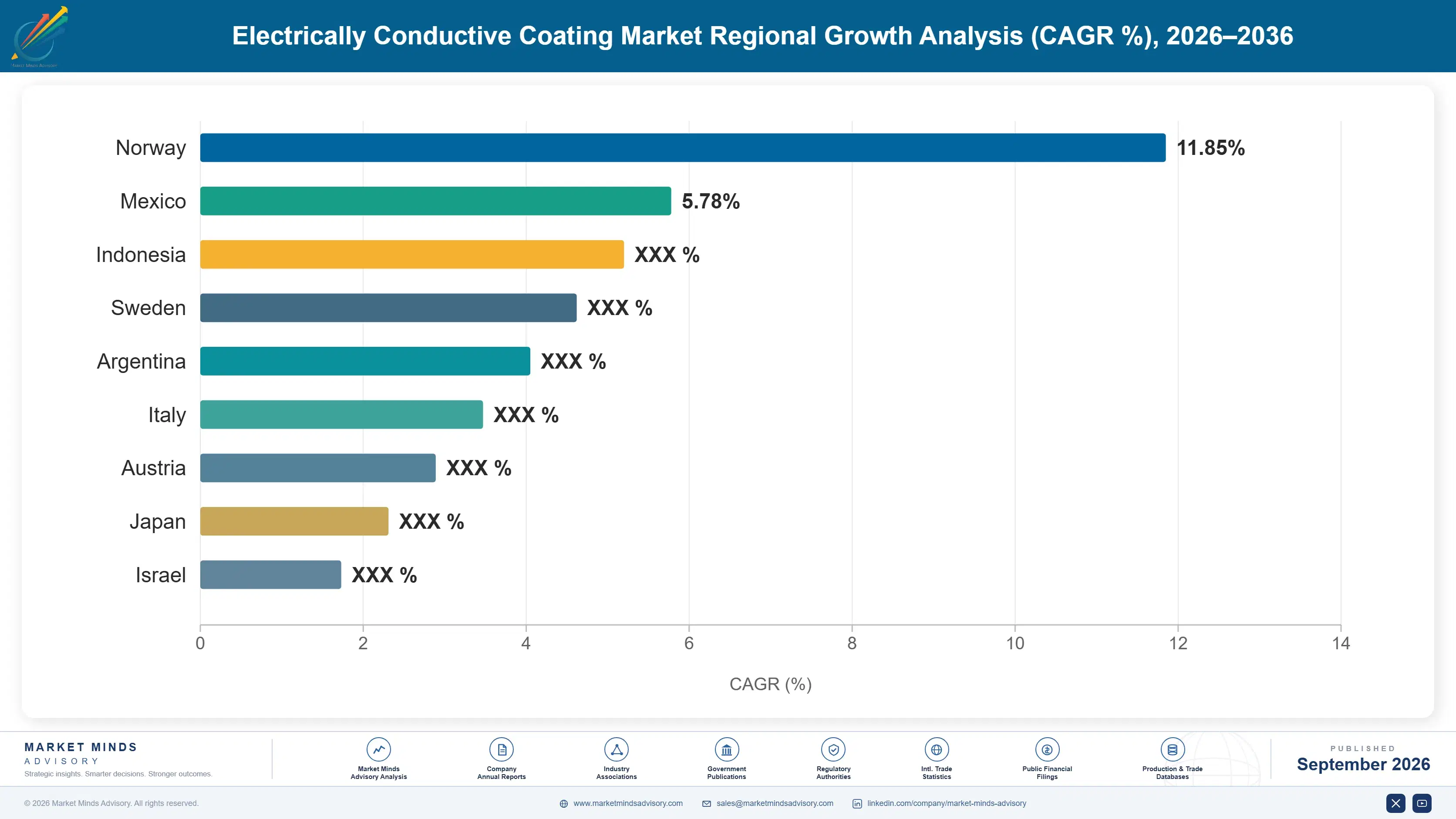
electrically-conductive-coating-market-country-cagr-analysis-1789984283822

Turning Formulation Chemistry Into Margin Advantage

Formulators are extending revenue beyond baseline per-kilogram coating pricing into premium performance formulations, technical application support services, and index-linked pricing contracts, capturing more value per customer account as raw material volatility and evolving shielding requirements continue reshaping the industry landscape everywhere across every geography, customer segment, application, end market, and price tier served today.

Premium High-Performance Formulation Pricing Tier Strategy

Formulators including PPG and Parker Chomerics have introduced premium formulation tiers commanding meaningfully higher pricing for applications requiring the highest available shielding effectiveness, particularly aerospace and defense customers who prioritize performance over cost considerations that dominate consumer electronics purchasing decisions more broadly across every qualified account they currently maintain, service, and support directly and reliably. These premium formulations now generate roughly 25 to 30 percent higher margin than standard formulations sold to less demanding industrial customers. Adoption has grown steadily as customers recognize performance differentiation justifies the premium price paid.
Market Impact: Premium formulations add 25 to 30 percent margin

Technical Application Support Services Attached To Contracts

Formulators increasingly bundle technical application support services, including on-site spray equipment calibration and cure process optimization, directly into new formulation supply contracts rather than leaving customers to self-manage the requalification process entirely on their own without any assistance whatsoever from the supplying vendor directly or indirectly. This support services attach has generated meaningful incremental revenue per customer account, with some formulators reporting service revenue equal to roughly 15 to 20 percent of the underlying formulation contract value. Customers value the reduced production disruption risk this support delivers throughout the process.
Market Impact: Support services add 15 to 20 percent revenue

Index-Linked Pricing Contracts Passing Through Volatility

Formulators have introduced index-linked pricing contracts tied directly to silver and copper commodity benchmarks, passing raw material price volatility through to customers rather than absorbing margin compression during price spikes that have historically squeezed formulator profitability quite considerably over time and across multiple successive commodity cycles endured industry-wide and globally. This pricing structure has meaningfully stabilized formulator margins across volatile commodity cycles, with adopting formulators reporting margin volatility reduced by roughly 20 to 25 percent compared with fixed pricing contracts. Customers accept this trade-off for improved supply reliability and predictability.
Market Impact: Reduces margin volatility 20 to 25 percent overall

Multi-Year Supply Agreements Locking In Customer Retention

Formulators are increasingly offering meaningful multi-year supply agreement discounts, typically 8 to 12 percent off standard annual pricing, to lock customers into longer commitment terms and reduce the requalification risk that switching to a competing formulator entails for both contracting parties involved in the negotiated relationship established over multiple years. This approach trades near-term revenue discount for greater customer lifetime value certainty, since a multi-year commitment substantially reduces the probability a customer evaluates competing formulators before their contract naturally expires. Larger industrial accounts have proven most receptive to this trade-off.
Market Impact: Multi-year agreements save 8 to 12 percent overall

Who Controls the Margin Pool

The electrically conductive coating market remains moderately fragmented on a revenue basis, with the top five formulators holding an estimated 42 percent combined share while dozens of specialty regional formulators compete for the remainder. PPG and Henkel lead on installed customer relationships, but the gap to third-place Parker Chomerics and fourth-place MG Chemicals has narrowed as formulation performance parity increases.
Current competitive activity centers on hybrid formulation development and water-based chemistry transition, with formulators racing to demonstrate cost-competitive performance that matches or exceeds pure silver formulations. Chase Corporation has expanded its hybrid formulation capability specifically to compete against PPG and Henkel in the automotive segment, while MG Chemicals continues investing in application equipment compatibility to capture mid-market customers before larger rivals establish reference accounts.

Emerging pressure comes from specialty Chinese chemical manufacturers backed by domestic electronics manufacturing scale, several of which have already displaced established formulators in discrete regional supply deals despite lacking broad global distribution reach and brand recognition. Rankings are most likely to shift in water-based formulation chemistry, where regulatory-native challengers can compete on comparable footing against established incumbents carrying legacy solvent-based product portfolios.
electrically-conductive-coating-market-company-positioning-matrix-1789984284346

Competitive Moat and Risk Dimensions

PPG INDUSTRIES

Moat: Broad Coatings Portfolio Depth

PPG uses its position as one of the industry's broadest coatings suppliers to bundle conductive coating sales alongside other protective and decorative coating products within the same customer contract, giving it cross-selling reach that specialty conductive-only competitors cannot easily replicate across large industrial accounts and long-term relationships.
PPG INDUSTRIES

Risk: Silver Price Exposure Concentration

PPG's premium silver-based formulation portfolio carries meaningful exposure to silver commodity price volatility, and competitors offering hybrid or copper-based alternatives increasingly win cost-sensitive customer evaluations that PPG's premium positioning struggles to match on price alone in competitive bidding situations across most industrial accounts served today.
HENKEL

Moat: Water-Based Chemistry Leadership

Henkel invested early in water-based conductive coating formulation chemistry ahead of tightening European environmental regulation, giving it a genuine technical head start that competitors scrambling to reformulate under regulatory pressure now must close through accelerated and costly development programs of their own design and testing.
HENKEL

Risk: Limited Asian Manufacturing Footprint

Henkel's manufacturing footprint remains more concentrated in Europe relative to Asian competitors positioned closer to the world's largest electronics manufacturing base, creating a logistics and responsiveness disadvantage against domestic Chinese formulators serving customers with much shorter lead time requirements and expectations overall today and tomorrow.

Players Tracked

Prominent Players

PPG Industries
Henkel
Parker Chomerics
MG Chemicals
Chase Corporation

Other Key Players

Master Bond
Techspray
Electro-Coatings
Kisco
SDC Technologies
Nolato
3M
Vacuum Metallizing Corp
Cima NanoTech
DuPont
Dow
Wacker Chemie
Shin-Etsu Chemical
Sun Chemical
Diemat

Recent Developments

JANUARY 2026

PPG Launches Hybrid Silver-Copper Formulation Line

PPG launched a new hybrid silver-copper conductive coating formulation line targeting cost-sensitive automotive customers seeking meaningful shielding performance without the full cost premium of pure silver formulations. The launch responds directly to competitive pressure from formulators who introduced comparable hybrid chemistry earlier in the cycle.
Signal: Signals hybrid formulation chemistry has become a mainstream requirement rather than a niche offering across the board today.
SEPTEMBER 2025

Henkel Acquires Water-Based Formulation Startup

Henkel acquired a privately held water-based conductive coating formulation startup specializing in automotive-grade chemistry, adding intellectual property and formulation talent to accelerate its own water-based product roadmap. The acquired team brings an established reference deployment with a major European automotive supplier already using the technology.
Signal: Shows established formulators are increasingly buying regulatory-compliant chemistry capability rather than building it internally from scratch.
APRIL 2025

MG Chemicals Expands Asian Manufacturing Capacity

MG Chemicals announced a capacity expansion at its Asian manufacturing facility, adding production lines specifically dedicated to hybrid silver-copper formulations serving regional electronics and automotive customers closer to their final assembly operations. The expansion reduces lead times for customers previously served from more distant facilities.
Signal: Indicates formulators are steadily relocating manufacturing capacity closer to concentrated Asian manufacturing demand centers overall today.

Silver and Copper Filler Cost Exposure

Silver and copper conductive fillers together account for an estimated 50 to 60 percent of formulation cost of goods sold, with silver sourced primarily from mining byproduct streams in Mexico, Peru, and China rather than dedicated silver mining operations built specifically for that industrial purpose. Resin binder and solvent inputs add further meaningful cost exposure to the underlying formulation.
Silver spot prices rose sharply during 2023 and 2024 as investment demand competed directly against industrial consumption from solar panel manufacturing for the same constrained metal supply, according to United States Geological Survey mineral commodity summaries covering the period. Several formulators disclosed raw material cost pressure of 15 to 20 percent within annual reports covering this period, compressing margins on contracts signed before the increase.

Smaller formulators lacking negotiated volume discounts with silver and copper particle suppliers face meaningfully higher input costs than scale incumbents who commit to multi-year supply agreements in advance, creating a persistent cost disadvantage that compounds as commodity volatility continues. Geographic exposure also varies, with formulators dependent on a single filler supplier facing greater disruption risk than those with diversified sourcing relationships.
electrically-conductive-coating-market-cost-volatility-analysis-1789984284545

Multi-Sourcing Filler Particles Across Regional Suppliers

Several formulators have qualified secondary filler particle suppliers across multiple regions worldwide, including domestic sources in North America and Europe, rather than relying on a single overseas source alone, reducing disruption risk while maintaining comparable conductivity specification standards required for shielding performance across their full formulation portfolio and every served customer account globally today.

Hybrid Formulation Development Reducing Silver Dependency

Formulators are increasingly developing hybrid silver-copper and copper-only formulations requiring meaningfully less silver content overall, particularly for mid-tier applications where extreme performance is not strictly required, reducing exposure to silver price volatility while maintaining comparable conductivity performance for the vast majority of commercial and industrial applications served across every region and market today and tomorrow.

Index-Linked Customer Pricing Passing Through Volatility

Formulators have introduced index-linked pricing contracts tied directly to commodity benchmarks and market indices, passing raw material price volatility through to customers rather than absorbing margin compression during price spikes, stabilizing formulator profitability across volatile commodity cycles that periodically squeeze the entire industry's margins and overall profitability quite considerably each and every single year.

Portfolio Architecture for Margin Defence

Conductive coatings follow a three-tier portfolio architecture ranging from basic nickel and carbon-based formulations at the low end through hybrid silver-copper formulations to next-generation premium pure silver systems, with gross margins expanding meaningfully at each successive tier as conductivity performance, application complexity, and raw material cost increase together over time, scale, application demand, and reliability requirements together.
Volume tier products compete primarily on price against increasingly capable nickel and carbon-based alternatives, compressing margins for formulators unable to differentiate on application support quality across a broad price-sensitive customer base spanning multiple geographies and industries alike and consistently over an extended period of time. Premium silver formulations carry materially higher margins, since aerospace and defense customers value proven performance and reliability enough to pay a substantial premium over comparable lower-tier alternatives on the open market.

High-value margin pools concentrate overwhelmingly in premium silver and hybrid silver-copper formulations, where conductivity sophistication and application support depth command premium pricing that basic nickel-based coatings simply cannot match given their comparatively limited performance ceiling relative to what demanding aerospace and 5G applications increasingly require at scale, complexity, and reliability expectations today.

Volume / Commodity-Adjacent Tier

Basic nickel and carbon-based conductive coatings serving price-sensitive consumer electronics and general industrial customers, priced primarily on cost with thin differentiation beyond baseline shielding effectiveness and reliability for smaller regional accounts.
Gross Margin: 22-30%

Premium / Certified Tier

Hybrid silver-copper formulations balancing conductivity performance against raw material cost, commanding premium pricing through proven reliability and application support built over multiple successive product generations and long-standing customer relationships developed over time.
Gross Margin: 38-46%

Sustainability / Regulatory / Next-Generation Tier

Premium pure silver and water-based regulatory-compliant formulations addressing aerospace, defense, and strict environmental compliance requirements, commanding the highest margins given genuine technical differentiation versus legacy alternatives still widely used industry-wide.
Gross Margin: 46-56%
electrically-conductive-coating-market-portfolio-architecture-1789984285053

High-value Sub-segments and Strategic Watch-out

Silver-Based Conductive Coatings

The fastest-growing and highest-margin segment, combining premium pricing with strong unit economics as demanding aerospace, defense, and 5G applications continue specifying the highest available conductivity performance nationwide and internationally, backed by sustained multi-year investment, prioritization, and executive-level support across every single major account maintained today.
Gross Margin: 48-56%

Silver-Copper Hybrid Coatings

Strong growth and healthy margins driven by cost-sensitive automotive and consumer electronics adoption, though competitive intensity from repositioned incumbents keeps pricing power somewhat below the leading pure silver segment at comparable scale and geography across most customer accounts served today, tomorrow, and well into the future.
Gross Margin: 40-48%

Nickel-Based Coatings

The volume core of the market, generating steady but thinning margins as customers increasingly upgrade toward hybrid formulations that most no longer view nickel-based coatings as sufficiently differentiated for advanced applications requiring meaningfully higher performance levels than before and going forward across every account served.
Gross Margin: 24-32%

Carbon and Graphite-Based Coatings

A strategic watch-out segment facing gradual displacement as metal-filled formulations supersede carbon-based alternatives across most demanding applications, requiring formulators to migrate customers before legacy revenue erodes faster than replacement revenue can realistically offset it across the entire affected customer base worldwide, internationally, and domestically today.
Gross Margin: 20-28%

Why Formulation Qualification Locks In Customers

Conductive coating supply contracts function as multi-year annuities once qualified into a customer's application process, since switching formulators requires requalifying spray equipment calibration and cure oven profiles that most manufacturing engineers avoid absent a genuinely compelling technical or commercial reason to switch suppliers. Repeat purchase rates from already-qualified formulators consistently exceed 80 percent across successive contract renewals and expansion phases.
Adoption stickiness varies by end-use vertical: aerospace and defense customers exhibit the deepest lock-in given the extreme cost of any shielding failure and the lengthy certification process new formulations must pass before deployment, while consumer electronics customers switch formulators more readily since their qualification requirements are considerably less demanding and less costly to repeat. Automotive customers sit somewhere between these two extremes on switching cost.

Buyer profiles are shifting generationally as procurement teams increasingly weigh total cost of ownership including raw material volatility exposure rather than simply comparing per-kilogram formulation price, changing evaluation criteria away from the pure conductivity benchmarks that dominated purchasing decisions a decade ago toward supply chain resilience and pricing structure stability, a shift formulators ignore at real competitive risk over the coming forecast period.
electrically-conductive-coating-market-end-use-penetration-index-1789984285547

Where Formulators Should Focus Next

These are among the four positions where our research anticipates prominent divergence between winners and laggards over the coming forecast period. Each is grounded in the demand model, the regulatory perimeter, and the announced capacity pipeline.
01 / FORMULATION CHEMISTRY STRATEGY

Accelerate Hybrid Formulation Development Before Rivals Consolidate

Formulators still relying primarily on pure silver formulations face a widening cost competitiveness gap against rivals offering hybrid formulations that capture most of silver's performance at meaningfully lower raw material exposure and price risk overall. Customers evaluating new suppliers increasingly disqualify vendors lacking hybrid formulation capability early in the procurement process, since cost predictability now weighs as heavily as raw conductivity performance in vendor scoring. Investing in hybrid formulation development now secures qualification slots before competitors fully mobilize comparable capability.
02 / SUPPLY CHAIN STRATEGY

Diversify Silver Sourcing Before The Next Price Spike

Silver price volatility has already compressed formulator margins repeatedly, and formulators dependent on single-source supply relationships remain exposed to renewed price spikes that could strike again with little advance warning at nearly any point in the ongoing commodity cycle. Diversifying sourcing toward multiple regional suppliers now, while pricing remains comparatively stable, secures cost predictability that competitors scrambling after the next spike will simply lack entirely. Waiting until disruption actually occurs only compounds the eventual cost of transition considerably over time.
03 / REGULATORY COMPLIANCE STRATEGY

Complete Water-Based Reformulation Ahead Of Regulatory Deadlines

Environmental regulation on volatile organic compound content is tightening across multiple jurisdictions simultaneously, and formulators still relying on legacy solvent-based chemistry risk losing access to regulated markets entirely once compliance deadlines pass without adequate reformulation work completed well ahead of the applicable schedule. Completing water-based reformulation now, ahead of the tightest compliance deadlines, secures continued market access that competitors scrambling at the last minute will struggle to match. Delaying this transition only compounds the eventual reformulation cost and regulatory risk considerably.
04 / GEOGRAPHIC EXPANSION STRATEGY

Deepen China Manufacturing Presence Ahead Of Peak Demand

China's electronics and electric vehicle manufacturing buildout creates a narrow window for formulators to establish local supply relationships before domestic customers standardize on whichever formulators win initial qualification contracts nationwide and across every single province and city. Formulators without an established regional manufacturing presence risk permanent exclusion from China's enormous and growing demand base once incumbent relationships solidify around local suppliers offering shorter lead times. Early investment in local manufacturing capacity now determines competitive position for years beyond the current cycle.

Engagement Snapshot From the Field

A live engagement with an industry participant carrying material or product regulatory and market exposure ahead of a defining policy shift, showing how our research translates into a defensible multi-year portfolio strategy.
MARKET MINDS ADVISORY · CLIENT ENGAGEMENT SUMMARY
Electrically Conductive Coating Producer Strategic Portfolio Review and Transition Roadmap 2026·Investment Scenario on Electrically Conductive Coating Exposure Evaluation 2025-26
CLIENT PROFILE
The client is a tier-one European automotive electronics supplier producing battery management and power electronics enclosures for multiple major automakers, generating annual revenue exceeding 4 billion dollars (client-reported, unverified by MMA). The supplier was evaluating a formulation switch to reduce silver cost exposure ahead of a major new electric vehicle platform launch requiring substantially higher shielding volume than prior programs.
STRATEGIC CHALLENGE
Rising silver prices had compressed the supplier's margin on existing shielding contracts, and engineering leadership needed an independent assessment of whether hybrid silver-copper formulations could meet the stringent shielding effectiveness requirements the new electric vehicle platform demanded without requiring costly requalification delays that would jeopardize the platform's aggressive launch timeline.
MMA APPROACH
MMA conducted a structured formulation evaluation spanning technical performance testing, reference customer interviews with two comparable automotive electronics suppliers, and total cost of ownership modeling across a five-year horizon for three candidate hybrid formulations. The assessment weighted shielding effectiveness under accelerated aging conditions, application equipment compatibility, and formulator supply chain resilience as the most decisive selection criteria.
KEY FINDINGS
  1. Two of the three candidate hybrid formulations met the required shielding effectiveness threshold under accelerated aging conditions, while the third fell short by a meaningful margin unsuitable for the demanding application.
  2. Application equipment compatibility testing revealed one formulation required meaningful spray equipment recalibration, adding unplanned cost and schedule risk the supplier had not anticipated during initial vendor discussions.
  3. Total cost of ownership modeling showed the recommended formulation would save approximately 22 percent over five years compared with continuing the existing pure silver formulation the supplier had used previously.
  4. Reference customers reported the recommended formulator's technical support responsiveness during initial qualification exceeded that of the supplier's incumbent formulator by a meaningful and measurable margin.
CLIENT PROFILE
The client is a tier-one European automotive electronics supplier producing battery management and power electronics enclosures for multiple major automakers, generating annual revenue exceeding 4 billion dollars (client-reported, unverified by MMA). The supplier was evaluating a formulation switch to reduce silver cost exposure ahead of a major new electric vehicle platform launch requiring substantially higher shielding volume than prior programs.
STRATEGIC CHALLENGE
Rising silver prices had compressed the supplier's margin on existing shielding contracts, and engineering leadership needed an independent assessment of whether hybrid silver-copper formulations could meet the stringent shielding effectiveness requirements the new electric vehicle platform demanded without requiring costly requalification delays that would jeopardize the platform's aggressive launch timeline.
MMA APPROACH
MMA conducted a structured formulation evaluation spanning technical performance testing, reference customer interviews with two comparable automotive electronics suppliers, and total cost of ownership modeling across a five-year horizon for three candidate hybrid formulations. The assessment weighted shielding effectiveness under accelerated aging conditions, application equipment compatibility, and formulator supply chain resilience as the most decisive selection criteria.
KEY FINDINGS
  1. Two of the three candidate hybrid formulations met the required shielding effectiveness threshold under accelerated aging conditions, while the third fell short by a meaningful margin unsuitable for the demanding application.
  2. Application equipment compatibility testing revealed one formulation required meaningful spray equipment recalibration, adding unplanned cost and schedule risk the supplier had not anticipated during initial vendor discussions.
  3. Total cost of ownership modeling showed the recommended formulation would save approximately 22 percent over five years compared with continuing the existing pure silver formulation the supplier had used previously.
  4. Reference customers reported the recommended formulator's technical support responsiveness during initial qualification exceeded that of the supplier's incumbent formulator by a meaningful and measurable margin.
RECOMMENDED STRATEGY
Phase 1: Phase 1 (Months 1 to 3): Complete a structured formulation evaluation incorporating accelerated aging tests and detailed reference customer interviews. Phase 2: Phase 2 (Months 4 to 9): Execute phased requalification of application equipment and cure process parameters for the new formulation. Phase 3: Phase 3 (Months 10 to 12): Complete full production ramp and finalize a multi-year supply agreement with the selected formulator.
OUTCOME
The supplier selected the recommended hybrid formulation and completed requalification within eleven months, closely matching MMA's projected timeline for the new platform launch. Reported annual material cost savings reached approximately 19 percent against the prior pure silver formulation (client-reported, unverified by MMA), and leadership credited the structured evaluation process with avoiding a weaker formulation choice.

Frequently Asked Questions

Foundational context covering the market sizes, CAGR, scope, country, region and competition that inform every finding below. This section is provided to cover basics and most often pre-purchase conversations, answered from the MMA Primary Research Dataset.

What is the current size of the Electrically Conductive Coating Market?

The global electrically conductive coating market reached 3.2 billion dollars in 2025. Growth is driven primarily by 5G infrastructure density and electric vehicle power electronics requiring extensive EMI shielding.

How large will the Electrically Conductive Coating Market be by 2036?

The market is projected to reach 7.09 billion dollars by 2036, roughly a 2.06-fold expansion from the 2026 base. This reflects sustained electronics and automotive manufacturing demand for shielding materials.

What is the CAGR for the Electrically Conductive Coating Market 2026 to 2036?

The market is projected to grow at a 7.5 percent compound annual growth rate between 2026 and 2036. Bull and bear scenarios range from 6.3 to 8.7 percent depending on silver price volatility.

Which segment is growing fastest?

Silver-based conductive coatings lead at a 10.5 percent CAGR, roughly 1.4 times the overall market rate. This reflects demanding aerospace, defense, and 5G applications specifying the highest available conductivity performance.

Who are the major companies in the Electrically Conductive Coating Market?

PPG Industries, Henkel, Parker Chomerics, MG Chemicals, and Chase Corporation lead the market on a revenue basis, together holding an estimated 42 percent combined share. Dozens of specialty formulators compete for the rest.

Which country is growing fastest?

China leads country-level growth at a 9.5 percent CAGR, driven by concentrated electronics manufacturing and rapidly expanding electric vehicle production. This sustains meaningful demand for conductive coating shielding materials domestically.

Report Segmentation Architecture

The full report scope spans multiple orthogonal segmentation dimensions, with cross-tabulated demand data provided for each dimension pair. Coverage extends further to regional breakdowns, trend trajectories, and the competitive detail needed to support segment-level decision-making.

By Primary Market Dimension

  • Silver-Based Coatings
  • Copper-Based Coatings
  • Silver-Copper Hybrid Coatings
  • Nickel-Based Coatings
  • Carbon and Graphite-Based Coatings
  • Specialty Conductive Polymer Coatings

By End-Use Industry

  • Consumer Electronics
  • Automotive and Electric Vehicles
  • Telecommunications Infrastructure
  • Aerospace and Defense
  • Industrial Equipment

By Commercial Dimension

  • Direct Formulator Supply Contracts
  • Distributor Channel Sales
  • Application Support Services
  • Index-Linked Pricing Agreements

By Region

  • North America
  • Western Europe
  • East Asia
  • South Asia and Pacific
  • Latin America
  • Middle East and Africa
  • Eastern Europe

Scope, Methodology, and Coverage

Every figure in this report is reproducible from documented input assumptions. The scope below maps the historical period, the forecast horizon, the segmentation dimensions, and the countries covered, alongside the underlying primary and qualitative methodology.
Historical Period
2020 to 2025
Forecast Period
2026 to 2036
Base Year
2025 (USD billions; MMA Primary Research Dataset, September 2026)
Market Definition
The electrically conductive coating market covers coating formulations applying conductive particle fillers, including silver, copper, nickel, and carbon-based materials, to substrates for EMI shielding, static dissipation, and grounding applications. It excludes bulk conductive adhesives and non-coating conductive inks used in printed electronics.
Quantitative Units
USD billions (current prices); CAGR in percent
Segmentation Dimensions
By Primary Market Dimension; By End-Use Industry; By Commercial Dimension; By Region
Regions Covered
North America, Western Europe, East Asia, South Asia and Pacific, Latin America, Middle East and Africa, Eastern Europe
Countries Covered
USA, China, Germany, France, UK, Japan, South Korea, India, Australia, Canada, Brazil, Mexico, Indonesia, Vietnam, Thailand, Malaysia, UAE, Saudi Arabia, South Africa, Nigeria, Turkey, Poland, Netherlands, Italy, Spain, Sweden, Switzerland, Argentina, Colombia, Singapore, and additional markets relevant to this sector
Key Companies Profiled
PPG Industries, Henkel, Parker Chomerics, MG Chemicals, Chase Corporation, Master Bond, Techspray, Electro-Coatings, Kisco, SDC Technologies, Nolato, 3M, Vacuum Metallizing Corp, Cima NanoTech, DuPont
Quantitative Methodology
Primary survey, n=3,800 respondents, Q4 2025, six countries; demand-side model with trade association cross-validation
Qualitative Methodology
47 expert interviews, Q4 2025; applied to validate demand model assumptions, identify emerging dynamics, and assess competitive positioning
Report Format
PDF and XLSX data workbook (Word format preview document)
Publisher
Market Minds Advisory
Report Code
MMA-2026-CHM-961
Published
September 2026
Contact
sales@marketmindsadvisory.com | www.marketmindsadvisory.com

Purchase the full Electrically Conductive Coating Market Report (2026 to 2036).

This report delivers a comprehensive assessment of the global electrically conductive coating market across all seven world regions and the full ten-year forecast period running through the very end of the year 2036. It profiles twenty leading formulators on a revenue basis, examines segment-level growth across six primary filler material categories, and details the commercial mechanisms driving margin stability amid raw material volatility. Regional analysis covers manufacturing concentration effects on demand patterns. The report also includes an anonymized client case study illustrating real-world formulation selection decision-making.
Seven-region market sizing and ten-year forecast
Twenty-company competitive benchmarking on a revenue basis
Segment-level CAGR and market share breakdown
Revenue lever and index-linked pricing model analysis
Input cost exposure and silver volatility assessment
Anonymized client engagement case study with outcomes

Built For The People Who Decide

From boardroom strategy to bench-side execution, this report is read cover-to-cover by leaders shaping the next decade of their industry, turning demand scenarios, market dynamics and valuation benchmarks into decisions.
CXOs/ Presidents/ VPs/ Managers
M&A and Corporate Development
Strategy Teams and R&D Heads
Procurement and Product Directors
Regulatory and Compliance Leaders
Investor Relations and Equity Analysts