Market Minds Advisory
GCC Electrical Service Market

GCC Electrical Service Market: An Asset Base Ageing Faster Than The Workforce Grows

The Gulf built its electrical infrastructure in one compressed burst, and all of it reaches mid-life together. Nationalisation quotas arrive at the same moment, against a field workforce that is overwhelmingly expatriate.

Lead Analyst

David Horsley

Published

September 2026

Make Smarter Decisions with Customized Research Insights

Request a free sample report and evaluate market opportunities, growth trends, and competitive dynamics relevant to your business needs.

2025 MARKET VALUE$2.9BMarket Size 2025
2036 FORECAST VALUE$6.0BBase Case , 2026 to 2036
CAGR 2026 TO 20366.8 %Bull 8.0% / Bear 5.6%
INCREMENTAL OPPORTUNITY$2.9BNet 10- year value creation
EXPANSION MULTIPLE1.93x2036 value over 2026 base
Strategic Levers
M&A Pipeline
Regional Outlook
Country Rankings
Competitive Intelligence
Segmental Deep-dive
Call-Us : 91 93563 13602

Executive Snapshot and Market Trajectory

The Gulf built most of its electrical infrastructure in a single compressed burst between 2000 and 2015, and that entire asset base now reaches mid-life at very nearly the same moment. Maintenance demand arrives as a wave rather than a curve. The market is worth USD 2.9 billion in 2025.
Condition monitoring and predictive maintenance grows fastest at 10.2%, exactly 1.50 times the market rate, because there are simply not enough qualified technicians to keep doing time-based maintenance on an asset population of this size. Middle East and Africa holds 87% of value, which follows directly from a market scoped to the six Gulf states. South Asia and Pacific takes 5% on engineering and technician supply.
Concentration is low at 24% across the top five, split between global equipment makers servicing their own installed base and regional contractors carrying far larger field workforces than they do. Competition turns on technician availability, on response time, and on nationalisation quota compliance, which is now scored directly during tender evaluation. Roughly 78% of the skilled electrical field workforce is currently expatriate, and government policy requires that number to fall.
Market Definition
The GCC electrical service market covers third-party and manufacturer services performed on installed electrical power infrastructure across Saudi Arabia, the United Arab Emirates, Qatar, Kuwait, Oman, and Bahrain, spanning condition monitoring, testing and commissioning, preventive maintenance, retrofit and life extension, and emergency repair. New equipment supply, cable and overhead line construction, generation plant mechanical services, building HVAC and plumbing maintenance, and telecommunications work are excluded.
Base Year Value
$2.9B in 2025 (MMA Primary Research Dataset, August 2026)
Forecast Period
2026 to 2036, eleven discrete annual values
CAGR
6.8% base case. Bull 8.0%. Bear 5.6%.
Fastest Growth Segment
Condition Monitoring and Predictive Maintenance: 10.2% CAGR
Fastest Growth Country
Saudi Arabia: 7.9% CAGR
Fastest Growth Region
South Asia and Pacific: 8.4% CAGR
Largest Region
Middle East and Africa: 87% of 2025 global value
Market Leaders
ABB, Alfanar, Siemens Energy, Schneider Electric, Hitachi Energy. Source: MMA Primary Research Dataset, July 2026.
Primary Survey
n=3,800 procurement and R&D decision-makers, Q4 2025, six countries
Methodology
Demand-side build-up, cross-validated against public data, 47 expert interviews

GCC Electrical Service Market Forecast Scenarios

electrical-service-industry-in-gcc-size-forecast-scenario-1787333870932
Between 2020 and 2025 the market grew steadily while everything around it did not. Oil price collapse in 2020 cut capital projects hard, but maintenance on installed assets continued because losing supply in this climate is not survivable. Recovery from 2022 brought capital work and deferred maintenance back at once. A 5.7% historical CAGR reflects a service base considerably more resilient than construction.
Three mechanisms carry the 6.8% base case. The ageing installed base is the largest, since switchgear and transformers commissioned during the construction boom now average eighteen years and need intervention on a schedule nobody can defer indefinitely. Nationalisation quotas are the second, forcing providers into training, certification, and productivity investment that raises the cost of delivered service. And giga-project commissioning across Saudi Arabia adds testing and certification volume ahead of any maintenance demand.
The 8.0% bull case turns on utilities outsourcing substation operations at scale, which Saudi and Emirati transmission operators have both discussed without committing. The 5.6% bear case is oil revenue weakness pushing state-owned utilities into deferring planned maintenance, a pattern the region followed in 2020 and one that recovers slowly once the discipline is broken.

An Asset Base That Aged All At Once

Compressed construction produces compressed obsolescence. The Gulf states installed most of their transmission and distribution infrastructure inside about fifteen years, which was efficient at the time and creates a genuine problem now. Switchgear, transformers, and protection systems commissioned together reach the end of their reliable service life together, and the average installed asset across the region is now around eighteen years old.
TOP FIVE CONCENTRATION24%Field remains fragmented across global and regional service providers
CONTRACTED SERVICE SHARE41%Work under term agreements rather than one-off purchase orders
AVERAGE CONTRACT DURATION3 yearsTypical term for a framework maintenance agreement in region
EXPATRIATE TECHNICIAN SHARE78%Skilled field workforce recruited from outside the member states
SUBSTATION ASSET AGE18 yearsAverage age of the installed high voltage switchgear population
EMERGENCY RESPONSE SHARE22%Revenue arising from unplanned breakdown callouts rather than planned work
The maintenance workload that follows cannot be met the way it always has been. Roughly 78% of the skilled electrical field workforce across the region is expatriate, recruited largely from South Asia, and nationalisation quotas are steadily tightening the supply of exactly those visas. Providers cannot simply hire their way through the wave, and everybody in the industry now understands that.
That constraint is what drives the technology shift here. Condition monitoring, online partial discharge measurement, and thermal imaging let a smaller team cover a much larger asset population by intervening only where the data actually says to. It is not adopted because it is modern. It is adopted because the alternative, time-based maintenance across every asset, needs a workforce nobody can legally recruit.
"Utilities here talk about digital maintenance as though it were a strategy choice. It is not. It is arithmetic: the asset count went up, the visa allocation went down, and something had to give."
Director, Gulf Energy Infrastructure Practice · MMA Energy Practice &middo

Market Trends

Nationalisation Quotas Reshape Field Workforce Economics

Saudization and Emiratisation targets apply to technical trades that were almost entirely expatriate for three decades, and electrical service providers now carry quota obligations against a national workforce that has not historically trained for field maintenance. Meeting them requires training programmes, certification pathways, and wage structures materially above what expatriate hiring cost. Providers who built compliance capability early are winning contracts on that basis rather than on price. Those who did not are subcontracting quota exposure to others, which works only until the auditing tightens further. Auditing has tightened noticeably over the past two years.
Market Impact: NEOM commits 500 billion dollars

Condition Monitoring Substitutes Directly For Scarce Technicians

Online partial discharge monitoring, dissolved gas analysis, and thermal imaging let a service team cover a much larger asset population by intervening where the data indicates rather than on a fixed calendar. Adoption across Gulf utilities has accelerated sharply, and it is driven by workforce arithmetic rather than by any enthusiasm for digital tools. A monitored substation needs perhaps a third of the routine visits an unmonitored one does. That is the only mechanism available for covering an asset base growing faster than the technician pool. No other lever available to these utilities does the same work.
Market Impact: Solar capacity exceeds 15 gigawatts

Market Opportunities and Growth Drivers

Giga-Project Commissioning Generates Testing And Certification Volume

NEOM, the Red Sea developments, Diriyah, and Qiddiya are all energising electrical infrastructure across the second half of this decade, and every substation, switchboard, and protection system requires testing, commissioning, and certification before handover. That work is front-loaded, specialist, and priced well above routine maintenance because schedule pressure is severe and the qualified teams are scarce. It also creates the installed base that will need servicing for thirty years afterwards. Providers positioned on commissioning are effectively buying the maintenance relationship that follows it. Commissioning teams qualified for this work are genuinely scarce across the region.
Market Impact: Providers decline 15% of enquiries

Grid Interconnection And Renewables Add Protection Complexity

The GCC Interconnection Authority network and large solar additions in Saudi Arabia, the UAE, and Oman have made protection coordination considerably harder than it was on a simple radial system with synchronous generation. Inverter-based resources behave differently under fault conditions, and relay settings that worked for two decades no longer hold. Utilities need protection studies, relay retesting, and coordination reviews at a frequency they never previously budgeted for. This is specialist engineering work rather than field labour, and it carries much better margins. It also recurs, because every new connection changes the coordination again.
Market Impact: Settlement runs past 180 days

Market Restraints and Challenges

Skilled Technician Supply Constrains Delivery Capacity

Providers routinely turn down work because they cannot staff it, and the constraint is qualified high voltage technicians rather than demand. The root cause is that the trade was built entirely on expatriate recruitment from South Asia, and quota policy is now tightening that channel faster than national training pipelines can replace it. Commercially it caps growth regardless of order book and pushes wages up across the industry. Participants are mitigating through in-house training academies, partnerships with technical colleges, and remote diagnostic capability that reduces how many site visits a given asset base actually requires.
Market Impact: Quotas reach 40% in trades

State Utility Payment Cycles Strain Provider Cash

Government-owned utilities and ministries are the largest customers in this market and they pay slowly, with settlement periods that regularly run past six months on completed work. The root cause is budget approval processes designed for capital projects rather than for recurring service invoicing. Commercially this favours large contractors with balance sheet depth and squeezes the specialist firms that hold the scarcest technical capability. Mitigation runs toward milestone-based contract structures, receivables financing arranged through regional banks, and framework agreements with scheduled payment terms written in at the outset. Few specialist firms have the balance sheet to wait.
Market Impact: Monitoring cuts routine visits 60%
3 additional market trends, 2 additional growth drivers, and 4 additional restraints and challenges are covered in the full report. Contact sales@marketmindsadvisory.com to access the complete intelligence.

Segment CAGR and Growth Architecture

Segmentation follows service type, because what a provider is actually asked to do determines the skills required, the pricing model applied, and whether the work is contracted or purely transactional in nature. Asset class, voltage level, and customer type are handled in the framework and in commentary rather than being treated as segments here.
electrical-service-industry-in-gcc-market-share-analysis-1787333871463

Condition Monitoring and Predictive Maintenance

Condition monitoring grows fastest at 10.2%, exactly 1.50 times the market rate, and workforce arithmetic rather than technology enthusiasm explains it. Online partial discharge monitoring, dissolved gas analysis, thermal imaging, and remote diagnostics let a service team cover far more assets by intervening only where measurement indicates a developing fault. A monitored substation needs roughly a third of the routine visits an unmonitored one requires. Utilities across the region have moved quickly because they cannot recruit the technicians a calendar-based programme would need. Contracts here are recurring, data-led, and considerably harder for a competitor to displace once the baseline history exists. Displacement risk falls further with every year of accumulated measurement.
CAGR 10.2%

Testing, Commissioning and Certification

Testing and commissioning grows at 7.8% on the back of giga-project energisation across Saudi Arabia and continued substation additions elsewhere in the region. Every switchboard, transformer, and protection system requires primary and secondary injection testing, relay coordination verification, and certification before an asset goes live, and schedule pressure on these projects is severe enough that pricing holds well. The work is specialist, equipment-intensive, and demands engineers rather than technicians. It also establishes the relationship that carries into maintenance afterwards, which is why providers bid commissioning at margins they would not otherwise accept. Handover certification is the gateway into a thirty-year maintenance relationship, and everybody bidding knows it. Margins reflect that scarcity plainly.
CAGR 7.8%
Full segment breakdown across 7 segments available in the complete report.

Regional Architecture and Country Demand Map

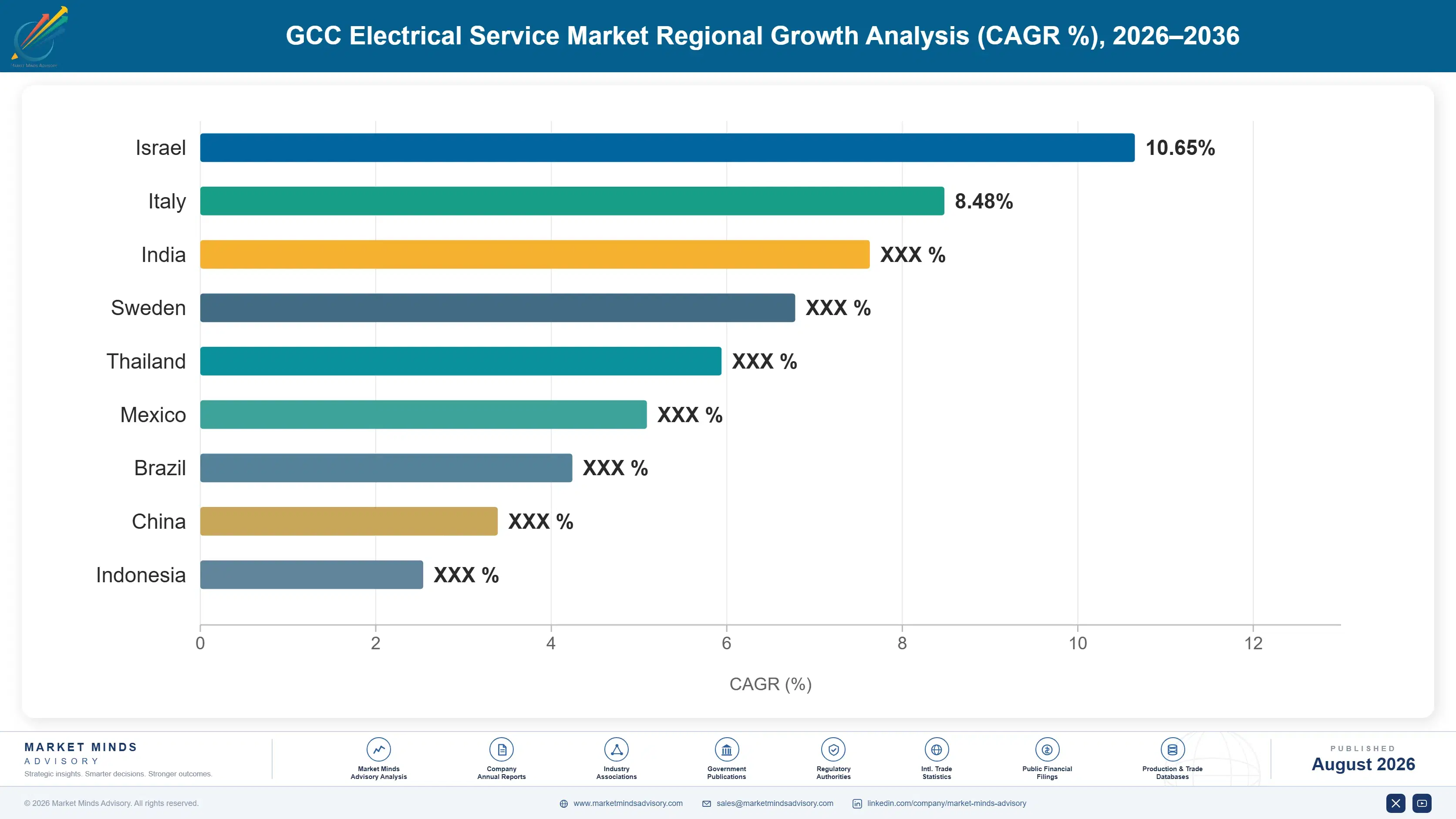
This market is scoped to the six Gulf states, so the seven-region table concentrates almost entirely in one place and most figures sit well outside the bands this framework applies. Residual shares represent delivery capability based outside the region. Each out-of-band figure is explained below.

Middle East and Africa

Middle East and Africa holds 87% of value, far above the 6% ceiling this framework normally applies, which follows directly from a market scoped to the six Gulf states. Saudi Arabia accounts for the largest share on the sheer scale of its transmission network and the volume of giga-project energisation now under way. The United Arab Emirates follows with a denser but smaller asset base and the region's most demanding reliability standards. Qatar, Kuwait, Oman, and Bahrain contribute steady maintenance volumes on infrastructure of similar vintage. Growth at 6.8% matches the market rate by definition, since this is where essentially all of the work is performed. Country weighting within the region shifts as project energisation moves between them.
Share: 87% | CAGR: 6.8% (2026 to 2036)

South Asia and Pacific

Five percent of value is attributed to South Asia and Pacific, well below the floor this framework applies, and it represents delivery capability rather than any local demand. Indian engineering houses perform protection studies, relay coordination, and design verification remotely for Gulf clients at a fraction of regional engineering cost. Larsen and Toubro in particular executes substantial GCC electrical scope through Indian engineering centres. Pakistani and Filipino technician recruitment channels supply much of the field workforce that physically performs the work. Growth at 8.4% exceeds the market rate as more engineering scope moves offshore under cost and quota pressure together. Cost and quota pressure both push in the same direction here.
Share: 5% | CAGR: 8.4% (2026 to 2036)
Regional intelligence for 5 additional markets available in the complete report: Western Europe, North America, East Asia, Eastern Europe, Latin America. Contact sales@marketmindsadvisory.com.
electrical-service-industry-in-gcc-country-cagr-analysis-1787333872025

Where Gulf Service Margin Actually Sits

Field labour in this market is capped by visa policy rather than by demand, so growth on headcount alone is simply not available to anybody. Margin comes from work that does not scale with technicians: remote diagnostics, specialist engineering, and contract structures that pay for asset availability rather than for hours spent on site.

Charge For Availability Instead Of Attendance

Most maintenance contracts here still price scheduled visits, which ties revenue directly to a headcount that quota policy caps. Availability-based agreements guaranteeing an uptime figure with penalties attached break that link entirely and price 20% to 35% above equivalent time-based scope. The provider then has every incentive to deploy monitoring rather than people, and keeps the saving. Utilities accept the structure once somebody quantifies what an unplanned outage costs them in a climate where supply loss is not tolerable for long. The structure changes what the provider is actually incentivised to do.
Market Impact: Availability contracts price 20 to

Build Remote Engineering Capability Outside The Region

Protection studies, relay coordination, arc flash calculations, and design verification need engineers rather than field technicians, and none of that work requires anybody to be physically present in the Gulf. Executing it from Indian or Egyptian engineering centres cuts delivered cost 40% to 55% while sidestepping local quota exposure entirely. Clients care about the stamp on the calculation, not the desk it came from. Providers who built this capability early can bid engineering-heavy scope at prices purely local competitors cannot approach at all. Regulatory acceptance of remote engineering has already been established.
Market Impact: Offshore engineering cuts cost 40 t

Own The National Training Pipeline Early

Nationalisation quotas are tightening across technical trades and every provider will eventually need certified national technicians, which nobody currently has in sufficient numbers. Building an in-house academy with technical college partnerships costs USD 2 million to USD 5 million to establish and produces a workforce that satisfies quota while carrying no visa risk at all. It also becomes a tender differentiator immediately, since government clients increasingly score localisation directly. Competitors subcontracting their quota exposure are buying time rather than solving anything. The cohorts take three years, which is why waiting is expensive.
Market Impact: Academies cost 2 to 5 million dolla

Who Controls the Margin Pool

Concentration is low at 24% across the top five measured on GCC electrical service revenue, and the market divides along a clear line. Global equipment makers service their own installed base with deep technical capability and thin field coverage, while regional contractors hold large workforces and win on presence rather than on engineering depth. ABB leads on installed base breadth, Alfanar on regional scale and localisation. Neither model covers the whole requirement.
Competition currently turns on three things. Technician availability, which caps what any provider can actually deliver regardless of order book. Nationalisation quota compliance, now scored directly in government tenders rather than treated as a background obligation. And response time on unplanned failures, which utilities weight heavily because heat makes supply loss genuinely dangerous rather than merely inconvenient.

Pressure is coming from regional players moving upmarket into protection engineering and condition monitoring, work that global equipment makers once held alone. Alfanar and Larsen and Toubro have both invested in exactly that capability. Rankings will shift toward providers combining engineering depth with local workforce scale, which is currently a gap that neither incumbent model fills properly.
electrical-service-industry-in-gcc-company-positioning-matrix-1787333872546

Competitive Moat and Risk Dimensions

ABB

Moat: Installed base and technical depth

ABB services an installed base of switchgear, drives, and protection equipment across Gulf utilities and industry that took three decades to build, and it holds the design data, legacy parts, and factory backing nobody else can offer. For a utility facing a fault on twenty-year-old protection, the original manufacturer is frequently the only party able to diagnose it.
ABB

Risk: Thin field workforce coverage

ABB's Gulf field presence is small relative to regional contractors, which limits how much routine and emergency work it can physically absorb and exposes it on nationalisation quotas against a small national headcount. As utilities bundle engineering with volume field scope into single framework agreements, that imbalance increasingly pushes ABB into a subcontractor position on contracts it should lead.
ALFANAR

Moat: Regional scale and localisation

Alfanar combines manufacturing, contracting, and service across Saudi Arabia with a national workforce built long before quotas made it mandatory, which gives it both delivery capacity and localisation scoring that foreign providers struggle to match. In tenders where quota compliance is scored directly, that position is worth considerably more than any technical differentiator on the bid.
ALFANAR

Risk: Engineering depth on legacy equipment

Alfanar's technical capability is strongest on its own and on current-generation equipment, and weaker on the legacy multi-vendor population that makes up much of the installed base. Utilities facing complex failures on older foreign switchgear still route those to the original manufacturer, which caps how much of the highest-value diagnostic work Alfanar can realistically capture.

Players Tracked

Prominent Players

ABB
Alfanar
Siemens Energy
Schneider Electric
Hitachi Energy

Other Key Players

Larsen and Toubro
Al Hassan Engineering
Galfar Engineering
Descon Engineering
Nasser S. Al Hajri Corporation
Bahwan Engineering
Al Shafar Electromechanical
Drake and Scull International
Emrill Services
Enova Facilities Management
EFS Facilities Services
Imdaad
Farnek
Al Naboodah Group
Voltas

Recent Developments

APRIL 2025

Saudi transmission operator tendered condition monitoring framework

A Saudi transmission operator tendered a multi-year condition monitoring framework covering partial discharge and dissolved gas analysis across a large substation population. The stated driver was covering an expanding asset base without a proportional increase in field technician headcount, which recruitment policy no longer permits.
Signal: Monitoring is being bought as a direct sub
OCTOBER 2024

Regional contractor opened Saudi technician training academy

A regional electrical contractor opened a training academy in Saudi Arabia targeting national technicians for high voltage field trades, partnering with technical colleges on certification pathways. The investment responds to quota obligations that tender evaluation now scores directly rather than treating as a background compliance matter.
Signal: Localisation has moved from a background c
JANUARY 2025

Emirati utility awarded availability-based substation service contract

An Emirati utility awarded a substation service agreement priced against guaranteed availability rather than against scheduled attendance, with penalties attached to unplanned outage duration. The structure transfers delivery risk to the provider and removes any incentive to send technicians where monitoring data does not require them.
Signal: Availability pricing breaks the link betwe

Labour, Visas, Test Equipment, Travel

Field labour dominates the cost structure at roughly 48% to 58% of cost of sales, and the largest part of that is expatriate technicians recruited through South Asian and Filipino channels with visa, accommodation, and repatriation costs attached. Specialist test equipment, primary injection sets, partial discharge analysers, and calibration adds 12% to 18%. Vehicles, mobilisation, and site travel across dispersed assets account for most of the remainder.
Saudi expatriate levy increases from 2018 onward raised the fully loaded cost of every non-national employee, and further nationalisation measures have compounded it since. Providers holding multi-year framework agreements priced before those changes absorbed the increase directly. Larsen and Toubro noted Middle East margin pressure from labour cost and mobilisation across that period, and no contractor was insulated from a policy applied uniformly to all employers.

Exposure divides by workforce composition rather than by geography. Providers with a high national headcount carry higher base wages but no levy exposure and no visa renewal risk. Those running almost entirely on expatriate labour face both, and their cost base moves with policy decisions nobody can forecast. Smaller subcontractors sit worst, absorbing quota exposure passed down by principals without the scale to run training programmes.
electrical-service-industry-in-gcc-cost-volatility-analysis-1787333872743

Write levy and quota escalation into framework agreements

Multi-year service contracts priced against a labour cost that government policy can change annually leave the provider carrying a risk it cannot manage. Escalation clauses tied to published levy rates and quota requirements move that exposure to the client, who is generally a government entity and therefore closer to the policy than the contractor is.

Shift engineering scope to offshore delivery centres

Protection studies, coordination reviews, and design verification need no physical presence in the Gulf and cost considerably less when executed from Indian or Egyptian engineering centres. Moving that scope offshore removes both levy exposure and quota obligation on a meaningful portion of headcount, while clients continue to receive the same stamped deliverable they always did.

Invest in monitoring to reduce field visit volume

Every routine site visit avoided is labour cost removed from a base that policy keeps inflating. Condition monitoring reduces attendance on a given asset population substantially, which lowers exposure to the single largest and least controllable input in this business. The capital outlay repays quickly at current loaded labour rates across a reasonably sized substation portfolio.

Portfolio Architecture for Margin Defence

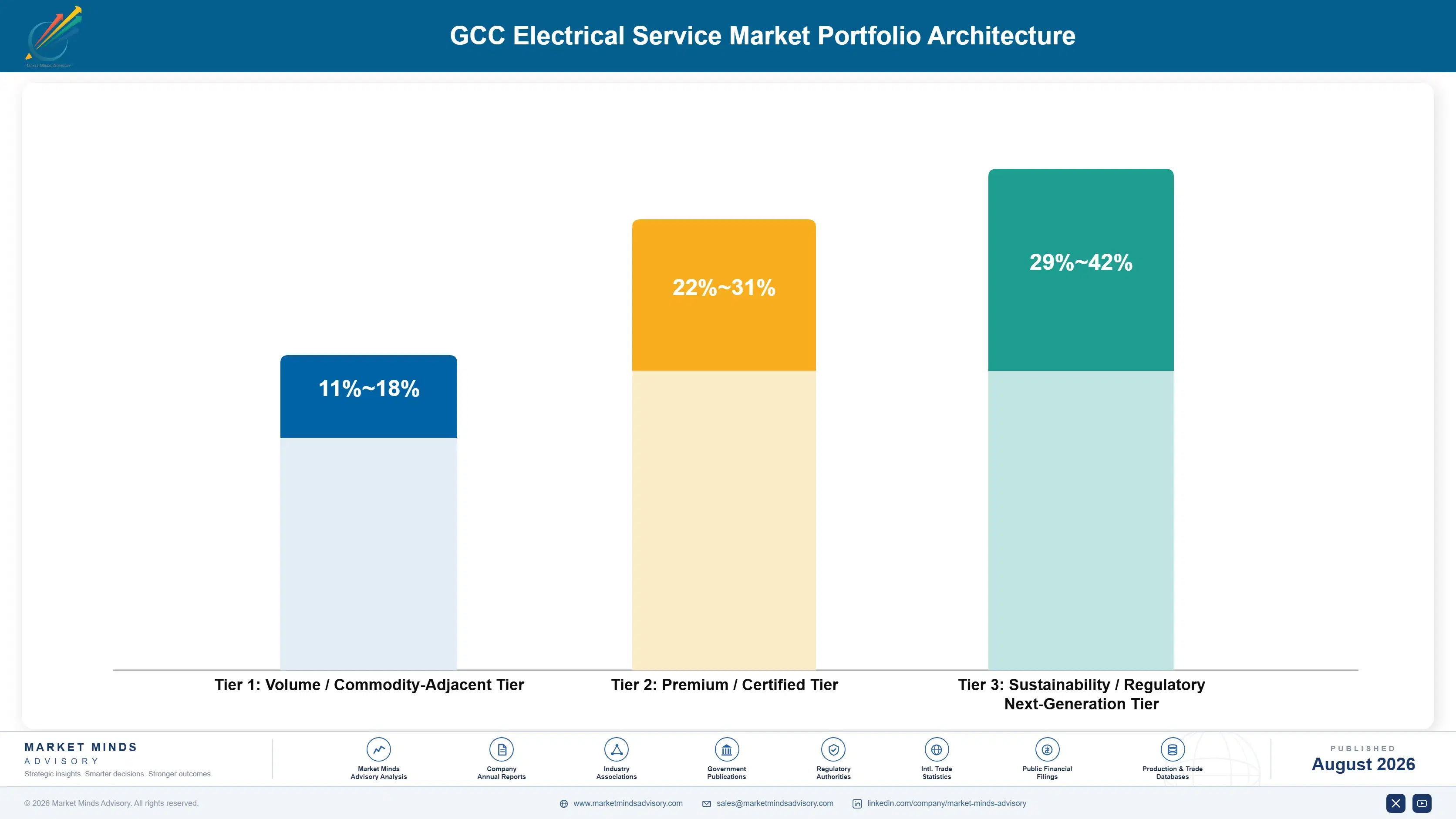
Margin here tracks how far the work sits from field headcount. Routine preventive maintenance and emergency callout are labour businesses competing against contractors with lower overheads, and pricing reflects exactly that. Protection engineering, condition monitoring, and availability-based agreements earn against outcomes rather than hours, and they are the only parts of this market where scale is not capped by visa allocation.
The volume tension is real and uncomfortable. Field maintenance volume funds the branch network, the vehicle fleet, and the standing relationship with the utility that makes higher-value work reachable at all. Walking away from it to chase engineering scope means losing the presence that wins the engineering scope. Providers have to carry the low-margin base to reach the profitable work above it.

High-value pools sit in three places. Condition monitoring contracts carrying multi-year data histories that competitors cannot replicate, protection and coordination engineering driven by renewable integration, and availability-based agreements that pay for uptime instead of attendance. All three are defended by capability and by accumulated data rather than by workforce size, which is exactly why they escape the constraint holding everything else back.

Volume / Commodity-Adjacent Tier

Routine preventive maintenance, emergency callout, and general electrical field work sold on rate cards. Competition is against contractors with lower overhead structures, and the range reflects how differently local and international cost bases carry the same scope.
Gross Margin: 11-18%

Premium / Certified Tier

Testing, commissioning, certification, and retrofit work requiring accredited engineers and specialist instrumentation. Scarcity of qualified teams rather than any barrier to entry sustains the margin, particularly under giga-project schedule pressure.
Gross Margin: 22-31%

Sustainability / Regulatory / Next-Generation Tier

Condition monitoring contracts, protection studies for renewable integration, and availability-based service agreements. The wide range reflects genuinely different economics between recurring monitoring subscriptions and one-off engineering studies priced per deliverable.
Gross Margin: 29-42%
electrical-service-industry-in-gcc-portfolio-architecture-1787333873245

High-value Sub-segments and Strategic Watch-out

Condition Monitoring Contracts

Growing at 10.2% with strong recurring margins, because a multi-year measurement history is genuinely difficult for a competitor to displace once it exists. Adoption is driven by technician scarcity rather than by any enthusiasm for digital tools among the buyers. Early contracts are worth more than their first term suggests.
Gross Margin: 32-44%

Protection And Coordination Engineering

Growing as inverter-based generation makes fault behaviour harder to model on networks designed for synchronous machines. It needs engineers rather than field technicians, which means it escapes the quota constraint capping every other part of this market. Margins here hold better than anywhere else in the market.
Gross Margin: 34-46%

Preventive Maintenance And Callout

The volume base of the market and the thinnest margin in it, competing against contractors carrying far lower overhead. It funds the branch network and standing utility relationship that makes higher-value engineering work reachable in the first place. Nobody wins this work on anything except rate card.
Gross Margin: 11-18%

Giga-Project Commissioning

Front-loaded, schedule-driven, and priced well because qualified commissioning teams are scarce across the region. The watch-out is that this volume is finite and ends when the projects energise, leaving providers who staffed heavily for it exposed afterwards. Staffing decisions taken now determine the exposure later.
Gross Margin: 26-38%

What Follows The First Contract

Electrical service in the Gulf is almost entirely annuity income, which is unusual and badly underexploited. Assets need attention for thirty years and roughly 41% of work already sits under term agreements rather than purchase orders. What providers under-collect is escalation: contracts written years ago at labour rates that policy has since raised repeatedly, renewed on the same terms because nobody reopened the pricing.
Stickiness varies sharply by service type rather than by client. Condition monitoring is the stickiest work in the market, because a competitor taking it over inherits no measurement history and must rebuild trend baselines from nothing across every asset. Commissioning is transactional and ends at handover. Routine maintenance sits between the two, retendered regularly and won on rate card unless the incumbent has made itself operationally difficult to remove.

Buyer profiles have shifted toward asset management and procurement compliance. The decision used to sit with a substation engineer who knew the contractor personally and valued response time above everything. It increasingly sits with an asset management function tracking reliability metrics and a procurement office scoring localisation directly, and neither of those cares much about a relationship built over two decades of callouts.
electrical-service-industry-in-gcc-end-use-penetration-index-1787333873732

Where To Compete Here

These are among the four positions where our research anticipates prominent divergence between winners and laggards over the coming forecast period. Each is grounded in the demand model, the regulatory perimeter, and the announced capacity pipeline.
01 / AVAILABILITY CONTRACT CONVERSION

Price uptime, not attendance

Scheduled-visit pricing ties revenue directly to a technician headcount that visa and quota policy has already capped, which means growth on the current contract model is simply not available to anybody operating in this market. Availability agreements carrying uptime guarantees break that link entirely, and they price a fifth to a third above equivalent time-based scope. The provider then keeps whatever monitoring saves it in attendance, and the utility gets a firm commitment that it can actually hold somebody to.
02 / OFFSHORE ENGINEERING DELIVERY

Move the calculations out of the region

Protection studies, coordination reviews, and design verification all require qualified engineers rather than any physical presence at a Gulf substation, and executing them from Indian or Egyptian centres cuts the delivered cost by roughly half. It also removes both the expatriate levy exposure and the quota obligation on that portion of headcount entirely. Clients care about the stamp on the deliverable rather than about the desk that produced it, and those who have tried the arrangement have not gone back since.
03 / NATIONAL WORKFORCE BUILDING

Own the training pipeline before competitors need it

Every provider operating in this market will eventually need certified national technicians, and almost nobody currently has them in anything close to the numbers required to meet the tightening quotas. An in-house training academy built with technical college partnerships costs only a few million dollars and it produces a workforce that satisfies quota while carrying no visa renewal risk whatsoever. Government tenders already score localisation directly, which means the investment starts paying back well before the first cohort even qualifies.
04 / MONITORING DATA OWNERSHIP

Build the trend history nobody else has

A condition monitoring contract becomes almost impossible to displace once several years of measurement history exist, because any challenger inherits no baseline at all and must rebuild trend data across every single asset from nothing. That makes the early contracts worth considerably more than their first-term value will ever suggest on paper to a pricing committee. Providers bidding these agreements purely on near-term margin are quietly giving away a durable competitive position that compounds every single year it continues to run.

Engagement Snapshot From the Field

A live engagement with an industry participant carrying material or product regulatory and market exposure ahead of a defining policy shift, showing how our research translates into a defensible multi-year portfolio strategy.
MARKET MINDS ADVISORY · CLIENT ENGAGEMENT SUMMARY
GCC Electrical Service Producer Strategic Portfolio Review and Transition Roadmap 2026·Investment Scenario on GCC Electrical Service Exposure Evaluation 2025-26
CLIENT PROFILE
A state-owned transmission utility operating several hundred high voltage substations across a Gulf member state, with annual operations and maintenance spending near USD 410 million (client-reported, unverified by MMA). Most of the network had been commissioned within a fifteen-year window, and the maintenance organisation was overwhelmingly staffed by expatriate technicians recruited through South Asian channels.
STRATEGIC CHALLENGE
Nationalisation targets required a substantial reduction in expatriate technical headcount over five years, while the ageing asset base needed more maintenance rather than less. The utility could not recruit nationals fast enough to replace departing technicians, and deferring maintenance on eighteen-year-old switchgear was not an option anybody would sign off on.
MMA APPROACH
MMA modelled maintenance labour demand against the achievable national recruitment curve to quantify the gap year by year. Substations were then segmented by criticality and condition, and monitoring deployment was assessed for how much routine attendance each configuration could realistically remove. Outsourcing options were evaluated against what contractors could deliver given the same workforce constraint the utility faced.
KEY FINDINGS
  1. The projected technician shortfall reached 340 positions by 2030 (client-reported, unverified by MMA) even under the most optimistic national recruitment assumptions available.
  2. Condition monitoring across the highest-criticality third of the substation population would remove enough routine attendance to close roughly 60% of that projected shortfall.
  3. Contractors bidding the outsourced scope faced the same nationalisation constraint, so outsourcing transferred the problem rather than solving any part of it.
  4. Emergency callout volume was concentrated in a small subset of assets whose condition data would have flagged the developing faults well in advance.
CLIENT PROFILE
A state-owned transmission utility operating several hundred high voltage substations across a Gulf member state, with annual operations and maintenance spending near USD 410 million (client-reported, unverified by MMA). Most of the network had been commissioned within a fifteen-year window, and the maintenance organisation was overwhelmingly staffed by expatriate technicians recruited through South Asian channels.
STRATEGIC CHALLENGE
Nationalisation targets required a substantial reduction in expatriate technical headcount over five years, while the ageing asset base needed more maintenance rather than less. The utility could not recruit nationals fast enough to replace departing technicians, and deferring maintenance on eighteen-year-old switchgear was not an option anybody would sign off on.
MMA APPROACH
MMA modelled maintenance labour demand against the achievable national recruitment curve to quantify the gap year by year. Substations were then segmented by criticality and condition, and monitoring deployment was assessed for how much routine attendance each configuration could realistically remove. Outsourcing options were evaluated against what contractors could deliver given the same workforce constraint the utility faced.
KEY FINDINGS
  1. The projected technician shortfall reached 340 positions by 2030 (client-reported, unverified by MMA) even under the most optimistic national recruitment assumptions available.
  2. Condition monitoring across the highest-criticality third of the substation population would remove enough routine attendance to close roughly 60% of that projected shortfall.
  3. Contractors bidding the outsourced scope faced the same nationalisation constraint, so outsourcing transferred the problem rather than solving any part of it.
  4. Emergency callout volume was concentrated in a small subset of assets whose condition data would have flagged the developing faults well in advance.
RECOMMENDED STRATEGY
Phase 1: Phase one: deploy condition monitoring across the highest-criticality substations, prioritising those assets generating a disproportionate share of emergency callout volume. Phase 2: Phase two: move protection studies and coordination engineering to an offshore centre, releasing scarce local engineers for field supervision instead. Phase 3: Phase three: establish a technician academy with a technical college partner, sized against the residual gap remaining after monitoring deployment.
OUTCOME
The utility deployed monitoring across its highest-criticality substations and reported unplanned outage events down roughly 28% in the first full year (client-reported, unverified by MMA). Engineering scope moved offshore as recommended, and the academy admitted its first cohort within the year against a shortfall now projected at well under half the original figure.

Frequently Asked Questions

Foundational context covering the market sizes, CAGR, scope, country, region and competition that inform every finding below. This section is provided to cover basics and most often pre-purchase conversations, answered from the MMA Primary Research Dataset.

What is the current size of the GCC Electrical Service Market?

The market reached USD 2.9 billion in 2025 and is forecast at USD 3.10 billion for 2026. Demand follows the ageing of infrastructure commissioned during the regional construction boom.

How large will the GCC Electrical Service Market be by 2036?

MMA forecasts USD 5.98 billion by 2036, an increase of USD 2.88 billion over 2026. That represents an expansion multiple of 1.93 times across the forecast period.

What is the CAGR for the GCC Electrical Service Market 2026 to 2036?

The base case CAGR is 6.8%, with a bull case at 8.0% and a bear case at 5.6%. The bull case depends on utilities outsourcing substation operations at genuine scale.

Which segment is growing fastest?

Condition monitoring and predictive maintenance grows fastest at 10.2%, exactly 1.50 times the market rate. Technician scarcity rather than technology preference is what drives the adoption.

Who are the major companies in the GCC Electrical Service Market?

ABB, Alfanar, Siemens Energy, Schneider Electric, and Hitachi Energy lead the market. The top five hold roughly 24% of GCC electrical service revenue, which is low and reflects a fragmented contractor field.

Which country is growing fastest?

Saudi Arabia grows fastest at 7.9%, driven by giga-project energisation alongside the largest and oldest transmission asset base in the region. Nationalisation policy also raises the cost of every delivered service hour there.

Report Segmentation Architecture

The full report scope spans multiple orthogonal segmentation dimensions, with cross-tabulated demand data provided for each dimension pair. Coverage extends further to regional breakdowns, trend trajectories, and the competitive detail needed to support segment-level decision-making.

By Service Type

  • Condition Monitoring and Predictive Maintenance
  • Testing, Commissioning and Certification
  • Retrofit, Upgrade and Life Extension
  • Preventive Maintenance and Servicing
  • Emergency Repair and Breakdown Response

By End-Use Industry

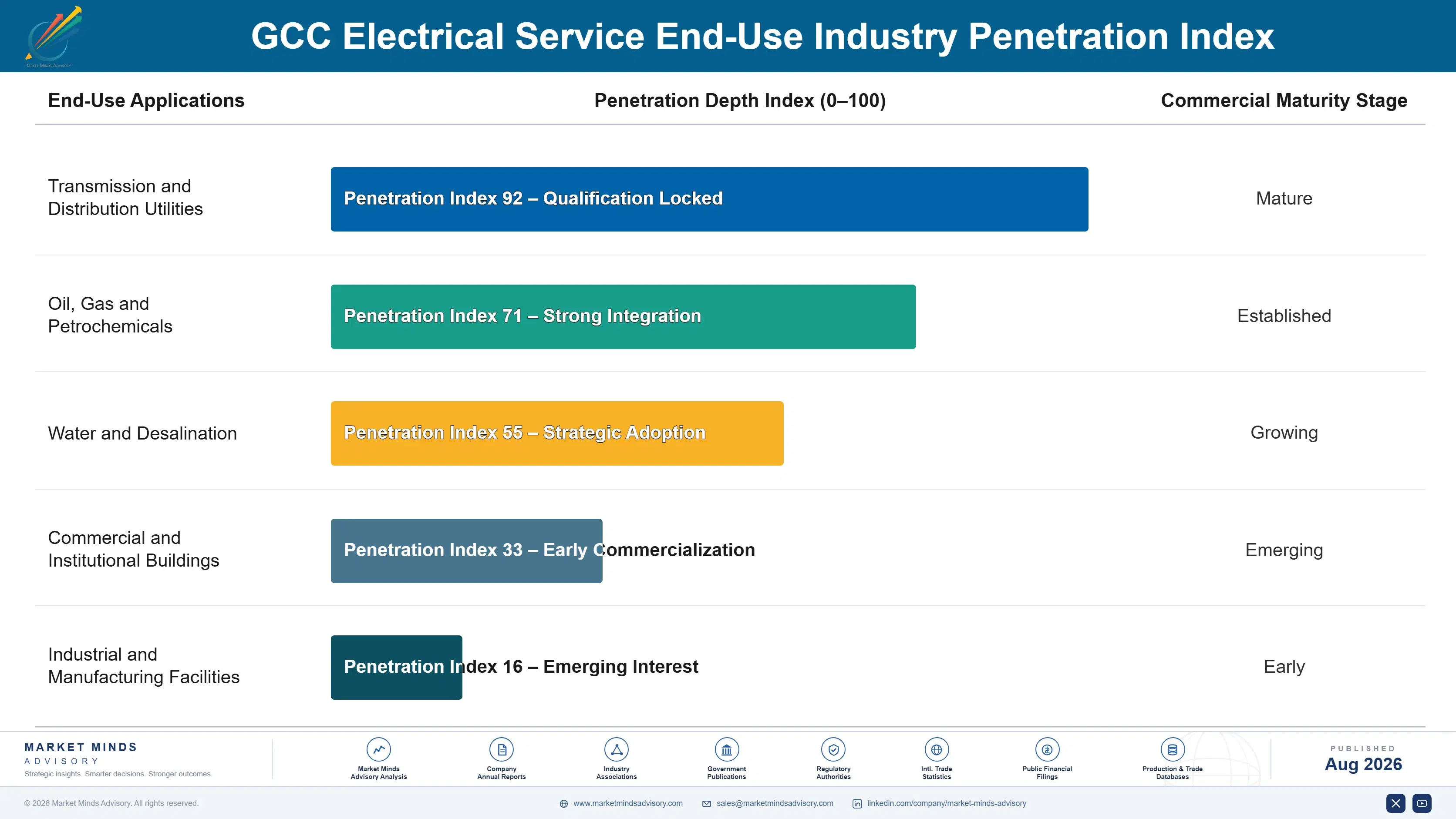
  • Transmission and Distribution Utilities
  • Oil, Gas and Petrochemicals
  • Water and Desalination
  • Commercial and Institutional Buildings
  • Industrial and Manufacturing Facilities

By Commercial Dimension

  • Multi-Year Framework Agreements
  • Availability-Based Service Contracts
  • Project-Linked Commissioning Scope
  • Transactional Callout and Rate Card Work
  • Manufacturer Warranty and Extended Cover

By Region

  • Middle East and Africa
  • South Asia and Pacific
  • Western Europe
  • North America
  • East Asia
  • Eastern Europe
  • Latin America

Scope, Methodology, and Coverage

Every figure in this report is reproducible from documented input assumptions. The scope below maps the historical period, the forecast horizon, the segmentation dimensions, and the countries covered, alongside the underlying primary and qualitative methodology.
Historical Period
2020 to 2025
Forecast Period
2026 to 2036
Base Year
2025 (USD billions; MMA Primary Research Dataset, August 2026)
Market Definition
The GCC electrical service market comprises services performed on installed electrical power infrastructure across Saudi Arabia, the United Arab Emirates, Qatar, Kuwait, Oman, and Bahrain, valued at contracted service revenue paid to manufacturer service arms, specialist testing firms, and electrical contractors. It spans condition monitoring and predictive maintenance, testing, commissioning and certification, preventive maintenance and servicing, retrofit, upgrade and life extension, and emergency repair and breakdown response, covering transmission and distribution assets, industrial electrical systems, and building power infrastructure. New equipment supply, overhead line and cable construction, generation plant mechanical and civil services, building mechanical and plumbing maintenance, instrumentation and control system integration sold independently, and telecommunications work are excluded.
Quantitative Units
USD billions (current prices); volume in contracted service man-hours
Segmentation Dimensions
By Service Type; By End-Use Industry; By Commercial Dimension; By Region
Regions Covered
Middle East and Africa, South Asia and Pacific, Western Europe, North America, East Asia, Eastern Europe, Latin America
Countries Covered
Saudi Arabia, United Arab Emirates, Qatar, Kuwait, Oman, Bahrain, with supply-side coverage of India, Pakistan, Philippines, Egypt, Turkey, Germany, Switzerland, Sweden, France, Italy, UK, USA, Canada, China, Japan, South Korea, Poland, Romania, Brazil, Mexico, and additional markets relevant to this sector
Key Companies Profiled
ABB, Alfanar, Siemens Energy, Schneider Electric, Hitachi Energy, Larsen and Toubro, Al Hassan Engineering, Galfar Engineering, Descon Engineering, Nasser S. Al Hajri Corporation, Bahwan Engineering, Al Shafar Electromechanical, Drake and Scull International, Emrill Services, Enova Facilities Management, EFS Facilities Services, Imdaad, Farnek, Al Naboodah Group, Voltas
Quantitative Methodology
Primary survey, n=3,800 respondents, Q4 2025, six countries; demand-side model with trade association cross-validation
Qualitative Methodology
47 expert interviews, Q4 2025; applied to validate demand model assumptions, identify emerging dynamics, and assess competitive positioning
Report Format
PDF and XLSX data workbook (Word format preview document)
Publisher
Market Minds Advisory
Report Code
MMA-2026-ENE-596
Published
August 2026
Contact
sales@marketmindsadvisory.com | www.marketmindsadvisory.com

Purchase the full GCC Electrical Service Market Report (2026 to 2036).

The full report examines electrical service demand across the six Gulf states and five service types, with particular attention to how nationalisation policy caps delivery capacity independently of demand. It quantifies the maintenance wave arriving from infrastructure commissioned in a single compressed window, and models the technician shortfall against achievable national recruitment. Competitive analysis covers twenty participants assessed on GCC electrical service revenue, including where regional contractors are moving into engineering work global manufacturers once held alone. Country chapters map asset age profiles against contracted service coverage.
Six-country asset age and maintenance demand analysis
Five service type segmentation with growth rates
Twenty participant competitive assessment and localisation positioning
Technician shortfall modelling against national recruitment curves
Availability contract and monitoring economics benchmarking
Offshore engineering delivery cost comparison by discipline

Built For The People Who Decide

From boardroom strategy to bench-side execution, this report is read cover-to-cover by leaders shaping the next decade of their industry, turning demand scenarios, market dynamics and valuation benchmarks into decisions.
CXOs/ Presidents/ VPs/ Managers
M&A and Corporate Development
Strategy Teams and R&D Heads
Procurement and Product Directors
Regulatory and Compliance Leaders
Investor Relations and Equity Analysts