

Market Minds Advisory
Electric Vehicle Insulation Market

Electric Vehicle Insulation Market: Trends and Forecast 2026 to 2036

Electric vehicle motor windings and battery packs demand insulation materials that survive higher voltages and thermal loads than combustion designs required, forcing suppliers to requalify winding wire and film chemistries against faster automaker validation timelines.

Lead Analyst

David Horsley

Published

September 2026

Make Smarter Decisions with Customized Research Insights

Request a free sample report and evaluate market opportunities, growth trends, and competitive dynamics relevant to your business needs.

2025 MARKET VALUE$4.2BMarket Size 2025
2036 FORECAST VALUE$11.3BBase Case , 2026 to 2036
CAGR 2026 TO 20369.4 %Bull 10.7% / Bear 8.1%
INCREMENTAL OPPORTUNITY$6.7BNet 10- year value creation
EXPANSION MULTIPLE2.46x2036 value over 2026 base
Strategic Levers
M&A Pipeline
Regional Outlook
Country Rankings
Competitive Intelligence
Segmental Deep-dive
Call-Us : 91 93563 13602

Executive Snapshot and Market Trajectory

Battery pack and motor winding insulation now sits on the critical path for electric vehicle safety certification, not a commodity afterthought suppliers can source late in the design cycle, and that shift is reshaping who gets invited to early platform development conversations across the supplier base.
Rising voltage architectures, many EV platforms now running 800-volt systems, are pushing automakers toward thinner, higher-dielectric-strength films and enamels that traditional 400-volt insulation suppliers cannot simply relabel and resell into new platforms today. Battery pack insulation is the fastest-growing application, expanding well ahead of motor winding and cable insulation combined, and demand concentrates heavily around China's battery and vehicle assembly clusters, where localized qualification cycles now run faster than in most Western markets.
Competitive intensity is rising as specialty chemical incumbents defend enamel and film positions against battery makers integrating insulation coating in-house to control cost and qualification timelines directly. Regulatory pressure adds a second axis: tightening thermal runaway and flammability standards in China and the EU are forcing much faster requalification cycles across the supplier base, rewarding those with in-house testing capacity over rivals reliant on third-party labs.
Market Definition
The electric vehicle insulation market covers dielectric films, magnet wire enamels, battery pack insulation coatings, and busbar and cable insulation materials engineered specifically for electric and hybrid vehicle powertrains. It excludes general automotive wiring insulation used in internal combustion vehicles and standalone battery cell chemistry.
Base Year Value
$4.2B in 2025 (MMA Primary Research Dataset, August 2026)
Forecast Period
2026 to 2036, eleven discrete annual values
CAGR
9.4% base case. Bull 10.7%. Bear 8.1%.
Fastest Growth Segment
Battery Pack Insulation Films and Coatings: 14.6% CAGR
Fastest Growth Country
China: 12.2% CAGR
Fastest Growth Region
South Asia and Pacific: 11.4% CAGR
Largest Region
East Asia: 38% of 2025 global value
Market Leaders
Leading suppliers: DuPont, 3M, Sumitomo Electric, Elantas, and Von Roll. Source: MMA Primary Research Dataset, July 2026.
Primary Survey
n=3,800 procurement and R&D decision-makers, Q4 2025, six countries
Methodology
Demand-side build-up, cross-validated against public data, 47 expert interviews

Electric Vehicle Insulation Market Forecast Scenarios

electric-vehicle-insulation-market-trends-size-forecast-scenario-1787548734175
Between 2020 and 2025 the market grew at an estimated 8.4% annually as early EV platforms scaled production and automakers began qualifying dedicated insulation grades rather than adapting combustion-era wire enamels, a transition that accelerated sharply after 2022 as battery pack volumes multiplied across major assembly regions and voltage architectures climbed well beyond what legacy insulation systems were originally designed to handle safely.
The base case assumes 9.4% annual growth through 2036, anchored in three commercial mechanisms: continued 800-volt platform rollout requiring higher-dielectric-strength films, expanding battery pack production capacity across China, South Korea, and increasingly Europe, and automaker requalification cycles that favor suppliers with proven thermal runaway containment credentials. Motor winding insulation grows steadily but battery pack insulation carries the base case forward fastest, reflecting the underlying shift in where vehicle-level insulation content actually concentrates.
The bull case, 10.7%, assumes faster 800-volt architecture adoption across mainstream vehicle segments beyond today's premium platforms alone, pulling forward demand for higher-dielectric-strength films several years ahead of the base case timeline. The bear case, 8.1%, reflects a scenario where solid-state battery commercialization delays past 2036 slow the pace of insulation material redesign that liquid-electrolyte pack transitions would otherwise require industry-wide.

Insulation Moves From Commodity to Qualification Gatekeeper

Electric vehicle insulation has quietly become a genuine qualification bottleneck rather than a sourcing afterthought, since automakers now require multi-month thermal runaway and dielectric strength testing before approving any new material grade for battery pack or motor winding use across a given vehicle platform. That testing burden favors suppliers who already hold validated grades over new entrants proposing unproven chemistries, regardless of price.
TOP-5 SUPPLIER CONCENTRATION46%Reflects moderate consolidation among established insulation film and enamel producers
AVERAGE FILM ASP$18 per sq meterTracks pricing for high-dielectric-strength battery pack insulation film grades
CHINA PRODUCTION SHARE58%Shows how concentrated global insulation material output has become domestically
CAPACITY UTILIZATION76%Indicates suppliers are running plants near practical operating ceiling levels
POLYMER SHARE OF COGS44% to 54%Captures how exposed margins are to upstream polymer feedstock swings
PLATFORM REQUALIFICATION CYCLE5 to 7 yearsMarks how often automakers revalidate insulation material grades per platform
Capacity utilization sits around 76% globally, tight enough that lead times stretch during periods of battery pack demand surges, particularly around new platform launches in China and South Korea. Average selling prices for high-dielectric-strength battery pack film run meaningfully above legacy motor winding enamel, reflecting the added engineering content and certification cost embedded in newer insulation grades built for 800-volt architectures.
Polymer feedstock exposure remains the single largest cost variable, with resin and specialty additive inputs representing 44% to 54% of cost of goods sold depending on grade complexity and film thickness requirements. Suppliers integrated backward into polymer production carry a meaningful cost advantage over those purchasing resin on the open market, particularly during feedstock price spikes tied to broader petrochemical cycles.
"Insulation used to be the part of the bill of materials nobody argued about. Now it's one of the first things a battery engineer wants to see test data on, and that has quietly rewritten who wins these contracts."
Principal Analyst, Automotive Materials and Electrification Practice · MMA Chemicals and Materials Practice · August 2026

Market Trends

800-Volt Architecture Adoption Accelerates Across Mainstream EV Platforms

Roughly 46% of new battery electric vehicle platforms launched globally in 2025 use 800-volt architecture, up from an estimated 15% in 2021, and that shift is the single biggest driver of insulation material redesign this decade. Higher voltage systems demand thinner films with materially higher dielectric strength than legacy 400-volt insulation grades ever required, forcing suppliers to requalify entire product lines rather than extend existing chemistries. Automakers moving to 800-volt platforms increasingly specify insulation suppliers earlier in vehicle development, before final battery pack architecture is locked, avoiding late-stage requalification delays that push launch timelines back by months.
Market Impact: 5-minute containment mandate under GB 38031

Battery Cell Makers Bring Insulation Coating Capability In-House

Several leading battery cell manufacturers have begun integrating insulation coating and film lamination directly into cell and module production lines rather than sourcing pre-coated materials from specialty chemical suppliers, a shift that removes an estimated 8% to 12% of external insulation spend from the addressable market at cell makers pursuing this strategy. This vertical integration concentrates among the largest battery producers with sufficient scale to justify dedicated coating lines, while smaller cell makers continue purchasing externally sourced insulation materials. The trend narrows the addressable market for independent suppliers among top-tier battery accounts, even as overall vehicle production keeps growing.
Market Impact: 27 EU states require compliance documentation

Market Opportunities and Growth Drivers

China's Revised Battery Safety Standard Mandates Enhanced Containment

China's revised GB 38031 battery safety standard, effective 2026, requires battery packs to prevent fire and explosion for at least five minutes after thermal runaway begins, up from a prior no-fire requirement measured in seconds under the earlier standard. Meeting this threshold requires higher-performance insulation and thermal barrier materials between cells and modules, directly expanding addressable insulation content per vehicle across every battery pack sold in China going forward. Suppliers with validated containment-grade chemistries are seeing accelerated qualification interest from domestic and multinational automakers manufacturing locally, ahead of the standard's enforcement date across the domestic fleet.
Market Impact: Resin prices swung over 30%

EU Battery Regulation Tightens Safety and Traceability Requirements

The EU Battery Regulation 2023/1542 introduces carbon footprint declarations, due diligence, and safety documentation requirements phased in through 2027, pushing automakers and battery makers selling into the European Union to document insulation material sourcing and performance data more rigorously than before. Roughly 27 member states now require this documentation for vehicles sold within the bloc, and suppliers unable to provide traceable, compliant material data risk exclusion from European automaker qualification lists entirely. This is accelerating demand for insulation suppliers with established European testing and certification infrastructure, over those relying solely on Asian test facilities and documentation standards.
Market Impact: 12 to 18 month qualification timelines

Market Restraints and Challenges

Polymer Feedstock Volatility Squeezes Insulation Supplier Margins

Specialty polymer resin prices used in high-dielectric-strength film production swung by more than 30% between 2023 and 2025, driven by upstream petrochemical feedstock volatility rather than insulation-specific demand shifts. The root cause is that most insulation film producers still purchase resin on the open market rather than under long-term contracts, leaving margins exposed every time naphtha or ethylene pricing spikes unexpectedly. The commercial impact falls hardest on smaller suppliers without pricing power to pass costs through to automaker contracts mid-cycle. Some larger suppliers are exploring backward integration into resin production or multi-year supply agreements to dampen this exposure going forward.
Market Impact: 46% of new platforms now 800-volt

Lengthy Automaker Qualification Cycles Slow New Entrant Access

New insulation grades typically require twelve to eighteen months of automaker qualification testing before winning a contract, a timeline rooted in the safety-critical nature of battery pack and motor winding applications where failure risk is unacceptable. This restricts new entrants and smaller specialty chemical firms from winning share quickly, even when material performance is genuinely competitive with incumbents already holding validated grades. The commercial impact concentrates qualification wins among established players with existing relationships and in-house test infrastructure. Some new entrants mitigate this by partnering with tier-1 suppliers who already hold qualification standing, borrowing credibility rather than building it independently.
Market Impact: 8% to 12% of spend internalized
3 additional market trends, 2 additional growth drivers, and 4 additional restraints and challenges are covered in the full report. Contact sales@marketmindsadvisory.com to access the complete intelligence.

Segment CAGR and Growth Architecture

Segmentation follows material and product type, the classification automakers themselves actually use when qualifying insulation suppliers, since each material category faces distinct dielectric, thermal, and mechanical performance requirements rather than a shared testing pathway across all six categories, and each typically involves a separate supplier relationship, procurement cycle, and bill of materials line entirely.
electric-vehicle-insulation-market-trends-market-share-analysis-1787548734706

Battery Pack Insulation Films and Coatings

Battery pack insulation films and coatings are the fastest-growing segment, expanding at 14.6% annually as 800-volt architectures and rising energy density push automakers toward thinner, higher-dielectric-strength materials between cells and modules across nearly every new platform launched globally. Demand concentrates around China's battery cluster, where cell makers are scaling gigafactory capacity fastest, though South Korean and Japanese producers hold a technical edge in premium film grades used in flagship platforms sold globally at higher price points. Growth here outpaces every other segment because battery pack redesigns happen more frequently than motor or cable architecture changes, and each redesign typically requires a fresh round of insulation requalification testing before production approval can proceed.
CAGR 14.6%

Thermal Barrier and Fire-Retardant Films

Thermal barrier and fire-retardant films, the second-fastest segment at 12.8% annually, sit directly behind battery pack films in overall growth because tightening containment standards like China's revised GB 38031 require dedicated barrier layers between cells beyond what standard insulation coatings alone can provide safely across most new vehicle platforms sold globally today. These films are typically specified separately from primary insulation materials, creating an independent and rapidly scaling line item in every new battery pack bill of materials sold worldwide today. Suppliers with validated containment performance data are winning share fastest, since automakers treat this category as safety-critical and rarely switch suppliers once a validated grade passes qualification testing successfully.
CAGR 12.8%
Full segment breakdown across 6 segments available in the complete report.

Regional Architecture and Country Demand Map

Demand concentrates heavily around China's integrated battery and vehicle assembly clusters, with East Asia broadly commanding the largest regional share by a wide margin, while North America and Western Europe hold meaningful but comparatively smaller positions across most product categories, and emerging markets scale unevenly behind them.

East Asia

China anchors East Asian demand through sheer battery and vehicle assembly scale, home to the largest concentration of gigafactory capacity and EV platform launches worldwide, and this dominance pushes the region's share meaningfully above MMA's standard band, a deliberate house-rule deviation reflecting China's genuinely outsized position in global battery and EV insulation demand. Japan and South Korea contribute premium film and enamel technology from established chemical producers exporting globally, while Chinese domestic suppliers scale production fastest to serve local gigafactories. Regional growth outpaces most mature markets as battery pack requalification cycles run faster domestically than in most Western regulatory environments, reinforcing the region's durable manufacturing lead well into the next decade.
Share: 38% | CAGR: 10.4% (2026 to 2036)

North America

Domestic battery gigafactory construction, backed by continued federal manufacturing incentives, is pulling insulation demand toward newly commissioned plants across the American South and Midwest rather than relying solely on imported battery cells from overseas suppliers. Automakers building North American EV platforms increasingly require insulation suppliers to hold local production capacity, shortening supply chains and reducing exposure to cross-border tariff volatility that has periodically disrupted imported film shipments in recent years. North America's share sits below MMA's standard band, a deliberate house-rule deviation reflecting how heavily global battery insulation demand concentrates in East Asian gigafactory clusters relative to slower-ramping American capacity. Canadian mineral processing investment adds a smaller, complementary regional contribution.
Share: 20% | CAGR: 8.4% (2026 to 2036)
Regional intelligence for 5 additional markets available in the complete report: Western Europe, South Asia and Pacific, Latin America, Middle East and Africa, Eastern Europe. Contact sales@marketmindsadvisory.com.
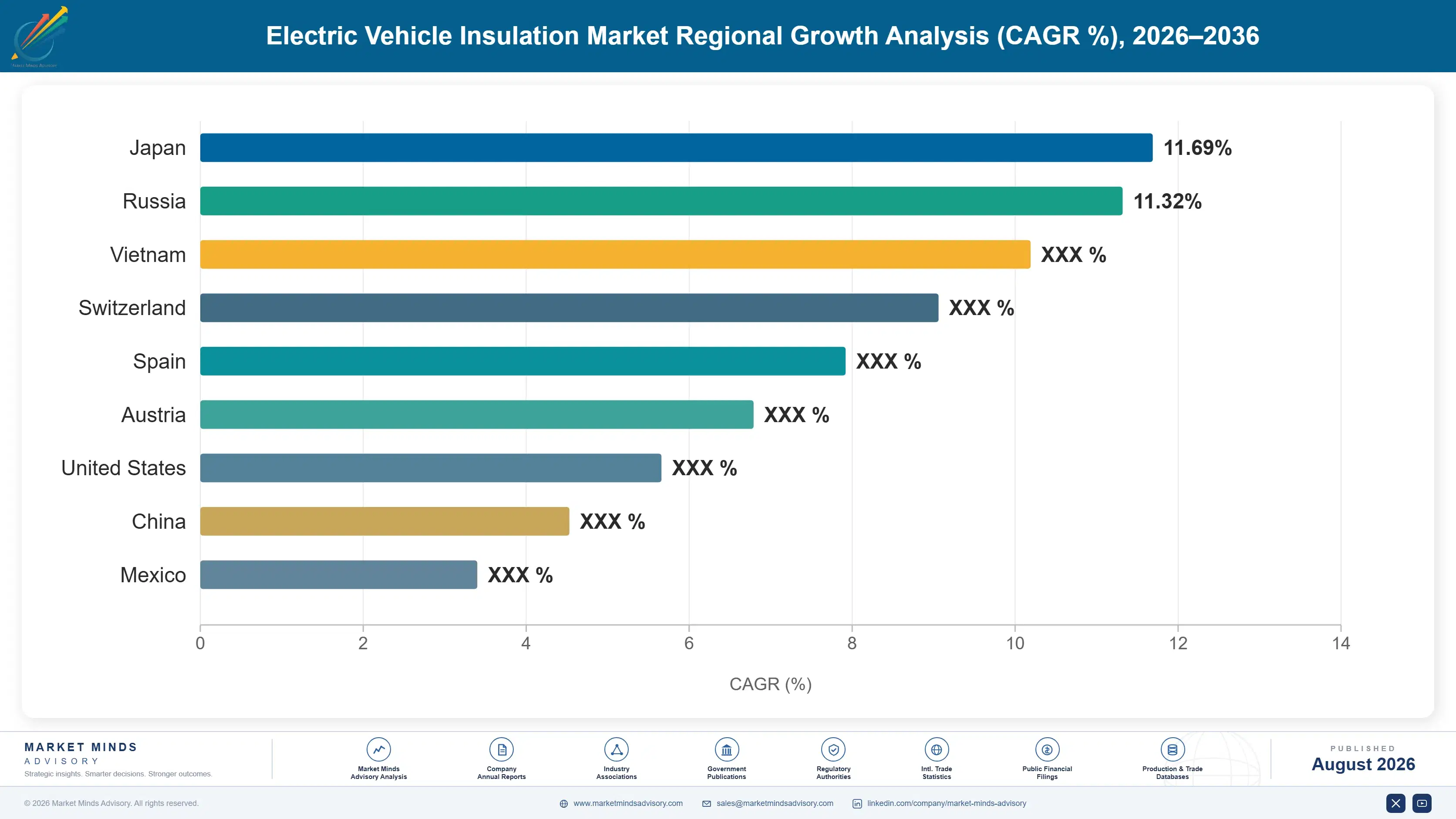
electric-vehicle-insulation-market-trends-country-cagr-analysis-1787548735217

Where Insulation Suppliers Can Capture Margin

Four commercial levers determine which insulation suppliers capture disproportionate margin as the market shifts toward higher-voltage, safety-critical applications: moving into thermal barrier films, integrating backward into resin supply, localizing production inside China's battery clusters, and extending into adjacent stationary battery storage applications that share closely similar technical requirements and qualification pathways across both categories.

Expand Into Thermal Barrier Film Production

Thermal barrier and fire-retardant films are growing at 12.8% annually, nearly 1.4 times the overall market rate, as containment standards like China's revised GB 38031 require dedicated barrier layers beyond standard insulation coatings. Suppliers already qualified on primary insulation materials hold a natural advantage entering this adjacent category, since automakers prefer consolidating safety-critical material sourcing with fewer, already-trusted suppliers rather than adding new qualification relationships. Entry requires meaningful capital investment in flame-testing infrastructure, but the margin premium on validated barrier film grades justifies that investment for suppliers with existing automaker relationships and scale.
Market Impact: Adds 12.8% CAGR from adjacent barrier film category

Backward Integrate Into Polymer Resin Supply

Polymer resin represents 44% to 54% of cost of goods sold for insulation film producers, and resin prices swung by more than 30% between 2023 and 2025 on petrochemical feedstock volatility unrelated to insulation demand itself. Suppliers integrating backward into resin production, or securing multi-year supply contracts with fixed pricing bands, insulate margins from exactly this kind of swing and can offer automakers more predictable long-term pricing than competitors purchasing resin on the open market. This is a capital-intensive lever best suited to larger suppliers with balance sheets that support upstream investment.
Market Impact: Shields 44% to 54% of total COGS exposure

Localize Production Inside China's Battery Clusters

East Asia holds 38% of global demand and China's domestic requalification cycles now run faster than in most Western regulatory environments, meaning suppliers without local production face a meaningful lag in responding to design changes from Chinese automakers and battery makers. Establishing or expanding manufacturing footprint inside China's battery clusters shortens this response time meaningfully and reduces exposure to cross-border logistics and tariff risk that periodically disrupts imported film and enamel shipments. This lever carries geopolitical and intellectual property considerations that suppliers must weigh carefully before committing capital to local joint ventures.
Market Impact: Captures share of East Asia's 38% regional demand

Expand Into Stationary Battery Storage Insulation

Grid-scale battery storage installations are scaling rapidly as utilities and renewable developers add capacity, and these systems require insulation materials with performance characteristics closely related to EV battery pack insulation, though qualification pathways differ somewhat by application. Suppliers already holding validated EV battery insulation grades can extend that credibility into stationary storage bids relatively efficiently, capturing incremental revenue from a category growing an estimated 15% annually without building entirely new technical capability from scratch. This diversification also reduces dependence on EV production cycles alone, smoothing revenue across a broader base of electrification-driven end markets overall.
Market Impact: Diversifies revenue beyond a single 9.4% EV demand driver

Who Controls the Margin Pool

Concentration is moderate, with a CR5 near 46% on a production-capacity basis and a meaningful gap separating the five established leaders from a long tail of regional and specialty challengers still building the automaker-grade validation records that incumbents accumulated steadily over multiple prior vehicle platform generations and product cycles.
Current competitive activity centers on three fronts: qualifying higher-dielectric-strength film grades for 800-volt platforms, building or expanding production capacity inside China's battery clusters, and pursuing backward integration into polymer resin supply to stabilize margins against feedstock volatility across multiple product lines. Several suppliers are also investing directly in flame-testing and thermal runaway containment infrastructure to compete for the fastest-growing barrier film category specifically.

Emerging pressure comes from battery cell makers integrating insulation coating capability in-house, narrowing the addressable market among top-tier accounts specifically, and from Chinese domestic suppliers scaling production fast enough to challenge established Japanese and European producers on delivery speed. Rankings could shift meaningfully over the next several years if Chinese suppliers close the technical gap on premium film grades the way they have already done in battery cell manufacturing itself, a transition worth watching closely.
electric-vehicle-insulation-market-trends-company-positioning-matrix-1787548735738

Competitive Moat and Risk Dimensions

DUPONT

Moat: Decades of Automaker Qualification Depth

DuPont has held qualified insulation material grades with major automakers for decades, spanning multiple vehicle platform generations before EVs existed at meaningful scale. That accumulated validation history lets DuPont move new EV-specific grades through automaker testing faster than competitors lacking comparable existing relationships and trust built over many years of reliable delivery.
DUPONT

Risk: Diversified Portfolio Dilutes EV Focus

DuPont's insulation business sits inside a much larger diversified materials conglomerate, meaning capital allocation for EV-specific film and enamel investment competes internally against numerous other business lines. Competitors focused exclusively on EV insulation can sometimes move faster on dedicated capacity decisions than a diversified parent company weighing multiple corporate priorities simultaneously.
3M

Moat: Broad Materials Science Research Base

3M draws on materials science research spanning dozens of adjacent industries, giving it a wider pool of dielectric and thermal barrier chemistry to adapt for EV insulation than specialty-focused competitors working from a narrower research base. This breadth has repeatedly let 3M introduce new film grades ahead of smaller rivals lacking comparable internal research depth and cross-industry expertise.
3M

Risk: Legacy Liability Overhang on Reputation

3M continues managing legacy environmental liability exposure unrelated to its EV insulation business, and some automakers have grown more cautious about supplier reputational risk during procurement reviews as a result. This creates an opening for competitors without comparable legacy liability history to position themselves as a cleaner reputational choice during automaker supplier audits.

Players Tracked

Prominent Players

DuPont
3M
Sumitomo Electric
Elantas
Von Roll

Other Key Players

Axalta Coating Systems
PPG Industries
Nitto Denko Corporation
Toray Industries
Resonac Holdings
Furukawa Electric
LS Cable and System
Nan Ya Plastics
SGL Carbon
Saint-Gobain
Zeon Corporation
Kaneka Corporation
Teijin Limited
DIC Corporation
Hitachi Metals

Recent Developments

MARCH 2025

DuPont Expands Battery Insulation Film Capacity in China

DuPont opened a new battery pack insulation film production line at its facility in China, expanding capacity specifically to serve gigafactory customers scaling 800-volt platform production. The expansion followed eighteen months of joint qualification testing with two major Chinese battery cell manufacturers ahead of full commercial supply.
Signal: Signals Western insulation suppliers are prioritizing direct China production capacity over export-only supply models to remain competitive.
SEPTEMBER 2025

Sumitomo Electric Signs Multi-Year Enamel Supply Agreement

Sumitomo Electric signed a multi-year supply agreement with a leading South Korean battery cell manufacturer to provide premium magnet wire enamel for upcoming 800-volt motor platforms. The agreement was not an equity stake or joint venture, simply a long-term commercial supply commitment covering multiple vehicle programs.
Signal: Shows premium film and enamel suppliers locking in demand ahead of platform launches through direct commercial agreements.
JANUARY 2026

Elantas Acquires Thermal Barrier Film Specialist

Elantas acquired a smaller specialty coatings producer with established thermal barrier film capability, adding validated containment-grade chemistry to its existing insulation portfolio without building that technical capability internally from scratch first. The acquisition closed after a shortened regulatory review given the target's modest revenue scale.
Signal: Confirms acquisition is becoming a faster path into thermal barrier films than internal development for mid-size suppliers.

Polymer Feedstock Exposure and Margin Risk

Polymer resin and specialty additive inputs represent 44% to 54% of cost of goods sold for insulation film and enamel producers, sourced primarily from petrochemical crackers in the Gulf Coast, the Middle East, and increasingly China. Copper for magnet wire conductor cores adds a secondary input cost, though insulation coating itself dominates value-added content on higher-grade battery pack film.
Naphtha and ethylene feedstock prices rose sharply through 2024 following supply disruptions tracked by the EIA's petrochemical feedstock reporting, pushing specialty resin costs up by more than 30% within an eighteen-month window before partially retreating in 2025. Insulation film producers without long-term fixed-price resin contracts absorbed most of this swing directly, compressing gross margins by an estimated four to six percentage points during the peak of the spike before pricing stabilized.

Exposure varies meaningfully by player type: suppliers integrated backward into resin production absorb feedstock swings far better than pure insulation converters purchasing resin on the open market, and this gap becomes a genuine competitive disadvantage during volatile pricing periods. Geographic exposure differs too, since Middle Eastern and Chinese producers sit closer to feedstock sources than European or North American converters reliant on longer supply chains and imported resin shipments.
electric-vehicle-insulation-market-trends-cost-volatility-analysis-1787548735933

Secure Multi-Year Fixed-Price Resin Supply Contracts

Negotiating multi-year fixed-price or banded-price resin supply agreements protects margin against the kind of feedstock volatility that hit specialty resin costs hard through 2024, giving insulation producers genuinely predictable input costs to plan capacity investment and automaker pricing commitments around, rather than absorbing spot-market price swings directly into gross margin every single quarter unpredictably.

Pursue Backward Integration Into Resin Production Capacity

Larger insulation suppliers with sufficient balance sheet capacity can integrate backward into resin production directly, capturing the margin that would otherwise flow to third-party petrochemical suppliers while gaining more predictable feedstock access during periods of broader market tightness across the industry. This approach requires meaningful upfront capital but pays back through reduced long-term margin volatility.

Diversify Feedstock Sourcing Across Multiple Geographic Regions

Sourcing resin from multiple geographic regions, rather than relying on a single supply corridor, reduces exposure to any one region's disruption, whether from geopolitical tension, severe weather events, or unplanned plant outages. Suppliers already doing this reported smoother cost pass-through during the 2024 volatility spike than peers dependent on a single feedstock source or supplier relationship.

Portfolio Architecture for Margin Defence

The portfolio splits into three tiers with meaningful margin separation tied to validation depth rather than raw material cost alone. Commodity-adjacent motor winding enamels compete mainly on price and delivery reliability, while premium battery pack films and thermal barrier grades command durable premiums tied to automaker-validated safety performance and containment credentials.
The tension between volume hardware and certification premium is sharpening as 800-volt platform rollout and China's tightened safety standards expand demand for premium and next-generation insulation grades faster than commodity-adjacent enamel demand grows, pulling supplier investment toward the higher-margin tiers even though volume enamel remains a meaningful and stable base globally. Suppliers maintaining a foothold across all three tiers preserve optionality, while those chasing only next-generation contracts risk losing the steady cash flow that commodity-adjacent business still reliably provides during slower demand periods.

High-value margin pools concentrate specifically in battery pack insulation films and thermal barrier chemistries meeting the newest containment standards, both requiring genuine engineering and testing investment that conventional enamel producers must build or acquire rather than simply extend from existing production lines. Commodity-adjacent motor winding enamel, by contrast, remains a large but slower-growing volume base offering thinner, more price-competitive margins for most participants going forward.

Volume / Commodity-Adjacent Tier

Commodity-adjacent motor winding enamels and standard cable insulation sold primarily on price and delivery reliability into mainstream vehicle segments without next-generation containment or 800-volt dielectric requirements yet, particularly across cost-sensitive markets worldwide.
Gross Margin: 12%-18%

Premium / Certified Tier

Premium battery pack films and validated barrier coatings integrated into automaker-certified safety platforms commanding durable premiums tied to containment performance and a proven multi-year track record with global regulators and buyers across major markets.
Gross Margin: 24%-32%

Sustainability / Regulatory / Next-Generation Tier

Next-generation and sustainability-driven insulation grades built specifically for solid-state battery readiness and evolving regulatory containment standards, representing the newest and most technically demanding corner of the entire product portfolio sold globally.
Gross Margin: 30%-40%
electric-vehicle-insulation-market-trends-portfolio-architecture-1787548736434

High-value Sub-segments and Strategic Watch-out

Battery Pack Insulation Films and Coatings

High value with strong growth, tied directly to 800-volt battery pack platform scaling independent of broader mainstream replacement cycles across most vehicle segments and price tiers worldwide today. Validated containment performance increasingly decides which supplier wins long-term premium platform contracts across most major automakers and regions worldwide.
Gross Margin: 30%-38%

Thermal Barrier and Fire-Retardant Films

High value with moderate growth, anchored in established motor winding enamel platforms where automakers value proven durability over the fastest possible technical iteration across most vehicle segments and production regions today. Suppliers here compete on reliability and cost efficiency more than on the newest dielectric performance metrics alone.
Gross Margin: 26%-34%

Magnet Wire Enamels

The volume core, serving mainstream vehicle segments across most global markets regardless of hybrid or 800-volt platform adoption pace currently underway across the broader industry. Steady growth tracks vehicle production volume rather than any specific technology transition emerging across the wider category today and going forward.
Gross Margin: 14%-20%

Busbar and Cable Insulation

The strategic watch-out, facing accelerating price competition as Chinese domestic suppliers scale production for cost-sensitive vehicle segments worldwide across nearly every price tier and product category today. Remaining international supplier volume concentrates in accounts still requiring proven validation history and established track records built over many years.
Gross Margin: 12%-16%

The Certification Annuity in Insulation

Insulation revenue behaves like an annuity tied to vehicle platform life rather than a one-time material sale, since automakers standardize a validated insulation grade across a platform generation lasting six to eight years rather than re-qualifying suppliers annually for each individual model year. Suppliers winning a platform slot collect predictable volume through the entire production run, insulated from single-year demand swings that affect less validated categories.
Adoption depth varies by end-use vertical: premium and performance EV segments adopted 800-volt architecture and premium film grades earliest, while mainstream passenger EV segments in price-sensitive markets still often rely on 400-volt systems and simpler enamel chemistries for now. Commercial and off-highway electric vehicle adoption remains the shallowest vertical, constrained by duty-cycle durability requirements that current insulation grades have not yet fully satisfied at meaningful scale.

Buyer profiles are shifting generationally as battery safety engineers, rather than purely mechanical component buyers, now approve insulation sourcing decisions inside major automakers and battery makers alike across most vehicle programs today. This younger buyer cohort weighs thermal runaway containment data and regulatory documentation alongside conventional dielectric performance, reshaping which suppliers get invited to next-generation platform qualification programs and long-term development partnerships.
electric-vehicle-insulation-market-trends-end-use-penetration-index-1787548736921

Priorities for Insulation Material Suppliers

These are among the four positions where our research anticipates prominent divergence between winners and laggards over the coming forecast period. Each is grounded in the demand model, the regulatory perimeter, and the announced capacity pipeline.
01 / PRODUCT PORTFOLIO STRATEGY

Prioritize battery pack film qualification over legacy motor winding enamel volume

Battery pack insulation films are growing at 14.6% annually, roughly 1.55 times the overall market's 9.4% pace, and that gap will widen further as more automakers standardize 800-volt architecture across mainstream trims through 2036. Suppliers still weighted toward legacy motor winding enamel risk ceding the highest-margin contracts to competitors who invested early in battery pack film qualification and containment testing. The near-term priority is securing at least one battery pack film design win before the next major platform-generation sourcing cycle closes.
02 / REGIONAL MANUFACTURING FOOTPRINT

Expand China production capacity ahead of demand acceleration

East Asia already commands 38% of global electric vehicle insulation demand and is growing at 10.4% annually, faster than the 9.4% global average, driven by domestic gigafactory expansion and requalification cycles that run faster than in most Western markets. Suppliers without meaningful China production capacity face longer lead times and tariff exposure that domestic competitors simply do not carry into contract negotiations. Expanding regional footprint now, rather than after demand fully materializes, preserves negotiating leverage on platform contracts signed over the next several years.
03 / FEEDSTOCK RISK MANAGEMENT

Lock in multi-year resin contracts before the next price spike

Polymer resin represents 44% to 54% of cost of goods sold for insulation producers, and resin prices swung by more than 30% between 2023 and 2025 on petrochemical feedstock volatility unrelated to insulation demand itself. Suppliers still purchasing resin entirely on the open market remain exposed to the next feedstock price shock in exactly the same way, eroding margin unpredictably each time it happens. Securing multi-year fixed-price contracts or backward integration now protects margin ahead of the next inevitable volatility cycle.
04 / TALENT AND ENGINEERING MIX

Recruit battery safety engineers into insulation sourcing teams

Buyer profiles inside major automakers and battery makers are shifting toward battery safety engineers who weigh thermal runaway containment data and regulatory documentation alongside conventional dielectric performance metrics when awarding platform contracts across most vehicle segments. Suppliers whose sales and engineering teams still speak primarily in traditional dielectric terms risk losing credibility with this newer buyer cohort during technical evaluation rounds and qualification reviews. Investing in safety-engineering-literate technical sales talent now positions suppliers to win next-generation platform bids before competitors adjust their approach.

Engagement Snapshot From the Field

A live engagement with an industry participant carrying material or product regulatory and market exposure ahead of a defining policy shift, showing how our research translates into a defensible multi-year portfolio strategy.
MARKET MINDS ADVISORY · CLIENT ENGAGEMENT SUMMARY
Electric Vehicle Insulation Producer Strategic Portfolio Review and Transition Roadmap 2026·Investment Scenario on Electric Vehicle Insulation Exposure Evaluation 2025-26
CLIENT PROFILE
The client is a mid-size specialty chemical producer with annual insulation-segment revenue of approximately 310 million dollars (client-reported, unverified by MMA), supplying magnet wire enamel primarily to internal combustion and early hybrid vehicle platforms. The company had not yet developed a battery pack film product line and was evaluating whether to enter that category at the time of engagement.
STRATEGIC CHALLENGE
Leadership recognized that motor winding enamel demand growth was slowing relative to battery pack insulation, but internal engineering teams lacked any film production experience entirely, and management debated whether organic development or acquisition offered the faster path into the category before competitors locked in gigafactory relationships and long-term supply commitments.
MMA APPROACH
MMA combined primary interviews with battery cell manufacturers and a technical gap analysis comparing the client's existing coating expertise against battery pack film requirements, then modeled organic development against acquisition timelines given the segment's 14.6% projected CAGR to quantify which path reached commercial revenue meaningfully faster and with lower execution risk.
KEY FINDINGS
  1. Gigafactory customers were finalizing film supplier shortlists roughly twelve months earlier than the client's internal product roadmap assumed, compressing the available entry window.
  2. Organic film development would require an estimated thirty months to reach automaker-grade validation, while acquiring a smaller qualified producer could close that gap by half.
  3. Client-reported internal margin data (client-reported, unverified by MMA) showed battery pack film carrying materially higher gross margin than existing enamel business lines.
  4. Two competing specialty chemical producers had already begun acquisition discussions with smaller film producers, narrowing the pool of viable acquisition targets remaining.
CLIENT PROFILE
The client is a mid-size specialty chemical producer with annual insulation-segment revenue of approximately 310 million dollars (client-reported, unverified by MMA), supplying magnet wire enamel primarily to internal combustion and early hybrid vehicle platforms. The company had not yet developed a battery pack film product line and was evaluating whether to enter that category at the time of engagement.
STRATEGIC CHALLENGE
Leadership recognized that motor winding enamel demand growth was slowing relative to battery pack insulation, but internal engineering teams lacked any film production experience entirely, and management debated whether organic development or acquisition offered the faster path into the category before competitors locked in gigafactory relationships and long-term supply commitments.
MMA APPROACH
MMA combined primary interviews with battery cell manufacturers and a technical gap analysis comparing the client's existing coating expertise against battery pack film requirements, then modeled organic development against acquisition timelines given the segment's 14.6% projected CAGR to quantify which path reached commercial revenue meaningfully faster and with lower execution risk.
KEY FINDINGS
  1. Gigafactory customers were finalizing film supplier shortlists roughly twelve months earlier than the client's internal product roadmap assumed, compressing the available entry window.
  2. Organic film development would require an estimated thirty months to reach automaker-grade validation, while acquiring a smaller qualified producer could close that gap by half.
  3. Client-reported internal margin data (client-reported, unverified by MMA) showed battery pack film carrying materially higher gross margin than existing enamel business lines.
  4. Two competing specialty chemical producers had already begun acquisition discussions with smaller film producers, narrowing the pool of viable acquisition targets remaining.
RECOMMENDED STRATEGY
Phase 1: Phase 1 (Months 1 to 4): Identify and evaluate two to three smaller film producers with existing automaker qualification standing. Phase 2: Phase 2 (Months 5 to 10): Complete acquisition due diligence and close on the strongest available qualified target identified during screening. Phase 3: Phase 3 (Months 11 to 18): Integrate the acquired production capability and pursue joint qualification with two priority gigafactory accounts.
OUTCOME
The client completed the acquisition within eleven months and secured a battery pack film supply agreement with one gigafactory customer, reporting an estimated 85 million dollars in contracted annual revenue (client-reported, unverified by MMA). Leadership credited the accelerated timeline directly to the build-versus-buy analysis MMA delivered early in the engagement.

Frequently Asked Questions

Foundational context covering the market sizes, CAGR, scope, country, region and competition that inform every finding below. This section is provided to cover basics and most often pre-purchase conversations, answered from the MMA Primary Research Dataset.

What is the current size of the Electric Vehicle Insulation Market?

The global electric vehicle insulation market reached an estimated 4.2 billion dollars in 2025. Growth is driven by rising 800-volt platform adoption and expanding battery pack production worldwide.

How large will the Electric Vehicle Insulation Market be by 2036?

MMA projects the market will reach approximately 11.3 billion dollars by 2036. That represents roughly 2.46 times the 2026 market size over the forecast decade.

What is the CAGR for the Electric Vehicle Insulation Market 2026 to 2036?

The base case CAGR is 9.4% annually across the 2026 to 2036 forecast period. Bull and bear scenarios range from 10.7% to 8.1% depending on adoption pace.

Which segment is growing fastest?

Battery Pack Insulation Films and Coatings are the fastest-growing segment, expanding at 14.6% annually, roughly 1.55 times the overall market rate. This reflects accelerating 800-volt platform standardization worldwide.

Who are the major companies in the Electric Vehicle Insulation Market?

Leading suppliers include DuPont, 3M, Sumitomo Electric, Elantas, and Von Roll, evaluated on a production-capacity basis. Together these five suppliers hold an estimated 46% combined share.

Which country is growing fastest?

China leads country-level growth at 12.2% annually, outpacing the broader East Asia regional average by a meaningful margin. Expanding gigafactory capacity and domestic battery safety standards continue to drive this acceleration forward.

Report Segmentation Architecture

The full report scope spans multiple orthogonal segmentation dimensions, with cross-tabulated demand data provided for each dimension pair. Coverage extends further to regional breakdowns, trend trajectories, and the competitive detail needed to support segment-level decision-making.

By Product Type

  • Magnet Wire Enamels
  • Battery Pack Insulation Films and Coatings
  • Busbar and Cable Insulation
  • Slot Liners and Winding Insulation Papers
  • Potting and Encapsulation Compounds
  • Thermal Barrier and Fire-Retardant Films

By End-Use Industry

  • Passenger Battery Electric Vehicles
  • Hybrid Electric Vehicles
  • Commercial and Light-Duty Electric Vehicles
  • Two-Wheelers and Micromobility
  • Off-Highway and Industrial Electric Vehicles

By Commercial Dimension

  • OEM Direct Supply Contracts
  • Battery Cell Maker Contracts
  • Tier-1 Supplier Distribution
  • Aftermarket Replacement and Service

By Region

  • East Asia
  • North America
  • Western Europe
  • South Asia and Pacific
  • Latin America
  • Middle East and Africa
  • Eastern Europe

Scope, Methodology, and Coverage

Every figure in this report is reproducible from documented input assumptions. The scope below maps the historical period, the forecast horizon, the segmentation dimensions, and the countries covered, alongside the underlying primary and qualitative methodology.
Historical Period
2020 to 2025
Forecast Period
2026 to 2036
Base Year
2025 (USD billions; MMA Primary Research Dataset, August 2026)
Market Definition
The electric vehicle insulation market covers dielectric films, magnet wire enamels, battery pack insulation coatings, and busbar and cable insulation materials engineered specifically for electric and hybrid vehicle powertrains. It excludes general automotive wiring insulation used in internal combustion vehicles and standalone battery cell chemistry.
Quantitative Units
USD billions (current prices); material volume in metric tons where applicable
Segmentation Dimensions
By Product Type; By End-Use Industry; By Commercial Dimension; By Region
Regions Covered
East Asia, North America, Western Europe, South Asia and Pacific, Latin America, Middle East and Africa, Eastern Europe
Countries Covered
USA, China, Germany, France, UK, Japan, South Korea, India, Australia, Canada, Brazil, Mexico, Indonesia, Vietnam, Thailand, Malaysia, UAE, Saudi Arabia, South Africa, Nigeria, Turkey, Poland, Netherlands, Italy, Spain, Sweden, Switzerland, Argentina, Colombia, Singapore, and additional markets relevant to this sector
Key Companies Profiled
DuPont, 3M, Sumitomo Electric, Elantas, Von Roll, Axalta Coating Systems, PPG Industries, Nitto Denko Corporation, Toray Industries, Resonac Holdings, Furukawa Electric, LS Cable and System, Nan Ya Plastics, SGL Carbon, Saint-Gobain, Zeon Corporation, Kaneka Corporation, Teijin Limited, DIC Corporation, Hitachi Metals
Quantitative Methodology
Primary survey, n=3,800 respondents, Q4 2025, six countries; demand-side model with trade association cross-validation
Qualitative Methodology
47 expert interviews, Q4 2025; applied to validate demand model assumptions, identify emerging dynamics, and assess competitive positioning
Report Format
PDF and XLSX data workbook (Word format preview document)
Publisher
Market Minds Advisory
Report Code
MMA-2026-CHM-206
Published
August 2026
Contact
sales@marketmindsadvisory.com | www.marketmindsadvisory.com

Purchase the full Electric Vehicle Insulation Market Report (2026 to 2036).

This report provides a complete assessment of the global electric vehicle insulation market across the 2026 to 2036 forecast period, covering sizing, segmentation, and regional demand patterns. It profiles the five leading suppliers and fifteen additional participants on a consistent production-capacity basis, detailing competitive positioning, recent corporate developments, and moat and risk analysis for the top two players. The report also examines input cost exposure, portfolio margin architecture, and revenue lever opportunities tied to 800-volt platform adoption. A dedicated regional chapter breaks down demand across all seven MMA-tracked regions.
Ten-year global market sizing and CAGR forecast model
Six-segment MECE product and material breakdown analysis
Seven-region demand share and growth rate analysis
Twenty-company competitive benchmarking and positioning dataset
Input cost exposure and portfolio margin modeling detail
Anonymized client engagement case study with outcomes

Built For The People Who Decide

From boardroom strategy to bench-side execution, this report is read cover-to-cover by leaders shaping the next decade of their industry, turning demand scenarios, market dynamics and valuation benchmarks into decisions.
CXOs/ Presidents/ VPs/ Managers
M&A and Corporate Development
Strategy Teams and R&D Heads
Procurement and Product Directors
Regulatory and Compliance Leaders
Investor Relations and Equity Analysts