Market Minds Advisory
Electric Three-Wheeler Market

Electric Three-Wheeler Market: Passenger and Cargo Fleet Growth, Battery Transition, and Supplier Strategy Through 2036

India's electric rickshaw fleet already numbers in the millions, and last-mile delivery operators across South Asia are adding electric cargo three-wheelers fast enough to pull the entire category toward lithium-ion batteries.

Lead Analyst

David Horsley

Published

September 2026

Make Smarter Decisions with Customized Research Insights

Request a free sample report and evaluate market opportunities, growth trends, and competitive dynamics relevant to your business needs.

2025 MARKET VALUE$13.5BMarket Size 2025
2036 FORECAST VALUE$54.4BBase Case , 2026 to 2036
CAGR 2026 TO 203613.5 %Bull 14.8% / Bear 12.2%
INCREMENTAL OPPORTUNITY$39.0BNet 10- year value creation
EXPANSION MULTIPLE3.55x2036 value over 2026 base
Strategic Levers
M&A Pipeline
Regional Outlook
Country Rankings
Competitive Intelligence
Segmental Deep-dive
Call-Us : 91 93563 13602

Executive Snapshot and Market Trajectory

Electric three-wheelers already carry more daily passengers and cargo across South Asia than most Western observers realize, a fleet built almost entirely on lead-acid batteries that is now transitioning toward lithium-ion at a pace reshaping supplier economics. That transition is now reshaping supplier economics across the entire category.
Lithium-ion battery three-wheelers are absorbing the fastest growth as fleet operators chase the range and charging speed lead-acid designs cannot match, particularly among cargo and last-mile delivery operators running vehicles on tight daily duty cycles. South Asia and Pacific anchors an overwhelming share of global unit volume, with India's e-rickshaw and cargo three-wheeler fleet alone dwarfing the combined installed base across every other region in this study by a wide margin.
Consolidation remains limited given the category's low technical barrier for basic lead-acid designs, even as organized manufacturers extend lithium-ion and swappable battery technology to capture fleet operators willing to pay for lower total cost of ownership. Passenger e-rickshaws remain the largest single application by unit volume, even as cargo and delivery applications now post the fastest incremental growth across the category. That gap keeps widening across organized fleet operators, a trend suppliers now track closely.
Market Definition
The electric three-wheeler market covers battery-electric passenger auto-rickshaws, cargo and load-carrier three-wheelers, and last-mile delivery three-wheelers powered by lead-acid, lithium-ion, or swappable battery systems. It excludes internal combustion three-wheelers, electric two-wheelers, and four-wheeled electric quadricycles sold as separate vehicle categories.
Base Year Value
$13.5B in 2025 (MMA Primary Research Dataset, August 2026)
Forecast Period
2026 to 2036, eleven discrete annual values
CAGR
13.5% base case. Bull 14.8%. Bear 12.2%.
Fastest Growth Segment
Lithium-Ion Battery Three-Wheelers: 19.0% CAGR
Fastest Growth Country
India: 15.8% CAGR
Fastest Growth Region
South Asia and Pacific: 15.5% CAGR
Largest Region
South Asia and Pacific: 48% of 2025 global value
Market Leaders
Mahindra Electric Mobility, Bajaj Auto, Piaggio, Kinetic Green Energy, and TVS Motor lead by disclosed electric three-wheeler shipment volume. Source: MMA Analysis based on company annual reports.
Primary Survey
n=3,800 procurement and R&D decision-makers, Q4 2025, six countries
Methodology
Demand-side build-up, cross-validated against public data, 47 expert interviews

Electric Three-Wheeler Market Forecast Scenarios

electric-three-wheeler-market-trends-size-forecast-scenario-1787315991517
Between 2020 and 2025 electric three-wheeler demand grew rapidly as India's e-rickshaw fleet expanded from a regional curiosity into mainstream urban and semi-urban passenger transportation, even as most of that growth relied on lead-acid battery technology throughout the period. Suppliers that anticipated the lithium shift early are now capturing a disproportionate share of new fleet contracts.
The base case assumes continued passenger e-rickshaw fleet expansion across India and neighboring South Asian markets, rapid lithium-ion battery adoption as cost curves fall closer to lead-acid parity, and accelerating cargo and last-mile delivery three-wheeler demand tied to e-commerce logistics growth across the region. These three mechanisms together sustain growth rates well above what passenger fleet expansion alone would suggest. Together they sustain growth rates well above what passenger fleet expansion alone would suggest.
The bull case rests on lithium-ion battery costs falling faster than currently expected, accelerating the transition away from lead-acid across both passenger and cargo applications. The bear case is continued price sensitivity among individual rickshaw operators keeping lead-acid designs dominant longer than currently modeled, slowing the category's shift toward higher-value lithium-ion and swappable battery configurations.

From Informal Fleet Vehicle to Organized Logistics Asset

Electric three-wheelers built their fleet base as an informal, individually owned passenger transportation solution across Indian cities, a bottom-up adoption pattern almost entirely disconnected from the top-down EV policy narrative shaping electric car markets elsewhere. That informal origin still shapes the category's economics, since the large majority of buyers are individual operators financing a single vehicle rather than fleet managers making bulk procurement decisions.
MARKET CONCENTRATIONCR5 26%top five manufacturers hold a modest combined shipment share
AVERAGE SELLING PRICE$1,850 per vehicleblended average price across lead-acid and lithium configurations
LEADING PRODUCTION COUNTRYIndia, 61% shareoutput concentrated near the world's largest fleet base
CAPACITY UTILISATION73%assembly lines running near ceiling in peak fleet order periods
BATTERY COST SHARE36% of vehicle COGSbattery pack now the single largest bill of materials line
SWAP STATION DENSITY4,200 stations regionallyswap infrastructure remains concentrated in dense urban cores
The market's commercial character splits between low-cost lead-acid designs still dominating individual operator purchases and a smaller but faster-growing lithium-ion segment increasingly specified by organized cargo and delivery fleet operators who value total cost of ownership over upfront price. Manufacturers serving the two segments compete on different terms, since individual buyers negotiate purely on purchase price while fleet buyers increasingly model total cost including battery replacement and charging downtime.
The next decade will be shaped by continued lithium-ion cost declines pulling organized fleet operators away from lead-acid, by e-commerce logistics growth sustaining cargo and delivery three-wheeler demand independent of passenger fleet trends, and by swappable battery infrastructure expanding beyond its current dense-urban concentration into a broader range of secondary cities and markets.
"Everyone building EV policy talks about passenger cars. Meanwhile India already runs more electric vehicles as rickshaws than most countries have on the road in total, and almost none of that growth needed a subsidy to happen."
Director, Electric Mobility Practice · MMA Electric Mobility and Micromobility V

Market Trends

Lithium-Ion Adoption Accelerating Among Fleet Operators

Lithium-ion battery three-wheelers, which charge faster and last longer than lead-acid equivalents even though they cost more upfront, have moved from a premium niche into mainstream fleet operator specification since 2023 as total cost of ownership calculations increasingly favor the technology for high-utilization vehicles. At least eight major cargo and delivery fleet operators have standardized on lithium-ion three-wheelers since 2024, up from a handful of pilot fleet references three years earlier. Manufacturers report lithium-ion models now carry a meaningful price premium over lead-acid equivalents, reflecting both battery cost and reduced downtime fleet operators increasingly value.
Market Impact: Sustains demand across 8 million un
Cargo and Last-Mile Delivery Applications Scaling Rapidly

E-commerce logistics growth across South Asian and Southeast Asian cities has pulled cargo and last-mile delivery three-wheelers into mainstream fleet procurement since 2023, a demand source largely independent of the passenger e-rickshaw fleet that historically dominated the category's unit volume. Delivery fleets have grown roughly 45 percent since 2023 across major logistics operators, reflecting cost advantages over traditional vehicles and urban access benefits in congestion-restricted city centers. This favors manufacturers with cargo-specific chassis engineering. Manufacturers without cargo-specific engineering are increasingly excluded from the fastest-growing bids logistics operators now issue regularly.
Market Impact: Outpaces passenger growth since 202

Market Opportunities and Growth Drivers

Passenger Fleet Expansion Sustaining Baseline Volume Growth

India's electric rickshaw fleet continues expanding as individual operators replace aging combustion auto-rickshaws with electric equivalents, drawn by lower fuel and maintenance costs that improve daily earnings for operators who typically rely on the vehicle as their primary income source. India's electric rickshaw fleet has grown to several million vehicles as of 2025, a volume base that continues expanding steadily as electric options become the default choice for new auto-rickshaw purchases across most Indian cities. This driver alone sustains the category's largest single volume base even as growth in percentage terms is now fastest in cargo and delivery applications instead.
Market Impact: Confines lithium below 30 pct

E-Commerce Logistics Growth Driving Cargo Fleet Demand

Rapid e-commerce growth across South Asian and Southeast Asian markets is driving logistics companies to expand last-mile delivery fleets, and electric three-wheelers increasingly win that fleet procurement decision given their lower operating cost and favorable access in congestion-restricted urban zones many cities now enforce. This driver has pulled cargo and delivery three-wheeler demand growth ahead of passenger e-rickshaw growth in percentage terms since 2023, reflecting the underlying strength of e-commerce volume growth across the region. This driver compounds as e-commerce penetration continues rising across markets still early in that broader adoption curve.
Market Impact: Limits swap access to 15 pct

Market Restraints and Challenges

Individual Operator Price Sensitivity Limits Lithium Adoption

Individual rickshaw operators, who represent the large majority of passenger e-rickshaw buyers, remain extremely sensitive to upfront purchase price given their limited access to formal financing and the thin margins that characterize individual auto-rickshaw operation as a livelihood, a root cause tied directly to the informal, self-financed nature of most purchases in this specific buyer segment. The commercial impact keeps lead-acid designs dominant among individual operators even as organized fleet buyers increasingly shift toward lithium-ion, creating a genuine bifurcation in technology adoption by buyer type. Manufacturers are pursuing battery leasing partnerships to make lithium-ion accessible without the full upfront cost.
Market Impact: Shifts 8 fleet operators to lithium

Swappable Battery Infrastructure Remains Geographically Limited

Swappable battery infrastructure, which would otherwise solve much of the charging time and range anxiety limiting electric three-wheeler adoption, remains concentrated in a handful of dense urban markets where operator density justifies the capital investment required to build and maintain a swap station network. The commercial impact confines the full benefit of swappable battery technology to operators in those specific served cities, leaving the broader market dependent on slower conventional charging that limits daily vehicle utilization for fleet operators. Infrastructure operators are expanding into secondary cities, though that pace still trails overall fleet growth.
Market Impact: Expands delivery fleets 45 pct
3 additional market trends, 3 additional growth drivers, and 4 additional restraints and challenges are covered in the full report. Contact sales@marketmindsadvisory.com to access the complete intelligence.

Segment CAGR and Growth Architecture

Segmentation follows application and battery technology rather than vehicle body style, since fleet and individual buyers alike procure three-wheelers by use case first and specify battery chemistry as a downstream cost and performance decision within that category. Buyers weigh cost, range, and total cost of ownership very differently across each category. That distinction shapes procurement more than body style does.
electric-three-wheeler-market-trends-market-share-analysis-1787315992062

Lithium-Ion Battery Three-Wheelers

Lithium-ion battery three-wheelers are growing fastest by a wide margin as fleet operators increasingly model total cost of ownership rather than upfront purchase price alone, a shift favoring lithium-ion's faster charging and longer service life over lead-acid despite the higher initial cost involved. The segment requires battery management and thermal safety engineering that basic lead-acid manufacturers historically never needed, favoring manufacturers who invested early over commodity lead-acid competitors. Adoption is spreading fastest among organized cargo and delivery fleet operators before reaching individual passenger buyers, since fleet economics reward utilization advantages more directly than limited daily individual-operator mileage. Competitive intensity remains lower than in lead-acid, since few manufacturers deliver validated lithium-ion vehicles at commercial standards.
CAGR 19.0%

Last-Mile Delivery Three-Wheelers

Last-mile delivery three-wheelers are growing faster than the broader market as e-commerce logistics companies expand electric delivery fleets across South Asian and Southeast Asian cities, a demand source largely independent of the passenger e-rickshaw fleet that historically dominated category volume. The segment benefits from favorable urban access rules many cities now enforce, since electric three-wheelers frequently qualify for congestion zone access or delivery windows combustion vehicles cannot use, a genuine operating advantage logistics companies value directly. Growth is concentrated among manufacturers offering cargo-specific chassis and load capacity engineering, since delivery fleet operators specify vehicles differently than passenger e-rickshaw buyers evaluating seating capacity and passenger comfort instead of payload volume and route efficiency.
CAGR 17.0%
Full segment breakdown across 6 segments available in the complete report.

Regional Architecture and Country Demand Map

South Asia and Pacific overwhelmingly dominates this market given India's massive electric three-wheeler fleet, with East Asia following on manufacturing and adjacent cargo demand while North America and Western Europe carry only minimal three-wheeler adoption. reflecting India's genuinely outsized share of global demand for this specific vehicle category.

North America

North America's 8 percent share sits well below the standard regional band used elsewhere in this research program, reflecting the genuine reality that three-wheeled passenger and cargo vehicles remain a niche category across the United States and Canada rather than a mainstream transportation mode comparable to South Asia. What demand exists concentrates in commercial cargo delivery pilots and specialty last-mile logistics applications in dense urban cores, rather than the passenger transportation use case that dominates the category globally. Mexico contributes a modest but growing share tied to urban delivery fleet pilots in its largest cities. This share reflects a genuinely underdeveloped market for this specific vehicle category, not a data or scope limitation.
Share: 8% | CAGR: 14.0% (2026 to 2036)

Western Europe

Western Europe's 6 percent share similarly sits below the standard regional band, reflecting that three-wheeled vehicles remain a niche urban delivery and micro-cargo category across the region rather than a mainstream passenger transportation mode as they are in South Asia. Italy and France show the greatest interest given their historical familiarity with three-wheeled commercial vehicles like the Piaggio Ape, providing cultural and regulatory familiarity most other European markets lack entirely. Germany and the Netherlands contribute modest cargo delivery fleet pilots tied to urban low-emission zone requirements that favor smaller, more maneuverable delivery vehicles. This share genuinely reflects underdeveloped category adoption within this study's scope rather than any data or methodology limitation.
Share: 6% | CAGR: 12.0% (2026 to 2036)
Regional intelligence for 5 additional markets available in the complete report: East Asia, South Asia and Pacific, Latin America, Middle East and Africa, Eastern Europe. Contact sales@marketmindsadvisory.com.
electric-three-wheeler-market-trends-country-cagr-analysis-1787315992572

Where Three-Wheeler Manufacturers Can Expand Margin

Four commercial levers separate manufacturers capturing premium value from those competing purely on lead-acid unit price, spanning lithium-ion battery capability, fleet operator relationships, financing and leasing programs, and cargo-specific chassis engineering. Each pulls margin from a different point in the manufacturing and sales stack. Suppliers ignoring any lever cede ground to more diversified rivals. over time as the market matures.

Build Lithium-Ion Battery Management Capability Now

Manufacturers that invest in battery management and thermal safety engineering capture materially higher unit pricing than lead-acid designs ever commanded, since fleet operators are willing to pay for the total cost of ownership advantage lithium-ion delivers across high-utilization duty cycles. Lithium-ion three-wheelers carry roughly 1.8 to 2.5 times the unit price of comparable lead-acid vehicles, reflecting both battery cost and the reliability engineering fleet operators require before specifying a supplier at scale. Manufacturers without this capability are increasingly excluded from the fastest-growing fleet operator segment entirely, regardless of how competitive their lead-acid pricing remains against shrinking individual-operator demand.
Market Impact: Captures roughly 1.8 to 2.5 times t

Build Direct Fleet Operator Relationships Now

Manufacturers that establish direct supply relationships with organized cargo and delivery fleet operators, rather than selling primarily through individual operator dealer networks, capture larger multi-unit orders and more predictable demand visibility than fragmented individual-buyer sales ever provide. These fleet contracts typically deliver order volumes 3 to 5 times larger than fragmented individual purchases, with better payment terms and forecast visibility that reduce working capital strain. Manufacturers with established fleet relationships are winning platform-level standardization decisions as major logistics operators consolidate sourcing across their broader national footprint. That predictability matters considerably for capital-intensive production planning across a growing order book.
Market Impact: Captures order volume roughly 3 to

Offer Battery Leasing and Financing Programs

Manufacturers and financing partners that offer battery leasing programs separating the battery cost from the vehicle purchase price make lithium-ion accessible to individual operators who cannot afford the full upfront cost, expanding the addressable lithium-ion buyer base considerably beyond organized fleet operators alone. These leasing programs typically lift lithium conversion rates by 20 to 25 percent among cash-constrained operators, generating ongoing recurring revenue a one-time sale never provides. Manufacturers without financing programs cede these conversion opportunities to competitors who can structure the payback around actual daily earnings improvements operators realize immediately.
Market Impact: Lifts lithium conversion by 20 to 2

Develop Cargo-Specific Chassis and Load Engineering

Manufacturers that engineer cargo-specific chassis and load capacity beyond passenger e-rickshaw platforms capture design wins with delivery fleet operators that generic passenger-focused vehicle designs cannot serve competitively, since payload capacity and route efficiency matter more to delivery operators than passenger comfort features. This specialized engineering commands a 15 to 20 percent premium over passenger-configured vehicles adapted for cargo use, reflecting the genuine operational advantage purpose-built cargo chassis provide over retrofitted alternatives. Manufacturers with established cargo engineering expertise are winning multi-year delivery fleet contracts as e-commerce logistics operators standardize vehicle specifications across their growing networks.
Market Impact: Captures a 15 to 20 pct cargo premi

Who Controls the Margin Pool

CR5 sits at 26 percent, reflecting a market fragmented across hundreds of regional Indian manufacturers even as organized players extend their reach through lithium-ion capability and fleet operator relationships that smaller competitors increasingly cannot match. That gap is most visible in who can credibly bid on new organized fleet operator programs today.
Current competitive activity centers on lithium-ion manufacturing capacity expansion to serve growing fleet operator demand, battery leasing and financing partnerships between manufacturers and financial institutions, and continued consolidation as larger manufacturers acquire regional shops that lack capital to invest in lithium-ion capability. These moves are reshaping vendor shortlists at nearly every major logistics operator across multiple regions.

Emerging pressure comes from Chinese battery and vehicle manufacturers entering the South Asian market with competitively priced lithium-ion three-wheelers, whose domestic battery manufacturing scale is closing the cost gap with established Indian manufacturers faster than most incumbents expected just a few years ago. Fintech-backed leasing specialists entering from outside the traditional vehicle supply base are also gaining ground on battery financing. Neither trend looks likely to reverse over the coming several years given current investment patterns.
electric-three-wheeler-market-trends-company-positioning-matrix-1787315993098

Competitive Moat and Risk Dimensions

MAHINDRA ELECTRIC MOBILITY

Moat: Deep domestic dealer network

Mahindra's extensive domestic dealer and service network, built over decades of automotive manufacturing presence in India, gives it reach into secondary and tertiary cities that newer entrants cannot replicate quickly regardless of the capital they have available to deploy. Operators in secondary cities cite Mahindra's local service presence directly when choosing among alternatives.
MAHINDRA ELECTRIC MOBILITY

Risk: Lithium-ion transition investment risk

Mahindra's large existing lead-acid product portfolio creates internal tension around how aggressively to cannibalize that business with lithium-ion alternatives, a strategic hesitation newer lithium-focused entrants without legacy portfolio concerns do not face. Newer entrants without that legacy business are moving faster on lithium-only product lines as a result.
BAJAJ AUTO

Moat: Established brand trust with operators

Bajaj's decades of brand trust among individual auto-rickshaw operators, built through its dominant position in combustion three-wheelers before the electric transition began, gives it a credibility advantage newer electric-only entrants cannot replicate quickly among price-sensitive individual buyers. Operators upgrading from combustion three-wheelers frequently default to Bajaj given that established trust.
BAJAJ AUTO

Risk: Combustion legacy slows transition

Bajaj's substantial combustion three-wheeler revenue creates internal incentive tension around the pace of electric transition, a disadvantage relative to electric-only competitors with no legacy combustion business to protect or manage. Bajaj is investing selectively in lithium-ion to defend against this transition risk over time. That transition pace will determine how much share it eventually cedes to electric-only rivals.

Players Tracked

Prominent Players

Mahindra Electric Mobility
Bajaj Auto
Piaggio and C SpA
Kinetic Green Energy
TVS Motor Company

Other Key Players

Atul Auto Limited
Saera Electric Auto
YC Electric Vehicle
Mini Metro EV
Champion Polyplast
Terra Motors Corporation
Speego Vehicles
Dilli Electric Auto
Unique Manufacturing
Lohia Auto Industries
Kutty EV
City Electric Vehicles
Mudhol EV
JS Auto
Etrio Automobiles

Recent Developments

APRIL 2025

Mahindra Expands Lithium-Ion Assembly Line in India

Mahindra Electric Mobility commissioned an expanded lithium-ion three-wheeler assembly line at its Indian facility, adding dedicated capacity to serve growing cargo and delivery fleet demand from multiple logistics customers. The expansion represents Mahindra's largest dedicated lithium-ion capacity addition to date. The line focuses on cargo and delivery configurations.
Signal: Confirms lithium-ion three-wheeler demand
SEPTEMBER 2025

TVS Motor and a Major Logistics Operator Sign Fleet Supply Agreement

TVS Motor Company signed a multi-year supply agreement with a major South Asian logistics operator covering lithium-ion cargo three-wheelers across its expanding delivery network, structured as a supply contract rather than a joint venture. The agreement covers multiple fleet expansion phases through 2030. Financial terms were not disclosed publicly.
Signal: Confirms logistics operators are consolida
JANUARY 2026

Kinetic Green Acquires a Regional Battery Leasing Specialist

Kinetic Green Energy acquired a mid-sized Indian battery leasing and financing company, adding recurring revenue capability ahead of expanding individual operator lithium-ion adoption. The acquisition was Kinetic Green's first dedicated move into battery leasing ownership rather than partnering externally. Terms of the transaction were not disclosed.
Signal: Shows established manufacturers bringing b

Battery Pack and Lithium Cell Exposure

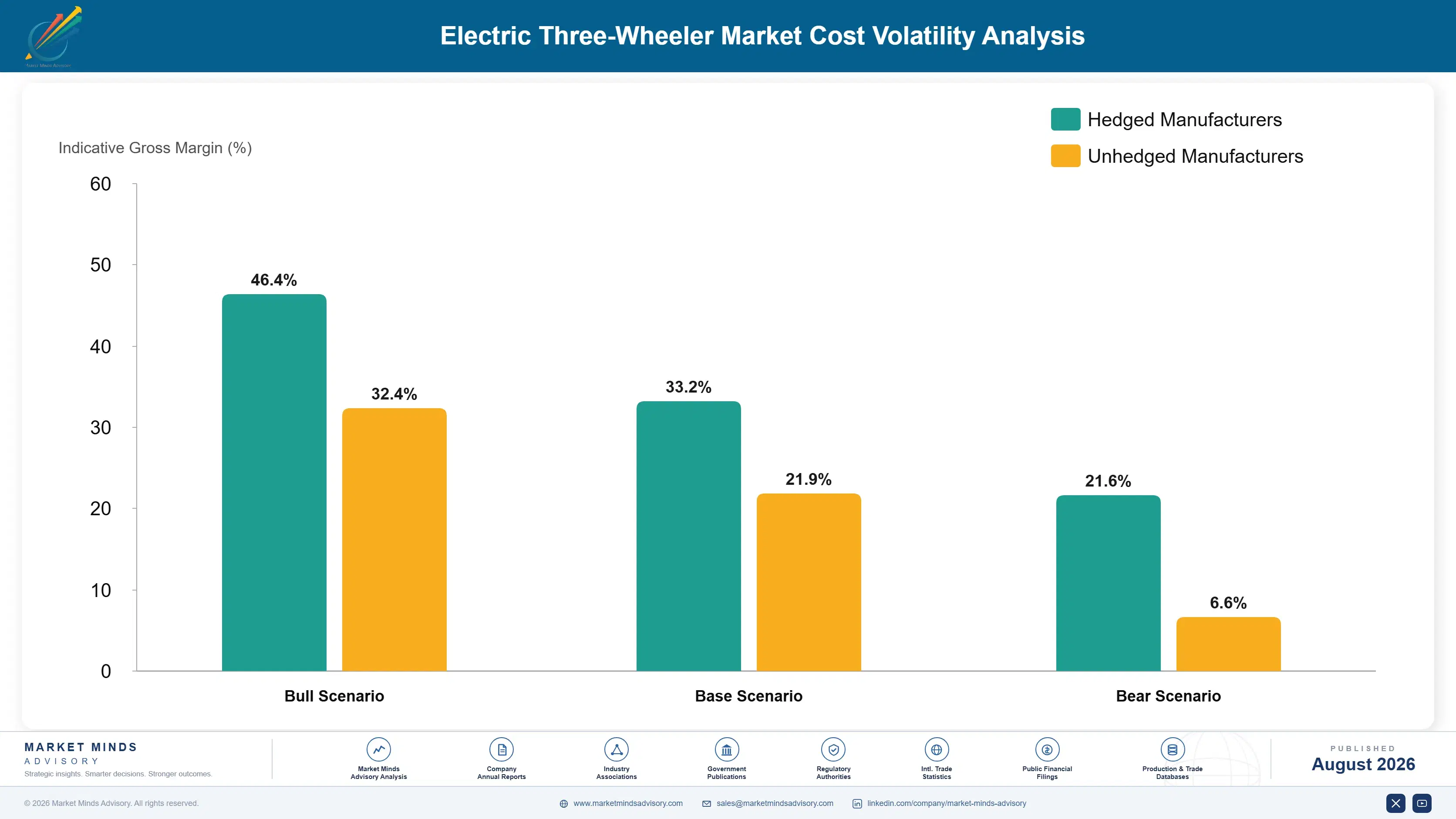
Battery packs, whether lead-acid or lithium-ion, account for roughly 36 percent of finished three-wheeler cost, with lithium-ion designs carrying substantially higher exposure to lithium and battery cell commodity pricing than lead-acid equivalents that draw on a more mature, lower-volatility supply chain instead. This cost structure differs meaningfully from most other emerging vehicle categories carrying lower battery exposure.
Lithium carbonate and battery cell prices, tied closely to broader global EV battery demand, remained volatile through 2023 and 2024 according to industry pricing data referenced in multiple manufacturer disclosures, squeezing margins at lithium-ion three-wheeler manufacturers without long-term cell supply agreements in place at the time. Several manufacturers reported extended lead times during that period, a disruption still referenced in current supplier risk disclosures and industry reporting broadly.

The competitive disadvantage falls hardest on smaller regional manufacturers without long-term lithium cell supply agreements, since spot-market purchasing leaves them exposed to price swings that larger, better-capitalized competitors with direct cell manufacturer relationships can partially avoid. Smaller manufacturers without cell relationships of their own carry meaningfully higher earnings volatility from this exposure than integrated competitors with broader manufacturing scale. That gap is widening as raw material volatility persists.
electric-three-wheeler-market-trends-cost-volatility-analysis-1787315993294

Long-Term Lithium Cell Supply Agreements

Larger manufacturers are locking in multi-year lithium cell supply agreements with battery producers to reduce exposure to spot-market shortages, trading some cost flexibility for supply certainty that smaller competitors without negotiating scale cannot access on comparable terms and pricing. Several major manufacturers signed new multi-year agreements during 2024 specifically to address this exposure. for downstream fleet customers.

Lead-Acid to Lithium Transition Sequencing

Manufacturers are sequencing their lead-acid to lithium-ion product transition carefully, maintaining lead-acid production capacity while lithium-ion scales, reducing the risk of stranded lead-acid manufacturing capacity during the technology shift. This sequencing approach reduces financial risk during the multi-year transition period across the broader product portfolio. for both manufacturers and their broader dealer network. reducing overall financial risk considerably.

Domestic Cell Sourcing Diversification

Manufacturers are qualifying battery cells from multiple domestic and regional sources rather than depending on a single supplier, reducing the risk that any one supplier's allocation constraint or price disruption stalls production across the assembly line. Larger manufacturers with greater purchasing scale are better positioned to negotiate favorable multi-year terms. across the broader supply chain.

Portfolio Architecture for Margin Defence

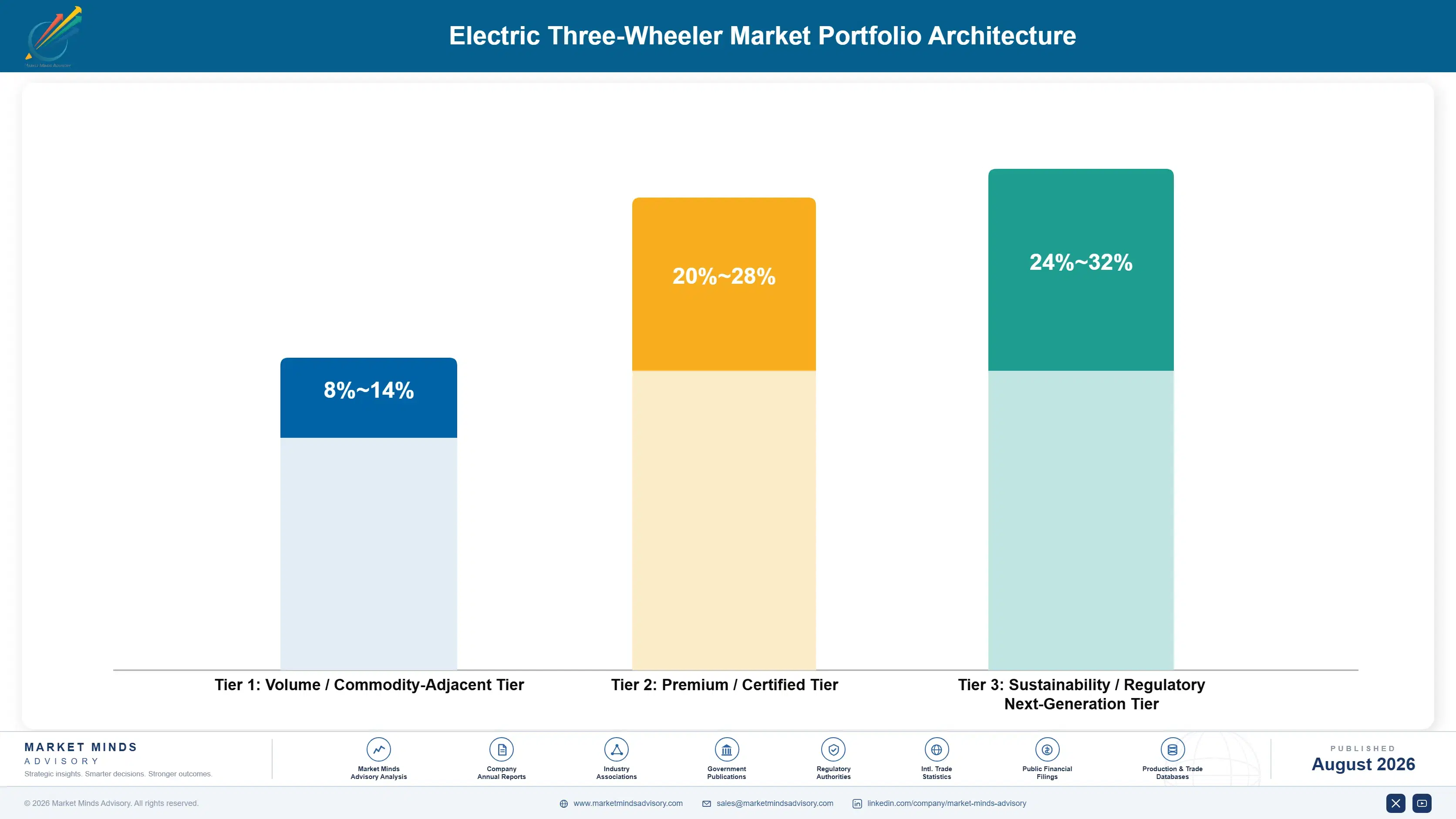
The portfolio splits into three tiers running on distinct economics: a volume tier built on lead-acid passenger e-rickshaws sold near cost parity across competing regional manufacturers, a premium tier of lithium-ion cargo and delivery three-wheelers carrying meaningfully higher margin, and an emerging next-generation tier built on swappable battery fleet vehicles that commands a technology premium beyond pure battery chemistry differentiation alone. Manufacturers rarely compete meaningfully acr
The tension between volume and premium is not simply about margin, since individual operators buying lead-acid vehicles are extremely price-sensitive and finance purchases with limited access to credit, while fleet and delivery buyers are paying for genuine total cost of ownership and utilization differentiation and tolerate meaningfully less price sensitivity as long as the operational benefit holds up against realistic alternatives available to them. That difference in buyer behavior shapes how each manufacturer structures its sales approach.

High-value margin pools concentrate in lithium-ion cargo vehicles and swappable battery fleet configurations, both of which combine technical differentiation with e-commerce logistics tailwinds that commodity lead-acid passenger vehicles simply cannot generate, giving manufacturers positioned in either pool meaningfully more pricing power than the broader market average would otherwise suggest.

Volume / Commodity-Adjacent Tier

Standard lead-acid passenger e-rickshaws for individual operators, priced to compete directly against other regional manufacturers on cost and financing accessibility across most transactions. Competition here centers almost entirely on price and financing accessibility.
Gross Margin: 8-14%

Premium / Certified Tier

Lithium-ion cargo and delivery three-wheelers meeting fleet operator reliability and total cost standards, sold into organized logistics fleets at a meaningful margin premium. Manufacturers here compete on total cost of ownership performance data.
Gross Margin: 20-28%

Sustainability / Regulatory / Next-Generation Tier

Swappable battery fleet vehicles combining rapid charging infrastructure and validated reliability, commanding a technology premium as fleet operators prioritize maximum vehicle utilization. This tier draws the strongest interest from organized logistics fleet programs.
Gross Margin: 24-32%
electric-three-wheeler-market-trends-portfolio-architecture-1787315993801

High-value Sub-segments and Strategic Watch-out

Lithium-Ion Cargo Three-Wheelers

Combines the fastest growth rate in the market with premium technology pricing, making it the single most valuable pool for manufacturers with battery management engineering capability built up over several years of dedicated investment. Few competitors currently hold both battery engineering and fleet operator relationships at once.
Gross Margin: 26-32%

Swappable Battery Fleet Vehicles

Growing steadily as infrastructure expands beyond dense urban cores, offering manufacturers with swap-compatible design capability a durable margin premium over conventional charging competitors facing utilization limits. Manufacturers without swap-compatible design are increasingly locked out of this category. Suppliers investing early are capturing disproportionate share of new fleet contracts.
Gross Margin: 24-32%

Standard Lead-Acid Passenger E-Rickshaws

The steady volume core of the market, growing roughly in line with overall passenger fleet expansion and offering predictable but noticeably thinner margin than either the lithium or swappable tiers above. It remains the segment most exposed to continued price-based regional competition. Margin compression here has been gradual but persistent.
Gross Margin: 8-14%

Legacy Non-Certified Regional Assemblies

A strategic watch-out segment facing margin compression as organized manufacturers and financing programs displace informal regional assembly shops even in traditionally price-driven secondary market segments. Operators still reliant on this category should plan for continued displacement pressure. Volume has fallen sharply across most urban markets since 2023.
Gross Margin: 4-10%

From Fleet Standardization to Battery Renewal

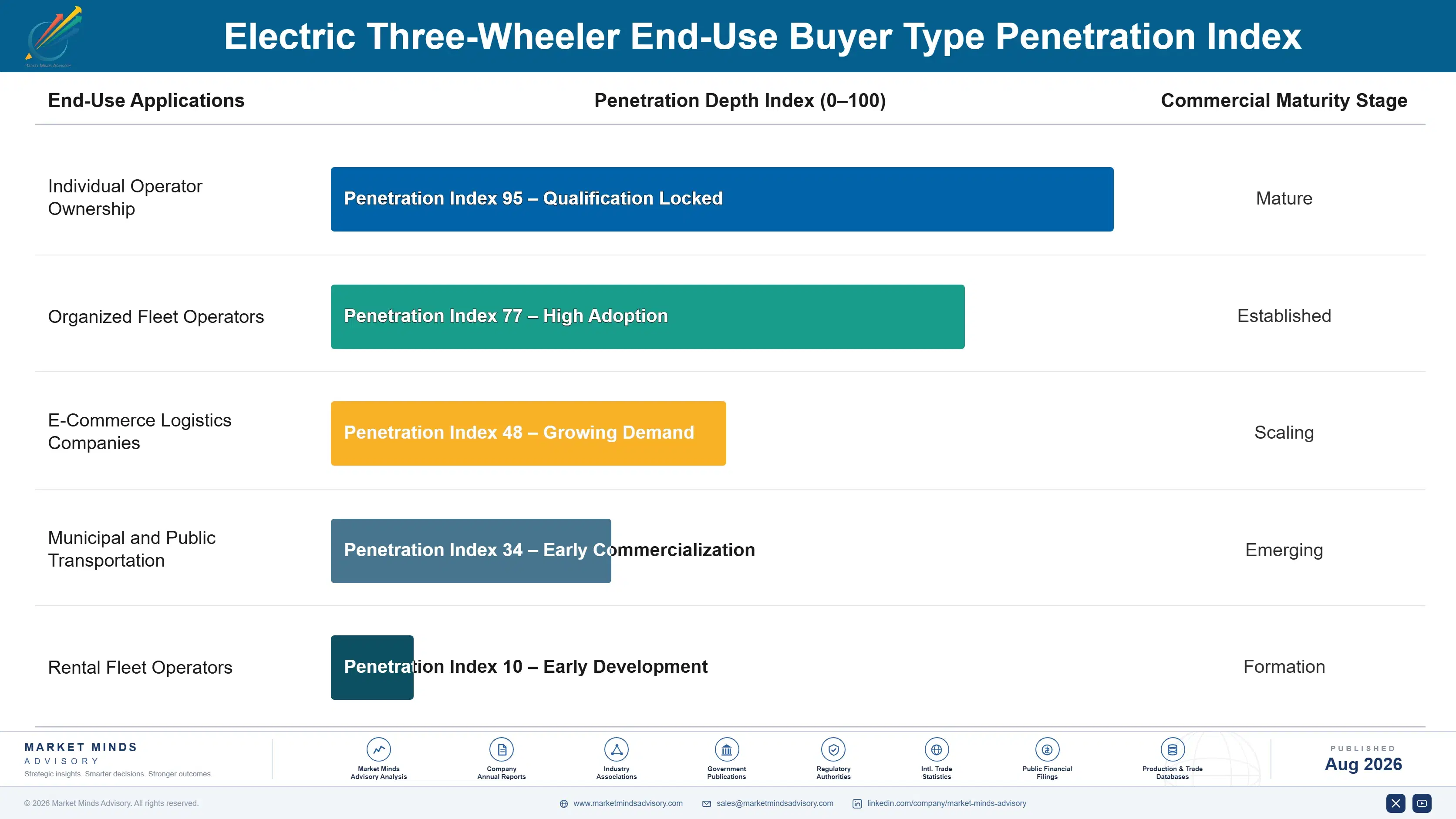
Fleet supply relationships behave closer to annuities than one-off transactional sales once a manufacturer wins organized fleet standardization status, since switching manufacturers mid-fleet disrupts parts inventory, driver training, and service network alignment operators are reluctant to repeat across their full operating footprint. Operators treat a fleet standardization win as effectively locked in once service alignment is complete.
Adoption depth varies sharply by buyer type: organized cargo and delivery fleet operators have pushed lithium-ion and swappable battery technology deep into standard procurement, while individual passenger e-rickshaw operators still rely largely on lead-acid given financing constraints that limit access to higher-upfront-cost lithium alternatives. Rural and semi-urban markets lag furthest behind in lithium adoption, prioritizing low upfront cost over the utilization benefits organized urban fleet operators increasingly expect as standard.

A generational shift is underway in buyer expectations as younger individual operators, increasingly comfortable with financing and leasing arrangements rather than outright purchase, are opening the door to lithium-ion adoption even in the individual-operator segment that has historically remained lead-acid dominant, a change reshaping how manufacturers structure their sales and financing operations. Manufacturers slow to adapt risk losing relevance with exactly the buyers driving procurement decisions forward.
electric-three-wheeler-market-trends-end-use-penetration-index-1787315994290

Lithium Transition Decides the Next Decade

These are among the four positions where our research anticipates prominent divergence between winners and laggards over the coming forecast period. Each is grounded in the demand model, the regulatory perimeter, and the announced capacity pipeline.
01 / BATTERY TECHNOLOGY FOCUS

Build lithium-ion battery management capability now

Lithium-ion three-wheelers carry nearly two times the pricing of lead-acid designs and require battery management engineering only a subset of manufacturers currently possess at commercial reliability standards. Manufacturers without this capability are increasingly excluded from the fastest-growing fleet operator segment as logistics companies standardize lithium specifications across their expanding delivery networks. Manufacturers should direct capital toward battery management engineering rather than expanding lead-acid capacity, since that path offers shrinking differentiation against organized fleet demand shifts already underway across most major markets.
02 / FLEET CHANNEL STRATEGY

Build direct fleet operator relationships now

Organized cargo and delivery fleet operators represent a growing and increasingly consolidated buyer base that manufacturers with direct relationships can serve more profitably than those dependent on fragmented individual-operator sales alone. Manufacturers with established fleet partnerships are capturing multi-unit standardization contracts that individual-buyer-dependent competitors cannot easily win on comparable terms or timelines. Building or strengthening these relationships now positions manufacturers to capture a channel that continues growing as a share of total category unit volume across nearly every region covered.
03 / FINANCING PROGRAM STRATEGY

Build battery leasing and financing programs now

Battery leasing programs expand the addressable lithium-ion buyer base considerably beyond organized fleet operators by making the technology accessible to individual operators who cannot afford the full upfront cost otherwise. Manufacturers offering these programs are converting individual operators into lithium-ion buyers at meaningfully higher rates than competitors requiring full upfront payment from cash-constrained buyers. Building or partnering toward financing capability now positions manufacturers to capture the largest remaining pool of price-sensitive individual buyers still purchasing lead-acid vehicles across most Indian cities.
04 / COMPONENT COST RISK MANAGEMENT

Secure long-term lithium cell supply agreements now

Lithium cell costs, tied closely to broader global EV battery demand cycles, remain the largest source of margin volatility across the premium segment of this category specifically, and manufacturers without long-term agreements are structurally disadvantaged relative to better-capitalized competitors with direct cell access. The 2023 to 2024 lithium price volatility demonstrated how quickly this exposure can compress margins for unhedged manufacturers operating on thin working capital. Manufacturers should prioritize locking in multi-year cell agreements before the next material price disruption arrives unexpectedly.

Engagement Snapshot From the Field

A live engagement with an industry participant carrying material or product regulatory and market exposure ahead of a defining policy shift, showing how our research translates into a defensible multi-year portfolio strategy.
MARKET MINDS ADVISORY · CLIENT ENGAGEMENT SUMMARY
Electric Three-Wheeler Producer Strategic Portfolio Review and Transition Roadmap 2026·Investment Scenario on Electric Three-Wheeler Exposure Evaluation 2025-26
CLIENT PROFILE
The client was a regional Indian three-wheeler manufacturer with roughly $58 million in annual revenue (client-reported, unverified by MMA), supplying primarily lead-acid passenger e-rickshaws to individual operators across northern India, seeking to build lithium-ion capability ahead of expanding organized fleet operator demand. The client had no prior lithium-ion battery management experience internally. The client had no prior lithium experience.
STRATEGIC CHALLENGE
The client's lead-acid-focused business faced flat growth among individual operators as competitors with lithium-ion capability had already begun winning organized fleet contracts the client lacked engineering capability to bid on competitively. Leadership set an eighteen-month window to build credible lithium-ion capability before losing further market position to better-positioned competitors. Leadership viewed the coming eighteen months as decisive for the client's long-term market position.
MMA APPROACH
MMA conducted a competitive technology capability assessment against lithium-ion leaders, modeled the capital investment case for battery management engineering against projected fleet operator design-win volume, and benchmarked battery leasing partnership structures to identify a realistic path forward for the client. MMA also reviewed leasing partnership models used by competitors who had already completed similar transitions.
KEY FINDINGS
  1. Lithium-ion fleet contracts carried roughly 2.0 times the margin of the client's existing lead-acid portfolio, based on comparable disclosed program economics across regional peers.
  2. Battery management investment payback fell within two years given the client's existing manufacturing footprint and dealer network already established across the region.
  3. The client's existing chassis and drivetrain expertise transferred meaningfully to lithium-ion platforms, reducing the engineering investment required relative to starting from scratch entirely.
  4. A battery leasing partnership with a regional fintech specialist could accelerate individual operator adoption faster than requiring full upfront payment. while meeting the client's aggressive eighteen-month timeline.
CLIENT PROFILE
The client was a regional Indian three-wheeler manufacturer with roughly $58 million in annual revenue (client-reported, unverified by MMA), supplying primarily lead-acid passenger e-rickshaws to individual operators across northern India, seeking to build lithium-ion capability ahead of expanding organized fleet operator demand. The client had no prior lithium-ion battery management experience internally. The client had no prior lithium experience.
STRATEGIC CHALLENGE
The client's lead-acid-focused business faced flat growth among individual operators as competitors with lithium-ion capability had already begun winning organized fleet contracts the client lacked engineering capability to bid on competitively. Leadership set an eighteen-month window to build credible lithium-ion capability before losing further market position to better-positioned competitors. Leadership viewed the coming eighteen months as decisive for the client's long-term market position.
MMA APPROACH
MMA conducted a competitive technology capability assessment against lithium-ion leaders, modeled the capital investment case for battery management engineering against projected fleet operator design-win volume, and benchmarked battery leasing partnership structures to identify a realistic path forward for the client. MMA also reviewed leasing partnership models used by competitors who had already completed similar transitions.
KEY FINDINGS
  1. Lithium-ion fleet contracts carried roughly 2.0 times the margin of the client's existing lead-acid portfolio, based on comparable disclosed program economics across regional peers.
  2. Battery management investment payback fell within two years given the client's existing manufacturing footprint and dealer network already established across the region.
  3. The client's existing chassis and drivetrain expertise transferred meaningfully to lithium-ion platforms, reducing the engineering investment required relative to starting from scratch entirely.
  4. A battery leasing partnership with a regional fintech specialist could accelerate individual operator adoption faster than requiring full upfront payment. while meeting the client's aggressive eighteen-month timeline.
RECOMMENDED STRATEGY
Phase 1: Phase 1 (0-9 months): Build battery management engineering capability and complete safety validation testing. ahead of the next fleet bidding cycle. Phase 2: Phase 2 (9-24 months): Bid lithium-ion fleet programs with two targeted regional logistics operators. to establish a credible track record quickly. Phase 3: Phase 3 (24-42 months): Launch a battery leasing partnership to expand individual operator adoption further. to reach cash-constrained individual operators.
OUTCOME
The client won lithium-ion fleet contracts with one of two targeted logistics operators within sixteen months of capability completion, adding an estimated $12 million in annual contracted revenue (client-reported, unverified by MMA) at materially higher margin than its legacy lead-acid business had previously generated. A second engagement on individual-operator leasing expansion followed shortly after.

Frequently Asked Questions

Foundational context covering the market sizes, CAGR, scope, country, region and competition that inform every finding below. This section is provided to cover basics and most often pre-purchase conversations, answered from the MMA Primary Research Dataset.

What is the current size of the Electric Three-Wheeler Market?

The global electric three-wheeler market is valued at approximately $13.5 billion in 2025, spanning passenger, cargo, and delivery applications across lead-acid and lithium-ion battery configurations.

How large will the Electric Three-Wheeler Market be by 2036?

The market is projected to reach approximately $54.4 billion by 2036, driven primarily by lithium-ion adoption and rapidly expanding cargo and delivery fleet applications. Lithium-ion adoption is accelerating that growth trajectory.

What is the CAGR for the Electric Three-Wheeler Market 2026 to 2036?

The market is projected to grow at a compound annual rate of 13.5 percent between 2026 and 2036, with lithium-ion battery three-wheelers growing fastest within that total.

Which segment is growing fastest?

Lithium-ion battery three-wheelers are growing fastest at 19.0 percent annually, roughly 1.41 times the overall market rate, driven by fleet operator total cost of ownership economics.

Who are the major companies in the Electric Three-Wheeler Market?

Mahindra Electric Mobility, Bajaj Auto, Piaggio, Kinetic Green Energy, and TVS Motor lead the market by disclosed shipment volume, alongside fifteen other significant manufacturers. Fifteen additional manufacturers round out the field.

Which country is growing fastest?

India is growing fastest among major markets at 15.8 percent annually, supported by its massive existing fleet base and rapidly expanding cargo and delivery applications.

Report Segmentation Architecture

The full report scope spans multiple orthogonal segmentation dimensions, with cross-tabulated demand data provided for each dimension pair. Coverage extends further to regional breakdowns, trend trajectories, and the competitive detail needed to support segment-level decision-making.

By Application and Battery Technology

  • Passenger E-Rickshaws
  • Cargo and Load-Carrier Three-Wheelers
  • Last-Mile Delivery Three-Wheelers
  • Lead-Acid Battery Three-Wheelers
  • Lithium-Ion Battery Three-Wheelers
  • Swappable Battery Three-Wheelers

By End-Use Buyer Type

  • Individual Operator Ownership
  • Organized Fleet Operators
  • E-Commerce Logistics Companies
  • Municipal and Public Transportation
  • Rental Fleet Operators

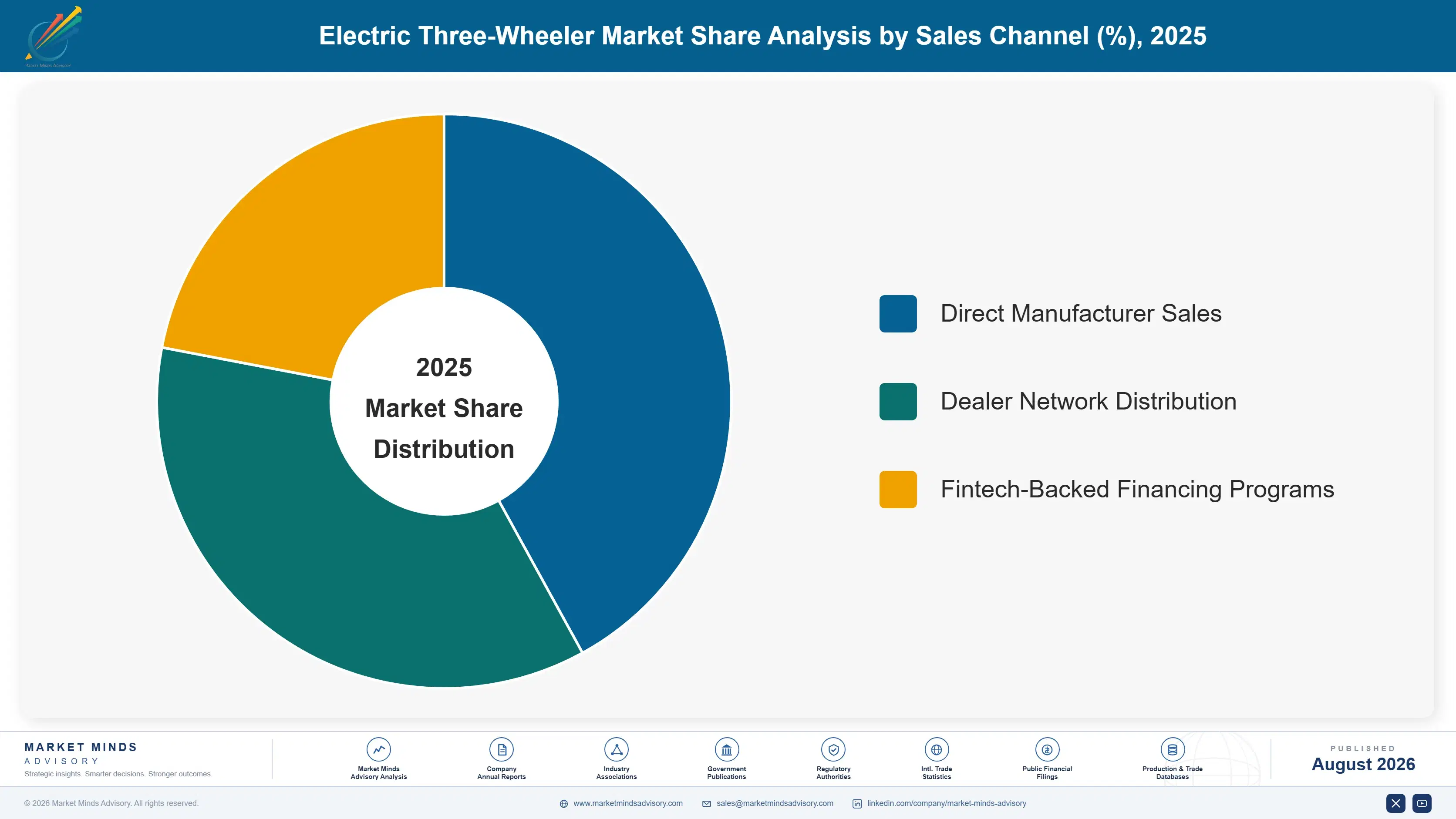
By Sales Channel

  • Direct Manufacturer Sales
  • Dealer Network Distribution
  • Fintech-Backed Financing Programs

By Region

  • North America
  • Western Europe
  • East Asia
  • South Asia and Pacific
  • Latin America
  • Middle East and Africa
  • Eastern Europe

Scope, Methodology, and Coverage

Every figure in this report is reproducible from documented input assumptions. The scope below maps the historical period, the forecast horizon, the segmentation dimensions, and the countries covered, alongside the underlying primary and qualitative methodology.
Historical Period
2020 to 2025
Forecast Period
2026 to 2036
Base Year
2025 (USD billions; MMA Primary Research Dataset, August 2026)
Market Definition
This report covers battery-electric passenger auto-rickshaws, cargo and load-carrier three-wheelers, and last-mile delivery three-wheelers powered by lead-acid, lithium-ion, or swappable battery systems. It excludes internal combustion three-wheelers, electric two-wheelers, and four-wheeled electric quadricycles sold as separate vehicle categories.
Quantitative Units
USD billions (current prices); million vehicle units shipped where applicable
Segmentation Dimensions
By Application and Battery Technology; By End-Use Buyer Type; By Sales Channel; By Region
Regions Covered
North America, Western Europe, East Asia, South Asia and Pacific, Latin America, Middle East and Africa, Eastern Europe
Countries Covered
India, China, USA, Germany, France, UK, Japan, South Korea, Australia, Canada, Brazil, Mexico, Indonesia, Vietnam, Thailand, Bangladesh, Sri Lanka, Nigeria, Kenya, South Africa, UAE, Saudi Arabia, Turkey, Poland, Netherlands, Italy, Spain, Argentina, Colombia, Singapore, and additional markets relevant to this sector
Key Companies Profiled
Mahindra Electric Mobility, Bajaj Auto, Piaggio and C SpA, Kinetic Green Energy, TVS Motor Company, Atul Auto Limited, Saera Electric Auto, YC Electric Vehicle, Mini Metro EV, Champion Polyplast, Terra Motors Corporation, Speego Vehicles, Dilli Electric Auto, Unique Manufacturing, Lohia Auto Industries, Kutty EV, City Electric Vehicles, Mudhol EV, JS Auto, Etrio Automobiles
Quantitative Methodology
Primary survey, n=3,800 respondents, Q4 2025, six countries; demand-side model with trade association cross-validation
Qualitative Methodology
47 expert interviews, Q4 2025; applied to validate demand model assumptions, identify emerging dynamics, and assess competitive positioning
Report Format
PDF and XLSX data workbook (Word format preview document)
Publisher
Market Minds Advisory
Report Code
MMA-2026-AUT-206
Published
August 2026
Contact
sales@marketmindsadvisory.com | www.marketmindsadvisory.com

Purchase the full Electric Three-Wheeler Market Report (2026 to 2036).

The full Electric Three-Wheeler Market report delivers a complete quantitative and qualitative assessment across all six application and technology segments, seven regions, and twenty profiled companies operating in this space. It includes detailed sizing and forecast models through 2036, competitive benchmarking on shipment volume, and a full technology tracker covering lead-acid to lithium-ion transition timelines by application. Buyers receive segment-level and country-level data tables supporting the full analysis presented throughout this report. Analysts update the underlying dataset each quarter to reflect the latest manufacturer disclosures.
Segment-level sizing across six application and technology types
Country-level forecast data across thirty markets
Competitive benchmarking on shipment volume basis
Technology tracker for lead-acid to lithium-ion transition
Fleet operator adoption curves by country and application
Twenty-company competitive profile database, updated quarterly

Built For The People Who Decide

From boardroom strategy to bench-side execution, this report is read cover-to-cover by leaders shaping the next decade of their industry, turning demand scenarios, market dynamics and valuation benchmarks into decisions.
CXOs/ Presidents/ VPs/ Managers
M&A and Corporate Development
Strategy Teams and R&D Heads
Procurement and Product Directors
Regulatory and Compliance Leaders
Investor Relations and Equity Analysts